Category: Travel

  • How To Find Cheap Flights To Mexico City For Your Next Trip

    How To Find Cheap Flights To Mexico City For Your Next Trip

    Mexico City is one of the great cities of the Americas: a historic center built on the ruins of Tenochtitlan, museums that rank with any in the world, leafy neighborhoods full of cafés, and some of the best food you will eat anywhere, from street tacos to tasting menus. It is also a major airline hub, which is good news for anyone hunting for a fair price. Big hubs attract competition, and competition keeps fares honest. Finding a genuinely cheap flight still takes a method, though: choosing the right season, comparing airports and routings, understanding what each fare includes and knowing how the city’s two main airports differ. This guide walks through when to go, when to book, how to compare nonstop and connecting options from Canada and the United States, what the entry process looks like, how to get from the airport into the city, and how to keep the rest of the trip affordable. It is part of our flight booking series, which starts with our guide to the best time to book cheap flights and hotels.

    The short answer

    Travel outside the big holiday weeks, especially Christmas and New Year, Semana Santa (Holy Week) and the Día de Muertos period around the start of November, and you will usually find better fares and hotel rates. Book roughly two to four months ahead for ordinary dates and earlier for holidays. Search a range of dates and compare nonstop and one-stop options, because a sensible connection can be much cheaper. Check which airport your flight uses: Mexico City International (AICM, code MEX) is close to the city, while Felipe Ángeles International (AIFA, code NLU) is well to the north. Price the whole trip, with bags and seats included. And read the official entry requirements for your passport before you book. You can compare fares across a whole month on our flight search.

    The Palacio de Bellas Artes in Mexico City at dusk
    Mexico City's historic center is one of the great sights of the Americas (Photo: Daniel Case via Wikimedia Commons, CC BY-SA 3.0)

    When to visit Mexico City

    Mexico City sits in a high valley at about 2,240 meters, which gives it a mild climate year-round. It rarely gets very hot, and evenings can be cool at any time of year. The seasons that matter are wet and dry, not summer and winter.

    PeriodWeatherCrowds and prices
    November to FebruaryDry, sunny days and cool nights; the coolest monthsPopular with visitors from the north; Christmas and New Year are peak
    March to MayDry and the warmest time of year; spring can be hazySemana Santa is very busy and many locals travel; otherwise good value
    June to SeptemberRainy season, usually with afternoon or evening showers and sunny morningsOften the lowest prices outside summer school holidays
    OctoberRains tapering off, pleasant temperaturesBuilds toward Día de Muertos at the start of November, when demand rises

    For value, the rainy season can be surprisingly good: showers usually come later in the day, mornings are often clear, and the city is green. Pack a light rain jacket and plan museum visits for the afternoon. Visitors with respiratory conditions should note the Government of Canada’s advice that air pollution in Mexico City peaks between December and March.

    Holidays and events that move prices

    • Christmas and New Year: the busiest and most expensive period for flights from Canada and the United States.
    • Semana Santa: Holy Week, the week before Easter, when many Mexicans travel. Flights and hotels across the country get expensive.
    • Independence Day: celebrations on the night of September 15 and on September 16 bring big crowds to the historic center.
    • Día de Muertos: the Day of the Dead celebrations around November 1 and 2 are a major draw, with events and decorations throughout the city in the days before. Book early if you want to be there.
    • Summer school holidays: July and August bring family travel from the north and within Mexico.

    If you want the best balance of weather and price, look at late January and February outside long weekends, late April and May after Semana Santa, and the quieter weeks of the rainy season.

    When to book

    Flights from Canada and the United States to Mexico City behave like other medium-haul international routes. Use these windows as a guide, then book when a fare lands at or below the normal level for your route.

    TripSensible booking window
    Ordinary dates from the U.S.About 1 to 3 months ahead
    Ordinary dates from CanadaAbout 2 to 4 months ahead
    Christmas, New Year, Semana Santa, Día de MuertosAbout 4 to 6 months ahead, or as soon as your plans are firm
    Short noticePossible on a busy hub route, but rarely cheap on peak dates

    Start watching fares as soon as you know roughly when you want to go. Look at a month view to spot the cheap days, set a price alert, and book once you see a fare that matches or beats what you have been seeing. For flights to or from the United States booked at least seven days before departure, most airlines let you cancel within 24 hours without penalty, which gives you a day to double-check. Our international flights booking tips explain the wider strategy for trips abroad.

    Choosing your airports

    At the Mexico City end

    Mexico City now has two main airports, and it matters which one your ticket uses.

    • Mexico City International Airport (AICM, code MEX), officially Benito Juárez International, sits inside the city, east of the center. It has two terminals, Terminal 1 and Terminal 2, and handles most international flights. Being so close to neighborhoods like the Centro Histórico, Roma and Condesa, it is usually the most convenient choice. Check your terminal on your booking and on the airport’s official site.
    • Felipe Ángeles International Airport (AIFA, code NLU) opened in 2022 north of the city in the State of Mexico. Some domestic and a smaller number of international flights use it. It can be a good option if the fare is much lower, but the ground transfer to central Mexico City is much longer, and in traffic can take well over an hour.
    • Toluca International (TLC), west of the city, handles a small number of flights. It is rarely the right choice for a visitor unless the fare saving is large.

    When you compare fares, look at the airport code on each option. A cheaper flight into AIFA may cost you more in time and transport than it saves.

    At your end

    From Canada, Toronto, Montreal and Vancouver have typically had nonstop service to Mexico City; from other Canadian cities, you will usually connect, either through one of those airports or through a U.S. or Mexican hub. From the United States, many large hubs have nonstops, including cities such as Chicago, Dallas, Houston, Los Angeles, New York and Atlanta, and connections are easy from almost everywhere. Search from every airport you could realistically use, and remember to include the cost of getting there. Our flights from Toronto, flights from Montreal and flights from Vancouver pages are a good place to start from Canada.

    Terminal 2 at Mexico City International Airport
    Check the airport code: AICM is inside the city, AIFA is well to the north (Photo: Sharon Hahn Darlin via Wikimedia Commons, CC BY 2.0)

    Nonstop or connecting?

    A nonstop flight is the easy choice when the price difference is small. A connection can make sense when the saving is significant or when nonstop times do not suit you. Weigh these points:

    • Total travel time. A connection can add several hours. Compare door-to-door time, not just the fare.
    • Connection length. Very short connections are risky, especially if you need to change terminals or clear immigration. Very long ones eat into the value of the saving.
    • Connecting through the United States. The U.S. has no international transit zone, so travelers connecting through a U.S. airport go through U.S. border formalities even if they never leave the airport. Canadians generally need only a valid passport, but travelers of other nationalities may need U.S. travel authorization. Allow extra time for the process.
    • One ticket or two. On a single ticket, the airline rebooks you if a delay makes you miss your connection. On two separate tickets, you are usually on your own. Avoid self-connecting on a tight schedule.
    • Checked bags. On a single ticket, bags are normally checked through to Mexico City, although you may need to collect and recheck them at your first point of entry in some countries. Ask at check-in.

    Comparing airlines and fares

    Mexico City is the main hub of Aeroméxico, Mexico’s flag carrier, and an important base for Mexican low-cost airlines such as Volaris and Viva Aerobus. Major U.S. and Canadian airlines also fly in from their hubs. That variety is the reason prices can be competitive, but it also means fares are structured very differently.

    Airline typeTypical strengthsWhat to check
    Full-service airlinesMore included, easier connections, loyalty benefitsWhether your fare type includes a checked bag and seat selection
    Low-cost airlinesLow base fares, especially on nonstop routesCarry-on and checked bag fees, seat fees and size limits
    Basic economy fares on any airlineThe lowest price on that flightNo changes, last boarding, possible carry-on restrictions

    Compare the total with the bags and seats you actually need. A slightly higher fare that includes a checked bag can easily beat a bare-bones one. Our carry-on size guide explains how to check limits, and our flight details guide explains fare brands and baggage allowances.

    Entry requirements: check before you book

    Entry rules change, and they depend on your passport, so always read the official page for your nationality before booking.

    • Canadians: the Government of Canada’s travel advice for Mexico says Canadian tourists do not need a visa for stays of up to 180 days, and that your passport must be valid for the expected duration of your stay. It also explains how arrival works: an officer may stamp your passport with your permitted stay, or you may be directed to an e-gate kiosk, and you may need to complete a digital migration form. Keep proof of your entry with you.
    • U.S. citizens: read the U.S. State Department’s Mexico country information page for passport and entry requirements.
    • Other nationalities: check Mexico’s requirements for your passport, and U.S. transit rules if you connect through the United States.

    The same government pages carry safety and health advice, including regional advisories within Mexico, so read them as part of your planning. The Canadian page notes that Mexico City’s altitude can affect some visitors; take it easy on your first day, drink water and talk to a doctor before you go if you have heart or lung conditions.

    Getting from the airport into the city

    From AICM, the main options are:

    • Authorized airport taxis. Buy a ticket at an official taxi booth inside the terminal, with the price based on your destination zone, then take it to the taxi rank. This is the simplest option for most first-time visitors, especially at night.
    • Ride-hailing apps. App-based rides operate in Mexico City; follow the airport signs to the designated pickup areas.
    • Metrobús and Metro. Metrobús Line 4 serves the airport terminals and runs toward the historic center, and the Metro has a station near Terminal 1. Public transit is very cheap but can be crowded, and it is awkward with large suitcases.
    • Hotel transfers. Some hotels arrange pickups; compare the price with an authorized taxi.

    From AIFA, allow much more time. Check the current transport options on the airport’s information before you fly, and weigh the cost of the transfer against the fare saving. Most visitors do not need a rental car in Mexico City itself: traffic is heavy, parking is limited, and taxis, apps and transit cover the areas you will want to see. A car can make sense for road trips beyond the city.

    The Zocalo and Metropolitan Cathedral in Mexico City
    The Centro Historico is a convenient base for first-time visitors (Photo: Jeff Kramer via Wikimedia Commons, CC BY 2.0)

    Where to stay, and how it affects your budget

    Hotel prices vary widely by neighborhood. Choosing the right base can save both money and hours in traffic.

    NeighborhoodWhy stay thereGood for
    Centro HistóricoWalking distance to the Zócalo, the cathedral, Templo Mayor and Bellas ArtesFirst-time visitors and sightseeing
    Roma Norte and CondesaTree-lined streets, parks, cafés, restaurants and nightlifeFood lovers and longer stays
    JuárezCentral, between the historic center and Roma, near Paseo de la ReformaEasy access to several areas
    PolancoUpscale hotels, shopping, fine dining, near Chapultepec Park and major museumsComfort and business travelers
    CoyoacánColonial streets, a relaxed pace, near the Frida Kahlo MuseumA quieter base, farther from the center

    Book a refundable room on our hotel search once your flight is set, then recheck the price before your cancellation deadline. Our hotel booking tips explain how to compare total prices.

    What to do once you are there

    You can fill a week in Mexico City without leaving the city limits. The highlights most visitors build a trip around:

    • The historic center: the Zócalo, one of the largest public squares in the world, the Metropolitan Cathedral, the ruins of the Templo Mayor and the Palacio de Bellas Artes.
    • Chapultepec: a vast park with Chapultepec Castle and the National Museum of Anthropology, one of the most important museums in the Americas. Give it at least half a day.
    • Coyoacán: the Frida Kahlo Museum, the Casa Azul, is hugely popular; buy timed tickets in advance.
    • Xochimilco: the canals in the south of the city, where colorful boats called trajineras carry groups along the water.
    • Teotihuacan: the pyramids of the Sun and Moon, an easy and very popular day trip northeast of the city. Start early to beat the heat and the crowds.
    • Food: markets, taco stands, bakeries and some of the most celebrated restaurants in Latin America. Eating well here does not have to be expensive.

    The city’s official tourism site, CDMX Travel from the Mexico City tourism ministry, lists attractions, neighborhoods and events.

    Keeping the rest of the trip affordable

    • Eat where locals eat. Markets, fondas serving set lunches and street stands offer excellent food for very little.
    • Use the free and low-cost sights. Walking the historic center, Chapultepec Park and many churches and public buildings costs nothing; some museums have free days for residents, so check.
    • Use transit or taxis wisely. Metro and Metrobús fares are very low; apps and authorized taxis are reasonably priced for longer trips.
    • Carry some pesos. Cards are widely accepted in hotels and restaurants, but markets and small vendors often prefer cash. Use bank ATMs inside branches or shopping centers.
    • Drink bottled or filtered water. Tap water is not recommended for drinking; most hotels provide bottled water.

    Mexico City or the beach?

    Many travelers from Canada and the United States think of Mexico as the beach. If you are deciding between a city trip and a resort, Mexico City often offers more to do for the money, with lower hotel prices outside the luxury end and a cooler climate. A beach resort offers rest and sun. Some travelers combine both, flying into Mexico City and continuing to the coast on a domestic flight. If the beach is calling, our guides to the best time to fly to Cancun and things to do in Cancun cover the Caribbean side, and you can compare fares on Cancun flights. For more ideas on stretching your budget, see our list of budget travel destinations.

    Use alerts, points and flexibility together

    The travelers who find the best fares to Mexico City usually combine several small habits rather than relying on one trick.

    • Set alerts on more than one route. If you could fly from two or three airports, watch all of them. A fare drop from a nearby city might beat your home airport.
    • Consider one-way fares. Flying out on one airline and back on another can sometimes give better times or a lower total, especially when low-cost airlines are involved. Compare with a round trip before booking.
    • Price points against cash. Loyalty points can be good value on routes where cash fares are high, such as holiday dates. Compare the points price and taxes with the cash fare before redeeming.
    • Stay flexible by a day or two. Moving your departure by a single day can drop the fare to a cheaper level.
    • Book the hotel on a refundable rate. Once the flight is set, a flexible room lets you rebook if prices fall.

    Common mistakes to avoid

    • Not checking the airport code. A flight into AIFA instead of AICM can mean a much longer transfer.
    • Booking during Semana Santa or Día de Muertos without meaning to. Check the calendar before choosing dates.
    • Comparing base fares instead of totals. Add bags and seats, especially on low-cost airlines.
    • Tight connections through a U.S. airport. Border formalities take time.
    • Ignoring the altitude. Plan a lighter first day.
    • Skipping the travel advice. Read your government’s page for Mexico before you book and again before you fly.
    • Arriving too late for check-in. International check-in deadlines are earlier than domestic ones; our guide on how early to arrive for an international flight explains why.

    An aerial view of Chapultepec Castle on its hill in Chapultepec Park, Mexico City
    Chapultepec Park holds the castle and the National Museum of Anthropology (Photo: ProtoplasmaKid via Wikimedia Commons, CC BY 4.0)

    Frequently asked questions

    What is the cheapest time to fly to Mexico City?

    Outside the major holiday periods: late January and February outside long weekends, late April and May after Semana Santa, and the quieter weeks of the rainy season often have better fares. Check a fare calendar for your route.

    How far ahead should I book a flight to Mexico City?

    About one to three months ahead from the United States and two to four months ahead from Canada for ordinary dates, and earlier for Christmas, Semana Santa and Día de Muertos.

    Which airport should I fly into?

    For most visitors, Mexico City International (AICM, MEX) is the most convenient because it is inside the city. Felipe Ángeles (AIFA, NLU) is much farther north, so only choose it if the saving justifies the longer transfer.

    Do Canadians need a visa for Mexico?

    According to the Government of Canada, Canadian tourists do not need a visa for stays of up to 180 days. Entry rules can change, so check the official travel advice before you book and before you fly.

    Is it cheaper to connect through the United States?

    Sometimes. A connection through a U.S. hub can be cheaper than a nonstop, but you will go through U.S. border formalities during the connection, so allow enough time and check any travel authorization your passport requires.

    Is the rainy season a bad time to visit?

    Not necessarily. Rain usually comes in the afternoon or evening, mornings are often clear, and prices can be lower. Pack a rain jacket and plan indoor visits for later in the day.

    Do I need a rental car in Mexico City?

    Usually not. Traffic is heavy and parking is limited, while taxis, ride-hailing apps, the Metro and Metrobús cover the main areas. A car can be useful for trips outside the city.

    How do I get from the airport to my hotel?

    From AICM, an authorized taxi bought at an official booth inside the terminal is the simplest option. Ride-hailing apps, Metrobús Line 4 and the Metro are alternatives.

    Ready to plan your trip? Search a whole month of fares to Mexico City on our flight search to find the cheapest days and routings, then compare rooms in the neighborhood that suits you on our hotel search. For the bigger picture on timing, read our guide to the best time to book cheap flights and hotels.

  • Best Money Belt for Travel: Top Picks for Every Budget

    Best Money Belt for Travel: Top Picks for Every Budget

    A money belt is one of the least glamorous pieces of travel gear and one of the most reassuring. It is a slim pouch worn under your clothes, against your body, where a pickpocket cannot see it and cannot reach it without you noticing. Used well, it holds the things that would turn a bad day into a ruined trip: your passport, a backup card, emergency cash and a copy of your travel documents. Used badly, it becomes a sweaty lump you dig into at the ticket counter, which tells everyone watching exactly where your valuables are. This guide explains how to choose the best money belt for travel and how to use it properly: what a money belt is for and what it is not for, the alternatives worth knowing, which features matter, how to wear one comfortably in heat, what to carry in it, what happens at airport security, the cash reporting rules at borders, and the money belts from our original list.

    The short answer

    Choose a slim, flat, breathable money belt that fits your passport, has a sturdy zipper and an adjustable elastic strap, and comes in a color that does not show through light clothing. Wear it under your waistband, at the front or on your hip, and use it only for reserves: passport, backup card and emergency cash. Carry a small daily wallet with a day’s cash and one card for everyday spending, so you never have to open the money belt in public. RFID blocking is a harmless extra, not a deciding feature. If you are crossing a border with a large amount of cash, remember that many countries require you to declare it, however well hidden it is.

    What a money belt is for, and what it is not

    The single most important idea in this guide is that a money belt is a safe you wear, not a wallet. It works because nobody knows it is there. The moment you pull up your shirt to pay for a coffee, that advantage is gone.

    A money belt is for:

    • Your passport on days when you need to carry it, such as travel days, border crossings and places where you are required to carry ID.
    • A backup card from a different account or network than your main card, so one lost wallet does not cut you off from money.
    • Emergency cash, ideally in a widely accepted currency, for the day your cards do not work.
    • Copies of key documents, such as a photocopy of your passport data page, insurance details and emergency contacts.

    It is not for your phone, your daily spending money, your transit card or anything you need to reach several times a day. Those belong in a secure front pocket, a small wallet or a bag like the ones in our guide to anti-theft backpacks.

    Money belt types and alternatives

    “Money belt” covers a few different designs, and some travelers prefer an alternative altogether. This table compares the main options.

    TypeHow it is wornStrengthsWatch out for
    Under-clothes waist pouchFlat pouch on an elastic strap, under your waistbandHolds a passport, very discreet, the classic choiceCan feel warm and sweaty; awkward to reach
    Belt with hidden zipperA normal-looking belt with a zippered channel insideInvisible, nothing extra to wearHolds only folded cash; no room for a passport or cards
    Neck walletPouch on a cord around your neck, under your shirtHolds a passport, easy to reachCord can show; easier to snatch if visible
    Leg or ankle walletStrapped to your calf or ankle under trousersVery hard for a pickpocket to reachOnly works with long pants; can be uncomfortable when walking a lot
    Clip-on or bra pouchSmall pouch clipped inside clothingTiny and lightHolds little; not for a passport
    Hidden pocket in clothingZippered inner pocket in pants or a jacketNothing extra to wearDepends on what you are wearing that day
    Waist pack worn outsideVisible belt bag at the front of your bodyEasy access, holds moreVisible, so it is a bag, not a hidden stash

    For most travelers, an under-clothes waist pouch is the best all-round choice because it holds a passport comfortably. A hidden-zipper belt is a good complement for a small cash reserve, and a neck wallet suits people who find anything around the waist uncomfortable.

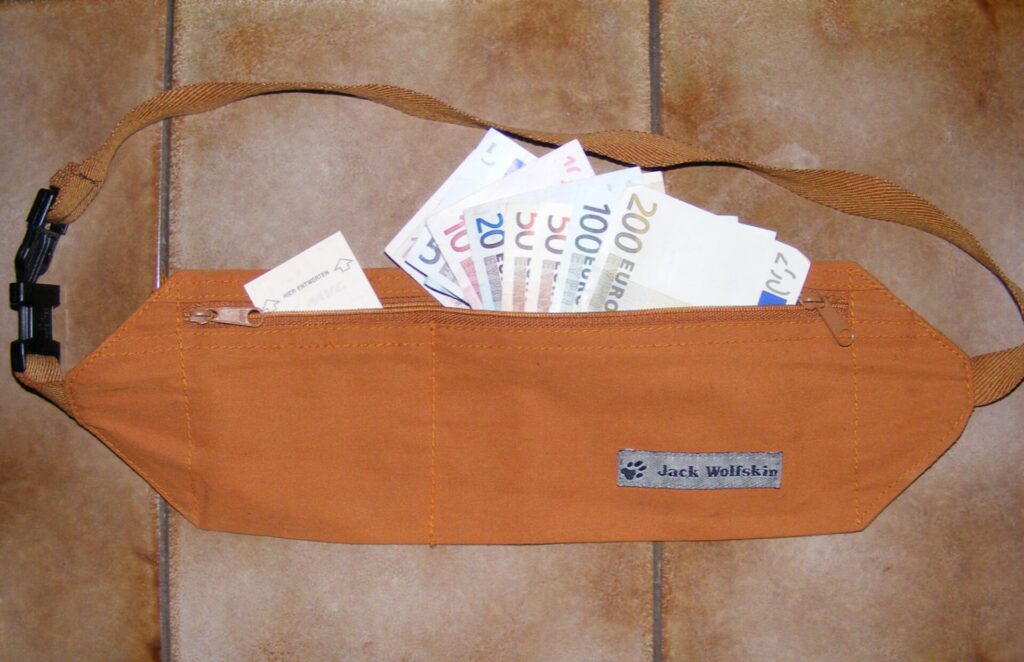
    A brown belt with a hidden zippered compartment for folded cash
    A belt with a hidden zipper holds a folded cash reserve but has no room for a passport (Photo: User:Mattes via Wikimedia Commons, Public domain)

    What to look for

    Size and capacity

    Make sure the pouch fits your passport without bending it, plus a few cards and folded bills. Bigger is not better: a thick, overstuffed money belt shows through clothing and is uncomfortable. Look for two or three compartments so you can separate your passport, cards and cash.

    Comfort and fabric

    You may wear a money belt for many hours in heat. A soft, breathable back panel against your skin makes a big difference. Lightweight nylon or polyester fronts with a mesh or moisture-wicking back are common. Avoid stiff or scratchy materials and bulky seams.

    Strap and buckle

    An adjustable elastic strap lets you wear the belt at your waist or lower on your hips and keeps it snug when you sit. A flat, low-profile buckle is more comfortable and less visible than a chunky one. Check that the strap is long enough for your waist measurement, especially if you want to wear it over a layer.

    Zippers

    The zipper is the part most likely to fail. Look for a smooth, sturdy zipper with a pull you can find by feel, and ideally a design where the zipper faces your body so it cannot be opened from outside.

    Color

    Choose a neutral color that does not show through the clothes you plan to wear. Beige and skin-tone shades disappear under light shirts; black suits dark clothing. Bright colors defeat the purpose.

    Sweat protection

    Sweat can soak through to your passport and cash on hot days. Some money belts include a water-resistant inner layer; if yours does not, keep documents inside a thin zip-top bag within the pouch.

    RFID blocking

    Many money belts advertise RFID-blocking layers that stop radio signals from reaching contactless cards and chipped passports. That does no harm, but remote skimming is a far less common risk for travelers than a hand in a pocket or a lost wallet. Treat RFID blocking as a small bonus, not a reason to choose one belt over another.

    Washability

    A money belt worn against skin needs washing. Check that it can be hand washed and dries quickly.

    How to wear a money belt properly

    • Under your waistband, not over it. Wear the belt against your skin or over a thin base layer, with your pants or skirt waistband over it, and your shirt tucked in or hanging over.
    • At the front or on your hip. At the front, you will feel any interference. On the hip, it can be more comfortable when sitting. At the back, it is harder to monitor.
    • Tuck the pouch into your pants. Many travelers wear the belt around the waist and tuck the pouch just inside the waistband of their pants, which hides it well.
    • Access it in private. If you need something from it, go to a restroom, your hotel room or a quiet corner, not the ticket counter or the market stall.
    • Adjust before you leave. Walk around your room, sit and bend to check it does not slip or show.
    • Choose clothes that help. Loose shirts and pants with a comfortable waistband hide a money belt better than tight-fitting clothes. Our guide to travel pants for men covers pants with room for one.

    The split system: how a money belt fits into your kit

    The safest approach to carrying money is to split it so that no single loss can strand you:

    • Daily wallet: a day’s cash and one card, in a zippered front pocket or a secure bag. This is what you use for everyday spending. A slim organizer like those in our guide to travel wallets for women works well.
    • Money belt: passport (when needed), a backup card and emergency cash.
    • Hotel safe: spare cards, extra cash, your passport on days you do not need it, and valuables such as jewelry; a small case from our guide to travel jewelry cases keeps them together.
    • Digital backup: a photo of your passport data page, card emergency numbers and insurance details stored securely on your phone and in the cloud.

    With that setup, a stolen daily wallet costs you a day’s cash and a card you can freeze from your banking app, and nothing more.

    Money belts from our original list

    The money belts below were featured in the original version of this guide. They are not a ranked test, and they come from small brands whose designs, materials and dimensions change between versions, so check the current product listing for compartment layout, size and materials before you buy. All five follow the same basic idea: a slim pouch worn under clothing, with RFID-blocking material advertised as an extra.

    Peak Gear RFID Blocking Travel Money Belt

    Peak Gear’s money belt is a classic under-clothes waist pouch, sold in neutral colors including beige that disappear under light clothing. A traditional design like this suits most travelers who want a straightforward place for a passport, cards and cash, and who will wear it under a shirt all day.

    Alpha Keeper Money Belt

    Alpha Keeper markets its money belt as a hidden passport holder with RFID blocking and several zippered sections. A layout with separate compartments suits travelers who carry more than one currency, or who want to keep their passport apart from cards and cash so they can reach one without exposing the rest.

    VENTURE 4TH Money Belt

    VENTURE 4TH’s money belt is a slim under-clothes design with a simple layout; the version in our original list was black. A minimal, no-frills belt suits budget travelers and backpackers who want the essentials done well without extra pockets. Choose a lighter color if you mostly wear pale clothes.

    Slim RFID-blocking money belt and passport holder

    The original list also included a generic slim money belt marketed as a low-profile waist pouch that can be worn under clothes, with an RFID-blocking pocket and water-resistant material. Generic designs like this vary a lot in quality, so check the zipper, the strap and the seller’s return policy, and do not rely on water resistance alone to protect a passport from sweat.

    The Belt of Orion Money Belt

    The Belt of Orion sells a slim anti-theft money belt marketed for both men and women, designed to sit flat against the body with space for a passport, cash and small documents. It suits travelers who want a modern, purpose-built design. As with any money belt, check that the current version fits your passport without bending it.

    Choosing between them

    Because these belts share the same basic design, choose on fit and comfort: a pouch that holds your passport flat, a strap that fits your waist comfortably, a color that disappears under your clothes and a zipper that feels sturdy. If you can, compare the listed dimensions against your passport before ordering.

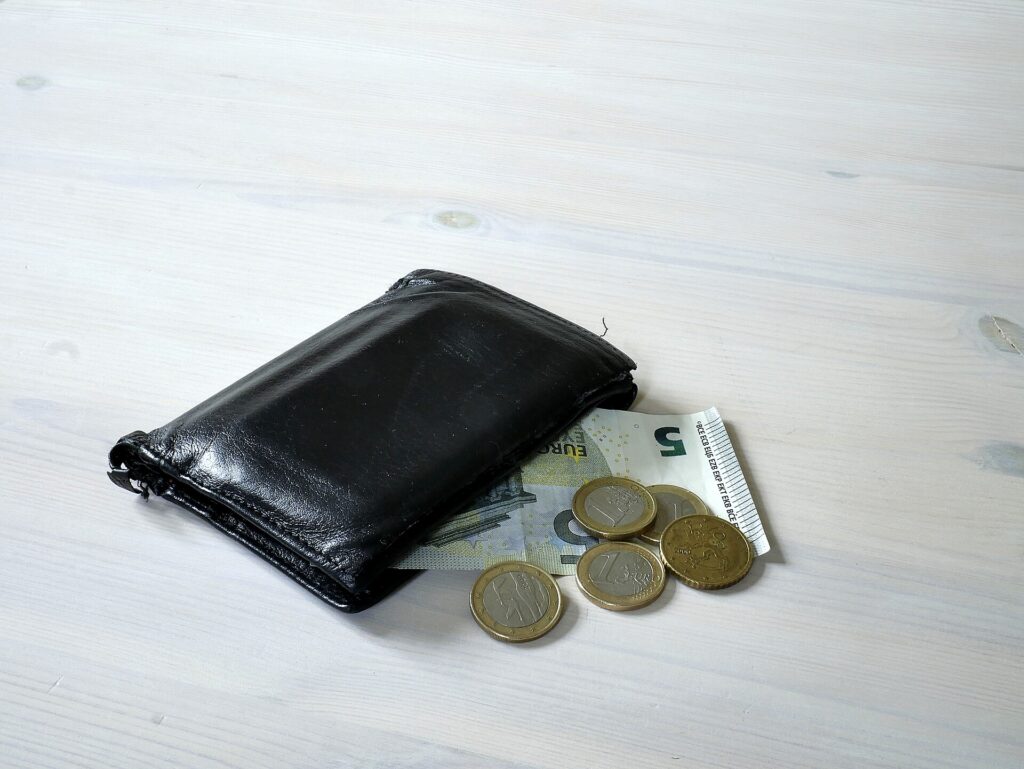
    A wallet with banknotes and coins
    Keep a day's cash and one card in a daily wallet so the money belt stays closed (Photo: Santeri Viinamäki via Wikimedia Commons, CC BY-SA 4.0)

    What to carry in a money belt, and what to leave out

    Put in

    • Your passport on travel days or when ID is required.
    • One backup debit or credit card, ideally on a different network from your main card.
    • Emergency cash in a widely accepted currency, in addition to some local currency.
    • A photocopy of your passport data page and your travel insurance emergency number.
    • A small card with an emergency contact.

    Leave out

    • Your phone, which is too bulky and which you need often.
    • Daily spending money, which should be in your daily wallet.
    • Keys, coins and receipts, which add bulk and noise.
    • Anything you need to reach often, such as transit cards or tickets.

    If you only carry a passport and a card or two, a slim passport holder kept in a hidden pocket of your bag can do the job instead; our passport holder guide covers the options.

    Money belts at airport security

    Security screening procedures vary between countries and airports and change over time. Officers may ask you to remove a money belt and put it through the X-ray, or may screen it on your body, and metal zippers and buckles can trigger a metal detector. To keep things simple, many travelers take the money belt off before the checkpoint and put it inside their carry-on bag, then put it back on in a restroom airside. Keep your boarding pass and passport somewhere easy to reach for the checks before and after security. In the United States, see the TSA’s security screening pages; in Canada, check CATSA’s guidance. Never leave your bag with the money belt inside out of sight at the checkpoint.

    Carrying cash across borders

    A money belt hides cash from pickpockets, not from customs. Many countries require travelers to declare large amounts of cash and other monetary instruments when they enter or leave. Carrying the money is usually legal; failing to declare it can lead to seizure and penalties.

    • Canada: you must report currency and monetary instruments of CAN$10,000 or more to the Canada Border Services Agency when you arrive in or leave Canada. See the CBSA’s page on travelling with CAN$10,000 or more.
    • United States: travelers entering or leaving with more than US$10,000 or its foreign equivalent in currency or monetary instruments must file a report with Customs and Border Protection. See CBP’s page on money and other monetary instruments.
    • Elsewhere: thresholds and rules differ by country, and some apply to families traveling together. Check the official customs site for every country on your itinerary before you go.

    Rules change, so confirm them before each trip rather than relying on any figure in a blog post, this one included.

    Wearing a money belt in hot weather

    Heat is where money belts are least pleasant and where people are most tempted to leave them behind. A few habits help:

    • Choose a belt with a breathable, moisture-wicking back panel.
    • Wear it over a thin, breathable base layer rather than directly against skin if you sweat a lot.
    • Keep documents in a thin zip-top bag inside the pouch.
    • Wear it lower on your hips, where there may be more airflow, or try a neck or leg wallet instead.
    • Leave the passport in the hotel safe on sightseeing days if local rules allow, and carry a copy instead.
    • Wash the belt regularly and let it dry fully.

    At the beach, a money belt is not practical at all. Take only what you need, use the hotel safe for the rest, and consider a small waterproof pouch. Our guide to travel flip-flops covers the rest of a light beach kit.

    A crowded evening market with shoppers browsing food stalls under lanterns
    Crowded markets and transit hubs are where a hidden money belt earns its place (Photo: PattayaPatrol via Wikimedia Commons, CC BY-SA 4.0)

    Where money belts make the most sense

    A money belt earns its place most clearly on travel days, border crossings, overnight trains and buses, busy transit hubs, crowded markets and big tourist sights, and in destinations where your government’s advice warns of pickpocketing or bag snatching. Canada’s travel advice and advisories describe common scams and theft risks for each country. In a quiet town where you leave your passport in the hotel safe, a zippered pocket and a daily wallet may be all you need. Walking all day with a money belt is also far more pleasant in comfortable shoes; our guide to walking shoes for travel covers how to choose them.

    If something is lost or stolen

    • Freeze cards first using your banking apps, then call your bank to report the loss.
    • Report the theft to local police and get a report number for your insurer.
    • Replace your passport. Canadians abroad can find help through the Government of Canada’s emergency assistance page. US citizens should follow the State Department’s lost or stolen passport guidance. Contact your embassy or consulate as soon as possible if you have a flight coming up.
    • Use your backups. This is exactly what the backup card, emergency cash and document copies in your money belt are for.
    • Contact your travel insurer promptly, since many policies have time limits and require a police report.

    Common mistakes

    • Using the money belt as a wallet. Every time you open it in public, you show thieves where your valuables are.
    • Overstuffing it. A bulging money belt shows through clothes and is uncomfortable.
    • Wearing it over your clothes. Then it is just a waist pack.
    • Putting everything in one place. Split cards and cash between your daily wallet, the money belt and the hotel safe.
    • Forgetting sweat. Protect documents with a thin plastic bag inside the pouch.
    • Assuming hidden cash is exempt from customs. Declare large sums where required.
    • Choosing a bright color. Neutral colors disappear under clothes.

    Frequently asked questions

    Are money belts still worth it?

    Yes, for travel days, border crossings, crowded cities and overnight transport. With contactless payments and phones, many travelers carry less cash than before, but a passport and backup card still need a safe home. A money belt is one of the simplest ways to protect them.

    Where should I wear a money belt?

    Under your clothes, with the pouch at the front or on your hip and tucked inside your waistband. Avoid wearing it at the back, where you cannot feel it.

    Is a money belt or a neck wallet better?

    A waist money belt is usually more discreet and stable. A neck wallet is easier to reach and can be cooler in heat, but the cord can show. Choose the one you will actually wear all day.

    Do I need RFID blocking?

    It is a harmless extra, but physical theft and lost wallets are much more common risks. Choose a money belt for comfort, size and zippers first.

    Can I wear a money belt through airport security?

    You may be asked to remove it for screening. Many travelers put it in their carry-on before the checkpoint and put it back on afterward. Check the rules for your departure airport.

    How much cash should I carry in a money belt?

    Enough to cover an emergency, such as a night’s accommodation, a meal and transport, until you can reach a bank or replace a card. Remember that many countries require you to declare large amounts at the border.

    Can people tell I am wearing a money belt?

    Not if it is slim, in a neutral color and worn under loose clothing, and if you never open it in public.

    With your valuables secured, the trip itself can take center stage. Compare fares on our flight search, choose a hotel with an in-room safe for your passport and spares on our hotel search, and if you are exploring a big, busy city, our guides to things to do in Rome and things to do in Paris will help you plan days where a well-worn money belt earns its place. For the rest of your kit, start with our main guide to travel luggage.

  • The Ultimate Guide to Business Travel Hotels in 2026

    The Ultimate Guide to Business Travel Hotels in 2026

    On a work trip, the hotel is your office, your bedroom and your base of operations, and it is chosen under constraints a leisure traveler never faces: a meeting at a fixed address, a travel policy with a nightly cap, a flight home that leaves before breakfast, and a need to be sharp on camera or in a boardroom the next morning. The right business hotel is not necessarily the most expensive one or the one with the grandest lobby. It is the one that removes friction: a short, predictable commute, a quiet room, reliable Wi-Fi, a desk you can actually work at, breakfast that opens early enough, and a receipt your finance team will accept without questions. This guide explains how to choose one, which amenities really matter and which are marketing, how to handle conference room blocks, airport stays and extended trips, how loyalty programs and corporate rates work, and the mistakes that cost business travelers the most time and money.

    The short answer

    Choose on location first: the shortest reliable door-to-door time to where you need to be, at the time you need to be there. Then check the work essentials: recent reviews that mention the Wi-Fi, a real desk, a quiet room and breakfast hours that suit your schedule. Book a flexible rate, because business plans change, and book through a channel that produces an itemized folio in your or your company’s name. Join the chain’s loyalty program even if you only travel a few times a year. For conferences, book inside the official room block through the organizer’s link. For early flights, stay at the airport. Compare options on our hotel search, and see our pillar guide to hotel booking tips for the fundamentals.

    What makes a hotel good for business travel

    Hotels market themselves to business travelers with business centers, meeting rooms and executive lounges. Some of that matters; much of it does not, because most professionals now travel with a laptop and a phone and never touch a business center. What actually decides whether a work trip goes smoothly is more basic.

    • Commute time. The hours you spend getting between the hotel and your meetings are the single largest variable in a business trip. Fifteen minutes on foot beats forty in a taxi at rush hour, every day.
    • Sleep. A quiet, dark room with a good bed and working climate control is the amenity that most affects your performance. It rarely appears in the marketing.
    • Connectivity. Wi-Fi that handles video calls from the room, not just email in the lobby.
    • A place to work. A desk at the right height, a chair you can sit in for an hour, and power outlets where you need them.
    • Timing. Breakfast that opens before your first meeting, a gym that opens before breakfast, a front desk that can store luggage after checkout, and late checkout when your flight is in the evening.
    • Clean billing. An accurate, itemized receipt with the right name and company on it.

    Everything else, from the lobby design to the rooftop bar, is secondary. When you compare two hotels, compare them on those six things.

    Location: how to choose it properly

    “Near the meeting” is not the same as “a short commute”. A hotel two kilometers away across a river with one congested bridge can take longer to reach than one five kilometers away on a direct subway line. Before booking, check the route at the actual time you will travel, on the actual day of the week, using a map app’s departure-time setting. Consider:

    • Walkability. If you can walk to your meetings, you remove traffic, taxi queues and ride-hail surge pricing from the equation, and you arrive with a clear head.
    • Transit. In cities with good rail systems, a hotel on the same line as your office, the airport train or the convention center is often better than one closer by distance. Our city transport guides, such as Toronto: car rental or public transit, explain how each system works.
    • Multiple meeting locations. If you are visiting several clients across a city, stay near the best transit hub or the center of gravity of your appointments, not next to any single one.
    • Evening plans. A hotel in an empty office district may be ideal at 8 a.m. and bleak at 8 p.m. If you are entertaining clients, a location near restaurants matters.
    • Parking and driving. If you are driving or renting, factor in hotel parking, which in downtown cores can be a significant nightly charge, often valet-only. Our car rental search compares airport and downtown pickups.

    A slightly more expensive hotel with a ten-minute walk frequently costs less in total than a cheaper one that requires two taxis a day, and it gives you back the time. Most travel policies care about total trip cost, and a short explanation of the saving will usually justify a higher room rate.

    A hotel lobby with a small business center
    Most business travelers now work from the room, not the business center (Photo: Opera Cadet from PARIS, FRANCE via Wikimedia Commons, CC BY-SA 2.0)

    The work essentials, and how to check them before you book

    Wi-Fi

    Almost every hotel advertises free Wi-Fi. What varies is whether it can handle a video call from your room at 9 a.m. when half the building is doing the same. The listing will not tell you; recent guest reviews will. Search the reviews for “Wi-Fi”, “internet” and “video call”, and weight comments from the last few months most heavily. Some hotels offer a faster paid tier or a faster tier for loyalty members. If a call or presentation matters, bring a backup: your phone’s hotspot, a travel eSIM with data, or a portable router. Public Wi-Fi, including hotel networks, should be treated as untrusted; use your company’s VPN, keep devices updated, and follow the guidance from the Canadian Centre for Cyber Security on connecting safely away from the office.

    The desk and the chair

    Room photos show whether there is a desk. They do not show whether it is a proper work surface or a narrow shelf beside the television. Look for photos taken by guests, and for rooms described as having a work desk or an ergonomic chair. Some newer select-service hotels have replaced desks with lounge seating and communal work areas; that suits some people and not others. If you need to take calls privately, check that the room, not only the lobby, is a usable work space.

    A quiet room

    Request a room away from the elevators, ice machines, the street side and any rooftop bar or event space, and on a higher floor. You can add this as a request at booking and repeat it at check-in. Loyalty members are more likely to have requests honored. If the room is noisy, ask to move on the first night rather than enduring it; it is much easier for the front desk to reassign a room before the hotel fills.

    Breakfast, gym and hours

    Check when breakfast opens. A hotel restaurant that starts serving at 7 a.m. is no use for a 7:30 meeting across town. Many select-service hotels offer a grab-and-go option from early morning. If you exercise, check the gym’s hours and equipment in recent photos. A 24-hour gym with two treadmills is different from a proper fitness center.

    Check-in and checkout

    Mobile check-in and digital room keys, now offered by the major chains through their apps, let you go straight to your room after a late arrival. Late checkout is often available on request, especially for elite members, and is invaluable when your flight is in the evening. If you cannot get it, ask the front desk to store your bags and find out whether the gym or lounge has showers you can use before the flight.

    A neatly made hotel room with a king bed and bedside lamps
    A quiet, dark room with a good bed matters more on a work trip than any lobby (Photo: PattayaPatrol via Wikimedia Commons, CC BY-SA 4.0)

    Types of business hotel, and when each makes sense

    Hotel typeBest forWatch for
    Downtown full-service hotelClient meetings, entertaining, trips with evening eventsHigher rates on weekdays, paid parking, paid breakfast
    Select-service hotelSolo trips with a tight budget cap; practical rooms and included breakfast at many brandsLimited dining, smaller desks at some brands, no room service
    Airport hotelEarly departures, late arrivals, meetings held at the airportIsolation from the city; shuttle schedules; noise on some sides
    Convention or attached hotelMulti-day conferences and trade showsRates rise sharply outside the official block; lines at peak times
    Extended-stay or apartment-hotelProjects of a week or more; relocations; training coursesFewer staff and services; housekeeping may be weekly
    Boutique or independent hotelCharacter, neighborhood locations, shorter tripsVariable Wi-Fi and desks; may not earn chain points or accept corporate rates

    Airport hotels: when they are the right call

    For a 6 a.m. departure, an airport hotel can be the difference between a normal night’s sleep and a 3:30 alarm and a taxi in the dark. They also work for late arrivals, for one-day trips where the meeting is near the airport, and as a fallback when a flight is cancelled. Several major Canadian airports have hotels connected to the terminal: at Toronto Pearson the Sheraton Gateway is linked to Terminal 3, Vancouver International has the Fairmont Vancouver Airport inside the terminal, Montreal-Trudeau has an in-terminal Marriott, and Calgary International has one as well. Elsewhere, airport hotels are usually a short shuttle ride away; check the shuttle’s hours, because some stop overnight or start after the first flights leave.

    Before booking, compare the total trip. An airport hotel plus a quick walk to security may cost less than a downtown hotel plus a pre-dawn taxi, and it buys you sleep. Our airport arrival time guide explains how early you need to be at the airport for different kinds of flight.

    Conferences, trade shows and room blocks

    Large events negotiate a block of rooms at one or more hotels near the venue, at an agreed group rate, and publish a booking link or housing service to attendees. Book inside that block when you can:

    • The block rate is often lower than what the same hotel charges the public during a big event, and it sometimes includes Wi-Fi or other extras.
    • The block has a cut-off date, usually weeks before the event, after which unsold rooms return to general inventory at regular prices. Book early.
    • Organizers rely on the block. Events often commit to filling a certain number of rooms, and attendees booking inside the block help keep registration prices and future venues viable.
    • Beware of unofficial housing offers. Exhibitors and attendees at large events are sometimes contacted by companies claiming to be the official housing provider. Book only through the link on the event’s own website or in the organizer’s official communications, and be suspicious of anyone who calls or emails you offering rooms.

    If the block is full, look at hotels one transit stop away rather than paying peak rates next door, and remember that during a citywide convention, rates across the whole city rise. Canada’s major convention centers, including the Metro Toronto Convention Centre, the Vancouver Convention Centre, the Palais des congrès de Montréal and the Shaw Centre in Ottawa, all have hotels within walking distance; our neighborhood pages for the Toronto Entertainment District, Old Montreal and the ByWard Market show nearby options.

    The Fairmont Vancouver Airport hotel inside the YVR terminal
    The Fairmont Vancouver Airport sits inside the terminal at YVR, ideal before an early flight (Photo: BriYYZ from Toronto, Canada via Wikimedia Commons, CC BY-SA 2.0)

    Rates, policies and paying for the room

    Corporate and negotiated rates

    Many companies negotiate rates with specific hotels or chains in the cities their staff visit most, often through a travel management company. If your employer has negotiated rates, use them: they are usually flexible, sometimes include breakfast or Wi-Fi, and keep you inside policy. Some chains also offer a general corporate rate to anyone traveling for business; it is not always cheaper than the best public rate, so compare. Government employees and contractors have their own rate programs.

    Per diems and policy caps

    If your employer sets a nightly cap, check it against the destination before you book; a cap that works in a mid-size city may not cover a downtown hotel in a major city during a busy week. Government per diem tables are a useful public benchmark for what lodging reasonably costs in a given place: the US General Services Administration publishes per diem rates by city, and the Government of Canada’s National Joint Council publishes its Travel Directive for public servants. If you have to exceed your policy, document why, such as a citywide event, before you book.

    Flexible rates

    Business plans change: meetings move, projects slip, a client cancels. For most work trips, a flexible rate with free cancellation until a day or two before arrival is worth the small premium over a prepaid rate. Note the deadline and time zone. If your trip is truly fixed and your company accepts the risk, prepaid rates can save money, but a no-show on a non-refundable rate is a cost nobody wants to explain.

    Fees, deposits and receipts

    Compare totals, not nightly rates: taxes, destination or resort fees, parking and paid Wi-Fi can change the ranking. At check-in, hotels usually place a hold on a card for incidentals. If you use a corporate card, make sure it is the card on file for the room and incidentals, and ask the front desk to email you an itemized folio at checkout. Expense teams generally need the folio, not just a credit card slip or a booking confirmation, and in Canada, a business registered for GST/HST may be able to recover the tax paid on accommodation; ask your finance team what documentation they need.

    Loyalty programs: worth it even for occasional travelers

    Joining a hotel chain’s loyalty program is free and pays off even at a few stays a year. Members typically get the best available rates on the chain’s own site, free or faster Wi-Fi at many brands, mobile check-in and digital keys, and a better chance of having room requests honored. Frequent travelers who reach elite status add late checkout, upgrades, lounge access and breakfast at some brands, depending on the program and tier. The largest programs include Marriott Bonvoy, Hilton Honors, World of Hyatt and IHG One Rewards; check each program’s current terms, because benefits change.

    Two practical points. First, if you want points and elite credit, book in a way that the program recognizes: usually directly with the hotel or through your company’s approved channel. Stays booked through some third parties may not earn. Second, do not let points override judgment. A hotel of your preferred chain that adds thirty minutes of commuting each way is not a good trade for the points it earns.

    Extended stays and project work

    For a week or more in one place, the math changes. An extended-stay hotel or apartment-hotel with a kitchen, a proper table and in-room laundry can cost less per night than a standard hotel and makes long trips far more livable. Ask about weekly or monthly rates, which are often not shown in standard searches, and about how often housekeeping comes. For very long stays, check whether your company has a preferred provider, and whether there are tax implications for stays beyond a certain length in the destination.

    Extending a work trip into the weekend

    Downtown hotels that are full of business travelers from Monday to Thursday often drop their rates on Friday and Saturday nights, when the business crowd leaves. That makes adding a weekend to a work trip, with a partner or family joining you, better value than it looks. Check your company’s policy on mixing personal and business travel: usually the employer pays for the business nights and you pay for the rest, and the flight change must not cost the company more. If your family is joining, our guide to booking hotels for family vacations covers room sizes and occupancy.

    Crossing the Canada-US border for work

    Business travel between Canada and the United States is routine, but the entry requirements are not the hotel’s problem, they are yours. Frequent cross-border travelers should look at NEXUS, the joint trusted-traveler program, and US citizens who travel internationally should consider Global Entry. Visa-exempt visitors flying to Canada from countries other than the US generally need an Electronic Travel Authorization. Rules about what counts as permitted business activity differ by country and change over time, so confirm on the official pages before you travel. For hotel advice specific to Canada, see our guide to hotel booking in Canada.

    The Metro Toronto Convention Centre in downtown Toronto
    The Metro Toronto Convention Centre: book inside the official room block before the cut-off (Photo: Raysonho @ Open Grid Scheduler / Grid Engine via Wikimedia Commons, Public domain)

    Safety and security on the road

    • Protect your room number. A good front desk writes it down rather than announcing it. If yours says it aloud in a busy lobby, ask for a different room.
    • Use the door’s secondary lock and check that connecting doors are locked.
    • Use the room safe or keep your laptop with you; do not leave devices unlocked.
    • Treat unexpected calls to your room with caution, especially ones asking you to confirm card details. Go to the front desk in person instead.
    • Know your exits. Take thirty seconds on arrival to find the nearest stairwell.
    • Share your itinerary with your company’s travel team if it has one; many employers have a duty-of-care process that relies on knowing where staff are staying.

    Common mistakes business travelers make

    Booking on price alone

    The cheapest hotel that meets policy can cost more once taxis, parking and lost time are counted. Compare the whole trip.

    Trusting “free Wi-Fi” without checking

    Free and usable are different things. Read recent reviews and bring a backup connection for anything important.

    Missing the conference block

    Booking after the cut-off, or outside the official link, often means paying more for a worse location.

    Forgetting the folio

    Ask for an itemized receipt at checkout, check it for errors before you leave, and file it with your expenses right away.

    A pre-trip checklist

    • Map the commute from each shortlisted hotel at the time you will travel.
    • Read recent reviews for Wi-Fi, noise and the desk.
    • Check breakfast and gym hours against your schedule.
    • Book a flexible rate within policy, under your loyalty number, with the right name and company.
    • For a conference, book through the organizer’s official link before the cut-off date.
    • Add requests: quiet room, high floor, late checkout if needed.
    • Book the flight on our flight search and, if needed, a car on our car rental search.
    • Save the hotel’s direct phone number and the cancellation deadline.

    Frequently asked questions

    What should I look for in a business travel hotel?

    A short, reliable commute to your meetings, a quiet room, Wi-Fi that handles video calls, a real desk, breakfast that opens early enough, flexible cancellation and an itemized receipt.

    Is it better to stay near the airport or downtown for a business trip?

    Downtown if your meetings are there and you have daytime flights. At the airport if you have a very early departure or a late arrival, or if your meeting is near the airport.

    How far ahead should I book a hotel for a work trip?

    As soon as the trip is confirmed, on a flexible rate. For conferences, book inside the official block well before its cut-off date. During citywide events, book as early as you can.

    Are hotel loyalty programs worth joining for occasional business travel?

    Yes. They are free, member rates are often the best available on the chain’s site, and members typically get better Wi-Fi and are more likely to have requests honored.

    Should I book the conference hotel or somewhere nearby?

    The official block is usually the best value and the most convenient. If it is full or over budget, look one transit stop away rather than paying peak public rates next to the venue.

    What receipt do I need for expenses?

    Usually the hotel’s itemized folio showing each night, taxes and any extras, in your name. Ask for it at checkout and check it before you leave.

    Why are downtown hotels cheaper on weekends?

    Because their weekday guests are business travelers who go home on Friday. With fewer guests on Friday and Saturday nights, many downtown hotels lower their rates.

    Ready to book your next work trip? Compare downtown, airport and convention-area options on our hotel search, find the right flight on our flight search, and price a rental on our car rental search. Headed to Canada’s biggest business city? Start with hotels in Toronto, and see our tips on finding the best hotel deals online and last-minute hotel booking for trips that come up at short notice.

  • Travel Pants for Men: 10 Best Picks for Comfort, Style & Adventure in 2026

    Travel Pants for Men: 10 Best Picks for Comfort, Style & Adventure in 2026

    A good pair of travel pants does more work than almost anything else in your bag. It sits through a long-haul flight without digging in, walks all day through a city, survives being rolled into a backpack, looks presentable at dinner, and dries overnight after a sink wash in the hotel bathroom. A bad pair wrinkles into a mess by the time you land, stays damp for two days after a rain shower, and has one shallow pocket that drops your phone every time you sit down. This guide explains how to choose travel pants for men: which fabrics do what, how stretch, gussets and pockets make a difference, how to get the fit right, which style suits flights, business trips, city breaks, hiking and hot or cold climates, how many pairs to pack and how to care for them on the road. It also covers the pants from our original list, grouped by the kind of traveler each one suits.

    The short answer

    For most trips, pack one pair of stretch travel chinos in a synthetic or synthetic-blend fabric that resists wrinkles and dries quickly, plus one second pair chosen for the trip: technical hiking pants for trails, a smarter pair for business, or lighter pants for heat. Look for stretch, a comfortable waistband, at least one zippered or deep pocket and a fabric that still looks tidy after a day in a bag. Try them on and sit down in them, because the real test of travel pants is hour six of a flight, not a quick look in a store mirror. Wear the heavier pair on the plane, and keep jeans for trips where you will not need to wash or dry anything fast.

    A stack of folded chino pants in different colors on a chair
    Neutral travel chinos in navy, olive or khaki go with every top in your bag (Photo: Menswear Market via Wikimedia Commons, CC BY 2.0)

    What makes pants good for travel

    Fabric

    Fabric decides almost everything: how the pants feel after hours of sitting, how they look after being packed, how fast they dry and how warm they are. The main options are:

    • Nylon and polyester. Synthetic fabrics are the backbone of most travel and hiking pants. They are light, strong, resist wrinkles and dry quickly. Some feel a little technical or shiny, though many modern versions look like regular chinos.
    • Cotton and cotton blends. Cotton is soft, breathable and looks classic, but it wrinkles, holds water and dries slowly. Cotton blended with a synthetic and some stretch fiber is a common middle ground for everyday pants.
    • Wool and merino blends. Wool resists odor, regulates temperature well and drapes nicely, which is why some premium travel trousers use it. It needs gentler care and costs more.
    • Stretch fibers. A small amount of elastane or spandex, blended into almost any fabric, makes pants far more comfortable for flights, stairs and long walks.

    Wrinkle resistance

    Pants that come out of a bag looking tidy save you ironing on every trip. Synthetics and wool blends resist creasing best; pure cotton creases most. Rolling rather than folding helps any fabric.

    Quick drying

    Quick-drying fabric matters more than most people expect. It means a pair you wash in a sink can be dry by morning, you are not stuck in damp pants after a sudden downpour, and you can pack fewer pairs overall.

    Stretch and a gusseted crotch

    Stretch fabric and a gusset, an extra diamond-shaped panel of fabric in the crotch found in many outdoor and travel pants, give you freedom to climb stairs, step up onto trains and sit cross-legged without seams pulling. They also make a big difference to comfort in economy seats.

    Pockets

    Travel pants often add a zippered pocket, deeper front pockets or a hidden pocket for a passport or phone. Zippered pockets stop things falling out when you sit and make a pickpocket’s job harder. Too many bulky pockets, though, make pants look like workwear and feel heavy when loaded.

    Waistband

    A waistband with a little stretch or an adjustable tab stays comfortable after a big meal and through hours of sitting, and some travelers like a slim built-in belt that avoids metal detectors. If you wear a belt, choose one with minimal metal.

    Weight and packability

    Light fabrics pack small and are comfortable in heat but may feel thin in cold wind. Heavier fabrics are warmer and more durable. Think about the climate you are traveling to.

    Fabrics compared

    FabricBest forStrengthsWatch out for
    Nylon or polyester with stretchMost travel, hiking, humid climatesLight, tough, quick-drying, resists wrinklesCan look technical; may hold odors
    Cotton-synthetic blend with stretchCity trips, everyday wearSoft, classic look, some wrinkle resistanceDries slower than full synthetics
    100 percent cotton chinoDry, mild climates, short tripsComfortable and breathable, classic lookWrinkles, holds water, slow to dry
    Stretch denimCasual trips, cool weatherDurable, familiar, hides dirtHeavy, slow to dry, bulky to pack
    Wool or merino blendBusiness travel, cool climatesResists odor and wrinkles, smart drapeCosts more, needs gentle care
    CanvasOutdoor work, road trips, rugged useVery durable, good for cargo stylesStiffer and heavier; slow to dry

    Styles and who they suit

    Travel chinos

    Chino-style travel pants look like ordinary smart-casual trousers but use stretch and faster-drying fabrics. They are the most versatile single pair: fine on a flight, in a museum, at a restaurant and in a casual office.

    Technical hiking pants

    Hiking pants use tough synthetic fabric, often with a gusset, articulated knees and zippered pockets. They are the best choice for trails, wet climates and active trips, and many look acceptable around town.

    Convertible zip-off pants

    Zip-off legs turn pants into shorts. They are practical on hot hikes and safaris where mornings are cool and afternoons hot, though the look is very outdoorsy and the zippers can rub.

    Commuter and five-pocket pants

    These look like jeans or casual trousers but are often made with stretch fabric. They are easy everyday travel pants for city trips.

    Cargo pants

    Cargo pockets give you room for a phone, a map and snacks without a bag. They suit road trips, outdoor travel and casual destinations. Keep valuables out of outer cargo pockets in crowded places.

    Joggers

    Soft joggers are comfortable on long flights and overnight trains. They are less versatile at your destination, so many travelers change on arrival.

    Jeans

    Jeans are familiar and hard-wearing, but they are heavy, bulky, slow to dry and tight when you sit for hours. If you love them, wear them on the plane and pack lighter pants.

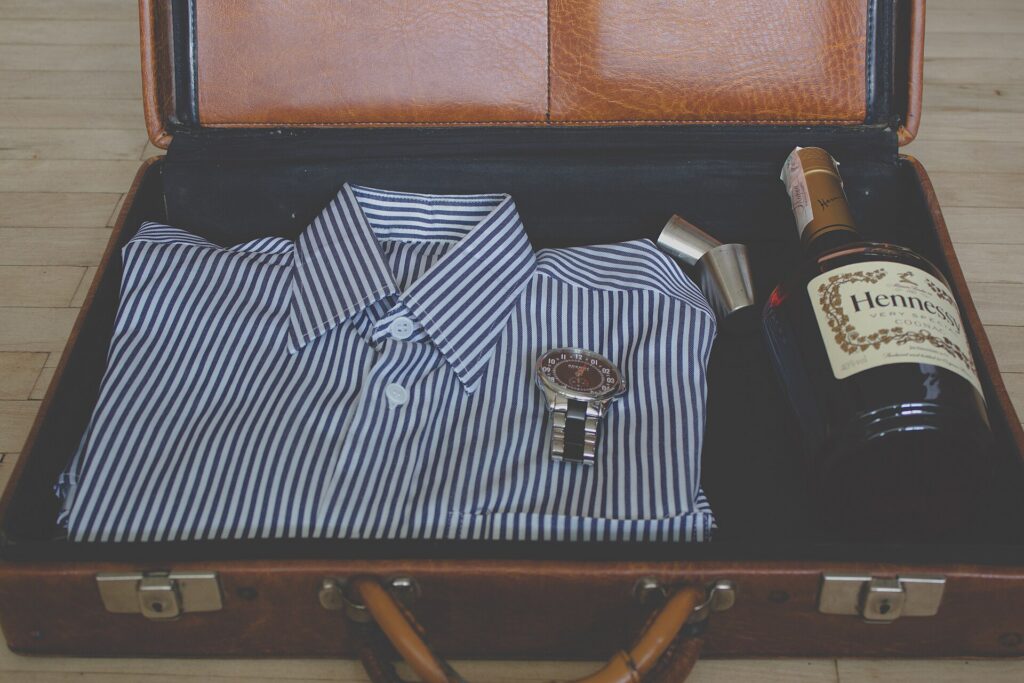
    Clothes and travel essentials being packed into an open suitcase
    Two quick-drying pairs and a sink wash cover most trips of any length (Photo: Angelina Litvin linalitvina via Wikimedia Commons, CC0)

    How to get the fit right

    • Sit down. Sit in the pants for a few minutes, cross your legs and lean forward. If the waist digs in or the seat pulls, they will be worse on a flight.
    • Squat and step. A deep squat and a high step test the gusset and stretch. You should not feel seams pulling.
    • Check the rise. A mid rise tends to be most comfortable for long sitting; a very low rise can feel insecure and a very high rise can press on your stomach.
    • Get the leg and hem right. A slim, tapered leg looks tidy and stays out of the way on stairs. The hem should sit on top of your walking shoes without bunching or dragging on the ground.
    • Allow for a loaded pocket. Put your phone and wallet in the pockets you will use. Some slim cuts become uncomfortable once pockets are full.
    • Check the maker’s size chart. Sizes and cuts vary a lot between brands, and fits such as straight, relaxed, slim and athletic mean different things to different makers.

    Match the pants to the trip

    Long-haul flights

    Comfort is everything. Stretch, a soft or stretchy waistband and a fabric that does not crush into deep creases all help. Loose enough at the ankle is useful too, especially if you wear compression socks on long flights. A zippered pocket keeps your phone from sliding into the seat gap.

    Business trips

    Choose a travel chino or wool-blend trouser in a neutral color that works with a blazer and dress shoes. A wrinkle-resistant fabric means you can wear them from the airport straight into a meeting.

    City breaks

    Smart-casual travel chinos or five-pocket stretch pants look at home in cafés and restaurants and handle long walking days. Pair them with the kind of shoes in our guide to comfortable walking shoes for traveling. In many places of worship, covering your knees is expected, which is another reason to pack at least one pair of long pants even in summer. Canada’s travel advice pages include a laws and culture section for each country, which often mentions dress norms.

    Hiking and outdoor trips

    Technical hiking pants in a durable, quick-drying synthetic with a gusset are the right tool. Avoid cotton on long hikes, since it stays wet and cold. If you are carrying a pack, our guide to hiking backpacks covers fit and loads.

    Hot and humid destinations

    Choose light, breathable, quick-drying fabrics in lighter colors. In places with mosquitoes or ticks, long pants help protect your legs, especially at dawn and dusk. The CDC explains how permethrin-treated clothing and gear can be used to prevent bites; follow the product instructions and never apply clothing treatments to skin.

    Cold weather

    Heavier fabrics, wool blends or lined pants help, but the most flexible approach is a thin thermal base layer under your regular travel pants. That keeps you warm outdoors and comfortable indoors without packing a second heavy pair.

    Pants from our original list

    The pants below were featured in the original version of this guide. They are grouped by the kind of traveler they suit rather than ranked, and the descriptions reflect each product’s style and name rather than test results. Fabrics, fits and features change between versions, so check the maker’s current product page and size chart before you buy.

    Smart and business-friendly

    Haggar Sport Men’s Travel Performance Pant. Haggar is a long-established American trouser brand, and its Travel Performance line is positioned as a smart pant for travelers who want to go from the airport to a meeting or dinner. A pant like this suits business travelers and anyone who wants a classic look with stretch and easy care.

    prAna Men’s Brion Pant. prAna is an outdoor and lifestyle brand, and the Brion is its well-known everyday pant with a clean, chino-like look and stretch. It suits travelers who want one pair that works on a trail in the morning and a restaurant in the evening, and it sits at the premium end of this list.

    Everyday travel chinos

    Unionbay Men’s Rainier Travel Tech Chino. Unionbay‘s Rainier is a lightweight travel chino aimed at comfort and versatility. It suits city breaks, airport days and casual trips where you want a chino look with more give than traditional cotton.

    Amazon Essentials Men’s Commuter Pants. A budget commuter pant with a clean, modern look and stretch fabric. It suits travelers who want an affordable everyday pair for flights, city walking and casual dinners.

    Amazon Essentials Men’s 5-Pocket Stretch Twill Pants. A jeans-style five-pocket pant in stretch twill. It suits travelers who like the look and pockets of jeans but want something lighter and more comfortable for sitting.

    Outdoor and hiking

    ATG by Wrangler Men’s Cliffside Utility Pant. A synthetic utility pant from Wrangler’s outdoor-oriented ATG range. Synthetic outdoor pants like this suit hiking, camping and adventure travel where you need freedom of movement and fabric that dries quickly.

    Pudolla Men’s Lightweight Hiking Pants. A budget hiking pant that its seller describes as lightweight and quick-drying with zippered pockets. Pants of this type suit active trips, casual hikes and warm-weather travel. Build quality varies more with budget outdoor brands, so check the fabric details and return policy.

    Columbia Men’s Flex ROC Pant. Columbia is one of the best-known outdoor clothing brands, and the Flex ROC is a casual, outdoor-style pant with stretch. It suits road trips, park visits and travelers who want a rugged look that still works in town. Check the fabric content for the version you buy, since cotton-rich pants dry more slowly than synthetics.

    Cargo and rugged

    Lee Men’s Extreme Motion Canvas Cargo Pant. Lee’s Extreme Motion range is built around stretch and ease of movement, and this canvas cargo version adds cargo pockets. It suits road trips and outdoor travel where you want storage without a bag. Canvas is durable but heavier and slower to dry than synthetic travel fabrics.

    Wrangler Authentics Men’s Relaxed Fit Stretch Cargo Pant. Wrangler’s relaxed stretch cargo pant offers a roomy fit and plenty of pockets at a budget price. It suits casual trips, camping and travelers who prefer a looser cut.

    A marked hiking trail crossing a colorful volcanic mountainside
    On trails and in wet weather, synthetic hiking pants dry fast where cotton stays cold and heavy (Photo: Jakub Hałun via Wikimedia Commons, CC BY 4.0)

    How many pairs to pack

    With quick-drying fabrics, two pairs of pants cover most trips of any length: one to wear and one to wash or keep clean for evenings. For trips over a week, add laundry rather than more pants. A simple formula that works for many travelers:

    • One versatile travel chino in a neutral color, worn on travel days.
    • One second pair for the trip: hiking pants, a smarter trouser, lightweight pants for heat or a pair of shorts.
    • Optional joggers or sleep pants for flights, trains and hotel rooms if you have room.

    Choose colors that work with every top you pack. Navy, charcoal, olive and khaki hide dirt and match most things. Our main guide to choosing travel luggage covers how to build a light carry-on kit around a few versatile pieces, and a travel pack like the one in our Peak Design Travel Backpack 45L guide makes it easy to carry.

    Packing pants so they arrive wearable

    • Roll synthetics and casual pants. Rolling saves space and reduces sharp creases.
    • Fold smart trousers along the crease. Lay them flat on top of other clothes or use a garment folder.
    • Use packing cubes. Cubes keep pants compressed and stop them getting crushed under shoes.
    • Hang them on arrival. Hanging pants in a steamy bathroom while you shower relaxes many wrinkles.

    Washing and drying on the road

    Quick-drying pants are only useful if you wash them the right way. Wash in a sink with a little travel detergent or shampoo, rinse well, then roll the pants tightly in a towel and press or stand on the roll to squeeze out water. Hang them overnight somewhere with airflow, away from direct heat. Most synthetic travel pants will be dry or nearly dry by morning; cotton blends take longer. Check the care label, and avoid high heat for technical fabrics and stretch fibers.

    Airport security and your pants

    Metal belt buckles, rivets and some zippers can set off metal detectors. Screening procedures vary by airport and country and change over time, so check the rules for your departure airport. In the United States, the TSA explains the process on its security screening pages; in Canada, see CATSA’s guidance. Empty your pockets into your bag before you reach the checkpoint, and choose a belt with minimal metal or put it in the tray to speed things up.

    Pockets, valuables and pickpockets

    Pants pockets are where many travelers lose phones and wallets, especially back pockets in crowds. A zippered pocket helps, but for passports, spare cards and larger amounts of cash, a money belt worn under your waistband is safer. Keep only a day’s cash and one card in your front pocket, and use a secure bag such as one of the anti-theft backpacks we cover for everything else. Our guide to passport holders covers the rest of your document kit.

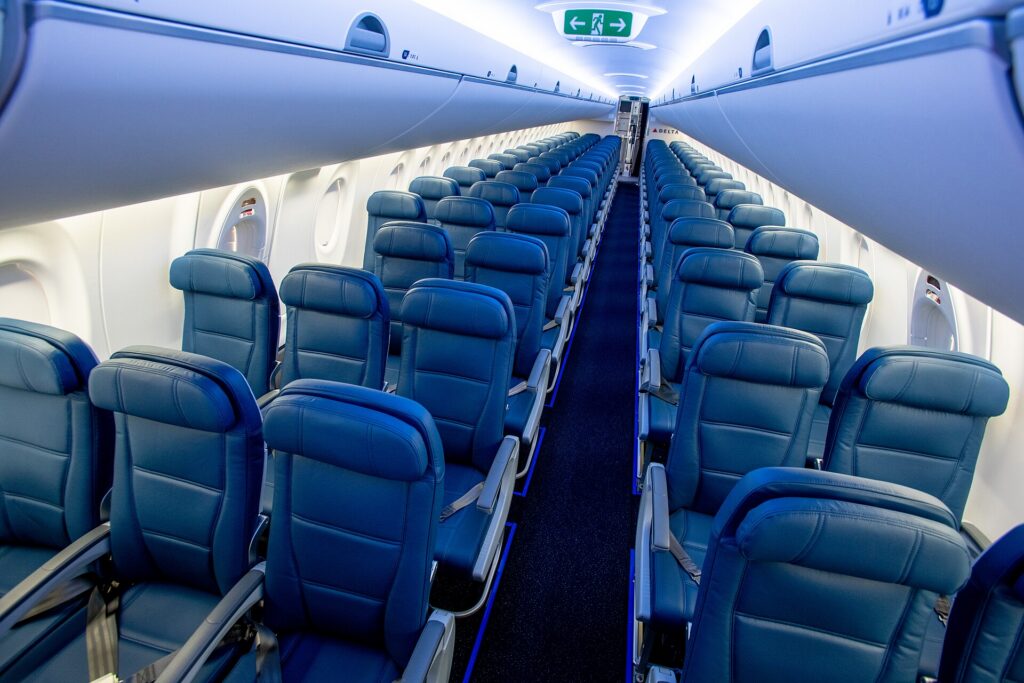
    Rows of economy seats in the main cabin of a narrowbody airliner
    The real test of travel pants is hour six in an economy seat, so sit down in them before you buy (Photo: Delta News Hub via Wikimedia Commons, CC BY 2.0)

    Care that makes travel pants last

    • Follow the care label. Many technical fabrics dislike high heat, fabric softener and bleach.
    • Wash less, air more. Hanging pants to air out between wears reduces washing, which extends their life.
    • Close zippers before washing. Open zippers snag other clothes and wear out faster.
    • Repair small damage early. A loose button or a small tear is easy to fix before it spreads.
    • Retire them honestly. Thin seat fabric and worn-out stretch are signs a pair is near the end of its travel life; demote it to home use.

    Common mistakes

    • Flying in stiff jeans. Heavy denim is uncomfortable after hours of sitting and slow to dry if you need to wash it.
    • Buying without sitting down. The seat and waist only reveal themselves when you sit.
    • Packing too many pairs. Two quick-drying pairs and a sink wash beat four slow-drying ones.
    • Choosing cotton for hiking or humid trips. It stays wet and heavy.
    • Keeping valuables in back pockets. Use zippered front pockets or a money belt.
    • Forgetting local dress norms. Long pants are expected in many religious sites and some restaurants.
    • Picking a color that matches nothing. Neutral colors work with every top in your bag.

    Frequently asked questions

    What are the best pants to wear on a long flight?

    Pants with stretch, a comfortable waistband and a fabric that resists wrinkles. Travel chinos and soft joggers are popular choices. Avoid stiff denim and tight waistbands.

    What fabric is best for travel pants?

    For most travelers, a nylon or polyester fabric with some stretch, because it is light, tough, wrinkle-resistant and quick-drying. Cotton blends look more classic but dry slower, and wool blends are good for business and cool climates.

    How many pairs of pants should I pack for two weeks?

    Two or three pairs of quick-drying pants are enough for most people if you can do a sink wash or use a laundry once. Add shorts or joggers if the climate or trip calls for them.

    Are hiking pants acceptable for city travel?

    Many modern hiking pants look close to casual chinos and work well in cities. Very technical styles with lots of pockets or zip-off legs look outdoorsy, which may matter in smarter restaurants.

    Can I wear jeans for travel?

    Yes, especially in cool weather and on trips where you will not wash clothes. They are heavy and slow to dry, so wear them on the plane rather than packing them, and bring a lighter second pair.

    Do travel pants with hidden pockets stop pickpockets?

    Zippered and hidden pockets make theft harder, but they are not a guarantee. Keep only a day’s cash and one card in your pants, and carry passports and backups in a money belt or a secure bag.

    Should I buy pants with insect protection?

    If you are heading somewhere with mosquitoes or ticks, long pants help, and the CDC explains how permethrin-treated clothing can reduce bites. Follow product instructions and your destination’s health advice.

    With your travel wardrobe sorted, plan the trip that will put it to work. Compare fares on our flight search, including flexible dates, find a hotel that suits your plans on our hotel search, and pick up a car for road trips and trailheads on our car rental search. For a city break that rewards comfortable, smart-casual pants, start with flights to London and our guide to things to do in London, and for the rest of your kit, see our main guide to travel luggage.

  • Travel Keyboard: 7 Best Portable Foldable Keyboards for Work & Travel in 2026

    Travel Keyboard: 7 Best Portable Foldable Keyboards for Work & Travel in 2026

    Typing a long email on a phone screen is slow. Writing a report on a tablet’s on-screen keyboard is worse. And a laptop keyboard, perched on a hotel desk that is too high or a tray table that is too small, can leave your neck and wrists complaining by the end of a trip. A travel keyboard fixes a surprising amount of that for very little weight. It can turn a phone or a tablet into something close to a laptop for writing, and it can turn a laptop on a stand into a proper workstation. This guide explains the different kinds of travel keyboards, what actually matters when you choose one, how to set it up and use it on planes, trains and in hotel rooms, the options from our original list and who each one suits, and the few rules that apply when you fly with small battery-powered gadgets. It is part of our travel gear series, which starts with our main guide to choosing travel luggage.

    The short answer

    If you want to write on a phone or tablet, a slim Bluetooth keyboard with a built-in cover or a folding keyboard that packs to pocket size is the most practical. If you use a laptop on a stand, a compact Bluetooth keyboard with a normal key layout and a small mouse will serve you better than a tiny folding one. If you type all day, prioritize full-size key spacing and a layout without an awkward split, or choose an ergonomic split design deliberately. Whatever you pick, choose multi-device pairing so you can switch between phone, tablet and laptop, a rechargeable battery with USB-C so it shares a cable with your other gear, and a layout that matches your operating system. Try typing a paragraph on it at home before you rely on it for a deadline on the road.

    A folding Bluetooth keyboard opened flat, showing its two halves
    Folding keyboards open to near full-size keys and close to about the size of a large phone (Photo: Toshiyuki IMAI via Wikimedia Commons, CC BY-SA 2.0)

    Why carry a travel keyboard at all?

    A keyboard is not essential for everyone. It earns its place if any of these sound familiar:

    • You want to leave the laptop at home. For writing, email and messaging, a tablet or even a phone plus a keyboard can handle a lot of work, and the combination is lighter than most laptops.
    • You work long hours from hotels. Raising the laptop screen on a stand improves your posture, but then you need a separate keyboard to type comfortably.
    • You write on the move. Journalists, students, novelists and bloggers often find that writing on trains and in cafés goes faster with real keys.
    • You switch devices a lot. A multi-device keyboard lets you answer a message on your phone and go straight back to a document on your tablet without changing keyboards.

    If you only write the occasional short message on a trip, you probably do not need one. If you plan to work on the road, it is one of the lightest upgrades you can pack, alongside the other items in our guide to laptop travel accessories.

    Types of travel keyboards

    Folding keyboards

    Folding keyboards hinge in the middle, or in two places for a tri-fold design, and close to roughly the size of a large phone or a paperback. Open, they give you something close to full-size keys. The trade-off is the fold itself: keys near the hinge can be split between halves or pushed slightly apart, which takes some getting used to, and the hinge is the part most likely to wear out. Many folding keyboards include a small stand for a phone.

    Slim non-folding keyboards

    These are thin, light keyboards with compact layouts that do not fold. Some include a cover that protects the keys in your bag and flips round to act as a surface or stand. They avoid the hinge problem and usually feel more solid to type on, but they are longer when packed, roughly the width of a small tablet.

    Split ergonomic folding keyboards

    Some folding keyboards turn the fold into a feature: the two halves angle apart so your hands sit in a more natural position. They take a few days to adjust to if you are used to a standard layout, and they suit people who type a lot and already like ergonomic keyboards at home.

    Tablet keyboard cases

    A keyboard case attaches to a specific tablet and doubles as protection. It is the tidiest option if you only ever type on one tablet, but it ties you to that device, adds weight to the tablet all the time and usually cannot be used with a phone or laptop.

    Keyboard and mouse combos

    Some folding keyboards are sold with a small wireless mouse. The pair gives you a complete setup for a laptop on a stand or a tablet that supports a mouse, useful for spreadsheets and editing work.

    Roll-up silicone keyboards

    Flexible silicone keyboards roll up and resist spills, but most people find their soft, mushy keys slow and tiring for real typing. They are a niche choice rather than a general recommendation.

    TypePacked sizeTyping feelBest forWatch out for
    Folding (bi-fold or tri-fold)Pocket or phone sizeGood once used to the splitPhone and tablet users who pack lightKeys near the hinge, hinge wear
    Slim non-folding with coverSmall-tablet widthSolid, familiarTablet writers, laptop-on-stand setupsLonger to pack
    Split ergonomic foldingPocket or phone sizeComfortable after adjustingHeavy typists who like ergonomic layoutsLearning curve
    Tablet keyboard caseAttached to tabletVaries by modelOne-tablet usersTied to one device, adds weight
    Keyboard and mouse comboPocket plus mouseSimilar to foldingLaptop on a stand, spreadsheet workTwo items to charge
    Roll-up siliconeRolled tubeSoft and slowSpill-prone environmentsPoor for long typing

    What matters when you choose

    Key size and spacing

    The single biggest factor in typing comfort is whether the keys are close to full size and spaced like a normal keyboard. Your fingers are trained on standard spacing, and a keyboard that shrinks it by even a little slows you down and adds typos. Check that the letter keys are full width and that important keys such as Shift, Enter, Backspace and the arrow keys are not squeezed into odd positions.

    Key feel

    Scissor-switch keys, similar to many laptop keyboards, feel crisp and stable. Softer membrane keys are quieter but can feel vague. Very short key travel is common on slim keyboards; some people like it and some find it tiring. If you can, try a keyboard in a store or buy from a seller with an easy return policy.

    Layout and operating system

    Windows, macOS, iPadOS, Android and ChromeOS use different modifier keys and shortcuts. Many travel keyboards support several systems and switch layouts automatically or with a key combination, and some brands sell separate versions for Apple devices. Choose one whose modifier keys match what you use most, or you will be fighting muscle memory every time you copy and paste.

    Multi-device pairing

    Many travel keyboards remember two or three devices and switch between them with a button. For travelers who use a phone, a tablet and a laptop, this is one of the most useful features, since it saves re-pairing every time you change device.

    Battery and charging

    Rechargeable keyboards with a USB-C port share a cable with the rest of your gear, which means one fewer thing to pack. Keyboards that use replaceable coin cells or AAA batteries can run a long time, but you need spares for a long trip. Whatever the type, look for an automatic sleep mode or a power switch, so the keyboard does not drain in your bag.

    Connection type

    Bluetooth connects directly to phones, tablets and most laptops without an extra part. Some keyboards also offer a small USB receiver or a wired USB-C connection, which can be steadier in places crowded with wireless signals and useful for devices without Bluetooth. A receiver is small and easy to lose, so keep it in a pocket of your cable pouch.

    Size, weight and protection

    A keyboard you leave at home helps nobody. Weigh the packed size against how much you type. A cover or case protects the keys in a packed bag and stops keys being pressed accidentally, which can wake your devices or drain the battery.

    Stand for a phone or tablet

    Some keyboards include a fold-out stand or a slot for a phone or tablet. Without one, you need a separate stand or a tablet case that props the screen up. A small, light stand is worth carrying if your keyboard does not include one.

    Close-up of a slim Bluetooth keyboard attached to a tablet
    Paired with a tablet, a slim keyboard handles email and writing for far less weight than a laptop (Photo: Maurizio Pesce from Milan, Italia via Wikimedia Commons, CC BY 2.0)

    Options from our original list

    The keyboards below were featured in the original version of this guide. They cover different needs rather than a strict ranking. Models, layouts and features change, so check the current specifications from the maker or seller before you buy.

    TECKNET wireless foldable Bluetooth keyboard

    TECKNET’s foldable Bluetooth keyboard is a full-size folding design that includes a numeric keypad, which is unusual in a folding keyboard. It suits travelers who work with numbers, such as accountants, analysts and anyone who lives in spreadsheets, and who want a number pad without carrying a full desk keyboard. A keyboard with a number pad is wider when open, so check that it fits the tray tables and café tables you use.

    Logitech Keys-To-Go 2

    The Logitech Keys-To-Go 2 is a slim, non-folding keyboard with a built-in cover that protects the keys in your bag. Logitech describes it as using low-profile scissor keys, connecting to up to three devices and working with Android, ChromeOS, Windows, iPadOS, iOS and macOS, and it offers a universal version and a version with an Apple layout. It suits tablet users and anyone who wants a thin keyboard that slides into a sleeve or a handbag and feels more solid than a folding design.

    Targus Ergonomic Foldable Bluetooth Antimicrobial Keyboard

    The Targus Ergonomic Foldable Bluetooth Antimicrobial Keyboard uses a split layout that angles the two halves for a more natural hand position. Targus says it folds to about the size of a smartphone, pairs with up to three devices over Bluetooth, recharges over USB-C and is treated with its DefenseGuard antimicrobial additive. It suits travelers who already prefer ergonomic keyboards and do a lot of typing. The antimicrobial treatment is a surface feature, not a reason to skip cleaning, and the split layout takes a few days to get used to.

    Portable foldable keyboard and mouse combo

    The original list included an unbranded folding keyboard sold with a wireless mouse, listed with Bluetooth as well as USB-A and USB-C connection options. A combo like this suits travelers who want a complete, inexpensive setup for a laptop on a stand or a tablet that supports a mouse. With unbranded products, check the seller’s return policy and read the listing carefully for the connection types and operating systems it supports.

    Samsers foldable keyboard and mouse combo

    Samsers sells a folding keyboard with a rechargeable wireless mouse, and the original list featured it in more than one color. It is a budget-friendly way to put together a portable workstation for hotel rooms and coworking spaces. Check the listing for the exact connection options and which devices it supports before you buy.

    Samsers full-size foldable Bluetooth keyboard (KF08S)

    The Samsers KF08S is a folding Bluetooth keyboard without a mouse, sold with a protective cover. It suits travelers who want a full-size folding layout for a phone or tablet and do not need a mouse. As with any folding keyboard, pay attention to the keys near the fold when you first try it.

    Setting up a travel keyboard

    • Charge it fully at home and pair it with every device you plan to use, assigning each to a channel if it supports multi-device switching.
    • Set the layout on each device, especially the language and the operating-system mode, so symbols and shortcuts are where you expect.
    • Learn the switch keys for changing devices and for special functions like brightness, volume and the home screen on a tablet.
    • Practice for a few days. Write something real at home. It is much better to discover that you hate the split in your living room than on deadline in an airport.
    • Pack the charging cable in your cable pouch, or confirm that the keyboard charges from a cable you already carry.

    Using a keyboard on planes, trains and in hotels

    On a plane

    Economy tray tables are small, and the seat in front may recline into your space. A tablet in a stand plus a folding keyboard often fits better than a laptop, because the screen and keyboard can be arranged separately. Put the tablet at the back of the tray and the keyboard in front, or rest the keyboard on your lap. Bluetooth accessories are generally allowed during flights with the device in airplane mode and Bluetooth switched back on, but crew instructions and airline policies come first, especially during takeoff and landing. If the flight is long, a pair of noise-cancelling headphones makes focused work much easier.

    On a train

    Trains are often better than planes for working: bigger tables, more legroom and sometimes power outlets. A folding keyboard and a phone or tablet stand make good use of a small table seat. Keep the keyboard close when the train brakes, and put the whole setup away before your stop so nothing slides off the table.

    In a hotel room

    Hotel desks are often too high for comfortable laptop typing. Raise the laptop screen on a stand or a stack of books and put the keyboard lower on the desk, or on your lap in a chair, so your elbows are near a right angle. If you are choosing a hotel for a work trip, our business travel hotels guide explains what to look for in a room you will work from.

    In cafés and coworking spaces

    Café tables are small and crowded, and a keyboard plus a phone or tablet takes up less space than a laptop. Keep your bag at your feet with a strap around your leg, and never leave devices on the table when you go to order. Our guide to anti-theft backpacks covers habits and bag features that help in busy places.

    A wooden writing desk with a phone and kettle in a hotel room
    Hotel desks are often too high for laptop typing; a stand and a separate keyboard fix the posture (Photo: Haydn Blackey from Cardiff, Wales via Wikimedia Commons, CC BY-SA 2.0)

    Tablet plus keyboard or laptop?

    For some trips, a tablet with a keyboard can replace a laptop entirely. It works well when your work is mainly writing, email, messaging, video calls and web-based tools, and when you value a light bag. It works less well when you need desktop software, many windows side by side, complex file management or a company laptop with its own security tools. Many travelers take both on long work trips and leave the laptop behind on short ones. Try a full working day on the tablet at home before you commit.

    A compact folding Bluetooth keyboard opened on a wooden table
    Keys near the fold take a little practice, so try a new keyboard at home before a work trip (Photo: Cartonfox via Wikimedia Commons, CC0)

    Flying with keyboards and small gadgets

    Keyboards, mice and other small accessories with built-in rechargeable batteries are generally fine in carry-on bags. The stricter rules apply to spare lithium batteries and power banks, which must travel in the cabin rather than in checked baggage. As principles:

    • Keep battery-powered gadgets in your carry-on where possible, where you can reach them and they are safe from rough handling.
    • Spare lithium batteries and power banks are cabin only, and should be protected from short circuits in their packaging, a case or a separate bag.
    • Switch keyboards off or use the cover so keys are not pressed in your bag.
    • Check the official rules before you fly: the FAA’s PackSafe lithium battery guidance, the TSA’s What Can I Bring? tool and CATSA’s guidelines for batteries. Airlines can add their own rules.

    If you are trying to carry fewer chargers overall, our guide to 3-in-1 Apple chargers covers one way to consolidate them.

    Packing a keyboard setup

    A complete mobile workstation can be surprisingly small: a folding or slim keyboard, a compact mouse, a folding stand for a laptop or tablet, and one USB-C cable that charges all of them. Keep the keyboard in a padded pocket of your bag or in a sleeve so the hinge and keys are protected, and keep small parts like a USB receiver in a zip pocket. If you carry a heavy tech bag through big airports, a rolling laptop bag can take the weight off your shoulders. For the bag the rest of your trip goes into, see our main travel luggage guide.

    Care and longevity

    The hinge on a folding keyboard and the charging port are the parts most likely to fail. Open and close the keyboard gently, do not force it past its natural angle, and avoid carrying it loose where it can be bent. Wipe the keys with a slightly damp cloth and let it dry fully before closing; avoid soaking it or spraying liquid directly onto the keys. Charge the battery every few weeks if you store the keyboard between trips, since leaving a lithium battery fully empty for a long time is hard on it.

    Common mistakes

    • Choosing the smallest keyboard possible. Tiny keyboards are easy to pack and hard to type on. Size for comfort first.
    • Ignoring the operating system. A keyboard laid out for a different system makes every shortcut awkward.
    • Not testing before the trip. Folding layouts take practice.
    • Forgetting a stand. A keyboard without a way to prop up the screen is only half a setup.
    • Leaving it switched on in a bag. Keys get pressed, devices wake up and batteries drain.
    • Losing the receiver or the cable. Keep small parts in one pouch.

    Frequently asked questions

    Are folding keyboards good for typing?

    Good ones are comfortable for most people once they adjust to the fold. Check that the letter keys are full size and try typing a real paragraph before a trip. If you type all day, a slim non-folding keyboard can feel more solid.

    Can I use a Bluetooth keyboard on a plane?

    Generally yes, with your device in airplane mode and Bluetooth switched back on, but crew instructions and airline policy always come first, particularly during takeoff and landing.

    Will a travel keyboard work with both my iPhone and my Windows laptop?

    Many do. Look for multi-device pairing and support for both operating systems, and check how the keyboard handles the different modifier keys.

    Can a tablet and keyboard replace a laptop for travel?

    For writing, email and web-based work, often yes. For desktop software, heavy multitasking or a company-managed laptop, usually not. Test a full day at home first.

    Is a keyboard with a built-in battery allowed in checked luggage?

    Small devices with installed batteries are treated differently from spare batteries, but it is safest to keep them in your carry-on. Spare lithium batteries and power banks are not allowed in checked bags.

    Rechargeable or replaceable batteries?

    Rechargeable keyboards with USB-C share a cable with your other gear. Replaceable batteries can last a long time but mean carrying spares on long trips.

    Do I need a mouse as well?

    For writing, usually not. For spreadsheets, editing and design work on a laptop on a stand, a compact mouse makes a big difference.

    Once your mobile office is packed, plan where you will use it. Compare fares on our flight search, find a hotel with a proper desk and good Wi-Fi on our hotel search, and if your trip needs a car, check our car rental search. Working from a new city for a week? Flights to Vancouver and our guide to things to do in Vancouver make a fine start, with plenty of cafés to test your new keyboard in.

  • Rolling Laptop Bag: 5 Best Picks for Business Travel & Daily Commutes in 2026

    Rolling Laptop Bag: 5 Best Picks for Business Travel & Daily Commutes in 2026

    A heavy laptop bag feels fine for the first ten minutes. By the time you have walked the length of a big-airport concourse, stood in a security line and crossed a convention center, the strap has dug a groove into your shoulder and you are shifting the bag from side to side every few steps. A rolling laptop bag solves that by putting the weight on wheels: a padded compartment for your computer, room for chargers and files, and a telescoping handle so you pull it instead of carrying it. It is not the right bag for everyone, though. Wheels add weight, a wheeled case can count as your full carry-on rather than your personal item, and stairs, cobblestones and crowded trains are much less friendly to wheels than airport floors. This guide explains the different kinds of rolling laptop bags, how airline size rules affect which one you should buy, what to look for in wheels, handles, materials and organization, how to get through security and pack batteries correctly, and the options from our original list with who each one suits. It is part of our travel gear series, which starts with our main guide to choosing travel luggage.

    The short answer

    If you fly often with a laptop and your shoulders object to a heavy tech bag, a rolling laptop bag is worth it, but choose the type carefully. For day commutes and short work trips, a compact wheeled briefcase with a padded laptop sleeve and a trolley strap is the most practical. For overnight trips, an overnight roller or laptop spinner with a separate clothing section can replace a suitcase entirely. If you already travel with a carry-on suitcase, consider a carry-on with a built-in laptop pocket plus a slim personal item instead of two wheeled bags. Before you buy, measure your laptop, not just its screen size, and compare the bag’s outside dimensions, wheels included, with the carry-on and personal-item limits of the airlines you use. Spare batteries and power banks always go in the cabin, never in a checked bag, and the rolling bag is a good place for them.

    Travelers walking with bags along a long concourse at Chicago O'Hare International Airport
    Long concourses are where wheels earn their keep: a rolling bag takes the laptop's weight off your shoulder (Photo: N i c o l a from Fiumicino (Rome), Italy via Wikimedia Commons, CC BY 2.0)

    What counts as a rolling laptop bag?

    The term covers several quite different bags. Knowing which kind you are looking at saves a lot of confusion when you compare product listings.

    Wheeled briefcase or laptop roller

    This is the classic design: a briefcase-shaped bag, usually upright, with two inline wheels, a telescoping handle and a padded laptop compartment. It holds a laptop, a tablet, files, a notebook and a charger or two, with perhaps enough spare room for a shirt. It is aimed at commuters and day trips, and it is often the smallest and lightest wheeled option.

    Laptop spinner

    A laptop spinner has four wheels that turn in every direction, so you can push it beside you rather than tow it behind. Spinners are easy to steer on smooth floors and in tight spaces like airplane aisles. They are usually a little taller and heavier than a two-wheel roller, and the exposed wheels are more vulnerable on rough ground.

    Overnight roller

    An overnight roller adds a clothing compartment to the laptop section. It is designed for one- or two-night business trips where you want a single wheeled bag for everything: laptop, chargers, a change of clothes and a toiletry kit. Many are sized close to a full carry-on, which matters for airline rules.

    Carry-on suitcase with a laptop pocket

    Many softside carry-ons now have a padded front compartment for a laptop. This is not a laptop bag in the strict sense, but for many business travelers it is the better answer: one wheeled bag for clothes and computer, and a small personal item for the flight.

    TypeBest forStrengthsWatch out for
    Wheeled briefcase (two wheels)Daily commutes, day trips, meetingsCompact, light for a wheeled bag, handles curbs wellLimited space; strains the wrist on long pulls
    Laptop spinner (four wheels)Frequent flyers, big airportsPushes beside you, easy in aisles and crowdsExposed wheels, rolls away on slopes and trains
    Overnight rollerOne- or two-night business tripsReplaces a suitcase; clothes and tech in one bagOften counts as your full carry-on
    Hardside rolling caseFragile gear, rainy climatesCrush and water protection, wipes cleanRigid, fewer pockets, can scuff
    Carry-on with laptop pocketTravelers who already use a carry-onOne wheeled bag for everythingLaptop pocket may be less padded than a dedicated case

    The airline question: personal item or carry-on?

    This is the most important thing to get right, and the one most product listings gloss over. Most airlines allow two cabin items on standard fares: a carry-on for the overhead bin and a smaller personal item that must fit under the seat in front of you. A slim laptop bag usually counts as the personal item. A wheeled laptop bag, because of the wheel housing and the handle, is often big enough to count as the carry-on instead.

    That has real consequences:

    • If the rolling bag is your carry-on, you cannot also bring a carry-on suitcase on most fares. That works for day trips and one-night stays, but not for longer trips unless you check a bag.
    • If you want the rolling bag as your personal item, it has to fit the airline’s personal-item dimensions and go under the seat. Only the most compact wheeled briefcases manage this, and under-seat space varies between aircraft and seat rows.
    • Basic and ultra-low-cost fares sometimes include only a personal item. A wheeled bag that counts as a carry-on may trigger a fee at the gate.
    • Measurements include wheels and handles. A bag listed as fitting a 15.6-inch laptop says nothing about its outside dimensions. Look for the full external measurements, or measure it yourself with the pockets packed.

    Rules differ between airlines and change often, so check the official page before you buy and again before you fly. Good starting points are Air Canada carry-on baggage, WestJet carry-on baggage and Delta carry-on baggage. Our guide to Delta carry-on size rules walks through one airline in detail, and the travel luggage guide explains how carry-on and personal-item limits fit together across a whole bag system.

    A practical rule: if you usually travel with a carry-on suitcase, look for a rolling laptop bag with a trolley sleeve that slides over the suitcase handle, or skip wheels on the laptop bag entirely and let the suitcase do the rolling. If the laptop bag is your only bag, a larger overnight roller makes sense.

    Passengers lined up at a TSA security checkpoint in a bright airport terminal
    Pack the laptop where it slides out in one move, since many checkpoints still ask for it in its own bin (Photo: Tony Webster via Wikimedia Commons, CC BY 2.0)

    How to choose a rolling laptop bag

    Laptop fit

    Screen size is only a rough guide. Two laptops with 15.6-inch screens can differ in width, depth and thickness, and a gaming or workstation laptop can be much thicker than an ultrabook. Measure your laptop’s actual width, depth and thickness and compare them with the internal dimensions of the laptop compartment if the maker lists them. The compartment should hold the laptop snugly, with padding on all sides and a raised or suspended floor so the laptop does not take the impact when the bag is set down hard.

    Wheels

    Two inline wheels are recessed into the frame, which protects them and handles curbs, gravel and uneven sidewalks better. Four spinner wheels let you push the bag upright beside you and turn in place, which is easier in terminals, aisles and elevators. Larger wheels roll more smoothly over cracks and thresholds. Replaceable wheels are a sign of a bag built to be repaired rather than thrown away.

    Handle

    A telescoping handle should lock firmly at more than one height and not rattle when extended. Twin-pole handles are generally steadier than single-pole designs. Tall travelers should check the fully extended height; a handle that is too short makes you stoop and swing the bag into your heels. Carry handles on the top and side matter every time you lift the bag into a bin or a trunk, and the wheels and handle add weight, so when two bags seem equal, choose the lighter one.

    Materials

    Higher-denier ballistic nylon and polyester resist abrasion well and hide scuffs. Water-resistant fabric and coated zippers protect electronics in a sudden downpour between a taxi and a lobby, which is more common than most people expect. Hardshell cases protect against crushing but scuff visibly.

    Organization

    Look for a front panel with slots for pens, cards and a phone; a zip pocket or pouch for chargers and cables; a file section for documents; and a quick-access pocket for a passport and boarding pass. Our guide to laptop travel accessories covers cable pouches, adapters and stands that fit inside.

    Security features

    Lockable zippers, a hidden pocket against the back panel and puncture-resistant zippers make a bag harder to open quietly. They are not a replacement for keeping the bag in sight. If theft in crowds is your main worry, our guide to anti-theft backpacks explains which features actually matter and why.

    Security screening with a rolling laptop bag

    Airport screening rules for laptops are not the same everywhere. At many checkpoints you still need to take a laptop out and place it in its own bin; at checkpoints with newer screening technology, or for travelers in trusted traveler programs, laptops can sometimes stay in the bag. The rule is whatever the officers at that checkpoint tell you, so pack for the strictest case:

    • Put the laptop in the compartment closest to the top or back, so it slides out without unpacking anything else.
    • Keep liquids, gels and aerosols in one clear bag in an outside pocket, ready to remove if asked. The TSA liquids rule covers US airports, and CATSA’s what-can-I-bring page covers Canadian ones.
    • Avoid dense clutter around the laptop. A tangle of cables and chargers packed tightly around the computer is more likely to need a second look.

    Allow enough time for all of this, especially on international departures. Our guide to airport arrival times for international flights explains how early to get there.

    Power banks, spare batteries and your laptop bag

    A laptop bag is where most travelers keep their power bank, a spare camera battery or a charging case, so the lithium battery rules matter here. The principles are consistent across North America, even though the details are set by each authority and airline:

    • Spare lithium batteries and power banks go in the cabin, never in checked baggage. Batteries installed in a laptop or phone are treated differently from spares, but the safest habit is to keep all battery-powered devices with you.
    • Size limits are based on watt-hours. Most phone power banks and laptop batteries sit under the common 100 Wh threshold. Larger batteries generally need airline approval, and very large ones are not allowed at all.
    • Protect the terminals. Keep spares in their original packaging, a protective case or a separate plastic bag, away from keys and coins.
    • If a rolling bag gets gate-checked, take the laptop, power bank and any spare batteries out before you hand it over. This is the most common way batteries end up in the hold by accident.
    • Airlines can be stricter. Some carriers have added their own limits on using or charging power banks during the flight, so read your airline’s page as well.

    Read the official guidance before you fly: the FAA’s PackSafe page on lithium batteries, the TSA’s power banks entry and CATSA’s guidelines for batteries. If you want fewer chargers in the bag to begin with, our guide to 3-in-1 Apple chargers shows how one charger can cover a phone, a watch and earbuds.

    Rows of seats in an airport gate area with large windows onto the airfield
    At the gate, a wheeled bag that counts as your carry-on may be the only cabin bag your fare allows (Photo: AITFFan1 via Wikimedia Commons, CC0)

    Options from our original list

    The bags below were featured in the original version of this guide. They cover different needs rather than a strict ranking, and designs, sizes and features change between versions and sellers, so confirm the current details and outside dimensions before you buy.

    Amazon Basics 15.6-inch rolling laptop bag

    Amazon Basics sells a simple wheeled laptop case designed for laptops up to 15.6 inches, with a telescoping handle and a main compartment for files and accessories. It is a budget option for commuters and occasional business travelers who want to get the weight off their shoulders without spending much. As with any budget bag, check the wheels and zippers when it arrives, and treat it as a commuting bag first and a heavy-duty travel bag second.

    Rockland Revolution hardside rolling computer case

    Rockland’s Revolution rolling computer case uses a hard shell instead of fabric, with wheels and a pull handle. A hardside case like this suits travelers who worry about crushing and rain more than about outside pockets, and people who like a clean, wipeable exterior. Check the outside dimensions against your airline’s carry-on limit, and remember that a rigid case will not flex to fit a tight under-seat space.

    Travelpro Maxlite 5 carry-on spinner

    The Travelpro Maxlite 5 21-inch expandable carry-on spinner is a suitcase rather than a laptop bag, but it earned its place on the original list as an alternative for people who want one wheeled bag for clothes and work gear. Travelpro describes the Maxlite line as one of its lightest wheeled carry-ons, with four spinner wheels and an expansion zipper, and notes that a fully expanded case may not meet airline carry-on limits. Pair it with a slim laptop sleeve or a small personal item and you have a complete business-trip setup.

    Kensington Contour 2.0 laptop spinner

    Kensington’s Contour 2.0 Executive Balance Laptop Spinner is a four-wheel laptop spinner for 15.6-inch laptops. Kensington describes it as a four-wheeled spinner made from water-resistant ballistic polyester, with a lockable zip and a trolley pass-through for stacking it on a larger roller. It suits frequent business travelers who want a dedicated, well-organized laptop spinner, and the line also includes larger overnight versions with a clothing compartment.

    BAGSMART 17.3-inch quilted rolling laptop bag

    BAGSMART’s rolling laptop bag pairs a quilted exterior with wheels and a compartment designed for laptops up to 17.3 inches. It is marketed mainly to women, but it suits anyone who carries a large laptop and wants a bag that looks more like a stylish tote than a standard black briefcase. With a laptop this large, check both the compartment size and the bag’s outside dimensions, since big-laptop bags often end up counting as your carry-on.

    Rolling bag, backpack or shoulder bag?

    Wheels are not always the answer. Here is how the three main ways to carry a laptop compare:

    • Rolling bag: best for heavy loads, long airport walks, flat cities and anyone who finds carrying weight on the shoulders uncomfortable. Weaker on stairs, cobblestones, crowded trains and anywhere without elevators.
    • Backpack: best for mixed terrain, public transit, multi-city trips and travelers who want their hands free. It spreads weight across both shoulders and is usually lighter than a wheeled bag. Our guide to the Peak Design Travel Backpack 45L covers carry-on travel packs with laptop compartments, and anti-theft backpacks add security features for busy cities.
    • Shoulder bag or briefcase: best for light loads and short carries, and it looks the most formal. It becomes uncomfortable quickly once it holds a heavy laptop, chargers and files.

    Many business travelers own both and pick by trip.

    How to pack a rolling laptop bag

    • Laptop first, in the padded compartment, with nothing hard pressing against the screen side.
    • Heavy items low and near the wheels: the power brick, a power bank in its pouch, a mouse. This keeps the bag stable and stops it tipping forward when you let go.
    • Cables and small chargers in one pouch so you can pull them all out at a hotel desk or a security bin in one move.
    • Documents and a notebook flat in the file section, away from anything that could leak.
    • Liquids bag and passport in outside pockets for quick access at security and check-in.
    • A layer and a snack on top for cold cabins and delayed flights.
    • Leave some room. An overstuffed laptop bag puts pressure on the laptop and makes zippers fail.

    If you type a lot on the road, a folding travel keyboard slips into the front panel and turns a tablet or a hotel desk into a proper workstation. For long flights, noise-cancelling headphones are the one extra most business travelers never leave behind.

    Vintage photo of passengers with luggage walking along a platform beside a train at Chicago Union Station
    Platforms, stairs and moving trains are harder on wheels than airport floors; a two-wheel roller stands steadier (Photo: Charles O'Rear via Wikimedia Commons, Public domain)

    Using a rolling bag on real trips

    Trains and transit

    On trains and subways, a spinner will roll with every brake and curve. Lay it on its back, wedge it between your feet or choose a two-wheel roller that stands more steadily. Stairs at older stations are the weak point; a shoulder strap or a grab handle at the base makes carrying easier.

    Hotels and offices

    Rolling bags are at home on hotel corridors and office carpets. When you arrive, unpack the laptop and chargers onto the desk rather than working out of the bag; it is easier to see what you have and harder to leave something behind at checkout. If you are choosing where to stay for a work trip, our business travel hotels guide covers what to look for in a room you need to work from.

    Care, repairs and warranties

    Wheels, handles and zippers fail first, so check them a week before a trip rather than the night before. Wipe wheels clean after rain or grit, push the handle fully down before lifting by the side handle and never sit on a spinner. Many brands sell replacement wheels and handles, and a luggage repair shop can often fix a wheel for much less than a new bag. Warranties vary widely, from short defect-only coverage to long guarantees that include damage from travel. Keep the receipt, register the bag if the brand asks you to and read the warranty terms before you choose between two similar bags.

    Common mistakes

    • Buying by screen size alone. Measure the laptop, especially if it is thick or has a large power brick.
    • Forgetting that wheels change the category. A wheeled bag often counts as your carry-on, not your personal item.
    • Packing batteries loose. Keep power banks and spares protected and in the cabin, and remove them if the bag is gate-checked.
    • Ignoring the handle height. A short handle is tiring and makes the bag clip your heels.

    Frequently asked questions

    Is a rolling laptop bag allowed as a personal item?

    Sometimes, but not usually. Only compact wheeled briefcases that fit the airline’s personal-item dimensions and go under the seat qualify. Many rolling laptop bags are large enough to count as the carry-on. Check the airline’s official limits and measure the bag with wheels and handle included.

    Are spinner wheels or two wheels better for a laptop bag?

    Spinners are easier in airports and aisles and can be pushed beside you. Two inline wheels handle curbs, cobblestones and sidewalks better and are less likely to break. Choose based on where you roll most.

    What size rolling laptop bag do I need?

    Measure your laptop’s width, depth and thickness and compare them with the compartment, not just the listed screen size. Then choose the smallest bag that holds everything you carry on a typical trip.

    Can I keep my power bank in a rolling laptop bag?

    Yes, as long as the bag stays with you in the cabin. Spare lithium batteries and power banks are not allowed in checked baggage, so take them out if the bag is gate-checked. See the FAA, TSA and CATSA pages linked above.

    Do I have to take my laptop out at security?

    It depends on the checkpoint and your screening program. Many checkpoints still require it, while some newer ones do not. Pack the laptop where you can slide it out quickly and follow the officers’ instructions.

    Is a rolling laptop bag better than a backpack?

    For heavy loads and airport-heavy trips, often yes. For trains, stairs, old cities and hands-free travel, a backpack is usually better. Many frequent travelers own both.

    Once the bag is sorted, focus on the trip. Compare fares for your next work trip on our flight search, find a hotel with a proper desk on our hotel search, and pick up a car with room for your bags on our car rental search. If your next meeting is in Toronto, our guide to getting around Toronto will help you decide between a rental and transit, and flights to Toronto are a good place to start. For the rest of your kit, head back to our main guide to travel luggage.

  • Peak Design Travel Backpack 45L: 5 Best Picks

    Peak Design Travel Backpack 45L: 5 Best Picks

    The Peak Design Travel Backpack 45L is one of the best-known bags built around a simple idea: carry everything for a trip in one bag on your back, and walk off the plane without waiting at a baggage carousel. It packs like a suitcase, carries like a backpack and works with a set of packing and camera cubes, which is why it shows up so often with photographers, remote workers and people who hop between cities by train. It is also a premium bag, and it is not the right answer for every traveler. This guide explains what the Travel Backpack 45L does well, how its expandable capacity and access points work, whether it fits airline carry-on rules, how it compares with Peak Design’s Travel Duffelpack and Outdoor Backpack 45L, and how to choose and pack any 40 to 45 liter travel backpack so a week of travel fits comfortably on your back.

    The short answer

    If you want a single carry-on bag for trips of up to a week or so, value organization and plan to walk, take trains or climb stairs with your luggage, the Peak Design Travel Backpack 45L is a strong choice. It compresses for shorter trips and expands for longer ones, opens wide like a suitcase, has a dedicated laptop sleeve and works with Peak Design’s cubes. If you need more volume for bulky or sports gear, the Travel Duffelpack is a better fit. If your trip is built around trails rather than terminals, look at the Outdoor Backpack 45L or a proper hiking pack. And if your shoulders or back do not enjoy carrying weight, a carry-on suitcase with wheels may simply be the better bag for you. Whichever you choose, check your airline’s current carry-on limits before you fly, since a 45 liter bag packed full sits at the edge of many allowances.

    A traveler with a large backpack waiting on a railway platform
    Stairs, platforms and crowded carriages are where a travel backpack beats a roller (Photo: Clem Onojeghuo clemono2 via Wikimedia Commons, CC0)

    What the Travel Backpack 45L is designed to do

    Most backpacks load from the top, which means the thing you need is always at the bottom. The Travel Backpack 45L is built the other way: it opens along the back panel like a clamshell suitcase, so you can lay it flat on a hotel bed and see everything at once. It adds side access to reach things without opening the whole bag, and a front section for smaller items. The bag’s capacity can be reduced with compression zips and straps when you pack light and expanded to its full 45 liters when you need the room, so the same bag works for a three-night work trip and a week-long holiday.

    It is also designed as part of a system. Peak Design sells packing cubes, a camera cube, a tech pouch and a wash pouch sized to fit the bag, and the laptop sleeve sits against your back where it is protected and easy to slide out at security. The idea is that the backpack does the carrying and the cubes do the organizing. You can check current features, dimensions and accessory compatibility on Peak Design’s own site.

    Key features, and why they matter

    Adjustable capacity

    The single most useful feature is that the bag changes size. Compressed, it is slimmer and easier to carry around a city, less likely to bump people on a train and more likely to fit tighter carry-on limits. Expanded, it holds enough for most people for a week, especially if you do laundry once. Peak Design lists the exact modes and dimensions for each, and those are the numbers to compare against your airline.

    Suitcase-style opening and multiple access points

    The clamshell opening makes packing and unpacking far easier than a top-loader, and it is quicker at a security checkpoint when you need to pull out a laptop or a bag of liquids. Side access lets you grab a jacket or a camera without unzipping the main compartment.

    Laptop and tablet sleeves

    A padded sleeve for a laptop and a separate slot for a tablet or documents keep electronics protected and separate from clothes. Check the listed laptop size against your machine, particularly if you carry a large 16-inch laptop.

    Harness and hip belt

    Padded shoulder straps, a sternum strap and a hip belt make a loaded bag much more comfortable. The harness and hip belt can be tucked away, which keeps them from snagging in overhead bins or on baggage belts if you ever have to gate-check it. For long walks with a full bag, use the hip belt: it moves weight from your shoulders to your hips.

    Materials and weather resistance

    The shell is a weather-resistant recycled nylon, with water-resistant zippers. That will keep a passing shower off your clothes, but it is not a waterproof dry bag. In heavy rain, pack electronics in the middle of the bag and consider a rain cover if you walk a lot between stations.

    Warranty

    Peak Design offers a lifetime warranty on its bags. That is part of what you are paying for with a premium pack, and it is worth reading the current terms on the manufacturer’s site so you know what it covers.

    Is the Peak Design Travel Backpack 45L carry-on size?

    It was designed with carry-on travel in mind, but “carry-on size” always depends on three things: the airline, the fare and how full you pack it. The principles:

    • Compressed, it fits more airlines. A slimmer bag is more likely to meet stricter limits and to fit smaller overhead bins on regional jets.
    • Fully expanded and stuffed, it sits at the edge. A 45 liter pack packed to bursting can exceed a carry-on depth limit, especially with full front pockets.
    • Some fares only allow a personal item. Basic and ultra-low-cost fares may include only a small under-seat bag; a 45 liter pack is a full carry-on on any airline.
    • Some airlines weigh cabin bags. A full backpack with a laptop and camera can be heavy, so check whether your airline has a cabin weight limit.

    Always check the official page before you fly: Air Canada carry-on baggage, WestJet carry-on baggage and Delta carry-on baggage are good examples of how airlines publish their limits. For budget carriers in Europe, read the cabin bag rules closely; easyJet’s cabin bag page shows how a free allowance can be much smaller than a full carry-on. Our guide to Delta carry-on sizes goes deeper on one airline, and our main guide to travel luggage explains carry-on, personal item and checked allowances in general.

    Who it suits, and who should look elsewhere

    A good fit for

    • One-bag travelers who want to skip checked bags and move fast between flights, trains and hotels.
    • Multi-city trips with stairs, cobblestones, ferries and crowded platforms, where wheels are a liability.
    • Remote workers who need a laptop, chargers and a week of clothes in one bag.
    • Travel photographers who want a camera cube inside a bag that does not look like a camera bag.
    • Business travelers who prefer a backpack to a roller and want something that looks tidy in a meeting.

    Probably not the best choice for

    • Travelers with back, neck or shoulder problems, who will usually be happier with a wheeled carry-on.
    • Long trips in cold weather with bulky layers and boots, where the volume runs out quickly.
    • Serious hiking, where a pack with a real load-bearing frame and a torso-length adjustment carries weight much better; see our guide to hiking backpacks.
    • Tight budgets. The Travel Backpack 45L is a premium bag. Many simpler 40 liter travel packs do the core job for less, without the accessory ecosystem.
    A travel photographer taking a picture at a pagoda
    A camera cube turns part of a travel backpack into a padded camera bag without making it look like one (Photo: Jay.Jarosz via Wikimedia Commons, CC BY-SA 4.0)

    Travel Backpack 45L vs the alternatives

    BagBest forStrengthsTrade-offs
    Peak Design Travel Backpack 45LOne-bag carry-on travel, city hoppingSuitcase-style opening, adjustable capacity, laptop sleeve, cube systemPremium price; heavy when full; at the edge of some carry-on limits when expanded
    Peak Design Travel DuffelpackRoad trips, sports and bulky gear, longer tripsLarge duffel opening, more volume, stowable backpack strapsToo big for most carry-on limits when full; less organization
    Peak Design Outdoor Backpack 45LHiking, outdoor photography, trips mixing trails and townsRoll-top, hip belt and harness built for trail use, camera cube compatibleLess suitcase-like organization for city travel
    Carry-on suitcaseAirport-to-hotel trips, travelers who prefer not to carry weightWheels take the load; easy to packAwkward on stairs, cobbles and crowded trains
    Smaller 25 to 35 liter packWeekend trips, minimalists, strict airlinesLighter, fits more carry-on limits, some fit personal-item limitsNeeds disciplined packing for longer trips

    The Peak Design options worth considering

    The original version of this guide listed five Peak Design products. Several are the same bag in different colors, so here they are grouped by model. Colors, capacities and specifications change between versions, so confirm the current details on the manufacturer’s site before you buy.

    Peak Design Travel Backpack 45L (Black)

    The flagship, and the bag this guide is named for. It is the most versatile of the group: carry-on focused, organized, and suited to everything from a work trip to a week in Europe. Black is the most understated color and looks at home in an office or a boutique hotel. Choose it if you want one bag that does most trips and you will use the laptop sleeve and cubes.

    Peak Design Travel Duffelpack (Ocean, Black and Eclipse)

    The Travel Duffelpack combines a duffel’s big, open main compartment with backpack straps that tuck away when you do not need them. The original guide listed it in three colors: Ocean, Black and Eclipse. It holds more than the Travel Backpack and is better for road trips, ski and sports gear, camera kits and longer trips where you plan to check a bag. It is less organized inside, so packing cubes matter more, and when full it is generally a checked bag rather than a carry-on. Choose it if you value volume and easy loading over carry-on compliance.

    Peak Design Outdoor Backpack 45L (Kelp)

    Part of Peak Design’s outdoor line, this pack uses a roll-top closure and a harness and hip belt designed for carrying on trails, and it works with the brand’s camera cubes. The original guide listed it in the Kelp color. It suits hikers, landscape photographers and travelers whose trip mixes trails with towns. For city travel it is less convenient than the Travel Backpack’s suitcase-style opening, and for multi-day backpacking with a tent and food, a dedicated trekking pack with an adjustable frame may still carry better.

    Do you need the matching cubes and pouches?

    Peak Design’s packing cubes, camera cube, tech pouch and wash pouch are shaped to fill the Travel Backpack neatly, and that fit is the main argument for buying them. They are not required, though. Any packing cubes of a sensible size will organize the bag, and many travelers already own a toiletry bag and a cable pouch that work fine. A reasonable approach is to start with the backpack alone, take one trip, and then buy only the pieces that would have solved a real problem: a camera cube if you carried a camera loose in your clothes, a tech pouch if you spent time hunting for a charger, or a set of cubes if the bag turned into a jumble by day three. That keeps the total cost down and avoids a closet full of accessories you do not use. If you carry a lot of electronics, our guide to 3-in-1 Apple chargers shows how to cut down the number of chargers you pack in the first place.

    How to choose any 40 to 45 liter travel backpack

    Whether you buy the Peak Design or another brand, the same questions decide whether a travel pack works for you.

    • Capacity. About 40 to 45 liters is the practical maximum for most carry-on limits. Around 30 to 35 liters suits light packers and strict airlines. Adjustable-capacity bags give you both.
    • Fit. A travel pack should sit close to your back with the weight resting on your hips via the hip belt. If you are short or tall, check the harness length; some brands offer sizes or adjustable harnesses.
    • Opening. A full clamshell or wide U-shaped zipper packs like a suitcase. A top-loader is simpler and lighter but slower to live out of.
    • Laptop access. A separate laptop compartment you can open without unpacking clothes saves time at security.
    • Empty weight. Frames, padding and hardware add weight. A heavy empty bag makes airline cabin weight limits harder to meet.
    • Materials. Tough, weather-resistant fabric and good zippers matter more than lots of pockets.
    • Security. Lockable zippers and hidden pockets are useful in crowded cities; our guide to anti-theft backpacks covers what those features actually do.
    • Warranty and repairability. A bag you will carry for years should come from a brand that stands behind it.
    Clothes, shoes and travel items laid out next to a backpack ready for packing
    Lay it all out first: a week of clothes fits in 45 liters when every piece works with the others (Photo: www.Pixel.la Free Stock Photos via Wikimedia Commons, CC0)

    Packing a 45 liter backpack for a week

    A week in a backpack is easy with the right approach. A typical warm-weather packing list for one person:

    • Four or five tops and two or three bottoms that all work together; our guide to travel pants for men covers versatile options that dress up or down.
    • Underwear and socks for five days, plus a plan to wash a load midweek.
    • One warm layer and one light rain jacket.
    • One pair of shoes on your feet and at most one more in the bag; see our guide to walking shoes for travel for a pair that does both.
    • A small toiletry bag that meets liquid rules, and a tech pouch for chargers and cables.
    • Laptop and tablet in the sleeves, and documents in a slim wallet or a passport holder.

    Pack heavy items, like shoes and the toiletry bag, close to your back and in the middle of the bag, and light, bulky clothes toward the outside. Packing cubes compress soft clothing and keep the bag tidy when you open it at a checkpoint. Keep your liquids where you can reach them: in the United States, the TSA liquids rule sets the limits for cabin bags, and in Canada, CATSA explains what you can bring. For cables, adapters and chargers, our list of laptop travel accessories has ideas that pack small.

    For travel photographers

    Many people buy this bag for the camera cube: a padded insert that turns part of the backpack into a camera bag while the rest holds clothes. A few tips if you carry camera gear:

    • Keep cameras and lenses in the cabin. Never check expensive gear if you can avoid it.
    • Carry spare batteries in the cabin. Spare lithium batteries, including camera batteries and power banks, generally must not go in checked bags. The FAA’s PackSafe guidance on lithium batteries explains the rules, and airlines publish their own limits.
    • Balance the load. Camera gear is dense; place the cube close to your back so the bag does not pull backward.
    • Think about access. Side access to the camera cube lets you shoot without unpacking your clothes.
    • Drones need extra checks. Airlines and destinations have their own rules about drones and their batteries; check both before you pack one.

    Getting through the airport with a travel backpack

    • Pack for the checkpoint. Laptop in its sleeve, liquids at the top, and nothing in pockets that will need to come out. A clamshell bag makes this easy.
    • Tuck away straps before the X-ray. Loose straps snag on belts and bins. Use the stowable harness and hip belt if the bag is ever gate-checked.
    • Board early if you can. A full-size backpack needs overhead space. Slide it in lengthwise with the top handle facing out, so you can reach it quickly.
    • Keep a small bag for the seat. A light pouch or sling with your headphones, snacks and documents means you do not have to open the overhead bin mid-flight; our guide to noise-cancelling headphones for flying helps with the long legs.
    • Arrive with time to spare. Our guide to airport arrival times for international flights has the details.

    Caring for a premium travel pack

    A good bag lasts longer with a little care. Empty it after each trip and let it air out before storing it. Spot-clean fabric with a damp cloth and mild soap rather than a washing machine, which can damage coatings and padding. Keep zippers free of grit, and do not force a zipper around an overstuffed corner. If something breaks, contact the manufacturer before attempting a repair yourself, since a DIY fix can affect a warranty claim.

    Common mistakes with travel backpacks

    • Packing to full expansion every time. If you always fill every liter, the bag will be heavy and at the edge of carry-on limits. Pack compressed by default and expand only when you need to.
    • Ignoring the hip belt. Carrying 10 kg or more on your shoulders alone is tiring. Clip the belt and tighten it.
    • Buying before measuring. Compare the bag’s real dimensions with the strictest airline you plan to fly.
    • Carrying valuables in outer pockets. In crowds, keep your phone, wallet and passport in inner or body-side pockets.
    • Treating weather resistance as waterproof. Heavy rain will eventually get in. Protect electronics.
    • Forgetting the return trip. Leave room for anything you buy on the way.

    Frequently asked questions

    Is the Peak Design Travel Backpack 45L carry-on approved?

    It is designed for carry-on travel and fits many airlines’ limits, especially when compressed. Whether it fits depends on the airline, the fare and how full you pack it, so check the airline’s current dimensions before you fly.

    Is the Peak Design Travel Backpack 45L waterproof?

    It is weather-resistant, not waterproof. The shell and zippers keep out light rain and splashes, but prolonged heavy rain can get in, so protect electronics in wet weather.

    Can it hold a laptop?

    Yes. It has a dedicated padded laptop sleeve plus a tablet slot. Check the listed laptop size on Peak Design’s site against your machine.

    Is it good for photographers?

    Yes, especially with Peak Design’s camera cube, which turns part of the bag into a padded camera compartment while leaving room for clothes.

    What is the difference between the Travel Backpack and the Travel Duffelpack?

    The Travel Backpack is built for carry-on travel with suitcase-style organization and a laptop sleeve. The Travel Duffelpack is a larger duffel with backpack straps, better for bulky gear, road trips and longer trips, and generally a checked bag when full.

    Can I fit a week of clothes in a 45 liter backpack?

    Most people can, especially with packing cubes, a mix-and-match wardrobe and a midweek laundry stop. Cold-weather trips are harder because of bulky layers.

    Is a travel backpack better than a carry-on suitcase?

    It depends on the trip and your body. Backpacks win on stairs, trains and rough streets; suitcases win in airports and for anyone who prefers not to carry weight.

    With the bag packed, the next step is the trip. Search fares on our flight search, where flexible dates often save enough to cover a good bag, compare places to stay on our hotel search, and if the plan includes a road trip, check our car rental search. A one-bag trip suits city hopping in Europe perfectly: read our guide to traveling Europe on a multi-city itinerary, then compare flights to London or flights to Rome to start.

  • Carry-On Luggage Size Delta: 7 Best Bags for 2026

    Carry-On Luggage Size Delta: 7 Best Bags for 2026

    Few things sour the start of a trip faster than being told at the gate that your bag is too big. Carry-on rules look simple, a few numbers on an airline’s website, but the details trip people up: whether wheels and handles count, what happens on small regional jets, how a personal item differs from a carry-on, why a bag labeled “carry-on” in a store can still be too long, and how the rules change when your trip involves more than one airline. This guide explains Delta’s carry-on size rules as published on its official website, how they compare with Air Canada and WestJet, how to measure your bag properly, what to look for when you buy carry-on luggage, and how to pack so that one bag and one personal item really are enough. Airline rules change, so treat the figures here as a starting point and check the airline’s own page before you fly. This guide is part of our flight booking series, which starts with our guide to the best time to book cheap flights and hotels.

    The short answer

    At the time of writing, Delta’s carry-on baggage page says that each passenger can bring one carry-on bag and one personal item free of charge. The carry-on must not exceed 22 x 14 x 9 inches (56 x 35 x 23 cm), and its combined length, width and height must not exceed 45 linear inches (114 cm). Those measurements include handles and wheels. The personal item, such as a purse, laptop bag or small backpack, must fit under the seat in front of you. On Delta Connection flights with 50 seats or fewer, only personal items can be carried on board, and larger bags are tagged and loaded in the hold, then returned to you as you leave the aircraft. Delta also notes that its SkyTeam and codeshare partners may have different rules. Check before you fly, measure your bag at home including the wheels, and if you are booking now, compare fares and total costs on our flight search.

    A Delta Air Lines Boeing 737 parked at a gate in Minneapolis
    Delta's published carry-on limit includes wheels and handles; check it before you fly (Photo: Saskjays via Wikimedia Commons, CC BY-SA 4.0)

    Delta’s carry-on rules in detail

    Here is what Delta’s carry-on page says, in plain terms. Rules can change at any time, so confirm on the official page before each trip.

    The allowance

    Each passenger can bring one carry-on bag for the overhead bin and one personal item for under the seat. Delta gives examples of personal items: a purse, briefcase, small backpack, belt bag, camera bag, diaper bag or laptop bag, or another item of similar or smaller size. Laptops should stay in the cabin; Delta notes that computers cannot be checked unless security directs otherwise. Exceptions apply for passengers traveling with an infant in arms or with a pet in the cabin.

    The size limit

    The carry-on bag must not exceed 22 inches long, 14 inches wide and 9 inches deep (56 x 35 x 23 cm), and the three measurements added together must not exceed 45 inches (114 cm). The limits include handles and wheels. Delta says that size check displays are available at ticket counters and gates if you want to confirm that your bag fits.

    Items that do not count toward your allowance

    Delta lists several things you can bring in addition to your carry-on and personal item: a jacket or umbrella, food or drink bought after security, a bag of duty-free purchases, and special items such as strollers, wheelchairs, child safety seats and assistive devices.

    Weight

    Delta’s carry-on page sets out dimensions rather than a weight limit for the carry-on. It does, however, say that flight attendants are unable to proactively help customers place bags in overhead bins, with certain exceptions. In practice, that means you should be able to lift your bag above your head yourself. Rules can differ on partner airlines and in some countries, so check if your trip includes another carrier.

    Full flights and gate checking

    If your bag does not fit, or a very full flight runs short of bin space, Delta says a flight attendant or gate agent can check your bag at the gate. On crowded flights, some carry-on bags may be gate checked free of charge during boarding and returned when you leave the aircraft, with a pink Gate Claim or Planeside tag attached.

    Regional flights

    On Delta Connection flights with 50 seats or fewer, overhead space is limited, so Delta permits only personal items on board. Larger items get a pink Gate Claim or Planeside tag, are loaded in the hold and are returned to you when you leave the aircraft. If your trip includes a small regional aircraft, pack your carry-on so it can be handed over at the door without stress, which means keeping valuables, medication and spare batteries in your personal item.

    Comfort devices

    Delta also lists comfort items that are not allowed on its flights, including inflatable seat devices, knee defenders and seat recline blockers, foot hammocks, window and tray table organizers, pods and tents. Check the list before you pack travel gadgets.

    How Delta compares with Air Canada and WestJet

    Many trips involve more than one airline, especially between Canada and the United States. The table shows the carry-on and personal item sizes each airline published on its official site when we checked. Rules change, and fare type can matter, so confirm on each airline’s page before you fly.

    AirlineCarry-on bagPersonal itemBasic fare notes
    Delta22 x 14 x 9 in (56 x 35 x 23 cm), 45 linear in (114 cm), including handles and wheelsMust fit under the seat in front; examples given, no dimensions listed on the pagePersonal items only on Delta Connection flights with 50 seats or fewer
    Air Canada23 x 40 x 55 cm (9 x 15.5 x 21.5 in), including wheels and handles33 x 43 x 16 cm (13 x 17 x 6 in)Economy Basic fares bought on or after January 3, 2025 allow only a personal item on some itineraries
    WestJet56 x 23 x 36 cm (22 x 9 x 14 in)41 x 15 x 33 cm (16 x 6 x 13 in)UltraBasic allows a personal item only, with exceptions such as flights to and from Europe and Asia

    Two practical lessons come out of this comparison. First, the numbers are close but not identical. Air Canada’s limit is slightly shorter than Delta’s (55 cm against 56 cm) but wider (40 cm against 35 cm). A bag that fits both needs to respect the smaller figure in each direction: roughly 55 x 35 x 23 cm. Second, the fare can matter as much as the airline. Basic fares on some airlines and routes allow only a personal item, so always check what your ticket includes before you plan to travel carry-on only. Air Canada also states that no weight limit applies to carry-on bags, but that you must be able to lift yours into the bin without help.

    If you are comparing fares, add the cost of a checked bag, or of a fare that includes a carry-on, to the cheapest price before deciding. Our international flights booking tips explain how to compare fare brands, and our guide to reading your flight details shows where the baggage allowance appears on a booking.

    Open overhead luggage compartments above economy seats on an Airbus
    A bag that fits the sizer still needs bin space, so board with your group (Photo: User:Mattes via Wikimedia Commons, Public domain)

    How to measure your bag properly

    Most carry-on problems come from measuring the wrong thing. Retail listings often quote the size of the main compartment or round the numbers, and they may leave out the wheels and handles that airlines include.

    1. Pack the bag as you will travel with it. An empty softside bag measures smaller than a full one, and outside pockets bulge.
    2. Measure the height from the floor to the top of the handle, with the telescoping handle fully retracted and the bag standing on its wheels.
    3. Measure the width across the widest point, including side handles and any feet.
    4. Measure the depth from the front of the fullest pocket to the back, including wheel housings.
    5. Add the three numbers and check them against the airline’s linear limit as well as each individual limit.
    6. Check the expansion zipper. Many bags meet carry-on limits only when unexpanded. If you expand it to fit souvenirs on the way home, measure again.
    7. Compare with the airline’s page, not the product label. If you fly several airlines, use the smallest figure in each direction.

    A simple check: a bag sold as a “22.75-inch” carry-on is, by its own description, longer than 22 inches unless that figure excludes the wheels. Some bags labeled “carry-on plus” or “large carry-on” are designed for airlines with bigger limits. The label is marketing; the tape measure is the rule.

    Buying carry-on luggage: what to look for

    The original version of this guide listed several popular carry-on suitcases from brands such as SWISSGEAR, Delsey, Travelers Club and Wrangler. All of these brands sell bags marketed as carry-ons, but product listings change often and are not always clear about whether wheels are included in the dimensions, so rather than repeat a list we cannot vouch for, here is how to judge any bag yourself.

    External dimensions, including wheels

    This is the first and most important check. Look for a manufacturer’s page that states the overall dimensions including wheels and handles, then compare with the airline limit. If the listing is unclear, measure the bag in the store or when it arrives, and keep the packaging until you are sure.

    Hardside or softside

    Hardside bags protect fragile contents and resist rain, and they hold their shape, which makes the size predictable. Softside bags usually have outside pockets for quick access and can squeeze into a tight bin or sizer, but they bulge when overpacked. Frequent carry-on travelers are split between the two; choose based on how you pack and what you carry.

    Spinner or two-wheel

    Four spinner wheels make a bag easy to roll down a narrow aircraft aisle and through crowded terminals. Two inline wheels are recessed into the bag, which often leaves more packing space for the same external size and survives rough pavement better. If you want every centimeter of space within the limit, a two-wheel bag often has the edge.

    The bag’s own weight

    A lighter bag leaves more of your strength, and any weight limit on other airlines, for your belongings. Since Delta expects you to lift your own bag into the bin, a light bag also makes boarding easier.

    Handles, zippers and wheels

    These are the parts that fail. Look for a handle that locks firmly at more than one height without wobbling, sturdy zippers, and wheels that can be replaced. A good warranty from the manufacturer is worth paying for.

    Locks

    Many bags include locks designed so that security officers can open them for inspection without breaking them. They are useful for checked bags; for a carry-on that stays with you, they matter less.

    Organization

    Compression straps, a divided interior and a laptop sleeve make it easier to live out of one bag. A front pocket for your liquids bag and documents speeds up security.

    Other types of carry-on bag

    • Travel backpacks. A structured travel backpack is easier on stairs, cobblestones and trains than a roller, and often fits carry-on limits well. Our review of the Peak Design Travel Backpack 45L looks at one popular option, and our guide to anti-theft backpacks covers security features.
    • Duffels. Soft duffels squeeze into tight spaces, but can be hard on the shoulders over long walks.
    • Underseat bags. A small roller or tote designed to fit under the seat can work as your personal item or, on basic fares, as your only bag. Our guide to rolling laptop bags covers options for work travelers.
    • Suitcase sets. A matching set can be good value, but check the carry-on piece’s overall dimensions separately, since set pieces are not always sized for strict airline limits.

    For a wider look at choosing luggage, see our travel luggage guide.

    Delta check-in counters and kiosks at Atlanta airport
    Size check displays are available at Delta ticket counters and gates (Photo: Atlantacitizen via Wikimedia Commons, Public domain)

    Liquids, batteries and what goes in your carry-on

    Size is only half the carry-on story. What you pack inside also has rules.

    Liquids

    Delta’s page summarizes the common rule: liquids, gels, aerosols and pastes in containers of up to 3.4 ounces or 100 milliliters, all in a single quart-size clear, resealable bag, which you may need to take out at security. In Canada, CATSA describes the same principle as containers of 100 mL or less in one clear 1 L bag, and notes that at CT-equipped screening lines, liquids and large electronics may stay in your bag. Medication, baby formula and breast milk usually have exemptions with extra screening. Check the rules for the country you are departing from: TSA in the United States and CATSA in Canada.

    Batteries and electronics

    Spare lithium batteries and power banks generally must travel in the cabin, not in checked baggage. The FAA’s PackSafe pages explain the rules for U.S. flights. This matters if your carry-on is gate checked: take power banks and spare batteries out and keep them in your personal item.

    Things to keep with you

    Whatever happens to your carry-on, your personal item should hold what you cannot be without: passport and documents, medication, phone, chargers, keys, valuables and a change of clothes. Our guide to what not to wear on a flight includes a short list of backup items worth carrying.

    How to pack a carry-on for a week

    Traveling with only a carry-on saves time at the airport and removes the risk of a lost bag. It takes a little discipline.

    • Build a small capsule wardrobe. Choose a few tops and bottoms that all go together in two or three colors.
    • Wear your bulkiest items. Heavy shoes and your warmest layer go on your body, not in the bag.
    • Roll or use packing cubes. Cubes compress clothing and keep the bag organized when you open it in a hotel room.
    • Limit shoes. Two pairs, including the pair you wear, cover most trips.
    • Decant toiletries. Travel-size containers fit the liquid rules, and hotels often provide basics.
    • Plan to do laundry. A sink wash or hotel laundry halfway through a trip halves what you need to pack.
    • Leave space. A bag packed to bursting will not fit a sizer and has no room for anything you buy.

    Boarding tips to keep your bag with you

    Even a perfectly sized bag can end up gate checked if the bins fill before you board. A few habits improve your chances.

    • Board with your group, and be ready. Bins fill from the front, and passengers in later boarding groups are the most likely to be asked to check bags.
    • Consider a seat that boards earlier or comes with bin space. Delta’s Delta Comfort page, for example, lists earlier boarding and dedicated overhead bin space among its benefits.
    • Put your bag in wheels first. On most aircraft, that uses the bin most efficiently; follow crew instructions where they differ.
    • Keep your personal item under the seat. Placing it in the overhead bin takes space from someone else’s carry-on.
    • Volunteer when it suits you. If the crew asks for volunteers to check bags free at the gate and you have no tight connection, it can save you the stress of hunting for space.

    When to check a bag instead

    Carry-on only is not always the best choice. Consider checking a bag if:

    • You are traveling for more than a week to somewhere cold, with bulky clothing.
    • You need liquids in larger quantities, such as specific skincare or medication that does not fit the liquid rules and is not exempt.
    • You are carrying sports equipment, gifts or anything you cannot lift easily.
    • Your fare includes a checked bag anyway, as many premium and some standard fares do.
    • Your route includes small regional aircraft where carry-ons are handled at the door anyway.

    If you check a bag, allow time to drop it before the deadline. Our guide to how early to arrive for an international flight explains why bag drop cut-offs matter. Travelers in premium cabins usually get a larger allowance; our guide to the difference between first class and business class covers what each cabin includes, and our guide to business class upgrade hacks explains how to get there for less.

    The main cabin of a Delta Air Lines Airbus A220 with overhead bins
    Pack a bag you can lift into the bin yourself (Photo: Delta News Hub via Wikimedia Commons, CC BY 2.0)

    Common carry-on mistakes

    • Trusting the label. “Carry-on” on a tag does not mean the bag meets your airline’s limits including wheels.
    • Measuring an empty bag. A full softside bag is bigger than an empty one.
    • Expanding on the way home. An expanded bag often exceeds the depth limit.
    • Assuming every airline is the same. Delta, Air Canada and WestJet all publish slightly different numbers.
    • Ignoring your fare. Some basic fares allow only a personal item.
    • Forgetting regional jets. On small Delta Connection aircraft, carry-ons go in the hold.
    • Leaving batteries in a bag that gets gate checked. Move them to your personal item.
    • Packing a bag you cannot lift. Crew may not be able to help you put it in the bin.

    Frequently asked questions

    What is Delta’s carry-on size limit?

    According to Delta’s carry-on page at the time of writing, 22 x 14 x 9 inches (56 x 35 x 23 cm), with a combined total of no more than 45 inches (114 cm), including handles and wheels. Check the page before you fly, as rules can change.

    Does Delta weigh carry-on bags?

    Delta’s carry-on page lists size limits rather than a weight limit for the carry-on, but notes that flight attendants cannot proactively help lift bags into bins. Pack a bag you can lift yourself, and check partner airline rules if another carrier operates part of your trip.

    Do wheels and handles count toward Delta’s carry-on size?

    Yes. Delta says the measurements include any handles or wheels.

    What counts as a personal item on Delta?

    Delta gives examples such as a purse, briefcase, small backpack, belt bag, camera bag, diaper bag or laptop bag, or an item of similar size that fits under the seat in front of you.

    Can I bring a carry-on on a Delta Connection flight?

    On Delta Connection flights with 50 seats or fewer, Delta permits only personal items on board. Larger bags are tagged, loaded in the hold and returned to you when you leave the aircraft.

    Will a bag that fits Delta also fit Air Canada?

    Not necessarily. Air Canada’s published limit is 55 cm long, slightly shorter than Delta’s 56 cm, but allows 40 cm of width against Delta’s 35 cm. A bag of about 55 x 35 x 23 cm fits both.

    What happens if my carry-on is too big?

    Delta says a gate agent or flight attendant can check it at the gate. Depending on the airline and fare, a bag that should have been checked may carry a fee, so measure before you leave home.

    Is a 22-inch suitcase a carry-on?

    Only if the 22 inches includes the wheels and handle and the other dimensions also fit. Many bags described as 22-inch measure more once wheels are included, so measure the bag itself.

    Bag measured and packed? Compare fares and baggage costs across flexible dates on our flight search, then find a place to stay with our hotel search. Flying through Delta’s biggest hub? Our Atlanta airport guide helps you find your way around, and our guide to the best time to fly to New York will help you choose your dates.

  • The Complete Guide to Rental Car Booking Tips for Every Traveler

    The Complete Guide to Rental Car Booking Tips for Every Traveler

    A rental car can be the best money you spend on a trip or the most frustrating line item on your credit card statement, and the difference is rarely luck. It comes down to a handful of decisions made before you ever reach the counter: whether you need a car at all, which class to book, when and where to pick it up, how the insurance and fuel rules work, and what you agree to when you sign. This guide walks through every one of those decisions in the order you will face them, explains what the jargon on the rental agreement actually means, and flags the mistakes that cost travelers the most. It is written for North American travelers renting at home or abroad, whether you are picking up a compact for a weekend in Chicago, a minivan in Orlando or a manual hatchback in Rome.

    If you already know you need a car, you can compare rates from the major companies side by side on our car rental search. If you are still deciding, start with the first section.

    The short version

    If you read nothing else, these are the habits that save the most money and trouble:

    • Decide whether you need a car for the whole trip. Many city trips need a car for one or two days, not seven.
    • Book early on a free-cancellation rate, then keep checking. If the price drops, rebook and cancel the original.
    • Compare the total price, not the daily rate. Taxes, airport fees and add-ons can change the ranking completely.
    • Know your insurance before you arrive. Call your auto insurer and your card issuer, and write down exactly what each covers.
    • Choose full-to-full fuel and refill close to the return location.
    • Photograph and video the car at pickup and at return, including the fuel gauge and odometer.
    • Return on time. Rental days are usually counted in 24-hour blocks from pickup, and a short delay can cost a full day.

    Step 1: Decide whether you need a car, and for how long

    The cheapest rental is the one you do not take. In dense cities with good transit, such as New York, London, Paris, Toronto or Montreal, a car is often a liability: parking is scarce and expensive, hotels charge nightly for it, and traffic eats the time you saved. In spread-out places such as Los Angeles, Phoenix, Orlando, Dallas or Calgary, or anywhere your plans include national parks, small towns or a coastline, a car is often the only practical way to get around.

    The smartest answer is frequently a split: go without a car for the city days, then rent for the day trips or the road-trip leg. Neighborhood branches often open later and close earlier than airport counters, but their rates can be lower and they save you paying for a car that sits in a hotel garage. Our guide to renting a car versus public transport versus taxis works through the decision in detail, and our city guides answer it for specific places, for example New York, Los Angeles and Las Vegas.

    Step 2: Choose the right car class

    Rental companies sell car classes, not specific models. The listing will show one model with the words “or similar”, and you are guaranteed the class, not the car in the picture. Book the smallest class that genuinely fits your people and your luggage; bigger cars cost more per day, burn more fuel and are harder to park in old city centers. But do not squeeze four adults and four suitcases into a compact to save a little, because you will pay for it in comfort on every drive.

    ClassRealistic fitBest forWatch out for
    Economy / compactTwo adults, two carry-ons and one checked bagCity driving, tight parking, short tripsSmall trunk; can feel underpowered on mountain roads or highways
    Intermediate / standard sedanTwo to four adults, two large bagsMost couples and small familiesRear seats get tight for three adults on long drives
    Full-size sedanFour adults, three or four bagsLong highway drives, business travelParking in older European and downtown garages
    Compact or midsize SUVFour people, luggage plus a strollerFamilies, winter trips, gravel roadsHigher fuel use; “SUV” does not always mean all-wheel drive
    Full-size or three-row SUVFive to seven people with limited luggage when all rows are upLarger families, ski tripsLuggage space disappears with the third row in use
    MinivanSeven or eight people, or five with plenty of luggageFamilies with car seats, groupsLimited supply at peak times; book early
    Premium / luxuryAs a sedan, with more comfort and featuresBusiness travel, special occasionsOften excluded from credit card rental coverage

    Two class details trip travelers up regularly. First, if you need all-wheel or four-wheel drive, for a ski trip or a mountain road in winter, check whether the class guarantees it; many listings do not. Second, if you are renting in Europe, Latin America or much of Asia, the default is often a manual transmission. If you cannot drive stick confidently, filter for automatic and book early, because automatics are the smaller part of many fleets outside North America.

    A car rental counter in the arrivals area at Vancouver International Airport
    Airport rental counters are the most convenient place to pick up, and usually the most expensive (Photo: GoToVan from Vancouver, Canada via Wikimedia Commons, CC BY 2.0)

    Step 3: When to book

    Car rental prices move with supply and demand, and unlike airline seats, the fleet at a given location is fixed in the short term. When every car on the lot is spoken for, prices climb sharply and the minivans and SUVs go first. The periods that reliably tighten supply are summer, the Christmas and New Year weeks, spring break and school holidays, long weekends, and big local events such as a major conference, a championship game or a festival.

    The practical strategy is simple:

    1. Book as soon as your dates are firm, on a “pay later” or free-cancellation rate. For peak periods and larger vehicles, that means weeks or months ahead.
    2. Check the price again a few weeks out and a few days out. Rental rates do fall as well as rise, especially when a location has more cars than expected.
    3. If it drops, book the cheaper rate first, then cancel the original. Never cancel first; the lower price may disappear.

    Prepaid rates can be cheaper, but they usually carry cancellation fees or no refund at all, and some companies do not refund unused days if you return early. Use them only when your plans cannot change. It also pays to test slightly different pickup and return times: because rentals are priced in 24-hour periods, and weekly rates sometimes undercut five or six daily rates, a small shift can change the price noticeably.

    Step 4: Airport or neighborhood pickup?

    Airport locations are the most convenient and usually the most expensive. Many airports allow rental companies to pass on concession fees and facility charges, which appear on your bill as separate line items, and some add a customer facility charge that pays for a consolidated rental car center. Off-airport and neighborhood branches avoid some of those charges, but they add a shuttle ride or a taxi, and their opening hours are shorter; an office that closes at 6 pm on Saturday and reopens Monday is not much use for a Sunday afternoon return.

    A few rules of thumb:

    • Arriving late at night, with kids or with lots of luggage: pay for the airport location.
    • Spending the first days in a transit-friendly city: take the train or a taxi to your hotel and rent from a neighborhood branch on the day you leave town.
    • Flying in with a flight that might be delayed: add your flight number to the reservation, so the counter knows to hold the car rather than marking you a no-show.

    Our airport guides, such as Toronto Pearson, LAX and Denver International, explain where the rental counters are and how to reach them.

    The entrance to the consolidated Rental Car Center at Miami International Airport
    Many large airports group every company in one rental car center, often paid for through a facility charge on your bill (Photo: Xnatedawgx via Wikimedia Commons, CC BY-SA 4.0)

    Step 5: Read the whole price

    The daily rate in large type is the start of the price, not the end. Before you compare two offers, open the full breakdown and look for:

    • Taxes and airport fees, which vary widely by city and state or province.
    • Young driver surcharges, typically for drivers under 25.
    • Additional driver fees, charged per day at many companies.
    • One-way or drop fees if you return to a different location.
    • Equipment: child seats, GPS, ski racks, snow chains, each usually charged per day, often with a cap per rental.
    • Mileage limits, rare on North American leisure rentals but common on some specialty vehicles and international rentals.
    • Toll programs and their daily service fees.
    • Coverage products you may or may not need, covered in the next step.

    A rate that looks cheaper per day can end up costing more once these are added. Compare like for like: the same class, the same pickup and return times, the same drivers, the same coverage.

    Step 6: Understand rental car insurance

    Insurance is where most counter arguments happen and where most travelers either overpay or leave themselves exposed. There are four products you are likely to be offered, under slightly different names depending on the company and country.

    Collision damage waiver (CDW) or loss damage waiver (LDW)

    Strictly speaking, not insurance but a waiver: if you buy it, the company agrees not to charge you for damage to, or theft of, its car, subject to exclusions. Without it, you are responsible for the car’s damage, and sometimes also for “loss of use” while it is being repaired and for administrative fees. In Europe and many other regions a basic waiver is often included in the price but comes with a high deductible (called an “excess”), and the counter will offer a second product to reduce that deductible.

    Liability coverage

    Liability covers damage you cause to other people and their property. Rules differ sharply by country, state and province: some rentals include a legal minimum, some include very little, and in some countries, Mexico being the best-known example for North Americans, locally issued liability insurance is mandatory and your home policy is not accepted. Rental companies sell supplemental liability to top up the minimum.

    Personal accident and personal effects coverage

    These cover medical costs for you and your passengers and theft of belongings from the car. Many travelers already have this through health insurance, travel insurance or a home or renter’s policy.

    Where you may already be covered

    • Your own auto policy. In the US and Canada, many personal policies extend some coverage to rental cars for personal use, but often only within your home country, and not always collision.
    • Your credit card. Many cards include a rental collision benefit if you pay for the whole rental with that card and decline the company’s waiver. Some are primary, some are secondary to your own policy, and most have exclusions: certain countries, luxury and exotic cars, large vans and trucks, and rentals longer than a set number of days. Liability is almost never included.
    • Travel insurance. Some policies include rental car damage coverage as an option.

    Do this before the trip, not at the counter: call your insurer and your card issuer, ask exactly what is covered, in which countries, for which vehicle types and for how long, and ask them to send the benefit terms in writing. Then decide which of the counter products you actually need. Declining coverage you do not have is the expensive mistake; buying coverage you already have is the common one.

    Step 7: Drivers, age, license and payment

    • Minimum age. At most major companies in the US and Canada, the minimum is 21 (sometimes 20), with a daily surcharge for drivers under 25 and restrictions on premium classes. A few US states require companies to rent to younger drivers, with fees. Outside North America the rules vary, and some countries also have upper age limits or extra requirements for older drivers.
    • Additional drivers. Anyone who will drive must be on the agreement, present at pickup with a valid license. Some companies, and some jurisdictions, waive the fee for a spouse or domestic partner; ask. An unlisted driver in an accident can void your coverage.
    • Credit versus debit. Nearly every company prefers a credit card in the main driver’s name and places a hold for the estimated total plus a deposit. Debit cards are accepted at some locations with extra conditions, such as proof of a return flight or a credit check, and the hold ties up real money in your account for days after the return.
    • Your license. Bring the physical card. A digital license is not accepted everywhere, and an expired or temporary paper license can be refused.
    • International Driving Permit. An IDP is a translation of your license recognized under international conventions. Some countries require it, others recommend it, and rental companies sometimes ask for it even where the law does not. Canadians get one from CAA, as explained on the Government of Canada’s IDP page; Americans get one from the issuers listed by the US State Department. Get it before you leave; it cannot be issued abroad.

    Step 8: Fuel policies and electric cars

    PolicyHow it worksWhen it makes sense
    Full-to-fullPick up full, return full; you pay only for fuel you use, at pump pricesAlmost always the best value
    Prepaid fuel (full-to-empty)Pay for a full tank at pickup, return at any level, no refund for fuel leftOnly if you will genuinely return near empty and have no time to refuel
    Refuel on returnReturn below full and the company refills it at its own per-unit rate plus a service feeRarely; this is usually the most expensive way to buy fuel
    Same-to-sameReturn at the level you received itFine, but photograph the gauge at pickup

    Fill up within a few miles of the return location and keep the receipt; some companies ask for it if the gauge reads just below full. If you rent an electric vehicle, ask about the return charge requirement (many companies set a minimum percentage), where the nearest fast chargers are, which charging networks work with the car, and whether charging cables are included. EVs are excellent in cities with good charging and less relaxing on long rural drives where chargers are sparse. The US Department of Energy’s Alternative Fuels Data Center has a station locator that is useful for planning.

    A car dashboard fuel gauge showing a full tank
    On a full-to-full rental, photograph the gauge at pickup and bring the car back showing the same (Photo: Tony Webster via Wikimedia Commons, CC BY 2.0)

    Step 9: Mileage, one-way trips and borders

    Most leisure rentals in the US and Canada include unlimited mileage, but check, especially for specialty vehicles, local-renter rates and some international rentals. If you plan to drop the car somewhere else, price the one-way fee early; it can be large, but some popular routes are cheap in one direction when companies need to rebalance fleets. Our drive guides, such as Toronto to Montreal and Los Angeles to Las Vegas, are a good place to compare.

    Crossing a border needs to be declared at booking. Driving between the US and Canada is routine with the major companies, though some restrict certain vehicle classes; taking a US rental into Mexico, or driving between some European countries, can be restricted or require extra coverage and fees. Ask at booking and make sure the permission is written on the agreement.

    Step 10: Tolls

    Toll roads have increasingly gone cashless, charging by transponder or by photographing the license plate. Rental companies handle this through their own toll programs, which typically add a daily service fee on top of the tolls, sometimes for every day of the rental rather than only the days you use a toll road. Your options are to accept the program, use your own transponder where it is compatible and allowed, pay the toll operator directly online where that is possible, or plan routes that avoid tolls. Highway 407 ETR north of Toronto, for example, is fully electronic, and its operator’s site explains how unregistered vehicles are billed. Ask at the counter how tolls will be charged and read the program terms before you drive off.

    At the counter: handling the upsell

    Counter staff are often paid partly on what they sell, so expect offers of an upgrade, prepaid fuel, coverage and a toll package. None of that is a scam; some of it is useful. But decide in advance. A calm “no thank you, I have coverage through my card and my policy” is enough. Before you sign, check that the agreement matches your reservation: the class, the total estimate, the return date and time, the fuel policy, the drivers, and that nothing you declined has been added. If the class you booked is not available, the usual practice is a free upgrade to a larger class, not a paid one; ask for it.

    Loyalty programs are free to join at most companies and are worth it even if you rent once a year: members at many large airports skip the counter and go straight to the car, which saves time and removes the sales pitch entirely.

    Inspect the car before you leave the lot

    1. Walk around the car with your phone recording video. Get every panel, the bumpers, the wheels and the windshield, then close-ups of anything scratched, dented or chipped.
    2. Photograph the dashboard showing the fuel level, the odometer and any warning lights.
    3. Check the interior for stains, burns, damage and smells, and confirm the spare tire or inflation kit is present.
    4. Test the basics: lights, wipers, air conditioning, mirrors, seat adjustment and any child seat you rented.
    5. Get damage noted. Make sure anything you find is recorded on the checkout sheet or in the app, and ask an agent to initial it if possible.

    It is also worth entering the license plate or VIN into the recall lookup on the NHTSA recalls page if you are renting in the US; it takes a minute.

    While you have the car

    • Breakdowns: the roadside assistance number is usually on the key tag, the windshield sticker or the agreement. Call it before you call a tow truck yourself, or you may not be reimbursed.
    • Accidents: make sure everyone is safe, call the police if required locally, photograph everything, exchange details, and notify the rental company as soon as you can. Do not sign anything admitting fault.
    • Parking tickets and traffic cameras: fines follow the car. The company pays the authority, bills your card and usually adds an administrative fee, sometimes months later.
    • Changing plans: if you need the car longer, call and extend before your return time rather than just keeping it; the rate can be very different.
    Rows of rental cars parked in an airport rental lot
    Before you drive off, record a video walkaround of the car and photograph the dashboard (Photo: User:Mattes via Wikimedia Commons, Public domain)

    Returning the car

    Return timing matters more than most travelers expect. Rental days are usually counted in 24-hour blocks from pickup, grace periods are short, and being a few hours late can add a full day at a higher rate. Returning early is not always cheaper either, because rates may be recalculated. Allow extra time at airports, where the return garage can be a shuttle ride from the terminal, refill nearby, and do another video walkaround and dashboard photo. If you drop after hours, you normally remain responsible for the car until staff check it in, so your photos matter even more. Our guide to car rental return timing covers grace periods, late fees, early returns and after-hours drop-offs in detail. Check your final receipt before you leave and your card statement for the following weeks.

    Renting with kids

    Families have extra choices to make: vehicle size once car seats go in, whether to rent seats or bring your own, and which companies make pickup easiest with tired children. Child seats rented at the counter are charged per day, availability is not guaranteed unless reserved, and staff are generally not permitted to install them for you. Car seat laws vary by state, province and country; Transport Canada’s child car seat safety page is a good starting point for the principles. Our guide to the best car rental services for family vacations covers all of this, including seat math for three-across rows.

    Renting abroad

    • Check the license rules for each country, including whether you need an IDP.
    • Learn the road basics: which side of the road, how roundabouts work, speed units, and local rules such as low-emission zones and restricted historic centers, which are enforced by camera in many European cities and generate fines that reach you long after the trip.
    • Confirm what “included” means. Quoted rates abroad may or may not include basic collision cover, theft protection and liability, and deductibles can be large.
    • Expect smaller cars and manual gearboxes, and narrow streets and parking spaces to match.
    • Keep your passport with your license; many counters ask for both.

    Our city guides for Rome, London, Paris and Cancun go into local specifics.
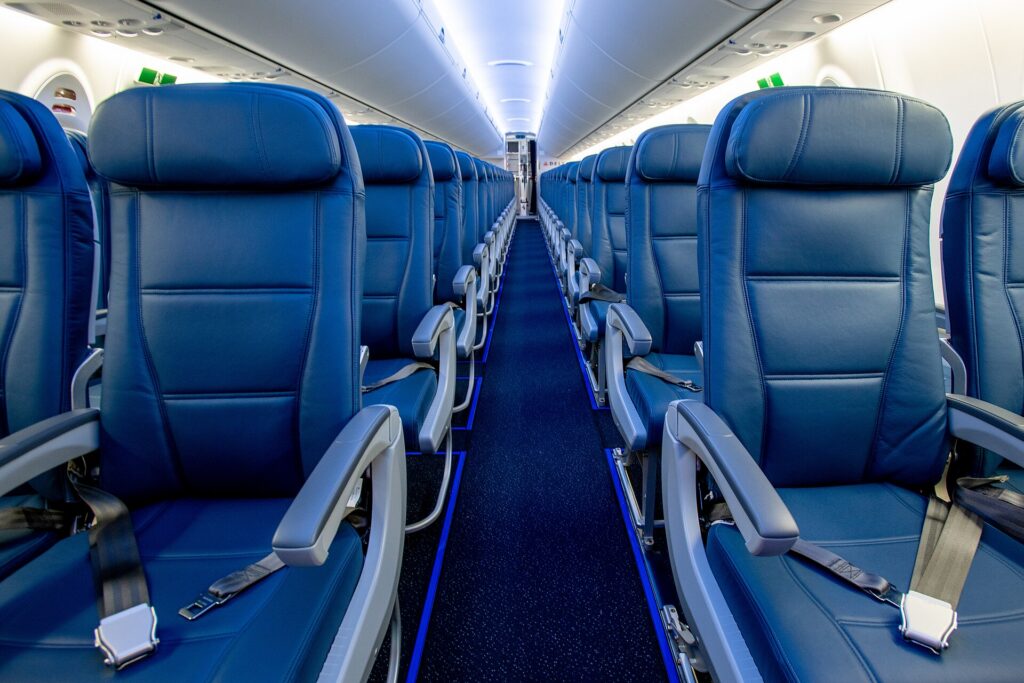
    The mistakes that cost the most

    • Booking late for peak dates and paying whatever is left, often for a car that is too big or too small.
    • Comparing daily rates instead of totals, then discovering the fees at the counter.
    • Assuming a credit card covers everything, including liability, luxury cars or a country it excludes.
    • Letting an unlisted friend drive.
    • Skipping the pickup video, then having no proof about a scratch that was already there.
    • Accepting prepaid fuel and returning with half a tank.
    • Keeping the car an extra few hours without calling, and paying for an extra day at a walk-up rate.
    • Renting for the entire trip when you only needed a car for two days of it.

    Book the trip, not just the car

    A rental works best when it fits the rest of the itinerary. Match pickup to your flight’s arrival time, leaving a buffer for delays; choose a hotel with parking if you will keep the car overnight, and factor the parking fee into the room rate; and time the return so you are not racing for a flight. Our guide to the best time to book flights and hotels covers timing for the other two pieces, and our hotel booking tips explain how to read the fees on a room rate the same way you now read a rental agreement.

    Frequently asked questions

    How far in advance should I book a rental car?

    As soon as your dates are firm, on a free-cancellation rate. For summer, holidays, spring break and large vehicles, that means weeks to months ahead. Then keep checking and rebook if the price drops.

    Is it cheaper to rent a car at the airport or in town?

    Often in town, because airport locations pass on concession and facility fees. But neighborhood branches have shorter hours and require getting there, so the saving is only worth it when the timing works.

    Do I need the rental company’s insurance?

    It depends on what you already have. Check your own auto policy and your credit card’s rental benefit before the trip, get the terms in writing, and buy only what fills a real gap, especially liability and any coverage abroad.

    Can I rent a car with a debit card?

    At some locations, with conditions such as proof of travel or a credit check, and a hold on your funds. A credit card in the main driver’s name is far simpler.

    What happens if I return the car late?

    After a short grace period, most companies charge hourly and then a full extra day once you pass a threshold of a few hours. Call before your return time if you know you will be late.

    Which fuel option is best?

    Full-to-full in almost every case. Prepaid fuel only makes sense if you will return nearly empty.

    Do I need an International Driving Permit?

    For some countries, yes, and rental counters may ask for one even where it is only recommended. Check the official government guidance for your destination and get the permit before you leave home.

    Can I add a second driver?

    Yes, at pickup, with their license present. There is often a daily fee, sometimes waived for a spouse or partner. Never let an unlisted person drive.

    Ready to price it out? Compare rates from the major companies on our car rental search, or go straight to a destination such as Orlando, Calgary or Phoenix, and line up the rest of the trip with cheap flights and hotels.

  • 15 Best Guest Blogging Sites for Travel, Events, and Ticketing Enthusiasts

    15 Best Guest Blogging Sites for Travel, Events, and Ticketing Enthusiasts

    Search for “guest blogging sites for travel” and you will find long lists of websites that supposedly welcome contributors. Most of those lists are not really about writing. They exist to trade links: you supply an article, the site publishes it with a link back to you, and sometimes money changes hands along the way. That approach does little for a writer’s career, and search engines treat it as spam. If you love travel and want to write about it, there is a better path: pitching real publications, building a portfolio of work you are proud of, and learning how editors think. This guide explains how that works. It covers the difference between guest posting and genuine contributing, how editors evaluate pitches, what a strong travel story needs, how to handle rights, contracts and disclosure, how to build a portfolio from scratch, and the red flags that tell you an “opportunity” is really a link scheme.

    The short answer

    Skip the lists of “sites that accept guest posts”. Instead, choose a few publications you actually read, study what they publish, and find their official contributor or pitch guidelines. Pitch a specific story, not a destination, in a paragraph or two, with a working headline, your angle, your sources and a clear reason it matters now. Disclose any sponsored travel up front. Do not send finished drafts unless a publication asks for them. Read the contract so you know which rights you are selling. And build a portfolio on your own site with your best published clips. Two well-known travel publications that publish detailed pitch guidelines are AFAR and Condé Nast Traveler; reading both is a free education in what editors want.

    Close-up of hands typing on an old manual typewriter
    Good travel writing starts with a story, not a destination (Photo: Shixart1985 via Wikimedia Commons, CC BY 2.0)

    Guest posting, contributing and freelancing: what is the difference?

    These terms are often used interchangeably, but they describe very different arrangements.

    TypeWho pays whomWhat the editor wantsValue to your careerWatch out for
    Commissioned freelance storyThe publication pays youA reported, original story that fits a section and its readersHigh: paid clips, editor relationships, credibilityContract terms, rights, kill fees
    Unpaid contribution to a reputable outletNo payment either wayGenuine expertise or a personal perspective the outlet cannot get elsewhereModerate: a credible clip, exposure to real readersGiving away rights; working for free indefinitely
    Brand or company blog postSometimes the brand pays youUseful content that fits the brand’s audienceVaries: can be good paid work if clearly labeledUnclear disclosure; being asked to make claims you cannot support
    “Guest post for a backlink”Often you, or an agency, pay the siteA link, not a storyLow: few real readers, no editorial credibilitySearch engine penalties, pay-to-publish schemes

    The first two build a writing career. The third can be legitimate paid work. The fourth is a marketing tactic, and it is increasingly risky.

    Why link-driven guest blogging is a dead end

    Google’s own spam policies list large-scale guest posting campaigns with keyword-rich anchor text links as an example of link spam, alongside buying and selling links. Google also asks publishers to mark paid or sponsored links with the appropriate attributes, as explained in its guide to qualifying outbound links. In practice, that means:

    • Sites built to sell guest posts tend to have few genuine readers, so your work reaches almost nobody.
    • Editors notice. A portfolio full of thin, keyword-stuffed guest posts on low-quality sites can hurt your credibility with serious publications.
    • The links may be discounted or penalized, which defeats the purpose for anyone trying to promote a business.
    • Some arrangements are simply scams: pay-to-publish sites that disappear, or “editors” who ask for payment for a placement they never deliver.

    If your goal is to write, write for readers. The links, reputation and income follow from good work in credible places.

    How editors evaluate travel pitches

    A pitch is a short proposal for a story you have not yet written. Editors read a lot of them, and the ones that succeed tend to share the same qualities. The guidelines published by AFAR and Condé Nast Traveler are unusually explicit about this, and they echo what editors across the industry say.

    A story, not a place

    “I’m going to Lisbon next month; do you want anything?” is not a pitch. Condé Nast Traveler’s guidelines put it plainly: pitch stories and angles, not destinations. A story has a subject, a tension or a discovery, and a reason a reader would care. “How a new generation of chefs is reviving a nearly lost regional cuisine” is a story. “Lisbon” is a destination.

    A reason to run it now
    Editors look for timeliness: a news peg, an anniversary, a new opening, a trend, a seasonal hook or a change in how people travel. Without a reason to publish now, a good idea can sit in an inbox indefinitely.

    A fit with the publication

    Every publication has sections, formats and a voice. A pitch that shows you have read the publication, knows which section it belongs in and has checked that it has not already covered the story is far more likely to get a reply. If it has covered the topic before, explain what is new about your angle.

    Why you

    Editors want to know why you are the right person to write the piece: expertise, access to people or places, local knowledge, language skills or lived experience. Condé Nast Traveler also asks writers to consider whether they are the best person to tell a particular story, especially one about a community they do not belong to.

    Sources and substance

    Name the people you plan to interview, the places you will visit and the reporting you will do. Both AFAR and Condé Nast Traveler ask for specifics like characters, sources and news pegs, and Condé Nast Traveler says it is not looking for diary-like travelogues that simply follow the course of a trip.

    Brevity

    Condé Nast Traveler asks for pitches no longer than a paragraph or two. A long pitch suggests a writer who has not yet found the story.

    Transparency

    If your trip was sponsored in any way, say so. AFAR says it allows press trips but appreciates being told, and Condé Nast Traveler asks writers to disclose any sponsorship and notes that trips can be pitched after the fact with clear disclosure.

    No finished drafts

    Both publications say they do not accept completed stories on spec; send the pitch, not the draft. Many other outlets work the same way, although some smaller publications and personal essay sections do ask for complete pieces. Follow each publication’s guidelines.

    The anatomy of a strong pitch

    A pitch email usually contains the following, in this order.

    1. A clear subject line: “Pitch: [working headline]” plus the section, if you know it.
    2. A greeting to the right editor: check the masthead or the guidelines for who handles your section. Pitch one editor at a time; Condé Nast Traveler specifically asks writers not to send the same idea to several of its editors.
    3. The hook: one or two sentences that make the editor want to read on.
    4. The story: what you will report, who you will talk to, what the reader will learn, and why now.
    5. The format: proposed length and section, and any photo or video possibilities.
    6. Why you: a sentence or two about your relevant experience, with links to two or three of your best clips.
    7. Disclosure: any sponsored travel or relationships with the places or companies involved.

    Here is an example of the kind of structure that works. The details are illustrative, not a real assignment:

    Subject: Pitch: Quebec City in January, without a car. Hi [editor], most winter visitors to Quebec City see the old town for a weekend and leave. But the city’s ski hills, cross-country trails and ice canoeing are all reachable by public transit and shuttles, making it one of the few North American winter destinations you can do properly without driving. I would report a service-driven feature of around 1,500 words, with interviews with a local ski instructor, a transit planner and an ice canoe team captain, and practical sections on getting there, where to stay and what to pack. I have lived in the region for eight years and write regularly about winter travel; links to recent clips are below. My trip is self-funded.

    It is short, specific, timely for a winter issue, and makes clear what the reader gets.

    A person writing notes by hand in a notebook
    Keep detailed notes, names and sources: fact-checkers will ask for them (Photo: Kristin Hardwick via Wikimedia Commons, CC0)

    What a strong travel story needs

    Once you land the assignment, the work begins. Good travel writing combines storytelling with reliable information.

    A sense of place

    Readers should feel the texture of a place: its sounds, smells, people and rhythms. That comes from specific, observed detail, not from adjectives like “breathtaking” and “hidden gem”.

    Reporting, not just impressions

    Talk to people who live and work there. Get their names, their roles and their exact words. Their voices make a story credible and alive.

    Service information

    Many travel stories, especially online, include practical information: when to go, how to get there, where to stay, what it costs and what to watch out for. Readers use this to plan. Look at how service-driven guides are structured, such as our guides to things to do in Paris and the best time to fly to Paris, which combine context with decisions a reader can act on.

    Accuracy

    Travel details go out of date quickly. Check opening hours, prices, entry rules and transport links on official sources close to publication, and note when you visited. If you cannot confirm a detail, leave it out or flag it for your editor. Many publications have fact-checkers who will ask for your sources, so keep your notes, recordings, receipts and links organized.

    Structure and a point of view

    A strong travel story has a shape: an opening that pulls the reader in, a clear throughline and an ending that lands. It also has a point of view. Tell the reader what you think, and why.

    Rights, contracts and getting paid

    Before you write a word on assignment, understand what you are agreeing to.

    Know which rights you are selling

    • First rights give the publication the right to publish the piece first, after which you can often resell or republish it.
    • Exclusive rights for a set period prevent you from publishing the piece elsewhere for that time.
    • All rights or work-for-hire arrangements mean the publication owns the work outright, and you may not be able to reuse it.

    Copyright law differs by country. For the basics, see the US Copyright Office FAQ and the Canadian Intellectual Property Office’s copyright guide. If a contract is complex or the stakes are high, consider advice from a lawyer or a writers’ organization.

    Understand payment terms

    Check the rate, whether it is per word or per piece, when you will be paid (on acceptance or on publication), whether expenses are covered, and whether there is a kill fee if the story is canceled. Some publications publish their rates in their guidelines; others do not. Send a clear invoice with the agreed amount and keep track of payment dates.

    Photos and other media

    Only submit photos you took yourself or have the right to license. If your photos show identifiable people in private settings, consider whether you need their permission. Discuss image rights separately from text rights.

    Disclosure and ethics

    Trust is a travel writer’s most valuable asset. Protect it.

    • Disclose sponsored travel. Tell your editor up front if any part of your trip was paid for by a tourism board, hotel, airline or tour company, and follow the publication’s policy on disclosing it to readers.
    • Follow advertising rules on your own channels. If a brand gives you free travel, products or payment and you post about it on your blog or social media, advertising rules apply. In the US, see the FTC’s Endorsement Guides FAQ; Canada’s Competition Bureau has published similar guidance on influencer marketing.
    • Keep editorial and advertising separate. Never accept payment in exchange for favorable coverage in a piece presented as independent editorial.
    • Be fair to the people you write about. Quote accurately, give context and consider the impact of your story on communities, especially small or vulnerable ones.
    • Do not plagiarize. Attribute facts and quotes, and never copy another writer’s work, including from guidebooks or other websites.

    How to build a travel writing portfolio from scratch

    Editors want to see clips, but you need clips to get assignments. Here is how writers break that loop.

    1. Start where you live

    You are already an expert on your own city or region. Local newspapers, city magazines, community sites and regional travel publications often need stories about nearby places, and you have access nobody else has.

    2. Pick a focus

    Generalist travel writers compete with everyone. Specialists stand out: winter sports, rail travel, accessible travel, food, family travel, budget travel, hiking or a particular region. A focus also makes your pitches more credible.

    3. Publish your own work well

    A personal website or newsletter with a few carefully written, well-reported pieces shows editors how you write. Treat it like a publication: accurate, edited and useful. Quality beats quantity.

    4. Write for trade and niche publications

    Industry, hobby and alumni publications are often more open to new writers and pay attention to expertise. The clips count.

    5. Collect your best clips in one place

    Create a simple portfolio page with your three to six best pieces, a short bio and a way to contact you. Link to it in every pitch.

    6. Track your pitches

    Keep a simple spreadsheet of each pitch, the editor, the date sent and any response. AFAR, for example, asks writers to follow up only if they have not heard back within two weeks. Follow up once, politely, then move on and pitch the idea elsewhere if it is not picked up.

    7. Build relationships

    Once an editor accepts your work, deliver clean copy on time, respond quickly to edits and pitch them again. Many writers get most of their work from a small number of editors who trust them.

    Long wooden reading tables in a research room at the New York Public Library
    Research on official sources before you pitch and again before you file (Photo: Diliff via Wikimedia Commons, CC BY 2.5)
    A desk with an open notebook, pens and a pair of glasses
    Track every pitch, editor and follow-up in one place (Photo: Shixart1985 via Wikimedia Commons, CC BY 2.0)

    How to find publications to pitch

    • Start with what you read. You already know the voice, sections and readers of your favorite publications.
    • Look for official guidelines. Many publications have a contributor, pitch or “write for us” page, often linked from the footer, the About page or the masthead. Use that information rather than third-party lists, which go out of date quickly.
    • Read the masthead. It tells you which editors handle which sections.
    • Read recent issues and stories. Make sure the publication has not just run your idea, and note which formats appear regularly.
    • Check that it is a real publication. A credible outlet has named editors, a clear editorial focus, real readers and a history of original reporting.

    Red flags: when an “opportunity” is really a link scheme

    • You are asked to pay to be published. Legitimate editorial outlets do not charge writers.
    • The pitch is about links, not readers. Requests for “do-follow links”, specific anchor text or “domain metrics” are signs of a link-selling operation.
    • There is no named editor. Or the only contact is a generic sales email.
    • The site publishes on every topic. A “travel” site that also runs posts on loans, casinos and supplements is usually selling links.
    • Nobody edits your work. Real publications edit, fact-check and push back.
    • You are asked to hide sponsorship. Any request to disguise paid content as independent editorial is a reason to walk away.

    Planning research trips on a writer’s budget

    Few writers are fully funded for every trip, so traveling efficiently matters. Our pillar guide to budget travel destinations explains how to weigh the cost of getting there against the daily cost of being there, and our guide on how to save money for a trip helps you plan ahead. When you have a story in mind, compare a whole month of fares on our flight search, then find a well-located room on our hotel search. If your story involves a concert, game or festival, check event listings first and plan the trip around the date. Our guide to planning and booking a trip on TicketScanner walks through the process.

    Common mistakes new travel writers make

    • Pitching a destination instead of a story.
    • Sending the same pitch to many editors at the same publication.
    • Writing the whole piece before pitching, when the publication wants a pitch first.
    • Ignoring the publication’s guidelines, word counts and sections.
    • Relying on superlatives and clichés instead of specific detail and reporting.
    • Not disclosing sponsored travel.
    • Signing away all rights without realizing it.
    • Chasing links instead of readers.

    Frequently asked questions

    Is guest blogging still worth it for travel writers?

    Guest posting purely for backlinks is not a good use of a writer’s time, and search engines treat large-scale link-driven guest posting as spam. Contributing genuinely useful work to credible publications, paid or unpaid, can be worthwhile because it builds a portfolio and reaches real readers.

    How do I pitch a travel publication?

    Read the publication and its official pitch guidelines, identify the right section and editor, and send a short email with a working headline, your angle, your sources, why the story matters now and links to your best clips. Disclose any sponsored travel.

    Do I need published clips to pitch?

    Clips help, but a strong, specific pitch can get attention on its own, especially for local stories or topics where you have genuine expertise. Start with local and niche outlets and your own well-edited site.

    Should I send a finished article?

    Usually not. Many publications, including AFAR and Condé Nast Traveler, ask for pitches rather than completed stories. Follow each publication’s guidelines; some essay sections do want complete drafts.

    How long should I wait before following up on a pitch?

    Follow the publication’s guidance if it gives any; AFAR, for example, suggests following up if you have not heard back within two weeks. Otherwise, one polite follow-up after a couple of weeks is reasonable, then move on.

    Can I write about a press trip?

    Many publications accept stories from press trips if you disclose the sponsorship, but policies vary and some do not. Check before you travel and tell your editor up front.

    How do travel writers get paid?

    Publications pay per word or per piece, on acceptance or on publication, depending on the contract. Check the rate, payment terms, expenses policy and kill fee before you start.

    More guides in this series

    This article is part of our destinations and planning series. For destination ideas and story inspiration, start with the pillar guide to budget travel destinations, then explore the best places to visit in Europe in fall, traveling to Japan, America’s most unique state parks and relaxing vacations for doing absolutely nothing.

    Ready to research your next story? Compare fares across a whole month on our flight search, find a room in the right neighborhood on our hotel search, and, if you are starting with a classic, look at flights to Paris.