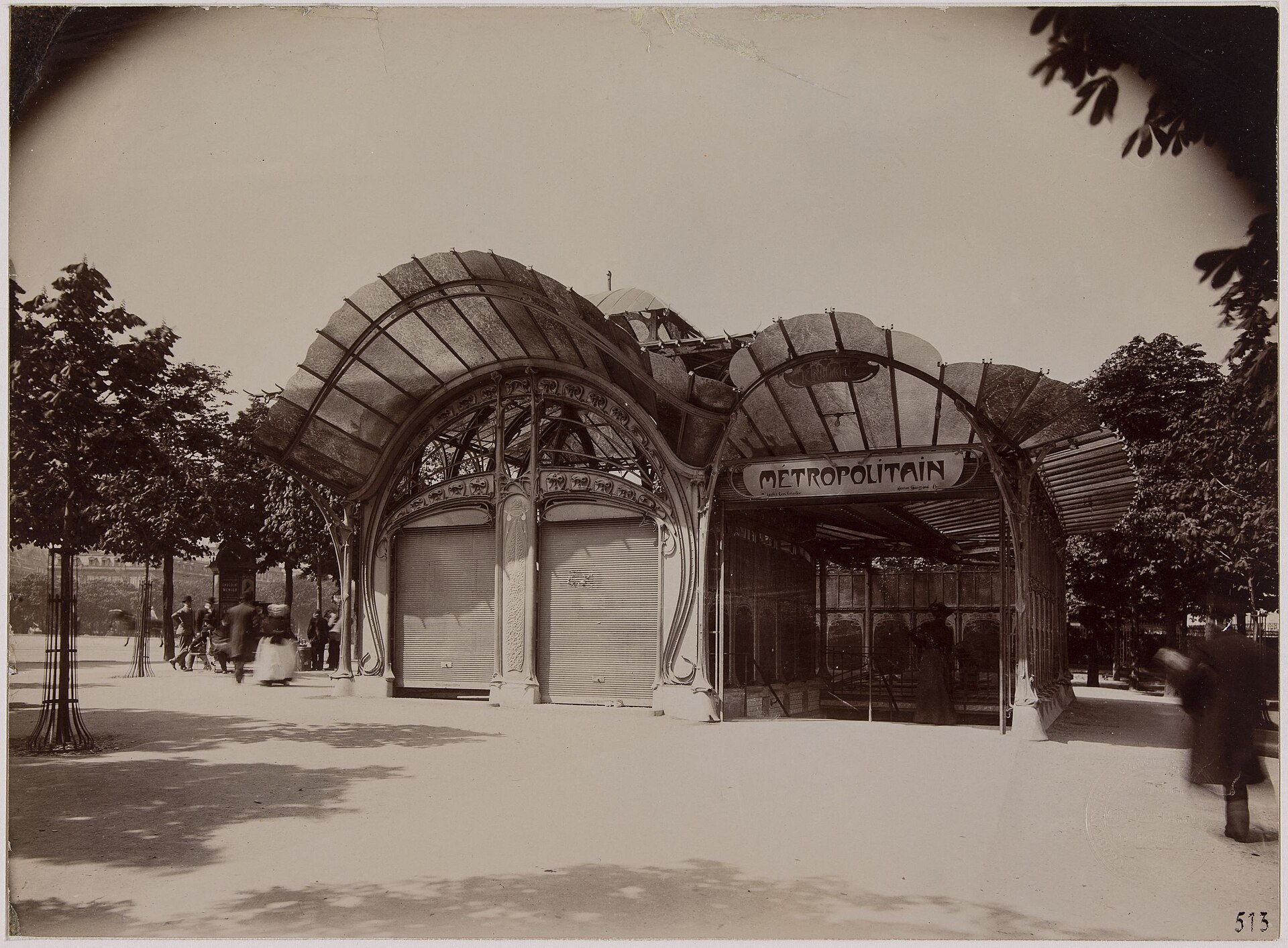
Paris is the easiest question in this series. For a stay in the city itself, a rental car is not just unnecessary but a burden: the Métro puts a station within a few minutes’ walk of almost every address, the streets are being steadily handed over to buses, bikes and pedestrians, parking is scarce and expensive, and most hotels in the centre have no garage at all. Even the classic day trips, Versailles, Disneyland, Giverny, Fontainebleau and Reims, are faster and cheaper by train. But the question does not end at the Périphérique. If your trip continues to the Loire châteaux, the Normandy beaches, the Champagne vineyards or a road trip across France, a car becomes the right tool, and the trick is knowing where and when to pick it up so that you never have to drive in Paris at all. This guide explains how the city is laid out, how the Métro, RER, buses and tickets work, what driving here is really like, when a car earns its keep, and gives you a straightforward way to decide.
The short answer
Skip the car for any stay in Paris itself and for the day trips most visitors take; the Métro, the RER, the suburban trains, your feet and the occasional taxi cover all of it, and you will save on parking, fuel, tolls and stress. Rent a car only for the part of the trip that leaves the city: the Loire Valley, Normandy and Mont-Saint-Michel, the Champagne villages, Burgundy, or a longer road trip through France. Even then, the best plan is usually to take a fast train out of Paris and pick up the car at a station or airport on the way, rather than collecting one in the city. And if you arrive late at night with heavy bags, the fixed-fare airport taxi is the stress-free third option. Our guide to car, transit or taxi in a new city sets out the general trade-offs; this one applies them to Paris.
How Paris is laid out
The city of Paris proper is small by world-capital standards, about 10 kilometres across, enclosed by the Boulevard Périphérique ring road and home to around two million people, with another ten million in the suburbs beyond. The Seine flows east to west through the middle, dividing the Right Bank to the north, with the Louvre, the Marais, the Opéra, the Champs-Élysées and Montmartre, from the Left Bank to the south, with Saint-Germain, the Latin Quarter, the Eiffel Tower and Montparnasse. The city is divided into twenty arrondissements, numbered in a clockwise spiral from the 1st around the Louvre, and every address carries its number; the last digits of the postcode give it away, so 75004 is the 4th. The historic centre, roughly the first seven arrondissements, is compact enough to cross on foot in an hour.
Hotels cluster in every central arrondissement, with the densest choice in the Marais and around the Opéra on the Right Bank and in Saint-Germain and the Latin Quarter on the Left. Very few have parking. Our Paris hotel search lets you compare them, and our guide to staying in Le Marais covers the most central, walkable option.
Getting in from the airports
From Charles de Gaulle (CDG), about 25 kilometres northeast, the RER B runs to Gare du Nord in about 35 minutes and continues through Châtelet, Saint-Michel and Denfert-Rochereau, connecting with most Métro lines; the Roissybus runs to Opéra; and taxis charge a fixed fare to anywhere in the city, one rate for the Right Bank and a slightly higher one for the Left. From Orly (ORY), about 14 kilometres south, Métro line 14 has run directly into the centre since 2024, reaching Châtelet in around half an hour, and fixed-fare taxis serve the city too. Public-transport trips to and from the airports need a specific airport ticket rather than a standard one, while a weekly Navigo pass covers them. Every major rental company has desks at both airports, but unless you are heading straight out to the regions, there is no reason to collect a car there. Check Paris Aéroport for current ground-transport details; our CDG airport guide covers the layout.
Paris public transport, explained
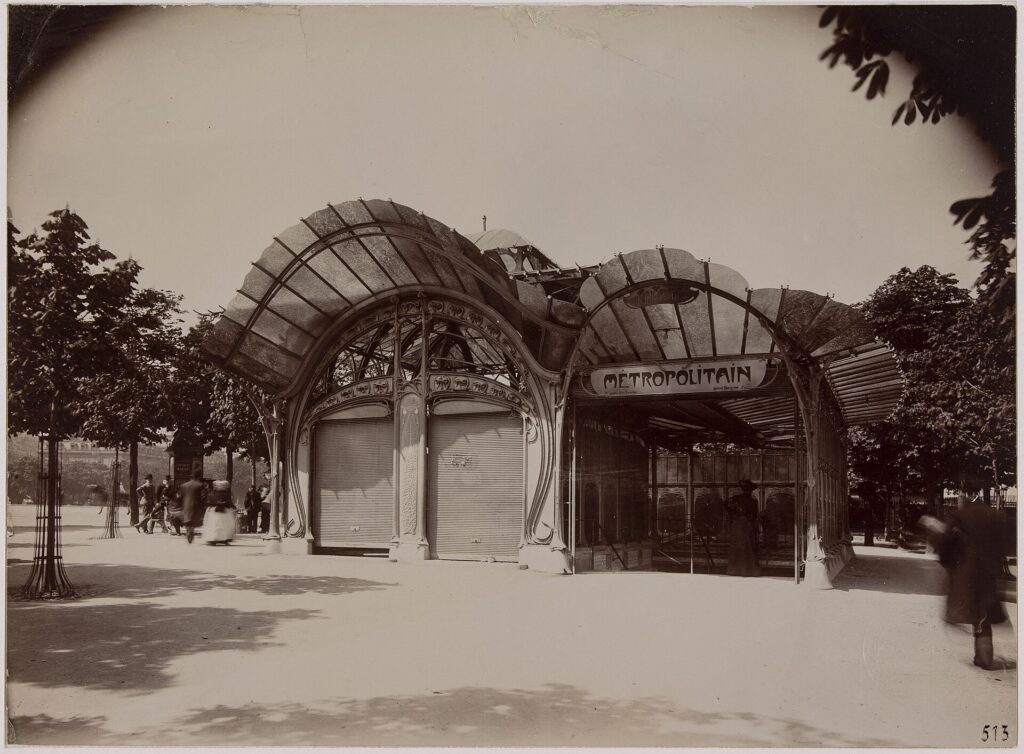
Public transport in Paris and the surrounding Île-de-France region is organised by Île-de-France Mobilités and run mainly by the RATP and the national railway, SNCF. It is dense, frequent and fast; its weaknesses are crowding at rush hour, a lot of stairs, and a ticketing system that has changed more than once in recent years.
The Métro
Sixteen lines, numbered 1 to 14 plus two short branch lines, 3bis and 7bis, with more than 300 stations, most of them only a few hundred metres apart. Lines are identified by number, colour and the name of the terminus in the direction you are travelling, which is what the signs show, so check the end station before you go down to the platform. Line 1, which runs east to west past the Louvre, the Tuileries, the Champs-Élysées and La Défense, and line 14, the fast line between Saint-Lazare, Châtelet, Gare de Lyon and Orly, are fully automated. Trains run from about 5.30 in the morning until after one at night, later on Friday and Saturday nights, and the Noctilien night buses fill the gap.
The RER and suburban trains
The five RER lines, A to E, are express trains that cross the city underground with few stops and then fan out into the suburbs. They are the fast way across Paris and the way to the main day trips: the RER B to CDG and the Stade de France, the RER A to La Défense and Disneyland, and the RER C along the Left Bank to Versailles. The Transilien suburban trains from the main stations reach further, including Chantilly, Fontainebleau and Giverny’s station at Vernon.
Buses and trams
More than 300 bus routes criss-cross the city and suburbs, and they are the scenic alternative to the Métro: routes along the Seine and across the centre pass one landmark after another, and every bus is step-free.
Fares and tickets
Since 2025, a single Métro-train-RER ticket covers any one journey by Métro, RER or suburban train anywhere in the region at one flat price, apart from the airports, which have their own airport ticket; a separate, cheaper bus-tram ticket covers journeys by bus or tram. The old paper tickets are being phased out. The simplest option for visitors is to buy tickets on a phone with the official Île-de-France Mobilités app, or to load them onto a Navigo Easy card, a reusable card sold for a small fee at station counters and machines. If you are staying a week, the Navigo weekly pass, which runs from Monday to Sunday, needs an ID photo and a Navigo card and covers unlimited travel across the whole region, including the airports, Versailles and Disneyland; it is usually the best deal if your dates fit. Children under four travel free, and reduced fares apply to young children. Check Île-de-France Mobilités for current fares before you go.
Accessibility
This is the Métro’s weak point. Most of the network dates from the early twentieth century, and only line 14 and the newest extensions are fully step-free; many stations have long corridors and stairs with no lift. The RER is better in places, and every bus is low-floor and accessible, so travellers with a wheelchair, a buggy or heavy luggage should plan bus routes. The RATP publishes accessibility information for each line.
Beyond the Métro
- Walking. Central Paris is made for it. Stations are so close together that walking between neighbouring ones is often quicker than changing lines, and the walk along the Seine from the Eiffel Tower to Notre-Dame passes most of the city’s great sights.
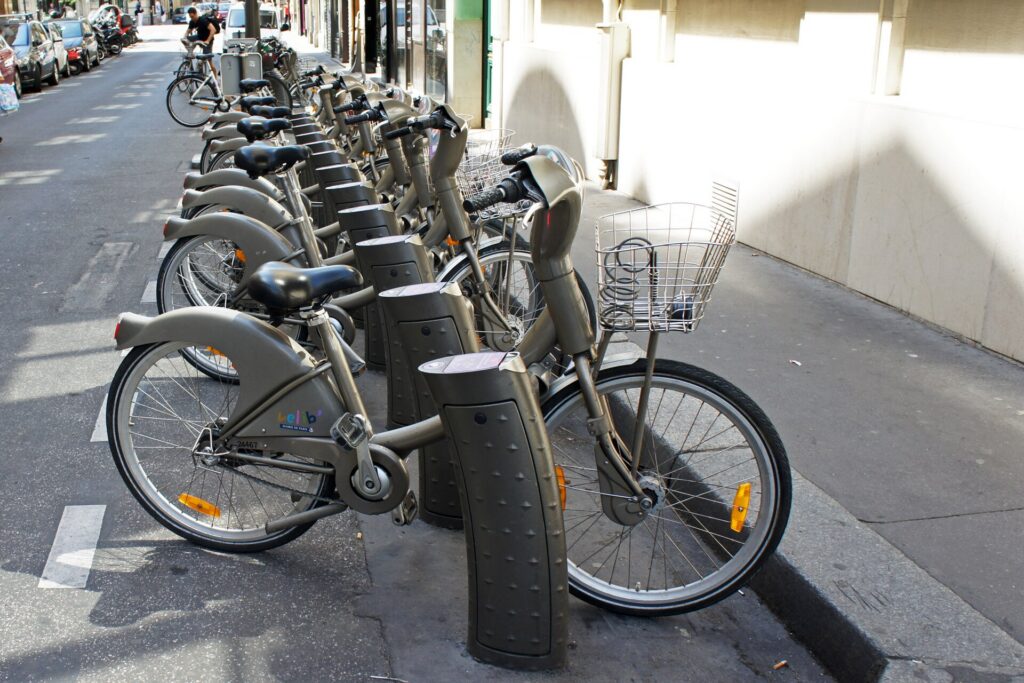
- Vélib’ and cycling. Paris has transformed itself into a cycling city, with hundreds of kilometres of cycle lanes, the Rue de Rivoli largely given over to bikes and buses, and the Vélib’ bike-share system with classic and electric bikes at stations across the city and inner suburbs. Shared e-scooters were banned in 2023, but electric bikes from private operators remain.
- Taxis and ride-hail. Licensed taxis, with a light on the roof, can be hailed or found at taxi ranks, and Uber and other ride-hail apps operate widely. Taxis can use the bus lanes, which helps at rush hour; for a group of three or four, a short ride can be competitive with Métro fares.
- Trains beyond the region. High-speed TGV and Eurostar trains leave from the city’s big stations: Gare du Nord for London and Brussels, Gare de l’Est for Reims and Strasbourg, Gare de Lyon for the southeast, and Montparnasse for the Loire, Brittany and Bordeaux. SNCF Connect sells tickets for all of them.
Driving in Paris: what it is really like
Driving in Paris is not dangerous so much as slow, confusing and expensive, and the city has spent twenty years making it harder on purpose. The speed limit is 30 km/h on most streets and, since 2024, 50 km/h on the Périphérique; through traffic has been restricted in the four central arrondissements since late 2024; lanes have been converted to bus and bike lanes across the city; and on-street parking has become steadily more expensive for visitors. Add narrow one-way streets, delivery vans double-parked in the only lane, scooters threading between cars, and the famous roundabout at the Arc de Triomphe, where twelve avenues meet with no lane markings and traffic entering has priority, and you have a city where locals themselves increasingly leave the car at home.
Parking
On-street parking in Paris is paid almost everywhere, with the city’s highest rates in the central arrondissements, time limits for visitors, and a much higher visitor rate for heavier vehicles, including many SUVs. Payment is by card at the machines or through an app; there are no coin meters to feed. Underground public car parks are plentiful and easier, but a full day in one costs more than many museum tickets combined, and hotels that offer parking charge a substantial nightly fee. Parking fines are enforced and follow the car, and the rental company will pass them on with an administrative charge.
Rules and conditions worth knowing
- Crit’Air sticker. Paris and its inner suburbs operate a low-emission zone, and vehicles need a Crit’Air air-quality sticker on the windscreen. Cars rented in France normally have one; if you are driving in from another country, order it in advance from the official Crit’Air site, and check the current rules, which have been the subject of political debate.
- Priority to the right. Unless signs say otherwise, traffic joining from the right has priority, including on some roundabouts; it catches out North American drivers more than anything else.
- Manual gearboxes are still the default in rental fleets. Automatics are available but cost more and sell out first; book one specifically if you need it.
- Tolls. The autoroutes out of Paris to Normandy, the Loire, Champagne and the south are mostly tolled. Toll booths take cards, and the cost is worth adding to any comparison.
- Speed limits and cameras. 130 km/h on autoroutes, 110 in the rain; 80 or 90 km/h on two-lane roads depending on the department; 50 or less in towns. Fixed and mobile speed cameras are everywhere, and fines follow the car.
- Licence. Visitors can drive on a valid Canadian, American or British licence for a short stay; an International Driving Permit alongside it is recommended. Rental companies often set a minimum age of 21 and charge a young-driver surcharge.
- Alcohol. The limit is 0.5 grams per litre of blood, lower than in much of North America, and lower still for new drivers.
When renting a car makes sense
- The Loire Valley châteaux. Chambord, Chenonceau, Cheverny and dozens more are spread across the countryside; take the train to Tours or Blois and pick up a car there.
- Normandy. The D-Day beaches, the American Cemetery, Bayeux, Honfleur, Étretat and Mont-Saint-Michel are far apart and poorly served by public transport; the train to Caen or Bayeux plus a car is the classic plan.
- The Champagne villages. Reims and Épernay are easy by train, but the vineyard villages and smaller champagne houses between them need a car and a designated driver.
- Burgundy, Provence and the Dordogne. Rural France rewards a car, and the fast train gets you to within an hour of each.
- Families with lots of luggage heading to the regions. A car from CDG, straight onto the autoroute, avoids hauling bags through Paris.
- A road trip across France. Pick up on the day you leave Paris, not before, and consider a one-way rental to another city or airport.
If any of those apply, our rental car booking tips cover insurance, deposits and the questions to ask at the counter, and our family car rental guide looks at vehicle choice.
When it does not
- You are staying in Paris, in any arrondissement, and your plans are the city.
- You are visiting Versailles, Disneyland, Fontainebleau, Chantilly, Giverny or Reims as day trips, all of which are easy by train.
- You are in town for a match at the Stade de France or the Parc des Princes, or a concert, when traffic and parking are at their worst and the RER and Métro run extra trains.
- You are travelling solo or as a couple and only need a car for a day; a guided tour or a train plus a local taxi is often cheaper.
The hybrid plan for a Paris-plus-regions trip
Go car-free for the Paris days and rent only for the regional days, and think carefully about where you pick up. The worst option is collecting a car at an office in central Paris and driving out through the city traffic. Better is to take a high-speed train to the edge of the region you are visiting and collect the car at the station: Tours or Saint-Pierre-des-Corps for the Loire, Caen for Normandy, Reims for Champagne, Avignon for Provence, all of which have rental offices at or beside the station. If you are starting your trip in the regions straight off a long-haul flight, collect at CDG, where the autoroutes to the north, east and west are minutes away, or take a TGV directly from CDG’s own station. If you are finishing in the regions, drop the car at a station and take the train back into Paris, or return it at CDG or Orly on the way to your flight, which avoids driving into the centre entirely. Check one-way fees, which vary a great deal, and book an automatic early if you need one. Bison Futé, the official French road-traffic service, publishes forecasts of the busiest days on the autoroutes.
A worked cost comparison
Numbers change with the season and the booking window, so treat this as a method rather than a quote, and check current rates before deciding. For a five-night stay in Paris for two people, the car-free version costs the RER or a taxi from the airport, two weekly Navigo passes or a handful of tickets, and perhaps a couple of late-night taxis; the rental version adds five days of a car, five nights of hotel or underground parking at Paris rates, fuel, and the airport collection fee. The transport option wins by a wide margin. For the same stay plus a day at Versailles and a day at Giverny, the car-free version adds the RER C to Versailles, which is covered by a weekly Navigo pass, and return train tickets to Vernon with the shuttle bus to Giverny; a one-day rental for Giverny adds the car, fuel, tolls and parking, and the train is usually cheaper for two people and not much slower. For a week split between Paris and Normandy, the hybrid plan, a train to Caen and a three-day rental there, typically costs less than a week-long rental from Paris once parking and tolls are included, and spares you the drive out of the city. Run the numbers for your own dates, but the pattern is consistent: in Paris, pay for the car only on the days you are outside it.
Driving out of Paris in each season
The autoroutes that radiate from Paris are fast and well maintained, but the timing of your departure matters more than the season. The worst days of the year are the big French holiday getaways: the first and last weekends of July and August, when Bison Futé issues red and black warnings and queues on the A6 south and the A10 toward the Loire and Bordeaux can stretch for tens of kilometres, and the Friday afternoons before the May bridge weekends. In summer, leave early in the morning, avoid Saturdays in July and August, and expect heavy traffic back into Paris on Sunday evenings. In spring and autumn, the roads are quieter outside the school holidays, and the Loire and Normandy are at their most pleasant for driving, with fewer coaches at the châteaux. In winter, snow rarely affects the main roads; short daylight on rural roads is the bigger issue. In every season, the ring roads around Paris, the Périphérique and the A86, jam every weekday morning and evening, so time your departure outside the rush hour or pick up the car beyond them.
Decision table
| Your trip | Recommendation | Why |
|---|---|---|
| City break in Paris, couple or solo | No car | The Métro reaches everything; parking is scarce and expensive |
| Paris with day trips to Versailles, Disneyland or Giverny | No car | RER and suburban trains are faster and cheaper |
| Late arrival with heavy luggage | Fixed-fare taxi | A known price to your door, and it can use the bus lanes |
| Loire Valley châteaux | Train to Tours or Blois, then rent | The châteaux are spread out; the drive out of Paris is not worth it |
| Normandy and Mont-Saint-Michel | Train to Caen or Bayeux, then rent | Beaches and villages are far apart and poorly served by buses |
| Champagne | Train to Reims; rent or book a tour for the villages | The cellars in Reims are walkable; the vineyards are not |
| Family heading straight to the regions | Rent at CDG | Straight onto the autoroute without entering Paris |
| Road trip across France | Rent on the day you leave Paris, ideally one-way | Paris is the start, not the place for the car |
Money-saving tips for both options
- On transport: buy a weekly Navigo pass if your stay runs Monday to Sunday; walk between nearby stations; take the bus for scenic routes; and use the airport ticket or pass rather than paying twice.
- On a rental: pick up outside Paris, book early for July and August, reserve an automatic if you need one, check one-way fees, decline extras you already have through a credit card or home policy (check first), and budget for tolls.
- On the hotel: if you must bring a car into Paris, choose a hotel with parking or near an underground car park and price the fee into the room rate.
- On timing: avoid the big holiday getaway weekends and the Paris ring roads at rush hour; the best time to fly to Paris guide lists the holiday periods.
- On day trips: compare a train-plus-taxi day with a one-day rental; for one or two people, the train usually wins.
Frequently asked questions
Is it worth renting a car in Paris?
Not for the city or the usual day trips. Rent only for the Loire, Normandy, Champagne or a road trip, and pick the car up outside Paris.
Is Paris public transport good for tourists?
Excellent for coverage and frequency; the Métro and RER reach almost everything. The drawbacks are rush-hour crowding and stairs.
How do I get from CDG to central Paris?
The RER B to Gare du Nord and Châtelet in about 35 to 45 minutes, the Roissybus to Opéra, or a fixed-fare taxi.
Can I visit Versailles without a car?
Yes. The RER C runs to Versailles Château Rive Gauche, a short walk from the palace, and suburban trains from Saint-Lazare and Montparnasse serve the town too.
Do I need an International Driving Permit in France?
It is recommended alongside a Canadian, American or British licence, and some rental desks ask for one; it is cheap and quick to obtain at home.
Is parking expensive in Paris?
Yes. Street parking is paid and time-limited for visitors, heavier cars pay more, and underground car parks and hotel garages are costly.
What is the best way to see the Loire or Normandy from Paris?
Take the train to Tours, Blois, Caen or Bayeux and rent a car there, or join a guided day tour if you only have one day.
Whichever way you go, start with the flight. Compare cheap flights to Paris, choose a neighbourhood with our Paris hotel search, and plan your days with our first-timer’s guide to Paris.
Keep planning with TicketScanner
- Cheap flights to Paris
- Paris hotels — few central hotels have parking
- Things to do in Paris: a first-timer's guide
- Best time to fly to Paris: month by month
- Paris Charles de Gaulle (CDG) airport guide
- Where to stay: Le Marais — central and walkable
- Rental car booking tips
- Car, transit or taxi in a new city?
- How to travel Europe multi-city — trains, open-jaw flights and one-way rentals
Leave a Reply