Tag: Europe Travel

  • Things to Do in Rome: A First-Timer’s Guide

    Things to Do in Rome: A First-Timer’s Guide

    Rome is the one city where the guidebook cliché is simply true: you cannot see it all, and you should stop trying on the first afternoon. Two and a half thousand years of building sit on top of each other in the bend of the Tiber, and the street you take to dinner may follow a road the legions marched on. The trick for a first visit is to pick the handful of things that genuinely earn a whole morning, book the three that need booking, and leave the rest of the time for the neighbourhoods, the food and the long evenings in piazzas, which is where Rome actually happens. This guide covers the ancient centre, the Vatican, the piazzas, the neighbourhoods, the museums, the food, day trips by train, and the practical details that separate a good trip from a hot, queue-heavy one.

    If you are still comparing cheap flights to Rome, read this alongside our guides to the best time to fly to Rome and whether you need a car, which for most visitors here is a firm no. Between the three you can plan the whole trip.
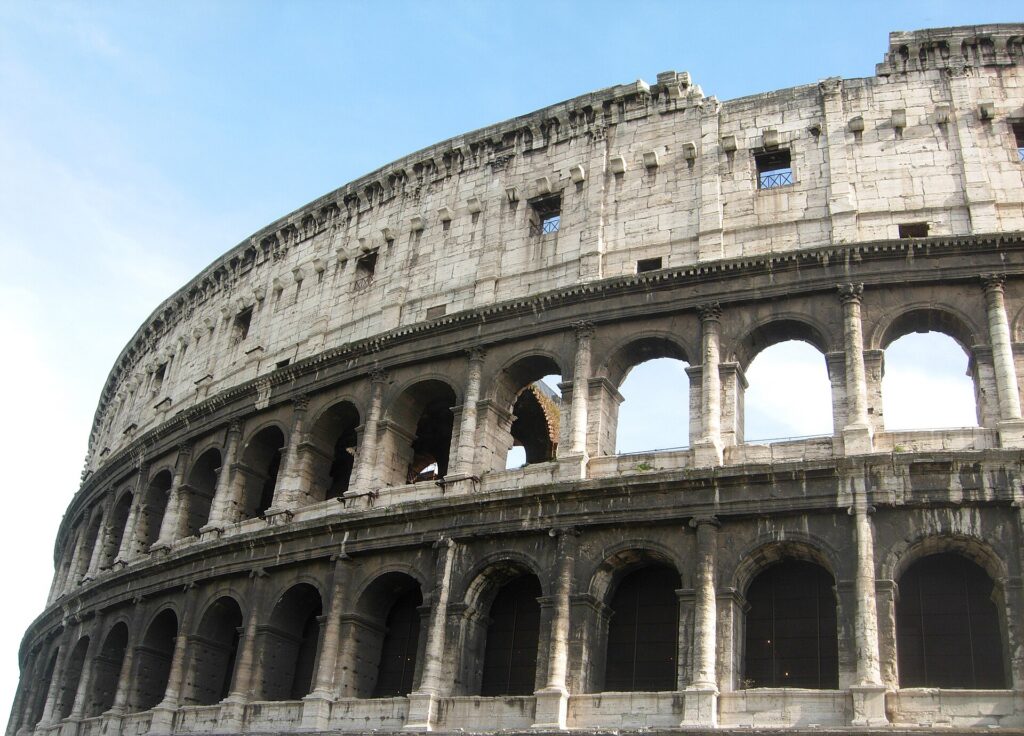
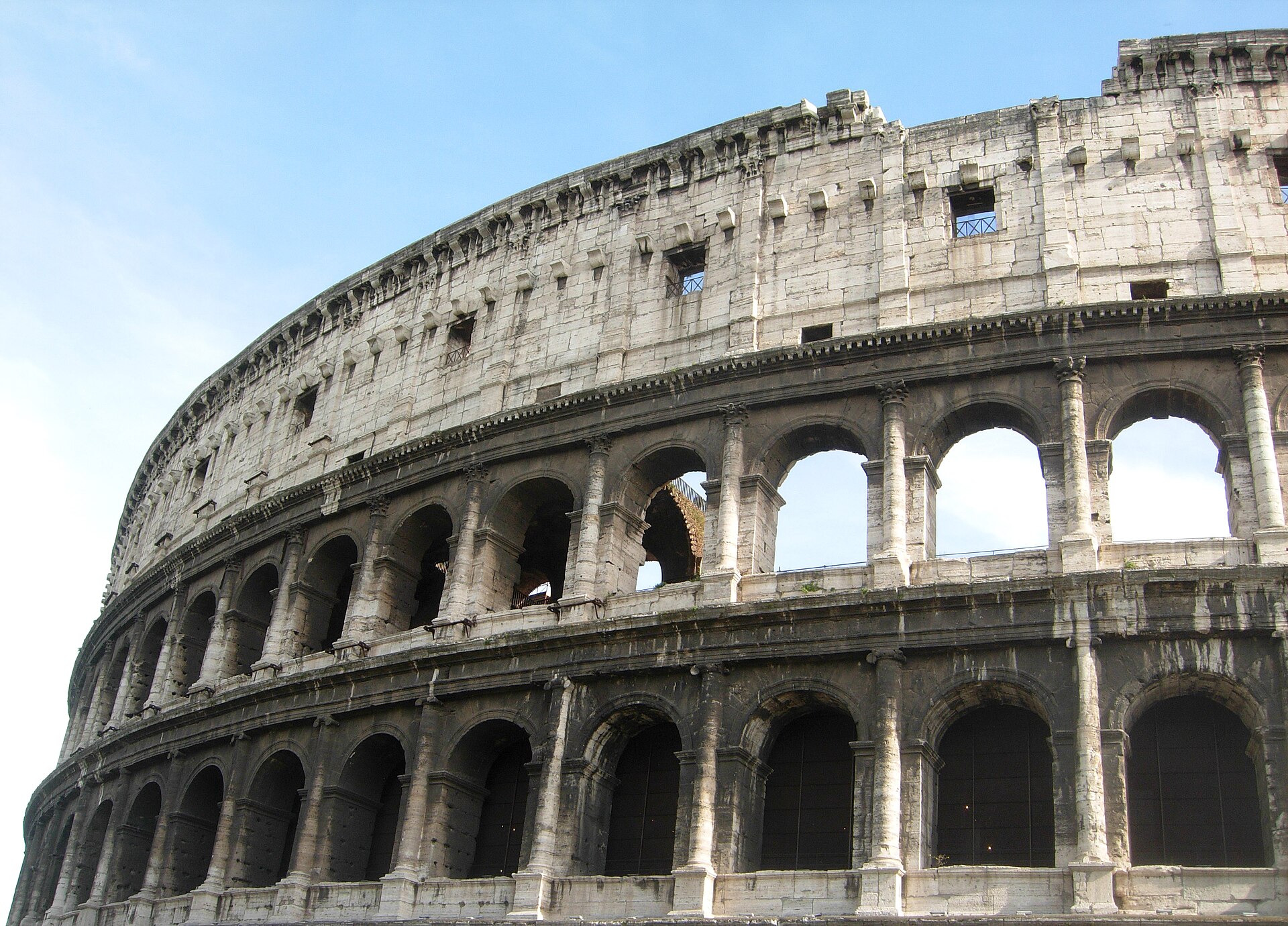
    The Colosseum in Rome seen from the outside
    The Colosseum, the first stop on almost every visit to Rome (Photo: Acediscovery via Wikimedia Commons, CC BY 4.0)

    Rome at a glance for first-timers

    • Airport: Leonardo da Vinci, always called Fiumicino (FCO), about 30 km southwest of the centre; the Leonardo Express train reaches Termini station in around half an hour, and official white taxis charge a fixed fare into the centre. Ciampino (CIA), southeast of the city, handles the low-cost carriers. See our Fiumicino airport guide.
    • Getting around: on foot, above all; the historic centre is compact and most of the famous sights are within a 40-minute walk of each other. The metro skirts the centre, so buses and the number 8 tram fill the gaps.
    • Money: euros. Cards are accepted nearly everywhere, though small bars prefer cash. Tipping is not expected; rounding up is plenty, and the per-person cover charge, the coperto, is normal.
    • Weather: mild, wet winters, long hot summers with July and August well above 30 °C, and two glorious shoulders in spring and autumn. Our month-by-month guide has the detail.
    • Where to stay: the Centro Storico for walking everywhere; Monti for a village feel two minutes from the Forum; Trastevere for the evenings; Prati for the Vatican and calmer streets; around Termini for the budget and the trains. Our Rome hotel search covers them all.

    Ancient Rome: the Colosseum, the Forum and the Palatine

    Start with the Colosseum, because it is the building everyone has already seen and it is still astonishing in person: the largest amphitheatre the Romans ever built, inaugurated in 80 AD, with the exposed hypogeum where animals and gladiators waited beneath the arena floor. It is managed together with the Roman Forum and the Palatine Hill as a single archaeological park, and one ticket covers all three; buy it online from the park’s own site for a timed entry, because the walk-up queue in summer can run to hours and the ticket touts outside are best ignored. Do the Colosseum first thing or late in the day, then cross to the Forum, where the Senate house, the Arch of Titus and the Via Sacra are still legible with a map or a guide. Finish on the Palatine, the hill where Rome was founded and the emperors built their palaces; it is quieter and greener, with views over the Circus Maximus. Allow half a day for the three together and bring water, because the Forum has almost no shade.

    Two more ancient sites deserve a place on a first visit. The Pantheon, the best-preserved building of the ancient world, has a concrete dome that was the largest on earth for more than a thousand years and an open oculus at its centre through which rain falls onto the marble floor; it now charges a small admission for tourists, and the queue moves quickly. The Baths of Caracalla, south of the Circus Maximus, are vast, rarely crowded, and give a better sense of the scale of imperial Rome than anything in the Forum; in summer the opera stages performances among the ruins.

    The historic centre: piazzas, fountains and the Spanish Steps

    The Centro Storico is the medieval and Baroque city packed into the bend of the Tiber, and it is meant to be walked without much of a plan. Piazza Navona, built on the outline of a Roman stadium, holds Bernini’s Fountain of the Four Rivers and Borromini’s church of Sant’Agnese, and is the most theatrical square in the city. The Trevi Fountain, a few streets east, is grander in person than in the photographs and permanently crowded; go before eight in the morning or after eleven at night, and expect the city to manage access to the basin during busy periods after its recent restoration. The Spanish Steps climb from the designer shops of Via Condotti to the church of Trinità dei Monti, and sitting on them is now forbidden, which the police do enforce. Campo de’ Fiori has a morning market; the Jewish Ghetto beside it, one of the oldest Jewish communities in Europe, has the Portico d’Ottavia and the Turtle Fountain. The churches most visitors walk past hold Caravaggios: San Luigi dei Francesi and Sant’Agostino near Navona, and Santa Maria del Popolo at the top of the Tridente, all free to enter.
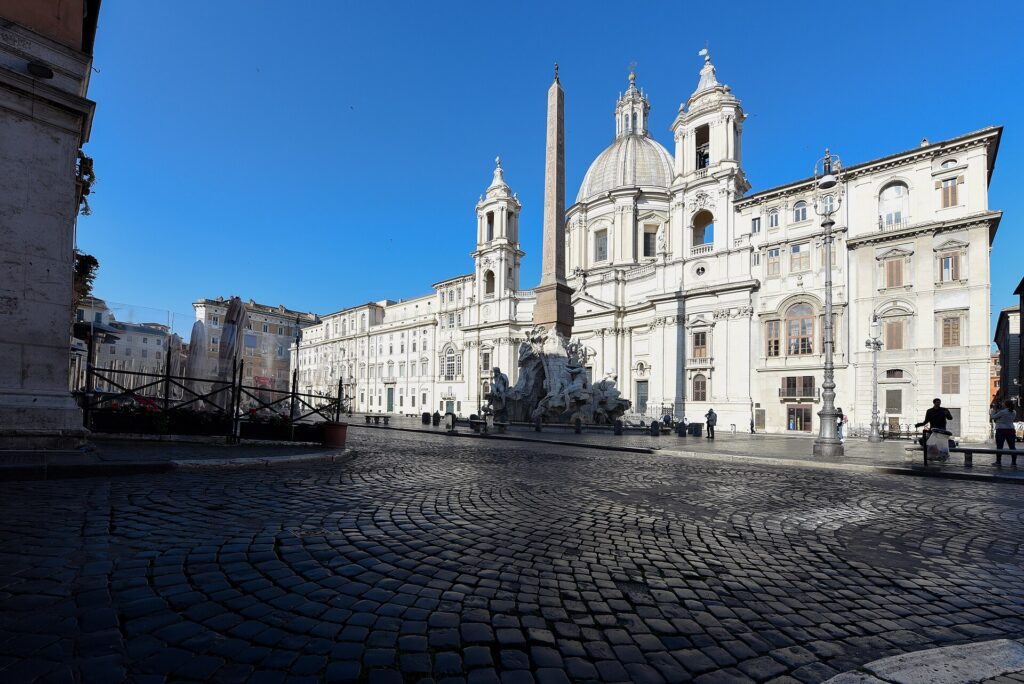
    Piazza Navona in Rome, the Baroque square built on the outline of a Roman stadium
    Piazza Navona, built on the outline of a Roman stadium (Photo: Meshari Alawfi via Wikimedia Commons, CC BY 4.0)

    The Vatican: St Peter’s, the Museums and the Sistine Chapel

    Vatican City is a separate state, but it is a twenty-minute walk or a short metro ride from the centre, and it is a full day. St Peter’s Basilica is free to enter, which is why the security queue in the piazza can be long; arrive when it opens in the morning, dress with shoulders and knees covered, and inside, see Michelangelo’s Pietà and Bernini’s baldachin, then climb the dome for the finest view in Rome. The Vatican Museums are the other half of the day: kilometres of galleries that end in the Raphael Rooms and the Sistine Chapel, where Michelangelo’s ceiling and Last Judgment need no introduction. Book a timed ticket on the museums’ own site weeks ahead in high season; the museums are closed on Sundays except the last Sunday of the month, when entry is free and the queue is enormous. Across the river, Castel Sant’Angelo, Hadrian’s mausoleum turned papal fortress, has a spiral ramp, frescoed apartments and a rooftop terrace facing the dome. Papal audiences are held most Wednesday mornings when the Pope is in Rome, and tickets are free through the Prefecture of the Papal Household.
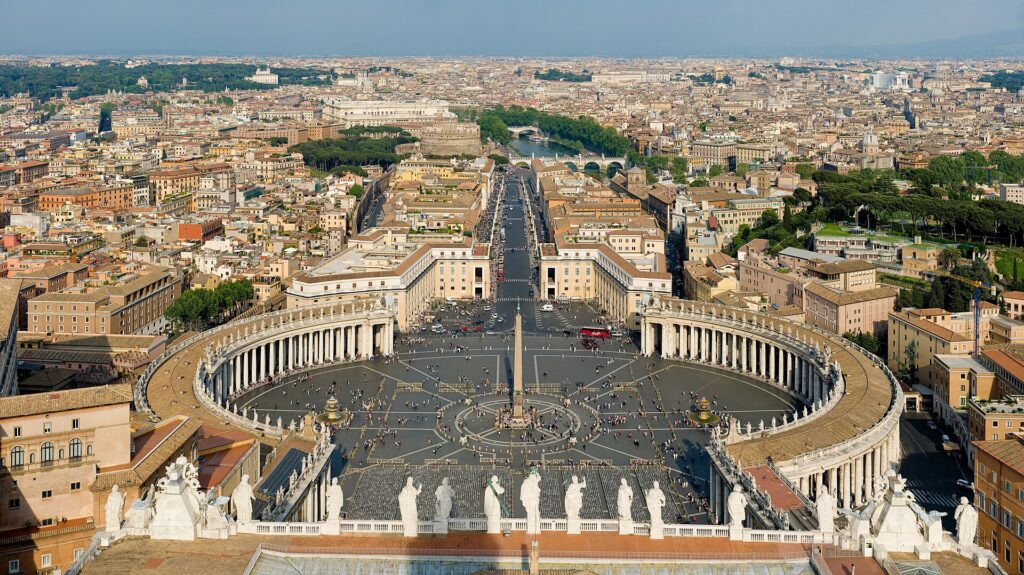
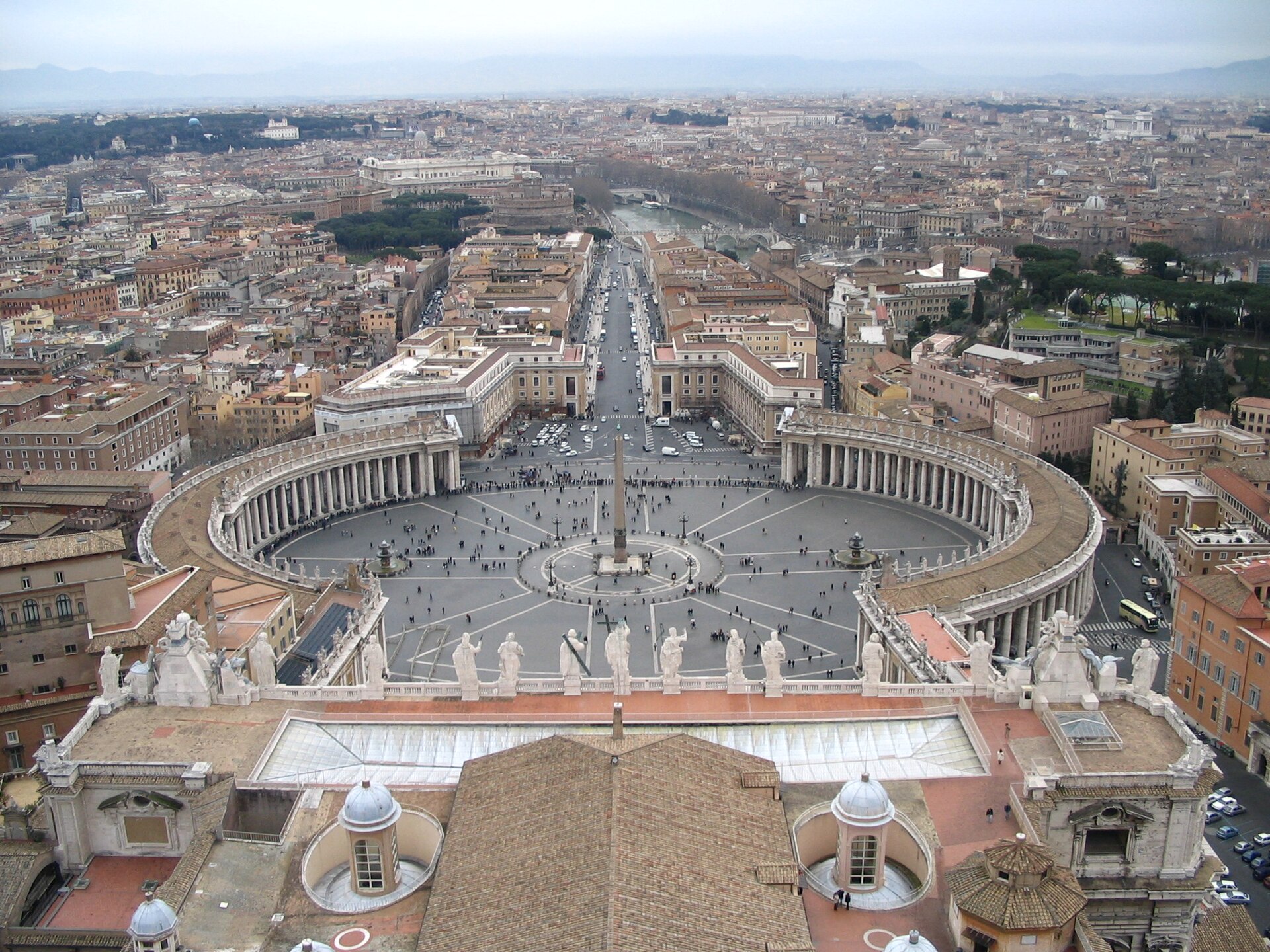
    St Peter's Basilica and St Peter's Square in Vatican City
    St Peter's Basilica: free to enter, and the dome climb is the best view in Rome (Photo: Diliff via Wikimedia Commons, CC BY-SA 3.0)

    Neighbourhoods worth a half-day

    Trastevere

    Across the river from the Ghetto, Trastevere is the neighbourhood people picture when they imagine Rome: cobbled lanes, washing lines, ivy on ochre walls, and the piazza in front of Santa Maria in Trastevere, whose golden mosaics are among the finest in the city. It is quiet in the morning and very lively at night, when the restaurants and bars spill into the streets. Climb the Janiculum hill behind it for the panorama and the noon cannon, and cross the Ponte Sisto footbridge back to the centre.

    Monti

    Tucked between the Forum and Via Nazionale, Monti is the oldest residential quarter in Rome and now its most fashionable small neighbourhood, with wine bars, vintage shops and trattorias around Piazza della Madonna dei Monti. It is two minutes from the Colosseum and feels a world away, and the churches of San Pietro in Vincoli, with Michelangelo’s Moses, and Santa Prassede, with its Byzantine mosaics, are both here.

    Testaccio

    South of the Aventine, working-class Testaccio is the birthplace of Roman cooking: the covered market, the trattorias that built their reputations on the quinto quarto, or fifth quarter, of the animal, the hill of broken amphorae called Monte Testaccio, the Pyramid of Cestius and, beside it, the Non-Catholic Cemetery where Keats and Shelley are buried. It is the best neighbourhood in the city for eating.

    The Aventine

    The hill above Testaccio is residential and calm, and it holds three small pleasures within a hundred metres of each other: the Orange Garden with its view across the river to St Peter’s, the early Christian basilica of Santa Sabina with its carved wooden doors, and the keyhole in the gate of the Knights of Malta, through which the dome is perfectly framed at the end of an avenue of hedges.

    Prati

    The orderly nineteenth-century grid north of the Vatican is where Romans shop on Via Cola di Rienzo, eat at the Mercato Trionfale, one of the city’s largest food markets, and stay away from the crowds. It is the natural base for a Vatican-heavy visit.

    Museums, galleries and culture

    Rome’s museums are as good as any in Europe and, outside the Vatican, far less crowded. The Borghese Gallery, in the park of Villa Borghese, holds Bernini’s Apollo and Daphne and his David, six Caravaggios and a Titian in a villa built to show them off; entry is by timed two-hour slot and must be reserved in advance, and it is the one museum in the city that visitors most regret missing. The Capitoline Museums on the Campidoglio, in the piazza Michelangelo designed, are the oldest public museums in the world, with the bronze she-wolf, the colossal head of Constantine and a window over the Forum. Palazzo Massimo, the main site of the National Roman Museum beside Termini, has the frescoed garden room from the villa of Livia. For the modern city, MAXXI, Zaha Hadid’s museum of twenty-first-century art in Flaminio, and the Auditorium Parco della Musica next to it, Renzo Piano’s three-hall concert complex, are the reasons to leave the centre. For what is on stage during your dates, our Rome events page lists concerts, shows and matches.

    Sports

    Football is the city’s other religion. AS Roma and Lazio share the Stadio Olimpico in the Foro Italico, north of the centre beside the Tiber, and the derby between them, played twice a season, is one of the most intense fixtures in European football. Tickets for Serie A matches are named and sold through the clubs’ own channels, with the buyer’s passport details required, so buy ahead rather than at the turnstile and carry the same ID to the match. The same stadium hosts Italy’s home games in the Six Nations rugby championship in February and March, when the city fills with visiting fans. In May, the Internazionali d’Italia brings the world’s best tennis players to the clay courts of the Foro Italico, and the ring of marble athletes around the Stadio dei Marmi next door is worth a look even without a ticket. Check what is on sale in Rome for your dates before you book flights.

    What to eat, and where

    Roman cooking is simple, specific and fiercely local. The four pastas are cacio e pepe, carbonara, amatriciana and gricia, all built on pecorino, black pepper and, in three of the four, cured pork jowl; order at least two over the trip and you will understand why Romans argue about them. Carciofi alla giudia, artichokes fried until the leaves crisp like petals, are the dish of the Ghetto and are in season from late winter to spring. Supplì, fried rice croquettes with a heart of mozzarella, are the city’s street snack, and pizza al taglio, sold by the slice and weighed, is the lunch; Roman round pizza, thin and crisp, is a dinner dish and most pizzerias only fire their ovens in the evening. Testaccio is the place for offal and oxtail, Trastevere and Monti for a classic trattoria dinner, the Ghetto for Roman-Jewish cooking. Coffee is drunk standing at the bar, quickly, and costs a fraction of the table price; a maritozzo, a sweet bun split and filled with whipped cream, is the proper breakfast pastry. For gelato, trust the shops with covered metal tubs over the fluorescent mountains. Dinner starts late, rarely before half past seven, and a Roman evening is properly begun with an aperitivo in a piazza.

    Rome through the seasons

    Rome is a different city in each season, and what you do depends on when you come. Spring (March to May) is the classic season: wisteria on the walls, azaleas on the Spanish Steps in late April, the Forum green, Holy Week and Easter drawing pilgrims to the Vatican, and the city’s birthday on 21 April. It is also the most crowded, and the most expensive for hotels. Summer (June to August) is hot, often above 35 °C in July and August, but the city adapts: open-air cinema and concerts fill the parks, the opera moves to the Baths of Caracalla, and Romans leave town around Ferragosto on 15 August, when many family restaurants close. Sightsee early, siesta through the afternoon, and eat late. Autumn (September to November) is the Romans’ favourite: warm, golden light, the ottobrata, the run of fine October days the city is known for, the Rome Film Fest, and, by November, rain and the year’s lowest hotel rates. Winter (December to February) is mild by northern standards, damp, and quiet outside the holidays: nativity scenes in every church, the Christmas market in Piazza Navona, the Pope’s Christmas blessing, the Befana on 6 January, then six weeks of the emptiest museums of the year. Our month-by-month guide has the fare patterns that go with each season.

    Parks, views and the Appian Way

    Villa Borghese is the city’s central park, a landscaped estate above the Spanish Steps with rowing boats, bikes for hire, the Bioparco zoo and the Pincio terrace at its western edge, which gives the classic sunset view over Piazza del Popolo to the dome of St Peter’s. The Janiculum above Trastevere is the other great viewpoint, and the Vittoriano, the enormous white monument on Piazza Venezia, has a lift to a rooftop terrace that puts you in the middle of the skyline. South of the walls, the Appia Antica regional park preserves the first miles of the Roman road that ran to the heel of Italy: basalt paving, cypresses, the catacombs of San Callisto and San Sebastiano, and the tomb of Cecilia Metella. The road is closed to traffic on Sundays and holidays, when hiring a bike at the park’s visitor centre and riding out along the stones is one of the best half-days in Rome. The 118 bus runs out along it from the Circus Maximus.
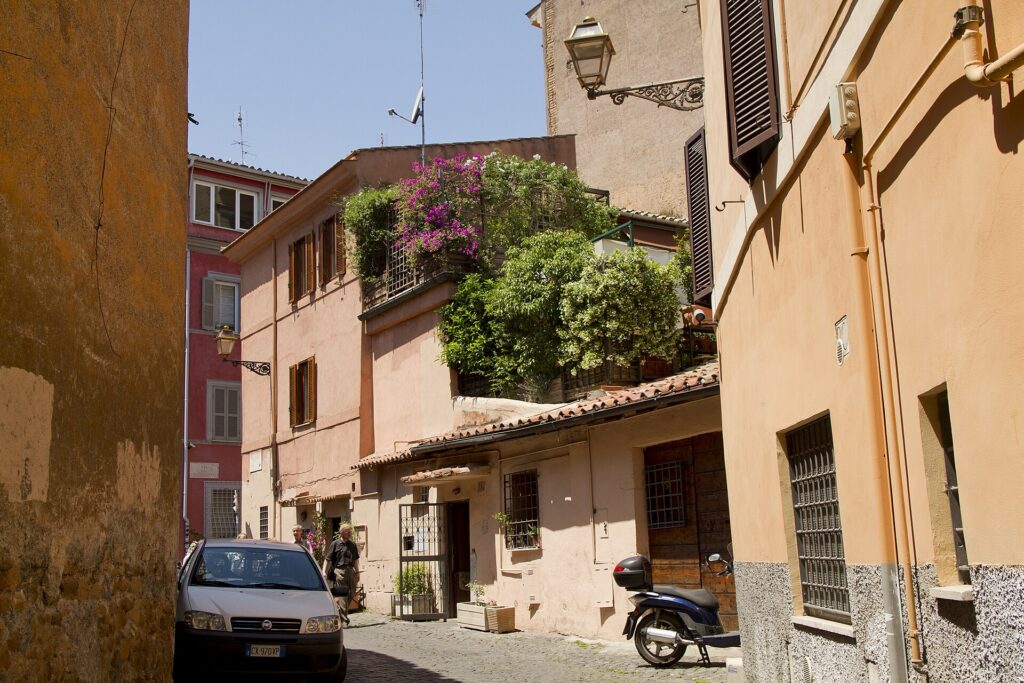
    A narrow street in the Trastevere neighbourhood of Rome
    Trastevere, quiet in the morning and the liveliest neighbourhood in Rome at night (Photo: trolvag via Wikimedia Commons, CC BY-SA 3.0)

    Rome with kids

    Rome is easier with children than its reputation suggests, provided you keep the museum hours short. The Colosseum is the obvious hit, and the underground and arena-floor tours are worth the extra for older kids; the Bocca della Verità, the stone face that supposedly bites liars’ hands, takes ten minutes. Villa Borghese, with its boats, bikes, zoo and puppet theatre, is the full afternoon; Explora, the children’s museum near Piazza del Popolo, suits the under-tens. The catacombs on the Appia Antica are agreeably spooky, Castel Sant’Angelo is a real castle with cannons, and the Vatican dome climb is a genuine adventure for anyone over about eight. Gelato solves most disputes. In summer, the beach at Ostia is half an hour away on the train from Piramide. Strollers cope badly with the cobbles; bring a carrier.

    Rome on a budget

    An extraordinary amount of Rome is free: every church, including St Peter’s; the Pantheon for children and residents and for a small fee for everyone else; the Forum from the pavement of Via dei Fori Imperiali; the fountains, the piazzas, the Spanish Steps, the Pincio, the Janiculum and the Orange Garden; and the nasoni, the cast-iron street fountains that pour cold drinking water on nearly every block, so nobody needs to buy a bottle. State museums, including the Colosseum park, the Borghese and Palazzo Massimo, are free on the first Sunday of each month, and the Vatican Museums on the last Sunday; both come with queues to match. The Roma Pass bundles transit with museum entries and can pay off on a short, busy stay. Drink coffee at the bar, lunch on pizza al taglio, and order the house wine. The hotel tourist tax, charged per person per night, is unavoidable. Compare rates by neighbourhood on our Rome hotel search, and remember that Prati, Testaccio and the streets around Termini are consistently cheaper than the Centro Storico for the same standard of room.

    Day trips from Rome

    Rome’s rail hub makes it the easiest base in Italy for day trips, and almost none of them need a car. Ostia Antica, the excavated port city at the mouth of the Tiber, is a Pompeii without the crowds, half an hour from Piramide on the Metromare line. Tivoli, an hour east, has two UNESCO sites: the fountains and terraces of Villa d’Este and the sprawling ruins of Hadrian’s Villa. The Castelli Romani, the hill towns south of the city, are the Romans’ own escape, with Frascati’s white wine and porchetta stalls half an hour away by regional train. Orvieto, on its volcanic plug in Umbria, has the finest Gothic cathedral façade in Italy and is just over an hour by train. High-speed trains run by Trenitalia and Italo put Florence about an hour and a half away and Naples just over an hour, and from Naples the local train continues to Pompeii; both are long but entirely feasible days. A car earns its keep only for the countryside of Tuscia north of Rome and the cliff village of Civita di Bagnoregio; if that is the plan, see our Rome car rental page and pick the car up at the airport or Termini on the day you leave the city. Turismo Roma, the city’s official tourism site, covers the wider region and current events.

    Two sample itineraries

    Three days, on foot

    Day one: the Colosseum at opening, the Forum and the Palatine, lunch in Monti, the Capitoline Museums and the view from the Vittoriano, dinner in Trastevere. Day two: the Vatican Museums on the first slot, St Peter’s and the dome, lunch in Prati, Castel Sant’Angelo, an evening walk from Piazza Navona to the Pantheon and the Trevi Fountain after dark. Day three: the Borghese Gallery on a reserved slot, a wander through Villa Borghese to the Pincio, the Spanish Steps and the Caravaggios in Santa Maria del Popolo, an afternoon in Testaccio or the Ghetto, and a final dinner of cacio e pepe.

    Five days, with the region

    Add a day for the Appia Antica by bike and the Baths of Caracalla, and a day trip by train to Tivoli, Ostia Antica or Florence, returning to Rome for dinner. Nobody needs a car for any of it.

    Practical details

    • Transit: one ticket covers metro, buses and trams for 100 minutes, with day and multi-day passes available; tap a contactless card at the metro gates or on board. ATAC, the city transit operator, has maps; our transit-versus-car guide goes into detail.
    • From Fiumicino: the Leonardo Express to Termini, the slower FL1 regional train to Trastevere and Ostiense, a fixed-fare white taxi, or an airport bus. Aeroporti di Roma covers both airports.
    • Weather: comfortable shoes for the cobbles, a hat and water in summer, an umbrella from October to March. The Servizio Meteorologico forecast is the official one.
    • Time zone: Central European Time, six hours ahead of Toronto and New York.
    • Entry requirements: Canadian, American, British and most other visa-exempt travellers can spend up to 90 days in any 180 in the Schengen area without a visa, on a passport valid for at least three months beyond the planned departure. The EU’s Entry/Exit System now records non-EU travellers’ fingerprints and photo at the border, and the ETIAS travel authorisation is due to follow; check the official EU travel page for what applies to you before you travel.
    • Safety: violent crime is rare; pickpocketing on the 64 bus, on Metro line A and around Termini is not. Keep bags closed and in front of you in crowds.
    • Dress: shoulders and knees covered inside St Peter’s and the major basilicas, for everyone.

    Frequently asked questions

    How many days do you need in Rome?

    Three full days covers the ancient centre, the Vatican, the Borghese and two neighbourhoods without rushing; five lets you add the Appia Antica, Ostia Antica or Tivoli and a slow afternoon or two.

    What is the number one thing to do in Rome?

    The Colosseum and the Forum on a first morning, then the Pantheon. If you can only book one thing, book the Borghese Gallery.

    Is Rome walkable?

    Entirely, within the historic centre. The Vatican, the Colosseum and Trastevere are all within a 40-minute walk of the Pantheon, and the cobbles reward good shoes.

    Do I need a car in Rome?

    No, and inside the walls it is actively a problem: the historic centre is a camera-enforced limited-traffic zone and parking is scarce. Trains handle nearly every day trip.

    Is Rome expensive?

    Hotels in the centre in spring and autumn are, and the tourist tax adds to every night. Food, coffee, transit and the free churches and piazzas keep the rest of the trip reasonable.

    What is Rome known for?

    The Colosseum, the Vatican, the Pantheon, the fountains and piazzas of the Baroque centre, the four Roman pastas, and two and a half thousand years of history stacked in one walkable city.

    Ready to go? Compare flights to Rome, find a place to stay with our Rome hotel search, and if the countryside is on the list, price a rental car for those days only.

  • Best Time to Fly to Rome: Seasons, Weather & Prices

    Best Time to Fly to Rome: Seasons, Weather & Prices

    Rome has no true off-season, only quieter months and busier ones, and its airfares follow a calendar that is part climate, part Church and part European holiday habit. It is one of the most visited cities in the world, the seat of the Catholic Church, and the capital of a country that takes the whole of August off, which means that seats and hotel rooms are pulled in different directions at different times of year: pilgrims at Easter, tour groups in spring and autumn, North American families in July, Italians leaving the city in August, and Christmas visitors in December. Add a Mediterranean climate that is mild and wet in winter and genuinely hot in high summer, and the “best time” question has several right answers depending on what you want from the trip. This guide walks through the weather month by month, the fare seasons, the holidays and events that move prices, and how to handle the two airports.

    The short answer

    For the best balance of weather, prices and crowds, aim for late April to early June, avoiding Easter week itself, and late September to the end of October, when the heat has broken, the light turns golden and the city is at its most comfortable for walking. The cheapest fares come in January and February, after the Epiphany holiday on 6 January, and in November, when rain and short days keep demand low and hotel rates reach their annual floor. The most expensive stretches are Easter and Holy Week, when pilgrims fill every room near the Vatican, June to August for transatlantic fares, when North American summer travel peaks, and the Christmas and New Year fortnight. August is its own case: flights stay expensive, but the heat and the Roman exodus can soften hotel rates in the city. Whatever you choose, run a flexible-date search on our Rome flights page; a shift of a few days around Easter or a long weekend can change the fare band entirely.

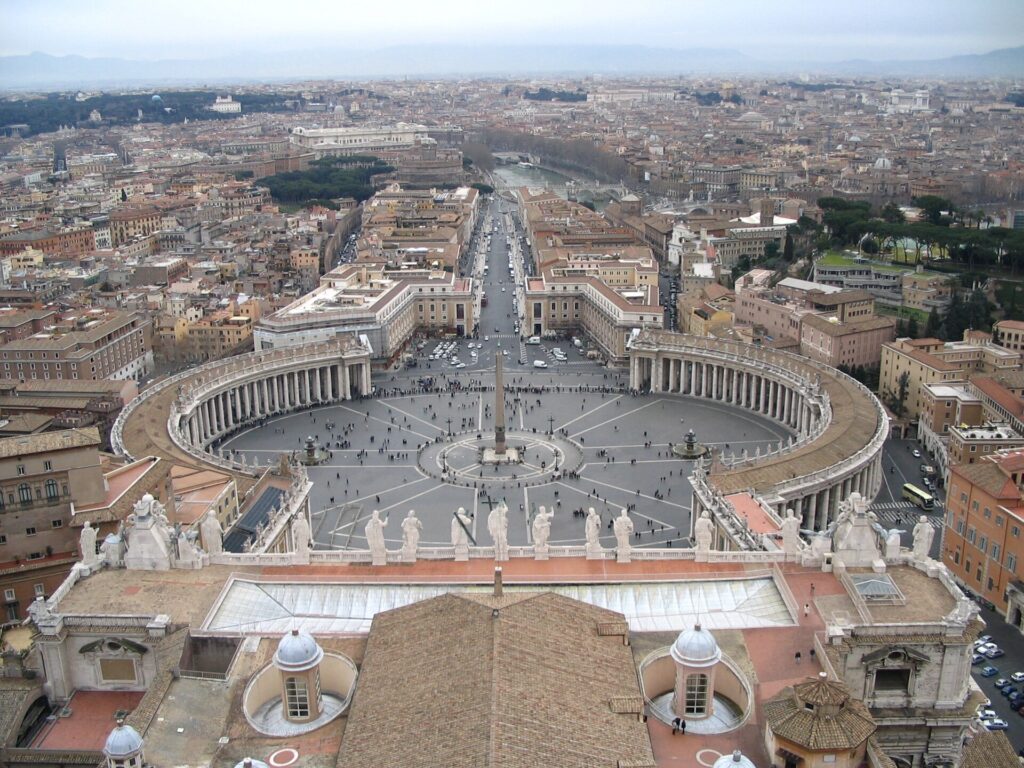
    St Peter's Square in Vatican City seen from the dome of St Peter's Basilica
    St Peter's Square, which fills with pilgrims at Easter, the busiest week of the Roman year (Photo: valyag via Wikimedia Commons, CC BY-SA 3.0)

    Rome’s weather, season by season

    Rome sits about 25 kilometres inland from the Tyrrhenian Sea, in a basin of low hills, and it has a classic Mediterranean climate: hot, dry summers, mild winters with most of the year’s rain, and long, warm shoulders in spring and autumn. Snow is rare enough to make the national news when it happens. The figures below are approximate seasonal patterns based on the long-term climate normals of Italy’s national weather service, the Servizio Meteorologico dell’Aeronautica Militare; check its current forecast before you pack, because a summer heatwave or an autumn storm can move the numbers a long way from the average.

    MonthTypical daytime highTypical overnight lowWhat it feels likeFare pressure
    Januaryaround 12 °Caround 3 °CCool, often sunny, damp in the evenings; occasional frostLow after 6 January
    Februaryaround 13 °Caround 4 °CSimilar, with the first mild days by the end of the monthLow; small rise for Carnival and half-term weeks
    Marcharound 16 °Caround 6 °CChangeable; bright, warm afternoons and showersModerate; high if Easter falls in March
    Aprilaround 19 °Caround 8 °CSpring proper; wisteria and azaleas, some rainy daysHigh, with an Easter spike
    Mayaround 24 °Caround 12 °CWarm and mostly dry; many people’s ideal monthHigh
    Junearound 28 °Caround 16 °CSummer arrives; hot afternoons, long eveningsHigh to peak
    Julyaround 31 °Caround 18 °CHot and dry; heatwaves push well above 35 °CPeak for flights
    Augustaround 31 °Caround 19 °CThe hottest month; Romans leave around FerragostoPeak for flights; city hotels can soften
    Septemberaround 27 °Caround 15 °CStill summer for the first half; the first storms laterHigh
    Octoberaround 22 °Caround 11 °CWarm, golden days between heavy downpoursHigh to moderate
    Novemberaround 16 °Caround 7 °CThe wettest month; mild between the rainLow
    Decemberaround 13 °Caround 4 °CCool, damp and festiveLow until mid-month, then peak

    Three things the table cannot show. First, the summer heat is harder than the numbers suggest: stone streets, little shade in the Forum and the Palatine, and warm nights mean that a 33 °C day in Rome feels more punishing than the same figure at home, and the city now has heatwaves most summers that push the afternoon well past 35 °C. Second, the rain comes in bursts: autumn and winter rain in Rome tends to arrive as heavy downpours that clear within hours rather than steady drizzle, so a wet forecast rarely writes off a whole day. Third, the light: the low, warm light of October and the long evenings of May and June are a large part of why people fall for the city, and they do not show up in any average.

    How Rome’s fare seasons work

    Three calendars drive seats into Rome: the Church, which fills the city at Easter, for major papal ceremonies and for jubilee years; the tourist seasons of spring and autumn, when tour groups, cruise passengers and independent travellers from every continent arrive for the ideal walking weather; and the school and work holidays of North America and Europe, which push transatlantic fares to their annual high in June, July and August. Hotel rates and airfares do not always move together here. Hotels are most expensive in April, May, June, September and October; flights from North America are usually most expensive from mid-June to mid-August; and August can combine high fares with softer hotel rates as the heat keeps some visitors away and Romans head for the coast.

    Peak season

    Easter and Holy Week, late April to the end of June, September and most of October for hotels, plus mid-June to mid-August for transatlantic fares, and roughly 20 December to 6 January. Easter moves each year between late March and late April, and the week before it, with the papal ceremonies in St Peter’s Square, is the single busiest week of the Roman year for hotels near the Vatican and across the centre. Spring weekends when an Italian public holiday creates a long weekend, such as 25 April or 1 May, are also tight. If you must travel in peak, book early, book the Vatican Museums and the Borghese Gallery the moment your dates are fixed, and consider staying in Prati, Testaccio or near Termini rather than the Centro Storico.

    Shoulder season

    March outside Easter, early to mid-November, and the second half of October in most years. March gives you spring flowers and mild afternoons with the risk of showers; late October and early November give you warm days, fewer groups and the new season’s produce in the markets, at the cost of some heavy rain. For many travellers these are the smartest windows of all, since the Vatican queues are shorter and the weather is still good for walking all day.

    Low season

    From 7 January to the end of February, and late November to mid-December. Fares and hotel rates are at their lowest, the museums are at their emptiest, and the weather is cool rather than cold, with plenty of bright days between the rain. The exceptions are the Six Nations rugby weekends in February and March, when Italy’s home matches at the Stadio Olimpico fill hotels with visiting fans, and the European school half-term weeks in February. Pack a warm layer and an umbrella and you will have the Sistine Chapel with a fraction of the summer crowd.

    As elsewhere, mid-week departures and early or late flights usually price below Friday and Sunday afternoons on the same route, and a search across a whole month reveals cheaper pairs of dates close to your first choice. Our guide to the best times to book explains how to read those patterns.

    Rome month by month

    January

    The first week is still holiday season, ending with the Epiphany on 6 January, when the Befana market fills Piazza Navona and families return from the mountains. After that, January is one of the two cheapest months of the year to fly and stay. Days are cool and often clear, nights are chilly, and the queues at the Colosseum and the Vatican Museums are as short as they ever get. The winter sales begin in early January and run for several weeks, which makes it a good month for shopping as well as sightseeing.

    February

    Similar weather with more daylight, and low fares apart from the Six Nations weekends and Carnival, which in Rome is a modest affair of children in costume and confetti in the piazzas rather than the spectacle of Venice. Late-winter produce, including the first Roman artichokes and puntarelle, the bitter chicory salad dressed with anchovy, is in the markets. This is the best value month for a museum-heavy trip.

    March

    Changeable: bright, warm afternoons, cool mornings and a few days of rain. The Rome Marathon closes central streets on a Sunday in March, the Six Nations continues, and fares climb through the month, sharply so if Easter falls early. The artichoke season is at its height, and outdoor tables reappear in the piazzas on sunny days.

    April

    Spring proper, and usually the month of Easter, which brings the Holy Week ceremonies at St Peter’s, the Good Friday Way of the Cross at the Colosseum, and the Easter Sunday blessing in the piazza. The Natale di Roma, the city’s birthday on 21 April, is marked with parades of costumed legionaries near the Circus Maximus, and the Spanish Steps are traditionally decked with azaleas in the second half of the month. Liberation Day on 25 April is a national holiday, and in some years it combines with 1 May to create a long break for Italians. Fares and hotels are high all month.

    May

    For many visitors the ideal month: warm, mostly dry and long. Labour Day on 1 May brings a huge free concert in the piazza in front of St John Lateran, and the Internazionali d’Italia, one of the most important clay-court tennis tournaments in the world, fills the Foro Italico for two weeks. The rose garden on the Aventine opens to the public for the season. Demand is high throughout, especially at weekends.

    June

    Summer arrives, with long evenings and hot afternoons. Republic Day on 2 June brings a military parade along Via dei Fori Imperiali, and the feast of Saints Peter and Paul on 29 June, the patrons of Rome, is a city holiday with a papal Mass. The summer opera season at the Baths of Caracalla begins, open-air cinema and concerts start in the parks, and transatlantic fares move into peak once North American schools finish.

    July

    Hot and dry, with heatwaves most years, and peak season for fares from North America. The city adapts: sightseeing starts at opening time, the afternoon is for a long lunch and a rest, and life resumes in the evening, when the stalls and bars along the Tiber embankments, the Caracalla opera and the outdoor film screenings are in full swing. Book early-morning slots at the Colosseum and the Vatican, carry water and refill it at the nasoni street fountains, and plan indoor visits for the hottest hours.

    August

    The hottest month, and the month Rome empties of Romans. Around Ferragosto, the 15 August holiday, many family-run restaurants, bars and shops close for one to three weeks, and the city takes on a quiet, slightly surreal air, with tourists outnumbering residents in the centre. Flights remain expensive, but hotel rates in the city can ease compared with June and September. Traffic, by contrast, is light, and the museums keep their usual hours. If you come, stay somewhere with good air conditioning and plan a day at the beach at Ostia or a trip to the hills.

    September

    The first half is still summer, with warm evenings and the return of the Romans after the holidays; the second half brings the first autumn storms and the start of the cultural season, with the Romaeuropa festival of music, dance and theatre beginning. Tour groups return in force, and hotel rates climb back to spring levels. Transatlantic fares begin to ease after the first week.

    October

    The Romans’ favourite month, known for the ottobrata, the run of fine, warm days that the city celebrates by eating outside. Heavy rain arrives in bursts, the Rome Film Fest brings premieres and red carpets to the Auditorium Parco della Musica, and the new olive oil and chestnuts appear in the markets. Hotels are still busy, especially at weekends, but fares are lower than in summer.

    November

    The wettest month and, outside the first few days, one of the cheapest. All Saints’ Day on 1 November is a national holiday. The museums are quiet, the rain comes and goes, and mild days between the storms are perfect for walking. Hotel rates reach their annual low in the second half of the month.

    December

    Two months in one. The first half is quiet and good value, with nativity scenes appearing in the churches and the Christmas market opening in Piazza Navona; the Immaculate Conception on 8 December is a public holiday, when the Pope traditionally visits the column in Piazza di Spagna. From about 20 December, fares and hotel rates jump for Christmas, with midnight Mass at St Peter’s and the Pope’s Christmas Day blessing, and they stay high through New Year’s Eve and the Epiphany.

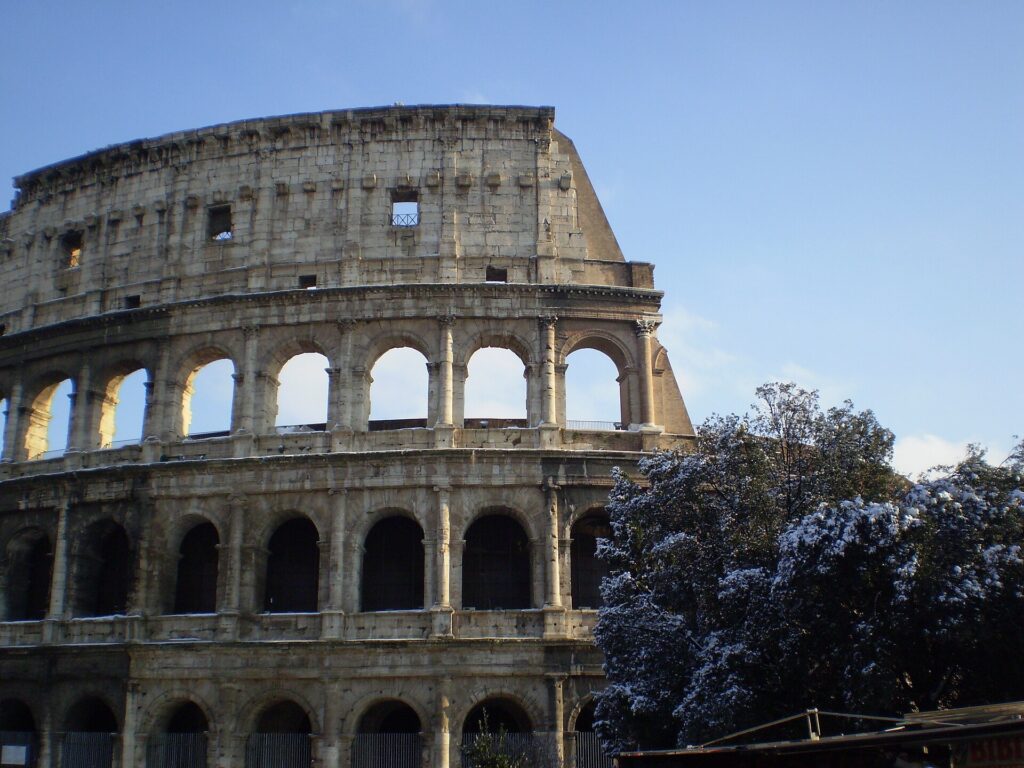
    The Colosseum in Rome with a light covering of snow
    Snow on the Colosseum in February 2012: rare enough in Rome to make the national news (Photo: Barbaking via Wikimedia Commons, CC BY-SA 3.0)

    Events that move Rome flight and hotel prices

    Cross-check these against your dates before you book. Exact dates shift each year; Turismo Roma, the city’s official tourism site, keeps the current calendar, and the Holy See’s site publishes the papal liturgical calendar.

    • Easter and Holy Week (late March to late April): the biggest hotel spike of the year, especially near the Vatican.
    • Six Nations rugby (February and March): Italy’s home weekends at the Stadio Olimpico.
    • Rome Marathon (a Sunday in March).
    • Natale di Roma, Liberation Day and Labour Day (21 April, 25 April, 1 May): a run of holidays that can create long weekends for Italians.
    • Internazionali d’Italia (two weeks in May) at the Foro Italico.
    • Republic Day and Saints Peter and Paul (2 June and 29 June).
    • Ferragosto (15 August): quieter city, busier coast and roads.
    • Rome Film Fest (October) and the autumn trade fairs and congresses, which can fill hotels mid-week.
    • Christmas to Epiphany (roughly 20 December to 6 January).
    • Serie A football, especially the Roma-Lazio derby, and stadium concerts. Our Rome events page shows what is on sale for your dates.

    Getting in from the airport

    Rome has two airports, both run by Aeroporti di Roma. Leonardo da Vinci, known to everyone as Fiumicino (FCO), about 30 kilometres southwest of the centre near the coast, is Italy’s largest airport and the hub of ITA Airways, with nonstop flights from several North American gateways, including New York, Toronto and Montreal, and from nearly every European capital. Ciampino (CIA), about 15 kilometres southeast, is smaller and handles mostly low-cost European airlines. From Fiumicino, the Leonardo Express train runs nonstop to Termini station in around half an hour, and the slower, cheaper FL1 regional line stops at Trastevere, Ostiense and Tiburtina, which suits many hotels better; tickets for both are sold by Trenitalia at the station and online. Licensed white taxis charge a fixed fare from Fiumicino to anywhere inside the Aurelian Walls, and several coach companies run cheaper, slower buses to Termini. From Ciampino, buses run to Termini and to the nearest metro and rail stations. Rental desks are at both airports, though for a city stay you will not want a car. Our Rome car-versus-transit guide covers that decision, and our Fiumicino airport guide covers the layout.

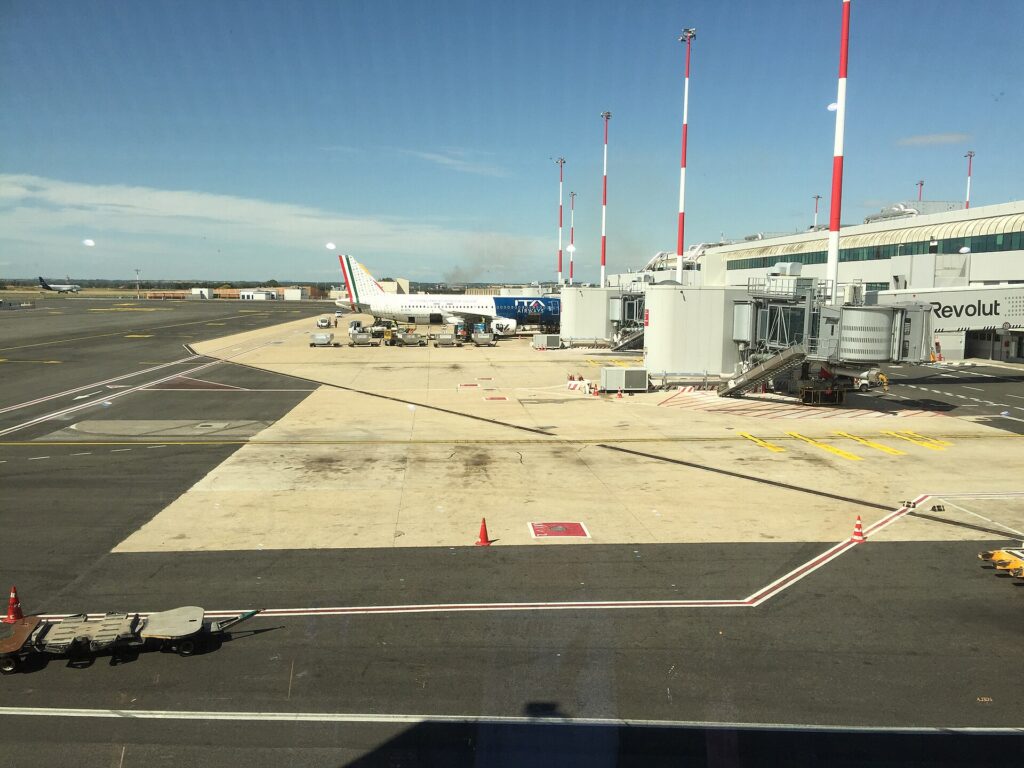
    Aircraft at the gates of Rome Fiumicino airport seen from the terminal
    Rome Fiumicino (FCO), Italy's largest airport, half an hour from Termini by train (Photo: Air fans via Wikimedia Commons, CC0)

    Timing tricks that work for Rome

    • Search the whole month. Easter, the spring holidays and Christmas create sharp edges in the fare calendar. A calendar search on TicketScanner shows them instantly, and the week after Easter is often far cheaper than the week before it.
    • Book the hotel first around Easter. A cheap fare into Holy Week is not cheap once the room is added. Run a Rome hotel search for the same dates before you commit to either.
    • Fly mid-week. Tuesday to Thursday departures are usually the value on transatlantic routes, and Saturday nights in Rome rarely cost more than weekday ones outside the peaks.
    • Consider an open jaw. Many travellers combine Rome with another European city. Flying into Rome and home from Paris or London, or the reverse, can price close to a return and saves a backtrack; our guide to choosing between England, Italy and France helps with the itinerary.
    • Check Ciampino for European hops. If you are arriving from elsewhere in Europe on a low-cost airline, Ciampino may be cheaper, though the transfer into the city is slower.
    • Watch for strikes. Italian transport strikes are announced in advance, and air strikes protect certain morning and evening time bands, but a strike day can still disrupt connections and trains. Allow a buffer, and read our guide to how early to arrive for international departures.
    • Flying out of Rome instead? The same seasonality applies in reverse; see cheap flights from Rome.
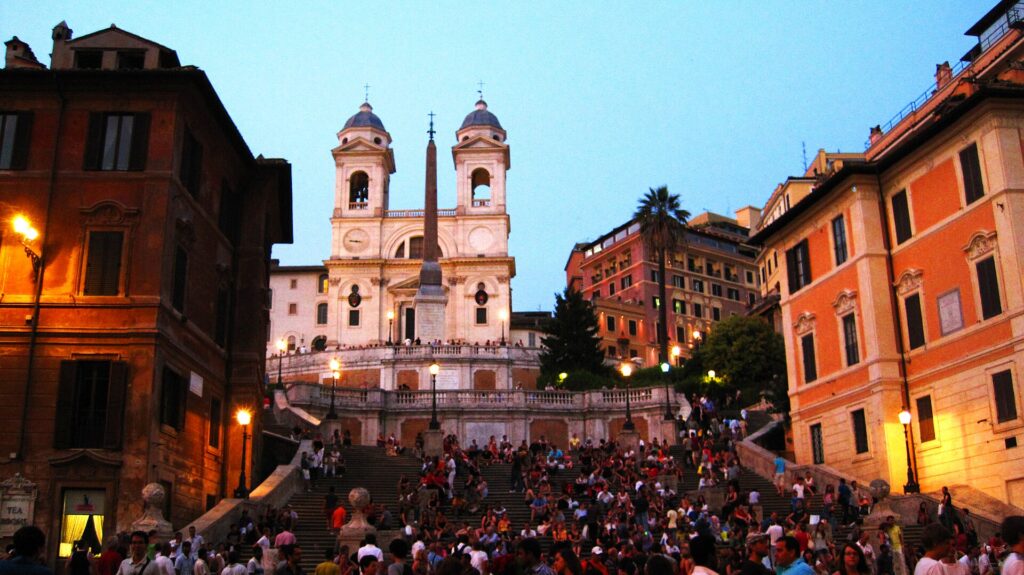
    The Spanish Steps in Rome at dusk seen from the Barcaccia fountain
    The Spanish Steps at dusk: in summer, Rome comes alive after the heat of the afternoon (Photo: Eebyrne via Wikimedia Commons, CC BY 3.0)

    What to pack, by season

    Winter (December to February): a warm coat or a padded jacket, layers for heated interiors, a compact umbrella and waterproof shoes for the cobbles, which turn slippery in the rain. Spring (March to May): layers, a light jacket for the evenings and an umbrella for March and April showers. Summer (June to August): light, breathable clothing, a hat, sunscreen and a refillable water bottle, plus a scarf or light layer to cover shoulders in churches, since the dress code at St Peter’s and the major basilicas applies whatever the temperature. Autumn (September to November): summer clothes for September, layers and a rain jacket for October and November. In every season, the single most important item is a pair of comfortable, broken-in walking shoes; a typical day in Rome is fifteen to twenty thousand steps on stone.

    The best time to fly to Rome for…

    Easter and the Vatican

    Holy Week, booked as early as possible, with the hotel first and papal ceremony tickets requested well ahead. For the Vatican without the crowds, January, February and November.

    Walking weather

    Late April to early June and the last week of September through October: warm enough to eat outside, cool enough to walk all day.

    The lowest fares

    Mid-January to the end of February and the second half of November, outside the rugby weekends.

    Food

    February to April for Roman artichokes and spring lamb; October and November for new olive oil, chestnuts and mushrooms.

    Families

    Late June, before the worst of the heat, or the October half-term weeks, when the weather is still warm and the queues are shorter than in summer.

    International visitors

    Canadian, American and British citizens can spend up to 90 days in any 180 in the Schengen area without a visa, on a passport valid for at least three months beyond the planned departure. The EU’s Entry/Exit System now records non-EU travellers’ fingerprints and photo at the border, and the ETIAS travel authorisation is due to follow; the official EU travel page explains what applies to you.

    Frequently asked questions

    What is the cheapest month to fly to Rome?

    January after the Epiphany and February are consistently the lowest, followed by November and the first half of December.

    What is the best month to visit Rome for weather?

    May and October, with late April, early June and late September close behind. July and August are hot; November is the wettest month.

    Is August a bad time to visit Rome?

    It is hot, and many family restaurants close around Ferragosto, but the city is quieter, traffic is light and hotel rates can be lower than in June. Plan early mornings and late evenings and it works.

    How expensive is Rome at Easter?

    Very: Holy Week is the most expensive week of the year for hotels near the Vatican and in the centre, and flights rise too. The week after Easter is noticeably cheaper.

    Should I fly into Fiumicino or Ciampino?

    Fiumicino for flights from North America and most full-service airlines, with the train to Termini. Ciampino only if a low-cost European fare is much cheaper, since the transfer is by bus.

    How far ahead should I book flights to Rome?

    Earlier for Easter, June to August and Christmas, when fares tend only to rise; for January, February and November, fares are stable enough that finding the right dates matters more.

    Does it snow in Rome?

    Rarely. A light snowfall happens every few years and is a news event when it settles; most winter days are cool and bright, or cool and wet.

    Ready to pick your dates? Compare fares across the whole month on our Rome flights page, then find a room with our Rome hotel search. For what to do when you land, start with our first-timer’s guide to Rome.

  • Rome: Car Rental or Public Transit?

    Rome: Car Rental or Public Transit?

    Rome is the easiest decision in this series: for a stay in the city itself, do not rent a car. The historic centre is a camera-enforced limited-traffic zone that will fine a rental car automatically, parking is scarce and confusing, the traffic is a sport the locals have been practising since childhood, and the sights are closer together than most visitors expect, so walking is not only possible but the best way to see the place. What Rome does have is cheap if imperfect transit, licensed taxis with fixed airport fares, and one of Europe’s best rail hubs for day trips. The car question only becomes real when your plans leave the city: a road trip through Tuscany or Umbria, a few days in a farmhouse in the hills, or the small towns of the countryside north of Rome that the trains do not reach. This guide explains how the city is laid out, how transit and tickets work, what driving here is really like, how the limited-traffic zones catch visitors out, and gives you a straightforward way to decide.

    The short answer

    Skip the car for any stay in Rome itself: the Colosseum, the Vatican, the Pantheon, Trastevere, Monti and the Borghese are all walkable from each other, and the metro, buses, trams and taxis cover the rest. Take the train for the classic day trips, Florence, Naples, Pompeii, Orvieto, Tivoli, Ostia Antica and the Castelli Romani, all of which are well served by rail. Rent a car only for the days when you are leaving Rome for the countryside: a Tuscany or Umbria road trip, the hill towns and lakes of Tuscia to the north, the beaches and villages along the southern coast, or a rural stay where the nearest station is miles away. Even then, pick it up on the day you leave the city, not the day you arrive. Compare rental rates for those days on our Rome car rental page.

    How Rome is laid out

    The Rome that visitors come to see is small. The historic centre sits in a bend of the Tiber, mostly inside the Aurelian Walls that the emperors built in the third century, and a brisk walk across it from the Vatican in the west to Termini station in the east takes about an hour. The Centro Storico, with the Pantheon, Piazza Navona and the Trevi Fountain, fills the bend of the river; the ancient centre, with the Colosseum, the Forum and the Palatine, lies to its southeast; Monti sits between the Forum and Termini; and Trastevere, the Vatican and the orderly grid of Prati are across the river on the west bank. Testaccio and the Aventine are to the south. Beyond the walls, the city sprawls for kilometres to the Grande Raccordo Anulare, the motorway ring road known as the GRA, and the airports lie outside it, Fiumicino to the southwest near the coast and Ciampino to the southeast.

    Hotels cluster in the Centro Storico, around Termini for budget and trains, in Trastevere for the evenings, in Monti near the Forum, and in Prati for the Vatican and a calmer residential feel. Our Rome hotel search lets you compare them.

    Getting in from the airport

    Fiumicino (FCO), Rome’s main airport, is about 30 kilometres from the centre and has its own railway station a short walk from arrivals. The Leonardo Express runs nonstop to Termini in around half an hour, every 15 to 30 minutes through the day; the FL1 regional train is cheaper and slower and stops at Trastevere, Ostiense and Tiburtina, which can leave you closer to your hotel. Buy tickets from the machines or the Trenitalia app, and if you have a paper ticket for the FL1, validate it before boarding. Licensed white taxis charge a fixed fare from Fiumicino to any address inside the Aurelian Walls, displayed on the taxi door and at the rank; use only the official rank outside arrivals and ignore anyone offering a ride inside the terminal. Coach companies run cheaper buses to Termini. Ciampino (CIA), about 15 kilometres southeast, has no rail link of its own; buses run to Termini and to the nearest metro and train stations, and taxis charge a fixed fare into the centre. The rental companies have counters at both airports. Aeroporti di Roma has current ground-transport details, and our Fiumicino airport guide covers the layout.

    Rome’s transit, explained

    ATAC, the city transport company, runs the metro, buses and trams. Romans complain about it, and it is sometimes crowded, late or on strike, but for a visitor it is cheap and covers every sight you are likely to want. Its main limitation is that the metro skirts the historic centre rather than crossing it, because every attempt to dig a tunnel through Rome runs into archaeology.

    The metro

    Three lines. Line A runs from the northwest to the southeast and is the one visitors use most: Ottaviano for the Vatican, Flaminio for Piazza del Popolo, Spagna for the Spanish Steps, Barberini for the Trevi Fountain, Repubblica, Termini and San Giovanni. Line B crosses it at Termini and runs south past Cavour for Monti, Colosseo, Circo Massimo and Piramide for Testaccio and the Ostia trains, to EUR; a branch, B1, splits off to the northeast. Line C runs in from the eastern suburbs to San Giovanni, where it meets Line A, and is being extended through the centre toward the Colosseum and beyond; check ATAC’s map for which of the new stations have opened when you travel. Trains run from early morning until about 11.30 pm, later on Friday and Saturday nights.

    Buses and trams

    Buses fill the gaps the metro leaves, and several routes are essentially tourist lines. The 40 and the 64 run from Termini along Via Nazionale to Piazza Venezia, Largo Argentina and the Vatican; the 64 is famously crowded and famously worked by pickpockets. The H bus links Termini with Trastevere. The number 8 tram runs from near Piazza Venezia across the river through Trastevere and is the easiest way into that neighbourhood from the centre when it is running normally; trams 2, 3 and 19 serve Flaminio, the Aventine and the Villa Borghese area. Night buses, marked with an N, run on the main corridors after the metro closes. At rush hour, walking is often faster.

    Fares and tickets

    A standard ticket, the BIT, is valid for 100 minutes on buses and trams, with one metro journey included, and there are 24-hour, 48-hour and 72-hour passes and a weekly ticket. The simplest option for most visitors is to tap a contactless bank card or phone at the metro gates and on the readers aboard buses and trams, using the same card each time. Paper tickets are sold at tobacconists, newsstands and station machines and must be validated on first use, in the gate or in the machine on board; inspectors do check, and the on-the-spot fine is far more than a week of tickets. Check ATAC’s site for current fares before you go.

    Accessibility

    Accessibility is improving but uneven: newer stations have lifts, several older Line A stations do not, and most buses and trams are low-floor. The bigger obstacle is the city itself: cobbles, narrow pavements and steps make the historic centre hard going for wheelchairs and strollers, and taxis are often the practical answer.

    Beyond ATAC

    • Walking. The best way to see Rome, by a long way. The Pantheon is within a 40-minute walk of the Colosseum, the Vatican, Trastevere and the Spanish Steps, and the walks between them are where you find the city. Bring shoes that can handle fifteen kilometres of stone a day.
    • Taxis. Licensed Rome taxis are white, with a roof sign and a licence number on the door. Find them at ranks in the main piazzas and at the stations, or book through an app such as itTaxi or FreeNow; hailing one in the street rarely works. Uber operates mainly as a booking app for licensed taxis and private-hire cars rather than as a cheap alternative.
    • Bikes and e-scooters. Shared e-bikes and e-scooters are available across much of the city through the usual apps. They are handy along the Tiber cycle path and in Villa Borghese and the flatter neighbourhoods; on the cobbles, the hills and in the traffic around Piazza Venezia they take nerve. Italy has tightened its e-scooter rules, and helmets are now compulsory.
    • Regional trains. Trenitalia’s regional lines run from Termini, Tiburtina and Ostiense to Tivoli, Frascati and the Castelli Romani, Orvieto and the coast; the Metromare line runs from next to Piramide to Ostia Antica and the beach at Ostia.
    • High-speed trains. Trenitalia and Italo run fast trains from Termini to Florence in about an hour and a half and Naples in just over an hour, which makes both, and Pompeii beyond Naples, practical day trips. Book ahead for the best fares.
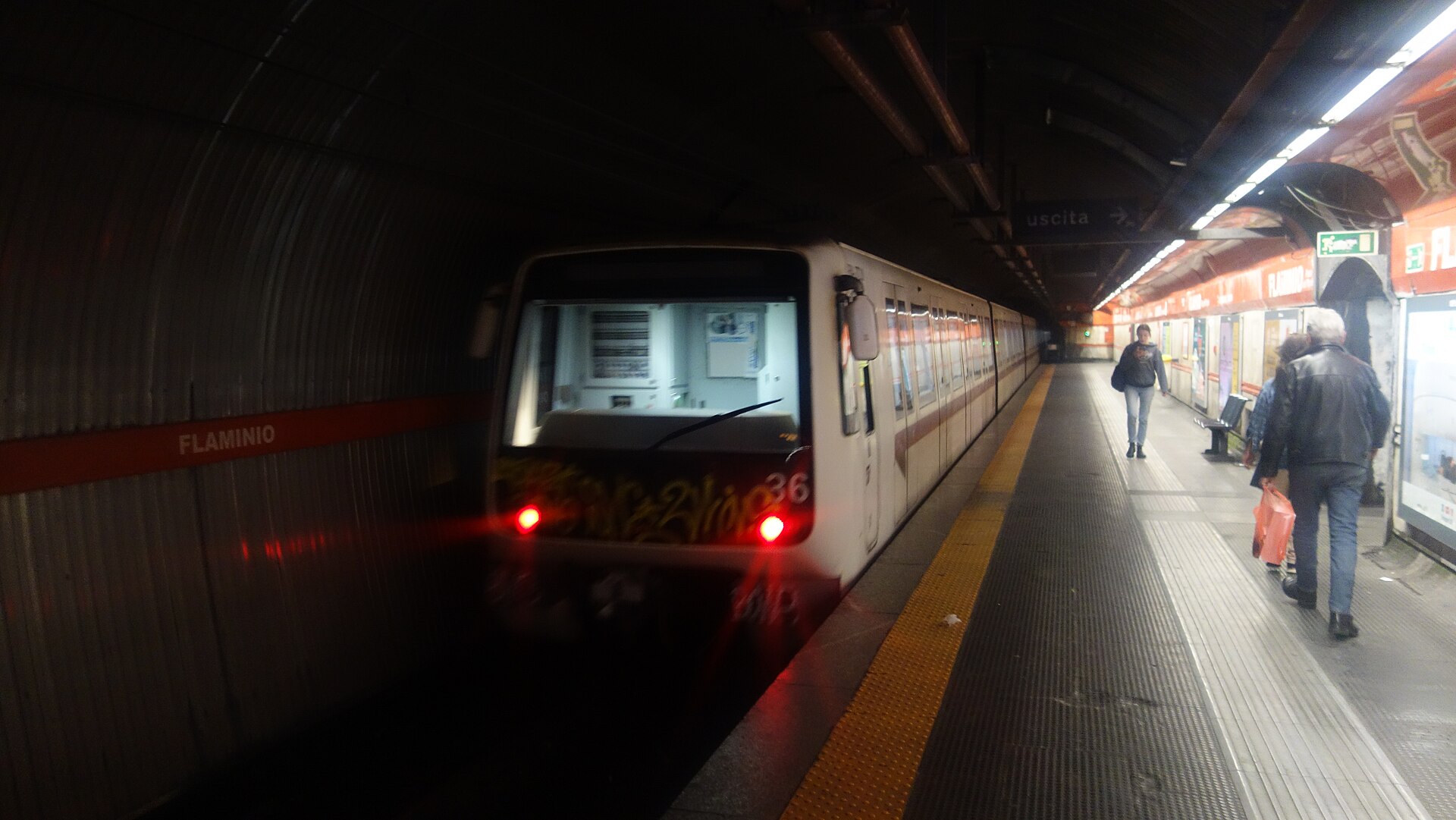
    A Line A metro train arriving at Flaminio station in Rome
    Line A of the Rome Metro at Flaminio, the stop for Piazza del Popolo (Photo: Mint0ri via Wikimedia Commons, CC0)

    Driving in Rome: what it is really like

    Driving in Rome is not dangerous so much as demanding. Lanes are suggestions, scooters fill every gap on both sides of you, horns are a means of communication rather than an insult, and the large piazzas, Piazza Venezia above all, are roundabouts without markings where confidence counts for more than right of way. The locals are skilled and fast and expect you to be the same. The GRA and the roads into the centre jam every weekday morning and evening. None of that is impossible for a confident driver, but two further features make it a genuinely bad idea for visitors: the limited-traffic zones and the parking.

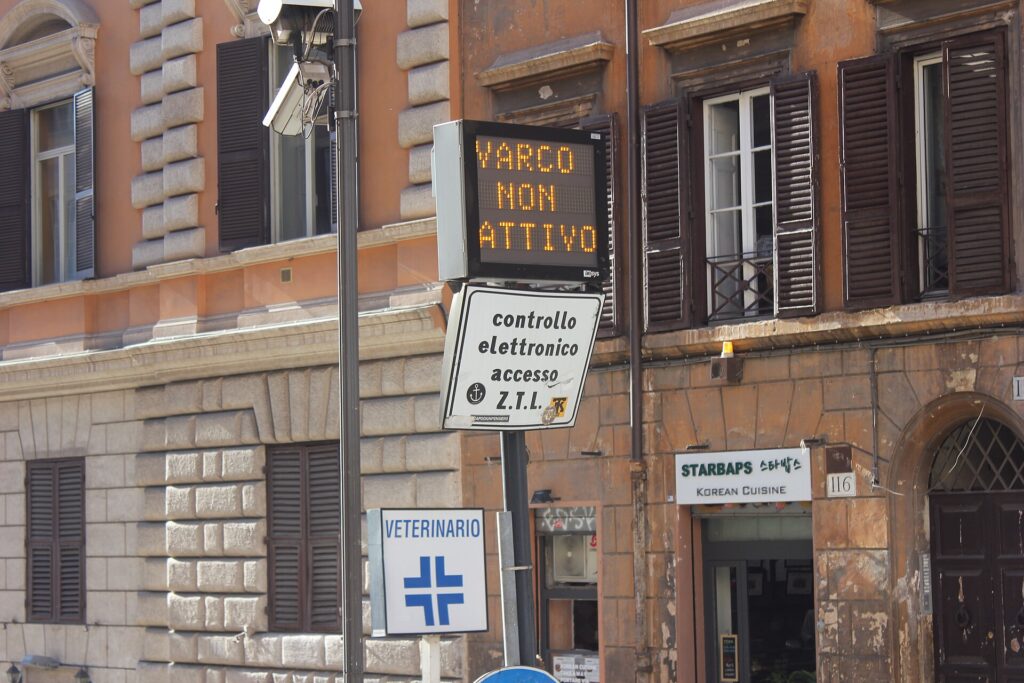
    A limited-traffic zone gate with camera and sign on Via Cavour in Rome
    A ZTL gate on Via Cavour: drive through when it reads varco attivo and the fine follows you home (Photo: CAPTAIN RAJU via Wikimedia Commons, CC BY-SA 4.0)

    The ZTL: the fine you will not see coming

    Most of the historic centre is a Zona a Traffico Limitato, or ZTL, where only residents and permit holders may drive during enforcement hours. The entry points, called varchi, have cameras and an electronic sign that reads “varco attivo” when the zone is being enforced. The main Centro Storico zone is active through the day on weekdays and for much of Saturday, and there are night zones in Trastevere, Testaccio, San Lorenzo and Monti on weekend nights. Drive through an active gate in a rental car and the camera records the plate; months later, the fine arrives through the rental company, which adds its own administration fee for passing on your details, and it is not unusual for a visitor to receive several fines for one confused afternoon. Some hotels inside the zone can register a guest’s plate for access to unload; ask before you arrive, and never assume a satellite navigation app will route you around the zone. Roma Servizi per la Mobilità, the city’s mobility agency, publishes the zones and their hours.

    Parking

    Street parking in Rome follows a colour code. Blue lines mean paid parking, at meters or through parking apps; white lines are free but almost always full; yellow lines are reserved for residents, disabled permit holders or loading, and parking in them risks a fine or a tow. A car left in the wrong place can be towed with impressive speed. There are a few large garages, including under Villa Borghese, and hotel parking in a nearby garage can cost nearly as much per night as the rental itself. In the countryside parking is easier, though usually outside the walls, since most medieval centres have their own ZTL too.

    Rules and conditions worth knowing

    • International Driving Permit. Drivers with a non-EU licence, including Canadian, American and British licence holders, should carry an International Driving Permit alongside their home licence; it is required by Italian law, and you get it at home before you leave.
    • Tolls. The motorways, or autostrade, are tolled. Take a ticket on entry and pay on exit by card or cash, and avoid the yellow Telepass lanes, which are for electronic transponders only. Autostrade per l’Italia publishes routes, tolls and traffic.
    • Speed cameras. Fixed cameras are common, and many motorways use Tutor average-speed cameras over long sections. The motorway limit is 130 km/h, lower in rain.
    • Headlights must be on at all times on motorways and main roads outside built-up areas.
    • No right turn on red. Unlike in North America, a red light means stop, whatever the direction.
    • Drink-driving limits are lower than in most of North America, and zero for drivers with less than three years’ experience.
    • Winter equipment. From 15 November to 15 April, many roads, especially in the Apennines, require winter tyres or snow chains on board where signed; ask the rental company whether the car is equipped if you are heading into the mountains.
    • Fuel. Petrol is benzina and diesel is gasolio; many stations have a cheaper self-service side and a pricier attended side.
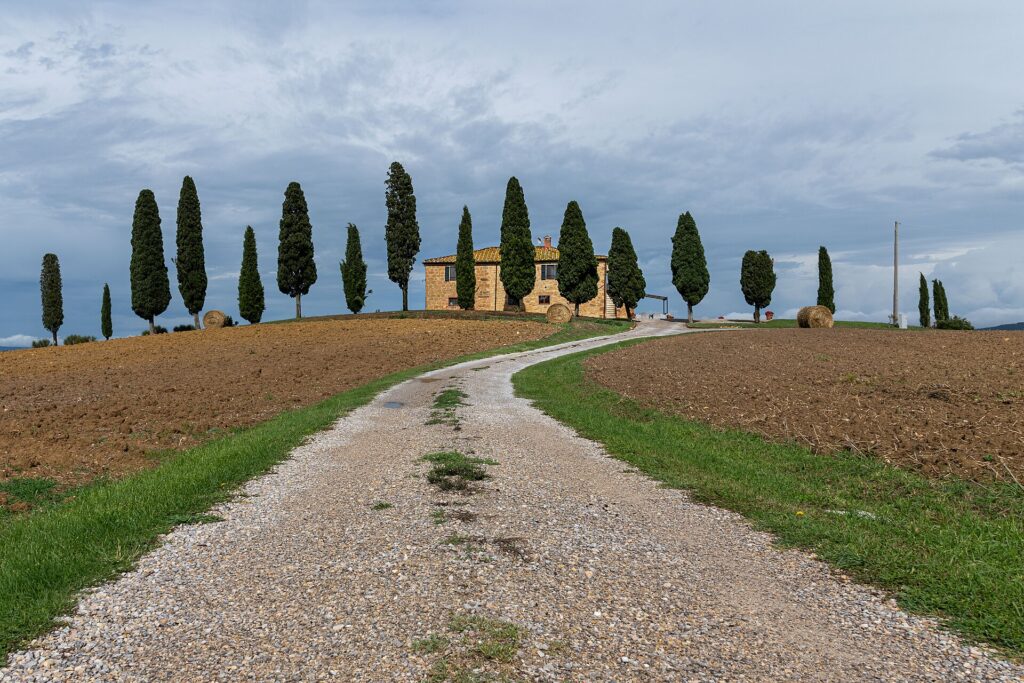
    A country road leading to cypress trees and a farmhouse in the Val d'Orcia, Tuscany
    The Val d'Orcia in southern Tuscany, a little over two hours from Rome and the classic reason to rent (Photo: kuhnmi via Wikimedia Commons, CC BY 2.0)

    When renting a car makes sense

    • A Tuscany or Umbria road trip. The hill towns, vineyards and farmhouse stays of southern Tuscany and Umbria are the classic reason to rent; the A1 motorway puts Orvieto about an hour and a half north and the Val d’Orcia a little over two hours.
    • Tuscia and the lakes. The countryside north of Rome, with Viterbo, Lake Bolsena, Lake Bracciano and the cliff-top village of Civita di Bagnoregio, is poorly served by public transport and rewarding by car.
    • The southern coast. Sperlonga, Sabaudia and the Circeo national park are summer escapes that a car makes simple.
    • Rural stays. An agriturismo in the hills is a wonderful base and almost always car-dependent.
    • Families with luggage leaving Rome. Once you are out of the city, a car solves the logistics of children, bags and small towns.

    If any of those apply, our rental car booking tips cover insurance, deposits and the questions to ask at the counter, and our family car rental guide looks at vehicle choice. Book an automatic well ahead if you need one, since manual transmission is still the default in Italy, and choose the smallest car that fits, because village streets and parking spaces are narrow.

    When it does not

    • You are staying in Rome and your plans are the city: a car will cost you parking and fines and save you nothing.
    • Your day trips are Florence, Naples, Pompeii, Orvieto, Tivoli or Ostia Antica, all easier by train.
    • You are visiting the Amalfi Coast, where the roads are narrow, parking is scarce and the train to Naples or Salerno plus the ferries and buses is the better plan.
    • You are in town for Easter, a papal event or a big match, when traffic and closures around the Vatican and the Stadio Olimpico make driving pointless.

    The hybrid plan for a city-plus-countryside trip

    Go car-free for the Rome days and rent only for the countryside, and think carefully about where you pick up. The best place to collect a car for a road trip is usually Fiumicino airport, even if you are not flying that day: it sits outside the city with direct access to the motorway network, so you never have to drive through the centre or near a ZTL gate, and the Leonardo Express or the FL1 gets you there from Termini or Trastevere in half an hour. The rental offices around Termini are closer to most hotels, but driving out of the station area means navigating some of the busiest streets in Rome. A pattern that works well: arrive at Fiumicino, take the train into the city, spend three or four car-free days in Rome, take the train back out to the airport to collect a car, drive north into Tuscany or Umbria, and either return to Fiumicino for the flight home or drop the car in Florence and continue by train, if the one-way fee is reasonable. Compare the day rates on our Rome car rental page against a full-trip rental and the difference is usually obvious.

    A worked cost comparison

    Numbers change with the season and the booking window, so treat this as a method rather than a quote, and check current rates before deciding. For a four-night city break for two people, the car-free version costs two train tickets each way to the airport or one fixed-fare taxi, a couple of 72-hour transit passes or a few days of contactless fares, and perhaps two or three taxi rides at night; the rental version adds four days of a compact car, four nights of garage parking at central rates, fuel, and the very real risk of a ZTL fine arriving months later with an administration fee on top. The transit option wins by a wide margin. For the same four nights plus a day trip to Florence, the high-speed train, booked ahead, gets two people there and back faster and with less stress than the three-hour drive each way, and avoids Florence’s ZTL too. For a week split between Rome and a Tuscan farmhouse, the hybrid plan is the clear winner: four car-free days in Rome, then a rental collected at Fiumicino for the countryside days only. Run the rental rates for your dates on our Rome car rental page and put them beside the train fares before you choose.

    Driving out of Rome in each season

    Once you are past the GRA, driving in central Italy is a pleasure: good motorways, beautiful secondary roads and towns worth stopping in every half hour. The seasons still shape the experience. In summer, the problem is the exodus: on the weekends of late July and early August, and around Ferragosto on 15 August, the motorways out of Rome and the coast roads to the beaches carry what Italians call the esodo, and the Sunday evening return can double journey times. Leave early, travel mid-week, and never leave anything visible in a parked car. In autumn, the heavy rains of October and November can flood underpasses and turn the GRA into a crawl, but the countryside is at its best for the harvest and the vineyards. In winter, the lowlands are mild, but the Apennines east of Rome get real snow, and the winter-equipment rule from 15 November to 15 April applies on the mountain roads. In spring, the roads are at their most pleasant, with the exception of Easter and the long weekends around 25 April and 1 May, when Romans head for the country in large numbers. In every season, the last few kilometres into a hill town are the ones to watch: the old centres are almost always ZTLs, so park outside the walls and walk in.

    Decision table

    Your tripRecommendationWhy
    City break in Rome, couple or soloNo carWalking, the metro and taxis cover it; parking and ZTL fines are real costs
    Easter, papal events or a big matchNo carClosures and crowds around the Vatican and the Olimpico
    Day trips to Florence, Naples or PompeiiTrainHigh-speed rail is faster than driving and avoids city-centre parking
    Tivoli, Ostia Antica, Orvieto, FrascatiTrainRegional trains and the Metromare serve them directly
    Rome plus a Tuscany or Umbria road tripHybrid: rent at Fiumicino for the countryside daysCar-free city days, easy motorway access from the airport
    Tuscia, the lakes, Civita di BagnoregioOne or two days’ rentalPoor public transport, easy driving
    Farmhouse or villa stayRent for the rural daysMost agriturismi are car-dependent
    Amalfi Coast from RomeTrain to Naples or Salerno, then ferry or busNarrow roads and scarce parking on the coast

    Money-saving tips for both options

    • On transit: tap the same contactless card every time, buy a 48-hour or 72-hour pass for heavy sightseeing days, and walk whenever the distance is under two kilometres, which in the centre is most of the time.
    • At the airport: the FL1 is much cheaper than the Leonardo Express for one or two people; for three or four with luggage, the fixed-fare taxi can be the better deal.
    • On a rental: pick up at Fiumicino on the day you leave Rome, book an automatic early if you need one, carry your International Driving Permit, decline extras you already have through a credit card or home policy (check first), and photograph the car at pickup and return.
    • On fines: learn to recognise the ZTL signs and the “varco attivo” display, and keep to the speed limits on Tutor-monitored motorways; either mistake can cost more than the rental.
    • On timing: avoid the GRA at rush hour and the motorways on summer Saturdays and Sunday evenings; the best time to fly to Rome guide lists the busiest holidays, and our guide to car, transit or taxi in a new city covers the wider trade-offs.

    Frequently asked questions

    Is it worth renting a car in Rome?

    Not for the city. Rent only for the days you spend in the countryside, and pick the car up at Fiumicino on the way out.

    Is Rome public transport good for tourists?

    Good enough, and cheap. The metro, the 40 and 64 buses, the H bus and the 8 tram reach every major sight, although the metro skirts the historic centre and walking is often quicker.

    How do I get from Fiumicino airport to the centre of Rome?

    The Leonardo Express to Termini in around half an hour, the cheaper FL1 regional train to Trastevere, Ostiense and Tiburtina, a fixed-fare white taxi, or an airport coach.

    What is a ZTL in Rome?

    A limited-traffic zone covering most of the historic centre and several neighbourhoods, enforced by cameras at the entry points. Driving through an active gate in a rental car produces a fine, passed on months later with an administration fee.

    Do I need an International Driving Permit in Italy?

    Yes, if your licence was issued outside the EU. Carry it with your home licence.

    Is it easy to find parking in Rome?

    No. Blue lines are paid, white lines are free and nearly always full, and yellow lines are reserved.

    Can I get to Florence or Pompeii from Rome without a car?

    Yes, easily. High-speed trains reach Florence in about an hour and a half and Naples in just over an hour, with the local train from Naples continuing to Pompeii.

    Whichever way you go, start with the flight. Compare cheap flights to Rome, choose a neighbourhood with our Rome hotel search, and if the countryside is on the list, price the rental for those days only on our Rome car rental page. For what to see once you are there, start with our first-timer’s guide to Rome.

  • London: Should You Rent a Car or Rely on Public Transit?

    London: Should You Rent a Car or Rely on Public Transit?

    London is the easiest city in this series to answer. For almost every visitor, the honest answer to “should I rent a car?” is no, and it is not close. The city has one of the most extensive public transport networks in the world, run under one authority with one way of paying, and it reaches every sight, neighbourhood, station and airport a visitor is likely to need. Driving in central London, meanwhile, means a daily congestion charge, a city-wide emissions zone, streets laid out long before cars, parking that is scarce and priced accordingly, traffic on the left and journeys that are usually slower than the Tube. The exceptions are real but narrow: a road trip into the English countryside, a family visit deep in the outer suburbs, or a traveller for whom stairs and crowds are a genuine barrier. This guide explains how the city is laid out, how the Underground, buses and trains work and what they cost, what driving here is really like, when a car genuinely earns its keep, and gives you a straightforward way to decide.

    The short answer

    Do not rent a car for London itself. That covers the sights of Westminster, the South Bank, the City, the museums of South Kensington, the markets and neighbourhoods, Greenwich, Kew and Hampton Court, and it covers the classic day trips to Windsor, Oxford, Cambridge, Bath, Brighton and Canterbury, all of which are faster and less stressful by train. Tap a contactless card or phone at the gates, let the daily cap protect you from overpaying, and walk between the central sights. Rent a car only for the parts of a trip that leave London behind: the Cotswolds, the south coast, Devon and Cornwall, the Lake District or a rural cottage, where villages and trailheads sit beyond the railway. Even then, the smart move is to collect the car on the day you leave the city, never on the day you arrive. If a road trip is on the itinerary, compare pickup locations on our car rental search and read on for the details.

    How London is laid out

    London is not a grid but a collection of villages that grew together along the Thames, and it shows. The river curves east to west through the middle of the city; the West End (Soho, Covent Garden, Mayfair and the shopping streets), Westminster with Parliament and the palaces, and the City of London, the old walled Square Mile that is now the financial district, all sit on the north bank, while the South Bank, Southwark and Borough face them across the water. South Kensington’s museums and Hyde Park lie west of the centre, Camden and Regent’s Park to the north, Shoreditch and the East End to the east, and Greenwich downriver to the southeast. Beyond that, Greater London sprawls for more than 1,500 square kilometres inside the M25 orbital motorway, with Heathrow on its western edge. Transport fares are organised in zones, from Zone 1 in the centre out to Zone 6, where Heathrow sits, and beyond; nearly every sight a first-time visitor needs is in Zones 1 and 2.

    Hotels cluster in the West End and Covent Garden, around Paddington, King’s Cross and Victoria stations, in South Kensington and Earl’s Court, along the South Bank and in the City, and increasingly in Shoreditch, Canary Wharf and Stratford, where rates are lower and the Elizabeth line and Jubilee line put the centre within a few stops. Almost none of the central hotels have parking, which tells you something about how London expects its visitors to travel. Our hotel booking tips explain how to find the best rate by area.

    Getting in from the airport

    From Heathrow, the main long-haul airport, there are three good rail options and no good reason to drive. The Elizabeth line runs from the Heathrow stations straight through Paddington, Bond Street, Tottenham Court Road, Farringdon, Liverpool Street and on to Canary Wharf without a change, and is the best all-round choice. The Heathrow Express reaches Paddington in about fifteen minutes for a premium fare, best booked in advance. The Piccadilly line is the cheapest ride, slower and busier but direct to Earl’s Court, Knightsbridge, Piccadilly Circus, Covent Garden and King’s Cross. A black cab or a ride-hail car into central London takes 45 minutes to well over an hour depending on traffic and is expensive; it makes sense only for a group with heavy luggage or for a hotel far from a station. From Gatwick, the Gatwick Express runs to Victoria and Thameslink trains to London Bridge, Farringdon and St Pancras; from Stansted, the Stansted Express runs to Liverpool Street; from Luton, a shuttle connects to trains at Luton Airport Parkway; and London City sits on the DLR, a few stops from Canary Wharf and Bank. Every major rental company has desks at Heathrow and Gatwick, which is useful on the way out of the country, not on the way in. Our Heathrow airport guide covers the terminals.

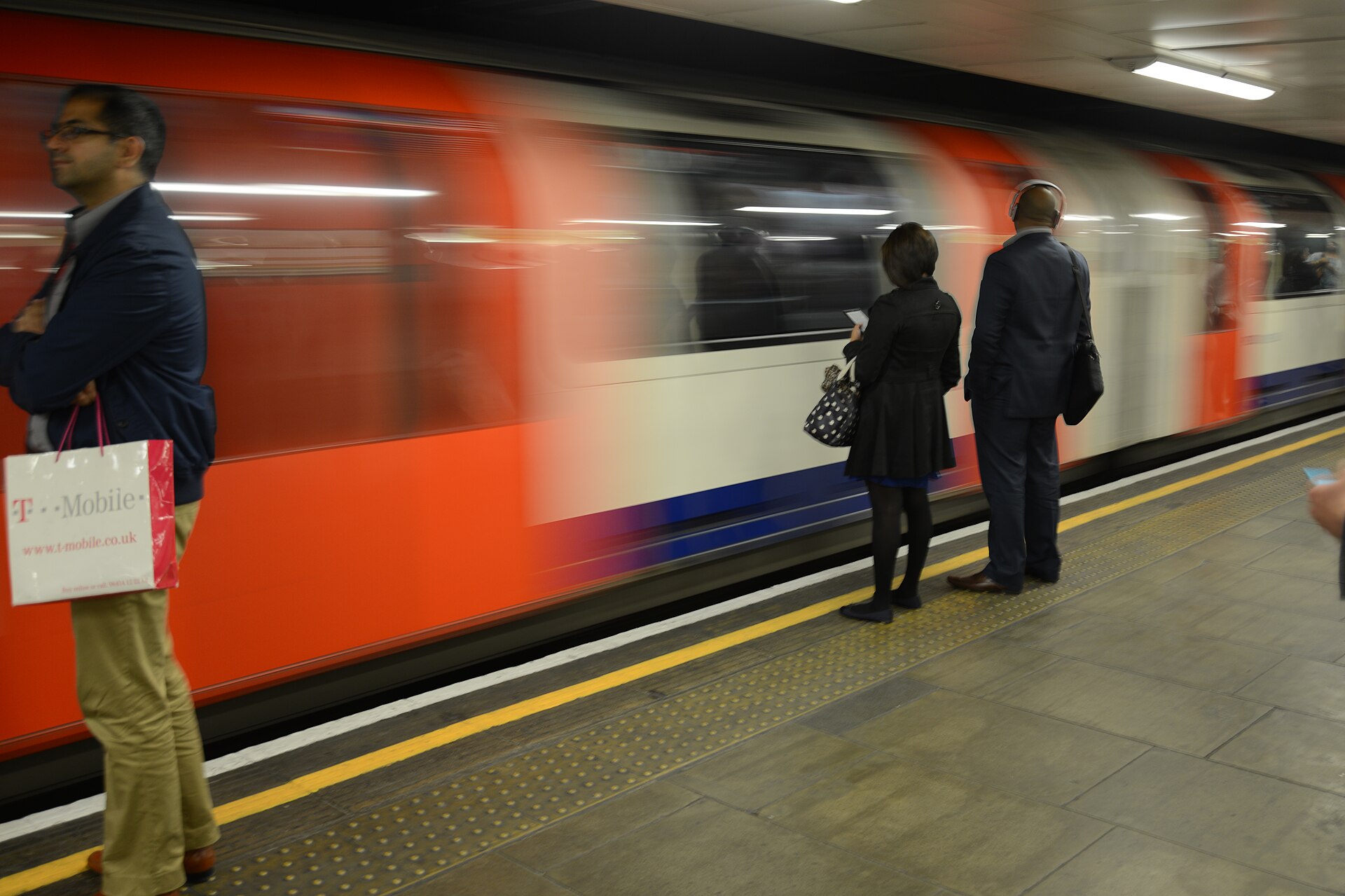
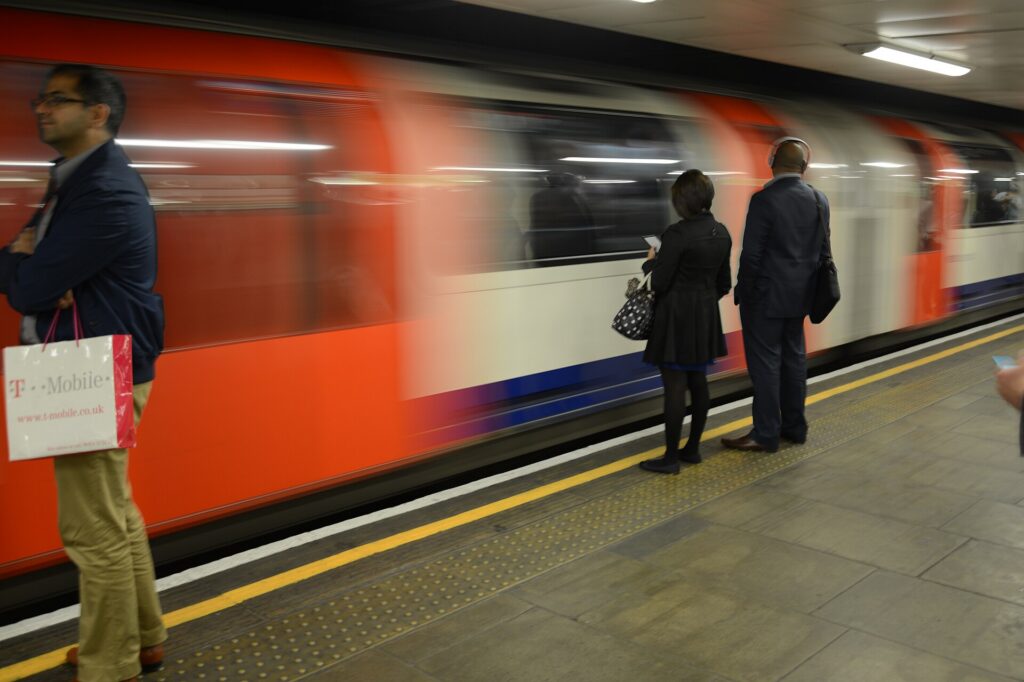
    A London Underground Central line train leaving Mile End station
    The Underground reaches almost every sight a visitor needs, with fares capped daily when you tap a contactless card (Photo: Aleem Yousaf via Wikimedia Commons, CC BY-SA 2.0)

    London’s public transport, explained

    Transport for London (TfL) runs the Underground, the Elizabeth line, the London Overground, the Docklands Light Railway, the trams and the bus network, and they all share one fare system. It is busy at rush hour and occasionally disrupted by engineering works at weekends, but it is frequent, extensive and easy to use, and for a visitor it removes any need for a car.

    The Underground

    The Tube is the oldest underground railway in the world and still the backbone of the city, with eleven lines, each with its own colour on the famous map, and around 270 stations. In central London, trains on the main lines come every two to five minutes through most of the day, and you rarely need to check a timetable. Some useful habits: stations in the centre are often closer together than the map suggests, and walking between Covent Garden and Leicester Square, or Charing Cross and Embankment, is quicker than riding; many central stations involve long corridors and stairs, so allow time; and the Victoria, Jubilee, Central, Northern and Piccadilly lines run the Night Tube on Friday and Saturday nights on all or part of their routes. Stand on the right on escalators and let passengers off before boarding, and you will blend in.

    The Elizabeth line, the Overground and the DLR

    The Elizabeth line, opened in 2022, is a fast, air-conditioned east-west railway that crosses the centre in a few minutes, linking Heathrow and Paddington to the West End, the City, Canary Wharf and Stratford; it is the most comfortable way across town. The London Overground, now divided into six named lines, circles the inner suburbs and reaches neighbourhoods such as Shoreditch, Dalston, Hackney and Camden Road that the Tube misses. The driverless Docklands Light Railway serves Canary Wharf, Greenwich and London City Airport, and a seat at the front of the train is one of the city’s best free views. Trams run in south London around Croydon and Wimbledon.

    Buses

    London’s red double-deckers run on hundreds of routes, many around the clock, and the top deck is the cheapest sightseeing tour in the city: routes through the West End, along the Strand and past St Paul’s cover many of the landmarks. Buses do not accept cash; you tap a contactless card, phone or Oyster card on boarding. The Hopper fare lets you make unlimited bus and tram journeys within one hour of the first tap for a single fare, and a bus fare is always cheaper than the Tube. Stops display the route numbers and a letter; the TfL journey planner and the common mapping apps show live arrivals.

    Fares and paying

    The simplest way to pay is to tap a contactless bank card or phone on the yellow readers at the gates and on buses, using the same card or device every time. Fares depend on the zones you travel through and the time of day, with higher peak fares on weekday mornings and late afternoons; the system caps what you pay automatically, both per day and, from Monday to Sunday, per week, so a heavy sightseeing day never costs more than a day pass would have. Check with your bank that your card does not charge foreign-transaction fees on each tap. An Oyster card, bought at stations, works the same way and suits visitors without a contactless card. Paper single tickets are far more expensive and not worth buying. Children under eleven travel free with a fare-paying adult. Check TfL’s site for current fares and caps before you go.

    Accessibility

    Accessibility is London’s weak point. The Elizabeth line, the DLR, the trams and every bus are step-free, and a growing share of Tube stations have lifts, but many older central stations still involve stairs and long passages. TfL publishes a step-free Tube map and its journey planner has a step-free option; for travellers with limited mobility, buses, the Elizabeth line and black cabs, which are all wheelchair accessible, cover most of what the Tube does.

    Beyond TfL

    • Walking. Central London is compact, and many of the best experiences, the South Bank from Westminster to Tower Bridge, the West End at night, the lanes of the City at the weekend, are walks. A first-time visitor can easily cover fifteen kilometres a day.
    • Cycling. The Santander Cycles docking bikes, known to everyone as Boris bikes, are available across the centre, and several dockless e-bike schemes operate through an app. Protected cycle routes now cross much of inner London, and Hyde Park and Regent’s Park are pleasant rides.
    • Black cabs and ride-hail. Licensed black cabs can be hailed on the street when the yellow light is on, are metered, and their drivers know the city by heart; Uber, Bolt and other apps operate everywhere. Both are expensive for long journeys in traffic but useful late at night or with luggage.
    • The river bus. Uber Boat by Thames Clippers runs a scheduled service along the Thames between west London, Westminster, the Tower, Canary Wharf and Greenwich, accepts contactless payment, and is the most enjoyable commute in the city.
    • National Rail. Mainline trains from the big termini (Paddington, King’s Cross, St Pancras, Euston, Victoria, Waterloo, London Bridge and Liverpool Street) serve the suburbs and every day-trip destination; National Rail has the timetables, and advance and off-peak tickets are much cheaper than buying on the day at peak.
    • Eurostar. High-speed trains from St Pancras reach Paris in a little over two hours and Brussels in about the same; Eurostar sells the tickets, and passport checks happen before you board.
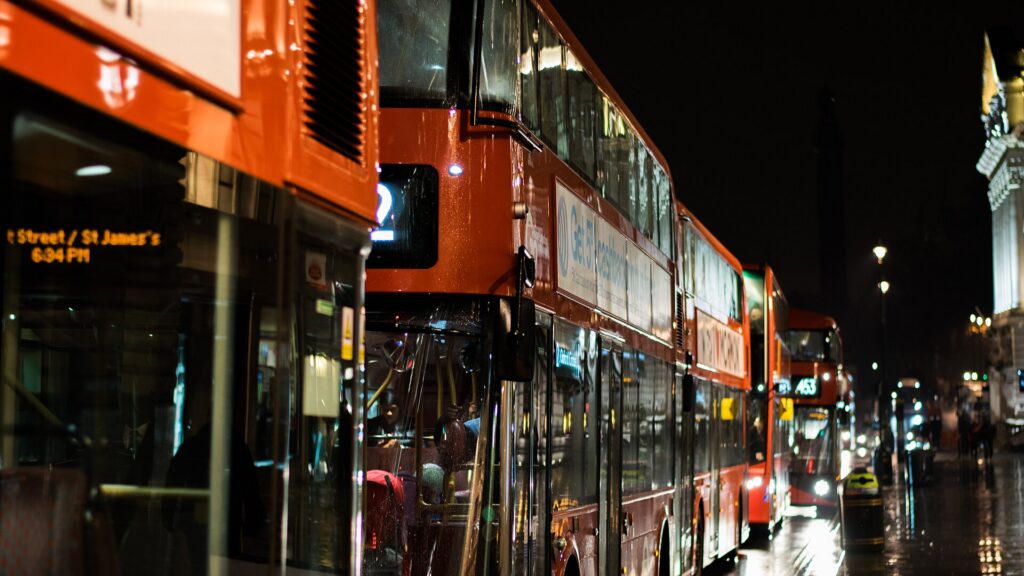
    A red double-decker bus on a London street at night
    London's buses are cashless, run around the clock on many routes, and the Hopper fare covers transfers within an hour (Photo: 0x010C via Wikimedia Commons, CC BY-SA 4.0)

    Driving in London: what it is really like

    Driving in central London is slow, expensive and stressful, and Londoners who own cars rarely use them to go into the centre. Traffic moves at walking pace for much of the day, the street plan is a medieval tangle of one-way systems, narrow lanes and junctions where five roads meet, and bus lanes, cycle lanes and red routes govern where you can drive and stop. On top of that, visitors drive on the left in cars that are usually manual unless they pay for an automatic, and navigate roundabouts clockwise. Two charges apply to drivers. The Congestion Charge is a daily fee for driving within the central zone during its operating hours, which cover the working day on weekdays and the afternoon and early evening at weekends and on bank holidays; it is charged per day however briefly you enter, and it has risen repeatedly. The Ultra Low Emission Zone (ULEZ) covers all of Greater London around the clock; most modern rental cars meet its standards, but confirm with the rental company, because a non-compliant car adds another daily charge. Neither charge is paid at a toll booth: cameras read the number plate and you pay online, and if you forget, the penalty goes to the rental company, which will pass it on to you with an administration fee.

    A Congestion Charge zone entry sign on a street in central London
    The Congestion Charge zone: cameras read every number plate, and the rental company passes on any penalty (Photo: Mark Ahsmann via Wikimedia Commons, CC BY-SA 3.0)

    Parking

    Parking is the other reason not to drive. Most central streets are controlled parking zones, reserved for residents with permits or metered by the hour at some of the highest rates in Europe and paid through apps rather than coins; commercial car parks in the centre charge by the hour at similar levels, and the few central hotels with garages charge heavily for them. Outside the centre, parking eases but rarely disappears: suburban high streets have short-stay limits, and the car parks at Kew, Hampton Court and the big parks fill on sunny weekends. If you do end up with a car in London, the cheapest option is often to leave it at a hotel or car park in the outer suburbs near a Tube or rail station and travel in by train.

    Rules and conditions worth knowing

    • Drive on the left and give way to traffic from the right at roundabouts. If you are not used to it, collect the car somewhere quieter than central London.
    • Licences. Visitors can drive in the UK on a valid Canadian or U.S. licence; ask the rental company whether it also wants an International Driving Permit, and note that many companies charge extra for drivers under 25.
    • Speed limits and cameras. A 20 mph limit now applies on many central and inner London roads, and fixed and average-speed cameras are everywhere; the fines follow the car.
    • Red routes and bus lanes. Red lines mean no stopping at all during their hours; bus lanes are camera-enforced during the hours on the sign.
    • River crossings. The Dartford Crossing on the M25 east of London charges a fee paid online, and the Blackwall and Silvertown tunnels in east London now charge as well.
    • The M25. The orbital motorway is the way around London and one of the busiest roads in Europe; allow extra time at rush hour, on Friday afternoons and on bank holiday weekends.
    • Fuel and cars. Fuel is expensive by North American standards and sold by the litre; rental cars are smaller than you may be used to, which is an advantage on country lanes.

    When renting a car makes sense

    • The Cotswolds. The honey-stone villages northwest of Oxford are served by a handful of stations, but moving between villages is far easier by car.
    • Stonehenge, Salisbury and Bath as a loop. Each is reachable by train and tour, but a car lets you combine them with Avebury and the Wiltshire countryside in a day or two.
    • The south coast, Devon and Cornwall. Coves, coastal paths and fishing villages sit well beyond the railway.
    • A countryside cottage or a wedding in a village. Rural England assumes a car, and taxis are scarce.
    • Family visits in the outer suburbs, where bus journeys can be long and the Tube does not reach.
    • Limited mobility. For travellers for whom stairs and crowds are a genuine barrier, a car for trips outside the centre can make sense, though black cabs are often the better answer within it.

    If any of those apply, our rental car booking tips cover insurance, deposits and the questions to ask at the counter, our family car rental guide looks at vehicle choice, and our note on car rental return timing helps you avoid late fees on the way to the airport.

    When it does not

    • Your trip is London itself, including Greenwich, Kew and Hampton Court.
    • Your day trips are Windsor, Oxford, Cambridge, Bath, Brighton, Canterbury or Paris, all faster by train.
    • You are staying anywhere in Zones 1 to 3, where parking alone would cost more than your transport.
    • You are travelling solo or as a couple, when rail tickets bought in advance are cheaper than a rental, fuel and charges.
    • You have never driven on the left and your first drive would be out of Heathrow in rush hour.

    The hybrid plan for a London-plus-countryside trip

    Spend the London days car-free, then collect a car on the day you leave the city, and think carefully about where you pick up. For the Cotswolds, Bath or the west, the best option is often to take the train to Oxford, Reading or Swindon and pick up a car there, skipping London traffic entirely. For the south coast or Kent, a pickup in a suburban branch or at Gatwick avoids the centre. Heathrow is a good choice at either end: collect a car there after your London days, heading west on the M4 or M40 without entering the city, or return it there before your flight home. Avoid collecting a car in central London, where you pay for parking before you have used it and start the trip in the most difficult driving conditions in the country. A pattern that works well: Elizabeth line from Heathrow into the city, four car-free days in London, a train to Oxford to pick up a rental, three days in the Cotswolds and Bath, and a return drop at Heathrow on the way to the flight. Book automatics early if you need one, because they are the first cars to sell out. Compare pickup locations on our car rental search before you fix the plan.

    Eurostar trains at London St Pancras International station
    St Pancras, where Eurostar trains leave for Paris and Brussels and fast domestic trains run to Kent (Photo: mattbuck (category) via Wikimedia Commons, CC BY-SA 3.0)

    A worked cost comparison

    Numbers change with the season and the booking window, so treat this as a method rather than a quote, and check current prices before deciding. For a five-night London trip for two people, the car-free version costs a return Elizabeth line or Piccadilly line journey from Heathrow for two, five days of capped contactless travel each, perhaps a river bus to Greenwich, and a black cab home after a late show; with the daily cap, even a heavy sightseeing day costs a modest fixed amount. The rental version adds five days of a car, five nights of central parking if you can find it, the Congestion Charge on every weekday and weekend afternoon you enter the zone, fuel, and journeys that are slower than the Tube. It is not a close contest, and the car-free option wins by a large margin. For the same five nights with day trips to Windsor, Oxford and Bath, the car-free version adds three rail return fares each, much cheaper when booked in advance for off-peak trains; driving adds the rental, fuel, parking in three busy tourist towns and the stress of leaving and re-entering London each day. The train still wins for two people, and usually for four. For a week split between London and the Cotswolds, the hybrid plan is the clear winner: car-free in the city, a train out to Oxford, and three or four days of a rental picked up there, with none of the London charges. Run the rental rates for your countryside days on our car rental search and set them beside the rail fares before you choose.

    Leaving London by road: the countryside in each season

    Once you are out of London, England is a pleasant place to drive, with good motorways, well-signed A-roads and country lanes that are narrow, hedged and beautiful. The challenge is getting out, and the timing matters in every season. In summer, the roads to the coast and the West Country are at their busiest on Friday afternoons and Saturday mornings, and the M25, the M4 and the A303 past Stonehenge can queue for hours on the bank holiday weekends at the end of May and August; leave early in the morning or mid-week. In spring, the Easter weekend brings the first big exodus, but otherwise April and May are ideal, with long days and quieter roads. In autumn, September is one of the best months for touring, with settled weather and the school holidays over, and the October half-term is the one busy week. In winter, snow is uncommon in the south of England, but fog, frost on country lanes and early darkness, with sunset before four in December, shorten the driving day; plan to be at your destination before dark. In any season, avoid leaving or returning to London in the weekday rush hours, allow for roadworks on the M25, and remember that a single-track lane with passing places is normal in the countryside. And in any season, the train to the edge of the region and a car from there will save you most of the hardest miles.

    Decision table

    Your tripRecommendationWhy
    City break in central LondonNo carThe Tube, buses and your feet reach everything; driving means charges, traffic and parking
    London with day trips to Windsor, Oxford, Bath or BrightonNo carTrains are faster, cheaper when booked ahead, and deliver you to the town centre
    London plus ParisNo carEurostar from St Pancras reaches Paris in a little over two hours
    London plus the Cotswolds or the West CountryHybrid: train out of London, rent thereCar-free city days, a car where villages and lanes need one
    Road trip around EnglandRent at Heathrow after your London daysHead west without entering the city; return it before your flight
    Family visit in the outer suburbsConsider a rental for those daysSuburban journeys can be long by bus; parking is easier outside the centre
    Travellers with limited mobilityBlack cabs and step-free transport in the centre, a car beyondMany older Tube stations have stairs; cabs and buses are all accessible
    Arriving jet-lagged at HeathrowNo car, Elizabeth line or Heathrow ExpressDriving on the left in rush hour after an overnight flight is a poor start

    Money-saving tips for both options

    • On transport: use the same contactless card or phone for every journey so the daily and weekly caps apply; take the bus when you can for the Hopper fare; travel after the morning peak when possible; and walk between neighbouring central stations.
    • On trains out of London: book advance tickets for day trips and travel off-peak; a railcard can cut fares further for some travellers staying longer.
    • On a rental: pick up outside central London, book an automatic early if you need one, check that the car is ULEZ-compliant, decline extras you already have through a credit card or home policy (check first), and pay any Congestion Charge or crossing fee yourself on the day to avoid penalties.
    • On the hotel: a room near an Elizabeth line or Jubilee line station in Zone 2 is often much cheaper than Zone 1 and only a few minutes further from the sights.
    • On timing: avoid driving out of London on Friday afternoons and bank holiday weekends; the best time to fly to London guide lists the busiest dates.

    For a broader comparison of the options in any city, see our guide to renting a car versus public transport versus taxis, and if Paris is next on the itinerary, our Paris transport guide covers the Métro, the RER and the same car question there.

    Frequently asked questions

    Is it worth renting a car in London?

    Not for the city. Public transport is faster, cheaper and easier than driving, and central London adds a congestion charge, an emissions zone and expensive parking. A car only makes sense for trips into the countryside, collected on the way out.

    Is London public transport good for tourists?

    It is excellent: the Tube, the Elizabeth line, the Overground, the DLR and the buses reach every sight, run frequently, and share one fare system with automatic daily caps when you tap a contactless card or phone.

    How do I get from Heathrow to central London?

    The Elizabeth line is the best all-round option, the Heathrow Express the fastest to Paddington, and the Piccadilly line the cheapest. A taxi takes 45 minutes to over an hour and costs far more.

    Do I need an Oyster card?

    Not if you have a contactless bank card or phone that works without foreign-transaction fees; it gets the same fares and caps. An Oyster card is the alternative if you do not.

    What is the London Congestion Charge?

    A daily fee for driving within central London during its operating hours, paid online and enforced by cameras. It is separate from the Ultra Low Emission Zone, which covers all of Greater London.

    Can I drive in the UK on a Canadian or U.S. licence?

    Yes, as a visitor. Check whether your rental company also asks for an International Driving Permit, and remember that traffic drives on the left.

    How do I get to Stonehenge or the Cotswolds without a car?

    For Stonehenge, take the train to Salisbury and the tour bus from the station, or book a coach tour from London. For the Cotswolds, trains reach a handful of towns, and local buses and tours cover the villages; a car gives you far more freedom there.

    Whichever way you go, start with the flight. Compare cheap flights to London, plan your days with our first-timer’s guide to London, and if the countryside is on the list, price a rental for those days on our car rental search.

  • Paris: Should You Rent a Car or Rely on Public Transit?

    Paris: Should You Rent a Car or Rely on Public Transit?

    Paris is the easiest question in this series. For a stay in the city itself, a rental car is not just unnecessary but a burden: the Métro puts a station within a few minutes’ walk of almost every address, the streets are being steadily handed over to buses, bikes and pedestrians, parking is scarce and expensive, and most hotels in the centre have no garage at all. Even the classic day trips, Versailles, Disneyland, Giverny, Fontainebleau and Reims, are faster and cheaper by train. But the question does not end at the Périphérique. If your trip continues to the Loire châteaux, the Normandy beaches, the Champagne vineyards or a road trip across France, a car becomes the right tool, and the trick is knowing where and when to pick it up so that you never have to drive in Paris at all. This guide explains how the city is laid out, how the Métro, RER, buses and tickets work, what driving here is really like, when a car earns its keep, and gives you a straightforward way to decide.

    The short answer

    Skip the car for any stay in Paris itself and for the day trips most visitors take; the Métro, the RER, the suburban trains, your feet and the occasional taxi cover all of it, and you will save on parking, fuel, tolls and stress. Rent a car only for the part of the trip that leaves the city: the Loire Valley, Normandy and Mont-Saint-Michel, the Champagne villages, Burgundy, or a longer road trip through France. Even then, the best plan is usually to take a fast train out of Paris and pick up the car at a station or airport on the way, rather than collecting one in the city. And if you arrive late at night with heavy bags, the fixed-fare airport taxi is the stress-free third option. Our guide to car, transit or taxi in a new city sets out the general trade-offs; this one applies them to Paris.

    How Paris is laid out

    The city of Paris proper is small by world-capital standards, about 10 kilometres across, enclosed by the Boulevard Périphérique ring road and home to around two million people, with another ten million in the suburbs beyond. The Seine flows east to west through the middle, dividing the Right Bank to the north, with the Louvre, the Marais, the Opéra, the Champs-Élysées and Montmartre, from the Left Bank to the south, with Saint-Germain, the Latin Quarter, the Eiffel Tower and Montparnasse. The city is divided into twenty arrondissements, numbered in a clockwise spiral from the 1st around the Louvre, and every address carries its number; the last digits of the postcode give it away, so 75004 is the 4th. The historic centre, roughly the first seven arrondissements, is compact enough to cross on foot in an hour.

    Hotels cluster in every central arrondissement, with the densest choice in the Marais and around the Opéra on the Right Bank and in Saint-Germain and the Latin Quarter on the Left. Very few have parking. Our Paris hotel search lets you compare them, and our guide to staying in Le Marais covers the most central, walkable option.

    Getting in from the airports

    From Charles de Gaulle (CDG), about 25 kilometres northeast, the RER B runs to Gare du Nord in about 35 minutes and continues through Châtelet, Saint-Michel and Denfert-Rochereau, connecting with most Métro lines; the Roissybus runs to Opéra; and taxis charge a fixed fare to anywhere in the city, one rate for the Right Bank and a slightly higher one for the Left. From Orly (ORY), about 14 kilometres south, Métro line 14 has run directly into the centre since 2024, reaching Châtelet in around half an hour, and fixed-fare taxis serve the city too. Public-transport trips to and from the airports need a specific airport ticket rather than a standard one, while a weekly Navigo pass covers them. Every major rental company has desks at both airports, but unless you are heading straight out to the regions, there is no reason to collect a car there. Check Paris Aéroport for current ground-transport details; our CDG airport guide covers the layout.

    The Art Nouveau Guimard entrance of Porte Dauphine Métro station in Paris
    A Guimard Métro entrance: in central Paris, the next station is rarely more than a few minutes' walk away (Photo: Maindron, Charles (Paris, 29–06–1861 – Saint-Cloud, en 15–07–1940 — 1940), photographe via Wikimedia Commons, CC0)

    Paris public transport, explained

    Public transport in Paris and the surrounding Île-de-France region is organised by Île-de-France Mobilités and run mainly by the RATP and the national railway, SNCF. It is dense, frequent and fast; its weaknesses are crowding at rush hour, a lot of stairs, and a ticketing system that has changed more than once in recent years.

    The Métro

    Sixteen lines, numbered 1 to 14 plus two short branch lines, 3bis and 7bis, with more than 300 stations, most of them only a few hundred metres apart. Lines are identified by number, colour and the name of the terminus in the direction you are travelling, which is what the signs show, so check the end station before you go down to the platform. Line 1, which runs east to west past the Louvre, the Tuileries, the Champs-Élysées and La Défense, and line 14, the fast line between Saint-Lazare, Châtelet, Gare de Lyon and Orly, are fully automated. Trains run from about 5.30 in the morning until after one at night, later on Friday and Saturday nights, and the Noctilien night buses fill the gap.

    The RER and suburban trains

    The five RER lines, A to E, are express trains that cross the city underground with few stops and then fan out into the suburbs. They are the fast way across Paris and the way to the main day trips: the RER B to CDG and the Stade de France, the RER A to La Défense and Disneyland, and the RER C along the Left Bank to Versailles. The Transilien suburban trains from the main stations reach further, including Chantilly, Fontainebleau and Giverny’s station at Vernon.

    Buses and trams

    More than 300 bus routes criss-cross the city and suburbs, and they are the scenic alternative to the Métro: routes along the Seine and across the centre pass one landmark after another, and every bus is step-free.

    Fares and tickets

    Since 2025, a single Métro-train-RER ticket covers any one journey by Métro, RER or suburban train anywhere in the region at one flat price, apart from the airports, which have their own airport ticket; a separate, cheaper bus-tram ticket covers journeys by bus or tram. The old paper tickets are being phased out. The simplest option for visitors is to buy tickets on a phone with the official Île-de-France Mobilités app, or to load them onto a Navigo Easy card, a reusable card sold for a small fee at station counters and machines. If you are staying a week, the Navigo weekly pass, which runs from Monday to Sunday, needs an ID photo and a Navigo card and covers unlimited travel across the whole region, including the airports, Versailles and Disneyland; it is usually the best deal if your dates fit. Children under four travel free, and reduced fares apply to young children. Check Île-de-France Mobilités for current fares before you go.

    Accessibility

    This is the Métro’s weak point. Most of the network dates from the early twentieth century, and only line 14 and the newest extensions are fully step-free; many stations have long corridors and stairs with no lift. The RER is better in places, and every bus is low-floor and accessible, so travellers with a wheelchair, a buggy or heavy luggage should plan bus routes. The RATP publishes accessibility information for each line.

    Beyond the Métro

    • Walking. Central Paris is made for it. Stations are so close together that walking between neighbouring ones is often quicker than changing lines, and the walk along the Seine from the Eiffel Tower to Notre-Dame passes most of the city’s great sights.
    • Vélib’ and cycling. Paris has transformed itself into a cycling city, with hundreds of kilometres of cycle lanes, the Rue de Rivoli largely given over to bikes and buses, and the Vélib’ bike-share system with classic and electric bikes at stations across the city and inner suburbs. Shared e-scooters were banned in 2023, but electric bikes from private operators remain.
    • Taxis and ride-hail. Licensed taxis, with a light on the roof, can be hailed or found at taxi ranks, and Uber and other ride-hail apps operate widely. Taxis can use the bus lanes, which helps at rush hour; for a group of three or four, a short ride can be competitive with Métro fares.
    • Trains beyond the region. High-speed TGV and Eurostar trains leave from the city’s big stations: Gare du Nord for London and Brussels, Gare de l’Est for Reims and Strasbourg, Gare de Lyon for the southeast, and Montparnasse for the Loire, Brittany and Bordeaux. SNCF Connect sells tickets for all of them.
    A row of Vélib' shared bikes at a docking station in central Paris
    Vélib', the city's bike-share system, with classic and electric bikes across Paris and the inner suburbs (Photo: Mariordo (Mario Roberto Durán Ortiz) via Wikimedia Commons, CC BY-SA 3.0)

    Driving in Paris: what it is really like

    Driving in Paris is not dangerous so much as slow, confusing and expensive, and the city has spent twenty years making it harder on purpose. The speed limit is 30 km/h on most streets and, since 2024, 50 km/h on the Périphérique; through traffic has been restricted in the four central arrondissements since late 2024; lanes have been converted to bus and bike lanes across the city; and on-street parking has become steadily more expensive for visitors. Add narrow one-way streets, delivery vans double-parked in the only lane, scooters threading between cars, and the famous roundabout at the Arc de Triomphe, where twelve avenues meet with no lane markings and traffic entering has priority, and you have a city where locals themselves increasingly leave the car at home.

    Parking

    On-street parking in Paris is paid almost everywhere, with the city’s highest rates in the central arrondissements, time limits for visitors, and a much higher visitor rate for heavier vehicles, including many SUVs. Payment is by card at the machines or through an app; there are no coin meters to feed. Underground public car parks are plentiful and easier, but a full day in one costs more than many museum tickets combined, and hotels that offer parking charge a substantial nightly fee. Parking fines are enforced and follow the car, and the rental company will pass them on with an administrative charge.

    Rules and conditions worth knowing

    • Crit’Air sticker. Paris and its inner suburbs operate a low-emission zone, and vehicles need a Crit’Air air-quality sticker on the windscreen. Cars rented in France normally have one; if you are driving in from another country, order it in advance from the official Crit’Air site, and check the current rules, which have been the subject of political debate.
    • Priority to the right. Unless signs say otherwise, traffic joining from the right has priority, including on some roundabouts; it catches out North American drivers more than anything else.
    • Manual gearboxes are still the default in rental fleets. Automatics are available but cost more and sell out first; book one specifically if you need it.
    • Tolls. The autoroutes out of Paris to Normandy, the Loire, Champagne and the south are mostly tolled. Toll booths take cards, and the cost is worth adding to any comparison.
    • Speed limits and cameras. 130 km/h on autoroutes, 110 in the rain; 80 or 90 km/h on two-lane roads depending on the department; 50 or less in towns. Fixed and mobile speed cameras are everywhere, and fines follow the car.
    • Licence. Visitors can drive on a valid Canadian, American or British licence for a short stay; an International Driving Permit alongside it is recommended. Rental companies often set a minimum age of 21 and charge a young-driver surcharge.
    • Alcohol. The limit is 0.5 grams per litre of blood, lower than in much of North America, and lower still for new drivers.
    A TGV high-speed train at Paris Gare de Lyon
    A TGV at a Paris terminus: take the train out and pick up the car in the regions (Photo: Jordi Verdugo via Wikimedia Commons, CC BY-SA 2.0)

    When renting a car makes sense

    • The Loire Valley châteaux. Chambord, Chenonceau, Cheverny and dozens more are spread across the countryside; take the train to Tours or Blois and pick up a car there.
    • Normandy. The D-Day beaches, the American Cemetery, Bayeux, Honfleur, Étretat and Mont-Saint-Michel are far apart and poorly served by public transport; the train to Caen or Bayeux plus a car is the classic plan.
    • The Champagne villages. Reims and Épernay are easy by train, but the vineyard villages and smaller champagne houses between them need a car and a designated driver.
    • Burgundy, Provence and the Dordogne. Rural France rewards a car, and the fast train gets you to within an hour of each.
    • Families with lots of luggage heading to the regions. A car from CDG, straight onto the autoroute, avoids hauling bags through Paris.
    • A road trip across France. Pick up on the day you leave Paris, not before, and consider a one-way rental to another city or airport.

    If any of those apply, our rental car booking tips cover insurance, deposits and the questions to ask at the counter, and our family car rental guide looks at vehicle choice.

    When it does not

    • You are staying in Paris, in any arrondissement, and your plans are the city.
    • You are visiting Versailles, Disneyland, Fontainebleau, Chantilly, Giverny or Reims as day trips, all of which are easy by train.
    • You are in town for a match at the Stade de France or the Parc des Princes, or a concert, when traffic and parking are at their worst and the RER and Métro run extra trains.
    • You are travelling solo or as a couple and only need a car for a day; a guided tour or a train plus a local taxi is often cheaper.

    The hybrid plan for a Paris-plus-regions trip

    Go car-free for the Paris days and rent only for the regional days, and think carefully about where you pick up. The worst option is collecting a car at an office in central Paris and driving out through the city traffic. Better is to take a high-speed train to the edge of the region you are visiting and collect the car at the station: Tours or Saint-Pierre-des-Corps for the Loire, Caen for Normandy, Reims for Champagne, Avignon for Provence, all of which have rental offices at or beside the station. If you are starting your trip in the regions straight off a long-haul flight, collect at CDG, where the autoroutes to the north, east and west are minutes away, or take a TGV directly from CDG’s own station. If you are finishing in the regions, drop the car at a station and take the train back into Paris, or return it at CDG or Orly on the way to your flight, which avoids driving into the centre entirely. Check one-way fees, which vary a great deal, and book an automatic early if you need one. Bison Futé, the official French road-traffic service, publishes forecasts of the busiest days on the autoroutes.

    A worked cost comparison

    Numbers change with the season and the booking window, so treat this as a method rather than a quote, and check current rates before deciding. For a five-night stay in Paris for two people, the car-free version costs the RER or a taxi from the airport, two weekly Navigo passes or a handful of tickets, and perhaps a couple of late-night taxis; the rental version adds five days of a car, five nights of hotel or underground parking at Paris rates, fuel, and the airport collection fee. The transport option wins by a wide margin. For the same stay plus a day at Versailles and a day at Giverny, the car-free version adds the RER C to Versailles, which is covered by a weekly Navigo pass, and return train tickets to Vernon with the shuttle bus to Giverny; a one-day rental for Giverny adds the car, fuel, tolls and parking, and the train is usually cheaper for two people and not much slower. For a week split between Paris and Normandy, the hybrid plan, a train to Caen and a three-day rental there, typically costs less than a week-long rental from Paris once parking and tolls are included, and spares you the drive out of the city. Run the numbers for your own dates, but the pattern is consistent: in Paris, pay for the car only on the days you are outside it.

    Driving out of Paris in each season

    The autoroutes that radiate from Paris are fast and well maintained, but the timing of your departure matters more than the season. The worst days of the year are the big French holiday getaways: the first and last weekends of July and August, when Bison Futé issues red and black warnings and queues on the A6 south and the A10 toward the Loire and Bordeaux can stretch for tens of kilometres, and the Friday afternoons before the May bridge weekends. In summer, leave early in the morning, avoid Saturdays in July and August, and expect heavy traffic back into Paris on Sunday evenings. In spring and autumn, the roads are quieter outside the school holidays, and the Loire and Normandy are at their most pleasant for driving, with fewer coaches at the châteaux. In winter, snow rarely affects the main roads; short daylight on rural roads is the bigger issue. In every season, the ring roads around Paris, the Périphérique and the A86, jam every weekday morning and evening, so time your departure outside the rush hour or pick up the car beyond them.

    Decision table

    Your tripRecommendationWhy
    City break in Paris, couple or soloNo carThe Métro reaches everything; parking is scarce and expensive
    Paris with day trips to Versailles, Disneyland or GivernyNo carRER and suburban trains are faster and cheaper
    Late arrival with heavy luggageFixed-fare taxiA known price to your door, and it can use the bus lanes
    Loire Valley châteauxTrain to Tours or Blois, then rentThe châteaux are spread out; the drive out of Paris is not worth it
    Normandy and Mont-Saint-MichelTrain to Caen or Bayeux, then rentBeaches and villages are far apart and poorly served by buses
    ChampagneTrain to Reims; rent or book a tour for the villagesThe cellars in Reims are walkable; the vineyards are not
    Family heading straight to the regionsRent at CDGStraight onto the autoroute without entering Paris
    Road trip across FranceRent on the day you leave Paris, ideally one-wayParis is the start, not the place for the car

    Money-saving tips for both options

    • On transport: buy a weekly Navigo pass if your stay runs Monday to Sunday; walk between nearby stations; take the bus for scenic routes; and use the airport ticket or pass rather than paying twice.
    • On a rental: pick up outside Paris, book early for July and August, reserve an automatic if you need one, check one-way fees, decline extras you already have through a credit card or home policy (check first), and budget for tolls.
    • On the hotel: if you must bring a car into Paris, choose a hotel with parking or near an underground car park and price the fee into the room rate.
    • On timing: avoid the big holiday getaway weekends and the Paris ring roads at rush hour; the best time to fly to Paris guide lists the holiday periods.
    • On day trips: compare a train-plus-taxi day with a one-day rental; for one or two people, the train usually wins.

    Frequently asked questions

    Is it worth renting a car in Paris?

    Not for the city or the usual day trips. Rent only for the Loire, Normandy, Champagne or a road trip, and pick the car up outside Paris.

    Is Paris public transport good for tourists?

    Excellent for coverage and frequency; the Métro and RER reach almost everything. The drawbacks are rush-hour crowding and stairs.

    How do I get from CDG to central Paris?

    The RER B to Gare du Nord and Châtelet in about 35 to 45 minutes, the Roissybus to Opéra, or a fixed-fare taxi.

    Can I visit Versailles without a car?

    Yes. The RER C runs to Versailles Château Rive Gauche, a short walk from the palace, and suburban trains from Saint-Lazare and Montparnasse serve the town too.

    Do I need an International Driving Permit in France?

    It is recommended alongside a Canadian, American or British licence, and some rental desks ask for one; it is cheap and quick to obtain at home.

    Is parking expensive in Paris?

    Yes. Street parking is paid and time-limited for visitors, heavier cars pay more, and underground car parks and hotel garages are costly.

    What is the best way to see the Loire or Normandy from Paris?

    Take the train to Tours, Blois, Caen or Bayeux and rent a car there, or join a guided day tour if you only have one day.

    Whichever way you go, start with the flight. Compare cheap flights to Paris, choose a neighbourhood with our Paris hotel search, and plan your days with our first-timer’s guide to Paris.

  • Things to Do in London: A First-Timer’s Guide

    Things to Do in London: A First-Timer’s Guide

    London does not need selling, but it does need editing. It is a city of nine million people spread across more than 1,500 square kilometres, with two thousand years of history layered on top of each other, a dozen world-class museums that charge nothing to enter, a theatre district that runs more shows in a week than most countries stage in a year, and neighbourhoods so different from one another that Greenwich, Notting Hill and Shoreditch could be three separate cities. First-time visitors tend to make one of two mistakes: they try to see all of it and spend the trip on the Underground, or they stay within a mile of Big Ben and never find out why Londoners love the place. This guide is the edit. It covers the sights that earn a day, the neighbourhoods worth a half-day, the free museums, the parks and the river, the theatre and the football, the food, the day trips that England makes easy, and the practical details that turn a long-haul flight into a good trip.

    If you are still comparing cheap flights to London, read this alongside our guides to the best time to fly to London and whether you need a car (you almost certainly do not). Between the three you can plan the whole trip.

    Tower Bridge and the towers of the City of London across the Thames
    Tower Bridge and the City of London from the south bank of the Thames (Photo: Diliff via Wikimedia Commons, CC BY 3.0)

    London at a glance for first-timers

    • Airports: Heathrow (LHR), the main long-haul gateway, is about 24 km west of the centre and connected by the Elizabeth line, the Heathrow Express and the Piccadilly line; Gatwick, Stansted, Luton and London City handle much of the European and low-cost traffic. See our Heathrow airport guide.
    • Getting around: the Underground, the buses and the Elizabeth line reach everything in this guide, and you pay by tapping a contactless card or phone with an automatic daily cap. Walking between central sights is often faster than the Tube. Nobody needs a car in London; our transport guide explains why.
    • Money: pounds sterling. Contactless payment is accepted almost everywhere, including on buses, which no longer take cash. Prices include 20 percent VAT, and a service charge of around 12.5 percent is usually added to restaurant bills, so no further tip is expected. Tipping in pubs is not customary.
    • Weather: mild, grey and changeable in every season, with cool summers and wet, rarely freezing winters. A light waterproof layer is more useful than an umbrella. Our month-by-month guide has the detail.
    • Where to stay: Westminster, St James’s and Covent Garden for the sights on foot; South Bank and Southwark for the river and the theatres; Kensington for the museums and the parks; Shoreditch or Camden for nightlife; King’s Cross for a value base with the best transport links in the city. Our hotel booking tips cover how to get the rate down.

    Westminster: Big Ben, the Abbey and the palaces

    Start where the postcards do. The Houses of Parliament, properly the Palace of Westminster, fill the north bank of the Thames between Westminster Bridge and Lambeth Bridge, and the clock tower that everyone calls Big Ben (the name belongs to the bell) is best seen from the south end of Westminster Bridge in the early morning before the crowds arrive. Across Parliament Square, Westminster Abbey has crowned every English and British monarch since 1066 and holds the graves of Newton, Darwin, Dickens and Chaucer; it is one of the few major sights in London that charges admission, and it is worth it, particularly with the audio guide. A ten-minute walk up Whitehall passes the Cenotaph, Downing Street behind its gates, and the Horse Guards, where the mounted sentries change through the morning, before reaching Trafalgar Square and Nelson’s Column. Off Whitehall, the Churchill War Rooms, the underground complex from which the Second World War was directed, is one of the best museums in the city. From Trafalgar Square, the Mall runs through St James’s Park to Buckingham Palace; the Changing of the Guard takes place on set mornings, the State Rooms open to visitors in summer, and the park itself, with its pelicans and its view of the palace across the lake, is the prettiest in central London.

    The Houses of Parliament and the Elizabeth Tower beside Westminster Bridge
    The Palace of Westminster and Big Ben from the South Bank (Photo: Mikey from Wythenshawe, Manchester, UK via Wikimedia Commons, CC BY 2.0)

    The South Bank and Bankside: the river walk everyone should take

    The south bank of the Thames between Westminster Bridge and Tower Bridge is the best walk in London, and it takes about an hour without stops, which nobody manages. It begins at the London Eye, the observation wheel opposite Parliament, passes the National Theatre and the concrete arts complex of the Southbank Centre, with its skateboarders, book market under Waterloo Bridge and riverside bars, and continues past the Oxo Tower to Tate Modern, the power station turned gallery whose Turbine Hall is free to walk into and whose viewing terrace gives one of the best free views of St Paul’s across the river. Next door, Shakespeare’s Globe is a faithful reconstruction of the 1599 theatre; the summer season plays to standing “groundlings” in the open yard for a few pounds, which is the best theatre bargain in the city. Beyond it, under the railway arches by London Bridge, Borough Market has been feeding the city for centuries and is now its most famous food market, at its best on a weekday morning. The walk ends at Tower Bridge, with HMS Belfast moored below it and the Shard, the tallest building in Britain, rising over London Bridge station behind you.

    The City and the Tower

    The Tower of London is the essential paid attraction, a thousand-year-old fortress that has been a palace, a prison, a mint and a zoo and that still houses the Crown Jewels; book a timed ticket through Historic Royal Palaces, arrive at opening, go straight to the jewels before the queue forms and then join a Yeoman Warder tour. From the Tower, the Square Mile of the City of London, the financial district on the site of the Roman town, is a place of contrasts: medieval churches and livery halls between glass towers with nicknames (the Gherkin, the Walkie-Talkie, the Cheesegrater). The Sky Garden at the top of the Walkie-Talkie is free to visit with an advance booking and gives a better view than most paid decks. St Paul’s Cathedral, Wren’s masterpiece after the Great Fire of 1666, charges admission but the climb to the Whispering Gallery and the dome is one of the great London experiences. The City empties at weekends, which makes Saturday the best day to walk its lanes and the worst to look for lunch; Leadenhall Market and the streets around the Bank of England are at their most atmospheric on a weekday.

    The great free museums

    London’s national museums are free, which changes how you use them: instead of one exhausting day, visit two or three for an hour or two each. The British Museum in Bloomsbury holds the Rosetta Stone, the Parthenon sculptures and the Egyptian galleries under Norman Foster’s glass Great Court; go early and pick three rooms. The National Gallery on Trafalgar Square has Van Gogh’s Sunflowers, Turner, Constable and the great Italian collection, with the National Portrait Gallery around the corner. In South Kensington, three museums sit on one street: the Natural History Museum, with its dinosaurs and its cathedral-like Romanesque hall, the Science Museum, and the V&A, the world’s largest museum of design and decorative art, whose café and courtyard are worth the visit alone. Across the river, Tate Britain holds the Turner collection and Tate Modern the contemporary art, with a boat linking the two. Smaller and stranger: the Wallace Collection in Marylebone, Sir John Soane’s Museum in Lincoln’s Inn Fields, the Imperial War Museum in Lambeth, and the Museum of London Docklands on the history of the port. Most charge for special exhibitions and all are busiest on wet weekend afternoons.

    The glass-roofed Great Court of the British Museum in Bloomsbury
    The Great Court of the British Museum, free to enter like all of London's national museums (Photo: Andy Li via Wikimedia Commons, CC0)

    Neighbourhoods worth a half-day

    Soho and Covent Garden

    The West End’s two liveliest districts sit side by side. Covent Garden’s piazza and covered market have street performers, the London Transport Museum and the Royal Opera House; Soho, to the west, is the city’s restaurant, bar and theatre village, with Chinatown at its southern edge and Carnaby Street on its western one. Come for dinner and a show and stay for the pubs.

    Notting Hill and Portobello Road

    West of Hyde Park, Notting Hill’s pastel terraces and the Saturday antiques market on Portobello Road are the reason the area is so photographed. Go on a Saturday morning for the market, or on a weekday for the quiet streets and the independent shops of Westbourne Grove; in late August the Notting Hill Carnival takes over the whole district.

    Shoreditch, Spitalfields and the East End

    East of the City, Shoreditch is the street-art, bar and independent-shop quarter, Spitalfields has a covered market and Georgian streets, and Brick Lane has the curry houses, the Sunday market and the bagel bakeries that stay open all night. Columbia Road’s Sunday flower market is a half-hour’s walk north. This is the London that changes fastest, and the best area for a night out.

    Camden and Regent’s Park

    Camden Town’s markets along the canal are chaotic, touristy and still fun, and the music venues around it launched half of British rock. Walk south along the Regent’s Canal to Regent’s Park, the rose garden and London Zoo, or climb Primrose Hill for the skyline view.

    Greenwich

    Downriver by boat or on the DLR, Greenwich is a day on its own: the Cutty Sark, the Royal Observatory on the hill where the Prime Meridian is marked in the courtyard, the National Maritime Museum, the Old Royal Naval College and its Painted Hall, the covered market, and the park with the best view of Canary Wharf and the Thames in the city.

    Kensington and Chelsea

    The museums of South Kensington, Kensington Palace and its gardens, the Royal Albert Hall, the shops of the King’s Road and the riverside at Chelsea Embankment: this is the grand, expensive, well-kept London of the guidebooks, and it is at its best on a sunny afternoon.

    Parks, palaces and the river

    London has more green space than any comparable capital, and the Royal Parks are the core of it. Hyde Park and Kensington Gardens together form a two-mile stretch of lawns, the Serpentine lake, Speakers’ Corner and the Diana memorial fountain; Regent’s Park has the rose garden and the zoo; St James’s Park and Green Park frame Buckingham Palace; and Richmond Park, in the southwest, is a genuine deer park of ancient oaks and bracken that feels a hundred miles from the city. Hampstead Heath has the swimming ponds and the view from Parliament Hill. The palaces are spread along the river: Kensington Palace in the park, Hampton Court, Henry VIII’s Tudor palace with its maze and gardens, about 35 minutes by train from Waterloo, and Kew Gardens, the world’s most important botanic garden, with its Victorian glasshouses and treetop walkway, on the District line. The Thames itself is a transport route: Uber Boat by Thames Clippers runs a scheduled river bus from Putney in the west past Westminster and the Tower to Greenwich and beyond, accepts contactless payment, and is the most enjoyable way to travel between Westminster, the Tower and Greenwich.

    Theatre, music and sport

    The West End runs around forty theatres within a few streets of Shaftesbury Avenue and the Strand, with musicals, new plays and the long-runners, and the National Theatre, the Old Vic, the Globe and the Almeida stage the serious drama. Buy on the day at the TKTS booth in Leicester Square or through the theatres’ own sites; matinees are cheaper. Classical music runs at the Barbican, the Southbank Centre, Wigmore Hall and the Royal Albert Hall, where the Proms fill every night from mid-July to mid-September with cheap standing tickets. The O2 in Greenwich is the big arena, and Wembley Stadium and the Tottenham Hotspur Stadium host the stadium shows. For sport, London usually has six or seven clubs in the Premier League, with Arsenal, Chelsea and Tottenham the biggest names and Crystal Palace, Fulham, Brentford and West Ham among the others, and the England national side at Wembley. Rugby is at Twickenham, cricket at Lord’s and the Oval, and the two weeks of Wimbledon in late June and early July are the most famous tennis tournament in the world; the daily ballot and the queue still give walk-up fans a chance. For what is on stage and in the stadiums during your dates, our London events page lists concerts, shows and matches on sale.

    What to eat, and where

    London’s food has two faces, and both are good. The first is the pub: a Sunday roast with Yorkshire pudding, fish and chips, a pie, a pint of cask ale, in a room that has served the same purpose for two or three hundred years. The riverside pubs in Hammersmith, Wapping and Greenwich, the ancient ones off Fleet Street and in Southwark, and any well-run local in Bloomsbury or Islington will do. The second is the city of immigrants: Indian and Bangladeshi food on Brick Lane and, better, in Tooting and Southall; Turkish grills on Green Lanes and in Dalston; Vietnamese on Kingsland Road; Chinatown and the dim sum houses of Soho; Caribbean in Brixton; Portuguese in Stockwell. Add the markets, with Borough for produce and lunch, Maltby Street for the arches, Broadway Market and Brixton Village at weekends, and the food halls that have opened in every district; the afternoon tea rituals of the grand hotels and the department stores; and a restaurant scene that ranges from the chains everyone loves to some of the world’s best tasting menus. Coffee is now excellent everywhere, and the bakeries of Hackney and Bermondsey are worth a detour on a Saturday morning.

    London through the seasons

    London works in every season, which is one reason it is among the most visited cities in the world. Winter (December to February) is dark by four but the city dresses for it: the Christmas lights on Regent Street and Oxford Street, the markets on the South Bank, the seasonal ice rinks at Somerset House and elsewhere, Winter Wonderland in Hyde Park, and the January sales. It is also when the museums and the theatres are quietest and the hotel rates lowest. Spring (March to May) brings blossom to the parks, daffodils to St James’s, the Boat Race on the Thames, the London Marathon in April, and the Chelsea Flower Show in late May; the days are long by May and the weather is at its most reliable in the second half of the season. Summer (June to August) is the crowded, expensive, glorious version: Wimbledon, the Proms, open-air theatre in Regent’s Park, the Buckingham Palace State Rooms, swimming on the Heath, and long evenings on the river. Autumn (September to November) is the local favourite, with the parks turning gold, Open House weekend opening buildings that are normally closed, the film festival in October, Bonfire Night fireworks on the fifth of November and the Lord Mayor’s Show on the second Saturday of November. Our month-by-month guide matches the seasons to the fare patterns.

    London with kids

    London is an outstanding city for children, and much of it is free. The Natural History Museum, with the blue whale in the hall and the dinosaur gallery, and the Science Museum next door, with its hands-on floors and flight gallery, are the obvious full day in South Kensington, and the Diana Memorial Playground in Kensington Gardens is next to them. The Tower of London, with its ravens, armour and Crown Jewels, and HMS Belfast, the warship moored by Tower Bridge, cover a day in the east. The London Transport Museum in Covent Garden lets children climb on old buses and Tube trains. London Zoo in Regent’s Park, the Cutty Sark and the Observatory in Greenwich, a ride on the London Eye, the top deck of a red bus and the front seat of a driverless DLR train through Docklands all work for younger children; the Changing of the Guard is a hit if you arrive early enough to see. The Warner Bros. Studio Tour, the Harry Potter film sets at Leavesden northwest of the city, needs a timed ticket booked well ahead and a train to Watford Junction. Children under eleven travel free on the Tube and buses with an adult, and most restaurants are relaxed about families before seven in the evening.

    London on a budget

    London is expensive to sleep in and cheap to see. The national museums, the parks, the river walk, the Changing of the Guard, the Sky Garden, the markets, the street art of Shoreditch, the view from Primrose Hill and the ceremonial streets of Westminster all cost nothing. Pay for the Tower, the Abbey and one view, and skip the rest of the ticketed attractions unless one really matters to you. Travel with a contactless card and the daily cap means you will never overpay on transport, and the bus, with its Hopper fare, is the cheapest tour in the city. Eat at the markets, in the pubs and in the neighbourhoods rather than in the West End, and use the supermarket meal deal for lunch, as the locals do. Theatre on the day from TKTS, standing tickets at the Globe and the Proms, and the cheaper seats booked directly with the theatres are far below the headline prices. Hotels are the cost that matters, and the answer is location: stay in Zone 2 near a good Tube or Elizabeth line station rather than in Zone 1, book well ahead for summer, and read our guide to the best times to book before you commit.

    Day trips from London

    England is small and its railways start in London, which makes the day trips easy and the car unnecessary. Windsor, with the castle that is the monarch’s weekend home and the town beneath it, is under an hour by train from Waterloo or Paddington. Oxford and Cambridge are each about an hour by train, from Paddington and King’s Cross respectively, and both are best seen on foot with a walking tour of the colleges. Bath, the Georgian spa city with its Roman baths, is about an hour and a half from Paddington. Brighton, the seaside city with the pier, the Royal Pavilion and the Lanes, is an hour from Victoria or London Bridge. Canterbury and its cathedral are an hour on the high-speed line from St Pancras. Stonehenge is the one that needs a tour or a train to Salisbury and a bus; English Heritage runs the site and sells timed tickets. Further afield, Paris is a little over two hours by Eurostar from St Pancras, close enough for an overnight, and our Paris guide and Paris flights page cover it; our guide to multi-city trips in Europe explains how to combine the two. For any of these, buy train tickets in advance through National Rail and travel after the morning peak for the cheapest fares. VisitBritain covers the rest of the country.

    Windsor Castle above the town of Windsor, west of London
    Windsor Castle, under an hour by train from central London (Photo: Diego Delso via Wikimedia Commons, CC BY-SA 4.0)

    Two sample itineraries

    Two days, on foot and by Tube

    Day one: Westminster Bridge at eight for Big Ben without the crowds, the Abbey at opening, Whitehall and the Churchill War Rooms, lunch in St James’s, Buckingham Palace and the park, the National Gallery for an hour, then dinner in Soho and a West End show. Day two: the Tower of London at opening, a walk across Tower Bridge and along the South Bank past Borough Market for lunch, Tate Modern and the Globe, the river bus back to Westminster or on to Greenwich, and a pub dinner by the river.

    Four days, with the neighbourhoods

    Add a morning in the British Museum and an afternoon in Bloomsbury and Covent Garden, then a day split between South Kensington’s museums, Hyde Park and Notting Hill; finish with Greenwich by boat, or a day trip to Windsor, Oxford or Brighton, and a final evening in Shoreditch.

    Practical details

    • Transport: tap a contactless card, phone or Oyster card at the gates and on the bus; fares cap automatically each day and each week. Transport for London has the maps and the journey planner; our transport guide explains the zones, the peak hours and the airport options.
    • From Heathrow: the Elizabeth line to Paddington and the West End, the Heathrow Express to Paddington in a quarter of an hour, or the Piccadilly line for the cheapest ride. Heathrow’s site covers the terminals, and our Heathrow guide the layout.
    • Weather: a waterproof layer in every season, comfortable shoes always, and a warm coat from November to March. The Met Office forecast is the one to trust.
    • Time zone: Greenwich Mean Time in winter and British Summer Time from late March to late October; five hours ahead of Toronto and New York and eight ahead of Vancouver for most of the year.
    • Entry requirements: Canadian, American and most other visa-exempt visitors now need an Electronic Travel Authorisation before boarding, applied for online in advance. The UK government’s visa checker is the authoritative source and tells you what applies to your passport.
    • Safety: a safe city by the standards of any capital; the practical risks are phone-snatching from bikes in the centre and pickpockets on crowded Tube platforms, so keep phones out of sight at the kerb.

    Frequently asked questions

    How many days do you need in London?

    Three full days covers Westminster, the South Bank, the Tower and two or three museums; five lets you add the neighbourhoods and Greenwich; a week gives you a day trip or two and a proper feel for the city.

    What is the number one thing to do in London?

    Walk the South Bank from Westminster Bridge to Tower Bridge with stops at Tate Modern and Borough Market. It is free, it takes a morning, and it shows you more of London than any single ticketed attraction.

    Is London walkable?

    The centre is, and most first-time itineraries cover Westminster, the West End, the City and the South Bank on foot with a few Tube rides between them. The outer neighbourhoods need the Tube, the bus or the boat.

    Do I need a car in London?

    No. Driving in central London involves a congestion charge, an emissions zone, scarce and expensive parking and slower journeys than the Tube. Day trips go by train. Our car-versus-transport guide explains the exceptions.

    Is London expensive?

    Hotels and drinks are; almost everything else can be done cheaply. The major museums are free, transport is capped, and the markets and pubs feed you well for less than the West End restaurants.

    What is London known for?

    The monarchy and its palaces, Parliament and Big Ben, the Tower and the Crown Jewels, the West End theatres, the red buses and black cabs, the pubs, the free museums, the Premier League, and a mixture of cultures that makes it one of the most cosmopolitan cities on earth.

    Ready to go? Compare flights to London, check the best month to travel before you pick dates, and see what is on in London while you are there, from West End shows to Premier League matches.

  • Best Time to Fly to London: Seasons, Weather & Prices

    Best Time to Fly to London: Seasons, Weather & Prices

    London is one of the busiest air destinations on earth, and that shapes the “best time” question in a way that is different from almost anywhere else. There is never a month when the city is empty, never a month when the museums close or the theatres go dark, and never a month when the weather is genuinely bad enough to keep people away. What changes through the year is the price of getting there and, even more, the price of sleeping there. Transatlantic fares follow the North American holiday calendar, London’s hotels follow the British school holidays and the city’s enormous events diary, and the two do not always line up. Add a climate that is mild, grey and changeable in every season, with summer evenings that stay light until after nine and December afternoons that are dark before four, and you have a city where the right answer depends on what you want to trade. This guide walks through the weather month by month, the fare seasons, the events that move prices, the airports, and the timing tricks that work for London.

    The short answer

    For the best balance of weather and value, aim for late April to early June, when the parks are in blossom, the days are long and the summer crowds and fares have not yet arrived, and September to mid-October, when the weather is often settled, the schools are back and the city’s cultural season is starting. The cheapest fares come in January, February and early March, outside the school half-term week in February, and in November, when transatlantic demand is at its lowest and London hotels are at their most reasonable. The most expensive stretches are late June to the end of August, when North American summer travel and the British school holidays overlap, and the two weeks around Christmas and New Year, when fares from Canada and the U.S. peak even though London’s hotels are relatively quiet in the days after Christmas. Whatever you choose, run a flexible-date search on our London flights page; with so many daily departures from North America, a shift of two or three days can move the fare more than a change of month.

    The Palm House at Kew Gardens seen across the summer gardens
    Kew Gardens in July, when long days and warm weather make London's peak season expensive (Photo: Daniel Case via Wikimedia Commons, CC BY-SA 3.0)

    London’s weather, season by season

    London has a temperate maritime climate: mild winters, warm rather than hot summers, and rain spread fairly evenly through the year, usually as light showers rather than downpours. Snow is rare and seldom settles for long; heatwaves have become more frequent, and a few days above 30 °C now happen in most summers. The figures below are approximate seasonal patterns based on the long-term climate averages published by the UK Met Office; check the current forecast before you pack, because a London day can include sunshine, a shower and a cold wind in the space of an afternoon.

    MonthTypical daytime highTypical overnight lowWhat it feels likeFare pressure
    Januaryaround 8 °Caround 2 °CGrey, damp and short days; frost on clear nights, snow only occasionallyLow after the first week
    Februaryaround 9 °Caround 2 °CSimilar, with more light by the end of the month; the first daffodilsLow; rises for the half-term week
    Marcharound 12 °Caround 4 °CChangeable; blustery days, early blossom, cold snaps still possibleLow to moderate; Easter can fall late in the month
    Aprilaround 15 °Caround 6 °CSpring proper; showers and sunshine, parks in full blossomModerate; Easter holidays push it up
    Mayaround 18 °Caround 9 °COften lovely; long, green and one of the drier monthsModerate; bank holiday weekends busy
    Junearound 21 °Caround 12 °CWarm, light until after nine in the eveningHigh from mid-month
    Julyaround 24 °Caround 14 °CThe warmest month; occasional heatwaves, and the Tube gets hotPeak
    Augustaround 23 °Caround 14 °CWarm, with thundery showers some years; many Londoners are awayPeak
    Septemberaround 20 °Caround 11 °COften settled and mild; a good month for walkingModerate, falling after the first week
    Octoberaround 16 °Caround 9 °CAutumn colour, cooler evenings, more rain toward the endModerate; half-term week busier
    Novemberaround 11 °Caround 5 °CDamp, grey and dark by half past four; the Christmas lights go onLow
    Decemberaround 9 °Caround 3 °CCool, festive and dark before four on the shortest daysLow until mid-month, then peak from North America

    Three things the table cannot show. First, the light: London sits at roughly the same latitude as Calgary, so the difference between seasons is dramatic, with around sixteen and a half hours of daylight in late June and fewer than eight in late December. A summer evening on the river at half past nine is one of the great pleasures of the city; a December visit means planning outdoor sights for the middle of the day. Second, the rain: London’s reputation is worse than its record, and the typical wet day is a drizzle or a passing shower rather than a washout, but it can come in any month, and a light waterproof jacket is more useful than an umbrella in the wind. Third, the heat indoors: many older buildings, hotels and much of the Underground have no air conditioning, so a 30 °C day in July feels hotter in London than the number suggests.

    How London’s fare seasons work

    Three calendars drive the cost of a London trip. The first is the North American holiday calendar, which sets transatlantic fares: summer and the Christmas holidays are expensive, spring break lifts March, and the autumn and late winter are cheap. The second is the British school calendar, which fills the city’s hotels and attractions during the Easter holidays, the half-term weeks in February, late May and late October, and the long summer holiday from late July to early September. The third is London’s events diary, which is so crowded that some part of the city is always hosting something: Wimbledon, the big stadium concerts, the Chelsea Flower Show, the fashion weeks and the major conferences all push up hotel rates on their dates. The result is a long, expensive summer, a sharp Christmas spike on the flights, and two shoulders in spring and autumn that are the sweet spot for most visitors.

    Peak season

    Mid-June to the end of August, plus roughly December 18 to January 3 for flights from North America. Summer is the most expensive time for both flights and hotels, and the queues at the Tower, the London Eye and Buckingham Palace are at their longest; July, when Wimbledon, the start of the Proms and the first week of the British school holidays overlap, is often the tightest month for rooms. The Christmas weeks are unusual: transatlantic fares peak as North Americans fly home or on holiday, but London’s hotels, emptied of business travellers, can be good value between Christmas and New Year’s Eve. If you must travel in summer, book early, fly mid-week, and stay slightly outside the centre near a good Tube or Elizabeth line station.

    Shoulder season

    April to mid-June and September to October. Spring gives you blossom, long evenings and the parks at their best, with fares that step up through May; autumn gives you settled weather in September, autumn colour in October and the start of the theatre, gallery and concert seasons. Watch the Easter holidays, the two May bank holiday weekends, the late-May half-term and the late-October half-term, when British families travel and attractions fill.

    Low season

    November, and January to mid-March outside the February half-term. Transatlantic fares are at their lowest, hotel rates in the centre drop noticeably, and the museums, theatres and restaurants are full of Londoners rather than visitors. January brings the sales and short, grey days; November brings the Christmas lights and markets before the December crowds. The weather is cool and damp rather than harsh, so the main cost of a winter trip is daylight.

    As elsewhere, mid-week departures and overnight flights from North America usually price below Friday and Sunday departures on the same route, and a search across a whole month reveals cheaper pairs of dates close to your first choice. Our guide to the best times to book explains how to read those patterns, and our international flight booking tips cover the long-haul specifics.

    London month by month

    January

    After New Year’s Day, one of the two cheapest months of the year to fly and the cheapest for hotels. The days are short and grey, but London is built for winter: the national museums are free and uncrowded, the January sales fill Oxford Street and the department stores, and the West End runs discount schemes on theatre tickets to fill seats in the quiet weeks. The New Year’s Day Parade through the West End closes the holidays. A good month for a city-focused trip built around museums, theatre and restaurants.

    February

    Still cheap outside the half-term week in mid-February, when British families take a short break and attractions fill. The first blossom and daffodils appear in the parks, Chinese New Year brings one of the biggest celebrations outside Asia to the West End and Trafalgar Square in late January or February, and the Six Nations rugby championship fills Twickenham and the pubs on match weekends. London Fashion Week, held in February and September, lifts hotel rates in the centre for a few days.

    March

    Changeable, with blustery days and the parks beginning to bloom. Fares stay low for most of the month, but spring break in Canada and the U.S. lifts transatlantic prices for a fortnight, and when Easter falls in March, the school holidays begin with it. St Patrick’s Day brings a festival to Trafalgar Square, and the clocks go forward to British Summer Time on the last Sunday of the month, adding an hour of evening light overnight.

    April

    Spring proper, with blossom along the streets and cherry trees in the Royal Parks and at Kew. The Easter holidays, usually two weeks in late March or April, fill the attractions and lift prices; outside them, April is good value. The London Marathon, usually on a Sunday in late April, closes a large part of the city and fills hotels near the route and the finish on the Mall. The Boat Race between Oxford and Cambridge rows the Thames in late March or early April.

    May

    Often the best month of the year for weather and value together: long days, fresh green parks, some of the lowest rainfall of the year, and fares that are still below summer levels. There are two bank holidays, on the first and last Mondays of the month, and the late-May half-term follows the second; these are the dates to book around. The Chelsea Flower Show in late May is the high point of the gardening year and books out well ahead.

    June

    Warm, light until after nine in the evening, and increasingly busy. Trooping the Colour, the King’s official birthday parade, marches down the Mall on a Saturday in June, open-air theatre starts in Regent’s Park, and the summer exhibitions open at the galleries. Wimbledon begins in the last week of June and runs for two weeks; fares and hotels climb steeply from mid-month as North American summer travel begins. Early June is the value play.

    July

    Peak season. Wimbledon runs into the first half of the month, the Proms begin their nightly concerts at the Royal Albert Hall in mid-July, the big outdoor concerts fill Hyde Park, and the British school holidays start in the third week. It is the warmest month and the most crowded; the parks, the river and the long evenings are the reward. Book the hotel before the flight, and expect the queues at the headline sights to be at their longest.

    August

    Still peak, although many Londoners are away and the City is noticeably quieter on weekdays. The Proms continue, the parks host open-air cinema and concerts, and the Notting Hill Carnival takes over west London over the August bank holiday weekend at the end of the month, drawing crowds in the hundreds of thousands. Fares from North America ease slightly in the last week as schools there go back.

    September

    The month many Londoners would send you to. The weather is often mild and settled, the summer crowds thin out once the schools return in the first week, and fares fall steadily through the month. The Proms end with the Last Night in mid-September, London Fashion Week and the design festival fill the calendar, and Open House weekend opens hundreds of normally closed buildings to the public. Business travel returns, so mid-week hotel rates in the centre can be firmer than the season suggests.

    October

    Autumn colour in the parks, cooler evenings and moderate prices, with the half-term week in late October the one to book around. The BFI London Film Festival brings premieres to Leicester Square and cinemas across the city, the galleries open their big autumn exhibitions, and the clocks go back on the last Sunday of the month, bringing the dark afternoons in suddenly.

    November

    One of the cheapest months of the year. It is grey and damp, and dark by half past four, but the Christmas lights are switched on across the West End early in the month, the markets and ice rinks open, Bonfire Night fireworks light up the parks around the fifth, and the Lord Mayor’s Show parades through the City on the second Saturday. Before the December crowds, this is the best-value way to see festive London.

    December

    Two months in one. The first half continues November’s low transatlantic fares, with the city at its most festive and the markets and Winter Wonderland in Hyde Park in full swing, though weekend hotel rates in the centre rise with Christmas shopping and office parties. From about December 18, fares from North America peak for the holidays. London itself goes quiet on Christmas Day, when almost all public transport stops, and the New Year’s Eve fireworks on the Thames are a ticketed event with limited viewing areas along the river.

    Christmas lights strung above Regent Street in London's West End
    Regent Street's Christmas lights, switched on in November, before the December fare spike from North America (Photo: The wub via Wikimedia Commons, CC BY-SA 4.0)

    Events that move London flight and hotel prices

    Cross-check these against your dates before you book. Exact dates shift each year; Visit London keeps the current calendar, and the UK government’s bank holiday page lists the public holidays.

    • School half-terms in mid-February, late May and late October, and the Easter holidays in late March or April.
    • London Marathon (usually a Sunday in late April).
    • Chelsea Flower Show (late May).
    • Wimbledon (two weeks from the last week of June); the official site explains the ballot and the queue.
    • The Proms (mid-July to mid-September) and the big summer concerts in Hyde Park and at Wembley.
    • British school summer holidays (late July to early September), which overlap with North American summer travel.
    • Notting Hill Carnival (August bank holiday weekend, the last weekend of August).
    • London Fashion Week (February and September) and major trade fairs, which can fill central hotels mid-week.
    • Christmas to New Year, when transatlantic fares peak.
    • Premier League, rugby and NFL games, stadium tours and West End openings. Our London events page shows what is on sale for your dates.

    Getting in from the airport

    London has six airports, and which one you land at matters more than in most cities. Heathrow (LHR), about 24 kilometres west of the centre, is the main long-haul gateway, with the widest choice of nonstop flights from Canada and the U.S. on British Airways, Air Canada and the major North American airlines. It is also the best connected: the Elizabeth line runs straight through the West End and the City without changing, the Heathrow Express reaches Paddington in about fifteen minutes for a premium fare, and the Piccadilly line is the cheapest ride into central London, slower but direct to Knightsbridge, Piccadilly Circus and King’s Cross. Gatwick (LGW), south of the city, handles some transatlantic flights and a great deal of European and holiday traffic, with the Gatwick Express to Victoria and Thameslink trains to London Bridge, Farringdon and St Pancras. Stansted and Luton, to the north, are the low-cost airports for Europe, linked by the Stansted Express and by Thameslink and East Midlands Railway trains; London City, in Docklands, is the business airport on the DLR, a few stops from Canary Wharf; Southend is the smallest. For a North American visitor, the practical rule is to compare Heathrow and Gatwick on price and then weigh the transfer: Heathrow is almost always the easier arrival. Our Heathrow airport guide covers the terminals, and our London transport guide explains why nobody should pick up a rental car at the airport.

    Terminal 5 at London Heathrow Airport
    Heathrow, London's main long-haul gateway, linked to the centre by the Elizabeth line, the Heathrow Express and the Tube (Photo: CedarGlen86 via Wikimedia Commons, CC0)

    Timing tricks that work for London

    • Search the whole month. With dozens of daily departures from North America, the fare calendar has deep dips mid-week. A calendar search on TicketScanner shows them instantly.
    • Price the hotel first in summer. A good fare into Wimbledon fortnight or the late-July school holidays is not a good deal once a London hotel room is added. Check rates for the same dates before you commit to either, and read our hotel booking tips.
    • Compare Heathrow and Gatwick. The fare difference between the two can be significant on some routes; the Gatwick Express or Thameslink closes most of the gap in convenience.
    • Fly overnight, arrive in the morning. Eastbound transatlantic flights arrive early, so book a hotel that will store luggage and plan a gentle first day on foot in the fresh air, which is the best cure for jet lag.
    • Consider an open-jaw ticket. Flying into London and home from Paris or Rome, with the Eurostar or a short flight in between, often costs little more than a return; see flights to Paris and our guide to multi-city trips in Europe.
    • Avoid the British school holidays if your dates are flexible; the half-term weeks and the Easter holidays fill attractions and lift hotel rates even when transatlantic fares are low.
    • Allow time at the airport on the way home. Heathrow security and long walks to the gates mean a generous buffer; our guide to how early to arrive covers what to allow.
    • Flying out of London instead? The same seasonality applies in reverse; see cheap flights from London.
    Performers in costume at the Notting Hill Carnival in west London
    The Notting Hill Carnival fills west London over the August bank holiday weekend (Photo: David Sedlecký via Wikimedia Commons, CC BY-SA 4.0)

    What to pack, by season

    Winter (December to February): a warm, waterproof coat, a scarf and gloves, and shoes that can handle wet pavements; you will rarely need snow boots, but you will want layers, because the Tube and the museums are warm and the streets are raw. Spring (March to May): layers, a light waterproof jacket and something warm for the evenings, which are cool even when the afternoons are bright. Summer (June to August): light clothing, a light jacket or jumper for the evenings and for air-conditioned theatres, sunglasses, and a compact umbrella for the showers; in a heatwave, a refillable water bottle for the Tube. Autumn (September to November): layers again, a proper waterproof by late October, and a warm coat by November. In every season, bring the most comfortable walking shoes you own; London is a city you see on foot, and a first-time visitor easily walks fifteen kilometres a day.

    The best time to fly to London for…

    Sightseeing on foot

    Late April to early June, or September, for long days, mild weather and manageable queues.

    Theatre, museums and restaurants

    January to early March and November, when fares and hotel rates are low, the West End runs ticket promotions, and the galleries are quiet.

    Festive London

    Late November and the first half of December, for the lights, the markets and the ice rinks before the Christmas fare spike.

    The lowest fares

    January after New Year, February outside half-term, and November. Pair with a city-focused itinerary and plan outdoor sights for the middle of the day.

    Families

    If your children’s school calendar allows, March Break in Canada and many U.S. spring breaks fall in mid-March, often a week or more away from the British Easter holidays, which is the window to aim for; otherwise, the last week of August into early September, when London’s own schools are about to return.

    International visitors

    Canadian, American and most other visa-exempt visitors now need an Electronic Travel Authorisation (ETA), applied for online before travel. The UK government’s visa checker explains what applies to your passport, and Transport for London has the journey planner and fare information for your arrival.

    Frequently asked questions

    What is the cheapest month to fly to London?

    January and November are consistently the lowest from North America, followed by February outside the half-term week and early March before spring break.

    What is the best month to visit London for weather?

    May and September offer the best combination of mild temperatures, long days and fewer crowds; June and July are warmer but busier and more expensive.

    How rainy is London?

    Less than its reputation. Rain is spread through the year, usually as showers or drizzle rather than heavy downpours, and most days have dry spells. Carry a light waterproof in every season.

    Is London expensive in summer?

    Yes. Mid-June to August is the most expensive time for both flights and hotels, and July, with Wimbledon and the start of the school holidays, is often the tightest month for rooms.

    Should I fly into Heathrow or Gatwick?

    Heathrow for convenience, with the Elizabeth line, the Heathrow Express and the Tube direct to the centre; Gatwick if the fare saving is worthwhile, with the Gatwick Express and Thameslink covering the transfer.

    How far ahead should I book?

    Well ahead for summer, the Christmas holidays and any major event date, when fares and hotel rates tend only to rise; for the low season, fares are stable enough that finding the right days of the week matters more than booking early.

    Does it snow in London?

    Occasionally, usually between December and February, and it rarely lasts more than a day or two in the city. A cold, damp week is far more likely than a snowy one.

    Ready to pick your dates? Compare fares across the whole month on our London flights page, then see what is on in London for your trip. For what to do when you land, start with our first-timer’s guide to London.

  • Things to Do in Paris: A First-Timer’s Guide

    Things to Do in Paris: A First-Timer’s Guide

    Paris is the city everyone thinks they already know, and that is exactly why a first visit can disappoint the people who plan it badly. They queue for the lift at the Eiffel Tower at noon, walk the Louvre from end to end in one exhausted afternoon, eat a mediocre croque-monsieur beside the Champs-Élysées and leave wondering what the fuss was about. Plan it well and Paris repays every hour: a medieval island with a rebuilt cathedral at its heart, the world’s greatest concentration of art, twenty arrondissements that each feel like a separate small town, a food culture built around the daily bread run and the neighbourhood market, and a river that ties it all together. This guide covers the landmarks that earn their queues, the museums worth booking, the neighbourhoods worth a slow half-day, the food, the calendar and the sport, the day trips to Versailles, Giverny and Champagne, and the practical details that turn a checklist into a trip.

    If you are still comparing cheap flights to Paris, read this alongside our guides to the best time to fly to Paris and whether you need a car. Between the three you can plan the whole trip.

    The Eiffel Tower seen across the Trocadéro gardens in Paris
    The Eiffel Tower from the Trocadéro, the classic first view of Paris (Photo: NonOmnisMoriar via Wikimedia Commons, CC BY-SA 3.0)

    Paris at a glance for first-timers

    • Airports: Charles de Gaulle (CDG), about 25 km northeast of the centre, handles most long-haul flights; Orly (ORY), about 14 km south, handles many European and domestic routes. The RER B train, Métro line 14 from Orly, or a fixed-fare taxi gets you in. See our CDG airport guide.
    • Getting around: the Métro reaches within a few minutes’ walk of almost everything, the RER trains cross the city and run to Versailles and Disneyland, and the centre is compact enough to walk from the Louvre to the Latin Quarter in twenty minutes. A car is a liability inside the city.
    • Money: euros. Cards, including contactless, are accepted almost everywhere, though a few bakeries and market stalls still prefer cash for small sums. Service is included in restaurant prices by law, so tipping is optional; rounding up or leaving a euro or two for good service is plenty.
    • Weather: mild and changeable, with grey, damp winters, a soft spring, warm summers that can turn to heatwaves, and a golden early autumn. Rain is frequent but rarely heavy. Our month-by-month guide has the detail.
    • Where to stay: Le Marais for walking everywhere and a lively evening; Saint-Germain or the Latin Quarter for the classic Left Bank; the 7th near the Eiffel Tower for calm; Montmartre or the Canal Saint-Martin for a more local feel and lower prices. Our Paris hotel search covers them all.

    The Eiffel Tower, the Trocadéro and the Seine

    Start where everyone starts, but do it properly. The Eiffel Tower was built for the 1889 World’s Fair and was meant to be temporary; it is now one of the most visited paid monuments in the world, and the queue is the only thing that can spoil it. Book a timed ticket online, go early in the morning or after dark, and consider walking the stairs to the second floor, which is quicker than the lift queue and more interesting. For the classic photograph, cross the river to the terraces of the Trocadéro, and come back after dark, when the tower sparkles with thousands of lights for five minutes at the start of every hour. The lawns of the Champ de Mars below it are the city’s favourite summer picnic ground. From the foot of the tower, a Seine cruise is the laziest and one of the best introductions to the city: an hour on the water passes the Musée d’Orsay, the Louvre, Notre-Dame and a string of bridges, of which the gilded Pont Alexandre III is the grandest.

    The islands: Notre-Dame, Sainte-Chapelle and the Île Saint-Louis

    Paris began on the Île de la Cité, and the island is still its symbolic centre. Notre-Dame reopened in December 2024 after the fire of 2019 and a five-year restoration that rebuilt the spire and the roof and cleaned the interior to a pale, luminous stone that few living Parisians had ever seen; entry to the cathedral is free, the queue moves quickly, and you can reserve a time slot online to skip most of it. The climb up the towers is ticketed separately. A few minutes’ walk away, Sainte-Chapelle, the royal chapel built in the 1240s to hold relics, is the single most beautiful interior in the city: the upper chapel is almost entirely walls of thirteenth-century stained glass, and on a sunny morning it glows. The Conciergerie next door is the prison where Marie Antoinette spent her last weeks. Cross the footbridge behind Notre-Dame to the Île Saint-Louis, a quiet island of seventeenth-century mansions, small shops and the famous Berthillon ice cream, and walk its quays at sunset.

    Notre-Dame de Paris on the Île de la Cité at dusk, seen from the Pont de la Tournelle
    Notre-Dame, reopened in December 2024 after five years of restoration (Photo: Benh LIEU SONG via Wikimedia Commons, CC BY-SA 4.0)

    The Louvre, the Tuileries and the great museums

    The Louvre is the largest art museum in the world, a former royal palace with more than eight centuries of history behind I. M. Pei’s glass pyramid, and no one sees it in a day. Book a timed ticket online, which is required; arrive at opening; and choose a wing rather than trying to cover the whole building. The Mona Lisa, the Venus de Milo and the Winged Victory of Samothrace are the big three and draw the crowds; the Egyptian antiquities and the Napoleon III apartments reward walking further. It is closed on Tuesdays. From the Louvre, the Tuileries Garden runs west to the Place de la Concorde, and at its far end the Musée de l’Orangerie holds Monet’s Water Lilies in two oval rooms designed for them, one of the most serene half-hours in Paris. Across the river, the Musée d’Orsay, in a former Beaux-Arts railway station, has the world’s finest Impressionist and Post-Impressionist collection: Monet, Renoir, Degas, Van Gogh, Cézanne and Manet’s Luncheon on the Grass. It is closed on Mondays. If you plan to visit several major museums, the Paris Museum Pass, sold for two, four or six days, covers most of them.

    The glass pyramid in the Cour Napoléon of the Louvre
    The Louvre's glass pyramid; book a timed ticket and choose one wing (Photo: Benh LIEU SONG (Flickr) via Wikimedia Commons, CC BY-SA 3.0)

    Neighbourhoods worth a half-day

    Le Marais

    Straddling the 3rd and 4th arrondissements on the Right Bank, the Marais is the best-preserved quarter of pre-revolutionary Paris and the most rewarding neighbourhood to wander. The Place des Vosges, laid out in the early 1600s, is the oldest planned square in the city; the streets around it hold aristocratic mansions turned into museums, the Musée Picasso and the Musée Carnavalet, the museum of the history of Paris, whose permanent collection is free. Rue des Rosiers, the heart of the old Jewish quarter, is where to queue for falafel, and the Marché des Enfants Rouges, the city’s oldest covered market, is the lunch stop. Many of its boutiques open on Sundays.

    Saint-Germain and the Latin Quarter

    The Left Bank of legend. Saint-Germain-des-Prés has the literary cafés, the Café de Flore and Les Deux Magots, and the city’s best-dressed shop windows; the Luxembourg Gardens, with the Senate palace, the Medici fountain and the green metal chairs, are the most Parisian park in Paris. East of them, the Latin Quarter climbs past the Sorbonne to the domed Panthéon, where Voltaire, Victor Hugo and Marie Curie are buried, and down the market street of rue Mouffetard.

    Montmartre

    The hill in the north of the city, crowned by the white domes of the Sacré-Cœur, still feels like the village it was when Renoir, Picasso and Toulouse-Lautrec lived there. Entry to the basilica is free and the view from its steps takes in the whole city; the funicular saves the climb and takes a standard transit ticket. The Place du Tertre is crowded with portrait painters, but the lanes behind it, the vineyard, the Musée de Montmartre and the Rue de l’Abreuvoir, are quiet and lovely. Ignore anyone offering to tie a string bracelet on your wrist at the bottom of the steps.

    Canal Saint-Martin and Belleville

    In the northeast, the tree-lined Canal Saint-Martin, with its iron footbridges and locks, is where young Parisians picnic on summer evenings, and the streets around it are full of independent cafés, bakeries and bars. Uphill, Belleville is one of the most diverse neighbourhoods in the city, with Chinese, Vietnamese and North African restaurants, street art and the Parc de Belleville, which has one of the best free views of Paris. Père Lachaise, the cemetery of Chopin, Oscar Wilde and Édith Piaf, is a short walk south.

    The Champs-Élysées and the Arc de Triomphe

    The grand avenue itself is mostly flagship stores and chains now, but the walk from the Place de la Concorde to the Arc de Triomphe is still one of the great urban axes. Climb the arch, about 280 steps, for a rooftop view straight down the twelve avenues that radiate from it, and come at dusk, when the flame over the Tomb of the Unknown Soldier is rekindled.

    More museums, culture and landmarks

    Beyond the big three, Paris has more first-rate museums than any visitor can manage. The Musée Rodin, in an eighteenth-century mansion with a rose garden, has The Thinker and The Kiss, and the garden alone is worth the small entry fee. Les Invalides houses the army museum and Napoleon’s tomb under its golden dome. The Palais Garnier, the nineteenth-century opera house, can be toured by day and is as extravagant inside as out. The Fondation Louis Vuitton, Frank Gehry’s glass sailing ship in the Bois de Boulogne, and the Bourse de Commerce are the two big contemporary art addresses. The Centre Pompidou, the home of modern art, closed in 2025 for a renovation expected to last until around 2030, so check before you plan around it. Underground, the Catacombs at Denfert-Rochereau, a kilometre and a half of tunnels lined with the bones of six million Parisians, sell out days ahead; book online. For music, the Philharmonie de Paris in the Parc de la Villette is one of the world’s best concert halls, and for what is on stage and in the stadiums during your dates, our Paris events page lists concerts, shows and games. The Paris tourist office has current opening hours and exhibition listings.

    The Paris calendar: Bastille Day and the big events

    The biggest day of the Paris year is 14 July, the national holiday the rest of the world calls Bastille Day: a military parade down the Champs-Élysées in the morning, with a fly-past trailing the tricolour, firefighters’ balls in fire stations across the city the night before, and fireworks over the Eiffel Tower after dark, watched by crowds on the Champ de Mars and along the Seine. On 21 June, the Fête de la Musique puts free concerts on every street corner until the small hours. From mid-July to late August, Paris Plages brings sand, deckchairs and activities to the riverbanks and the Bassin de la Villette, and since the 2024 Olympics, supervised swimming spots have opened in the Seine itself in summer. The Journées du Patrimoine, on the third weekend of September, open ministries, palaces and private mansions that are closed the rest of the year. Fashion Weeks in late winter and early autumn fill the hotels and the smartest restaurants, and from late November the department stores on Boulevard Haussmann unveil their Christmas windows and the Champs-Élysées lights up. If you are coming for any of these, book the hotel before the flight.

    Sports

    Paris Saint-Germain, the city’s football club, plays at the Parc des Princes in the southwest of the city, and a match there is one of the loudest nights in European sport; tickets are scarce and sold mainly to members, so plan ahead. The Stade de France in Saint-Denis, reached by RER, hosts the French national football and rugby teams, the Six Nations in February and March, and the biggest stadium concerts. Roland-Garros, the French Open, runs for a fortnight from late May into early June at the clay courts beside the Bois de Boulogne, and ground passes for the outer courts are the best-value tickets in tennis. The Tour de France traditionally finishes in Paris on a Sunday in late July, and watching the riders race past on the Champs-Élysées is free. Check what is on sale in Paris for your dates before you book flights.

    What to eat, and where

    Paris eats around the day’s rhythm, and the best meals are often the simplest. Start at the boulangerie: a croissant in the morning, a baguette tradition at lunchtime, and a pastry in the afternoon; the city holds an annual competition for the best baguette, and the winner supplies the Élysée Palace for a year. At lunch, look for the formule, the fixed-price two- or three-course menu that most bistros offer on weekdays and that is far better value than dinner. The revived bouillons, huge, noisy dining rooms with low prices, serve the classics. The street markets, from the Marché d’Aligre near Bastille to the market streets of rue Cler and rue Mouffetard, are the place to assemble a picnic of cheese, charcuterie, fruit and bread. Beyond French food, eat falafel in the Marais, Vietnamese and Chinese food in the 13th arrondissement, couscous in Belleville, and Breton crêpes around Montparnasse, where Brittany’s trains arrive. Ask for a carafe d’eau and tap water is free; many restaurants close on Sundays or Mondays and for part of August.

    Paris through the seasons

    Paris is a different city in each season, and the best things to do change with it. Winter (December to February) is grey and damp, rarely freezing: the museums are at their least crowded, the Christmas windows fill December, and a long bistro lunch is the answer to a wet afternoon. Spring (March to May) is the season of the songs: the chestnut trees flower along the boulevards in April, the cafés put their tables back out, and the May public holidays give Parisians a string of long weekends. Summer (June to August) is long evenings that stay light until ten, the Fête de la Musique, Bastille Day, Paris Plages and open-air cinema at La Villette; in August many Parisians leave town, some small shops and restaurants close, and the city feels oddly quiet. Autumn (September to November) is the local favourite: the rentrée brings new exhibitions and restaurant openings, the light is golden on the river, the Journées du Patrimoine open closed doors, and November is quiet and cheap. Our month-by-month guide has the fare patterns that go with each season.

    Paris with kids

    Paris is better with children than its reputation suggests. The Luxembourg Gardens have a large playground, a puppet theatre and the pond where children push wooden sailboats with sticks; the Jardin d’Acclimatation in the Bois de Boulogne is an old-fashioned amusement park with rides, animals and play areas. The Jardin des Plantes combines a small historic zoo with the Grande Galerie de l’Évolution, a parade of stuffed animals under a glass roof that children love. The Cité des Sciences at La Villette has hands-on galleries for every age. National museums, including the Louvre and Orsay, are free for under-18s, which makes short visits painless. For a day out, Disneyland Paris is 40 minutes away on the RER A, and Parc Astérix, the French alternative, is north of CDG. Buggies are hard work on the Métro, which has many stairs; the buses are step-free.

    Paris on a budget

    Paris is expensive, but much of its best is free. Notre-Dame and the Sacré-Cœur cost nothing to enter; the permanent collections of the city’s own museums, including the Carnavalet and the Petit Palais, are free; the gardens, the Seine quays, Père Lachaise and the view from the Parc de Belleville cost nothing; and the rooftop terrace of the Galeries Lafayette department store has a free view of the Opéra and the Eiffel Tower. Several national museums are free on the first Sunday of certain months, EU residents under 26 get into national collections free, and the Museum Pass pays for itself if you visit three or four major sites. Eat the lunchtime formule rather than dinner, picnic from the markets, and drink wine at the counter rather than at a table. Stay in the 10th, 11th or 18th rather than the 1st or 7th. Compare rates by neighbourhood on our Paris hotel search.

    Day trips from Paris

    Versailles is the essential one: the Château de Versailles, the Hall of Mirrors, the vast formal gardens, Marie Antoinette’s hamlet and the Trianon palaces, 40 minutes away on the RER C. Book a timed ticket, avoid Mondays, when it is closed, and Tuesdays, when it is busiest, and allow a full day. Giverny, Monet’s house and water garden, is an hour by train from Saint-Lazare to Vernon plus a shuttle, and is open from spring to autumn only. Disneyland Paris is at the end of the RER A. Fontainebleau, a royal château many visitors prefer to Versailles, with a huge forest for walking, is 40 minutes from Gare de Lyon. Reims, the champagne capital, with its Gothic cathedral and the great champagne houses’ cellars, is about 45 minutes by high-speed train from Gare de l’Est. Chartres, with the finest medieval stained glass in Europe, is about an hour from Montparnasse. Mont-Saint-Michel and the Normandy D-Day beaches are possible as long day trips but much better with a night away. All of these work by train; our car-versus-transport guide explains when a rental earns its keep. And London is little more than two hours away by Eurostar; see our guide to things to do in London.

    The Palace of Versailles seen from its formal gardens
    Versailles, 40 minutes from central Paris on the RER C and the essential day trip (Photo: Basile Morin via Wikimedia Commons, CC BY-SA 4.0)

    Two sample itineraries

    Three days, first visit

    Day one: Notre-Dame and Sainte-Chapelle at opening, the Île Saint-Louis, lunch in the Marais and an afternoon among its squares and museums, then dinner in the Latin Quarter. Day two: the Louvre at opening, a walk through the Tuileries to the Orangerie, the Champs-Élysées to the Arc de Triomphe, and the Eiffel Tower after dark with a timed ticket. Day three: the Musée d’Orsay in the morning, lunch in Saint-Germain and an afternoon in the Luxembourg Gardens, then Montmartre for sunset from the Sacré-Cœur and dinner on the hill.

    Five days, with day trips

    Add a full day at Versailles, and a fifth day for Giverny in season, Reims for champagne, or the Canal Saint-Martin, Belleville and Père Lachaise for the Paris most visitors never see.

    Practical details

    • Transit: load tickets onto a Navigo Easy card or your phone through the official app; a weekly Navigo pass runs Monday to Sunday and covers the airports, Versailles and Disneyland. The RATP has maps; our transport guide goes into detail.
    • From the airports: the RER B from CDG to Gare du Nord and Châtelet, Métro line 14 from Orly, or a fixed-fare taxi from either. Paris Aéroport covers ground transport for both.
    • Weather: pack layers and a compact umbrella in every season. Météo-France is the forecast to check, including heatwave warnings in summer.
    • Time zone: Central European Time, one hour ahead of London and six ahead of New York.
    • Entry requirements: Canadian, American, British and most other visa-exempt travellers can spend up to 90 days in any 180 in the Schengen area without a visa. The EU’s Entry/Exit System now records non-EU travellers’ fingerprints and photo at the border, and the ETIAS travel authorisation is due to follow; check the official EU travel page for what applies to you.
    • Safety: violent crime against visitors is rare; pickpocketing on Métro line 1, around the Eiffel Tower and at the Sacré-Cœur is not. Keep bags closed and ignore petition-signers and the “found” gold ring.

    Frequently asked questions

    How many days do you need in Paris?

    Three full days covers the essential landmarks, two major museums and two neighbourhoods; five lets you add Versailles and a slower day, and a week barely scratches the surface.

    What is the number one thing to do in Paris?

    For the view, the Eiffel Tower after dark. For the experience, a slow walk along the Seine from the Île Saint-Louis past Notre-Dame and the Louvre, ending with dinner on the Left Bank.

    Is Paris walkable?

    Very. The historic centre is compact, and walking between the Louvre, Notre-Dame, the Marais and Saint-Germain is faster and more pleasant than the Métro for short hops.

    Do I need a car in Paris?

    No. The Métro and RER cover the city and the main day trips, and parking is scarce and expensive. Rent only for the Loire, Normandy or a road trip, and pick it up on the way out.

    Do I need to book the Louvre and the Eiffel Tower in advance?

    Yes. The Louvre requires a timed ticket, and booking the Eiffel Tower online saves hours in summer. Versailles, the Catacombs and Sainte-Chapelle also sell out.

    Is Paris expensive?

    Hotels and dinners are; transport, bread, markets, parks and many museums are not. Lunch menus and a weekly transit pass stretch a budget a long way.

    Ready to go? Compare flights to Paris, find a place to stay with our Paris hotel search, and see what is on in Paris during your dates.

  • Best Time to Fly to Paris: Seasons, Weather & Prices

    Best Time to Fly to Paris: Seasons, Weather & Prices

    Paris is one of the most visited cities on earth in every month of the year, which means there is no truly empty season and no truly cheap one. What changes is the balance. Transatlantic demand peaks in summer, when North American families and students arrive in their millions; hotel prices, by contrast, are driven as much by the trade-fair and fashion calendars, which can fill every room in the city in the dead of winter; and the French school holidays and the string of May public holidays reshape demand on European routes. The weather is mild and changeable rather than extreme, though summer heatwaves are now a regular feature. The result is a city where the “best time” depends on whether you are optimising for the fare, the hotel, the weather or the crowds. This guide walks through the weather month by month, the fare seasons, the events that move prices, and how to handle the airports.

    The short answer

    For the best balance of weather, prices and crowds, go in late April to early June, avoiding the May bridge weekends if you can, or from early September to mid-October, when the summer crowds have gone, the city is back at work and the light is golden. The cheapest fares usually come from early January to mid-March, outside the February school holidays and Fashion Week, and in November and the first half of December. The most expensive stretches are June to August for flights from North America, Christmas and New Year, Easter, and the Fashion Weeks and big trade fairs, which push hotel rates to their annual highs without much warning to outsiders. August is a curious case: flights stay expensive, but hotels often soften as business travel stops and Parisians leave town. Whatever you choose, run a flexible-date search on our Paris flights page; a shift of a few days either side of a holiday weekend can change the fare band entirely.

    The Pont Alexandre III across the Seine in central Paris
    The Seine in central Paris, busy in every month of the year (Photo: Getfunky Paris via Wikimedia Commons, CC BY 2.0)

    Paris weather, season by season

    Paris has a temperate, oceanic climate: no dry season, no real wet season, rain spread across the year in frequent light showers rather than downpours, mild winters in which snow is rare and rarely settles, and warm summers with long evenings. The figures below are approximate seasonal patterns based on the long-term climate normals published by Météo-France for central Paris; check the current forecast before you pack, and watch for its heatwave warnings in summer.

    MonthTypical daytime highTypical overnight lowWhat it feels likeFare pressure
    Januaryaround 8 °Caround 3 °CGrey, damp and short-dayed; frost some nights, snow rareLow, except New Year and the fashion and trade-fair weeks
    Februaryaround 9 °Caround 3 °CSimilar, with the light returning; occasional bright cold spellsLow; rises for school holidays and the agriculture show
    Marcharound 13 °Caround 6 °CChangeable; the first mild days and the first café terracesLow to moderate; Fashion Week at the start
    Aprilaround 16 °Caround 8 °CSpring proper, blossom and showers in equal measureModerate; Easter spike
    Mayaround 20 °Caround 11 °COften lovely; the gardens at their bestModerate to high; public-holiday bridge weekends
    Junearound 23 °Caround 14 °CWarm, long evenings light until about ten; thunderstorms possibleHigh
    Julyaround 26 °Caround 16 °CWarm to hot; heatwaves can push well above 35 °CPeak
    Augustaround 25 °Caround 16 °CWarm and quiet; many Parisians leave; storms break the heatHigh for flights, softer for hotels
    Septemberaround 21 °Caround 13 °COften settled and warm; the city returns to workModerate to high; Fashion Week at the end
    Octoberaround 16 °Caround 10 °CCrisp, golden, then wetter; autumn colour in the parksModerate; trade fairs and the autumn holidays
    Novemberaround 11 °Caround 6 °CGrey and damp; the quietest monthLow
    Decemberaround 8 °Caround 4 °CCold, damp and festive; the lights go upLow until mid-month, then peak

    Three things the table cannot show. First, heatwaves: Paris set its all-time record above 40 °C in July 2019, and several recent summers have brought spells of 35 °C or more; many older hotels and apartments have no air conditioning, and the Métro can be stifling, so check whether your room is air-conditioned if you are travelling in July or August. Second, the rain: it falls on roughly one day in three across the year, but usually as drizzle or a passing shower, and it rarely spoils a whole day; an umbrella and a museum plan are enough. Third, the light: in June the sun sets after half past nine and the evenings seem endless, while in December it is dark before five, which changes how much you can fit into a day more than the temperature does.

    How Paris fare seasons work

    Three calendars drive demand into Paris. The first is leisure travel from outside Europe, which peaks in summer and around Christmas and Easter and sets the price of long-haul flights. The second is the French and European holiday calendar: the staggered school holidays in February, April, late October and at Christmas, and the public holidays in May, which move prices on flights and trains within Europe. The third is business and the trade fairs: Paris is one of the world’s great exhibition cities, and the Fashion Weeks and the big salons at the Porte de Versailles and Paris Nord Villepinte exhibition centres can push hotel rates to peak levels in otherwise quiet months. A cheap flight into a trade-fair week is not cheap once the hotel is added.

    Peak season

    June to August, plus roughly December 20 to January 2, and Easter. Transatlantic fares are at their highest from mid-June to mid-August, and July is the busiest month at the big sights, with long queues at the Eiffel Tower, the Louvre and Versailles even with timed tickets. Hotels are expensive in June and July but often soften in August, when business travel stops. If you must travel in peak, book early, book timed entry to everything, fly mid-week, and consider an air-conditioned room.

    Shoulder season

    April to May and September to October. Spring gives you blossom and long days before the summer crowds; the catch is Easter and the May bridge weekends, when Parisians and neighbouring Europeans travel and prices jump. Early autumn is the connoisseur’s choice, with settled weather, new exhibitions after the summer break and the restaurants back from holiday; the catch is Fashion Week at the turn of September and October and a heavy trade-fair calendar that can fill hotels mid-week.

    Low season

    Early January to mid-March and November to mid-December, outside the fashion and trade-fair weeks. Fares from North America are at their lowest, the museums are at their least crowded, the January sales are on, and hotel rates in quieter weeks can be half the summer level. The trade-off is grey, damp weather and short days. Watch the February school holidays and the International Agriculture Show at the turn of February and March.

    As elsewhere, mid-week departures and overnight transatlantic flights on less popular days usually price below Friday and Sunday departures on the same route, and a search across a whole month reveals cheaper pairs of dates close to your first choice. Our guide to the best times to book explains how to read those patterns.

    Paris month by month

    January

    Grey, cool and, after New Year, one of the cheapest months to fly. The winter sales, the soldes, start in the second week and run for a month, and the department stores on Boulevard Haussmann are at their busiest. The museums are quiet, the bistros are warm, and the Epiphany galette des rois fills every bakery window. Menswear and haute couture fashion weeks and the Maison & Objet design fair can push up hotel rates for a few days mid-month; outside those, this is the value window.

    February

    Similar weather with longer days, and low fares outside the French winter school holidays, which are staggered by region across roughly four weeks from mid-February. The Six Nations rugby brings match weekends at the Stade de France, and the International Agriculture Show at the Porte de Versailles, late February into early March, fills the hotels in the south of the city.

    March

    Changeable, occasionally mild, and still good value, apart from women’s Fashion Week in the first days of the month, when the smarter hotels are booked solid. The first café terraces come out on sunny afternoons and the city’s gardens start to turn green by the end of the month.

    April

    Spring arrives properly, with blossom in the parks and along the boulevards and plenty of showers. Easter and the French spring school holidays push fares and hotel rates up for two or three weeks, and the Paris Marathon on a Sunday in April closes central streets. Outside Easter, April is one of the best-value spring months.

    May

    Often the loveliest month, with warm days and the gardens at their peak, and one of the trickiest to book. May has several public holidays, the first and eighth of May, Ascension Thursday and often Whit Monday, and when they fall close to a weekend the French take a long “bridge” weekend and prices on European routes and in hotels jump. Roland-Garros begins in the last week of the month. Book early and aim for mid-week.

    June

    Long, warm and busy, with evenings that stay light until ten. The Fête de la Musique on 21 June fills the streets with free concerts, the end of Roland-Garros, the menswear shows and, in odd-numbered years, the Paris Air Show at Le Bourget lift hotel rates. Transatlantic fares climb steeply through the month as North American schools finish; early June is the value play.

    July

    Peak season. Bastille Day on 14 July brings the military parade on the Champs-Élysées and fireworks at the Eiffel Tower, the Tour de France traditionally finishes on the Champs-Élysées on a Sunday late in the month, and Paris Plages turns the riverbanks into a beach from mid-July. Flights and the big sights are at their busiest, and a heatwave is always possible. Book everything early.

    August

    The month Paris empties of Parisians. Many small restaurants, bakeries and shops close for two or three weeks, usually around the 15 August holiday, while the museums and big sights stay open and crowded with visitors. Flights stay expensive until the last week, but hotel rates often dip as business travel disappears, which makes August better value for the room than for the fare.

    September

    The rentrée: the city comes back to work and school, the new exhibitions open, and the weather is often the most settled of the autumn. The Journées du Patrimoine on the third weekend open buildings closed the rest of the year. Fares fall after the first week, but women’s Fashion Week at the turn of the month and a busy trade-fair calendar can make mid-week hotels surprisingly expensive.

    October

    Crisp and golden early, wetter later, with autumn colour in the Luxembourg and the Tuileries. Fashion Week spills into the first days of the month, the Paris Motor Show fills the Porte de Versailles in even-numbered years, and the autumn school holidays, the two weeks around 1 November, lift family demand at the end of the month. Mid-October is a sweet spot.

    November

    Grey, damp and the quietest month of the year, with some of the lowest fares and hotel rates. The Beaujolais nouveau arrives on the third Thursday, the Christmas lights go up on the Champs-Élysées and the department stores unveil their windows late in the month, and the museums are wonderfully uncrowded.

    December

    Two months in one. The first half keeps November’s prices with the festive lights and the Christmas markets; from about 20 December, fares and hotel rates jump for Christmas and New Year, when Paris is one of the most popular city breaks in Europe. New Year’s Eve on the Champs-Élysées draws huge crowds.

    Christmas lights on the Champs-Élysées in Paris
    The Champs-Élysées in December: festive and good value until the holiday fortnight (Photo: photo by Didier Boy de la Tour copyright ACT lighting design 20011 via Wikimedia Commons, CC BY 3.0)

    Events that move Paris flight and hotel prices

    Cross-check these against your dates before you book. Exact dates shift each year; the Paris tourist office keeps the current calendar.

    • Fashion Weeks: menswear and haute couture in January and late June to early July; women’s collections in late February to early March and late September to early October.
    • French school holidays: winter (mid-February to mid-March, by region), spring (April), summer (July and August), autumn (around 1 November) and Christmas.
    • International Agriculture Show (late February to early March) and the other big salons at the Porte de Versailles and Villepinte.
    • Easter and the May public holidays with their bridge weekends.
    • Roland-Garros (late May to early June).
    • Fête de la Musique (21 June) and, in odd-numbered years, the Paris Air Show in June.
    • Bastille Day (14 July) and the Tour de France finale (a Sunday in late July).
    • Journées du Patrimoine (third weekend of September).
    • PSG and Stade de France fixtures, the Six Nations and stadium concerts. Our Paris events page shows what is on sale for your dates.
    • Christmas to New Year, the most expensive fortnight of the winter.

    Getting in from the airports

    Paris has two main airports, both run by Paris Aéroport. Charles de Gaulle (CDG), about 25 kilometres northeast of the centre, is Air France’s hub and one of the largest airports in Europe, with three terminals, Terminal 2 split into several halls, and an automated shuttle train, CDGVAL, linking them. Nonstop flights arrive from every major North American city and most of the world. The RER B train runs from the airport to Gare du Nord in about 35 minutes and continues through Châtelet, Saint-Michel and Denfert-Rochereau; the Roissybus goes to Opéra; and taxis charge a fixed fare to the Right Bank and a slightly higher fixed fare to the Left Bank. Terminal 2 also has a high-speed rail station with direct TGV services to Lyon, Bordeaux, Marseille, Brussels and beyond, which means you can connect straight from a long-haul flight to the regions without entering Paris. A dedicated express rail link from CDG to Gare de l’Est is under construction. Orly (ORY), about 14 kilometres south, handles many European, domestic and some long-haul flights, and since 2024 Métro line 14 has run directly from Orly into the heart of the city at Châtelet in around half an hour; fixed-fare taxis also serve Orly. Beauvais, about 85 kilometres north, is used by some low-cost airlines and connected to Porte Maillot by a coach that takes over an hour, so price that time in before booking the cheaper fare. Trips to and from the airports on public transport carry a separate airport fare; see our Paris car-versus-transport guide for how tickets work, and our CDG airport guide for the layout.

    A terminal at Paris Charles de Gaulle Airport
    Paris Charles de Gaulle (CDG), Air France's hub and the main long-haul gateway (Photo: Syced via Wikimedia Commons, CC0)

    Timing tricks that work for Paris

    • Search the whole month. Holidays, bridge weekends and Fashion Week create sharp edges in the fare calendar. A calendar search on TicketScanner shows them instantly.
    • Price the hotel before the flight. Trade fairs can make a quiet-looking week the most expensive of the season for rooms. Run a Paris hotel search for the same dates before you commit.
    • Compare CDG and Orly. Both are well connected now that line 14 reaches Orly, so include both in your search; avoid Beauvais unless the saving outweighs the coach.
    • Fly mid-week. Friday and Sunday departures are the priciest on most routes; Tuesday and Wednesday are usually the value.
    • Use August for the hotel, not the fare. If you are flexible, late August combines softening hotel rates with falling fares in the last week.
    • Consider an open-jaw ticket. Fly into Paris and home from London, Rome or Amsterdam to build a multi-city trip; our guide to travelling Europe multi-city explains how, and London is little more than two hours away by Eurostar.
    • Allow time at CDG. Terminal changes and security queues can be long in summer; our guide to how early to arrive covers what to allow.
    • Flying out of Paris instead? The same seasonality applies in reverse; see cheap flights from Paris.
    Spring blossom in front of the church of Saint-Vincent-de-Paul in Paris
    Spring in Paris: blossom and showers, and some of the best value of the year outside Easter (Photo: Tomdesp via Wikimedia Commons, CC BY-SA 4.0)

    What to pack, by season

    Winter (December to February): a warm, water-resistant coat, a scarf, layers, and comfortable waterproof shoes for long days on wet cobblestones. Spring (March to May): layers, a light raincoat and a compact umbrella; a sunny April afternoon can turn to a cold shower in minutes. Summer (June to August): light, breathable clothing, sun protection, a refillable water bottle for the public fountains, and one smarter outfit for dinner; if you are visiting churches, something to cover your shoulders. Autumn (September to November): layers again, a warmer jacket by late October, and an umbrella. In every season, bring shoes you can walk ten or fifteen kilometres in; Paris is a walking city and the Métro has a lot of stairs.

    The best time to fly to Paris for…

    First-time sightseeing

    Late April to early June or September to mid-October, with timed tickets booked for the Louvre, the Eiffel Tower and Versailles.

    The lowest fares

    Early January to mid-March and November, outside the fashion weeks and school holidays. Pair a cheap fare with a museum-heavy itinerary.

    Summer events

    June for the Fête de la Musique and Roland-Garros, July for Bastille Day and the Tour de France finish, booked as early as possible.

    Christmas in Paris

    The first two weeks of December, for the lights and the markets without the holiday prices.

    Families

    Late June before the European school holidays begin, or late August, when hotels soften and the crowds thin in the last week.

    International visitors

    Canadian, American, British and most other visa-exempt travellers can spend up to 90 days in any 180 in the Schengen area without a visa. The EU’s Entry/Exit System now records non-EU travellers’ fingerprints and photo at the border, which can lengthen queues at CDG, and the ETIAS travel authorisation is due to follow; check the official EU travel page for what applies to you, and France-Visas if you need a visa.

    Frequently asked questions

    What is the cheapest month to fly to Paris?

    January and February, outside New Year, the school holidays and the fashion weeks, are consistently the lowest from North America, with November close behind.

    What is the best month to visit Paris for weather?

    May, June and September are the most reliable for warm, pleasant days. July and August are warmer but can bring heatwaves.

    Is August a good time to visit Paris?

    It can be. Hotels are often cheaper and the city is calm, but some small restaurants and shops close, flights stay expensive, and heat is a risk.

    Which airport is better, CDG or Orly?

    Both are well connected. CDG has more long-haul flights and the RER B; Orly is closer and now on Métro line 14. Choose on fare and flight times.

    How far ahead should I book flights to Paris?

    Earlier for summer, Christmas, Easter and the May holidays, when fares tend only to rise; for January to March and November, finding the right dates matters more than booking months ahead.

    Does it snow in Paris?

    Occasionally, for a day or two in some winters, but it rarely settles for long. Expect cold rain rather than snow.

    When is Paris least crowded?

    November and January to early March, when even the Louvre can feel calm on a weekday morning.

    Ready to pick your dates? Compare fares across the whole month on our Paris flights page, then find a room with our Paris hotel search. For what to do when you land, start with our first-timer’s guide to Paris.

  • How to Travel Europe in 2025: The Complete Multi-City Itinerary Guide

    How to Travel Europe in 2025: The Complete Multi-City Itinerary Guide

    Europe is built for multi-city travel. Distances are short, high-speed trains link many of the great cities center to center, budget airlines cover the longer hops, and a border crossing inside the Schengen area can be as uneventful as changing trains. That ease is also the trap. It is tempting to squeeze eight cities into two weeks and come home having seen mostly station platforms and airport queues. A good multi-city trip is designed: a route that flows in one direction, the right number of bases for the time you have, transport chosen leg by leg, and flights into one city and out of another. This guide walks through each decision in order, with sample itineraries, a transport comparison, the entry rules North American travelers need to know, and the mistakes that cost the most time and money.

    The short answer

    Plan around bases, not cities: allow at least three nights in each place, and fewer bases than you think. Draw the route in one direction and book an open-jaw flight, into the first city and home from the last, so you never backtrack. Take the train for journeys up to around four or five hours, where it usually beats flying once airport time is counted, and fly for longer hops, checking bag fees and airport locations. Travel in May, June, September or October for the best balance of weather, crowds and prices. And check entry rules before you book: the Schengen 90-day limit, the EU’s new border systems and the UK’s electronic travel authorization all apply to Canadian and US visitors. Start by comparing fares into the major gateways on our flight search.

    Eurostar trains at the platforms of St Pancras International station in London
    The Eurostar links London with Paris, Brussels and Amsterdam, city center to city center (Photo: Oxyman via Wikimedia Commons, CC BY 2.5)

    Step 1: Decide what kind of trip you want

    Before you open a map, decide what the trip is for. It shapes which cities make the cut and how long you spend in each.

    • Art, history and landmarks: Rome, Paris, Florence, Athens, Vienna, London.
    • Scenery and the outdoors: the Swiss Alps, the Norwegian fjords, the Dolomites, the Cinque Terre, the Scottish Highlands.
    • Nightlife and city energy: Berlin, Budapest, Barcelona, Amsterdam.
    • Food and wine: Lyon, Bologna, San Sebastián, Porto, and the wine regions of France, Italy and Spain.
    • Value: Lisbon, Kraków, Budapest and Prague, where daily costs are lower than in the western capitals; our guide to budget travel destinations covers the best-value options in depth.

    Write down your top priorities, such as museums, food, beaches, hiking or architecture, and rank candidate cities against them. If you are torn between the classic three countries, our comparison of England, Italy and France helps you choose. And if part of the trip is about doing very little, our list of relaxing vacations for doing absolutely nothing includes slower European options.

    Step 2: Match the number of cities to the time you have

    This is where most itineraries go wrong. Every move costs you roughly half a day: checking out, getting to the station or airport, the journey, getting to the new hotel, and finding your feet. Three moves in a week means a day and a half of travel. The rule of thumb that works for most travelers is at least three nights per base, with day trips to see nearby places without changing hotels.

    Trip length (nights in Europe)Comfortable number of basesExample
    7 nights2Paris and London, or Rome and Florence
    10 nights3London, Paris and Amsterdam
    14 nights3 to 4London, Paris, a stop in between, and Rome
    21 nights5 to 6Berlin, Prague, Vienna, Budapest and one or two smaller towns

    Big cities deserve more time than small ones. Paris, London and Rome each justify four nights or more on a first visit; a smaller town can often be covered in two, or as a day trip from a larger base.

    Step 3: Build a route that flows

    A good route moves in one general direction and connects cities that are close together by fast, direct transport. A bad one zigzags, which wastes days and money.

    Classic routes by region

    • Western Europe: London to Paris to Brussels to Amsterdam. All four are linked by high-speed rail, including the Eurostar under the Channel.
    • Central Europe: Berlin to Prague to Vienna to Budapest. Trains connect each pair, and the cities are close enough that no single leg is long.
    • Italy: Venice to Florence to Rome, with high-speed trains between each, and Naples or the Amalfi Coast as an extension south.
    • Iberia and the Mediterranean: Lisbon to Madrid to Barcelona, then on to Nice or Rome. Use a flight for the longer hops, such as Lisbon to Madrid or Barcelona to Rome.
    • Eastern Europe: Kraków to Budapest and on to Bucharest or Sofia, using a mix of trains, buses and short flights, since rail connections in the region are slower.

    Use open-jaw flights

    An open-jaw ticket flies you into one city and home from another, for example into London and out of Rome. It saves you the time and cost of returning to your starting point, and on many routes it costs about the same as a round trip. When you search, use the multi-city option and compare it with a round trip plus a one-way budget flight back to your arrival city. The major gateways from North America include London, Paris, Rome, Amsterdam, Frankfurt, Lisbon and Madrid; compare fares to London, Paris and Rome to see which combination is cheapest for your dates.

    Consider arrival and departure airports

    Know what to expect when you land. Our airport guides for London Heathrow, Paris Charles de Gaulle and Rome Fiumicino cover terminals and transfers into the city, which matters when you land after an overnight flight.

    Charles Bridge crossing the Vltava River in Prague
    Prague, a natural stop on a Central Europe route between Berlin, Vienna and Budapest (Photo: DXR via Wikimedia Commons, CC BY-SA 4.0)

    Sample itineraries

    Ten days: London, Paris and Amsterdam

    Fly into London and spend three nights, then take the Eurostar to Paris for four nights, and continue by high-speed train to Amsterdam for three nights before flying home. Every leg is by rail from city center to city center. Our guides to things to do in London and things to do in Paris help you plan the days, and our guides to getting around London and Paris explain transit passes and airport transfers.
    Two weeks: London, Paris and Rome

    The classic first trip. Four nights in London, four in Paris, then a flight or an overnight train south to Rome for five nights, with a day trip to Florence or Naples by high-speed train. Fly home from Rome. Our guide to things to do in Rome covers the city, and our guide to getting around Rome explains why a car is rarely worth it in the city itself.

    Three weeks: Central Europe

    Fly into Berlin for four nights, take the train to Prague for four, continue to Vienna for four and Budapest for four, with a couple of nights in a smaller town such as Český Krumlov or Salzburg along the way. Fly home from Budapest or Vienna. Daily costs are generally lower in Prague and Budapest than in Berlin and Vienna, which balances the budget.

    Ten days in fall: wine and harvest

    Fly into Lisbon for three nights, take the train to Porto for three, then fly to Rome and finish with four nights in Rome with a day in the countryside. For more autumn ideas, see our guide to the best places to visit in Europe in fall.

    Step 4: Choose transport leg by leg

    There is no single best way to get around Europe. Pick the right mode for each leg.

    ModeBest forWatch out for
    High-speed trainTrips up to about four or five hours; city center to city centerFares that rise closer to departure; seat reservations on many routes
    Night trainLong legs where you save a hotel night and a daytimeLimited routes; book sleeper or couchette berths early
    Budget airlineLong distances and routes with no fast railBag fees, strict size limits, airports far from the city
    Long-distance busTight budgets and routes with poor railLonger journey times, traffic delays
    Rental carCountryside, wine regions, small villagesCity traffic zones, parking, cross-border and one-way fees

    Trains

    Rail is the most pleasant way to cross Europe and, on many routes, the fastest once you count airport security and transfers. High-speed lines link the major cities of France, Germany, Italy, Spain, Belgium and the Netherlands, and the Eurostar connects London with Paris, Brussels and Amsterdam. National operators such as Deutsche Bahn sell tickets across much of the network and are good for checking timetables. On many high-speed routes, the cheapest fares go early and prices climb as departure approaches, so book once your route is set.

    Night trains have made a comeback on several routes; the Austrian operator’s Nightjet network is one of the largest. A sleeper saves a night’s accommodation and a daytime spent traveling, though berths sell out early in summer.

    A German ICE high-speed train at the platform of Munich Central Station
    High-speed trains usually beat flying on trips of up to about four or five hours (Photo: 4300streetcar via Wikimedia Commons, CC BY 4.0)

    Rail passes

    A Eurail pass (for non-European residents; Europeans use Interrail) gives unlimited travel on a set number of days. It can be good value for trips with many long rail legs or for travelers who want to decide on the day. For a trip with only a few journeys booked in advance, individual tickets are often cheaper. Many high-speed and night trains also require a seat reservation on top of the pass, sometimes with a fee, so check before you rely on one.

    Budget airlines

    Carriers such as Ryanair, easyJet and Wizz Air cover huge networks at low base fares, and they are the sensible choice for long hops like Lisbon to Rome. The fare is only the start. Carry-on allowances are often limited to a small under-seat bag unless you pay more, checked bags cost extra, and some routes use secondary airports far from the city, adding transfer time and cost. Paris-Beauvais, for example, is well outside Paris. Price the whole journey, including bags and the airport transfer, before you compare with the train.

    Buses

    Companies such as FlixBus and BlaBlaCar Bus run extensive networks at low fares. Buses are slower than trains but can be the cheapest option, and on some routes in Eastern Europe and the Balkans they are more direct than rail.

    Rental cars

    A car is a liability in big cities and a gift in the countryside. Pick one up when you leave a city for Tuscany, Provence or the Scottish Highlands, and return it before the next city. Watch for restricted traffic zones in many Italian historic centers, where driving in without a permit brings automatic fines, and for steep fees when you drop a car in a different country. Some countries require an International Driving Permit alongside your license; Canadians can read the requirements on the Government of Canada’s International Driving Permit page. Compare rental rates on our Rome car rental page or on our main car rental search, and read our rental car booking tips before you book.

    Step 5: Set a realistic budget

    Costs vary more within Europe than many first-time visitors expect. London, Paris, Zurich, Amsterdam and the Nordic capitals are among the most expensive cities in the world for accommodation, while Lisbon, Kraków, Budapest and Prague offer more for less. A route that mixes both balances the total.

    Build the budget from real numbers: price your flights and a few candidate hotels for your dates, add a daily figure for food and local transit, then add intercity transport, attractions, insurance and a buffer of 10 to 15 percent. Our guide on how to save money for a trip includes a worksheet and a savings timeline. A few habits save the most:

    • Eat your main meal at lunch, when many restaurants offer a set menu.
    • Buy city transit passes rather than single tickets if you will ride often.
    • Look for free museum days and free permanent collections; many major London museums are free to enter.
    • Carry a refillable water bottle; many cities have public fountains.
    • Travel light to avoid bag fees on budget airlines.

    Step 6: Choose where to stay in each city

    On a multi-city trip, location matters twice: for sightseeing and for getting out on moving day. A hotel near the station you will leave from, or on a direct metro line to it, makes transfer days far easier.

    • Stay central or on a direct line. A cheaper room far out often costs more in time and transit.
    • Check the total price with city taxes. Many European cities add a per-person, per-night tourist tax.
    • Use refundable rates until your route is fixed, then decide whether to switch to cheaper prepaid rates.
    • Mix accommodation types: a hotel in one city, an apartment with a kitchen in another, a guesthouse in a small town.

    Compare rooms on our hotel search, including Paris hotels and Rome hotels, and neighborhoods like the Marais in Paris and Trastevere in Rome. Our hotel booking tips explain how to compare rates, fees and cancellation terms.
    Gabled canal houses along a quiet canal in Amsterdam
    Amsterdam is an easy high-speed train ride from Paris and Brussels (Photo: Kaci Baum kacibaum via Wikimedia Commons, CC0)
    Step 7: Know the entry rules

    Entry rules for Europe have been changing, and they matter more on a multi-country trip. Confirm the current requirements for your passport on official sites before you book and again before you fly.

    The Schengen area and the 90-day rule

    Most of continental Europe is part of the Schengen area, which has no routine passport checks between member countries. Canadian and US citizens can usually visit for up to 90 days in any 180-day period without a visa, and that limit counts all Schengen countries together, not each one separately. Your passport generally needs to have been issued within the last ten years and remain valid for at least three months after your planned departure from the area.

    The EU Entry/Exit System and ETIAS

    The EU has introduced the Entry/Exit System (EES), which registers non-EU travelers electronically, including fingerprints and a facial image, when they cross the external Schengen border, replacing passport stamps. Allow extra time at your first entry. The EU also plans to require visa-exempt visitors to obtain an ETIAS travel authorization before traveling; check the official site for its start date and apply only there.

    The United Kingdom and Ireland

    The UK is not in the Schengen area, and time there does not count toward your 90 days. Visitors from Canada, the US and many other countries now need an Electronic Travel Authorisation (ETA) before traveling to the UK, including when connecting through some UK airports. Ireland is also outside Schengen and has its own entry rules.

    Currencies

    The euro is used in most, but not all, of the countries on a typical route. The UK uses the pound, Switzerland the franc, and the Czech Republic, Hungary, Poland, Denmark, Sweden and Norway their own currencies. A card without foreign transaction fees and a bank ATM on arrival cover most needs; always pay in the local currency when a terminal offers to convert.

    Step 8: Pack for several climates and a lot of stairs

    Multi-city trips mean carrying your luggage through stations, up hotel stairs and over cobblestones. Pack less than you think.

    • Aim for a carry-on and a daypack. Moving is faster, and you avoid bag fees on budget flights.
    • Layers beat bulk. A light waterproof jacket and a warm mid-layer cover most shoulder-season weather.
    • Bring the right plug adapters. Most of continental Europe uses Type C and F plugs, the UK and Ireland use Type G, and Switzerland uses Type J, though Type C plugs usually fit there too.
    • Comfortable walking shoes matter more than anything else you pack; our guide to comfortable walking shoes for traveling helps you choose.
    • Keep documents in two places: originals on you, copies in a secure cloud folder.

    For staying connected, a European eSIM or a local SIM is usually far cheaper than your home carrier’s roaming plan. Download offline maps and a translation app before you leave. Pickpocketing is the most common problem in busy tourist areas and on crowded transit, so keep valuables in a zipped inner pocket, a money belt or an anti-theft backpack.

    Step 9: Pick the right season

    • Late spring (April to early June): mild weather, long days, gardens in bloom, and fewer crowds than summer.
    • Summer (late June to August): the warmest weather and the longest days, but also the biggest crowds and highest prices. Late July and August are peak, and some businesses in southern European cities close for part of August.
    • Early fall (September to October): warm seas in the south, harvest festivals, Oktoberfest in Munich, and falling prices; many travelers consider it the best time of all.
    • Winter (November to March): the cheapest months outside the holidays, with Christmas markets in December and short, cold days in the north.

    Our month-by-month guides to the best time to fly to Paris, London and Rome show how fares and weather change through the year.

    Mistakes that cost the most

    • Too many cities. The most common mistake by far. Cut one base and add a day trip.
    • Zigzag routes. Draw the route on a map before you book anything.
    • Round-trip tickets that force backtracking. Price an open jaw first.
    • Comparing budget fares without bags. A cheap flight plus a checked bag and a long airport bus can cost more than the train.
    • Buying a rail pass by default. Price your actual journeys as point-to-point tickets first.
    • Forgetting the 90-day rule. It counts across all Schengen countries combined.
    • Driving into historic centers. Traffic zone fines can arrive by mail months later.

    Frequently asked questions

    How many cities should I visit in two weeks?

    Three or four is the sweet spot for most travelers. That allows three to four nights in each, plus a day trip or two, without spending half the trip in transit.

    Is it cheaper to fly or take the train between European cities?

    It depends on the route and how early you book. Budget flights can have lower base fares, but once you add bags and airport transfers, the train is often competitive, and it is usually faster door to door on routes under about four or five hours.

    Do I need a rail pass?

    Not usually. Passes suit trips with many long journeys or travelers who want total flexibility. For a typical two-week trip with a handful of legs booked in advance, individual tickets are often cheaper.

    How far ahead should I book?

    Book transatlantic flights once your dates are firm and fares look reasonable, often a few months out. Book high-speed trains as soon as your route is fixed, since fares tend to rise. Reserve refundable hotels early for summer.

    Do Canadians and Americans need a visa for Europe?

    For short tourist visits to the Schengen area, usually not, within the 90-in-180-day limit. The UK requires an ETA, and the EU’s ETIAS authorization is due to follow. Always check the official requirements for your passport.

    Can I use one currency everywhere?

    No. The euro covers much of the continent, but the UK, Switzerland, the Czech Republic, Hungary, Poland and the Nordic countries outside Finland use their own currencies. A no-fee card handles most of this seamlessly.

    Can I book the whole trip in one place?

    You can compare flights, hotels and rental cars for each leg on TicketScanner; our guide to planning a trip with TicketScanner explains how to use flexible dates and combine the three. Rail tickets are booked with the operators.

    Ready to build your route? Start with the flights: compare open-jaw fares into and out of Europe’s gateways on our flight search, then line up rooms city by city on our hotel search. For more ideas on where to go, see our guide to budget travel destinations.