Ask a Torontonian whether you should rent a car for your visit and you will usually get a laugh before you get an answer. The answer, for most trips, is no. Toronto’s downtown is compact and walkable, its subway and streetcar network reaches almost everything a first-time visitor wants to see, and driving in the core means paying for parking that can rival the cost of a hotel room in a smaller city. But “most trips” is not “all trips”. If you are heading to Niagara Falls, cottage country or the suburbs, travelling with small children in January, or splitting your time between the city and somewhere else in Ontario, a car can be the difference between a relaxed week and a logistical one. This guide lays out how the city is built, how its transit really works, what driving here is actually like, and a straightforward way to decide which option fits your trip.
The short answer
Skip the car if you are staying downtown or near a subway line and your plans are the city itself: the CN Tower, the museums, the neighbourhoods, a game, a show, the islands. Transit, walking and the occasional taxi will cover all of it, and you will not think about parking once. Rent a car if you have day trips on the list, if you are staying with family in the suburbs, if you are travelling in deep winter with young children and a lot of gear, or if Toronto is one stop on a longer Ontario itinerary. And in many cases the smartest answer is both: go car-free for the city days and pick up a rental from a downtown location for the one or two days you actually need it. Compare rates for either approach on our Toronto car rental page.
How Toronto is laid out
Toronto is a grid on a slope that runs gently down to Lake Ontario. Yonge Street is the north-south spine, and the main east-west streets (Front, King, Queen, Dundas, College, Bloor, St. Clair, Eglinton) cross it at roughly even intervals. Downtown is the rectangle between the lake and Bloor Street, and between roughly Bathurst Street in the west and the Don River in the east. Almost everything on a first-time visitor’s list sits inside that rectangle or within one subway ride of it. That geography is why transit works so well here: the sights cluster along two subway lines and a handful of streetcar routes, and the distances between them are short.
Hotels cluster in four areas. The Entertainment District and the Financial District put you within walking distance of the CN Tower, Union Station, the theatres and the waterfront. Yorkville, at Bloor and Bay, is the upscale option beside the museums. The waterfront hotels trade a slightly longer walk for lake views. Airport-area hotels near Pearson are the cheapest, and the worst choice if you plan to spend your evenings downtown without a car. Our Toronto hotel search lets you compare all four.
Getting in from the airport
From Toronto Pearson (YYZ)
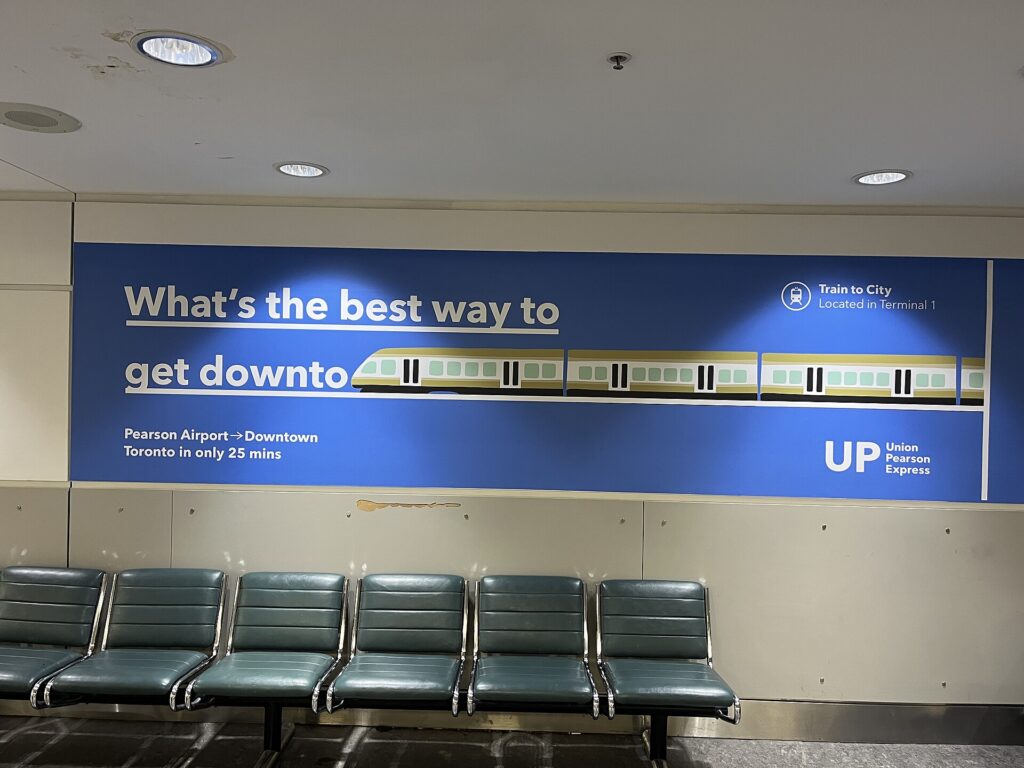
Pearson is about 25 kilometres from downtown, and on a bad afternoon the drive can take an hour. The UP Express train solves that: it leaves Terminal 1 every fifteen minutes for most of the day, stops at Weston and Bloor, and reaches Union Station in about 25 minutes, with PRESTO cards and tap-to-pay accepted. If you are arriving at Terminal 3, the free inter-terminal train takes you to Terminal 1 in a couple of minutes. The cheaper option is the TTC’s 900 Airport Express bus to Kipling station at the western end of the Bloor-Danforth subway line, which works well if your hotel is on that line or you are on a tight budget and have time. Taxis and ride-hail services pick up outside both terminals, and every major rental company has counters in the terminals. The official Pearson site keeps current ground-transport details and terminal maps; our Pearson airport guide covers the layout.
From Billy Bishop Toronto City Airport (YTZ)
Billy Bishop sits on the western edge of the Toronto Islands, and the mainland terminal is at the foot of Bathurst Street. A pedestrian tunnel and a short ferry, both free, connect the two. From the mainland it is a walk to the western waterfront hotels, a streetcar ride along Queens Quay or up Bathurst to the rest of downtown, or a short taxi. If you are flying in from Ottawa, Montreal, Halifax, New York, Boston, Chicago or Washington and staying downtown, Billy Bishop is often the more convenient airport even at a somewhat higher fare; the airport’s site lists routes and access options.
From Hamilton (YHM)
If a low-cost fare has brought you into Hamilton, roughly 75 kilometres away, this is the one arrival where a rental car almost always makes sense. Ground transport into Toronto without one is slow, and a car makes Niagara, which is closer to Hamilton than to Toronto, an easy add-on.
Toronto’s transit, explained
The Toronto Transit Commission runs the subway, streetcars and buses. It is the third-busiest transit system in North America, it is generally safe and frequent, and for visitors it is simpler than it looks on the map.
The subway
Two lines do most of the work. Line 1 (Yonge-University) is a U shape that runs down Yonge Street from the northern suburbs through downtown to Union Station and back up University Avenue and Spadina Road; it touches the Eaton Centre, City Hall, Union Station, the museums at Museum and St. George stations, and Yorkville. Line 2 (Bloor-Danforth) runs east-west across the city along Bloor Street and the Danforth, from Kipling in the west to Kennedy in the east, crossing Line 1 at Bloor-Yonge and St. George. Line 4 (Sheppard) is a short line in the north that few visitors use. Newer light-rail lines have been under construction across the city for years; check the TTC’s current map for what is open when you travel. Trains run from early morning until around 1:30 a.m., later on Saturdays, with a network of Blue Night buses and streetcars covering the small hours.
Streetcars
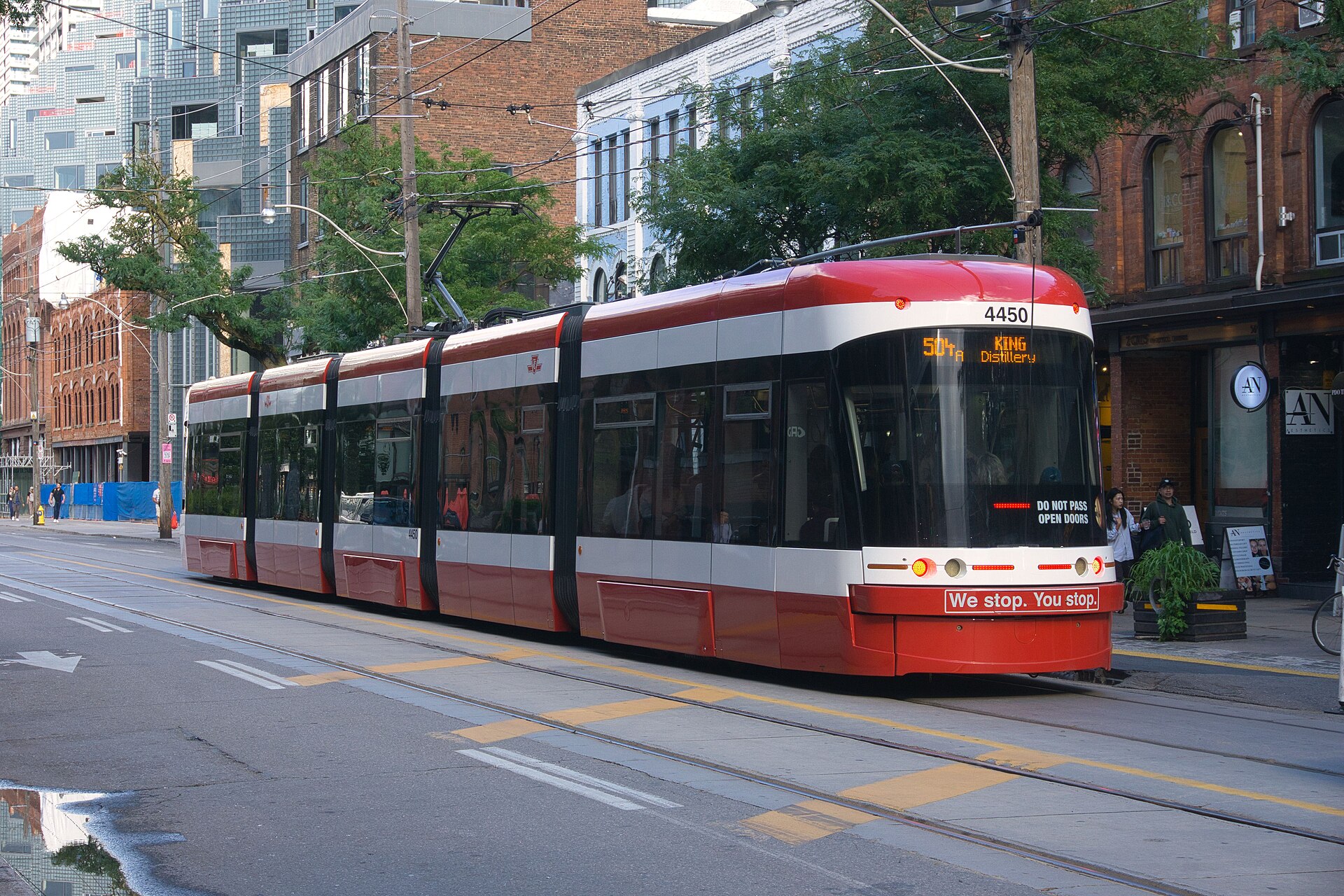
Toronto has the largest streetcar network in the Americas, and it is the most pleasant way to see the downtown grid. The main east-west routes run along Queen, King, Dundas and College streets and Queens Quay; the north-south routes on Spadina and Bathurst connect the waterfront to the Bloor-Danforth line. Streetcars share the road with cars on most streets, which makes them slower than the subway but far better for watching the city go by. Two rules that catch visitors out: you board through any door and tap on board, and cars driving behind a streetcar must stop when its doors are open, so never step off without looking.
Fares, PRESTO and tap-to-pay
You do not need to buy anything before you ride. Tap a contactless credit card, debit card, phone or watch on the reader at any fare gate or on any bus or streetcar and you are paid. A single tap covers a two-hour transfer window in any direction, so a subway ride, a streetcar and a bus within two hours cost one fare. If you would rather not tap a card, buy a PRESTO card from a machine in any subway station and load it; PRESTO also works on the UP Express and on GO Transit and the transit systems in the surrounding regions, and since the One Fare program began, transfers between the TTC and those systems within the window no longer cost a second fare. Children twelve and under ride the TTC free. Check the TTC’s site for current fares and any day-pass options before you go.
Accessibility
Most, though not all, subway stations have elevators, all buses and the newer streetcars are low-floor and accessible, and the TTC publishes a list of accessible stations. If step-free access matters, plan around that list rather than assuming every station has it.
Beyond the TTC
- GO Transit is the regional rail and bus network, hubbed at Union Station. It reaches Hamilton, Oakville, Oshawa, Barrie and the whole suburban ring, and runs seasonal weekend trains and year-round buses to Niagara Falls. See GO Transit for schedules.
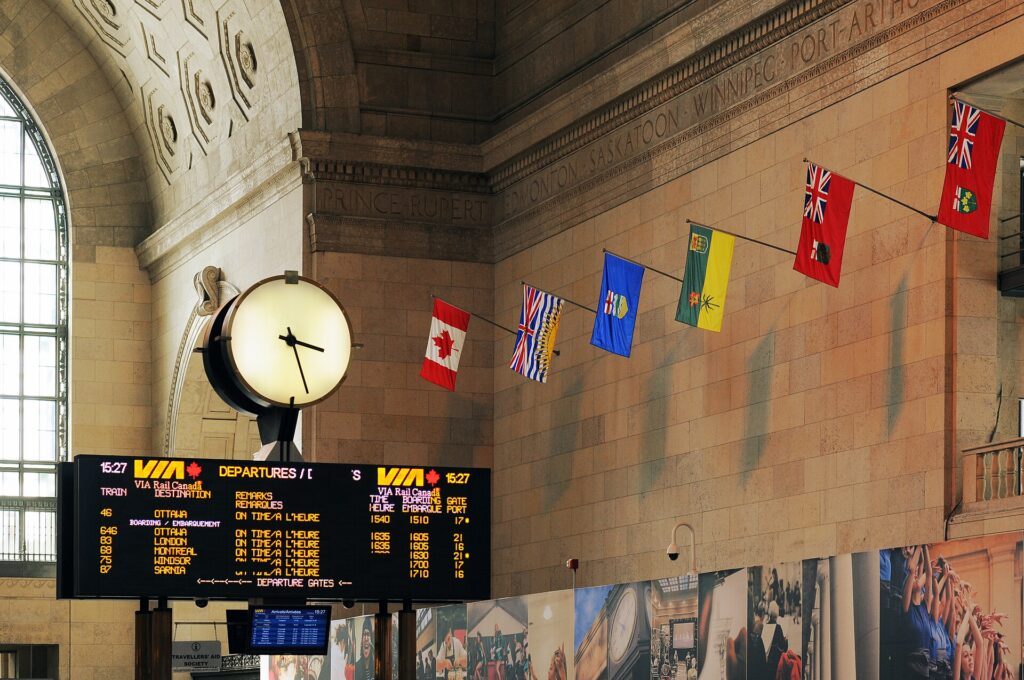
- VIA Rail runs from Union Station to Montreal, Ottawa, Kingston and Windsor; the Toronto-Montreal corridor is a genuine alternative to flying or driving between the two cities.
- Bike Share Toronto has hundreds of docks across the central city and operates year-round. It is the best way to cover the waterfront trail and to get between neighbourhoods that are a little too far to walk.
- The Toronto Islands ferries leave from the Jack Layton Ferry Terminal at the foot of Bay Street; the islands themselves are car-free.
- Walking and the PATH. Downtown is flat and dense. In winter, the PATH network of underground walkways links Union Station, most of the Financial District and the Eaton Centre, which is how locals move around in January.
- Taxis and ride-hail. Uber and Lyft both operate, and licensed taxis are plentiful downtown. For a group of three or four, a short taxi ride can cost about the same as transit fares and save real time late at night.
Driving in Toronto: what it is really like
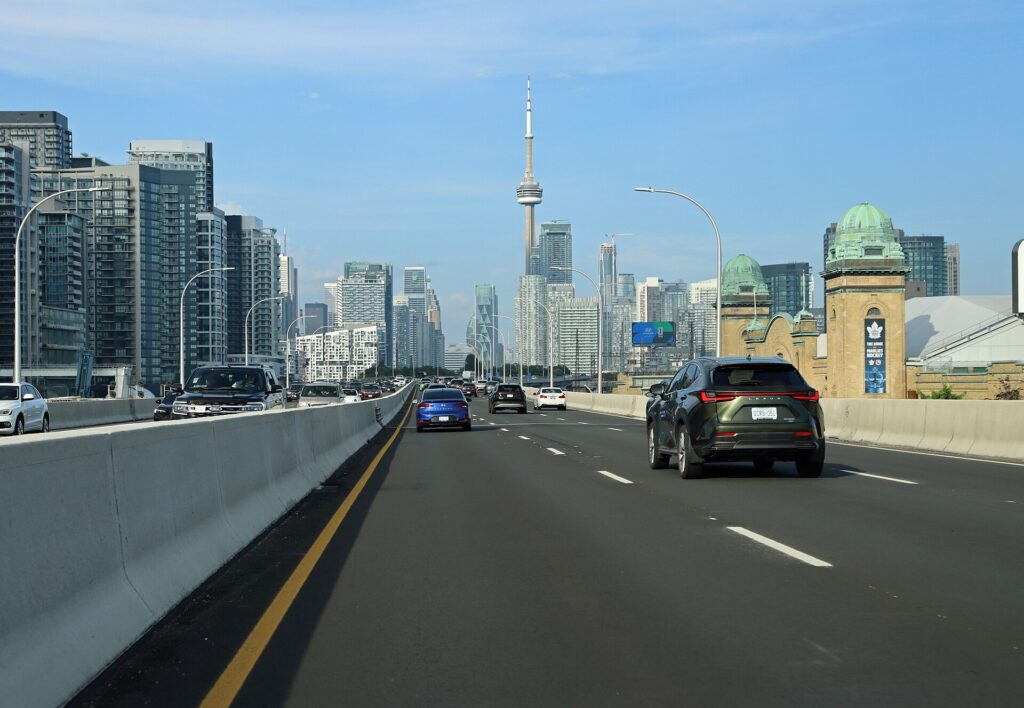
Toronto is not a hard city to drive in by the standards of New York or Boston. The grid is logical, drivers are generally orderly, and signage is clear. What makes it tiring is volume. Highway 401, the main east-west artery across the north of the city, is one of the busiest highways in North America. The Gardiner Expressway, the elevated road that carries traffic along the waterfront into downtown, and the Don Valley Parkway, which feeds in from the northeast, both jam solidly in the morning and evening peaks, roughly seven to nine-thirty and four to six-thirty on weekdays, and regularly at other times when there is an event at the stadiums or a lane closed for construction. Summer is construction season, and it shows.
Parking
This is the deciding factor for most visitors. Downtown hotels typically charge a substantial nightly fee for parking, and overnight rates at commercial lots are not much better. Street parking exists but is metered, time-limited, and on the main streets is prohibited during rush hours, with towing enforced. The city’s Green P lots are the most predictable option. Add it up for a five-night stay and the parking alone can cost more than a week of transit for two people, before you have paid for the car or the fuel.
Tolls, cameras and rules worth knowing
- Highway 407, the toll road that runs across the top of the region, uses electronic tolling with no booths. Rental companies pass the tolls through, usually with an administrative fee per trip; ask the counter how they handle it before you use it.
- Red-light and automated speed cameras operate across the city; fines follow the car, and the rental company will bill you.
- Streetcars: when a streetcar stops and its doors open, traffic behind it must stop. It is the law in Ontario and it is enforced.
- Right turns on red are permitted after a full stop unless signed otherwise, as in most of North America.
- Bike lanes are extensive downtown and often physically separated; check your mirror before every turn.
- Winter: Ontario does not require winter tires, and rental cars usually come on all-seasons. For the city that is fine. If you are heading north to ski or to cottage country between December and March, ask specifically for a vehicle with winter tires.
When renting a car makes sense
- Day trips. Niagara Falls and Niagara-on-the-Lake, Stratford, Prince Edward County, Blue Mountain, Elora, Muskoka and Algonquin are all far easier and more flexible by car. Most of our day-trip suggestions assume one.
- Family in the suburbs. If you are staying in Mississauga, Brampton, Vaughan, Markham or Scarborough with relatives, a car makes evenings downtown and days in the suburbs both workable.
- Winter with young children. Strollers, car seats, snowsuits and a streetcar in a February snowstorm are a hard combination. A car and a hotel with parking can be worth every dollar.
- Multi-stop Ontario or cross-border trips. Toronto to Ottawa, Montreal, Detroit or Buffalo is a natural drive, and a one-way rental can be cheaper than the extra flights.
- Arriving at Hamilton. Covered above; almost always yes.
- Accessibility or mobility needs that transit cannot comfortably meet.
If any of those apply, our rental car booking tips cover insurance, deposits and the questions to ask at the counter, and our family car rental guide looks at vehicle choice.
When it does not
- You are staying downtown or within a few minutes of a subway station.
- Your plans are the icons, the museums, the neighbourhoods, a show and a game.
- You are visiting for a festival, a conference or a sporting event, when downtown traffic and parking are at their worst.
- You are travelling as a couple or solo and value your time over a fixed vehicle.
- You dislike driving in snow and are visiting between December and March.
The hybrid plan most visitors should use
Go car-free for the city portion of the trip, then rent a car for exactly the days you need it, picking it up from a downtown location rather than the airport. Downtown pickups let you avoid airport surcharges, skip the drive in from Pearson at peak time, and avoid paying hotel parking on the nights you are not using the car. Book the rental in advance for the specific dates; walk-up availability downtown on a summer weekend is poor. Return it the evening before you fly, take the UP Express or a taxi to the airport, and the whole thing costs a fraction of a week-long rental. Compare the day rates on our Toronto car rental page against the full-trip rate and the difference is usually obvious.
Decision table
| Your trip | Recommendation | Why |
|---|---|---|
| Weekend downtown, couple or solo | No car | Everything is walkable or one subway ride; parking would cost more than the transit |
| Four or five days, one day trip to Niagara | Hybrid: rent for one day downtown | Car-free city days, car for the one day it matters |
| Family visit to the suburbs | Rent for the whole stay | Suburban transit is slower and the car earns its keep daily |
| Winter trip with small children | Rent, choose a hotel with parking | Weather and gear make transit hard work |
| Ontario road trip starting or ending in Toronto | Rent (consider one-way) | Toronto is the bookend, not the destination |
| Flying into Hamilton | Rent at the airport | Ground transport without a car is poor |
| Conference, TIFF week or a big game | No car | Downtown traffic and parking are at their worst |
| Business trip, meetings across the region | Rent, or taxi and GO | Depends on how spread out the meetings are |
Money-saving tips for both options
- On transit: tap the same card every time so transfers register; use the two-hour window to combine errands; ride the streetcars for sightseeing rather than paying for a bus tour.
- On a rental: compare downtown and airport pickup prices, book early for summer and holiday weekends, decline extras you already have through your credit card or home insurance (check first), ask about the 407 toll policy, and refuel before you return.
- On the hotel: if you are renting, price the parking fee into the room rate when you compare; a slightly pricier hotel with included parking can be the cheaper choice.
- On timing: avoid arriving or leaving downtown by car in the weekday peaks; the best time to fly to Toronto guide lists the event weeks when downtown traffic is heaviest.
- On the airport run: the UP Express is almost always faster than a taxi from Pearson in daytime traffic, and for one or two people it is cheaper too.
Frequently asked questions
Is it worth renting a car in Toronto?
Only if you are leaving the city, staying in the suburbs, or travelling in winter with young children. For a downtown-focused visit, transit and walking are faster and far cheaper once parking is counted.
Is Toronto public transit good for tourists?
Yes. Two subway lines and the downtown streetcars reach nearly every major sight, tap-to-pay means no ticket to buy, and a single fare covers two hours of transfers.
How do I get from Pearson Airport to downtown Toronto?
The UP Express train from Terminal 1 to Union Station takes about 25 minutes. The TTC 900 bus to Kipling station is cheaper and slower; taxis and ride-hail are available outside both terminals.
Can I use my credit card on the TTC?
Yes. Tap a contactless credit or debit card, or a phone or watch, at the fare gate or on board. A PRESTO card is an alternative and also works on GO Transit and the UP Express.
Is parking expensive in downtown Toronto?
Yes. Hotel and commercial lot rates are high enough that for a stay of several nights the parking alone can exceed the cost of transit for two people for the whole trip.
Do I need winter tires to drive in Toronto?
Not by law, and rentals usually come on all-season tires, which are adequate for the city. Ask for winter tires if you are driving north to ski country or cottage country between December and March.
Can I get to Niagara Falls without a car?
Yes: GO Transit runs seasonal weekend trains and year-round buses, VIA Rail serves the region, and many companies run day tours from downtown. A car gives you more flexibility for Niagara-on-the-Lake and the wineries.
Whichever way you go, start with the flight. Compare cheap flights to Toronto, choose a neighbourhood with our Toronto hotel search, and if a day trip is on the list, price the rental for those dates on our Toronto car rental page.
Keep planning with TicketScanner
- Toronto car rentals — compare downtown and airport pickup
- Cheap flights to Toronto
- Toronto hotels — factor parking into the rate
- Things to do in Toronto: a first-timer's guide
- Best time to fly to Toronto: month by month
- Toronto Pearson (YYZ) airport guide
- Rental car booking tips
- Car, transit or taxi in a new city?
Leave a Reply