Tag: Toronto

  • Best Time to Fly to Toronto: Seasons, Weather & Prices

    Best Time to Fly to Toronto: Seasons, Weather & Prices

    Toronto is a four-season city in the truest sense: the same downtown that sits under a foot of snow in February fills its patios in July, and the price of a seat to Toronto Pearson moves with that calendar. If you are flexible on dates, the difference between a good week and a bad week to fly can be larger than the difference between two airlines. This guide walks through Toronto’s weather month by month, the periods when fares and hotel rates climb, the festivals and long weekends that quietly drive those spikes, and which of the city’s three airports makes sense for your trip.

    The short answer

    For most first-time visitors, the sweet spot is late May through June and again from early September to mid-October. Both windows bring comfortable temperatures, long days in spring and warm lake evenings in fall, and demand that sits below the summer peak. The cheapest fares of the year usually appear from mid-January to early March, when the city is cold, the days are short, and business travel is the main thing filling planes. The most expensive stretches are the summer school holidays (July and August), the Christmas and New Year period, and a handful of event weeks covered below, TIFF in September being the one that surprises people most.

    Whichever window you choose, run a Toronto flight search on TicketScanner with flexible dates before you commit. The calendar view makes it obvious when a mid-week departure or a shift of two or three days changes the price band entirely.

    Cherry blossoms in full bloom at High Park, Toronto, in spring
    High Park cherry blossoms, a late-April to early-May event that fills hotels near the park (Photo: Fabian Roudra Baroi via Wikimedia Commons, CC BY-SA 4.0)

    Toronto’s weather, season by season

    Toronto sits on the northwest shore of Lake Ontario, and the lake matters. It softens the worst of the winter cold compared with cities further inland, keeps spring slightly cooler than you would expect from the calendar, and holds warmth into October. The figures below are approximate seasonal patterns drawn from the long-term climate normals published by Environment and Climate Change Canada; always check the current forecast a few days before you fly, because Toronto can swing ten degrees in a day when a front moves through.

    MonthTypical daytime highTypical overnight lowWhat it feels likeFare pressure
    Januaryaround -1 °Caround -7 °CCold, grey, snow on the ground most weeks; wind off the lake bites downtownLow (after the first week)
    Februaryaround 0 °Caround -6 °CStill deep winter; the coldest snaps of the year often land hereLow, except Family Day weekend
    Marcharound 4 °Caround -2 °CThaw and freeze; slush, then the first mild afternoonsLow to moderate (March Break)
    Aprilaround 12 °Caround 3 °CUnpredictable; a warm week can be followed by a late snowfallModerate
    Mayaround 19 °Caround 9 °CSpring proper; cherry blossoms, patios open, cool eveningsModerate; rises around the long weekend
    Junearound 24 °Caround 14 °CWarm, long days, occasional thunderstormsModerate to high
    Julyaround 27 °Caround 18 °CHot and humid; humidex values well above the thermometerHigh
    Augustaround 26 °Caround 17 °CHot and humid, cooling slightly in the last weekHigh
    Septemberaround 22 °Caround 13 °CWarm days, crisp evenings; the lake is at its warmestModerate, with a TIFF spike
    Octoberaround 14 °Caround 7 °CFall colour in the ravines and High Park; jacket weatherModerate to low
    Novemberaround 7 °Caround 1 °CGrey and damp; first snow is common late in the monthLow
    Decemberaround 1 °Caround -4 °CWinter arrives; festive lights and markets downtownLow until mid-month, then peak

    Two things the table cannot show. First, humidity: a 27 °C July afternoon downtown routinely carries a humidex reading in the mid-30s, so plan indoor breaks if you are not used to it. Second, daylight: Toronto gets roughly fifteen and a half hours of daylight around the June solstice and under nine hours in late December. A winter visit is not shorter in days, but it is much shorter in usable sightseeing light.

    How Toronto’s fare seasons work

    Airfares to Toronto follow a pattern that is more predictable than most travellers assume, because the city’s demand is driven by three overlapping calendars: the school year in Ontario and in the American and European markets that feed it, the business-travel week, and a festival schedule that is heavily concentrated between June and September.

    Peak season

    Late June to the end of August, plus the two weeks around Christmas and New Year. Schools are out across Canada, the United States and the United Kingdom, families travel, and Toronto’s summer festival season is in full swing. Expect the highest fares and the tightest hotel availability, especially on weekends. If you must travel in peak, book early and fly mid-week; a Tuesday or Wednesday departure frequently sits in a lower fare band than the Friday of the same week.

    Shoulder season

    April to mid-June and September to October. This is where value and weather overlap. Demand is real but not frantic, hotels have inventory, and the city is either waking up (spring) or at its most photogenic (fall). Watch for the long weekends, Victoria Day in late May and Thanksgiving in early October, and for the September TIFF window, all of which temporarily behave like peak.

    Low season

    Mid-January to early March, and most of November. Fares are at their lowest, and Toronto’s winter has its own appeal: skating at Nathan Phillips Square, museums without queues, restaurant weeks, and hockey. The trade-off is weather risk. Build a buffer into connections, and if you are flying in from a warm climate, read our note on what to wear on the plane and pack a real coat in your carry-on rather than checking it.

    Fares also move with the day of the week and the time of day. Early-morning and late-evening departures are often priced below mid-day flights on the same route, and a search that spans the whole month will usually reveal a cheaper pair of dates within a few days of your first choice. Our guide to the best times to book flights and hotels goes deeper on how to read those patterns.

    Toronto month by month

    January

    The first week is still holiday-priced; after that, January is reliably the cheapest month to fly into Toronto. It is also genuinely cold. Highs hover around freezing, lows drop below -10 °C on the colder days, and the wind on the waterfront makes it feel colder still. What January does well: hockey at Scotiabank Arena, the winter restaurant festival (Winterlicious usually runs from late January into February), the PATH network of underground walkways that lets you cross much of the financial district without stepping outside, and museum days at the ROM and the AGO with no crowds. Fly in with a checked-bag-free strategy if you can; winter storms occasionally disrupt Pearson, and being able to walk off with everything you own is worth a lot.

    February

    Similar to January in temperature and price, with one exception: Family Day, an Ontario statutory holiday on the third Monday of February, creates a mini long weekend that lifts fares and hotel rates for a few days. Outside that weekend, February is a strong value month. The Toronto Light Festival at the Distillery District has run in recent winters, and the city’s skating rinks, including the one at Nathan Phillips Square, are at their best. Check the City of Toronto’s festivals and events listings for what is scheduled in the year you travel.

    March

    March is a transition month, and the weather is honest about it: slush, sudden thaws, and the odd late snowstorm. Prices stay low except around March Break, the Ontario school holiday in the middle of the month, when family demand rises and flights from sun destinations back into Toronto get busy. If you are visiting rather than returning, aim for the first or last week of the month.

    April

    Spring arrives unevenly. Early April can still be cold; by the end of the month the patios are cautiously opening and the city is greening up. The Blue Jays’ home season begins at Rogers Centre, which puts a few thousand extra visitors in downtown hotels on game nights. Fares sit in the moderate band, and hotel rates are noticeably lower than they will be in six weeks. April is an underrated month for a museum-and-food trip.

    May

    The best-kept secret in the Toronto calendar. The cherry blossoms in High Park usually peak in late April or the first week of May, drawing big local crowds on the weekend but few overnight visitors. Doors Open Toronto, which lets you inside dozens of buildings normally closed to the public, typically falls in late May. The Victoria Day long weekend (the Monday before May 25) is the one date to book around. Otherwise, May offers spring weather, opening-season energy, and prices well below June.

    June

    Warm, long, and busy. Pride Toronto culminates in one of the largest Pride parades in North America at the end of the month, Luminato brings arts programming across the city, and the summer patio season is fully open. Fares step up from mid-month as schools finish. If June is your month, the first two weeks are the value play.

    July

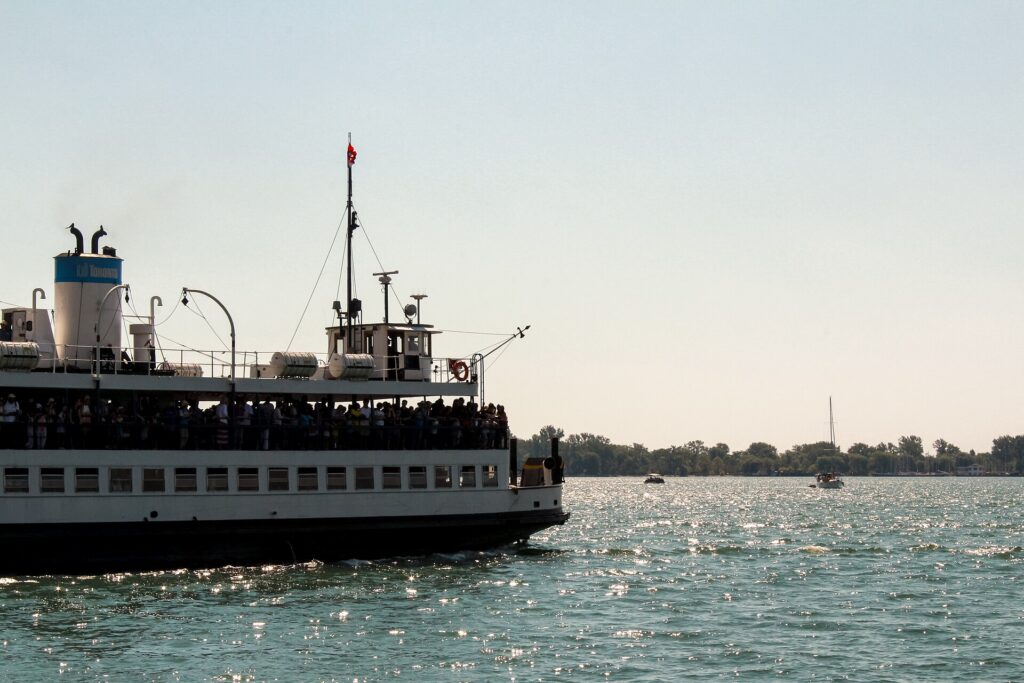
    Peak season proper. Canada Day on July 1 opens the month with fireworks and a long weekend; the Honda Indy runs at Exhibition Place; Summerlicious brings prix-fixe menus to restaurants across the city; and the humidity settles in. Fares and hotel rates are at their annual high. The Toronto Islands, with their beaches and car-free lanes, are the local escape valve, and the ferry line at Jack Layton Ferry Terminal on a hot Saturday tells you everything about demand.

    August

    Still peak, with two big demand events: the Toronto Caribbean Carnival (often called Caribana), whose grand parade takes place on the Saturday of the first weekend in August, a civic long weekend in Ontario; and the Canadian National Exhibition, the CNE, which runs from mid-August to Labour Day at Exhibition Place. The last week of August, after most families have flown home but before the CNE closes, is a small pocket of slightly softer pricing.

    September

    Many locals will tell you September is the best month in Toronto, and the weather agrees: warm days, cool nights, and a lake that has finally warmed up. The catch is the Toronto International Film Festival, which runs for roughly ten days in early-to-mid September and fills downtown hotels with the film industry. TIFF week fares and room rates behave like peak season. Fly in after the festival closes and you get September weather at shoulder prices. Check TIFF’s official site for the exact dates before you book.

    October

    Fall colour in the ravines, High Park and the Don Valley; crisp days that still reach the mid-teens; and, apart from the Thanksgiving long weekend on the second Monday of the month, steadily falling prices. Nuit Blanche, the all-night contemporary art event, has landed in late September or October in recent years. Late October is one of the best value-for-weather windows of the whole year.

    November

    Grey, damp and quiet, which is exactly why fares and hotel rates are low. The Royal Agricultural Winter Fair fills Exhibition Place for ten days in early November, the Santa Claus Parade runs in the middle of the month, the Cavalcade of Lights switches on the holiday lights at Nathan Phillips Square, and the Distillery Winter Village (formerly the Toronto Christmas Market) opens at the Distillery District in the second half of the month. If you like a city at its festive best without paying festive prices, the last ten days of November are the target.

    December

    Two months in one. The first half continues November’s value pricing with the added bonus of the holiday markets and lights in full swing. From about December 18 onward, fares and hotel rates jump for the Christmas and New Year period and stay high into the first days of January. Winter is fully here: expect snow, short days, and the occasional weather delay at Pearson.

    Snow-covered path in High Park, Toronto, in winter
    Toronto in January: cold, quiet, and usually the cheapest month to fly in (Photo: Chicken4War via Wikimedia Commons, CC BY-SA 4.0)

    Events that move Toronto flight and hotel prices

    The following dates are worth cross-checking against your travel plans before you book. Some are worth planning a trip around; all of them are worth knowing about if your dates happen to overlap. Exact dates shift each year, so confirm with Destination Toronto or the event organizers.

    • Family Day weekend (third Monday of February): short domestic spike.
    • March Break (mid-March): family travel, especially inbound from sun destinations.
    • Victoria Day weekend (Monday before May 25): the unofficial start of summer.
    • Pride Toronto (late June): major weekend demand downtown.
    • Canada Day (July 1) and the surrounding long weekend.
    • Toronto Caribbean Carnival (civic long weekend, early August): one of the busiest weekends of the year for hotels.
    • Canadian National Exhibition (mid-August to Labour Day): steady demand, plus the air show on Labour Day weekend.
    • TIFF (early-to-mid September): the single biggest hotel-rate spike outside the holidays.
    • Thanksgiving weekend (second Monday of October).
    • Christmas to New Year (roughly December 18 to January 3).
    • Major sporting events: Blue Jays playoff games, Raptors and Maple Leafs playoff runs in April through June, and international matches at BMO Field can all tighten hotel availability on short notice. Our Toronto events page lists what is on sale for the dates you are considering.

    Which Toronto airport should you fly into?

    Toronto has two airports inside the city region and a third an hour away that budget carriers have used. The right choice depends on where you are coming from and where you are staying.

    Toronto Pearson International (YYZ)

    Canada’s busiest airport, in Mississauga about 25 kilometres northwest of downtown. Virtually every international flight and most domestic and transborder flights land here. There are two terminals: Terminal 1 is the Air Canada and Star Alliance home, and Terminal 3 hosts most other carriers, including WestJet and the major American airlines. Getting downtown is straightforward: the UP Express train runs from Terminal 1 to Union Station in about 25 minutes, the TTC’s 900 Airport Express bus connects to Kipling subway station, and taxis and ride-hail pick up outside both terminals. Check the official Pearson site for terminal maps and current ground-transport options, and see our Toronto car-rental-versus-transit guide before you reserve a car at the airport.
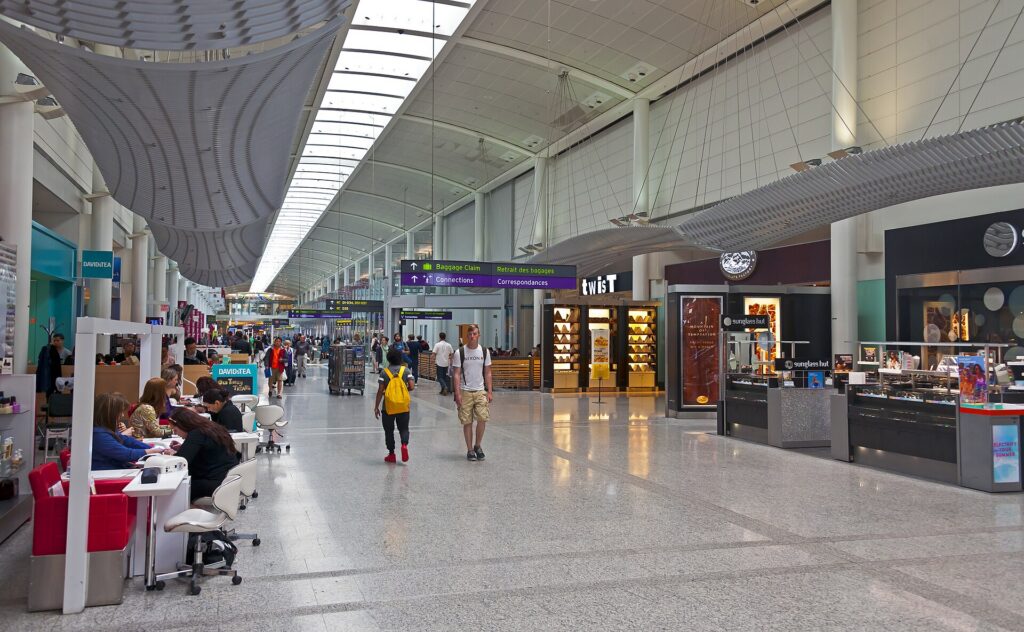
    Terminal 1 at Toronto Pearson International Airport (YYZ)
    Terminal 1 at Toronto Pearson (YYZ), the hub for Air Canada and most international arrivals (Photo: Daniel Case via Wikimedia Commons, CC BY-SA 3.0)

    Billy Bishop Toronto City Airport (YTZ)

    On an island a few hundred metres from the downtown waterfront, Billy Bishop is one of the most convenient city airports anywhere. Porter Airlines is the main operator, with Air Canada also flying select routes; destinations are mostly short-haul, covering eastern Canada and the northeastern United States, including Newark, Boston, Chicago and Washington. A free pedestrian tunnel and a short ferry connect the terminal to the mainland, and from there it is a walk, a streetcar or a five-minute taxi to most downtown hotels. If you are travelling from a city Billy Bishop serves and staying downtown, it is often worth a slightly higher fare for the hour it saves at each end.

    John C. Munro Hamilton International (YHM)

    About 75 kilometres southwest of Toronto, Hamilton’s airport has periodically hosted low-cost carriers on domestic and sun routes. A very low fare into Hamilton can be worth it if you are renting a car, heading to Niagara, or have time to spare; it is a poor choice if you are staying downtown without a car and arriving late, because the ground-transport options are thin. Compare the total trip cost, not just the fare.

    Timing tricks that actually work for Toronto

    • Search a whole month, not a date. Toronto’s demand curve has sharp edges around long weekends and TIFF. A calendar search on TicketScanner shows those edges instantly; shifting a Friday arrival to Thursday, or leaving on the Tuesday after a long weekend, is often the single cheapest change you can make.
    • Fly mid-week in peak season. July and August weekends are where the highest fares live. Tuesday and Wednesday departures on the same route are frequently in a lower band.
    • Book the event weeks early and the low-season weeks late. TIFF, Caribbean Carnival and Christmas fares rarely fall as departure approaches; January and November fares, by contrast, are stable enough that waiting for the right dates costs little.
    • Price the flight and the hotel together. A cheap fare into a TIFF week is not cheap once you have paid the hotel. Run a Toronto hotel search for the same dates before you commit to either.
    • Consider Billy Bishop for short-haul. From cities it serves, the door-to-door time saving is real, and the fare gap is often smaller than expected.
    • Build a winter buffer. If you are connecting through Pearson between December and March, avoid the tightest connection times. Our guide on how early to arrive for an international flight covers what to allow.
    • Coming from the US Northeast? The New York to Toronto route has its own rhythms, with multiple airports on both ends worth comparing.
    • Flying out of Toronto instead? The same seasonality applies in reverse; see cheap flights from Toronto for outbound routes.
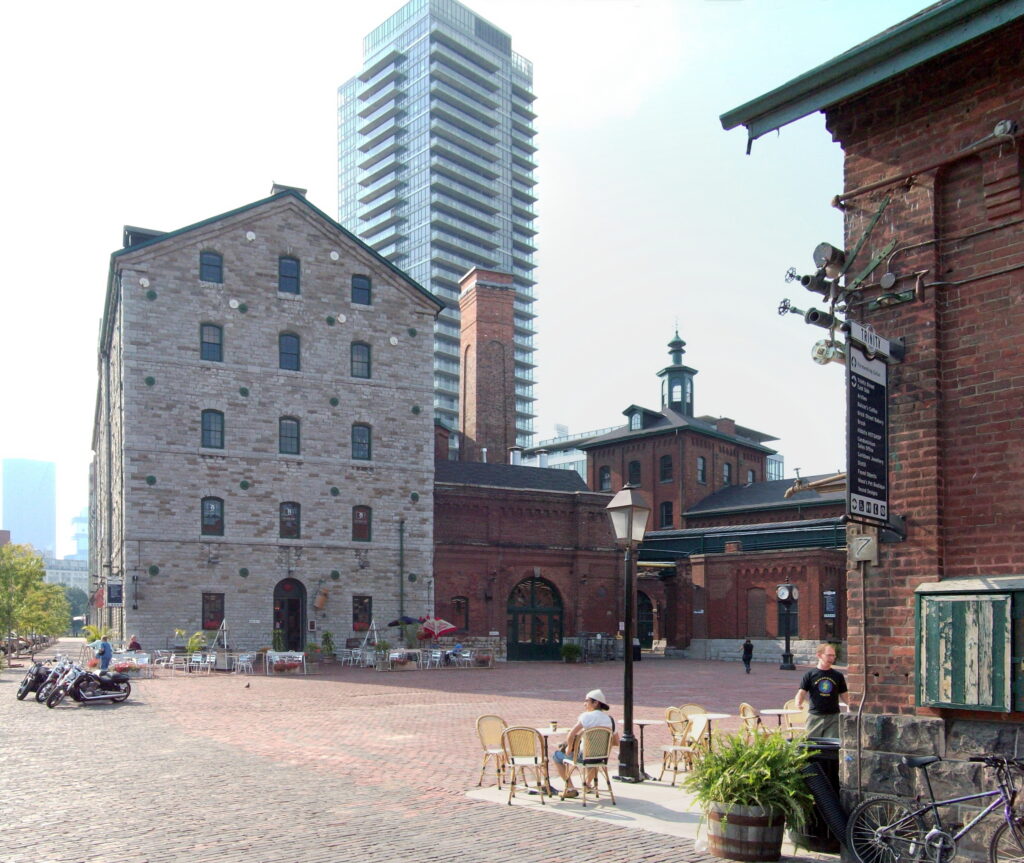
    The flatiron-shaped Gooderham Building in Toronto's Distillery District
    The historic Distillery District, a popular Toronto stop year-round (Photo: Geo Swan, stitched by Marku1988 via Wikimedia Commons, CC BY-SA 3.0)

    What to pack, by season

    Winter (December to March): an insulated, wind-resistant coat, a hat that covers your ears, waterproof boots with grip, and layers for overheated indoor spaces. Spring (April to May): a rain shell, a mid-weight jacket, and shoes you do not mind getting wet; mornings can be near freezing and afternoons mild. Summer (June to August): light, breathable clothing, sun protection, and something for aggressively air-conditioned restaurants and subway cars. Fall (September to November): layers again, a warm jacket by mid-October, and an umbrella in November. Whatever the season, Toronto is a walking city; comfortable shoes matter more than anything else on this list.

    The best time to fly to Toronto for…

    Families

    Late June (before peak fares fully set in) or the last week of August into Labour Day, when the CNE is on and the Toronto Islands, the zoo and Ripley’s Aquarium are all in full summer operation. March Break works well if you are content with indoor attractions.

    The lowest fares

    Mid-January through the first week of March, avoiding Family Day weekend, and the first half of November. Pair with a downtown hotel and lean into the indoor city: the PATH, the museums, the theatre district and the hockey.

    Food and festivals

    July for Summerlicious, patios and the Caribbean Carnival; late January and February for Winterlicious at a fraction of the price. Kensington Market’s pedestrian Sundays run through the summer months.

    Sports

    April to June for hockey and basketball playoff atmosphere; April to September for baseball; the fall for Toronto FC and the Argonauts at BMO Field. Ticket availability, not the fare, is usually the constraint; check what is on sale in Toronto before you book flights.

    Business travel

    Any month, but note that downtown hotels price sharply around TIFF and the big convention weeks. Mid-week arrivals in the shoulder months are the most predictable.

    Cross-border and visiting family

    If you are a U.S. citizen flying in, a valid passport is required, and travellers from visa-exempt countries other than the United States generally need an Electronic Travel Authorization; the Government of Canada’s visitor page explains what applies to you. Canadians returning from abroad should review the current travel advice and entry requirements. Security screening at Canadian airports is run by CATSA, whose site lists what you can carry on.

    Frequently asked questions

    What is the cheapest month to fly to Toronto?

    January and February are consistently the lowest-fare months, followed by November and early December. The first week of January is the exception, as it is still priced with the holidays.

    What is the best month to visit Toronto for weather?

    September for warm days and cool nights, with June a close second. Both are far more comfortable than the humid heart of July and August.

    Is Toronto expensive to visit in summer?

    July and August are the most expensive months for both flights and hotels, driven by school holidays and a dense festival calendar. Mid-week travel and booking well ahead take some of the edge off.

    Should I fly into Pearson or Billy Bishop?

    Pearson for almost all international and long-haul flights and the widest choice of fares; Billy Bishop if you are coming from eastern Canada or the U.S. Northeast and staying downtown, where the convenience is hard to beat.

    How far ahead should I book a flight to Toronto?

    Earlier for peak periods and event weeks, when fares tend only to rise; for low-season dates the fares are stable enough that finding the right pair of days matters more than booking months out. Use flexible-date search and compare across a full month.

    Does it snow in Toronto in April?

    Occasionally, yes, usually early in the month and rarely lasting. By late April the city is firmly in spring, and the High Park cherry blossoms follow soon after.

    When do the High Park cherry blossoms bloom?

    Typically late April to early May, for roughly a week to ten days depending on the year’s weather. The City of Toronto’s parks pages post bloom updates each spring.

    Ready to pick your dates? Compare fares across the whole month on our Toronto flights page, then line up a place to stay with our Toronto hotel search. If you are planning what to do once you land, start with our first-timer’s guide to Toronto.

  • Toronto: Should You Rent a Car or Rely on Public Transit?

    Toronto: Should You Rent a Car or Rely on Public Transit?

    Ask a Torontonian whether you should rent a car for your visit and you will usually get a laugh before you get an answer. The answer, for most trips, is no. Toronto’s downtown is compact and walkable, its subway and streetcar network reaches almost everything a first-time visitor wants to see, and driving in the core means paying for parking that can rival the cost of a hotel room in a smaller city. But “most trips” is not “all trips”. If you are heading to Niagara Falls, cottage country or the suburbs, travelling with small children in January, or splitting your time between the city and somewhere else in Ontario, a car can be the difference between a relaxed week and a logistical one. This guide lays out how the city is built, how its transit really works, what driving here is actually like, and a straightforward way to decide which option fits your trip.

    The short answer

    Skip the car if you are staying downtown or near a subway line and your plans are the city itself: the CN Tower, the museums, the neighbourhoods, a game, a show, the islands. Transit, walking and the occasional taxi will cover all of it, and you will not think about parking once. Rent a car if you have day trips on the list, if you are staying with family in the suburbs, if you are travelling in deep winter with young children and a lot of gear, or if Toronto is one stop on a longer Ontario itinerary. And in many cases the smartest answer is both: go car-free for the city days and pick up a rental from a downtown location for the one or two days you actually need it. Compare rates for either approach on our Toronto car rental page.

    How Toronto is laid out

    Toronto is a grid on a slope that runs gently down to Lake Ontario. Yonge Street is the north-south spine, and the main east-west streets (Front, King, Queen, Dundas, College, Bloor, St. Clair, Eglinton) cross it at roughly even intervals. Downtown is the rectangle between the lake and Bloor Street, and between roughly Bathurst Street in the west and the Don River in the east. Almost everything on a first-time visitor’s list sits inside that rectangle or within one subway ride of it. That geography is why transit works so well here: the sights cluster along two subway lines and a handful of streetcar routes, and the distances between them are short.

    Hotels cluster in four areas. The Entertainment District and the Financial District put you within walking distance of the CN Tower, Union Station, the theatres and the waterfront. Yorkville, at Bloor and Bay, is the upscale option beside the museums. The waterfront hotels trade a slightly longer walk for lake views. Airport-area hotels near Pearson are the cheapest, and the worst choice if you plan to spend your evenings downtown without a car. Our Toronto hotel search lets you compare all four.

    Getting in from the airport

    From Toronto Pearson (YYZ)

    Pearson is about 25 kilometres from downtown, and on a bad afternoon the drive can take an hour. The UP Express train solves that: it leaves Terminal 1 every fifteen minutes for most of the day, stops at Weston and Bloor, and reaches Union Station in about 25 minutes, with PRESTO cards and tap-to-pay accepted. If you are arriving at Terminal 3, the free inter-terminal train takes you to Terminal 1 in a couple of minutes. The cheaper option is the TTC’s 900 Airport Express bus to Kipling station at the western end of the Bloor-Danforth subway line, which works well if your hotel is on that line or you are on a tight budget and have time. Taxis and ride-hail services pick up outside both terminals, and every major rental company has counters in the terminals. The official Pearson site keeps current ground-transport details and terminal maps; our Pearson airport guide covers the layout.

    A UP Express train at the Toronto Pearson airport station
    The UP Express links Pearson Terminal 1 to Union Station in about 25 minutes (Photo: David Wilson from Oak Park, Illinois, USA via Wikimedia Commons, CC BY 2.0)

    From Billy Bishop Toronto City Airport (YTZ)

    Billy Bishop sits on the western edge of the Toronto Islands, and the mainland terminal is at the foot of Bathurst Street. A pedestrian tunnel and a short ferry, both free, connect the two. From the mainland it is a walk to the western waterfront hotels, a streetcar ride along Queens Quay or up Bathurst to the rest of downtown, or a short taxi. If you are flying in from Ottawa, Montreal, Halifax, New York, Boston, Chicago or Washington and staying downtown, Billy Bishop is often the more convenient airport even at a somewhat higher fare; the airport’s site lists routes and access options.

    From Hamilton (YHM)

    If a low-cost fare has brought you into Hamilton, roughly 75 kilometres away, this is the one arrival where a rental car almost always makes sense. Ground transport into Toronto without one is slow, and a car makes Niagara, which is closer to Hamilton than to Toronto, an easy add-on.

    Toronto’s transit, explained

    The Toronto Transit Commission runs the subway, streetcars and buses. It is the third-busiest transit system in North America, it is generally safe and frequent, and for visitors it is simpler than it looks on the map.

    The subway

    Two lines do most of the work. Line 1 (Yonge-University) is a U shape that runs down Yonge Street from the northern suburbs through downtown to Union Station and back up University Avenue and Spadina Road; it touches the Eaton Centre, City Hall, Union Station, the museums at Museum and St. George stations, and Yorkville. Line 2 (Bloor-Danforth) runs east-west across the city along Bloor Street and the Danforth, from Kipling in the west to Kennedy in the east, crossing Line 1 at Bloor-Yonge and St. George. Line 4 (Sheppard) is a short line in the north that few visitors use. Newer light-rail lines have been under construction across the city for years; check the TTC’s current map for what is open when you travel. Trains run from early morning until around 1:30 a.m., later on Saturdays, with a network of Blue Night buses and streetcars covering the small hours.

    The Great Hall inside Union Station, Toronto
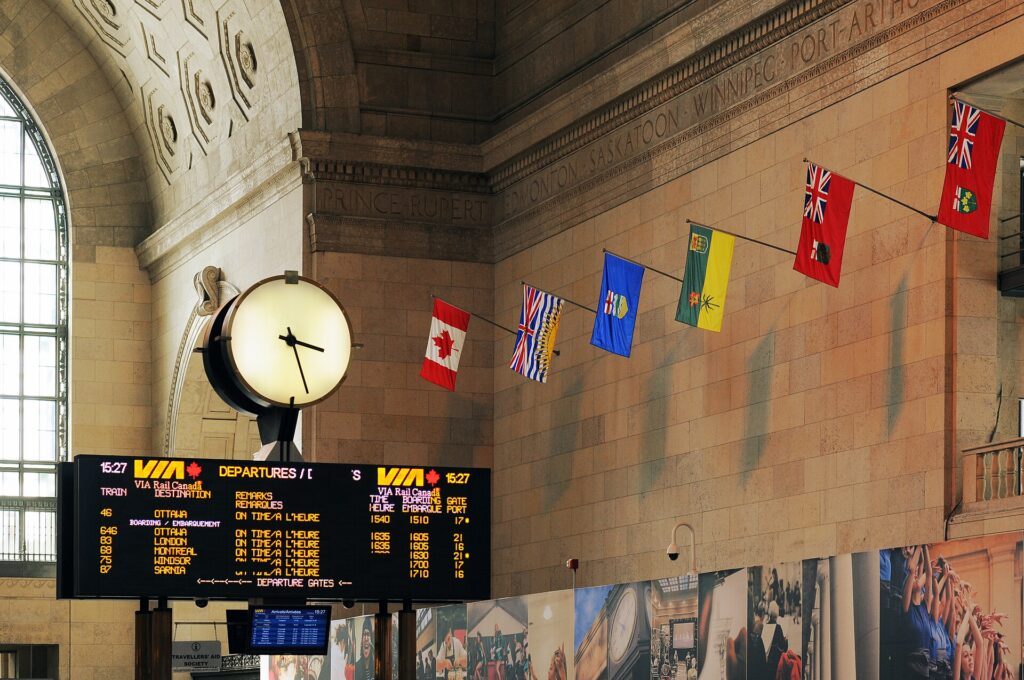
    Union Station: the hub for GO Transit, VIA Rail, the UP Express and Line 1 of the subway (Photo: Milan Suvajac via Wikimedia Commons, CC BY-SA 4.0)

    Streetcars

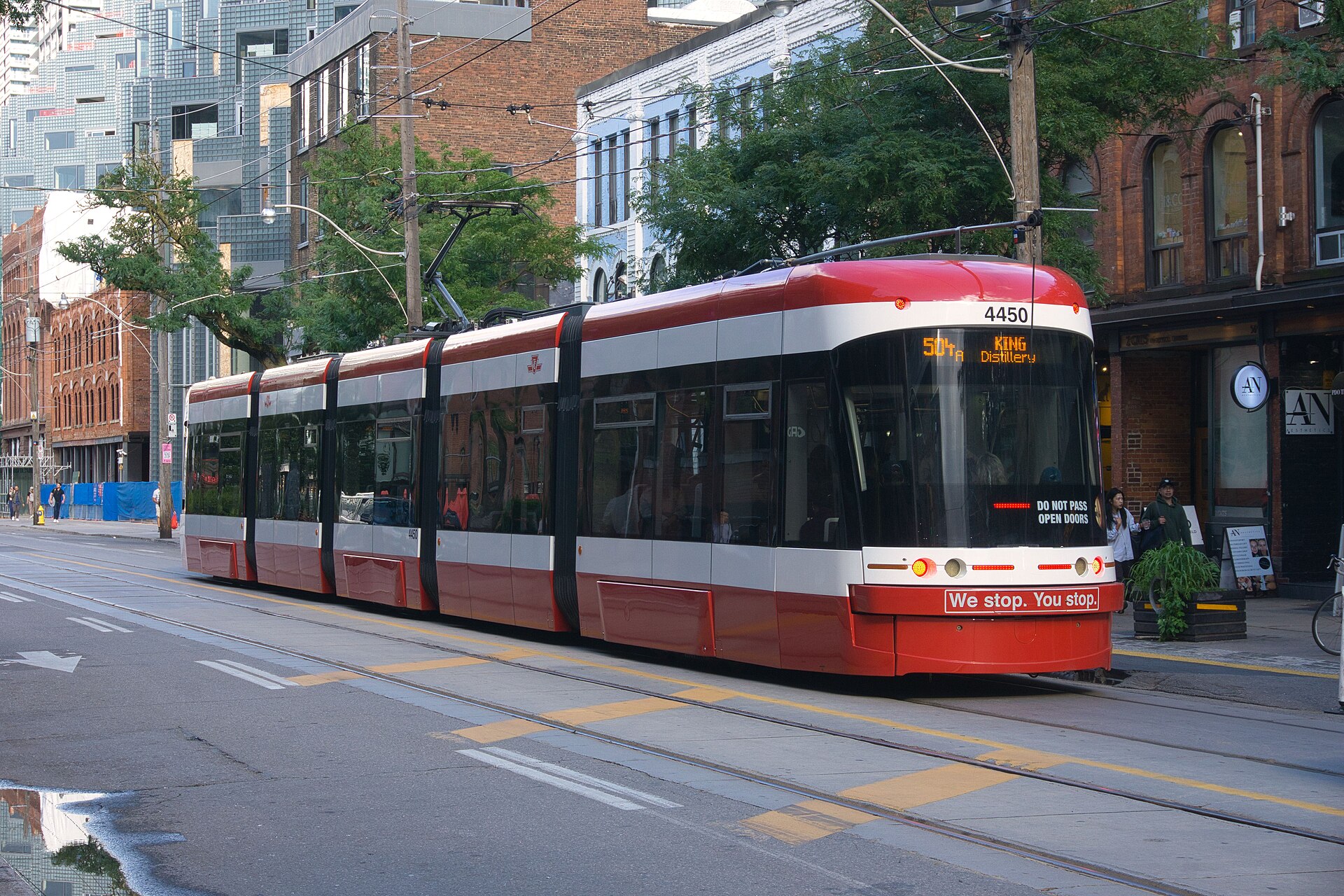
    Toronto has the largest streetcar network in the Americas, and it is the most pleasant way to see the downtown grid. The main east-west routes run along Queen, King, Dundas and College streets and Queens Quay; the north-south routes on Spadina and Bathurst connect the waterfront to the Bloor-Danforth line. Streetcars share the road with cars on most streets, which makes them slower than the subway but far better for watching the city go by. Two rules that catch visitors out: you board through any door and tap on board, and cars driving behind a streetcar must stop when its doors are open, so never step off without looking.

    A red TTC streetcar on a downtown Toronto street
    TTC streetcars run on most of the main downtown east-west streets (Photo: Chicken4War via Wikimedia Commons, CC BY-SA 4.0)

    Fares, PRESTO and tap-to-pay

    You do not need to buy anything before you ride. Tap a contactless credit card, debit card, phone or watch on the reader at any fare gate or on any bus or streetcar and you are paid. A single tap covers a two-hour transfer window in any direction, so a subway ride, a streetcar and a bus within two hours cost one fare. If you would rather not tap a card, buy a PRESTO card from a machine in any subway station and load it; PRESTO also works on the UP Express and on GO Transit and the transit systems in the surrounding regions, and since the One Fare program began, transfers between the TTC and those systems within the window no longer cost a second fare. Children twelve and under ride the TTC free. Check the TTC’s site for current fares and any day-pass options before you go.

    Accessibility

    Most, though not all, subway stations have elevators, all buses and the newer streetcars are low-floor and accessible, and the TTC publishes a list of accessible stations. If step-free access matters, plan around that list rather than assuming every station has it.

    Beyond the TTC

    • GO Transit is the regional rail and bus network, hubbed at Union Station. It reaches Hamilton, Oakville, Oshawa, Barrie and the whole suburban ring, and runs seasonal weekend trains and year-round buses to Niagara Falls. See GO Transit for schedules.
    • VIA Rail runs from Union Station to Montreal, Ottawa, Kingston and Windsor; the Toronto-Montreal corridor is a genuine alternative to flying or driving between the two cities.
    • Bike Share Toronto has hundreds of docks across the central city and operates year-round. It is the best way to cover the waterfront trail and to get between neighbourhoods that are a little too far to walk.
    • The Toronto Islands ferries leave from the Jack Layton Ferry Terminal at the foot of Bay Street; the islands themselves are car-free.
    • Walking and the PATH. Downtown is flat and dense. In winter, the PATH network of underground walkways links Union Station, most of the Financial District and the Eaton Centre, which is how locals move around in January.
    • Taxis and ride-hail. Uber and Lyft both operate, and licensed taxis are plentiful downtown. For a group of three or four, a short taxi ride can cost about the same as transit fares and save real time late at night.

    Driving in Toronto: what it is really like

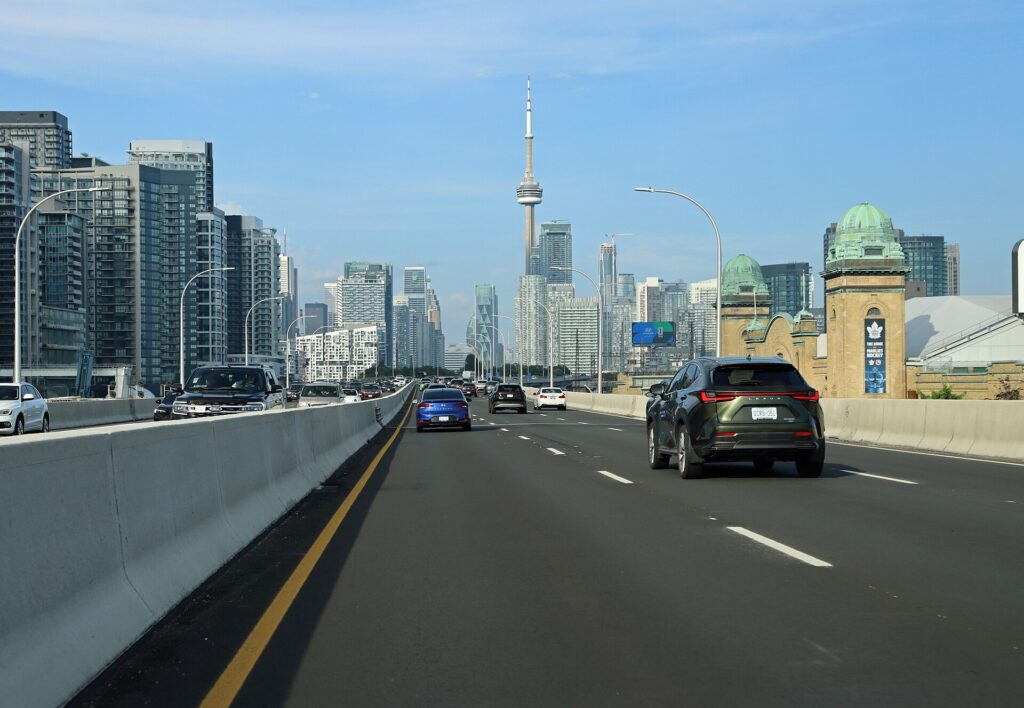
    Toronto is not a hard city to drive in by the standards of New York or Boston. The grid is logical, drivers are generally orderly, and signage is clear. What makes it tiring is volume. Highway 401, the main east-west artery across the north of the city, is one of the busiest highways in North America. The Gardiner Expressway, the elevated road that carries traffic along the waterfront into downtown, and the Don Valley Parkway, which feeds in from the northeast, both jam solidly in the morning and evening peaks, roughly seven to nine-thirty and four to six-thirty on weekdays, and regularly at other times when there is an event at the stadiums or a lane closed for construction. Summer is construction season, and it shows.

    Traffic on the Gardiner Expressway, Toronto
    The Gardiner Expressway: the main route into downtown by car, and the main reason many visitors leave the car at the hotel (Photo: Coolcaesar via Wikimedia Commons, CC BY 4.0)

    Parking

    This is the deciding factor for most visitors. Downtown hotels typically charge a substantial nightly fee for parking, and overnight rates at commercial lots are not much better. Street parking exists but is metered, time-limited, and on the main streets is prohibited during rush hours, with towing enforced. The city’s Green P lots are the most predictable option. Add it up for a five-night stay and the parking alone can cost more than a week of transit for two people, before you have paid for the car or the fuel.

    Tolls, cameras and rules worth knowing

    • Highway 407, the toll road that runs across the top of the region, uses electronic tolling with no booths. Rental companies pass the tolls through, usually with an administrative fee per trip; ask the counter how they handle it before you use it.
    • Red-light and automated speed cameras operate across the city; fines follow the car, and the rental company will bill you.
    • Streetcars: when a streetcar stops and its doors open, traffic behind it must stop. It is the law in Ontario and it is enforced.
    • Right turns on red are permitted after a full stop unless signed otherwise, as in most of North America.
    • Bike lanes are extensive downtown and often physically separated; check your mirror before every turn.
    • Winter: Ontario does not require winter tires, and rental cars usually come on all-seasons. For the city that is fine. If you are heading north to ski or to cottage country between December and March, ask specifically for a vehicle with winter tires.

    When renting a car makes sense

    • Day trips. Niagara Falls and Niagara-on-the-Lake, Stratford, Prince Edward County, Blue Mountain, Elora, Muskoka and Algonquin are all far easier and more flexible by car. Most of our day-trip suggestions assume one.
    • Family in the suburbs. If you are staying in Mississauga, Brampton, Vaughan, Markham or Scarborough with relatives, a car makes evenings downtown and days in the suburbs both workable.
    • Winter with young children. Strollers, car seats, snowsuits and a streetcar in a February snowstorm are a hard combination. A car and a hotel with parking can be worth every dollar.
    • Multi-stop Ontario or cross-border trips. Toronto to Ottawa, Montreal, Detroit or Buffalo is a natural drive, and a one-way rental can be cheaper than the extra flights.
    • Arriving at Hamilton. Covered above; almost always yes.
    • Accessibility or mobility needs that transit cannot comfortably meet.

    If any of those apply, our rental car booking tips cover insurance, deposits and the questions to ask at the counter, and our family car rental guide looks at vehicle choice.

    When it does not

    • You are staying downtown or within a few minutes of a subway station.
    • Your plans are the icons, the museums, the neighbourhoods, a show and a game.
    • You are visiting for a festival, a conference or a sporting event, when downtown traffic and parking are at their worst.
    • You are travelling as a couple or solo and value your time over a fixed vehicle.
    • You dislike driving in snow and are visiting between December and March.

    The hybrid plan most visitors should use

    Go car-free for the city portion of the trip, then rent a car for exactly the days you need it, picking it up from a downtown location rather than the airport. Downtown pickups let you avoid airport surcharges, skip the drive in from Pearson at peak time, and avoid paying hotel parking on the nights you are not using the car. Book the rental in advance for the specific dates; walk-up availability downtown on a summer weekend is poor. Return it the evening before you fly, take the UP Express or a taxi to the airport, and the whole thing costs a fraction of a week-long rental. Compare the day rates on our Toronto car rental page against the full-trip rate and the difference is usually obvious.

    Decision table

    Your tripRecommendationWhy
    Weekend downtown, couple or soloNo carEverything is walkable or one subway ride; parking would cost more than the transit
    Four or five days, one day trip to NiagaraHybrid: rent for one day downtownCar-free city days, car for the one day it matters
    Family visit to the suburbsRent for the whole staySuburban transit is slower and the car earns its keep daily
    Winter trip with small childrenRent, choose a hotel with parkingWeather and gear make transit hard work
    Ontario road trip starting or ending in TorontoRent (consider one-way)Toronto is the bookend, not the destination
    Flying into HamiltonRent at the airportGround transport without a car is poor
    Conference, TIFF week or a big gameNo carDowntown traffic and parking are at their worst
    Business trip, meetings across the regionRent, or taxi and GODepends on how spread out the meetings are

    Money-saving tips for both options

    • On transit: tap the same card every time so transfers register; use the two-hour window to combine errands; ride the streetcars for sightseeing rather than paying for a bus tour.
    • On a rental: compare downtown and airport pickup prices, book early for summer and holiday weekends, decline extras you already have through your credit card or home insurance (check first), ask about the 407 toll policy, and refuel before you return.
    • On the hotel: if you are renting, price the parking fee into the room rate when you compare; a slightly pricier hotel with included parking can be the cheaper choice.
    • On timing: avoid arriving or leaving downtown by car in the weekday peaks; the best time to fly to Toronto guide lists the event weeks when downtown traffic is heaviest.
    • On the airport run: the UP Express is almost always faster than a taxi from Pearson in daytime traffic, and for one or two people it is cheaper too.

    Frequently asked questions

    Is it worth renting a car in Toronto?

    Only if you are leaving the city, staying in the suburbs, or travelling in winter with young children. For a downtown-focused visit, transit and walking are faster and far cheaper once parking is counted.

    Is Toronto public transit good for tourists?

    Yes. Two subway lines and the downtown streetcars reach nearly every major sight, tap-to-pay means no ticket to buy, and a single fare covers two hours of transfers.

    How do I get from Pearson Airport to downtown Toronto?

    The UP Express train from Terminal 1 to Union Station takes about 25 minutes. The TTC 900 bus to Kipling station is cheaper and slower; taxis and ride-hail are available outside both terminals.

    Can I use my credit card on the TTC?

    Yes. Tap a contactless credit or debit card, or a phone or watch, at the fare gate or on board. A PRESTO card is an alternative and also works on GO Transit and the UP Express.

    Is parking expensive in downtown Toronto?

    Yes. Hotel and commercial lot rates are high enough that for a stay of several nights the parking alone can exceed the cost of transit for two people for the whole trip.

    Do I need winter tires to drive in Toronto?

    Not by law, and rentals usually come on all-season tires, which are adequate for the city. Ask for winter tires if you are driving north to ski country or cottage country between December and March.

    Can I get to Niagara Falls without a car?

    Yes: GO Transit runs seasonal weekend trains and year-round buses, VIA Rail serves the region, and many companies run day tours from downtown. A car gives you more flexibility for Niagara-on-the-Lake and the wineries.

    Whichever way you go, start with the flight. Compare cheap flights to Toronto, choose a neighbourhood with our Toronto hotel search, and if a day trip is on the list, price the rental for those dates on our Toronto car rental page.

  • Things to Do in Toronto: A First-Timer’s Guide

    Things to Do in Toronto: A First-Timer’s Guide

    Toronto rewards a plan. Canada’s largest city is spread along a lakefront that runs for kilometres, and its best experiences are clustered in neighbourhoods that are each worth a half-day on their own. Try to see everything with no structure and you will spend your trip on the subway. Group the city by area, give yourself one “big” sight per day and one neighbourhood to wander, and Toronto opens up quickly. This guide is built for a first visit: the landmarks that genuinely earn their reputation, the museums and shows worth booking, the neighbourhoods locals actually spend time in, the food, the sports, the day trips, and the practical details that make the difference between a good trip and a great one.

    If you are still comparing cheap flights to Toronto, read this alongside our guides to the best time to fly to Toronto and whether you need a car. Between the three, you can plan the whole trip.

    Toronto skyline and CN Tower at sunset seen from the Toronto Islands
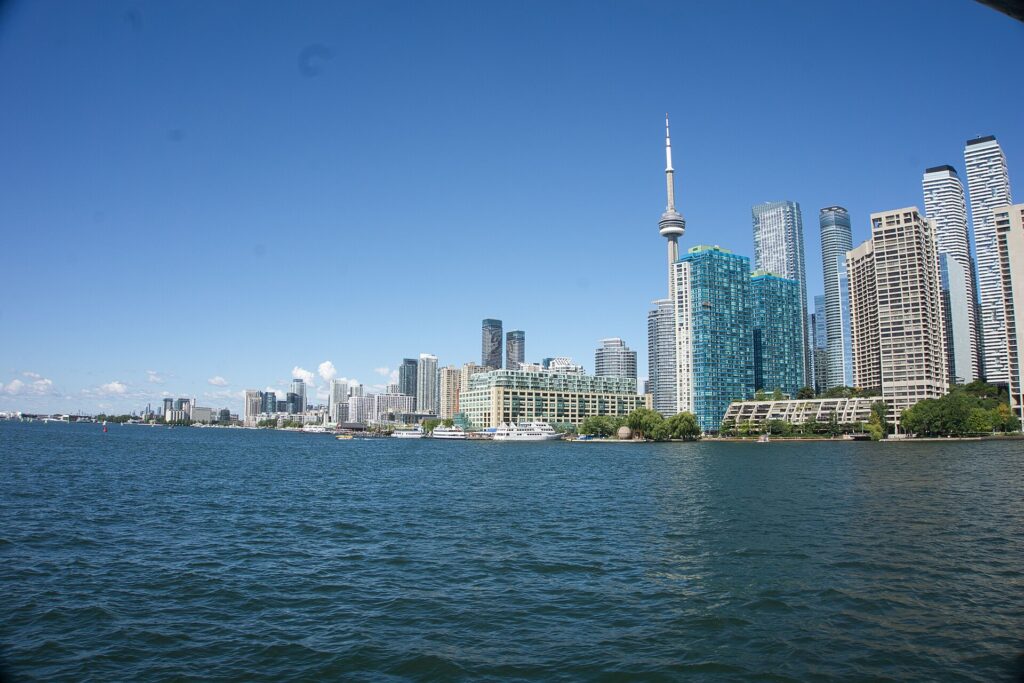
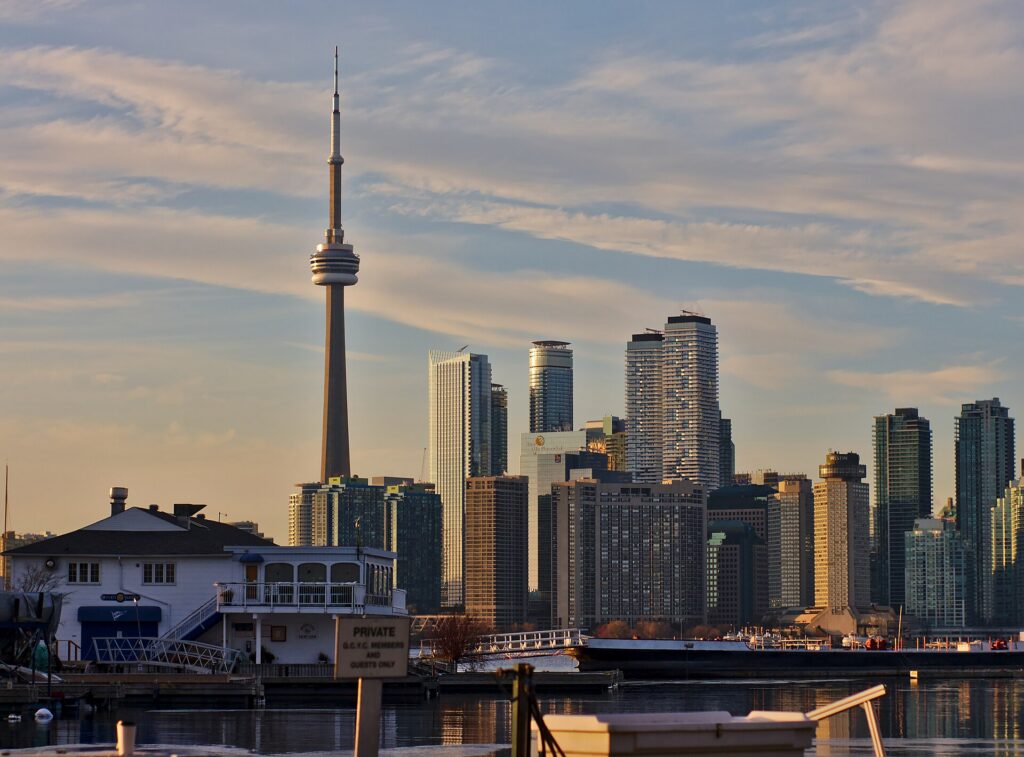
    The Toronto skyline from the Toronto Islands, a 15-minute ferry ride from downtown (Photo: Jchmrt via Wikimedia Commons, CC BY-SA 4.0)

    Toronto at a glance for first-timers

    • Airports: Toronto Pearson (YYZ), about 25 km northwest of downtown, handles nearly all international flights; Billy Bishop (YTZ) sits on an island minutes from the downtown core and serves short-haul routes in eastern Canada and the U.S. Northeast. See our Toronto Pearson airport guide.
    • Getting around: the TTC subway, streetcars and buses cover the central city well, and downtown is compact enough to walk. Most first-time visitors do not need a car unless they are planning day trips.
    • Money: Canadian dollars. Prices on menus and shelves do not include Ontario’s 13% HST, which is added at the till. Tipping 15 to 20 percent in restaurants is customary. Tap-to-pay is accepted almost everywhere, including on transit.
    • Language: English, with a genuinely multilingual population; Toronto is one of the most diverse cities in the world, and that shows in its food.
    • Where to stay: the Entertainment District and the Financial District for walkability to the big sights; Yorkville for upscale shopping and the museums; the waterfront for lake views; the Bloor-Yonge and Queen West areas for a more local feel. Our Entertainment District hotel guide and Toronto hotel search cover the options.

    The downtown icons

    CN Tower

    Yes, it is touristy, and yes, it is still worth it. The CN Tower was the world’s tallest free-standing structure for more than three decades, and the view from the main observation level takes in the whole city, the lake, and on a clear day the mist of Niagara Falls on the horizon. The glass floor is a rite of passage. The EdgeWalk, a hands-free walk around the outside of the main pod on a harness, is the city’s best-known thrill experience and books out in summer. Go at sunset if you can; the timed-entry ticket system means you should book the slot in advance rather than queue on the day.

    Ripley’s Aquarium of Canada and Rogers Centre

    Both sit at the foot of the tower. Ripley’s Aquarium is one of the best rainy-day and family attractions in the city, with a moving walkway through an underwater tunnel that small children will not want to leave. Next door, Rogers Centre is home to the Toronto Blue Jays from April to September; a weeknight game is one of the cheapest ways to sit under the open roof with the tower lit up above you.

    The Toronto Islands

    The single best thing to do in Toronto on a warm day costs the price of a ferry ticket. The Toronto Islands are a car-free chain of parkland a fifteen-minute ferry ride from the Jack Layton Ferry Terminal at the foot of Bay Street, with beaches, picnic lawns, bike rentals, a small amusement park (Centreville, open in the warmer months) and the definitive view of the skyline. Ward’s Island is the quieter, residential end; Centre Island has the amenities; Hanlan’s Point has the widest beach. Bring water and food, because options on the islands are limited, and check the City of Toronto’s parks pages for ferry schedules, which change by season.

    Downtown Toronto skyline seen from the Toronto Islands ferry
    The city from the Toronto Islands ferry, which leaves from Jack Layton Ferry Terminal at the foot of Bay Street (Photo: Chicken4War via Wikimedia Commons, CC BY-SA 4.0)

    Harbourfront and the waterfront trail

    Between the ferry terminal and the foot of Bathurst Street, Harbourfront Centre runs a year-round program of free outdoor concerts, craft studios you can watch at work, skating in winter and a summer sailing scene. The waterfront trail continues in both directions for kilometres; a rented bike from a Bike Share Toronto dock is the easiest way to cover it.

    Nathan Phillips Square and City Hall

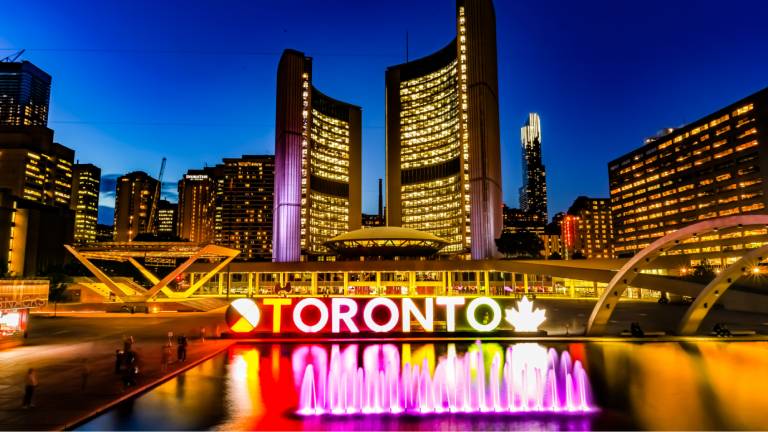
    The plaza in front of Toronto’s modernist City Hall is the city’s civic living room: a reflecting pool in summer, a skating rink in winter, the illuminated TORONTO sign for the obligatory photo, and free events through the year. The Cavalcade of Lights in November switches on the holiday season here.

    St. Lawrence Market

    The St. Lawrence Market, a few blocks east of the Financial District, is the place to eat a peameal bacon sandwich, buy Ontario cheese and maple products, and see how Toronto shopped before supermarkets. The main South Market runs Tuesday to Sunday; the Saturday farmers’ market draws the crowds. Go hungry and go early.

    The Distillery District

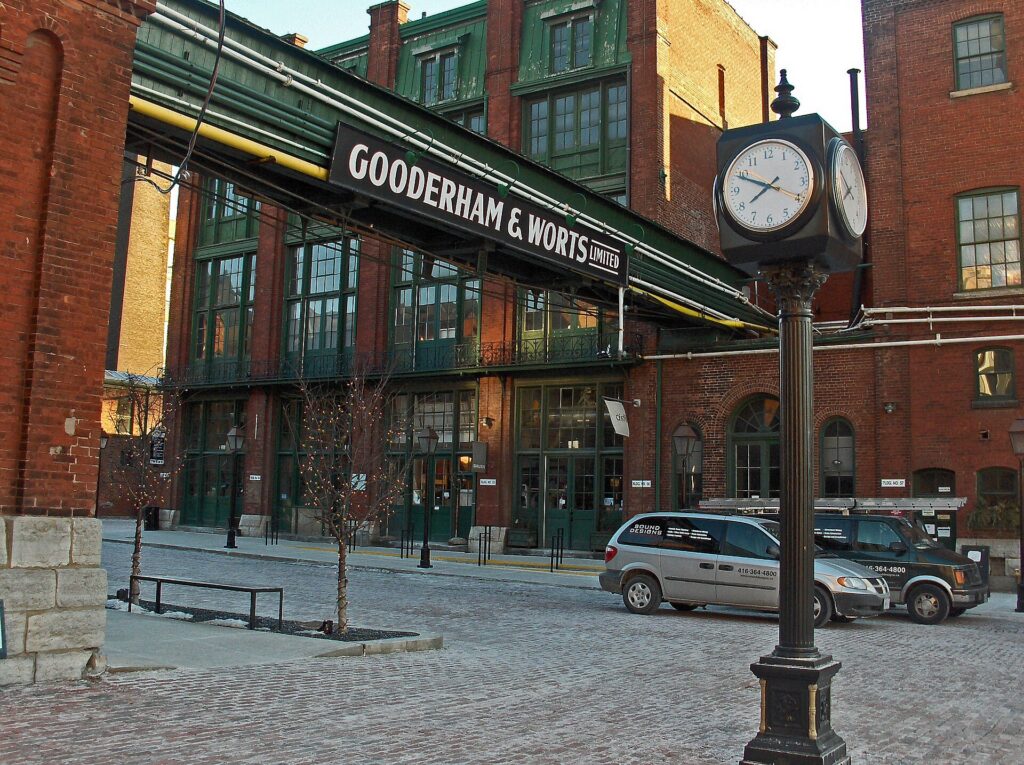
    A ten-minute walk east of St. Lawrence Market, the Distillery District is a pedestrian-only cluster of Victorian industrial buildings that once housed the Gooderham & Worts distillery and now hold galleries, restaurants, a brewery, a sake maker and a theatre. It is at its most atmospheric in the evening and, in late November and December, during the Distillery Winter Village, when the lanes fill with lights and market stalls.

    Victorian brick buildings and cobblestone lane in the Distillery District, Toronto
    The pedestrian-only Distillery District, east of downtown (Photo: Mathew Ingram via Wikimedia Commons, CC BY 2.0)

    Museums, galleries and the stage

    Royal Ontario Museum

    Canada’s largest museum, the ROM, sits at Bloor Street and Avenue Road above its own subway station. The dinosaur galleries are the draw for families, the world-culture and natural-history collections reward a full day, and the Michael Lee-Chin Crystal, the angular glass addition on Bloor, is a landmark in its own right. Allow at least three hours.

    The Royal Ontario Museum on Bloor Street, Toronto, with its glass crystal addition
    The Royal Ontario Museum at Bloor and Avenue Road, beside the Museum subway station (Photo: Maksim Sokolov (Maxergon) via Wikimedia Commons, CC BY-SA 4.0)

    Art Gallery of Ontario

    On Dundas Street West at the edge of Chinatown, the AGO holds one of the world’s great collections of Henry Moore sculpture, the definitive gathering of the Group of Seven and Tom Thomson, and a Frank Gehry redesign whose spiral staircase and Galleria Italia are worth the visit alone. Check the gallery’s site for free or reduced-admission evenings, which have run on a regular weekly schedule in recent years.

    Casa Loma

    A Gothic Revival mansion built by a financier who ran out of money before he ran out of ambition, Casa Loma is Toronto’s castle: turrets, secret passages, an underground tunnel to the stables and gardens with a view over the city. It sits north of Dupont Street, an uphill walk from Dupont subway station. Seasonal events, including a summer symphony series and Halloween and holiday programming, sell out.

    The smaller museums worth your time

    The Hockey Hall of Fame at Yonge and Front lets you stand next to the Stanley Cup. The Bata Shoe Museum and the Gardiner Museum of ceramics, both near the ROM, are small, excellent and rarely crowded. The Aga Khan Museum, in Don Mills, pairs a serene modern building with a collection of Islamic art and is one of the city’s most beautiful spaces. Evergreen Brick Works, in the Don Valley, is a reclaimed brick factory with trails, a Saturday farmers’ market and a good café.

    Theatre, music and film

    Toronto is the third-largest English-language theatre centre in the world after London and New York. The Mirvish theatres on King Street West and Yonge Street host the touring Broadway productions; the Four Seasons Centre is home to the Canadian Opera Company and the National Ballet of Canada; Roy Thomson Hall hosts the Toronto Symphony; and Massey Hall, reopened after a full restoration, remains the city’s best room for a concert. Every September the Toronto International Film Festival takes over the Entertainment District, and its year-round home, the TIFF Lightbox on King Street, screens films every day. For what is on sale during your dates, our Toronto events page lists concerts, shows and games.

    Neighbourhoods worth a half-day

    Kensington Market and Chinatown

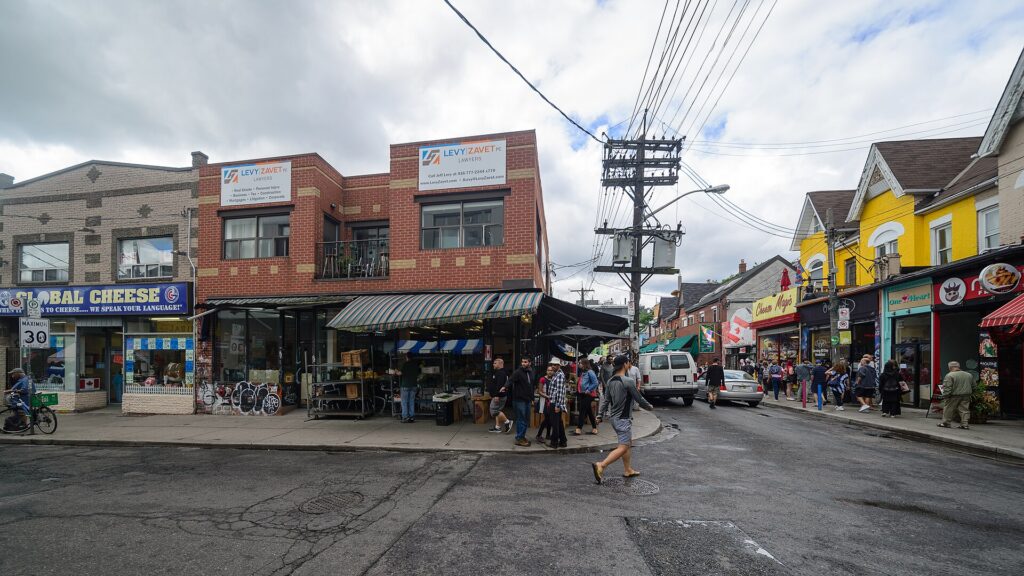
    Start on Spadina Avenue at Dundas, the heart of the largest of Toronto’s Chinatowns, for dim sum and bakeries, then walk two blocks west into Kensington Market. Kensington is a scruffy, colourful grid of vintage shops, cheese mongers, Latin American and Caribbean grocers, taquerias and patios, and it is at its best on Pedestrian Sundays, when the streets close to traffic on the last Sunday of the month from late spring to fall.

    Colourful shopfronts at Kensington Avenue and Baldwin Street in Kensington Market, Toronto
    Kensington Market, a few blocks west of Chinatown (Photo: Arild Vågen via Wikimedia Commons, CC BY-SA 4.0)

    Queen West, Ossington and Trinity Bellwoods

    Queen Street West from University Avenue to Bathurst is the shopping-and-brunch stretch; keep going past Bathurst and it becomes West Queen West, with galleries, independent boutiques and Graffiti Alley, the lane behind Queen where the murals run for blocks. Trinity Bellwoods Park is the neighbourhood’s front lawn on a summer afternoon, and Ossington Avenue, running north from Queen, has one of the city’s best concentrations of restaurants and bars.

    Yorkville

    Once the centre of the 1960s folk scene, Yorkville is now Toronto’s luxury district: the flagship stores on Bloor Street, the boutique hotels, the galleries on Hazelton Avenue and the outdoor tables where the film festival crowd gathers each September. It sits right beside the ROM, which makes it an easy pairing.

    The Danforth, Leslieville and the Beaches

    Take the Bloor-Danforth subway east and the neighbourhoods change character with each stop. The Danforth around Chester and Pape stations is Greektown, with the restaurants to match. Leslieville, along Queen Street East, is the brunch-and-antiques strip. Keep going east to the Beaches, where a wooden boardwalk runs along Woodbine and Kew beaches and the pace slows down entirely; it is a different city from the Financial District, and it is twenty-five minutes away.

    Little Italy, Koreatown and the west end

    College Street west of Bathurst is Little Italy, still lined with cafés and trattorias and lively late into the night. Bloor Street west of Bathurst is Koreatown, with barbecue restaurants and karaoke. Further west, Roncesvalles Avenue is the Polish-heritage main street beside High Park, Toronto’s largest park, with a free zoo, Grenadier Pond, the famous cherry blossoms in late April or early May, and outdoor Shakespeare in summer.

    Sports and live events

    Toronto is a serious sports city, and a game is one of the most local things a visitor can do. The Maple Leafs and Raptors play at Scotiabank Arena, attached to Union Station; the Blue Jays play at Rogers Centre beside the CN Tower; Toronto FC and the Argonauts share BMO Field at Exhibition Place; and the Marlies, the Leafs’ farm team, are the affordable hockey option. MLSE, which owns most of those teams, lists home schedules; for tickets across all of them, plus concerts at Scotiabank Arena, Budweiser Stage and Massey Hall, check what is on in Toronto for your dates before you book flights, because a playoff run or a stadium tour can tighten hotel availability quickly.

    The festival calendar is dense from June to September: Pride at the end of June, Canada Day on July 1, the Honda Indy in July, the Toronto Caribbean Carnival on the August long weekend, the Canadian National Exhibition from mid-August to Labour Day, and TIFF in September. The City of Toronto’s festivals calendar and Destination Toronto keep current dates.

    What to eat, and where

    Toronto’s defining food experience is not a dish but a map. More than half the city’s residents were born outside Canada, and each community has a main street. Eat dim sum in Chinatown or, for the real thing, in Scarborough or Markham; Caribbean roti and jerk in the west end and in Scarborough; Greek on the Danforth; Italian on College; Korean on Bloor; South Asian on Gerrard Street East, the Gerrard India Bazaar; Portuguese in Little Portugal along Dundas West; and Middle Eastern almost everywhere. The city’s own contributions are the peameal bacon sandwich at St. Lawrence Market and, less romantically, an outstanding brunch culture in Leslieville and on Queen West.

    Two restaurant festivals bring prix-fixe menus to hundreds of restaurants: Winterlicious in late January and February, and Summerlicious in July. Both are good ways to try the city’s more ambitious kitchens at a fixed price. In summer, patios matter: Toronto takes its outdoor dining seriously for the few months it can.

    Toronto with kids

    The Toronto Islands and Centreville, Ripley’s Aquarium, the ROM’s dinosaurs, the High Park zoo and playground, the Toronto Zoo in Scarborough (large, spread out, and best with a full day), skating at Nathan Phillips Square in winter, the Hockey Hall of Fame for older kids, and a Blue Jays game with the roof open. Children under 13 ride the TTC free, which makes getting between all of the above cheap.

    Day trips from Toronto

    Niagara Falls is the obvious one: about an hour and a half by car, reachable by seasonal GO train service and year-round bus, and offered by every tour company in the city. The boat to the base of the Horseshoe Falls is the experience worth paying for; Niagara Falls Tourism covers the rest. Niagara-on-the-Lake, twenty minutes further, is wine country and the home of the Shaw Festival. Stratford, two hours west, runs one of North America’s great theatre festivals from spring to fall. Prince Edward County, two and a half hours east, has wineries, sand dunes and small-town inns. Blue Mountain, north of the city, is the closest ski resort in winter and a hiking and cycling base in summer. Algonquin Provincial Park, three hours north, is the classic Ontario canoe landscape; Ontario Parks handles reservations. Most of these are far easier with a car; see our Toronto car rental page and our rental car booking tips if you are planning more than one.

    Two sample itineraries

    Two days, no car

    Day one: St. Lawrence Market for breakfast, walk to the Distillery District, streetcar back west along King Street through the Financial and Entertainment Districts, CN Tower at sunset, dinner on King West. Day two: Ferry to the Toronto Islands in the morning, back for lunch in Chinatown, Kensington Market in the afternoon, the AGO if it is a late-opening evening, and a game or a show at night.

    Four days, with one day trip

    Add a day for the ROM, Yorkville and Casa Loma, a day for the west end (Queen West, Ossington, High Park or the Beaches, depending on the season), and use the fourth day for Niagara Falls. Rent the car for that single day from a downtown location rather than the airport, which keeps parking out of the equation for the rest of the trip.

    Practical details

    • Transit: tap a credit card, debit card or phone on any TTC vehicle or fare gate, or buy a PRESTO card; a single tap covers a two-hour transfer window. The TTC’s site has maps and service alerts. Our transit-versus-car guide goes into detail.
    • From Pearson: the UP Express train reaches Union Station in about 25 minutes. Details on both airports are on the Pearson and Billy Bishop sites.
    • Weather: humid summers, cold snowy winters, and two lovely shoulder seasons. The best time to fly to Toronto guide has a month-by-month table; check Environment Canada’s forecast before you pack.
    • The PATH: a network of underground walkways connects most of the Financial District, Union Station and the Eaton Centre. In January it is how locals get around downtown without a coat.
    • Entry requirements: U.S. citizens need a valid passport; most other visa-exempt visitors arriving by air need an Electronic Travel Authorization. The Government of Canada’s visitor page is the authoritative source.
    • Safety: Toronto is a large, generally safe city; the usual big-city awareness applies downtown late at night.

    Frequently asked questions

    How many days do you need in Toronto?

    Three full days covers the icons and two or three neighbourhoods comfortably; five lets you add a day trip and slow down. A weekend is enough for the downtown core and the islands.

    What is the number one thing to do in Toronto?

    On a warm day, the ferry to the Toronto Islands, for the skyline view alone. In any season, the CN Tower at sunset is the classic.

    Is Toronto walkable?

    Downtown, very. The stretch from the waterfront north to Bloor Street and from the Distillery District west to Bathurst is flat and dense with things to see. Beyond that, the subway and streetcars fill the gaps.

    Do I need a car in Toronto?

    Not for the city itself. Rent one for day trips to Niagara, wine country or the parks, ideally from a downtown location for just those days.

    What is Toronto known for?

    The CN Tower, its diversity and food, the Toronto International Film Festival, its sports teams, and a waterfront and island park system that most first-time visitors underestimate.

    Is Toronto expensive?

    Hotels downtown are the main cost, especially in summer and during TIFF. Transit, the islands, the markets, the parks and many festivals are free or inexpensive. Booking flights in shoulder season and comparing hotels across neighbourhoods keeps the total manageable.

    Ready to go? Compare flights to Toronto, find a place to stay with our Toronto hotel search, and if Niagara is on the list, price a rental car for the day.

  • New York to Toronto Cheap Flights: How to Find the Best Deals

    New York to Toronto Cheap Flights: How to Find the Best Deals

    New York to Toronto is one of the busiest cross-border air routes in North America. It links the largest city in the United States with the largest city in Canada, it is short enough to fly in about an hour and a half, and it is served by several airlines from three New York airports to two Toronto airports. That combination is good news for anyone looking for a cheap flight: lots of competition and lots of choice. It also means there are more ways to get it wrong, from picking the airport pair that looks cheapest but costs you an hour in traffic, to booking a fare that charges for the bag you assumed was included, to arriving at the airport without the right document for the border. This guide explains how to pick the right airports, when to fly and book, how airlines and fares compare on this route, what to know about the border in each direction, how to get downtown at both ends, and when the train or the car is worth considering. It is part of our flight booking series, which starts with our guide to the best time to book cheap flights and hotels.

    The short answer

    Compare all six airport pairs: JFK, LaGuardia and Newark in New York, and Toronto Pearson and Billy Bishop Toronto City Airport in Toronto. Billy Bishop is on an island next to downtown Toronto and can save a long transfer. Fly midweek or on Saturday if you can, because the route is heavy with business travelers on weekdays and weekend visitors on Fridays and Sundays. Book roughly one to three months ahead, earlier for holidays and big event weekends. Price the total, including bags and seats and the cost of getting to and from each airport. And bring the right document: U.S. citizens need a valid passport to fly to Canada, and most other visitors need an eTA or a visa. Compare fares across a whole month on our Toronto flights page or from the other direction on New York flights.

    Billy Bishop Toronto City Airport on the Toronto Islands, seen from the CN Tower
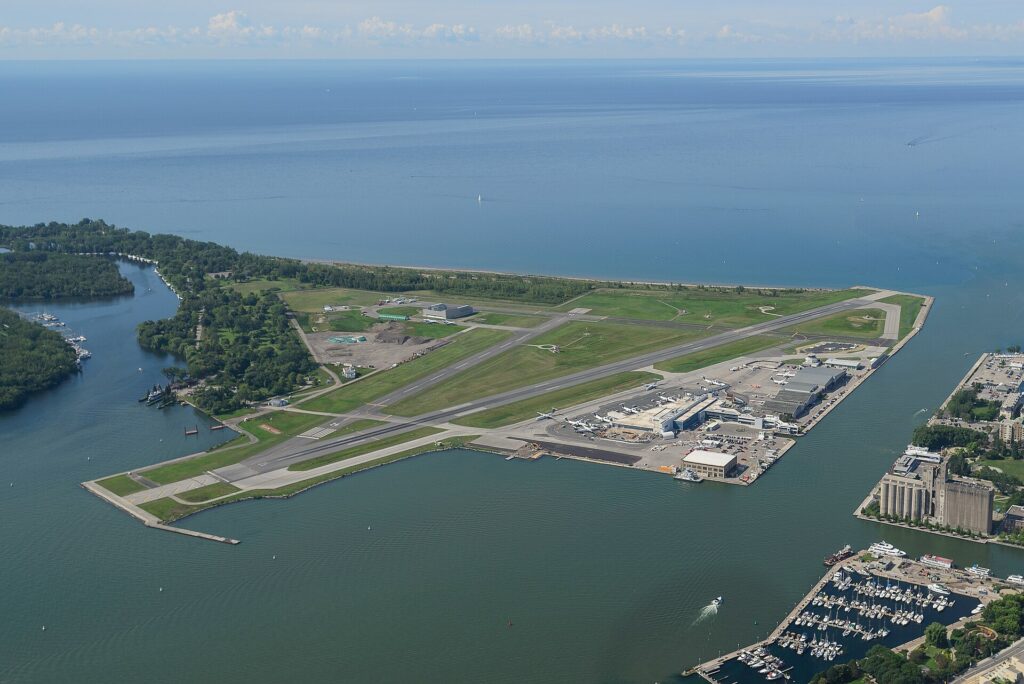
    Billy Bishop sits next to downtown Toronto and can save a long transfer (Photo: Arild Vågen via Wikimedia Commons, CC BY-SA 4.0)

    Know your airports on both sides

    The choice of airports shapes the fare, the airlines available, and how long the trip takes door to door. On a short flight, the ground transfer can take longer than the flight itself, so choose with your final destination in mind.

    New York

    AirportLocationBest for
    LaGuardia (LGA)Queens, closest major airport to Midtown ManhattanManhattan, Queens and the Bronx; quick trips
    JFKSoutheast QueensBrooklyn, Queens and anyone connecting from long-haul flights; AirTrain to the subway and Long Island Rail Road
    Newark (EWR)New Jersey, west of ManhattanNew Jersey, the west side of Manhattan and travelers using the AirTrain to rail connections

    Check each airport’s official site for current transit options: LaGuardia, JFK and Newark. Our JFK airport guide covers terminals and transfers, and our guide to getting around New York explains why most visitors skip the car.

    Toronto

    AirportLocationBest for
    Toronto Pearson (YYZ)Mississauga, northwest of downtownThe widest choice of airlines and flights; travelers heading to the west and north of the city or connecting onward
    Billy Bishop Toronto City (YTZ)Toronto Island, next to downtownDowntown hotels, the Financial District and the waterfront

    Toronto Pearson is Canada’s busiest airport, with two passenger terminals, Terminal 1 and Terminal 3. Check which one your airline uses on the Toronto Pearson website or our Toronto Pearson airport guide. The UP Express train connects Pearson with Union Station downtown; the operator describes the trip as 28 minutes, with trains every 15 minutes.

    Billy Bishop is a small airport on the Toronto Islands, reached by a pedestrian tunnel or a very short ferry ride from the foot of Bathurst Street, with a shuttle to Union Station. For a trip to downtown Toronto it can save a lot of time. Porter Airlines has long flown between Billy Bishop and Newark, and other airlines have added service at the island airport in recent years; check the current schedule when you search. The airport’s official site lists destinations and ground transportation, and notes that U.S. preclearance is now open there.

    Which airlines fly New York to Toronto?

    The route is served by Canadian airlines including Air Canada and Porter, and by major U.S. airlines from their New York hubs. Porter, for example, flies Billy Bishop to Newark and has added Pearson to LaGuardia service. Schedules and airport pairs change, so search all combinations rather than assuming. On a route this competitive, the cheapest airline varies by day and time, and the airlines often match each other’s fares on popular flights.

    What to compareWhy it matters on this route
    Airport pairA cheaper fare into Pearson may cost more overall if you are staying downtown and Billy Bishop was an option
    Fare typeBasic fares may exclude seat selection, changes and, on some airlines, a full-size carry-on
    Checked bag policyTransborder fares often charge for the first checked bag on the cheapest fare types
    Aircraft sizeRegional aircraft have smaller overhead bins; a large carry-on may be checked at the door
    ScheduleAn early nonstop protects a same-day meeting better than a cheaper midday flight
    LoyaltyStatus and credit card benefits can include free bags and better seats, changing which fare is really cheapest

    Check the current baggage and fare rules on each airline’s own site before you pay. Our carry-on size guide explains how to measure your bag and how limits compare between U.S. and Canadian airlines, and our flight details guide decodes fare brands and codeshares.

    When to fly and when to book

    Days and times

    This is a classic business route. Weekday morning and early evening flights are popular with people traveling for work, and Friday afternoon and Sunday evening flights fill with weekend visitors. Midweek flights, Saturday flights and midday departures are often cheaper. Very early morning and late evening flights can be good value, but check how you will get to and from the airport at those hours.

    Seasons

    PeriodWhat to expect
    January to MarchCold in both cities; often the cheapest time outside holiday weekends
    April to JunePleasant weather arrives; long weekends and June events increase demand
    July and AugustSummer peak for leisure travel and festivals
    September and OctoberExcellent weather; the Toronto International Film Festival in September and busy conference weeks lift hotel rates
    November and DecemberQuieter until the holidays; Thanksgiving weekends in each country and the Christmas period are busy

    Remember that the two countries celebrate Thanksgiving on different dates, Canada in October and the United States in November, and each country’s long weekends affect demand in its own direction. For more detail on each city’s seasons, see our guides to the best time to fly to Toronto and the best time to fly to New York.

    Booking window

    For ordinary dates, booking about one to three months ahead is a sensible window. For holiday weekends and major event dates, book earlier. Set a price alert, watch the route for a few weeks to learn what a normal fare looks like, and book when a fare lands at or below that level. For flights to or from the United States booked at least seven days out, most airlines let you cancel within 24 hours of booking without penalty, which is a useful safety net.

    Terminal B at LaGuardia Airport in New York
    LaGuardia is the closest major airport to Midtown Manhattan (Photo: David from Simply Aviation via Wikimedia Commons, CC BY 4.0)

    Crossing the border in each direction

    Flying New York to Toronto

    When you fly into Canada, you clear Canadian border formalities on arrival in Toronto. The documents you need depend on your citizenship:

    • U.S. citizens do not need an electronic travel authorization (eTA). The Government of Canada says they must carry proper identification such as a valid U.S. passport.
    • U.S. lawful permanent residents are also exempt from the eTA, but must travel with a valid passport from their country of nationality and a valid green card or equivalent proof of status.
    • Other visa-exempt travelers generally need an eTA before boarding a flight to Canada, and some nationalities need a visitor visa.

    Check your requirements on the Government of Canada’s eTA page before you book, and read the Canada Border Services Agency’s travel documents guidance. Declare any food, alcohol, cash and goods according to CBSA rules.

    Flying Toronto to New York

    On the way back, you usually clear U.S. border formalities before you leave Toronto. Toronto Pearson has U.S. preclearance facilities, and Billy Bishop now offers preclearance too, so you land in New York as a domestic passenger with no immigration line. That is convenient, but it means you need to arrive at the Toronto airport earlier than for a domestic flight, because check-in, security and preclearance all happen before departure. Our guide on how early to arrive for an international flight explains how to plan it.

    Getting downtown at each end

    AirportMain options into the city
    Toronto PearsonUP Express to Union Station; TTC buses; taxis and ride-hailing; rental cars
    Billy BishopWalk through the pedestrian tunnel or take the short ferry, then streetcar, shuttle, taxi or walk into downtown
    LaGuardiaBuses to the subway and rail connections; taxis and ride-hailing
    JFKAirTrain to the subway or Long Island Rail Road; taxis and ride-hailing
    NewarkAirTrain to NJ Transit and Amtrak trains toward New York Penn Station; taxis and ride-hailing

    In Toronto, the TTC runs the subway, streetcars and buses; the TTC website has routes and fares. Our guide to renting a car or using transit in Toronto explains when a car is worth it, and you can compare prices on Toronto car rentals if you plan day trips to Niagara Falls or cottage country.

    Fly, drive or take the train?

    For most travelers, flying is the fastest way between the two cities, but it is worth knowing the alternatives.

    • Flying: about an hour and a half in the air, plus airport time. Best for most trips, especially short ones.
    • Train: Amtrak’s Maple Leaf, operated with VIA Rail, runs between New York Penn Station and Toronto Union Station, with border inspection along the way. It takes most of a day, but it is scenic, runs city center to city center and suits travelers who prefer not to fly.
    • Driving: a long day’s drive through New York State, with a border crossing near Niagara Falls or Buffalo. It makes sense if you want a car in Toronto or plan to stop along the way.
    • Bus: usually the cheapest fare but the longest trip.

    For a weekend or a business trip, a flight almost always wins. For a slow trip with stops in upstate New York or Niagara, the car or train can be part of the fun.

    A step-by-step booking routine for this route

    • Decide where you are staying in both cities, so you know which airports are really convenient.
    • Search a flexible range of dates and all airport pairs; our flights from New York and flights from Toronto pages show fares across the month.
    • Shortlist a few options and add bags, seats and ground transfer costs to each.
    • Check your documents for the border before paying.
    • Book, then use the 24-hour cancellation window to double-check names and details.
    • Book a refundable hotel for the same dates, then recheck the price before the free cancellation deadline.
    • Check the events calendar. Our Toronto events and New York events pages show what is on.
    Inside a UP Express train, which links Toronto Pearson with Union Station
    UP Express links Pearson with Union Station downtown (Photo: David Wilson from Oak Park, Illinois, USA via Wikimedia Commons, CC BY 2.0)

    If you fly this route often

    New York to Toronto is a commuter route for many people: consultants, bankers, lawyers, people with family in both cities and couples splitting time between them. If you fly it several times a year, a few habits pay off.

    • Consider NEXUS. NEXUS is a joint Canada and U.S. trusted traveler program for low-risk, pre-approved travelers. According to the Canada Border Services Agency’s NEXUS page, members can use self-serve kiosks and automated gates at major Canadian airports, expedited security lines where available, and TSA PreCheck lanes at participating U.S. airports. It involves an application, a fee and an interview, and it lasts five years.
    • Pick an airline and stick with it where it makes sense. On a short route, the fare difference between airlines is often small, and the perks of status, such as free bags, better seats and priority boarding, can matter more than a small saving.
    • Learn the airport pair that works for you. Many regulars settle on one combination, such as Billy Bishop and Newark for downtown Toronto and west Manhattan, or Pearson and LaGuardia for a wider schedule.
    • Watch fares for your usual days. Set a standing price alert for your typical departure days so you notice when the route gets cheaper.
    • Keep a flexible fare in mind. If your plans change often, a fare that allows changes can cost less over a year than repeatedly forfeiting cheap nonrefundable tickets.

    Making a same-day business trip work

    A day trip between the two cities is very doable. Book the first or second flight of the morning, which is less likely to be delayed by knock-on problems, and a return in the early evening with a later backup option on the same airline. Travel with a carry-on only, keep your passport and boarding pass on your phone and in your pocket, and leave extra time in Toronto for U.S. preclearance on the way home. If your meetings are downtown, Billy Bishop can save an hour or more of ground travel compared with Pearson, which is a big share of a short day.

    Where to stay

    In Toronto, staying downtown puts you close to the CN Tower, the waterfront, the Financial District and the theaters; the Entertainment District is a popular base and is close to both Union Station and Billy Bishop. Compare prices on our Entertainment District hotels page or all Toronto hotels. For ideas on what to do, read our guide to things to do in Toronto.

    In New York, Midtown Manhattan is the classic base for first-time visitors, with easy access to Broadway and the major sights, but Brooklyn, Queens and Lower Manhattan can offer better value. Compare on our Times Square hotels page or all New York hotels, and see our guides to things to do in New York and visiting New York on a budget.

    Making the most of a weekend in Toronto

    Many New Yorkers fly to Toronto for a long weekend, and the city rewards it. Downtown is compact, transit is straightforward and most visitors can see the waterfront, the CN Tower, a museum and a couple of neighborhoods in two or three days. Flying up on Thursday evening or Saturday morning and back on Monday often costs less than the classic Friday-to-Sunday pattern, and downtown hotels that fill with business travelers midweek often cut rates on Friday and Saturday nights. Check a Blue Jays, Maple Leafs or Raptors home schedule if you want to catch a game, and remember that prices are in Canadian dollars once you arrive, which can make the trip feel better value for visitors paying in U.S. dollars, depending on the exchange rate at the time.

    Points, miles and packages

    Short cross-border flights can be good value for loyalty points, especially when cash fares are high on busy weekday flights. Compare the points price with the cash fare, and remember that taxes and fees still apply. If you fly the route often, airline status or a co-branded credit card can add free checked bags and better seats, which changes which fare is really cheapest. Flight and hotel packages are sometimes available; compare the package price with booking separately and read the change rules. For more on getting better seats, see our guide to business class upgrade hacks.

    A Porter Airlines Dash 8-400 landing at Billy Bishop Toronto City Airport
    Compare every airline and airport pair on this busy route (Photo: Fabian Roudra Baroi via Wikimedia Commons, CC BY-SA 4.0)

    Common mistakes to avoid

    • Searching only one airport pair. The cheapest and most convenient options may be at different airports.
    • Forgetting the transfer. A cheaper fare to a farther airport can cost more in time and taxis.
    • Arriving without the right document. U.S. citizens need a passport to fly to Canada; many other travelers need an eTA.
    • Underestimating preclearance. On the way back from Toronto, U.S. border formalities happen before departure; allow time.
    • Assuming a bag is included. Check the fare rules on transborder basic fares.
    • Booking a large carry-on on a small aircraft. It may be checked at the door; keep valuables in your personal item.
    • Ignoring holiday calendars on both sides. Canadian and U.S. long weekends fall on different dates.

    Frequently asked questions

    How long is the flight from New York to Toronto?

    About an hour and a half in the air, depending on the airports and routing. Allow extra time for the airport and ground transfers at both ends.

    Which airport in Toronto is best?

    Billy Bishop is best if you are staying downtown and a flight suits you. Toronto Pearson offers the most flights and airlines, and the UP Express connects it with Union Station.

    Which New York airport is cheapest for Toronto?

    It varies by date and airline. Search JFK, LaGuardia and Newark together, and include the cost and time of getting to each one.

    Do U.S. citizens need a passport to fly to Canada?

    The Government of Canada says U.S. citizens must carry proper identification such as a valid U.S. passport. They do not need an eTA. Check the official page before you travel.

    Do I clear customs in Toronto on the way back to New York?

    Usually yes. Toronto Pearson has U.S. preclearance, and Billy Bishop now offers it too, so you clear U.S. border formalities before departure and arrive in New York as a domestic passenger.

    What is the cheapest day to fly between New York and Toronto?

    Midweek and Saturday flights are often cheaper than Friday and Sunday flights. Use a fare calendar to check your dates.

    How far in advance should I book?

    About one to three months ahead for ordinary dates, and earlier for holidays and big events. Set a price alert and book when the fare is at or below the normal level.

    Is it cheaper to book a round trip or two one-way tickets?

    On this route, one-way fares are often priced reasonably, so two one-ways, even on different airlines or between different airports, can give you better times at a similar total. Compare both ways, and remember that each separate ticket has its own bag and change rules.

    Is the train a good alternative?

    It is a scenic city-center-to-city-center option, but it takes most of a day. For short trips, flying is much faster.

    Ready to book? Compare fares across a whole month on our Toronto flights page, check both Toronto airports and all three New York airports, then find a room for the same dates on our Toronto hotels page. For more on timing, read our guide to the best time to book cheap flights and hotels.

  • Cheap Flight Deals to Toronto: Your Gateway to the Marvels of Canada’s Cultural Hub

    Cheap Flight Deals to Toronto: Your Gateway to the Marvels of Canada’s Cultural Hub

    Toronto, the capital of Ontario and Canada’s largest city, is one of the most rewarding city breaks in North America. It has a skyline anchored by the CN Tower, a string of car-free islands a short ferry ride from downtown, major museums and galleries, big-league sports, a film festival that draws stars every September and neighborhoods where you can eat your way around the world in a weekend. It is also one of the best-connected cities on the continent. Toronto Pearson is Canada’s busiest airport, and the downtown island airport, Billy Bishop, puts some flights a short walk from the Financial District. That volume of flights is what makes good fares possible, but only if you know how the city’s seasons, events and airports affect the price. This guide explains when to go, when to book, which airport to use, how fares from within Canada, from the United States and from overseas differ, how to get downtown, and how to keep the whole trip affordable. It is part of our flight booking series, which starts with our guide to the best time to book cheap flights and hotels.

    The short answer

    Winter and the quieter shoulder weeks are cheapest, while summer, the September film festival and major holiday weekends are the most expensive. Book about one to three months ahead for domestic and U.S. trips and two to six months ahead from overseas, earlier for peak dates. Compare both Toronto airports: Pearson has by far the most flights, while Billy Bishop is right next to downtown. Search a whole month, because shifting by a day often changes the fare. Compare the total price with bags and seats included. And if you are not Canadian, check your entry requirements, including whether you need an eTA, before you book. Compare fares across the month on our Toronto flights page.

    The Toronto skyline and CN Tower seen across the water from the Toronto Islands
    Toronto has two airports close to the city, and Billy Bishop is right by downtown (Photo: Jchmrt via Wikimedia Commons, CC BY-SA 4.0)

    Why Toronto is worth the trip

    Toronto works for almost any kind of traveler, which is part of why so many flights go there.

    • Landmarks and views: the CN Tower, the waterfront and the view of the skyline from the Toronto Islands.
    • Museums and culture: the Royal Ontario Museum, the Art Gallery of Ontario, a large theater district and a busy live music scene.
    • Neighborhoods and food: Kensington Market, Chinatown, Little Italy, the Distillery District and the St. Lawrence Market, with food from nearly every culture in one of the most diverse cities in the world.
    • Sports: the Maple Leafs and Raptors in winter, the Blue Jays in summer, and soccer and football too.
    • Easy day trips: Niagara Falls and the Niagara wine region are a manageable drive or tour away.

    Our guide to things to do in Toronto covers the highlights in detail, and the official tourism site, Destination Toronto, lists events and attractions.

    When to visit, and what it does to the price

    Toronto has four real seasons, and flight and hotel prices follow them closely.

    PeriodWeatherCrowds and prices
    January to MarchCold, with snow; a real Canadian winterUsually the cheapest months for flights and hotels, outside holiday weekends and school breaks in March
    April and MayCool to mild spring; parks turn greenGood value; the Victoria Day long weekend in May is busier
    June to AugustWarm to hot and humid; long eveningsPeak season, with Pride in June, big summer festivals, the Caribbean Carnival and the Canadian National Exhibition in late summer
    September and OctoberWarm early, crisp later; fall colorThe Toronto International Film Festival in September and conference season push hotel rates up; October is often excellent value
    November and DecemberCold, first snow possibleQuiet in November; holiday markets and Christmas travel make late December busy

    For the best mix of weather and price, look at May, early June, late September and October outside the film festival and Thanksgiving weekend. For the lowest prices, a winter weekend can be remarkably cheap if you do not mind the cold, and much of Toronto’s appeal, from museums to theater to restaurants, is indoors. Our month-by-month guide to the best time to fly to Toronto goes deeper.

    Events that move prices

    Big events fill hotels and flights on specific dates. Before you fix your trip, check what is on during your dates on our Toronto events page. A major concert run, a playoff series or a festival weekend can make hotels expensive even when flights look reasonable. If you are coming for the event, book as early as you can; if not, consider a different weekend.

    Which airport: Pearson, Billy Bishop or somewhere else?

    AirportWhat it offersChoose it when
    Toronto Pearson (YYZ)Canada’s busiest airport; flights from across Canada, the U.S. and around the world; two terminalsYou want the widest choice of flights and fares, or you are flying from overseas
    Billy Bishop Toronto City (YTZ)A small island airport next to downtown with flights to cities in Canada and the U.S.You are staying downtown and there is a flight from your city
    Hamilton (YHM)A smaller airport southwest of Toronto, sometimes served by low-cost airlinesThe fare saving outweighs a longer transfer, especially if you are going to Hamilton or Niagara
    Buffalo Niagara (BUF)A U.S. airport across the border from the Niagara regionYou are a U.S. traveler willing to drive and cross the border, and the saving is large

    For most visitors, the choice is between Pearson and Billy Bishop. Toronto Pearson is in Mississauga, northwest of downtown, with Terminal 1 and Terminal 3; check which one your airline uses before you travel, and see our Toronto Pearson airport guide. Billy Bishop sits on the Toronto Islands, connected to the mainland by a pedestrian tunnel and a short ferry, with a shuttle to Union Station. A slightly higher fare into Billy Bishop can easily be the cheaper trip once you count the transfer from Pearson, if you are staying downtown.

    Using a distant airport only makes sense when the numbers really work. Add the cost of the transfer, parking or a rental car, the time involved and, for Buffalo, the border crossing, before you decide.

    Border inspection kiosks in the Terminal 3 arrivals hall at Toronto Pearson
    Pearson has the widest choice of flights, and international arrivals clear the border here (Photo: Silver Dovelet via Wikimedia Commons, CC BY-SA 4.0)

    Flying from within Canada

    Toronto is the biggest domestic hub in the country, with frequent flights from every major Canadian city. Air Canada, WestJet and Porter all fly to Toronto, and low-cost airlines serve some routes. A few things are worth knowing:

    • Busy business corridors. Routes such as Montreal, Ottawa, Calgary and Vancouver to Toronto carry many business travelers, so weekday peak flights are pricier. Midday, Saturday and midweek flights are often cheaper.
    • Compare airports on both ends. From Montreal or Ottawa, both Pearson and Billy Bishop are often options; from Vancouver or Calgary, you will almost always land at Pearson.
    • Check the train and the car for short trips. From Montreal and Ottawa, the train or a drive can compete with flying door to door. Our Toronto to Montreal and Toronto to Ottawa road trip pages cover those routes.
    • Know your protections. Canada’s Air Passenger Protection Regulations set out what airlines owe you for delays, cancellations and denied boarding.

    Canadian air fares are advertised with all mandatory taxes and fees included, but optional extras such as checked bags and seat selection are not, so compare totals with the extras you need. Our guide to carry-on size rules compares Canadian and U.S. airline limits.

    Flying from the United States

    Transborder flights to Toronto arrive from dozens of U.S. cities, with the heaviest traffic from the Northeast, Chicago, Florida and major hubs. The route from New York is one of the busiest in North America; our guide to cheap flights from New York to Toronto covers it in detail, including all six airport combinations.

    • Documents: the Government of Canada says U.S. citizens do not need an eTA but must carry proper identification such as a valid U.S. passport. U.S. lawful permanent residents are also eTA-exempt but need a valid passport and a valid green card. Check the official eTA page before you travel.
    • On arrival: you clear Canadian border formalities in Toronto. The Canada Border Services Agency explains what to bring and declare on its travel documents page.
    • On the way home: Toronto Pearson has U.S. preclearance, and Billy Bishop now offers it too, so you clear U.S. border formalities before departure. Arrive earlier than you would for a domestic flight.
    • Currency: fares may be shown in U.S. or Canadian dollars depending on where you book; compare in the same currency.

    Flying from overseas

    Toronto Pearson has nonstop flights from Europe, Asia, Latin America, the Caribbean and beyond, and many one-stop options through other hubs. For long-haul trips:

    • Book earlier. Two to six months ahead is a sensible window, and earlier still for summer and Christmas.
    • Compare nonstop and one-stop. A connection through a European or U.S. hub can be cheaper, but check transit rules; connecting through the United States means going through U.S. border formalities even in transit.
    • Check entry requirements. Most visa-exempt travelers need an eTA to fly to Canada, and some nationalities need a visitor visa. Apply well before you book nonrefundable travel.
    • Consider an open-jaw trip. Flying into Toronto and home from Montreal or Vancouver can be a smart way to see more of Canada.

    Our international flights booking tips cover routings, layovers and hidden costs in more depth, and our guide on how early to arrive for an international flight explains check-in deadlines.

    When to book

    TripSensible booking window
    Domestic Canada, ordinary datesAbout 1 to 3 months ahead
    From the U.S., ordinary datesAbout 1 to 3 months ahead
    Summer, long weekends, the film festival, holidaysAbout 2 to 4 months ahead, or as soon as plans are firm
    From overseasAbout 2 to 6 months ahead
    Last minuteSometimes fine on busy domestic routes midweek; rarely cheap on peak dates

    The method is the same everywhere: start searching early to learn what a normal fare looks like, set a price alert, and book when the fare meets that level. Our fare calendar on the flight search shows prices across the whole month so you can see the cheap days at a glance. Waiting for a last-minute deal on a popular date usually costs more, not less.

    A ferry crossing Toronto harbor to the Toronto Islands
    A ferry ticket buys the best skyline view in the city (Photo: Jason Zhang via Wikimedia Commons, CC BY-SA 3.0)

    Getting from the airport to downtown

    • UP Express from Pearson: the UP Express train runs between Pearson and Union Station downtown. The operator describes the trip as 28 minutes, with trains every 15 minutes. It is the fastest and most predictable way downtown.
    • TTC from Pearson: public buses connect Pearson with the subway. It is the cheapest option and slower, but useful if you are staying outside downtown. Routes and fares are on the TTC website.
    • Taxis and ride-hailing from Pearson: convenient with luggage or a group, but traffic on the highways into the city can be heavy at rush hour.
    • From Billy Bishop: walk through the pedestrian tunnel or take the short ferry to the mainland, then walk, take a streetcar, use the airport shuttle to Union Station or grab a taxi.

    Do you need a car? For a downtown trip, usually not: transit, walking and taxis cover most of what visitors want, and hotel parking is expensive. For day trips to Niagara or cottage country, a car helps. Our guide to renting a car or using transit in Toronto weighs it up, and you can compare prices on Toronto car rentals.

    Stopovers and connections in Toronto

    Many travelers pass through Toronto Pearson on the way somewhere else: between Europe and the Americas, between the Caribbean and Western Canada, or between smaller Canadian cities. If your itinerary includes a long connection, it can be worth turning it into a short stopover. The UP Express makes downtown easy to reach, so even a single night lets you see the waterfront, eat well and see the skyline from the CN Tower or the islands.

    • Check whether a stopover changes the fare. Sometimes adding a night or two in Toronto costs little or nothing extra; sometimes it prices the trip as two separate journeys. Search it both ways.
    • Know the entry rules. Leaving the airport means entering Canada, so you need the right documents, such as an eTA or visa where required. Some travelers in transit also need an eTA or transit visa even if they stay airside, so check the official rules for your passport.
    • Allow enough time on a tight connection. Pearson is large, and connections between international, transborder and domestic flights can involve border formalities and security. The airport’s connections page explains the process.
    • Stay near the airport for very early departures. Airport hotels make sense before a dawn flight; for anything longer, downtown is the better base.

    Traveling to Toronto with kids

    Toronto is an easy family city, with the aquarium at the foot of the CN Tower, the Royal Ontario Museum’s dinosaur galleries, the islands’ beaches and a children’s amusement area, and a zoo on the east side of the city. For families, timing matters even more than usual: flights and hotels are most expensive during summer holidays, March break and the Christmas period. If your children are young enough to travel outside school holidays, the savings can be substantial. Book family rooms early, because they sell first, and check seat selection rules on your fare so you can sit together. Our guide to the best time to book hotels for family vacations has more on timing.
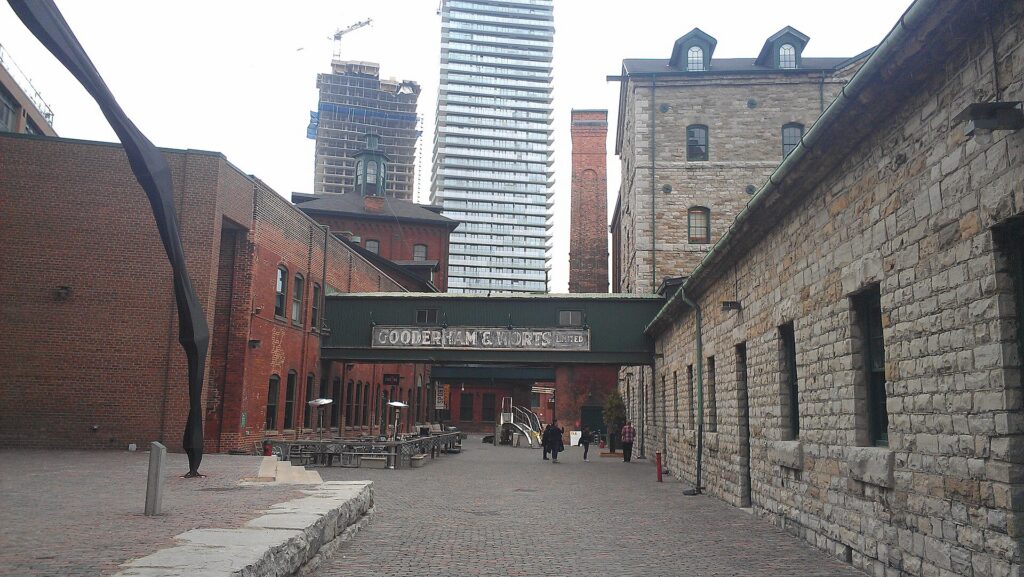
    Where to stay

    AreaWhy stay there
    Entertainment DistrictClose to the CN Tower, theaters, Union Station and the waterfront; easy from both airports
    Financial District and waterfrontCentral, close to the island ferry and Billy Bishop; busy on weekdays, quieter at weekends
    Yorkville and the AnnexUpscale shopping, the Royal Ontario Museum, leafy streets
    Old Town and the Distillery DistrictHistoric streets, the St. Lawrence Market, restaurants
    Near PearsonConvenient for early flights and short stopovers, far from downtown sights

    Downtown business hotels are often cheaper on Friday and Saturday nights, when the weekday corporate guests have gone home, which makes Toronto a good weekend destination. Compare prices on our Entertainment District hotels page or all Toronto hotels, and book a refundable rate so you can rebook if the price drops. Our guide to booking hotels in Canada has more tips.

    A simple plan for a first long weekend

    If you are flying in for three or four days, a loose plan helps you choose the right hotel and the right flight times. Arrive early on the first day if you can, so you have an afternoon for the waterfront and the CN Tower area. Spend a day on culture, with the Royal Ontario Museum or the Art Gallery of Ontario in the morning and Kensington Market and Chinatown for lunch and a wander. Give another day to the Toronto Islands in warm weather, or to the Distillery District and the St. Lawrence Market in the colder months, and finish with a game, a show or dinner in one of the city’s many neighborhoods. Save Niagara Falls for a longer trip, or for a day when you have a car or a tour booked. Booking a late-afternoon or evening flight home gives you one more morning in the city, but on the way to the United States, leave time for preclearance.

    Keeping the whole trip affordable

    • Use transit. The TTC covers downtown and beyond; a day of subway and streetcars costs far less than taxis.
    • Take the ferry to the islands. The islands offer beaches, bike paths and the best skyline view in the city for the price of a ferry ticket.
    • Eat in the markets and neighborhoods. The St. Lawrence Market, Kensington Market and the city’s many neighborhood restaurants are good value.
    • Check free and discounted museum times. Some museums and galleries offer free or reduced admission at set times; check their websites.
    • Stay over a weekend. Downtown hotels are often cheaper on Friday and Saturday nights.
    • Travel light. A carry-on-only trip avoids checked bag fees on the cheapest fares.

    Common mistakes to avoid

    • Booking during the film festival or a festival weekend by accident. Check the events calendar first.
    • Ignoring Billy Bishop. For a downtown stay, it can save time and taxi fares.
    • Choosing a distant airport without doing the math. Hamilton and Buffalo only make sense with a large saving.
    • Forgetting the eTA. Most visa-exempt travelers who are not U.S. citizens need one to fly to Canada.
    • Underestimating the return. U.S.-bound travelers clear preclearance before departure; arrive early.
    • Renting a car for a downtown trip. Parking and traffic make it poor value.
    • Comparing base fares instead of totals. Add bags and seats before choosing.
    Brick streets and Victorian industrial buildings in Toronto's Distillery District
    Neighborhoods like the Distillery District make Toronto an easy weekend trip (Photo: Alonso Inostrosa Psijas from Santiago, Chile via Wikimedia Commons, CC BY-SA 2.0)

    Frequently asked questions

    What is the cheapest month to fly to Toronto?

    Winter months such as January and February are usually the cheapest, outside holiday weekends and school breaks. Late spring and October are good value with better weather.

    Which Toronto airport is cheaper to fly into?

    Pearson usually has the most flights and the widest range of fares, but Billy Bishop can be the cheaper trip overall if you are staying downtown, because the transfer is so short.

    How far in advance should I book a flight to Toronto?

    About one to three months ahead from within Canada or the U.S., and two to six months ahead from overseas. Book earlier for summer, holidays and the film festival.

    Do I need an eTA to fly to Toronto?

    U.S. citizens do not need an eTA, but they must carry proper identification such as a valid passport. Most other visa-exempt travelers do need an eTA, and some nationalities need a visa. Check the Government of Canada’s eTA page before you book.

    How do I get from Pearson to downtown Toronto?

    The UP Express train runs to Union Station in about 28 minutes, according to the operator, with trains every 15 minutes. TTC buses, taxis and ride-hailing are alternatives.

    Is Toronto expensive to visit?

    Hotels in peak season and during big events can be pricey, but winter and shoulder-season trips, weekend hotel rates, good transit and affordable neighborhood food make a budget trip very achievable.

    Are last-minute flights to Toronto ever cheap?

    Occasionally on busy domestic routes midweek, when airlines have seats to fill. On peak dates and weekends, prices usually rise as departure approaches.

    Can I combine Toronto with other Canadian cities?

    Yes. Montreal and Ottawa are close enough for a train or drive, and flights connect Toronto with every major Canadian city. See our guides to flying to Montreal and things to do in Ottawa.

    Ready to plan your Toronto trip? Search a whole month of fares on our Toronto flights page to find the cheapest days, check what is on with our Toronto events listings, and compare rooms for the same dates on our Toronto hotels page. For more on timing, read our guide to the best time to book cheap flights and hotels.