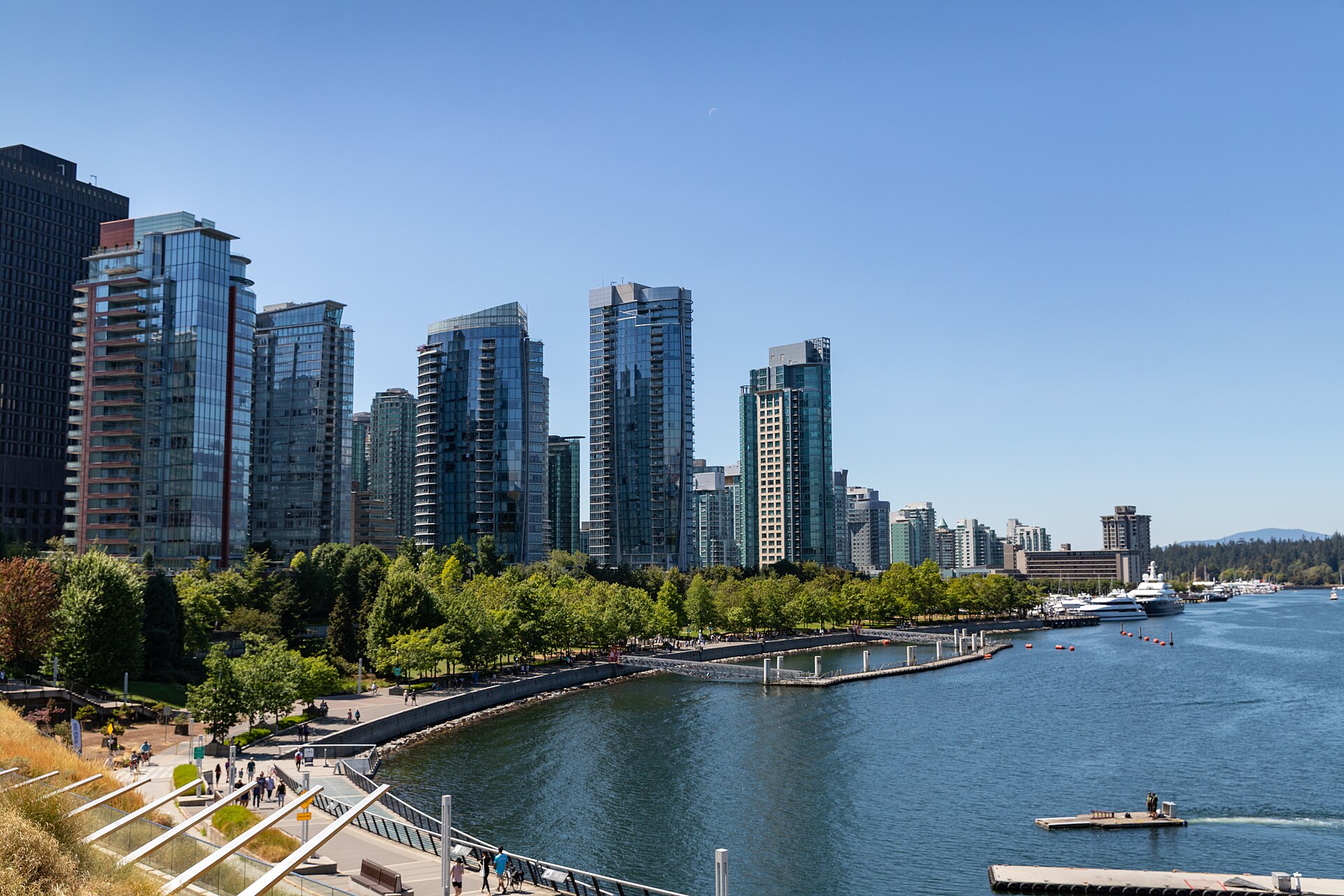
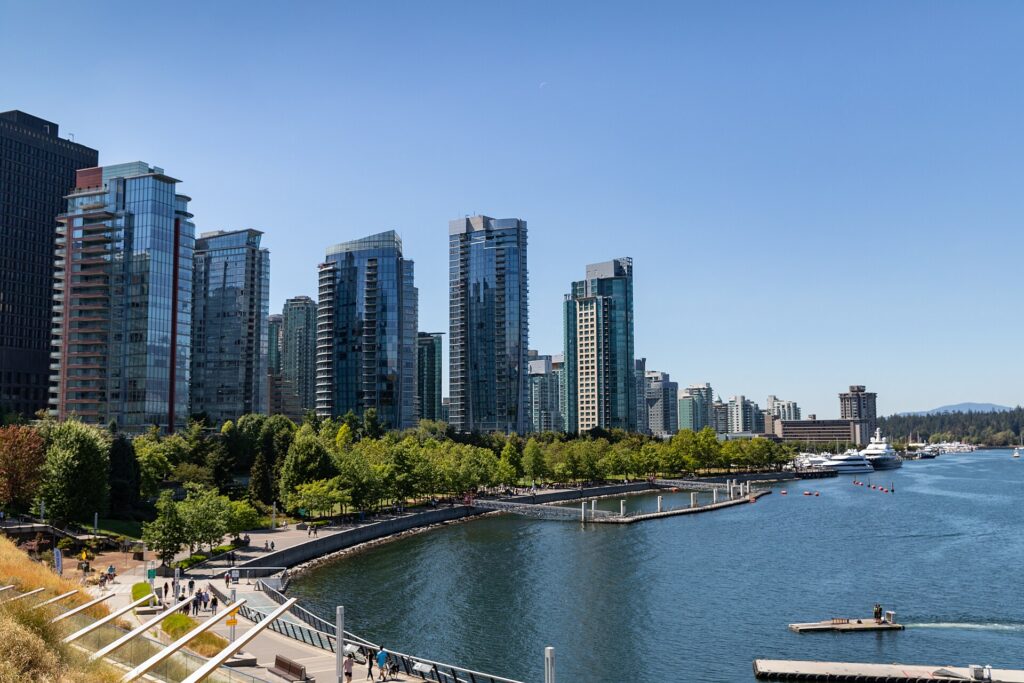
Vancouver is the rare big city where the setting is the main attraction. Downtown sits on a peninsula with the ocean on three sides and the Coast Mountains rising straight out of the water across the inlet, and a first-time visitor can walk from a glass tower to a temperate rainforest in the time it takes to cross most cities’ financial districts. That geography shapes how you should plan: think in terms of the peninsula (downtown, Stanley Park, the West End), the water (Granville Island, the beaches, the seawall), the North Shore (the mountains and the suspension bridges) and the neighbourhoods across False Creek, and give each a half-day or more. This guide covers the sights that genuinely earn their reputation, the neighbourhoods locals actually spend time in, the food, the sports, the day trips that make Vancouver a gateway as much as a destination, and the practical details that turn a good trip into a great one.
If you are still comparing cheap flights to Vancouver, read this alongside our guides to the best time to fly to Vancouver and whether you need a car. Between the three you can plan the whole trip.
Vancouver at a glance for first-timers
- Airport: Vancouver International (YVR), in Richmond about 12 km from downtown; the Canada Line SkyTrain runs from inside the terminal to Waterfront Station in about 25 minutes. See our YVR airport guide.
- Getting around: SkyTrain, buses, the SeaBus to the North Shore, and small ferries across False Creek cover nearly everything; downtown is flat and walkable, and the seawall is made for bikes. Most visitors do not need a car unless they are heading to Whistler or the ferries.
- Money: Canadian dollars. Shelf and menu prices do not include the federal GST and the provincial PST, which are added at the till. Tipping 15 to 20 percent in restaurants is customary. Tap-to-pay works almost everywhere, including on transit.
- Weather: mild year-round, dry and warm from June to September, and wet from October to March. A waterproof shell is more useful than an umbrella. Our month-by-month guide has the detail.
- Where to stay: downtown and Coal Harbour for walkability and views; the West End for the beaches and Stanley Park; Yaletown for restaurants and the False Creek seawall; Kitsilano for a local, beachy feel across the bridge. Our Vancouver hotel search covers all of them.
Stanley Park and the Seawall
Start here. Stanley Park is a 400-hectare forest at the tip of the downtown peninsula, larger than New York’s Central Park and far wilder, and the paved seawall that runs around its edge is the single best free thing to do in the city. The full loop is roughly nine kilometres and takes about an hour by bike or three on foot, passing the totem poles at Brockton Point, the Nine O’Clock Gun, the Lions Gate Bridge from underneath, Siwash Rock, and Third Beach, where locals gather for sunset. Rent a bike from one of the shops on Denman Street at the park entrance, or pick up a Mobi bike-share bicycle. Inside the park, the Vancouver Aquarium is the biggest draw for families, Prospect Point has the classic view across to the North Shore, and the trails through the interior, cedar, hemlock and fir, are quiet even on a summer weekend. The City of Vancouver publishes park maps and any seawall closures, which happen after winter storms.
Granville Island
Under the south end of the Granville Street Bridge, a former industrial island has become the city’s favourite public space. The Granville Island Public Market is the reason to go: dozens of stalls selling fish, produce, baked goods, cheese, and ready-to-eat lunch you carry outside to eat on the dock while buskers play and seagulls plot. Around the market are artisan studios, a brewery, theatres, a boat-building school and a Kids Market with its own water park. The best way to arrive is by water: the tiny Aquabus and False Creek Ferries boats shuttle across from the foot of Hornby Street, from Yaletown and from Science World, and the ride is an attraction in its own right. Go in the morning on a weekday if you want the market without the crowds.
Gastown, Chinatown and the downtown core
Gastown
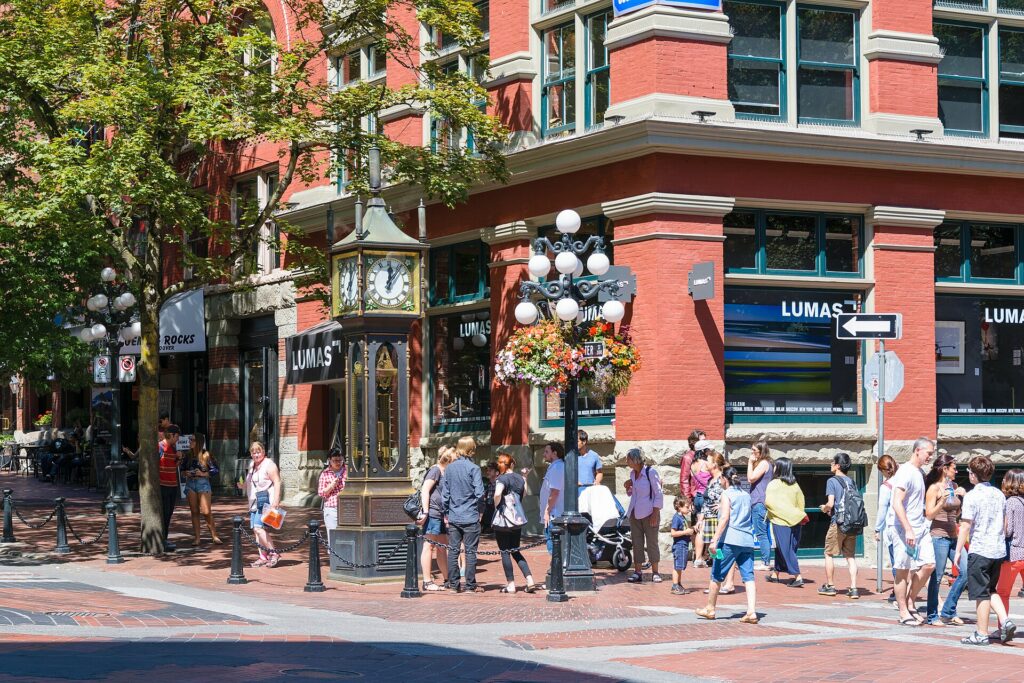
Vancouver began here, and the cobblestone streets and Victorian warehouses of Water Street are now full of restaurants, bars, design shops and the famous steam clock, which whistles on the quarter hour and draws a crowd that locals find slightly baffling. Gastown is at its best in the evening. Be aware that it borders the Downtown Eastside along Hastings Street, where the city’s homelessness and drug crisis is concentrated; it is not dangerous to walk through, but it can be confronting, and most visitors simply stay on Water and Cordova streets.
Chinatown
One of the oldest and largest Chinatowns in North America sits just south of Gastown around Pender and Keefer streets. The Dr. Sun Yat-Sen Classical Chinese Garden, built by craftsmen from Suzhou using traditional methods, is a serene walled garden worth an hour; the surrounding blocks have bakeries, barbecue shops and, increasingly, some of the city’s most interesting new restaurants. Combine it with Gastown for a half-day on foot.
Canada Place, Coal Harbour and the waterfront
The white sails of Canada Place, the cruise terminal, are the city’s postcard building. Beside it, the Olympic Cauldron from the 2010 Winter Games sits at Jack Poole Plaza, and the Coal Harbour seawall runs west past the marinas, seaplane terminal and the Devonian Harbour Park toward Stanley Park, with the North Shore mountains filling the view the entire way. FlyOver Canada, a flight-simulation ride inside Canada Place, is a good rainy-day option with children. The Harbour Air seaplanes that land and take off beside the seawall are the most Vancouver form of transport there is; a scenic flight or the hop to Victoria is worth the money once.
Robson Street, the Vancouver Art Gallery and the library
Robson Street is the shopping and ramen strip that connects downtown to the West End. The Vancouver Art Gallery on Robson Square holds the definitive collection of Emily Carr, British Columbia’s most important painter, and the Vancouver Public Library’s central branch, a Colosseum-shaped building with a rooftop garden, is one of the city’s best pieces of architecture and free to wander.
The North Shore: bridges, mountains and rainforest
Capilano Suspension Bridge Park
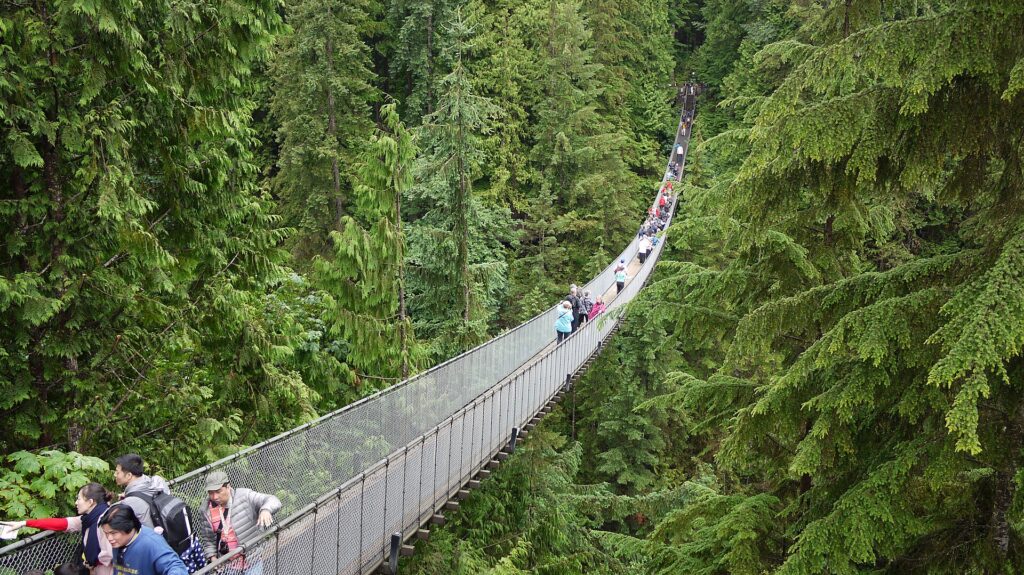
The Capilano Suspension Bridge swings 70 metres above the Capilano River in a rainforest canyon twenty minutes from downtown, and the park around it, with a treetop walkway and a cliff-edge path bolted to the canyon wall, is the North Shore’s most visited attraction. It is expensive and, in summer, busy; a free shuttle runs from Canada Place, and going early or late in the day helps. If the admission price puts you off, Lynn Canyon Park, further east, has a smaller free suspension bridge, swimming holes and forest trails.
Grouse Mountain
A gondola, the Skyride, climbs Grouse Mountain from the base station a few minutes past Capilano. At the top are the views back over the city and the Strait of Georgia, a grizzly bear refuge, a lumberjack show in summer and skiing and snowshoeing in winter. The Grouse Grind, a brutally steep 2.9-kilometre trail straight up the mountain, is a Vancouver institution; locals do it for fitness, visitors do it once and take the gondola down. Cypress and Seymour, the other two local mountains, are less commercial, better for serious skiing, and reachable by car or seasonal shuttle.
Deep Cove and the SeaBus
The SeaBus ferry from Waterfront Station crosses Burrard Inlet to Lonsdale Quay in twelve minutes for the price of a transit fare, and the view of the skyline from the water is worth the trip on its own. From Lonsdale, buses continue to the mountains and east to Deep Cove, a village on a fjord where you can rent a kayak or walk the short Quarry Rock trail to a viewpoint over Indian Arm.
Beaches, parks and gardens
Vancouver has real city beaches. English Bay, at the foot of the West End, is the downtown beach and the place to watch the sunset and, in late July and early August, the Celebration of Light fireworks. Kitsilano Beach, across the Burrard Bridge, has the city’s best people-watching, a heated outdoor saltwater pool that is one of the longest in Canada, and mountain views across the bay. Jericho and Spanish Banks, further west, are quieter and wider, with sand flats at low tide. Wreck Beach, below the University of British Columbia, is the clothing-optional one. Inland, Queen Elizabeth Park is the highest point in the city with a conservatory and formal gardens, and VanDusen Botanical Garden is 22 hectares of themed gardens that are lovely in every season, including a maze that children adore.
Museums and culture
The Museum of Anthropology at UBC is the one museum every visitor should make time for: a magnificent Arthur Erickson building on the cliffs above the Strait of Georgia holding one of the world’s great collections of Northwest Coast First Nations art, including monumental totem poles and Bill Reid’s carving The Raven and the First Men. Allow half a day including the bus ride out. Science World, the geodesic dome at the east end of False Creek, is the best children’s attraction in the city. The Museum of Vancouver and the H.R. MacMillan Space Centre share a site in Vanier Park beside Kitsilano; the Bill Reid Gallery downtown is a small, excellent introduction to the Haida artist. In summer, Bard on the Beach stages Shakespeare in tents in Vanier Park with the mountains as the backdrop, and it is one of the most Vancouver evenings you can have. For what is on stage and in the arenas during your dates, our Vancouver events page lists concerts, shows and games.
Neighbourhoods worth a half-day
The West End
Between downtown and Stanley Park, the West End is dense, leafy, residential and walkable, with Denman and Davie streets for cafés and casual restaurants, English Bay at the bottom of the hill, and the park at the top. It is the best base in the city for a first visit without a car.
Yaletown and False Creek
Converted warehouses on the north shore of False Creek hold restaurants with long patios, and the seawall runs the whole way round the inlet past the Olympic Village and Science World to Granville Island. The Roundhouse, a former rail yard, is the neighbourhood’s community centre; the ferry docks are its transit.
Kitsilano and West 4th
Across the Burrard Bridge, Kitsilano is the beach town inside the city: West 4th Avenue for shops and brunch, Kits Beach for the afternoon, and the Vanier Park museums and Bard on the Beach a short walk away.
Main Street and Mount Pleasant
The city’s independent-shop and craft-brewery strip runs along Main Street from about 2nd to 30th Avenue, with a dense cluster of breweries in the industrial blocks of Mount Pleasant and murals from the annual mural festival on nearly every wall. This is where locals in their twenties and thirties spend their weekends.
Commercial Drive
The Drive, east of downtown, is the old Italian and Portuguese main street turned bohemian: espresso bars, cheap and good restaurants from every cuisine, and the best place in the city to watch a football match with a crowd.
Richmond
The city south of the Fraser River, on the Canada Line, has the most authentic Chinese food in North America, from dim sum halls to hole-in-the-wall noodle shops, and a summer night market that is an event in itself. Steveston, at Richmond’s southwest corner, is a historic fishing village where you can buy spot prawns off the boats and visit the Gulf of Georgia Cannery. Tourism Richmond maps the food.
Sports and live events
The Vancouver Canucks play at Rogers Arena from October to April, and a home game is the loudest thing that happens downtown. The Whitecaps (soccer) and BC Lions (football) share BC Place, the stadium with the retractable roof beside the arena. In summer, the Vancouver Canadians, a minor-league baseball team, play at Nat Bailey Stadium beside Queen Elizabeth Park; it is cheap, charming, and a favourite local evening. Concert tours stop at Rogers Arena and BC Place; smaller acts play the Commodore Ballroom and the Orpheum. Check what is on sale in Vancouver for your dates before you book flights, because a playoff run or a stadium show fills downtown hotels quickly. The festival calendar runs from the Cherry Blossom Festival in April through the jazz festival in June, the Celebration of Light and Pride in summer, the PNE fair in late August, and the Vancouver International Film Festival in the fall; Destination Vancouver keeps the dates.
What to eat, and where
Vancouver’s food is Pacific first and Asian second, and the two overlap constantly. The sushi is better and cheaper than almost anywhere outside Japan; wild salmon, spot prawns in May and June, and Dungeness crab are the local luxuries; and the city’s ramen, izakaya and Cantonese dim sum scenes are all serious. Richmond for dim sum and regional Chinese cooking; Robson Street for ramen; Main Street and Commercial Drive for the independent, chef-driven restaurants and breweries; Granville Island for lunch; the West End for casual Japanese, Korean and Thai. Two local institutions worth a detour: Japadog, the hot-dog stand on Robson that pioneered Japanese-style toppings, and the food trucks that cluster around the Vancouver Art Gallery at lunchtime. Dine Out Vancouver, in late January and February, offers prix-fixe menus at hundreds of restaurants and is the best value on the calendar.
Vancouver with kids
Science World, the Vancouver Aquarium, the Kids Market and water park on Granville Island, the Kitsilano outdoor pool, the beaches, the VanDusen maze, the Capilano treetop walkways and the grizzly bears on Grouse Mountain. The False Creek ferries and the SeaBus are adventures in themselves at no extra cost, and children twelve and under ride TransLink free.
Day trips from Vancouver
Whistler is two hours north on the Sea to Sky Highway, one of the most beautiful drives in North America, past Shannon Falls and the Sea to Sky Gondola at Squamish. In winter it is the largest ski resort in North America; in summer the Peak 2 Peak gondola, the mountain biking and the lakes make it just as worthwhile. Whistler Blackcomb has resort details; coach services run from downtown and the airport if you would rather not drive. Victoria, the provincial capital on Vancouver Island, is a BC Ferries crossing from Tsawwassen to Swartz Bay, about an hour and a half on the water plus the drives at either end, or a 35-minute seaplane from the downtown harbour; the Butchart Gardens and the Inner Harbour are the draws. Bowen Island, a twenty-minute ferry from Horseshoe Bay, is the easy island escape. Harrison Hot Springs, the Fraser Valley wineries and Fort Langley are all under two hours east by car. Most of these are easier with a vehicle; see our Vancouver car rental page, and note that BC requires winter tires on the Sea to Sky and other mountain highways from October to April, so ask for them when you book in those months. Destination BC covers the wider province.
Two sample itineraries
Two days, no car
Day one: rent bikes on Denman Street and ride the Stanley Park seawall in the morning, lunch on Denman or Davie, the Aquabus to Granville Island in the afternoon, dinner in Yaletown. Day two: SeaBus to Lonsdale Quay and the bus to Capilano or Grouse in the morning, back for a late lunch in Gastown, the Dr. Sun Yat-Sen garden and Chinatown, sunset at English Bay, and a Canucks game or a show at night.
Four days, with one day trip
Add a day for Kitsilano, the Museum of Anthropology and Spanish Banks, a day for Main Street, Commercial Drive and Richmond’s food, and use the fourth for Whistler by car or coach, or Victoria by ferry or seaplane. Rent the car for that single day from a downtown location rather than the airport.
Practical details
- Transit: tap a credit card, debit card or phone at any fare gate or on any bus, or buy a Compass card; a single tap covers 90 minutes of transfers. Fares on the SkyTrain and SeaBus are zoned, buses are a flat fare, and a surcharge applies when you board the Canada Line at the airport stations. TransLink has maps and alerts; our transit-versus-car guide goes deeper.
- From YVR: the Canada Line to Waterfront takes about 25 minutes. The airport’s site covers ground transport and terminal maps.
- Weather: a waterproof shell year-round, layers in every season, and sunscreen in summer. Environment Canada’s forecast is the one to check.
- Time zone: Pacific, three hours behind Toronto and Montreal and eight behind London.
- Entry requirements: U.S. citizens need a valid passport; most other visa-exempt visitors arriving by air need an Electronic Travel Authorization. The Government of Canada’s visitor page is the authoritative source.
- Safety: a safe city by any standard; the usual big-city awareness applies downtown at night, and the Downtown Eastside is best avoided after dark.
Frequently asked questions
How many days do you need in Vancouver?
Three full days covers the peninsula, Granville Island and the North Shore comfortably; five lets you add Whistler or Victoria. A weekend is enough for Stanley Park, Granville Island and Gastown.
What is the number one thing to do in Vancouver?
The Stanley Park seawall by bike, ideally in the late afternoon so you finish at Third Beach for sunset.
Is Vancouver walkable?
Downtown, the West End, Yaletown and Gastown, very. The rest of the city is a short SkyTrain, bus or ferry ride, and the seawall connects most of the waterfront on foot or by bike.
Do I need a car in Vancouver?
Not for the city itself. Rent one for Whistler, the Sea to Sky, the Fraser Valley or a ferry trip to the island, ideally from a downtown location for just those days.
Is Vancouver expensive?
Hotels downtown are the main cost, especially from June to September and during cruise weekends. The parks, beaches, seawall, markets and many festivals are free, and transit is inexpensive. Shoulder-season flights and comparing hotels across neighbourhoods keep the total in check.
What is Vancouver known for?
Its setting between the ocean and the mountains, Stanley Park, Granville Island, outstanding Asian and Pacific food, the 2010 Winter Olympics, and being the gateway to Whistler and Vancouver Island.
Ready to go? Compare flights to Vancouver, find a place to stay with our Vancouver hotel search, and if Whistler or the ferries are on the list, price a rental car for those days.
Keep planning with TicketScanner
- Cheap flights to Vancouver
- Vancouver hotels — by neighbourhood
- Vancouver car rentals — for Whistler, the Sea to Sky and the ferries
- Events in Vancouver — Canucks, concerts and shows on sale
- Best time to fly to Vancouver: month by month
- Vancouver: rent a car or use transit?
- Vancouver International (YVR) airport guide
- Where to stay: Yaletown
Leave a Reply