Tag: Vancouver

  • Vancouver: Should You Rent a Car or Rely on Public Transit?

    Vancouver: Should You Rent a Car or Rely on Public Transit?

    Vancouver is one of the few North American cities where the honest answer to “should I rent a car?” is usually a confident no, and one of the few where the exceptions are so appealing that many visitors end up renting one anyway. Downtown is a compact peninsula with no freeway running into it, the SkyTrain reaches the airport, the suburbs and most of what you want to see, a ferry crosses to the North Shore for the price of a bus fare, and parking is expensive and scarce. But the mountains, the Sea to Sky Highway to Whistler, the ferry terminals to Vancouver Island and the Fraser Valley are all much easier with a vehicle, and for a lot of trips the smart plan is to go car-free in the city and rent for one or two days. This guide explains how the region is laid out, how transit and fares work, what driving and parking are really like, and gives you a straightforward way to decide.

    The short answer

    Skip the car if you are staying downtown, in the West End, Yaletown or Kitsilano, and your plans are the city itself: Stanley Park, Granville Island, Gastown, the beaches, the North Shore attractions, a Canucks game. Rent a car if you are driving to Whistler or Squamish, visiting the Fraser Valley or the Okanagan, taking a rental across on the ferry to Vancouver Island, staying with family in the suburbs, or travelling in the wet months with young children and a lot of gear. And for most first-time visitors the best answer is both: transit and walking for the city days, then a rental from a downtown location for exactly the days you leave town. Compare rates for either approach on our Vancouver car rental page.

    How Vancouver is laid out

    The City of Vancouver is a peninsula bounded by Burrard Inlet to the north and the Fraser River to the south, with a smaller peninsula, downtown, jutting into the inlet at the top. English Bay and False Creek separate downtown from the rest of the city; three bridges (Lions Gate to the North Shore, and the Burrard, Granville and Cambie bridges across False Creek) carry all the traffic in and out. There is no freeway into downtown; the closest, Highway 1, runs along the eastern edge of the city. That single fact explains most of Vancouver’s traffic and most of the case against renting a car for a downtown stay.

    Hotels cluster downtown and in Coal Harbour, in the West End near the beaches and Stanley Park, in Yaletown along False Creek, and in Richmond near the airport. The first three put you within walking distance of most sights; Richmond is cheaper, convenient for early flights, and on the Canada Line, but it is 25 minutes from downtown by train and further by car in traffic. Our Vancouver hotel search lets you compare all of them.

    Getting in from the airport

    From Vancouver International (YVR)

    YVR is on Sea Island in Richmond, about 12 kilometres from downtown, and the transit connection is one of the best of any airport in North America. The Canada Line SkyTrain leaves from a station inside the terminal, between the domestic and international halls, and reaches Waterfront Station downtown in about 25 minutes, with stops at Vancouver City Centre and Yaletown-Roundhouse on the way. Trains run every few minutes from early morning until after midnight. Tap a credit card, debit card or phone at the gate, or buy a Compass card from the machines; a small airport surcharge is added to the fare when you board at the airport stations. Taxis and ride-hail pick up outside arrivals, and the rental counters are in the parkade across from the terminal. The airport’s site has current ground-transport details; our YVR airport guide covers the layout.
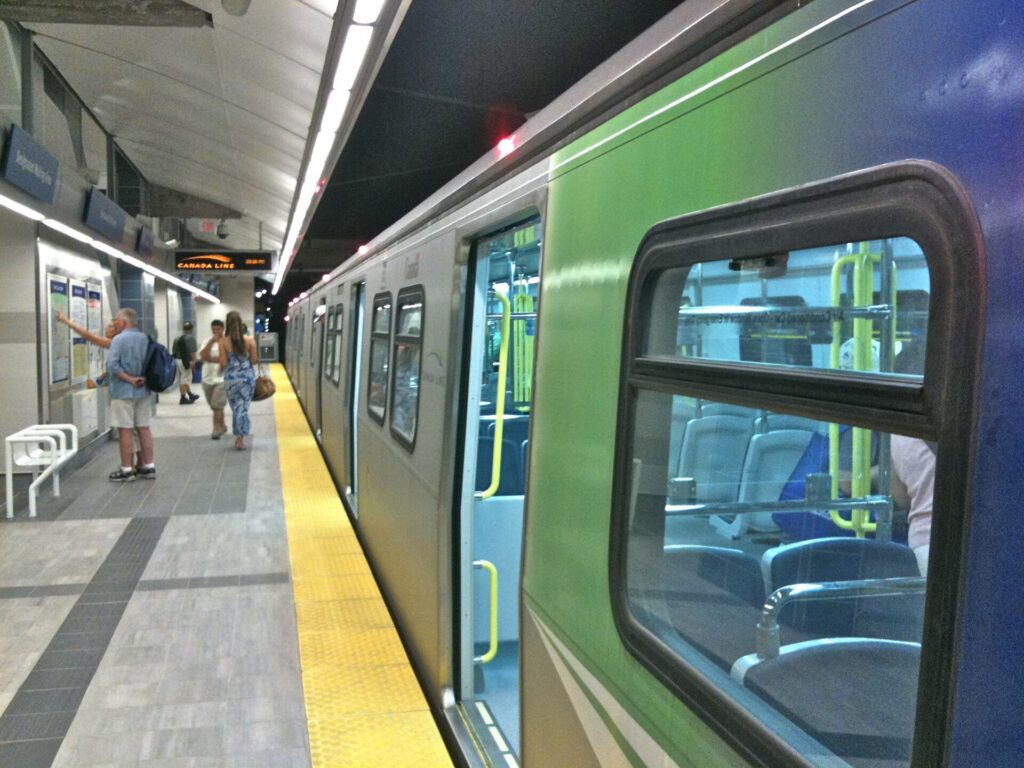
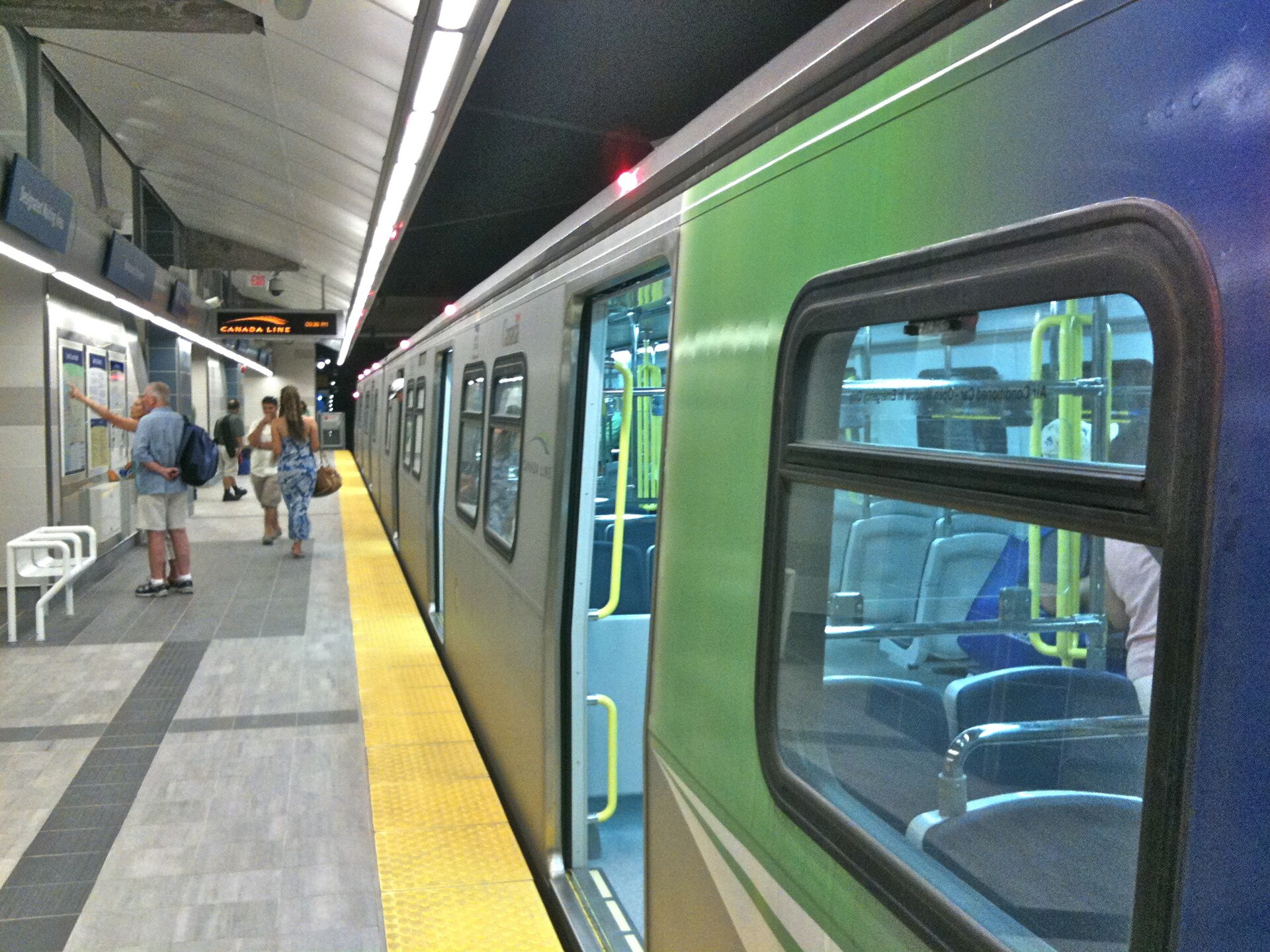
    A Canada Line SkyTrain at a station in Vancouver
    A Canada Line train at Vancouver City Centre: the line runs from the airport to Waterfront Station in about 25 minutes (Photo: Dan Udey

    Camera location49° 16′ 53.4″ N, 123° 07′ 04.8″ W   View this and other nearby images on: OpenStreetMap 49.281500; -123.118000 via Wikimedia Commons, CC BY 2.0)

    From Abbotsford (YXX) or Bellingham (BLI)

    If a low fare has brought you into Abbotsford, 70 kilometres east in the Fraser Valley, or across the border into Bellingham, Washington, a rental car is close to essential; transit into Vancouver from either is slow and involves several changes, and from Bellingham it involves a border crossing.

    Vancouver’s transit, explained

    TransLink runs an integrated network of SkyTrain lines, buses, the SeaBus and the West Coast Express commuter train across Metro Vancouver, and for visitors it is simple to use, frequent and safe.

    SkyTrain

    Three automated lines. The Canada Line runs north-south from Waterfront Station through downtown to Richmond and the airport. The Expo Line runs from Waterfront east through Chinatown, Main Street-Science World and Commercial-Broadway to Burnaby, New Westminster and Surrey. The Millennium Line runs from VCC-Clark through Commercial-Broadway east to Coquitlam, and an extension along Broadway toward Arbutus has been under construction for years; check the TransLink map for what is open when you travel. For a visitor the useful stops are Waterfront (Gastown, Canada Place, the SeaBus), Vancouver City Centre (Robson Street), Yaletown-Roundhouse, Main Street-Science World, Commercial-Broadway (the Drive) and the airport.

    Buses

    Buses fill in everything the trains do not reach, and several are effectively sightseeing routes: the 19 through Stanley Park, the 50 to Granville Island, the 4 and 14 to the University of British Columbia and the Museum of Anthropology, and the 236 from Lonsdale Quay up to Capilano and Grouse Mountain. The RapidBus routes are limited-stop expresses with their own lanes on the busiest corridors.

    The SeaBus

    A passenger ferry that crosses Burrard Inlet from Waterfront Station to Lonsdale Quay in North Vancouver in twelve minutes, every fifteen minutes or better through the day, for a regular transit fare. It is the connection to the North Shore mountains and a genuinely scenic ride; the view of the skyline on the return crossing is one of the best in the city.
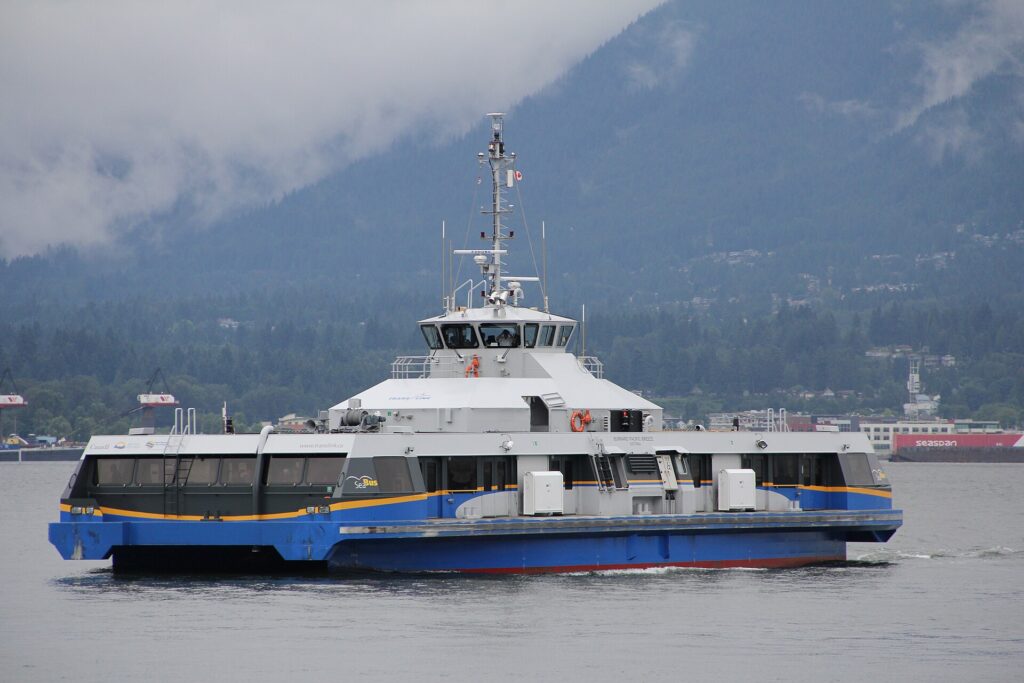
    The SeaBus passenger ferry crossing Burrard Inlet between downtown Vancouver and North Vancouver
    The SeaBus crosses Burrard Inlet to the North Shore in twelve minutes for a regular transit fare (Photo: ~riley via Wikimedia Commons, CC BY-SA 3.0)

    Fares, Compass and tap-to-pay

    You do not need to buy anything in advance. Tap a contactless credit card, debit card, phone or watch at any fare gate or bus reader; a single tap covers 90 minutes of transfers in any direction. Alternatively, buy a Compass card from any SkyTrain station and load it with stored value or a DayPass. SkyTrain and SeaBus fares are zoned, with three zones across the region and higher fares for crossing zone boundaries during weekday daytime; buses are a single flat fare regardless of distance. Boarding the Canada Line at YVR or the other Sea Island stations adds an airport surcharge. Children twelve and under ride free. Check TransLink’s site for current fares before you go.

    Accessibility

    Every SkyTrain station has elevators, all buses are low-floor with ramps, and the SeaBus and its terminals are step-free. It is one of the more accessible transit systems in Canada.

    Beyond TransLink

    • False Creek ferries. The Aquabus and False Creek Ferries are small private boats linking the foot of Hornby Street, Yaletown, Granville Island, the Olympic Village and Science World. They take a few minutes, cost a few dollars, and are the best way to reach Granville Island.
    • Mobi bike share. Docks across downtown, the West End, Kitsilano and Mount Pleasant. The seawall is flat, separated from traffic, and covers Stanley Park, Coal Harbour, False Creek and Kitsilano; a bike is the ideal way to see it.
    • Seaplanes. Harbour Air flies from the downtown waterfront to Victoria, Nanaimo and the islands. Expensive, but a 35-minute flight replaces a half-day of ferries and driving.
    • BC Ferries. The Tsawwassen terminal, south of the airport, serves Victoria and the Gulf Islands; Horseshoe Bay, in West Vancouver, serves Nanaimo, Bowen Island and the Sunshine Coast. Both are reachable by bus, but a car makes the island end of the trip far easier.
    • Taxis and ride-hail. Uber and Lyft operate across Metro Vancouver, and licensed taxis are plentiful downtown. For a group, a short ride can cost about the same as transit fares and save time late at night.
    • Coaches to Whistler. Scheduled coach services run from downtown hotels and the airport to Whistler along the Sea to Sky, which is how many visitors do the trip without renting.

    Driving in Vancouver: what it is really like

    Vancouver drivers are courteous by big-city standards and the street grid is easy to follow, but the geography works against you. Every route into downtown crosses a bridge, and the three False Creek bridges and the Lions Gate Bridge jam solidly in the weekday peaks, roughly seven to nine-thirty in the morning and three-thirty to six-thirty in the evening. The Lions Gate, with its three lanes and counterflow system, is the North Shore’s single bottleneck, and a Sunday evening return from Whistler can add an hour just to cross it. Highway 1 through Burnaby and the Massey Tunnel under the Fraser are the other reliable jams. There are no road tolls anywhere in Metro Vancouver, which is one genuine advantage over Toronto.
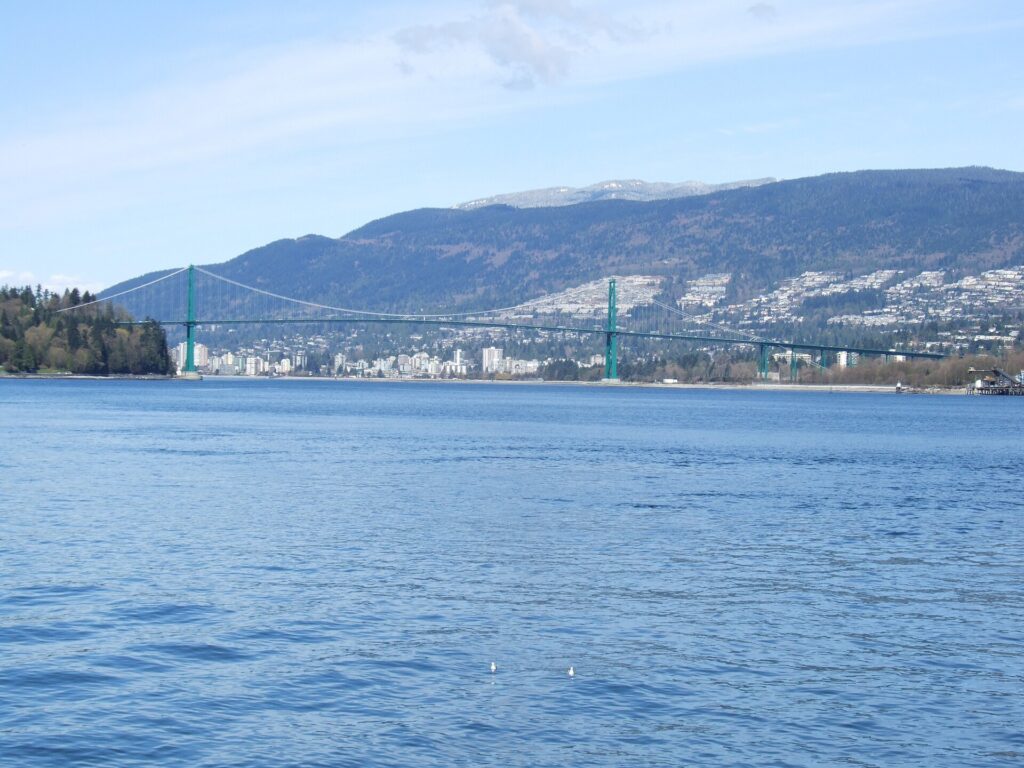
    The Lions Gate Bridge across the First Narrows between Stanley Park and the North Shore
    The Lions Gate Bridge: three lanes, a counterflow system, and the North Shore's rush-hour bottleneck (Photo: Xiao23 via Wikimedia Commons, CC BY-SA 3.0)

    Parking

    Parking is the deciding factor. Downtown hotels charge a substantial nightly fee, commercial lots downtown and in Yaletown are among the most expensive in Canada, and street parking is metered, short-term and strictly enforced. Stanley Park and the beaches have pay parking that fills by mid-morning on summer weekends. Add a week of hotel parking to a week of rental and you have paid for a great many SkyTrain rides.

    Rules and conditions worth knowing

    • Winter tires are required by law on designated BC highways, including the Sea to Sky Highway to Whistler and Highway 1 east of Hope, from October 1 to April 30. Rental cars from Vancouver locations are not guaranteed to have them; ask specifically if you are driving to the mountains in those months. DriveBC publishes road conditions and closures.
    • Right turns on red are permitted after a full stop unless signed otherwise.
    • Intersection safety cameras issue speed and red-light tickets; fines follow the car, and rental companies bill you with an administrative fee.
    • Bike lanes are extensive and physically separated downtown; check your mirror at every turn.
    • Distracted driving penalties in BC are among the strictest in Canada; mount the phone before you move.
    • Wildlife and weather on the Sea to Sky: heavy rain and, in winter, snow and black ice above Squamish. Allow more time than the map suggests.
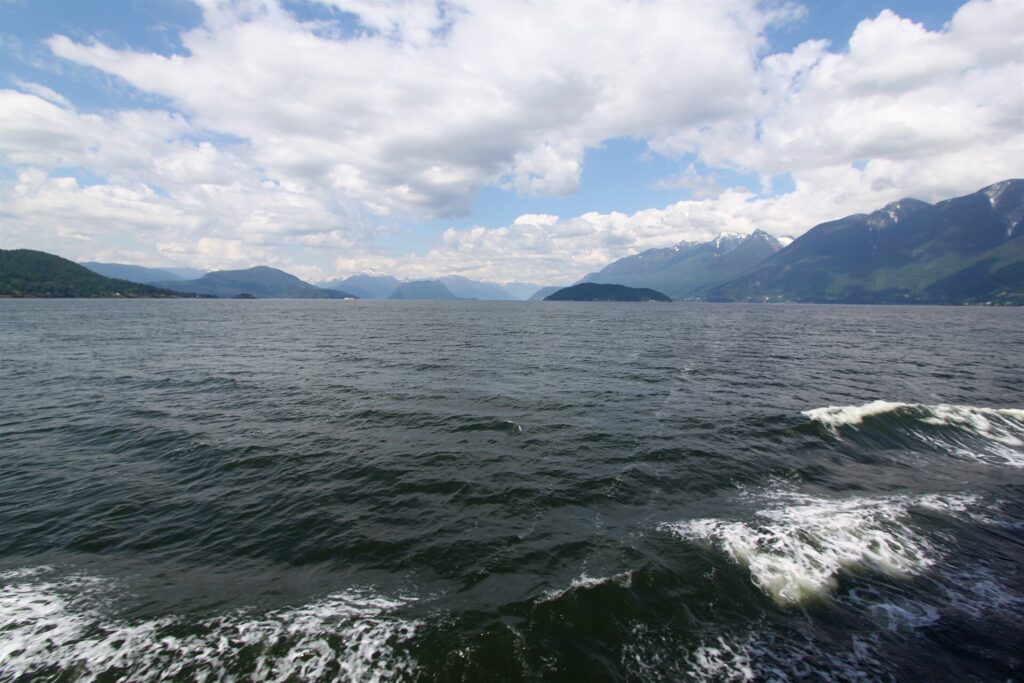
    The Sea to Sky Highway along Howe Sound between Vancouver and Whistler
    Howe Sound from Horseshoe Bay, the start of the Sea to Sky Highway to Whistler, the one drive most visitors rent a car for (Photo: Roy Luck via Wikimedia Commons, CC BY 2.0)

    When renting a car makes sense

    • Whistler and the Sea to Sky. The drive is the point, and a car lets you stop at Shannon Falls, the Sea to Sky Gondola and Brandywine Falls on the way.
    • Vancouver Island by ferry. Rental cars are allowed on BC Ferries (confirm with your rental company), and Victoria, Tofino and the island are far easier with one.
    • The Fraser Valley and the Okanagan. Wineries, Harrison Hot Springs, Fort Langley and the four-hour drive to Kelowna are all car trips.
    • Family in the suburbs. Surrey, Burnaby, Coquitlam and Langley are on transit but spread out; a car earns its keep daily.
    • Arriving at Abbotsford or Bellingham. Covered above; almost always yes.
    • Winter with young children. Rain, gear and a stroller on a crowded bus is a hard combination; a car and a hotel with parking can be worth every dollar.

    If any of those apply, our rental car booking tips cover insurance, deposits and the questions to ask at the counter, and our family car rental guide looks at vehicle choice.

    When it does not

    • You are staying downtown, in the West End, Yaletown, Coal Harbour or Kitsilano.
    • Your plans are Stanley Park, Granville Island, Gastown, the beaches, the North Shore attractions and a game or a show.
    • You are visiting during cruise season, the Celebration of Light or a big game, when downtown traffic and parking are at their worst.
    • You are travelling as a couple or solo and value time over a fixed vehicle.
    • You are visiting in the wet season and would rather not drive unfamiliar roads in the rain.

    The hybrid plan most visitors should use

    Go car-free for the city portion of the trip, then rent for exactly the days you leave town, picking up from a downtown location rather than the airport. Downtown pickups avoid airport surcharges, let you skip the drive in at peak time, and spare you hotel parking on the nights you are not using the car. Book ahead for the dates you need; walk-up availability on a summer weekend is poor, and vehicles with winter tires are limited in the ski months. Return the car the evening before you fly and take the Canada Line to the airport. Compare the day rates on our Vancouver car rental page against a full-trip rental and the difference is usually obvious.

    Rental logistics in Vancouver, if you do rent

    A few local details make the rental itself smoother. Where to pick up: the airport counters sit in the parkade directly across from the terminal, and every major company also has downtown branches, most of them clustered around the hotel district on Burrard, Robson and West Georgia streets and in Yaletown; downtown pickup avoids the airport concession fees that are added to YVR rentals and lets you collect the car on the morning you actually leave the city. One-way rentals to Whistler, Kelowna or Calgary are common and can be cheaper than a return when the road trip is the point; the Vancouver-to-Calgary drive through the Rockies is one of the great routes in Canada, and a car that ends in Calgary pairs well with a flight home from there. Ferries: most companies allow their vehicles on BC Ferries within the province, but confirm at the counter and factor the vehicle fare into the budget, because a car adds significantly to the cost of the Victoria crossing compared with walking on. Insurance: British Columbia has a public auto insurer, and rental agreements include basic third-party coverage; collision coverage is sold as an add-on unless your credit card or home policy provides it, so check before you arrive rather than deciding at the counter. Electric vehicles are common in Vancouver’s rental fleets and charging is easy in the city, thinner on the Sea to Sky and in the interior; a hybrid is the safer choice for a mountain trip. Fuel is more expensive in Metro Vancouver than almost anywhere else in Canada because of regional taxes, which is one more reason to keep the car for the out-of-town days only. And in the ski months, ask explicitly for a vehicle fitted with winter tires when you book, not when you collect; the supply is limited, and the highway signs at Horseshoe Bay are not a suggestion.

    Decision table

    Your tripRecommendationWhy
    Weekend downtown, couple or soloNo carEverything is walkable, on the seawall or one SkyTrain ride away; parking would cost more than transit
    Four or five days with a Whistler day tripHybrid: rent for one or two days downtownCar-free city days, car for the Sea to Sky
    City plus Vancouver IslandHybrid, or rent for the island portionRentals can go on the ferry; the island needs a car, the city does not
    Family visit to Surrey, Burnaby or LangleyRent for the whole staySuburban distances make the car worthwhile daily
    Winter trip with small childrenRent, choose a hotel with parkingRain and gear make transit hard work
    Ski trip to Whistler, staying in WhistlerRent at YVR with winter tires, or take the coachWhistler village itself is car-free; the car is only for getting there
    Flying into Abbotsford or BellinghamRent at the airportTransit into the city is slow from both
    Cruise passenger with a day or two in the cityNo carCanada Place is walking distance from downtown hotels

    Money-saving tips for both options

    • On transit: tap the same card every time so the 90-minute transfer registers; ride the SeaBus and the False Creek ferries as sightseeing instead of paying for a harbour tour; use a DayPass on a heavy sightseeing day.
    • On a rental: compare downtown and airport pickup prices, book early for summer and the ski months, ask about winter tires and ferry policies, decline extras you already have through a credit card or home policy (check first), and refuel before you return.
    • On the hotel: if you are renting, price the parking fee into the room rate; a slightly pricier hotel with included parking can be cheaper.
    • On timing: avoid the bridges in the weekday peaks and the Lions Gate on Sunday evenings; the best time to fly to Vancouver guide lists the event weekends when downtown is busiest.
    • On the airport run: the Canada Line is faster than a taxi in daytime traffic and, for one or two people, far cheaper.

    Frequently asked questions

    Is it worth renting a car in Vancouver?

    Only if you are leaving the city: Whistler, the ferries, the Fraser Valley, or the suburbs. For a downtown-focused visit, transit, the seawall and the ferries are faster and far cheaper once parking is counted.

    Is Vancouver public transit good for tourists?

    Yes. The Canada Line connects the airport to downtown in 25 minutes, the SkyTrain and buses reach nearly every major sight, tap-to-pay means no ticket to buy, and the SeaBus is a scenic ride for a bus fare.

    How do I get from YVR to downtown Vancouver?

    The Canada Line SkyTrain from inside the terminal to Waterfront Station, about 25 minutes. Taxis and ride-hail are available outside arrivals.

    Can I use my credit card on Vancouver transit?

    Yes. Tap a contactless credit or debit card, or a phone or watch, at the fare gate or on the bus. A Compass card is the alternative.

    Do I need winter tires to drive to Whistler?

    By law, yes, from October 1 to April 30 on the Sea to Sky Highway. Ask for them when you book, or take the coach.

    Is parking expensive in downtown Vancouver?

    Yes. Hotel and commercial lot rates are among the highest in Canada, and street parking is scarce and strictly enforced.

    Can I take a rental car on the ferry to Victoria?

    Most Vancouver rental companies allow travel within British Columbia including BC Ferries, but confirm the policy when you book.

    Whichever way you go, start with the flight. Compare cheap flights to Vancouver, choose a neighbourhood with our Vancouver hotel search, and if Whistler or the island is on the list, price the rental for those dates on our Vancouver car rental page.

  • Things to Do in Vancouver: A First-Timer’s Guide

    Things to Do in Vancouver: A First-Timer’s Guide

    Vancouver is the rare big city where the setting is the main attraction. Downtown sits on a peninsula with the ocean on three sides and the Coast Mountains rising straight out of the water across the inlet, and a first-time visitor can walk from a glass tower to a temperate rainforest in the time it takes to cross most cities’ financial districts. That geography shapes how you should plan: think in terms of the peninsula (downtown, Stanley Park, the West End), the water (Granville Island, the beaches, the seawall), the North Shore (the mountains and the suspension bridges) and the neighbourhoods across False Creek, and give each a half-day or more. This guide covers the sights that genuinely earn their reputation, the neighbourhoods locals actually spend time in, the food, the sports, the day trips that make Vancouver a gateway as much as a destination, and the practical details that turn a good trip into a great one.

    If you are still comparing cheap flights to Vancouver, read this alongside our guides to the best time to fly to Vancouver and whether you need a car. Between the three you can plan the whole trip.

    The downtown Vancouver skyline and harbour with the North Shore mountains behind
    Downtown Vancouver from the harbour, with the North Shore mountains behind (Photo: dronepicr via Wikimedia Commons, CC BY 2.0)

    Vancouver at a glance for first-timers

    • Airport: Vancouver International (YVR), in Richmond about 12 km from downtown; the Canada Line SkyTrain runs from inside the terminal to Waterfront Station in about 25 minutes. See our YVR airport guide.
    • Getting around: SkyTrain, buses, the SeaBus to the North Shore, and small ferries across False Creek cover nearly everything; downtown is flat and walkable, and the seawall is made for bikes. Most visitors do not need a car unless they are heading to Whistler or the ferries.
    • Money: Canadian dollars. Shelf and menu prices do not include the federal GST and the provincial PST, which are added at the till. Tipping 15 to 20 percent in restaurants is customary. Tap-to-pay works almost everywhere, including on transit.
    • Weather: mild year-round, dry and warm from June to September, and wet from October to March. A waterproof shell is more useful than an umbrella. Our month-by-month guide has the detail.
    • Where to stay: downtown and Coal Harbour for walkability and views; the West End for the beaches and Stanley Park; Yaletown for restaurants and the False Creek seawall; Kitsilano for a local, beachy feel across the bridge. Our Vancouver hotel search covers all of them.

    Stanley Park and the Seawall

    Start here. Stanley Park is a 400-hectare forest at the tip of the downtown peninsula, larger than New York’s Central Park and far wilder, and the paved seawall that runs around its edge is the single best free thing to do in the city. The full loop is roughly nine kilometres and takes about an hour by bike or three on foot, passing the totem poles at Brockton Point, the Nine O’Clock Gun, the Lions Gate Bridge from underneath, Siwash Rock, and Third Beach, where locals gather for sunset. Rent a bike from one of the shops on Denman Street at the park entrance, or pick up a Mobi bike-share bicycle. Inside the park, the Vancouver Aquarium is the biggest draw for families, Prospect Point has the classic view across to the North Shore, and the trails through the interior, cedar, hemlock and fir, are quiet even on a summer weekend. The City of Vancouver publishes park maps and any seawall closures, which happen after winter storms.

    Granville Island

    Under the south end of the Granville Street Bridge, a former industrial island has become the city’s favourite public space. The Granville Island Public Market is the reason to go: dozens of stalls selling fish, produce, baked goods, cheese, and ready-to-eat lunch you carry outside to eat on the dock while buskers play and seagulls plot. Around the market are artisan studios, a brewery, theatres, a boat-building school and a Kids Market with its own water park. The best way to arrive is by water: the tiny Aquabus and False Creek Ferries boats shuttle across from the foot of Hornby Street, from Yaletown and from Science World, and the ride is an attraction in its own right. Go in the morning on a weekday if you want the market without the crowds.

    Granville Island Public Market in Vancouver
    Granville Island Public Market, a short Aquabus ride across False Creek from downtown (Photo: Roy Luck via Wikimedia Commons, CC BY 2.0)

    Gastown, Chinatown and the downtown core

    Gastown

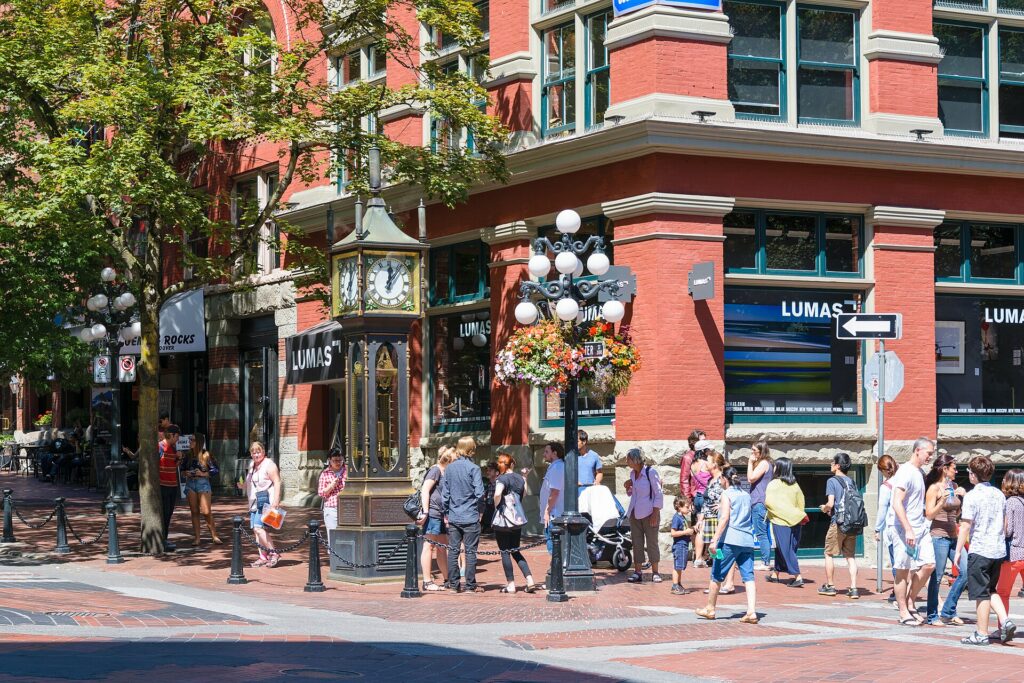
    Vancouver began here, and the cobblestone streets and Victorian warehouses of Water Street are now full of restaurants, bars, design shops and the famous steam clock, which whistles on the quarter hour and draws a crowd that locals find slightly baffling. Gastown is at its best in the evening. Be aware that it borders the Downtown Eastside along Hastings Street, where the city’s homelessness and drug crisis is concentrated; it is not dangerous to walk through, but it can be confronting, and most visitors simply stay on Water and Cordova streets.

    The Gastown steam clock on Water Street, Vancouver
    The steam clock on Water Street in Gastown, the oldest part of the city (Photo: Xicotencatl via Wikimedia Commons, CC BY-SA 4.0)

    Chinatown

    One of the oldest and largest Chinatowns in North America sits just south of Gastown around Pender and Keefer streets. The Dr. Sun Yat-Sen Classical Chinese Garden, built by craftsmen from Suzhou using traditional methods, is a serene walled garden worth an hour; the surrounding blocks have bakeries, barbecue shops and, increasingly, some of the city’s most interesting new restaurants. Combine it with Gastown for a half-day on foot.

    Canada Place, Coal Harbour and the waterfront

    The white sails of Canada Place, the cruise terminal, are the city’s postcard building. Beside it, the Olympic Cauldron from the 2010 Winter Games sits at Jack Poole Plaza, and the Coal Harbour seawall runs west past the marinas, seaplane terminal and the Devonian Harbour Park toward Stanley Park, with the North Shore mountains filling the view the entire way. FlyOver Canada, a flight-simulation ride inside Canada Place, is a good rainy-day option with children. The Harbour Air seaplanes that land and take off beside the seawall are the most Vancouver form of transport there is; a scenic flight or the hop to Victoria is worth the money once.

    Robson Street, the Vancouver Art Gallery and the library

    Robson Street is the shopping and ramen strip that connects downtown to the West End. The Vancouver Art Gallery on Robson Square holds the definitive collection of Emily Carr, British Columbia’s most important painter, and the Vancouver Public Library’s central branch, a Colosseum-shaped building with a rooftop garden, is one of the city’s best pieces of architecture and free to wander.

    The North Shore: bridges, mountains and rainforest

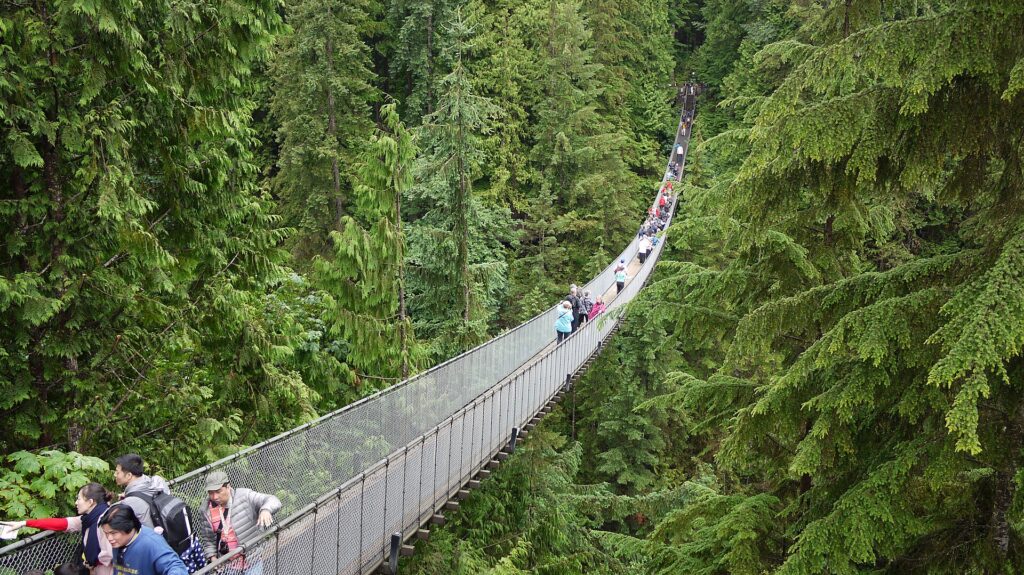
    Capilano Suspension Bridge Park

    The Capilano Suspension Bridge swings 70 metres above the Capilano River in a rainforest canyon twenty minutes from downtown, and the park around it, with a treetop walkway and a cliff-edge path bolted to the canyon wall, is the North Shore’s most visited attraction. It is expensive and, in summer, busy; a free shuttle runs from Canada Place, and going early or late in the day helps. If the admission price puts you off, Lynn Canyon Park, further east, has a smaller free suspension bridge, swimming holes and forest trails.

    The Capilano Suspension Bridge in North Vancouver
    The Capilano Suspension Bridge in North Vancouver, 20 minutes from downtown (Photo: Markus Säynevirta via Wikimedia Commons, CC BY-SA 4.0)

    Grouse Mountain

    A gondola, the Skyride, climbs Grouse Mountain from the base station a few minutes past Capilano. At the top are the views back over the city and the Strait of Georgia, a grizzly bear refuge, a lumberjack show in summer and skiing and snowshoeing in winter. The Grouse Grind, a brutally steep 2.9-kilometre trail straight up the mountain, is a Vancouver institution; locals do it for fitness, visitors do it once and take the gondola down. Cypress and Seymour, the other two local mountains, are less commercial, better for serious skiing, and reachable by car or seasonal shuttle.

    Deep Cove and the SeaBus

    The SeaBus ferry from Waterfront Station crosses Burrard Inlet to Lonsdale Quay in twelve minutes for the price of a transit fare, and the view of the skyline from the water is worth the trip on its own. From Lonsdale, buses continue to the mountains and east to Deep Cove, a village on a fjord where you can rent a kayak or walk the short Quarry Rock trail to a viewpoint over Indian Arm.

    Beaches, parks and gardens

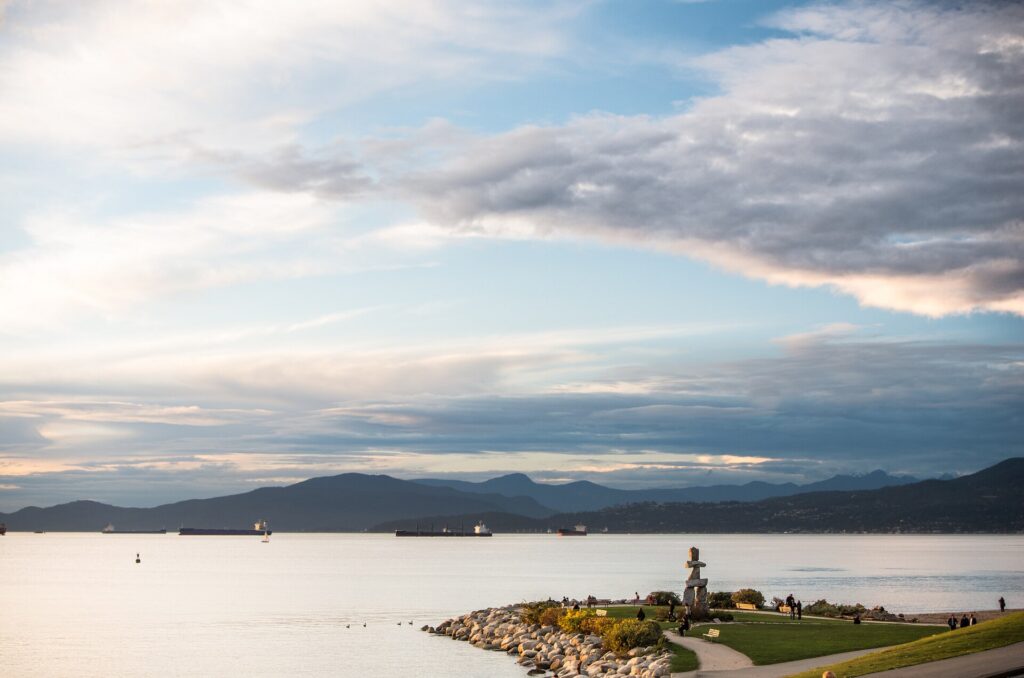
    Vancouver has real city beaches. English Bay, at the foot of the West End, is the downtown beach and the place to watch the sunset and, in late July and early August, the Celebration of Light fireworks. Kitsilano Beach, across the Burrard Bridge, has the city’s best people-watching, a heated outdoor saltwater pool that is one of the longest in Canada, and mountain views across the bay. Jericho and Spanish Banks, further west, are quieter and wider, with sand flats at low tide. Wreck Beach, below the University of British Columbia, is the clothing-optional one. Inland, Queen Elizabeth Park is the highest point in the city with a conservatory and formal gardens, and VanDusen Botanical Garden is 22 hectares of themed gardens that are lovely in every season, including a maze that children adore.

    Museums and culture

    The Museum of Anthropology at UBC is the one museum every visitor should make time for: a magnificent Arthur Erickson building on the cliffs above the Strait of Georgia holding one of the world’s great collections of Northwest Coast First Nations art, including monumental totem poles and Bill Reid’s carving The Raven and the First Men. Allow half a day including the bus ride out. Science World, the geodesic dome at the east end of False Creek, is the best children’s attraction in the city. The Museum of Vancouver and the H.R. MacMillan Space Centre share a site in Vanier Park beside Kitsilano; the Bill Reid Gallery downtown is a small, excellent introduction to the Haida artist. In summer, Bard on the Beach stages Shakespeare in tents in Vanier Park with the mountains as the backdrop, and it is one of the most Vancouver evenings you can have. For what is on stage and in the arenas during your dates, our Vancouver events page lists concerts, shows and games.

    Neighbourhoods worth a half-day

    The West End

    Between downtown and Stanley Park, the West End is dense, leafy, residential and walkable, with Denman and Davie streets for cafés and casual restaurants, English Bay at the bottom of the hill, and the park at the top. It is the best base in the city for a first visit without a car.

    Yaletown and False Creek

    Converted warehouses on the north shore of False Creek hold restaurants with long patios, and the seawall runs the whole way round the inlet past the Olympic Village and Science World to Granville Island. The Roundhouse, a former rail yard, is the neighbourhood’s community centre; the ferry docks are its transit.

    Kitsilano and West 4th

    Across the Burrard Bridge, Kitsilano is the beach town inside the city: West 4th Avenue for shops and brunch, Kits Beach for the afternoon, and the Vanier Park museums and Bard on the Beach a short walk away.

    Main Street and Mount Pleasant

    The city’s independent-shop and craft-brewery strip runs along Main Street from about 2nd to 30th Avenue, with a dense cluster of breweries in the industrial blocks of Mount Pleasant and murals from the annual mural festival on nearly every wall. This is where locals in their twenties and thirties spend their weekends.

    Commercial Drive

    The Drive, east of downtown, is the old Italian and Portuguese main street turned bohemian: espresso bars, cheap and good restaurants from every cuisine, and the best place in the city to watch a football match with a crowd.

    Richmond

    The city south of the Fraser River, on the Canada Line, has the most authentic Chinese food in North America, from dim sum halls to hole-in-the-wall noodle shops, and a summer night market that is an event in itself. Steveston, at Richmond’s southwest corner, is a historic fishing village where you can buy spot prawns off the boats and visit the Gulf of Georgia Cannery. Tourism Richmond maps the food.

    Sports and live events

    The Vancouver Canucks play at Rogers Arena from October to April, and a home game is the loudest thing that happens downtown. The Whitecaps (soccer) and BC Lions (football) share BC Place, the stadium with the retractable roof beside the arena. In summer, the Vancouver Canadians, a minor-league baseball team, play at Nat Bailey Stadium beside Queen Elizabeth Park; it is cheap, charming, and a favourite local evening. Concert tours stop at Rogers Arena and BC Place; smaller acts play the Commodore Ballroom and the Orpheum. Check what is on sale in Vancouver for your dates before you book flights, because a playoff run or a stadium show fills downtown hotels quickly. The festival calendar runs from the Cherry Blossom Festival in April through the jazz festival in June, the Celebration of Light and Pride in summer, the PNE fair in late August, and the Vancouver International Film Festival in the fall; Destination Vancouver keeps the dates.

    What to eat, and where

    Vancouver’s food is Pacific first and Asian second, and the two overlap constantly. The sushi is better and cheaper than almost anywhere outside Japan; wild salmon, spot prawns in May and June, and Dungeness crab are the local luxuries; and the city’s ramen, izakaya and Cantonese dim sum scenes are all serious. Richmond for dim sum and regional Chinese cooking; Robson Street for ramen; Main Street and Commercial Drive for the independent, chef-driven restaurants and breweries; Granville Island for lunch; the West End for casual Japanese, Korean and Thai. Two local institutions worth a detour: Japadog, the hot-dog stand on Robson that pioneered Japanese-style toppings, and the food trucks that cluster around the Vancouver Art Gallery at lunchtime. Dine Out Vancouver, in late January and February, offers prix-fixe menus at hundreds of restaurants and is the best value on the calendar.

    Vancouver with kids

    Science World, the Vancouver Aquarium, the Kids Market and water park on Granville Island, the Kitsilano outdoor pool, the beaches, the VanDusen maze, the Capilano treetop walkways and the grizzly bears on Grouse Mountain. The False Creek ferries and the SeaBus are adventures in themselves at no extra cost, and children twelve and under ride TransLink free.

    Day trips from Vancouver

    Whistler is two hours north on the Sea to Sky Highway, one of the most beautiful drives in North America, past Shannon Falls and the Sea to Sky Gondola at Squamish. In winter it is the largest ski resort in North America; in summer the Peak 2 Peak gondola, the mountain biking and the lakes make it just as worthwhile. Whistler Blackcomb has resort details; coach services run from downtown and the airport if you would rather not drive. Victoria, the provincial capital on Vancouver Island, is a BC Ferries crossing from Tsawwassen to Swartz Bay, about an hour and a half on the water plus the drives at either end, or a 35-minute seaplane from the downtown harbour; the Butchart Gardens and the Inner Harbour are the draws. Bowen Island, a twenty-minute ferry from Horseshoe Bay, is the easy island escape. Harrison Hot Springs, the Fraser Valley wineries and Fort Langley are all under two hours east by car. Most of these are easier with a vehicle; see our Vancouver car rental page, and note that BC requires winter tires on the Sea to Sky and other mountain highways from October to April, so ask for them when you book in those months. Destination BC covers the wider province.

    Two sample itineraries

    Two days, no car

    Day one: rent bikes on Denman Street and ride the Stanley Park seawall in the morning, lunch on Denman or Davie, the Aquabus to Granville Island in the afternoon, dinner in Yaletown. Day two: SeaBus to Lonsdale Quay and the bus to Capilano or Grouse in the morning, back for a late lunch in Gastown, the Dr. Sun Yat-Sen garden and Chinatown, sunset at English Bay, and a Canucks game or a show at night.

    Four days, with one day trip

    Add a day for Kitsilano, the Museum of Anthropology and Spanish Banks, a day for Main Street, Commercial Drive and Richmond’s food, and use the fourth for Whistler by car or coach, or Victoria by ferry or seaplane. Rent the car for that single day from a downtown location rather than the airport.

    Practical details

    • Transit: tap a credit card, debit card or phone at any fare gate or on any bus, or buy a Compass card; a single tap covers 90 minutes of transfers. Fares on the SkyTrain and SeaBus are zoned, buses are a flat fare, and a surcharge applies when you board the Canada Line at the airport stations. TransLink has maps and alerts; our transit-versus-car guide goes deeper.
    • From YVR: the Canada Line to Waterfront takes about 25 minutes. The airport’s site covers ground transport and terminal maps.
    • Weather: a waterproof shell year-round, layers in every season, and sunscreen in summer. Environment Canada’s forecast is the one to check.
    • Time zone: Pacific, three hours behind Toronto and Montreal and eight behind London.
    • Entry requirements: U.S. citizens need a valid passport; most other visa-exempt visitors arriving by air need an Electronic Travel Authorization. The Government of Canada’s visitor page is the authoritative source.
    • Safety: a safe city by any standard; the usual big-city awareness applies downtown at night, and the Downtown Eastside is best avoided after dark.

    Frequently asked questions

    How many days do you need in Vancouver?

    Three full days covers the peninsula, Granville Island and the North Shore comfortably; five lets you add Whistler or Victoria. A weekend is enough for Stanley Park, Granville Island and Gastown.

    What is the number one thing to do in Vancouver?

    The Stanley Park seawall by bike, ideally in the late afternoon so you finish at Third Beach for sunset.

    Is Vancouver walkable?

    Downtown, the West End, Yaletown and Gastown, very. The rest of the city is a short SkyTrain, bus or ferry ride, and the seawall connects most of the waterfront on foot or by bike.

    Do I need a car in Vancouver?

    Not for the city itself. Rent one for Whistler, the Sea to Sky, the Fraser Valley or a ferry trip to the island, ideally from a downtown location for just those days.

    Is Vancouver expensive?

    Hotels downtown are the main cost, especially from June to September and during cruise weekends. The parks, beaches, seawall, markets and many festivals are free, and transit is inexpensive. Shoulder-season flights and comparing hotels across neighbourhoods keep the total in check.

    What is Vancouver known for?

    Its setting between the ocean and the mountains, Stanley Park, Granville Island, outstanding Asian and Pacific food, the 2010 Winter Olympics, and being the gateway to Whistler and Vancouver Island.

    Ready to go? Compare flights to Vancouver, find a place to stay with our Vancouver hotel search, and if Whistler or the ferries are on the list, price a rental car for those days.

  • Best Time to Fly to Vancouver: Seasons, Weather & Prices

    Best Time to Fly to Vancouver: Seasons, Weather & Prices

    Vancouver’s weather has a reputation, and the reputation is only half right. Yes, it rains, and from November to February it rains a great deal. But the same Pacific air that brings the rain also gives Vancouver the mildest winters of any major Canadian city, the earliest spring, and a summer that is warm, dry and almost absurdly pleasant. Airfares follow that pattern closely: the city is busiest and most expensive from June to September, when the cruise ships are in and the mountains are green, and quietest in the wet months, with a twist that Toronto does not have, because Whistler’s ski season keeps winter demand higher than you might expect. This guide walks through Vancouver month by month, the fare seasons, the events that push prices up, and which of the region’s airports to fly into.

    The short answer

    For weather and value together, aim for late April to early June or mid-September to mid-October. Spring brings cherry blossoms, long days and dry spells before the summer crowds; early fall keeps most of the summer’s warmth and loses most of its prices. The cheapest fares are usually in November, January and the first half of February, when the rain is heaviest and the days are shortest. The most expensive stretches are July and August, the Christmas and New Year period, and the mid-February and mid-March school breaks, when families fly in for the mountains. Whatever you choose, run a flexible-date search on our Vancouver flights page; on the west coast, shifting a trip by a week can move it from one fare season into another.

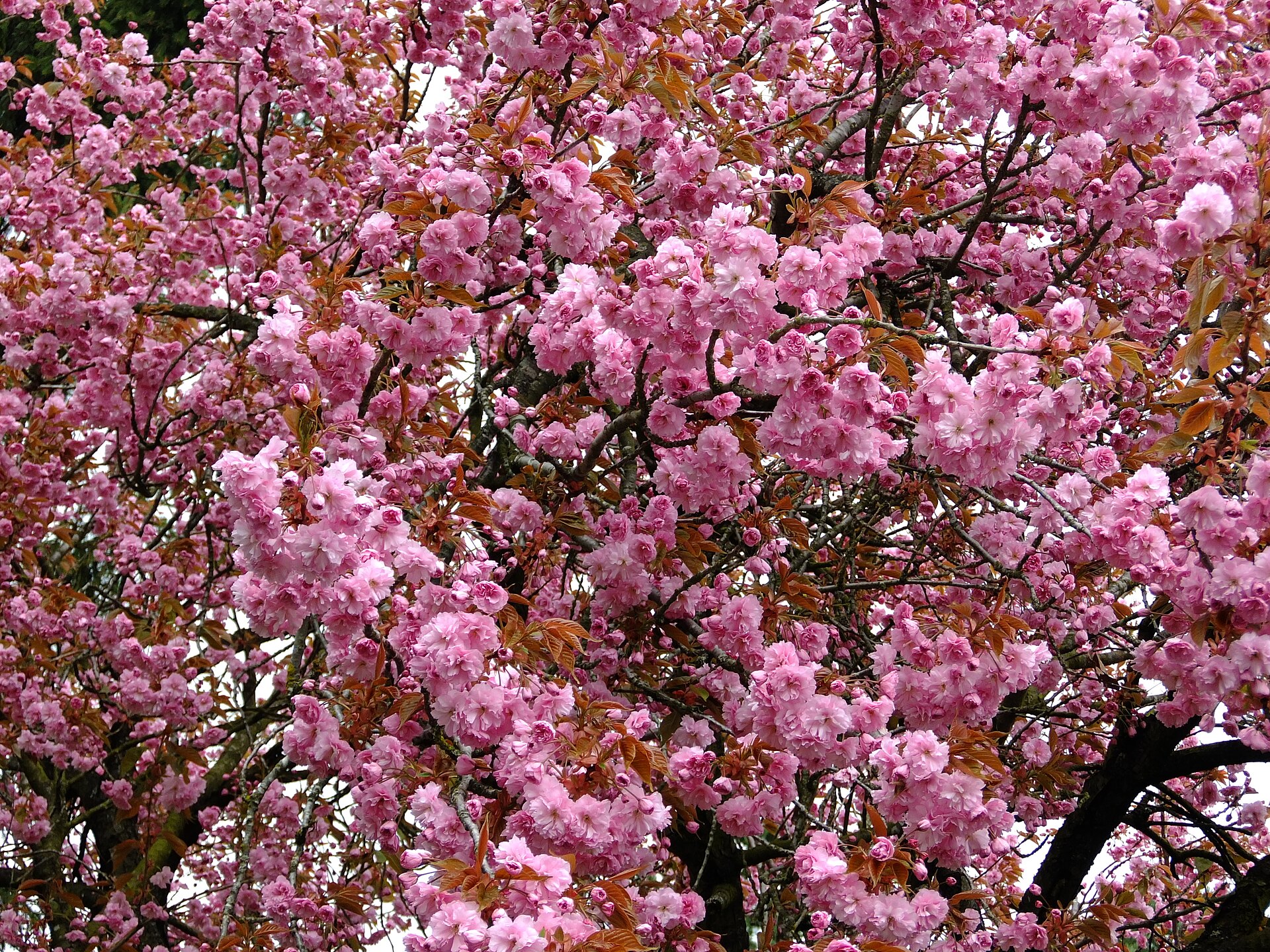
    Cherry blossoms lining a Vancouver street in spring
    Cherry blossoms in Metro Vancouver, a late-March to mid-April spectacle across the region (Photo: Reg Natarajan from Vancouver, Bogotá via Wikimedia Commons, CC BY 2.0)

    Vancouver’s weather, season by season

    Vancouver sits between the Pacific and the Coast Mountains, and both shape the weather. The ocean keeps temperatures in a narrow band year-round; the mountains wring the moisture out of incoming Pacific systems, which is why the North Shore is wetter than the airport and why it can be raining downtown while the sun is out in Richmond. The figures below are approximate seasonal patterns based on the long-term climate normals from Environment and Climate Change Canada; check the current forecast before you pack.

    MonthTypical daytime highTypical overnight lowWhat it feels likeFare pressure
    Januaryaround 7 °Caround 1 °CMild but very wet; snow downtown is rare, snow on the local mountains is notLow, except the first week
    Februaryaround 8 °Caround 2 °CStill wet; the first blossoms appear late in the monthLow to moderate; rises for Family Day and ski weekends
    Marcharound 10 °Caround 3 °CRain eases, cherry blossoms begin, mountains still skiingModerate; spring break spike
    Aprilaround 14 °Caround 6 °CBlossoms at their peak, dry spells lengthenModerate
    Mayaround 18 °Caround 9 °CSpring proper; patios and beaches wake up; cruise season startsModerate, rising
    Junearound 20 °Caround 12 °CWarm, long evenings, occasional grey spells locals call JuneuaryModerate to high
    Julyaround 23 °Caround 14 °CDry, sunny, rarely humid; the best weather of the yearHigh
    Augustaround 23 °Caround 14 °CDry and warm; wildfire smoke from the interior is possible in some yearsHigh
    Septemberaround 19 °Caround 11 °COften the driest, clearest month; cool eveningsModerate, falling after Labour Day
    Octoberaround 14 °Caround 7 °CFall colour, then the rains return late in the monthModerate to low
    Novemberaround 9 °Caround 4 °CThe wettest month; grey and short daysLow
    Decemberaround 6 °Caround 1 °CWet and mild; festive lights and markets; ski season opensLow until mid-month, then peak

    Two things the table does not show. First, the rain is seasonal, not constant: Vancouver gets most of its annual rainfall between October and March, and a July visitor may not see a drop. Second, daylight swings hard: around sixteen hours at the June solstice and barely eight in late December, which matters more here than in most cities because so much of what Vancouver offers is outdoors.

    How Vancouver’s fare seasons work

    Three things drive demand for seats into Vancouver: the summer, when the city is at its best and the Alaska cruise ships turn Canada Place into a revolving door; the mountains, which pull skiers in from December to April; and the Asia-Pacific and transborder business traffic that runs year-round. The result is a fare curve with a high summer plateau, a real but softer winter bump, and two shoulder windows where the weather is often good and the prices are not.

    Peak season

    Late June to early September, plus roughly December 18 to January 3. Summer is when Vancouver’s weather is reliably excellent and when Whistler, Victoria and the Rockies are all in season, so the city becomes the gateway for the whole region. Hotel rates downtown climb sharply on cruise turnaround days, which fall on weekends through the summer. If you must travel in peak, book early, fly mid-week, and price your hotel before you price your flight.

    Shoulder season

    April to mid-June and mid-September to October. The cherry blossoms, the Sun Run and the marathon give spring a festive feel without the summer fares; September is frequently the clearest month of the year and comes with a distinct drop in hotel rates once the cruise season winds down. Watch for the Victoria Day and Thanksgiving long weekends, which behave briefly like peak.

    Low season

    November, January and the first half of February, with a caveat: ski weekends and the February Family Day long weekend can lift fares from Canadian cities, and the mid-March spring break does the same for family travel. Outside those dates, low season is genuinely low. The trade-off is rain and short days, offset by a city that does the indoor things well: museums, Asian food that is among the best in North America, and Whistler an easy day away.

    As elsewhere, mid-week departures and early or late flights often price below Friday and Sunday afternoons on the same route, and a calendar search usually reveals a cheaper pair of dates within a few days of your first choice. Our guide to the best times to book explains how to read those patterns.

    Vancouver month by month

    January

    Mild, wet and quiet. Downtown rarely sees snow that lasts, but Grouse, Cypress and Seymour, the three ski hills you can see from the city, are in full operation, and Whistler is two hours up the Sea to Sky Highway. After the first week, January is one of the two cheapest months to fly in. The Dine Out Vancouver restaurant festival runs from mid-January into February and is a genuine reason to visit; the Vancouver Canucks are at home at Rogers Arena.

    February

    Similar weather, with a difference: the first cherry and plum blossoms appear in the last week, and the light noticeably returns. Fares are low outside the Family Day long weekend (the third Monday of February) and the ski weekends around it. The Lunar New Year parade in Chinatown is one of the largest outside Asia, and the Vancouver International Wine Festival usually lands in late February or March.

    March

    The rain begins to ease and the blossoms take over. Vancouver has tens of thousands of ornamental cherry trees, and from mid-March through April whole streets turn pink; the Vancouver Cherry Blossom Festival celebrates it. The mid-March spring break creates a two-week spike in family travel, especially for the mountains. Book around it and March is a good-value month.

    April

    Peak blossom season, longer dry spells, and a city that suddenly looks like its postcards. The Vancouver Sun Run, one of the largest 10-kilometre races in the world, fills downtown one Sunday in April. Fares are moderate, hotel rates are still well below summer, and the mountains are usually still skiing. April is an underrated month for a first visit.

    May

    Spring proper. The Victoria Day long weekend (the Monday before May 25) marks the unofficial start of summer, cruise season begins at Canada Place, and the Vancouver Marathon runs in early May. Fares rise through the month but stay below June; the first half of May is the value window.

    June

    Long evenings, warm days, and the occasional grey week locals have nicknamed Juneuary. Schools finish at the end of the month and fares step up with them. The Vancouver International Jazz Festival runs around the last week of June into early July, and the Dragon Boat Festival takes over False Creek. If June is your month, travel in the first half.

    July

    The best weather of the year, and the highest prices. Canada Day on July 1 opens the month with fireworks; the beaches at English Bay, Kitsilano and Jericho fill every evening; and the Celebration of Light fireworks competition brings hundreds of thousands of people to the waterfront on three evenings across late July and early August. Book early and expect downtown hotels to be full on weekends.

    English Bay Beach in Vancouver on a summer day
    English Bay, the downtown beach where the Celebration of Light fireworks are watched from the sand (Photo: Robbie Vize via Wikimedia Commons, CC BY 3.0)

    August

    Still peak, and still dry and warm. The Pride parade fills the West End on the first Sunday of the month, the Pacific National Exhibition (the PNE) runs from the third week of August to Labour Day, and the cruise season is at its busiest. In some years, wildfire smoke from the interior can settle over the city for days at a time; check the air quality forecast if you have respiratory concerns. The last week of August is slightly softer on prices as families head home.

    September

    Many Vancouverites will tell you this is the best month, and the weather often agrees: dry, clear, warm afternoons and cool evenings, with the mountains sharp on the skyline. Fares and hotel rates fall after Labour Day and the cruise season tails off through the month. The Vancouver Fringe Festival and the start of the Vancouver International Film Festival, which runs from late September into October, are the cultural bookends.

    October

    Fall colour in Stanley Park and along the Seawall, mild days, and a steady slide toward low-season pricing, apart from the Thanksgiving long weekend on the second Monday. The rains usually return in the second half of the month. Early October is one of the best value-for-weather windows of the year.

    November

    The wettest month and, with January, the cheapest. The city is grey and the days short, but it is also when the Vancouver Christmas Market opens downtown in the second half of the month, the local ski hills begin to open, and hotel rates are at their annual low. If you are coming for Whistler’s early season or for a food-and-museums weekend, November delivers it for the least money.

    December

    Two months in one, again. The first half continues November’s pricing with the holiday lights and markets in full swing and the mountains open. From about December 18, fares and hotel rates jump for Christmas and New Year, and Whistler’s holiday weeks drive some of the highest airfares of the whole year into Vancouver. Winter is mild downtown; bring rain gear, not a parka.

    Inside the terminal at Vancouver International Airport (YVR)
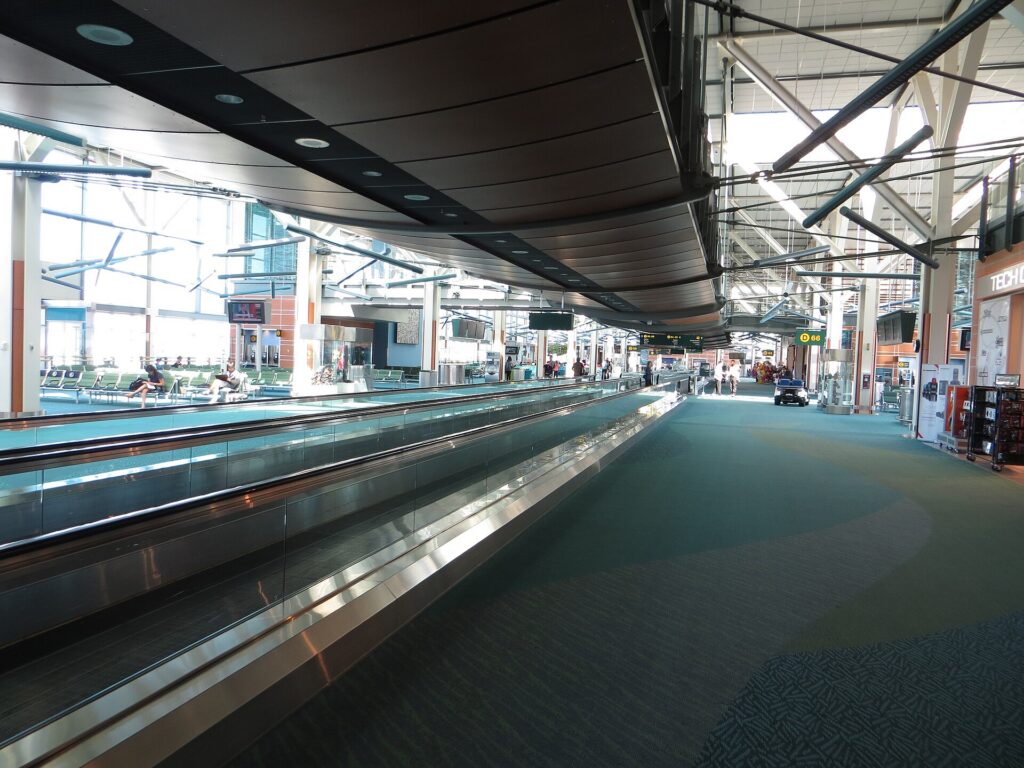
    Inside the terminal at Vancouver International Airport (YVR), 25 minutes from downtown by Canada Line (Photo: Sunnya343 via Wikimedia Commons, CC BY-SA 4.0)

    Events that move Vancouver flight and hotel prices

    Cross-check these against your dates before you book. Exact dates shift each year; Destination Vancouver keeps the current calendar.

    • Family Day weekend (third Monday of February) and the surrounding ski weekends.
    • Spring break (mid-March, two weeks in most BC districts).
    • Victoria Day weekend (Monday before May 25) and the start of cruise season.
    • Cruise turnaround weekends (May to October): tens of thousands of passengers pass through downtown hotels on the busiest Saturdays and Sundays.
    • Canada Day (July 1).
    • Celebration of Light (late July into early August).
    • Vancouver Pride (first weekend of August) and the PNE (late August to Labour Day).
    • Vancouver International Film Festival (late September into October).
    • Thanksgiving weekend (second Monday of October).
    • Christmas to New Year, including Whistler’s holiday weeks.
    • Major games and concerts at Rogers Arena and BC Place: Canucks playoff runs in spring, Whitecaps and BC Lions home dates, and stadium tours. Our Vancouver events page shows what is on sale for your dates.

    Which airport should you fly into?

    Vancouver International (YVR)

    YVR sits on Sea Island in Richmond, about 12 kilometres from downtown, and handles nearly every flight into the region, including the trans-Pacific routes that make Vancouver Canada’s gateway to Asia. Getting downtown is as easy as it gets in North America: the Canada Line SkyTrain runs from a station inside the terminal to Waterfront Station in about 25 minutes, with a modest airport surcharge added to the fare when you board at YVR. Taxis and ride-hail pick up outside arrivals, and the rental counters are in the parkade across from the terminal. TransLink has the transit details; our YVR airport guide covers the layout, and our Vancouver car-versus-transit guide will help you decide whether to book a car at all.

    Abbotsford (YXX)

    About 70 kilometres east of the city in the Fraser Valley, Abbotsford has periodically hosted low-cost carriers on domestic and sun routes. A very low fare can be worth it with a rental car or if you are heading to the Okanagan or the eastern suburbs; without a car, the trip into downtown is slow. Price the whole journey, not the fare.

    Bellingham, Washington (BLI)

    Ninety kilometres south, across the border, Bellingham’s airport is a long-standing option for Canadians chasing cheaper U.S. domestic fares. It only makes sense with a car and a passport, and border wait times can erase the savings on a busy day. If you are a visitor rather than a resident, ignore it.

    Seaplanes and the ferry

    If your trip continues to Victoria or Vancouver Island, Harbour Air flies seaplanes from the downtown waterfront and from YVR’s south terminal, and BC Ferries sails from Tsawwassen, south of the airport. Both are worth factoring into which airport and which side of the city you choose.

    Timing tricks that work for Vancouver

    • Search the whole month. Vancouver’s fare curve has sharp steps around spring break, the long weekends, and the cruise weekends. A calendar view on TicketScanner shows them instantly.
    • Fly mid-week in summer. Saturday and Sunday are cruise turnaround days; Tuesday and Wednesday arrivals avoid both the fare bump and the hotel crush.
    • Book the ski weeks early. Christmas, Family Day and spring break fares from Canadian cities rarely fall as the date approaches. November and January fares, by contrast, are stable enough to wait for the right dates.
    • Price the hotel first in May through September. A cheap fare into a cruise weekend is not cheap once the room is added. Run a Vancouver hotel search for the same dates before you commit to either.
    • Coming from the east? Vancouver is three hours behind Toronto and Montreal. A morning departure eastbound lands mid-afternoon; a red-eye westbound is the classic value flight and worth the tired first day for many travellers. Our note on what to wear on a long flight applies.
    • Build a winter buffer. Fog and the occasional Pacific storm can disrupt YVR between November and February; avoid the tightest connections. Our guide to how early to arrive for an international flight covers what to allow.
    • Flying out of Vancouver instead? The same seasonality applies in reverse; see cheap flights from Vancouver.
    Granville Island seen from the Granville Bridge in Vancouver
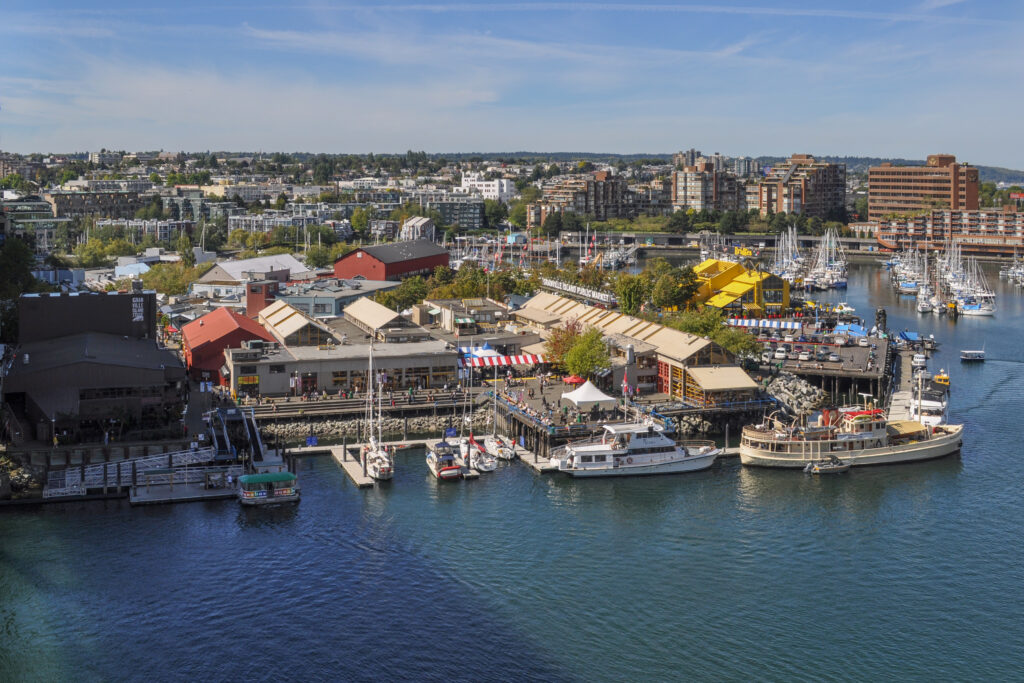
    Granville Island Public Market is a favourite stop on a Vancouver visit (Photo: Joe Mabel via Wikimedia Commons, CC BY-SA 3.0)

    What to pack, by season

    Winter (November to February): a waterproof shell with a hood, waterproof shoes, and layers; an umbrella is optional and locals will judge you for it, but it works. A parka is overkill downtown and essential on the mountains. Spring (March to May): a rain shell, a light sweater, and sunglasses; the weather changes by the hour. Summer (June to September): light clothing, a warm layer for the evenings, which cool quickly by the water, and swimwear. Fall (October): the rain shell again, a warmer jacket by late in the month. Year-round, Vancouver is a walking, cycling and hiking city; bring shoes you can cover kilometres in.

    The best time to fly to Vancouver for…

    Families

    The first half of July for guaranteed beach weather with the least peak-price exposure, or the last week of August into Labour Day for the PNE. Spring break works for a ski-and-city split if you book early.

    The lowest fares

    November, and mid-January to early February outside the Family Day weekend. Pair with Dine Out Vancouver and a day at Whistler or on the local mountains.

    Skiing

    January and February for snow reliability, March for longer days and softer prices once spring break has passed, with Whistler’s holiday weeks the most expensive of all.

    Cherry blossoms and spring

    Late March to mid-April. Book a hotel in the West End or Kitsilano and walk.

    Food and festivals

    Late June to early August for the jazz festival, Celebration of Light and Pride; late January for Dine Out Vancouver at a fraction of the price.

    Cruise passengers

    Arrive a day or two before the ship, mid-week if you can, and stay downtown; the Canada Place cruise terminal is a short taxi ride or a walk from most central hotels.

    Cross-border and international visitors

    U.S. citizens need a valid passport; most other visa-exempt travellers arriving by air need an Electronic Travel Authorization. The Government of Canada’s visitor page explains what applies to you, and CATSA lists what you can carry through security.

    Frequently asked questions

    What is the cheapest month to fly to Vancouver?

    November and January are consistently the lowest, followed by early February and early December. The Christmas weeks and the February and March school breaks are the exceptions in winter.

    What is the best month to visit Vancouver for weather?

    July and August for warmth and dry days, with September a close third and often the clearest. April and May are lovely if you can accept some showers.

    Does it really rain all the time in Vancouver?

    No. Most of the year’s rain falls from October to March. Summer is dry, and September is often the driest month of all.

    Is Vancouver expensive in summer?

    Yes: July and August are the most expensive months for flights and especially for downtown hotels, driven by cruise season and the region’s short, perfect summer. Mid-week travel and early booking help.

    How far ahead should I book?

    Earlier for summer, the holidays and the school breaks, when fares tend only to rise; for November through early February, fares are stable enough that finding the right dates matters more than booking months out.

    Should I fly into Vancouver or Seattle?

    If Vancouver is the destination, fly into YVR: the Canada Line makes the airport-to-downtown trip trivial, and the border crossing from Seattle can take hours on a busy day. Seattle only makes sense as part of a two-city trip with a car.

    When do Vancouver’s cherry blossoms bloom?

    From late March into April, depending on the variety and the year, with the peak usually in the first half of April.

    Ready to pick your dates? Compare fares across the whole month on our Vancouver flights page, then find a room with our Vancouver hotel search. For what to do when you land, start with our first-timer’s guide to Vancouver.