Tag: Flight Booking

  • Best Time to Fly to Los Angeles: Seasons, Weather & Prices

    Best Time to Fly to Los Angeles: Seasons, Weather & Prices

    Los Angeles has the kind of climate that makes “best time to visit” sound like a trick question. It is mild and mostly dry in every month, and there is no season when the city shuts down. But the airfares and hotel rates tell a different story. Los Angeles International is one of the busiest airports in the world, and demand for its seats follows the school calendar, the holidays, the award shows, the theme parks, the festivals in the desert and the conventions downtown far more than it follows the weather. Add a coastal climate where June can be gray at the beach while the Valley bakes, and timing matters more than the postcard suggests. This guide walks through the weather month by month, the fare seasons, the events that move prices, the airports, and the timing tricks that work for Los Angeles.

    The short answer

    For weather and value together, the best windows are mid-September to early November, when the ocean is at its warmest, the summer crowds have gone home and the skies are often the clearest of the year, and late April to mid-May, before the coastal gray and the summer fares set in. The cheapest fares usually come in late January and February, outside the Presidents’ Day weekend, and in the first two weeks of December. The most expensive stretches are mid-June to mid-August, when families fill the theme parks and the beaches, Thanksgiving week, the Christmas and New Year holidays, and the spring break weeks of March and early April. Competition among the many airlines serving Los Angeles keeps fares lower than demand alone would suggest, but the gap between a good week and a bad one is large. Whatever you choose, run a flexible-date search on our Los Angeles flights page; moving a trip by three or four days around a holiday weekend often changes the price band entirely.

    Venice Beach on a sunny day in Los Angeles
    Venice Beach in late summer, when the ocean is at its warmest and the fares start to fall (Photo: Giuseppe Milo via Wikimedia Commons, CC BY 3.0)

    Los Angeles weather, season by season

    Los Angeles has a Mediterranean climate: warm, dry summers, mild winters with a short rainy season, and sunshine for most of the year. What complicates it is geography. The city runs from the Pacific to the mountains, and the temperature can differ by 10 °C (20 °F) between Santa Monica and the San Fernando Valley on the same summer afternoon. The figures below are approximate seasonal patterns for downtown, based on the long-term climate normals published by NOAA and the National Weather Service’s Los Angeles office; the beach cities run cooler in summer and the Valley and inland areas run hotter, so check the forecast for the part of the city where you will be staying.

    MonthTypical daytime highTypical overnight lowWhat it feels likeFare pressure
    Januaryaround 20 °C (68 °F)around 9 °C (49 °F)Mild, clear days between storms; snow on the mountains behind the cityHigh for New Year, then low
    Februaryaround 20 °C (68 °F)around 10 °C (50 °F)The wettest month on average, though most days are dry and brightLow, except Presidents’ Day weekend
    Marcharound 21 °C (70 °F)around 11 °C (52 °F)Green hills, the last rain of the season, wildflowers inlandModerate to high; spring break
    Aprilaround 23 °C (73 °F)around 13 °C (55 °F)Pleasant and settled; cool eveningsModerate; Easter and festival weekends busy
    Mayaround 24 °C (75 °F)around 14 °C (58 °F)“May Gray”: overcast mornings at the coast, sun inland by noonModerate; rises for Memorial Day
    Junearound 26 °C (79 °F)around 17 °C (62 °F)“June Gloom” at the beach, warm inland, long eveningsHigh from mid-month
    Julyaround 29 °C (84 °F)around 18 °C (65 °F)Sunny and warm; hot in the Valley and the desertPeak
    Augustaround 29 °C (85 °F)around 19 °C (66 °F)The warmest month on average; heat waves inlandPeak until the last week
    Septemberaround 29 °C (84 °F)around 18 °C (65 °F)Hot spells, warm ocean, empty beaches after Labor DayModerate, falling after Labor Day
    Octoberaround 26 °C (79 °F)around 16 °C (60 °F)Clear and dry; Santa Ana winds can bring heat and fire weatherLow to moderate
    Novemberaround 23 °C (73 °F)around 12 °C (53 °F)Warm days, cool nights, the first rain in some yearsLow, except Thanksgiving week
    Decemberaround 19 °C (67 °F)around 9 °C (48 °F)Mild and often sunny; storms possibleLow until mid-month, then peak

    Three things the table cannot show. First, the marine layer: in late spring and early summer, a bank of low cloud forms over the cool Pacific overnight and sits over the coast until late morning or, on some days, all day. Locals call it May Gray and June Gloom, and it means that a June beach day in Santa Monica can be 20 °C (68 °F) and overcast while Burbank, fifteen miles inland, is sunny and ten degrees warmer. Second, the ocean: the water off Los Angeles is cold by subtropical standards, around 14 to 16 °C (the upper 50s to about 60 °F) in winter and spring, and only reaching the upper teens to around 21 °C (the upper 60s to around 70 °F) in August and September, which is why the best swimming comes late in the summer. Third, the Santa Ana winds: hot, dry winds from the desert that blow toward the coast mostly between October and early spring, bringing the clearest air and the highest temperatures of the year to the beach and, with them, the serious wildfire risk that the region lives with.

    How Los Angeles fare seasons work

    Three forces drive seats into Los Angeles. The first is leisure travel, which follows the American school calendar: summer, spring break, Thanksgiving and the winter holidays are when families fly in for Disneyland, Universal and the beach. The second is the entertainment and business calendar, with the award season from January to March, the big conventions downtown, and the film, music and tech industries keeping weekday flights busy year-round. The third is the airport itself. LAX is a hub for several major airlines and a gateway to Asia, Australia and Latin America, and with Burbank, Long Beach, Orange County and Ontario also in the region, few cities in the world have more competition on more routes. The result is a strong summer peak, sharp holiday spikes, and long stretches of the year when fares into Los Angeles are among the best value in the country for the distance flown.

    Peak season

    Mid-June to mid-August, the week of Thanksgiving, roughly December 18 to January 2, and the spring break weeks in March and early April. Summer is the longest and most expensive: school is out across the country, the theme parks run extended hours, and international visitors from Europe and Asia add to the domestic crowds. If you must travel in summer, book early, fly mid-week, and consider staying downtown or inland rather than on the coast, where rates climb fastest.

    Shoulder season

    Late April to early June and mid-September to early November. Late spring gives you green hills, settled weather and moderate prices, with May Gray the main drawback for a beach trip. Early fall is the local favorite: the ocean is warm, the days are long enough and the kids are back in school. Watch the long weekends, Memorial Day, Labor Day and Columbus Day or Indigenous Peoples’ Day, and the weekends of big festivals and conventions.

    Low season

    Early to mid-January after the holidays, February outside Presidents’ Day weekend, and the first half of December. Fares and hotel rates are at their lowest, the air is at its clearest after the winter rains, and the snow on the San Gabriel Mountains makes the skyline views the best of the year. The trade-off is a chance of a few days of heavy rain and cooler evenings.

    As elsewhere, mid-week departures and early morning or late evening flights usually price below Friday and Sunday afternoons on the same route, and a search across a whole month reveals cheaper pairs of dates close to your first choice. Our guide to the best times to book explains how to read those patterns.

    Los Angeles month by month

    January

    The year opens with the Rose Parade and the Rose Bowl game in Pasadena on New Year’s Day, which fills hotels across the San Gabriel Valley and keeps fares high through the first weekend. After that, January is one of the best-value months of the year. Days are mild and often brilliantly clear after a storm, the mountains are white, and museums and the Getty are at their least crowded. Award season begins with the Golden Globes in Beverly Hills.

    February

    Statistically the wettest month, but rain comes in a handful of storms rather than every day, and the rest of the month is bright and green. The Grammys are held downtown, Lunar New Year brings the Golden Dragon Parade to Chinatown and celebrations to the San Gabriel Valley, and the Presidents’ Day weekend (the third Monday) is a busy family travel weekend. Outside it, February has some of the lowest fares of the year.

    March

    The hills are at their greenest, wildflowers bloom in the deserts and the Antelope Valley, and the gray whale migration passes Palos Verdes. The Oscars are held at the Dolby Theatre in Hollywood in late winter or early spring, closing streets around Hollywood and Highland for days. The LA Marathon runs from Dodger Stadium to Santa Monica. Spring break starts mid-month for many schools, and fares climb through the second half.

    April

    Settled, pleasant weather, and a busy month for the region because of the Coachella and Stagecoach festivals, held on consecutive weekends in Indio in the desert east of the city. Most festival-goers fly into Los Angeles or Palm Springs, which lifts fares into LAX on those Thursdays and Fridays. Easter and the tail of spring break add to the demand.

    May

    One of the most comfortable months for sightseeing, with warm afternoons and cool evenings, and one of the better value windows before summer. The catch is May Gray at the coast: beach mornings are often overcast, although the sun usually breaks through inland. Memorial Day weekend (the last Monday) is the unofficial start of summer and the one date to book around.

    June

    Summer arrives in stages. The marine layer, now called June Gloom, keeps the beaches cool and cloudy on many mornings, while the Valley and Pasadena warm up quickly. Schools finish across the country in the first half of the month, and fares rise steadily from about the third week. LA Pride fills West Hollywood, and the Hollywood Bowl season begins.

    July

    Peak season. The marine layer burns off earlier, the beaches are at their busiest, the theme parks are packed, and the Dodgers are in full swing. The Fourth of July brings fireworks at the Rose Bowl, the beaches and across the county, and Anime Expo fills the convention center downtown around the holiday. Comic-Con, in San Diego later in the month, pulls visitors through Los Angeles too. Hotel rates are at their annual high, especially at the beach and in Anaheim.

    August

    The warmest month on average, and often the most humid, with heat waves in the Valley and inland. Demand stays high until the last week, when schools in California and much of the country go back and prices soften noticeably.

    September

    The local secret. After Labor Day (the first Monday), the crowds disappear, fares fall and the beaches empty on weekdays, but the weather stays summery, and heat waves in September are common; some of the hottest days of the year arrive now. The Emmys are held in Los Angeles, NFL season starts at SoFi Stadium, and the ocean is at its warmest.

    October

    Clear, dry and warm, with low fares outside the long weekend in the middle of the month. The Santa Ana winds can arrive now, bringing heat, very dry air and a red-flag fire risk; check the forecast and any warnings before you plan a hike. Halloween is huge, with the West Hollywood carnival, haunted attractions at the theme parks, and Día de los Muertos celebrations running into early November.

    November

    Warm days, cool evenings and, in some years, the first rain of the season. Fares are low until Thanksgiving week (the fourth Thursday), one of the busiest travel periods of the year in the United States. The LA Auto Show opens downtown late in the month, and the theme parks switch to their holiday decorations.

    December

    Two months in one. The first half is quiet and cheap, with holiday lights, the Hollywood Christmas Parade and festive seasons at Disneyland and the Grove. From about December 18, fares and hotel rates jump for the Christmas and New Year holidays, when Los Angeles fills with domestic and international visitors and the theme parks hit capacity.

    Downtown Los Angeles at sunset with snow-capped Mount Baldy behind
    Winter in Los Angeles: clear air after the rain, snow on the mountains, and the lowest fares of the year (Photo: Alek Leckszas via Wikimedia Commons, CC BY-SA 4.0)

    Events that move Los Angeles flight and hotel prices

    Cross-check these against your dates before you book. Exact dates shift each year; Discover Los Angeles, the official tourism board, keeps the current calendar.

    • The Rose Parade and Rose Bowl (New Year’s Day, or January 2 when the first falls on a Sunday): Pasadena’s hotels sell out; the Tournament of Roses publishes the details.
    • Award season (January to March): the Golden Globes, the Grammys and the Oscars tighten hotels in Hollywood, Beverly Hills and downtown around their dates.
    • Presidents’ Day weekend (third Monday of February) and spring break (mid-March to mid-April, varying by school district).
    • Coachella and Stagecoach (consecutive weekends in April): fares into LAX and Palm Springs rise for each festival weekend.
    • Memorial Day (last Monday of May), the Fourth of July and Labor Day (first Monday of September): the three biggest summer travel weekends.
    • Anime Expo (around the Fourth of July) and other large conventions at the LA Convention Center, which fill downtown hotels; check the convention calendar if downtown rates look unusually high.
    • Thanksgiving week and Christmas to New Year: the busiest holiday travel of the year.
    • Home games, playoffs and stadium concerts: Dodgers postseason runs, Rams and Chargers games at SoFi, and stadium tours can fill hotels near the venues. Our Los Angeles events page shows what is on sale for your dates.
    • The 2028 Olympic and Paralympic Games, which Los Angeles hosts in the summer of 2028, will make that July and August the most in-demand weeks the city has seen in decades; book very early if you plan to be there.

    Getting in from the airport

    Most visitors arrive at Los Angeles International (LAX), on the coast in Westchester, about 30 kilometers (18 miles) southwest of downtown. It is a horseshoe of terminals around a single loop road, with the Tom Bradley International Terminal at the far end. The loop is notoriously congested, and the airport has been in the middle of a long modernization program: taxis and ride-hail pickups operate from the LAX-it lot, reached by a free shuttle or a short walk from the terminals; the FlyAway bus runs to Union Station downtown and to Van Nuys in the Valley; and the LAX/Metro Transit Center station, linked to the terminals by shuttle and, when complete, by the new automated people mover train, connects the airport to the Metro rail network. Rental companies are reached by shuttle from the terminals. Check the airport’s site for the current state of the people mover and the rental car center before you land.

    Los Angeles also has four other commercial airports, and they are often worth checking. Hollywood Burbank (BUR) is small, quick and closest to Hollywood, Universal and the Valley. Long Beach (LGB) is convenient for the South Bay, Long Beach and the cruise terminals. John Wayne (SNA) in Orange County is the closest to Disneyland, and Ontario (ONT), in the Inland Empire, sometimes has the lowest fares for travelers heading east toward Palm Springs or Joshua Tree. A search that includes all five can turn up a better fare or a shorter drive; our Los Angeles car-versus-transit guide covers the ground transport from each, and our LAX airport guide covers the layout.

    The Theme Building at Los Angeles International Airport (LAX)
    LAX, one of the busiest airports in the world, with the 1961 Theme Building at its center (Photo: Junkyardsparkle via Wikimedia Commons, CC0)

    Timing tricks that work for Los Angeles

    • Search the whole month. Holiday weekends, festivals and school breaks create sharp edges in the fare calendar; a calendar search on TicketScanner shows them instantly.
    • Check all five airports. Burbank, Long Beach, Orange County and Ontario compete with LAX on many routes; the cheapest fare is not always into the biggest airport, and the shortest drive rarely is.
    • Price the hotel before the flight in summer. A cheap fare into July is not cheap once a beach hotel is added. Run a Los Angeles hotel search for the same dates, and compare the beach with Hollywood and downtown.
    • Fly mid-week and avoid the loop at rush hour. Tuesday, Wednesday and Saturday flights are often the cheapest, and an arrival outside the weekday afternoon peak saves an hour on the freeway.
    • Go in September for summer without the summer prices. The weather is as warm as August, the ocean warmer, and fares and hotel rates drop the day after Labor Day.
    • Pair Los Angeles with a road trip. San Diego, Las Vegas and San Francisco are all classic drives, and an open-jaw ticket, flying into one city and out of another, can cost little more than a return; see our Los Angeles to San Diego and Los Angeles to Las Vegas route guides.
    • Allow time at LAX. Security lines and the loop road are unpredictable; our guide to how early to arrive covers what to allow, and if you are flying out of Los Angeles instead, see cheap flights from Los Angeles.

    The Hollywood Bowl amphitheater in the Hollywood Hills
    The Hollywood Bowl, whose summer season runs from June to September (Photo: Royalsafira via Wikimedia Commons, CC BY-SA 4.0)

    What to pack, by season

    Winter (December to February): layers for mild days and chilly evenings, a light jacket or sweater for nights that can drop below 10 °C (50 °F), and a rain jacket and shoes that can handle a downpour. Spring (March to May): layers again, a light jacket for the gray coastal mornings, and sunscreen for the afternoons. Summer (June to August): light clothing, a hat and serious sun protection, swimwear, and a sweater for the beach in the evening, when the ocean breeze makes it cooler than you expect. Fall (September to November): summer clothing into October, with a layer for the evenings, and plenty of water on hot, dry Santa Ana days. In any season, bring comfortable walking shoes.

    The best time to fly to Los Angeles for…

    The beach

    Late July to early October, when the marine layer has cleared and the ocean is at its warmest; September after Labor Day is the sweet spot.

    Theme parks

    Mid-week in January, February, early May, September and early December, avoiding school holidays; lines are shortest and tickets are often cheaper outside the peak dates.

    Sightseeing and museums

    Late winter and spring, from late January to May, for clear air, comfortable temperatures and the lowest crowds at the Getty and Griffith Observatory.

    The lowest fares

    Late January and February, outside Presidents’ Day weekend, and the first half of December.

    Families

    The last two weeks of August, once many schools are back, or the week after spring break in April, when the weather is good and the parks are calmer.

    International visitors

    Canadians need a valid passport; travelers from Visa Waiver Program countries need an approved ESTA before boarding, and everyone else needs a visa. U.S. Customs and Border Protection explains what applies to you, and the TSA lists what you can carry through security. For desert day trips, Joshua Tree National Park is best visited from October to April, when the heat is bearable.

    Frequently asked questions

    What is the cheapest month to fly to Los Angeles?

    February is usually the cheapest, followed by January after the New Year holiday and the first half of December. September and October, outside long weekends, are the best-value months for good weather.

    What is the best month to visit Los Angeles for weather?

    September and October, for warm days, a warm ocean and clear skies. April and May are also excellent, apart from gray mornings at the coast.

    Does it rain much in Los Angeles?

    Not much. Downtown averages around 14 inches (355 mm) a year, almost all of it between November and March, usually in a few heavy storms. Summer is almost completely dry.

    What are May Gray and June Gloom?

    A layer of low cloud that forms over the cool Pacific and covers the coast in late spring and early summer, often burning off by midday. The beaches are cooler and grayer than inland neighborhoods during those weeks.

    Should I fly into LAX or Burbank?

    LAX has far more flights and is closer to the beaches and the Westside; Burbank is quicker to get through and closer to Hollywood, Universal and the Valley. Compare both, along with Long Beach and Orange County, for your dates.

    How far ahead should I book?

    Earlier for summer, spring break, Thanksgiving and the winter holidays, when fares tend only to rise. For January, February, the fall and early December, finding the right dates matters more than booking months ahead.

    When are the Santa Ana winds?

    Mostly between October and March, with the strongest events often in the fall. They bring hot, very dry weather and high fire danger; the National Weather Service issues warnings when they are expected.

    Ready to pick your dates? Compare fares across the whole month on our Los Angeles flights page, then find a room with our Los Angeles hotel search. For what to do when you land, start with our first-timer’s guide to Los Angeles.

  • Best Time to Fly to Toronto: Seasons, Weather & Prices

    Best Time to Fly to Toronto: Seasons, Weather & Prices

    Toronto is a four-season city in the truest sense: the same downtown that sits under a foot of snow in February fills its patios in July, and the price of a seat to Toronto Pearson moves with that calendar. If you are flexible on dates, the difference between a good week and a bad week to fly can be larger than the difference between two airlines. This guide walks through Toronto’s weather month by month, the periods when fares and hotel rates climb, the festivals and long weekends that quietly drive those spikes, and which of the city’s three airports makes sense for your trip.

    The short answer

    For most first-time visitors, the sweet spot is late May through June and again from early September to mid-October. Both windows bring comfortable temperatures, long days in spring and warm lake evenings in fall, and demand that sits below the summer peak. The cheapest fares of the year usually appear from mid-January to early March, when the city is cold, the days are short, and business travel is the main thing filling planes. The most expensive stretches are the summer school holidays (July and August), the Christmas and New Year period, and a handful of event weeks covered below, TIFF in September being the one that surprises people most.

    Whichever window you choose, run a Toronto flight search on TicketScanner with flexible dates before you commit. The calendar view makes it obvious when a mid-week departure or a shift of two or three days changes the price band entirely.

    Cherry blossoms in full bloom at High Park, Toronto, in spring
    High Park cherry blossoms, a late-April to early-May event that fills hotels near the park (Photo: Fabian Roudra Baroi via Wikimedia Commons, CC BY-SA 4.0)

    Toronto’s weather, season by season

    Toronto sits on the northwest shore of Lake Ontario, and the lake matters. It softens the worst of the winter cold compared with cities further inland, keeps spring slightly cooler than you would expect from the calendar, and holds warmth into October. The figures below are approximate seasonal patterns drawn from the long-term climate normals published by Environment and Climate Change Canada; always check the current forecast a few days before you fly, because Toronto can swing ten degrees in a day when a front moves through.

    MonthTypical daytime highTypical overnight lowWhat it feels likeFare pressure
    Januaryaround -1 °Caround -7 °CCold, grey, snow on the ground most weeks; wind off the lake bites downtownLow (after the first week)
    Februaryaround 0 °Caround -6 °CStill deep winter; the coldest snaps of the year often land hereLow, except Family Day weekend
    Marcharound 4 °Caround -2 °CThaw and freeze; slush, then the first mild afternoonsLow to moderate (March Break)
    Aprilaround 12 °Caround 3 °CUnpredictable; a warm week can be followed by a late snowfallModerate
    Mayaround 19 °Caround 9 °CSpring proper; cherry blossoms, patios open, cool eveningsModerate; rises around the long weekend
    Junearound 24 °Caround 14 °CWarm, long days, occasional thunderstormsModerate to high
    Julyaround 27 °Caround 18 °CHot and humid; humidex values well above the thermometerHigh
    Augustaround 26 °Caround 17 °CHot and humid, cooling slightly in the last weekHigh
    Septemberaround 22 °Caround 13 °CWarm days, crisp evenings; the lake is at its warmestModerate, with a TIFF spike
    Octoberaround 14 °Caround 7 °CFall colour in the ravines and High Park; jacket weatherModerate to low
    Novemberaround 7 °Caround 1 °CGrey and damp; first snow is common late in the monthLow
    Decemberaround 1 °Caround -4 °CWinter arrives; festive lights and markets downtownLow until mid-month, then peak

    Two things the table cannot show. First, humidity: a 27 °C July afternoon downtown routinely carries a humidex reading in the mid-30s, so plan indoor breaks if you are not used to it. Second, daylight: Toronto gets roughly fifteen and a half hours of daylight around the June solstice and under nine hours in late December. A winter visit is not shorter in days, but it is much shorter in usable sightseeing light.

    How Toronto’s fare seasons work

    Airfares to Toronto follow a pattern that is more predictable than most travellers assume, because the city’s demand is driven by three overlapping calendars: the school year in Ontario and in the American and European markets that feed it, the business-travel week, and a festival schedule that is heavily concentrated between June and September.

    Peak season

    Late June to the end of August, plus the two weeks around Christmas and New Year. Schools are out across Canada, the United States and the United Kingdom, families travel, and Toronto’s summer festival season is in full swing. Expect the highest fares and the tightest hotel availability, especially on weekends. If you must travel in peak, book early and fly mid-week; a Tuesday or Wednesday departure frequently sits in a lower fare band than the Friday of the same week.

    Shoulder season

    April to mid-June and September to October. This is where value and weather overlap. Demand is real but not frantic, hotels have inventory, and the city is either waking up (spring) or at its most photogenic (fall). Watch for the long weekends, Victoria Day in late May and Thanksgiving in early October, and for the September TIFF window, all of which temporarily behave like peak.

    Low season

    Mid-January to early March, and most of November. Fares are at their lowest, and Toronto’s winter has its own appeal: skating at Nathan Phillips Square, museums without queues, restaurant weeks, and hockey. The trade-off is weather risk. Build a buffer into connections, and if you are flying in from a warm climate, read our note on what to wear on the plane and pack a real coat in your carry-on rather than checking it.

    Fares also move with the day of the week and the time of day. Early-morning and late-evening departures are often priced below mid-day flights on the same route, and a search that spans the whole month will usually reveal a cheaper pair of dates within a few days of your first choice. Our guide to the best times to book flights and hotels goes deeper on how to read those patterns.
    Toronto month by month

    January

    The first week is still holiday-priced; after that, January is reliably the cheapest month to fly into Toronto. It is also genuinely cold. Highs hover around freezing, lows drop below -10 °C on the colder days, and the wind on the waterfront makes it feel colder still. What January does well: hockey at Scotiabank Arena, the winter restaurant festival (Winterlicious usually runs from late January into February), the PATH network of underground walkways that lets you cross much of the financial district without stepping outside, and museum days at the ROM and the AGO with no crowds. Fly in with a checked-bag-free strategy if you can; winter storms occasionally disrupt Pearson, and being able to walk off with everything you own is worth a lot.

    February

    Similar to January in temperature and price, with one exception: Family Day, an Ontario statutory holiday on the third Monday of February, creates a mini long weekend that lifts fares and hotel rates for a few days. Outside that weekend, February is a strong value month. The Toronto Light Festival at the Distillery District has run in recent winters, and the city’s skating rinks, including the one at Nathan Phillips Square, are at their best. Check the City of Toronto’s festivals and events listings for what is scheduled in the year you travel.

    March

    March is a transition month, and the weather is honest about it: slush, sudden thaws, and the odd late snowstorm. Prices stay low except around March Break, the Ontario school holiday in the middle of the month, when family demand rises and flights from sun destinations back into Toronto get busy. If you are visiting rather than returning, aim for the first or last week of the month.

    April

    Spring arrives unevenly. Early April can still be cold; by the end of the month the patios are cautiously opening and the city is greening up. The Blue Jays’ home season begins at Rogers Centre, which puts a few thousand extra visitors in downtown hotels on game nights. Fares sit in the moderate band, and hotel rates are noticeably lower than they will be in six weeks. April is an underrated month for a museum-and-food trip.

    May

    The best-kept secret in the Toronto calendar. The cherry blossoms in High Park usually peak in late April or the first week of May, drawing big local crowds on the weekend but few overnight visitors. Doors Open Toronto, which lets you inside dozens of buildings normally closed to the public, typically falls in late May. The Victoria Day long weekend (the Monday before May 25) is the one date to book around. Otherwise, May offers spring weather, opening-season energy, and prices well below June.

    June

    Warm, long, and busy. Pride Toronto culminates in one of the largest Pride parades in North America at the end of the month, Luminato brings arts programming across the city, and the summer patio season is fully open. Fares step up from mid-month as schools finish. If June is your month, the first two weeks are the value play.

    July

    Peak season proper. Canada Day on July 1 opens the month with fireworks and a long weekend; the Honda Indy runs at Exhibition Place; Summerlicious brings prix-fixe menus to restaurants across the city; and the humidity settles in. Fares and hotel rates are at their annual high. The Toronto Islands, with their beaches and car-free lanes, are the local escape valve, and the ferry line at Jack Layton Ferry Terminal on a hot Saturday tells you everything about demand.

    August

    Still peak, with two big demand events: the Toronto Caribbean Carnival (often called Caribana), whose grand parade takes place on the Saturday of the first weekend in August, a civic long weekend in Ontario; and the Canadian National Exhibition, the CNE, which runs from mid-August to Labour Day at Exhibition Place. The last week of August, after most families have flown home but before the CNE closes, is a small pocket of slightly softer pricing.

    September

    Many locals will tell you September is the best month in Toronto, and the weather agrees: warm days, cool nights, and a lake that has finally warmed up. The catch is the Toronto International Film Festival, which runs for roughly ten days in early-to-mid September and fills downtown hotels with the film industry. TIFF week fares and room rates behave like peak season. Fly in after the festival closes and you get September weather at shoulder prices. Check TIFF’s official site for the exact dates before you book.

    October

    Fall colour in the ravines, High Park and the Don Valley; crisp days that still reach the mid-teens; and, apart from the Thanksgiving long weekend on the second Monday of the month, steadily falling prices. Nuit Blanche, the all-night contemporary art event, has landed in late September or October in recent years. Late October is one of the best value-for-weather windows of the whole year.

    November

    Grey, damp and quiet, which is exactly why fares and hotel rates are low. The Royal Agricultural Winter Fair fills Exhibition Place for ten days in early November, the Santa Claus Parade runs in the middle of the month, the Cavalcade of Lights switches on the holiday lights at Nathan Phillips Square, and the Distillery Winter Village (formerly the Toronto Christmas Market) opens at the Distillery District in the second half of the month. If you like a city at its festive best without paying festive prices, the last ten days of November are the target.

    December

    Two months in one. The first half continues November’s value pricing with the added bonus of the holiday markets and lights in full swing. From about December 18 onward, fares and hotel rates jump for the Christmas and New Year period and stay high into the first days of January. Winter is fully here: expect snow, short days, and the occasional weather delay at Pearson.

    Snow-covered path in High Park, Toronto, in winter
    Toronto in January: cold, quiet, and usually the cheapest month to fly in (Photo: Chicken4War via Wikimedia Commons, CC BY-SA 4.0)

    Events that move Toronto flight and hotel prices

    The following dates are worth cross-checking against your travel plans before you book. Some are worth planning a trip around; all of them are worth knowing about if your dates happen to overlap. Exact dates shift each year, so confirm with Destination Toronto or the event organizers.

    • Family Day weekend (third Monday of February): short domestic spike.
    • March Break (mid-March): family travel, especially inbound from sun destinations.
    • Victoria Day weekend (Monday before May 25): the unofficial start of summer.
    • Pride Toronto (late June): major weekend demand downtown.
    • Canada Day (July 1) and the surrounding long weekend.
    • Toronto Caribbean Carnival (civic long weekend, early August): one of the busiest weekends of the year for hotels.
    • Canadian National Exhibition (mid-August to Labour Day): steady demand, plus the air show on Labour Day weekend.
    • TIFF (early-to-mid September): the single biggest hotel-rate spike outside the holidays.
    • Thanksgiving weekend (second Monday of October).
    • Christmas to New Year (roughly December 18 to January 3).
    • Major sporting events: Blue Jays playoff games, Raptors and Maple Leafs playoff runs in April through June, and international matches at BMO Field can all tighten hotel availability on short notice. Our Toronto events page lists what is on sale for the dates you are considering.

    Which Toronto airport should you fly into?

    Toronto has two airports inside the city region and a third an hour away that budget carriers have used. The right choice depends on where you are coming from and where you are staying.

    Toronto Pearson International (YYZ)

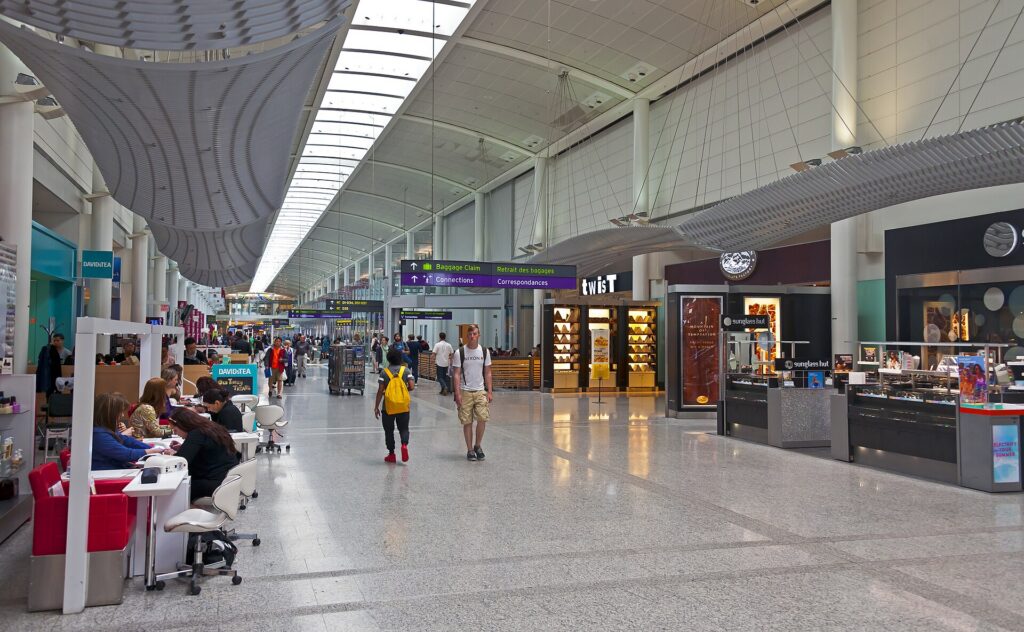
    Canada’s busiest airport, in Mississauga about 25 kilometres northwest of downtown. Virtually every international flight and most domestic and transborder flights land here. There are two terminals: Terminal 1 is the Air Canada and Star Alliance home, and Terminal 3 hosts most other carriers, including WestJet and the major American airlines. Getting downtown is straightforward: the UP Express train runs from Terminal 1 to Union Station in about 25 minutes, the TTC’s 900 Airport Express bus connects to Kipling subway station, and taxis and ride-hail pick up outside both terminals. Check the official Pearson site for terminal maps and current ground-transport options, and see our Toronto car-rental-versus-transit guide before you reserve a car at the airport.

    Terminal 1 at Toronto Pearson International Airport (YYZ)
    Terminal 1 at Toronto Pearson (YYZ), the hub for Air Canada and most international arrivals (Photo: Daniel Case via Wikimedia Commons, CC BY-SA 3.0)

    Billy Bishop Toronto City Airport (YTZ)

    On an island a few hundred metres from the downtown waterfront, Billy Bishop is one of the most convenient city airports anywhere. Porter Airlines is the main operator, with Air Canada also flying select routes; destinations are mostly short-haul, covering eastern Canada and the northeastern United States, including Newark, Boston, Chicago and Washington. A free pedestrian tunnel and a short ferry connect the terminal to the mainland, and from there it is a walk, a streetcar or a five-minute taxi to most downtown hotels. If you are travelling from a city Billy Bishop serves and staying downtown, it is often worth a slightly higher fare for the hour it saves at each end.

    John C. Munro Hamilton International (YHM)

    About 75 kilometres southwest of Toronto, Hamilton’s airport has periodically hosted low-cost carriers on domestic and sun routes. A very low fare into Hamilton can be worth it if you are renting a car, heading to Niagara, or have time to spare; it is a poor choice if you are staying downtown without a car and arriving late, because the ground-transport options are thin. Compare the total trip cost, not just the fare.

    Timing tricks that actually work for Toronto

    • Search a whole month, not a date. Toronto’s demand curve has sharp edges around long weekends and TIFF. A calendar search on TicketScanner shows those edges instantly; shifting a Friday arrival to Thursday, or leaving on the Tuesday after a long weekend, is often the single cheapest change you can make.
    • Fly mid-week in peak season. July and August weekends are where the highest fares live. Tuesday and Wednesday departures on the same route are frequently in a lower band.
    • Book the event weeks early and the low-season weeks late. TIFF, Caribbean Carnival and Christmas fares rarely fall as departure approaches; January and November fares, by contrast, are stable enough that waiting for the right dates costs little.
    • Price the flight and the hotel together. A cheap fare into a TIFF week is not cheap once you have paid the hotel. Run a Toronto hotel search for the same dates before you commit to either.
    • Consider Billy Bishop for short-haul. From cities it serves, the door-to-door time saving is real, and the fare gap is often smaller than expected.
    • Build a winter buffer. If you are connecting through Pearson between December and March, avoid the tightest connection times. Our guide on how early to arrive for an international flight covers what to allow.
    • Coming from the US Northeast? The New York to Toronto route has its own rhythms, with multiple airports on both ends worth comparing.
    • Flying out of Toronto instead? The same seasonality applies in reverse; see cheap flights from Toronto for outbound routes.
    The flatiron-shaped Gooderham Building in Toronto's Distillery District
    The historic Distillery District, a popular Toronto stop year-round (Photo: Geo Swan, stitched by Marku1988 via Wikimedia Commons, CC BY-SA 3.0)

    What to pack, by season

    Winter (December to March): an insulated, wind-resistant coat, a hat that covers your ears, waterproof boots with grip, and layers for overheated indoor spaces. Spring (April to May): a rain shell, a mid-weight jacket, and shoes you do not mind getting wet; mornings can be near freezing and afternoons mild. Summer (June to August): light, breathable clothing, sun protection, and something for aggressively air-conditioned restaurants and subway cars. Fall (September to November): layers again, a warm jacket by mid-October, and an umbrella in November. Whatever the season, Toronto is a walking city; comfortable shoes matter more than anything else on this list.

    The best time to fly to Toronto for…

    Families

    Late June (before peak fares fully set in) or the last week of August into Labour Day, when the CNE is on and the Toronto Islands, the zoo and Ripley’s Aquarium are all in full summer operation. March Break works well if you are content with indoor attractions.

    The lowest fares

    Mid-January through the first week of March, avoiding Family Day weekend, and the first half of November. Pair with a downtown hotel and lean into the indoor city: the PATH, the museums, the theatre district and the hockey.

    Food and festivals

    July for Summerlicious, patios and the Caribbean Carnival; late January and February for Winterlicious at a fraction of the price. Kensington Market’s pedestrian Sundays run through the summer months.

    Sports

    April to June for hockey and basketball playoff atmosphere; April to September for baseball; the fall for Toronto FC and the Argonauts at BMO Field. Ticket availability, not the fare, is usually the constraint; check what is on sale in Toronto before you book flights.

    Business travel

    Any month, but note that downtown hotels price sharply around TIFF and the big convention weeks. Mid-week arrivals in the shoulder months are the most predictable.

    Cross-border and visiting family

    If you are a U.S. citizen flying in, a valid passport is required, and travellers from visa-exempt countries other than the United States generally need an Electronic Travel Authorization; the Government of Canada’s visitor page explains what applies to you. Canadians returning from abroad should review the current travel advice and entry requirements. Security screening at Canadian airports is run by CATSA, whose site lists what you can carry on.

    Frequently asked questions

    What is the cheapest month to fly to Toronto?

    January and February are consistently the lowest-fare months, followed by November and early December. The first week of January is the exception, as it is still priced with the holidays.

    What is the best month to visit Toronto for weather?

    September for warm days and cool nights, with June a close second. Both are far more comfortable than the humid heart of July and August.

    Is Toronto expensive to visit in summer?

    July and August are the most expensive months for both flights and hotels, driven by school holidays and a dense festival calendar. Mid-week travel and booking well ahead take some of the edge off.

    Should I fly into Pearson or Billy Bishop?

    Pearson for almost all international and long-haul flights and the widest choice of fares; Billy Bishop if you are coming from eastern Canada or the U.S. Northeast and staying downtown, where the convenience is hard to beat.

    How far ahead should I book a flight to Toronto?

    Earlier for peak periods and event weeks, when fares tend only to rise; for low-season dates the fares are stable enough that finding the right pair of days matters more than booking months out. Use flexible-date search and compare across a full month.

    Does it snow in Toronto in April?

    Occasionally, yes, usually early in the month and rarely lasting. By late April the city is firmly in spring, and the High Park cherry blossoms follow soon after.

    When do the High Park cherry blossoms bloom?

    Typically late April to early May, for roughly a week to ten days depending on the year’s weather. The City of Toronto’s parks pages post bloom updates each spring.

    Ready to pick your dates? Compare fares across the whole month on our Toronto flights page, then line up a place to stay with our Toronto hotel search. If you are planning what to do once you land, start with our first-timer’s guide to Toronto.

  • Best Time to Fly to New York: Seasons, Weather & Prices

    Best Time to Fly to New York: Seasons, Weather & Prices

    New York is the busiest air market in North America, and that works in your favor. Three major airports, every large airline, and more routes than any other American city mean that there is almost always a seat somewhere, and that fares are driven less by a shortage of flights than by the city’s own calendar. That calendar is crowded: the holidays from Thanksgiving to New Year, when the whole world seems to want to see the tree and the windows; a summer when international visitors arrive in force; a fall when the weather is perfect and conventions, Fashion Week and the United Nations fill every hotel; and a deep, cold, quiet stretch after New Year when the city is at its cheapest. The flight is rarely the expensive part of a New York trip. The hotel is, and the two do not always peak together. This guide walks through the weather month by month, the fare and hotel seasons, the events that move prices, and how to handle the three airports.

    The short answer

    For the best balance of weather and price, go in late April to early June, when the parks are green and the heat has not arrived, or in early November, after the fall peak and before the holidays. September and October have the best weather of the year, and New Yorkers will tell you so, but they are also the most expensive months for hotels. The cheapest time to fly and to stay is January and February, after the New Year week, when fares and room rates fall to their annual low and the city’s Restaurant Week and Broadway Week discounts arrive to fill the seats. The most expensive stretches are the weeks from Thanksgiving to New Year, especially mid-December, late September during the UN General Assembly, and the summer for transatlantic flights. Whatever you choose, run a flexible-date search on our New York flights page; a shift of a few days, or a switch between JFK, LaGuardia and Newark, can change the fare band entirely.

    Bow Bridge in Central Park surrounded by fall color
    Central Park in the fall, the season with the best weather and the highest hotel rates (Photo: Querent via Wikimedia Commons, CC BY 4.0)

    New York’s weather, season by season

    New York has four distinct seasons and a coastal climate that can swing hard within each of them. Winters are cold and sometimes snowy, with a nor’easter or two most years; spring is brief and changeable; summers are hot, humid and punctuated by thunderstorms; and fall is long, dry and golden. The figures below are approximate seasonal patterns based on the long-term Central Park climate normals from NOAA’s National Weather Service; check the current forecast before you pack, because a week in March or November can hold both a warm day and a snowstorm.

    MonthTypical daytime highTypical overnight lowWhat it feels likeFare pressure
    Januaryaround 4 °C (39 °F)around -3 °C (27 °F)Cold, gray, windy between the towers; snow is possibleLow after New Year’s week
    Februaryaround 6 °C (42 °F)around -2 °C (29 °F)Still cold; often the snowiest monthLow; rises for Presidents’ Day weekend
    Marcharound 10 °C (50 °F)around 2 °C (35 °F)Raw and changeable; a late snowfall is commonLow to moderate; spring break spike
    Aprilaround 17 °C (62 °F)around 7 °C (45 °F)Blossom month; showers and the first warm daysModerate; Easter spike
    Mayaround 22 °C (71 °F)around 13 °C (55 °F)Warm, green, often perfectModerate to high
    Junearound 26 °C (80 °F)around 18 °C (64 °F)Warm to hot; humidity builds; long eveningsHigh
    Julyaround 29 °C (85 °F)around 21 °C (70 °F)Hot and humid; heat waves above 32 °C (90 °F); thunderstormsHigh for flights; hotels a little softer
    Augustaround 28 °C (83 °F)around 21 °C (69 °F)Hot and sticky; locals leave town on weekendsHigh early, easing late in the month
    Septemberaround 24 °C (76 °F)around 17 °C (62 °F)Warm and settling; the best weather beginsHigh, with a UN week hotel peak
    Octoberaround 18 °C (65 °F)around 11 °C (51 °F)Crisp, dry and sunny; leaves turn late in the monthHigh for hotels
    Novemberaround 12 °C (54 °F)around 5 °C (42 °F)Cool and clear, then cold; late foliage in the parksModerate; peak around Thanksgiving
    Decemberaround 7 °C (44 °F)around 0 °C (33 °F)Cold and festive; dark by late afternoonPeak, especially hotels

    Three things the table cannot show. First, the humidity: a July day at 29 °C in New York feels far hotter than the number suggests, the subway platforms are hotter still, and the heat stored in the pavement keeps nights warm. Plan outdoor sightseeing for mornings and evenings in high summer. Second, the wind: in winter the avenues act as wind tunnels, and a day that reads as a few degrees above freezing can feel well below it at a river-facing corner. Third, the storms: summer thunderstorms and winter nor’easters are the two kinds of weather that ground flights at all three airports at once, and the Atlantic hurricane season, which peaks from August to October, occasionally sends the remnants of a tropical storm up the coast.

    How New York’s fare seasons work

    Three forces set prices for a New York trip. The first is tourism, which peaks in summer for international visitors and at Christmas for everyone. The second is business and conventions, which fill Midtown hotels from Monday to Thursday for most of the year and push fall rates to their highest. The third is competition: with three airports and nearly every carrier in the country fighting for the market, New York fares are often lower than those to smaller cities at the same distance, and a sale on one airline tends to be matched quickly by others. The practical result is that flights and hotels follow slightly different curves. Flights peak in summer and over the holidays; hotels peak in the fall and in December, and are softer in July and August than most visitors expect.

    Peak season

    The weeks from Thanksgiving to New Year, especially the middle of December, are the most expensive of the year for hotels, with flights also high around the holidays themselves. Late September and October are the other hotel peak, driven by perfect weather, conventions and the United Nations General Assembly, whose high-level week in the second half of September fills Midtown East and closes streets around the UN. June to mid-August is peak for transatlantic and long-haul flights. If you must travel in a peak window, book early, fly mid-week, and consider staying in Brooklyn or Long Island City.

    Shoulder season

    Mid-March to early June, and early November before Thanksgiving. Late April and May are the sweet spot for weather and value, with Easter and Memorial Day weekend the dates to watch. Early November keeps some of October’s color and crisp weather at noticeably lower hotel rates, although Marathon weekend, on the first Sunday of the month, fills the city.

    Low season

    From the first full week of January to early March. Fares and hotel rates are at their lowest, the museums and restaurants are at their quietest, and the city runs its best promotions to fill the gap: NYC Restaurant Week and NYC Broadway Week both land in this window. The exceptions are the Martin Luther King Jr. and Presidents’ Day long weekends and the mid-February school break, when domestic travel rises. Build a buffer into connections in case of snow.

    As elsewhere, mid-week departures and early or late flights usually price below Friday and Sunday afternoons on the same route, and a search across a whole month reveals cheaper pairs of dates close to your first choice. Our guide to the best times to book explains how to read those patterns.

    New York month by month

    January

    After New Year’s week, the cheapest month of the year, and one of the best for anyone who dislikes crowds. It is cold, with highs just above freezing and the chance of a real snowstorm, but the museums, Broadway and the restaurants are all at full strength and easier to get into. NYC Restaurant Week and Broadway Week usually begin in the second half of the month, and the holiday decorations linger into the first days of January.

    February

    Still cold, often snowy, and still cheap outside Presidents’ Day weekend (the third Monday of February) and the mid-winter school break that surrounds it. The Lunar New Year celebrations in Chinatown and Flushing, New York Fashion Week and the tail of the winter promotions fill the calendar. A strong value month for a theater-and-food trip.

    March

    Raw and changeable, with late snow in some years and the first mild days in others. The St. Patrick’s Day Parade up Fifth Avenue on or around March 17 is one of the largest in the world. Spring break brings a spike in family travel through the second half of the month; book around it and March is still good value.

    April

    The blossom month: magnolias and cherry trees in Central Park and the Brooklyn Botanic Garden, and the first warm afternoons. Easter weekend brings the Easter Parade and Bonnet Festival on Fifth Avenue, a spike in family travel and higher rates. The Broadway season’s spring openings crowd into April ahead of the Tony Awards nominations, which makes it a strong month for new shows. Pack for showers.

    May

    Often the most pleasant month of the year, and prices reflect it. Central Park is at its greenest, rooftop bars and outdoor dining open in earnest, and Fleet Week brings the Navy to the Hudson piers over Memorial Day weekend (the last Monday of May), the unofficial start of summer and a date to book around.

    June

    Long, warm evenings, Shakespeare in the Park, the Tribeca Festival, the Tony Awards, free outdoor concerts across the boroughs, and the Pride March on the last Sunday of the month, which draws an enormous crowd. Transatlantic fares are high from the middle of the month as schools finish in Europe and North America. Early June is the value play.

    July

    Hot and humid, with heat waves and afternoon thunderstorms. The Fourth of July brings the Macy’s fireworks over the East River or the Hudson, depending on the year. Flights are at summer peak, but hotel rates, freed from the business traveler, are often lower than in spring or fall, and the city’s free summer programming, from outdoor movies in Bryant Park to concerts in the parks, is in full swing.

    August

    The month New Yorkers leave town. It is hot and sticky, the city is noticeably quieter, and hotel rates can be surprisingly reasonable, especially in the second half. The US Open begins in the last week of August at Flushing Meadows and runs into September, lifting demand in Queens.

    September

    The city comes back from vacation and the best weather of the year begins. Labor Day weekend, New York Fashion Week, the Feast of San Gennaro in Little Italy and, above all, the UN General Assembly high-level week in the second half of the month drive hotel rates to some of their highest levels of the year and snarl Midtown traffic. Fly in the first half of the month if you can.

    October

    Crisp, dry and sunny, and the favorite month of many New Yorkers. Hotel rates stay high all month. The leaves start to turn in Central Park in the last week, the Village Halloween Parade fills Sixth Avenue on October 31, and Columbus Day weekend brings a small rise in domestic travel. Book well ahead for October hotels.

    November

    Two months in one. The first three weeks are one of the best-value windows of the year, with cool, clear weather and the last of the foliage in the parks, interrupted only by the New York City Marathon on the first Sunday. Thanksgiving (the fourth Thursday) brings the Macy’s parade and the start of the holiday season, and fares and hotel rates rise sharply around it.

    December

    The most expensive month for hotels, and for good reason: the Rockefeller Center tree, the Fifth Avenue windows, the holiday markets in Bryant Park and Union Square, the Radio City Christmas Spectacular, the Nutcracker at Lincoln Center, and New Year’s Eve in Times Square. The first week of December is the least expensive part of the season; the week before Christmas and New Year’s week are the peak. Book as early as you can.

    The Christmas tree and holiday decorations at Rockefeller Center in Midtown Manhattan
    The Rockefeller Center tree: December is the most expensive month for New York hotels (Photo: JJonahJackalope via Wikimedia Commons, CC BY-SA 4.0)

    Events that move New York flight and hotel prices

    Cross-check these against your dates before you book. Exact dates shift each year; New York City Tourism + Conventions, the official visitor bureau, keeps the current calendar.

    • New Year’s Eve in Times Square and the days either side.
    • Presidents’ Day weekend (third Monday of February) and the February school break.
    • Spring break and Easter (late March to April, varies by year).
    • Memorial Day weekend and Fleet Week (late May).
    • Pride (last Sunday of June) and the Fourth of July.
    • The US Open (last week of August into the first week of September).
    • The UN General Assembly high-level week (second half of September): the single most disruptive week of the year for Midtown hotels and traffic.
    • The New York City Marathon (first Sunday of November).
    • Thanksgiving to New Year, peaking in the week before Christmas.
    • Big games and concerts at Madison Square Garden, Yankee Stadium and MetLife Stadium. Our New York events page shows what is on sale for your dates.

    Getting in from the airports

    New York has three major airports, and choosing between them is one of the best ways to save. John F. Kennedy International (JFK), in southeast Queens about 24 kilometers (15 miles) from Midtown, handles most long-haul international flights and is in the middle of a multi-year rebuild, with new terminals opening in phases. The AirTrain links every terminal to Jamaica station, for the Long Island Rail Road to Penn Station or Grand Central Madison and the E train, and to Howard Beach for the A train; yellow taxis charge a flat fare to Manhattan plus tolls and surcharges, and the drive takes 45 minutes to well over an hour depending on traffic. LaGuardia (LGA), in northern Queens, is the closest to Midtown and mostly domestic, with rebuilt terminals and bus links to the subway. Newark Liberty (EWR), in New Jersey, is a major hub with its own AirTrain to a rail station on the Northeast Corridor, from which NJ Transit and Amtrak trains reach Penn Station in about half an hour; for the West Side and Lower Manhattan it can be as convenient as JFK. Search all three at once, then weigh the ground transport; our New York car-versus-transit guide covers the options, and our JFK airport guide covers the layout.

    The AirTrain approaching Terminal 4 at John F. Kennedy International Airport
    The AirTrain at JFK links every terminal to the subway and the Long Island Rail Road (Photo: Acroterion via Wikimedia Commons, CC BY-SA 4.0)

    Timing tricks that work for New York

    • Search all three airports. JFK, LaGuardia and Newark compete on most routes, and the cheapest of the three changes from week to week. A multi-airport search on TicketScanner shows them side by side.
    • Price the hotel first in the fall and December. A cheap fare in October or mid-December is not cheap once the room is added. Run a New York hotel search for the same dates before you commit to either.
    • Stay over a weekend. Midtown hotels built for business travelers often drop their rates on Friday and Saturday nights, the reverse of most leisure destinations.
    • Fly mid-week. Tuesday, Wednesday and Saturday departures are usually cheaper than Friday and Sunday on the busiest domestic routes.
    • Avoid the UN week. If your dates fall in the second half of September and rates look strangely high, that is why; move a week either way.
    • Build a weather buffer. Thunderstorms in summer and snow in winter cause cascading delays across all three airports; avoid tight connections, and read our guide to how early to arrive for what to allow.
    • Combine cities by train. An open-jaw ticket into New York and out of Boston, Philadelphia or Washington, with Amtrak in between, is often no more expensive than a round trip.
    • Flying out of New York instead? The same seasonality applies in reverse; see cheap flights from New York.
    The beach at Coney Island in Brooklyn
    Coney Island, a subway ride from Manhattan, when the summer heat sets in (Photo: Chiffon Lions via Wikimedia Commons, CC BY-SA 3.0)

    What to pack, by season

    Winter (December to February): a warm, windproof coat, a hat, gloves, a scarf and waterproof boots for slush at the crossings, plus layers you can shed in overheated museums and subway cars. Spring (March to May): layers, a light waterproof jacket and an umbrella; March can still be cold. Summer (June to August): the lightest clothing you own, a refillable water bottle, sun protection and a compact umbrella for the afternoon storms, plus a light layer for aggressively air-conditioned theaters and restaurants. Fall (September to November): a light jacket in September, a warmer one by November. In every season, the most important item is a pair of comfortable walking shoes: a normal day in New York means 15,000 steps or more.

    The best time to fly to New York for…

    The holidays

    The first week of December for the tree, the windows and the markets at lower rates than the weeks that follow; book well ahead if Christmas week or New Year’s Eve is the point.

    Good weather

    Mid-September to late October, or May. Book the hotel early for fall.

    The lowest fares

    Mid-January to late February outside the long weekends, with Restaurant Week and Broadway Week as a bonus.

    Broadway

    Any time, but January and February for the best availability and the two-for-one Broadway Week offers, and late spring for the new season’s openings before the Tony Awards.

    Families

    Late spring or late August, when the parks and beaches are open and the heat and crowds are more manageable than in July; December for the holiday magic if the budget allows.

    International visitors

    Travelers from Visa Waiver Program countries need an approved ESTA before they board; most others need a visa. The State Department’s travel site explains what applies to you, U.S. Customs and Border Protection covers arrival, and the TSA lists what you can carry through security.

    Frequently asked questions

    What is the cheapest month to fly to New York?

    January and February, after the New Year week and outside the long weekends. Early March and the first three weeks of November are the next best.

    What is the best month to visit New York for weather?

    October, with September and May close behind. July and August are hot and humid; January and February are cold.

    Which New York airport is best?

    Whichever is cheapest and closest to where you are staying. JFK has the most international flights, LaGuardia is closest to Midtown, and Newark is often the easiest for the West Side and Lower Manhattan by train.

    How expensive is New York at Christmas?

    Very, for hotels: mid-December is the priciest time of the year. Flights rise too, though less sharply. The first week of December offers most of the atmosphere for less.

    Is New York crowded in summer?

    The landmarks are, with international visitors at their peak, but many New Yorkers leave on weekends, and hotels are often cheaper than in spring or fall.

    How far ahead should I book?

    Earlier for December, the fall and summer transatlantic flights, when fares tend only to rise; for January to early March, fares are stable enough that finding the right dates matters more than booking early.

    Does it snow in New York?

    Most winters bring a few snowfalls, usually between December and March, and occasionally a major storm that closes the airports for a day. Many winters are milder than the city’s reputation.

    Ready to pick your dates? Compare fares across the whole month on our New York flights page, then find a room with our New York hotel search. For what to do when you land, start with our first-timer’s guide to New York.

  • Best Time to Fly to London: Seasons, Weather & Prices

    Best Time to Fly to London: Seasons, Weather & Prices

    London is one of the busiest air destinations on earth, and that shapes the “best time” question in a way that is different from almost anywhere else. There is never a month when the city is empty, never a month when the museums close or the theatres go dark, and never a month when the weather is genuinely bad enough to keep people away. What changes through the year is the price of getting there and, even more, the price of sleeping there. Transatlantic fares follow the North American holiday calendar, London’s hotels follow the British school holidays and the city’s enormous events diary, and the two do not always line up. Add a climate that is mild, grey and changeable in every season, with summer evenings that stay light until after nine and December afternoons that are dark before four, and you have a city where the right answer depends on what you want to trade. This guide walks through the weather month by month, the fare seasons, the events that move prices, the airports, and the timing tricks that work for London.

    The short answer

    For the best balance of weather and value, aim for late April to early June, when the parks are in blossom, the days are long and the summer crowds and fares have not yet arrived, and September to mid-October, when the weather is often settled, the schools are back and the city’s cultural season is starting. The cheapest fares come in January, February and early March, outside the school half-term week in February, and in November, when transatlantic demand is at its lowest and London hotels are at their most reasonable. The most expensive stretches are late June to the end of August, when North American summer travel and the British school holidays overlap, and the two weeks around Christmas and New Year, when fares from Canada and the U.S. peak even though London’s hotels are relatively quiet in the days after Christmas. Whatever you choose, run a flexible-date search on our London flights page; with so many daily departures from North America, a shift of two or three days can move the fare more than a change of month.

    The Palm House at Kew Gardens seen across the summer gardens
    Kew Gardens in July, when long days and warm weather make London's peak season expensive (Photo: Daniel Case via Wikimedia Commons, CC BY-SA 3.0)

    London’s weather, season by season

    London has a temperate maritime climate: mild winters, warm rather than hot summers, and rain spread fairly evenly through the year, usually as light showers rather than downpours. Snow is rare and seldom settles for long; heatwaves have become more frequent, and a few days above 30 °C now happen in most summers. The figures below are approximate seasonal patterns based on the long-term climate averages published by the UK Met Office; check the current forecast before you pack, because a London day can include sunshine, a shower and a cold wind in the space of an afternoon.

    MonthTypical daytime highTypical overnight lowWhat it feels likeFare pressure
    Januaryaround 8 °Caround 2 °CGrey, damp and short days; frost on clear nights, snow only occasionallyLow after the first week
    Februaryaround 9 °Caround 2 °CSimilar, with more light by the end of the month; the first daffodilsLow; rises for the half-term week
    Marcharound 12 °Caround 4 °CChangeable; blustery days, early blossom, cold snaps still possibleLow to moderate; Easter can fall late in the month
    Aprilaround 15 °Caround 6 °CSpring proper; showers and sunshine, parks in full blossomModerate; Easter holidays push it up
    Mayaround 18 °Caround 9 °COften lovely; long, green and one of the drier monthsModerate; bank holiday weekends busy
    Junearound 21 °Caround 12 °CWarm, light until after nine in the eveningHigh from mid-month
    Julyaround 24 °Caround 14 °CThe warmest month; occasional heatwaves, and the Tube gets hotPeak
    Augustaround 23 °Caround 14 °CWarm, with thundery showers some years; many Londoners are awayPeak
    Septemberaround 20 °Caround 11 °COften settled and mild; a good month for walkingModerate, falling after the first week
    Octoberaround 16 °Caround 9 °CAutumn colour, cooler evenings, more rain toward the endModerate; half-term week busier
    Novemberaround 11 °Caround 5 °CDamp, grey and dark by half past four; the Christmas lights go onLow
    Decemberaround 9 °Caround 3 °CCool, festive and dark before four on the shortest daysLow until mid-month, then peak from North America

    Three things the table cannot show. First, the light: London sits at roughly the same latitude as Calgary, so the difference between seasons is dramatic, with around sixteen and a half hours of daylight in late June and fewer than eight in late December. A summer evening on the river at half past nine is one of the great pleasures of the city; a December visit means planning outdoor sights for the middle of the day. Second, the rain: London’s reputation is worse than its record, and the typical wet day is a drizzle or a passing shower rather than a washout, but it can come in any month, and a light waterproof jacket is more useful than an umbrella in the wind. Third, the heat indoors: many older buildings, hotels and much of the Underground have no air conditioning, so a 30 °C day in July feels hotter in London than the number suggests.

    How London’s fare seasons work

    Three calendars drive the cost of a London trip. The first is the North American holiday calendar, which sets transatlantic fares: summer and the Christmas holidays are expensive, spring break lifts March, and the autumn and late winter are cheap. The second is the British school calendar, which fills the city’s hotels and attractions during the Easter holidays, the half-term weeks in February, late May and late October, and the long summer holiday from late July to early September. The third is London’s events diary, which is so crowded that some part of the city is always hosting something: Wimbledon, the big stadium concerts, the Chelsea Flower Show, the fashion weeks and the major conferences all push up hotel rates on their dates. The result is a long, expensive summer, a sharp Christmas spike on the flights, and two shoulders in spring and autumn that are the sweet spot for most visitors.

    Peak season

    Mid-June to the end of August, plus roughly December 18 to January 3 for flights from North America. Summer is the most expensive time for both flights and hotels, and the queues at the Tower, the London Eye and Buckingham Palace are at their longest; July, when Wimbledon, the start of the Proms and the first week of the British school holidays overlap, is often the tightest month for rooms. The Christmas weeks are unusual: transatlantic fares peak as North Americans fly home or on holiday, but London’s hotels, emptied of business travellers, can be good value between Christmas and New Year’s Eve. If you must travel in summer, book early, fly mid-week, and stay slightly outside the centre near a good Tube or Elizabeth line station.

    Shoulder season

    April to mid-June and September to October. Spring gives you blossom, long evenings and the parks at their best, with fares that step up through May; autumn gives you settled weather in September, autumn colour in October and the start of the theatre, gallery and concert seasons. Watch the Easter holidays, the two May bank holiday weekends, the late-May half-term and the late-October half-term, when British families travel and attractions fill.

    Low season

    November, and January to mid-March outside the February half-term. Transatlantic fares are at their lowest, hotel rates in the centre drop noticeably, and the museums, theatres and restaurants are full of Londoners rather than visitors. January brings the sales and short, grey days; November brings the Christmas lights and markets before the December crowds. The weather is cool and damp rather than harsh, so the main cost of a winter trip is daylight.

    As elsewhere, mid-week departures and overnight flights from North America usually price below Friday and Sunday departures on the same route, and a search across a whole month reveals cheaper pairs of dates close to your first choice. Our guide to the best times to book explains how to read those patterns, and our international flight booking tips cover the long-haul specifics.

    London month by month

    January

    After New Year’s Day, one of the two cheapest months of the year to fly and the cheapest for hotels. The days are short and grey, but London is built for winter: the national museums are free and uncrowded, the January sales fill Oxford Street and the department stores, and the West End runs discount schemes on theatre tickets to fill seats in the quiet weeks. The New Year’s Day Parade through the West End closes the holidays. A good month for a city-focused trip built around museums, theatre and restaurants.

    February

    Still cheap outside the half-term week in mid-February, when British families take a short break and attractions fill. The first blossom and daffodils appear in the parks, Chinese New Year brings one of the biggest celebrations outside Asia to the West End and Trafalgar Square in late January or February, and the Six Nations rugby championship fills Twickenham and the pubs on match weekends. London Fashion Week, held in February and September, lifts hotel rates in the centre for a few days.

    March

    Changeable, with blustery days and the parks beginning to bloom. Fares stay low for most of the month, but spring break in Canada and the U.S. lifts transatlantic prices for a fortnight, and when Easter falls in March, the school holidays begin with it. St Patrick’s Day brings a festival to Trafalgar Square, and the clocks go forward to British Summer Time on the last Sunday of the month, adding an hour of evening light overnight.

    April

    Spring proper, with blossom along the streets and cherry trees in the Royal Parks and at Kew. The Easter holidays, usually two weeks in late March or April, fill the attractions and lift prices; outside them, April is good value. The London Marathon, usually on a Sunday in late April, closes a large part of the city and fills hotels near the route and the finish on the Mall. The Boat Race between Oxford and Cambridge rows the Thames in late March or early April.

    May

    Often the best month of the year for weather and value together: long days, fresh green parks, some of the lowest rainfall of the year, and fares that are still below summer levels. There are two bank holidays, on the first and last Mondays of the month, and the late-May half-term follows the second; these are the dates to book around. The Chelsea Flower Show in late May is the high point of the gardening year and books out well ahead.

    June

    Warm, light until after nine in the evening, and increasingly busy. Trooping the Colour, the King’s official birthday parade, marches down the Mall on a Saturday in June, open-air theatre starts in Regent’s Park, and the summer exhibitions open at the galleries. Wimbledon begins in the last week of June and runs for two weeks; fares and hotels climb steeply from mid-month as North American summer travel begins. Early June is the value play.

    July

    Peak season. Wimbledon runs into the first half of the month, the Proms begin their nightly concerts at the Royal Albert Hall in mid-July, the big outdoor concerts fill Hyde Park, and the British school holidays start in the third week. It is the warmest month and the most crowded; the parks, the river and the long evenings are the reward. Book the hotel before the flight, and expect the queues at the headline sights to be at their longest.

    August

    Still peak, although many Londoners are away and the City is noticeably quieter on weekdays. The Proms continue, the parks host open-air cinema and concerts, and the Notting Hill Carnival takes over west London over the August bank holiday weekend at the end of the month, drawing crowds in the hundreds of thousands. Fares from North America ease slightly in the last week as schools there go back.

    September

    The month many Londoners would send you to. The weather is often mild and settled, the summer crowds thin out once the schools return in the first week, and fares fall steadily through the month. The Proms end with the Last Night in mid-September, London Fashion Week and the design festival fill the calendar, and Open House weekend opens hundreds of normally closed buildings to the public. Business travel returns, so mid-week hotel rates in the centre can be firmer than the season suggests.

    October

    Autumn colour in the parks, cooler evenings and moderate prices, with the half-term week in late October the one to book around. The BFI London Film Festival brings premieres to Leicester Square and cinemas across the city, the galleries open their big autumn exhibitions, and the clocks go back on the last Sunday of the month, bringing the dark afternoons in suddenly.

    November

    One of the cheapest months of the year. It is grey and damp, and dark by half past four, but the Christmas lights are switched on across the West End early in the month, the markets and ice rinks open, Bonfire Night fireworks light up the parks around the fifth, and the Lord Mayor’s Show parades through the City on the second Saturday. Before the December crowds, this is the best-value way to see festive London.

    December

    Two months in one. The first half continues November’s low transatlantic fares, with the city at its most festive and the markets and Winter Wonderland in Hyde Park in full swing, though weekend hotel rates in the centre rise with Christmas shopping and office parties. From about December 18, fares from North America peak for the holidays. London itself goes quiet on Christmas Day, when almost all public transport stops, and the New Year’s Eve fireworks on the Thames are a ticketed event with limited viewing areas along the river.

    Christmas lights strung above Regent Street in London's West End
    Regent Street's Christmas lights, switched on in November, before the December fare spike from North America (Photo: The wub via Wikimedia Commons, CC BY-SA 4.0)

    Events that move London flight and hotel prices

    Cross-check these against your dates before you book. Exact dates shift each year; Visit London keeps the current calendar, and the UK government’s bank holiday page lists the public holidays.

    • School half-terms in mid-February, late May and late October, and the Easter holidays in late March or April.
    • London Marathon (usually a Sunday in late April).
    • Chelsea Flower Show (late May).
    • Wimbledon (two weeks from the last week of June); the official site explains the ballot and the queue.
    • The Proms (mid-July to mid-September) and the big summer concerts in Hyde Park and at Wembley.
    • British school summer holidays (late July to early September), which overlap with North American summer travel.
    • Notting Hill Carnival (August bank holiday weekend, the last weekend of August).
    • London Fashion Week (February and September) and major trade fairs, which can fill central hotels mid-week.
    • Christmas to New Year, when transatlantic fares peak.
    • Premier League, rugby and NFL games, stadium tours and West End openings. Our London events page shows what is on sale for your dates.

    Getting in from the airport

    London has six airports, and which one you land at matters more than in most cities. Heathrow (LHR), about 24 kilometres west of the centre, is the main long-haul gateway, with the widest choice of nonstop flights from Canada and the U.S. on British Airways, Air Canada and the major North American airlines. It is also the best connected: the Elizabeth line runs straight through the West End and the City without changing, the Heathrow Express reaches Paddington in about fifteen minutes for a premium fare, and the Piccadilly line is the cheapest ride into central London, slower but direct to Knightsbridge, Piccadilly Circus and King’s Cross. Gatwick (LGW), south of the city, handles some transatlantic flights and a great deal of European and holiday traffic, with the Gatwick Express to Victoria and Thameslink trains to London Bridge, Farringdon and St Pancras. Stansted and Luton, to the north, are the low-cost airports for Europe, linked by the Stansted Express and by Thameslink and East Midlands Railway trains; London City, in Docklands, is the business airport on the DLR, a few stops from Canary Wharf; Southend is the smallest. For a North American visitor, the practical rule is to compare Heathrow and Gatwick on price and then weigh the transfer: Heathrow is almost always the easier arrival. Our Heathrow airport guide covers the terminals, and our London transport guide explains why nobody should pick up a rental car at the airport.

    Terminal 5 at London Heathrow Airport
    Heathrow, London's main long-haul gateway, linked to the centre by the Elizabeth line, the Heathrow Express and the Tube (Photo: CedarGlen86 via Wikimedia Commons, CC0)

    Timing tricks that work for London

    • Search the whole month. With dozens of daily departures from North America, the fare calendar has deep dips mid-week. A calendar search on TicketScanner shows them instantly.
    • Price the hotel first in summer. A good fare into Wimbledon fortnight or the late-July school holidays is not a good deal once a London hotel room is added. Check rates for the same dates before you commit to either, and read our hotel booking tips.
    • Compare Heathrow and Gatwick. The fare difference between the two can be significant on some routes; the Gatwick Express or Thameslink closes most of the gap in convenience.
    • Fly overnight, arrive in the morning. Eastbound transatlantic flights arrive early, so book a hotel that will store luggage and plan a gentle first day on foot in the fresh air, which is the best cure for jet lag.
    • Consider an open-jaw ticket. Flying into London and home from Paris or Rome, with the Eurostar or a short flight in between, often costs little more than a return; see flights to Paris and our guide to multi-city trips in Europe.
    • Avoid the British school holidays if your dates are flexible; the half-term weeks and the Easter holidays fill attractions and lift hotel rates even when transatlantic fares are low.
    • Allow time at the airport on the way home. Heathrow security and long walks to the gates mean a generous buffer; our guide to how early to arrive covers what to allow.
    • Flying out of London instead? The same seasonality applies in reverse; see cheap flights from London.
    Performers in costume at the Notting Hill Carnival in west London
    The Notting Hill Carnival fills west London over the August bank holiday weekend (Photo: David Sedlecký via Wikimedia Commons, CC BY-SA 4.0)

    What to pack, by season

    Winter (December to February): a warm, waterproof coat, a scarf and gloves, and shoes that can handle wet pavements; you will rarely need snow boots, but you will want layers, because the Tube and the museums are warm and the streets are raw. Spring (March to May): layers, a light waterproof jacket and something warm for the evenings, which are cool even when the afternoons are bright. Summer (June to August): light clothing, a light jacket or jumper for the evenings and for air-conditioned theatres, sunglasses, and a compact umbrella for the showers; in a heatwave, a refillable water bottle for the Tube. Autumn (September to November): layers again, a proper waterproof by late October, and a warm coat by November. In every season, bring the most comfortable walking shoes you own; London is a city you see on foot, and a first-time visitor easily walks fifteen kilometres a day.

    The best time to fly to London for…

    Sightseeing on foot

    Late April to early June, or September, for long days, mild weather and manageable queues.

    Theatre, museums and restaurants

    January to early March and November, when fares and hotel rates are low, the West End runs ticket promotions, and the galleries are quiet.

    Festive London

    Late November and the first half of December, for the lights, the markets and the ice rinks before the Christmas fare spike.

    The lowest fares

    January after New Year, February outside half-term, and November. Pair with a city-focused itinerary and plan outdoor sights for the middle of the day.

    Families

    If your children’s school calendar allows, March Break in Canada and many U.S. spring breaks fall in mid-March, often a week or more away from the British Easter holidays, which is the window to aim for; otherwise, the last week of August into early September, when London’s own schools are about to return.

    International visitors

    Canadian, American and most other visa-exempt visitors now need an Electronic Travel Authorisation (ETA), applied for online before travel. The UK government’s visa checker explains what applies to your passport, and Transport for London has the journey planner and fare information for your arrival.

    Frequently asked questions

    What is the cheapest month to fly to London?

    January and November are consistently the lowest from North America, followed by February outside the half-term week and early March before spring break.

    What is the best month to visit London for weather?

    May and September offer the best combination of mild temperatures, long days and fewer crowds; June and July are warmer but busier and more expensive.

    How rainy is London?

    Less than its reputation. Rain is spread through the year, usually as showers or drizzle rather than heavy downpours, and most days have dry spells. Carry a light waterproof in every season.

    Is London expensive in summer?

    Yes. Mid-June to August is the most expensive time for both flights and hotels, and July, with Wimbledon and the start of the school holidays, is often the tightest month for rooms.

    Should I fly into Heathrow or Gatwick?

    Heathrow for convenience, with the Elizabeth line, the Heathrow Express and the Tube direct to the centre; Gatwick if the fare saving is worthwhile, with the Gatwick Express and Thameslink covering the transfer.

    How far ahead should I book?

    Well ahead for summer, the Christmas holidays and any major event date, when fares and hotel rates tend only to rise; for the low season, fares are stable enough that finding the right days of the week matters more than booking early.

    Does it snow in London?

    Occasionally, usually between December and February, and it rarely lasts more than a day or two in the city. A cold, damp week is far more likely than a snowy one.

    Ready to pick your dates? Compare fares across the whole month on our London flights page, then see what is on in London for your trip. For what to do when you land, start with our first-timer’s guide to London.

  • Best Time to Fly to Paris: Seasons, Weather & Prices

    Best Time to Fly to Paris: Seasons, Weather & Prices

    Paris is one of the most visited cities on earth in every month of the year, which means there is no truly empty season and no truly cheap one. What changes is the balance. Transatlantic demand peaks in summer, when North American families and students arrive in their millions; hotel prices, by contrast, are driven as much by the trade-fair and fashion calendars, which can fill every room in the city in the dead of winter; and the French school holidays and the string of May public holidays reshape demand on European routes. The weather is mild and changeable rather than extreme, though summer heatwaves are now a regular feature. The result is a city where the “best time” depends on whether you are optimising for the fare, the hotel, the weather or the crowds. This guide walks through the weather month by month, the fare seasons, the events that move prices, and how to handle the airports.

    The short answer

    For the best balance of weather, prices and crowds, go in late April to early June, avoiding the May bridge weekends if you can, or from early September to mid-October, when the summer crowds have gone, the city is back at work and the light is golden. The cheapest fares usually come from early January to mid-March, outside the February school holidays and Fashion Week, and in November and the first half of December. The most expensive stretches are June to August for flights from North America, Christmas and New Year, Easter, and the Fashion Weeks and big trade fairs, which push hotel rates to their annual highs without much warning to outsiders. August is a curious case: flights stay expensive, but hotels often soften as business travel stops and Parisians leave town. Whatever you choose, run a flexible-date search on our Paris flights page; a shift of a few days either side of a holiday weekend can change the fare band entirely.

    The Pont Alexandre III across the Seine in central Paris
    The Seine in central Paris, busy in every month of the year (Photo: Getfunky Paris via Wikimedia Commons, CC BY 2.0)

    Paris weather, season by season

    Paris has a temperate, oceanic climate: no dry season, no real wet season, rain spread across the year in frequent light showers rather than downpours, mild winters in which snow is rare and rarely settles, and warm summers with long evenings. The figures below are approximate seasonal patterns based on the long-term climate normals published by Météo-France for central Paris; check the current forecast before you pack, and watch for its heatwave warnings in summer.

    MonthTypical daytime highTypical overnight lowWhat it feels likeFare pressure
    Januaryaround 8 °Caround 3 °CGrey, damp and short-dayed; frost some nights, snow rareLow, except New Year and the fashion and trade-fair weeks
    Februaryaround 9 °Caround 3 °CSimilar, with the light returning; occasional bright cold spellsLow; rises for school holidays and the agriculture show
    Marcharound 13 °Caround 6 °CChangeable; the first mild days and the first café terracesLow to moderate; Fashion Week at the start
    Aprilaround 16 °Caround 8 °CSpring proper, blossom and showers in equal measureModerate; Easter spike
    Mayaround 20 °Caround 11 °COften lovely; the gardens at their bestModerate to high; public-holiday bridge weekends
    Junearound 23 °Caround 14 °CWarm, long evenings light until about ten; thunderstorms possibleHigh
    Julyaround 26 °Caround 16 °CWarm to hot; heatwaves can push well above 35 °CPeak
    Augustaround 25 °Caround 16 °CWarm and quiet; many Parisians leave; storms break the heatHigh for flights, softer for hotels
    Septemberaround 21 °Caround 13 °COften settled and warm; the city returns to workModerate to high; Fashion Week at the end
    Octoberaround 16 °Caround 10 °CCrisp, golden, then wetter; autumn colour in the parksModerate; trade fairs and the autumn holidays
    Novemberaround 11 °Caround 6 °CGrey and damp; the quietest monthLow
    Decemberaround 8 °Caround 4 °CCold, damp and festive; the lights go upLow until mid-month, then peak

    Three things the table cannot show. First, heatwaves: Paris set its all-time record above 40 °C in July 2019, and several recent summers have brought spells of 35 °C or more; many older hotels and apartments have no air conditioning, and the Métro can be stifling, so check whether your room is air-conditioned if you are travelling in July or August. Second, the rain: it falls on roughly one day in three across the year, but usually as drizzle or a passing shower, and it rarely spoils a whole day; an umbrella and a museum plan are enough. Third, the light: in June the sun sets after half past nine and the evenings seem endless, while in December it is dark before five, which changes how much you can fit into a day more than the temperature does.

    How Paris fare seasons work

    Three calendars drive demand into Paris. The first is leisure travel from outside Europe, which peaks in summer and around Christmas and Easter and sets the price of long-haul flights. The second is the French and European holiday calendar: the staggered school holidays in February, April, late October and at Christmas, and the public holidays in May, which move prices on flights and trains within Europe. The third is business and the trade fairs: Paris is one of the world’s great exhibition cities, and the Fashion Weeks and the big salons at the Porte de Versailles and Paris Nord Villepinte exhibition centres can push hotel rates to peak levels in otherwise quiet months. A cheap flight into a trade-fair week is not cheap once the hotel is added.

    Peak season

    June to August, plus roughly December 20 to January 2, and Easter. Transatlantic fares are at their highest from mid-June to mid-August, and July is the busiest month at the big sights, with long queues at the Eiffel Tower, the Louvre and Versailles even with timed tickets. Hotels are expensive in June and July but often soften in August, when business travel stops. If you must travel in peak, book early, book timed entry to everything, fly mid-week, and consider an air-conditioned room.

    Shoulder season

    April to May and September to October. Spring gives you blossom and long days before the summer crowds; the catch is Easter and the May bridge weekends, when Parisians and neighbouring Europeans travel and prices jump. Early autumn is the connoisseur’s choice, with settled weather, new exhibitions after the summer break and the restaurants back from holiday; the catch is Fashion Week at the turn of September and October and a heavy trade-fair calendar that can fill hotels mid-week.

    Low season

    Early January to mid-March and November to mid-December, outside the fashion and trade-fair weeks. Fares from North America are at their lowest, the museums are at their least crowded, the January sales are on, and hotel rates in quieter weeks can be half the summer level. The trade-off is grey, damp weather and short days. Watch the February school holidays and the International Agriculture Show at the turn of February and March.

    As elsewhere, mid-week departures and overnight transatlantic flights on less popular days usually price below Friday and Sunday departures on the same route, and a search across a whole month reveals cheaper pairs of dates close to your first choice. Our guide to the best times to book explains how to read those patterns.

    Paris month by month

    January

    Grey, cool and, after New Year, one of the cheapest months to fly. The winter sales, the soldes, start in the second week and run for a month, and the department stores on Boulevard Haussmann are at their busiest. The museums are quiet, the bistros are warm, and the Epiphany galette des rois fills every bakery window. Menswear and haute couture fashion weeks and the Maison & Objet design fair can push up hotel rates for a few days mid-month; outside those, this is the value window.

    February

    Similar weather with longer days, and low fares outside the French winter school holidays, which are staggered by region across roughly four weeks from mid-February. The Six Nations rugby brings match weekends at the Stade de France, and the International Agriculture Show at the Porte de Versailles, late February into early March, fills the hotels in the south of the city.

    March

    Changeable, occasionally mild, and still good value, apart from women’s Fashion Week in the first days of the month, when the smarter hotels are booked solid. The first café terraces come out on sunny afternoons and the city’s gardens start to turn green by the end of the month.

    April

    Spring arrives properly, with blossom in the parks and along the boulevards and plenty of showers. Easter and the French spring school holidays push fares and hotel rates up for two or three weeks, and the Paris Marathon on a Sunday in April closes central streets. Outside Easter, April is one of the best-value spring months.

    May

    Often the loveliest month, with warm days and the gardens at their peak, and one of the trickiest to book. May has several public holidays, the first and eighth of May, Ascension Thursday and often Whit Monday, and when they fall close to a weekend the French take a long “bridge” weekend and prices on European routes and in hotels jump. Roland-Garros begins in the last week of the month. Book early and aim for mid-week.

    June

    Long, warm and busy, with evenings that stay light until ten. The Fête de la Musique on 21 June fills the streets with free concerts, the end of Roland-Garros, the menswear shows and, in odd-numbered years, the Paris Air Show at Le Bourget lift hotel rates. Transatlantic fares climb steeply through the month as North American schools finish; early June is the value play.

    July

    Peak season. Bastille Day on 14 July brings the military parade on the Champs-Élysées and fireworks at the Eiffel Tower, the Tour de France traditionally finishes on the Champs-Élysées on a Sunday late in the month, and Paris Plages turns the riverbanks into a beach from mid-July. Flights and the big sights are at their busiest, and a heatwave is always possible. Book everything early.

    August

    The month Paris empties of Parisians. Many small restaurants, bakeries and shops close for two or three weeks, usually around the 15 August holiday, while the museums and big sights stay open and crowded with visitors. Flights stay expensive until the last week, but hotel rates often dip as business travel disappears, which makes August better value for the room than for the fare.

    September

    The rentrée: the city comes back to work and school, the new exhibitions open, and the weather is often the most settled of the autumn. The Journées du Patrimoine on the third weekend open buildings closed the rest of the year. Fares fall after the first week, but women’s Fashion Week at the turn of the month and a busy trade-fair calendar can make mid-week hotels surprisingly expensive.

    October

    Crisp and golden early, wetter later, with autumn colour in the Luxembourg and the Tuileries. Fashion Week spills into the first days of the month, the Paris Motor Show fills the Porte de Versailles in even-numbered years, and the autumn school holidays, the two weeks around 1 November, lift family demand at the end of the month. Mid-October is a sweet spot.

    November

    Grey, damp and the quietest month of the year, with some of the lowest fares and hotel rates. The Beaujolais nouveau arrives on the third Thursday, the Christmas lights go up on the Champs-Élysées and the department stores unveil their windows late in the month, and the museums are wonderfully uncrowded.

    December

    Two months in one. The first half keeps November’s prices with the festive lights and the Christmas markets; from about 20 December, fares and hotel rates jump for Christmas and New Year, when Paris is one of the most popular city breaks in Europe. New Year’s Eve on the Champs-Élysées draws huge crowds.

    Christmas lights on the Champs-Élysées in Paris
    The Champs-Élysées in December: festive and good value until the holiday fortnight (Photo: photo by Didier Boy de la Tour copyright ACT lighting design 20011 via Wikimedia Commons, CC BY 3.0)

    Events that move Paris flight and hotel prices

    Cross-check these against your dates before you book. Exact dates shift each year; the Paris tourist office keeps the current calendar.

    • Fashion Weeks: menswear and haute couture in January and late June to early July; women’s collections in late February to early March and late September to early October.
    • French school holidays: winter (mid-February to mid-March, by region), spring (April), summer (July and August), autumn (around 1 November) and Christmas.
    • International Agriculture Show (late February to early March) and the other big salons at the Porte de Versailles and Villepinte.
    • Easter and the May public holidays with their bridge weekends.
    • Roland-Garros (late May to early June).
    • Fête de la Musique (21 June) and, in odd-numbered years, the Paris Air Show in June.
    • Bastille Day (14 July) and the Tour de France finale (a Sunday in late July).
    • Journées du Patrimoine (third weekend of September).
    • PSG and Stade de France fixtures, the Six Nations and stadium concerts. Our Paris events page shows what is on sale for your dates.
    • Christmas to New Year, the most expensive fortnight of the winter.

    Getting in from the airports

    Paris has two main airports, both run by Paris Aéroport. Charles de Gaulle (CDG), about 25 kilometres northeast of the centre, is Air France’s hub and one of the largest airports in Europe, with three terminals, Terminal 2 split into several halls, and an automated shuttle train, CDGVAL, linking them. Nonstop flights arrive from every major North American city and most of the world. The RER B train runs from the airport to Gare du Nord in about 35 minutes and continues through Châtelet, Saint-Michel and Denfert-Rochereau; the Roissybus goes to Opéra; and taxis charge a fixed fare to the Right Bank and a slightly higher fixed fare to the Left Bank. Terminal 2 also has a high-speed rail station with direct TGV services to Lyon, Bordeaux, Marseille, Brussels and beyond, which means you can connect straight from a long-haul flight to the regions without entering Paris. A dedicated express rail link from CDG to Gare de l’Est is under construction. Orly (ORY), about 14 kilometres south, handles many European, domestic and some long-haul flights, and since 2024 Métro line 14 has run directly from Orly into the heart of the city at Châtelet in around half an hour; fixed-fare taxis also serve Orly. Beauvais, about 85 kilometres north, is used by some low-cost airlines and connected to Porte Maillot by a coach that takes over an hour, so price that time in before booking the cheaper fare. Trips to and from the airports on public transport carry a separate airport fare; see our Paris car-versus-transport guide for how tickets work, and our CDG airport guide for the layout.

    A terminal at Paris Charles de Gaulle Airport
    Paris Charles de Gaulle (CDG), Air France's hub and the main long-haul gateway (Photo: Syced via Wikimedia Commons, CC0)

    Timing tricks that work for Paris

    • Search the whole month. Holidays, bridge weekends and Fashion Week create sharp edges in the fare calendar. A calendar search on TicketScanner shows them instantly.
    • Price the hotel before the flight. Trade fairs can make a quiet-looking week the most expensive of the season for rooms. Run a Paris hotel search for the same dates before you commit.
    • Compare CDG and Orly. Both are well connected now that line 14 reaches Orly, so include both in your search; avoid Beauvais unless the saving outweighs the coach.
    • Fly mid-week. Friday and Sunday departures are the priciest on most routes; Tuesday and Wednesday are usually the value.
    • Use August for the hotel, not the fare. If you are flexible, late August combines softening hotel rates with falling fares in the last week.
    • Consider an open-jaw ticket. Fly into Paris and home from London, Rome or Amsterdam to build a multi-city trip; our guide to travelling Europe multi-city explains how, and London is little more than two hours away by Eurostar.
    • Allow time at CDG. Terminal changes and security queues can be long in summer; our guide to how early to arrive covers what to allow.
    • Flying out of Paris instead? The same seasonality applies in reverse; see cheap flights from Paris.
    Spring blossom in front of the church of Saint-Vincent-de-Paul in Paris
    Spring in Paris: blossom and showers, and some of the best value of the year outside Easter (Photo: Tomdesp via Wikimedia Commons, CC BY-SA 4.0)

    What to pack, by season

    Winter (December to February): a warm, water-resistant coat, a scarf, layers, and comfortable waterproof shoes for long days on wet cobblestones. Spring (March to May): layers, a light raincoat and a compact umbrella; a sunny April afternoon can turn to a cold shower in minutes. Summer (June to August): light, breathable clothing, sun protection, a refillable water bottle for the public fountains, and one smarter outfit for dinner; if you are visiting churches, something to cover your shoulders. Autumn (September to November): layers again, a warmer jacket by late October, and an umbrella. In every season, bring shoes you can walk ten or fifteen kilometres in; Paris is a walking city and the Métro has a lot of stairs.

    The best time to fly to Paris for…

    First-time sightseeing

    Late April to early June or September to mid-October, with timed tickets booked for the Louvre, the Eiffel Tower and Versailles.

    The lowest fares

    Early January to mid-March and November, outside the fashion weeks and school holidays. Pair a cheap fare with a museum-heavy itinerary.

    Summer events

    June for the Fête de la Musique and Roland-Garros, July for Bastille Day and the Tour de France finish, booked as early as possible.

    Christmas in Paris

    The first two weeks of December, for the lights and the markets without the holiday prices.

    Families

    Late June before the European school holidays begin, or late August, when hotels soften and the crowds thin in the last week.

    International visitors

    Canadian, American, British and most other visa-exempt travellers can spend up to 90 days in any 180 in the Schengen area without a visa. The EU’s Entry/Exit System now records non-EU travellers’ fingerprints and photo at the border, which can lengthen queues at CDG, and the ETIAS travel authorisation is due to follow; check the official EU travel page for what applies to you, and France-Visas if you need a visa.

    Frequently asked questions

    What is the cheapest month to fly to Paris?

    January and February, outside New Year, the school holidays and the fashion weeks, are consistently the lowest from North America, with November close behind.

    What is the best month to visit Paris for weather?

    May, June and September are the most reliable for warm, pleasant days. July and August are warmer but can bring heatwaves.

    Is August a good time to visit Paris?

    It can be. Hotels are often cheaper and the city is calm, but some small restaurants and shops close, flights stay expensive, and heat is a risk.

    Which airport is better, CDG or Orly?

    Both are well connected. CDG has more long-haul flights and the RER B; Orly is closer and now on Métro line 14. Choose on fare and flight times.

    How far ahead should I book flights to Paris?

    Earlier for summer, Christmas, Easter and the May holidays, when fares tend only to rise; for January to March and November, finding the right dates matters more than booking months ahead.

    Does it snow in Paris?

    Occasionally, for a day or two in some winters, but it rarely settles for long. Expect cold rain rather than snow.

    When is Paris least crowded?

    November and January to early March, when even the Louvre can feel calm on a weekday morning.

    Ready to pick your dates? Compare fares across the whole month on our Paris flights page, then find a room with our Paris hotel search. For what to do when you land, start with our first-timer’s guide to Paris.

  • New York to Toronto Cheap Flights: How to Find the Best Deals

    New York to Toronto Cheap Flights: How to Find the Best Deals

    New York to Toronto is one of the busiest cross-border air routes in North America. It links the largest city in the United States with the largest city in Canada, it is short enough to fly in about an hour and a half, and it is served by several airlines from three New York airports to two Toronto airports. That combination is good news for anyone looking for a cheap flight: lots of competition and lots of choice. It also means there are more ways to get it wrong, from picking the airport pair that looks cheapest but costs you an hour in traffic, to booking a fare that charges for the bag you assumed was included, to arriving at the airport without the right document for the border. This guide explains how to pick the right airports, when to fly and book, how airlines and fares compare on this route, what to know about the border in each direction, how to get downtown at both ends, and when the train or the car is worth considering. It is part of our flight booking series, which starts with our guide to the best time to book cheap flights and hotels.

    The short answer

    Compare all six airport pairs: JFK, LaGuardia and Newark in New York, and Toronto Pearson and Billy Bishop Toronto City Airport in Toronto. Billy Bishop is on an island next to downtown Toronto and can save a long transfer. Fly midweek or on Saturday if you can, because the route is heavy with business travelers on weekdays and weekend visitors on Fridays and Sundays. Book roughly one to three months ahead, earlier for holidays and big event weekends. Price the total, including bags and seats and the cost of getting to and from each airport. And bring the right document: U.S. citizens need a valid passport to fly to Canada, and most other visitors need an eTA or a visa. Compare fares across a whole month on our Toronto flights page or from the other direction on New York flights.

    Billy Bishop Toronto City Airport on the Toronto Islands, seen from the CN Tower
    Billy Bishop sits next to downtown Toronto and can save a long transfer (Photo: Arild Vågen via Wikimedia Commons, CC BY-SA 4.0)

    Know your airports on both sides

    The choice of airports shapes the fare, the airlines available, and how long the trip takes door to door. On a short flight, the ground transfer can take longer than the flight itself, so choose with your final destination in mind.

    New York

    AirportLocationBest for
    LaGuardia (LGA)Queens, closest major airport to Midtown ManhattanManhattan, Queens and the Bronx; quick trips
    JFKSoutheast QueensBrooklyn, Queens and anyone connecting from long-haul flights; AirTrain to the subway and Long Island Rail Road
    Newark (EWR)New Jersey, west of ManhattanNew Jersey, the west side of Manhattan and travelers using the AirTrain to rail connections

    Check each airport’s official site for current transit options: LaGuardia, JFK and Newark. Our JFK airport guide covers terminals and transfers, and our guide to getting around New York explains why most visitors skip the car.

    Toronto

    AirportLocationBest for
    Toronto Pearson (YYZ)Mississauga, northwest of downtownThe widest choice of airlines and flights; travelers heading to the west and north of the city or connecting onward
    Billy Bishop Toronto City (YTZ)Toronto Island, next to downtownDowntown hotels, the Financial District and the waterfront

    Toronto Pearson is Canada’s busiest airport, with two passenger terminals, Terminal 1 and Terminal 3. Check which one your airline uses on the Toronto Pearson website or our Toronto Pearson airport guide. The UP Express train connects Pearson with Union Station downtown; the operator describes the trip as 28 minutes, with trains every 15 minutes.

    Billy Bishop is a small airport on the Toronto Islands, reached by a pedestrian tunnel or a very short ferry ride from the foot of Bathurst Street, with a shuttle to Union Station. For a trip to downtown Toronto it can save a lot of time. Porter Airlines has long flown between Billy Bishop and Newark, and other airlines have added service at the island airport in recent years; check the current schedule when you search. The airport’s official site lists destinations and ground transportation, and notes that U.S. preclearance is now open there.

    Which airlines fly New York to Toronto?

    The route is served by Canadian airlines including Air Canada and Porter, and by major U.S. airlines from their New York hubs. Porter, for example, flies Billy Bishop to Newark and has added Pearson to LaGuardia service. Schedules and airport pairs change, so search all combinations rather than assuming. On a route this competitive, the cheapest airline varies by day and time, and the airlines often match each other’s fares on popular flights.

    What to compareWhy it matters on this route
    Airport pairA cheaper fare into Pearson may cost more overall if you are staying downtown and Billy Bishop was an option
    Fare typeBasic fares may exclude seat selection, changes and, on some airlines, a full-size carry-on
    Checked bag policyTransborder fares often charge for the first checked bag on the cheapest fare types
    Aircraft sizeRegional aircraft have smaller overhead bins; a large carry-on may be checked at the door
    ScheduleAn early nonstop protects a same-day meeting better than a cheaper midday flight
    LoyaltyStatus and credit card benefits can include free bags and better seats, changing which fare is really cheapest

    Check the current baggage and fare rules on each airline’s own site before you pay. Our carry-on size guide explains how to measure your bag and how limits compare between U.S. and Canadian airlines, and our flight details guide decodes fare brands and codeshares.

    When to fly and when to book

    Days and times

    This is a classic business route. Weekday morning and early evening flights are popular with people traveling for work, and Friday afternoon and Sunday evening flights fill with weekend visitors. Midweek flights, Saturday flights and midday departures are often cheaper. Very early morning and late evening flights can be good value, but check how you will get to and from the airport at those hours.

    Seasons

    PeriodWhat to expect
    January to MarchCold in both cities; often the cheapest time outside holiday weekends
    April to JunePleasant weather arrives; long weekends and June events increase demand
    July and AugustSummer peak for leisure travel and festivals
    September and OctoberExcellent weather; the Toronto International Film Festival in September and busy conference weeks lift hotel rates
    November and DecemberQuieter until the holidays; Thanksgiving weekends in each country and the Christmas period are busy

    Remember that the two countries celebrate Thanksgiving on different dates, Canada in October and the United States in November, and each country’s long weekends affect demand in its own direction. For more detail on each city’s seasons, see our guides to the best time to fly to Toronto and the best time to fly to New York.

    Booking window

    For ordinary dates, booking about one to three months ahead is a sensible window. For holiday weekends and major event dates, book earlier. Set a price alert, watch the route for a few weeks to learn what a normal fare looks like, and book when a fare lands at or below that level. For flights to or from the United States booked at least seven days out, most airlines let you cancel within 24 hours of booking without penalty, which is a useful safety net.

    Terminal B at LaGuardia Airport in New York
    LaGuardia is the closest major airport to Midtown Manhattan (Photo: David from Simply Aviation via Wikimedia Commons, CC BY 4.0)

    Crossing the border in each direction

    Flying New York to Toronto

    When you fly into Canada, you clear Canadian border formalities on arrival in Toronto. The documents you need depend on your citizenship:

    • U.S. citizens do not need an electronic travel authorization (eTA). The Government of Canada says they must carry proper identification such as a valid U.S. passport.
    • U.S. lawful permanent residents are also exempt from the eTA, but must travel with a valid passport from their country of nationality and a valid green card or equivalent proof of status.
    • Other visa-exempt travelers generally need an eTA before boarding a flight to Canada, and some nationalities need a visitor visa.

    Check your requirements on the Government of Canada’s eTA page before you book, and read the Canada Border Services Agency’s travel documents guidance. Declare any food, alcohol, cash and goods according to CBSA rules.

    Flying Toronto to New York

    On the way back, you usually clear U.S. border formalities before you leave Toronto. Toronto Pearson has U.S. preclearance facilities, and Billy Bishop now offers preclearance too, so you land in New York as a domestic passenger with no immigration line. That is convenient, but it means you need to arrive at the Toronto airport earlier than for a domestic flight, because check-in, security and preclearance all happen before departure. Our guide on how early to arrive for an international flight explains how to plan it.

    Getting downtown at each end

    AirportMain options into the city
    Toronto PearsonUP Express to Union Station; TTC buses; taxis and ride-hailing; rental cars
    Billy BishopWalk through the pedestrian tunnel or take the short ferry, then streetcar, shuttle, taxi or walk into downtown
    LaGuardiaBuses to the subway and rail connections; taxis and ride-hailing
    JFKAirTrain to the subway or Long Island Rail Road; taxis and ride-hailing
    NewarkAirTrain to NJ Transit and Amtrak trains toward New York Penn Station; taxis and ride-hailing

    In Toronto, the TTC runs the subway, streetcars and buses; the TTC website has routes and fares. Our guide to renting a car or using transit in Toronto explains when a car is worth it, and you can compare prices on Toronto car rentals if you plan day trips to Niagara Falls or cottage country.

    Fly, drive or take the train?

    For most travelers, flying is the fastest way between the two cities, but it is worth knowing the alternatives.

    • Flying: about an hour and a half in the air, plus airport time. Best for most trips, especially short ones.
    • Train: Amtrak’s Maple Leaf, operated with VIA Rail, runs between New York Penn Station and Toronto Union Station, with border inspection along the way. It takes most of a day, but it is scenic, runs city center to city center and suits travelers who prefer not to fly.
    • Driving: a long day’s drive through New York State, with a border crossing near Niagara Falls or Buffalo. It makes sense if you want a car in Toronto or plan to stop along the way.
    • Bus: usually the cheapest fare but the longest trip.

    For a weekend or a business trip, a flight almost always wins. For a slow trip with stops in upstate New York or Niagara, the car or train can be part of the fun.

    A step-by-step booking routine for this route

    • Decide where you are staying in both cities, so you know which airports are really convenient.
    • Search a flexible range of dates and all airport pairs; our flights from New York and flights from Toronto pages show fares across the month.
    • Shortlist a few options and add bags, seats and ground transfer costs to each.
    • Check your documents for the border before paying.
    • Book, then use the 24-hour cancellation window to double-check names and details.
    • Book a refundable hotel for the same dates, then recheck the price before the free cancellation deadline.
    • Check the events calendar. Our Toronto events and New York events pages show what is on.
    Inside a UP Express train, which links Toronto Pearson with Union Station
    UP Express links Pearson with Union Station downtown (Photo: David Wilson from Oak Park, Illinois, USA via Wikimedia Commons, CC BY 2.0)

    If you fly this route often

    New York to Toronto is a commuter route for many people: consultants, bankers, lawyers, people with family in both cities and couples splitting time between them. If you fly it several times a year, a few habits pay off.

    • Consider NEXUS. NEXUS is a joint Canada and U.S. trusted traveler program for low-risk, pre-approved travelers. According to the Canada Border Services Agency’s NEXUS page, members can use self-serve kiosks and automated gates at major Canadian airports, expedited security lines where available, and TSA PreCheck lanes at participating U.S. airports. It involves an application, a fee and an interview, and it lasts five years.
    • Pick an airline and stick with it where it makes sense. On a short route, the fare difference between airlines is often small, and the perks of status, such as free bags, better seats and priority boarding, can matter more than a small saving.
    • Learn the airport pair that works for you. Many regulars settle on one combination, such as Billy Bishop and Newark for downtown Toronto and west Manhattan, or Pearson and LaGuardia for a wider schedule.
    • Watch fares for your usual days. Set a standing price alert for your typical departure days so you notice when the route gets cheaper.
    • Keep a flexible fare in mind. If your plans change often, a fare that allows changes can cost less over a year than repeatedly forfeiting cheap nonrefundable tickets.

    Making a same-day business trip work

    A day trip between the two cities is very doable. Book the first or second flight of the morning, which is less likely to be delayed by knock-on problems, and a return in the early evening with a later backup option on the same airline. Travel with a carry-on only, keep your passport and boarding pass on your phone and in your pocket, and leave extra time in Toronto for U.S. preclearance on the way home. If your meetings are downtown, Billy Bishop can save an hour or more of ground travel compared with Pearson, which is a big share of a short day.

    Where to stay

    In Toronto, staying downtown puts you close to the CN Tower, the waterfront, the Financial District and the theaters; the Entertainment District is a popular base and is close to both Union Station and Billy Bishop. Compare prices on our Entertainment District hotels page or all Toronto hotels. For ideas on what to do, read our guide to things to do in Toronto.

    In New York, Midtown Manhattan is the classic base for first-time visitors, with easy access to Broadway and the major sights, but Brooklyn, Queens and Lower Manhattan can offer better value. Compare on our Times Square hotels page or all New York hotels, and see our guides to things to do in New York and visiting New York on a budget.

    Making the most of a weekend in Toronto

    Many New Yorkers fly to Toronto for a long weekend, and the city rewards it. Downtown is compact, transit is straightforward and most visitors can see the waterfront, the CN Tower, a museum and a couple of neighborhoods in two or three days. Flying up on Thursday evening or Saturday morning and back on Monday often costs less than the classic Friday-to-Sunday pattern, and downtown hotels that fill with business travelers midweek often cut rates on Friday and Saturday nights. Check a Blue Jays, Maple Leafs or Raptors home schedule if you want to catch a game, and remember that prices are in Canadian dollars once you arrive, which can make the trip feel better value for visitors paying in U.S. dollars, depending on the exchange rate at the time.

    Points, miles and packages

    Short cross-border flights can be good value for loyalty points, especially when cash fares are high on busy weekday flights. Compare the points price with the cash fare, and remember that taxes and fees still apply. If you fly the route often, airline status or a co-branded credit card can add free checked bags and better seats, which changes which fare is really cheapest. Flight and hotel packages are sometimes available; compare the package price with booking separately and read the change rules. For more on getting better seats, see our guide to business class upgrade hacks.

    A Porter Airlines Dash 8-400 landing at Billy Bishop Toronto City Airport
    Compare every airline and airport pair on this busy route (Photo: Fabian Roudra Baroi via Wikimedia Commons, CC BY-SA 4.0)

    Common mistakes to avoid

    • Searching only one airport pair. The cheapest and most convenient options may be at different airports.
    • Forgetting the transfer. A cheaper fare to a farther airport can cost more in time and taxis.
    • Arriving without the right document. U.S. citizens need a passport to fly to Canada; many other travelers need an eTA.
    • Underestimating preclearance. On the way back from Toronto, U.S. border formalities happen before departure; allow time.
    • Assuming a bag is included. Check the fare rules on transborder basic fares.
    • Booking a large carry-on on a small aircraft. It may be checked at the door; keep valuables in your personal item.
    • Ignoring holiday calendars on both sides. Canadian and U.S. long weekends fall on different dates.

    Frequently asked questions

    How long is the flight from New York to Toronto?

    About an hour and a half in the air, depending on the airports and routing. Allow extra time for the airport and ground transfers at both ends.

    Which airport in Toronto is best?

    Billy Bishop is best if you are staying downtown and a flight suits you. Toronto Pearson offers the most flights and airlines, and the UP Express connects it with Union Station.

    Which New York airport is cheapest for Toronto?

    It varies by date and airline. Search JFK, LaGuardia and Newark together, and include the cost and time of getting to each one.

    Do U.S. citizens need a passport to fly to Canada?

    The Government of Canada says U.S. citizens must carry proper identification such as a valid U.S. passport. They do not need an eTA. Check the official page before you travel.

    Do I clear customs in Toronto on the way back to New York?

    Usually yes. Toronto Pearson has U.S. preclearance, and Billy Bishop now offers it too, so you clear U.S. border formalities before departure and arrive in New York as a domestic passenger.

    What is the cheapest day to fly between New York and Toronto?

    Midweek and Saturday flights are often cheaper than Friday and Sunday flights. Use a fare calendar to check your dates.

    How far in advance should I book?

    About one to three months ahead for ordinary dates, and earlier for holidays and big events. Set a price alert and book when the fare is at or below the normal level.

    Is it cheaper to book a round trip or two one-way tickets?

    On this route, one-way fares are often priced reasonably, so two one-ways, even on different airlines or between different airports, can give you better times at a similar total. Compare both ways, and remember that each separate ticket has its own bag and change rules.

    Is the train a good alternative?

    It is a scenic city-center-to-city-center option, but it takes most of a day. For short trips, flying is much faster.

    Ready to book? Compare fares across a whole month on our Toronto flights page, check both Toronto airports and all three New York airports, then find a room for the same dates on our Toronto hotels page. For more on timing, read our guide to the best time to book cheap flights and hotels.

  • The Ultimate Guide to Business Travel Hotels in 2026

    The Ultimate Guide to Business Travel Hotels in 2026

    On a work trip, the hotel is your office, your bedroom and your base of operations, and it is chosen under constraints a leisure traveler never faces: a meeting at a fixed address, a travel policy with a nightly cap, a flight home that leaves before breakfast, and a need to be sharp on camera or in a boardroom the next morning. The right business hotel is not necessarily the most expensive one or the one with the grandest lobby. It is the one that removes friction: a short, predictable commute, a quiet room, reliable Wi-Fi, a desk you can actually work at, breakfast that opens early enough, and a receipt your finance team will accept without questions. This guide explains how to choose one, which amenities really matter and which are marketing, how to handle conference room blocks, airport stays and extended trips, how loyalty programs and corporate rates work, and the mistakes that cost business travelers the most time and money.

    The short answer

    Choose on location first: the shortest reliable door-to-door time to where you need to be, at the time you need to be there. Then check the work essentials: recent reviews that mention the Wi-Fi, a real desk, a quiet room and breakfast hours that suit your schedule. Book a flexible rate, because business plans change, and book through a channel that produces an itemized folio in your or your company’s name. Join the chain’s loyalty program even if you only travel a few times a year. For conferences, book inside the official room block through the organizer’s link. For early flights, stay at the airport. Compare options on our hotel search, and see our pillar guide to hotel booking tips for the fundamentals.

    What makes a hotel good for business travel

    Hotels market themselves to business travelers with business centers, meeting rooms and executive lounges. Some of that matters; much of it does not, because most professionals now travel with a laptop and a phone and never touch a business center. What actually decides whether a work trip goes smoothly is more basic.

    • Commute time. The hours you spend getting between the hotel and your meetings are the single largest variable in a business trip. Fifteen minutes on foot beats forty in a taxi at rush hour, every day.
    • Sleep. A quiet, dark room with a good bed and working climate control is the amenity that most affects your performance. It rarely appears in the marketing.
    • Connectivity. Wi-Fi that handles video calls from the room, not just email in the lobby.
    • A place to work. A desk at the right height, a chair you can sit in for an hour, and power outlets where you need them.
    • Timing. Breakfast that opens before your first meeting, a gym that opens before breakfast, a front desk that can store luggage after checkout, and late checkout when your flight is in the evening.
    • Clean billing. An accurate, itemized receipt with the right name and company on it.

    Everything else, from the lobby design to the rooftop bar, is secondary. When you compare two hotels, compare them on those six things.

    Location: how to choose it properly

    “Near the meeting” is not the same as “a short commute”. A hotel two kilometers away across a river with one congested bridge can take longer to reach than one five kilometers away on a direct subway line. Before booking, check the route at the actual time you will travel, on the actual day of the week, using a map app’s departure-time setting. Consider:

    • Walkability. If you can walk to your meetings, you remove traffic, taxi queues and ride-hail surge pricing from the equation, and you arrive with a clear head.
    • Transit. In cities with good rail systems, a hotel on the same line as your office, the airport train or the convention center is often better than one closer by distance. Our city transport guides, such as Toronto: car rental or public transit, explain how each system works.
    • Multiple meeting locations. If you are visiting several clients across a city, stay near the best transit hub or the center of gravity of your appointments, not next to any single one.
    • Evening plans. A hotel in an empty office district may be ideal at 8 a.m. and bleak at 8 p.m. If you are entertaining clients, a location near restaurants matters.
    • Parking and driving. If you are driving or renting, factor in hotel parking, which in downtown cores can be a significant nightly charge, often valet-only. Our car rental search compares airport and downtown pickups.

    A slightly more expensive hotel with a ten-minute walk frequently costs less in total than a cheaper one that requires two taxis a day, and it gives you back the time. Most travel policies care about total trip cost, and a short explanation of the saving will usually justify a higher room rate.

    A hotel lobby with a small business center
    Most business travelers now work from the room, not the business center (Photo: Opera Cadet from PARIS, FRANCE via Wikimedia Commons, CC BY-SA 2.0)

    The work essentials, and how to check them before you book

    Wi-Fi

    Almost every hotel advertises free Wi-Fi. What varies is whether it can handle a video call from your room at 9 a.m. when half the building is doing the same. The listing will not tell you; recent guest reviews will. Search the reviews for “Wi-Fi”, “internet” and “video call”, and weight comments from the last few months most heavily. Some hotels offer a faster paid tier or a faster tier for loyalty members. If a call or presentation matters, bring a backup: your phone’s hotspot, a travel eSIM with data, or a portable router. Public Wi-Fi, including hotel networks, should be treated as untrusted; use your company’s VPN, keep devices updated, and follow the guidance from the Canadian Centre for Cyber Security on connecting safely away from the office.

    The desk and the chair

    Room photos show whether there is a desk. They do not show whether it is a proper work surface or a narrow shelf beside the television. Look for photos taken by guests, and for rooms described as having a work desk or an ergonomic chair. Some newer select-service hotels have replaced desks with lounge seating and communal work areas; that suits some people and not others. If you need to take calls privately, check that the room, not only the lobby, is a usable work space.

    A quiet room

    Request a room away from the elevators, ice machines, the street side and any rooftop bar or event space, and on a higher floor. You can add this as a request at booking and repeat it at check-in. Loyalty members are more likely to have requests honored. If the room is noisy, ask to move on the first night rather than enduring it; it is much easier for the front desk to reassign a room before the hotel fills.

    Breakfast, gym and hours

    Check when breakfast opens. A hotel restaurant that starts serving at 7 a.m. is no use for a 7:30 meeting across town. Many select-service hotels offer a grab-and-go option from early morning. If you exercise, check the gym’s hours and equipment in recent photos. A 24-hour gym with two treadmills is different from a proper fitness center.

    Check-in and checkout

    Mobile check-in and digital room keys, now offered by the major chains through their apps, let you go straight to your room after a late arrival. Late checkout is often available on request, especially for elite members, and is invaluable when your flight is in the evening. If you cannot get it, ask the front desk to store your bags and find out whether the gym or lounge has showers you can use before the flight.

    A neatly made hotel room with a king bed and bedside lamps
    A quiet, dark room with a good bed matters more on a work trip than any lobby (Photo: PattayaPatrol via Wikimedia Commons, CC BY-SA 4.0)

    Types of business hotel, and when each makes sense

    Hotel typeBest forWatch for
    Downtown full-service hotelClient meetings, entertaining, trips with evening eventsHigher rates on weekdays, paid parking, paid breakfast
    Select-service hotelSolo trips with a tight budget cap; practical rooms and included breakfast at many brandsLimited dining, smaller desks at some brands, no room service
    Airport hotelEarly departures, late arrivals, meetings held at the airportIsolation from the city; shuttle schedules; noise on some sides
    Convention or attached hotelMulti-day conferences and trade showsRates rise sharply outside the official block; lines at peak times
    Extended-stay or apartment-hotelProjects of a week or more; relocations; training coursesFewer staff and services; housekeeping may be weekly
    Boutique or independent hotelCharacter, neighborhood locations, shorter tripsVariable Wi-Fi and desks; may not earn chain points or accept corporate rates

    Airport hotels: when they are the right call

    For a 6 a.m. departure, an airport hotel can be the difference between a normal night’s sleep and a 3:30 alarm and a taxi in the dark. They also work for late arrivals, for one-day trips where the meeting is near the airport, and as a fallback when a flight is cancelled. Several major Canadian airports have hotels connected to the terminal: at Toronto Pearson the Sheraton Gateway is linked to Terminal 3, Vancouver International has the Fairmont Vancouver Airport inside the terminal, Montreal-Trudeau has an in-terminal Marriott, and Calgary International has one as well. Elsewhere, airport hotels are usually a short shuttle ride away; check the shuttle’s hours, because some stop overnight or start after the first flights leave.

    Before booking, compare the total trip. An airport hotel plus a quick walk to security may cost less than a downtown hotel plus a pre-dawn taxi, and it buys you sleep. Our airport arrival time guide explains how early you need to be at the airport for different kinds of flight.

    Conferences, trade shows and room blocks

    Large events negotiate a block of rooms at one or more hotels near the venue, at an agreed group rate, and publish a booking link or housing service to attendees. Book inside that block when you can:

    • The block rate is often lower than what the same hotel charges the public during a big event, and it sometimes includes Wi-Fi or other extras.
    • The block has a cut-off date, usually weeks before the event, after which unsold rooms return to general inventory at regular prices. Book early.
    • Organizers rely on the block. Events often commit to filling a certain number of rooms, and attendees booking inside the block help keep registration prices and future venues viable.
    • Beware of unofficial housing offers. Exhibitors and attendees at large events are sometimes contacted by companies claiming to be the official housing provider. Book only through the link on the event’s own website or in the organizer’s official communications, and be suspicious of anyone who calls or emails you offering rooms.

    If the block is full, look at hotels one transit stop away rather than paying peak rates next door, and remember that during a citywide convention, rates across the whole city rise. Canada’s major convention centers, including the Metro Toronto Convention Centre, the Vancouver Convention Centre, the Palais des congrès de Montréal and the Shaw Centre in Ottawa, all have hotels within walking distance; our neighborhood pages for the Toronto Entertainment District, Old Montreal and the ByWard Market show nearby options.

    The Fairmont Vancouver Airport hotel inside the YVR terminal
    The Fairmont Vancouver Airport sits inside the terminal at YVR, ideal before an early flight (Photo: BriYYZ from Toronto, Canada via Wikimedia Commons, CC BY-SA 2.0)

    Rates, policies and paying for the room

    Corporate and negotiated rates

    Many companies negotiate rates with specific hotels or chains in the cities their staff visit most, often through a travel management company. If your employer has negotiated rates, use them: they are usually flexible, sometimes include breakfast or Wi-Fi, and keep you inside policy. Some chains also offer a general corporate rate to anyone traveling for business; it is not always cheaper than the best public rate, so compare. Government employees and contractors have their own rate programs.

    Per diems and policy caps

    If your employer sets a nightly cap, check it against the destination before you book; a cap that works in a mid-size city may not cover a downtown hotel in a major city during a busy week. Government per diem tables are a useful public benchmark for what lodging reasonably costs in a given place: the US General Services Administration publishes per diem rates by city, and the Government of Canada’s National Joint Council publishes its Travel Directive for public servants. If you have to exceed your policy, document why, such as a citywide event, before you book.

    Flexible rates

    Business plans change: meetings move, projects slip, a client cancels. For most work trips, a flexible rate with free cancellation until a day or two before arrival is worth the small premium over a prepaid rate. Note the deadline and time zone. If your trip is truly fixed and your company accepts the risk, prepaid rates can save money, but a no-show on a non-refundable rate is a cost nobody wants to explain.

    Fees, deposits and receipts

    Compare totals, not nightly rates: taxes, destination or resort fees, parking and paid Wi-Fi can change the ranking. At check-in, hotels usually place a hold on a card for incidentals. If you use a corporate card, make sure it is the card on file for the room and incidentals, and ask the front desk to email you an itemized folio at checkout. Expense teams generally need the folio, not just a credit card slip or a booking confirmation, and in Canada, a business registered for GST/HST may be able to recover the tax paid on accommodation; ask your finance team what documentation they need.

    Loyalty programs: worth it even for occasional travelers

    Joining a hotel chain’s loyalty program is free and pays off even at a few stays a year. Members typically get the best available rates on the chain’s own site, free or faster Wi-Fi at many brands, mobile check-in and digital keys, and a better chance of having room requests honored. Frequent travelers who reach elite status add late checkout, upgrades, lounge access and breakfast at some brands, depending on the program and tier. The largest programs include Marriott Bonvoy, Hilton Honors, World of Hyatt and IHG One Rewards; check each program’s current terms, because benefits change.

    Two practical points. First, if you want points and elite credit, book in a way that the program recognizes: usually directly with the hotel or through your company’s approved channel. Stays booked through some third parties may not earn. Second, do not let points override judgment. A hotel of your preferred chain that adds thirty minutes of commuting each way is not a good trade for the points it earns.

    Extended stays and project work

    For a week or more in one place, the math changes. An extended-stay hotel or apartment-hotel with a kitchen, a proper table and in-room laundry can cost less per night than a standard hotel and makes long trips far more livable. Ask about weekly or monthly rates, which are often not shown in standard searches, and about how often housekeeping comes. For very long stays, check whether your company has a preferred provider, and whether there are tax implications for stays beyond a certain length in the destination.

    Extending a work trip into the weekend

    Downtown hotels that are full of business travelers from Monday to Thursday often drop their rates on Friday and Saturday nights, when the business crowd leaves. That makes adding a weekend to a work trip, with a partner or family joining you, better value than it looks. Check your company’s policy on mixing personal and business travel: usually the employer pays for the business nights and you pay for the rest, and the flight change must not cost the company more. If your family is joining, our guide to booking hotels for family vacations covers room sizes and occupancy.

    Crossing the Canada-US border for work

    Business travel between Canada and the United States is routine, but the entry requirements are not the hotel’s problem, they are yours. Frequent cross-border travelers should look at NEXUS, the joint trusted-traveler program, and US citizens who travel internationally should consider Global Entry. Visa-exempt visitors flying to Canada from countries other than the US generally need an Electronic Travel Authorization. Rules about what counts as permitted business activity differ by country and change over time, so confirm on the official pages before you travel. For hotel advice specific to Canada, see our guide to hotel booking in Canada.

    The Metro Toronto Convention Centre in downtown Toronto
    The Metro Toronto Convention Centre: book inside the official room block before the cut-off (Photo: Raysonho @ Open Grid Scheduler / Grid Engine via Wikimedia Commons, Public domain)

    Safety and security on the road

    • Protect your room number. A good front desk writes it down rather than announcing it. If yours says it aloud in a busy lobby, ask for a different room.
    • Use the door’s secondary lock and check that connecting doors are locked.
    • Use the room safe or keep your laptop with you; do not leave devices unlocked.
    • Treat unexpected calls to your room with caution, especially ones asking you to confirm card details. Go to the front desk in person instead.
    • Know your exits. Take thirty seconds on arrival to find the nearest stairwell.
    • Share your itinerary with your company’s travel team if it has one; many employers have a duty-of-care process that relies on knowing where staff are staying.

    Common mistakes business travelers make

    Booking on price alone

    The cheapest hotel that meets policy can cost more once taxis, parking and lost time are counted. Compare the whole trip.

    Trusting “free Wi-Fi” without checking

    Free and usable are different things. Read recent reviews and bring a backup connection for anything important.

    Missing the conference block

    Booking after the cut-off, or outside the official link, often means paying more for a worse location.

    Forgetting the folio

    Ask for an itemized receipt at checkout, check it for errors before you leave, and file it with your expenses right away.

    A pre-trip checklist

    • Map the commute from each shortlisted hotel at the time you will travel.
    • Read recent reviews for Wi-Fi, noise and the desk.
    • Check breakfast and gym hours against your schedule.
    • Book a flexible rate within policy, under your loyalty number, with the right name and company.
    • For a conference, book through the organizer’s official link before the cut-off date.
    • Add requests: quiet room, high floor, late checkout if needed.
    • Book the flight on our flight search and, if needed, a car on our car rental search.
    • Save the hotel’s direct phone number and the cancellation deadline.

    Frequently asked questions

    What should I look for in a business travel hotel?

    A short, reliable commute to your meetings, a quiet room, Wi-Fi that handles video calls, a real desk, breakfast that opens early enough, flexible cancellation and an itemized receipt.

    Is it better to stay near the airport or downtown for a business trip?

    Downtown if your meetings are there and you have daytime flights. At the airport if you have a very early departure or a late arrival, or if your meeting is near the airport.

    How far ahead should I book a hotel for a work trip?

    As soon as the trip is confirmed, on a flexible rate. For conferences, book inside the official block well before its cut-off date. During citywide events, book as early as you can.

    Are hotel loyalty programs worth joining for occasional business travel?

    Yes. They are free, member rates are often the best available on the chain’s site, and members typically get better Wi-Fi and are more likely to have requests honored.

    Should I book the conference hotel or somewhere nearby?

    The official block is usually the best value and the most convenient. If it is full or over budget, look one transit stop away rather than paying peak public rates next to the venue.

    What receipt do I need for expenses?

    Usually the hotel’s itemized folio showing each night, taxes and any extras, in your name. Ask for it at checkout and check it before you leave.

    Why are downtown hotels cheaper on weekends?

    Because their weekday guests are business travelers who go home on Friday. With fewer guests on Friday and Saturday nights, many downtown hotels lower their rates.

    Ready to book your next work trip? Compare downtown, airport and convention-area options on our hotel search, find the right flight on our flight search, and price a rental on our car rental search. Headed to Canada’s biggest business city? Start with hotels in Toronto, and see our tips on finding the best hotel deals online and last-minute hotel booking for trips that come up at short notice.

  • Carry-On Luggage Size Delta: 7 Best Bags for 2026

    Carry-On Luggage Size Delta: 7 Best Bags for 2026

    Few things sour the start of a trip faster than being told at the gate that your bag is too big. Carry-on rules look simple, a few numbers on an airline’s website, but the details trip people up: whether wheels and handles count, what happens on small regional jets, how a personal item differs from a carry-on, why a bag labeled “carry-on” in a store can still be too long, and how the rules change when your trip involves more than one airline. This guide explains Delta’s carry-on size rules as published on its official website, how they compare with Air Canada and WestJet, how to measure your bag properly, what to look for when you buy carry-on luggage, and how to pack so that one bag and one personal item really are enough. Airline rules change, so treat the figures here as a starting point and check the airline’s own page before you fly. This guide is part of our flight booking series, which starts with our guide to the best time to book cheap flights and hotels.

    The short answer

    At the time of writing, Delta’s carry-on baggage page says that each passenger can bring one carry-on bag and one personal item free of charge. The carry-on must not exceed 22 x 14 x 9 inches (56 x 35 x 23 cm), and its combined length, width and height must not exceed 45 linear inches (114 cm). Those measurements include handles and wheels. The personal item, such as a purse, laptop bag or small backpack, must fit under the seat in front of you. On Delta Connection flights with 50 seats or fewer, only personal items can be carried on board, and larger bags are tagged and loaded in the hold, then returned to you as you leave the aircraft. Delta also notes that its SkyTeam and codeshare partners may have different rules. Check before you fly, measure your bag at home including the wheels, and if you are booking now, compare fares and total costs on our flight search.

    A Delta Air Lines Boeing 737 parked at a gate in Minneapolis
    Delta's published carry-on limit includes wheels and handles; check it before you fly (Photo: Saskjays via Wikimedia Commons, CC BY-SA 4.0)

    Delta’s carry-on rules in detail

    Here is what Delta’s carry-on page says, in plain terms. Rules can change at any time, so confirm on the official page before each trip.

    The allowance

    Each passenger can bring one carry-on bag for the overhead bin and one personal item for under the seat. Delta gives examples of personal items: a purse, briefcase, small backpack, belt bag, camera bag, diaper bag or laptop bag, or another item of similar or smaller size. Laptops should stay in the cabin; Delta notes that computers cannot be checked unless security directs otherwise. Exceptions apply for passengers traveling with an infant in arms or with a pet in the cabin.

    The size limit

    The carry-on bag must not exceed 22 inches long, 14 inches wide and 9 inches deep (56 x 35 x 23 cm), and the three measurements added together must not exceed 45 inches (114 cm). The limits include handles and wheels. Delta says that size check displays are available at ticket counters and gates if you want to confirm that your bag fits.

    Items that do not count toward your allowance

    Delta lists several things you can bring in addition to your carry-on and personal item: a jacket or umbrella, food or drink bought after security, a bag of duty-free purchases, and special items such as strollers, wheelchairs, child safety seats and assistive devices.

    Weight

    Delta’s carry-on page sets out dimensions rather than a weight limit for the carry-on. It does, however, say that flight attendants are unable to proactively help customers place bags in overhead bins, with certain exceptions. In practice, that means you should be able to lift your bag above your head yourself. Rules can differ on partner airlines and in some countries, so check if your trip includes another carrier.

    Full flights and gate checking

    If your bag does not fit, or a very full flight runs short of bin space, Delta says a flight attendant or gate agent can check your bag at the gate. On crowded flights, some carry-on bags may be gate checked free of charge during boarding and returned when you leave the aircraft, with a pink Gate Claim or Planeside tag attached.

    Regional flights

    On Delta Connection flights with 50 seats or fewer, overhead space is limited, so Delta permits only personal items on board. Larger items get a pink Gate Claim or Planeside tag, are loaded in the hold and are returned to you when you leave the aircraft. If your trip includes a small regional aircraft, pack your carry-on so it can be handed over at the door without stress, which means keeping valuables, medication and spare batteries in your personal item.

    Comfort devices

    Delta also lists comfort items that are not allowed on its flights, including inflatable seat devices, knee defenders and seat recline blockers, foot hammocks, window and tray table organizers, pods and tents. Check the list before you pack travel gadgets.

    How Delta compares with Air Canada and WestJet

    Many trips involve more than one airline, especially between Canada and the United States. The table shows the carry-on and personal item sizes each airline published on its official site when we checked. Rules change, and fare type can matter, so confirm on each airline’s page before you fly.

    AirlineCarry-on bagPersonal itemBasic fare notes
    Delta22 x 14 x 9 in (56 x 35 x 23 cm), 45 linear in (114 cm), including handles and wheelsMust fit under the seat in front; examples given, no dimensions listed on the pagePersonal items only on Delta Connection flights with 50 seats or fewer
    Air Canada23 x 40 x 55 cm (9 x 15.5 x 21.5 in), including wheels and handles33 x 43 x 16 cm (13 x 17 x 6 in)Economy Basic fares bought on or after January 3, 2025 allow only a personal item on some itineraries
    WestJet56 x 23 x 36 cm (22 x 9 x 14 in)41 x 15 x 33 cm (16 x 6 x 13 in)UltraBasic allows a personal item only, with exceptions such as flights to and from Europe and Asia

    Two practical lessons come out of this comparison. First, the numbers are close but not identical. Air Canada’s limit is slightly shorter than Delta’s (55 cm against 56 cm) but wider (40 cm against 35 cm). A bag that fits both needs to respect the smaller figure in each direction: roughly 55 x 35 x 23 cm. Second, the fare can matter as much as the airline. Basic fares on some airlines and routes allow only a personal item, so always check what your ticket includes before you plan to travel carry-on only. Air Canada also states that no weight limit applies to carry-on bags, but that you must be able to lift yours into the bin without help.

    If you are comparing fares, add the cost of a checked bag, or of a fare that includes a carry-on, to the cheapest price before deciding. Our international flights booking tips explain how to compare fare brands, and our guide to reading your flight details shows where the baggage allowance appears on a booking.

    Open overhead luggage compartments above economy seats on an Airbus
    A bag that fits the sizer still needs bin space, so board with your group (Photo: User:Mattes via Wikimedia Commons, Public domain)

    How to measure your bag properly

    Most carry-on problems come from measuring the wrong thing. Retail listings often quote the size of the main compartment or round the numbers, and they may leave out the wheels and handles that airlines include.

    1. Pack the bag as you will travel with it. An empty softside bag measures smaller than a full one, and outside pockets bulge.
    2. Measure the height from the floor to the top of the handle, with the telescoping handle fully retracted and the bag standing on its wheels.
    3. Measure the width across the widest point, including side handles and any feet.
    4. Measure the depth from the front of the fullest pocket to the back, including wheel housings.
    5. Add the three numbers and check them against the airline’s linear limit as well as each individual limit.
    6. Check the expansion zipper. Many bags meet carry-on limits only when unexpanded. If you expand it to fit souvenirs on the way home, measure again.
    7. Compare with the airline’s page, not the product label. If you fly several airlines, use the smallest figure in each direction.

    A simple check: a bag sold as a “22.75-inch” carry-on is, by its own description, longer than 22 inches unless that figure excludes the wheels. Some bags labeled “carry-on plus” or “large carry-on” are designed for airlines with bigger limits. The label is marketing; the tape measure is the rule.

    Buying carry-on luggage: what to look for

    The original version of this guide listed several popular carry-on suitcases from brands such as SWISSGEAR, Delsey, Travelers Club and Wrangler. All of these brands sell bags marketed as carry-ons, but product listings change often and are not always clear about whether wheels are included in the dimensions, so rather than repeat a list we cannot vouch for, here is how to judge any bag yourself.

    External dimensions, including wheels

    This is the first and most important check. Look for a manufacturer’s page that states the overall dimensions including wheels and handles, then compare with the airline limit. If the listing is unclear, measure the bag in the store or when it arrives, and keep the packaging until you are sure.

    Hardside or softside

    Hardside bags protect fragile contents and resist rain, and they hold their shape, which makes the size predictable. Softside bags usually have outside pockets for quick access and can squeeze into a tight bin or sizer, but they bulge when overpacked. Frequent carry-on travelers are split between the two; choose based on how you pack and what you carry.

    Spinner or two-wheel

    Four spinner wheels make a bag easy to roll down a narrow aircraft aisle and through crowded terminals. Two inline wheels are recessed into the bag, which often leaves more packing space for the same external size and survives rough pavement better. If you want every centimeter of space within the limit, a two-wheel bag often has the edge.

    The bag’s own weight

    A lighter bag leaves more of your strength, and any weight limit on other airlines, for your belongings. Since Delta expects you to lift your own bag into the bin, a light bag also makes boarding easier.

    Handles, zippers and wheels

    These are the parts that fail. Look for a handle that locks firmly at more than one height without wobbling, sturdy zippers, and wheels that can be replaced. A good warranty from the manufacturer is worth paying for.

    Locks

    Many bags include locks designed so that security officers can open them for inspection without breaking them. They are useful for checked bags; for a carry-on that stays with you, they matter less.

    Organization

    Compression straps, a divided interior and a laptop sleeve make it easier to live out of one bag. A front pocket for your liquids bag and documents speeds up security.

    Other types of carry-on bag

    • Travel backpacks. A structured travel backpack is easier on stairs, cobblestones and trains than a roller, and often fits carry-on limits well. Our review of the Peak Design Travel Backpack 45L looks at one popular option, and our guide to anti-theft backpacks covers security features.
    • Duffels. Soft duffels squeeze into tight spaces, but can be hard on the shoulders over long walks.
    • Underseat bags. A small roller or tote designed to fit under the seat can work as your personal item or, on basic fares, as your only bag. Our guide to rolling laptop bags covers options for work travelers.
    • Suitcase sets. A matching set can be good value, but check the carry-on piece’s overall dimensions separately, since set pieces are not always sized for strict airline limits.

    For a wider look at choosing luggage, see our travel luggage guide.

    Delta check-in counters and kiosks at Atlanta airport
    Size check displays are available at Delta ticket counters and gates (Photo: Atlantacitizen via Wikimedia Commons, Public domain)

    Liquids, batteries and what goes in your carry-on

    Size is only half the carry-on story. What you pack inside also has rules.

    Liquids

    Delta’s page summarizes the common rule: liquids, gels, aerosols and pastes in containers of up to 3.4 ounces or 100 milliliters, all in a single quart-size clear, resealable bag, which you may need to take out at security. In Canada, CATSA describes the same principle as containers of 100 mL or less in one clear 1 L bag, and notes that at CT-equipped screening lines, liquids and large electronics may stay in your bag. Medication, baby formula and breast milk usually have exemptions with extra screening. Check the rules for the country you are departing from: TSA in the United States and CATSA in Canada.

    Batteries and electronics

    Spare lithium batteries and power banks generally must travel in the cabin, not in checked baggage. The FAA’s PackSafe pages explain the rules for U.S. flights. This matters if your carry-on is gate checked: take power banks and spare batteries out and keep them in your personal item.

    Things to keep with you

    Whatever happens to your carry-on, your personal item should hold what you cannot be without: passport and documents, medication, phone, chargers, keys, valuables and a change of clothes. Our guide to what not to wear on a flight includes a short list of backup items worth carrying.

    How to pack a carry-on for a week

    Traveling with only a carry-on saves time at the airport and removes the risk of a lost bag. It takes a little discipline.

    • Build a small capsule wardrobe. Choose a few tops and bottoms that all go together in two or three colors.
    • Wear your bulkiest items. Heavy shoes and your warmest layer go on your body, not in the bag.
    • Roll or use packing cubes. Cubes compress clothing and keep the bag organized when you open it in a hotel room.
    • Limit shoes. Two pairs, including the pair you wear, cover most trips.
    • Decant toiletries. Travel-size containers fit the liquid rules, and hotels often provide basics.
    • Plan to do laundry. A sink wash or hotel laundry halfway through a trip halves what you need to pack.
    • Leave space. A bag packed to bursting will not fit a sizer and has no room for anything you buy.

    Boarding tips to keep your bag with you

    Even a perfectly sized bag can end up gate checked if the bins fill before you board. A few habits improve your chances.

    • Board with your group, and be ready. Bins fill from the front, and passengers in later boarding groups are the most likely to be asked to check bags.
    • Consider a seat that boards earlier or comes with bin space. Delta’s Delta Comfort page, for example, lists earlier boarding and dedicated overhead bin space among its benefits.
    • Put your bag in wheels first. On most aircraft, that uses the bin most efficiently; follow crew instructions where they differ.
    • Keep your personal item under the seat. Placing it in the overhead bin takes space from someone else’s carry-on.
    • Volunteer when it suits you. If the crew asks for volunteers to check bags free at the gate and you have no tight connection, it can save you the stress of hunting for space.

    When to check a bag instead

    Carry-on only is not always the best choice. Consider checking a bag if:

    • You are traveling for more than a week to somewhere cold, with bulky clothing.
    • You need liquids in larger quantities, such as specific skincare or medication that does not fit the liquid rules and is not exempt.
    • You are carrying sports equipment, gifts or anything you cannot lift easily.
    • Your fare includes a checked bag anyway, as many premium and some standard fares do.
    • Your route includes small regional aircraft where carry-ons are handled at the door anyway.

    If you check a bag, allow time to drop it before the deadline. Our guide to how early to arrive for an international flight explains why bag drop cut-offs matter. Travelers in premium cabins usually get a larger allowance; our guide to the difference between first class and business class covers what each cabin includes, and our guide to business class upgrade hacks explains how to get there for less.

    The main cabin of a Delta Air Lines Airbus A220 with overhead bins
    Pack a bag you can lift into the bin yourself (Photo: Delta News Hub via Wikimedia Commons, CC BY 2.0)

    Common carry-on mistakes

    • Trusting the label. “Carry-on” on a tag does not mean the bag meets your airline’s limits including wheels.
    • Measuring an empty bag. A full softside bag is bigger than an empty one.
    • Expanding on the way home. An expanded bag often exceeds the depth limit.
    • Assuming every airline is the same. Delta, Air Canada and WestJet all publish slightly different numbers.
    • Ignoring your fare. Some basic fares allow only a personal item.
    • Forgetting regional jets. On small Delta Connection aircraft, carry-ons go in the hold.
    • Leaving batteries in a bag that gets gate checked. Move them to your personal item.
    • Packing a bag you cannot lift. Crew may not be able to help you put it in the bin.

    Frequently asked questions

    What is Delta’s carry-on size limit?

    According to Delta’s carry-on page at the time of writing, 22 x 14 x 9 inches (56 x 35 x 23 cm), with a combined total of no more than 45 inches (114 cm), including handles and wheels. Check the page before you fly, as rules can change.

    Does Delta weigh carry-on bags?

    Delta’s carry-on page lists size limits rather than a weight limit for the carry-on, but notes that flight attendants cannot proactively help lift bags into bins. Pack a bag you can lift yourself, and check partner airline rules if another carrier operates part of your trip.

    Do wheels and handles count toward Delta’s carry-on size?

    Yes. Delta says the measurements include any handles or wheels.

    What counts as a personal item on Delta?

    Delta gives examples such as a purse, briefcase, small backpack, belt bag, camera bag, diaper bag or laptop bag, or an item of similar size that fits under the seat in front of you.

    Can I bring a carry-on on a Delta Connection flight?

    On Delta Connection flights with 50 seats or fewer, Delta permits only personal items on board. Larger bags are tagged, loaded in the hold and returned to you when you leave the aircraft.

    Will a bag that fits Delta also fit Air Canada?

    Not necessarily. Air Canada’s published limit is 55 cm long, slightly shorter than Delta’s 56 cm, but allows 40 cm of width against Delta’s 35 cm. A bag of about 55 x 35 x 23 cm fits both.

    What happens if my carry-on is too big?

    Delta says a gate agent or flight attendant can check it at the gate. Depending on the airline and fare, a bag that should have been checked may carry a fee, so measure before you leave home.

    Is a 22-inch suitcase a carry-on?

    Only if the 22 inches includes the wheels and handle and the other dimensions also fit. Many bags described as 22-inch measure more once wheels are included, so measure the bag itself.

    Bag measured and packed? Compare fares and baggage costs across flexible dates on our flight search, then find a place to stay with our hotel search. Flying through Delta’s biggest hub? Our Atlanta airport guide helps you find your way around, and our guide to the best time to fly to New York will help you choose your dates.

  • The Complete Guide to Rental Car Booking Tips for Every Traveler

    The Complete Guide to Rental Car Booking Tips for Every Traveler

    A rental car can be the best money you spend on a trip or the most frustrating line item on your credit card statement, and the difference is rarely luck. It comes down to a handful of decisions made before you ever reach the counter: whether you need a car at all, which class to book, when and where to pick it up, how the insurance and fuel rules work, and what you agree to when you sign. This guide walks through every one of those decisions in the order you will face them, explains what the jargon on the rental agreement actually means, and flags the mistakes that cost travelers the most. It is written for North American travelers renting at home or abroad, whether you are picking up a compact for a weekend in Chicago, a minivan in Orlando or a manual hatchback in Rome.

    If you already know you need a car, you can compare rates from the major companies side by side on our car rental search. If you are still deciding, start with the first section.

    The short version

    If you read nothing else, these are the habits that save the most money and trouble:

    • Decide whether you need a car for the whole trip. Many city trips need a car for one or two days, not seven.
    • Book early on a free-cancellation rate, then keep checking. If the price drops, rebook and cancel the original.
    • Compare the total price, not the daily rate. Taxes, airport fees and add-ons can change the ranking completely.
    • Know your insurance before you arrive. Call your auto insurer and your card issuer, and write down exactly what each covers.
    • Choose full-to-full fuel and refill close to the return location.
    • Photograph and video the car at pickup and at return, including the fuel gauge and odometer.
    • Return on time. Rental days are usually counted in 24-hour blocks from pickup, and a short delay can cost a full day.

    Step 1: Decide whether you need a car, and for how long

    The cheapest rental is the one you do not take. In dense cities with good transit, such as New York, London, Paris, Toronto or Montreal, a car is often a liability: parking is scarce and expensive, hotels charge nightly for it, and traffic eats the time you saved. In spread-out places such as Los Angeles, Phoenix, Orlando, Dallas or Calgary, or anywhere your plans include national parks, small towns or a coastline, a car is often the only practical way to get around.

    The smartest answer is frequently a split: go without a car for the city days, then rent for the day trips or the road-trip leg. Neighborhood branches often open later and close earlier than airport counters, but their rates can be lower and they save you paying for a car that sits in a hotel garage. Our guide to renting a car versus public transport versus taxis works through the decision in detail, and our city guides answer it for specific places, for example New York, Los Angeles and Las Vegas.

    Step 2: Choose the right car class

    Rental companies sell car classes, not specific models. The listing will show one model with the words “or similar”, and you are guaranteed the class, not the car in the picture. Book the smallest class that genuinely fits your people and your luggage; bigger cars cost more per day, burn more fuel and are harder to park in old city centers. But do not squeeze four adults and four suitcases into a compact to save a little, because you will pay for it in comfort on every drive.

    ClassRealistic fitBest forWatch out for
    Economy / compactTwo adults, two carry-ons and one checked bagCity driving, tight parking, short tripsSmall trunk; can feel underpowered on mountain roads or highways
    Intermediate / standard sedanTwo to four adults, two large bagsMost couples and small familiesRear seats get tight for three adults on long drives
    Full-size sedanFour adults, three or four bagsLong highway drives, business travelParking in older European and downtown garages
    Compact or midsize SUVFour people, luggage plus a strollerFamilies, winter trips, gravel roadsHigher fuel use; “SUV” does not always mean all-wheel drive
    Full-size or three-row SUVFive to seven people with limited luggage when all rows are upLarger families, ski tripsLuggage space disappears with the third row in use
    MinivanSeven or eight people, or five with plenty of luggageFamilies with car seats, groupsLimited supply at peak times; book early
    Premium / luxuryAs a sedan, with more comfort and featuresBusiness travel, special occasionsOften excluded from credit card rental coverage

    Two class details trip travelers up regularly. First, if you need all-wheel or four-wheel drive, for a ski trip or a mountain road in winter, check whether the class guarantees it; many listings do not. Second, if you are renting in Europe, Latin America or much of Asia, the default is often a manual transmission. If you cannot drive stick confidently, filter for automatic and book early, because automatics are the smaller part of many fleets outside North America.

    A car rental counter in the arrivals area at Vancouver International Airport
    Airport rental counters are the most convenient place to pick up, and usually the most expensive (Photo: GoToVan from Vancouver, Canada via Wikimedia Commons, CC BY 2.0)

    Step 3: When to book

    Car rental prices move with supply and demand, and unlike airline seats, the fleet at a given location is fixed in the short term. When every car on the lot is spoken for, prices climb sharply and the minivans and SUVs go first. The periods that reliably tighten supply are summer, the Christmas and New Year weeks, spring break and school holidays, long weekends, and big local events such as a major conference, a championship game or a festival.

    The practical strategy is simple:

    1. Book as soon as your dates are firm, on a “pay later” or free-cancellation rate. For peak periods and larger vehicles, that means weeks or months ahead.
    2. Check the price again a few weeks out and a few days out. Rental rates do fall as well as rise, especially when a location has more cars than expected.
    3. If it drops, book the cheaper rate first, then cancel the original. Never cancel first; the lower price may disappear.

    Prepaid rates can be cheaper, but they usually carry cancellation fees or no refund at all, and some companies do not refund unused days if you return early. Use them only when your plans cannot change. It also pays to test slightly different pickup and return times: because rentals are priced in 24-hour periods, and weekly rates sometimes undercut five or six daily rates, a small shift can change the price noticeably.

    Step 4: Airport or neighborhood pickup?

    Airport locations are the most convenient and usually the most expensive. Many airports allow rental companies to pass on concession fees and facility charges, which appear on your bill as separate line items, and some add a customer facility charge that pays for a consolidated rental car center. Off-airport and neighborhood branches avoid some of those charges, but they add a shuttle ride or a taxi, and their opening hours are shorter; an office that closes at 6 pm on Saturday and reopens Monday is not much use for a Sunday afternoon return.

    A few rules of thumb:

    • Arriving late at night, with kids or with lots of luggage: pay for the airport location.
    • Spending the first days in a transit-friendly city: take the train or a taxi to your hotel and rent from a neighborhood branch on the day you leave town.
    • Flying in with a flight that might be delayed: add your flight number to the reservation, so the counter knows to hold the car rather than marking you a no-show.

    Our airport guides, such as Toronto Pearson, LAX and Denver International, explain where the rental counters are and how to reach them.

    The entrance to the consolidated Rental Car Center at Miami International Airport
    Many large airports group every company in one rental car center, often paid for through a facility charge on your bill (Photo: Xnatedawgx via Wikimedia Commons, CC BY-SA 4.0)

    Step 5: Read the whole price

    The daily rate in large type is the start of the price, not the end. Before you compare two offers, open the full breakdown and look for:

    • Taxes and airport fees, which vary widely by city and state or province.
    • Young driver surcharges, typically for drivers under 25.
    • Additional driver fees, charged per day at many companies.
    • One-way or drop fees if you return to a different location.
    • Equipment: child seats, GPS, ski racks, snow chains, each usually charged per day, often with a cap per rental.
    • Mileage limits, rare on North American leisure rentals but common on some specialty vehicles and international rentals.
    • Toll programs and their daily service fees.
    • Coverage products you may or may not need, covered in the next step.

    A rate that looks cheaper per day can end up costing more once these are added. Compare like for like: the same class, the same pickup and return times, the same drivers, the same coverage.

    Step 6: Understand rental car insurance

    Insurance is where most counter arguments happen and where most travelers either overpay or leave themselves exposed. There are four products you are likely to be offered, under slightly different names depending on the company and country.

    Collision damage waiver (CDW) or loss damage waiver (LDW)

    Strictly speaking, not insurance but a waiver: if you buy it, the company agrees not to charge you for damage to, or theft of, its car, subject to exclusions. Without it, you are responsible for the car’s damage, and sometimes also for “loss of use” while it is being repaired and for administrative fees. In Europe and many other regions a basic waiver is often included in the price but comes with a high deductible (called an “excess”), and the counter will offer a second product to reduce that deductible.

    Liability coverage

    Liability covers damage you cause to other people and their property. Rules differ sharply by country, state and province: some rentals include a legal minimum, some include very little, and in some countries, Mexico being the best-known example for North Americans, locally issued liability insurance is mandatory and your home policy is not accepted. Rental companies sell supplemental liability to top up the minimum.

    Personal accident and personal effects coverage

    These cover medical costs for you and your passengers and theft of belongings from the car. Many travelers already have this through health insurance, travel insurance or a home or renter’s policy.

    Where you may already be covered

    • Your own auto policy. In the US and Canada, many personal policies extend some coverage to rental cars for personal use, but often only within your home country, and not always collision.
    • Your credit card. Many cards include a rental collision benefit if you pay for the whole rental with that card and decline the company’s waiver. Some are primary, some are secondary to your own policy, and most have exclusions: certain countries, luxury and exotic cars, large vans and trucks, and rentals longer than a set number of days. Liability is almost never included.
    • Travel insurance. Some policies include rental car damage coverage as an option.

    Do this before the trip, not at the counter: call your insurer and your card issuer, ask exactly what is covered, in which countries, for which vehicle types and for how long, and ask them to send the benefit terms in writing. Then decide which of the counter products you actually need. Declining coverage you do not have is the expensive mistake; buying coverage you already have is the common one.

    Step 7: Drivers, age, license and payment

    • Minimum age. At most major companies in the US and Canada, the minimum is 21 (sometimes 20), with a daily surcharge for drivers under 25 and restrictions on premium classes. A few US states require companies to rent to younger drivers, with fees. Outside North America the rules vary, and some countries also have upper age limits or extra requirements for older drivers.
    • Additional drivers. Anyone who will drive must be on the agreement, present at pickup with a valid license. Some companies, and some jurisdictions, waive the fee for a spouse or domestic partner; ask. An unlisted driver in an accident can void your coverage.
    • Credit versus debit. Nearly every company prefers a credit card in the main driver’s name and places a hold for the estimated total plus a deposit. Debit cards are accepted at some locations with extra conditions, such as proof of a return flight or a credit check, and the hold ties up real money in your account for days after the return.
    • Your license. Bring the physical card. A digital license is not accepted everywhere, and an expired or temporary paper license can be refused.
    • International Driving Permit. An IDP is a translation of your license recognized under international conventions. Some countries require it, others recommend it, and rental companies sometimes ask for it even where the law does not. Canadians get one from CAA, as explained on the Government of Canada’s IDP page; Americans get one from the issuers listed by the US State Department. Get it before you leave; it cannot be issued abroad.

    Step 8: Fuel policies and electric cars

    PolicyHow it worksWhen it makes sense
    Full-to-fullPick up full, return full; you pay only for fuel you use, at pump pricesAlmost always the best value
    Prepaid fuel (full-to-empty)Pay for a full tank at pickup, return at any level, no refund for fuel leftOnly if you will genuinely return near empty and have no time to refuel
    Refuel on returnReturn below full and the company refills it at its own per-unit rate plus a service feeRarely; this is usually the most expensive way to buy fuel
    Same-to-sameReturn at the level you received itFine, but photograph the gauge at pickup

    Fill up within a few miles of the return location and keep the receipt; some companies ask for it if the gauge reads just below full. If you rent an electric vehicle, ask about the return charge requirement (many companies set a minimum percentage), where the nearest fast chargers are, which charging networks work with the car, and whether charging cables are included. EVs are excellent in cities with good charging and less relaxing on long rural drives where chargers are sparse. The US Department of Energy’s Alternative Fuels Data Center has a station locator that is useful for planning.

    A car dashboard fuel gauge showing a full tank
    On a full-to-full rental, photograph the gauge at pickup and bring the car back showing the same (Photo: Tony Webster via Wikimedia Commons, CC BY 2.0)

    Step 9: Mileage, one-way trips and borders

    Most leisure rentals in the US and Canada include unlimited mileage, but check, especially for specialty vehicles, local-renter rates and some international rentals. If you plan to drop the car somewhere else, price the one-way fee early; it can be large, but some popular routes are cheap in one direction when companies need to rebalance fleets. Our drive guides, such as Toronto to Montreal and Los Angeles to Las Vegas, are a good place to compare.

    Crossing a border needs to be declared at booking. Driving between the US and Canada is routine with the major companies, though some restrict certain vehicle classes; taking a US rental into Mexico, or driving between some European countries, can be restricted or require extra coverage and fees. Ask at booking and make sure the permission is written on the agreement.

    Step 10: Tolls

    Toll roads have increasingly gone cashless, charging by transponder or by photographing the license plate. Rental companies handle this through their own toll programs, which typically add a daily service fee on top of the tolls, sometimes for every day of the rental rather than only the days you use a toll road. Your options are to accept the program, use your own transponder where it is compatible and allowed, pay the toll operator directly online where that is possible, or plan routes that avoid tolls. Highway 407 ETR north of Toronto, for example, is fully electronic, and its operator’s site explains how unregistered vehicles are billed. Ask at the counter how tolls will be charged and read the program terms before you drive off.

    At the counter: handling the upsell

    Counter staff are often paid partly on what they sell, so expect offers of an upgrade, prepaid fuel, coverage and a toll package. None of that is a scam; some of it is useful. But decide in advance. A calm “no thank you, I have coverage through my card and my policy” is enough. Before you sign, check that the agreement matches your reservation: the class, the total estimate, the return date and time, the fuel policy, the drivers, and that nothing you declined has been added. If the class you booked is not available, the usual practice is a free upgrade to a larger class, not a paid one; ask for it.

    Loyalty programs are free to join at most companies and are worth it even if you rent once a year: members at many large airports skip the counter and go straight to the car, which saves time and removes the sales pitch entirely.

    Inspect the car before you leave the lot

    1. Walk around the car with your phone recording video. Get every panel, the bumpers, the wheels and the windshield, then close-ups of anything scratched, dented or chipped.
    2. Photograph the dashboard showing the fuel level, the odometer and any warning lights.
    3. Check the interior for stains, burns, damage and smells, and confirm the spare tire or inflation kit is present.
    4. Test the basics: lights, wipers, air conditioning, mirrors, seat adjustment and any child seat you rented.
    5. Get damage noted. Make sure anything you find is recorded on the checkout sheet or in the app, and ask an agent to initial it if possible.

    It is also worth entering the license plate or VIN into the recall lookup on the NHTSA recalls page if you are renting in the US; it takes a minute.

    While you have the car

    • Breakdowns: the roadside assistance number is usually on the key tag, the windshield sticker or the agreement. Call it before you call a tow truck yourself, or you may not be reimbursed.
    • Accidents: make sure everyone is safe, call the police if required locally, photograph everything, exchange details, and notify the rental company as soon as you can. Do not sign anything admitting fault.
    • Parking tickets and traffic cameras: fines follow the car. The company pays the authority, bills your card and usually adds an administrative fee, sometimes months later.
    • Changing plans: if you need the car longer, call and extend before your return time rather than just keeping it; the rate can be very different.
    Rows of rental cars parked in an airport rental lot
    Before you drive off, record a video walkaround of the car and photograph the dashboard (Photo: User:Mattes via Wikimedia Commons, Public domain)

    Returning the car

    Return timing matters more than most travelers expect. Rental days are usually counted in 24-hour blocks from pickup, grace periods are short, and being a few hours late can add a full day at a higher rate. Returning early is not always cheaper either, because rates may be recalculated. Allow extra time at airports, where the return garage can be a shuttle ride from the terminal, refill nearby, and do another video walkaround and dashboard photo. If you drop after hours, you normally remain responsible for the car until staff check it in, so your photos matter even more. Our guide to car rental return timing covers grace periods, late fees, early returns and after-hours drop-offs in detail. Check your final receipt before you leave and your card statement for the following weeks.

    Renting with kids

    Families have extra choices to make: vehicle size once car seats go in, whether to rent seats or bring your own, and which companies make pickup easiest with tired children. Child seats rented at the counter are charged per day, availability is not guaranteed unless reserved, and staff are generally not permitted to install them for you. Car seat laws vary by state, province and country; Transport Canada’s child car seat safety page is a good starting point for the principles. Our guide to the best car rental services for family vacations covers all of this, including seat math for three-across rows.

    Renting abroad

    • Check the license rules for each country, including whether you need an IDP.
    • Learn the road basics: which side of the road, how roundabouts work, speed units, and local rules such as low-emission zones and restricted historic centers, which are enforced by camera in many European cities and generate fines that reach you long after the trip.
    • Confirm what “included” means. Quoted rates abroad may or may not include basic collision cover, theft protection and liability, and deductibles can be large.
    • Expect smaller cars and manual gearboxes, and narrow streets and parking spaces to match.
    • Keep your passport with your license; many counters ask for both.

    Our city guides for Rome, London, Paris and Cancun go into local specifics.

    The mistakes that cost the most

    • Booking late for peak dates and paying whatever is left, often for a car that is too big or too small.
    • Comparing daily rates instead of totals, then discovering the fees at the counter.
    • Assuming a credit card covers everything, including liability, luxury cars or a country it excludes.
    • Letting an unlisted friend drive.
    • Skipping the pickup video, then having no proof about a scratch that was already there.
    • Accepting prepaid fuel and returning with half a tank.
    • Keeping the car an extra few hours without calling, and paying for an extra day at a walk-up rate.
    • Renting for the entire trip when you only needed a car for two days of it.

    Book the trip, not just the car

    A rental works best when it fits the rest of the itinerary. Match pickup to your flight’s arrival time, leaving a buffer for delays; choose a hotel with parking if you will keep the car overnight, and factor the parking fee into the room rate; and time the return so you are not racing for a flight. Our guide to the best time to book flights and hotels covers timing for the other two pieces, and our hotel booking tips explain how to read the fees on a room rate the same way you now read a rental agreement.

    Frequently asked questions

    How far in advance should I book a rental car?

    As soon as your dates are firm, on a free-cancellation rate. For summer, holidays, spring break and large vehicles, that means weeks to months ahead. Then keep checking and rebook if the price drops.

    Is it cheaper to rent a car at the airport or in town?

    Often in town, because airport locations pass on concession and facility fees. But neighborhood branches have shorter hours and require getting there, so the saving is only worth it when the timing works.

    Do I need the rental company’s insurance?

    It depends on what you already have. Check your own auto policy and your credit card’s rental benefit before the trip, get the terms in writing, and buy only what fills a real gap, especially liability and any coverage abroad.

    Can I rent a car with a debit card?

    At some locations, with conditions such as proof of travel or a credit check, and a hold on your funds. A credit card in the main driver’s name is far simpler.

    What happens if I return the car late?

    After a short grace period, most companies charge hourly and then a full extra day once you pass a threshold of a few hours. Call before your return time if you know you will be late.

    Which fuel option is best?

    Full-to-full in almost every case. Prepaid fuel only makes sense if you will return nearly empty.

    Do I need an International Driving Permit?

    For some countries, yes, and rental counters may ask for one even where it is only recommended. Check the official government guidance for your destination and get the permit before you leave home.

    Can I add a second driver?

    Yes, at pickup, with their license present. There is often a daily fee, sometimes waived for a spouse or partner. Never let an unlisted person drive.

    Ready to price it out? Compare rates from the major companies on our car rental search, or go straight to a destination such as Orlando, Calgary or Phoenix, and line up the rest of the trip with cheap flights and hotels.

  • International Flights Booking Tips: How to Save Money and Travel Smart

    International Flights Booking Tips: How to Save Money and Travel Smart

    An international flight is usually the largest single cost of a trip abroad, and it is the booking with the most ways to go wrong. The fare you see first depends on the dates, the airports, the routing and the fare brand. The price you actually pay depends on bags, seats and the currency you are charged in. And a flight that looks perfect on screen can still leave you stranded at a connection, turned away at check-in for a passport that expires too soon, or arriving at dawn with nowhere to sleep. The good news is that a handful of habits fix almost all of it. This guide walks through how to find a good international fare, how to choose a routing and a connection you can trust, what to check before you pay, the entry documents to sort out first, and the mistakes that cost travelers the most money and stress.

    The short answer

    If you only remember a handful of things, make it these. Check your passport and entry requirements before you book, not after. Search flexible dates and nearby airports, because a one-day shift or a different departure city often saves more than anything else. Book long-haul trips roughly two to six months ahead, earlier for summer in Europe and the December holidays. Keep connections on one ticket whenever you can, and allow more time than the minimum. Compare the full price, with bags, seats and change conditions, not the headline fare. And read the fare rules before you pay, so you know what happens if your plans change. You can compare international fares across a whole month on our flight search.

    An Air Canada Boeing 787 Dreamliner departing Toronto Pearson
    Long-haul fares are often at their best two to six months out, earlier for summer and the holidays (Photo: BriYYZ from Toronto, Canada via Wikimedia Commons, CC BY-SA 2.0)

    Step 1: Sort out passports and entry rules first

    It sounds backward to think about documents before fares, but it is the order that saves money. An airline will deny boarding if you do not meet the entry rules of your destination, and a nonrefundable ticket will not be refunded because your passport was the problem.

    Passport validity

    Many countries require your passport to be valid for a period beyond your stay, commonly three or six months, and some require blank pages for stamps. For most of the Schengen area in Europe, the rule is that your passport must have been issued within the previous ten years and remain valid for at least three months after you plan to leave. Several countries in Asia, the Middle East and Latin America ask for six months of validity on arrival. If your passport is close to expiry, renew it before you book. Canadians can check timelines on the Government of Canada passport page, and U.S. citizens on the State Department passport page.

    Visas and electronic travel authorizations

    More and more countries that do not require a visa now require an online authorization before you fly. The United Kingdom’s Electronic Travel Authorisation (ETA) applies to most visa-exempt visitors, including Canadians and Americans. The United States requires an ESTA for travelers under the Visa Waiver Program; Canadian citizens are exempt. Canada requires an eTA for most visa-exempt visitors arriving by air. The European Union is introducing a digital Entry/Exit System and an authorization called ETIAS for visa-exempt visitors; the official EU travel site has the current status. Apply only through official government websites, since lookalike sites charge extra for the same form.

    Transit counts too

    Your connection airport has rules of its own. The United States has no airside international transit, so every passenger connecting through a U.S. airport must be admissible to the U.S., with an ESTA or visa as required, even if you never leave the airport. Canada, the United Kingdom and other countries have transit requirements for certain nationalities. Check the rules for every country you will touch before choosing a routing. Your government’s travel advice, such as Canada’s travel advice and advisories, lists entry requirements and safety information by destination.

    Once you have confirmed you can go, keep your documents organized for the day; a simple passport holder helps keep your passport, boarding pass and printouts together.

    Step 2: Choose your dates with demand in mind

    International fares follow demand closely. Summer in Europe, the December holidays, spring break for beach destinations and major national holidays in your destination all push prices up. The shoulder seasons, April to early June and September to October for much of the Northern Hemisphere, usually offer the best mix of price and weather. Our pillar guide to the best time to book cheap flights and hotels goes through the seasons and booking windows in detail.

    Day of the week

    Midweek departures, often Tuesday and Wednesday, and sometimes Saturday, are frequently cheaper than Friday and Sunday. On long-haul routes with one flight a day, the pattern can be weaker, so use a fare calendar to see the cheapest days for your specific route rather than relying on a rule.

    How far ahead to book

    For long-haul international trips, fares are often at their best somewhere around two to six months before departure. Book toward the earlier end for July and August in Europe, Christmas and New Year, and any trip tied to school holidays, because the cheapest fare levels on those dates sell first and rarely come back. For off-peak trips, you can watch longer and book when a good fare appears. Set a price alert as soon as you start planning; it teaches you what a normal fare looks like for your route, so you recognize a good one when you see it.
    Sales

    Airlines run international fare sales several times a year, with the late-November Black Friday and Cyber Monday period among the most dependable. Sale fares are often valid for winter and spring travel and come with tight conditions. Our guide to Cyber Monday flight deals explains how to judge them.
    Step 3: Widen your airport search

    Flexible airports are one of the most reliable ways to save on international flights. Fares vary between airports because of competition, the airlines that serve them and airport charges.

    • Departure airports: if you live between two cities, price both. In Canada, a larger hub such as Toronto, Montreal or Vancouver usually has more nonstop international flights and more competition than a smaller airport, which can outweigh the cost of getting there. Some Canadians also compare U.S. border airports; include parking, the drive and currency when you do.
    • Arrival airports: many big destinations have several airports. In New York, compare JFK, Newark and LaGuardia. In London, Heathrow, Gatwick, Stansted and Luton all see international flights. In the San Francisco Bay Area, compare SFO with Oakland and San Jose. In Paris, compare Charles de Gaulle and Orly.
    • Nearby cities: flying into a major hub and taking a train can beat flying directly to a smaller city, especially in Europe. For multi-country trips, our guide to traveling Europe on a multi-city route explains how to plan it.

    Always price the transfer. A cheaper fare into an airport an hour and a half from your hotel can cost more once you add a train, a taxi or a night’s parking at home. Our airport guides, such as London Heathrow and Paris Charles de Gaulle, cover the ground transport options.

    Rows of economy seats with seatback screens in a Boeing 787 cabin
    On long overnight flights, the routing and the cabin matter as much as the fare (Photo: Cityswift via Wikimedia Commons, CC BY 2.0)

    Step 4: Pick a routing you can live with

    The cheapest international fares often involve a connection, and the connection is where most trips go wrong. Weigh time, reliability and comfort alongside price.

    Nonstop versus one stop

    A nonstop flight costs more on many routes, but it removes the risk of a missed connection and saves hours. On long-haul trips, a single well-timed connection at a major hub is often a reasonable compromise. Two or more connections to save a small amount is rarely worth it.

    Choose the hub, not just the fare

    If you connect, where you connect matters. Large hubs have more flights, so if you miss a connection there are more options to rebook you. Some airports are easier to connect through than others: a connection that requires changing terminals, clearing immigration, rechecking bags and going through security again takes much longer than one within the same terminal. Connecting through the United States always involves immigration and customs, so allow extra time.

    How much connection time to allow

    Airlines and airports set a minimum connection time, and a ticket sold with a connection meets that minimum on paper. In practice, give yourself more when you can: on international itineraries, a buffer of two hours or more is more comfortable than the bare minimum, especially at large airports, in winter, when you are traveling with children, or when you must clear immigration during the connection.

    One ticket, or separate tickets?

    This is the single most important routing decision. When all your flights are on one ticket, the airline is responsible for getting you to your destination if a delay makes you miss a connection, and your checked bags are usually transferred for you. When you book separate tickets, for example a long-haul flight to London and a separate low-cost flight to Italy, each airline treats its flight as the whole journey. If the first is late and you miss the second, you may lose the second ticket and have to buy another. If you do combine separate tickets, leave several hours between them, or better, stay a night at the connecting city, and budget for the risk.

    Open-jaw and multi-city tickets

    You do not have to fly in and out of the same city. An open-jaw itinerary, such as flying into Paris and home from Rome, often costs about the same as a round trip and saves you backtracking. Use the multi-city search option to price it. Our Rome and Paris timing guides help you choose which end to start from.

    Step 5: Compare the full price

    International fares are increasingly sold in fare brands, often called something like basic, standard, flexible and premium. They share the same seat but differ in what is included. The cheapest brand on some airlines, even on long-haul routes, may exclude a checked bag, advance seat selection, changes or refunds.

    What to checkWhy it mattersTip
    Checked baggageSome long-haul basic fares do not include a checked bagCompare the fare with a bag included; adding a bag later can cost more
    Carry-on allowanceSize and weight limits vary by airline, and some have weight limits on cabin bagsCheck each airline on your itinerary; see our carry-on size guide
    Seat selectionFamilies and couples who want to sit together may need to payCheck whether seats can be chosen free at check-in
    Changes and refundsThe cheapest brands are often nonrefundable and unchangeableIf your dates might move, the flexible brand is effectively insurance
    Mixed airlinesDifferent airlines on one ticket may have different bag rulesThe rules of the airline operating the longest or first flight often apply; confirm with the booking
    CurrencyPaying in a foreign currency can add card fees; paying in your home currency on a foreign site can add a poor exchange rateUse a card without foreign transaction fees where you can

    A fare that looks slightly more expensive but includes a checked bag and a seat can easily win once extras are added. Our flight details guide explains how to read fare brands and baggage allowances on your itinerary.

    Premium economy, business and upgrades

    On long overnight flights, a better cabin can be worth more than on any other trip. Premium economy, where offered, gives more space for a moderate premium. Business class on long-haul routes usually means a flat bed. Prices swing widely by route and date, and upgrade offers sometimes appear after booking. Our guides to business class upgrade strategies and the difference between first and business class explain when paying up makes sense.

    Step 6: Compare booking channels

    Use a comparison search to find the best combination of dates, airports and airlines, then check the booking terms before you pay. Booking directly with the airline can make changes and disruption handling simpler, because you deal with one company. Travel agencies and online agencies can offer fares or combinations the airline does not show, but changes may need to go through the agency. Whichever you choose, check that the traveler names exactly match the passports, confirm the fare brand, and save the booking reference and ticket number.

    Step 7: Use loyalty programs and points

    Joining an airline’s frequent flyer program is free, and you can usually credit flights to a partner program in the same alliance. The three big alliances are Star Alliance, oneworld and SkyTeam. If you travel internationally more than once a year, concentrating your flying in one alliance helps you build status and use miles. If you already hold points on a credit card, check their value for your trip before paying cash, especially on expensive peak dates when award seats can be the better deal. Availability of reward seats is limited, so search early.

    The check-in hall at London Heathrow Terminal 4
    Airlines check passports and entry documents at check-in, before you ever reach the gate (Photo: Eric0892 via Wikimedia Commons, CC BY 4.0)

    Step 8: Know your rights if things go wrong

    Passenger protection rules depend on where you fly and on which airline. Knowing the basics before you travel helps you ask for the right thing at the airport.

    • Canada: the Air Passenger Protection Regulations set airline obligations for flights to, from and within Canada, including communication, care, rebooking, refunds and, in some cases, compensation for delays and cancellations.
    • European Union: EU air passenger rights cover flights departing from the EU and flights into the EU on EU airlines, including compensation for long delays and cancellations in many circumstances.
    • United States: the Department of Transportation requires refunds when an airline cancels or significantly changes a flight and you choose not to travel, and requires the 24-hour free cancellation or hold option for tickets bought at least seven days before departure.

    Rules change and exceptions apply, so check the official page for your situation.

    Travel insurance

    Government health plans usually cover little or nothing abroad, and a medical emergency overseas can be very expensive. Consider insurance that covers emergency medical care, and read what it says about trip cancellation, interruption and delay. Check whether a credit card you already hold includes any travel coverage, and what its limits are, before buying a separate policy.

    Step 9: Plan the arrival, not just the flight

    Overnight flights to Europe from North America typically land in the morning, and hotel check-in is usually in the afternoon. A few habits make the first day far easier.

    • Think about the arrival time when choosing flights. A slightly later departure that lands mid-morning can make the first day more manageable.
    • Book the hotel from the night you arrive if you want a room waiting for you in the morning, or ask the hotel about early check-in and luggage storage. Our hotel booking tips explain how to ask.
    • Remember the date change. An overnight flight arrives the next calendar day; book hotel nights to match.
    • Plan the transfer from the airport before you land, including how to pay for it.
    • Handle jet lag with light and sleep. Get daylight on arrival, stay up until a reasonable local bedtime and keep the first day light.

    The day of travel

    International departures need more time at the airport than domestic flights, because of document checks at check-in, bag drop cutoffs and, in some cases, exit or pre-clearance controls. Many airlines recommend arriving about three hours before an international flight. Our guide to how early to arrive for an international flight explains check-in deadlines, security and the variables by airport. Check in online as soon as it opens, usually 24 hours before departure on many airlines, and make sure your security-sensitive items follow the rules at your departure airport, such as the CATSA screening guidance in Canada.

    For a long flight, comfortable, layered clothing and good footwear matter; our guide to what not to wear on a flight covers it, and our guides to compression socks for long flights and noise-cancelling headphones help with the long haul.

    Common mistakes that cost the most

    • Booking before checking entry rules. A passport that expires too soon or a missing electronic authorization can mean denied boarding and a lost fare.
    • Names that do not match the passport. Enter names exactly as they appear in the passport. Fixing an error after ticketing can be costly.
    • Tight connections on separate tickets. If the first flight is late, you absorb the loss.
    • Ignoring the transit country. Connecting through the United States requires U.S. entry documents.
    • Comparing headline fares instead of totals. Bags and seats change the ranking.
    • Booking the cheapest brand for uncertain plans. If your dates might change, flexibility is worth paying for.
    • Forgetting the arrival. A dawn arrival with no room and a long transfer can cost a day.
    • Using unofficial visa sites. Apply directly through the government website.

    A quick pre-booking checklist

    • Passport valid for the required period after your trip, with blank pages if needed.
    • Visa or electronic authorization for the destination and any transit country.
    • Dates chosen after checking a fare calendar.
    • Alternative departure and arrival airports priced, with transfers included.
    • Routing checked: connection airport, connection time, one ticket.
    • Fare brand compared with bags, seats and change conditions.
    • Names match passports exactly.
    • Travel insurance decided.
    • Arrival plan: hotel check-in, transfer and first night.
    The international terminal at Vancouver International Airport
    Vancouver is Canada's main gateway to Asia, and a common connection point on transpacific trips (Photo: Wpcpey via Wikimedia Commons, CC BY-SA 4.0)

    Destination examples

    Canada to Europe

    Nonstop options are widest from Toronto, Montreal and Vancouver, with summer the most expensive season and late fall and winter the cheapest. Consider an open-jaw ticket if you are visiting more than one country. Start with our London flights and Paris flights pages.

    North America to Mexico

    Beach resorts peak in winter and around spring break. A big hub such as Mexico City can offer more competition and more flights; our guide to cheap flights to Mexico City covers the options, and our Cancun flights page shows fares to the coast.

    Transborder flights between Canada and the U.S.

    Flights between Canada and the United States behave much like domestic flights in pricing, but you need a passport or an accepted travel document, and at several large Canadian airports you clear U.S. customs and immigration before you board. Our guide to cheap flights between New York and Toronto is a good example of how airport choice changes the fare.

    Asia

    Long-haul trips to Asia from Canada usually route through Vancouver or a Pacific hub. Check passport validity rules carefully, since six months is common in the region. Our Japan travel guide covers planning a first trip.

    Frequently asked questions

    How far in advance should I book an international flight?

    As a guide, about two to six months ahead for long-haul trips, earlier for peak summer and holiday dates. Set a price alert and book when the fare reaches or dips below the normal level for your route.

    Is it cheaper to book international flights directly with the airline?

    Sometimes, sometimes not. Use a comparison search to find the best option, then compare the airline’s own price and conditions. Booking directly can make changes and disruptions simpler to handle.

    Are one-way international tickets more expensive?

    On many routes, one-way fares are now reasonably priced, but on some, a round trip is still cheaper. Compare both, and consider an open-jaw ticket if you are flying home from a different city.

    What is a safe connection time for international flights?

    The minimum connection time on your ticket is legal, not generous. On international trips, two hours or more is more comfortable, especially if you must clear immigration or change terminals.

    What happens if I miss a connection on separate tickets?

    The second airline usually has no obligation to help, and you may have to buy a new ticket. Leave a large buffer or book all flights on one ticket.

    Do I need a visa to connect through another country?

    It depends on the country and your nationality. The United States requires every connecting passenger to be admissible to the U.S. Check each transit country’s rules before booking.

    Should I buy travel insurance for an international trip?

    Medical coverage is strongly worth considering, because government health plans cover little abroad. Read the policy to see what it covers for cancellation, delays and pre-existing conditions.

    Ready to find your fare? Start with a flexible date range and a few nearby airports on our flight search, then line up your stay with our hotel search. For the timing side of the decision, read our guide to the best time to book cheap flights and hotels.