Tag: Flight Booking

  • Best Time to Fly to Detroit: Seasons, Weather & Prices

    Best Time to Fly to Detroit: Seasons, Weather & Prices

    Detroit is an easy city to fly to and a surprisingly interesting one to time. Detroit Metropolitan Wayne County Airport (DTW) is one of Delta’s biggest hubs, with nonstop flights from almost every large city in North America and long-haul service to Europe and Asia, and low-cost carriers compete hard on the leisure routes to Florida, the Southwest and the East Coast. That keeps the airfare side of a Detroit trip fairly predictable. What moves the total price is the city’s calendar and its climate: a long, gray winter that makes January and February the cheapest months of the year; a short, sweet summer when the riverfront, Belle Isle and the festivals are at their best; a run of big events, from the auto show in January to the Grand Prix, the Dream Cruise, the Jazz Festival and the marathon, that can fill downtown hotels on particular weekends; and football Saturdays in Ann Arbor and Lions Sundays downtown that ripple through the whole region’s hotel market in the fall. This guide walks through the weather month by month, the fare and hotel seasons, the events that move prices, and how to get into the city from DTW.

    The short answer

    For the best balance of weather and price, go in late May to mid-June, when the parks are green and the patios open before the summer peak, or in September to mid-October, when the weather is often the most settled of the year and the fall color arrives. The cheapest fares and hotel rates come from January to early March, outside the auto show and the holiday weekends, when the city is cold and quiet and the hotels are hungry. The most expensive stretches are big event weekends: Movement and the Grand Prix around the end of May, the Fourth of July and the fireworks, the Woodward Dream Cruise in August, the Jazz Festival on Labor Day weekend, the marathon in October, Thanksgiving and the holiday weeks. Detroit’s summer peak is gentler than in coastal cities, because the region’s own residents head north to the lakes rather than into town. Whatever you choose, run a flexible-date search on our Detroit flights page; a shift of a few days can change the fare band entirely.
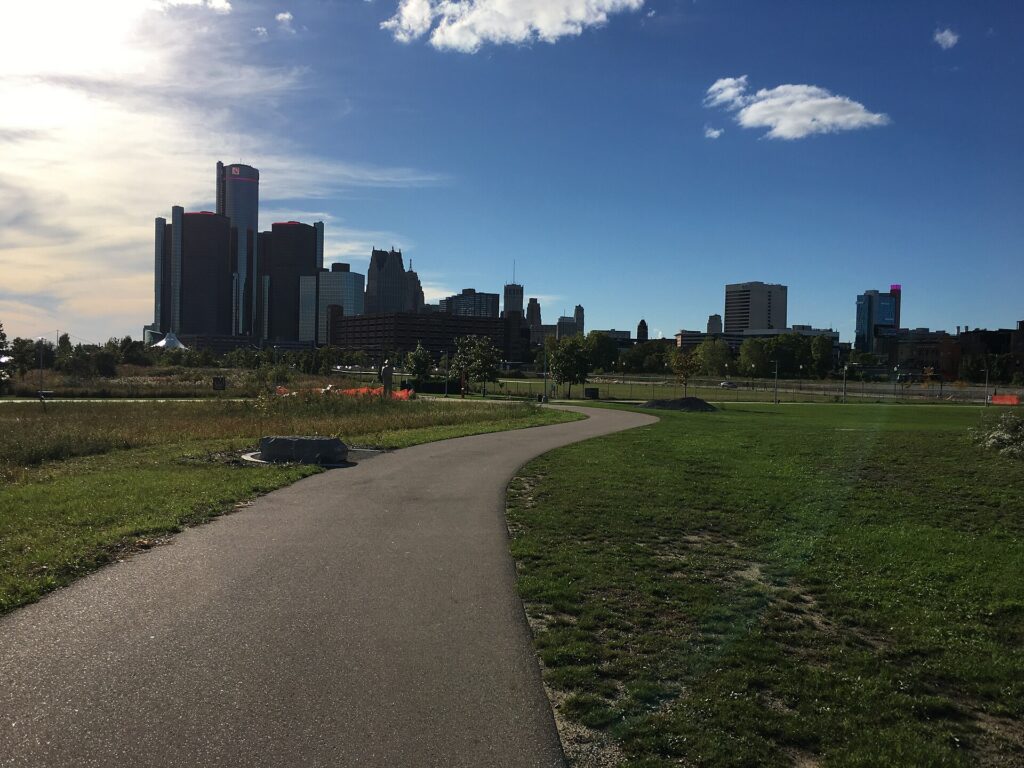
    The Detroit RiverWalk at Milliken State Park with downtown Detroit behind
    The Detroit RiverWalk in summer, when the city is at its liveliest and hotel rates at their highest (Photo: Fredlyfish4 via Wikimedia Commons, CC BY-SA 4.0)

    Detroit’s weather, season by season

    Detroit has a humid continental climate shaped by the Great Lakes. Winters are cold, cloudy and snowy, with a handful of Arctic outbreaks most years; spring is short and changeable, with cool, damp weeks and sudden warm spells; summers are warm to hot and humid, with thunderstorms; and fall is crisp and clear, with frost arriving in October. The figures below are approximate seasonal patterns based on the long-term climate normals from NOAA’s National Weather Service office for Detroit; check the current forecast before you pack, because a week in April can bring both snow and summer warmth.

    MonthTypical daytime highTypical overnight lowWhat it feels likeFare pressure
    Januaryaround 0 °C (32 °F)around -7 °C (19 °F)Cold, gray and snowy; the coldest monthLow after New Year’s week; auto show bump
    Februaryaround 2 °C (35 °F)around -6 °C (21 °F)Deep winter, with the odd thawLow
    Marcharound 8 °C (46 °F)around -2 °C (29 °F)Raw and changeable; snow and mild days alternateLow to moderate; spring break
    Aprilaround 15 °C (59 °F)around 4 °C (39 °F)Cool and showery; spring arrives in fitsModerate
    Mayaround 21 °C (70 °F)around 10 °C (50 °F)Green and pleasant; the best of springModerate; high on Memorial Day weekend
    Junearound 27 °C (80 °F)around 16 °C (60 °F)Warm, long days; thunderstormsHigh
    Julyaround 29 °C (84 °F)around 18 °C (64 °F)Hot and humid; the warmest monthHigh
    Augustaround 28 °C (82 °F)around 17 °C (63 °F)Hot and humid, easing late in the monthHigh, softer after mid-month
    Septemberaround 24 °C (75 °F)around 13 °C (55 °F)Warm, drier and often sunnyModerate; high on Labor Day weekend
    Octoberaround 17 °C (62 °F)around 6 °C (43 °F)Crisp and clear; fall colorModerate, with a marathon spike
    Novemberaround 9 °C (48 °F)around 1 °C (34 °F)Gray and cooling fast; first snow possibleLow, then high for Thanksgiving
    Decemberaround 3 °C (37 °F)around -4 °C (25 °F)Cold, cloudy and festive; snow likelyModerate early, then peak for the holidays

    Three things the table cannot show. First, the clouds: the Great Lakes keep Detroit under gray skies for much of November to February, and the lack of sun makes winter feel longer than the thermometer suggests. Second, the cold snaps: a few times most winters, Arctic air drops overnight lows well below -18 °C (0 °F) and the wind chill makes exposed skin a concern; snowfall is usually moderate rather than extreme, since the city sits upwind of the heaviest lake-effect bands, but a single storm can still close roads and delay flights. Third, the summer storms: thunderstorms build on hot afternoons from June to August, sometimes with damaging wind, and they are the main cause of summer delays at DTW.

    How Detroit’s fare seasons work

    Three calendars drive demand for Detroit. The first is the leisure and events calendar, which is concentrated between Memorial Day and mid-October, when the riverfront, the festivals, the ballpark and the big weekends draw visitors from across the Midwest and Ontario. The second is business travel: the auto industry, its suppliers and the engineering firms of the suburbs keep weekday flights and hotels near the airport and along the freeways busy year-round, with a lull at the holidays and in high summer. The third is the hub effect: because DTW is a major Delta connecting hub, there are far more seats into Detroit than the local market alone would support, so fares from other hubs and from Florida and the Sun Belt are often competitive, while routes where Delta faces little competition can be pricier. For most visitors, the hotel is the bigger swing factor, and it swings on event weekends.

    Peak season

    Late May to August, the big event weekends in September and October, and roughly Thanksgiving through New Year’s Day. Summer brings the highest hotel rates of the year downtown, with Memorial Day weekend, the Fourth of July and Dream Cruise weekend at the top; the holidays bring family travel and the big Thanksgiving Day parade and Lions game. If you must travel in peak, book early, fly mid-week and compare hotels across neighborhoods and the suburbs rather than only downtown.

    Shoulder season

    April to mid-May and mid-September to early November. Late spring gives you long days and green parks before the summer surge; fall gives you the most reliable weather and the color. Watch for home football weekends, both the Lions downtown and the University of Michigan in Ann Arbor, which can lift hotel rates across the region on fall weekends.

    Low season

    January to early March, outside New Year’s week, the auto show and the long weekends. Fares and hotel rates are at their lowest, the museums and restaurants are quiet, and the Red Wings and Pistons are in season. The trade-off is cold, gray weather and the chance of a snowstorm; build a buffer into connections.

    As elsewhere, mid-week departures and early or late flights usually price below Friday and Sunday afternoons on the same route, and a search across a whole month reveals cheaper pairs of dates close to your first choice. Our guide to the best times to book explains how to read those patterns.

    Detroit month by month

    January

    The cheapest month of the year to fly and to stay, after the New Year week, and the coldest. The Detroit Auto Show at Huntington Place, one of the oldest in the country, has returned to a winter slot after a few years in September; check its current dates, because it fills downtown hotels while it runs. Otherwise the city is yours: no lines at the DIA, skating at Campus Martius, and Red Wings and Pistons games at Little Caesars Arena.

    February

    Deep winter, with low fares and gray skies, broken by Presidents’ Day weekend and the occasional thaw. An excellent month for a museum, music and food trip if you pack for the cold, and hotel rates downtown are at their softest.

    March

    Raw and changeable, with snow one day and a mild spell the next. Corktown’s St. Patrick’s Day parade, one of the oldest in the Midwest, fills Michigan Avenue on the Sunday before the holiday, and college spring breaks lift fares in the middle of the month. The first half of March is still one of the cheapest windows of the year.

    April

    Spring arrives unevenly. The Tigers open their season at Comerica Park, in weather that can include snow flurries, and Opening Day is an unofficial city holiday. Fares are moderate, and graduation weekends at the region’s universities begin to fill hotels in Ann Arbor and the suburbs late in the month.

    May

    Green and pleasant, and the start of the busy season. Movement, the electronic music festival in Hart Plaza, takes over Memorial Day weekend and draws fans from around the world to the birthplace of techno, and the Detroit Grand Prix brings IndyCar racing to downtown streets around the end of the month or the start of June. Book around those weekends and May is a lovely time to visit.

    June

    Long days and warm weather. The riverfront and Belle Isle are at their best, the patios fill, and in late June the fireworks over the Detroit River, a joint celebration of Canada Day and the Fourth of July watched from both shores, draw enormous crowds downtown. Fares and hotel rates climb through the month; early June is the value play.

    July

    Peak summer: hot, humid and busy, with the Fourth of July, the free Concert of Colors world music festival in Midtown, Tigers games, and the beaches on Belle Isle and at Metroparks around the region. Many locals head “up north” to the lakes, which keeps city hotel rates below those of coastal cities in the same weeks.

    August

    The Woodward Dream Cruise, on the third Saturday of the month, is billed as the world’s largest one-day automotive event, with classic cars and huge crowds along Woodward Avenue through the northern suburbs, and hotels along the route fill for the weekend. The rest of the month is hot and summery, with slightly softer prices once schools start late in the month.

    September

    One of the best months to visit: warm, drier and settled. Labor Day weekend brings the free Detroit Jazz Festival downtown and Arts, Beats and Eats in Royal Oak, and the month continues with design events, since Detroit is a UNESCO City of Design, and the start of football season, with the Lions at Ford Field and Michigan in Ann Arbor. Outside the big weekends, it is excellent value.

    October

    Crisp and clear, with fall color on Belle Isle and in the parks and orchards around the region. The Detroit Free Press Marathon, in mid-October, is one of the few international marathons in the world, crossing the Ambassador Bridge into Canada and returning through the tunnel, and that weekend is busy downtown. The rest of the month is quiet and good value.

    November

    Gray and cooling, with the first snow possible late in the month. The first half is quiet and cheap. America’s Thanksgiving Parade marches down Woodward on Thanksgiving morning, the Lions play their traditional home game that afternoon, and the holiday tree goes up at Campus Martius; Thanksgiving week brings a sharp spike in fares as the whole country travels.

    December

    Two months in one. The first half is festive and moderately priced, with the rink and markets downtown and Noel Night, when Midtown’s museums and shops open their doors for an evening of music and lights in early December. From about the middle of the month, fares rise sharply for Christmas and New Year.
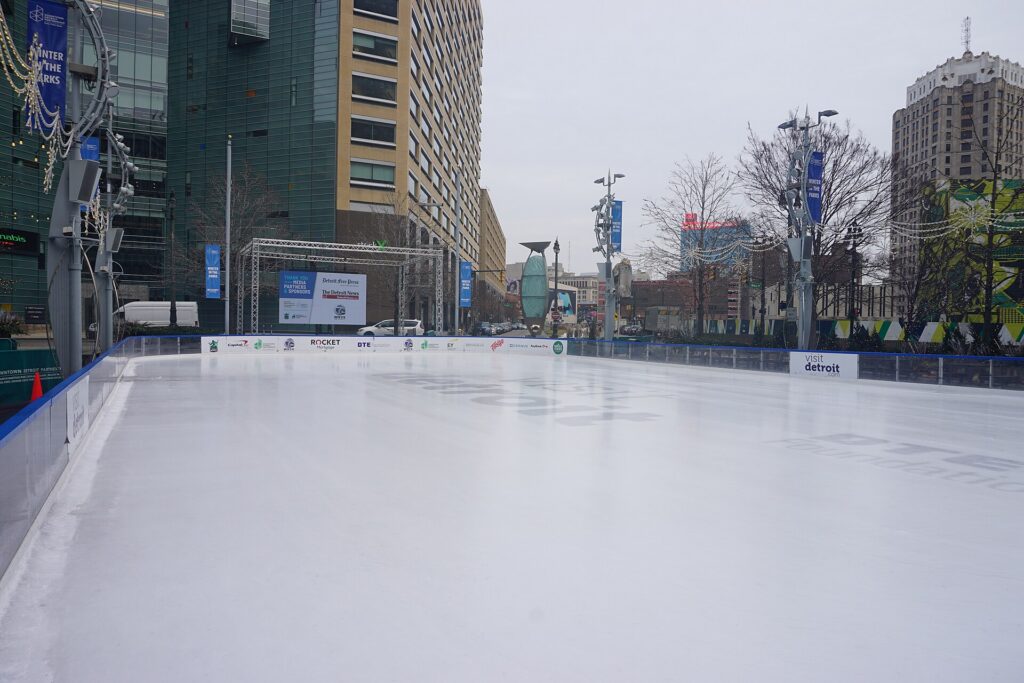
    Skaters on the ice rink at Campus Martius Park in downtown Detroit in winter
    Skating at Campus Martius: Detroit in winter is cold, gray and the cheapest time of year to visit (Photo: Michael Barera via Wikimedia Commons, CC BY-SA 4.0)

    Events that move Detroit flight and hotel prices

    Cross-check these against your dates before you book. Exact dates shift each year; Visit Detroit, the official tourism site, keeps the current calendar.

    • Detroit Auto Show (winter, at Huntington Place; check the current dates).
    • University graduations (late April and early May), which fill hotels in Ann Arbor and the suburbs.
    • Movement (Memorial Day weekend) and the Detroit Grand Prix (around the end of May or the start of June).
    • River fireworks (late June) and the Fourth of July.
    • Woodward Dream Cruise (the third Saturday of August).
    • Detroit Jazz Festival and Arts, Beats and Eats (Labor Day weekend).
    • Football weekends: the Lions at Ford Field and Michigan home games in Ann Arbor, from September.
    • Detroit Free Press Marathon (mid-October).
    • Thanksgiving, with the parade and the Lions game, through New Year’s Day.
    • Home games and concerts: Tigers from April to September, Red Wings and Pistons from October. Our Detroit events page shows what is on sale for your dates.

    Getting in from the airport

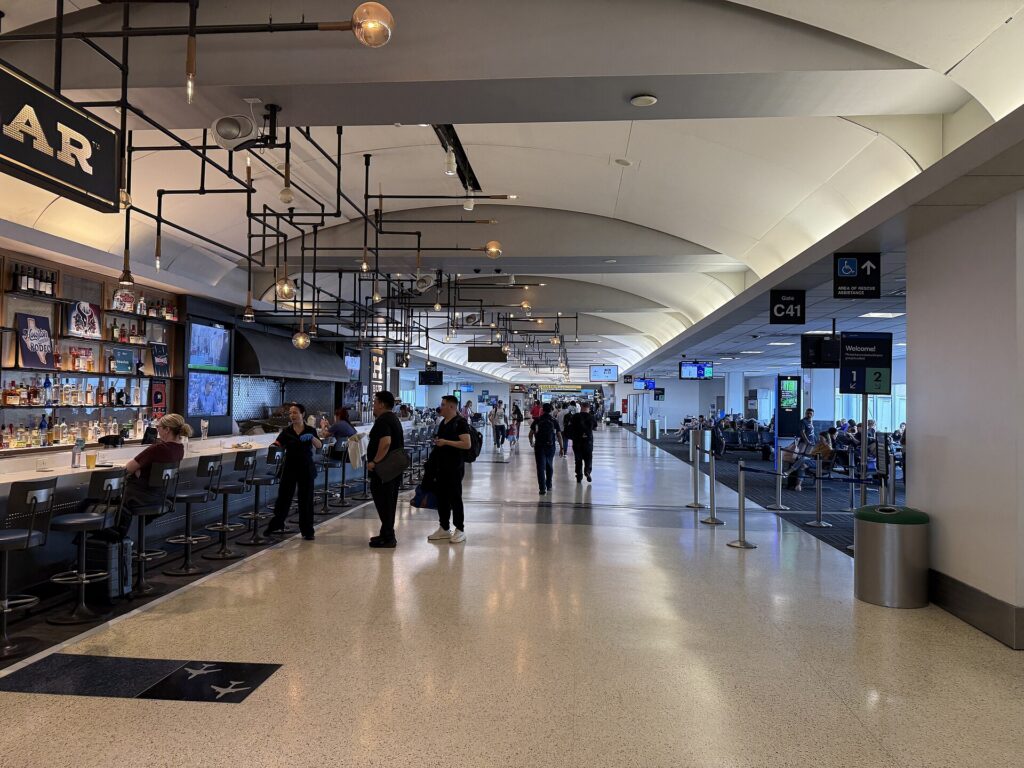
    Detroit Metropolitan Wayne County Airport (DTW) is in Romulus, about 32 km (20 miles) southwest of downtown Detroit, and it has two terminals. The McNamara Terminal, Delta’s hub, is a single long concourse with an elevated Express Tram running its length and a colorful light-and-music tunnel linking the concourses; Delta’s long-haul flights to Europe and Asia leave from here. The other terminal, the former North Terminal, handles most other airlines. The drive to downtown along I-94 takes 25 to 40 minutes by taxi or ride-hail, longer at rush hour; there is no rail link, but SMART runs express buses between the airport and downtown along Michigan Avenue, which are far cheaper and considerably slower, and the Michigan Flyer coach connects the airport with Ann Arbor and East Lansing. Rental companies run shuttle buses from both terminals to their lots. Our Detroit car-versus-transit guide works through the ground-transport decision, and our DTW airport guide covers the terminals.
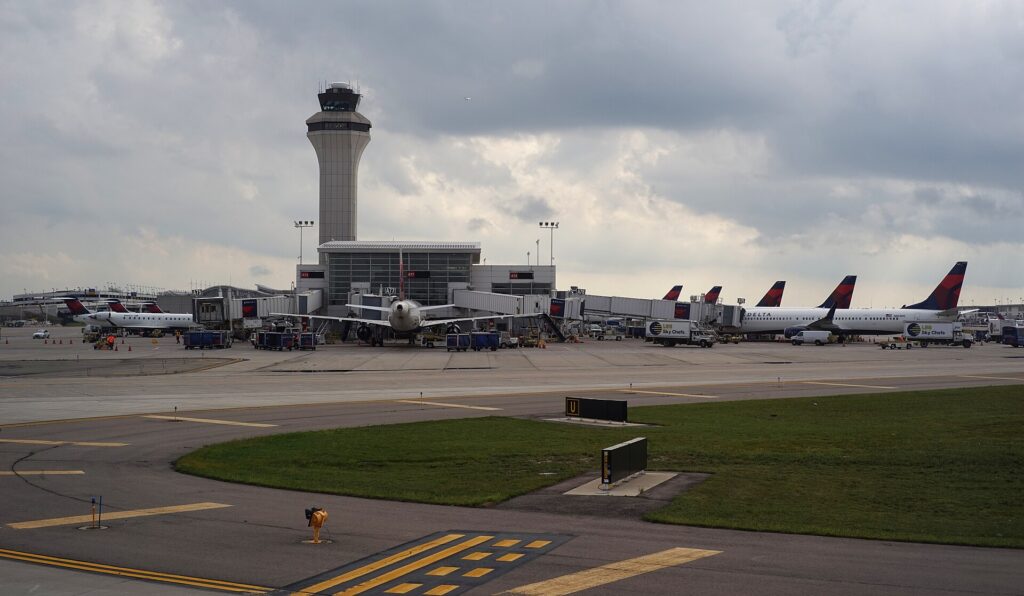
    The McNamara Terminal at Detroit Metropolitan Wayne County Airport
    The McNamara Terminal at DTW, Delta's Midwest hub and gateway to Europe and Asia (Photo: Dllu via Wikimedia Commons, CC BY-SA 4.0)

    Timing tricks that work for Detroit

    • Check the event calendar first. A cheap fare on Memorial Day weekend, Dream Cruise weekend or Labor Day weekend can come with a hotel rate that doubles the trip. Run a Detroit hotel search for the same dates before you commit.
    • Look at the suburbs. When downtown is full, hotels in Dearborn, near the airport or along the northern freeways are often much cheaper, and with a rental car the drive in is short outside rush hour.
    • Fly mid-week in shoulder season. Business travelers fill Monday morning and Thursday evening flights, and downtown hotels full of conference-goers on weekdays can be cheaper on weekends outside summer.
    • Go in winter for value. January to early March has the lowest prices of the year and the DIA, the Motown Museum and the restaurants at their quietest; just pack for the cold.
    • Coming from southwestern Ontario? Many travelers from Windsor and London drive across the border to fly from DTW because of its much larger route network. If you do, allow generous time for the crossing, carry documents both countries accept, and check U.S. Customs and Border Protection and the Canada Border Services Agency for current rules.
    • Build a weather buffer. Snowstorms in winter and thunderstorms in summer both cause delays at DTW; avoid the tightest connections. Our guide to how early to arrive covers what to allow.
    • Flying out of Detroit instead? DTW’s Delta network makes it one of the best departure airports in the Midwest for Europe and Asia; see cheap flights from Detroit.

    Classic Austin-Healey sports cars at the Woodward Dream Cruise
    The Woodward Dream Cruise in August, one of the busiest hotel weekends of the summer (Photo: Dane via Wikimedia Commons, CC BY 2.0)

    What to pack, by season

    Winter (December to March): a warm, windproof coat, a hat, gloves and a scarf, waterproof boots with grip for slushy sidewalks, and thermal layers for the coldest days. Spring (April to May): layers, a rain jacket and a sweater, because a warm afternoon can turn cold by evening, especially near the river. Summer (June to August): light, breathable clothing, sunscreen, a swimsuit for Belle Isle or a hotel pool, an umbrella for thunderstorms, and a light layer for air-conditioned museums and evenings on the RiverWalk. Fall (September to November): a medium jacket by October and a warm coat by November, plus layers for football games, which get cold after dark. In every season, bring comfortable walking shoes for downtown and Midtown, and your passport if Windsor is on the list.

    The best time to fly to Detroit for…

    Summer on the riverfront

    Mid-June to mid-July for long days, the fireworks and Belle Isle’s beach, or late August for warm weather with slightly softer prices. Book early for the big weekends.

    Good weather without the crowds

    September after Labor Day, or the first two weeks of June.

    The lowest fares

    Mid-January to early March, outside the auto show and the long weekends.

    Baseball and football

    May, June and September for comfortable Tigers games at Comerica Park; September to December for the Lions at Ford Field, with Thanksgiving Day the most famous (and most expensive) game of the year.

    Music lovers

    Memorial Day weekend for Movement and techno, Labor Day weekend for the free Jazz Festival, and any time of year for a Motown Museum tour.

    Families

    June to August, when Belle Isle, the Detroit Zoo, the RiverWalk and Greenfield Village at The Henry Ford are all in full swing; early December for the holiday lights and skating downtown.

    International visitors

    Travelers from Visa Waiver Program countries need an approved ESTA before they board; most others need a visa. The State Department’s travel site explains what applies to you, and the TSA lists what you can carry through security. If you plan a side trip to Windsor, check that your entry status allows you to leave and re-enter the United States by land before you go.

    Frequently asked questions

    What is the cheapest month to fly to Detroit?

    January, after the New Year week, followed by February and early March, outside the auto show and the long weekends.

    What is the best month to visit Detroit for weather?

    September, with late May, June and early October close behind. July and August are hot and humid; January and February are cold and gray.

    Is DTW a good airport to fly into?

    Yes. It is a large, modern Delta hub with a wide route network and two efficient terminals, and it has often ranked well in passenger satisfaction surveys. Its main drawback is the distance from downtown and the lack of a rail link.

    When are hotels most expensive in Detroit?

    On big event weekends: Memorial Day, the Grand Prix, the Fourth of July, the Dream Cruise, Labor Day, marathon weekend and Thanksgiving, plus the auto show in winter.

    How cold does Detroit get in winter?

    Daytime highs around freezing are typical in January, but Arctic outbreaks can push overnight lows below -18 °C (0 °F) for a few days most winters, with wind chills colder still.

    How far ahead should I book?

    Earlier for summer event weekends, football weekends, Thanksgiving and the holidays, when fares and hotel rates tend only to rise; from January to early March, fares are stable enough that finding the right dates matters more than booking early.

    Can I combine Detroit with Chicago or Toronto?

    Easily. Chicago is about four and a half hours west by car or a little longer on Amtrak, and Toronto about four hours east plus the border crossing. See our guides to things to do in Chicago and things to do in Toronto.

    Ready to pick your dates? Compare fares across the whole month on our Detroit flights page, then find a room with our Detroit hotel search. For what to do when you land, start with our first-timer’s guide to Detroit, and if you are weighing a car, read rent a car or use transit in Detroit.

  • Best Time to Fly to Montreal: Seasons, Weather & Prices

    Best Time to Fly to Montreal: Seasons, Weather & Prices

    Montreal has two personalities and prices them differently. From late June to early September the city is a festival: terraces on every street, the Quartier des Spectacles closed to traffic for the jazz festival and the comedy festival, the Grand Prix roaring through Parc Jean-Drapeau, and hotel rates to match. From December to March it is one of the snowiest major cities on earth, with a culture built around embracing that, and airfares that drop to their lowest of the year. In between are two short, lovely shoulders. This guide walks through the weather month by month, the fare seasons, the specific festival weeks that move prices more than the calendar suggests, and how to choose between Trudeau airport and the alternatives.

    The short answer

    For weather and value together, the windows are mid-May to mid-June and early September to mid-October. Spring brings the terraces back out before the festival crowds arrive; early fall keeps most of the summer’s warmth, adds the colour, and drops the prices. The cheapest fares of the year come from mid-January to early March and again in November, when Montreal is cold or grey and the planes are filled by business travel. The most expensive stretches are the Grand Prix weekend in mid-June, which is the single biggest hotel spike of the year, the festival heart of summer from late June through early August, and the Christmas and New Year period. Whichever window you choose, run a flexible-date search on our Montreal flights page; a few days either side of a festival weekend can change the fare band entirely.

    A performer on stage at the Montreal International Jazz Festival
    The Montreal International Jazz Festival takes over the Quartier des Spectacles for ten days from late June (Photo: Pierre5018 via Wikimedia Commons, CC BY 4.0)

    Montreal’s weather, season by season

    Montreal sits on an island in the St. Lawrence River, far enough inland to have a fully continental climate: real winters, humid summers, and short transitions. The figures below are approximate seasonal patterns based on the long-term climate normals from Environment and Climate Change Canada; check the current forecast before you pack, because the city can swing from a thaw to a blizzard inside a week in March or November.

    MonthTypical daytime highTypical overnight lowWhat it feels likeFare pressure
    Januaryaround -5 °Caround -13 °CCold, bright, snow-packed; the coldest snaps drop well below -20 °CLow, except the first week
    Februaryaround -3 °Caround -12 °CStill deep winter, with the most reliable snow cover of the yearLow; rises for Igloofest and Nuit Blanche weekends
    Marcharound 3 °Caround -5 °CThaw and refreeze; slush, then the first mild afternoons; maple season beginsLow, apart from the early-March school break
    Aprilaround 12 °Caround 2 °CUnpredictable; the snow finally goes, the city is grey and then suddenly greenModerate
    Mayaround 19 °Caround 9 °CSpring proper; the terraces reopen, the mountain turns greenModerate; rises around the late-May long weekend
    Junearound 24 °Caround 14 °CWarm and lively; the Grand Prix and the jazz festival open the summerHigh, with a Grand Prix spike
    Julyaround 27 °Caround 17 °CHot and humid; heat waves push the humidex into the high 30sHigh
    Augustaround 25 °Caround 16 °CHot, humid, thundery; cooling in the last weekHigh, with an Osheaga spike
    Septemberaround 20 °Caround 11 °CWarm days, cool nights; the best-kept-secret monthModerate, falling after Labour Day
    Octoberaround 13 °Caround 5 °CPeak fall colour on the mountain; jacket weather; first frostsModerate to low
    Novemberaround 5 °Caround -1 °CGrey and damp; the first lasting snow usually arrives late in the monthLow
    Decemberaround -2 °Caround -9 °CWinter arrives properly; holiday lights, markets and the first skatingLow until mid-month, then peak

    Two things the table does not capture. Snow: Montreal averages roughly two metres of it a season, and the city is built for it, with an underground pedestrian network, heated stations and a snow-clearing operation that is a spectacle in its own right. Winter here is not a reason to stay away; it is a reason to pack properly. Humidity: July and August afternoons routinely feel several degrees hotter than the thermometer, and the summer festivals are outdoor events; plan for shade, water and an air-conditioned hotel.

    How Montreal’s fare seasons work

    Montreal’s demand is driven by three overlapping calendars: the Quebec and Ontario school years, the corporate and university year, and a festival programme so dense from June to August that the city markets itself as a festival capital. The result is a summer plateau with sharp spikes on specific weekends, a real but shorter winter bump around the holidays and the February events, and two shoulder windows where the weather is often excellent and the prices are not.

    Peak season

    Mid-June to mid-August, plus roughly December 18 to January 3. The Canadian Grand Prix weekend, usually the second or third weekend of June, is in a class of its own: hotel rates across the city can double or more, and flights from the U.S. Northeast and Europe fill early. The jazz festival, the comedy festival, the fireworks competition and Osheaga keep demand high through July and into August. If you must travel in peak, book the hotel first, fly mid-week, and consider staying just outside the festival core.

    Shoulder season

    Mid-April to mid-June, avoiding the Grand Prix, and September to October. May and September are the months locals would send you to: terrace weather, manageable crowds, and hotel rates well below summer. Watch the Victoria Day weekend in late May, which Quebec marks as the National Patriots’ Day holiday, and Canadian Thanksgiving in early October.

    Low season

    Mid-January to early March and most of November. Fares are at their lowest, and Montreal’s winter has a genuine programme: Igloofest, the outdoor electronic music festival on the Old Port waterfront on weekends from mid-January to early February; Montréal en Lumière, the winter festival in late February with an all-night Nuit Blanche; skating in the parks; and the city’s restaurant scene at full strength with no waits. The trade-off is weather risk; build a buffer into connections and check the forecast before you fly.

    Fares also move with the day of the week and the hour: early-morning and late-evening departures and mid-week days usually sit below Friday and Sunday afternoons on the same route. Our guide to the best times to book flights and hotels goes deeper on reading those patterns.
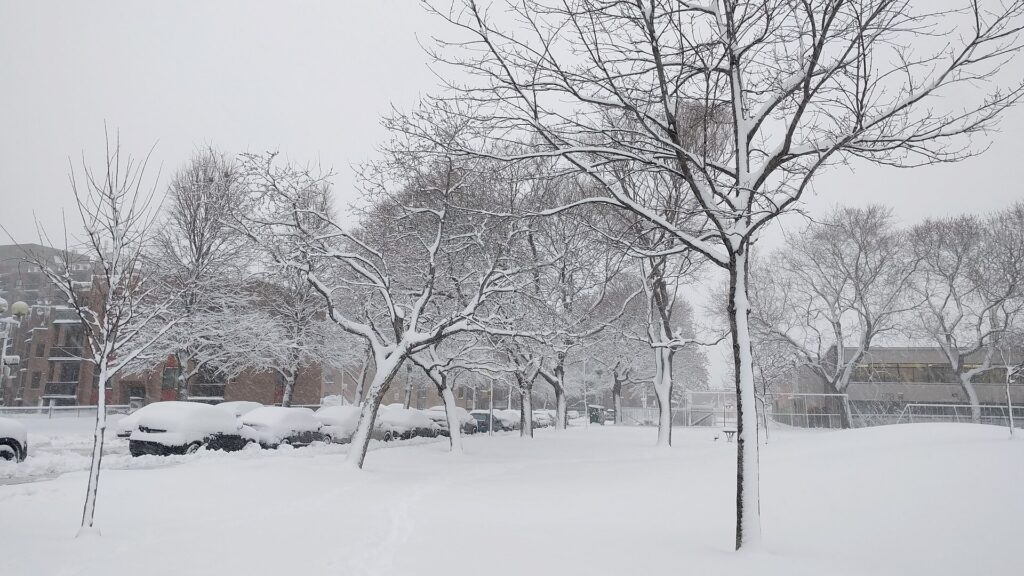
    Montreal month by month

    January

    Cold, bright and, after the first week, the cheapest month of the year to fly in. Highs sit below freezing and the coldest days bring wind chills well past -25 °C. What January does well: Igloofest in the Old Port on weekends from mid-month, the Canadiens at the Bell Centre, the underground city for getting between downtown hotels, shops and the metro without a coat, cross-country skiing and tobogganing on Mount Royal, and a restaurant scene that is a large part of why people visit Montreal at all. Pack a real coat and boots with grip.

    February

    Deep winter, reliable snow, and still low fares outside two things: Montréal en Lumière, the winter festival that fills the Quartier des Spectacles in the second half of the month and ends with the all-night Nuit Blanche, and the Quebec school break, which usually falls in the first week of March but can begin in late February. Igloofest continues into early February. Valentine’s weekend lifts hotel rates briefly.

    March

    A transition month, and honest about it: slush, sudden thaws, and a late blizzard most years. The school break, known as la relâche, in the first week of March, brings family travel and higher fares for a week; outside it, March is a low-season month. It is also maple syrup season, when the sugar shacks in the countryside outside the city open for the traditional cabane à sucre meals; a car or a tour makes that easy.

    April

    The snow finally goes and the city is briefly grey and muddy before turning green almost overnight in the last week. Fares are moderate and hotel rates are noticeably lower than they will be in eight weeks. The Canadiens’ season ends, or, in a good year, the playoffs begin, which can tighten hotels on game nights.

    May

    The terraces reopen, the mountain greens up, the cyclists and the BIXI bikes reappear, and the city is at its most cheerful. The Victoria Day long weekend in late May, National Patriots’ Day in Quebec, is the one date to book around; otherwise May offers spring weather at prices well below June. If you can travel in the second half of May, it is one of the best value-for-weather windows of the year.

    June

    Summer arrives, and so does the Grand Prix, usually on a mid-June weekend, when the city’s hotels are fuller and pricier than at any other time. The Fringe festival runs in mid-June, Saint-Jean-Baptiste Day on June 24 is Quebec’s national holiday, and the jazz festival opens in the last days of the month. Early June, before the race, is the value play; the week after the race is a small pocket of relief before July.

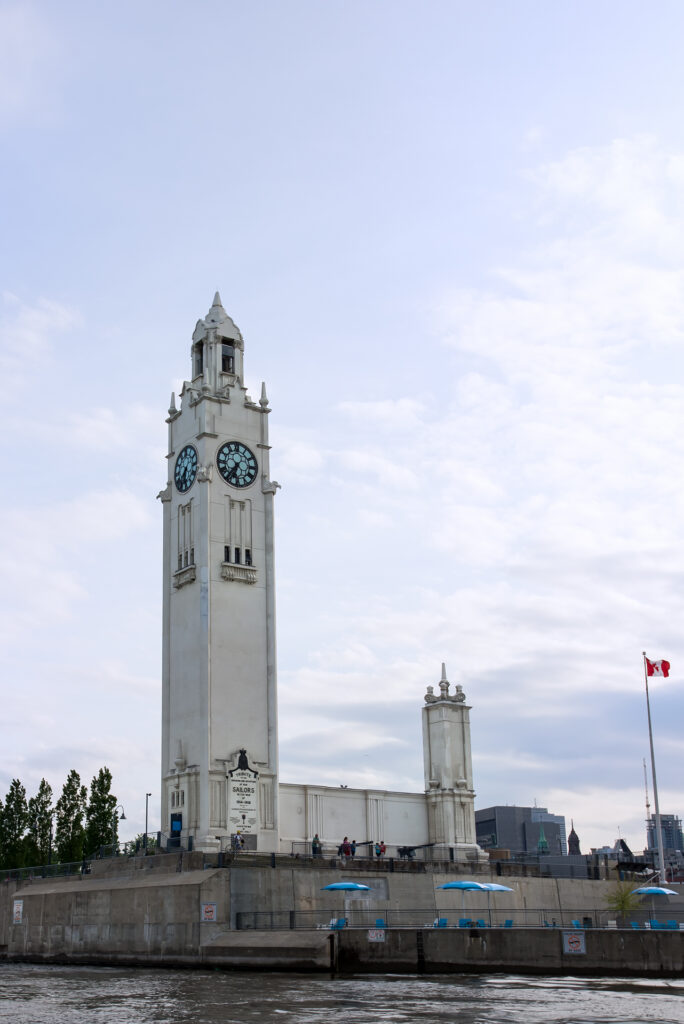
    The Old Port of Montreal in summer
    The Clock Tower in the Old Port, where Montreal spends its short, hot summer (Photo: Thebrianking via Wikimedia Commons, CC BY-SA 3.0)

    July

    Peak season, and Montreal at full volume. The jazz festival runs into the first week of the month, the Just for Laughs comedy festival takes over in the second half, the international fireworks competition lights up the river on weekends, Canada Day on July 1 opens the month, and the humidity settles in. Fares and hotel rates are at their annual high; book early and fly mid-week. Note that July 1 is also Quebec’s traditional moving day, which affects locals far more than visitors but does mean the city is busy that week.

    August

    Still peak, with Osheaga, the big outdoor music festival at Parc Jean-Drapeau, on the first weekend of the month, Montreal Pride in the second week, and the film festival at the end. The last week of August, once families have flown home and before the universities return, is a small pocket of softer pricing.

    September

    Many Montrealers will tell you this is the best month, and the weather agrees: warm days, cool nights, and the first hint of colour on Mount Royal. Fares and hotel rates fall after Labour Day and stay moderate through the month. The universities are back, the restaurants are full of locals rather than visitors, and the terraces stay open.

    October

    Fall colour peaks on the mountain and in the Laurentians in the first half of the month, and the Thanksgiving long weekend on the second Monday is the one demand spike. Late October is one of the best value-for-weather windows of the whole year, with jacket-weather days, quiet hotels and the city’s food at its seasonal best.

    November

    Grey, damp and quiet, and with January the cheapest month to fly. The first lasting snow usually arrives late in the month, the holiday lights and markets switch on in the second half, and the Canadiens are well into their season. If you want Montreal’s festive atmosphere without festive prices, the last ten days of November are the target.

    December

    Two months in one. The first half continues November’s value pricing with the holiday markets, the lights in the Old Port and the first skating of the season. From about December 18, fares and hotel rates jump for Christmas and New Year and stay high into the first days of January. Winter is fully here: expect snow, short days, and the occasional weather delay at Trudeau.

    Heavy snow falling on a Montreal street in winter
    Montreal in January: real winter, and the cheapest fares of the year (Photo: Wiki-asd-97 via Wikimedia Commons, CC BY 4.0)

    Events that move Montreal flight and hotel prices

    Cross-check these against your dates before you book. Exact dates shift each year; Tourisme Montréal keeps the current calendar.

    • Igloofest (weekends, mid-January to early February).
    • Montréal en Lumière and Nuit Blanche (late February).
    • Quebec school break, la relâche (usually the first week of March).
    • Victoria Day / National Patriots’ Day weekend (late May).
    • Canadian Grand Prix (a mid-June weekend): the biggest hotel spike of the year by a wide margin.
    • Saint-Jean-Baptiste Day (June 24) and Canada Day (July 1).
    • Montreal International Jazz Festival (late June to early July).
    • Just for Laughs (second half of July) and the international fireworks competition (summer weekends).
    • Osheaga (first weekend of August) and Montreal Pride (mid-August).
    • Thanksgiving weekend (second Monday of October).
    • Christmas to New Year.
    • Canadiens playoff runs (April to June in a good year) and stadium concerts. Our Montreal events page shows what is on sale for your dates.

    Which airport should you fly into?

    Montréal-Trudeau International (YUL)

    Montreal’s only commercial airport for scheduled passenger flights, in Dorval about 20 kilometres west of downtown, handles everything from the transborder shuttle flights to the Air Canada and Air Transat routes to Europe, North Africa and the Caribbean. Getting downtown is straightforward: the STM’s 747 bus runs around the clock between the terminal and downtown, stopping along René-Lévesque Boulevard and at the Berri-UQAM metro hub, in about 45 to 70 minutes depending on traffic, for a fare that includes 24 hours of unlimited transit. A flat-rate taxi fare applies from the airport to downtown; ride-hail services also pick up at the terminal. A station for the REM light-rail network is being built at the airport; check the airport’s site for its status and current ground-transport options. Our Trudeau airport guide covers the layout, and our Montreal car-versus-transit guide will help you decide whether to book a car at all.

    Montreal-Trudeau International Airport (YUL)
    Montreal-Trudeau International Airport (YUL) in Dorval, about 20 kilometres west of downtown (Photo: Wilfredor via Wikimedia Commons, CC0)

    Plattsburgh and Burlington (United States)

    For Montrealers and for visitors with a car, two small airports across the U.S. border, Plattsburgh (about an hour south) and Burlington, Vermont (about two hours), have long offered cheaper U.S. domestic and sun fares than Trudeau. They only make sense with a vehicle and a passport, and border wait times can erase the savings on a busy day. If you are a visitor rather than a resident, ignore them.

    Ottawa (YOW) and Quebec City (YQB)

    Ottawa’s airport is two hours away by road or VIA Rail and occasionally has better fares on specific routes; Quebec City’s is three hours. Neither is a practical substitute for a Montreal trip unless you are visiting both cities anyway. See our Ottawa flights and Quebec City flights pages if you are.

    Timing tricks that work for Montreal

    • Search the whole month. Montreal’s fare curve has sharper edges than most cities because of the festival weekends. A calendar search on TicketScanner shows the Grand Prix and Osheaga spikes instantly.
    • Book the hotel before the flight in June and July. A cheap fare into Grand Prix weekend is not cheap once the room is added; hotel rates move more than airfares that week. Run a Montreal hotel search for the same dates before you commit to either.
    • Fly mid-week in summer. Tuesday and Wednesday departures on the same route often sit in a lower band than the Friday.
    • Book the event weeks early and the low-season weeks late. Grand Prix, jazz festival and Christmas fares rarely fall as the date approaches; January and November fares are stable enough that waiting for the right dates costs little.
    • Coming from the U.S. Northeast? Montreal is a short flight from New York, Boston and Washington, and the shuttle-style frequency means the fare spread across a single day can be large.
    • Consider the train for a two-city trip. VIA Rail links Montreal with Toronto, Ottawa and Quebec City through the downtown Central Station; flying into one and out of the other can be cheaper than a return to the same city.
    • Build a winter buffer. Snow can disrupt Trudeau between December and March; avoid the tightest connections. Our guide to how early to arrive for an international flight covers what to allow.
    • Flying out of Montreal instead? The same seasonality applies in reverse; see cheap flights from Montreal.

    What to pack, by season

    Winter (December to March): an insulated, wind-resistant coat, a hat that covers your ears, a scarf, waterproof boots with real grip, and layers for overheated interiors; Montreal winter is colder than Toronto’s and it shows in what locals wear. Spring (April to May): a rain shell, a mid-weight jacket and shoes that can get wet. Summer (June to August): light, breathable clothing, sun protection, and something for aggressively air-conditioned restaurants and metro cars. Fall (September to November): layers, a warm jacket by mid-October, and an umbrella in November. Year-round, comfortable shoes: Montreal is a walking city with hills and cobblestones.

    The best time to fly to Montreal for…

    Families

    Late May or the last week of August for warm weather without peak prices, or the school break in early March for a snow-and-city trip if you book early.

    The lowest fares

    Mid-January to early March outside the relâche week, and November. Pair with a downtown hotel and lean into the indoor and winter city.

    Festivals

    Late June to early August, booked months ahead, with the hotel first. Or February, for Montréal en Lumière at a fraction of the price.

    Food

    Any month; Montreal’s restaurants are its most reliable attraction. September and October are the sweet spot for terraces, harvest menus and quiet tables.

    Skiing

    January to March, with the Laurentians and Mont-Tremblant ninety minutes north; see our Montreal car rental page, and note that Quebec requires winter tires on all vehicles from December 1 to March 15.

    Cross-border and international visitors

    U.S. citizens need a valid passport; most other visa-exempt travellers arriving by air need an Electronic Travel Authorization. The Government of Canada’s visitor page explains what applies to you, and CATSA lists what you can carry through security.

    Frequently asked questions

    What is the cheapest month to fly to Montreal?

    January and February, followed by November and early March outside the school break. The first week of January is the exception, as it is still priced with the holidays.

    What is the best month to visit Montreal for weather?

    September, with June a close second if you can avoid Grand Prix weekend. Both are far more comfortable than the humid heart of July.

    Is Montreal expensive in summer?

    The festival weeks are, and the Grand Prix weekend is the most expensive time of the year for hotels by a wide margin. Mid-week travel and early booking help; May and September give you most of the summer at a fraction of the price.

    How cold is Montreal in winter?

    Colder than Toronto and most U.S. cities: daytime highs below freezing from December to February and cold snaps well below -20 °C. The city is built for it, and a proper coat and boots make it entirely enjoyable.

    Which airport does Montreal use?

    Montréal-Trudeau (YUL), about 20 kilometres west of downtown, reached by the 747 bus, taxi or ride-hail. There is no other scheduled passenger airport in the city.

    How far ahead should I book a flight to Montreal?

    Earlier for the festival weeks and the holidays, when fares tend only to rise; for low-season dates, fares are stable enough that finding the right pair of days matters more than booking months out.

    Do I need to speak French in Montreal?

    No. French is the official language and you will hear it everywhere, but English is widely spoken in hotels, restaurants and shops in the areas visitors frequent, and a few words of French are appreciated.

    Ready to pick your dates? Compare fares across the whole month on our Montreal flights page, then find a room with our Montreal hotel search. For what to do when you land, start with our first-timer’s guide to Montreal.

  • Best Time to Fly to San Diego: Seasons, Weather & Prices

    Best Time to Fly to San Diego: Seasons, Weather & Prices

    San Diego has one of the gentlest climates of any big city in the United States, and that changes how you should think about timing a trip. There is no month when the weather rules the city out: winters are mild, summers are warm rather than hot, and the swing between the coolest and warmest months is only a few degrees. What moves prices instead is demand. Summer brings families, beach crowds and Comic-Con, the single biggest week of the hotel year; spring break and the holidays fill the rooms again; and a steady calendar of conventions can push downtown rates up in any month. Add the marine layer that grays the coast in late spring and early summer, and you have a city where the best time to go depends on whether you want the warmest ocean, the lowest total price or the clearest skies. This guide walks through the weather month by month, the fare seasons, the events that move prices, and how to get into the city from the airport.

    The short answer

    For the best mix of weather and value, come from mid-September to early November, when the summer crowds have gone, the days are warm and sunny, and the ocean is still at its warmest. For the lowest prices, look at January and February outside the holiday weekends, when hotels drop their rates and the weather is mild and often clear, if cool for swimming. The most expensive stretches are mid-June to late August, when school holidays, beach season and the San Diego County Fair overlap, the week of Comic-Con in July, spring break in March and early April, and the Thanksgiving, Christmas and New Year holidays. Whatever you choose, run a flexible-date search on our San Diego flights page, and price the hotel for the same dates before you commit; in summer, the room usually moves the total more than the fare.

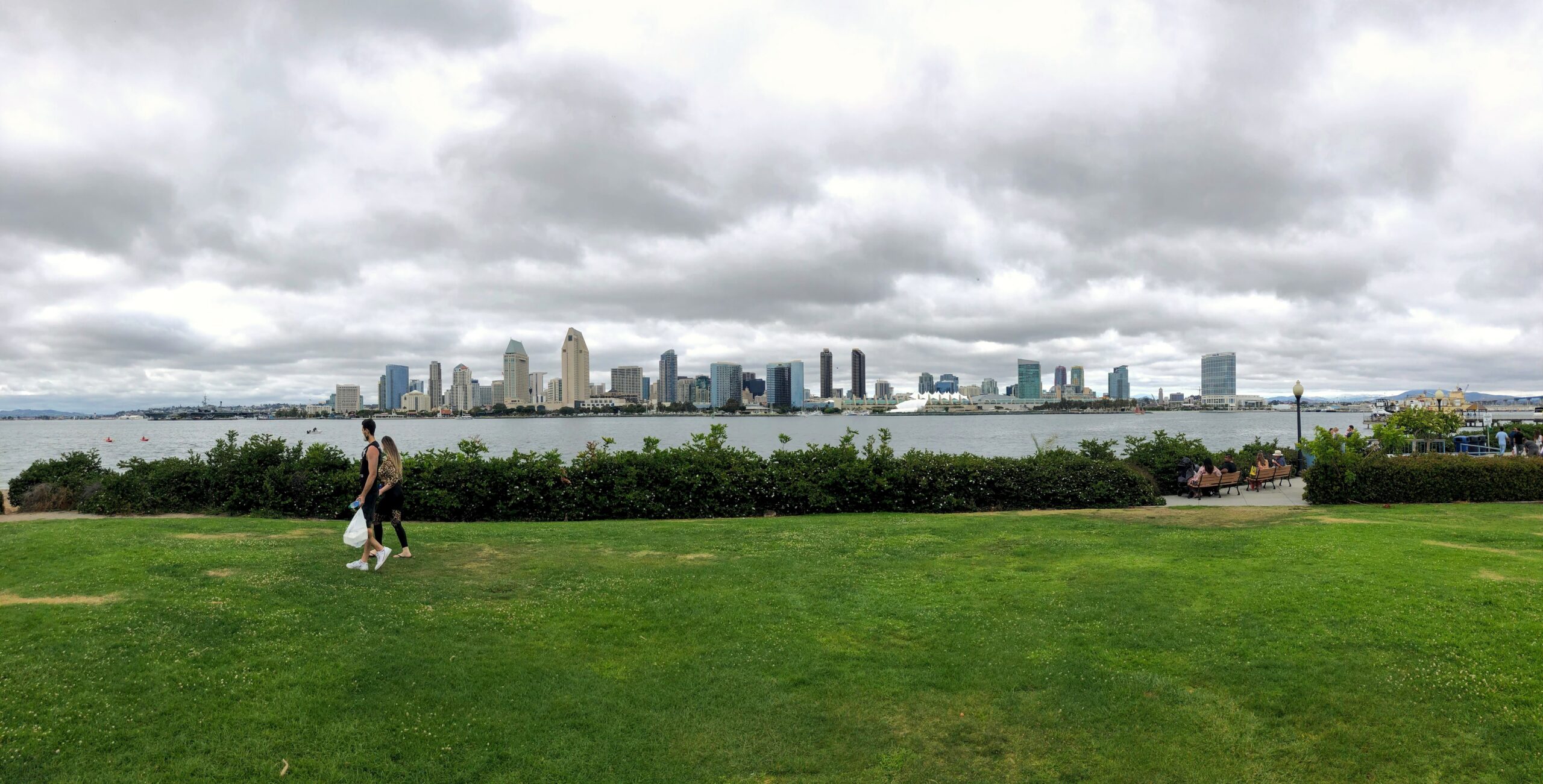
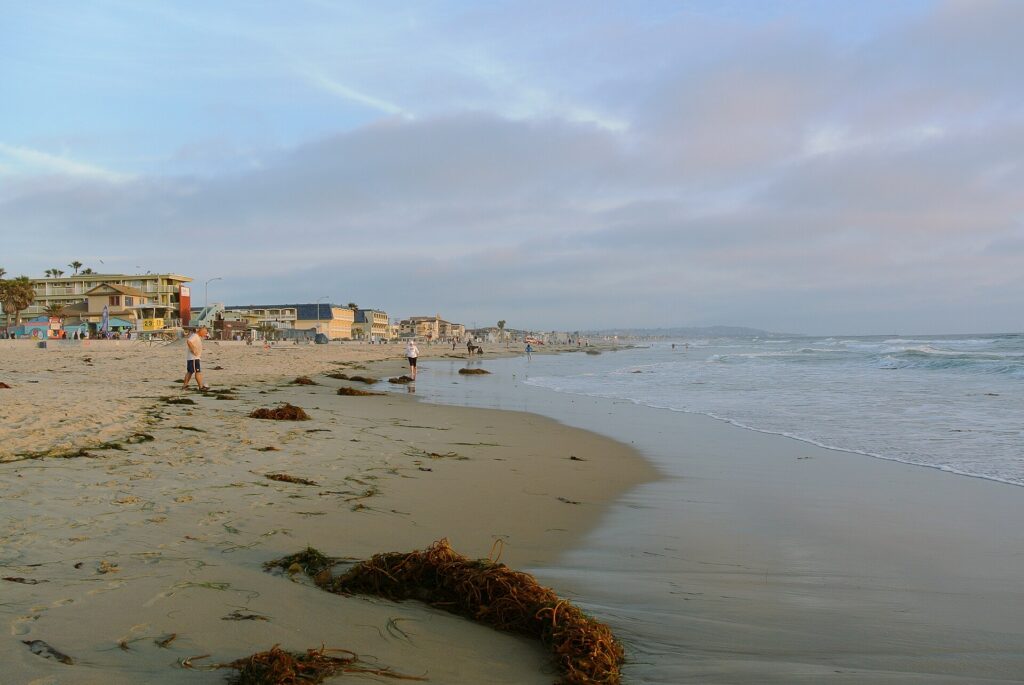
    The sand and surf at Pacific Beach in San Diego
    Pacific Beach in summer, the busiest and most expensive season on the San Diego coast (Photo: Adbar via Wikimedia Commons, CC BY-SA 3.0)

    San Diego weather, season by season

    San Diego sits on the Pacific in the far southwest corner of the country, and the cool California Current offshore moderates its climate in every season. It receives only about 250 mm (10 inches) of rain a year, almost all of it between November and March, and sees long runs of dry, sunny weather from summer into fall. The figures below are approximate seasonal patterns at San Diego International Airport, on the bay, based on the long-term climate normals published by NOAA and the National Weather Service’s San Diego office; check the current forecast before you pack, especially for winter storms and for Santa Ana wind and fire warnings in the fall.

    MonthTypical daytime highTypical overnight lowWhat it feels likeFare pressure
    Januaryaround 19 °C (66 °F)around 9 °C (49 °F)Mild, often clear days and cool nights; the wettest stretch of the yearLow; busier around the holiday weekends
    Februaryaround 19 °C (66 °F)around 10 °C (51 °F)Similar to January, with occasional rainstorms; gray whales offshoreLow; Presidents’ Day weekend busier
    Marcharound 19 °C (67 °F)around 12 °C (53 °F)Pleasant and green; the last of the rainModerate to high; spring break
    Aprilaround 21 °C (69 °F)around 13 °C (56 °F)Mild and mostly dry; wildflowers inlandModerate; Easter and spring break weeks higher
    Mayaround 21 °C (70 °F)around 16 °C (60 °F)May Gray: cloudy mornings on the coast, sun inlandModerate; Memorial Day weekend busy
    Junearound 23 °C (73 °F)around 17 °C (62 °F)June Gloom: gray starts, warm afternoonsHigh from mid-month; county fair
    Julyaround 24 °C (76 °F)around 19 °C (66 °F)Sunny and warm; the marine layer burns off earlierPeak; Fourth of July, Comic-Con
    Augustaround 26 °C (78 °F)around 20 °C (68 °F)The warmest month, with the warmest oceanPeak until mid-month, easing after
    Septemberaround 26 °C (78 °F)around 19 °C (66 °F)Warm and sunny; occasional hot spellsModerate after Labor Day
    Octoberaround 24 °C (75 °F)around 16 °C (61 °F)Clear and warm; Santa Ana winds possibleModerate
    Novemberaround 21 °C (70 °F)around 12 °C (54 °F)Mild and sunny; the first rains late in the monthModerate; Thanksgiving spike
    Decemberaround 19 °C (66 °F)around 9 °C (48 °F)Mild days, chilly nights, occasional rainLow until mid-month, then high

    Three things the table cannot show. First, the marine layer: in late spring and early summer, a deck of low cloud forms over the cool ocean at night and covers the coast until late morning or, on some days, all day. Locals call it May Gray and June Gloom, and it can make a beach day in early June feel cooler than one in October. Second, the ocean lags the air: the water is coolest in late winter and spring and warmest in August and September, so late summer and early fall are the best months for swimming, surfing and snorkeling without a wetsuit. Third, the Santa Ana winds: a few times each fall and winter, hot, dry winds blow from the deserts toward the coast, sending temperatures well above normal, dropping humidity to near zero and raising the wildfire danger across the county.

    How San Diego fare seasons work

    San Diego International is one of the busiest single-runway commercial airports in the country, with Southwest as its largest carrier, a strong Alaska Airlines presence, the other big U.S. airlines serving their hubs, and a handful of international routes to Canada, Mexico, Europe and Asia. That low-cost competition keeps domestic fares reasonable in most months, especially from the West and Southwest, and it means the sharpest price swings are in the hotel rooms. Three calendars drive them: school holidays, which fill the beach hotels from mid-June to August and again at spring break and the winter holidays; the convention calendar, led by Comic-Con in July, which can lift downtown rates in any month; and big events such as the county fair, the Del Mar racing season and major sporting weekends. The result is a long, expensive summer, busy holiday spikes, and quiet, good-value stretches in winter and after Labor Day.

    Peak season

    Mid-June to late August, plus spring break, Thanksgiving week, the Christmas and New Year holidays, and Comic-Con week. In summer the beach hotels charge their highest rates and weekends book up weeks ahead. If you must travel in peak, book the hotel early, fly midweek, and consider staying downtown or in Mission Valley, where rates are often lower than on the sand and the Trolley links you to the sights.

    Shoulder season

    March to May outside spring break, and mid-September to early November. These are many locals’ favorite months: spring is green, mild and quiet midweek, although May brings the gray mornings, and fall is warm, clear and uncrowded once the schools go back. Watch Easter, Memorial Day, the Labor Day weekend and big conventions.

    Low season

    Mid-November to mid-December outside Thanksgiving, and January and February outside the holiday weekends. Hotel rates are at their lowest of the year, and the zoo and Balboa Park are quiet. The ocean is cold for swimming, but it is prime time for whale watching and golf.

    As elsewhere, midweek departures and early or late flights usually price below Friday and Sunday afternoons on the same route, and a search across a whole month reveals cheaper pairs of dates close to your first choice. Our guide to the best times to book explains how to read those patterns.

    San Diego month by month

    January

    Quiet, mild and good value. Winter storms bring most of the year’s rain, usually a day or two at a time. Gray whales pass the coast on their southbound migration, and the PGA Tour’s event at Torrey Pines usually arrives late in the month or in early February. Martin Luther King Jr. weekend is busier; the rest of the month is one of the cheapest windows of the year.

    February

    Much like January, with a chance of rain and some of the clearest views of the year between storms. Whale watching peaks as the gray whales head north again with their calves, hotel rates stay low apart from Presidents’ Day weekend.

    March

    Green hills, the last of the rain, and the arrival of spring break, which lifts hotel rates and fills the beaches and theme parks for several weeks, depending on school calendars. In a wet year, the desert wildflowers at Anza-Borrego are spectacular, and the Flower Fields in Carlsbad start to bloom. The Padres open their season at the end of the month or in early April.

    April

    Mild and mostly dry, with the Flower Fields in full color and the San Diego Crew Classic rowing regatta on Mission Bay early in the month. Easter week and the tail of spring break are busy; the rest of April is a strong shoulder month for a city break.

    May

    The start of May Gray: many mornings on the coast are overcast and cool, and some days the sun never breaks through, while inland is warm and bright. Hotel rates are moderate until Memorial Day weekend, which marks the unofficial start of summer.

    June

    June Gloom continues, especially early in the month, but afternoons warm up and schools let out by mid-month, when rates jump. The San Diego County Fair runs at the Del Mar Fairgrounds from early June into early July. Book beach hotels early for the second half of the month.

    July

    Sunny, warm and the most expensive month of the year. The Fourth of July brings fireworks over the bay and crowds on every beach, the Del Mar racing season opens in mid-July, San Diego Pride fills Hillcrest, and Comic-Con International takes over the convention center and the whole of downtown for several days, usually in the second half of the month. During Comic-Con, downtown hotels sell out months in advance and rates rise across the city.

    August

    The warmest month, with the warmest ocean, and peak season until the schools go back, which in California can be as early as mid-August. After that, weekday rates ease noticeably while the weather stays perfect.

    September

    One of the best months of the year. After Labor Day weekend, the crowds thin, hotel rates fall, and the weather is warm and sunny, with the ocean still at its warmest. Occasional hot spells, sometimes driven by Santa Ana winds, can push the temperature well above normal even on the coast.

    October

    Clear, warm and quiet, with some of the most reliable sunshine of the year. Santa Ana winds are most likely from October on and bring hot, dry days and fire warnings. Rates are moderate apart from big convention weeks.

    November

    Mild and sunny, with the first winter rain usually arriving late in the month. Rates are moderate until Thanksgiving week, when fares from across the country rise. The San Diego Bay Wine and Food Festival usually runs in November.

    December

    Two months in one. The first half is quiet and good value, with December Nights, Balboa Park’s free holiday festival, in early December. From the week before Christmas, fares and hotel rates jump for the holidays, and the Holiday Bowl college football game brings fans to town near the end of the month.

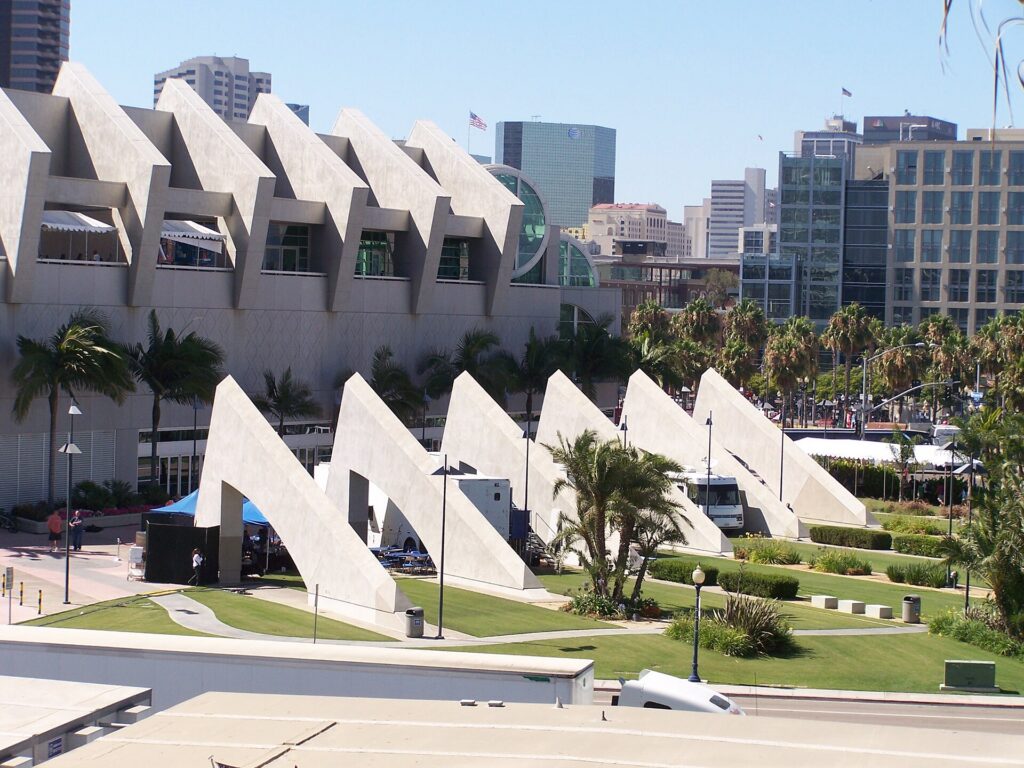
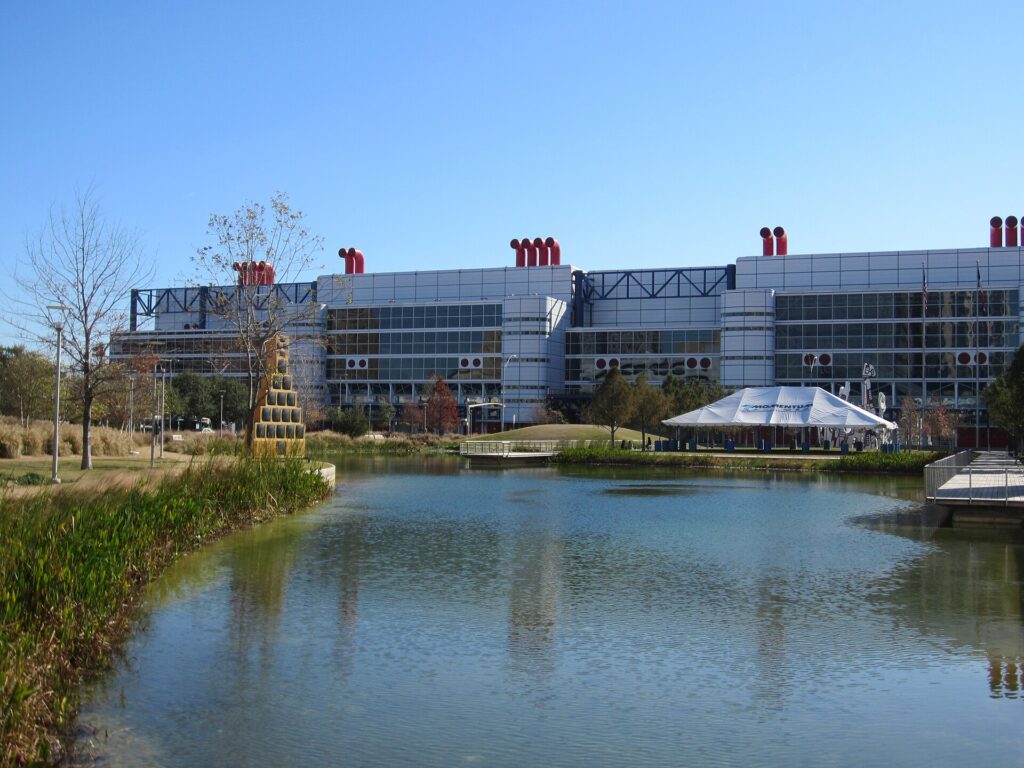
    The San Diego Convention Center during Comic-Con
    The San Diego Convention Center, home of Comic-Con, the biggest hotel week of the year (Photo: William Tung via Wikimedia Commons, CC BY-SA 2.0)

    Events that move San Diego flight and hotel prices

    Cross-check these against your dates before you book. Exact dates shift each year; the San Diego Tourism Authority keeps the current calendar.

    • Comic-Con International (July, San Diego Convention Center): the biggest hotel spike of the year; badges sell out long in advance through Comic-Con’s own site.
    • Spring break (March and early April, varying by school district and university).
    • San Diego County Fair (early June to early July, Del Mar).
    • Fourth of July and the Del Mar racing season (mid-July to early September).
    • San Diego Pride (July, Hillcrest).
    • Memorial Day and Labor Day weekends: the bookends of beach season.
    • Thanksgiving week and the Christmas and New Year holidays, including the Holiday Bowl.
    • Big conventions at the convention center in any month, and Padres and San Diego FC home games. Our San Diego events page shows what is on sale for your dates.

    Getting in from the airport

    San Diego International (SAN), sometimes still called Lindbergh Field, sits on the bay about 5 kilometers (3 miles) northwest of downtown, which makes it one of the most convenient big-city airports in the country. It has two terminals, Terminal 1 and Terminal 2; Terminal 1 has been rebuilt as part of a multi-year redevelopment, so road and parking layouts are still changing, and it is worth checking the airport’s site for current details. Getting downtown is easy: a taxi or ride-hail takes about ten minutes outside rush hour; public transit options include an MTS bus and the airport’s shuttle to the Old Town Transit Center, where you can change to the Trolley, the Coaster and Amtrak; and shuttle buses run from the terminals to the consolidated Rental Car Center on the north side of the airport. The airport has an overnight curfew on departures, so the last flights out leave before midnight and the first leave after dawn. Our San Diego car-versus-transit guide works through whether to rent, and our SAN airport guide covers the layout.

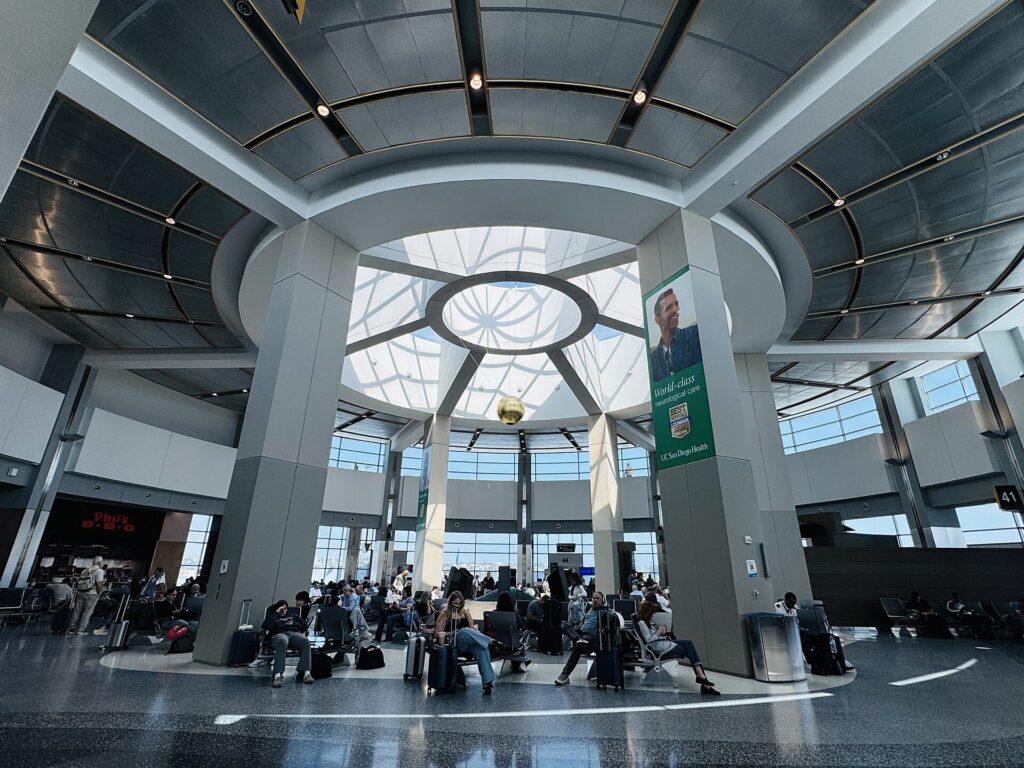
    Terminal 2 at San Diego International Airport (SAN)
    San Diego International (SAN), about 5 km (3 miles) from downtown (Photo: Missvain via Wikimedia Commons, CC0)

    Timing tricks that work for San Diego

    • Price the room first. Airline competition at SAN keeps many fares steady, while beach hotel rates can double between February and July. Run a San Diego hotel search for your dates before you commit to the flight, and check whether a big convention is in town.
    • Search the whole month. Comic-Con, spring break and holiday weekends create sharp edges in the calendar; a calendar search on TicketScanner shows them instantly, and the week after Labor Day is often far cheaper than the week before.
    • Fly midweek. Friday and Sunday afternoons are the busiest times at SAN; Tuesday to Thursday is usually the value.
    • Compare Los Angeles. LAX has far more international and long-haul flights, and the drive or the Pacific Surfliner train takes two to three hours; compare fares with our Los Angeles flights page and our guide to the best time to fly to Los Angeles, and see the Los Angeles to San Diego route guide.
    • Consider Tijuana for Mexico. The Cross Border Xpress, a pedestrian bridge from the U.S. side at Otay Mesa straight into Tijuana’s airport, opens up Mexican domestic fares. You need a ticket for a flight from Tijuana and a valid passport; Mexico’s Instituto Nacional de Migración sets the entry rules, and the U.S. return goes through normal CBP inspection.
    • Allow for the marine layer. Low cloud occasionally slows early-morning arrivals in late spring and summer; a buffer for tight connections helps, and our guide to how early to arrive covers what to allow.
    • Flying out of San Diego instead? The same seasonality applies in reverse; see cheap flights from San Diego.
    Sunset Cliffs on the Point Loma peninsula in San Diego
    Sunset Cliffs on Point Loma, as good in a clear January as in July (Photo: Tuxyso via Wikimedia Commons, CC BY-SA 3.0)

    May Gray, June Gloom and the beach calendar

    If the beach is the point of the trip, the calendar matters more than the table suggests. From roughly May to early July, the marine layer often sits over the coast until late morning, and some days it never clears; the sand is quieter, the light is soft, and a sweater is welcome, but it is not the postcard. From mid-July, the clouds burn off earlier and the afternoons are reliably bright. The water is warmest from August into early October, typically around 20 to 22 °C (high 60s to low 70s Fahrenheit), and coolest from January to April, when most surfers wear full wetsuits. After heavy winter rain, check the county’s beach water quality advisories before swimming. The practical conclusion: for swimming and sunbathing, September is the sweet spot, with warm water, clear skies and lower rates; for a mild, affordable city break with beach walks rather than beach days, January to April works well.

    What to pack, by season

    Winter (December to February): layers for mild days, a warm jacket for evenings that can drop below 10 °C (50 °F), a light rain shell, and sunglasses; add warmer clothing if you are heading to Julian or the mountains, where it can snow. Spring (March to May): light clothing, a sweater or jacket for gray mornings and cool evenings, and sunscreen. Summer (June to September): beachwear, a hat and high-factor sunscreen, which you need even under the marine layer, plus a light layer for evenings on the water. Fall (October to November): summer clothing into October, with a jacket for November nights. In every season, bring comfortable walking shoes for Balboa Park and the cliffs.

    The best time to fly to San Diego for…

    Beaches and swimming

    Late July to early October, and especially September after Labor Day, when the water is warmest and the crowds have thinned.

    Whale watching

    December to March for gray whales migrating along the coast, with a peak in January and February; blue whales and other species feed offshore in summer.

    Comic-Con

    Plan months ahead: secure the badge first, then book the hotel through the official housing process or as early as possible, and compare flights into SAN and LAX.

    Baseball

    April to September at Petco Park; weeknight games and midweek flights in April, May and September are the best value.

    The lowest prices

    January and February outside the holiday weekends, with mid-November to mid-December close behind.

    Families

    Summer for the warmest beaches, if you book early and accept peak rates; spring break and fall break for comfortable weather and slightly lower prices. The zoo, LEGOLAND and SeaWorld are quieter midweek outside school holidays.

    Road trips

    Spring and fall for combining San Diego with Los Angeles or Phoenix; in summer, the drive east on I-8 crosses some of the hottest desert in the country, so see our guide to the best time to fly to Phoenix before planning a desert leg.

    Cross-border and international visitors

    Canadians need a valid passport; travelers from Visa Waiver Program countries need an approved ESTA before boarding, and everyone else needs a visa. U.S. Customs and Border Protection explains what applies to you, including for re-entry after a day in Tijuana, and the TSA lists what you can carry through security.

    Frequently asked questions

    What is the cheapest month to fly to San Diego?

    For the total trip, January and February, when hotel rates are at their lowest outside the holiday weekends; airfares are usually reasonable too. Early December and late September are close behind.

    What is the best month to visit San Diego for weather?

    September and October, with warm, clear days and the warmest ocean. April and early November are close behind.

    Is San Diego warm enough for the beach in winter?

    For walking, sitting in the sun and tide pooling, often yes, with afternoons around 19 °C (66 °F). For swimming, the ocean is cold without a wetsuit.

    What is June Gloom?

    The low marine cloud that often covers the coast on late-spring and early-summer mornings, sometimes all day. It usually clears inland first and becomes less frequent from mid-July.

    How expensive is San Diego during Comic-Con?

    It is the most expensive week of the year for downtown hotels, and rates rise across the city. Flights rise less sharply. Book as early as possible, or avoid those dates if you are not attending.

    How far ahead should I book?

    Well ahead for summer, Comic-Con, spring break and the holidays; for winter and fall, rates are stable enough that choosing the right dates matters more than booking early.

    Does it rain much in San Diego?

    No. About 250 mm (10 inches) a year, almost all between November and March, often in a few storms. Summers are nearly dry.

    Ready to pick your dates? Compare fares across the whole month on our San Diego flights page, then find a room with our San Diego hotel search, perhaps in the Gaslamp Quarter. For what to do when you land, start with our first-timer’s guide to San Diego.

  • Best Time to Fly to Philadelphia: Seasons, Weather & Prices

    Best Time to Fly to Philadelphia: Seasons, Weather & Prices

    Philadelphia is one of the easiest big cities in the country to time well, because its price calendar is driven by a handful of predictable things rather than by one overwhelming season. There is the tourist calendar, which peaks with the Fourth of July in the city where the Declaration of Independence was signed and stays busy through the summer. There is the university calendar, with dozens of colleges in and around the city sending families into hotels for move-in weekends in late August and graduations in May. There is the convention calendar at the Pennsylvania Convention Center, which can fill Center City hotels on any weeknight of the year. And there is the sports calendar, which in a city this devoted to its teams can tighten rooms on an Eagles weekend in a way that surprises visitors. Philadelphia International is also a major American Airlines hub with nonstop service across the country and to Europe, so fares from most places are competitive in every month. This guide walks through the weather month by month, the fare and hotel seasons, the events that move prices, and how to get into the city from the airport.

    The short answer

    For the best balance of weather and price, go in late April to mid-May, before the summer heat and outside the graduation weekends, or in late September through October, when the humidity has broken, the evenings are cool and the fall foliage is starting in Fairmount Park and along the Wissahickon. The cheapest time to fly and stay is January and February, outside the long weekends and the Flower Show in early March, with the first three weeks of November close behind. The most expensive stretches are the Fourth of July week, the summer from mid-June to mid-August, the graduation weekends in May, Thanksgiving and the Christmas to New Year period, and any weekend when a big convention, a stadium concert or an Eagles playoff game lands in town. Whatever you choose, run a flexible-date search on our Philadelphia flights page; moving your trip by a few days around a holiday weekend or a graduation can change the fare band entirely.

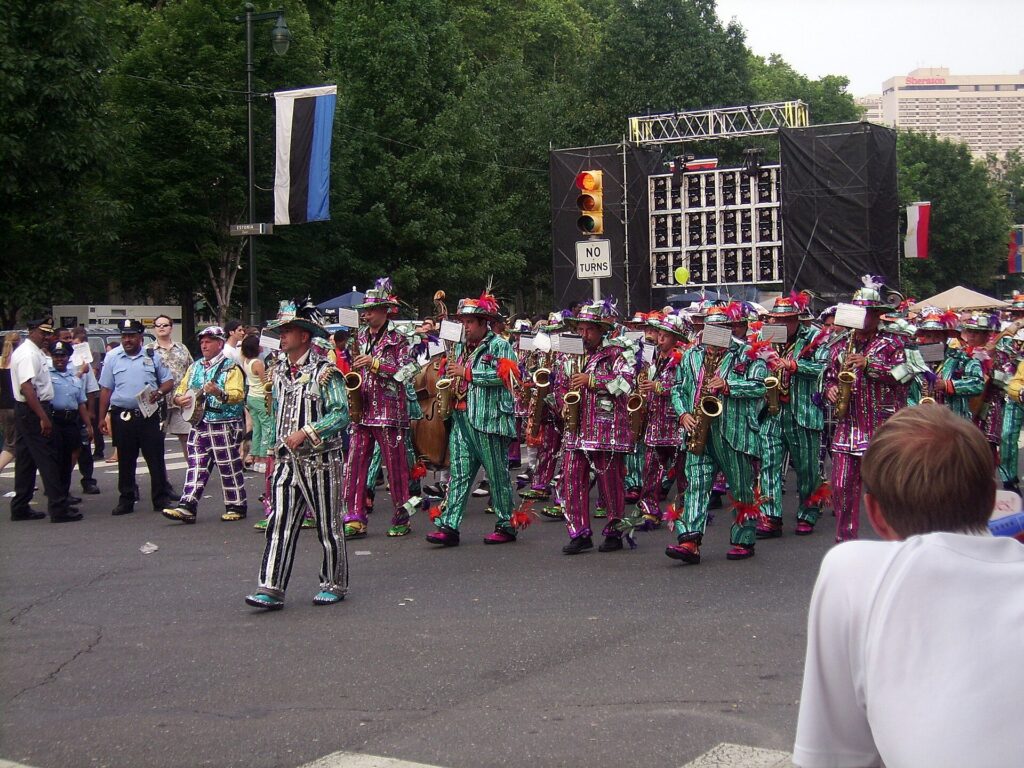
    A band marching in the Fourth of July parade in Philadelphia
    The Fourth of July parade in Philadelphia, the peak of the city's busiest and most expensive week (Photo: Reading Tom from Reading, UK via Wikimedia Commons, CC BY 2.0)

    Philadelphia’s weather, season by season

    Philadelphia sits between the Delaware and Schuylkill rivers, about 100 kilometers (60 miles) inland from the Atlantic, with a humid climate that gives it four very distinct seasons. Summers are hot and sticky with afternoon thunderstorms, winters are cold with a few snowfalls most years and the occasional big storm, and spring and fall are the seasons worth planning a trip around. The figures below are approximate seasonal patterns based on the long-term climate normals for Philadelphia International Airport from NOAA’s National Weather Service, whose Mount Holly office covers the city; check the current forecast before you pack, because March and November can each hold a mild afternoon and a hard freeze in the same week.

    MonthTypical daytime highTypical overnight lowWhat it feels likeFare pressure
    Januaryaround 5 °C (41 °F)around -3 °C (27 °F)Cold and often gray; snow in some years, raw wind off the riversLow, except New Year’s Day and MLK weekend
    Februaryaround 7 °C (45 °F)around -2 °C (28 °F)Still cold; the likeliest month for a heavy snowstormLow; rises for Presidents’ Day weekend
    Marcharound 12 °C (54 °F)around 2 °C (36 °F)Changeable; mild spells, late snow and plenty of windModerate; the Flower Show and spring break
    Aprilaround 18 °C (64 °F)around 7 °C (45 °F)Spring proper; cherry blossoms, showers, green parksModerate; school groups arrive
    Mayaround 24 °C (75 °F)around 13 °C (55 °F)Warm and pleasant; humidity starts to build late in the monthHigh on graduation weekends
    Junearound 29 °C (84 °F)around 18 °C (64 °F)Hot and humid; long evenings and thunderstormsHigh
    Julyaround 31 °C (88 °F)around 22 °C (72 °F)The hottest month; heat waves push the heat index far higherPeak around the Fourth, then high
    Augustaround 30 °C (86 °F)around 21 °C (70 °F)Hot and sticky; locals leave for the Jersey ShoreHigh, easing after mid-month
    Septemberaround 26 °C (79 °F)around 17 °C (63 °F)Warm and gradually drier; tropical storm remnants possibleModerate, falling after Labor Day
    Octoberaround 20 °C (68 °F)around 10 °C (50 °F)Crisp, sunny and colorful; many locals’ favorite monthModerate; high on convention weeks
    Novemberaround 14 °C (57 °F)around 4 °C (39 °F)Cool and increasingly gray; the leaves finish early in the monthLow until Thanksgiving week
    Decemberaround 8 °C (46 °F)around 0 °C (32 °F)Cold and festive; snow is possible but not reliableLow until mid-month, then peak

    Three things the table cannot show. First, the humidity: a July afternoon at 31 °C (88 °F) in Philadelphia feels much hotter than the same temperature in a dry climate, and the brick and asphalt of Center City hold the heat long after sunset, so plan the historic sites for the morning and the air-conditioned museums for the afternoon. Second, the snow: the city averages a modest amount each winter, but it tends to come in a few storms rather than a steady covering, and one big nor’easter can close schools and snarl flights for a day or two. Third, the rivers and the wind: a January day that looks mild on paper can feel bitter on the open plaza of Independence Mall or along the Delaware waterfront, so pack for the wind chill rather than the thermometer.

    How Philadelphia’s fare seasons work

    Four calendars drive seats and rooms in Philadelphia. The leisure calendar builds from the spring school-trip season into a summer peak around the Fourth of July. The university calendar puts parents into hotels for move-in in late August, family weekends in the fall and a run of commencement weekends through May, with the University of Pennsylvania’s graduation in mid-May the biggest single squeeze on Center City and University City rooms. The convention calendar at the Pennsylvania Convention Center, one of the largest in the Northeast, fills downtown hotels on weeknights with little regard for the season. And the sports calendar adds pressure on Eagles weekends in the fall and during any playoff run. Airfares are steadier than hotel rates, because PHL is a large American Airlines hub with competition from other carriers on the busiest routes, but the flights that matter to leisure travelers, Friday and Sunday afternoons, fill quickly on the big weekends. The pattern is a summer plateau with a sharp Fourth of July spike, a strong spring and fall, and a genuinely cheap winter.

    Peak season

    Mid-June to mid-August, the Fourth of July week above all, plus Thanksgiving week and roughly December 20 to January 2. The Fourth is Philadelphia’s own holiday: the Welcome America festival runs for days around it, and the free Parkway concert and fireworks draw huge crowds, so Old City and Center City hotels fill and rates climb well ahead. The rest of the summer is steady family and international travel, with the heat keeping a lid on the very highest prices. Graduation weekends in May behave like peak for hotels even though flights are only moderately busy. If you must travel in peak, book early, fly mid-week, and compare hotels near City Hall and in University City with those in Old City.

    Shoulder season

    April to early June and September to October. April brings the cherry blossoms and the first Phillies games but also the school groups that crowd Independence Hall into June; May is lovely apart from the graduation weekends. September, after Labor Day, is warm and quieter, and October is often the best month of the year for walking the city, with the foliage turning in Fairmount Park and along the Wissahickon at the end of the month. Watch the convention calendar and Eagles home dates, which can push weekday or weekend rates into peak territory at short notice.

    Low season

    January to early March, and November before Thanksgiving. Fares and hotel rates are at their lowest, the museums are at their emptiest, and the city is still busy enough to feel alive, with the 76ers and Flyers at home, the ice rinks open at Dilworth Park and on the waterfront, and restaurants eager for business. The exceptions are New Year’s Day, when the Mummers Parade fills Broad Street, the MLK and Presidents’ Day long weekends, and the Flower Show in early March. Build a weather buffer into any connection in January and February.

    As elsewhere, mid-week departures and early morning or late evening flights usually price below Friday and Sunday afternoons on the same route, and a search across a whole month reveals cheaper pairs of dates close to your first choice. Our guide to the best times to book explains how to read those patterns.

    Philadelphia month by month

    January

    Cold, gray and, after New Year’s Day, one of the cheapest months of the year. The Mummers Parade opens the year with string bands and sequined costumes along Broad Street, and then the city settles into winter. Highs hover a few degrees above freezing, snow falls in some years, and the major museums, from the art museum to the Barnes and the Penn Museum, are at their least crowded. Independence Hall and the Liberty Bell have the shortest lines of the year. Hotel rates in Center City drop sharply outside convention weeks, and a museum-and-restaurant long weekend is exceptional value.

    February

    Similar weather, with the highest chance of a real snowstorm, and low fares outside the Presidents’ Day weekend. The 76ers and Flyers are deep into their seasons at the arena in South Philadelphia, Philly Restaurant Week often falls in the winter months, and the skating rinks are open. If you are flexible, February is the month to find the lowest combination of flight and hotel prices.

    March

    Changeable, with mild afternoons, late snow and plenty of wind. The Philadelphia Flower Show, one of the largest and oldest in the world, fills the Convention Center for about a week in early March and brings a noticeable hotel spike to Center City. St. Patrick’s Day brings a parade and packed bars, and college spring breaks nudge fares from other cities up for a couple of weeks. The second half of March, with the first blossoms appearing, is a good value window.

    April

    Spring proper. The cherry trees bloom in Fairmount Park, around the Horticultural Center and along the river in the first half of the month, and a cherry blossom festival centered on the park’s Japanese House and Horticultural Center marks the season. The Phillies open their season at Citizens Bank Park, the Penn Relays fill Franklin Field in the last week of April, and school groups begin to crowd the historic district. Book Independence Hall tickets ahead from now until June.

    May

    Warm, green and one of the best months to walk the city, with one caveat: graduation weekends. Penn, Temple, Drexel, Villanova and many other colleges hold commencements across the month, and Penn’s in mid-May in particular fills hotels in University City and Center City. The Broad Street Run, a ten-mile race down the city’s spine, is usually the first Sunday of May, and Memorial Day weekend opens the Shore season. Check your dates against the university calendars before booking.

    June

    Hot, humid and busy. Spruce Street Harbor Park opens on the Delaware waterfront, the Odunde Festival on South Street is one of the largest African American street festivals in the country, Philly Pride fills the Gayborhood, and the Roots Picnic brings a big hip-hop and soul lineup to the city around the start of the month. Welcome America begins in the last days of June. Fares climb steadily as schools finish; early June is the value play.

    July

    Peak season, and the Fourth of July is the main event: a week of Welcome America festivities with free museum days, neighborhood block parties, the parade past Independence Hall, and the free concert on the Benjamin Franklin Parkway that ends with fireworks over the art museum. Rooms in Old City and Center City are at their annual maximum and sell out early. The rest of July is hot, with heat waves that make midday sightseeing hard work; the Phillies at home on a summer evening is the classic way to spend it.

    August

    Hot and sticky, and noticeably quieter as locals head for the Jersey Shore. Hotel rates often ease in the first half of the month, before the college move-in weekends late in August send parents and students into the city’s hotels, and before Labor Day weekend. For a visitor who can handle the heat and plans indoor afternoons, the middle of August can be surprisingly good value.

    September

    Warm, gradually drier and much calmer after Labor Day. The Philadelphia Fringe Festival fills theaters and odd spaces across the city for most of the month, the Eagles season begins, and the waterfront parks are still open. Remnants of tropical storms occasionally bring a day or two of heavy rain. Fares and hotel rates fall after Labor Day, apart from Eagles home weekends and big conventions.

    October

    Crisp, sunny and colorful, and for many Philadelphians the best month of the year. The foliage turns in Fairmount Park and along the Wissahickon in the second half of the month, Eastern State Penitentiary runs its famous Halloween nights, and in years when the Phillies reach the postseason the whole city turns red. Rates are moderate but can jump on college family weekends and convention weeks, so compare a few date pairs.

    November

    Cool and increasingly gray, with the leaves finishing early in the month and some of the lowest prices of the year until Thanksgiving. The Philadelphia Marathon takes over the Parkway and the river drives the weekend before Thanksgiving, and on Thanksgiving morning one of the oldest holiday parades in the country marches through Center City. The Christmas Village opens near City Hall in late November, and the Eagles are in full swing.

    December

    Two months in one. The first half is festive and reasonably priced, with the Christmas Village, the rinks at Dilworth Park and on the waterfront, and holiday concerts on the Avenue of the Arts. In years when the Army-Navy Game is played in Philadelphia, that December weekend fills hotels. From about December 20, fares climb for the holidays and stay high through New Year’s Day and the Mummers.

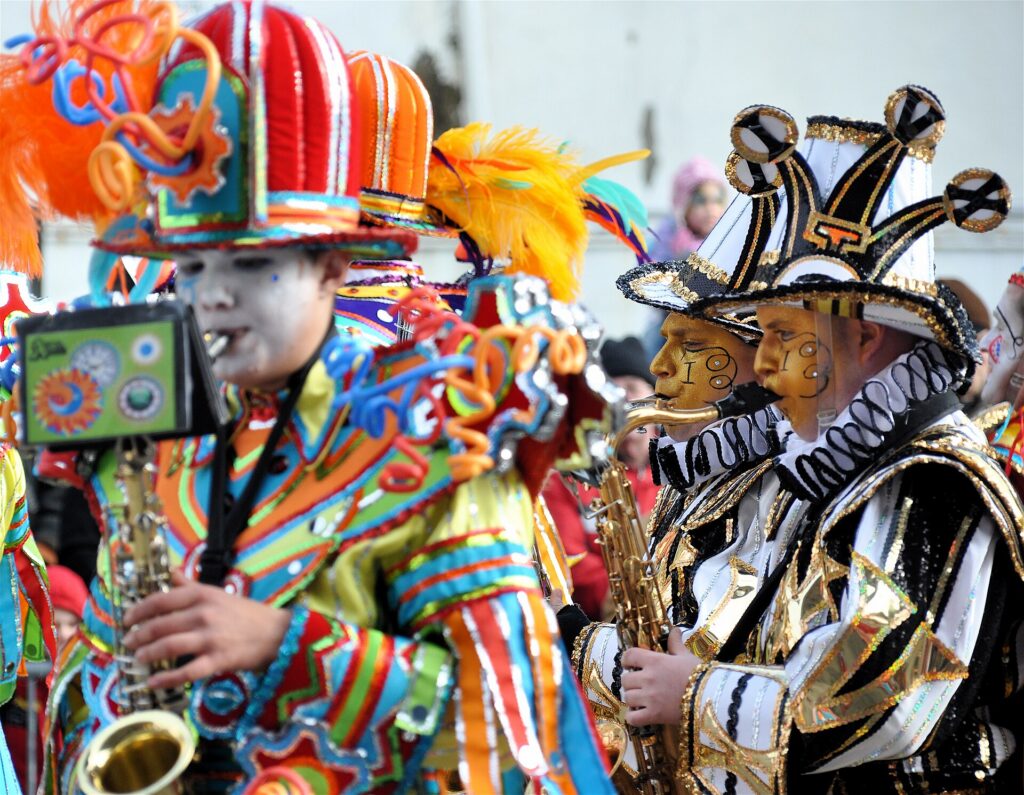
    Costumed performers in the Mummers Parade on New Year's Day in Philadelphia
    The Mummers Parade on New Year's Day, the colorful start to Philadelphia's cheapest season (Photo: Kevin Burkett from Philadelphia, Pa., USA via Wikimedia Commons, CC BY-SA 2.0)

    Events that move Philadelphia flight and hotel prices

    Cross-check these against your dates before you book. Exact dates shift each year; Visit Philadelphia keeps the current calendar.

    • New Year’s Day and the Mummers Parade on Broad Street.
    • Philadelphia Flower Show (early March) at the Convention Center.
    • Penn Relays (last week of April) at Franklin Field.
    • Graduation weekends (through May), especially Penn’s in mid-May.
    • Welcome America and the Fourth of July (late June to July 4): the single biggest hotel spike of the year in Old City and Center City.
    • College move-in (late August) and Labor Day weekend.
    • Eagles home games (September to January), and any Eagles, Phillies, 76ers or Flyers playoff run. Our Philadelphia events page shows what is on sale for your dates.
    • Philadelphia Marathon (the weekend before Thanksgiving) and Thanksgiving itself.
    • Christmas to New Year, plus the Army-Navy Game in the years it is played in the city.
    • Large conventions, which can fill Center City hotels on weeknights without warning; if your mid-week rates look strangely high, that is usually why.

    Getting in from the airport

    Philadelphia International (PHL) is in the southwest corner of the city beside the Delaware River, about 13 km (8 miles) from Center City, and it is the only major airport most visitors need to consider. It is a large hub for American Airlines, which flies nonstop to most big U.S. cities and to a long list of European destinations, and most other major U.S. carriers serve it too. The terminals are lettered A to F along a single curving building, with international flights mainly at Terminal A. Getting downtown is straightforward: the SEPTA Airport Line regional train stops at every terminal and runs to University City, 30th Street Station, Suburban Station and Jefferson Station in around 25 minutes, typically every half hour; taxis charge a flat fare to Center City; ride-hail pickups are in marked zones; and the rental car companies run shuttles from the terminals to their lots. Traffic on I-95 can stretch the drive from 20 minutes to well over 40 at rush hour, which is when the train earns its keep. Two alternatives are worth knowing about. Newark and Baltimore/Washington airports are each around 90 minutes away by car or train and occasionally have cheaper fares, and for travelers coming from New York, Washington or Boston, Amtrak to 30th Street Station is often faster door to door than flying. Our PHL airport guide covers the layout, and our car-versus-transit guide explains the onward options.

    Terminal B at Philadelphia International Airport (PHL)
    Philadelphia International (PHL), a major American Airlines hub about 13 kilometers (8 miles) from Center City (Photo: Dough4872 via Wikimedia Commons, CC BY-SA 4.0)

    Timing tricks that work for Philadelphia

    • Search the whole month. The Fourth of July, graduation weekends and holiday weekends create sharp edges in the fare calendar, and a calendar search on TicketScanner shows them instantly.
    • Book the hotel first around the Fourth and in May. A cheap fare into Welcome America week or Penn’s graduation weekend is not cheap once the room is added. Run a Philadelphia hotel search for the same dates before you commit to either.
    • Check the convention calendar. If mid-week rates in Center City look high, shift a night or two, or look at University City and the hotels near the airport on the Airport Line.
    • Fly mid-week, stay the weekend. Business travel makes Monday morning and Thursday evening flights busy; Tuesday and Wednesday departures and Saturday night stays are usually the value.
    • Compare the train. From New York, Washington or Boston, price Amtrak or a drive against the flight; our route guides for Washington, DC to Philadelphia and Philadelphia to Boston cover the road option.
    • Build a winter buffer. Snow and nor’easters can disrupt PHL between December and March; avoid the tightest connections. Our guide to how early to arrive covers what to allow.
    • Flying out of Philadelphia instead? PHL’s hub status means good nonstop options in every direction; see cheap flights from Philadelphia.
    Shoppers browsing food stalls inside Reading Terminal Market
    Reading Terminal Market, a Philadelphia institution since 1893 (Photo: ajay_suresh via Wikimedia Commons, CC BY 2.0)

    What to pack, by season

    Winter (December to February): a warm, windproof coat, a hat, gloves and waterproof shoes, because slush at the curb is more common than snow on the ground. Spring (March to May): layers, a light rain jacket and an umbrella, and a warmer layer for March evenings. Summer (June to August): light, breathable clothing, a refillable water bottle, sun protection and a light layer for air-conditioned museums and restaurants that can feel chilly after the heat outside. Fall (September to November): layers again, a medium jacket by late October, and comfortable walking shoes in every season, because the brick sidewalks and cobblestones of Old City are uneven. If a game is on the plan, add something green for the Eagles or red for the Phillies; you will fit in immediately.

    The best time to fly to Philadelphia for…

    The Fourth of July

    Arrive a few days before the Fourth to catch the Welcome America events, book as early as you can manage, and book the hotel first.

    History without the crowds

    January, February and November, when the lines at the Liberty Bell are short and timed tickets for Independence Hall are easy to get. Avoid April to June, when school groups fill the historic district.

    The best weather

    Late April to mid-May and late September to October, with October the most reliable for dry, sunny days.

    The lowest fares and hotel rates

    January and February outside the long weekends, and the first three weeks of November. Pair them with the museums and restaurants.

    Families

    Early June, before the peak, or the second half of October; in summer, plan indoor afternoons and use the waterfront parks and the Dilworth Park fountains in the evenings.

    International visitors

    Visitors from Visa Waiver Program countries need an approved ESTA before boarding; most others need a visa. The State Department’s travel site explains what applies to you, and the TSA lists what you can carry through security. For what to see once you land, start with our first-timer’s guide to Philadelphia, and if you are combining cities, our guides to New York, Washington, DC and Boston cover the rest of the Northeast Corridor.

    Frequently asked questions

    What is the cheapest month to fly to Philadelphia?

    January and February are consistently the lowest for both flights and hotels, followed by November before Thanksgiving and the second half of March outside the Flower Show.

    What is the best month to visit Philadelphia for weather?

    October, with May and late September close behind. July and August are hot and humid, and January and February are cold.

    How busy is Philadelphia around the Fourth of July?

    Very. It is the single most expensive week of the year for Old City and Center City hotels, and the Parkway concert and fireworks draw enormous crowds. Book months ahead, or come a week later for summer weather at lower prices.

    Is PHL a good airport to fly into?

    Yes. It is a large hub with plenty of nonstop options, it is close to the city, and the Airport Line train connects every terminal to Center City in around 25 minutes.

    Should I fly or take the train from New York or Washington?

    Take the train or drive. Amtrak reaches 30th Street Station from New York in roughly 70 to 90 minutes and from Washington in about two hours, which beats flying once airport time is counted.

    How far ahead should I book?

    Earlier for the Fourth of July, graduation weekends in May, Thanksgiving and the Christmas holidays, when fares tend only to rise; for January, February and November, fares are stable enough that finding the right dates matters more than booking far ahead.

    Does it snow in Philadelphia?

    Most winters bring a few snowfalls, usually in a handful of storms between December and March, and some years bring one big nor’easter. Many winter days are simply cold and dry.

    Ready to pick your dates? Compare fares across the whole month on our Philadelphia flights page, then find a room with our Philadelphia hotel search. For how to get around once you arrive, read our guide to renting a car or using public transit in Philadelphia.

  • Best Time to Fly to Houston: Seasons, Weather & Prices

    Best Time to Fly to Houston: Seasons, Weather & Prices

    Houston is a business city first, and its airfares show it. Two big airports, a United Airlines hub at Bush Intercontinental and a large Southwest Airlines operation at Hobby, compete for the traffic of the energy industry, the Texas Medical Center and one of the busiest convention calendars in the country, which keeps weekday flights full all year. Leisure demand layers on top: the rodeo in late February and March, spring break, the holidays, and the cruise passengers heading for Galveston. The weather adds its own twist. Houston’s winters are mild and its springs and falls are lovely, but its summers are long, hot and humid, and the city sits in the path of Gulf of Mexico hurricanes from June to November, which is exactly why late summer brings some of the lowest hotel rates of the year. This guide walks through the weather month by month, the fare seasons, the events that move prices, and how to choose between IAH and Hobby.

    The short answer

    For weather, the best windows are mid-October to early December and March to April, when days are warm, the humidity eases and the city lives outdoors. For value, late August and September and January after the holidays are usually the cheapest times to fly and to book a room, though late summer is hot and falls in the most active part of hurricane season. The most expensive stretches are rodeo season and spring break, from late February to mid-March, the week of the Offshore Technology Conference in early May, when the energy industry fills every hotel in the city, Thanksgiving, and the Christmas and New Year weeks. Whatever you choose, run a flexible-date search that includes both airports on our Houston flights page; a shift of a few days around the rodeo or a big convention can change the fare band entirely.

    A rodeo performance inside NRG Stadium (formerly Reliant Stadium) during the Houston Livestock Show and Rodeo
    The Houston Livestock Show and Rodeo, about three weeks from late February that fill hotels across the city (Photo: No machine-readable author provided. W0lfie assumed (based on copyright claims). via Wikimedia Commons, CC BY-SA 2.5)

    Houston’s weather, season by season

    Houston sits on the flat coastal plain about 80 kilometers (50 miles) from the Gulf of Mexico, and the Gulf defines its climate: warm, moist air for most of the year, heavy rain that can fall in any month, long humid summers, and short winters broken by cold fronts from the north. The figures below are approximate seasonal patterns based on the long-term climate normals for Bush Intercontinental from NOAA’s National Weather Service Houston/Galveston office; check the current forecast before you pack, because a Gulf downpour or a winter front can change the day in an hour.

    MonthTypical daytime highTypical overnight lowWhat it feels likeFare pressure
    Januaryaround 17 °C (63 °F)around 6 °C (43 °F)Mild and changeable; gray, damp days and occasional cold fronts; hard freezes are rareLow after New Year’s week
    Februaryaround 19 °C (67 °F)around 8 °C (47 °F)Mild, with the first azaleas late in the monthLow, rising sharply once the rodeo opens
    Marcharound 23 °C (74 °F)around 12 °C (53 °F)Warm and green; azaleas and bluebonnets; thunderstorms beginHigh: rodeo and spring break
    Aprilaround 27 °C (80 °F)around 16 °C (60 °F)Warm and pleasant, with the risk of severe storms and heavy rainModerate; Easter weekend busier
    Mayaround 31 °C (87 °F)around 20 °C (68 °F)Hot and increasingly humid; downpours can flood streetsModerate, with a sharp spike for the Offshore Technology Conference
    Junearound 33 °C (92 °F)around 23 °C (74 °F)Hot and sticky, with afternoon storms; hurricane season beginsModerate to high for flights, soft for hotels
    Julyaround 35 °C (95 °F)around 24 °C (75 °F)Hottest and most humid; heat index often above 38 °C (100 °F)Moderate; hotels at their cheapest
    Augustaround 35 °C (95 °F)around 24 °C (75 °F)Just as hot; tropical storm risk risingLow to moderate
    Septemberaround 32 °C (90 °F)around 21 °C (70 °F)Still hot and humid; the heart of hurricane seasonLow
    Octoberaround 28 °C (82 °F)around 16 °C (61 °F)Relief arrives with the first real fronts; often the best monthModerate; conventions and playoff baseball can lift it
    Novemberaround 22 °C (72 °F)around 11 °C (51 °F)Mild, dry and sunnyModerate, with a Thanksgiving spike
    Decemberaround 18 °C (64 °F)around 7 °C (45 °F)Mild, sometimes gray; cold fronts bring brief chillsLow until mid-month, then peak

    Three things the table cannot show. First, the humidity: from May to September the air is heavy with Gulf moisture, mornings are muggy even before sunrise, and the heat index, which combines temperature and humidity, is what you will actually feel. The National Weather Service issues heat advisories most summers; take them seriously, drink water and plan outdoor sightseeing for early morning or evening. Second, the rain: Houston receives around 50 inches (about 1,270 mm) a year, spread across every month, and it often arrives in short, intense downpours that can flood underpasses and low streets within an hour. Never drive into water on the road. Third, the hurricane season, which the next section covers in more detail.

    Hurricane season, in perspective

    The Atlantic hurricane season officially runs from June 1 to November 30, and the greatest risk to the Texas coast is from mid-August to early October. Most years pass without a direct hit on Houston, and most summer trips go ahead without a second thought, but the city has been struck hard in the past: Hurricane Harvey brought catastrophic flooding in 2017, and Hurricane Beryl knocked out power across much of the region in July 2024. The practical advice is simple. If you are booking for August through October, choose fares and hotels with flexible change policies or consider travel insurance that covers named storms, watch the outlooks from NOAA’s National Hurricane Center in the week before you travel, and remember that storms are tracked for days before they arrive, so airlines usually issue travel waivers well in advance.

    How Houston’s fare seasons work

    Three calendars drive seats into Houston. The first is business: the energy industry, the Medical Center, NASA contractors and the port keep Monday-morning and Thursday-evening flights full in every season, and big conventions at the George R. Brown Convention Center and NRG Park can fill downtown hotels without warning. The second is leisure, concentrated in rodeo season, spring break, the holidays and the cruise season out of Galveston. The third is the weather, which pushes visitors away in late summer and pulls them back in the fall. Because Houston is served by two large airports with different main airlines, competition on popular routes is strong, and a fare that looks high at one airport is often lower at the other.

    Peak season

    Late February to mid-March, for the Houston Livestock Show and Rodeo and spring break; the week of the Offshore Technology Conference in early May; Thanksgiving week; and the Christmas and New Year fortnight, from roughly the third week of December to the first days of January. During the rodeo, hotels near NRG Park and downtown fill for the big concert nights, and Texas school spring break, usually in the middle two weeks of March, adds families flying in and out. OTC week is the single sharpest hotel spike for business travelers. In summer, flights stay reasonably busy because Houstonians are flying out on vacation, but hotels in the city are soft.

    Shoulder season

    April to May outside OTC week, and October to early December outside Thanksgiving. These are the months with the most comfortable weather and moderate prices; October and November in particular are the local favorites. Watch Easter, Memorial Day, the Astros’ October playoff runs, and big home football weekends.

    Low season

    January after New Year’s week and early February, and late August through September. January is mild and quiet, apart from Houston Marathon weekend in mid-January. Late summer is hot, humid and in the heart of hurricane season, and it is when downtown and Galleria hotels discount most heavily; if you can handle the heat and book flexibly, it is excellent value.

    As elsewhere, mid-week departures and early or late flights usually price below Friday and Sunday afternoons on the same route, and a search across a whole month reveals cheaper pairs of dates close to your first choice. Our guide to the best times to book explains how to read those patterns.

    Houston month by month

    January

    Mild and changeable, with highs in the 60s °F and the occasional cold front that makes a jacket necessary for a day or two. After New Year’s week it is one of the cheapest months to fly and to stay, and it is a comfortable time for Space Center Houston, the museums and the bayou. The Houston Marathon in mid-January fills downtown hotels for one weekend. Hard freezes are rare but do happen; when they do, the city is not built for ice and roads can close for a day.

    February

    Mild, with azaleas starting to bloom by the end of the month. Fares stay low through the first half, then climb when the Houston Livestock Show and Rodeo opens in late February with its barbecue contest and trail rides. Mardi Gras is celebrated on Galveston Island in the weeks before Lent, and it fills the island’s hotels on its weekends.

    March

    Warm, green and beautiful, with azaleas in River Oaks and bluebonnets along the highways outside the city. It is also the busiest leisure month of the year: the rodeo runs into mid-March with a concert every night, and Texas school spring break, usually in the middle of the month, adds family travel. Book early, and compare IAH and Hobby.

    April

    One of the best months to visit, warm and pleasant before the humidity builds, with patio season in full swing and the Art Car Parade bringing hundreds of decorated vehicles to the streets. Spring storms can be severe, with hail and heavy rain, so keep an eye on the forecast. Fares are moderate apart from Easter weekend.

    May

    Hot and increasingly humid, with the chance of heavy rain. The Offshore Technology Conference at NRG Park in early May draws tens of thousands of energy-industry visitors, and hotel rates across the city jump that week; check the dates before you book. Memorial Day weekend is busy on the roads to Galveston. Otherwise, fares are moderate.

    June

    Summer arrives in earnest, and hurricane season begins on June 1. Afternoon thunderstorms are frequent. Juneteenth on June 19 is celebrated in Emancipation Park and in Galveston, where the holiday began, and Houston’s Pride celebrations take place during the month. Flights are busy with summer travelers, but city hotels start to soften.

    July

    The hottest, most humid month, with the heat index often above 100 °F (38 °C). The Fourth of July brings fireworks downtown, and the rest of the month is for air-conditioned museums, roofed baseball at Daikin Park, and early-morning or evening outings. Hotels are at their cheapest of the year, and fares ease after the holiday.

    August

    Just as hot, with rising tropical storm risk. Houston Restaurant Weeks, when many of the city’s restaurants offer fixed-price menus for charity, run through the month and into early September. Families head back to school in mid-August, and fares and hotel rates fall. Book flexibly.

    September

    Still hot and humid, and the peak of hurricane season. It is usually the cheapest month of the year for flights and hotels, and most years it passes without incident, but watch the forecasts in the days before you travel and avoid non-refundable bookings where you can. Labor Day weekend is busy on the roads to the coast.

    October

    Relief. The first real cold fronts arrive, the humidity drops, and the city moves back outdoors. It is often the best month of the year to visit. Fares are moderate, though large conventions and an Astros playoff run can tighten hotels on particular weeks, and the Texas Renaissance Festival draws weekend crowds northwest of the city through the fall.

    November

    Mild, dry and sunny, with comfortable days for Galveston, the bayou and outdoor dining. Fares are moderate until Thanksgiving, when the week’s flights are among the most expensive of the year; the city’s Thanksgiving parade runs downtown that morning. The week after Thanksgiving is a good-value window.

    December

    Mild, with occasional gray days and short cold snaps. The first half of the month is quiet and reasonably priced, with holiday lights across the city and ice skating at Discovery Green. From around the third week of the month, fares jump for the Christmas and New Year weeks as Houstonians fly home and visitors arrive.

    The pond in Hermann Park, Houston
    Hermann Park in spring, the season when Houston is at its greenest and most comfortable (Photo: Yinan Chen via Wikimedia Commons, Public Domain)

    Events that move Houston flight and hotel prices

    Cross-check these against your dates before you book. Exact dates shift each year; Visit Houston keeps the current calendar.

    • Houston Marathon (a Sunday in mid-January): fills downtown hotels for one weekend.
    • Houston Livestock Show and Rodeo (about three weeks from late February into March): the city’s biggest leisure event; the rodeo’s site has dates and the concert lineup.
    • Texas spring break (usually mid-March, varies by school district).
    • Offshore Technology Conference (early May): the sharpest business-hotel spike of the year.
    • Juneteenth (June 19) and Houston Pride (June).
    • Fourth of July, Memorial Day and Labor Day weekends, when Galveston and the coast fill up.
    • Hurricane season (June to November, peaking from mid-August to early October): low prices, higher risk.
    • Thanksgiving and Christmas to New Year.
    • Astros playoff runs, Texans home games, and stadium concerts. Our Houston events page shows what is on sale for your dates.
    • Big conventions, which can fill downtown hotels on weeknights; if your mid-week rates look strangely high, that is usually why.

    Getting in from the airport

    Houston has two commercial airports, both run by the Houston Airport System. George Bush Intercontinental (IAH), about 37 kilometers (23 miles) north of downtown, is the larger: a major United Airlines hub with nonstop flights across the United States and to dozens of cities in Latin America, Europe, Asia and the Middle East, and several terminals linked by an airside train. The drive downtown takes 30 to 45 minutes without traffic and closer to an hour at rush hour; taxis and ride-hail pick up outside every terminal, a shuttle bus runs to the consolidated rental car center, and METRO’s local bus service to downtown is cheap but slow. William P. Hobby (HOU), about 11 kilometers (7 miles) southeast of downtown, is dominated by Southwest Airlines, has a compact terminal with an international concourse for flights to Mexico, Central America and the Caribbean, and is 20 to 30 minutes from downtown by car. Hobby is also the closer airport for Space Center Houston and Galveston. Our guides to IAH and Hobby cover the layouts, and our Houston car-versus-transit guide works through whether to rent.

    George Bush Intercontinental Airport (IAH) in Houston
    Bush Intercontinental (IAH), a major United Airlines hub and Houston's main international gateway (Photo: Famartin via Wikimedia Commons, CC BY-SA 4.0)

    Timing tricks that work for Houston

    • Search both airports. United dominates IAH and Southwest dominates Hobby, and the cheaper airport changes from route to route and week to week. A calendar search on TicketScanner that includes both shows the difference instantly.
    • Book the hotel first for the rodeo and OTC. A cheap fare is not cheap once the room is added. Run a Houston hotel search for the same dates before you commit to either.
    • Fly mid-week, stay the weekend. Business traffic makes Monday morning and Thursday evening the priciest flights on most routes, while downtown and Galleria hotels often discount Friday and Saturday nights.
    • Book flexibly in late summer. August and September are the cheapest months, and a refundable fare or a flexible hotel rate costs little extra insurance against a tropical storm.
    • Pair Houston with Dallas. The two cities are about four hours apart on I-45, and fares into Dallas sometimes undercut Houston; a one-way rental makes a classic Texas trip. Our guide to the best time to fly to Dallas covers that end.
    • Allow time at IAH. Security and immigration lines can be long at peak times; our guide to how early to arrive covers what to allow.
    • Flying out of Houston instead? The same seasonality applies in reverse; see cheap flights from Houston.
    The lake at Discovery Green in downtown Houston, with the George R. Brown Convention Center behind
    Discovery Green, downtown Houston's front lawn, busiest from October to April when the heat eases (Photo: Another Believer via Wikimedia Commons, CC BY-SA 3.0)

    What to pack, by season

    Summer (June to September): the lightest, most breathable clothes you own, a hat, sunscreen, a refillable water bottle, a compact umbrella for the afternoon storms, and a light layer for the fierce air-conditioning indoors. Spring and fall (March to May, October to November): light clothes for warm days, a light jacket for the evenings and the odd cold front, and rain gear. Winter (December to February): layers and a medium jacket; most days are mild, but a front can drop the temperature sharply overnight. In every season, comfortable shoes for the museums and something smarter for Houston’s restaurants, which dress up more than visitors expect.

    The best time to fly to Houston for…

    The rodeo

    Late February to mid-March, booked as early as you can manage, with the hotel first and concert tickets bought when the lineup is announced.

    Space Center Houston and Galveston

    April to May or October to November, when the weather is warm enough for the beach but not punishing, and the Space Center’s tram lines are shorter than in the summer holidays.

    The best weather

    Mid-October to early December and March to April. Days are warm, evenings are comfortable, and the humidity is manageable.

    The lowest fares

    Late August and September, and January after the holidays. For late summer, book flexibly and keep an eye on the tropical forecast.

    Families

    Spring break is busy but ideal for the Space Center and the museums; the week after Thanksgiving and late October are calmer. In summer, lean on the indoor attractions and plan Galveston for the morning.

    International visitors

    Visitors from Visa Waiver Program countries need an approved ESTA before boarding; most others need a visa. The State Department’s travel site explains what applies to you, and the TSA lists what you can carry through security. IAH handles most long-haul arrivals, so allow time for immigration and customs.

    Frequently asked questions

    What is the cheapest month to fly to Houston?

    September is usually the lowest, followed by late August and January after New Year’s week. Early December before the holiday rush is also good value.

    What is the best month to visit Houston for weather?

    October and November, with March and April close behind. Summer is hot and humid; winter is mild but can be gray.

    Should I avoid Houston during hurricane season?

    Not necessarily. The season runs from June to November and most visits are unaffected, but from mid-August to early October book flexibly, consider travel insurance, and check the National Hurricane Center’s outlook before you go.

    How hot does Houston get in summer?

    Highs are typically in the mid-90s °F (about 35 °C) in July and August, and the humidity pushes the heat index above 100 °F (38 °C) on many days.

    Should I fly into IAH or Hobby?

    Compare both. IAH has far more international flights and is the United hub; Hobby is closer to downtown, the Space Center and Galveston, and is Southwest’s base.

    How far ahead should I book?

    Earlier for the rodeo, spring break, OTC week, Thanksgiving and Christmas, when fares tend only to rise; for late summer and January, finding the right dates matters more than booking early.

    Does it snow in Houston?

    Very rarely. Measurable snow falls only once every few years at most, but hard freezes do happen occasionally in winter, and the city is not equipped for ice when they do.

    Ready to pick your dates? Compare fares across the whole month on our Houston flights page, then find a room with our Houston hotel search. For what to do when you land, start with our first-timer’s guide to Houston.

  • Best Time to Fly to San Francisco: Seasons, Weather & Prices

    Best Time to Fly to San Francisco: Seasons, Weather & Prices

    San Francisco turns the usual rules about travel seasons upside down. Its summer is cool and foggy, its warmest weather arrives in September and October, its winter is mild and green between rainstorms, and its busiest hotel weeks are set as much by the conventions at Moscone Center as by tourists. Airfares follow a more familiar pattern, with a summer peak and a winter low, but the hotel bill often moves in a different direction, and in a city where rooms are among the most expensive in the country, that matters as much as the fare. Add three airports within an hour of downtown, a morning fog that can slow arrivals at SFO, and a festival calendar that fills whole weekends, and the “best time” question has more than one right answer. This guide walks through the weather month by month, the fare seasons, the events and conventions that move prices, and how to handle the airports.

    The short answer

    For the best weather, come in September or October, when the fog retreats and the city has its warmest, clearest days of the year; hotel rates are high then, so book early. For the best balance of value and pleasant weather, April and May give you green hills, wildflowers, fewer crowds and moderate prices, and early November often keeps the fall sunshine at lower rates. The cheapest fares come in January and February, outside the week of the big healthcare investment conference in mid-January, and in the weeks between Thanksgiving and the Christmas rush. The most expensive stretches are June to August for airfares, when families and international visitors arrive, September and October for hotels, when conventions and good weather coincide, and the Christmas and New Year weeks. Whatever you choose, run a flexible-date search on our San Francisco flights page, and check hotel rates for the same dates before you commit, because a single convention can double the cost of a room.

    Fog rolling over the San Francisco skyline, seen across the bay from Tiburon
    The summer fog over San Francisco: cool, gray afternoons are why September, not July, is the warmest month (Photo: Chris Koerner from St. Louis, USA via Wikimedia Commons, CC BY-SA 2.0)

    San Francisco’s weather, season by season

    San Francisco sits at the tip of a peninsula between the Pacific and the bay, and the cold ocean current offshore controls its climate. Winters are mild and wet, summers are cool and dry, frost and real heat are both rare, and the temperature range across the year is one of the narrowest of any large American city. The catch is the fog: in summer, the heat of California’s Central Valley draws cool, moist air from the ocean through the Golden Gate, and the western and northern parts of the city can spend whole weeks under a gray marine layer while the Mission and the East Bay bask in sun. The figures below are approximate seasonal patterns for downtown based on the long-term climate normals from NOAA’s National Weather Service office for the San Francisco Bay Area; check the current forecast before you pack, and remember that the Golden Gate Bridge and Ocean Beach are often several degrees cooler and much windier than downtown.

    MonthTypical daytime highTypical overnight lowWhat it feels likeFare pressure
    Januaryaround 14 °C (57 °F)around 8 °C (46 °F)The heart of the rainy season; clear, crisp days between stormsLow, except the healthcare conference week
    Februaryaround 16 °C (61 °F)around 9 °C (48 °F)Still wet, but the hills turn green and the first blossoms appearLow; rises for Presidents’ Day weekend
    Marcharound 17 °C (63 °F)around 9 °C (48 °F)Showers tapering off; windy, bright spellsModerate; spring break and conventions
    Aprilaround 18 °C (64 °F)around 10 °C (50 °F)Spring proper, with wildflowers and the occasional late showerModerate
    Mayaround 19 °C (66 °F)around 11 °C (52 °F)Mostly dry and pleasant; the first fog of the season arrivesModerate; rises for Memorial Day
    Junearound 20 °C (68 °F)around 12 °C (54 °F)Dry, with fog most afternoons on the west side; Pride at month’s endHigh
    Julyaround 20 °C (68 °F)around 13 °C (55 °F)Peak fog season; cool and windy at the bridge and the beachPeak
    Augustaround 21 °C (70 °F)around 13 °C (55 °F)Similar, with fog easing late in the monthHigh
    Septemberaround 22 °C (72 °F)around 13 °C (55 °F)Often the warmest month; clear skies and occasional hot spellsModerate for flights, high for hotels
    Octoberaround 22 °C (72 °F)around 12 °C (54 °F)Warm, clear and settled; the first rain usually late in the monthModerate for flights, high for hotels
    Novemberaround 18 °C (64 °F)around 10 °C (50 °F)The rainy season begins; mild, often sunny early in the monthLow, except Thanksgiving
    Decemberaround 14 °C (57 °F)around 8 °C (46 °F)Cool and wet, with festive lights downtownLow until mid-month, then peak

    Three things the table cannot show. First, the microclimates: on a July afternoon it can be 13 °C (55 °F) and misty at Ocean Beach, 20 °C (68 °F) and sunny in the Mission, and far hotter in Napa or the East Bay, all within an hour. Second, the wind: the afternoon sea breeze makes the waterfront, the bridge and the Alcatraz ferry feel colder than the numbers suggest in every season. Third, the storms: most of the city’s rain falls between November and March, often in a few heavy atmospheric-river storms that bring wind, flooding on the coast roads and airport delays, followed by days of brilliant clear weather. Summer, by contrast, is almost completely dry.

    How San Francisco’s fare seasons work

    Three calendars drive demand for San Francisco: leisure travel, which peaks in summer and at the holidays; the convention and business calendar, which fills Moscone Center and the downtown hotels for much of the year and is heaviest in the fall and late winter; and the tech industry, whose weekday business travel keeps flights from Seattle, Los Angeles, New York and Asia busy all year. The result is that airfares and hotel rates do not always move together. Summer is the peak for flights, as families and international visitors arrive, while September and October are often the peak for hotels, because the weather is at its best and the largest conferences are scheduled then. Winter is the value season for both, with one or two dramatic exceptions.

    Peak season

    June to August for airfares, plus roughly December 18 to January 3. Hotels are expensive all summer, and even more so during Pride weekend, Outside Lands and the Fourth of July. September and October are peak for hotels rather than flights, and a big convention week in the fall can push downtown room rates to their highest of the year. If you must travel in summer, book early, fly mid-week, and look at hotels near a BART station outside downtown.

    Shoulder season

    March to May, and November. Spring brings the greenest hills of the year, pleasant temperatures and moderate prices, though spring break and several large tech conferences can tighten hotels on particular weeks. November keeps some of October’s sunshine, with the rains usually starting in earnest later in the month, and rates fall steadily apart from Thanksgiving week.

    Low season

    January and February, and the first half of December. Fares are at their lowest, museums and Alcatraz are at their least crowded, and hotel rates drop sharply, except in the second week of January, when a major healthcare investment conference fills the Union Square hotels at some of the highest rates of the year, and on weekends with big conventions at Moscone. Build a weather buffer into connections, because winter storms can cause delays.

    As elsewhere, mid-week departures and early or late flights usually price below Friday and Sunday afternoons on the same route, and a search across a whole month reveals cheaper pairs of dates close to your first choice. Our guide to the best times to book explains how to read those patterns.

    San Francisco month by month

    January

    The heart of the rainy season, but between storms the days are clear and crisp and the views from Twin Peaks and the Golden Gate Bridge are the sharpest of the year. Fares are at their lowest after the New Year week. The exception is the second week of the month, when a large healthcare investment conference takes over Union Square and room rates soar; check hotel prices before you book flights for mid-January. Gray whales are passing the coast, and the headlands at Point Reyes are one of the best places to spot them.

    February

    Still wet, but the hills turn emerald green and the first magnolias and cherry blossoms bloom. The Chinese New Year Parade falls in February or early March, depending on the lunar calendar, and is one of the largest outside Asia; Chinatown hotels and restaurants fill for it. Presidents’ Day weekend lifts fares, but otherwise this is a strong value month.

    March

    The rain tapers off and bright, windy days become more common. Spring break brings families from mid-month, St. Patrick’s Day has a parade downtown, and large tech and gaming conferences can fill Moscone-area hotels on particular weeks. Prices rise to moderate levels.

    April

    One of the best months to visit: wildflowers on the headlands, green parks, comfortable temperatures and moderate prices. The Northern California Cherry Blossom Festival fills Japantown over two weekends, and the Giants’ baseball season opens at Oracle Park. A big security-industry conference at Moscone in the spring can push up downtown rates for a week; check before you book.

    May

    Mostly dry and pleasant, with the first fog arriving late in the month. Bay to Breakers, the costumed footrace across the city, is on a Sunday in May, and Carnaval fills the Mission on Memorial Day weekend, which lifts fares. The first half of May is one of the best value windows of the year.

    June

    Summer arrives and so does the fog, rolling in most afternoons over the west side while the eastern neighborhoods stay sunny. Schools finish, fares rise, and San Francisco Pride, on the last weekend of the month, is one of the largest celebrations in the world and fills every hotel in the city. Early June is the value play.

    July

    Peak season for flights, and the height of the fog. Visitors who arrive in shorts are regularly seen buying sweatshirts at Fisherman’s Wharf; bring a jacket. The Fourth of July fireworks over the bay are sometimes hidden by the fog. The sights are at their busiest, so book Alcatraz well ahead, and ride the cable cars early.

    August

    Similar to July, with the fog easing toward the end of the month. Outside Lands, the big music festival in Golden Gate Park, fills the city’s hotels for its weekend, usually in early or mid August. The last two weeks, once schools on the East Coast go back, can be slightly softer on fares.

    September

    The month San Franciscans would send you to: the fog retreats, the days are the warmest of the year, and the evenings are mild enough to eat outside. The summer crowds thin after Labor Day, so fares ease, but hotels stay expensive because this is prime convention season. The Folsom Street Fair is on the last Sunday of the month, and the wine-country harvest is under way to the north.

    October

    Warm, clear and settled, often with the finest weather of the year. Fleet Week brings the Navy’s Blue Angels over the bay in early October, and Hardly Strictly Bluegrass, a free music festival in Golden Gate Park, usually falls on the same or a nearby weekend. Salesforce’s giant Dreamforce conference, held in the fall, can fill downtown hotels for a week. Fares are moderate, rooms are not, and the first winter rain usually arrives late in the month.

    November

    The rainy season begins, but early November often keeps the fall sunshine, and fares and hotel rates fall steadily. Thanksgiving week is the exception. The Dungeness crab season normally opens around now, though openings have been delayed in some recent years, and the holiday lights and the Union Square tree appear at the end of the month.

    December

    Two months in one. The first half is cool, often wet and good value, with festive windows, the ice rink in Union Square and holiday events across the city. From about December 18, fares and hotel rates jump for Christmas and New Year, when San Francisco is a popular stop on California holiday trips and the New Year’s Eve fireworks over the Embarcadero draw big crowds.

    Dolores Park in the Mission District, with the San Francisco skyline behind
    Dolores Park in the Mission, the sunniest corner of the city when the fog sits on the west side (Photo: Guerinf via Wikimedia Commons, CC BY-SA 4.0)

    Events that move San Francisco flight and hotel prices

    Cross-check these against your dates before you book. Exact dates shift each year; San Francisco Travel keeps the current calendar.

    • The healthcare investment conference (second week of January): one of the most expensive hotel weeks of the year downtown.
    • Chinese New Year Parade (February or early March).
    • Large conventions at Moscone Center, especially in the spring and fall; if downtown rates look strangely high mid-week, that is usually why.
    • Bay to Breakers (a Sunday in May) and Carnaval (Memorial Day weekend).
    • San Francisco Pride (last weekend of June).
    • Outside Lands (a weekend in August).
    • Dreamforce (in the fall), Fleet Week and Hardly Strictly Bluegrass (early October).
    • Thanksgiving and Christmas to New Year.
    • Giants and Warriors home games and stadium concerts. Our San Francisco events page shows what is on sale for your dates.
    The Blue Angels flying in formation over San Francisco Bay during Fleet Week
    Fleet Week in early October, when the Blue Angels fly over the bay in the warmest weather of the year (Photo: Dllu via Wikimedia Commons, CC BY-SA 4.0)

    Getting in from the airport

    San Francisco is served by three major airports, and choosing between them can save money. San Francisco International (SFO), about 21 km (13 miles) south of downtown, is the main gateway, a major hub for United with nonstop flights across North America, Asia, Europe and Australia. BART trains run from the station at the International Terminal to downtown in about 30 minutes, and the free AirTrain connects every terminal with the BART station and the rental car center; taxis and ride-hail take 25 to 45 minutes depending on traffic. Oakland International (OAK), across the bay, is often cheaper on domestic routes, especially with Southwest, and a BART connector links it to the main network, making downtown San Francisco about 30 to 40 minutes away. San José (SJC), about an hour south, suits visitors heading to Silicon Valley. One SFO-specific quirk: the airport’s closely spaced parallel runways mean that low cloud and fog, most common on summer mornings, reduce the number of arrivals it can handle, so delays build up on foggy days. If you have a tight connection or an evening event, allow extra time; our guide to how early to arrive covers the departure side. Our SFO airport guide covers the layout, and our San Francisco car-versus-transit guide explains why most visitors do not need a car in the city.

    The International Terminal at San Francisco International Airport (SFO)
    The International Terminal at SFO, where BART trains leave for downtown (Photo: Gregory Varnum via Wikimedia Commons, CC BY-SA 4.0)

    Timing tricks that work for San Francisco

    • Price the hotel first. A cheap fare into a convention week is not cheap once the room is added. Run a San Francisco hotel search for your dates before you commit, and compare downtown with Fisherman’s Wharf, which is less affected by business travel.
    • Search the whole month. Pride, Outside Lands and the big conferences create sharp edges in the calendar; a calendar search on TicketScanner shows them instantly.
    • Compare all three airports. Oakland is often cheaper for domestic flights and is on BART; San José can be cheaper for Silicon Valley trips.
    • Fly mid-week. Tech business travel makes Monday morning and Thursday and Friday evening flights the busiest on most routes.
    • Allow for fog and storms. Summer morning fog and winter storms both slow SFO arrivals; avoid the tightest connections.
    • Combine it with Los Angeles. An open-jaw ticket, flying into San Francisco and out of Los Angeles, often costs little more than a return; drive between them on our San Francisco to Los Angeles route, and see our guide to the best time to fly to Los Angeles for the other end.
    • Flying out of San Francisco instead? The same seasonality applies in reverse; see cheap flights from San Francisco.

    What to pack, by season

    Winter (December to February): a waterproof jacket, an umbrella, shoes that cope with wet, steep sidewalks, and a warm layer for the evenings. Spring (March to May): layers and a windproof jacket, and sunglasses for the bright days. Summer (June to August): this is the season visitors get wrong. Pack a fleece or sweater and a windproof jacket, long pants and closed shoes, because the fog and wind make the waterfront, the bridge and the Alcatraz ferry genuinely cold, even when the Mission is warm; add sun protection for the afternoons when it clears. Fall (September to October): lighter clothes for the warm days, a layer for the evenings, and sun protection. In every season, comfortable walking shoes are essential, because the hills are real.

    The best time to fly to San Francisco for…

    Warm weather

    September and October, when the fog retreats and the city has its warmest days; book the hotel early.

    Sightseeing with fewer crowds

    April, May and early November, when the weather is pleasant, Alcatraz tickets are easier to get and hotel rates are moderate.

    The lowest fares

    January and February outside the mid-January conference week and Presidents’ Day, and the first half of December.

    Wine country

    September and October for the harvest and the warmest weather, or spring for green vineyards and quieter tasting rooms.

    Families

    Summer, when schools are out, with warm layers for the fog; or the spring break weeks, which are often sunnier.

    International visitors

    Visitors from Visa Waiver Program countries need an approved ESTA before boarding; most others need a visa. The State Department’s travel site explains what applies to you, and the TSA lists what you can carry through security.

    Frequently asked questions

    What is the cheapest month to fly to San Francisco?

    January and February are consistently the lowest for airfares, followed by early December and early November. Watch the mid-January conference week, when hotel rates soar.

    What is the best month to visit San Francisco for weather?

    September or October, the warmest and clearest months. April and May are a close second, with green hills and fewer crowds.

    Why is San Francisco so cold in summer?

    Heat in California’s interior draws cool, moist air from the Pacific through the Golden Gate, creating the fog that blankets the western and northern parts of the city on most summer afternoons.

    Should I fly into SFO or Oakland?

    Compare both. SFO has more flights and international service; Oakland is often cheaper for domestic trips and is on BART, about 30 to 40 minutes from downtown San Francisco.

    When does it rain in San Francisco?

    Mostly between November and March, often in a handful of big storms. From June to September, rain is rare.

    How far ahead should I book?

    Earlier for summer, Pride weekend, the fall convention season and the holidays, when prices tend only to rise. For January to early March, finding the right dates matters more than booking far ahead.

    Are flights into SFO often delayed?

    On foggy summer mornings and during winter storms, arrival delays are common because the airport has to space landings further apart. Allow a buffer for connections.

    Ready to pick your dates? Compare fares across the whole month on our San Francisco flights page, then find a room with our San Francisco hotel search. For what to do when you land, start with our first-timer’s guide to San Francisco.

  • Best Time to Fly to Washington, DC: Seasons, Weather & Prices

    Best Time to Fly to Washington, DC: Seasons, Weather & Prices

    Washington, DC runs on two calendars at once, and its prices follow both. The first is the tourist calendar: the cherry blossoms in late March and early April, a spring school-trip season that puts busloads of eighth-graders on every museum step until June, a hot summer centered on the Fourth of July, and a golden fall. The second is the government calendar: Congress in session from Tuesday to Thursday, lobbyists and consultants and conventions filling downtown hotels on weeknights, and an August recess and a Christmas break when the city empties. The result is a place where a Saturday night can cost less than a Tuesday, where August is hot but cheap, and where the week between Christmas and New Year, expensive almost everywhere else, is one of the best-value hotel weeks of the year. Add three airports that compete for the same passengers and you have a city with more ways to save than most. This guide walks through the weather month by month, the fare and hotel seasons, the events that move prices, and how to choose between Reagan National, Dulles and BWI.

    The short answer

    For the best balance of weather and price, go in late April to mid-May, after the blossoms and before the heat, or in late October and the first half of November, when the weather is still pleasant and the fall conference peak is easing. The cheapest time for hotels is January and February, outside the long weekends and inauguration years, together with August, when Congress is away, and the week between Christmas and New Year, although holiday flights themselves are not cheap. The most expensive stretches are cherry blossom season from late March to mid-April, the spring school-trip months that follow it, the Fourth of July week, and September and October weekdays, when Congress, conventions and good weather all coincide. Wherever you land, run a flexible-date search on our Washington, DC flights page and compare all three airports; a shift of a few days, or a switch from Reagan National to BWI, can change the fare band entirely.

    Cherry blossoms around the Tidal Basin with the Jefferson Memorial behind
    Peak bloom at the Tidal Basin, the most expensive week of the Washington spring (Photo: Alpacaaviator via Wikimedia Commons, CC BY-SA 4.0)

    Washington’s weather, season by season

    Washington sits on the Potomac at the edge of the South, with a humid subtropical climate that surprises visitors from the north. Summers are long, hot and sticky, with afternoon thunderstorms; winters are generally mild, with cold spells and an occasional heavy snowstorm that shuts the federal government for a day; and spring and fall are the seasons worth planning around. The figures below are approximate seasonal patterns based on the long-term climate normals for Reagan National Airport from NOAA’s National Weather Service; check the current forecast before you pack, because March and November can each hold a warm day and a freeze in the same week.

    MonthTypical daytime highTypical overnight lowWhat it feels likeFare pressure
    Januaryaround 7 °C (44 °F)around -2 °C (29 °F)Cold and gray; snow some years, mild spells othersLow, except inauguration years and MLK weekend
    Februaryaround 9 °C (48 °F)around -1 °C (31 °F)Still cold; the likeliest month for a big snowstormLow; rises for Presidents’ Day weekend
    Marcharound 14 °C (57 °F)around 3 °C (38 °F)Changeable; the blossoms open late in the monthModerate, then peak for the blossoms
    Aprilaround 20 °C (68 °F)around 8 °C (47 °F)Spring proper; blossoms, dogwoods, showersPeak, especially hotels
    Mayaround 25 °C (77 °F)around 14 °C (57 °F)Warm and green; humidity starts to buildHigh; graduation weekends fill hotels
    Junearound 29 °C (85 °F)around 19 °C (66 °F)Hot and humid; thunderstorms; long eveningsHigh
    Julyaround 32 °C (89 °F)around 22 °C (71 °F)The hottest month; heat indexes far above the thermometerHigh around the Fourth, then moderate
    Augustaround 31 °C (87 °F)around 21 °C (70 °F)Hot and sticky; the city empties during the recessLow to moderate for hotels
    Septemberaround 27 °C (81 °F)around 17 °C (63 °F)Warm; the humidity breaks later in the monthHigh on weekdays once Congress returns
    Octoberaround 21 °C (70 °F)around 11 °C (52 °F)Dry, sunny and mild; the best walking weather of the yearHigh, especially weekday hotels
    Novemberaround 15 °C (59 °F)around 5 °C (41 °F)Cool and clear; foliage lingers into the monthModerate; flights spike at Thanksgiving
    Decemberaround 9 °C (49 °F)around 1 °C (33 °F)Cool to cold and festive; snow is unusualModerate; hotels soft after mid-month, flights high

    Three things the table cannot show. First, the humidity: a July afternoon at 32 °C in Washington, on an unshaded Mall with marble reflecting the sun, feels far hotter than the number, and heat advisories are routine. Plan the memorials for early morning and after dark, and the air-conditioned museums for the middle of the day. Second, the snow: Washington gets little of it in an average winter, but the city handles it badly, and a few inches can close schools, slow the Metro’s outdoor sections and cancel flights at all three airports. Third, the storms: summer thunderstorms build most afternoons from June to August and can ground departures for an hour or two, and the Atlantic hurricane season occasionally sends the remnants of a tropical storm up the coast between August and October.

    How Washington’s fare seasons work

    Three forces set prices for a Washington trip. The first is tourism, which peaks in spring, when the blossoms and the school groups arrive, and again in summer for families and international visitors. The second is government and business: when Congress is in session, weekday hotel demand is intense, trade associations and conventions fill the Walter E. Washington Convention Center, and the airports are full of consultants flying in on Monday and home on Thursday. The third is competition: three airports, a United hub at Dulles, a large American Airlines operation at Reagan National, and Southwest as the biggest carrier at BWI mean that fares into the Washington area are often lower than to smaller cities at similar distances, and that one airport frequently undercuts the others on the same day. Flights and hotels therefore follow slightly different curves: flights peak for the holidays and summer, while hotels peak in spring and on fall weekdays, and are soft on weekends and in August.

    Peak season

    Late March to June, with the cherry blossom weeks and Easter at the top, followed by the school-trip season and the university graduation weekends in May. The Fourth of July week is a short, sharp peak of its own. September and October are the second hotel peak, driven by Congress, conventions and perfect weather, though that peak is concentrated on weeknights; a Friday-to-Sunday stay in October can cost much less than Tuesday to Thursday. If you must travel in peak, book early, consider a weekend stay, and look at hotels across the river in Arlington.

    Shoulder season

    Late April to mid-May outside graduation weekends, late June, and November before Thanksgiving. These weeks give you pleasant weather, most of spring’s or fall’s color, and noticeably lower hotel rates. Watch Memorial Day weekend, Veterans Day and the weekend before Thanksgiving.

    Low season

    January and February outside the long weekends, and August for hotels. Winter rates are at their annual low, the museums are at their quietest, and Metropolitan Washington Restaurant Week, usually in January and again in August, offers set menus at fixed prices across the city. The exception is inauguration years, when the January 20 swearing-in fills hotels across the whole region. August is hot, but Congress is on recess, weekday business travel drops away, and the city’s hotels discount accordingly.

    As elsewhere, mid-week departures and early or late flights usually price below Friday and Sunday afternoons on the same route, and a search across a whole month reveals cheaper pairs of dates close to your first choice. Our guide to the best times to book explains how to read those patterns.

    Washington month by month

    January

    Cold, often gray, and after the New Year one of the cheapest months to stay. Congress returns early in the month, which keeps some weekday rates higher than the season suggests, and the Martin Luther King Jr. weekend on the third Monday brings a small bump. In inauguration years, which come every four years, the week around January 20 is the most expensive of the entire cycle and hotels sell out months ahead. Otherwise, the museums are quiet, Restaurant Week is on, and the Capitals and Wizards are at home.

    February

    The likeliest month for a real snowstorm and the last of the low season. Presidents’ Day weekend, on the third Monday, lifts fares and hotel rates modestly, and it is a popular weekend for families to visit the capital. The rest of the month is excellent value for a museum-heavy trip, and the National Portrait Gallery’s presidents’ hall is at its least crowded.

    March

    Two months in one. The first half is quiet, changeable and still cheap. From mid-month, spring break and the first school groups arrive, and when the cherry blossoms approach peak bloom, usually in the last week of March or the first days of April, hotel rates climb to their highest level of the spring. The National Cherry Blossom Festival runs for about four weeks and publishes its schedule early in the year; the Park Service’s bloom forecast comes out in early March.

    April

    Peak season. The blossoms usually finish by mid-April, but the dogwoods, azaleas and tulips follow, Easter adds a family spike, and the White House Easter Egg Roll brings its own crowd. The school-trip season is in full swing, which means long lines at the Capitol and the Air and Space Museum on weekdays. Book early, and consider a weekend stay to soften the rate.

    May

    Warm, green and busy. Passport DC opens the embassies to visitors on weekends in May, university graduations fill hotels on specific weekends in the middle of the month, and Memorial Day weekend brings a parade and a free concert on the Capitol’s West Lawn. The weeks between graduation weekends are a good value window.

    June

    The heat arrives and the school groups thin out. Capital Pride fills the city early in the month, Juneteenth brings events across the city, and the Smithsonian Folklife Festival sets up on the Mall toward the end of June and runs into July. Fares are high for summer travel; hotels are firm but not at spring levels.

    July

    The hottest month, and the Fourth of July is the reason to come or to avoid it: a parade on Constitution Avenue, a concert on the West Lawn and fireworks over the Mall, watched by hundreds of thousands of people. Hotel rates spike for the holiday itself and ease afterward, and the rest of July is busy with families and international visitors but manageable. Plan every outdoor day around the heat.

    August

    Hot, humid and one of the best-value months for a hotel. Congress is on recess, the city’s professional population takes its vacations, and business hotels discount to fill rooms, especially on weekdays. Restaurant Week returns, the Nationals are at home, and the museums, although busy with families, are air-conditioned. If you can handle the heat, August is the capital at a discount.

    September

    Congress returns after Labor Day, conventions resume and weekday hotel rates climb sharply. The first half of the month is still hot; by the second half the humidity breaks and the weather turns lovely. Weekends are noticeably cheaper than weekdays, so a Friday-to-Monday trip is the smart play.

    October

    The best weather of the year: dry, sunny days, cool nights, and fall color that reaches its peak in Shenandoah around mid-month and in the city late in the month. It is also a busy conference month, the Marine Corps Marathon fills Arlington and the Mall late in the month, and weekday hotels are expensive. Book early and favor weekends.

    November

    Cool, clear and quieter, with the last of the foliage early in the month. Veterans Day brings ceremonies at Arlington National Cemetery. Thanksgiving week is a paradox: flights around the holiday are expensive, but Washington’s hotels are among the cheapest of the year because government and business travel stops. Before Thanksgiving, November is a shoulder-season sweet spot.

    December

    Festive and generally mild. The National Christmas Tree is lit on the Ellipse early in the month, the ice rink opens in the National Gallery’s sculpture garden, and holiday markets set up downtown. Congress often leaves by mid-December, and from then until New Year’s Day hotel rates drop to some of their lowest levels, even as holiday flights stay high. A late-December trip on a well-timed fare is one of the capital’s best deals.

    The U.S. Capitol after a winter snowfall
    Washington in winter: quiet museums, the lowest hotel rates and the occasional snowstorm (Photo: USCapitol via Wikimedia Commons, Public domain)

    Events that move Washington flight and hotel prices

    Cross-check these against your dates before you book. Exact dates shift each year; the official Washington, DC visitor site keeps the current calendar.

    • Presidential inauguration (January 20, every four years, next in 2029): the single largest hotel spike in the city’s calendar.
    • Martin Luther King Jr. weekend and Presidents’ Day weekend (third Mondays of January and February).
    • National Cherry Blossom Festival (late March to mid-April), with the peak bloom weekend the most expensive of the spring.
    • Spring school-trip season (March to early June), which fills hotels and museums on weekdays.
    • University graduations (weekends in mid-May) and Memorial Day weekend.
    • Capital Pride (June) and the Smithsonian Folklife Festival (late June into July).
    • Fourth of July on the National Mall.
    • Congressional sessions and large conventions, which fill downtown on weeknights; if mid-week rates look strangely high, that is usually why.
    • Marine Corps Marathon (late October) and home games for the Nationals, Capitals, Wizards and Commanders. Our Washington, DC events page shows what is on sale for your dates.

    Getting in from the airports

    Washington has three airports, and choosing the right one can save more than choosing the right week. Reagan National (DCA), across the Potomac in Arlington, is the closest: the Metro’s Blue and Yellow lines stop at the terminal, and you can be on the Mall in about 20 minutes. A federal perimeter rule limits most of its nonstop flights to shorter domestic routes, with a limited number of exemptions, so long-haul and most international flights use the other two. Dulles (IAD), about 42 km (26 miles) west in Virginia, is United’s hub and the main international gateway, with Eero Saarinen’s swooping main terminal; the Metro’s Silver Line reaches it, and the ride downtown takes around 50 minutes to an hour, while a taxi takes 40 minutes to well over an hour depending on traffic. Baltimore/Washington (BWI), about 50 km (30 miles) northeast, is Southwest’s biggest operation in the region and often has the lowest fares; a free shuttle bus links the terminal to the BWI rail station, where MARC commuter trains and Amtrak reach Union Station in roughly half an hour to 40 minutes. When you search, include all three: a cheaper fare into BWI or Dulles usually beats a more expensive one into Reagan National even after the longer ride. Our guides to Reagan National, Dulles and BWI cover the layouts, and our car-versus-Metro guide explains the onward options.

    Eero Saarinen's main terminal at Washington Dulles International Airport
    Dulles, the region's international gateway, now on the Metro's Silver Line (Photo: Gunnar Klack via Wikimedia Commons, CC BY-SA 4.0)

    Timing tricks that work for Washington

    • Search all three airports. The same dates can price very differently into DCA, IAD and BWI. TicketScanner’s search compares them side by side.
    • Stay on weekends. Washington’s hotel market is built around weekday government and business travel, so Friday and Saturday nights are often the cheapest of the week, the reverse of most leisure cities.
    • Use the recess. August, Thanksgiving week and the last two weeks of December are when Congress is away and hotels discount. Run a Washington, DC hotel search for those dates before you decide.
    • Book the blossoms early, or skip the peak. Rates in the peak bloom week can be far higher than those of two weeks later; the dogwoods and azaleas of late April are nearly as beautiful and far cheaper.
    • Stay across the river. Arlington, Crystal City and Rosslyn are a few Metro stops from the Mall and usually cheaper than downtown.
    • Combine cities. Philadelphia, Baltimore and New York are all on the Amtrak line; an open-jaw trip, flying into one and out of another, often costs no more than a round trip. See flights to Philadelphia for comparison.
    • Build a buffer. Summer thunderstorms and winter snow can disrupt all three airports at once; avoid the tightest connections. Our guide to how early to arrive covers what to allow.
    • Flying out of Washington instead? The same seasonality applies in reverse; see cheap flights from Washington, DC.
    Fourth of July fireworks beside the Washington Monument
    Independence Day on the National Mall, a short, sharp summer peak for hotels (Photo: Caballero1967 via Wikimedia Commons, CC BY-SA 4.0)

    What to pack, by season

    Winter (December to February): a warm coat, a hat and gloves, and waterproof shoes in case of slush; days vary from mild to properly cold. Spring (March to May): layers, a light rain jacket and an umbrella, with a warmer layer for cherry blossom sunrises. Summer (June to August): the lightest clothing you own, a hat, sunscreen, a refillable water bottle, and a sweater for the powerful air-conditioning in the museums. Fall (September to November): light clothing in September, layers and a jacket by late October. In every season, bring the most comfortable walking shoes you have; a day on the Mall is many kilometers on foot, and security lines move faster with a small bag.

    The best time to fly to Washington for…

    The cherry blossoms

    The last week of March or the first week of April, but watch the Park Service’s bloom forecast before you book, and book as early as the forecast allows.

    Museums without the crowds

    January, February and the first half of March, when the school groups have not arrived and hotels are at their cheapest.

    The best weather

    Late April to mid-May, and October, with late September close behind.

    The lowest hotel rates

    August, Thanksgiving week and the second half of December, plus weekends in almost any month.

    Families

    Late June or August for school vacations, planning outdoor sightseeing for mornings and evenings, or Thanksgiving week for a cooler, quieter visit.

    International visitors

    Visitors from Visa Waiver Program countries need an approved ESTA before boarding, and most others need a visa; the State Department’s travel site explains what applies to you. Domestic travelers need a REAL ID-compliant license or a passport at airport security, and the TSA lists what you can carry.

    Frequently asked questions

    What is the cheapest month to fly to Washington, DC?

    January and February are consistently the lowest for both flights and hotels outside the long weekends; August is also very cheap for hotels, and the late-December hotel lull is a bargain if you find a reasonable fare.
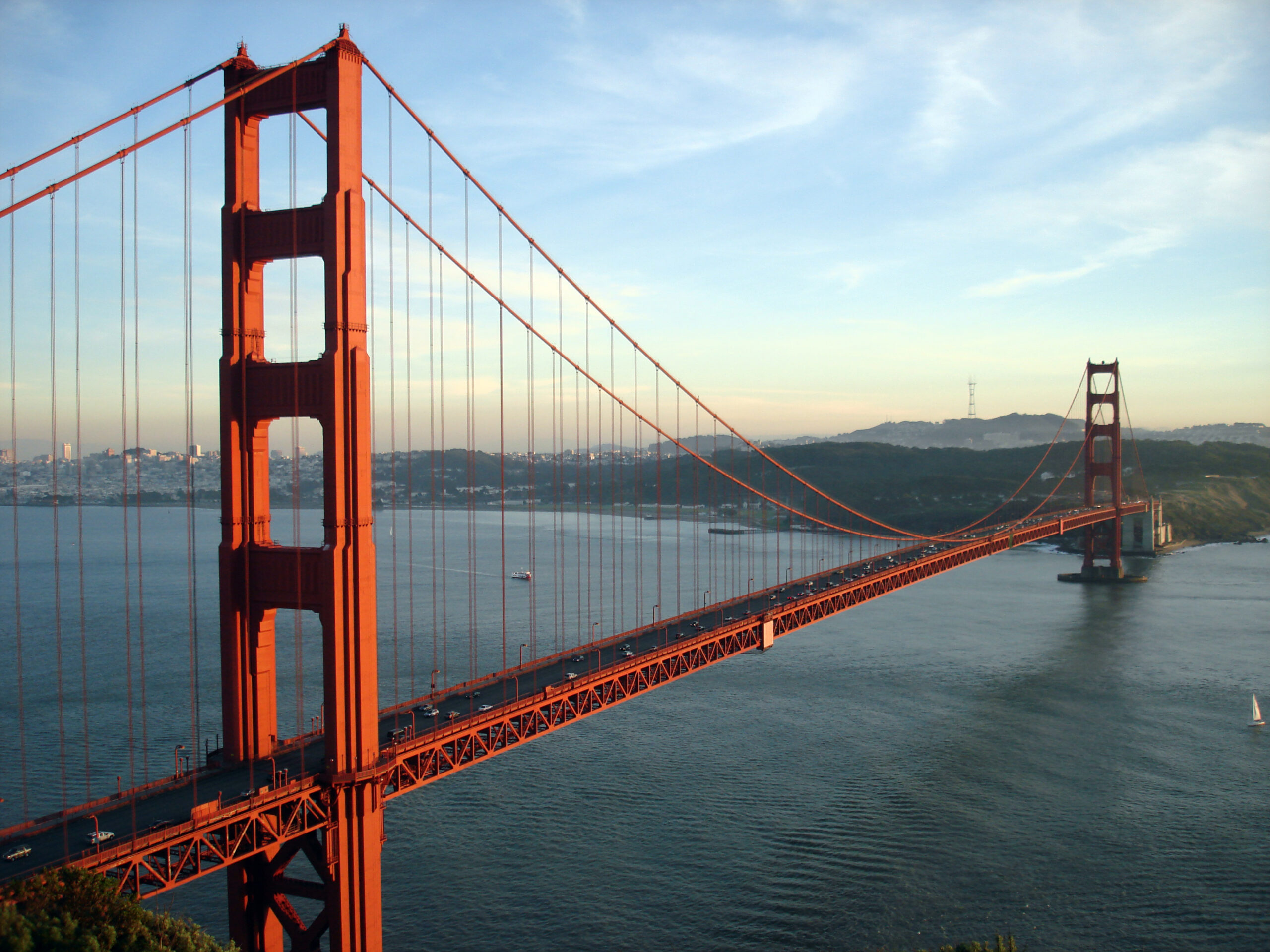
    When is the best time to see the cherry blossoms?

    Peak bloom usually falls in the last week of March or the first days of April and lasts only a few days. The National Park Service forecasts it in early March, and the festival runs for about four weeks around it.

    Why are Washington hotels cheaper on weekends?

    Because the city’s hotels depend on government, lobbying and convention travel from Monday to Thursday. On weekends and during congressional recesses, they discount to fill the rooms.

    Which airport should I fly into for Washington, DC?

    Reagan National is the most convenient, with the Metro at the terminal and the Mall 20 minutes away. Dulles has the international flights and the Silver Line; BWI often has the lowest fares and a train to Union Station. Compare all three.

    Is Washington too hot to visit in summer?

    It is hot and humid, but manageable if you see the memorials early and late and spend the afternoons in the air-conditioned museums, which are free.

    How far ahead should I book?

    Earlier for the cherry blossoms, the spring school season, the Fourth of July and inauguration years, when prices tend only to rise; for January, February and August, fares are stable enough that choosing the right dates matters more.

    Does it snow in Washington, DC?

    Some, in most winters, though average totals are modest. The occasional big storm can close the city and the airports for a day, so leave slack in a January or February itinerary.

    Ready to pick your dates? Compare fares across the whole month and all three airports on our Washington, DC flights page, then find a room with our Washington, DC hotel search. For what to do when you land, start with our first-timer’s guide to Washington, DC.

  • Best Time to Fly to Boston: Seasons, Weather & Prices

    Best Time to Fly to Boston: Seasons, Weather & Prices

    Boston runs on calendars that most cities do not have. It is a major tourist city with a short, glorious summer and the most famous fall foliage in the country, but it is also a college town on an enormous scale, with dozens of universities whose move-in days, parents’ weekends and graduations fill every hotel in the city several times a year. Add a medical and biotech economy that keeps the convention center busy, the oldest annual marathon in the world, a regatta that brings rowing crews from across the globe, and four professional teams with devoted followings, and you have a city where hotel rates, more than airfares, decide the real cost of a trip. The weather matters too: Boston winters are cold, snowy and occasionally stormy, and its springs arrive late. This guide walks through the weather month by month, the fare seasons, the events that move prices, and how to handle the airport.

    The short answer

    For the best combination of weather and value, aim for early June, before the summer peak takes hold, and the first half of November, when the foliage crowds have gone but the city is still mild and lively. Late September and October are the most beautiful weeks of the year, with crisp days and the leaves turning across New England, and also the most expensive, with hotel rates that rank among the highest in the country. The cheapest fares and rooms come in January, February and early March, outside the school vacation week in February. The priciest stretches are September and October, graduation weekends in May, Marathon weekend in April, and July and August for airfares. Whatever you choose, run a flexible-date search on our Boston flights page; moving a trip by a few days around a graduation or a holiday weekend can change the hotel bill far more than the fare.

    Fall color in the Boston Public Garden
    Boston in the fall, the season with the best weather and the highest hotel rates (Photo: Nina La via Wikimedia Commons, CC BY 3.0)

    Boston’s weather, season by season

    Boston sits on the Atlantic at the edge of a sheltered harbor, and the ocean shapes its weather in every season. Winters are cold and damp, with snow most years and a nor’easter or two capable of dropping a foot or more in a day; spring is late, cool and changeable, especially near the water; summers are warm and sometimes humid, with a sea breeze that can make the waterfront several degrees cooler than the suburbs; and fall is long, dry and bright. The figures below are approximate seasonal patterns based on the long-term Logan Airport climate normals from NOAA’s National Weather Service; check the current forecast before you pack, because a week in March or November can hold both a mild afternoon and a snowstorm.

    MonthTypical daytime highTypical overnight lowWhat it feels likeFare pressure
    Januaryaround 3 °C (37 °F)around -5 °C (23 °F)Cold and raw off the harbor; snow and the odd nor’easterLow after New Year’s week
    Februaryaround 4 °C (39 °F)around -4 °C (25 °F)Often the snowiest month; bright, cold days between stormsLow; rises for Presidents’ Day and school vacation week
    Marcharound 8 °C (46 °F)around -1 °C (31 °F)Gray and changeable; a late snowstorm is commonLow
    Aprilaround 14 °C (57 °F)around 5 °C (41 °F)Cool, showery, the first blossoms late in the monthModerate; Marathon weekend spike
    Mayaround 19 °C (67 °F)around 10 °C (50 °F)Green and pleasant, cool by the waterHigh on graduation weekends
    Junearound 25 °C (77 °F)around 16 °C (60 °F)Warm and long-lit; often the best month for weatherModerate to high
    Julyaround 28 °C (82 °F)around 19 °C (66 °F)Warm to hot, humid spells, thunderstormsHigh
    Augustaround 27 °C (81 °F)around 18 °C (65 °F)Warm and humid; the harbor is at its warmestHigh, then a move-in spike at month’s end
    Septemberaround 23 °C (73 °F)around 14 °C (58 °F)Warm days, cool nights, low humidityPeak for hotels
    Octoberaround 17 °C (62 °F)around 8 °C (47 °F)Crisp and bright; foliage seasonPeak for hotels
    Novemberaround 11 °C (52 °F)around 3 °C (38 °F)Cooling fast; bare trees by midmonthModerate, falling; Thanksgiving spike
    Decemberaround 6 °C (42 °F)around -2 °C (29 °F)Cold, festive, the first snow likelyLow until mid-month, then high

    Three things the table cannot show. First, the nor’easter: a coastal storm that tracks up the Atlantic and can bring heavy snow, high winds and coastal flooding, usually between December and March. Most years bring at least one, and when one is forecast, flights cancel pre-emptively and the city slows for a day or two. Second, the sea breeze: on a spring or early summer afternoon, the wind can turn onshore and drop the temperature on the waterfront by 5 to 10 degrees in an hour, so a warm morning in the Public Garden does not guarantee a warm evening in the Seaport. Third, humidity: the numbers for July and August look moderate, but a humid week in the upper 80s °F feels a good deal hotter, and many older buildings and triple-deckers are not air-conditioned.

    How Boston’s fare seasons work

    Four calendars drive demand for Boston: summer tourism, which fills the flights from June to August; the academic year, which sends a wave of students and parents through the city at the start of September, again on parents’ weekends in October, and again at graduation in May; the fall foliage, which makes late September and October the peak for hotels and for travelers heading on to Vermont, New Hampshire and Maine; and the conventions and medical meetings, which fill downtown and the Seaport on weekdays at any time of year. The result is an unusual pattern in which airfares peak in summer but hotel rates peak in the fall, and the two do not always move together. Boston Logan is also a busy, competitive airport, with JetBlue as its largest carrier and all the major airlines present, which helps keep fares on many domestic routes reasonable even when rooms are not.

    Peak season

    June through October, plus graduation weekends, Marathon weekend and the week between Christmas and New Year. Summer airfares are at their highest in July and early August, when families travel and the Cape Cod crowds pass through Logan. From Labor Day to the end of October, hotel rates climb to the year’s maximum: the students are back, conventions return, the weather is at its best, and leaf-peepers from around the world use Boston as the gateway to New England. If you must travel in peak, book the hotel early, consider Cambridge, Brookline or a hotel near a T station farther out, and fly mid-week.

    Shoulder season

    April to May and November. April is cool but green by the end of the month, with baseball back at Fenway, and May is lovely, but both carry spikes, for the Marathon and for commencements, that can make a single weekend as expensive as October. November, once the leaves have fallen, is the value month of the fall: mild in the first half, quiet, and with hotel rates well down from their October highs, until Thanksgiving week pushes fares up again.

    Low season

    January through mid-March, outside the holidays and school vacation week. Fares and rooms are at their lowest, the museums are uncrowded, the Celtics and Bruins are in season, and the city is cold but entirely functional. The trade-off is weather: build a buffer into connections, because a nor’easter can ground flights for a day. Early December, before the holiday rush, is another quiet, inexpensive window.

    As elsewhere, mid-week departures and early or late flights usually price below Friday and Sunday afternoons on the same route, and a search across a whole month reveals cheaper pairs of dates close to your first choice. Our guide to the best times to book explains how to read those patterns.

    Boston month by month

    January

    Cold, often snowy and, after the first week, one of the cheapest months of the year for both flights and hotels. The Celtics and Bruins play at TD Garden, the Frog Pond rink on Boston Common is open for skating, and the museums, the Museum of Fine Arts, the Gardner, the Museum of Science, are at their quietest. Pack for real cold and plan indoor days; the city handles snow well, and the T keeps running.

    February

    Similar weather and often the snowiest month, with low fares outside Presidents’ Day weekend (the third Monday of February) and the Massachusetts school vacation week that surrounds it, when local families travel and flights out of Boston and hotels in the ski country fill. A good month for a museum, food and hockey weekend.

    March

    Gray, changeable and usually cheap. The St. Patrick’s Day parade through South Boston, held on the Sunday around March 17, is one of the biggest in the country and fills the bars for the weekend. College spring breaks empty the student neighborhoods for a week or two, and a late snowstorm is always possible.

    April

    Spring arrives slowly, and the calendar gets busy. Patriots’ Day, the third Monday of April, brings the Boston Marathon, reenactments at Lexington and Concord at dawn, and a Red Sox morning game at Fenway, and hotel rates around the course and in Back Bay are among the highest of the year that weekend. The Massachusetts school vacation week falls the same week. Opening Day at Fenway, the magnolias on Commonwealth Avenue in the last week of the month, and the Swan Boats’ return to the Public Garden lagoon mark the start of the season.

    May

    Green, pleasant and, on the right weekends, very expensive. Commencement season runs through the second half of the month, when Harvard, MIT, Boston University, Northeastern, Boston College and dozens of other schools hold graduations, and families book hotels a year ahead; if your dates coincide, look well outside the city. The Boston Calling music festival fills Memorial Day weekend. The weekdays between the big weekends are much better value.

    June

    Often the best month for weather, with long evenings and warmth without the full humidity of July. Harbor ferries run on their summer schedules, Pride fills the city early in the month, and Harborfest begins in the last days of June. Fares rise as schools finish; the first two weeks are the value play.

    July

    Peak summer. The Fourth of July brings the Boston Pops concert and fireworks at the Hatch Shell on the Esplanade, one of the most famous Independence Day celebrations in the country, and the USS Constitution’s annual turnaround cruise in the harbor. Airfares are at their summer high, the Harbor Islands and Cape Cod are at their best, and the North End’s saints’ feasts begin on summer weekends. Expect humid spells and thunderstorms.

    August

    Warm and humid, with the North End feasts, the biggest of which closes the neighborhood’s streets on the last weekend of the month. The final days of August and the first of September bring the city’s strangest event: the mass move-in, when tens of thousands of students arrive at once and apartment leases turn over, rental trucks clog the streets, and hotels near the universities sell out. Avoid those days if you can.

    September

    Many Bostonians would say this is the best month of the year: warm days, cool nights, low humidity and the whole city back from vacation. It is also where hotel rates reach their annual peak, with conventions, parents’ weekends and pennant races at Fenway all competing for rooms. Airfares are moderate after Labor Day, so the hotel is the number to watch.

    October

    The postcard month. The foliage turns across New England through the month, starting in the northern mountains in late September and reaching the Boston area in the second half of October; the Indigenous Peoples’ Day (Columbus Day) weekend, the second Monday, is the busiest leaf-peeping weekend of the year. The Head of the Charles Regatta fills the river and the hotels for a weekend in the second half of the month, and Salem’s month of Halloween events draws huge crowds on weekends. Book early.

    November

    Rates fall steadily once the leaves are down, and the first half of the month is often mild enough for walking the Freedom Trail in a light jacket. Thanksgiving, the fourth Thursday, sends fares up for the week; Plymouth, an hour south, marks the holiday in style. The holiday lights go up on Boston Common late in the month.

    December

    Two months in one. The first half is quiet and inexpensive, with the tree lighting on the Common, holiday markets, the Boston Pops holiday concerts at Symphony Hall and the reenactment of the Boston Tea Party on December 16. From about December 18, fares rise sharply for Christmas and New Year, and the city celebrates New Year’s Eve with First Night events and fireworks over the harbor.

    Boston Common under snow in winter
    Boston in winter: cold and snowy, but the cheapest time of year to visit (Photo: Ethan Long via Wikimedia Commons, CC BY-SA 2.0)

    Events that move Boston flight and hotel prices

    Cross-check these against your dates before you book. Exact dates shift each year; Meet Boston, the city’s tourism bureau, keeps the current calendar.

    • Presidents’ Day weekend and February school vacation (third week of February).
    • St. Patrick’s Day parade (the Sunday around March 17).
    • Boston Marathon and Patriots’ Day (third Monday of April): a severe hotel spike across Back Bay and downtown.
    • Commencement weekends (second half of May): rooms sell out months ahead across the city and Cambridge.
    • Fourth of July and Harborfest.
    • Student move-in (the last days of August and September 1) and parents’ weekends in October.
    • Foliage season and the Head of the Charles (October): the highest hotel rates of the year.
    • Thanksgiving week and Christmas to New Year.
    • Red Sox, Celtics, Bruins and Patriots home games, playoff runs and stadium concerts. Our Boston events page shows what is on sale for your dates.
    • Medical and technology conventions at the Seaport, which can fill downtown hotels on weeknights without warning; if mid-week rates look strangely high, that is usually why.

    Getting in from the airport

    Boston is served by Boston Logan International (BOS), in East Boston on the far side of the harbor and only about 5 kilometers (3 miles) from downtown, which makes it one of the most convenient major airports in the country. It has four terminals, A, B, C and E, with Terminal E handling most international flights, and there are nonstop flights from nearly every large U.S. city and from dozens of destinations in Europe and beyond. Getting downtown is easy. The Silver Line SL1 bus runs from every terminal to South Station, where it connects with the Red Line, Amtrak and commuter rail, and has been free to board at the airport in recent years; free Massport shuttle buses link the terminals to Airport station on the Blue Line, which reaches downtown in minutes; water taxis cross the harbor to the waterfront; and taxis and ride-hail reach downtown through the harbor tunnels in 15 to 30 minutes when traffic is light. Logan Express buses run to Back Bay and several suburbs. Two alternatives are worth checking when Logan fares are high: Providence (PVD), about an hour south, has its own MBTA commuter rail station, and Manchester-Boston Regional (MHT) in New Hampshire is about an hour north by car. Our Boston car-versus-transit guide explains why most visitors do not need a car, and our Logan airport guide covers the layout.

    A terminal at Boston Logan International Airport
    Boston Logan, just 5 kilometers (3 miles) across the harbor from downtown (Photo: CaribDigita via Wikimedia Commons, Public domain)

    Timing tricks that work for Boston

    • Search the whole month. Boston’s spikes are narrow: a graduation weekend or Marathon Monday can sit beside perfectly normal dates. A calendar search on TicketScanner shows the edges instantly.
    • Price the hotel first in the fall and in May. In September, October and on commencement weekends, the room costs more than the flight. Run a Boston hotel search for the same dates before you commit.
    • Look across the river. Cambridge and Somerville hotels on the Red Line can be cheaper than Back Bay on weekends, and business-district hotels in the Seaport and the Financial District often drop their rates on Friday and Saturday nights.
    • Fly mid-week. Boston’s business and university traffic makes Monday morning and Friday and Sunday afternoon the busiest flights; Tuesday to Thursday is usually the value.
    • Check Providence and Manchester. A cheaper fare into PVD with a commuter rail ride, or into MHT with a rental car, can beat Logan, especially in summer.
    • Build a winter buffer. Nor’easters can ground flights for a day between December and March; avoid tight connections, and read our guide to how early to arrive at the airport.
    • Flying out of Boston instead? The same seasonality applies in reverse; see cheap flights from Boston.
    Sailboats on the Charles River Basin in Boston in summer
    Summer on the Charles River, when airfares to Boston are at their highest (Photo: EgorovaSvetlana via Wikimedia Commons, CC BY-SA 4.0)

    What to pack, by season

    Winter (December to March): a warm, waterproof coat, a hat, gloves and boots with grip for slushy sidewalks and icy brick. Spring (April to May): layers, a rain jacket and a sweater for the evenings, especially near the water. Summer (June to August): light, breathable clothing, sunscreen, an umbrella for thunderstorms and a light layer for air-conditioned museums and harbor cruises. Fall (September to November): layers and a medium jacket, heavier by November. In any season, bring comfortable shoes: Boston’s brick sidewalks and cobblestones are hard on thin soles, and you will walk more than you expect.

    The best time to fly to Boston for…

    Fall foliage

    Early to mid-October for the mountains of Vermont, New Hampshire and Maine, and the second half of October for Boston itself, booked months in advance.

    The Marathon

    Patriots’ Day weekend in April, with the hotel booked as soon as you have a bib or a plan, or stay outside the city on a T line.

    Baseball at Fenway

    June, when the weather is warm but not humid, or September for the pennant race; April games are often cold.

    The lowest fares

    January through early March, outside Presidents’ Day week, and early December. Pair with museums, restaurants and a Celtics or Bruins game.

    Families

    Late June and early July, for the Harbor Islands, the Aquarium and the Fourth of July, or the first half of November for smaller crowds and lower rates.

    International visitors

    Travelers from Visa Waiver Program countries need an approved ESTA before boarding; most others need a visa. The State Department’s travel site explains what applies to you, and the TSA lists what you can carry through security.

    Frequently asked questions

    What is the cheapest month to fly to Boston?

    January and February are consistently the lowest for both flights and hotels, outside the February school vacation week, followed by early March and early December.

    What is the best month to visit Boston for weather?

    June and September, with October close behind for crisp days and foliage. July and August are warm and can be humid; winter is cold and snowy.

    When is fall foliage in Boston?

    The color reaches the Boston area in the second half of October, after peaking earlier in northern New England. The Arnold Arboretum and the Public Garden are the best places to see it in the city.

    Why are Boston hotels so expensive in the fall?

    Because everything happens at once: the students are back, the convention calendar is full, the weather is at its best and foliage visitors use Boston as their base. September and October are among the most expensive months of any American city.

    Should I avoid Boston in winter?

    Not if you pack for it. January and February are cold, but they bring the lowest prices, empty museums and hockey and basketball season. Allow for a possible storm delay.

    How far ahead should I book?

    For graduation weekends, the Marathon and October, book the hotel months ahead. For winter and November, finding the right dates matters more than booking early.

    Is it better to fly into Boston or Providence?

    Boston for convenience, since Logan is minutes from downtown. Providence is worth checking when Logan fares are high, with a commuter rail link from the airport to the city.

    Ready to pick your dates? Compare fares across the whole month on our Boston flights page, then find a room with our Boston hotel search. For what to do when you land, start with our first-timer’s guide to Boston.

  • Best Time to Fly to Seattle: Seasons, Weather & Prices

    Best Time to Fly to Seattle: Seasons, Weather & Prices

    Seattle’s reputation for rain is the first thing most people think of when they plan a trip, and it is the least useful. The city gets less rain in a year than New York, Boston or Miami; what it has instead is a long, soft, gray season from October to May, when drizzle falls on more days than not, and a short, brilliant summer from July to September that is among the driest and most comfortable of any big American city. Airfares follow that summer closely, and they are pushed higher by something most visitors do not see coming: Seattle is the main U.S. home port for Alaska cruises, and from spring to fall, tens of thousands of passengers fly in and out on the weekends to board ships at the downtown piers. Add a large tech-industry business market, a convention calendar, a busy sports schedule, and a steady flow of Canadians coming south from Vancouver, and the “best time” question has a clear answer and a few important exceptions. This guide walks through the weather month by month, the fare seasons, the events and cruise weekends that move prices, and how to handle the airport.

    The short answer

    For weather, the best time to visit Seattle is July to mid-September, when the rain almost stops, the mountains are out and the evenings are long. For value, the sweet spots are late May and June, when the city is green and the summer rush has not peaked, and the second half of September, often warm and dry with the cruise and family crowds thinning. The cheapest fares usually come from January to early March and in November outside Thanksgiving week, when the city is gray, mild and quiet. The most expensive stretches are July and August, especially Friday to Sunday on cruise-ship weekends, the big summer event weekends like Seafair and Labor Day, and the Thanksgiving and Christmas holidays. Whatever you choose, run a flexible-date search on our Seattle flights page; moving a trip from a Saturday to a Tuesday in summer can change the fare and the hotel rate more than moving it by a month.

    An Alaska cruise ship docked at Pier 66 on the Seattle waterfront
    Alaska cruise ships turn around in Seattle every weekend from spring to fall, filling flights and hotels (Photo: Joe Mabel via Wikimedia Commons, CC BY-SA 4.0)
    Seattle’s weather, season by season

    Seattle sits on Puget Sound between the Olympic Mountains to the west and the Cascades to the east, and the Pacific keeps it mild: winters rarely freeze for long, summers rarely get hot, and the city’s rain, about 990 mm (39 inches) a year at the airport, falls mostly as light, persistent drizzle between October and May. The figures below are approximate seasonal patterns at Sea-Tac, based on the long-term climate normals published by NOAA and the National Weather Service’s Seattle office; check the current forecast before you pack, and remember that the mountains an hour away can be twenty degrees colder than the city.

    MonthTypical daytime highTypical overnight lowWhat it feels likeFare pressure
    Januaryaround 9 °C (48 °F)around 3 °C (37 °F)Gray, damp and dark by late afternoon; snow in the city is rare but possibleLow, except the New Year week
    Februaryaround 10 °C (50 °F)around 3 °C (37 °F)Much the same, with a little more light and the odd bright, cold dayLow; rises for Presidents’ Day weekend
    Marcharound 12 °C (54 °F)around 4 °C (39 °F)Showers and sun breaks; cherry blossoms by the end of the monthLow to moderate
    Aprilaround 15 °C (59 °F)around 6 °C (43 °F)Changeable; tulips in the Skagit Valley; the first cruise ships arriveModerate; spring break spike
    Mayaround 19 °C (66 °F)around 9 °C (48 °F)Greener and drier; long evenings beginModerate; cruise weekends start to bite
    Junearound 22 °C (71 °F)around 12 °C (53 °F)Pleasant, but often gray until July; locals call it “June gloom”High, rising through the month
    Julyaround 26 °C (79 °F)around 14 °C (57 °F)Dry, sunny and long; the driest month of the yearPeak
    Augustaround 26 °C (79 °F)around 14 °C (57 °F)Warm and dry; heat waves and wildfire smoke are possible in some yearsPeak
    Septemberaround 22 °C (72 °F)around 12 °C (53 °F)Often the best month: warm, dry, clear, with cooler nightsHigh early, easing after Labor Day
    Octoberaround 16 °C (60 °F)around 8 °C (46 °F)Crisp and colorful, with the rain returning by mid-monthModerate, falling
    Novemberaround 11 °C (51 °F)around 4 °C (40 °F)The wettest month; windstorms are possibleLow, except Thanksgiving week
    Decemberaround 8 °C (46 °F)around 2 °C (36 °F)Dark, damp and festive; snow in the mountains, rain in the cityLow until mid-month, then peak

    Three things the table cannot show. First, the gray: it is the number of cloudy days, not the amount of rain, that defines Seattle’s winter. In midwinter the sun sets around half past four in the afternoon, and whole weeks can pass under low cloud, which some visitors find cozy and others find oppressive; if you are coming for views of Mount Rainier and the Olympics, winter is the season you are least likely to see them. Second, the summer is genuinely dry: July and August together average only a small fraction of the annual rain, humidity is low, and a typical summer day is clear, 25 °C and bright until after nine in the evening. Many homes and older hotels have no air conditioning, so the occasional heat wave, when the temperature can climb well past 32 °C (90 °F), is felt more than the numbers suggest. Third, wildfire smoke: in some recent summers, fires in Washington, Oregon or British Columbia have blown smoke over the city for days at a time, usually in August or September, turning the sky orange and hiding the mountains. It is not every year, and it is unpredictable, but it is worth checking air quality before a late-summer trip built around hiking.

    How Seattle’s fare seasons work

    Four calendars drive seats into Seattle. The first is the weather, which concentrates leisure travel into the dry months. The second is the Alaska cruise season, roughly late April to October, when ships leave from the downtown piers and from Smith Cove near Magnolia, turning over thousands of passengers every weekend; cruise travelers typically fly in on Friday or Saturday, sail, and fly home a week later, which fills flights and downtown and airport hotels on exactly the days leisure visitors want. The third is business travel: the region’s big tech, aerospace and health employers keep weekday flights busy year-round, and the Seattle Convention Center fills downtown hotels whenever a large conference is in town. The fourth is sports and events, from Seahawks home games in the fall and winter to Seafair, Bumbershoot and the summer stadium concerts. The result is a high, long summer, a winter that is genuinely cheap outside the holidays, and two shoulders where the weather and the prices both cooperate.

    Peak season

    Late June to early September, plus Thanksgiving week and roughly December 18 to January 2. July and August are the most expensive months for both flights and hotels, and within them, Friday-to-Sunday cruise turnaround days are the sharpest spikes; downtown hotel rates on a summer Saturday can be a multiple of a midweek night in February. If you must travel in peak, book early, fly midweek, and consider arriving on a Tuesday or Wednesday, when the cruise crowds are at sea.

    Shoulder season

    May to late June and mid-September to October. May and June give you green hillsides, long evenings and blooming gardens, with the risk of cool gray days into early July; September gives you the most reliable weather of the year with thinning crowds after Labor Day. Early October is crisp and colorful, and fares drop steadily through the month. Watch Memorial Day, Labor Day and any weekend with a big convention.

    Low season

    Early November to mid-December, and January to early March, apart from the holidays and Presidents’ Day weekend. Fares and hotel rates are at their lowest, the museums, restaurants and markets are uncrowded, and the ski areas at Snoqualmie Pass and Stevens Pass, an hour or two east, are open. The trade-off is short days, frequent drizzle and a low chance of seeing the mountains. Pack a waterproof layer and plan an indoor day for every outdoor one.

    As elsewhere, midweek departures and early or late flights usually price below Friday and Sunday afternoons on the same route, and a search across a whole month reveals cheaper pairs of dates close to your first choice. Our guide to the best times to book explains how to read those patterns.

    Seattle month by month

    January

    Gray, mild and, after New Year, one of the two cheapest months to fly. Highs hover around 9 °C (48 °F), the rain is usually a drizzle rather than a downpour, and snow in the city is unusual but brings everything to a halt when it comes, because Seattle’s hills and its limited fleet of plows do not mix. The museums, Pike Place Market and the restaurants are at their least crowded, the Kraken are in season, and the Seahawks may be at home in the playoffs. A good month for a food-and-culture trip at low prices.

    February

    Similar weather with a little more daylight, and low fares outside Presidents’ Day weekend (the third Monday of February), when school breaks send families to the mountains. The Chinese New Year celebrations in the Chinatown-International District fall in late January or February, and the ski areas are at their deepest. Strong value for a city break.

    March

    Showers, sun breaks and the first real sense of spring. The cherry trees on the University of Washington quad bloom in the second half of the month and draw big weekend crowds; Emerald City Comic Con, one of the larger fan conventions on the West Coast, has taken place in spring in recent years and can fill downtown hotels. Otherwise fares are still low, and March is one of the better value months.

    April

    Changeable, with warm sunny days, cold showers and everything in between. The Skagit Valley Tulip Festival, about an hour north, runs through the month and packs the fields on weekends; the Mariners’ season is under way; and the first Alaska cruise ships of the year arrive toward the end of the month. Washington’s school spring break, usually in early April, is a small spike. Otherwise a moderate, good-value month.

    May

    Drier, greener and noticeably longer days. Opening Day of boating season, on the first Saturday of May, fills the Montlake Cut with decorated boats and a rowing regatta; the Seattle International Film Festival starts in the second half of the month; and Northwest Folklife fills Seattle Center over Memorial Day weekend. Cruise weekends start to push up hotel rates. Early May is the value window.

    June

    Pleasant but often gray until the Fourth of July, which locals call “June gloom”. The Fremont Solstice Parade and festival fall near the solstice, and Pride, one of the largest on the West Coast, fills the last weekend of the month with a parade downtown and events on Capitol Hill. Fares climb from mid-month as schools let out; the first half of June is the last shoulder bargain before summer.

    July

    The start of Seattle’s real summer: dry, sunny, and light until well after nine at night. The Fourth of July fireworks over Lake Union draw big crowds to Gas Works Park, Seafair’s neighborhood festivals and parades run through the month, and Mount Rainier’s wildflower season starts late in the month. Every cruise weekend is busy, and fares and hotels are at their annual peak.

    August

    Warm, dry and busy. Seafair Weekend, usually the first weekend of August, brings hydroplane races and an air show over Lake Washington; the Mariners are chasing the playoffs; and Rainier’s meadows are at their best. Heat waves and wildfire smoke are possible, and the last week, once schools start elsewhere, can be slightly softer on price.

    September

    The month many Seattleites would send you to. Labor Day weekend brings Bumbershoot to Seattle Center and PAX West, a large gaming convention, to downtown, and hotels are tight; after that, the weather is often the most settled of the year, the summer crowds leave, and fares ease week by week. The Seahawks’ home season and the University of Washington’s football Saturdays begin. The second half of the month is the best value-and-weather combination of the year.

    October

    Crisp, colorful and increasingly wet, with the rain usually returning for good by the middle of the month. Fall color in the Arboretum and along the Cascades highways, salmon runs in the local creeks, and the Kraken’s season opener fill the calendar, and fares keep falling. The Alaska cruise season winds down over the course of the month.

    November

    The wettest month, with the occasional windstorm and some of the cheapest fares of the year outside Thanksgiving week, one of the busiest travel periods in the country. The holiday lights go up downtown and at Pike Place late in the month, and the ski areas usually open by Thanksgiving if the snow cooperates.

    December

    Two months in one. The first half continues November’s low prices, with holiday markets, the lights, the Christmas ships that sail the lakes and the Sound with choirs aboard, and the mountains in early winter. From about December 18, fares jump for the Christmas and New Year holidays, and the Space Needle’s New Year’s Eve fireworks draw crowds to Seattle Center.

    The Seattle Aquarium on the waterfront on a typical rainy day
    A typical gray-season day on the Seattle waterfront: drizzle, not downpour (Photo: MarmadukePercy via Wikimedia Commons, CC BY-SA 3.0)

    Events that move Seattle flight and hotel prices

    Cross-check these against your dates before you book. Exact dates shift each year; Visit Seattle keeps the current calendar.

    • Alaska cruise turnaround weekends (late April to October): the steadiest weekend pressure on flights and downtown hotels all summer.
    • Memorial Day weekend and Northwest Folklife at Seattle Center.
    • Pride (last weekend of June).
    • Fourth of July and Seafair Weekend (usually the first weekend of August).
    • Labor Day weekend, with Bumbershoot and PAX West at the same time.
    • Large conventions at the Seattle Convention Center, which can fill downtown on weeknights; if midweek rates look strangely high, that is usually why.
    • Seahawks home games (September to January) and Mariners, Sounders and Kraken home stands, plus stadium concerts. Our Seattle events page shows what is on sale for your dates.
    • Thanksgiving week and Christmas to New Year.
    • Canadian long weekends, such as Victoria Day in May, BC Day in early August and Canadian Thanksgiving in October, which bring Vancouver-area visitors south and lengthen the border queues on I-5.

    Getting in from the airport

    Seattle’s main airport is Seattle-Tacoma International (SEA), run by the Port of Seattle and universally called Sea-Tac, about 20 kilometers (13 miles) south of downtown. It is the main hub for Alaska Airlines and a major hub for Delta, with nonstop flights to most large U.S. and Canadian cities and to Europe and Asia, and it is busy enough that you should allow real time for security at peak hours. Getting downtown: the Link light rail station is a walk across the parking garage from the terminal, and trains reach downtown in roughly 40 minutes; taxis and ride-hail pick up on a floor of the garage; and the rental car facility is a shuttle ride away from the terminal. If you are on a cruise, most lines run transfers from the airport to the piers, and taxis and ride-hail make the trip in 25 minutes to an hour depending on I-5 traffic. For combined trips with Vancouver, it is worth pricing an open-jaw ticket, into Seattle and out of Vancouver International (YVR) or the reverse; Bellingham, near the border, has a small airport with limited service. Our Seattle car-versus-transit guide works through the ground options, and our SEA airport guide covers the layout.

    The Central Terminal at Seattle-Tacoma International Airport (SEA)
    Seattle-Tacoma International (SEA), the hub for Alaska Airlines and a major Delta gateway (Photo: Walter Siegmund (talk) via Wikimedia Commons, CC BY-SA 3.0)

    Timing tricks that work for Seattle

    • Avoid cruise turnaround days. In summer, Friday to Sunday flights and downtown hotel nights carry the cruise premium. Arrive Tuesday or Wednesday and the same trip can cost noticeably less.
    • Book the hotel first in summer. A cheap fare into a Seafair or Labor Day weekend is not cheap once the room is added. Run a Seattle hotel search for the same dates before you commit to either.
    • Aim for September. The second half of the month has summer weather at shoulder prices, and it is the local favorite for a reason.
    • Consider an open jaw with Vancouver. Seattle and Vancouver are about three hours apart by road or four by train, and flying into one and out of the other can save a long backtrack; our best time to fly to Vancouver guide covers the other end.
    • Use winter for a city break. From January to early March, fares and hotel rates are at their lowest and the city’s food, coffee and museums are at their least crowded.
    • Allow time at Sea-Tac. Security lines at peak summer and holiday hours can be long; our guide to how early to arrive covers what to allow.
    • Flying out of Seattle instead? The same seasonality applies in reverse; see cheap flights from Seattle.
    The Seattle skyline across Lake Union from Gas Works Park
    The skyline across Lake Union from Gas Works Park, where summer evenings stay light past nine (Photo: WikiPedant via Wikimedia Commons, CC BY-SA 4.0)

    What to pack, by season

    Winter (November to February): a warm waterproof jacket with a hood, layers, and shoes that can handle wet sidewalks; do as locals do and skip the umbrella, which the wind turns inside out. Spring (March to May): layers and the same waterproof jacket, because showers and sun breaks alternate hourly. Summer (June to September): light clothing for the days, a sweater or light jacket for the evenings and the ferry decks, sunglasses and sunscreen for the long, bright days, and hiking shoes if you are heading to Rainier or the Olympics. Fall (October): layers again, and the waterproof jacket back in the bag by mid-month. For the mountains in any season, pack warmer than the city requires; the Paradise area of Mount Rainier can have snow on the ground into July.

    The best time to fly to Seattle for…

    Summer weather and views of the mountains

    Mid-July to mid-September, when rain is rare and Mount Rainier and the Olympics are visible most days.

    Mount Rainier and the national parks

    Late July to early September for wildflowers at Paradise and open high roads; the park has used timed-entry reservations for its busiest areas in peak summer. Mount Rainier National Park has current conditions and requirements.

    An Alaska cruise

    May, June and September usually offer lower cruise and hotel prices than July and August. Fly in at least a day before sailing, and avoid booking the tightest flight home on disembarkation morning.

    The lowest fares

    January to early March and November outside Thanksgiving. Pair them with a museum-and-food itinerary and a waterproof jacket.

    Families

    Late June or late August, when the weather is reliable and the city’s parks, beaches and ferries are at their best; book early, and avoid cruise weekends if you can.

    Cross-border and international visitors

    Canadians need a valid passport to fly in; travelers from Visa Waiver Program countries need an approved ESTA before boarding, and everyone else needs a visa. U.S. Customs and Border Protection explains what applies to you, and the TSA lists what you can carry through security. If your trip includes Vancouver or Victoria, check the Canada Border Services Agency for what you need to enter Canada, and remember that the rules differ depending on whether you cross by land, sea or air.

    Frequently asked questions

    What is the cheapest month to fly to Seattle?

    January and February are consistently the lowest, followed by early March and November outside Thanksgiving week.

    What is the best month to visit Seattle for weather?

    August and September, with July close behind. All three are dry and sunny, and September is usually less crowded and cheaper.

    Does it really rain all the time in Seattle?

    No. The city’s annual rainfall is lower than New York’s or Boston’s; it just falls as frequent light drizzle from October to May. Summers are among the driest of any big American city.

    How do Alaska cruises affect Seattle prices?

    From late April to October, cruise passengers fill flights and hotels from Friday to Sunday. Midweek arrivals avoid most of that premium.
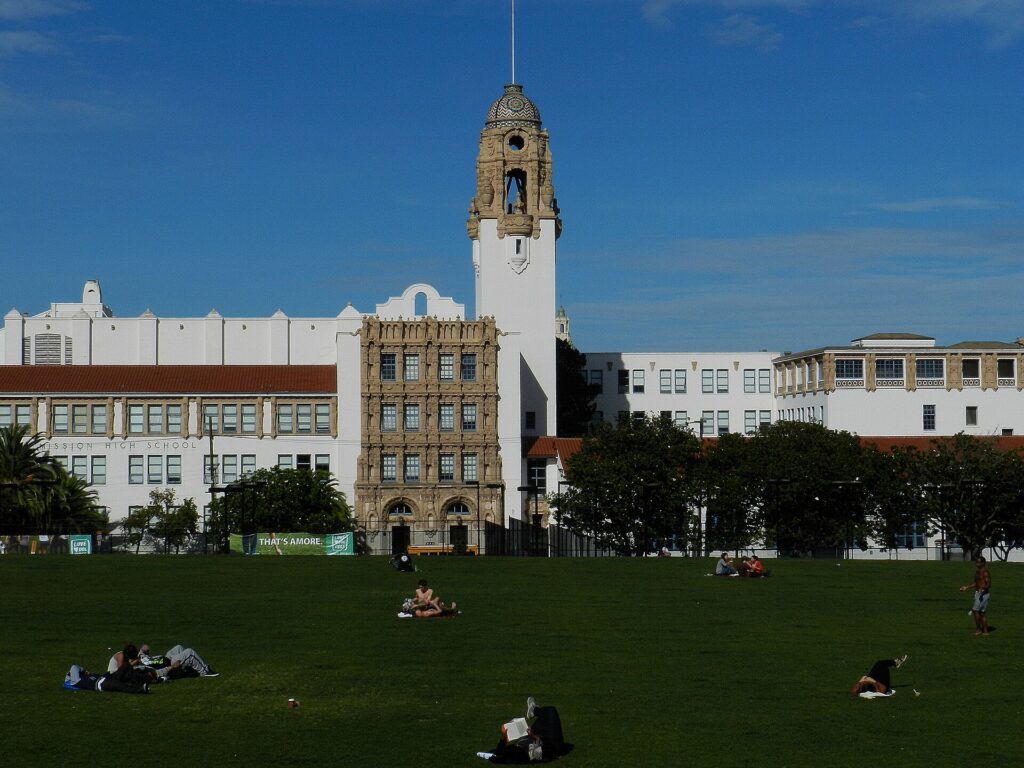
    Should I fly into Seattle or Vancouver for a Pacific Northwest trip?

    Price both. Seattle usually has more nonstop options from U.S. cities, but an open-jaw ticket, into one and out of the other, often works best if you plan to visit both.

    How far ahead should I book?

    Early for July, August, Labor Day and the holidays, when fares tend only to rise; for November through early March, fares are stable enough that finding the right dates matters more than booking months ahead.

    When can you see Mount Rainier from Seattle?

    On clear days in any season, but most reliably from July to September. Locals say “the mountain is out” when it appears, and in winter it can stay hidden for weeks.

    Ready to pick your dates? Compare fares across the whole month on our Seattle flights page, then find a room with our Seattle hotel search. For what to do when you land, start with our first-timer’s guide to Seattle.

  • Best Time to Fly to Las Vegas: Seasons, Weather & Prices

    Best Time to Fly to Las Vegas: Seasons, Weather & Prices

    Las Vegas breaks most of the rules about when to fly. In most cities, weekends are cheap for hotels and summer is peak season; in Las Vegas, Friday and Saturday nights cost several times what a Tuesday does, and the hottest months of the year are among the cheapest. The city’s calendar is driven by three forces that have little to do with school holidays: the desert climate, which makes spring and fall glorious and midsummer punishing; the convention calendar, which can fill much of the city’s roughly 150,000 hotel rooms midweek with trade-show crowds; and a growing list of huge events, from the Electric Daisy Carnival to the Formula 1 Grand Prix, that can double room rates for a weekend. Airfares are the easier half of the equation, because Harry Reid International is one of the best-connected leisure airports in the country and competition keeps fares low. This guide walks through the weather month by month, the fare and hotel seasons, the events that move prices, and how to handle the airport.
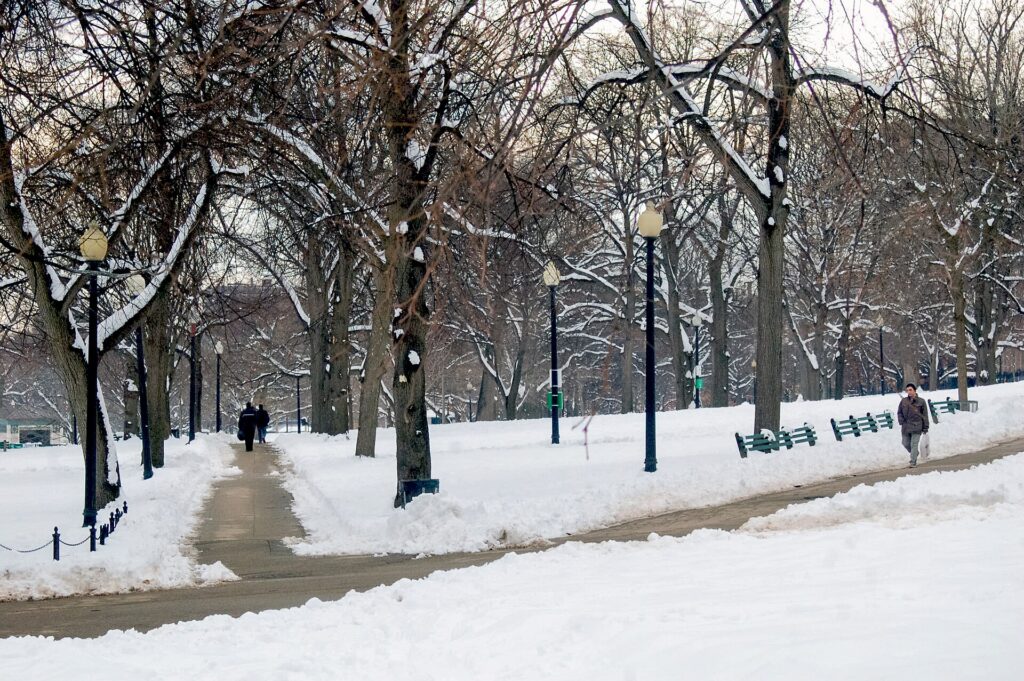
    The short answer

    For the best weather, come in March to May or late September to early November, when days are warm, the pools are open and the desert parks are comfortable for hiking. For the lowest prices, look at July and August, when the heat keeps crowds away and resorts discount heavily, at the first half of December outside the rodeo, and at the weeks after CES in January. The most expensive stretches are New Year’s Eve, the Grand Prix weekend in November, big convention weeks such as CES in early January, and the spring and fall weekends generally, when the weather is perfect and the city is full. Whatever you choose, fly and stay Sunday to Thursday if you can, and check the convention calendar before you commit; then run a flexible-date search on our Las Vegas flights page, where shifting a trip by a couple of days can change the total cost dramatically.

    The Welcome to Fabulous Las Vegas sign at the south end of the Strip
    The Welcome to Fabulous Las Vegas sign, in the median of the boulevard since 1959 (Photo: Tomás Del Coro via Wikimedia Commons, CC BY-SA 2.0)

    Las Vegas weather, season by season

    Las Vegas sits in a basin in the Mojave Desert, about 600 meters (2,000 feet) above sea level and ringed by mountains. It gets only about 100 mm (4 inches) of rain a year, sunshine on the great majority of days, low humidity, mild winters and some of the hottest summers of any large city in the country. The figures below are approximate seasonal patterns at the airport, based on the long-term climate normals published by NOAA and the National Weather Service’s Las Vegas office; check the current forecast before you pack, especially for heat warnings in summer and wind in spring.

    MonthTypical daytime highTypical overnight lowWhat it feels likeFare pressure
    Januaryaround 15 °C (59 °F)around 4 °C (40 °F)Cool, clear and sunny; cold after darkHigh for New Year and CES, then low
    Februaryaround 17 °C (63 °F)around 6 °C (43 °F)Mild days, chilly nights, the odd rainy spellModerate; Super Bowl and Presidents’ Day weekends busy
    Marcharound 22 °C (71 °F)around 10 °C (50 °F)Spring arrives; windy days are commonHigh; spring break and March Madness
    Aprilaround 26 °C (79 °F)around 14 °C (57 °F)Near-perfect; pools open, desert in flowerHigh
    Mayaround 32 °C (89 °F)around 19 °C (66 °F)Hot afternoons, warm evenings, full pool seasonHigh, with EDC and Memorial Day spikes
    Junearound 37 °C (99 °F)around 24 °C (76 °F)Very hot and dry; outdoor sightseeing at dawn onlyModerate, falling
    Julyaround 40 °C (104 °F)around 27 °C (81 °F)The hottest month; monsoon storms possibleLow, except the Fourth of July
    Augustaround 39 °C (102 °F)around 27 °C (80 °F)Extreme heat, more humid; flash-flood stormsLow
    Septemberaround 35 °C (95 °F)around 23 °C (73 °F)Still hot, cooling toward the end of the monthModerate, rising
    Octoberaround 27 °C (81 °F)around 15 °C (59 °F)Warm, dry and bright; ideal for hikingHigh
    Novemberaround 19 °C (67 °F)around 8 °C (47 °F)Pleasant days, cool nightsHigh for trade shows and the Grand Prix, low at Thanksgiving
    Decemberaround 14 °C (57 °F)around 4 °C (39 °F)Cool and sunny; frost some nights, snow on the mountainsModerate for the rodeo, low mid-month, peak at New Year

    Three things the table cannot show. First, the heat is dry, until it isn’t: for most of the year the humidity is so low that 35 °C (95 °F) feels bearable in the shade, but the desert sun is fierce, you dehydrate faster than you notice, and from mid-June to mid-September walking between resorts in the afternoon is genuinely dangerous for some people. Second, the monsoon: from July to September, moisture from the south brings sudden afternoon thunderstorms, dust storms and flash floods that can close roads and turn dry washes into rivers in minutes. Third, the evenings: the desert cools quickly after sunset in winter and spring, so a warm January afternoon at the pool can become a jacket night by eight o’clock, while in July the overnight low barely drops below 27 °C (80 °F).

    How Las Vegas fare seasons work

    Airfares into Las Vegas are among the most competitive in the country. Harry Reid is a huge leisure market served by almost every U.S. airline, with Southwest the largest carrier and low-cost airlines such as Frontier and Allegiant adding capacity, so seats from the West Coast and the Mountain states are plentiful and fares rarely spike as sharply as hotel rates do. The real price swings in Las Vegas are in the rooms. Three calendars drive them: the weekly cycle, in which Friday and Saturday nights cost far more than Sunday to Thursday; the convention calendar, which can make a Tuesday the most expensive night of the month; and the weather, which fills the city in spring and fall and empties it in the heat. The result is that the cheapest total trip is usually a midweek stay in a low season with no big convention in town.

    Peak season

    March to May and late September to mid-November, plus New Year’s Eve and the biggest event weekends. Spring and fall weekends fill every resort on the Strip, and room rates on a Saturday can be several times the Wednesday rate. Stack a convention on top, and even midweek rates climb. If you must travel in peak, book early, stay Sunday to Thursday, and consider a downtown or off-Strip hotel, where rates rise less sharply.

    Shoulder season

    February, early June and early September. The weather is either not quite warm enough for the pool or a little too hot for comfort, and prices sit in the middle. February is interesting because the Super Bowl weekend is one of the busiest betting weekends of the year, and Chinese New Year and Presidents’ Day draw crowds; outside those, it is good value with mild weather.

    Low season

    Late June to August, the first three weeks of December outside the National Finals Rodeo, and the middle of January once CES has left town. Summer is the classic Vegas bargain: the resorts discount heavily to fill rooms, the pools are at their best, and everything but outdoor sightseeing works as normal. Early December is quiet and festive. Thanksgiving week, oddly, is also often cheap on the Strip, because business travel stops and the city is not a traditional family destination.

    As elsewhere, mid-week departures and early or late flights usually price below Friday and Sunday afternoons on the same route, and a search across a whole month reveals cheaper pairs of dates close to your first choice. Our guide to the best times to book explains how to read those patterns, and our guide to cheap flight tickets to Las Vegas goes deeper on the airfare side.

    Las Vegas month by month

    January

    The year starts expensive. New Year’s Eve, when the Strip closes to traffic for fireworks from the resort rooftops, is one of the priciest nights of the year, and CES, the giant consumer-electronics show in the first full week of the month, fills the city with well over 100,000 attendees and sends room rates soaring. Once CES leaves, January becomes one of the cheapest months of the year: cool, sunny days around 15 °C (59 °F), quiet casinos, and ideal hiking weather at Red Rock and the Valley of Fire. The Golden Knights are in season, and the NFL playoffs keep the sportsbooks lively.

    February

    Mild and good value, with a few spikes. Super Bowl weekend in early February is one of the busiest weekends of the year for the sportsbooks and the parties; Chinese New Year brings lavish decorations to the resorts and crowds from the West Coast and Asia; and Presidents’ Day weekend and Valentine’s Day, with the city’s famous wedding chapels at full stretch, fill hotels too. Midweek in February is excellent value.
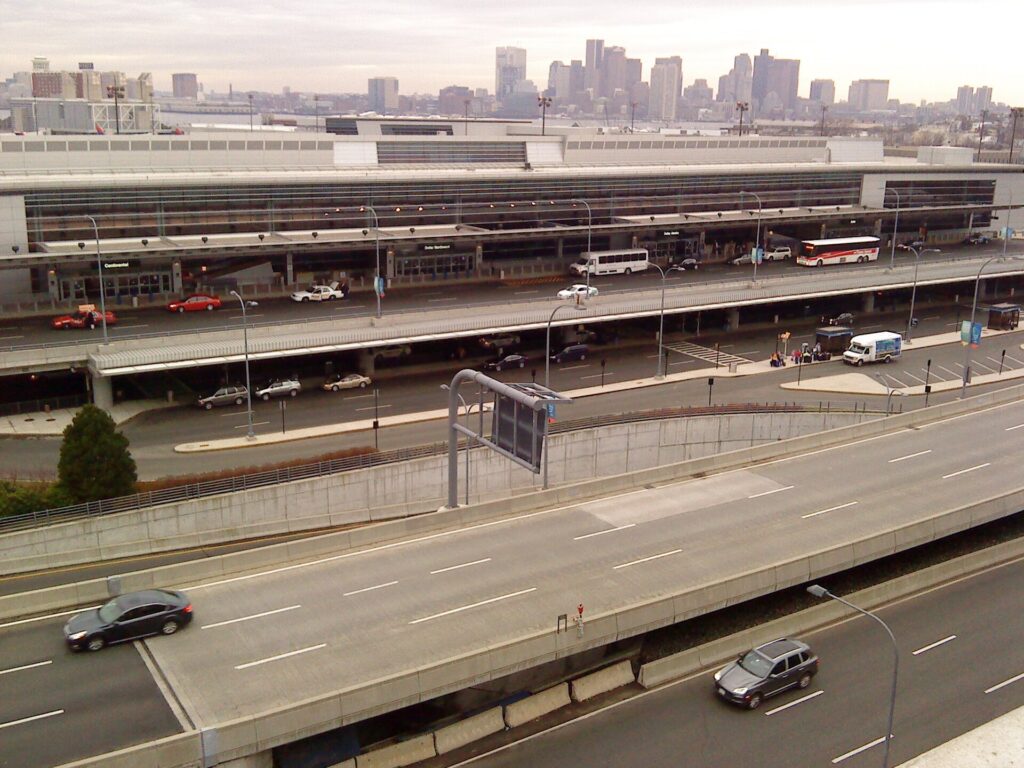
    March

    Spring arrives, and so do the crowds. Spring break brings college students and families; college basketball’s conference tournaments early in the month and the opening rounds of March Madness fill the sportsbooks from morning to night; and the weather is warm enough for the pools to open. Windy days are common. Weekends are expensive; midweek is manageable.

    April

    Possibly the best month of the year: warm, sunny, not yet hot, with the desert in bloom and the pools and dayclubs open. It is also one of the busiest, with conventions midweek and full resorts every weekend. Book early, and consider the Easter weekend and the big April trade shows when choosing dates.

    May

    Hot afternoons and warm nights, full pool season, and two big spikes. The Electric Daisy Carnival, one of the largest dance-music festivals in the world, takes over the Las Vegas Motor Speedway for three nights in mid-May and fills hotels across the valley; Memorial Day weekend is the unofficial start of summer and one of the biggest pool-party weekends of the year. Between those, May is excellent.
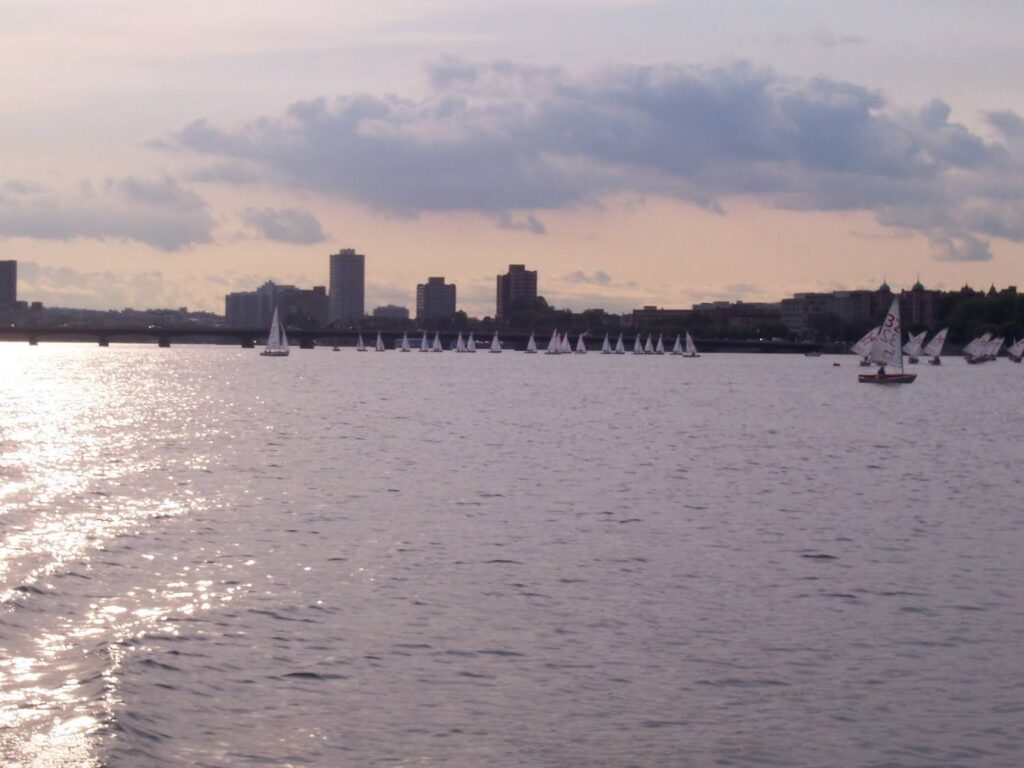
    June

    The heat arrives in earnest, with highs near 37 °C (99 °F) and rising, and prices begin to fall through the month. Father’s Day weekend and the big summer trade shows add pressure, but late June is often good value. Do outdoor sightseeing at dawn and spend the afternoons in the pool or inside.

    July

    The hottest month, with afternoons around 40 °C (104 °F) and nights that barely cool. It is also one of the cheapest: outside the Fourth of July weekend, when the resorts put on fireworks and the pools overflow, room rates drop to some of their lowest of the year. The monsoon can bring thunderstorms and flash floods in the second half of the month. If you are coming for the casinos, shows, restaurants and pools, July is a genuine bargain.

    August

    Still extremely hot, a little more humid, and still cheap. The monsoon storms are at their most frequent, and the big cybersecurity conferences and fashion trade shows fill midweek rooms for a few days. The Aces are in season, and the pools stay open. Book the desert day trips for sunrise, or skip them until fall.

    September

    Summer hangs on, with highs in the 30s °C (90s °F) most of the month, but prices climb as the conventions return after Labor Day and the weather improves. The Raiders’ season starts, the college football season fills weekends, and the last week of September is often very pleasant. Labor Day weekend is the last big pool party of the year.

    October

    One of the two best months: warm, dry, bright and ideal for hiking Red Rock, the Valley of Fire and the Grand Canyon. It is correspondingly busy and expensive, with big conventions midweek and full weekends, plus Halloween, when the Strip’s clubs and bars throw costume parties all weekend. Book early.

    November

    A month of extremes. The SEMA auto-industry show in the first week brings one of the largest trade crowds of the year, and the Las Vegas Grand Prix, a Formula 1 night race on a circuit through the Strip, sends room rates for its weekend in the second half of the month to eye-watering levels and closes streets for days. Then Thanksgiving week is often one of the cheapest of the year. Days are pleasant and nights cool.

    December

    The National Finals Rodeo, ten days in the first half of the month, brings cowboy hats, country concerts and full hotels to the whole city. The rest of early and mid December is quiet, festive and inexpensive, with the resorts dressed for the holidays and the Ethel M cactus garden lit up. From Christmas to New Year’s Eve, prices climb steeply for the biggest party of the year.

    A winding road through the red rock of Valley of Fire State Park
    Valley of Fire, an hour from the Strip and at its best from October to April (Photo: Gzzz via Wikimedia Commons, CC BY 4.0)

    Events that move Las Vegas flight and hotel prices

    Cross-check these against your dates before you book. Exact dates shift each year; the Las Vegas Convention and Visitors Authority keeps the current calendar, including the major conventions.

    • New Year’s Eve: the most expensive night of the year on the Strip.
    • CES (the first full week of January): the biggest convention of the year.
    • Super Bowl weekend (early February) and Chinese New Year (late January or February).
    • March Madness (conference tournaments and the opening rounds, early to mid-March) and spring break.
    • Electric Daisy Carnival (three nights in mid-May) and Memorial Day weekend.
    • Fourth of July and Labor Day weekends: the big pool-party weekends.
    • SEMA (early November) and the Las Vegas Grand Prix (a weekend in the second half of November).
    • National Finals Rodeo (ten days in the first half of December).
    • Big fights, residency openings, Raiders and Golden Knights games and stadium concerts. Our Las Vegas events page shows what is on sale for your dates.
    • Midweek trade shows, which can fill the city without warning; if your Tuesday rate looks higher than your Saturday rate, that is usually why.

    Getting in from the airport

    Harry Reid International Airport (LAS), named after the former Nevada senator and known as McCarran until 2021, is one of the busiest airports in the country and sits directly beside the south end of the Strip, about 8 km (5 miles) from its center. It has two terminals: Terminal 1, which handles Southwest and many domestic airlines, and Terminal 3, which handles international flights and several domestic carriers, connected airside by a tram to the D gates. Yes, there are slot machines at the gates. Getting to the Strip is quick: taxis wait at both terminals and the ride takes 15 to 25 minutes; ride-hail pickups are in designated areas of the parking garages; shared shuttle vans serve the major resorts; and RTC buses stop at the terminals, though with luggage and a transfer they are slower. All the rental companies operate from the off-airport Rent-A-Car Center, about 5 km (3 miles) away and reached by free dedicated shuttle buses from both terminals. Our Las Vegas rental car guide works through whether you need one, and our LAS airport guide covers the layout.

    Harry Reid International Airport (LAS), formerly McCarran, in Las Vegas
    Harry Reid International, known as McCarran until 2021, sits right beside the south end of the Strip (Photo: Craig Butz via Wikimedia Commons, CC BY-SA 3.0)

    Timing tricks that work for Las Vegas

    • Check the convention calendar first. A cheap fare into a CES or SEMA week is not cheap once the room is added. Run a Las Vegas hotel search for the same dates before you commit to either.
    • Stay Sunday to Thursday. Weekend nights on the Strip can cost several times the midweek rate for the same room; even shifting one night makes a difference.
    • Compare total prices. Nightly resort fees and parking charges add a substantial amount to the advertised room rate, so compare the all-in price, not the headline.
    • Use the summer. If the pool, the shows and the restaurants are the point, July and August offer the lowest rates of the year; do the desert at dawn or save it for another trip.
    • Consider driving from Southern California or Arizona. Las Vegas is a classic road trip from Los Angeles and Phoenix; see our Los Angeles to Las Vegas and Las Vegas to Phoenix route guides.
    • Leave time at the airport. Security lines at LAS can be long on Sunday and Monday mornings after a big weekend or convention. Our guide to how early to arrive covers what to allow.
    • Flying out of Las Vegas instead? The same seasonality applies in reverse; see cheap flights from Las Vegas.
    The High Roller observation wheel at the LINQ in Las Vegas
    The High Roller at the LINQ; spring and fall bring the best weather and the highest weekend rates (Photo: Tony Webster from San Francisco, California via Wikimedia Commons, CC BY 2.0)

    What to pack, by season

    Winter (December to February): layers for mild days, a warm jacket for evenings that drop close to freezing, and sunglasses. Spring (March to May): light clothing, swimwear, a layer for the evenings, and sunscreen, because the sun is already strong. Summer (June to September): the lightest clothing you own, a hat, high-factor sunscreen, a refillable water bottle, and a sweater for the aggressively air-conditioned casinos and theaters. Fall (October to November): summer clothing into October, with a jacket for the cooler nights of November. In every season, bring comfortable walking shoes, because a stroll between two neighboring resorts can be longer than it looks, and something smarter for the restaurants and nightclubs, which enforce dress codes.

    The best time to fly to Las Vegas for…

    Pool parties

    April to early June, and September, when the dayclubs are in full swing and the heat is manageable; Memorial Day and Labor Day weekends are the biggest parties.

    Hiking and the national parks

    March to May and October to November for Red Rock, the Valley of Fire, Zion and the Grand Canyon; winter works for the lower desert parks but brings snow to the Grand Canyon’s South Rim and Zion’s higher trails.

    Shows and dining on a budget

    July and August, the first half of December, or mid-January to early February, midweek.

    The lowest fares and rates

    Midweek in July, August or early December, with no major convention in town.

    Families

    Spring break or a fall break for comfortable weather for the Hoover Dam and the parks; summer is cheap, but the heat makes outdoor sightseeing hard with children.

    International visitors

    Canadians need a valid passport; visitors from Visa Waiver Program countries need an approved ESTA before boarding, and everyone else needs a visa. U.S. Customs and Border Protection explains what applies to you, and the TSA lists what you can carry through security. Grand Canyon National Park and the other national parks charge an entrance fee per vehicle; the National Park Service sells passes online and at the gates.

    Frequently asked questions

    What is the cheapest month to fly to Las Vegas?

    July and August are usually the cheapest for the whole trip, followed by the first half of December and mid-January after CES. Airfares vary less than hotel rates, so the room is where the savings are.

    What is the best month to visit Las Vegas for weather?

    April and October, with March, May and early November close behind.

    Is Las Vegas too hot in summer?

    For outdoor sightseeing in the afternoon, yes; highs around 40 °C (104 °F) are normal. For the pools, casinos, shows and restaurants, which are all air-conditioned or built for the heat, summer is fine and far cheaper.

    Why are Las Vegas hotels so expensive on some weekdays?
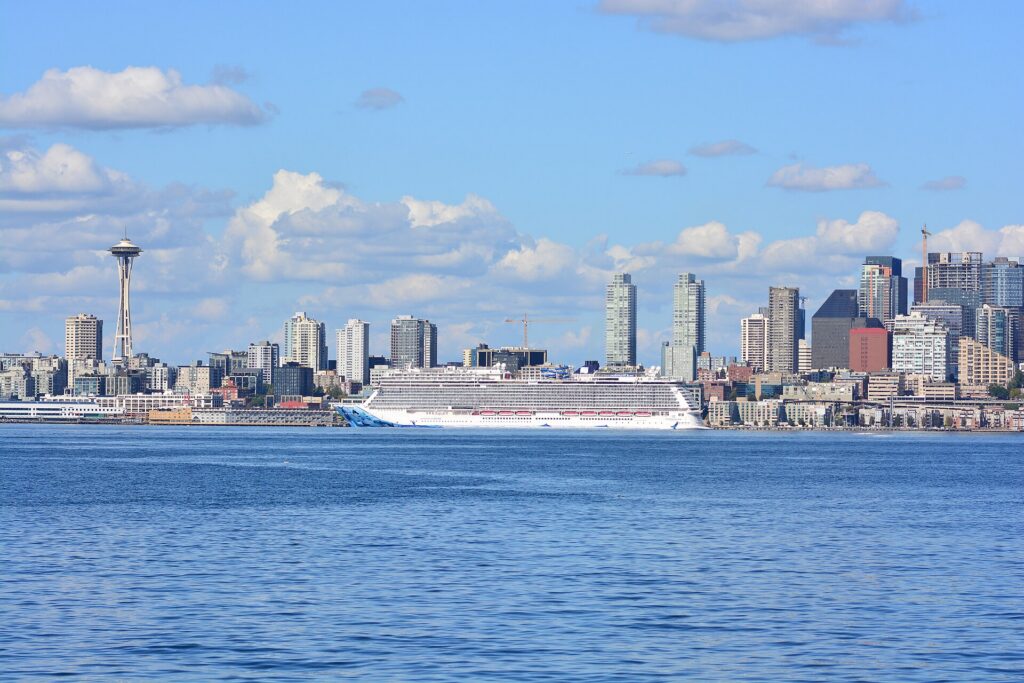
    Conventions. The city hosts some of the largest trade shows in the world, and a big one can fill every resort midweek. Check the convention calendar before booking.
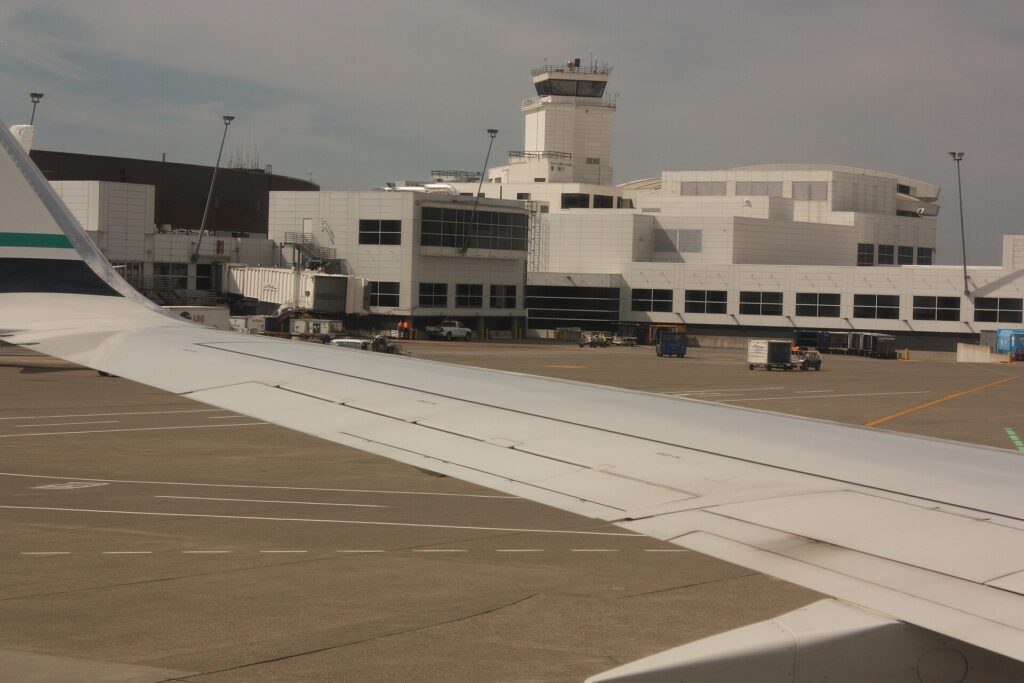
    Is it cheaper to go to Las Vegas midweek?

    Almost always. Sunday to Thursday nights are far cheaper than Friday and Saturday, unless a large convention is in town.

    How far ahead should I book?

    Earlier for New Year’s Eve, the Grand Prix, EDC, CES week and spring and fall weekends, when rates only rise; for midweek summer and early-December stays, rates are stable enough that finding the right dates matters more.

    Does it rain in Las Vegas?

    Rarely, about 100 mm (4 inches) a year, but winter storms and summer monsoon thunderstorms can bring sudden downpours and flash floods. Never drive into a flooded road.

    Ready to pick your dates? Compare fares across the whole month on our Las Vegas flights page, then find a room with our Las Vegas hotel search. For what to do when you land, start with our first-timer’s guide to Las Vegas.