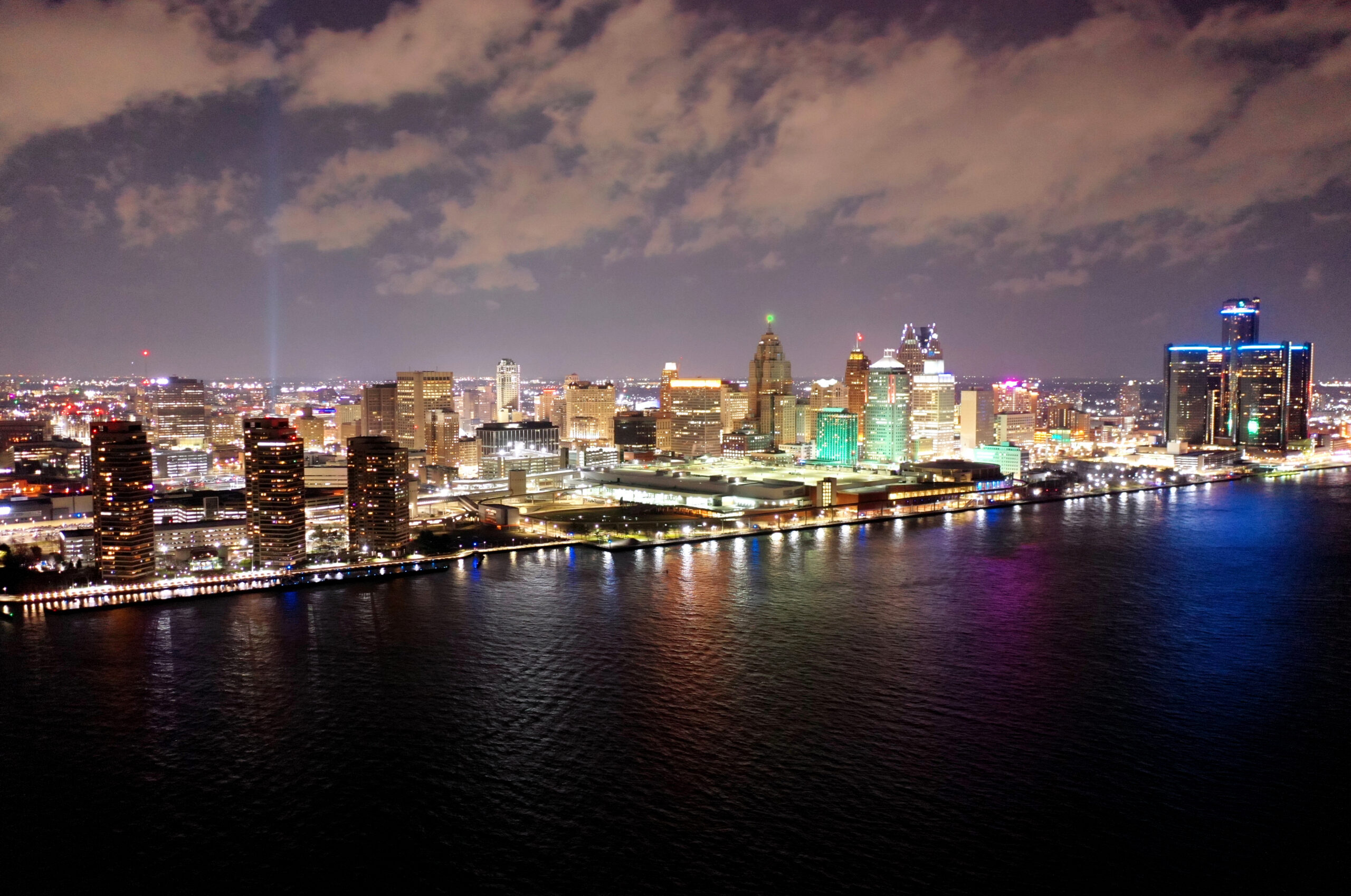
Detroit is the Motor City, and it was built around the car in a way few places on earth can match: the freeways were cut through the city in the 1950s and 1960s, the streetcars were torn out, and the region spread for miles in every direction along wide avenues and mile roads. So it will not surprise you that for many visitors the honest answer to “should I rent a car?” is yes. But the picture has changed. Downtown, Midtown and the riverfront have become dense, walkable districts again, the QLine streetcar runs up Woodward Avenue, the elevated People Mover circles downtown, a bike-share system covers the core, and ride-hail is cheap and quick for short hops. Parking downtown can be expensive on game days, and a rental sitting in a hotel garage for a three-day city break is money wasted. The right answer depends on where you stay and what you plan to see. This guide explains how the region is laid out, how the transit works, what driving here is really like, what to know about driving into Canada, and gives you a straightforward way to decide.
The short answer
Rent a car if The Henry Ford in Dearborn, the suburbs, the Detroit Zoo, Ann Arbor, Cranbrook or a road trip to Toronto, Chicago or northern Michigan are on the itinerary, if you are staying with family or in a suburban hotel, or if you are traveling with small children and gear. That is a lot of visitors. Skip the car if you are staying downtown or in Midtown for a city break, a convention, a concert or a game, and your plans are the riverfront, the DIA, the Motown Museum, Eastern Market, Corktown and the stadiums; walking, the QLine, the People Mover, MoGo bikes and the occasional ride-hail will cover that, and you will not pay for parking. And if you need a car for only part of the trip, rent it only for those days, picking up in the city rather than at the airport. Compare rental rates for any of these plans on our Detroit car rental page.
How Detroit is laid out
Detroit is a wheel laid over a grid. Downtown sits on the north bank of the Detroit River, with the great avenues radiating from it like spokes: Woodward Avenue, the main street of the region, runs north through Midtown and New Center to the suburbs and all the way to Pontiac; Michigan Avenue runs west through Corktown to Dearborn; Gratiot runs northeast and Jefferson follows the river east. Beyond the inner city, the grid takes over, measured by the mile roads that count north from downtown; 8 Mile Road forms much of the city’s northern boundary, and suburbs such as Ferndale, Royal Oak, Southfield and Troy lie beyond it. Dearborn is to the west, the Grosse Pointes to the east along Lake St. Clair, and Windsor, Ontario, is directly across the river to the south. The core that visitors care most about, downtown, Midtown, Corktown and the riverfront, is compact; the region as a whole is enormous, and most of it assumes a car.
Hotels cluster downtown around Campus Martius and the Renaissance Center, in Midtown and Corktown, in Dearborn, around the airport in Romulus, and along the suburban freeways in Southfield, Troy and Novi. Our Detroit hotel search lets you compare them, and it is worth checking the parking fee on any downtown hotel before you decide on a car.
Getting in from the airport
Detroit Metropolitan Wayne County Airport (DTW) is in Romulus, about 32 km (20 miles) southwest of downtown, and there is no rail link. By taxi or ride-hail, the drive along I-94 takes 25 to 40 minutes, longer at the weekday peaks. SMART, the suburban bus agency, runs express buses between the airport and downtown along Michigan Avenue; they cost a fraction of a taxi and take considerably longer, and they are a reasonable option for a solo traveler with light bags who is not in a hurry. The Michigan Flyer coach links the airport with Ann Arbor and East Lansing. Every major rental company serves DTW, with shuttle buses from both terminals to their lots, and if you are heading straight to Dearborn, Ann Arbor or the suburbs, the freeways start at the airport’s doorstep. Check the airport’s site for current ground-transport details; our DTW airport guide covers the terminals.
Detroit’s transit, explained
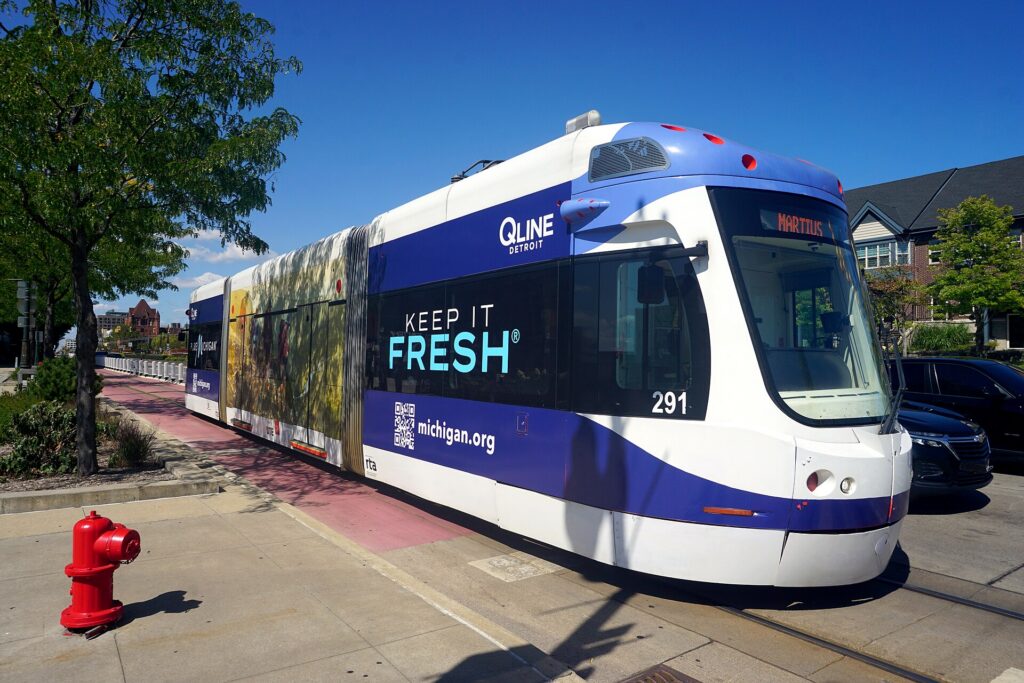
Transit in Detroit is split among several operators: the city’s Department of Transportation (DDOT) runs the buses inside the city, SMART runs the suburban buses, and the QLine and the People Mover serve the core. For a visitor based downtown or in Midtown, the rail pieces are genuinely useful; the bus network works but runs less often than a visitor from Chicago or Toronto would expect.
The QLine
The QLine is a streetcar that runs about 5 km (3.3 miles) up Woodward Avenue, from Congress Street downtown past Campus Martius, the Fox Theatre, the stadiums, Midtown’s museums and Wayne State University to Grand Boulevard in New Center, where the Fisher Building and the Amtrak station are. It shares the road with traffic, so it is not fast, but it links most of the city’s big sights in a straight line, and it runs every 15 minutes or so through the day. Rides have been fare-free in recent years; check the current policy before you go.
The People Mover
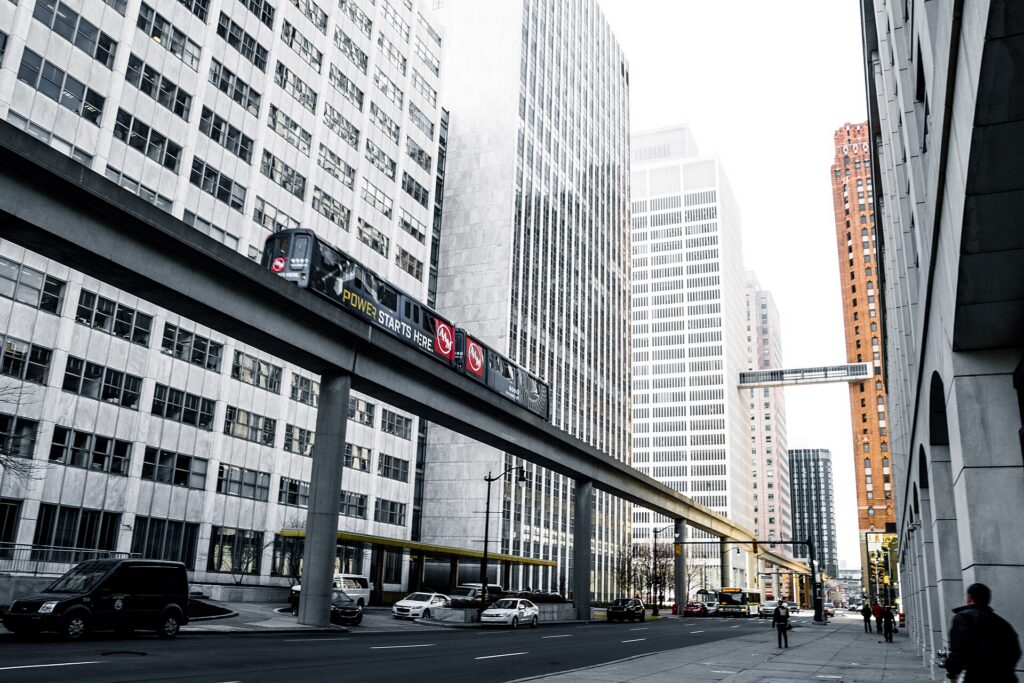
The Detroit People Mover is an automated elevated train that runs a one-way loop of about 4.7 km (2.9 miles) around downtown, with 13 stations, including the Renaissance Center, Huntington Place, Greektown, Grand Circus Park and the stops nearest the stadiums. A full loop takes about 15 minutes. It is a handy way to hop around downtown, especially in bad weather, and the ride above the streets, with views of the river and the Art Deco towers, is a sightseeing trip in itself. Fares have been nominal or waived in recent years; check before you ride.
Buses
DDOT’s buses cover the city along the main avenues, with the Woodward, Gratiot, Michigan and Jefferson routes the most useful for visitors, and SMART’s buses run out along the same spokes into the suburbs. Frequencies vary widely by route and time of day, service thins in the evenings and on weekends, and on some routes you may wait 20 minutes or more. Real-time arrival apps help a great deal.
Fares and tickets
DDOT and SMART share a regional fare system called Dart, with passes for a few hours, a day, a week or a month that work on both agencies’ buses. The simplest option for a visitor is to buy passes in the Dart app on your phone; you can also pay cash on board, usually with exact change. Reduced fares are available for children, seniors and riders with disabilities. Check the agencies’ sites for current fares.
Accessibility
DDOT and SMART buses are low-floor with ramps, the QLine’s stations are level with the streetcar floor, and the People Mover’s stations have elevators, though an elevator out of service can make a station unusable; check before relying on a particular stop with a wheelchair or a stroller.
Beyond DDOT and SMART
- Walking. Downtown, the riverfront, Midtown and Corktown are all walkable, and the RiverWalk and the Dequindre Cut are among the best urban walks in the Midwest. Distances between neighborhoods are longer than they look on a map, though, and some stretches in between are empty.
- MoGo bikes. Detroit’s bike-share system has pedal bikes and e-bikes at docks across downtown, Midtown, Corktown and the riverfront, and in several inner suburbs. The RiverWalk, the Dequindre Cut and the ride to Belle Isle make it the best way to see the waterfront.
- Taxis and ride-hail. Ride-hail is quick and relatively inexpensive by big-city standards, and for a group of three or four it can cost less than transit for short trips. Late at night it is the easy way back to your hotel.
- Amtrak. The Wolverine runs several times a day from Detroit’s New Center station and Dearborn to Ann Arbor and Chicago, and north to Pontiac. Amtrak is a real alternative to driving to Chicago or Ann Arbor.
- The D2A2 coach. An express coach links downtown Detroit and Ann Arbor, handy for a day trip without a car.
- To Windsor. Transit Windsor has run a tunnel bus between the two downtowns; check whether it is operating when you travel, and carry the same documents you would need by car. Via Rail trains run from Windsor to Toronto.
Driving in Detroit: what it is really like
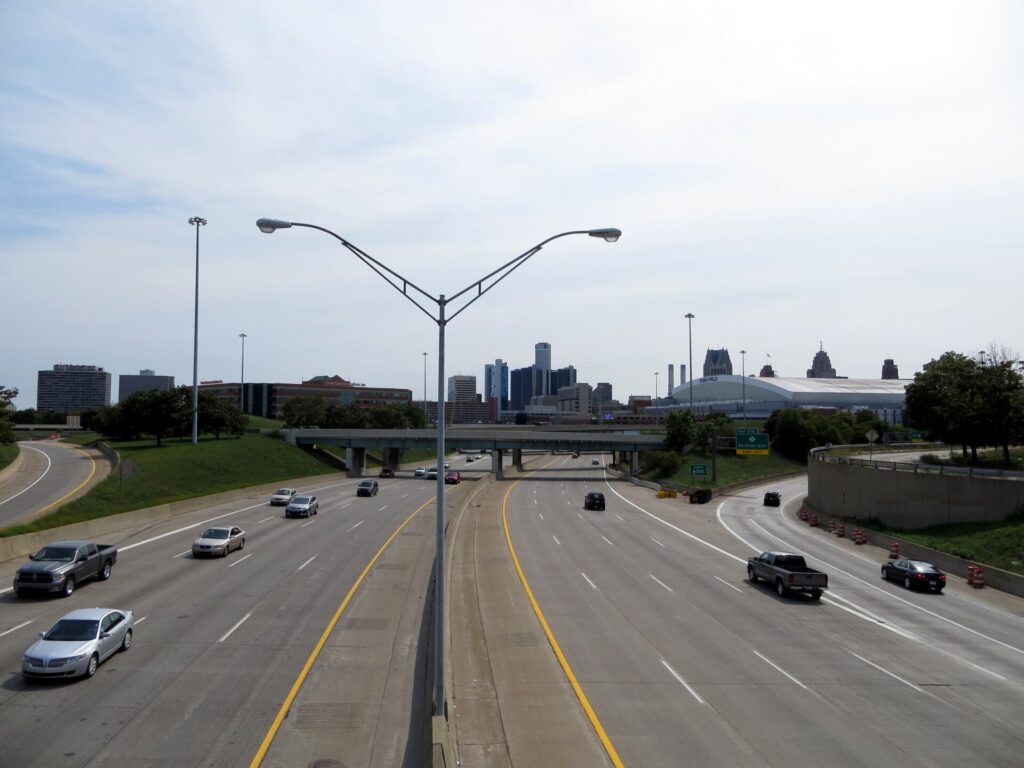
Driving in Detroit is easier than in most big American cities. The freeways are wide and plentiful, traffic is lighter than in Chicago or Toronto outside the peaks, and the grid of mile roads makes navigation simple. The main freeways are I-94, which runs from the airport through the city toward Port Huron; I-75, which runs north-south through downtown toward Toledo and northern Michigan; I-96, heading northwest toward Lansing and Grand Rapids; the Lodge Freeway (M-10), the quick route from downtown to Southfield; and I-696, the crosstown route through the northern suburbs. Rush hours bring slowdowns, especially on I-94, I-75 and I-696, and construction season, from spring to fall, closes lanes and sometimes whole freeway segments on weekends; a project to replace the I-375 spur with a street-level boulevard is reshaping the eastern edge of downtown. The one habit that confuses every visitor is the Michigan left: on many divided boulevards, including stretches of Woodward, left turns are banned at intersections, and you instead drive through, make a U-turn at a marked crossover in the median, and come back to turn right. Watch for the signs and it soon feels natural.
Parking
Parking in Detroit is generally cheaper and easier to find than in Chicago or Toronto, but it has its moments. Downtown has street meters, payable at kiosks or with the ParkDetroit app, and plenty of garages and surface lots; hotels charge a nightly fee, often for valet only. On game, concert and festival days, the lots around Comerica Park, Ford Field, Little Caesars Arena and Hart Plaza raise their prices sharply, and traffic around the District Detroit backs up before and after events. Midtown and Corktown have street parking and small lots, and parking at the suburban hotels, malls and attractions is usually free. Read the signs for rush-hour and street-cleaning restrictions, and in winter look out for snow emergency rules on main streets.
Rules and conditions worth knowing
- Tolls. Michigan’s freeways are toll-free. The tolls you are likely to meet are on the crossings to Canada: the Detroit-Windsor Tunnel, the Ambassador Bridge and the other international bridges.
- Phones. Michigan bans holding or using a phone while driving; hands-free only.
- Right turns on red are permitted after a full stop unless signed otherwise.
- Potholes. Michigan’s freeze-thaw winters produce famously bad potholes in late winter and spring. Drive with some caution in the right lane and report damage to the rental company.
- Winter driving. The freeways are plowed and salted quickly, and rental cars on all-season tires cope with most Detroit winters, but a heavy snowfall or freezing rain can make roads slick for a day. The state’s Department of Transportation has road conditions and closures.
- Fuel and fees. Airport rentals carry concession fees that city locations avoid, and gas stations are plentiful everywhere except downtown, so fill up in the suburbs before you return the car.
Driving into Canada
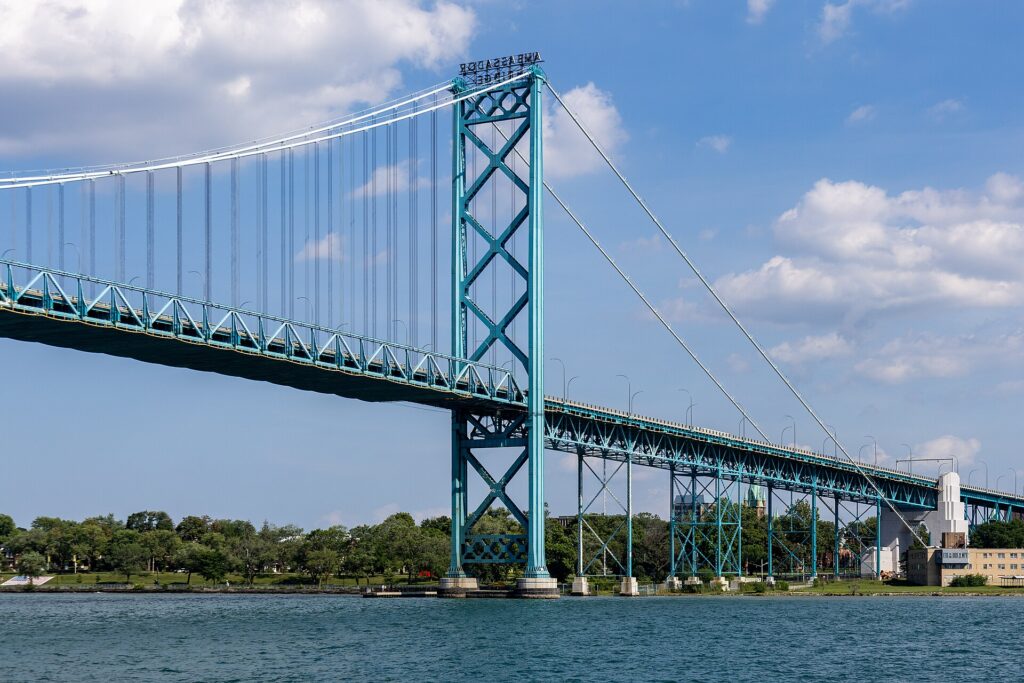
A rental makes a trip to Windsor, Point Pelee or Toronto easy, but crossing an international border in a rented car comes with a few principles. First, check the rental company’s cross-border policy before you book: most large companies allow their US cars into Canada, some restrict certain vehicle classes, and one-way rentals that end in Canada often carry a steep drop fee. Carry the rental agreement, and ask for proof of insurance that is valid in Canada. Second, everyone in the car needs documents both countries accept: for US citizens, a passport, passport card, NEXUS card or enhanced driver’s license; for everyone else, a passport plus whatever visa or status you need to enter Canada and to re-enter the United States. Third, declare what you carry, including food, alcohol, tobacco and large amounts of cash, and leave cannabis and firearms behind. The authoritative sources are the Canada Border Services Agency for entering Canada and U.S. Customs and Border Protection for returning. Across the river, speed limits and fuel are in kilometers and liters. The tunnel is the quickest route from downtown to downtown Windsor, the Ambassador Bridge connects to Southwest Detroit’s freeways, and the newest crossing, the Gordie Howe International Bridge, built to link I-75 directly to Ontario’s highways, is the natural route toward Toronto; check each crossing’s current status, tolls and wait times before you set off.
When renting a car makes sense
- Dearborn and the suburbs. The Henry Ford, the Detroit Zoo, Cranbrook and the suburban restaurants are spread out, and a car makes a day far easier.
- Road trips. Detroit is the start of classic drives east to Toronto, west to Chicago, or north to the lakes and the Mackinac Bridge; our route guides for Detroit to Toronto and Chicago to Detroit cover the two big city runs.
- Family visits and suburban hotels. If your base is in Troy, Novi or the Grosse Pointes, a car earns its keep daily.
- Families with small children and gear, for whom the bus is not practical.
- Business trips to suburban offices, where the auto companies, suppliers and engineering firms are spread along the freeways.
If any of those apply, our rental car booking tips cover insurance, deposits and the questions to ask at the counter, and our family car rental guide looks at vehicle choice.
When it does not
- You are staying downtown or in Midtown, and your plans are the riverfront, the museums, Motown, Eastern Market and Corktown.
- You are in town for a game, a concert, a festival or a convention at Huntington Place, when parking prices and traffic are at their worst and the People Mover and QLine go to the door.
- Your day trips are Ann Arbor or Chicago, both reachable by Amtrak, or Ann Arbor by the D2A2 coach.
- You are traveling solo or as a couple and would spend more on the rental, fees and hotel parking than on ride-hail and the odd transit pass.
The hybrid plan for a city-plus-suburbs visit
Go car-free for the downtown days and rent only for the days you leave the core, and think about where you pick up. Renting at DTW makes sense if you are heading straight to Dearborn, Ann Arbor or a suburban hotel, because the freeways start at the airport and you never touch downtown traffic. For everyone else, it pays to take a taxi or ride-hail downtown, spend the first days without a car, and pick up from a downtown or nearby rental office on the morning you head out; you avoid the airport fees and several nights of hotel parking. If your trip continues to Chicago or Toronto, a one-way rental is a classic itinerary, though one-way fees vary widely, and cross-border one-ways cost more. Book ahead for summer weekends, the Dream Cruise, football weekends and the holidays. Compare day rates on our Detroit car rental page against a full-trip rental and the difference is usually obvious.
A worked cost comparison
Numbers change with the season and the booking window, so treat this as a method rather than a quote, and check current rates before deciding. For a three-night city break downtown for two people, the car-free version costs a ride-hail each way from DTW, a handful of short ride-hail trips, perhaps a MoGo day pass and a transit pass; the rental version adds three days of a compact car with airport fees, three nights of hotel parking, fuel and event-day parking, and buys you little you could not reach almost as easily without it. The car-free option wins. For the same three nights plus a day at The Henry Ford, the hybrid version adds a single-day rental picked up downtown, or a pair of ride-hail trips to Dearborn, and both are cheaper than a three-day rental with parking. For a week split between the city, the suburbs and a drive to Toronto or up north, a rental is the practical answer, and the question becomes where to pick it up and whether your rental company allows the car into Canada. Run the rental rates for your dates on our Detroit car rental page and put them beside ride-hail and transit costs before you choose.
Driving out of Detroit in each season
The big drives from Detroit each have their own seasonal rhythm. In summer, the northbound I-75 is packed on Friday afternoons as the region heads “up north” to the lakes, cottages and the Mackinac Bridge, and southbound on Sunday evenings; leave early in the morning to avoid it. Border crossings to Canada are busiest on summer weekends and holiday Mondays in both directions. In fall, the drives north to Traverse City and the Leelanau Peninsula, and the color along the rivers, peak in early-to-mid October, and the roads are quieter once school is back. In winter, the freeways are plowed and generally open, but lake-effect snow can hit Ontario’s Highway 401 toward Toronto, west Michigan on the way to Chicago and the northern Lower Peninsula hard, making long drives slow for a few hours at a time; check the forecast and road conditions before you leave, and carry a scraper, a full tank and a warm layer. In spring, the roads are wet and potholed after the freeze-thaw, and construction season begins. The drive to Toronto takes about four hours on Highway 401 plus the border, and the drive to Chicago about four and a half hours on I-94, crossing into Central time, so you gain an hour going west and lose it coming back. Before a Toronto trip, read our Toronto car-versus-transit guide, because you will not want the car downtown there either.
Decision table
| Your trip | Recommendation | Why |
|---|---|---|
| City break downtown or in Midtown | No car | Walking, the QLine, the People Mover, MoGo and ride-hail cover it; hotel parking adds up |
| Game, concert or festival | No car | The People Mover and QLine serve the venues; event parking is expensive |
| City plus The Henry Ford | Hybrid: one-day rental or ride-hail | Dearborn is 20 minutes away by car |
| Ann Arbor or Chicago | No car: Amtrak or the D2A2 coach | Direct services from Detroit |
| Windsor for the day | Either: tunnel by car, or the tunnel bus if it is running | Check documents and the rental’s cross-border policy |
| Family visit to the suburbs | Rent for the whole stay | Suburban distances make the car worthwhile daily |
| Business trip to suburban offices | Rent at DTW | The freeways start at the airport; offices are spread out |
| Road trip to Toronto, Chicago or up north | Rent (check cross-border rules for Canada) | Detroit is the start, not the destination |
Money-saving tips for both options
- Without a car: stay downtown or in Midtown near the QLine, use the People Mover and MoGo for short hops, and share ride-hail trips with your group from the airport and between neighborhoods.
- On a rental: pick up in the city to avoid the airport fees, rent only for the days you leave the core, decline extras you already have through a credit card or home policy (check first), and fill up before you return the car.
- On the hotel: if you are renting, price the parking fee into the room rate, or stay in Dearborn or the suburbs where parking is usually free.
- On timing: avoid the freeways at the weekday peaks and the northbound I-75 on summer Fridays, and watch for event weekends, when hotels and parking are at their most expensive; the best time to fly to Detroit guide lists the busiest dates.
- On day trips: for one or two people, Amtrak or the D2A2 coach to Ann Arbor usually costs less than a day’s rental plus fuel and parking.
Frequently asked questions
Do you need a car in Detroit?
Not for a downtown and Midtown visit, where walking, the QLine, the People Mover and ride-hail cover the main sights. For Dearborn, the suburbs and road trips, a car makes life much easier, so rent for those days.
Is public transit in Detroit good for tourists?
For the core, yes: the QLine and the People Mover link most of the big sights. The bus network works but runs less frequently than in Chicago or Toronto, so many visitors combine transit with ride-hail.
How do I get from DTW to downtown Detroit?
By taxi or ride-hail in 25 to 40 minutes, or by SMART’s express bus, which is much cheaper and slower. There is no train.
Is parking expensive in downtown Detroit?
Usually moderate by big-city standards, but hotel parking adds up over several nights and lots near the stadiums charge much more on game and event days.
Can I drive a rental car from Detroit into Canada?
Usually, with most major companies, but check the policy before you book, carry the rental agreement and proof of insurance valid in Canada, and make sure everyone in the car has documents both countries accept.
Are there tolls around Detroit?
Not on Michigan’s freeways. You pay tolls only at the international crossings, such as the tunnel and bridges to Canada.
What is a Michigan left?
On many divided roads, left turns at intersections are banned; you drive through, make a U-turn at a marked median crossover, and turn right at the intersection instead.
Whichever way you go, start with the flight. Compare cheap flights to Detroit, choose a neighborhood with our Detroit hotel search, read our first-timer’s guide to Detroit, and if Dearborn, Windsor or a road trip is on the list, price the rental for those dates on our Detroit car rental page.
Keep planning with TicketScanner
- Detroit car rentals — compare airport and city pickup
- Cheap flights to Detroit
- Detroit hotels — factor parking into the rate
- Things to do in Detroit: a first-timer's guide
- Best time to fly to Detroit: month by month
- Detroit Metro (DTW) airport guide
- Driving Detroit to Toronto
- Driving Chicago to Detroit
- Rental car booking tips
- Car, transit or taxi in a new city?
Leave a Reply