Blog

  • Hotel Booking Tips For Saving Money On Your Next Trip

    Hotel Booking Tips For Saving Money On Your Next Trip

    For most trips, the hotel is the biggest single cost after the flight, and on a longer stay it is often bigger. It is also the part of a trip where small decisions compound: a room that looks cheap but sits forty minutes from everything you came to see, a nonrefundable rate booked before your dates were firm, a parking charge nobody mentioned, a resort fee that shows up at checkout. Saving money on a hotel is rarely about finding a secret discount. It is about knowing what a room will really cost you, choosing the right location and the right rate for your situation, and booking at a sensible moment. This guide walks through the whole process in order, from deciding what you need to what to check at the front desk, and links to the more detailed guides in this series for deal hunting, last-minute stays, family trips, business travel and hotels in Canada.

    The short answer

    If you only remember a handful of things, make it these. Choose the neighborhood before the hotel, because location drives both your daily costs and how much you enjoy the trip. Compare the total price, including taxes, mandatory fees, parking and breakfast, not the nightly rate on the search results. Match the rate to your certainty: pay the premium for free cancellation when your plans might move, and take the cheaper prepaid rate only when they will not. Book early for peak dates and big events, and stay flexible for quiet periods, when waiting can pay. Read recent reviews for patterns, not for the single angry post. And once you have found a property you like, check the hotel’s own site before you pay, since the same room sometimes comes with better terms there. You can start comparing properties and prices across your dates on our hotel search.

    A spacious hotel lobby with couches, rugs and a chandelier
    A great lobby is nice; the total price, the location and the cancellation terms matter more (Photo: Basile Morin via Wikimedia Commons, CC BY-SA 4.0)

    Step 1: Decide what you actually need

    The fastest way to overspend is to start scrolling before you know what you are looking for. Every filter you set in advance removes rooms you would never have booked.

    Who is traveling, and why

    A couple on a city break, a family of five, a solo business traveler and a group of friends going to a concert need different things. Families usually care about room size, bed configuration, a pool and breakfast; our guide to the best time to book hotels for family vacations covers timing around school holidays in detail. Business travelers care about location relative to meetings, a reliable desk and Wi-Fi, early breakfast and a smooth late check-in, which is the focus of the business travel hotels guide.

    Your must-haves and your nice-to-haves

    Write down the three or four things you will not compromise on, then everything else. Typical must-haves are a maximum total budget, a specific area, two beds or a separate sleeping space for children, parking if you are driving, an accessible room, or a quiet room if you are a light sleeper. Nice-to-haves are the gym, the rooftop bar and the view. Nice-to-haves break ties; they should never push you over budget.

    Your real budget

    Set the budget as a total for the stay, including taxes and fees, not as a nightly rate. A single figure for the whole trip forces you to account for costs that do not appear on the first page of results.

    Step 2: Pick the neighborhood before the hotel

    Location is the decision that most affects both cost and experience, and it is the one people rush. A cheaper hotel on the edge of the city is only a deal if the savings survive the taxis, transit fares, parking and time it costs you to get to the places you came for. A slightly more expensive room near a subway stop, in a walkable district, or next to the conference center can be the cheaper option once the whole trip is counted.

    A practical way to choose:

    • List the three or four places you will go most. Attractions, a conference venue, a relative’s house, a stadium.
    • Look at them on a map together. The area in the middle, or along a direct transit line between them, is usually where to stay.
    • Check the walk to the nearest station, not just the distance to downtown. A hotel described as “near the center” might be close in a straight line and awkward in practice.
    • Look at the street, not just the building. Street View and reviews that mention the area show whether it is lively, quiet or empty at night.
    • Price in parking if you are driving. Downtown hotels in large cities often charge a daily parking fee, sometimes steep, while suburban and airport properties frequently include it.

    Each city has a handful of areas that suit most visitors. Our neighborhood pages show hotels in the districts people ask about most, such as the Entertainment District in Toronto, Old Montreal, Times Square in New York and the Las Vegas Strip. If you are weighing whether you will need a car at all, our comparison of renting a car, public transit and taxis helps you decide how central you need to be.

    Step 3: Choose your dates with demand in mind

    Hotel prices follow demand closely, and demand follows a few predictable patterns. Understanding them lets you shift a trip by a day or two and pay noticeably less for the same room.

    Weekdays versus weekends

    In business-heavy downtowns, rooms are often busiest from Monday to Thursday and quieter on Friday and Saturday nights, when those hotels chase leisure guests. In resort towns, beach areas and weekend-getaway destinations it tends to work the other way around. Run the same search across a few arrival days and compare the totals.

    Seasons, holidays and school breaks

    Every destination has a high season, a low season and the shoulder months in between. Summer and the December holidays are peak almost everywhere in North America, ski areas peak in winter, and shoulder months often combine decent weather with much better availability. Our guide to the best time to book cheap flights and hotels goes through the seasonal patterns and booking windows in more depth.

    Events and conventions

    The biggest price swings come from events: a major concert, a playoff game, a marathon, a trade show, a festival. Before you book, check event listings for your dates; if something big is on, book early or shift your trip. Our Toronto events and Las Vegas events pages are good examples of the calendars worth checking.

    The reception desk in a city-center hotel lobby
    Check-in is the moment to confirm your rate, what is included and the room you want (Photo: JIP via Wikimedia Commons, CC BY-SA 4.0)

    Step 4: Compare the total price, not the nightly rate

    This is the single most important habit. Two hotels showing the same nightly rate can end up far apart once taxes, fees and extras are added.

    The rules on how prices must be displayed have tightened. In the United States, the Federal Trade Commission has adopted a rule requiring hotels and booking sites to show the total price, including mandatory fees, up front. In Canada, the Competition Bureau treats advertising a price that cannot be attained because of added mandatory fees as drip pricing, a deceptive marketing practice. These rules cover mandatory charges; optional ones like parking and breakfast are still yours to add, so check the rate details before you compare.

    Charges to look for before you book

    ChargeWhat it isHow to handle it
    TaxesSales, lodging and tourism taxes, which vary by city and province or stateCompare totals after tax; some sites show pre-tax prices by default
    Resort or destination feeA mandatory daily charge for amenities such as Wi-Fi, pool or gym accessCheck the rate details; it must be in the total where display rules apply
    ParkingDaily self-parking or valet charge, often high downtownAdd it for every night you will have a car; compare with nearby public lots
    BreakfastIncluded in some rates, a separate charge in othersValue it at what you would otherwise spend; families save the most
    Extra guestsA charge for additional adults, or for children above a certain ageEnter every traveler correctly so the price you see is the price you pay
    Early check-in or late checkoutGuaranteed early arrival or late departure, sometimes chargedAsk at booking; often free on request if the hotel is not full
    Pet feePer-night or per-stay charge, sometimes a cleaning depositConfirm the policy and any size limits before booking
    Deposit or incidentals holdA temporary hold on your card at check-inNot a charge, but it reduces available credit; see the payment section below

    Build a quick total for your two or three finalists that includes every night, taxes, fees, parking and breakfast if it matters to you. The ranking often changes.

    Step 5: Choose the right rate type

    The same room is usually sold at several prices with different conditions attached. Picking the right one is about matching flexibility to how certain your plans are.

    Rate typeTypical conditionsBest for
    Flexible, pay at the hotelFree cancellation until a deadline, often a day or two before arrival; card held as a guaranteePlans that might change; trips booked well in advance
    Advance purchase, nonrefundableLower price, paid in full at booking, no refund if you cancelFixed dates, such as a wedding or a conference you are sure to attend
    Member rateA discount for signing in to the hotel’s free loyalty programAlmost everyone who books directly; joining is usually free
    Package (flight plus hotel)Bundled price; changes and cancellations follow the package’s own termsResort and beach trips where the bundle genuinely beats separate prices
    Discount rates (auto club, senior, government, corporate)Eligibility required; ID or proof is often checked at check-inTravelers who genuinely qualify

    The flexible rate is effectively insurance. If the nonrefundable rate is only slightly cheaper, the flexibility is almost always worth paying for. If the gap is large and your dates are fixed, take the savings. Read the cancellation deadline carefully: “free cancellation” sometimes ends several days before arrival, not the evening before.

    A flexible booking also lets you take advantage of price drops. If you book a refundable rate early and prices fall closer to your dates, you can book the cheaper rate and cancel the first one, as long as you are still inside the free cancellation window. Always make the new reservation before canceling the old one.

    Step 6: Read reviews like an investigator

    Reviews are the best free information you have, but they reward a careful reading. Star ratings tell you the category of a hotel; recent reviews tell you what it is actually like to stay there now.

    • Sort by most recent. Hotels renovate, change management and sometimes decline. Reviews from the last few months matter far more than a high average built years ago.
    • Look for patterns. One complaint about noise is a light sleeper; ten complaints about noise from the bar downstairs is a fact about the building.
    • Search reviews for your must-haves. “Parking”, “crib”, “elevator”, “air conditioning”, “walls” or “Wi-Fi”, whatever matters to you.
    • Compare guest photos with the hotel’s photos. Professional photos use wide lenses and good light; guest photos show the real room.
    • Read how management responds. A thoughtful reply to a complaint is a good sign about how they will treat you if something goes wrong.

    Step 7: Compare where you book

    The smart approach is usually to use a comparison search to find the property and the price, then check the terms on the hotel’s own site before paying.

    ChannelStrengthsWatch for
    Comparison searchShows many properties and sites side by side; quick to see price ranges across dates and areasThe final price and conditions are set by the site you book with; check them there
    Online travel agencyWide choice, one account for many bookings, sometimes package or member discountsChanges and problems may need to go through the agency rather than the hotel; loyalty points may not apply
    Hotel directlyLoyalty points and elite benefits, member rates, easier special requests and changesNot always the lowest price; compare like for like, including cancellation terms

    When you compare, make sure you are comparing the same thing: the same room type, the same bed configuration, the same cancellation policy, and the same inclusions such as breakfast. The companion guide to finding the best hotel deals online goes deeper into comparison tactics, member pricing, bundles and how to avoid fake booking sites.

    A double bed with bedside lamps in a hotel room
    Room names vary by brand; check the bed configuration and room size, not just the label (Photo: JIP via Wikimedia Commons, CC BY-SA 4.0)

    Loyalty programs, briefly

    Every major hotel group runs a free loyalty program, and joining the one for the hotel you are booking is nearly always worthwhile, even for a single stay. Members typically get a lower rate when booking directly, free Wi-Fi at many brands, and the chance of perks such as late checkout.

    Loyalty becomes genuinely valuable when you travel often enough to concentrate your stays with one or two groups, which is where elite status, upgrades and breakfast benefits begin. If you travel once or twice a year, take the best total price and collect points where it costs nothing. Note that stays booked through third-party sites often do not earn points or recognize status, so check the program’s terms if that matters to you.

    Room types, beds and alternatives to hotels

    Room names vary wildly between brands, so read what is actually included. A “double” in one country is a single double bed; in another it means two beds. “Queen”, “king”, “two queens” and “double-double” are clearer. If you need two beds, choose a room type that guarantees them, because a “bed type requested” note is a request, not a promise. The listed room size tells you more than the name.

    For families and longer stays, consider suites and apartment-style hotels, which often include a kitchenette and a separate sleeping area. Solo travelers on a budget can look at hostels with private rooms. Vacation rentals can suit groups, but compare the full price including cleaning and service fees, and remember you give up a front desk.

    If you need an accessible room, book a room type that is specifically designated as accessible rather than adding a note, and call the hotel to confirm the features you need, such as a roll-in shower or visual alarms. In the United States, hotels are covered by the Americans with Disabilities Act, which includes requirements for how accessible rooms are described and reserved.

    When to book: a practical timeline

    • Peak dates and events: book as soon as your plans are firm, on a refundable rate. The best-located rooms go first.
    • Normal dates in a big city: booking a few weeks ahead is usually comfortable. Use a refundable rate and keep an eye on the price.
    • Quiet periods and low season: waiting can work, because hotels with empty rooms may lower rates close to the date. This is where last-minute booking shines, as explained in our last-minute hotel booking guide.
    • Small towns, national parks and island destinations: book early regardless of season, since there are only a few properties and they fill.

    The best strategy for most trips is to reserve a refundable room early, then check again a week or two before arrival. If the price has fallen, rebook. If it has risen, you are already protected.

    Paying: deposits, holds and currency

    Most hotels place a temporary hold on your card at check-in to cover incidentals, and sometimes the room total as well. The hold is released after checkout, but it can take several business days to disappear, and it reduces your available credit in the meantime. If you use a debit card, the hold may tie up money in your bank account, which is one reason many travelers prefer a credit card for hotels.

    When paying abroad, you may be offered the choice of paying in your home currency rather than the local one. This convenience usually comes with a less favorable exchange rate than your card would apply, so choosing the local currency is typically the cheaper option. If you are traveling internationally, also check your government’s advice for your destination before you book, such as Canada’s travel advice and advisories, for entry rules and local safety information.

    After you book, and at check-in

    Save your confirmation and check the dates, names, room type and number of guests. If you booked through a third party, contact the hotel a few days before arrival to confirm they have your reservation, and tell them if you will arrive late or have a special request such as a crib or a quiet room. Put your cancellation deadline in your calendar so you can recheck prices before it passes.

    At the desk, confirm the rate, the total and what is included, and ask politely about the room if anything matters to you; staff can often move you away from the elevator or to a higher floor when the hotel is not full. If something is wrong with the room, report it the first evening, when it is easiest to fix, and check the final bill before you leave.

    Common mistakes that cost money

    • Comparing nightly rates instead of totals. Taxes, mandatory fees and parking change the ranking.
    • Booking a nonrefundable rate for uncertain plans. The savings disappear the moment you need to change.
    • Choosing the cheapest area without costing the commute. Transit, taxis and lost time add up quickly.
    • Ignoring event calendars. A concert or convention can double the price of a normal weekend.
    • Booking through an unfamiliar site that looks like the hotel’s. Use known sites or the hotel’s official website, and be careful with phone numbers found in search ads; the FTC’s travel advice covers common booking scams.
    • Forgetting to recheck prices on a refundable booking. A quick search before your deadline can save real money.
    A carpeted guest-room corridor in a downtown Toronto hotel
    Ask for a room away from the elevators and ice machine if you are a light sleeper (Photo: Chris Woodrich via Wikimedia Commons, CC BY-SA 4.0)

    Tips for specific situations

    Family trips

    Prioritize space and sleep, check that the rate covers every child, and book early for school holidays. The family vacation hotel booking guide covers timing, room choices and what to check with children in tow.

    Business travel

    Proximity to meetings is worth paying for. Check your employer’s policy and negotiated rates first, and confirm the hotel issues an itemized invoice. Our business travel hotels guide covers what to look for and how to handle expenses.

    Spontaneous trips

    If you are booking days or hours ahead, flexibility on area and room type is your biggest advantage, and checking whether there is an event in town is essential. The last-minute hotel booking guide explains when waiting pays and when it backfires.

    Traveling in Canada

    Big Canadian cities are busiest in summer and during major events, and national-park towns fill early. Our guide to hotel booking in Canada covers taxes, seasons and where to stay in the main cities, and you can browse options in Toronto, Vancouver, Montreal and Calgary.

    Combining hotel, flight and car

    If you are also flying, book the flight first when fares are the more volatile part of the trip, then fit the hotel around it, using a refundable rate so a schedule change does not strand you with a room for the wrong nights. If you are renting a car, factor hotel parking into your choice of property; our rental car booking tips cover the other half of that decision. You can compare flights and rental cars for the same dates on TicketScanner.
    Frequently asked questions

    Is it cheaper to book a hotel directly or through a booking site?
    It depends on the hotel and the date. Booking sites are best for finding and comparing options; the hotel’s own site often matches the price and may add a member discount, loyalty points or better cancellation terms. Check both for the same room and conditions before you pay.

    How far in advance should I book a hotel?

    For peak seasons, holidays and major events, as soon as your plans are firm. For ordinary dates in a large city, a few weeks ahead is usually fine. For quiet periods, waiting can sometimes pay. Reserving a refundable rate early and rechecking later gives you the best of both.

    What day of the week is cheapest for a hotel stay?

    In business districts, Friday and Saturday nights are often cheaper; in resort and leisure destinations, weeknights usually are. Search a few arrival days to see the pattern.

    Are resort fees mandatory?

    Where a hotel charges one, it is typically mandatory for every night of the stay. In the United States, federal rules now require the total price including mandatory fees to be shown up front, and in Canada, advertising prices that leave out mandatory fees is treated as drip pricing.

    Should I pay for a refundable rate?

    If there is any real chance your plans will change, yes, especially when the price difference is small. A refundable rate also lets you rebook if prices fall before your cancellation deadline.

    Why did my card get charged more than the room price at check-in?

    Most likely it is a temporary hold for incidentals, not a charge. It is released after checkout, though it can take several business days to clear. Ask the front desk how much it will be.

    Ready to put this into practice? Start with the neighborhood and your dates, then compare properties, prices and totals side by side on our hotel search. If you still need to get there, check cheap flights for the same dates, and read the guide to the best hotel deals online before you book.

  • How To Find Cheap Flights To Mexico City For Your Next Trip

    How To Find Cheap Flights To Mexico City For Your Next Trip

    Mexico City is one of the great cities of the Americas: a historic center built on the ruins of Tenochtitlan, museums that rank with any in the world, leafy neighborhoods full of cafés, and some of the best food you will eat anywhere, from street tacos to tasting menus. It is also a major airline hub, which is good news for anyone hunting for a fair price. Big hubs attract competition, and competition keeps fares honest. Finding a genuinely cheap flight still takes a method, though: choosing the right season, comparing airports and routings, understanding what each fare includes and knowing how the city’s two main airports differ. This guide walks through when to go, when to book, how to compare nonstop and connecting options from Canada and the United States, what the entry process looks like, how to get from the airport into the city, and how to keep the rest of the trip affordable. It is part of our flight booking series, which starts with our guide to the best time to book cheap flights and hotels.

    The short answer

    Travel outside the big holiday weeks, especially Christmas and New Year, Semana Santa (Holy Week) and the Día de Muertos period around the start of November, and you will usually find better fares and hotel rates. Book roughly two to four months ahead for ordinary dates and earlier for holidays. Search a range of dates and compare nonstop and one-stop options, because a sensible connection can be much cheaper. Check which airport your flight uses: Mexico City International (AICM, code MEX) is close to the city, while Felipe Ángeles International (AIFA, code NLU) is well to the north. Price the whole trip, with bags and seats included. And read the official entry requirements for your passport before you book. You can compare fares across a whole month on our flight search.

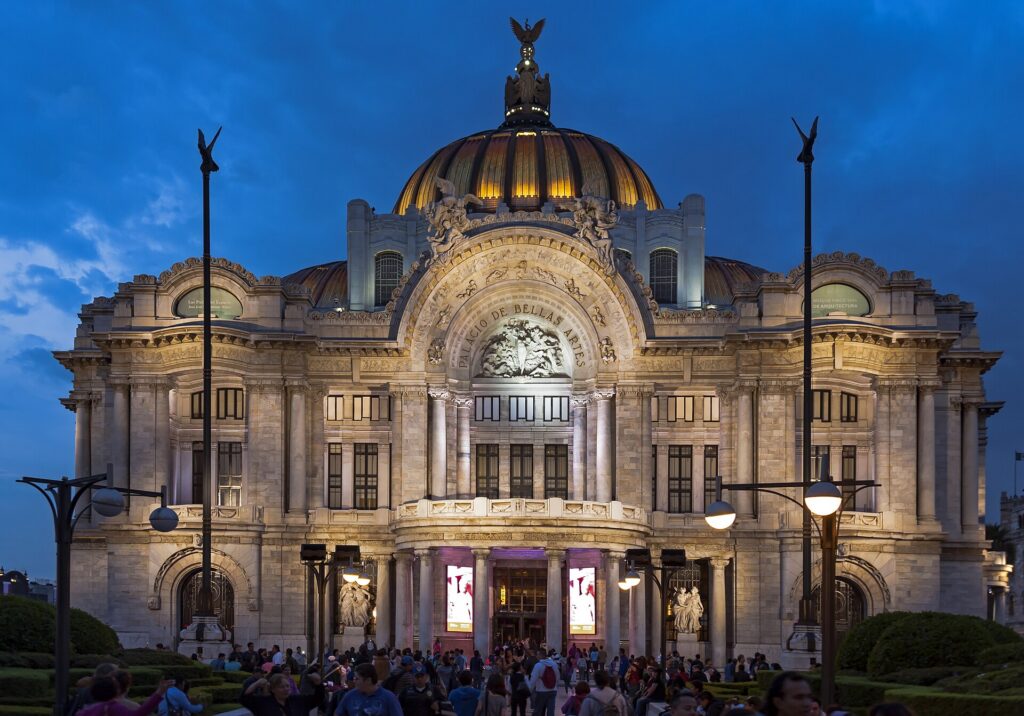
    The Palacio de Bellas Artes in Mexico City at dusk
    Mexico City's historic center is one of the great sights of the Americas (Photo: Daniel Case via Wikimedia Commons, CC BY-SA 3.0)

    When to visit Mexico City

    Mexico City sits in a high valley at about 2,240 meters, which gives it a mild climate year-round. It rarely gets very hot, and evenings can be cool at any time of year. The seasons that matter are wet and dry, not summer and winter.

    PeriodWeatherCrowds and prices
    November to FebruaryDry, sunny days and cool nights; the coolest monthsPopular with visitors from the north; Christmas and New Year are peak
    March to MayDry and the warmest time of year; spring can be hazySemana Santa is very busy and many locals travel; otherwise good value
    June to SeptemberRainy season, usually with afternoon or evening showers and sunny morningsOften the lowest prices outside summer school holidays
    OctoberRains tapering off, pleasant temperaturesBuilds toward Día de Muertos at the start of November, when demand rises

    For value, the rainy season can be surprisingly good: showers usually come later in the day, mornings are often clear, and the city is green. Pack a light rain jacket and plan museum visits for the afternoon. Visitors with respiratory conditions should note the Government of Canada’s advice that air pollution in Mexico City peaks between December and March.

    Holidays and events that move prices

    • Christmas and New Year: the busiest and most expensive period for flights from Canada and the United States.
    • Semana Santa: Holy Week, the week before Easter, when many Mexicans travel. Flights and hotels across the country get expensive.
    • Independence Day: celebrations on the night of September 15 and on September 16 bring big crowds to the historic center.
    • Día de Muertos: the Day of the Dead celebrations around November 1 and 2 are a major draw, with events and decorations throughout the city in the days before. Book early if you want to be there.
    • Summer school holidays: July and August bring family travel from the north and within Mexico.

    If you want the best balance of weather and price, look at late January and February outside long weekends, late April and May after Semana Santa, and the quieter weeks of the rainy season.

    When to book

    Flights from Canada and the United States to Mexico City behave like other medium-haul international routes. Use these windows as a guide, then book when a fare lands at or below the normal level for your route.

    TripSensible booking window
    Ordinary dates from the U.S.About 1 to 3 months ahead
    Ordinary dates from CanadaAbout 2 to 4 months ahead
    Christmas, New Year, Semana Santa, Día de MuertosAbout 4 to 6 months ahead, or as soon as your plans are firm
    Short noticePossible on a busy hub route, but rarely cheap on peak dates

    Start watching fares as soon as you know roughly when you want to go. Look at a month view to spot the cheap days, set a price alert, and book once you see a fare that matches or beats what you have been seeing. For flights to or from the United States booked at least seven days before departure, most airlines let you cancel within 24 hours without penalty, which gives you a day to double-check. Our international flights booking tips explain the wider strategy for trips abroad.

    Choosing your airports

    At the Mexico City end

    Mexico City now has two main airports, and it matters which one your ticket uses.

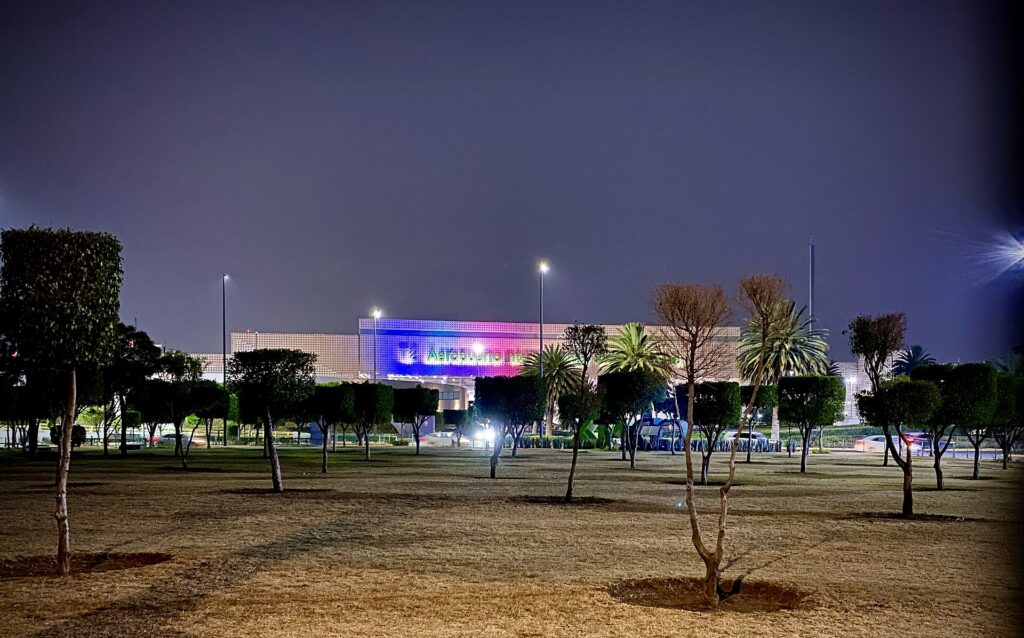
    • Mexico City International Airport (AICM, code MEX), officially Benito Juárez International, sits inside the city, east of the center. It has two terminals, Terminal 1 and Terminal 2, and handles most international flights. Being so close to neighborhoods like the Centro Histórico, Roma and Condesa, it is usually the most convenient choice. Check your terminal on your booking and on the airport’s official site.
    • Felipe Ángeles International Airport (AIFA, code NLU) opened in 2022 north of the city in the State of Mexico. Some domestic and a smaller number of international flights use it. It can be a good option if the fare is much lower, but the ground transfer to central Mexico City is much longer, and in traffic can take well over an hour.
    • Toluca International (TLC), west of the city, handles a small number of flights. It is rarely the right choice for a visitor unless the fare saving is large.

    When you compare fares, look at the airport code on each option. A cheaper flight into AIFA may cost you more in time and transport than it saves.

    At your end

    From Canada, Toronto, Montreal and Vancouver have typically had nonstop service to Mexico City; from other Canadian cities, you will usually connect, either through one of those airports or through a U.S. or Mexican hub. From the United States, many large hubs have nonstops, including cities such as Chicago, Dallas, Houston, Los Angeles, New York and Atlanta, and connections are easy from almost everywhere. Search from every airport you could realistically use, and remember to include the cost of getting there. Our flights from Toronto, flights from Montreal and flights from Vancouver pages are a good place to start from Canada.

    Terminal 2 at Mexico City International Airport
    Check the airport code: AICM is inside the city, AIFA is well to the north (Photo: Sharon Hahn Darlin via Wikimedia Commons, CC BY 2.0)

    Nonstop or connecting?

    A nonstop flight is the easy choice when the price difference is small. A connection can make sense when the saving is significant or when nonstop times do not suit you. Weigh these points:

    • Total travel time. A connection can add several hours. Compare door-to-door time, not just the fare.
    • Connection length. Very short connections are risky, especially if you need to change terminals or clear immigration. Very long ones eat into the value of the saving.
    • Connecting through the United States. The U.S. has no international transit zone, so travelers connecting through a U.S. airport go through U.S. border formalities even if they never leave the airport. Canadians generally need only a valid passport, but travelers of other nationalities may need U.S. travel authorization. Allow extra time for the process.
    • One ticket or two. On a single ticket, the airline rebooks you if a delay makes you miss your connection. On two separate tickets, you are usually on your own. Avoid self-connecting on a tight schedule.
    • Checked bags. On a single ticket, bags are normally checked through to Mexico City, although you may need to collect and recheck them at your first point of entry in some countries. Ask at check-in.

    Comparing airlines and fares

    Mexico City is the main hub of Aeroméxico, Mexico’s flag carrier, and an important base for Mexican low-cost airlines such as Volaris and Viva Aerobus. Major U.S. and Canadian airlines also fly in from their hubs. That variety is the reason prices can be competitive, but it also means fares are structured very differently.

    Airline typeTypical strengthsWhat to check
    Full-service airlinesMore included, easier connections, loyalty benefitsWhether your fare type includes a checked bag and seat selection
    Low-cost airlinesLow base fares, especially on nonstop routesCarry-on and checked bag fees, seat fees and size limits
    Basic economy fares on any airlineThe lowest price on that flightNo changes, last boarding, possible carry-on restrictions

    Compare the total with the bags and seats you actually need. A slightly higher fare that includes a checked bag can easily beat a bare-bones one. Our carry-on size guide explains how to check limits, and our flight details guide explains fare brands and baggage allowances.

    Entry requirements: check before you book

    Entry rules change, and they depend on your passport, so always read the official page for your nationality before booking.

    • Canadians: the Government of Canada’s travel advice for Mexico says Canadian tourists do not need a visa for stays of up to 180 days, and that your passport must be valid for the expected duration of your stay. It also explains how arrival works: an officer may stamp your passport with your permitted stay, or you may be directed to an e-gate kiosk, and you may need to complete a digital migration form. Keep proof of your entry with you.
    • U.S. citizens: read the U.S. State Department’s Mexico country information page for passport and entry requirements.
    • Other nationalities: check Mexico’s requirements for your passport, and U.S. transit rules if you connect through the United States.

    The same government pages carry safety and health advice, including regional advisories within Mexico, so read them as part of your planning. The Canadian page notes that Mexico City’s altitude can affect some visitors; take it easy on your first day, drink water and talk to a doctor before you go if you have heart or lung conditions.

    Getting from the airport into the city

    From AICM, the main options are:

    • Authorized airport taxis. Buy a ticket at an official taxi booth inside the terminal, with the price based on your destination zone, then take it to the taxi rank. This is the simplest option for most first-time visitors, especially at night.
    • Ride-hailing apps. App-based rides operate in Mexico City; follow the airport signs to the designated pickup areas.
    • Metrobús and Metro. Metrobús Line 4 serves the airport terminals and runs toward the historic center, and the Metro has a station near Terminal 1. Public transit is very cheap but can be crowded, and it is awkward with large suitcases.
    • Hotel transfers. Some hotels arrange pickups; compare the price with an authorized taxi.

    From AIFA, allow much more time. Check the current transport options on the airport’s information before you fly, and weigh the cost of the transfer against the fare saving. Most visitors do not need a rental car in Mexico City itself: traffic is heavy, parking is limited, and taxis, apps and transit cover the areas you will want to see. A car can make sense for road trips beyond the city.

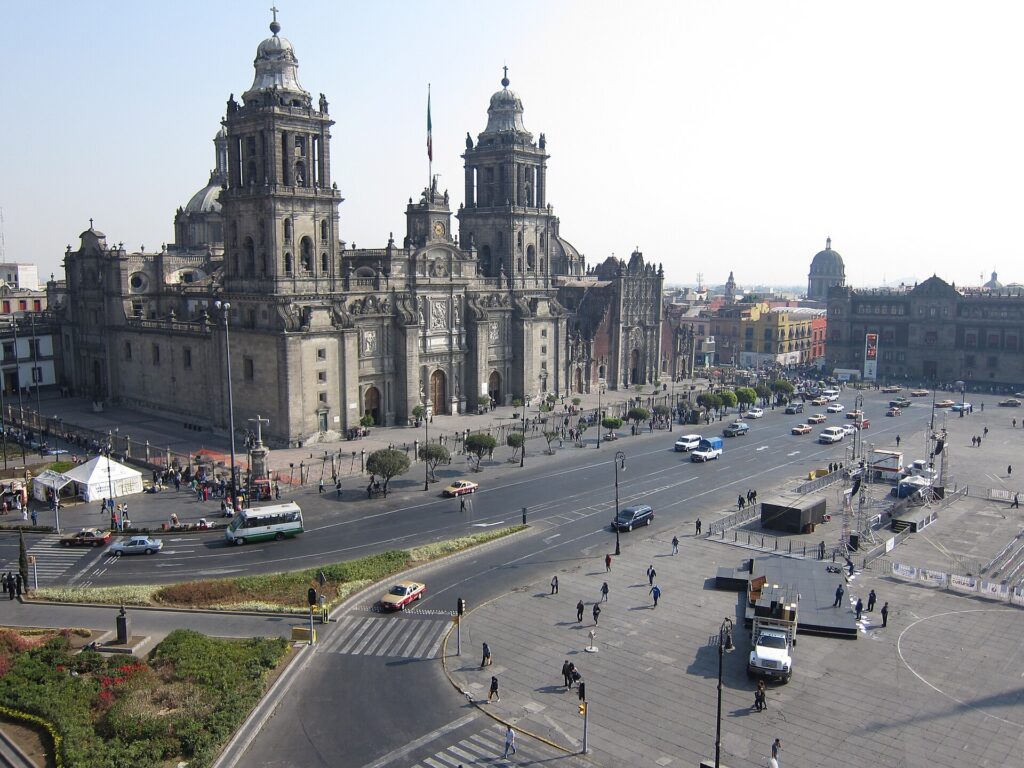
    The Zocalo and Metropolitan Cathedral in Mexico City
    The Centro Historico is a convenient base for first-time visitors (Photo: Jeff Kramer via Wikimedia Commons, CC BY 2.0)

    Where to stay, and how it affects your budget

    Hotel prices vary widely by neighborhood. Choosing the right base can save both money and hours in traffic.

    NeighborhoodWhy stay thereGood for
    Centro HistóricoWalking distance to the Zócalo, the cathedral, Templo Mayor and Bellas ArtesFirst-time visitors and sightseeing
    Roma Norte and CondesaTree-lined streets, parks, cafés, restaurants and nightlifeFood lovers and longer stays
    JuárezCentral, between the historic center and Roma, near Paseo de la ReformaEasy access to several areas
    PolancoUpscale hotels, shopping, fine dining, near Chapultepec Park and major museumsComfort and business travelers
    CoyoacánColonial streets, a relaxed pace, near the Frida Kahlo MuseumA quieter base, farther from the center

    Book a refundable room on our hotel search once your flight is set, then recheck the price before your cancellation deadline. Our hotel booking tips explain how to compare total prices.

    What to do once you are there

    You can fill a week in Mexico City without leaving the city limits. The highlights most visitors build a trip around:

    • The historic center: the Zócalo, one of the largest public squares in the world, the Metropolitan Cathedral, the ruins of the Templo Mayor and the Palacio de Bellas Artes.
    • Chapultepec: a vast park with Chapultepec Castle and the National Museum of Anthropology, one of the most important museums in the Americas. Give it at least half a day.
    • Coyoacán: the Frida Kahlo Museum, the Casa Azul, is hugely popular; buy timed tickets in advance.
    • Xochimilco: the canals in the south of the city, where colorful boats called trajineras carry groups along the water.
    • Teotihuacan: the pyramids of the Sun and Moon, an easy and very popular day trip northeast of the city. Start early to beat the heat and the crowds.
    • Food: markets, taco stands, bakeries and some of the most celebrated restaurants in Latin America. Eating well here does not have to be expensive.

    The city’s official tourism site, CDMX Travel from the Mexico City tourism ministry, lists attractions, neighborhoods and events.

    Keeping the rest of the trip affordable

    • Eat where locals eat. Markets, fondas serving set lunches and street stands offer excellent food for very little.
    • Use the free and low-cost sights. Walking the historic center, Chapultepec Park and many churches and public buildings costs nothing; some museums have free days for residents, so check.
    • Use transit or taxis wisely. Metro and Metrobús fares are very low; apps and authorized taxis are reasonably priced for longer trips.
    • Carry some pesos. Cards are widely accepted in hotels and restaurants, but markets and small vendors often prefer cash. Use bank ATMs inside branches or shopping centers.
    • Drink bottled or filtered water. Tap water is not recommended for drinking; most hotels provide bottled water.

    Mexico City or the beach?

    Many travelers from Canada and the United States think of Mexico as the beach. If you are deciding between a city trip and a resort, Mexico City often offers more to do for the money, with lower hotel prices outside the luxury end and a cooler climate. A beach resort offers rest and sun. Some travelers combine both, flying into Mexico City and continuing to the coast on a domestic flight. If the beach is calling, our guides to the best time to fly to Cancun and things to do in Cancun cover the Caribbean side, and you can compare fares on Cancun flights. For more ideas on stretching your budget, see our list of budget travel destinations.

    Use alerts, points and flexibility together

    The travelers who find the best fares to Mexico City usually combine several small habits rather than relying on one trick.

    • Set alerts on more than one route. If you could fly from two or three airports, watch all of them. A fare drop from a nearby city might beat your home airport.
    • Consider one-way fares. Flying out on one airline and back on another can sometimes give better times or a lower total, especially when low-cost airlines are involved. Compare with a round trip before booking.
    • Price points against cash. Loyalty points can be good value on routes where cash fares are high, such as holiday dates. Compare the points price and taxes with the cash fare before redeeming.
    • Stay flexible by a day or two. Moving your departure by a single day can drop the fare to a cheaper level.
    • Book the hotel on a refundable rate. Once the flight is set, a flexible room lets you rebook if prices fall.

    Common mistakes to avoid

    • Not checking the airport code. A flight into AIFA instead of AICM can mean a much longer transfer.
    • Booking during Semana Santa or Día de Muertos without meaning to. Check the calendar before choosing dates.
    • Comparing base fares instead of totals. Add bags and seats, especially on low-cost airlines.
    • Tight connections through a U.S. airport. Border formalities take time.
    • Ignoring the altitude. Plan a lighter first day.
    • Skipping the travel advice. Read your government’s page for Mexico before you book and again before you fly.
    • Arriving too late for check-in. International check-in deadlines are earlier than domestic ones; our guide on how early to arrive for an international flight explains why.
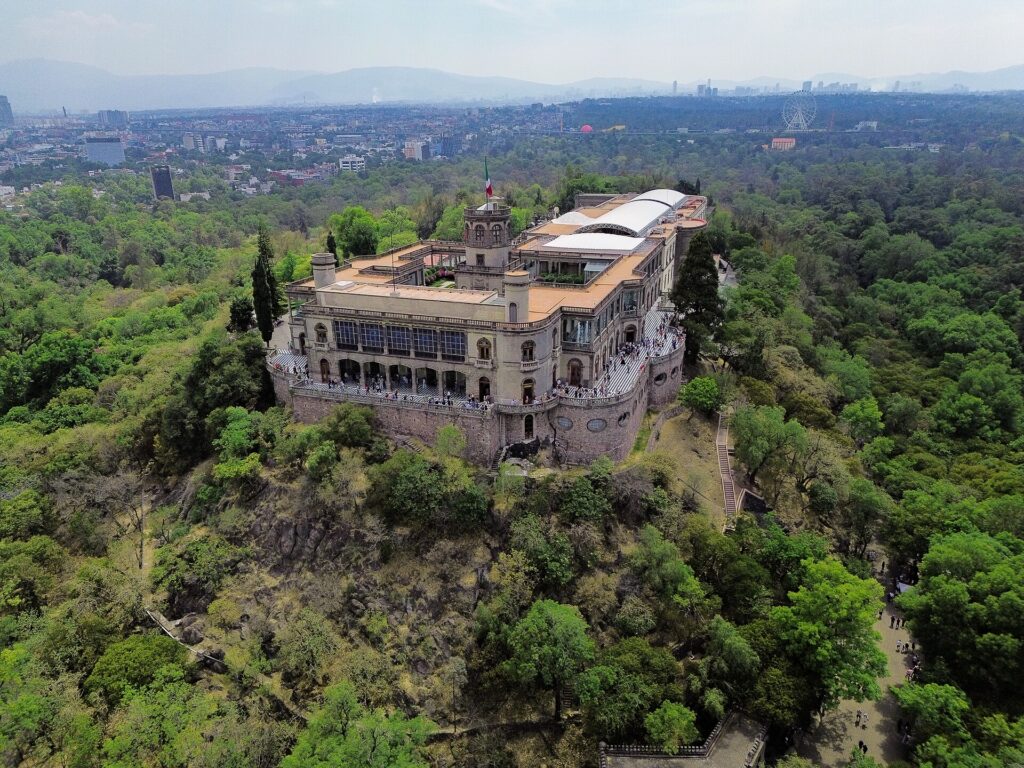
    An aerial view of Chapultepec Castle on its hill in Chapultepec Park, Mexico City
    Chapultepec Park holds the castle and the National Museum of Anthropology (Photo: ProtoplasmaKid via Wikimedia Commons, CC BY 4.0)

    Frequently asked questions

    What is the cheapest time to fly to Mexico City?

    Outside the major holiday periods: late January and February outside long weekends, late April and May after Semana Santa, and the quieter weeks of the rainy season often have better fares. Check a fare calendar for your route.

    How far ahead should I book a flight to Mexico City?

    About one to three months ahead from the United States and two to four months ahead from Canada for ordinary dates, and earlier for Christmas, Semana Santa and Día de Muertos.

    Which airport should I fly into?

    For most visitors, Mexico City International (AICM, MEX) is the most convenient because it is inside the city. Felipe Ángeles (AIFA, NLU) is much farther north, so only choose it if the saving justifies the longer transfer.

    Do Canadians need a visa for Mexico?

    According to the Government of Canada, Canadian tourists do not need a visa for stays of up to 180 days. Entry rules can change, so check the official travel advice before you book and before you fly.

    Is it cheaper to connect through the United States?

    Sometimes. A connection through a U.S. hub can be cheaper than a nonstop, but you will go through U.S. border formalities during the connection, so allow enough time and check any travel authorization your passport requires.

    Is the rainy season a bad time to visit?

    Not necessarily. Rain usually comes in the afternoon or evening, mornings are often clear, and prices can be lower. Pack a rain jacket and plan indoor visits for later in the day.

    Do I need a rental car in Mexico City?

    Usually not. Traffic is heavy and parking is limited, while taxis, ride-hailing apps, the Metro and Metrobús cover the main areas. A car can be useful for trips outside the city.

    How do I get from the airport to my hotel?

    From AICM, an authorized taxi bought at an official booth inside the terminal is the simplest option. Ride-hailing apps, Metrobús Line 4 and the Metro are alternatives.

    Ready to plan your trip? Search a whole month of fares to Mexico City on our flight search to find the cheapest days and routings, then compare rooms in the neighborhood that suits you on our hotel search. For the bigger picture on timing, read our guide to the best time to book cheap flights and hotels.

  • Difference Between First Class And Business Class For International Flights

    Difference Between First Class And Business Class For International Flights

    On a long international flight, the cabin you choose shapes the whole trip: whether you sleep, how you feel when you land, and how much of your first day you lose. Business class and first class both promise comfort, but the names are less helpful than they sound. “First class” means something very different on a two-hour domestic flight in North America than on a long-haul flight to Asia or the Middle East, and on many airlines business class is now the best seat on the plane. A modern business class seat on one airline can beat an older first class product on another. This guide explains what each cabin really offers, how to tell which product you are buying, how they compare on seats, sleep, lounges, food, service and baggage, and how to decide which is worth it for your trip. It is part of our flight booking series, which starts with our guide to the best time to book cheap flights and hotels.

    The short answer

    On long-haul international flights, business class usually means a lie-flat seat, lounge access, priority services and restaurant-style meals. International first class, where it still exists, adds more space and privacy, often a suite with a door, more personal service, more elaborate dining and more exclusive ground facilities, at a price that is often several times higher. On domestic flights in the United States and Canada, “first class” is usually a wider recliner with more legroom, closer to a short-haul business seat than to international first. Many airlines no longer sell international first at all, making business class their top cabin. For most travelers, long-haul business is the sweet spot of comfort and value, and the right question is not “business or first?” but “which seat, on which aircraft, at what price?” Compare cabins and dates for your route on our flight search.

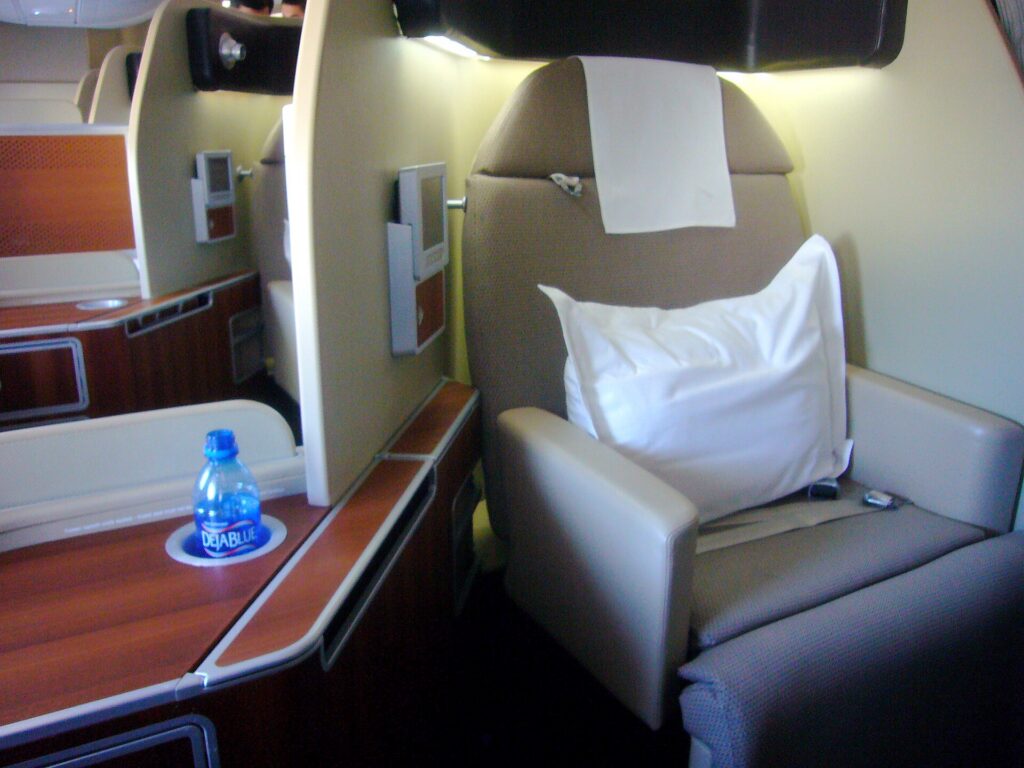
    A private first class suite with a wide seat and screen on a long-haul aircraft
    International first class: more space, more privacy and more personal service (Photo: David Lytle from San Francisco, CA, USA via Wikimedia Commons, CC BY 2.0)

    Why cabin names are confusing

    Airlines use cabin names as brands, not as standard definitions. There is no rule that says what a business class seat must include, and the same word can describe very different products. It helps to think of three situations.

    Long-haul flights with three premium tiers

    A small number of airlines fly large widebody aircraft with a first class cabin at the front, business class behind it, then premium economy and economy. On these flights, first is clearly the top product, and business is a step below it, though usually still a lie-flat bed. Emirates, for example, describes its first class cabin features separately from its business class, and the difference is presented as one of space, privacy and service.

    Long-haul flights where business is the top cabin

    Many airlines, including most North American carriers on their international routes, sell business class as their best long-haul product. Delta calls its version Delta One and describes it as its most premium experience, with 180-degree lie-flat seats on international and select long-haul domestic routes. Air Canada’s long-haul business cabin uses lie-flat pods on many of its international aircraft. On these flights there is no first class to buy: business is first, in practice.

    Short and medium flights in North America

    On domestic and regional flights in the United States and Canada, the front cabin is often branded “first class” or given an airline-specific name. It usually offers wider seats, more legroom, more recline, priority services and better food and drink, but not a bed. Delta’s Delta First page, for instance, describes up to 8 inches of extra legroom and up to 5.4 inches of recline compared with a standard Delta Main seat. That is a very comfortable seat for a three-hour flight, but it is a different product from international first class, and closer to what many airlines call business class on short routes.

    Europe adds one more twist: on many short-haul flights within Europe, business class is an economy-style seat with the middle seat kept free, plus lounge access, priority services and a meal. It is worth the money for flexibility and ground benefits, not for the seat itself.

    Even within one airline, the ladder can have many rungs. Delta’s onboard experience overview lists Delta Main Basic, Delta Main, Delta Comfort, Delta First, Delta Premium Select and Delta One, and notes that several of these now come in basic versions too. Extra-legroom economy such as Delta Comfort, with more legroom, earlier boarding and dedicated overhead bin space, is not a premium cabin at all, but it is often the most cost-effective step up on a short flight.

    The lesson is simple: judge the seat and the service, not the label. Our guide to reading your flight details explains how to find the aircraft type and fare brand on a booking.

    First class vs business class at a glance

    The table compares typical long-haul products with the domestic first class and premium economy cabins travelers often weigh them against. These are general patterns; the details depend on the airline, the aircraft and the fare.

    FeaturePremium economyDomestic first (North America)Long-haul businessInternational first
    SeatWider recliner with more legroomWide recliner, more legroom and reclineUsually lie-flat; many with direct aisle accessLie-flat, larger; often a private suite
    PrivacyLowLow to moderateModerate to high; some seats have doorsHigh; doors and enclosed suites common
    SleepBetter than economy, still uprightRest, not real sleepA proper bed on most long-haul aircraftA larger bed, often with extra bedding
    Ground servicesSometimes priority boardingPriority check-in, security and boardingPriority services and lounge accessDedicated check-in, first class lounges on some airlines
    DiningUpgraded economy mealsSnacks or meals depending on distanceMulti-course meals and premium drinksMore elaborate menus and more flexible timing
    ServiceShared crew with economy on some airlinesDedicated flight attendantDedicated crew, more attentionHighest crew-to-passenger ratio
    Checked bagsOften more than economyUsually includedUsually generousUsually the most generous
    Relative priceModerate step upModerate to high step upHighVery high, often several times business

    Seats and sleep: the difference that matters most

    On an overnight flight, the seat is what you are really paying for. A few details decide how well you sleep.

    Lie-flat, angled-flat and recliners

    A true lie-flat seat turns into a flat bed parallel to the floor. Some older business class seats are angled-flat: they recline a long way but leave you sliding gently toward your feet, which many people find harder to sleep in. Recliners, found in premium economy and domestic first, are comfortable for a daytime flight but not a bed. If sleep is your priority, confirm that your seat is fully flat, not just “flat bed” in marketing language.

    Direct aisle access and layout

    In modern long-haul business cabins, many seats are arranged so that every passenger can reach the aisle without climbing over anyone. Older layouts may have two seats side by side with the window passenger stepping over the aisle passenger. On a long overnight flight, direct aisle access is one of the most valuable features a business cabin can have. First class cabins are smaller and almost always give every passenger direct aisle access.

    Privacy and doors

    Doors and high partitions used to be a first class signature. Several airlines now fit them in business class too, which is one reason the gap between the two cabins has narrowed. Where first class still exists, the suites are usually larger, with more storage, a bigger screen, and sometimes room to sit opposite a companion for dinner.

    Bed length and space

    Seat dimensions vary by aircraft and seat position. Taller travelers should look at the specific seat map, since footwells and bed lengths can differ within the same cabin. Airline pages and seat maps at booking are the reliable source; if the airline does not publish a figure, do not rely on one you read elsewhere.

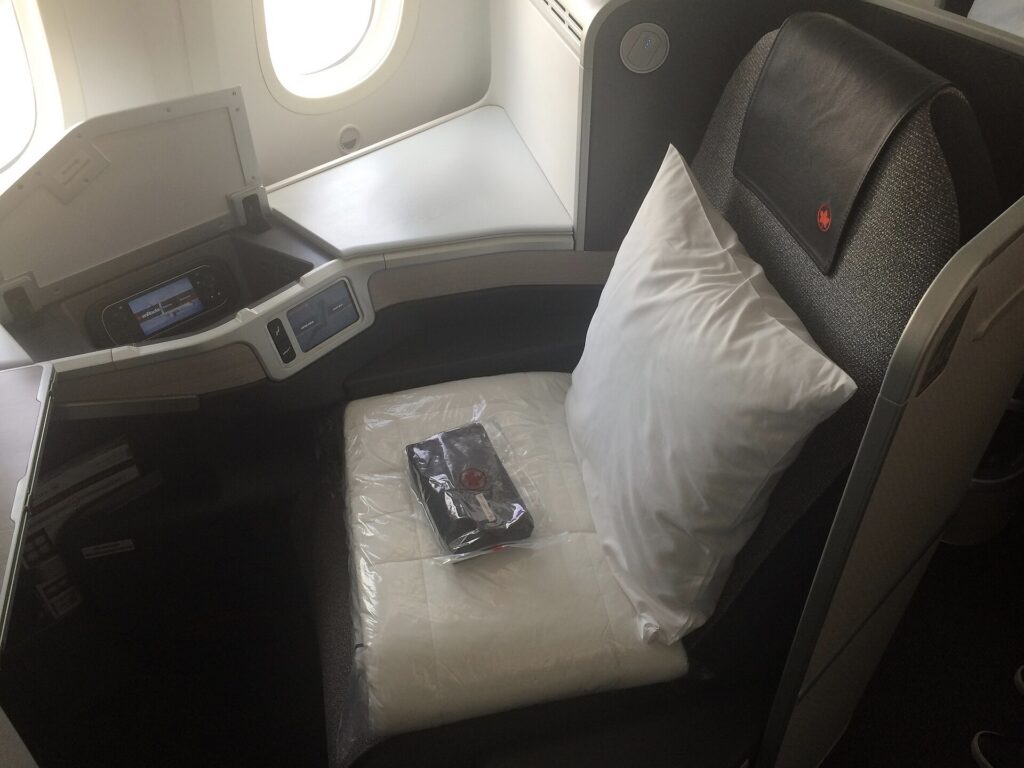
    A lie-flat business class pod on an Air Canada long-haul aircraft
    On many airlines, a lie-flat business seat is the best seat on the plane (Photo: Orcair via Wikimedia Commons, CC BY-SA 4.0)

    The airport experience

    A lot of what separates the cabins happens before you board.

    • Check-in and security. Business and first passengers usually get priority check-in and, at many airports, faster security lanes. Some airlines offer first class passengers dedicated check-in areas or separate terminals at their home airport.
    • Lounges. Long-haul business class usually includes lounge access. Some airlines operate separate first class lounges with à la carte dining and more space. At outstations, first and business passengers may share the same lounge.
    • Ground transport. A few airlines include chauffeur service for premium passengers on some routes. This is more common in first class and varies widely.
    • Boarding and baggage. Priority boarding and priority baggage handling are standard in both cabins. Delta’s Delta First page, for instance, lists priority check-in, security and boarding, bags delivered first and up to two free checked bags.

    Watch for exclusions. Some airlines now sell stripped-back versions of premium cabins with fewer ground benefits. Delta’s Delta One page notes that its basic business fare excludes some lounge access, for example. If the lounge matters to you, check the fare brand before you pay.

    Premium check-in and security lanes do not change how early you should arrive for an international departure, especially if you have bags to drop or a document check. Our guide to how early to arrive for an international flight gives realistic timings.

    Seating in an airline lounge at Heathrow Terminal 5
    Lounge access comes with most long-haul business tickets, but check basic premium fares (Photo: Mike McBey via Wikimedia Commons, CC BY 2.0)

    Food, drink and service

    Both premium cabins serve far better food than economy, but the style differs.

    Business class usually offers a multi-course meal with a choice of main dishes, a selection of wines and spirits, and a lighter meal or snacks before landing. On overnight flights, many airlines let you skip the main service or eat quickly so you can maximize sleep.

    First class usually adds more choice, more premium ingredients and drinks, and more flexibility: dining when you want rather than when the cart comes around. With fewer passengers per flight attendant, service is more personal, and crews often remember your preferences through the flight.

    On short domestic flights, the difference is smaller. Delta First, for example, describes snacks on shorter flights and meals on longer ones, with the offering depending on distance. If food matters, check what is served on your specific flight rather than assuming.

    Baggage, flexibility and the fine print

    Premium tickets typically include a larger checked baggage allowance, and many come with more flexible change and refund rules. Neither is universal: basic versions of premium cabins may carry stricter rules, and allowances differ by route and airline. Before you book, check:

    • The baggage allowance for your fare and route, including weight limits per bag.
    • Change and cancellation rules, especially if you are paying a premium partly for flexibility.
    • Lounge access, including whether it applies at every airport on your journey.
    • The aircraft and seat on every flight. A long itinerary may include a short connection on a smaller aircraft with a much simpler premium cabin, or none at all. The cabin you booked describes the fare, not a guarantee that every flight has the same seat.

    That last point catches many travelers out. A business class ticket from a smaller city to Asia might include a regional flight with a domestic-style first class seat, then a long-haul flight with a lie-flat bed. Look at each flight in the booking before you pay.

    Price and value

    International first class is usually priced far above business, often several times the fare, while the improvement in comfort is smaller than the price gap suggests. You are paying for exclusivity, space and service as much as for sleep. That is why many experienced travelers regard long-haul business as the best value premium product: it solves the biggest problem of a long flight, a proper bed, for a fraction of the cost of first.

    A few ways to think about value:

    • Price the sleep. On an overnight flight, compare the premium over economy with the cost of losing your first day at the destination.
    • Count what is included. Bags, lounge access, meals and flexibility reduce the real gap.
    • Look at premium economy. On daytime flights or when business prices are high, premium economy can deliver much of the comfort for much less.
    • Watch premium fare sales. Business fares drop on leisure routes and in quieter seasons, and flexible dates make a big difference. Our booking timing guide explains the seasons.
    • Consider upgrades. Paid upgrade offers, bids and miles can sometimes bring business class within reach. Our guide to business class upgrade hacks explains which methods work.

    Which cabin should you choose?

    The right answer depends on the flight and what you need at the other end.

    Choose long-haul business class if

    • You are on an overnight flight and need to function the next day.
    • You want a flat bed, lounge access and good food at a price that is high but not extreme.
    • You are traveling for work and arriving straight into meetings.
    • Your airline does not offer first class on the route anyway.

    Consider international first class if

    • Maximum privacy and space are worth a large premium to you.
    • You value highly personal service and flexible dining.
    • The trip is a once-in-a-lifetime occasion and you want the experience itself.
    • You can use miles for it at good value, which is how many travelers experience first class.

    Choose premium economy or domestic first if

    • The flight is short or in daytime, and a bed would be wasted.
    • You want more space and calm without the cost of long-haul business.
    • You are flying within North America, where the front cabin is a recliner anyway.

    Business travelers and company policies

    If your employer is paying, the travel policy may decide for you: many companies allow business class only above a certain flight length, and few allow first. Where you have a choice, a lie-flat seat on an overnight flight before a working day is the strongest case for business class, because the cost of arriving exhausted falls on the work itself. Our guide to business travel hotels covers the other half of a work trip.

    Traveling as a couple or family

    Seat layout matters more when you travel together. Some business cabins have center pairs designed for companions; others isolate every passenger. First class suites on some airlines can be arranged for companions to dine together. With children, check the airline’s rules on minimum ages in premium cabins and the availability of bassinets, and consider whether the cost for the whole family makes premium economy a better compromise.

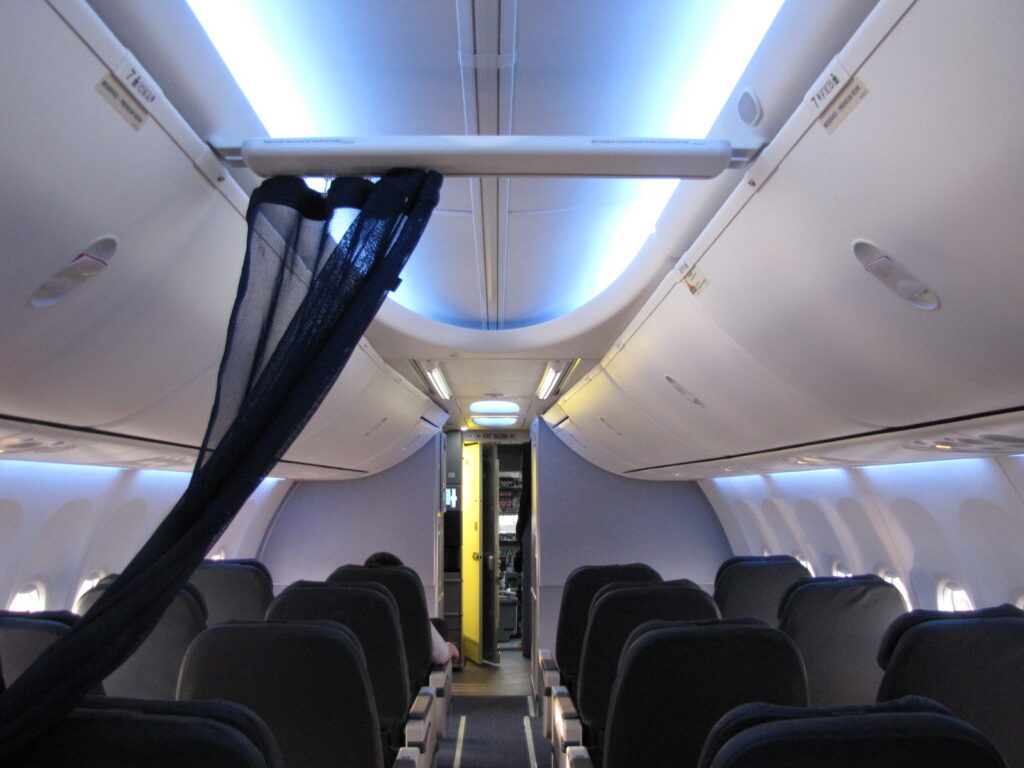
    Recliner seats in the first class cabin of a Boeing 737
    Domestic first class in North America: a wide recliner, not a bed (Photo: Planes and Places via Wikimedia Commons, CC BY-SA 2.0)

    How to check what you are really getting

    1. Find the aircraft type for each flight during booking. The same route can be flown by different aircraft with very different cabins.
    2. Open the seat map. Look at the layout: a 1-2-1 pattern usually means direct aisle access in business, while 2-2-2 or 2-3-2 patterns often mean you climb over a neighbor.
    3. Read the airline’s cabin page. Airlines describe their seats, lounges, meals and fare brands on their own sites, which are the most reliable source.
    4. Check the fare brand. Basic premium fares may exclude lounges, seat selection or changes.
    5. Check every flight. Confirm the cabin and seat on connections, not just the main long-haul flight.
    6. Check bags and flexibility. Make sure the allowance and rules fit your trip.

    For more on comparing routings and fare brands on long-haul trips, see our international flights booking tips.

    Getting the most from a premium cabin

    • Pick your seat early. Seats away from galleys and lavatories are quieter, and window seats in 1-2-1 layouts are often the most private.
    • Use the lounge wisely. Eat a proper meal in the lounge before an overnight flight, then skip the onboard service and sleep sooner.
    • Dress for sleep. Some airlines provide pajamas in premium cabins, but many do not. Comfortable layers help either way; our guide to what not to wear on a flight has practical advice.
    • Pack light anyway. A generous allowance is useful, but a sensible carry-on makes connections easier. Our carry-on size guide explains dimensions and packing.
    • Plan your arrival. If you arrive early in the morning, a hotel that allows early check-in or a day room can extend the rest you started on board. Compare options with our hotel search.

    Common mistakes when choosing a premium cabin

    • Trusting the cabin name. “First” on a domestic flight and “first” on a long-haul flight are different products.
    • Not checking the aircraft. An older aircraft on the same route may have angled seats or no direct aisle access.
    • Ignoring connections. A premium ticket may include a flight with a much simpler cabin.
    • Paying for first when business already solves the problem. For most travelers, a good business seat delivers the sleep that matters.
    • Buying a basic premium fare without reading the terms. Missing lounge access or strict change rules may not be worth the saving.
    • Booking a daytime flight in a lie-flat seat you will not use. Premium economy or a better economy seat may be enough.

    Frequently asked questions

    Is first class always better than business class?

    On the same aircraft and airline, yes: first is the higher product. Across airlines, not necessarily. A new business class seat can be more comfortable than an older first class seat on another airline, so compare the actual seat and service.

    What is the main difference between first and business class?

    Space, privacy and service. Long-haul business class usually offers a lie-flat seat, lounge access and good dining. First class adds larger suites, often with doors, more personal service, more elaborate dining and sometimes more exclusive ground services.

    Why is domestic first class different from international first class?

    On shorter flights in North America, airlines brand their front cabin as first class, but it is usually a wide recliner with better service, not a bed. It is closer to short-haul business class elsewhere than to international first.

    Do all airlines have first class?

    No. Many airlines sell business class as their top cabin on long-haul routes. First class is found mainly on some large international carriers and often only on certain aircraft and routes.

    Is business class worth it on a long-haul flight?

    It often is on overnight flights, where a flat bed lets you arrive rested. On daytime flights or when prices are high, premium economy can be the better value.

    Does business class include lounge access?

    On long-haul international flights, usually. But some airlines now sell basic premium fares that exclude lounge access, so check the fare brand before booking.

    How do I know if my business class seat is lie-flat?

    Check the aircraft type and seat map during booking and read the airline’s description of the cabin for that aircraft. If the airline shows a 1-2-1 layout and describes fully flat beds, you are likely in a modern product.

    Is premium economy the same as business class?

    No. Premium economy is a better economy seat with more legroom and recline, sometimes with better food and priority services. It is not a bed and usually does not include lounge access.

    Ready to compare cabins for your trip? Search economy, premium economy and business fares across flexible dates on our flight search, then book somewhere comfortable to land with our hotel search. If you are heading across the Atlantic, our guide to the best time to fly to London will help you pick your dates.

  • Salt Lake City: Should You Rent a Car or Rely on Public Transit?

    Salt Lake City: Should You Rent a Car or Rely on Public Transit?

    Salt Lake City is a split decision. For the city itself, it has one of the better transit setups in the Mountain West: a light-rail line straight from the airport terminal to downtown, a free-fare zone in the center, trains to the university, the suburbs and the soccer stadium, and a commuter railroad that runs the length of the Wasatch Front. But very few people fly to Salt Lake City just for the city. Most come to ski the Cottonwood Canyons or Park City, to drive south to the national parks, or to see the Great Salt Lake, and for almost all of that, a car is either essential or much easier. And in winter, the car itself comes with a catch: the canyon roads to the ski resorts have traction rules that many rental cars do not meet. This guide explains how the city is laid out, how UTA’s trains and buses work, what driving here is really like in every season, how the ski buses and shuttles compare with a rental, and gives you a straightforward way to decide.

    The short answer

    Rent a car if the national parks, Antelope Island, the Bonneville Salt Flats or a Utah road trip are on the itinerary, if you are skiing several resorts and want flexibility, if you are staying with family in the suburbs, or if you are traveling with children and gear. Skip the car if you are staying downtown for a city break, a convention, General Conference or a game, and your plans are Temple Square, the Capitol, the museums on the east bench and Sugar House; TRAX, the S-Line streetcar, your feet and the occasional ride-hail will cover that, and you will not pay for parking. And for skiing, there is a real middle path: the ski buses and resort shuttles reach the canyon resorts and Park City without you having to worry about winter traction rules or scarce parking. Compare rental rates for any of these plans on our Salt Lake City car rental page.

    How Salt Lake City is laid out

    Salt Lake City is built on one of the most logical street grids in the country, and it starts at Temple Square. The corner of Main Street and South Temple is the origin point, and almost every address in the valley counts blocks from there: 400 South is four blocks south of the temple, 700 East is seven blocks east, and an address such as 1300 South 900 East is a pair of coordinates rather than a street name. The pioneers laid out enormous blocks and streets wide enough, as the story goes, for a wagon team to turn around, so the streets are broad and easy to drive but the blocks are long on foot; a walk of “four blocks” is closer to a mile than a stroll. Downtown sits at the north end of the valley, with the State Capitol on the hill above it, the Avenues climbing to the northeast, the University of Utah on the east bench, and Sugar House a few miles to the southeast. The suburbs then fill the valley south for more than twenty miles, with the Cottonwood Canyons opening in the Wasatch on the east side and the airport to the west, beside the lake. The inner city is compact enough for transit; everything beyond it assumes a car.

    Hotels cluster downtown around Temple Square, the Salt Palace and the Delta Center, which is the natural base for a car-free visit, with more near the airport and along I-15 in the southern suburbs, and resort lodging up the canyons and in Park City. Our downtown and Temple Square hotel page and wider Salt Lake City hotel search let you compare them.

    Getting in from the airport

    Salt Lake City International (SLC) is about 6 kilometers (4 miles) west of downtown, closer than almost any other big-city airport in the country. The TRAX Green Line leaves from a station beside the terminal and reaches downtown in about 20 minutes, stopping along North Temple and at several downtown stations, for a standard fare; it is the easiest airport rail connection in the West. Taxis and ride-hail pick up at the terminal, and the drive downtown takes 10 to 20 minutes outside rush hour. The rental counters are in the garage facing the terminal, so there is no shuttle bus to a remote lot, and I-80 and I-215 are minutes from the exit, which means you can be on the road to Park City or the Cottonwood Canyons within half an hour of collecting the keys. Private shuttle companies run shared and private transfers from the airport to Park City and the canyon resorts, and many ski lodges arrange their own. Check the airport’s site for current ground-transport details; our SLC airport guide covers the layout, including the long walk to the far gates.

    A UTA TRAX Green Line train at Gallivan Plaza in downtown Salt Lake City
    TRAX in downtown Salt Lake City: free to ride within the Free Fare Zone, and about 20 minutes from the airport (Photo: An Errant Knight via Wikimedia Commons, CC BY-SA 4.0)

    Salt Lake City’s transit, explained

    The Utah Transit Authority, UTA, runs the light rail, the commuter trains, the streetcar and the buses across the Wasatch Front. For a downtown-based visitor it is clean, simple and genuinely useful; its limitation, as in most Western cities, is coverage and frequency once you leave the rail lines, especially in the evenings and on Sundays.

    TRAX light rail

    Three lines. The Green Line runs from the airport through downtown and out to West Valley City. The Red Line runs from the University of Utah and its hospital through downtown and south to the Daybreak development in South Jordan, where the Salt Lake Bees now play. The Blue Line runs from Salt Lake Central Station through downtown and south to Sandy, for the soccer stadium, and on to Draper. All three share the downtown tracks, and rides that start and end inside UTA’s downtown Free Fare Zone are free, on TRAX and on local buses, which covers Temple Square, City Creek, the Delta Center, the Salt Palace and most downtown hotels. Trains run from early morning until late evening, with less frequent service on Sundays.

    FrontRunner and the S-Line

    FrontRunner is the commuter railroad that runs north to Ogden and south to Provo from Salt Lake Central Station, useful for a day in Ogden’s historic 25th Street or a visit to Provo; it has historically not run on Sundays, so check the schedule. The S-Line streetcar is a short line from a TRAX connection in South Salt Lake to the heart of Sugar House, and it is the easiest way to reach that neighborhood.

    Buses and ski buses

    Buses fill in the rest, including the routes up to the Natural History Museum, Red Butte Garden and This Is the Place on the east bench. In winter, UTA has run ski bus service up Big and Little Cottonwood Canyons from park-and-ride lots in the valley to Solitude, Brighton, Snowbird and Alta, and the buses are exempt from the parking scramble at the top. Service levels have been cut back in some recent seasons, so check the current ski schedule on UTA’s site before building a trip around it, and expect full buses on powder mornings.

    Fares and tickets

    Buy tickets from the machines at TRAX and FrontRunner stations or through UTA’s mobile ticketing, and keep proof of payment for the whole trip; fare inspectors check on the trains. FrontRunner fares rise with distance, while TRAX and local buses charge a flat fare with transfers allowed within a time limit, and young children ride free with a paying adult. Ski buses have their own fares, and some resort passes have included free rides in past seasons. Payment options change, so check UTA’s site for current fares and ticketing before you go.

    Accessibility

    TRAX platforms offer level boarding, the buses are low-floor with ramps, and FrontRunner has accessible cars; UTA also runs paratransit for eligible riders.

    Beyond UTA

    • Walking. Downtown, the Avenues, 9th and 9th and Sugar House are pleasant on foot, but allow more time than the map suggests; the blocks are long and the streets wide.
    • Bike share and scooters. The city has a bike-share system and shared e-scooters in the warmer months, and protected bike lanes on several downtown streets. The foothill trails and City Creek Canyon are popular rides.
    • Taxis and ride-hail. Uber, Lyft and taxis operate across the valley; for a group, a short ride is competitive with transit fares and much quicker to the east bench or the neighborhoods off the rail lines.
    • Park City buses. A commuter bus connects downtown Salt Lake City with Park City, and within Park City the town’s own buses are free and reach both ski resorts, Main Street and the lodging areas, so a car-free ski week in Park City is realistic.
    • Ski and airport shuttles. Private shuttle companies run between the airport, downtown hotels, Park City and the canyon resorts; they are the easiest way to reach a slopeside lodge without driving.
    • Amtrak and intercity buses. The California Zephyr stops at Salt Lake Central Station once a day in each direction, at night, and intercity buses connect the city with other Western cities.
    A UTA FrontRunner commuter train at Provo station
    FrontRunner, the commuter railroad between Ogden, Salt Lake City and Provo (Photo: А at English Wikipedia via Wikimedia Commons, Public domain)

    Driving in Salt Lake City and beyond: what it is really like

    Salt Lake City is an easy place to drive by big-city standards: wide streets, a grid that tells you where you are, plenty of parking outside downtown, and freeways that are generally quick outside rush hour. The frustrations are specific. I-15, the north-south spine of the valley, backs up every weekday morning and evening, and I-215, the belt route, has its own bottlenecks near the canyon mouths. Some suburban intersections use unusual designs, such as continuous-flow intersections and “ThrU-turns”, that can surprise drivers from elsewhere; follow the signs and lane markings carefully. Construction season runs from spring to fall on the main routes. And the winter weather changes everything above the valley floor: the city might be dry while the canyons are in a full snowstorm.

    Little Cottonwood Canyon, the road corridor to Snowbird and Alta
    Little Cottonwood Canyon, where winter traction rules and avalanche closures shape every ski day (Photo: GyozaDumpling via Wikimedia Commons, CC BY-SA 4.0)

    Parking

    Downtown parking is moderately priced by big-city standards. Street meters are paid at kiosks or by app, and meters downtown have traditionally been free on Sundays and holidays; check the signs where you park. Garages at City Creek and around Temple Square are plentiful, and many downtown businesses validate. Hotels charge a nightly fee that is worth adding to the room rate when you compare. Outside the center, parking at the museums, the zoo, the malls and most trailheads is straightforward, although popular canyon trailheads fill early on summer weekends. The hardest parking in the region is at the ski resorts on busy days: several of the canyon resorts now charge for parking or require advance reservations on weekends and holidays, and the lots can fill before the lifts open after a big storm.

    Rules and conditions worth knowing

    • Canyon traction rules. Big and Little Cottonwood Canyons, the roads to Solitude, Brighton, Snowbird and Alta, have winter traction requirements, roughly from October to April. When UDOT puts restrictions in place, vehicles generally need four-wheel or all-wheel drive with tires rated for mud and snow (look for M+S or the mountain-snowflake symbol on the sidewall), or approved chains or traction devices, and troopers can turn back or fine drivers who do not comply. Many rental cars are front-wheel drive, and rental agreements often prohibit chains, so if you plan to drive the canyons, book an AWD or 4WD vehicle and check the tires at the counter. UDOT Traffic shows current restrictions, closures and canyon cameras.
    • Avalanche closures. After heavy snow, Little Cottonwood Canyon in particular closes for avalanche control, sometimes for hours, and guests at Alta and Snowbird can be kept indoors, a practice known locally as “interlodge”. Build slack into your plans on storm days and never stop in a marked avalanche zone.
    • The “red snake”. On powder mornings, the line of brake lights up Little Cottonwood can stretch back to the valley. Leave early, carpool, or take the bus.
    • Blood alcohol limit. Utah’s legal limit for drivers is 0.05 percent, lower than the rest of the country; the only safe plan after drinks is not to drive.
    • Wildlife. Deer are common on canyon roads and suburban edges at dawn and dusk, and moose appear in the higher canyons and around Park City; slow down.
    • Speed limits reach 80 mph on some rural interstates, and the long empty stretches toward the parks make it easy to drift above them; the Highway Patrol is active.
    • Right turns on red are permitted after a full stop unless signed otherwise.
    Interstate 80 climbing through Parleys Canyon east of Salt Lake City
    I-80 through Parleys Canyon, the main road from Salt Lake City to Park City (Photo: Grant Handy via Wikimedia Commons, CC BY-SA 4.0)

    When renting a car makes sense

    • The national parks. Arches and Canyonlands, Capitol Reef, Bryce Canyon and Zion are all at least three and a half hours away and connected by long, scenic highways; there is no practical way to see them without a car. Check each park’s rules before you go: Zion runs a shuttle on its main canyon road for much of the year, and Arches has used timed-entry reservations in recent peak seasons. International visitors should also check the National Park Service site, as entrance fees for non-US residents at the busiest parks have recently changed.
    • Skiing several resorts. A car, preferably AWD with the right tires, lets you chase the snow between the Cottonwood Canyons and Park City.
    • Antelope Island, the Bonneville Salt Flats and Golden Spike are all car trips of one to two hours each way.
    • Family in the suburbs. The valley is long and spread out; a car earns its keep daily.
    • Traveling with children and gear. Skis, car seats and luggage make shuttles and buses awkward.
    • Western road trips. Salt Lake City to Las Vegas takes about six hours on I-15, and to Denver about eight via I-80 across southern Wyoming; our Denver to Salt Lake City route guide covers the drive, and our Denver car-versus-transit guide covers the other end.

    If any of those apply, our rental car booking tips cover insurance, deposits and the questions to ask at the counter, and our family car rental guide looks at vehicle choice.

    When it does not

    • You are staying downtown and your plans are Temple Square, the Capitol, the museums and Sugar House.
    • You are in town for a convention, General Conference or a game at the Delta Center, when downtown parking is at its busiest and TRAX stops at the door.
    • You are skiing one resort or staying in Park City, where the free town buses, the ski buses and a shuttle from the airport cover everything.
    • You are traveling solo on a short trip and the rental, parking and fuel add up to more than the train and a few rides.

    The hybrid plan for a city-plus-mountains trip

    Go car-free for the city days and rent for the canyon or park days, and think carefully about where you pick up. Because the airport is so close to downtown and the rental counters are in the garage at the terminal, an airport pickup is more convenient here than in most cities, and heading straight to Park City or the canyons from the airport keeps you out of downtown traffic entirely. Renting from a downtown location can still make sense if you are spending the first nights in the city, because you avoid paying hotel parking on nights the car would sit unused. A pattern that works well: TRAX from the airport to a downtown hotel, two car-free days, then a rental for the mountain or park days, returned at the airport on the way to the flight home. In winter, reserve an AWD or 4WD vehicle well ahead for the canyon days, because they sell out on holiday weekends. Compare the day rates on our Salt Lake City car rental page against a full-trip rental and the difference is usually obvious.

    A worked cost comparison

    Numbers change with the season and the booking window, so treat this as a method rather than a quote, and check current rates before deciding. For a four-night city break downtown for two people, the car-free version costs two TRAX fares each way from the airport, a few bus or streetcar rides to the east bench and Sugar House, and perhaps a couple of ride-hail trips in the evening; the rental version adds four days of a compact car, four nights of hotel parking, fuel, and airport fees and taxes, and buys you very little you could not ride to. Transit wins easily. For a five-day ski trip staying in the city, compare an AWD rental for five days, plus fuel and any resort parking fees, against ski bus fares or daily shuttles for two; the bus is cheaper when it runs frequently and your resort is on its route, and the car wins when you want to ski different resorts, leave early on powder days, or travel with children. For a week-long national park loop, a rental is the only practical answer, and it is worth comparing a round trip from Salt Lake City with a one-way rental to Las Vegas, which saves a long drive back but adds a one-way fee. Run the rental rates for your dates on our Salt Lake City car rental page and put them beside the transit and shuttle costs before you choose.

    Driving the canyons and the Wasatch in each season

    The roads from Salt Lake City into the mountains are short, steep and beautiful, and they are where visitors most often underestimate the conditions. In winter, Big and Little Cottonwood Canyons climb about 900 m (3,000 feet) in less than ten miles on narrow, winding roads, and traction rules apply whenever UDOT declares them; a front-wheel-drive rental on all-season tires can be turned back at the canyon mouth. Little Cottonwood is avalanche terrain and closes for control work after big storms, and on powder mornings the traffic can take an hour or more. I-80 through Parleys Canyon to Park City is a wide interstate and much easier, but it is steep and can ice up in storms, and Guardsman Pass, the summer shortcut between Big Cottonwood and Park City, is closed in winter. In spring, the canyon roads are wet and clear while the resorts are still skiing, rockfall is more common during the thaw, and the high trails stay snowbound into June. In summer, the canyons are the city’s escape from the heat, trailhead lots fill early on weekends, and the Alpine Loop and Mirror Lake Highway into the Uinta Mountains open for scenic drives. Afternoon thunderstorms bring lightning to exposed ridges and flash floods to the southern slot canyons. In fall, the color on the canyon roads draws heavy weekend traffic from late September, and the first snow can close the high roads by late October. In every season, check UDOT Traffic before you set off, and the National Weather Service in Salt Lake City for storm warnings.

    Decision table

    Your tripRecommendationWhy
    City break downtown, couple or soloNo carTRAX from the airport, a free downtown zone and walkable sights
    Convention, General Conference or a gameNo carDowntown parking is busiest and TRAX stops at the venues
    Ski week in Park CityShuttle from the airport, free town busesBoth resorts and Main Street are on the free system
    Skiing the Cottonwood Canyons from the cityAWD or 4WD rental, or the ski busTraction rules and scarce parking favor the right car or the bus
    City plus a day at Antelope Island or Park CityHybrid: rent for the day tripCar-free city days, a car for the lake and the mountains
    National parks loopRent (consider one-way to Las Vegas)Long distances with no practical transit
    Family visit to the suburbsRent for the whole stayThe valley is long and spread out
    Western road trip via DenverRent (compare a one-way fee)Salt Lake City is a stop, not the destination

    Money-saving tips for both options

    • On transit: ride free within the downtown Free Fare Zone, take TRAX from the airport instead of a taxi, and check whether your ski pass includes bus rides.
    • On a rental: compare airport and downtown pickup, book AWD early for ski holidays, check the tires for canyon driving, decline extras you already have through a credit card or home policy (check first), and fill up before the canyons and the long empty stretches toward the parks.
    • On the hotel: if you are renting, add the parking fee to the room rate when you compare, and consider a hotel outside downtown with free parking on the TRAX line.
    • On timing: avoid I-15 in the weekday peaks and the Cottonwood Canyons on powder weekend mornings; the best time to fly to Salt Lake City guide lists the busiest weekends.
    • On the parks: if you plan to visit several national parks, an annual pass for the vehicle usually costs less than paying at each gate.

    Frequently asked questions

    Is it worth renting a car in Salt Lake City?

    For the national parks, the lake, a road trip or skiing several resorts, yes. For a downtown city break, a convention or General Conference, no; TRAX and your feet are enough.

    Is Salt Lake City public transit good for tourists?

    Good for the core: TRAX runs from the airport terminal to downtown, the university and the suburbs, and rides within the downtown Free Fare Zone are free. It thins out in the evenings, on Sundays and away from the rail lines.

    How do I get from Salt Lake City airport to downtown?

    The TRAX Green Line in about 20 minutes for a standard fare, or a taxi or ride-hail in 10 to 20 minutes outside rush hour.

    Can I ski in Utah without a car?

    Yes. Park City’s free buses and airport shuttles make a car-free week there easy, and UTA’s ski buses serve the Cottonwood Canyon resorts in winter, though schedules vary by season.

    Do I need four-wheel drive to drive to the ski resorts?

    For Big and Little Cottonwood Canyons, when traction restrictions are in effect you generally need four-wheel or all-wheel drive with suitable tires, or approved chains. Check UDOT’s current rules before you go, and ask for an AWD vehicle when you book.

    Is parking expensive in downtown Salt Lake City?

    Less than in most big cities. Meters are moderate and have traditionally been free on Sundays and holidays; hotel parking fees are the main cost.

    Can I visit the national parks from Salt Lake City without a car?

    Only on an organized tour. The parks are three and a half to four and a half hours away with no practical public transport; for independent travel, rent a car.

    Whichever way you go, start with the flight. Compare cheap flights to Salt Lake City, choose a neighborhood with our Salt Lake City hotel search, and if the canyons or the parks are on the list, price the rental for those dates on our Salt Lake City car rental page. For what to see once you arrive, start with our first-timer’s guide to Salt Lake City.

  • Best Time to Fly to Salt Lake City: Seasons, Weather & Prices

    Best Time to Fly to Salt Lake City: Seasons, Weather & Prices

    Salt Lake City runs on two calendars at once, and its airfares follow both. In winter it is the most convenient ski gateway in North America, with seven resorts within about an hour of the terminal and powder that draws skiers from both coasts and from overseas. From spring to fall it is one of the two main gateways, with Las Vegas, to Utah’s national parks, and road-trippers pour through on their way to Arches, Bryce Canyon and Zion. Layer on top of that a Delta hub that makes the airport one of the best connected in the West, twice-yearly church conferences that fill every downtown hotel, a July holiday that belongs to Utah alone, and a winter weather pattern, the valley inversion, that no temperature table can show, and you have a city where the “best time” depends entirely on why you are going. This guide walks through the weather month by month, the fare seasons, the events and holidays that move prices, and how to handle the airport.

    The short answer

    For the city and the canyons without skis, the best value-and-weather windows are mid-May to mid-June, before the summer heat and the peak road-trip season, and mid-September to mid-October, when the canyons turn gold and red, the air is clear and the national parks are at their most comfortable. For skiing, January outside the holiday weekends and early March combine deep snow with fares below the Christmas and Presidents’ Day peaks. The cheapest fares usually come in late April and May, when the ski season is over and the summer has not started, in November before Thanksgiving, and in early December. The most expensive stretches are the Christmas and New Year ski weeks, the Martin Luther King Jr. and Presidents’ Day weekends, March spring-break weeks, and June to August generally, when the parks drive demand. Whatever you choose, run a flexible-date search on our Salt Lake City flights page; a shift of a few days around a holiday weekend or a General Conference can change the fare band entirely.

    The downtown Salt Lake City skyline with the Wasatch Mountains behind
    Downtown Salt Lake City with the Wasatch Range behind (Photo: Invictus323 via Wikimedia Commons, CC BY 4.0)

    Salt Lake City’s weather, season by season

    Salt Lake City sits about 1,300 m (4,300 feet) above sea level on the floor of a valley between the Wasatch Range to the east and the Oquirrh Mountains to the west, with the Great Salt Lake to the northwest. That gives it a semi-arid climate with four distinct seasons: hot, dry summers, cold winters with regular snow, and short, changeable springs and falls, while the ski areas a few thousand feet higher are far colder and snowier than the city. The figures below are approximate seasonal patterns based on the long-term climate normals from NOAA’s National Weather Service office in Salt Lake City; check the current forecast before you pack, because a storm can drop the temperature sharply in a few hours, and the mountains are always colder than the valley.

    MonthTypical daytime highTypical overnight lowWhat it feels likeFare pressure
    Januaryaround 3 °C (38 °F)around -5 °C (23 °F)Cold, often gray in the valley during inversions; deep powder in the mountainsHigh for MLK weekend, otherwise moderate
    Februaryaround 7 °C (44 °F)around -3 °C (27 °F)Still wintry; storms alternate with clear, cold daysModerate; Presidents’ Day spike
    Marcharound 12 °C (54 °F)around 1 °C (34 °F)Mild in the city, often big snow in the canyons; longer days on the slopesHigh during spring-break weeks
    Aprilaround 16 °C (61 °F)around 4 °C (40 °F)Changeable; blossom in the valley, spring skiing up high, late snow possibleModerate early, falling as the resorts close
    Mayaround 22 °C (72 °F)around 9 °C (49 °F)Green and pleasant; spring showers; high trails still snowboundLow to moderate; rises for Memorial Day
    Junearound 28 °C (83 °F)around 14 °C (58 °F)Warm, dry and sunny; the canyons are green and coolHigh
    Julyaround 34 °C (93 °F)around 19 °C (67 °F)Hot and dry; afternoon thunderstorms late in the monthPeak
    Augustaround 33 °C (91 °F)around 18 °C (65 °F)Hot; monsoon storms; wildfire smoke possible in some yearsHigh, easing late in the month
    Septemberaround 27 °C (80 °F)around 13 °C (55 °F)Often the best month: warm, dry and clear; fall color begins up highModerate, falling after Labor Day
    Octoberaround 18 °C (65 °F)around 6 °C (42 °F)Crisp and bright; peak canyon color early; first snow in the mountainsLow to moderate
    Novemberaround 10 °C (50 °F)around -1 °C (31 °F)Cooling fast; the first valley snow; ski areas open late in the monthLow, then high for Thanksgiving
    Decemberaround 3 °C (38 °F)around -5 °C (23 °F)Cold and festive; inversions begin; the mountains are in full winterLow early, then peak for the holidays

    Three things the table cannot show. First, the inversion: on calm winter days a layer of cold air settles in the valley under warmer air above, trapping haze and pollution over the city for days at a time, sometimes a week or more, until a storm clears it. The city can sit under a gray lid at freezing point while the ski resorts twenty minutes up the canyons are in bright sunshine, which is one more reason to go uphill. Second, the snow: the Wasatch receives far more snow than the valley floor, and it is famously light and dry, partly thanks to the lake, which can add moisture to passing storms. The city might see a dusting while Alta measures a foot. Third, the dry heat and the sun: summer days feel less oppressive than the numbers suggest because the humidity is low, but the sun at altitude burns quickly, nights cool off, and you will drink more water than you planned.

    How Salt Lake City’s fare seasons work

    Three calendars drive seats into Salt Lake City: the ski season, which pulls visitors from late November to April and peaks on holiday weekends; the national parks and road-trip season, which runs from spring to fall and peaks in summer; and the city’s own calendar of conventions, church conferences and events. Behind all three is the Delta hub, which gives the airport more nonstop routes than a metro area of its size would normally support and keeps competition healthy on the big domestic routes, with Southwest, United, American, Alaska and several low-cost carriers also serving the city. The result is a double-peaked year, with winter holiday spikes and a long summer plateau, and two genuine shoulder seasons in between.

    Peak season

    Roughly December 20 to January 3, the Martin Luther King Jr. weekend in mid-January, Presidents’ Day weekend in mid-February, the March spring-break weeks, and June through mid-August. The winter peaks are driven by skiers and are sharpest at the canyon and Park City lodging, which spills over into city hotels; the summer peak is driven by national park road trips, family travel and the long July holiday stretch that includes both Independence Day and Pioneer Day. If you must travel in peak, book early, fly mid-week, and compare Park City lodging against a city hotel with a rental car.

    Shoulder season

    Mid-April to early June and September to October. April offers spring skiing at the higher resorts and blossom in the valley; late May and early June offer green canyons, pleasant heat and the parks before the summer crowds. September and October are the best months of the year for many visitors: settled weather, spectacular fall color in Big Cottonwood Canyon and along the Alpine Loop, and the southern parks at their most comfortable temperatures. Watch Memorial Day, Labor Day, the October General Conference weekend and Utah’s school fall break.

    Low season

    Late April and May in the mountain towns, which locals call mud season, November before Thanksgiving, and the first half of December. Fares are at their lowest, city hotels discount, and the ski resorts are either closed or just opening. Early December can be excellent value for skiers if the early storms have delivered, but it is a gamble; the higher resorts, such as Alta, Snowbird and Brighton, are the safer bets for early snow.

    As elsewhere, mid-week departures and early or late flights usually price below Friday and Sunday afternoons on the same route, and a search across a whole month reveals cheaper pairs of dates close to your first choice. Our guide to the best times to book explains how to read those patterns.

    Salt Lake City month by month

    January

    Deep winter and prime powder. The resorts are in full swing after the Christmas rush, and the weeks after New Year’s are among the best value of the ski season, apart from the Martin Luther King Jr. Day weekend (the third Monday of January), a big ski-travel weekend. January is also peak inversion season, so the city can be gray and cold while the mountains are sunny. The Sundance Film Festival, long held in Park City in late January and a major driver of Park City prices, is moving to Boulder, Colorado, from 2027, so late-January demand in the Park City area may ease; check before assuming.

    February

    Similar conditions with more daylight, reliable snow and low-to-moderate fares outside the Presidents’ Day weekend (the third Monday of February), one of the busiest ski weekends of the year. Weekdays in early and late February are some of the best ski value in the calendar, and the Jazz and the Mammoth are both at home through the month.

    March

    Often the snowiest month in the mountains, with big spring storms and longer, warmer days, which makes it many skiers’ favorite. It is also the month of spring break, when school holidays across the country send families to the slopes over several weeks; fares and lodging rise sharply in those weeks. In the valley, March brings the first mild days and blossom.

    April

    A month of transitions. The resorts close one by one, with Snowbird and some higher mountains often open into late spring, while the valley turns green and the orchards and the cherry trees at the Capitol bloom. The church’s General Conference, held on the first weekend of April, fills downtown hotels and adds crowds around Temple Square. Otherwise fares fall steadily through the month.

    May

    One of the best value months. The valley is green and warm, the canyons are waterfalls of snowmelt, and the southern national parks are pleasant before the summer heat, though the high country above about 2,700 m (9,000 feet) is often still under snow. Fares are low apart from the Memorial Day weekend at the end of the month.

    June

    Summer arrives with long days and dry heat. The Utah Arts Festival fills Library Square in late June, Utah Pride takes over downtown in early June, and the canyon trails open as the snow melts. Fares step up through the month as school ends and road-trip season begins in earnest.

    July

    Peak summer and peak heat. Independence Day is followed three weeks later by Pioneer Day on July 24, a Utah state holiday commemorating the arrival of the first pioneers in 1847, with a big downtown parade, rodeos and fireworks; for Utahns it is a bigger celebration than the Fourth. The canyons and Park City offer cooler air, and the southern parks are very hot. Fares are at their summer high.

    August

    Hot, with late-summer monsoon thunderstorms that can bring flash floods to the southern slot canyons, and wildfire smoke in some years. Fares ease in the second half as schools across the West return, which in Utah happens earlier than in many states. Late August is a good value window for the parks if you can handle the heat.

    September

    The month many locals would send you to: warm, dry, clear and calm, with the summer crowds thinning after Labor Day. The Utah State Fair runs in early September, the aspens start to turn at high elevation by late in the month, and the southern parks become comfortable for hiking again. Fares are moderate and falling.

    October

    Crisp, bright and often spectacular, with the canyon color peaking early in the month. The October General Conference weekend (the first weekend of the month) is the one date to book around downtown, and Utah’s school fall break brings a brief family-travel bump. The first snow usually dusts the peaks, and fares are low to moderate.

    November

    Winter arrives. The first snow often reaches the valley, the resorts open from about Thanksgiving depending on the snow, and fares and hotel rates are among the lowest of the year, with the exception of the Thanksgiving weekend itself, which is a heavy travel period nationally.

    December

    Two months in one. The first half continues November’s low pricing, with the holiday lights around Temple Square and City Creek and early-season skiing on reduced terrain. From about December 20, fares and lodging jump for the Christmas and New Year ski weeks, which are the most expensive of the year in Park City and the canyons.

    Winter inversion haze lying over the Salt Lake Valley
    Salt Lake City in winter: snowy, cold and sometimes hazy under an inversion while the mountains above are in sunshine (Photo: Derrellwilliams via Wikimedia Commons, CC BY-SA 4.0)

    Events that move Salt Lake City flight and hotel prices

    Cross-check these against your dates before you book. Exact dates shift each year; Visit Salt Lake keeps the current calendar.

    • Christmas to New Year: the peak of the ski season and the most expensive stretch of the year.
    • Martin Luther King Jr. weekend (third Monday of January) and Presidents’ Day weekend (third Monday of February): the biggest ski weekends.
    • Spring break (March, varying by school district across the country).
    • General Conference (first weekends of April and October): downtown hotels fill with visitors from around the world.
    • The Salt Lake Temple open house: the church plans a public open house for the renovated temple before its rededication, which is likely to raise demand for downtown hotels for as long as it runs; check Temple Square’s site for the dates.
    • Memorial Day, Independence Day and Pioneer Day (July 24).
    • Labor Day weekend and Utah’s school fall break in October.
    • Thanksgiving weekend, and the resort opening weekends around it.
    • Jazz and Mammoth home games, University of Utah football Saturdays, big concerts and conventions at the Salt Palace. Our Salt Lake City events page shows what is on sale for your dates.

    Getting in from the airport

    Salt Lake City has one commercial airport, Salt Lake City International (SLC), about 6 kilometers (4 miles) west of downtown, which makes it one of the closest major airports to its city center in the country. It was rebuilt from scratch as a single terminal with long concourses, opened in phases from 2020; the new building is bright and spacious, but the walk from security to the far gates is long, so allow extra time. Delta runs one of its main hubs here, with nonstop flights to most large US cities and a handful of international routes, and the other major and low-cost airlines serve the big domestic markets. Getting downtown: the TRAX Green Line light rail runs from the station beside the terminal to downtown in about 20 minutes, taxis and ride-hail pick up at the terminal, and the drive downtown takes 10 to 20 minutes outside rush hour. The rental counters are in the garage facing the terminal. For skiers, shuttle companies run to Park City and the canyon resorts, and the drive to the nearest lifts is under an hour. Our Salt Lake City car-versus-transit guide works through the rental decision, and our SLC airport guide covers the layout.

    Inside the new terminal at Salt Lake City International Airport (SLC)
    Salt Lake City International (SLC), rebuilt from 2020 and only about 20 minutes from downtown by TRAX (Photo: Farragutful via Wikimedia Commons, CC BY-SA 4.0)

    Timing tricks that work for Salt Lake City

    • Search the whole month. Holiday weekends create sharp edges in the fare calendar. A calendar search on TicketScanner shows them instantly, and the week after Presidents’ Day or MLK weekend is often much cheaper than the weekend itself.
    • Price lodging before the flight in ski season. A cheap fare into a holiday week is not cheap once a slopeside room is added. Compare a Salt Lake City hotel search with a rental car against canyon or Park City lodging for the same dates.
    • Use the hub. Delta’s network means nonstop flights from many mid-sized cities, and competition on the big routes from Los Angeles, Denver, Phoenix, Seattle and the Bay Area keeps fares reasonable outside the peaks.
    • Consider an open-jaw park trip. Fly into Salt Lake City and out of Las Vegas, or the reverse, and drive through Arches, Capitol Reef, Bryce Canyon and Zion on the way; compare flights to Las Vegas and the one-way rental fee before you commit.
    • Or pair it with Denver. The drive between the two cities takes about eight hours; our Denver to Salt Lake City route guide covers it, and our guide to the best time to fly to Denver shows how that city’s seasons line up.
    • Build a winter buffer. Snowstorms can disrupt SLC and close the canyon roads between December and March; avoid the tightest connections and leave a spare morning before an important flight home. Our guide to how early to arrive covers what to allow.
    • Flying out of Salt Lake City instead? The same seasonality applies in reverse; see cheap flights from Salt Lake City.
    Delicate Arch in Arches National Park at sunset, with the La Sal Mountains behind
    Arches National Park, about four hours from Salt Lake City and one reason summer fares stay high (Photo: Arches National Park via Wikimedia Commons, Public domain)

    What to pack, by season

    Winter (December to March): a warm, waterproof coat, hat, gloves and boots with grip for the city, and full ski layers for the mountains, where temperatures are much lower. Sunglasses and sunscreen matter on bright snow. Spring (April to May): layers and a rain shell, with a warm layer for late cold snaps and the high canyons. Summer (June to August): light, breathable clothing, a wide-brimmed hat, strong sunscreen and a refillable water bottle, plus a fleece for canyon evenings and a rain shell for afternoon storms. Fall (September to October): layers again, a warm jacket by late October, and hiking shoes for the canyon trails. For the national parks in any season, add sturdy footwear and more water than you think you need.

    The best time to fly to Salt Lake City for…

    Skiing

    Mid-January to early March outside the holiday weekends, for the best snow and value; March for longer days and big storms; early December only if you are flexible and watching the snow reports.

    The national parks

    Late April to early June and mid-September to late October, when temperatures in the southern parks are comfortable and the crowds are thinner than in summer. Check Arches and the other parks’ own pages for any reservation systems in force.

    Fall color

    Late September to mid-October, when the aspens and maples turn in Big Cottonwood Canyon, along the Alpine Loop and around Park City.

    The lowest fares

    Late April and May, November before Thanksgiving, and early December. Pair with a city break, a museum trip or the parks.

    Temple Square and church events

    Book early for General Conference weekends and the temple open house once its dates are set, and consider staying outside downtown if the center is full; TRAX makes it easy to get in.

    International visitors

    Visitors from Visa Waiver Program countries need an approved ESTA before boarding; most others need a visa. The State Department’s travel site explains what applies to you, and the TSA lists what you can carry through security. Many international visitors connect through another US hub; clear immigration at your first point of entry and allow for it in your connection time.

    Frequently asked questions

    What is the cheapest month to fly to Salt Lake City?

    Late April and May are consistently among the lowest, along with November before Thanksgiving and the first half of December.

    What is the best month to visit Salt Lake City for weather?

    September, with late May, early June and early October close behind. July and August are hot; December and January can bring inversion haze in the valley.

    What is the best month to ski in Utah?

    February and March usually offer the deepest base and reliable storms, and weekdays outside Presidents’ Day and spring break are the best value. January has excellent snow but more inversion days in the valley.

    What is an inversion?

    A winter weather pattern in which cold air is trapped in the valley beneath warmer air above, holding haze and pollution over the city until a storm clears it. The mountains above are often sunny while it lasts.

    Should I fly into Salt Lake City or Las Vegas for the national parks?

    Salt Lake City is closer to Arches, Canyonlands and Capitol Reef; Las Vegas is closer to Zion. For a loop through all five, fly into one and out of the other.

    How far ahead should I book?

    Earliest for the Christmas ski weeks, the holiday weekends, spring break and General Conference, when fares and lodging tend only to rise; for the shoulder months, fares are stable enough that finding the right dates matters more than booking early.

    Does it snow in Salt Lake City?

    Yes, regularly from November to March in the valley, though it often melts within days; the mountains above get many times more, which is why the skiing is so good.

    Ready to pick your dates? Compare fares across the whole month on our Salt Lake City flights page, then find a room with our Salt Lake City hotel search. For what to do when you land, start with our first-timer’s guide to Salt Lake City.

  • Things to Do in Salt Lake City: A First-Timer’s Guide

    Things to Do in Salt Lake City: A First-Timer’s Guide

    Salt Lake City gets treated as a connection. Delta runs one of its biggest hubs here, so millions of travelers see the airport and nothing else, and many who do leave the terminal head straight up a canyon to ski or south toward the national parks. They miss a city with far more going on than its quiet reputation suggests: a downtown laid out around Temple Square, the historic heart of a worldwide church, a domed Capitol on a hill with the whole valley below it, a natural history museum that ranks among the best in the West, walkable neighborhoods full of coffee shops and independent restaurants, two major-league teams in the same downtown arena, and a food and drink scene that has outgrown every joke about Utah’s liquor laws. And the mountains are not ninety minutes away but twenty-five: seven ski areas sit within about an hour of downtown, with the Great Salt Lake on the other side of town. This guide covers the sights that earn a day, the neighborhoods worth a half-day, the food, the skiing and the sports, the day trips that make Salt Lake City a base as much as a destination, and the practical details that turn a layover into a trip.

    If you are still comparing cheap flights to Salt Lake City, read this alongside our guides to the best time to fly to Salt Lake City and whether you need a car (for downtown, often not; for the canyons and the parks, usually yes). Between the three you can plan the whole trip.

    The Salt Lake City skyline with the snow-capped Wasatch Range beyond
    Downtown Salt Lake City at the foot of the Wasatch, with ski areas less than an hour away (Photo: Iansmh98 via Wikimedia Commons, CC BY-SA 4.0)

    Salt Lake City at a glance for first-timers

    • Airport: Salt Lake City International (SLC), about 6 km (4 miles) west of downtown, rebuilt from scratch and opened in stages from 2020. The TRAX Green Line runs from the terminal to downtown in roughly 20 minutes, and it is one of the closest big airports to its city center in the country. See our SLC airport guide.
    • Getting around: downtown is compact and TRAX light rail is free within the downtown Free Fare Zone; the University of Utah, Sugar House and the airport are all on rail. For the ski canyons, Park City and the national parks, most visitors rent a car. Our car-versus-transit guide explains when it helps.
    • Money: US dollars. Sales tax is added at the register rather than shown on the tag, and hotel taxes are higher again. Tipping 18 to 20 percent in restaurants is expected.
    • Altitude and air: the city sits about 1,300 m (4,300 feet) above sea level and the ski areas are far higher. The air is dry, so drink more water than usual and wear sunscreen in every season.
    • Weather: four distinct seasons: hot, dry summers, a long clear fall, snowy winters with occasional inversion haze in the valley, and a changeable spring. Our month-by-month guide has the detail.
    • Where to stay: downtown near Temple Square for the sights, the arena and TRAX; Sugar House for a neighborhood feel; the airport area for early flights; Park City or the canyon lodges if skiing is the whole point. Our Salt Lake City hotel search covers them all.

    Temple Square and downtown

    Temple Square is where the city began and where most first visits start. The pioneers who arrived in the valley in 1847, members of The Church of Jesus Christ of Latter-day Saints, laid out their city from this point, and the block and the surrounding campus remain the church’s worldwide headquarters. The granite Salt Lake Temple, completed in 1893 after forty years of construction, has been closed for a long seismic renovation, and the church plans a public open house with free tickets before the temple is rededicated; check the official Temple Square site for reservations and the current state of the grounds. After it is rededicated, only church members entering for worship go inside, but the gardens, the visitors’ center and much of the campus are open to everyone. The domed Tabernacle, famous for its acoustics and its enormous organ, is home to the Tabernacle Choir at Temple Square, whose weekly Music & the Spoken Word broadcast on Sunday mornings is free to attend. Across North Temple, the 21,000-seat Conference Center has a landscaped rooftop garden with a view of the Wasatch, and the Family History Library, the largest genealogical library in the world, is free and open to anyone who wants to trace their own ancestors. The Beehive House, the home of Brigham Young, offers free tours. Visitors of any faith, or none, are welcome throughout; dress is casual, and volunteers offer tours and answer questions without pressure.

    Immediately south, City Creek Center is an open-air shopping district with a restored creek running through it and a retractable glass roof. West of the square, the Delta Center hosts the Utah Jazz and the NHL’s Utah Mammoth, and the Salt Palace Convention Center fills the blocks to the south. Abravanel Hall, home of the Utah Symphony, and the Eccles Theater, where Broadway tours stop, are both a short walk away. Our downtown and Temple Square hotel page lists the options in the center.

    The granite Salt Lake Temple on Temple Square in downtown Salt Lake City
    Temple Square, the historic heart of the city and headquarters of The Church of Jesus Christ of Latter-day Saints (Photo: Bobjgalindo via Wikimedia Commons, CC BY 4.0)

    Capitol Hill and City Creek Canyon

    The Utah State Capitol sits on the hill directly north of downtown, a granite building with a great central dome, completed in 1916 and restored after a major seismic retrofit in the 2000s. It is free to enter, the rotunda and the chambers are open when the legislature is not sitting, and free guided tours run on weekdays; the steps give the best easy view in the city, straight down State Street to the southern end of the valley, with the Oquirrh Mountains to the west and the Wasatch to the east. East of the Capitol, City Creek Canyon is a narrow wooded canyon that runs straight out of the city into the mountains, with a paved road that is closed to cars on alternating days in summer so walkers and cyclists have it to themselves. Memory Grove, at the canyon mouth, is a quiet war-memorial park a few minutes’ walk from downtown. For a longer hike with a summit, Ensign Peak, a short, steep climb from the top of the Avenues, is where the pioneer leaders are said to have surveyed the valley in 1847, and it has the city’s best sunset view.

    The south front of the domed Utah State Capitol above downtown Salt Lake City
    The Utah State Capitol, free to visit, with the best easy view of the valley from its steps (Photo: GyozaDumpling via Wikimedia Commons, CC BY-SA 4.0)

    The east bench: museums, gardens and the pioneer story

    The foothills above the University of Utah hold the city’s best cluster of attractions. The Natural History Museum of Utah, in the Rio Tinto Center, a building terraced into the hillside, is the highlight: a wall of dinosaur skulls and skeletons from Utah’s extraordinary fossil beds, galleries on the Great Salt Lake, the state’s Native peoples and its geology, and a top-floor terrace with a view across the valley. Next door, Red Butte Garden is a large botanical garden with foothill trails and a summer outdoor concert series that sells out quickly. Down the hill, This Is the Place Heritage Park marks the spot where Brigham Young is said to have first looked out over the valley; it has a monument and a reconstructed pioneer village with costumed interpreters, craft demonstrations and a small train, and it tells the settlement story, including the Native nations who were already here. The Hogle Zoo is across the road, and the Utah Museum of Fine Arts is on the campus below. TRAX’s Red Line reaches the university, and buses cover the rest.

    Neighborhoods worth a half-day

    Sugar House

    A few miles southeast of downtown and reached on the S-Line streetcar, Sugar House is the city’s liveliest neighborhood away from the center: independent shops, bookstores, restaurants and bars along Highland Drive and 2100 South, and Sugar House Park, a big green space with a pond and a view of the Wasatch. It is the easiest place in the city to spend an unplanned afternoon.

    9th and 9th and 15th and 15th

    Named for their intersections, these two small commercial nodes east of downtown are the city’s most charming, with cafés, a vintage movie theater, bakeries and restaurants set among tree-lined streets of bungalows. Liberty Park, home of Tracy Aviary, is a short walk from 9th and 9th.

    The Avenues

    Climbing the hill northeast of Temple Square, the Avenues is the city’s oldest residential district, a grid of Victorian houses and small corner restaurants with views of downtown. Walk up from the Capitol, take in Ensign Peak, and come back down for dinner.

    Central Ninth and the Granary District

    South and west of downtown, these former warehouse and light-industrial areas have filled with breweries, distilleries, coffee roasters and restaurants. They are less polished than Sugar House and more fun for it.

    Museums, culture and family attractions

    Tracy Aviary, in Liberty Park, is one of the oldest bird parks in the country, with free-flight bird shows in summer. The Clark Planetarium, at the Gateway, has a dome theater and free exhibit floors. The Leonardo, a science and art museum in the old downtown library building on Library Square, is aimed at older children and curious adults. The Church History Museum, beside Temple Square, is free and covers the church’s story in art and artifacts. For live performance, the Utah Symphony, Utah Opera and Ballet West are the main companies, and the Eccles Theater hosts Broadway tours. Library Square, with the striking curved glass Salt Lake City Public Library by Moshe Safdie, is worth a visit for the building alone: walk up the sloping outer wall to the rooftop garden. For what is on stage and in the arenas during your dates, our Salt Lake City events page lists concerts, shows and games.

    Skiing the Wasatch

    Salt Lake City has a claim no other big American city can match: world-class skiing within about 40 minutes of downtown, and the airport less than an hour from the lifts. Utah’s license plates advertise “the Greatest Snow on Earth”, and the dry, light powder that falls on the Wasatch is the reason. Big Cottonwood Canyon holds Solitude and Brighton, the latter a local favorite with night skiing. Little Cottonwood Canyon, next door, holds Snowbird and Alta, two of the most celebrated ski mountains in the country for steep terrain and deep snow; Alta is one of the few resorts in North America that remains skiers only. Park City, over Parleys Canyon on I-80, has Park City Mountain, one of the largest ski areas in the country, and Deer Valley, known for grooming and service. The season generally runs from late November or early December into April, and Snowbird often stays open later. The canyon roads are the catch: they are narrow, steep and prone to closures for avalanche control after big storms, parking at several resorts now requires payment or reservations on busy days, and traction rules apply to cars in winter; our car-versus-transit guide covers the rules and the ski buses. Ski Utah has resort information and snow reports. Salt Lake City hosted the 2002 Winter Games and has been chosen to host again in 2034.

    Sports

    The Utah Jazz play NBA basketball at the Delta Center, one of the loudest arenas in the league, and since 2024 they have shared it with the city’s NHL team, now called the Utah Mammoth, which has given downtown a winter game-night crowd almost every week from October to April. Real Salt Lake plays MLS soccer, and the Utah Royals play in the NWSL, both at the soccer stadium in Sandy, south of the city and within reach of the TRAX Blue Line. The Salt Lake Bees, the Triple-A baseball team, have moved to a new ballpark in the Daybreak development in South Jordan, at the end of the TRAX Red Line. On fall Saturdays, the University of Utah’s football team fills Rice-Eccles Stadium, where the 2002 Olympic opening ceremony was held. Check what is on sale in Salt Lake City for your dates before you book flights.

    What to eat and drink, and where

    Salt Lake City’s food scene is more varied than visitors expect. Start with the local classics: fry sauce, the pink mix of ketchup and mayonnaise served with fries at every burger stand; the pastrami burger, a Utah drive-in staple; Utah-style scones, which are fried dough with honey butter rather than anything British; and funeral potatoes, a cheesy potato casserole that turns up at every family gathering. Drive-through “dirty soda” shops, mixing sodas with syrups and cream, are a local obsession. Beyond those, State Street and the west side have excellent Mexican food; the valley’s large Pacific Islander communities mean good Tongan and Samoan food; and downtown, Sugar House, 9th and 9th and the Central Ninth warehouse district hold the ambitious new restaurants. The Downtown Farmers Market in Pioneer Park runs on Saturdays in summer and early fall. As for drinks, Utah’s reputation lags the reality. The city has a thriving craft beer scene, several distilleries and plenty of bars; draft beer is limited to a lower alcohol content than elsewhere, with stronger beers sold in cans and bottles, restaurants serve wine and cocktails with food, and bars admit only those 21 and over. Wine and spirits for home are sold only in state-run liquor stores, which are closed on Sundays and holidays.

    Salt Lake City through the seasons

    Winter (December to March) is ski season: the canyons get deep, dry snow, the resorts are busy, and the Jazz and the Mammoth are both at home. The valley itself is colder and grayer than the mountains, and on still days a temperature inversion can trap haze over the city for a week, which is exactly when locals head uphill into the sunshine. Spring (April to May) is changeable, with late snow in the city and spring skiing in the canyons into April; it is the quietest, cheapest time in the valley, and the orchards and gardens bloom. Summer (June to August) is hot and dry, with long evenings, the Utah Arts Festival and Utah Pride in June, Pioneer Day on July 24 with a big parade and fireworks, and cool air in the high canyons. Fall (September to October) is the local favorite: warm, clear days, the aspens and maples turning gold and red in the canyons from late September, the Utah State Fair in early September, and the national parks at their most comfortable. The church’s General Conference, held on the first weekend of April and October, brings large crowds downtown; plan hotels around it. Our month-by-month guide has the fare patterns that go with each season.

    Salt Lake City with kids

    Salt Lake City is one of the most family-oriented cities in the country, and it shows. The Natural History Museum of Utah, with its dinosaurs and hands-on galleries, is the obvious first stop, and the Hogle Zoo and This Is the Place Heritage Park, with its pioneer village and train, sit side by side for a full day. The Leonardo, the Clark Planetarium and the Loveland Living Planet Aquarium in the southern suburbs fill a rainy afternoon. In summer, the fountains at City Creek Center and the splash pads in the city parks are free, and a drive up Big Cottonwood Canyon to a lake at the top makes an easy mountain afternoon. In winter, every resort has a ski school, and Antelope Island’s bison make a memorable day at any time of year. Our family car rental guide covers the vehicle question for canyon and park trips.

    Salt Lake City on a budget

    A lot of the best of Salt Lake City costs nothing. Temple Square, the Tabernacle Choir broadcast, the Conference Center roof garden, the Family History Library, the Beehive House tour, the Church History Museum and the State Capitol are all free, as are Memory Grove, City Creek Canyon, Ensign Peak and the Library Square rooftop. TRAX rides within the downtown Free Fare Zone cost nothing, and the train from the airport is cheap. Eat well for less on State Street and the west side, at the drive-ins and at the Saturday farmers market. Downtown hotel rates are usually at their most reasonable outside convention weeks, General Conference weekends and the ski holidays. Compare rates by neighborhood on our Salt Lake City hotel search.

    Day trips from Salt Lake City

    Antelope Island State Park, about an hour north across a causeway into the Great Salt Lake, is the essential lake trip: free-roaming bison and pronghorn, beaches where the salt water holds you up, and wide views across the water; the lake’s level rises and falls from year to year, and biting brine flies can be a nuisance in early summer. Park City, about 40 minutes east on I-80, is a former silver-mining town with a historic Main Street, galleries, restaurants, summer mountain biking and the Utah Olympic Park; the Sundance Film Festival, which put the town on the map every January, is moving to Boulder, Colorado, from 2027. The Bonneville Salt Flats, about 90 minutes to two hours west on I-80, are a blinding white plain famous for land-speed records. Golden Spike National Historical Park, about two hours north, marks where the first transcontinental railroad was completed in 1869. The Alpine Loop through American Fork Canyon, about an hour south and closed in winter, passes Timpanogos Cave and is one of the prettiest fall-color drives in the state. Utah’s famous national parks are farther than most visitors assume: Arches and Canyonlands near Moab are around four hours southeast, Capitol Reef and Bryce Canyon about four, and Zion around four and a half to the south. They are overnight trips rather than day trips, and Arches has used a timed-entry reservation system in recent peak seasons, so check the National Park Service site for current rules before you go. All of these are car trips; see our Salt Lake City car rental page. For a longer road trip, the drive between Salt Lake City and Denver takes about eight hours; our Denver to Salt Lake City route guide covers it, and our guide to things to do in Denver covers the other end. Utah’s official tourism site covers the wider state.

    The shoreline of Antelope Island in the Great Salt Lake
    Antelope Island, an hour north of downtown, with bison, beaches and the Great Salt Lake all around (Photo: Matthew Dillon from Hollywood, CA, USA via Wikimedia Commons, CC BY 2.0)

    Two sample itineraries

    Two days, no car

    Day one: TRAX from the airport, Temple Square and the Conference Center roof garden in the morning, lunch at City Creek or on Main Street, the walk up to the State Capitol and through Memory Grove in the afternoon, and dinner in the Avenues or downtown, with a Jazz or Mammoth game if one is on. Day two: TRAX to the university and a bus up to the Natural History Museum and Red Butte Garden in the morning, This Is the Place in the early afternoon, then the S-Line to Sugar House for the park, the shops and dinner.

    Four days, with the mountains and the lake

    Add a day in the canyons, skiing in winter or hiking and a scenic drive up Big Cottonwood in summer and fall, and a day split between Antelope Island and the Great Salt Lake shore, or Park City and the Olympic Park. Pick up a car downtown for those days and return it at the airport on the way home; in winter, confirm the car meets the canyon traction rules before you drive up.

    Practical details

    • Transit: buy tickets at TRAX station machines or through UTA’s app; rides that start and end in the downtown Free Fare Zone are free. UTA has maps, fares and service alerts; our transit-versus-car guide goes into detail.
    • From SLC: the TRAX Green Line to downtown, a taxi or ride-hail, or a rental from the counters in the garage facing the terminal. The airport’s site covers ground transport.
    • Weather: layers in every season, sunscreen and sunglasses year-round, a warm coat and good footwear from November to March, and water for summer heat. NOAA’s National Weather Service office in Salt Lake City has the forecast and air-quality context during inversions.
    • Sundays: the city is quieter on Sundays; most attractions and restaurants open, but some shops close, state liquor stores are shut, and some transit runs a reduced schedule.
    • Time zone: Mountain, two hours behind New York and one ahead of Los Angeles.
    • Entry requirements: visitors from Visa Waiver Program countries need an approved ESTA before boarding; most others need a visa. The State Department’s travel site is the authoritative source.
    • Safety: the areas visitors spend their time in are generally safe; use ordinary big-city awareness around the downtown transit hubs late at night, and in the mountains, check avalanche and weather conditions before heading off the groomed runs or up a trail.

    Frequently asked questions

    How many days do you need in Salt Lake City?

    Two full days covers Temple Square, the Capitol, the east bench museums and a neighborhood; add a day for Antelope Island or Park City, several for skiing, and at least three or four for a loop through the national parks.

    What is the number one thing to do in Salt Lake City?

    For a first visit, Temple Square and the walk up to the Capitol. In winter, ski the Cottonwood Canyons, which are closer to a major city than any comparable resorts in the country.

    Is Salt Lake City walkable?

    Downtown is, though the blocks are much longer than in most cities and a walk takes longer than the map suggests. The Avenues, Sugar House and 9th and 9th are pleasant on foot; the rest of the valley assumes a car.

    Do I need a car in Salt Lake City?

    Not for downtown, the university or Sugar House, all on TRAX or the streetcar. For the canyons, Park City, Antelope Island and the national parks, yes.

    Can non-members visit Temple Square?

    Yes. The grounds, gardens, visitors’ center, Tabernacle, Conference Center and Family History Library are open to all visitors free of charge. The temple itself is open to the public only during a pre-dedication open house; after rededication, entry is for church members attending worship.

    What is Salt Lake City known for?

    Temple Square and the church headquarters, the Great Salt Lake, the 2002 Winter Olympics, powder skiing in the Wasatch, the Utah Jazz, and its role as the gateway to Utah’s national parks.

    Ready to go? Compare flights to Salt Lake City, find a place to stay with our Salt Lake City hotel search, and if the canyons or the parks are on the list, price a rental car for those days.

  • Charlotte: Should You Rent a Car or Rely on Public Transit?

    Charlotte: Should You Rent a Car or Rely on Public Transit?

    Charlotte sits in the middle of the car question. It grew up around the automobile, with a ring of interstates, suburbs spilling into two states and an airport with no rail link, yet its center has changed faster than almost any in the South. A light-rail line now runs from the southern suburbs through South End and Uptown to NoDa and the university, a streetcar crosses Uptown, and the neighborhoods most visitors want are packed along those two lines. If your trip is Uptown, the museums, the NASCAR Hall of Fame, South End breweries and a game, you can do it without a car and save the hotel parking. If it includes the Speedway, Lake Norman, the Whitewater Center or the Blue Ridge Mountains, you will want one for part of the stay. This guide explains how the city is laid out, how the transit system works, what driving here is really like, and gives you a straightforward way to decide.

    The short answer

    Skip the car if you are staying in Uptown or South End for a city break, a conference or a game, and your plans are the central sights, the Rail Trail, NoDa and Plaza Midwood; the LYNX Blue Line, the Gold Line streetcar, your feet and the occasional ride-hail will cover that, and you will not pay nightly parking. Rent a car if you are going to a race at Charlotte Motor Speedway, spending time at Lake Norman or the Whitewater Center, heading to Asheville and the mountains, staying with family in the suburbs, or using Charlotte as the start of a Carolinas road trip. Go hybrid, and this is what most visitors should do, if your trip mixes the two: stay car-free for the city days and rent only for the days that leave it. Compare rates for any of these plans on our Charlotte car rental page.

    How Charlotte is laid out

    Charlotte is a hub-and-spoke city. At the center is Uptown, the compact business district built around the crossroads of Trade and Tryon Streets and wrapped in a tight inner freeway loop, I-277. From there the old trading roads radiate outward as the main avenues: South Boulevard to the south, Central Avenue and Independence Boulevard to the east, North Davidson to the northeast, Wilkinson Boulevard west toward the airport. I-77 crosses the city north to Lake Norman and south to Carowinds, I-85 runs northeast to Concord and southwest toward Atlanta, and I-485, a beltway of roughly 110 kilometers (67 miles), marks the practical edge of the metro. Outside Uptown the streets follow no grid, so a navigation app is essential.

    For a visitor, the geography is simpler. South End, Dilworth, Uptown, NoDa and Plaza Midwood sit within about five kilometers (three miles) of the Square, and three of them are on the Blue Line. The Speedway, the Whitewater Center, Lake Norman and the mountains are 20 minutes to two hours out by road. Hotels cluster in Uptown, South End, near the airport, in University City and around Concord Mills near the Speedway; our Charlotte hotel search compares them.

    Getting in from the airport

    Charlotte Douglas International (CLT) is about 11 kilometers (7 miles) west of Uptown, and it is not on the rail network. A taxi or ride-hail is the quickest way into the center, 15 to 20 minutes in normal traffic and considerably longer at the weekday rush, with pickups from the designated zones outside baggage claim. The CATS Route 5 bus runs between the terminal and the Charlotte Transportation Center in Uptown, beside the Spectrum Center, for a standard local fare; it takes roughly half an hour and connects there with the Blue Line and the Gold Line. The rental car counters are in the hourly parking deck opposite the terminal, a short walk from baggage claim, and you are on Billy Graham Parkway or I-85 within minutes. A rail line to the airport has been discussed and planned for years, but it is not something to count on for your trip. Our CLT airport guide covers the terminal layout.

    The LYNX Blue Line tracks and Rail Trail at East Park Avenue in South End, Charlotte
    The Blue Line through South End, where the Rail Trail runs beside the tracks (Photo: City Dweller 2 via Wikimedia Commons, CC BY-SA 4.0)

    Charlotte’s transit, explained

    The Charlotte Area Transit System, known as CATS, runs the light rail, the streetcar and the buses. For a visitor based in the center it is clean, easy and more than adequate. Its limitation is coverage: there is one rail line, and beyond its corridor the buses rarely beat a car or a ride-hail for time.

    The LYNX Blue Line

    The Blue Line is the backbone, and it runs through almost everything a visitor needs. From I-485 in the south it heads north into South End, where the New Bern, East/West Boulevard, Bland Street and Carson stations sit along the Rail Trail, then through Uptown with stops at Stonewall (for Bank of America Stadium), 3rd Street/Convention Center, the Charlotte Transportation Center (for the Spectrum Center and the Gold Line) and 7th Street. North of Uptown it reaches 36th Street in NoDa, then runs out through University City to the UNC Charlotte main campus, about 30 kilometers (19 miles) from the southern end. Trains run from early morning until after midnight, frequently at peak times and less often late and on Sundays, with extra service on event days. Suburban stations have park-and-ride lots.

    The CityLYNX Gold Line

    The Gold Line is a modern streetcar that crosses Uptown east to west along Trade Street and Elizabeth Avenue, from the historically Black Johnson C. Smith University area on the west side through the Square and the Charlotte Transportation Center to the hospitals and restaurants of Elizabeth and the edge of Plaza Midwood on the east. It is short, about six kilometers (four miles), and slower than walking at busy times, but it is handy for hopping across Uptown in the heat, and it has been fare-free in recent years; check CATS for the current policy.

    Buses

    Buses fill in the rest, including the Route 5 airport bus, Central Avenue to Plaza Midwood, and routes to Freedom Park and SouthPark. Service thins out in the evenings and on weekends, so check return times. There is no practical transit to the Whitewater Center, the Speedway, Carowinds or Lake Norman.

    Fares and tickets

    Buy single rides or a day pass from the machines on every Blue Line platform, or use the CATS Pass app. The light rail works on proof of payment with no gates, so buy before you board and keep your ticket handy for inspectors, who do check. A single ride includes a transfer window to local buses; express buses cost more, and day passes are good value for several rides. Fares are low by big-city standards; check CATS’s site for current prices and payment options.

    Accessibility

    Every Blue Line station has level boarding and ramps or elevators, the streetcars are low-floor, and every bus has a ramp or lift and priority seating. CATS also runs a paratransit service for eligible riders, which visitors with a disability can arrange in advance.

    Beyond CATS

    • Walking and the Rail Trail. Uptown is compact and easy on foot, and the Rail Trail runs alongside the Blue Line through South End, so you can walk between stations and ride back. In summer, walk in the morning or evening; Charlotte’s humidity makes a midday mile feel much longer.
    • Greenways and scooters. The Little Sugar Creek Greenway runs from Uptown south past Freedom Park, and shared e-scooters and e-bikes in parts of the center are a quick way to reach Dilworth or Plaza Midwood from a Blue Line stop.
    • Taxis and ride-hail. Uber and Lyft operate across the metro, and for two or more people a short ride to Plaza Midwood, Myers Park or Optimist Hall is competitive with transit and much quicker. Expect surge pricing and long waits after Panthers games, big concerts and on race nights.
    • Intercity trains and buses. Amtrak’s Piedmont trains link Charlotte with Raleigh several times a day, and the Carolinian and the Crescent continue north toward Washington and New York, with the Crescent also heading south to Atlanta and New Orleans. Amtrak’s site has the schedules. Intercity buses serve Atlanta, Raleigh and the coast.
    A CityLYNX Gold Line streetcar at the French Street stop in Charlotte
    The CityLYNX Gold Line streetcar, crossing Uptown along Trade Street and Elizabeth Avenue (Photo: Mark Clifton via Wikimedia Commons, CC BY-SA 2.0)

    Driving in Charlotte and beyond: what it is really like

    Charlotte is an easier city to drive in than Atlanta, and outside the rush hours most visitors find it straightforward: wide roads, plentiful parking beyond Uptown, and interstates to every corner of the metro. The frustrations are predictable. I-77 between Uptown and Lake Norman is the most congested corridor, which is why it has express toll lanes. I-85 toward Concord backs up every weekday and stops dead on race days. I-485 jams at the I-77 interchange in the south, and I-277 slows at every peak and every stadium event. Rush hours run from about 7 to 9 in the morning and 4 to 6:30 in the evening, and Friday afternoons are the worst as the city heads for the lakes and the mountains. Construction is constant in one of the fastest-growing cities in the country.

    Interstate 77 northbound approaching the I-277 inner loop in Charlotte
    I-77 at the I-277 loop around Uptown, where every rush hour and stadium event backs up (Photo: formulanone from Huntsville, United States via Wikimedia Commons, CC BY-SA 2.0)

    Parking

    Parking shows Charlotte’s two personalities. Uptown hotels typically charge a substantial nightly fee, often valet only, and garages near the stadium and the Spectrum Center switch to event pricing on game days; street meters are paid by machine or app and enforced. South End is tighter than it looks, and a paid lot is usually the answer. Everywhere else, parking is easy and mostly free: the malls, Freedom Park, NoDa’s side streets, the park-and-ride lots. The Whitewater Center charges for parking but not for entry to the grounds, and at the Speedway on race days arriving early is the only strategy that works.

    Rules and conditions worth knowing

    • Tolls. The I-77 express lanes north of Uptown and the Monroe Expressway to the southeast are electronic only, with no cash booths. North Carolina’s NC Quick Pass transponder works on them, and without one the toll is billed by plate, which rental companies pass on with an administration fee. Ask about the rental’s toll program at the counter, or simply stay in the free lanes.
    • Headlights with wipers. North Carolina law requires headlights whenever your windshield wipers are on, which, in a summer thunderstorm, is often.
    • Summer storms can flood underpasses and cut visibility on the interstates in minutes. Slow down, and never drive through water across a road.
    • Ice is rare but paralyzing, because the region has little equipment to treat roads. If it is forecast, stay put.
    • Texting while driving is illegal in North Carolina, and seatbelts are required for every occupant, front and back.
    • Right turns on red are permitted after a full stop unless signed otherwise, and the Move Over law requires you to change lanes or slow down for stopped emergency and service vehicles.
    • South Carolina starts 20 minutes south of Uptown at Carowinds and Fort Mill; you will cross the line without noticing.

    NCDOT, the state transportation department, publishes road conditions, closures and construction alerts.

    Lake Norman, north of Charlotte
    Lake Norman, 30 to 45 minutes up I-77 and one of the day trips that needs a car (Photo: James St. John via Wikimedia Commons, CC BY 2.0)

    When renting a car makes sense

    • Race weekends and the NASCAR trail. Charlotte Motor Speedway in Concord has no transit link, and the team showrooms are spread out.
    • Lake Norman. Marinas, lakeside restaurants and boat rentals in Cornelius, Davidson and Mooresville are 30 to 45 minutes up I-77 and are effectively car-only.
    • The Whitewater Center. Fifteen minutes west of Uptown by car, and a pricey ride-hail round trip otherwise.
    • The mountains. Asheville, the Biltmore Estate and the Blue Ridge Parkway are about two hours west, and Crowders Mountain State Park is 45 minutes. There is no practical public transport to any of them.
    • Family in the suburbs. Ballantyne, Matthews, Huntersville and the South Carolina side are built for cars.
    • Carolinas road trips. Charleston, Myrtle Beach and the Outer Banks are all drives from Charlotte, and Atlanta is about four hours down I-85; our Atlanta to Charlotte route guide covers that drive, and our Atlanta car-or-transit guide covers the city at the other end.

    If any of those apply, our rental car booking tips cover insurance, deposits and the questions to ask at the counter, and our family car rental guide looks at vehicle choice.

    When it does not

    • You are staying in Uptown or South End and your plans are the museums, the Hall of Fame, the breweries and the neighborhoods on the Blue Line.
    • You are in town for a conference at the Convention Center, a Hornets game or a Panthers or Charlotte FC match, when the Blue Line stops beside every venue and event parking is at its most expensive.
    • You are on a short stopover of a day or two, which is how many people first see Charlotte; a ride-hail from the airport and the light rail are all you need.
    • You are traveling solo, and the rental plus Uptown parking would cost more than a handful of ride-hail trips.

    The hybrid plan for a city-plus-region trip

    Go car-free for the city days and rent for the days that leave it, and think carefully about where you pick up. Renting at the airport is the most convenient, with the largest choice of cars and the longest opening hours, and it makes sense if you are heading straight to the mountains, the Speedway or Lake Norman on arrival, because the airport sits by I-85 and you never touch Uptown traffic. Renting from a neighborhood or Uptown office makes sense if you are spending the first nights in the city, because you avoid the airport concession fees and several nights of hotel parking. A pattern that works well for a four- or five-day trip: ride-hail or the Route 5 bus into Uptown, two or three car-free days on the Blue Line, then collect a car for a day at the Whitewater Center and a day in the mountains or at Lake Norman, and return it at the airport on the way to your flight. Book early for Memorial Day weekend, when rental demand spikes along with hotel rates, and for the summer holidays. Compare the day rates on our Charlotte car rental page against a full-trip rental and the difference is usually obvious.

    A worked cost comparison

    Numbers change with the season and the booking window, so treat this as a method rather than a quote. For a three-night city break in Uptown for two, the car-free version costs a ride-hail each way to the airport, a few Blue Line day passes and three or four short rides to Plaza Midwood or Optimist Hall. The rental version adds three days of a compact car, three nights of Uptown hotel parking, fuel and airport concession fees, and buys almost nothing you could not reach by train. Car-free wins easily. For the same three nights plus a day at the Whitewater Center and a day in Asheville, the car-free version needs a ride-hail round trip to the Whitewater Center, which is manageable, and a day tour or private transfer to the mountains, which is not. The hybrid adds a two-day rental collected in the city, fuel for about 400 kilometers (250 miles) and the Whitewater Center’s parking fee, and wins clearly, more so with every extra passenger. For a race weekend, a car from the airport is the practical answer. Put the rates for your dates from our Charlotte car rental page beside the ride-hail estimates before you choose.

    Driving from Charlotte to the mountains in each season

    The drive west to Asheville and the Blue Ridge is the one most visitors with a car end up making, and it is easy: interstates and four-lane highways the whole way, with the mountains appearing on the horizon about an hour and a half out. What changes is the traffic and what you find at the top. In spring, the valleys green up weeks before the high ridges, and higher sections of the Blue Ridge Parkway can stay closed into April, so check the park’s road status. In summer, the mountains are much cooler than Charlotte, so the westbound roads are busy on Friday evenings and eastbound on Sunday afternoons, and afternoon storms roll across the ridges. In fall, color reaches the high ridges in early October and the valleys by month’s end, and leaf-season weekends bring heavy traffic; go on a weekday and book mountain hotels early. In winter, the interstates are generally open but the Parkway closes in sections whenever there is ice or snow. Hurricane Helene badly damaged western North Carolina in 2024, and some roads, trails and Parkway sections have been slow to reopen; check the Parkway’s site and NCDOT before you set off.

    Decision table

    Your tripRecommendationWhy
    City break in Uptown or South EndNo carThe Blue Line, the Gold Line and your feet cover it; Uptown parking is expensive
    Convention, Panthers, Hornets or Charlotte FCNo carThe Blue Line stops beside every venue; event parking is at its priciest
    Short stopover of a day or twoNo carRide-hail from CLT and the light rail are all you need
    City plus Whitewater Center or Lake NormanHybrid: rent in the city for those daysCar-free city days, car for the places transit does not reach
    Race weekend at the SpeedwayRent at the airport and book earlyNo transit to Concord; allow hours for race-day traffic
    Asheville and the Blue RidgeRentNo practical public transport to the mountains
    Family visit to the suburbsRent for the whole staySuburban distances make the car worthwhile daily
    Carolinas or Southeast road tripRent (consider one-way to Atlanta)Charlotte is the start, not the destination

    Money-saving tips for both options

    • On transit: buy a day pass for a heavy sightseeing day, use the Gold Line across Uptown while it stays fare-free, and use the park-and-ride lots if you have a car and want a day in the center.
    • On a rental: compare airport and neighborhood pickup, book early for Memorial Day weekend and summer, decline extras you already have through a credit card or home policy (check first), and avoid the toll lanes unless you understand how the rental company bills them.
    • On the hotel: if you are renting, price the parking fee into the room rate; a hotel in South End or near a Blue Line park-and-ride can be cheaper overall than Uptown once parking is added.
    • On timing: avoid I-77 and I-85 at the weekday peaks, the westbound roads on Friday evening and the Concord area on any race weekend; the best time to fly to Charlotte guide lists the busiest weekends.
    • On game days: ride the Blue Line to Stonewall for the stadium or the Transportation Center for the Spectrum Center, and skip event parking and the post-game surge.

    Frequently asked questions

    Is it worth renting a car in Charlotte?

    For the Speedway, Lake Norman, the Whitewater Center, the mountains or the suburbs, yes. For a city break based in Uptown or South End, a conference or a game, no; the light rail, the streetcar and ride-hail are enough.

    Is Charlotte public transit good for tourists?

    Good along the Blue Line corridor, which happens to link most of the neighborhoods visitors want: South End, Uptown and NoDa. Beyond it, buses are slower and less frequent, and transit does not reach the airport by rail.

    How do I get from Charlotte airport to Uptown?

    A taxi or ride-hail in 15 to 20 minutes outside rush hour, or the CATS Route 5 bus to the Charlotte Transportation Center in about half an hour for a standard fare.

    Can I get to Charlotte Motor Speedway without a car?

    Not by public transit. A ride-hail works, but expect heavy surge pricing and long waits after a race. Most fans drive and arrive early.

    Is parking expensive in Uptown Charlotte?

    At hotels and on event nights, yes, and hotel parking is often valet only. Outside Uptown and South End, parking is easy and usually free.

    Are there toll roads in Charlotte?

    A few: the I-77 express lanes north of Uptown and the Monroe Expressway to the southeast, both electronic only. Every destination in this guide is reachable on free roads.

    Where does the light rail go in Charlotte?

    The LYNX Blue Line runs from I-485 in the south through South End and Uptown to NoDa, University City and UNC Charlotte in the northeast. It does not go to the airport, the Speedway or the Whitewater Center.

    Whichever way you go, start with the flight. Compare cheap flights to Charlotte, choose a neighborhood with our Charlotte hotel search, plan the sights with our first-timer’s guide to Charlotte, and if the Speedway, the lakes or the mountains are on the list, price the rental for those dates on our Charlotte car rental page.

  • Best Time to Fly to Charlotte: Seasons, Weather & Prices

    Best Time to Fly to Charlotte: Seasons, Weather & Prices

    Charlotte’s airfares follow a different logic from most American cities. Charlotte Douglas is one of American Airlines’ biggest hubs, and most of the people on the planes are connecting to somewhere else, which means the price of a ticket to Charlotte itself depends as much on the airline’s network as on the city’s own calendar. That calendar matters too: a long, humid summer, a spring and fall that are among the most pleasant in the country, a NASCAR race on Memorial Day weekend that draws one of the biggest crowds in American sport, NFL and college football from September to January, and a convention and banking calendar that fills Uptown hotels on weeknights. This guide walks through the weather month by month, the fare seasons, the events that move prices, and how to handle one of the busiest connecting airports in the world.

    The short answer

    For weather and value together, the best windows are mid-April to mid-May, avoiding Memorial Day weekend, and late September to early November, when the heat has broken, the skies are dry and the Blue Ridge Mountains two hours west are turning color. The cheapest fares usually come in January and February, after the New Year return, and in the first half of December. The most expensive stretches are Memorial Day weekend, when the Coca-Cola 600 fills hotels from Concord to Uptown, the summer school holidays from mid-June to mid-August, Thanksgiving and the Christmas and New Year weeks, and any weekend with a Panthers home game, the ACC Championship or a big stadium concert. Whatever you choose, run a flexible-date search on our Charlotte flights page; shifting a trip by a few days around a race or a holiday weekend can change the fare band entirely.

    Charlotte Motor Speedway in Concord on a race weekend in May
    Charlotte Motor Speedway, where the Coca-Cola 600 on Memorial Day weekend makes it the priciest hotel weekend of the year (Photo: Ken Lund from Reno, Nevada, USA via Wikimedia Commons, CC BY-SA 2.0)

    Charlotte’s weather, season by season

    Charlotte sits in the Piedmont of North Carolina at an elevation of about 230 meters (750 feet), between the Blue Ridge to the west and the coastal plain to the east. It has a humid subtropical climate: long, hot and humid summers with afternoon thunderstorms, short winters that are mostly mild but can bring a hard freeze or an ice storm, and a spring and fall that stretch for months. The figures below are approximate seasonal patterns based on the long-term climate normals for Charlotte Douglas from NOAA’s National Weather Service; check the current forecast before you pack, because spring and fall can swing ten degrees from one day to the next.

    MonthTypical daytime highTypical overnight lowWhat it feels likeFare pressure
    Januaryaround 11 °C (52 °F)around 0 °C (32 °F)Cool and often gray; an ice or snow event can shut the city for a day or twoLow, after the New Year return
    Februaryaround 13 °C (56 °F)around 2 °C (35 °F)Changeable; warm spells alternate with cold snapsLow; rises for Presidents’ Day weekend
    Marcharound 18 °C (64 °F)around 5 °C (41 °F)Spring arrives early; the first blossoms by mid-monthModerate; spring break spike
    Aprilaround 23 °C (73 °F)around 9 °C (49 °F)Dogwoods, azaleas and heavy pine pollen; near-perfect temperaturesModerate to high
    Mayaround 27 °C (80 °F)around 14 °C (58 °F)Warm and green; humidity building by the end of the monthModerate, with a Memorial Day race spike
    Junearound 31 °C (87 °F)around 19 °C (66 °F)Hot and humid; afternoon thunderstorms beginHigh from mid-month
    Julyaround 32 °C (90 °F)around 21 °C (70 °F)The hottest month; muggy nights and pop-up stormsHigh, especially around the Fourth
    Augustaround 31 °C (88 °F)around 21 °C (69 °F)Still hot and humid; the heat eases a little late in the monthHigh, softening after schools return
    Septemberaround 28 °C (82 °F)around 17 °C (63 °F)Warm; drier by the end of the month; tropical-storm remnants possibleModerate, falling after Labor Day
    Octoberaround 22 °C (72 °F)around 11 °C (51 °F)Often the best month: dry, sunny and mildModerate; football and race weekends spike
    Novemberaround 17 °C (62 °F)around 5 °C (41 °F)Crisp and clear; fall color lingers in the cityLow to moderate, peak at Thanksgiving
    Decemberaround 12 °C (54 °F)around 2 °C (35 °F)Cool and mostly dry; festive lights across the regionLow until mid-month, then peak

    Three things the table cannot show. First, the humidity: from June to early September, the air in Charlotte feels hotter than the numbers suggest, and a 32 °C (90 °F) afternoon with a thunderstorm building is normal. Second, the pollen: for a few weeks in late March and April, pine pollen turns cars, patios and anything left outside yellow, and allergy sufferers should plan accordingly. Third, winter weather: Charlotte sees measurable snow in some winters and none in others, but a quarter-inch of ice is enough to close schools, snarl the interstates and delay flights, because the region has little equipment to deal with it.

    How Charlotte’s fare seasons work

    Three forces drive prices into Charlotte. The first is the hub: American Airlines carries the large majority of passengers at Charlotte Douglas and runs a huge connecting operation, which gives the city a remarkable number of nonstop routes but also means less fare competition on many of them than at airports with several big carriers. The second is business travel: the banks, the energy and technology companies and the Charlotte Convention Center keep weekday flights and Uptown hotels busy year-round, especially Monday to Thursday. The third is the leisure calendar: summer holidays, the Memorial Day race, football season, and the regional pull of the mountains and the lakes. The result is a relatively flat fare curve with sharp spikes around specific weekends, and hotel prices that often move more than airfares do.

    Peak season

    Mid-June to mid-August, plus Memorial Day weekend, Thanksgiving week and roughly December 20 to January 2. Summer is driven by families, with Charlotte both a destination and a gateway to the beaches and the mountains. Memorial Day weekend is in a class of its own for hotels: the Coca-Cola 600 fills Concord, University City and much of Uptown, and weekend rates climb steeply. If you must travel in peak, book early, fly mid-week, and consider staying on the Blue Line away from the race-weekend hotspots.

    Shoulder season

    March to May and September to November. April and October are the two best months for weather, and both have busy weekends: spring break and college graduations in the spring, and football, the fall NASCAR weekend and homecoming weekends in the fall. Weekdays are usually good value in both seasons, and early May and early November are often the sweet spots.

    Low season

    January and February outside the holiday weekends, and the first half of December. Fares and hotel rates are at their lowest, the weather is cool but mostly manageable, and the Hornets are in season. The exceptions are Martin Luther King Jr. weekend, Presidents’ Day weekend and any big convention. Build a buffer into connections in case of an ice storm.

    As elsewhere, mid-week departures and early or late flights usually price below Friday and Sunday afternoons on the same route, and a search across a whole month reveals cheaper pairs of dates close to your first choice. Our guide to the best times to book explains how to read those patterns.

    Charlotte month by month

    January

    Cool, often gray and, after the first week, one of the two cheapest months to fly in. Highs are usually in the low teens Celsius (mid-50s Fahrenheit), with occasional cold snaps and the small but real chance of an ice storm that stops the city. The museums, the NASCAR Hall of Fame and the Hornets at the Spectrum Center are the main draws, and a Panthers playoff game, when there is one, fills Uptown for a weekend. Martin Luther King Jr. weekend brings a small bump.

    February

    Similar weather with more warm days and low fares outside Presidents’ Day weekend. Charlotte FC usually opens its MLS season late in the month or in early March. A strong value month for a city break focused on museums, food and breweries.

    March

    Spring comes early to the Piedmont. The first blossoms appear by mid-month, patios reopen, and the St. Patrick’s Day parade fills Uptown. Spring break from mid-March into April raises fares from the Northeast and Midwest, and when Charlotte hosts the ACC men’s basketball tournament, as it does in some years, Uptown hotels fill for that week.

    April

    Arguably the prettiest month, with dogwoods and azaleas in bloom across Myers Park and Dilworth, near-perfect temperatures and the Knights opening their baseball season at Truist Field. The catch is pine pollen, heaviest in early-to-mid April. Easter weekend and college events raise prices a little; weekdays remain good value.

    May

    Warm, green and busy. Quail Hollow Club hosts a PGA Tour event in most years, college graduations fill hotels on a couple of weekends, and Memorial Day weekend brings the Coca-Cola 600 at Charlotte Motor Speedway, the longest race on the NASCAR calendar. Book race weekend months ahead; the rest of May is fine value.

    June

    Summer arrives with heat, humidity and afternoon thunderstorms. The Whitewater Center, Lake Norman and the ballpark come into their own, and Juneteenth celebrations fill the city. Fares climb from mid-month as schools finish across the country. Early June is the value play.

    July

    The hottest month and part of the summer peak. The Fourth of July fireworks over Uptown are the big event, the Knights play most nights, and the mountains, two hours west and noticeably cooler, are at their busiest. Plan outdoor sightseeing for the morning and leave the afternoon for the museums.

    August

    Still hot and humid, with Charlotte Pride filling Uptown on a weekend in August and the Panthers’ preseason starting. Many schools in the South return in the first half of the month, and North Carolina’s public schools by the last week, so late August is usually softer on prices than July.

    September

    Warm and gradually drier, with prices falling after Labor Day. Football season begins, and Panthers home Sundays and big college games raise weekend hotel rates. The Festival in the Park fills Freedom Park, and this is the peak of hurricane season, when the remnants of a tropical storm occasionally bring a day or two of heavy rain.

    October

    Often the best month of the year: dry, sunny and mild, with the fall color reaching the Blue Ridge Mountains in the middle of the month. The fall NASCAR weekend at the Speedway, Panthers games, college homecomings and conventions make some weekends expensive; weekdays are excellent value.

    November

    Crisp, clear and quieter, with fall color lingering in the city’s oaks and maples until mid-month. Fares are low to moderate until Thanksgiving, when the Uptown parade and holiday travel create one of the busiest weeks of the year at the airport. The holiday lights at the Speedway switch on in mid-to-late November.

    December

    Two months in one. The first weekend often brings the ACC Championship Game to Bank of America Stadium, which fills Uptown hotels. The first half is otherwise cheap, with holiday lights at the Speedway and in McAdenville, Christmas Town USA. From about December 20, fares jump for the holidays, and a college bowl game around New Year adds another spike.

    An aerial view of the Uptown Charlotte skyline
    Uptown Charlotte from the air (Photo: Precisionviews via Wikimedia Commons, CC BY-SA 4.0)

    Events that move Charlotte flight and hotel prices

    Cross-check these against your dates before you book. Exact dates shift each year; Charlotte’s Got A Lot, the city’s official visitor site, keeps the current calendar.

    • Martin Luther King Jr. weekend and Presidents’ Day weekend in January and February.
    • Spring break (mid-March to mid-April), and the ACC men’s basketball tournament in the years Charlotte hosts it.
    • College graduations in May, when families fill hotels near the universities and Uptown.
    • The PGA Tour event at Quail Hollow in most Mays.
    • Memorial Day weekend and the Coca-Cola 600: the single biggest hotel spike of the year in Concord and University City, felt in Uptown too.
    • The Fourth of July and Labor Day weekends.
    • Carolina Panthers home games (September to January), the Speedway’s fall NASCAR weekend, and college football weekends.
    • Thanksgiving, the ACC Championship Game in early December, and Christmas to New Year with its bowl game.
    • Conventions and stadium concerts, which can fill Uptown hotels mid-week without warning. Our Charlotte events page shows what is on sale for your dates.

    Getting in from the airport

    Charlotte Douglas International (CLT) is about 11 kilometers (7 miles) west of Uptown and one of the busiest airports in the world by flight operations, most of them American Airlines and American Eagle flights feeding its hub. That hub gives Charlotte nonstops to most large U.S. cities, Canada, Mexico, the Caribbean and several European gateways, and a handful of other U.S. carriers, including low-cost airlines, also serve the airport. The terminal is a single building with several concourses fanning out from a central atrium, famous for its white rocking chairs, and it has been in the middle of a long expansion program, so allow extra time at the curb and in security at peak hours. Getting to Uptown: a taxi or ride-hail takes 15 to 20 minutes in normal traffic; the CATS Route 5 bus runs between the terminal and the Charlotte Transportation Center in Uptown for a standard local fare; and the rental car counters are a short walk from baggage claim. There is no rail link to the airport yet. Our Charlotte car-versus-transit guide works through whether to rent, and our CLT airport guide covers the layout.

    The central atrium of the terminal at Charlotte Douglas International Airport (CLT)
    Charlotte Douglas (CLT), one of American Airlines' largest hubs and one of the busiest airports in the world by flights (Photo: SunDawn via Wikimedia Commons, CC BY-SA 4.0)

    Timing tricks that work for Charlotte

    • Search the whole month. Race weekends, football Sundays and holidays create sharp edges in the calendar. A flexible search on TicketScanner shows them instantly.
    • Book the hotel first on big weekends. A cheap fare into Memorial Day weekend or an ACC Championship weekend is not cheap once the room is added. Run a Charlotte hotel search for the same dates before you commit.
    • Fly mid-week. Charlotte’s business traffic makes Monday morning and Thursday and Friday afternoon the priciest flights on many routes; Tuesday and Wednesday are usually the value.
    • Compare nearby airports. Because one airline dominates CLT, it is worth checking Greenville-Spartanburg, about an hour and a half southwest, and Raleigh-Durham, about two and a half hours northeast, especially from cities with low-cost service to them. Add the cost of the drive before you decide.
    • Consider Atlanta for a road trip. Atlanta is about four hours down I-85, and a one-way trip between the two cities works well; see our best time to fly to Atlanta guide and our Atlanta to Charlotte route guide.
    • Build a buffer for storms. Summer thunderstorms and the occasional winter ice storm cause ground stops at CLT that ripple across American’s network; avoid the tightest connections. Our guide to how early to arrive covers what to allow.
    • Flying out of Charlotte instead? The hub gives you a huge choice of nonstops; see cheap flights from Charlotte.
    Romare Bearden Park with the Uptown Charlotte skyline behind
    Romare Bearden Park in Uptown: spring and fall are the seasons to be outdoors in Charlotte (Photo: Fortibus via Wikimedia Commons, CC BY-SA 4.0)

    What to pack, by season

    Spring (March to May): layers for mornings and evenings, a light rain jacket, and antihistamines if pollen bothers you. Summer (June to August): the lightest, most breathable clothing you own, sunscreen, a hat, a water bottle, a compact umbrella for the afternoon storms, and a light layer for the heavily air-conditioned museums and restaurants. Fall (September to November): summer clothes into early October, then layers and a light jacket for the evenings. Winter (December to February): a warm coat, layers and shoes that can handle rain; the occasional ice storm is a reason to stay put rather than a reason to pack snow boots. If you are adding a mountain day, bring a warmer layer than the city needs in any season.

    The best time to fly to Charlotte for…

    The best weather

    Mid-April to mid-May, and late September to early November, with October the pick of the year.

    Racing

    Memorial Day weekend for the Coca-Cola 600, booked months ahead with the hotel first, or the Speedway’s fall race weekend. For the NASCAR Hall of Fame and a Speedway tour without the crowds, any weekday outside race weeks.

    Football and other sports

    September to early January for the Panthers and the college games, including the ACC Championship in early December; October to April for the Hornets; April to September for the Knights and summer evenings at Truist Field.

    The lowest fares

    January and February outside the holiday weekends, and early December before the holidays.

    Families

    Spring break or early June, when the Whitewater Center and Lake Norman are open and the heat has not yet peaked, or late August, once schools across the South have returned and prices soften.

    International visitors

    Visitors from Visa Waiver Program countries need an approved ESTA before boarding; most others need a visa. The State Department’s travel site explains what applies to you, and the TSA lists what you can carry through security. Most international travelers connect through CLT, and immigration and customs take place at your first U.S. airport, so allow a generous connection if Charlotte is your port of entry.

    Frequently asked questions

    What is the cheapest month to fly to Charlotte?

    January and February are usually the lowest outside the holiday weekends, followed by early December and weekdays in November before Thanksgiving.

    What is the best month to visit Charlotte for weather?

    October, with April and early May close behind. July and August are hot and humid; January can be cold and gray.

    How expensive is Charlotte on Memorial Day weekend?

    Very, for hotels: the Coca-Cola 600 makes it the priciest weekend of the year in Concord and University City and one of the priciest in Uptown. Flights rise too, though less sharply. The weeks either side are much cheaper.

    Why are flights to Charlotte sometimes expensive?

    Charlotte is a fortress hub for American Airlines, so on many routes there is little nonstop competition. Flexible dates, mid-week travel and a comparison with Greenville-Spartanburg or Raleigh-Durham usually find a better fare.

    How early should I get to the Charlotte airport?

    Two hours for domestic flights is sensible at busy times, and more at peak holiday periods or while construction affects the terminal; allow three for international departures.

    How far ahead should I book?

    Earlier for Memorial Day weekend, summer, Thanksgiving, Christmas and big football weekends, when fares tend only to rise; for January, February and weekday shoulder trips, fares are stable enough that finding the right dates matters more.

    Does it snow in Charlotte?

    Occasionally. Some winters bring a snowfall or two and others none, and ice storms are the bigger risk; when they happen, the city largely shuts down for a day or two.

    Ready to pick your dates? Compare fares across the whole month on our Charlotte flights page, then find a room with our Charlotte hotel search. For what to do when you land, start with our first-timer’s guide to Charlotte.

  • Things to Do in Charlotte: A First-Timer’s Guide

    Things to Do in Charlotte: A First-Timer’s Guide

    Charlotte is the biggest city in the Carolinas, and most people who pass through it never leave the airport. Charlotte Douglas is one of American Airlines’ largest hubs, so millions of travelers change planes under the white rocking chairs in the terminal atrium every year and fly on. That is their loss. The city outside has grown into one of the most pleasant urban centers in the South: a compact downtown, which locals call Uptown, built around a crossroads that has been the heart of the city since colonial times; modern art museums and the NASCAR Hall of Fame within a few blocks of each other; a light-rail line lined with breweries, food halls and converted textile mills; leafy streetcar suburbs; one of the largest man-made whitewater rivers in the world fifteen minutes from the skyline; and the Blue Ridge Mountains, the lakes and the racing towns of the Piedmont within a couple of hours. This guide covers the sights, the neighborhoods, the food, the racing and sports, the day trips and the practical details that turn a layover city into a real trip.

    If you are still comparing cheap flights to Charlotte, read this alongside our guides to the best time to fly to Charlotte and whether you need a car. Between the three you can plan the whole trip.

    Aerial view of the Uptown Charlotte skyline
    Uptown Charlotte, where the Bank of America Corporate Center tops the tallest skyline in the Carolinas (Photo: Precisionviews; edits (perspective correction and colour correction) made by Cmao20 (talk). Derivative file of File:Uptown Charlotte 2018 taking by DJI Phantom 4 pro.jpg via Wikimedia Commons, CC BY-SA 4.0)

    Charlotte at a glance for first-timers

    • Airport: Charlotte Douglas International (CLT), about 11 km (7 miles) west of Uptown; a taxi or ride-hail takes 15 to 20 minutes, and the CATS Route 5 bus runs to the Charlotte Transportation Center downtown. See our CLT airport guide.
    • Getting around: the LYNX Blue Line light rail links South End, Uptown, NoDa and the university, and the CityLYNX Gold Line streetcar crosses Uptown east to west. Uptown and South End are walkable. For the Speedway, the lakes, the Whitewater Center and the mountains, you will want a car.
    • Money: U.S. dollars. State and county sales tax is added at the till, and hotel rooms carry extra occupancy taxes. Tipping 18 to 20 percent in sit-down restaurants is customary.
    • Weather: hot, humid summers with afternoon thunderstorms, short and mostly mild winters with the occasional ice storm, and a long spring and fall that are the best times to visit. Our month-by-month guide has the detail.
    • Where to stay: Uptown for the museums, the arenas, the stadium and the light rail; South End for breweries, restaurants and the Rail Trail; Dilworth or Myers Park for a quieter, leafy stay; Concord or University City for race weekends. Our Charlotte hotel search covers them all.

    Uptown: the Square, the wards and the parks

    Charlotte grew up where two old trading paths crossed, and that intersection, Trade and Tryon Streets, is still the center of the city. Locals call it the Square, and each corner holds a bronze statue by Raymond Kaskey representing the forces that built Charlotte: a gold miner for commerce, a mill worker for industry, a railroad builder for transportation, and a mother and child for the future. Above them rises the Bank of America Corporate Center, 60 stories and the tallest building in the Carolinas, a reminder that Charlotte is the second-largest banking center in the country after New York. Uptown is divided into four historic wards. Fourth Ward, to the northwest, is the prettiest, with restored Victorian houses on quiet streets and the Settlers’ Cemetery, which has graves from the Revolutionary era. Third Ward holds Romare Bearden Park, named for the celebrated collagist born in Charlotte, facing Truist Field, where the Charlotte Knights play Triple-A baseball with the skyline as a backdrop; it is one of the best places in the city to spend a summer evening. First Ward, to the east, has First Ward Park and the start of the Little Sugar Creek Greenway.

    Levine Center for the Arts and the NASCAR Hall of Fame

    A few blocks south of the Square on South Tryon, the Levine Center for the Arts gathers several institutions around a single plaza. The Mint Museum Uptown has a strong American collection and an outstanding craft and design gallery of glass, ceramics, furniture and fashion. The Bechtler Museum of Modern Art, in a terracotta building by the Swiss architect Mario Botta, shows mid-century modernism, and Niki de Saint Phalle’s glittering mosaic Firebird on the sidewalk out front is the most photographed sculpture in the city. The Harvey B. Gantt Center for African-American Arts + Culture, named for Charlotte’s first Black mayor, occupies a striking building inspired by the Myers Street School, the city’s first school for Black children. The Mint’s original home, the Mint Museum Randolph in Eastover, is the relocated building of the branch U.S. Mint that opened here in the 1830s to coin gold from the Carolina gold rush, and it became the first art museum in North Carolina in 1936. One block west of the Levine Center, the NASCAR Hall of Fame is the attraction that surprises visitors most. Even people with no interest in racing enjoy it: a banked ramp lined with historic cars shows how steep the tracks really are, the pit-stop challenge lets you change a tire against the clock, and the racing simulators are as close as most of us will get to 190 miles an hour. Allow at least two hours.

    The NASCAR Hall of Fame in Uptown Charlotte
    The NASCAR Hall of Fame, a block from the Levine Center for the Arts and fun even for non-fans (Photo: Ken Lund from Reno, Nevada, USA via Wikimedia Commons, CC BY-SA 2.0)

    South End and the Rail Trail

    Just south of Uptown, along the LYNX Blue Line, South End has turned from a district of rail yards and warehouses into the liveliest neighborhood in the city. The Rail Trail, a walking and cycling path beside the light-rail tracks, ties it together, with public art, pocket parks and a steady stream of people heading between patios. Along and just off it are restaurants, coffee shops, design stores and taprooms, and Atherton Mill, a restored textile mill beside the tracks, has shops and places to eat. Because the Blue Line stops every few blocks, it is easy to ride down from Uptown, walk the Rail Trail south for an hour with stops, and ride back. Farther south on the same line, the Olde Mecklenburg Brewery, known for German-style lagers and a big beer garden, is the city’s most famous brewery.

    Neighborhoods worth a half-day

    NoDa

    North Davidson, universally called NoDa, is Charlotte’s arts district, a former mill village northeast of Uptown with murals on every other wall, small galleries, independent music venues, bars and restaurants along North Davidson and 36th Street. The Blue Line’s 36th Street station puts it ten minutes from the center, and NoDa Brewing is one of the city’s pioneering craft breweries.

    Plaza Midwood

    East of Uptown along Central Avenue, Plaza Midwood is the city’s most eclectic neighborhood: dive bars and cocktail lounges, vintage and record shops, barbecue and taco joints. Continue out Central Avenue and you reach the international corridor, with Vietnamese, Mexican, Salvadoran, Ethiopian and many other restaurants in modest strip malls.

    Dilworth and Myers Park

    Dilworth, laid out in 1891 as Charlotte’s first streetcar suburb, has bungalows, Latta Park and a strip of restaurants along East Boulevard. Myers Park, next door, was planned in the 1910s around Queens Road, whose canopy of huge willow oaks is one of the loveliest streets in the South. Freedom Park, at its edge, is the city’s favorite green space, with a lake and the Festival in the Park each September.

    Camp North End and Optimist Hall

    Just north of Uptown, Camp North End occupies a sprawling 1920s Ford Model T assembly plant later used by the Army, now a creative campus with food stalls, bars, studios, murals and outdoor events. A short ride away, Optimist Hall is a food hall in a restored 1890s textile mill. Together they are the best introduction to how Charlotte has reused its industrial past.

    Museums, culture and family attractions

    Discovery Place Science, on North Tryon in Uptown, is the city’s hands-on science museum, with an IMAX dome theater and galleries that fill a rainy day; its smaller sister, Discovery Place Nature, sits beside Freedom Park. The Charlotte Museum of History, in the east of the city, preserves the Hezekiah Alexander House, a 1774 stone house that is the oldest surviving home in Mecklenburg County, and tells the story of the region’s Revolutionary past, including the Mecklenburg Declaration of Independence, whose claimed date of May 20, 1775 still appears on the North Carolina flag. It is also where you learn why Charlotte is the Queen City, after Queen Charlotte, wife of George III, and why its NBA team is the Hornets: a British general in 1780 is said to have called the town a hornet’s nest of rebellion. The Billy Graham Library, near the airport, is a free museum telling the evangelist’s life story; Graham was born on a dairy farm in Charlotte. For live performance, Blumenthal Arts runs the Belk Theater, which hosts touring Broadway shows, and the Charlotte Symphony performs downtown. For what is on during your dates, our Charlotte events page lists concerts, shows and games.

    The Whitewater Center, the greenways and the lakes

    The U.S. National Whitewater Center, about fifteen minutes west of Uptown on the Catawba River, is the city’s great outdoor playground. At its heart is a man-made whitewater river with rapids big enough for serious rafting and kayaking, surrounded by more than a thousand acres of forest with miles of hiking and mountain-biking trails, zip lines, climbing walls, flatwater paddling on the Catawba, and a riverside bar with live music on summer evenings. Entry to the grounds and trails is free; you pay for parking and activity passes, and it is worth booking rafting ahead on summer weekends. Back in the city, the Little Sugar Creek Greenway runs from the edge of Uptown south past Freedom Park and is part of the longer Cross Charlotte Trail, the best way to see the neighborhoods at walking pace. North of the city, Lake Norman, the largest man-made lake in North Carolina, is where Charlotte goes boating in summer, with marinas and lakeside restaurants in Cornelius and Mooresville.

    The man-made whitewater channels of the U.S. National Whitewater Center in Charlotte
    The U.S. National Whitewater Center, fifteen minutes from Uptown on the Catawba River (Photo: Cpl. Ed Galo via Wikimedia Commons, Public domain)

    Racing: the Speedway and NASCAR country

    Charlotte is the center of American stock-car racing, and most NASCAR teams are based within an hour of Uptown. Charlotte Motor Speedway, about half an hour northeast in Concord, is one of the sport’s great tracks. Its biggest event is the Coca-Cola 600 on the Sunday of Memorial Day weekend, the longest race on the NASCAR calendar, run from late afternoon into the night before one of the largest crowds of any American sporting event; the track’s fall race weekend has in recent years used the Roval, which combines the oval with an infield road course. On race weekends hotels from Concord to Uptown fill and prices climb, and traffic on I-85 is severe, so plan early. Outside race weekends, the Speedway runs track tours, and in the holiday season it becomes a drive-through light show. Several race teams have showrooms open to visitors in Concord and in Mooresville, which calls itself Race City USA; check hours before you go.

    Sports

    Charlotte’s other teams play in or near Uptown. Bank of America Stadium, at the southwest edge of Uptown, is home to the Carolina Panthers of the NFL and Charlotte FC, the MLS club that drew one of the largest crowds in league history to its first home match; it also hosts the ACC Championship Game in December, a college bowl game around New Year and big stadium concerts. The Charlotte Hornets play NBA basketball at the Spectrum Center, beside the light-rail and streetcar stops, from October to April. The Charlotte Knights play at Truist Field from April to September, and the Charlotte Checkers play minor-league hockey at the domed Bojangles Coliseum. Quail Hollow Club, in the south of the city, hosts a PGA Tour event most springs. Check what is on sale in Charlotte before you book flights, because a Panthers game, a race weekend or a big concert can fill every hotel in the center.

    What to eat, and where

    Start with barbecue: North Carolina’s two great styles meet here, the pork shoulder with a tangy, lightly tomatoed vinegar dip of the Piedmont, whose capital, Lexington, is an hour northeast, and the whole-hog, vinegar-and-pepper style of the east. Order it chopped with slaw and hush puppies. Southern cooking fills the rest of the plate: fried chicken, biscuits, shrimp and grits, pimento cheese, collards, banana pudding and sweet tea. Bojangles, the chicken-and-biscuit chain now found across the South, opened its first restaurant in Charlotte in 1977, and Cheerwine, the cherry soda on every menu, comes from Salisbury, forty minutes up I-85. The international corridor along Central Avenue and parts of South Boulevard has some of the best Vietnamese, Mexican and Latin American food in the Carolinas at modest prices. The food halls at Optimist Hall and Camp North End are the easiest way to sample the newer scene, and South End, Plaza Midwood, Dilworth and NoDa are where most of the city’s best chefs cook. Charlotte also has one of the fastest-growing brewery scenes in the South, with dozens of taprooms across South End, NoDa and the old industrial districts.

    Charlotte through the seasons

    Spring (March to May) is the showpiece: dogwoods and azaleas bloom across Myers Park and Dilworth in late March and April, patios reopen in South End, the Knights and Charlotte FC start their seasons, and the Coca-Cola 600 on Memorial Day weekend brings the whole region to Concord. The drawback is the pine pollen, which coats every car in yellow dust for a few weeks in April. Summer (June to August) is hot and humid, with afternoon thunderstorms, so do the Whitewater Center in the morning, the museums in the afternoon, and finish at a ballgame or on a brewery patio; the Fourth of July fireworks over Uptown and Charlotte Pride in August are the big events. Fall (September to November) is the local favorite, warm and dry into October, with Panthers and college football on every screen, the Festival in the Park, the Speedway’s fall race weekend, and color arriving in the Blue Ridge in mid-to-late October. Winter (December to February) is short, mostly mild and the quietest time to visit, with the holiday lights at the Speedway and in McAdenville, the Thanksgiving parade in Uptown, and the Hornets in season. Our month-by-month guide has the fare patterns that go with each season.

    Charlotte with kids

    Charlotte is an easy city with children. Discovery Place Science is the obvious rainy-day morning, with Discovery Place Nature, beside the Freedom Park playground and lake, for younger children. The NASCAR Hall of Fame’s simulators and pit-stop challenge are a hit with anyone over about eight, and the Whitewater Center has kid-friendly zip lines, climbing and flatwater paddling. In summer the splash pads at Romare Bearden Park and First Ward Park are free, and a Knights game at Truist Field, with fireworks nights and a skyline view, is a cheap and cheerful evening. Carowinds, the amusement park that straddles the state line about twenty minutes south of Uptown, has a water park and some of the tallest roller coasters in the country. For families driving to the mountains, the lakes or the coast, our family car rental guide covers the vehicle question.

    Charlotte on a budget

    Much of the best of Charlotte is free: the Square and the Fourth Ward, Romare Bearden Park, the Rail Trail and the greenways, Freedom Park, the grounds and trails of the Whitewater Center (you pay only for parking), the murals of NoDa and Plaza Midwood, the Billy Graham Library, and the Gold Line streetcar across Uptown, which has run fare-free in recent years. Eat well for less along Central Avenue and at the food halls. Hotel rates outside race weekends, big games and conventions are generally lower than in Atlanta or Washington, DC, and a stay in South End or near a Blue Line station can save money without costing convenience. Compare rates by neighborhood on our Charlotte hotel search.

    Day trips from Charlotte

    The Blue Ridge Mountains are the classic escape. Asheville, about two hours west, is a mountain city of breweries, galleries and art deco architecture, and just outside it the Biltmore Estate, the Vanderbilt family’s French Renaissance chateau, is the largest privately owned house in the country. The Blue Ridge Parkway runs past both, with overlooks, waterfalls and trails; parts of the region, including sections of the Parkway, were badly damaged by Hurricane Helene in 2024, so check the park’s site for closures before you plan a route. Closer in, Crowders Mountain State Park, about 45 minutes west, has a steep summit hike with views back to the Charlotte skyline, and Kings Mountain National Military Park, just over the South Carolina line, preserves the site of a 1780 battle that turned the Revolutionary War in the South. Reed Gold Mine, about 40 minutes east, is the site of the first documented gold discovery in the United States, in 1799, with underground tours and gold panning. Charleston and Myrtle Beach are about three and a half hours away and better as overnights, and Atlanta is about four hours down I-85; our Atlanta to Charlotte route guide covers that drive, and our Atlanta guide covers the city at the other end. All of these are car trips; see our Charlotte car rental page.

    Mountain ridges seen from the Blue Ridge Parkway in North Carolina
    The Blue Ridge Parkway, about two hours west of Charlotte and the classic mountain day trip (Photo: James St. John via Wikimedia Commons, CC BY 2.0)

    Two sample itineraries

    Two days, no car

    Day one: the Square and a walk through the Fourth Ward in the morning, the Mint Museum Uptown or the Bechtler after lunch, the NASCAR Hall of Fame in the late afternoon, and dinner on Tryon Street or a Hornets game at night. Day two: the Blue Line to South End for brunch and a long walk along the Rail Trail, then the Blue Line north to NoDa for murals, a brewery and live music, and a late dinner in Plaza Midwood or at Optimist Hall.

    Four days, with the region

    Add a day at the Whitewater Center, rafting in the morning and hiking the trails in the afternoon. Then pick up a car and spend one day on the racing trail, with a Speedway tour in Concord and a team showroom in Mooresville followed by an evening at Lake Norman, and one day in the mountains, at Crowders Mountain or, with an early start, Asheville. Return the car at the airport on the way home.

    Practical details

    • Transit: buy tickets from the machines on Blue Line platforms or use the CATS Pass app; the light rail works on proof of payment, so keep your ticket for inspectors. Charlotte Area Transit System (CATS) has maps and service alerts; our transit-versus-car guide goes into detail.
    • From CLT: a taxi or ride-hail to Uptown in 15 to 20 minutes, the CATS Route 5 bus to the Charlotte Transportation Center, or a rental from the airport. The airport’s site covers ground transport.
    • Weather: light clothing, sunscreen and water in summer; layers in spring and fall; a warm coat for winter cold snaps. The National Weather Service’s Greenville-Spartanburg office, which covers Charlotte, has the forecast and the severe thunderstorm warnings common in spring and summer.
    • Time zone: Eastern, the same as New York and Atlanta.
    • Safety: the usual big-city awareness applies, especially in Uptown late at night and around transit stations; do not leave anything visible in a parked car.
    • Entry requirements: visitors from Visa Waiver Program countries need an approved ESTA before boarding; most others need a visa. The State Department’s travel site is the authoritative source. Charlotte’s Got A Lot, the city’s official visitor site, has current event listings.

    Frequently asked questions

    How many days do you need in Charlotte?

    Two full days covers Uptown, the museums, the NASCAR Hall of Fame, South End and NoDa; add one for the Whitewater Center and one or two for the Speedway, Lake Norman or the mountains.

    What is the number one thing to do in Charlotte?

    For most visitors, the NASCAR Hall of Fame, which is fun even for non-fans. For a second choice, walk the Rail Trail through South End on a sunny afternoon, or spend a day rafting at the Whitewater Center.

    Is Charlotte walkable?

    Uptown, South End, NoDa, Plaza Midwood and Dilworth are pleasant on foot, and the Blue Line links the first three. Beyond them, the city assumes a car or a ride-hail.

    Do I need a car in Charlotte?

    Not if you stay in Uptown or South End and stick to the central sights. For the Speedway, the lakes, the Whitewater Center and day trips, yes; rent only for those days.

    Is Charlotte expensive?

    Generally less than Atlanta or Washington, DC, and hotel rates are reasonable outside race weekends, Panthers games and big conventions, when they climb sharply.

    What is Charlotte known for?

    Banking, NASCAR, the Panthers and the Hornets, one of the country’s busiest airport hubs, barbecue and a booming brewery scene, and a Revolutionary history that gave it the nicknames the Queen City and the Hornet’s Nest.

    Ready to go? Compare flights to Charlotte, find a place to stay with our Charlotte hotel search, and if the Speedway, the lakes or the mountains are on the list, price a rental car for those days.

  • Quebec City: Should You Rent a Car or Rely on Public Transit?

    Quebec City: Should You Rent a Car or Rely on Public Transit?

    Quebec City is the clearest case in this series. Inside the walls, a car is not merely unnecessary but a liability: the streets are narrow, steep and cobbled, many are closed to traffic for much of the summer, parking is scarce and expensive, and everything a visitor wants is within a twenty-minute walk. Outside the walls, the neighbourhoods where the restaurants are, the Plains, the museums and even Montmorency Falls are on foot or a short bus ride. And yet the two things that make Quebec City more than a two-day stop, the Île d’Orléans across the bridge and the Charlevoix coast beyond it, are car country, with no useful transit at all. So the answer for most visitors is not one or the other but a sequence: no car for the city, a car for a day or two beyond it. This guide explains how the city is laid out, how the buses and the ferry work, the airport transfer, what driving and parking are really like in a walled city that gets three metres of snow, when a car is worth it, and gives you a straightforward way to decide.

    The short answer

    Do not rent a car for the city. If you are staying inside the walls, in Saint-Jean-Baptiste, in Saint-Roch or along the Grande Allée, and your plans are the Old Town, the Plains, the museums, the ferry and Montmorency, you will walk almost everywhere and take the bus for the rest, and a rental will sit in a garage costing money. Rent for a day or two if the Île d’Orléans, Sainte-Anne-de-Beaupré, the Canyon Sainte-Anne, Jacques-Cartier park, the ski hills or Charlevoix are on the itinerary, or if you are continuing on to Tadoussac, the Gaspé or Montreal by road. Rent for the whole trip only if you are staying outside the city, visiting family in the suburbs, or coming in winter to ski at Mont-Sainte-Anne or the Massif daily. Compare rental rates for any of these plans on our Quebec City car rental page.

    How Quebec City is laid out

    The city sits on the north bank of the St. Lawrence where the river narrows, on and below a cliff. The Upper Town, on the clifftop, is the walled Old Town of the Château Frontenac, the Terrasse Dufferin, the Place d’Armes and the ramparts, with the Citadelle at its highest point. The Lower Town, at the foot of the cliff, holds Place Royale, the Petit-Champlain, the Old Port, the Gare du Palais railway station and the Musée de la civilisation, and is connected to the Upper Town by the funicular, the Breakneck Stairs and several steep streets. West of the walls, along the clifftop, are the Plains of Abraham, the Grande Allée, the Parliament and the Musée national des beaux-arts, and beyond them the residential Montcalm neighbourhood. Just outside the Saint-Jean gate is Saint-Jean-Baptiste; down the hill from it, on the flat land along the Saint-Charles River, is Saint-Roch, and across the river is Limoilou. The airport, the university, the Centre Vidéotron arena and the suburbs lie to the west and north; Montmorency Falls and the bridge to the Île d’Orléans are fifteen minutes east along the river; Lévis is across the water. The historic core and the inner neighbourhoods are entirely walkable, though the hills are real.

    Hotels cluster inside the walls in Old Quebec, along the Grande Allée, in Saint-Roch, and near the airport and the arena for value. Very few hotels inside the walls have their own parking, and those that do charge for it. Our Quebec City hotel search lets you compare them.

    Getting in from the airport

    Québec City Jean Lesage International (YQB) is about 15 kilometres west of the Old Town, and the transfer is simple. Taxis charge a fixed fare to the downtown zone, which includes the Old Town, and take 20 to 30 minutes; ride-hail is also available. An RTC bus route links the terminal to the network, with a change to a Métrobus line for the Old Town, for a standard fare and about an hour; it is the cheap option and fine without much luggage. And every major rental company is in the terminal; renting on arrival makes sense only if you are heading straight out of the city, to the island, Charlevoix or a ski hill, rather than into the walls. Check the airport’s site and the RTC for current service; our YQB airport guide covers the layout. If you arrive by train from Montreal, the Gare du Palais is in the Lower Town, a ten-minute walk or a short taxi from the Old Town’s hotels.

    An RTC Métrobus in Quebec City
    The RTC's Métrobus lines: frequent, and the only transit a visitor needs (Photo: Tony Webster via Wikimedia Commons, CC BY-SA 4.0)

    Quebec City’s transit, explained

    The Réseau de transport de la Capitale, the RTC, runs the city’s buses; there is no metro and no light rail, though a tramway has been planned and debated for years. For a visitor, the network is simpler than it looks, because four Métrobus lines, numbered 800 to 807, run frequently along the main corridors and cover nearly everything, and the rest of the routes rarely matter.

    The Métrobus lines

    The 800 and 801 run from the western suburbs and the university along the Boulevard René-Lévesque and the Grande Allée corridor past the Plains, the Parliament and the Saint-Jean gate to the Old Town and down to the Lower Town and Saint-Roch, then east; the 802 and 807 cover the northern and eastern corridors. Between them, they connect the Old Town with the Grande Allée, the Musée national des beaux-arts, Saint-Roch, Limoilou, the university, the Centre Vidéotron and the Galeries de la Capitale mall, and a regular route continues east to Montmorency Falls. Buses run from early morning until around midnight, with reduced frequency on weekends.

    Fares and tickets

    Buy a single ticket, a day pass or a multi-day pass from the ticket outlets and machines, load fares on the OPUS card used across Quebec, or, on the newer buses, tap a contactless credit card; paying cash on board is possible but exact change is required. A single fare gives you a transfer window across the network. Children and seniors have reduced fares; check the RTC’s site for current prices and for the tourist passes it offers in summer.

    Accessibility

    The Métrobus fleet is low-floor and accessible; the Old Town’s hills and stairs are the real accessibility challenge, and the funicular is the step-free link between the Upper and Lower Towns.

    Beyond the buses

    • Walking. The Old Town is 4.6 kilometres around inside its walls; the Château to the Plains is fifteen minutes, the Château to Saint-Roch twenty, and the Lower Town is directly below. Most of a first visit is on foot, and the Upper Town to Lower Town transitions are the only real climbs.
    • The funicular links the Terrasse Dufferin with the Petit-Champlain for a small fare; the Breakneck Stairs beside it are free and famous.
    • The Lévis ferry crosses the St. Lawrence from the Old Port in twelve minutes, every half hour or so, and the view of the Château on the cliff from the deck is the best in the city; it is also the connection to the south-shore bus network.
    • Bikes. The àVélo bike-share system operates from spring to fall, and the flat riverside path east from the Old Port to Montmorency Falls, the Corridor du Littoral, is one of the best rides in eastern Canada; the island’s loop is a classic day ride for the fit.
    • Taxis and ride-hail. Licensed taxis and ride-hail cover the city; a ride from the Old Town to Saint-Roch or the Grande Allée is short and cheap, and to Montmorency it is competitive with the bus for two or more.
    • Calèches. The horse-drawn carriages that tour the Old Town are transport in name only, but a ride is a pleasant way to see the ramparts once.
    • Intercity. VIA Rail runs to Montreal in three hours from the Gare du Palais, and intercity buses serve Montreal, Charlevoix, the Saguenay and Tadoussac from the same station.
    The view of the Château Frontenac from the Lévis ferry on the St. Lawrence
    The Lévis ferry: twelve minutes across the river and the best view of the city for the price of a bus fare (Photo: Hayden Soloviev via Wikimedia Commons, CC BY 4.0)

    Driving in Quebec City: what it is really like

    Outside the walls, Quebec City is an ordinary mid-sized city to drive in: the Autoroutes 40, 73 and 440 ring and cross it, traffic jams on the bridges to Lévis and on the Boulevard Laurier corridor at rush hour, and construction season runs from May to October. Inside the walls, it is something else. The streets are narrow and steep, the corners are tight, the one-way system is a puzzle, and in summer many of the Old Town’s streets, including the Petit-Champlain and the streets around the Place d’Armes, are closed to traffic or restricted to residents for most of the day; in the Carnaval and the Festival d’été, the closures spread across the Upper Town and the Grande Allée. Winter adds three metres of snow: the Old Town’s streets narrow further between the banks, overnight parking bans for snow clearing move cars around the city, and the hills ice. It is not dangerous, but it is slow and stressful, and a driver spends the day looking for somewhere to leave the car.

    A narrow street inside the walls of Old Quebec
    Inside the walls: narrow, steep, cobbled and, in summer, closed to cars for much of the day (Photo: Wilfredor via Wikimedia Commons, CC0)

    Parking

    Parking inside the walls is the single strongest argument against a car. The few hotel garages charge a substantial nightly fee; the public garages, at the Hôtel de Ville, under the Place d’Youville and at the Old Port, are the practical options and fill on summer weekends and during the festivals; street parking is metered, time-limited and scarce. The city’s advice to visitors arriving by car is to leave it in a garage on the edge of the Old Town and walk, and it is good advice. Outside the walls, the picture improves quickly: the Grande Allée and Montcalm have metered street parking that is free overnight and on Sundays, Saint-Roch has garages and street parking, and the museums, the Plains, Montmorency and the island’s attractions all have their own lots. In winter, watch for the snow-removal signs, which impose temporary bans with short notice, and note that many street spaces are reserved for residents with permits.

    Rules and conditions worth knowing

    • Winter tires are required by law in Quebec on every vehicle from December 1 to March 15, and rental cars in the province are equipped accordingly; if your dates straddle those boundaries, ask.
    • No right turn on red on the Island of Montreal, but it is permitted in Quebec City and the rest of the province after a full stop, unless a sign prohibits it.
    • Signs are in French only. Arrêt is stop, and the pictograms are standard; a few minutes with a glossary before you drive is enough.
    • Photo radar operates on the autoroutes and at intersections across the region; fines follow the car and the rental company will bill you.
    • Snow-clearing bans. After a snowfall, temporary no-parking signs and flashing lights announce overnight clearing; a car left in the way is towed. Check the city’s snow-removal app or ask your hotel.
    • Autoroute 20 and 40 to Montreal are toll-free; the Pierre-Laporte and Quebec bridges to Lévis are free but slow at rush hour.
    • Fuel is more expensive in Quebec than in Ontario or Alberta.
    • Charlevoix’s roads are hilly, twisting and, in winter, demanding; the Route 138 along the river is spectacular and slow, and moose are a real hazard at dusk north of Baie-Saint-Paul. Québec 511 publishes road conditions.
    A country road on the Île d'Orléans near Quebec City
    The Île d'Orléans, fifteen minutes from the walls and the main reason to rent for a day (Photo: Wilfredor via Wikimedia Commons, CC0)

    When renting a car makes sense

    • The Île d’Orléans. The 67-kilometre loop of farms, cideries, vineyards and stone villages has no transit; a car or a strong pair of legs is the only way round.
    • The Côte-de-Beaupré. Sainte-Anne-de-Beaupré, the Canyon Sainte-Anne, Mont-Sainte-Anne and the Cap Tourmente bird reserve are strung along the same road east of the falls.
    • Charlevoix. Baie-Saint-Paul, the Massif, La Malbaie and the river road are the great trip from the city, and a car is essential; an overnight makes it better.
    • Tadoussac and the whales, three hours northeast, in season from June to October.
    • Jacques-Cartier National Park and the Valcartier waterpark and tubing park, north of the city.
    • Skiing daily at Mont-Sainte-Anne, Stoneham or the Massif; shuttles exist from some hotels, but a car makes a ski trip simple.
    • A road trip to Montreal, the Gaspé, the Saguenay or New England; one-way rentals to Montreal are routine, and our Montreal to Quebec City route guide covers the drive and our Montreal transit guide the other end.

    If any of those apply, our rental car booking tips cover insurance, deposits and the questions to ask at the counter.

    When it does not

    • You are staying anywhere inside the walls or in the inner neighbourhoods and your plans are the city and Montmorency.
    • You are in town for the Carnaval or the Festival d’été, when the Upper Town and the Grande Allée close and parking vanishes.
    • You are arriving by train from Montreal, which delivers you to the Lower Town on foot.
    • You are travelling solo or as a couple, when a taxi to Montmorency and a day pass cost less than a day of rental and parking.

    The hybrid plan

    Arrive without a car, spend the city days on foot and on the Métrobus, and rent for the day or two you leave the walls. Where to pick up: the rental companies have branches at the Gare du Palais in the Lower Town, along the Boulevard René-Lévesque near the Parliament, and in Sainte-Foy near the university, all of which avoid the airport concession fees and put you on the road east to the island in fifteen minutes; collect it in the morning of the day you need it and return it the same evening, or return it at the airport on the way to the flight home, which most companies allow within the city at little or no extra charge. For Charlevoix, a two-day rental with a night in Baie-Saint-Paul or La Malbaie is the shape most visitors settle on. Ask about winter tires if your dates fall outside the December-to-March mandate, and if you are skiing, ask for a roof rack or a vehicle that fits the gear. Compare the day rates on our Quebec City car rental page against a full-trip rental; with the parking inside the walls added, the hybrid almost always wins.

    A worked cost comparison

    Numbers change with the season and the booking window, so treat this as a method rather than a quote, and check current rates before deciding. For a three-night stay inside the walls for two people, the car-free version costs a fixed-fare taxi from the airport and back, a day pass or two for the Métrobus and the Montmorency bus, the ferry both ways, and perhaps one ride-hail to Saint-Roch for dinner; the rental version adds three days of a compact car, three nights of Old Town garage parking at the highest rates in the city, fuel and the airport fees, and buys nothing you could not walk or ride to. Transit wins by a wide margin. For the same three nights plus a day on the island and the Côte-de-Beaupré, the hybrid adds a one-day rental from the Lower Town, fuel and nothing else, since the island’s attractions have free parking; it is cheap and the only practical way to do the loop. For a five-day trip with two nights in Charlevoix, a rental from the day you leave the city to the day you return, or a one-way to Montreal, is the answer, and it is still cheaper than a car parked inside the walls for the city days. Run the rates for your dates and put them beside the transit fares before you choose.

    Decision table

    Your tripRecommendationWhy
    City break inside the walls, couple or soloNo carEverything is walkable; parking is scarce and expensive; streets close in summer
    Carnaval or Festival d’étéNo carStreet closures across the Upper Town; the Métrobus and your feet are the way in
    City plus the Île d’OrléansHybrid: one-day rental from the Lower TownThe island has no transit; the city needs no car
    City plus CharlevoixHybrid: two-day rental with a night on the coastThe river road and the villages are car country
    Arriving by train from MontrealNo car, rent locally if neededThe station is in the Lower Town
    Ski trip, dailyRent for the stay, at a hotel with parkingThe hills are 40 minutes out; winter tires are supplied
    Family visit to the suburbsRent for the whole staySuburban distances make the car worthwhile daily
    Quebec plus Tadoussac, the Gaspé or MontrealRent (consider one-way)Quebec City is the start of the drive, not its end

    Money-saving tips for both options

    • On transit: buy a day pass if you will ride the bus to Montmorency and the museums; take the ferry to Lévis for the view instead of a paid cruise; use the funicular once and the stairs the rest of the time.
    • On a rental: pick up in the Lower Town or on René-Lévesque rather than at the airport, rent only for the days you leave the walls, decline extras you already have through a credit card or home policy (check first), and fill up on the way back rather than near the Old Town.
    • On the hotel: if you are renting, choose a hotel on the Grande Allée or in Saint-Roch with parking rather than one inside the walls; if you are not, the Old Town’s car-free premium is worth paying for the atmosphere.
    • On timing: avoid the bridges to Lévis in the weekday peaks and the island’s road on summer Sunday afternoons, when everyone returns at once; the best time to fly to Quebec City guide lists the busy weekends.
    • On Montreal: for two people, the train from Montreal is usually cheaper than a one-way rental plus fuel, unless you want the car at the Quebec end anyway.

    Frequently asked questions

    Is it worth renting a car in Quebec City?

    Not for the city, where a car is a liability inside the walls. For the Île d’Orléans, Charlevoix, the ski hills or a road trip, yes; rent for those days only.

    Is Quebec City public transit good for tourists?

    Adequate and simple: four frequent Métrobus lines cover the corridors a visitor uses, a bus reaches Montmorency Falls, and the ferry crosses to Lévis. There is no metro, and for the Old Town itself you will not need any of it.

    How do I get from Quebec City airport to the Old Town?

    A fixed-fare taxi in 20 to 30 minutes, ride-hail, or an RTC bus with a change in about an hour. A rental only makes sense if you are heading straight out of the city.

    Can I get to the Île d’Orléans without a car?

    Only by bike or on a tour; there is no bus service on the island. A one-day rental is the practical answer.

    Do I need winter tires in Quebec City?

    They are required by law on every vehicle from December 1 to March 15, and rentals are equipped. Outside those dates, ask.

    Where can I park in Old Quebec?

    In the public garages at the Hôtel de Ville, under the Place d’Youville and at the Old Port, or at your hotel if it has a garage; street parking inside the walls is scarce, metered and time-limited. Park on the edge and walk.

    Should I drive or take the train from Montreal?

    The train for a city visit: three hours, station to Lower Town, no parking. Drive if you want the island and Charlevoix or are continuing on; our Montreal to Quebec City guide covers the route.

    Whichever way you go, start with the flight. Compare cheap flights to Quebec City, choose a neighbourhood with our Quebec City hotel search, and if the island or Charlevoix is on the list, price the rental for those dates on our Quebec City car rental page.