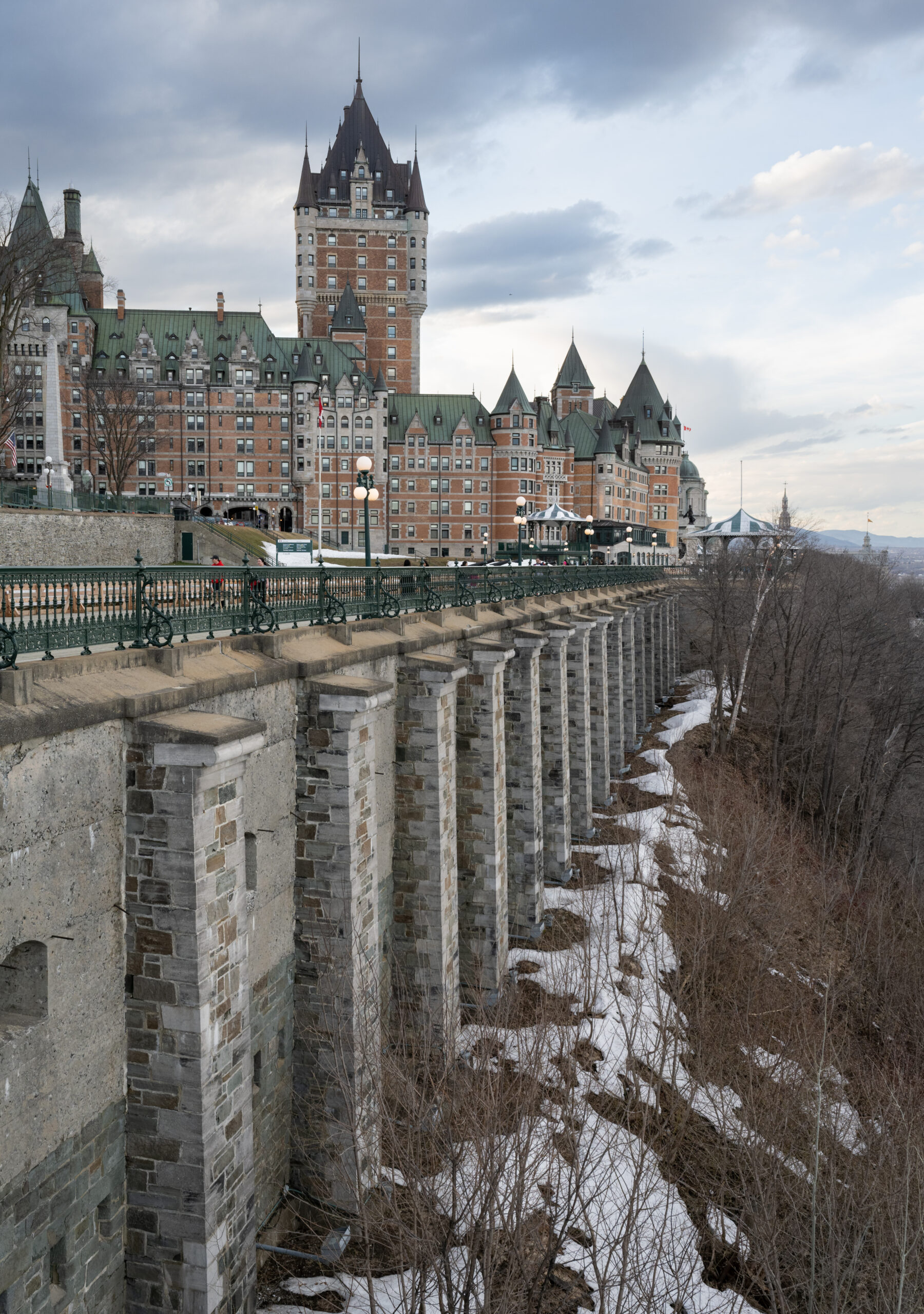
Quebec City is the clearest case in this series. Inside the walls, a car is not merely unnecessary but a liability: the streets are narrow, steep and cobbled, many are closed to traffic for much of the summer, parking is scarce and expensive, and everything a visitor wants is within a twenty-minute walk. Outside the walls, the neighbourhoods where the restaurants are, the Plains, the museums and even Montmorency Falls are on foot or a short bus ride. And yet the two things that make Quebec City more than a two-day stop, the Île d’Orléans across the bridge and the Charlevoix coast beyond it, are car country, with no useful transit at all. So the answer for most visitors is not one or the other but a sequence: no car for the city, a car for a day or two beyond it. This guide explains how the city is laid out, how the buses and the ferry work, the airport transfer, what driving and parking are really like in a walled city that gets three metres of snow, when a car is worth it, and gives you a straightforward way to decide.
The short answer
Do not rent a car for the city. If you are staying inside the walls, in Saint-Jean-Baptiste, in Saint-Roch or along the Grande Allée, and your plans are the Old Town, the Plains, the museums, the ferry and Montmorency, you will walk almost everywhere and take the bus for the rest, and a rental will sit in a garage costing money. Rent for a day or two if the Île d’Orléans, Sainte-Anne-de-Beaupré, the Canyon Sainte-Anne, Jacques-Cartier park, the ski hills or Charlevoix are on the itinerary, or if you are continuing on to Tadoussac, the Gaspé or Montreal by road. Rent for the whole trip only if you are staying outside the city, visiting family in the suburbs, or coming in winter to ski at Mont-Sainte-Anne or the Massif daily. Compare rental rates for any of these plans on our Quebec City car rental page.
How Quebec City is laid out
The city sits on the north bank of the St. Lawrence where the river narrows, on and below a cliff. The Upper Town, on the clifftop, is the walled Old Town of the Château Frontenac, the Terrasse Dufferin, the Place d’Armes and the ramparts, with the Citadelle at its highest point. The Lower Town, at the foot of the cliff, holds Place Royale, the Petit-Champlain, the Old Port, the Gare du Palais railway station and the Musée de la civilisation, and is connected to the Upper Town by the funicular, the Breakneck Stairs and several steep streets. West of the walls, along the clifftop, are the Plains of Abraham, the Grande Allée, the Parliament and the Musée national des beaux-arts, and beyond them the residential Montcalm neighbourhood. Just outside the Saint-Jean gate is Saint-Jean-Baptiste; down the hill from it, on the flat land along the Saint-Charles River, is Saint-Roch, and across the river is Limoilou. The airport, the university, the Centre Vidéotron arena and the suburbs lie to the west and north; Montmorency Falls and the bridge to the Île d’Orléans are fifteen minutes east along the river; Lévis is across the water. The historic core and the inner neighbourhoods are entirely walkable, though the hills are real.
Hotels cluster inside the walls in Old Quebec, along the Grande Allée, in Saint-Roch, and near the airport and the arena for value. Very few hotels inside the walls have their own parking, and those that do charge for it. Our Quebec City hotel search lets you compare them.
Getting in from the airport
Québec City Jean Lesage International (YQB) is about 15 kilometres west of the Old Town, and the transfer is simple. Taxis charge a fixed fare to the downtown zone, which includes the Old Town, and take 20 to 30 minutes; ride-hail is also available. An RTC bus route links the terminal to the network, with a change to a Métrobus line for the Old Town, for a standard fare and about an hour; it is the cheap option and fine without much luggage. And every major rental company is in the terminal; renting on arrival makes sense only if you are heading straight out of the city, to the island, Charlevoix or a ski hill, rather than into the walls. Check the airport’s site and the RTC for current service; our YQB airport guide covers the layout. If you arrive by train from Montreal, the Gare du Palais is in the Lower Town, a ten-minute walk or a short taxi from the Old Town’s hotels.
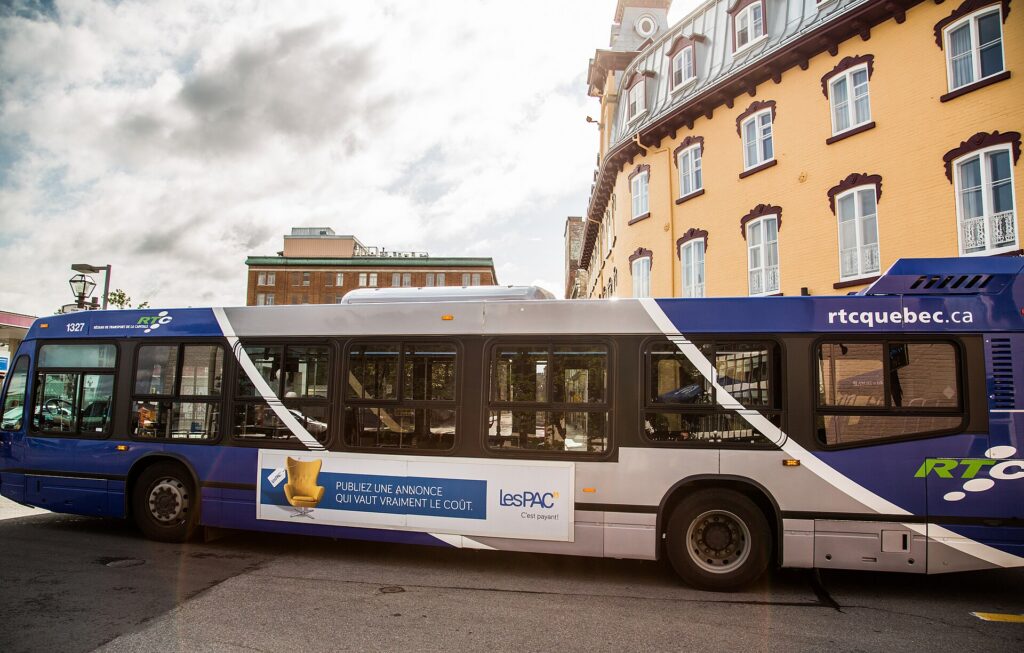
Quebec City’s transit, explained
The Réseau de transport de la Capitale, the RTC, runs the city’s buses; there is no metro and no light rail, though a tramway has been planned and debated for years. For a visitor, the network is simpler than it looks, because four Métrobus lines, numbered 800 to 807, run frequently along the main corridors and cover nearly everything, and the rest of the routes rarely matter.
The Métrobus lines
The 800 and 801 run from the western suburbs and the university along the Boulevard René-Lévesque and the Grande Allée corridor past the Plains, the Parliament and the Saint-Jean gate to the Old Town and down to the Lower Town and Saint-Roch, then east; the 802 and 807 cover the northern and eastern corridors. Between them, they connect the Old Town with the Grande Allée, the Musée national des beaux-arts, Saint-Roch, Limoilou, the university, the Centre Vidéotron and the Galeries de la Capitale mall, and a regular route continues east to Montmorency Falls. Buses run from early morning until around midnight, with reduced frequency on weekends.
Fares and tickets
Buy a single ticket, a day pass or a multi-day pass from the ticket outlets and machines, load fares on the OPUS card used across Quebec, or, on the newer buses, tap a contactless credit card; paying cash on board is possible but exact change is required. A single fare gives you a transfer window across the network. Children and seniors have reduced fares; check the RTC’s site for current prices and for the tourist passes it offers in summer.
Accessibility
The Métrobus fleet is low-floor and accessible; the Old Town’s hills and stairs are the real accessibility challenge, and the funicular is the step-free link between the Upper and Lower Towns.
Beyond the buses
- Walking. The Old Town is 4.6 kilometres around inside its walls; the Château to the Plains is fifteen minutes, the Château to Saint-Roch twenty, and the Lower Town is directly below. Most of a first visit is on foot, and the Upper Town to Lower Town transitions are the only real climbs.
- The funicular links the Terrasse Dufferin with the Petit-Champlain for a small fare; the Breakneck Stairs beside it are free and famous.
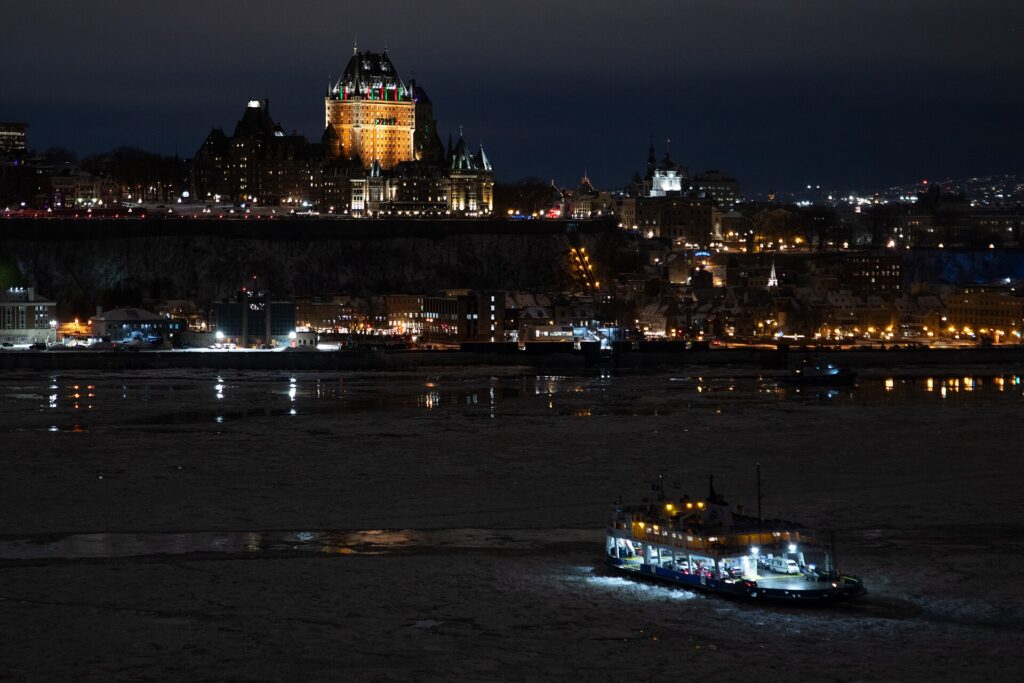
- The Lévis ferry crosses the St. Lawrence from the Old Port in twelve minutes, every half hour or so, and the view of the Château on the cliff from the deck is the best in the city; it is also the connection to the south-shore bus network.
- Bikes. The àVélo bike-share system operates from spring to fall, and the flat riverside path east from the Old Port to Montmorency Falls, the Corridor du Littoral, is one of the best rides in eastern Canada; the island’s loop is a classic day ride for the fit.
- Taxis and ride-hail. Licensed taxis and ride-hail cover the city; a ride from the Old Town to Saint-Roch or the Grande Allée is short and cheap, and to Montmorency it is competitive with the bus for two or more.
- Calèches. The horse-drawn carriages that tour the Old Town are transport in name only, but a ride is a pleasant way to see the ramparts once.
- Intercity. VIA Rail runs to Montreal in three hours from the Gare du Palais, and intercity buses serve Montreal, Charlevoix, the Saguenay and Tadoussac from the same station.
Driving in Quebec City: what it is really like
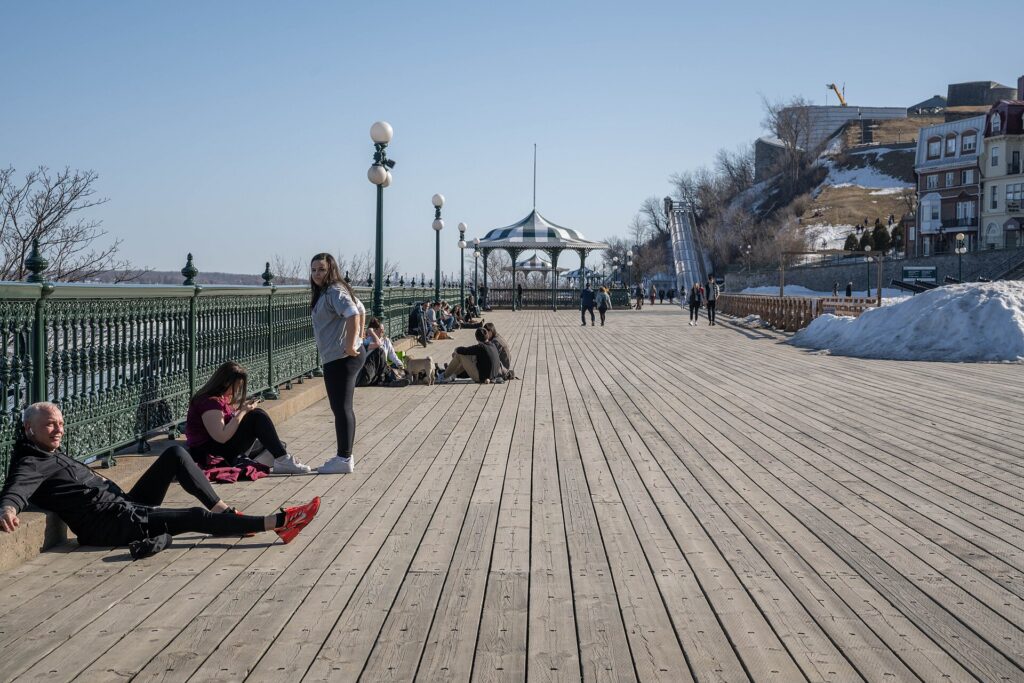
Outside the walls, Quebec City is an ordinary mid-sized city to drive in: the Autoroutes 40, 73 and 440 ring and cross it, traffic jams on the bridges to Lévis and on the Boulevard Laurier corridor at rush hour, and construction season runs from May to October. Inside the walls, it is something else. The streets are narrow and steep, the corners are tight, the one-way system is a puzzle, and in summer many of the Old Town’s streets, including the Petit-Champlain and the streets around the Place d’Armes, are closed to traffic or restricted to residents for most of the day; in the Carnaval and the Festival d’été, the closures spread across the Upper Town and the Grande Allée. Winter adds three metres of snow: the Old Town’s streets narrow further between the banks, overnight parking bans for snow clearing move cars around the city, and the hills ice. It is not dangerous, but it is slow and stressful, and a driver spends the day looking for somewhere to leave the car.
Parking
Parking inside the walls is the single strongest argument against a car. The few hotel garages charge a substantial nightly fee; the public garages, at the Hôtel de Ville, under the Place d’Youville and at the Old Port, are the practical options and fill on summer weekends and during the festivals; street parking is metered, time-limited and scarce. The city’s advice to visitors arriving by car is to leave it in a garage on the edge of the Old Town and walk, and it is good advice. Outside the walls, the picture improves quickly: the Grande Allée and Montcalm have metered street parking that is free overnight and on Sundays, Saint-Roch has garages and street parking, and the museums, the Plains, Montmorency and the island’s attractions all have their own lots. In winter, watch for the snow-removal signs, which impose temporary bans with short notice, and note that many street spaces are reserved for residents with permits.
Rules and conditions worth knowing
- Winter tires are required by law in Quebec on every vehicle from December 1 to March 15, and rental cars in the province are equipped accordingly; if your dates straddle those boundaries, ask.
- No right turn on red on the Island of Montreal, but it is permitted in Quebec City and the rest of the province after a full stop, unless a sign prohibits it.
- Signs are in French only. Arrêt is stop, and the pictograms are standard; a few minutes with a glossary before you drive is enough.
- Photo radar operates on the autoroutes and at intersections across the region; fines follow the car and the rental company will bill you.
- Snow-clearing bans. After a snowfall, temporary no-parking signs and flashing lights announce overnight clearing; a car left in the way is towed. Check the city’s snow-removal app or ask your hotel.
- Autoroute 20 and 40 to Montreal are toll-free; the Pierre-Laporte and Quebec bridges to Lévis are free but slow at rush hour.
- Fuel is more expensive in Quebec than in Ontario or Alberta.
- Charlevoix’s roads are hilly, twisting and, in winter, demanding; the Route 138 along the river is spectacular and slow, and moose are a real hazard at dusk north of Baie-Saint-Paul. Québec 511 publishes road conditions.
When renting a car makes sense
- The Île d’Orléans. The 67-kilometre loop of farms, cideries, vineyards and stone villages has no transit; a car or a strong pair of legs is the only way round.
- The Côte-de-Beaupré. Sainte-Anne-de-Beaupré, the Canyon Sainte-Anne, Mont-Sainte-Anne and the Cap Tourmente bird reserve are strung along the same road east of the falls.
- Charlevoix. Baie-Saint-Paul, the Massif, La Malbaie and the river road are the great trip from the city, and a car is essential; an overnight makes it better.
- Tadoussac and the whales, three hours northeast, in season from June to October.
- Jacques-Cartier National Park and the Valcartier waterpark and tubing park, north of the city.
- Skiing daily at Mont-Sainte-Anne, Stoneham or the Massif; shuttles exist from some hotels, but a car makes a ski trip simple.
- A road trip to Montreal, the Gaspé, the Saguenay or New England; one-way rentals to Montreal are routine, and our Montreal to Quebec City route guide covers the drive and our Montreal transit guide the other end.
If any of those apply, our rental car booking tips cover insurance, deposits and the questions to ask at the counter.
When it does not
- You are staying anywhere inside the walls or in the inner neighbourhoods and your plans are the city and Montmorency.
- You are in town for the Carnaval or the Festival d’été, when the Upper Town and the Grande Allée close and parking vanishes.
- You are arriving by train from Montreal, which delivers you to the Lower Town on foot.
- You are travelling solo or as a couple, when a taxi to Montmorency and a day pass cost less than a day of rental and parking.
The hybrid plan
Arrive without a car, spend the city days on foot and on the Métrobus, and rent for the day or two you leave the walls. Where to pick up: the rental companies have branches at the Gare du Palais in the Lower Town, along the Boulevard René-Lévesque near the Parliament, and in Sainte-Foy near the university, all of which avoid the airport concession fees and put you on the road east to the island in fifteen minutes; collect it in the morning of the day you need it and return it the same evening, or return it at the airport on the way to the flight home, which most companies allow within the city at little or no extra charge. For Charlevoix, a two-day rental with a night in Baie-Saint-Paul or La Malbaie is the shape most visitors settle on. Ask about winter tires if your dates fall outside the December-to-March mandate, and if you are skiing, ask for a roof rack or a vehicle that fits the gear. Compare the day rates on our Quebec City car rental page against a full-trip rental; with the parking inside the walls added, the hybrid almost always wins.
A worked cost comparison
Numbers change with the season and the booking window, so treat this as a method rather than a quote, and check current rates before deciding. For a three-night stay inside the walls for two people, the car-free version costs a fixed-fare taxi from the airport and back, a day pass or two for the Métrobus and the Montmorency bus, the ferry both ways, and perhaps one ride-hail to Saint-Roch for dinner; the rental version adds three days of a compact car, three nights of Old Town garage parking at the highest rates in the city, fuel and the airport fees, and buys nothing you could not walk or ride to. Transit wins by a wide margin. For the same three nights plus a day on the island and the Côte-de-Beaupré, the hybrid adds a one-day rental from the Lower Town, fuel and nothing else, since the island’s attractions have free parking; it is cheap and the only practical way to do the loop. For a five-day trip with two nights in Charlevoix, a rental from the day you leave the city to the day you return, or a one-way to Montreal, is the answer, and it is still cheaper than a car parked inside the walls for the city days. Run the rates for your dates and put them beside the transit fares before you choose.
Decision table
| Your trip | Recommendation | Why |
|---|---|---|
| City break inside the walls, couple or solo | No car | Everything is walkable; parking is scarce and expensive; streets close in summer |
| Carnaval or Festival d’été | No car | Street closures across the Upper Town; the Métrobus and your feet are the way in |
| City plus the Île d’Orléans | Hybrid: one-day rental from the Lower Town | The island has no transit; the city needs no car |
| City plus Charlevoix | Hybrid: two-day rental with a night on the coast | The river road and the villages are car country |
| Arriving by train from Montreal | No car, rent locally if needed | The station is in the Lower Town |
| Ski trip, daily | Rent for the stay, at a hotel with parking | The hills are 40 minutes out; winter tires are supplied |
| Family visit to the suburbs | Rent for the whole stay | Suburban distances make the car worthwhile daily |
| Quebec plus Tadoussac, the Gaspé or Montreal | Rent (consider one-way) | Quebec City is the start of the drive, not its end |
Money-saving tips for both options
- On transit: buy a day pass if you will ride the bus to Montmorency and the museums; take the ferry to Lévis for the view instead of a paid cruise; use the funicular once and the stairs the rest of the time.
- On a rental: pick up in the Lower Town or on René-Lévesque rather than at the airport, rent only for the days you leave the walls, decline extras you already have through a credit card or home policy (check first), and fill up on the way back rather than near the Old Town.
- On the hotel: if you are renting, choose a hotel on the Grande Allée or in Saint-Roch with parking rather than one inside the walls; if you are not, the Old Town’s car-free premium is worth paying for the atmosphere.
- On timing: avoid the bridges to Lévis in the weekday peaks and the island’s road on summer Sunday afternoons, when everyone returns at once; the best time to fly to Quebec City guide lists the busy weekends.
- On Montreal: for two people, the train from Montreal is usually cheaper than a one-way rental plus fuel, unless you want the car at the Quebec end anyway.
Frequently asked questions
Is it worth renting a car in Quebec City?
Not for the city, where a car is a liability inside the walls. For the Île d’Orléans, Charlevoix, the ski hills or a road trip, yes; rent for those days only.
Is Quebec City public transit good for tourists?
Adequate and simple: four frequent Métrobus lines cover the corridors a visitor uses, a bus reaches Montmorency Falls, and the ferry crosses to Lévis. There is no metro, and for the Old Town itself you will not need any of it.
How do I get from Quebec City airport to the Old Town?
A fixed-fare taxi in 20 to 30 minutes, ride-hail, or an RTC bus with a change in about an hour. A rental only makes sense if you are heading straight out of the city.
Can I get to the Île d’Orléans without a car?
Only by bike or on a tour; there is no bus service on the island. A one-day rental is the practical answer.
Do I need winter tires in Quebec City?
They are required by law on every vehicle from December 1 to March 15, and rentals are equipped. Outside those dates, ask.
Where can I park in Old Quebec?
In the public garages at the Hôtel de Ville, under the Place d’Youville and at the Old Port, or at your hotel if it has a garage; street parking inside the walls is scarce, metered and time-limited. Park on the edge and walk.
Should I drive or take the train from Montreal?
The train for a city visit: three hours, station to Lower Town, no parking. Drive if you want the island and Charlevoix or are continuing on; our Montreal to Quebec City guide covers the route.
Whichever way you go, start with the flight. Compare cheap flights to Quebec City, choose a neighbourhood with our Quebec City hotel search, and if the island or Charlevoix is on the list, price the rental for those dates on our Quebec City car rental page.
Keep planning with TicketScanner
- Quebec City car rentals — compare airport and downtown pickup
- Cheap flights to Quebec City
- Quebec City hotels — parking inside the walls is scarce
- Things to do in Quebec City: a first-timer's guide
- Best time to fly to Quebec City: month by month
- Quebec City Jean Lesage (YQB) airport guide
- Driving Montreal to Quebec City
- Montreal: rent a car or use transit?
- Rental car booking tips
- Car, transit or taxi in a new city?
Leave a Reply