Quebec City is the only walled city north of Mexico, the oldest French-speaking city on the continent, and, by a wide margin, the most European-feeling place in North America. Its Old Town, a UNESCO World Heritage Site since 1985, climbs from a huddle of seventeenth-century stone houses on the riverbank to a clifftop crowned by a copper-roofed hotel that looks like a fairy-tale castle, and the whole of it can be walked in an afternoon. That is the postcard, and it is real. What surprises first-time visitors is the rest: the battlefield park where the fate of the continent was decided, now the city’s Central Park; the lively working neighbourhoods just outside the walls where the restaurants have moved; a waterfall higher than Niagara fifteen minutes away; an island of farms and cider in the river; a summer music festival that draws headliners to a stage on the Plains; and a winter carnival that turns -20 °C into a party. This guide covers the sights, the neighbourhoods, the seasons, the food, the day trips and the practical details for a first visit.
If you are still comparing cheap flights to Quebec City, read this alongside our guides to the best time to fly to Quebec City and whether you need a car. Between the three you can plan the whole trip.
Quebec City at a glance for first-timers
- Airport: Québec City Jean Lesage International (YQB), about 15 km west of the Old Town; a taxi at a fixed downtown fare takes 20 to 30 minutes, and a city bus route connects to the network. See our YQB airport guide.
- Getting around: the Old Town is entirely walkable, hilly, and largely off-limits to cars in summer; the RTC buses cover the neighbourhoods beyond; a car is only for the Île d’Orléans, Charlevoix and the countryside.
- Money: Canadian dollars; Quebec adds the 5 percent federal GST and the 9.975 percent provincial QST at the till. Tipping 15 to 20 percent in restaurants is customary.
- Language: French, more so than Montreal. In the tourist trade everyone speaks English, but a bonjour goes a long way, and menus and signs are French first.
- Weather: warm, bright summers; a spectacular fall; a long, snowy, genuinely cold winter that the city celebrates; a late spring. Our month-by-month guide has the detail.
- Where to stay: inside the walls in Old Quebec for the atmosphere; Saint-Roch or Saint-Jean-Baptiste for the restaurants and lower prices; the Grande Allée for the Plains and the festival. Our Quebec City hotel search covers them all.
The Upper Town: the Château, the Terrasse and the walls
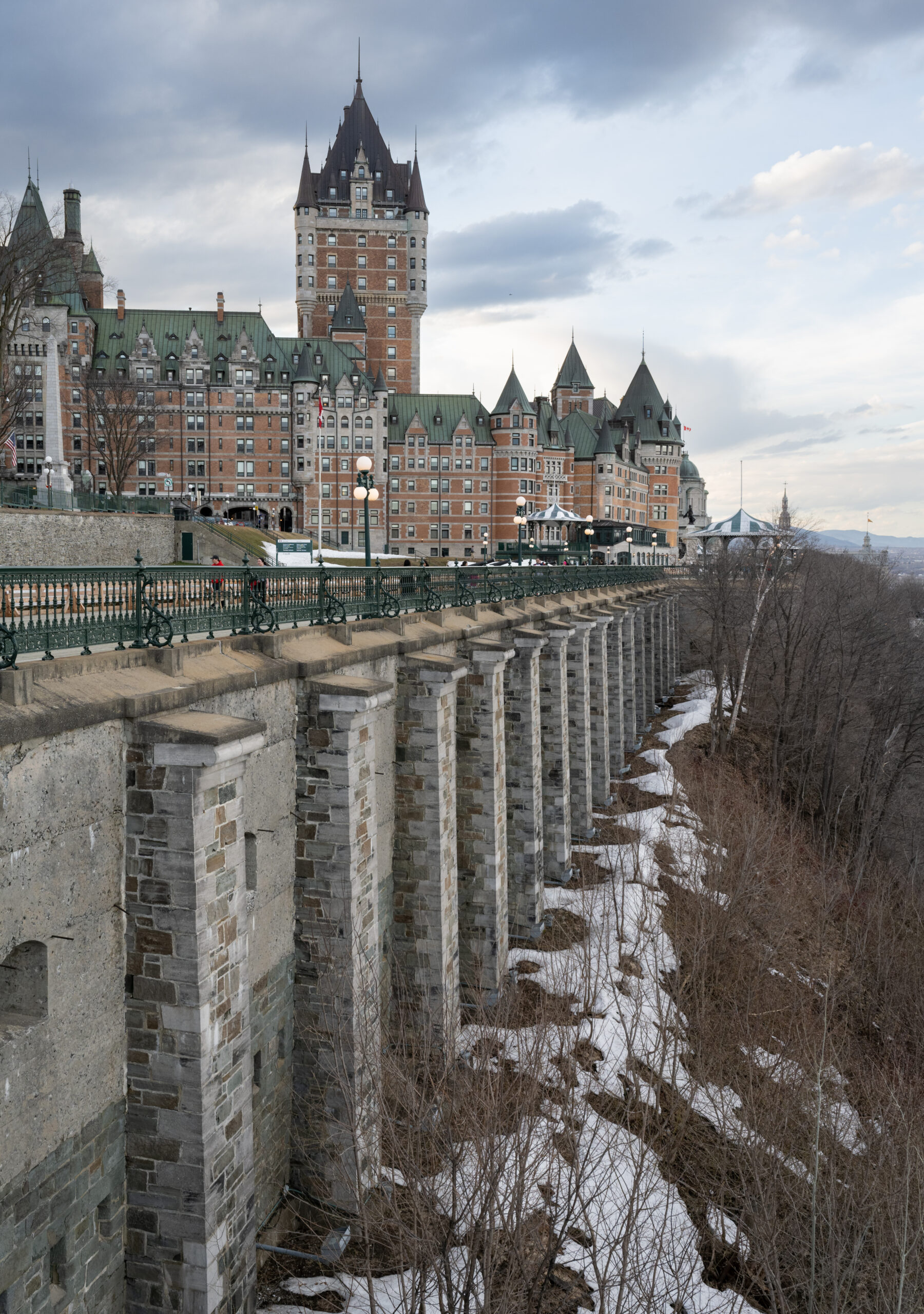
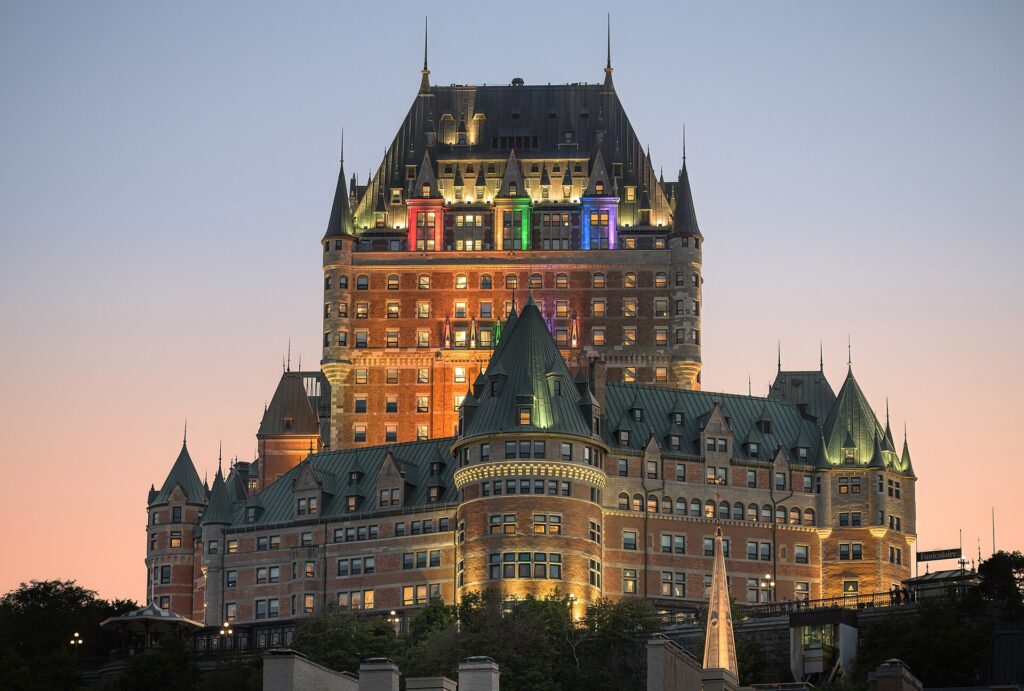
Start at the top. The Château Frontenac, the Canadian Pacific railway hotel that opened in 1893, is the most photographed hotel in the world and the visual centre of the city; you do not need to stay there to walk through the lobby or take a guided tour. In front of it, the Terrasse Dufferin is a wooden boardwalk along the cliff edge with the St. Lawrence and the Lévis shore below, street musicians in summer and a toboggan run in winter, and at its far end the Promenade des Gouverneurs climbs the cliff to the Citadelle and the Plains. The Place d’Armes beside the hotel is the historic heart, with the Holy Trinity Anglican cathedral, the first outside the British Isles, and the rue du Trésor, where artists sell prints. The Notre-Dame de Québec Basilica, the seat of the oldest diocese in North America north of Mexico, and the Séminaire de Québec, now the Musée de l’Amérique francophone, are a block away. And the ramparts, 4.6 kilometres of walls and gates that encircle the Upper Town, can be walked along the top for much of their length; the Saint-Louis and Saint-Jean gates are the grandest, and the Citadelle, the star-shaped British fort at the highest point, still garrisoned by the Royal 22e Régiment, offers tours and, in summer, a changing of the guard with a regimental goat.
The Lower Town: Petit-Champlain and Place Royale
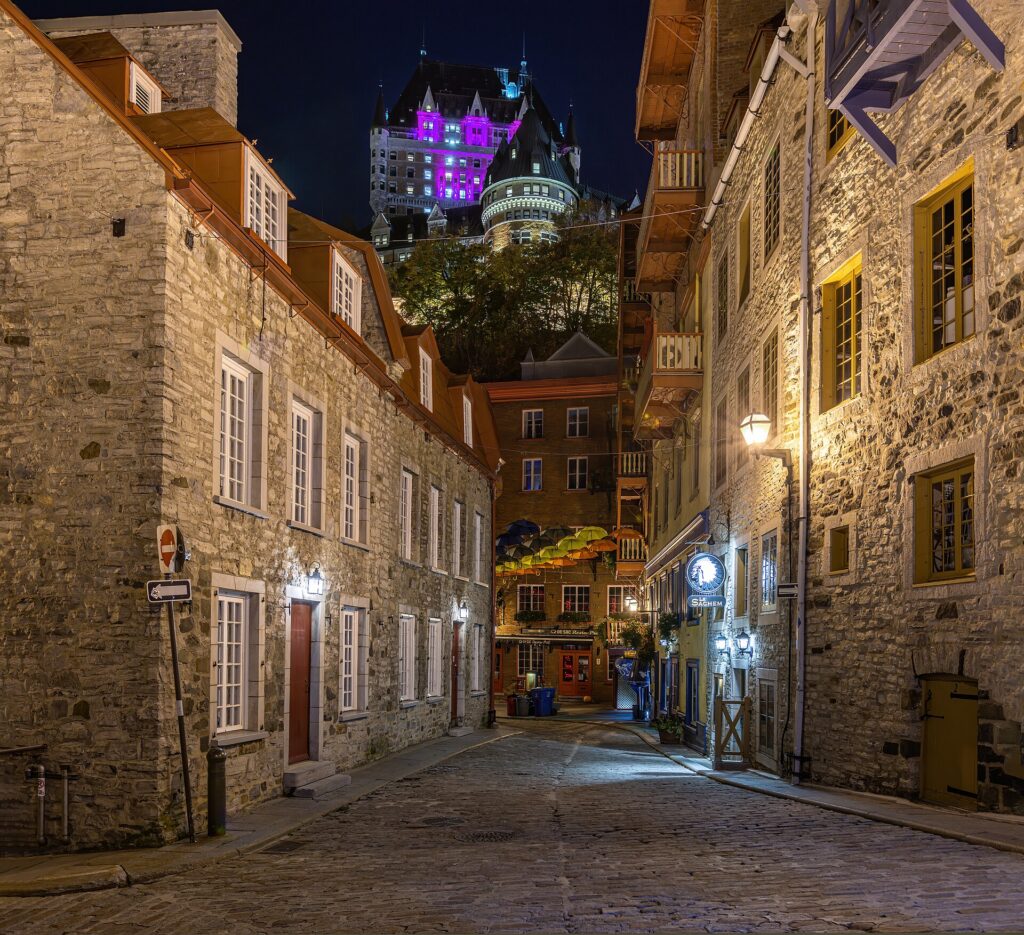
Below the cliff, reached by the Breakneck Stairs or the funicular from the Terrasse, is where the city began. Place Royale is the square where Samuel de Champlain built his habitation in 1608, surrounded by restored stone houses and the little church of Notre-Dame-des-Victoires, and it is the most concentrated piece of seventeenth-century North America that exists. The rue du Petit-Champlain, running from the square toward the river, is one of the oldest commercial streets on the continent, now a pedestrian lane of boutiques, galleries and cafés that is extremely pretty and extremely busy; go early or in the evening. Beyond it, the Old Port and the Marché du Vieux-Port, now the Grand Marché in a new location, hold the farmers’ market, the cruise terminal, and the Musée de la civilisation, a modern museum with strong permanent exhibitions on Quebec’s history and Indigenous peoples and the best rainy-day option in the city. The Lévis ferry, from the Old Port, crosses the river in twelve minutes and gives the classic view of the Château on the cliff; it is the best cheap outing in the city.
The Plains of Abraham and the museums
West of the Citadelle, the Plains of Abraham are the battlefield where Wolfe defeated Montcalm in 1759 and Britain won Canada, and they are now a 100-hectare park of lawns, gardens and Martello towers that serves as the city’s Central Park: concerts in summer, the Festival d’été’s main stage, cross-country skiing and snowshoeing in winter, and the best walk in the city along the cliff above the river. The Plains of Abraham Museum at the eastern edge explains the battle, and the Musée national des beaux-arts du Québec, on the western edge, holds the definitive collection of Quebec art, from the colonial period to Riopelle, in four buildings including a former prison and a striking glass pavilion by OMA. The Grande Allée, the boulevard running along the northern edge of the park from the Saint-Louis gate, is lined with restaurants and bars in Second Empire townhouses and is the city’s summer terrasse row, with the Parliament Building of Quebec, whose facade is a gallery of the province’s history, at its eastern end; free tours are available.
Beyond the walls: Saint-Jean-Baptiste, Saint-Roch and Limoilou
The Old Town is where you look; the neighbourhoods outside the walls are where you eat. Saint-Jean-Baptiste, along the rue Saint-Jean just outside the gate, is a lively strip of bistros, bars, the Épicerie J.A. Moisan grocery, the oldest in North America, and the city’s small gay village; it is the natural evening extension of the Old Town. Down the hill, Saint-Roch was a run-down industrial district twenty years ago and is now the city’s most interesting neighbourhood, with the rue Saint-Joseph’s restaurants, microbreweries, the Jardin Jean-Paul-L’Allier and a tech-and-design economy; it is where the city’s best-regarded chefs have opened. Across the Saint-Charles River, Limoilou is the next wave, a residential neighbourhood of triplexes and small restaurants along the 3e Avenue. All three are a walk or a short bus ride from the walls and are where you will pay noticeably less for dinner.
Montmorency Falls and the Île d’Orléans
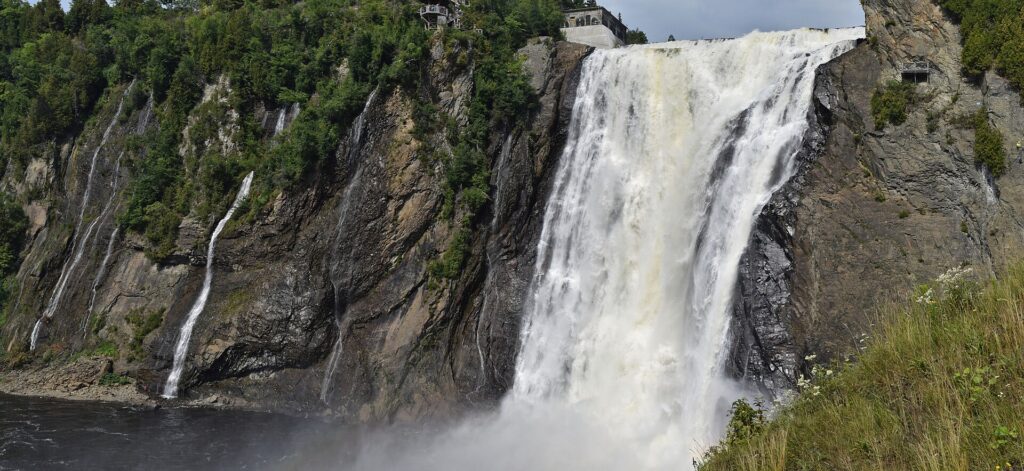
Montmorency Falls, fifteen minutes east of the Old Town, are 83 metres high, thirty metres higher than Niagara, and drop into the St. Lawrence at the point where the Île d’Orléans bridge crosses the river. A cable car, a suspension bridge over the top of the falls, a staircase down the cliff and, in summer, a zipline and a via ferrata make it a half-day; in winter, the spray freezes into a sugar-loaf cone at the base that ice climbers scale. A city bus reaches the park. The Île d’Orléans, just beyond, is a 67-kilometre loop of farms, orchards, vineyards, cider houses, strawberry fields, chocolate makers and stone churches that has been farmed since the 1650s and is the city’s larder; it needs a car or a bike, and a summer or fall afternoon there, buying cider and strawberries from the roadside stands, is one of the best things you can do in Quebec. Sainte-Anne-de-Beaupré, the pilgrimage basilica, is a little farther along the same road.
Festivals and events
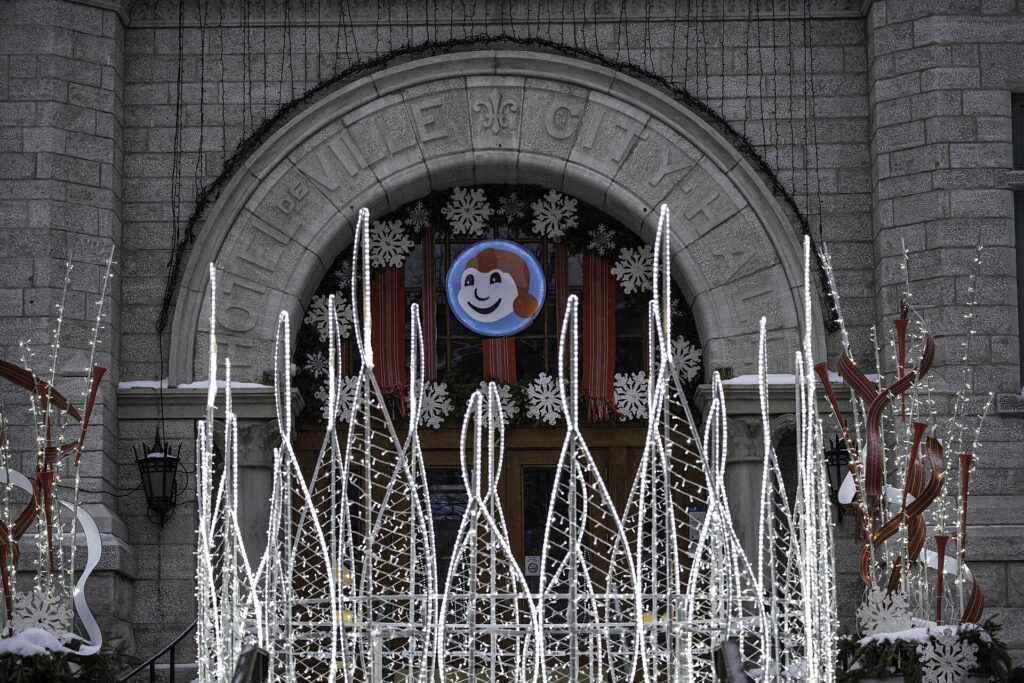
Quebec City’s two great festivals bracket the year. The Carnaval de Québec, over ten days in early February, is the largest winter carnival in the world: ice sculptures, night parades, a canoe race across the ice-choked river, snow baths, an ice palace, and Bonhomme, the snowman mascot, everywhere. The Festival d’été de Québec, over eleven days in July, puts international headliners on a huge stage on the Plains of Abraham and smaller acts across the city for a single inexpensive pass, and is one of the best-value music festivals in North America; hotels fill months ahead. Between them: the Fêtes de la Nouvelle-France in August, a costumed celebration of the colonial era in the Lower Town; the Grands Feux Loto-Québec fireworks over the river on summer evenings; the Marathon in October; the Marché de Noël allemand, a German Christmas market in the Old Town in December; and the Pentathlon des neiges and other winter sports events on the Plains. Destination Québec cité keeps the calendar, and our Quebec City events page lists what is on sale during your dates.
What to eat, and where
Quebec City is the capital of Québécois cooking, and a first visit should include the classics: tourtière, the spiced meat pie; poutine, which was invented in the province; pouding chômeur, the Depression-era maple pudding; pea soup, cretons, and, in spring, everything maple at a cabane à sucre. The Old Town’s restaurants along the rue Saint-Louis and in the Lower Town serve these to tourists, some very well and some not; the better versions, and the more inventive cooking, are in Saint-Roch, Saint-Jean-Baptiste and Limoilou, where the city’s best chefs work with the produce of the Île d’Orléans and Charlevoix, whose cheeses, lamb and ciders are the region’s pride. The Grand Marché is the place to graze on all of it. The Grande Allée is for a terrasse and a drink on a summer evening; the microbreweries in Saint-Roch are for the winter. And two Quebec institutions are mandatory: a bowl of café au lait and a croissant in a Saint-Jean bakery, and a queue for a cone at one of the crémeries when the sun is out.
Quebec City through the seasons
Summer (June to August) is the city at full volume: the Festival d’été, the New France festival, street performers on the Terrasse, the terrasses on the Grande Allée, the fireworks, the Île d’Orléans in fruit, and cruise ships in the Old Port. It is also the most crowded, and the Old Town’s lanes can be a slow shuffle in July; go early and late. Fall (September to October) is the local favourite and the photographer’s: the maples on the Plains and along the river turn in early October, Charlevoix and the island are at their most beautiful, the crowds thin, and the restaurants are at their best. Winter (December to March) is long, snowy and cold, and the city is transformed: the Old Town under snow with the Christmas market and the lights, the Carnaval in February, the toboggan run on the Terrasse, skiing at Mont-Sainte-Anne and Stoneham forty minutes away, cross-country on the Plains, the ice hotel, the Hôtel de Glace, rebuilt every winter outside the city, and the frozen falls at Montmorency. Dress for it and it is the most magical time to visit. Spring (April to May) is mud, melting snow and sugar shacks, then a burst of green in mid-May; it is the quietest and cheapest season. Our month-by-month guide matches each season to fares.
Quebec City with kids
The Old Town is a storybook for children, with the funicular, the Breakneck Stairs, the cannons on the ramparts, the changing of the guard and the goat at the Citadelle, the ferry to Lévis, the horse-drawn calèches, and the toboggan run on the Terrasse in winter. The Musée de la civilisation has excellent family exhibitions, the Aquarium du Québec in the west of the city has polar bears and walruses, Montmorency’s cable car and suspension bridge are an adventure, the Village Vacances Valcartier, half an hour north, is a summer waterpark and a winter tubing park, and the Carnaval is built for families. The island’s strawberry picking in early summer is a happy afternoon. The Old Town’s hills and cobbles are hard work with a stroller; a carrier is easier.
Quebec City on a budget
The best of the city is free: the Old Town itself, the ramparts, the Terrasse, Place Royale, the Plains of Abraham, the Parliament tour, the Lévis ferry’s view for a small fare, and the Festival d’été’s wristband is one of the best-value tickets in the country. The museums are moderately priced, and the Musée national des beaux-arts is free on Wednesday evenings for its permanent collection; check its site. Eat cheaply and well in Saint-Roch and Saint-Jean-Baptiste rather than inside the walls, at the Grand Marché, and at the bakeries. Hotels inside the walls are the most expensive in the city, especially in July and during the Carnaval; a room in Saint-Roch or along the Grande Allée is a ten-minute walk and a fraction of the price. Compare by neighbourhood on our Quebec City hotel search.
Day trips from Quebec City
Charlevoix, the region of mountains, villages and river views northeast of the city, is the great day trip and better as an overnight: Baie-Saint-Paul’s galleries, the Massif de Charlevoix ski hill in winter, the Malbaie, and the road along the St. Lawrence to Tadoussac, three hours away, where whales feed at the mouth of the Saguenay from June to October. Mont-Sainte-Anne and the Canyon Sainte-Anne, forty minutes east, offer skiing and mountain biking and a gorge with suspension bridges. Jacques-Cartier National Park, forty minutes north, is a glacial valley of canoeing, hiking and, in winter, skiing and snowshoeing. Wendake, the Huron-Wendat community on the city’s northern edge, has an excellent museum and hotel and a traditional longhouse. Montreal is three hours by train or car, and many visitors combine the two; our Montreal guide covers it, and our Montreal to Quebec City route guide covers the drive. All but Montreal need a car; see our Quebec City car rental page, and Bonjour Québec for the wider province.
Two sample itineraries
Two days, no car
Day one: the Terrasse Dufferin and the Château in the morning, the Place d’Armes and the basilica, a walk along the ramparts to the Saint-Jean gate, lunch on the rue Saint-Jean, the Citadelle in the afternoon, the Plains and the Musée national des beaux-arts, and dinner on the Grande Allée or in Saint-Jean-Baptiste. Day two: the funicular or the stairs to the Lower Town first thing before the crowds, Place Royale and the rue du Petit-Champlain, the Musée de la civilisation, the Lévis ferry there and back for the view, lunch at the Grand Marché, a bus to Montmorency Falls in the afternoon, and dinner in Saint-Roch.
Four days, with a car
Add a day looping the Île d’Orléans with a stop at Sainte-Anne-de-Beaupré or the Canyon Sainte-Anne, and a day in Charlevoix to Baie-Saint-Paul and back along the river road, or, with more time, on to Tadoussac for the whales.
Practical details
- Transit: the RTC buses, with the Métrobus lines the frequent ones; buy tickets or a day pass, or tap a credit card on newer buses. See our transit-versus-car guide for detail.
- From YQB: a fixed-fare taxi to downtown in 20 to 30 minutes, the city bus, or a rental from the terminal. The airport’s site covers ground transport.
- Weather: real winter gear from December to March, layers in every other season, and good shoes for the cobbles and hills. Environment Canada’s forecast is the one to check.
- Time zone: Eastern, the same as Montreal, Toronto and New York.
- Entry requirements: U.S. citizens need a valid passport; most other visa-exempt visitors arriving by air need an Electronic Travel Authorization. The Government of Canada’s visitor page is the authoritative source.
- Safety: one of the safest cities in North America; the only hazards are the ice on the stairs in winter and the crowds on the Petit-Champlain in July.
Frequently asked questions
How many days do you need in Quebec City?
Two full days covers the Old Town, the Plains, a museum and Montmorency; three adds the Île d’Orléans and the neighbourhoods outside the walls; four or five adds Charlevoix.
What is Quebec City best known for?
The walled Old Town and the Château Frontenac, the Plains of Abraham, the Winter Carnival, the Festival d’été, Montmorency Falls and Québécois food.
Is Quebec City walkable?
The Old Town and the neighbourhoods just outside the walls are, very much so, though hilly and cobbled. Montmorency is a bus ride; the island and Charlevoix need a car.
Do I need to speak French in Quebec City?
No, but it is more French than Montreal. In hotels, restaurants and shops in the tourist areas English is fine; a bonjour and a merci are appreciated everywhere.
Do I need a car in Quebec City?
Not for the city, where a car is a liability inside the walls. For the Île d’Orléans, Charlevoix and the parks, yes; rent for those days only.
Is Quebec City expensive?
Hotels inside the walls in July and during the Carnaval are expensive; everything else is moderate, and the neighbourhoods outside the walls are cheaper than Montreal for dining.
Which is better, Montreal or Quebec City?
Different things: Montreal is the big, bilingual, festival-and-nightlife city; Quebec City is the historic, French, walkable one. Three hours apart, they are best done together.
Ready to go? Compare flights to Quebec City, find a place to stay with our Quebec City hotel search, and if the island or Charlevoix is on the list, price a rental car for those days.
Keep planning with TicketScanner
- Cheap flights to Quebec City
- Quebec City hotels — inside and outside the walls
- Quebec City car rentals — for Charlevoix and the Île d'Orléans
- Events in Quebec City — concerts, shows and the Festival d'été on sale
- Best time to fly to Quebec City: month by month
- Quebec City: rent a car or use transit?
- Quebec City Jean Lesage (YQB) airport guide
- Where to stay: Old Quebec
- Driving Montreal to Quebec City
- Things to do in Montreal
Leave a Reply