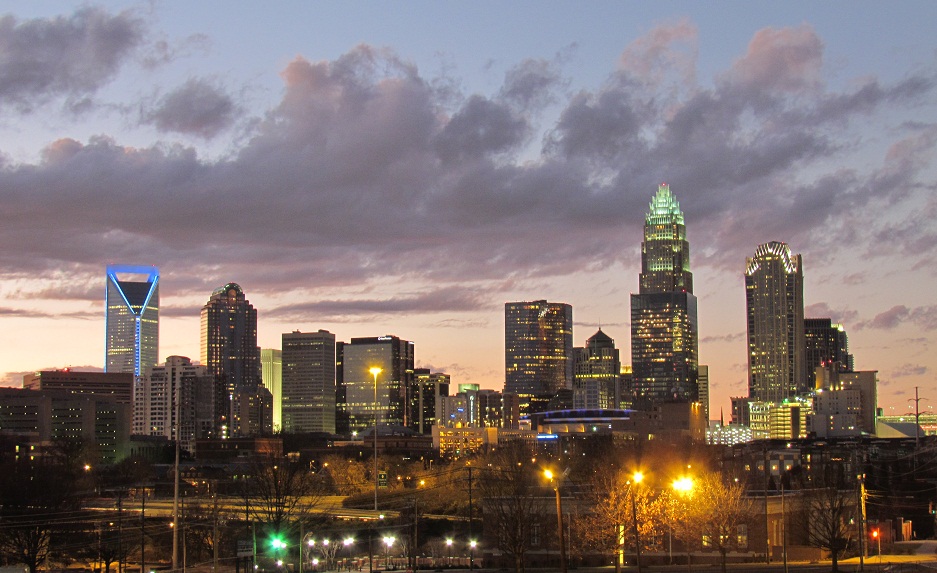
Charlotte is the biggest city in the Carolinas, and most people who pass through it never leave the airport. Charlotte Douglas is one of American Airlines’ largest hubs, so millions of travelers change planes under the white rocking chairs in the terminal atrium every year and fly on. That is their loss. The city outside has grown into one of the most pleasant urban centers in the South: a compact downtown, which locals call Uptown, built around a crossroads that has been the heart of the city since colonial times; modern art museums and the NASCAR Hall of Fame within a few blocks of each other; a light-rail line lined with breweries, food halls and converted textile mills; leafy streetcar suburbs; one of the largest man-made whitewater rivers in the world fifteen minutes from the skyline; and the Blue Ridge Mountains, the lakes and the racing towns of the Piedmont within a couple of hours. This guide covers the sights, the neighborhoods, the food, the racing and sports, the day trips and the practical details that turn a layover city into a real trip.
If you are still comparing cheap flights to Charlotte, read this alongside our guides to the best time to fly to Charlotte and whether you need a car. Between the three you can plan the whole trip.
Charlotte at a glance for first-timers
- Airport: Charlotte Douglas International (CLT), about 11 km (7 miles) west of Uptown; a taxi or ride-hail takes 15 to 20 minutes, and the CATS Route 5 bus runs to the Charlotte Transportation Center downtown. See our CLT airport guide.
- Getting around: the LYNX Blue Line light rail links South End, Uptown, NoDa and the university, and the CityLYNX Gold Line streetcar crosses Uptown east to west. Uptown and South End are walkable. For the Speedway, the lakes, the Whitewater Center and the mountains, you will want a car.
- Money: U.S. dollars. State and county sales tax is added at the till, and hotel rooms carry extra occupancy taxes. Tipping 18 to 20 percent in sit-down restaurants is customary.
- Weather: hot, humid summers with afternoon thunderstorms, short and mostly mild winters with the occasional ice storm, and a long spring and fall that are the best times to visit. Our month-by-month guide has the detail.
- Where to stay: Uptown for the museums, the arenas, the stadium and the light rail; South End for breweries, restaurants and the Rail Trail; Dilworth or Myers Park for a quieter, leafy stay; Concord or University City for race weekends. Our Charlotte hotel search covers them all.
Uptown: the Square, the wards and the parks
Charlotte grew up where two old trading paths crossed, and that intersection, Trade and Tryon Streets, is still the center of the city. Locals call it the Square, and each corner holds a bronze statue by Raymond Kaskey representing the forces that built Charlotte: a gold miner for commerce, a mill worker for industry, a railroad builder for transportation, and a mother and child for the future. Above them rises the Bank of America Corporate Center, 60 stories and the tallest building in the Carolinas, a reminder that Charlotte is the second-largest banking center in the country after New York. Uptown is divided into four historic wards. Fourth Ward, to the northwest, is the prettiest, with restored Victorian houses on quiet streets and the Settlers’ Cemetery, which has graves from the Revolutionary era. Third Ward holds Romare Bearden Park, named for the celebrated collagist born in Charlotte, facing Truist Field, where the Charlotte Knights play Triple-A baseball with the skyline as a backdrop; it is one of the best places in the city to spend a summer evening. First Ward, to the east, has First Ward Park and the start of the Little Sugar Creek Greenway.
Levine Center for the Arts and the NASCAR Hall of Fame
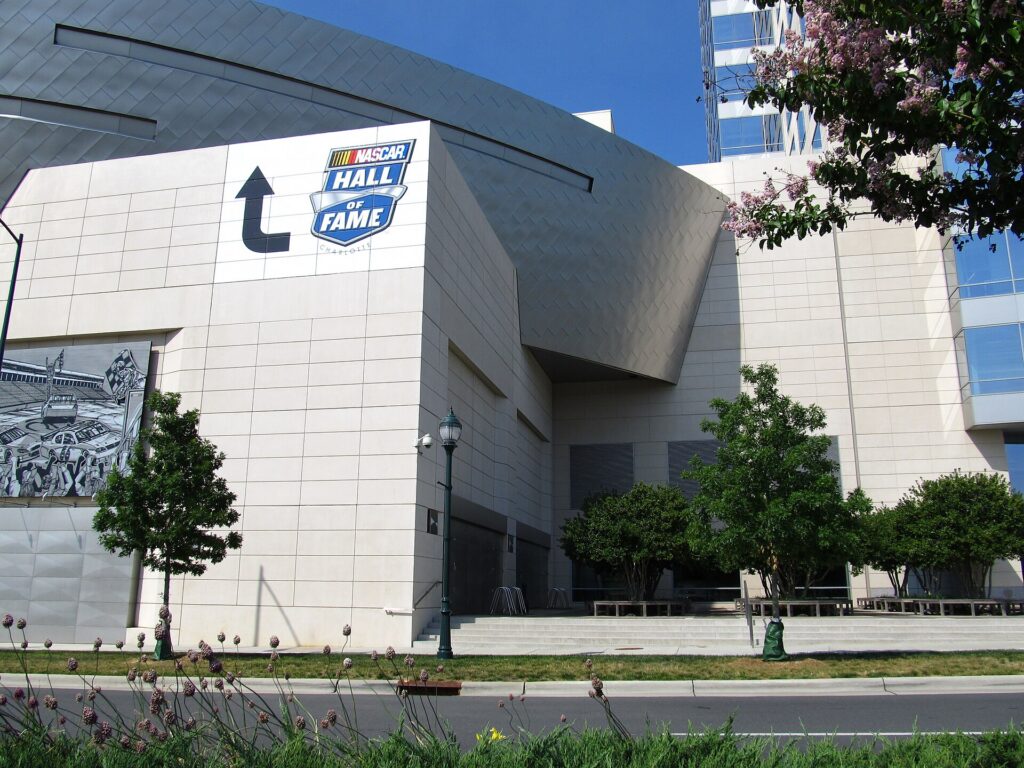
A few blocks south of the Square on South Tryon, the Levine Center for the Arts gathers several institutions around a single plaza. The Mint Museum Uptown has a strong American collection and an outstanding craft and design gallery of glass, ceramics, furniture and fashion. The Bechtler Museum of Modern Art, in a terracotta building by the Swiss architect Mario Botta, shows mid-century modernism, and Niki de Saint Phalle’s glittering mosaic Firebird on the sidewalk out front is the most photographed sculpture in the city. The Harvey B. Gantt Center for African-American Arts + Culture, named for Charlotte’s first Black mayor, occupies a striking building inspired by the Myers Street School, the city’s first school for Black children. The Mint’s original home, the Mint Museum Randolph in Eastover, is the relocated building of the branch U.S. Mint that opened here in the 1830s to coin gold from the Carolina gold rush, and it became the first art museum in North Carolina in 1936. One block west of the Levine Center, the NASCAR Hall of Fame is the attraction that surprises visitors most. Even people with no interest in racing enjoy it: a banked ramp lined with historic cars shows how steep the tracks really are, the pit-stop challenge lets you change a tire against the clock, and the racing simulators are as close as most of us will get to 190 miles an hour. Allow at least two hours.
South End and the Rail Trail
Just south of Uptown, along the LYNX Blue Line, South End has turned from a district of rail yards and warehouses into the liveliest neighborhood in the city. The Rail Trail, a walking and cycling path beside the light-rail tracks, ties it together, with public art, pocket parks and a steady stream of people heading between patios. Along and just off it are restaurants, coffee shops, design stores and taprooms, and Atherton Mill, a restored textile mill beside the tracks, has shops and places to eat. Because the Blue Line stops every few blocks, it is easy to ride down from Uptown, walk the Rail Trail south for an hour with stops, and ride back. Farther south on the same line, the Olde Mecklenburg Brewery, known for German-style lagers and a big beer garden, is the city’s most famous brewery.
Neighborhoods worth a half-day
NoDa
North Davidson, universally called NoDa, is Charlotte’s arts district, a former mill village northeast of Uptown with murals on every other wall, small galleries, independent music venues, bars and restaurants along North Davidson and 36th Street. The Blue Line’s 36th Street station puts it ten minutes from the center, and NoDa Brewing is one of the city’s pioneering craft breweries.
Plaza Midwood
East of Uptown along Central Avenue, Plaza Midwood is the city’s most eclectic neighborhood: dive bars and cocktail lounges, vintage and record shops, barbecue and taco joints. Continue out Central Avenue and you reach the international corridor, with Vietnamese, Mexican, Salvadoran, Ethiopian and many other restaurants in modest strip malls.
Dilworth and Myers Park
Dilworth, laid out in 1891 as Charlotte’s first streetcar suburb, has bungalows, Latta Park and a strip of restaurants along East Boulevard. Myers Park, next door, was planned in the 1910s around Queens Road, whose canopy of huge willow oaks is one of the loveliest streets in the South. Freedom Park, at its edge, is the city’s favorite green space, with a lake and the Festival in the Park each September.
Camp North End and Optimist Hall
Just north of Uptown, Camp North End occupies a sprawling 1920s Ford Model T assembly plant later used by the Army, now a creative campus with food stalls, bars, studios, murals and outdoor events. A short ride away, Optimist Hall is a food hall in a restored 1890s textile mill. Together they are the best introduction to how Charlotte has reused its industrial past.
Museums, culture and family attractions
Discovery Place Science, on North Tryon in Uptown, is the city’s hands-on science museum, with an IMAX dome theater and galleries that fill a rainy day; its smaller sister, Discovery Place Nature, sits beside Freedom Park. The Charlotte Museum of History, in the east of the city, preserves the Hezekiah Alexander House, a 1774 stone house that is the oldest surviving home in Mecklenburg County, and tells the story of the region’s Revolutionary past, including the Mecklenburg Declaration of Independence, whose claimed date of May 20, 1775 still appears on the North Carolina flag. It is also where you learn why Charlotte is the Queen City, after Queen Charlotte, wife of George III, and why its NBA team is the Hornets: a British general in 1780 is said to have called the town a hornet’s nest of rebellion. The Billy Graham Library, near the airport, is a free museum telling the evangelist’s life story; Graham was born on a dairy farm in Charlotte. For live performance, Blumenthal Arts runs the Belk Theater, which hosts touring Broadway shows, and the Charlotte Symphony performs downtown. For what is on during your dates, our Charlotte events page lists concerts, shows and games.
The Whitewater Center, the greenways and the lakes
The U.S. National Whitewater Center, about fifteen minutes west of Uptown on the Catawba River, is the city’s great outdoor playground. At its heart is a man-made whitewater river with rapids big enough for serious rafting and kayaking, surrounded by more than a thousand acres of forest with miles of hiking and mountain-biking trails, zip lines, climbing walls, flatwater paddling on the Catawba, and a riverside bar with live music on summer evenings. Entry to the grounds and trails is free; you pay for parking and activity passes, and it is worth booking rafting ahead on summer weekends. Back in the city, the Little Sugar Creek Greenway runs from the edge of Uptown south past Freedom Park and is part of the longer Cross Charlotte Trail, the best way to see the neighborhoods at walking pace. North of the city, Lake Norman, the largest man-made lake in North Carolina, is where Charlotte goes boating in summer, with marinas and lakeside restaurants in Cornelius and Mooresville.

Racing: the Speedway and NASCAR country
Charlotte is the center of American stock-car racing, and most NASCAR teams are based within an hour of Uptown. Charlotte Motor Speedway, about half an hour northeast in Concord, is one of the sport’s great tracks. Its biggest event is the Coca-Cola 600 on the Sunday of Memorial Day weekend, the longest race on the NASCAR calendar, run from late afternoon into the night before one of the largest crowds of any American sporting event; the track’s fall race weekend has in recent years used the Roval, which combines the oval with an infield road course. On race weekends hotels from Concord to Uptown fill and prices climb, and traffic on I-85 is severe, so plan early. Outside race weekends, the Speedway runs track tours, and in the holiday season it becomes a drive-through light show. Several race teams have showrooms open to visitors in Concord and in Mooresville, which calls itself Race City USA; check hours before you go.
Sports
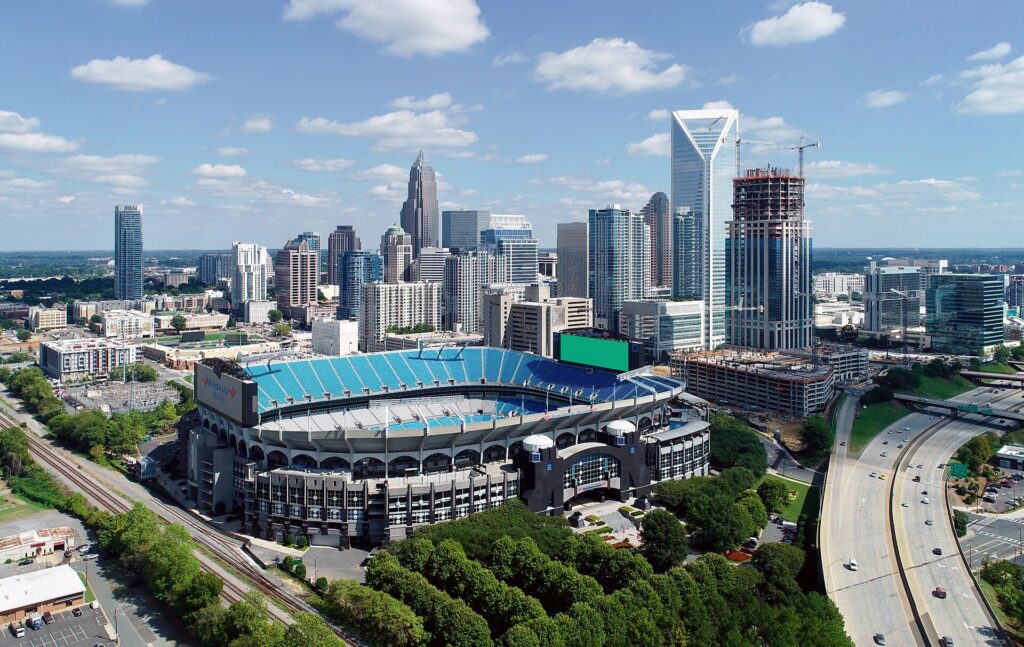
Charlotte’s other teams play in or near Uptown. Bank of America Stadium, at the southwest edge of Uptown, is home to the Carolina Panthers of the NFL and Charlotte FC, the MLS club that drew one of the largest crowds in league history to its first home match; it also hosts the ACC Championship Game in December, a college bowl game around New Year and big stadium concerts. The Charlotte Hornets play NBA basketball at the Spectrum Center, beside the light-rail and streetcar stops, from October to April. The Charlotte Knights play at Truist Field from April to September, and the Charlotte Checkers play minor-league hockey at the domed Bojangles Coliseum. Quail Hollow Club, in the south of the city, hosts a PGA Tour event most springs. Check what is on sale in Charlotte before you book flights, because a Panthers game, a race weekend or a big concert can fill every hotel in the center.
What to eat, and where
Start with barbecue: North Carolina’s two great styles meet here, the pork shoulder with a tangy, lightly tomatoed vinegar dip of the Piedmont, whose capital, Lexington, is an hour northeast, and the whole-hog, vinegar-and-pepper style of the east. Order it chopped with slaw and hush puppies. Southern cooking fills the rest of the plate: fried chicken, biscuits, shrimp and grits, pimento cheese, collards, banana pudding and sweet tea. Bojangles, the chicken-and-biscuit chain now found across the South, opened its first restaurant in Charlotte in 1977, and Cheerwine, the cherry soda on every menu, comes from Salisbury, forty minutes up I-85. The international corridor along Central Avenue and parts of South Boulevard has some of the best Vietnamese, Mexican and Latin American food in the Carolinas at modest prices. The food halls at Optimist Hall and Camp North End are the easiest way to sample the newer scene, and South End, Plaza Midwood, Dilworth and NoDa are where most of the city’s best chefs cook. Charlotte also has one of the fastest-growing brewery scenes in the South, with dozens of taprooms across South End, NoDa and the old industrial districts.
Charlotte through the seasons
Spring (March to May) is the showpiece: dogwoods and azaleas bloom across Myers Park and Dilworth in late March and April, patios reopen in South End, the Knights and Charlotte FC start their seasons, and the Coca-Cola 600 on Memorial Day weekend brings the whole region to Concord. The drawback is the pine pollen, which coats every car in yellow dust for a few weeks in April. Summer (June to August) is hot and humid, with afternoon thunderstorms, so do the Whitewater Center in the morning, the museums in the afternoon, and finish at a ballgame or on a brewery patio; the Fourth of July fireworks over Uptown and Charlotte Pride in August are the big events. Fall (September to November) is the local favorite, warm and dry into October, with Panthers and college football on every screen, the Festival in the Park, the Speedway’s fall race weekend, and color arriving in the Blue Ridge in mid-to-late October. Winter (December to February) is short, mostly mild and the quietest time to visit, with the holiday lights at the Speedway and in McAdenville, the Thanksgiving parade in Uptown, and the Hornets in season. Our month-by-month guide has the fare patterns that go with each season.
Charlotte with kids
Charlotte is an easy city with children. Discovery Place Science is the obvious rainy-day morning, with Discovery Place Nature, beside the Freedom Park playground and lake, for younger children. The NASCAR Hall of Fame’s simulators and pit-stop challenge are a hit with anyone over about eight, and the Whitewater Center has kid-friendly zip lines, climbing and flatwater paddling. In summer the splash pads at Romare Bearden Park and First Ward Park are free, and a Knights game at Truist Field, with fireworks nights and a skyline view, is a cheap and cheerful evening. Carowinds, the amusement park that straddles the state line about twenty minutes south of Uptown, has a water park and some of the tallest roller coasters in the country. For families driving to the mountains, the lakes or the coast, our family car rental guide covers the vehicle question.
Charlotte on a budget
Much of the best of Charlotte is free: the Square and the Fourth Ward, Romare Bearden Park, the Rail Trail and the greenways, Freedom Park, the grounds and trails of the Whitewater Center (you pay only for parking), the murals of NoDa and Plaza Midwood, the Billy Graham Library, and the Gold Line streetcar across Uptown, which has run fare-free in recent years. Eat well for less along Central Avenue and at the food halls. Hotel rates outside race weekends, big games and conventions are generally lower than in Atlanta or Washington, DC, and a stay in South End or near a Blue Line station can save money without costing convenience. Compare rates by neighborhood on our Charlotte hotel search.
Day trips from Charlotte
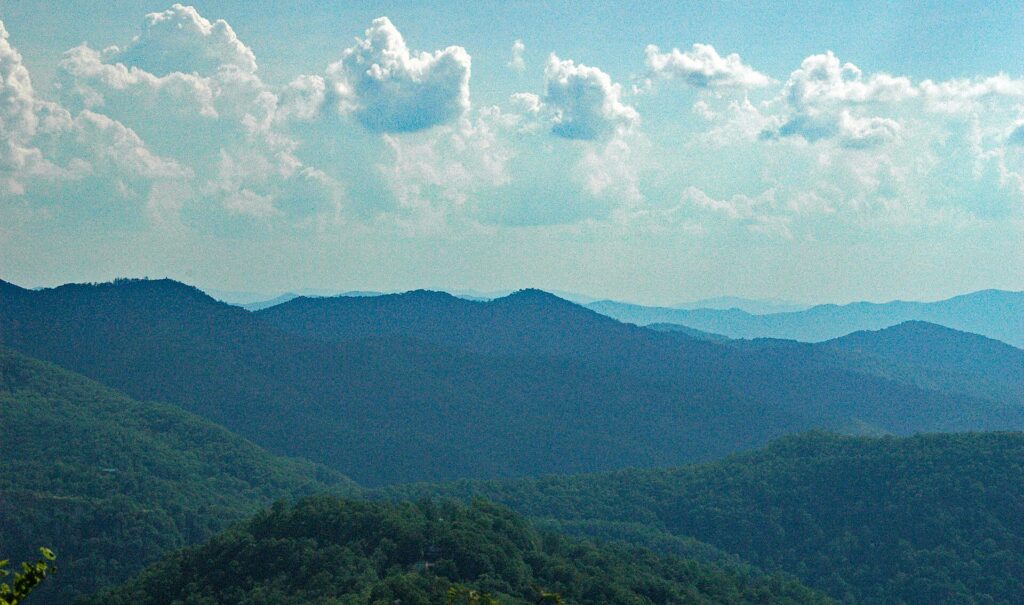
The Blue Ridge Mountains are the classic escape. Asheville, about two hours west, is a mountain city of breweries, galleries and art deco architecture, and just outside it the Biltmore Estate, the Vanderbilt family’s French Renaissance chateau, is the largest privately owned house in the country. The Blue Ridge Parkway runs past both, with overlooks, waterfalls and trails; parts of the region, including sections of the Parkway, were badly damaged by Hurricane Helene in 2024, so check the park’s site for closures before you plan a route. Closer in, Crowders Mountain State Park, about 45 minutes west, has a steep summit hike with views back to the Charlotte skyline, and Kings Mountain National Military Park, just over the South Carolina line, preserves the site of a 1780 battle that turned the Revolutionary War in the South. Reed Gold Mine, about 40 minutes east, is the site of the first documented gold discovery in the United States, in 1799, with underground tours and gold panning. Charleston and Myrtle Beach are about three and a half hours away and better as overnights, and Atlanta is about four hours down I-85; our Atlanta to Charlotte route guide covers that drive, and our Atlanta guide covers the city at the other end. All of these are car trips; see our Charlotte car rental page.
Two sample itineraries
Two days, no car
Day one: the Square and a walk through the Fourth Ward in the morning, the Mint Museum Uptown or the Bechtler after lunch, the NASCAR Hall of Fame in the late afternoon, and dinner on Tryon Street or a Hornets game at night. Day two: the Blue Line to South End for brunch and a long walk along the Rail Trail, then the Blue Line north to NoDa for murals, a brewery and live music, and a late dinner in Plaza Midwood or at Optimist Hall.
Four days, with the region
Add a day at the Whitewater Center, rafting in the morning and hiking the trails in the afternoon. Then pick up a car and spend one day on the racing trail, with a Speedway tour in Concord and a team showroom in Mooresville followed by an evening at Lake Norman, and one day in the mountains, at Crowders Mountain or, with an early start, Asheville. Return the car at the airport on the way home.
Practical details
- Transit: buy tickets from the machines on Blue Line platforms or use the CATS Pass app; the light rail works on proof of payment, so keep your ticket for inspectors. Charlotte Area Transit System (CATS) has maps and service alerts; our transit-versus-car guide goes into detail.
- From CLT: a taxi or ride-hail to Uptown in 15 to 20 minutes, the CATS Route 5 bus to the Charlotte Transportation Center, or a rental from the airport. The airport’s site covers ground transport.
- Weather: light clothing, sunscreen and water in summer; layers in spring and fall; a warm coat for winter cold snaps. The National Weather Service’s Greenville-Spartanburg office, which covers Charlotte, has the forecast and the severe thunderstorm warnings common in spring and summer.
- Time zone: Eastern, the same as New York and Atlanta.
- Safety: the usual big-city awareness applies, especially in Uptown late at night and around transit stations; do not leave anything visible in a parked car.
- Entry requirements: visitors from Visa Waiver Program countries need an approved ESTA before boarding; most others need a visa. The State Department’s travel site is the authoritative source. Charlotte’s Got A Lot, the city’s official visitor site, has current event listings.
Frequently asked questions
How many days do you need in Charlotte?
Two full days covers Uptown, the museums, the NASCAR Hall of Fame, South End and NoDa; add one for the Whitewater Center and one or two for the Speedway, Lake Norman or the mountains.
What is the number one thing to do in Charlotte?
For most visitors, the NASCAR Hall of Fame, which is fun even for non-fans. For a second choice, walk the Rail Trail through South End on a sunny afternoon, or spend a day rafting at the Whitewater Center.
Is Charlotte walkable?
Uptown, South End, NoDa, Plaza Midwood and Dilworth are pleasant on foot, and the Blue Line links the first three. Beyond them, the city assumes a car or a ride-hail.
Do I need a car in Charlotte?
Not if you stay in Uptown or South End and stick to the central sights. For the Speedway, the lakes, the Whitewater Center and day trips, yes; rent only for those days.
Is Charlotte expensive?
Generally less than Atlanta or Washington, DC, and hotel rates are reasonable outside race weekends, Panthers games and big conventions, when they climb sharply.
What is Charlotte known for?
Banking, NASCAR, the Panthers and the Hornets, one of the country’s busiest airport hubs, barbecue and a booming brewery scene, and a Revolutionary history that gave it the nicknames the Queen City and the Hornet’s Nest.
Ready to go? Compare flights to Charlotte, find a place to stay with our Charlotte hotel search, and if the Speedway, the lakes or the mountains are on the list, price a rental car for those days.
Keep planning with TicketScanner
- Cheap flights to Charlotte
- Charlotte hotels — by neighborhood
- Charlotte car rentals — for the Speedway, Lake Norman and the mountains
- Events in Charlotte — Panthers, Hornets, Charlotte FC, concerts and shows on sale
- Best time to fly to Charlotte: month by month
- Charlotte: rent a car or ride the LYNX?
- Charlotte Douglas (CLT) airport guide
- Where to stay: Uptown
- Driving Atlanta to Charlotte
- Things to do in Atlanta — about four hours down I-85
Leave a Reply