
Atlanta is the city most travelers pass through without ever seeing. Its airport is the busiest in the world, and millions of people change planes here every year without once stepping outside. That is a shame, because the city beyond the terminal is one of the most rewarding in the South: the birthplace of Martin Luther King Jr. and the heart of the civil rights movement, a downtown rebuilt around the 1996 Olympic Games, a former railway loop turned into a walking and cycling trail lined with food halls and murals, an arts district with the largest art museum in the Southeast, leafy Victorian neighborhoods, and a food scene that runs from fried chicken and lemon pepper wings to the international restaurants of Buford Highway. This guide covers the sights, the neighborhoods, the food, the day trips and the practical details that turn a layover city into a destination.
If you are still comparing cheap flights to Atlanta, read this alongside our guides to the best time to fly to Atlanta and whether to rent a car or ride MARTA. Between the three you can plan the whole trip.
Atlanta at a glance for first-timers
- Airport: Hartsfield-Jackson Atlanta International (ATL), about 16 km (10 miles) south of downtown, with its own MARTA rail station inside the domestic terminal; the train reaches downtown in about 20 minutes. See our ATL airport guide.
- Getting around: MARTA’s rail lines link the airport, downtown, Midtown, Buckhead and Decatur, and those neighborhoods are walkable on their own. The BeltLine’s Eastside Trail connects several more on foot. For the suburbs, the Braves’ ballpark and day trips, you will want a car or a ride-hail.
- Money: U.S. dollars. State and local sales tax is added at the till, and hotel rooms carry extra taxes and fees. Tipping 18 to 20 percent in sit-down restaurants is customary.
- Weather: long, hot and humid summers, mild winters with the occasional ice storm, and a spring and fall that are among the most pleasant in the country. Our month-by-month guide has the detail.
- Where to stay: downtown for the Olympic park attractions and the arenas; Midtown for the arts district, Piedmont Park, restaurants and the best MARTA access; Buckhead for upscale shopping; Inman Park or the Old Fourth Ward for the BeltLine and a neighborhood feel. Our Atlanta hotel search covers them all.
Downtown: Centennial Olympic Park and its neighbors
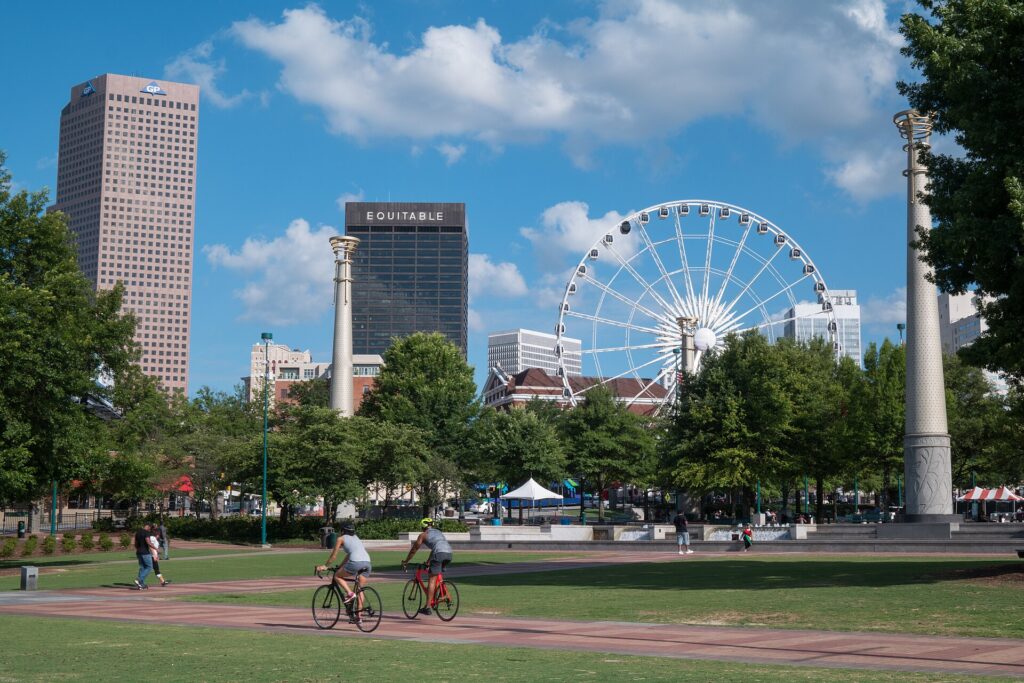
The 1996 Summer Olympics left Atlanta with Centennial Olympic Park, a 21-acre green space in the middle of downtown that serves as the front lawn for the city’s biggest attractions. The Fountain of Rings, where water jets dance in the shape of the Olympic symbol, is the park’s centerpiece. On its northern edge, the Georgia Aquarium is one of the largest in the world, and one of the very few aquariums anywhere where you can watch whale sharks, alongside manta rays, beluga whales and a large dolphin presentation; buy timed tickets online and go early on a weekday. Next door, the World of Coca-Cola tells the story of the drink invented by an Atlanta pharmacist in 1886, shows off the vault said to hold the secret formula, and ends in a tasting room with dozens of soft drinks from around the world. The National Center for Civil and Human Rights, on the same plaza, is the most powerful museum downtown, connecting the American civil rights movement to human rights struggles worldwide, with a lunch-counter sit-in exhibit that stays with visitors for a long time. The College Football Hall of Fame and the SkyView Ferris wheel complete the cluster. A few blocks south, the gold dome of the Georgia State Capitol, gilded with gold leaf from the North Georgia mountains, is open to visitors on weekdays.
Sweet Auburn and the Martin Luther King Jr. National Historical Park
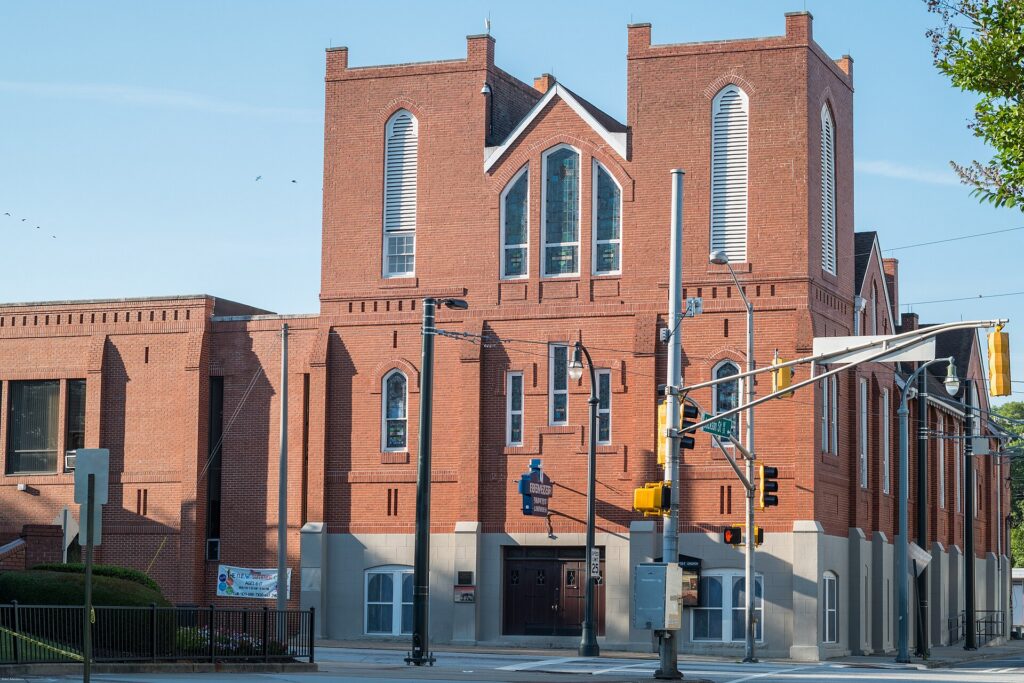
No visit to Atlanta is complete without Auburn Avenue. In the first half of the twentieth century, Sweet Auburn was one of the most prosperous Black business districts in the country, with banks, insurance companies, newspapers and churches, and it was here, in a Queen Anne house at 501 Auburn Avenue, that Martin Luther King Jr. was born in 1929. The Martin Luther King Jr. National Historical Park, run by the National Park Service and free to visit, covers several blocks. Start at the visitor center, which tells the story of the movement and King’s life, then walk to Historic Ebenezer Baptist Church, where King, his father and his grandfather all preached, and where recordings of his sermons play in the restored sanctuary. Across the street, The King Center holds the tomb of Dr. King and Coretta Scott King, set in a reflecting pool beside an eternal flame. The birth home itself is open for ranger-led tours on a limited basis; check the park’s site for the current schedule and how to reserve. Allow at least half a day, with lunch at the Sweet Auburn Curb Market a few blocks west; the Atlanta Streetcar loops back to Centennial Olympic Park.
The BeltLine and the Eastside Trail
The Atlanta BeltLine is the most ambitious urban project in the South: a 22-mile loop of former railway corridors around the city core, being turned into a continuous trail and park system that links dozens of neighborhoods. The most developed stretch, the Eastside Trail, runs for about three miles from the edge of Piedmont Park south through the Old Fourth Ward and Inman Park to Reynoldstown, and on a warm weekend it feels like the whole city is out on it. The anchors are two food halls in converted industrial buildings. Ponce City Market, in the enormous brick former Sears, Roebuck warehouse on Ponce de Leon Avenue, has a food hall on the ground floor, shops above, and a rooftop amusement park with mini golf and skyline views. Krog Street Market, farther south in Inman Park, is smaller and more local. Just off the trail, the Krog Street Tunnel, a railway underpass completely covered in constantly changing graffiti, is the most photographed wall in the city. Walk the whole Eastside Trail in about an hour and a half with stops, or rent a bike or a scooter.
Midtown: Piedmont Park, the arts district and the Fox
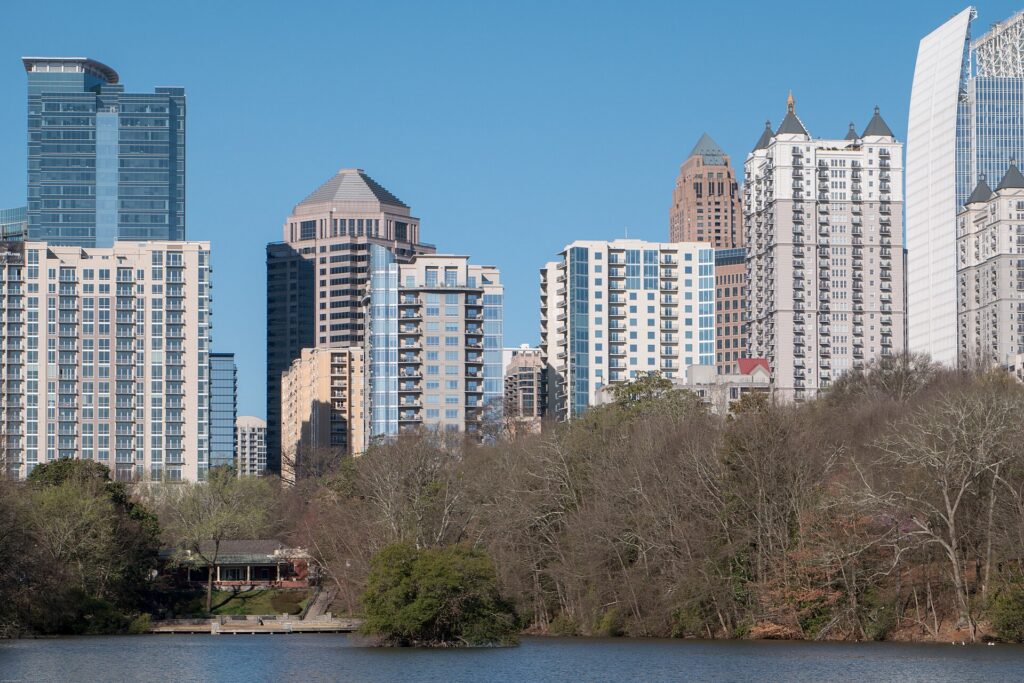
Midtown is the Atlanta most visitors fall for. Piedmont Park, laid out for the Cotton States Exposition of 1895 and later reshaped by the Olmsted Brothers firm, is the city’s central park: 200 acres of lawns, a lake with a view of the Midtown skyline, and the site of the city’s biggest festivals. On its northern edge, the Atlanta Botanical Garden is one of the best in the country, with a treetop canopy walk, a conservatory of tropical and desert plants, and in winter the Garden Lights, Holiday Nights show that sells out on weekends. A few blocks west on Peachtree Street, the High Museum of Art, the largest art museum in the Southeast, occupies a white Richard Meier building and a Renzo Piano expansion; its folk and self-taught art collection is outstanding. The High is part of the Woodruff Arts Center, which also houses the Alliance Theatre and the Atlanta Symphony Orchestra. Farther down Peachtree, the Fox Theatre, a 1929 movie palace with an Arabian-nights interior and a ceiling painted as a starlit sky, hosts Broadway tours and concerts and offers guided tours of the building. The Arts Center and Midtown MARTA stations put all of it within a short walk.
Neighborhoods worth a half-day
Inman Park
Atlanta’s first planned suburb, laid out in the 1880s and connected to downtown by an early electric streetcar, is a neighborhood of restored Victorian houses under huge old trees, with the BeltLine running along its western edge. The restaurants along Highland Avenue and around Krog Street Market are some of the best in the city, and the Inman Park Festival at the end of April, with its tour of homes and a gloriously eccentric parade, is one of the best neighborhood festivals in the South.
Little Five Points
Just east of Inman Park, the intersection of Moreland and Euclid Avenues is the city’s bohemian quarter: vintage clothing stores, record shops, tattoo parlors and bars, plus a skull-shaped burger-bar entrance that everyone photographs. It is the least polished corner of in-town Atlanta, which is exactly its appeal.
Virginia-Highland and Poncey-Highland
North and east of Ponce City Market, these two residential neighborhoods have walkable strips of cafés, bars and independent shops set among bungalows. Poncey-Highland is also home to the Jimmy Carter Presidential Library and Museum, set in landscaped grounds with a Japanese garden and a replica of the Oval Office.
Buckhead
Atlanta’s wealthy north end has the grandest houses in the city along West Paces Ferry Road, the upscale malls of Lenox Square and Phipps Plaza, and the Atlanta History Center: the 1928 Swan House mansion, a working 1860s farm, gardens, and the restored Battle of Atlanta cyclorama, a vast circular painting from the 1880s displayed in its own gallery.
Decatur
Technically its own city, Decatur is six miles east of downtown at the end of a MARTA ride, and its courthouse square, with restaurants, pubs and bookshops around the old DeKalb County courthouse, feels like a small Southern town.
Grant Park and Cabbagetown
Southeast of downtown, Grant Park has Victorian cottages and Zoo Atlanta, known for one of the largest gorilla populations in North America. Between the park and downtown, Historic Oakland Cemetery, founded in 1850, is a Victorian garden cemetery where Margaret Mitchell and golfer Bobby Jones are buried; the grounds are free and the guided tours are excellent. Next to it, the old mill village of Cabbagetown has shotgun houses, murals and a cluster of good restaurants.
Museums, culture and family attractions
Beyond the headline sights, Atlanta has a deep bench of museums. The Fernbank Museum of Natural History, in the Druid Hills neighborhood east of the city, has one of the largest dinosaurs ever found, an Argentinosaurus, dominating its Great Hall, and outdoor trails through an old-growth urban forest. The Center for Puppetry Arts in Midtown holds the largest collection of Jim Henson puppets and artifacts on public display, with shows that small children love. The Delta Flight Museum, in historic hangars beside the airport, lets you walk through a retired Boeing 747 and try a professional flight simulator, a good use of a long layover. The city also has a busy live music and comedy scene, from Little Five Points to the Eastside. The Atlanta University Center, west of downtown, is the largest consortium of historically Black colleges and universities in the country, including Morehouse and Spelman, and homecoming weekends there each fall are city-wide events. For what is on stage and in the arenas during your dates, our Atlanta events page lists concerts, shows and games.
Sports
Atlanta is one of the busiest sports cities in the country. Mercedes-Benz Stadium, the downtown stadium with a retractable roof that opens like a camera shutter, is home to the Atlanta Falcons of the NFL and Atlanta United, the MLS club whose crowds are among the largest in American soccer; it also hosts the SEC Championship Game, the Peach Bowl and, in 2026, World Cup matches. The Atlanta Hawks play NBA basketball at State Farm Arena, a short walk away, from October to April. The Atlanta Braves play baseball from April to September at Truist Park, northwest of the city in Cobb County, surrounded by The Battery’s restaurants and bars; note that the ballpark is not on the MARTA rail network, so plan on driving or a ride-hail. Check what is on sale in Atlanta for your dates before you book flights, because a big game or a convention can fill every downtown hotel.
What to eat, and where
Atlanta eats Southern, but it does not eat only Southern. The foundation is soul food and Southern cooking: fried chicken, collard greens, macaroni and cheese, biscuits, fried green tomatoes, peach cobbler, and the meat-and-three restaurants where you choose one main and three sides; Mary Mac’s Tea Room in Midtown has been serving it since 1945. The city’s signature bar snack is the lemon pepper wing, often ordered “wet,” with the lemon pepper tossed in butter. The Varsity, the giant drive-in beside Georgia Tech, has been shouting “What’ll ya have?” at customers since 1928, and a chili dog and a frosted orange there is an Atlanta rite. Then there is Buford Highway, a stretch of strip malls running northeast from Brookhaven through Chamblee and Doraville, with the best concentration of international restaurants in the Southeast: Korean barbecue, Vietnamese pho, Sichuan and Cantonese, Mexican taquerias and Salvadoran pupuserias, all within a few miles. The food halls at Ponce City Market and Krog Street Market are the easiest way to sample the newer scene, and the restaurants of Inman Park, the Westside and Decatur are where Atlanta’s best chefs cook.
Atlanta through the seasons
Atlanta is a different city in each season, and what you do depends on when you come. Spring (March to May) is the showpiece: dogwoods and azaleas bloom across the city in late March and April, the Atlanta Dogwood Festival fills Piedmont Park in April, the Inman Park Festival closes out the month, and the Atlanta Jazz Festival brings free concerts to Piedmont Park over Memorial Day weekend. The drawback is pollen, which coats every car in yellow dust for a few weeks. Summer (June to August) is hot and humid, with afternoon thunderstorms, and the day belongs to the air-conditioned museums and the aquarium, with evenings on the BeltLine and at the ballpark; the Peachtree Road Race, the largest 10K in the world, runs through the city every Fourth of July morning. Fall (September to November) is the local favorite, warm and dry into October, with college football on every screen, Dragon Con transforming downtown over Labor Day weekend, Atlanta Pride in October, and the fall color arriving in the North Georgia mountains in late October. Winter (December to February) is mild, quiet and the cheapest time to visit. Our month-by-month guide has the fare patterns that go with each season.
Atlanta with kids
Atlanta is an easy city with children, and much of the best of it is clustered downtown. The Georgia Aquarium is the obvious full morning, with its whale sharks and a touch pool, and the Fountain of Rings in Centennial Olympic Park is a free splash zone in summer. The Children’s Museum is next door, and the World of Coca-Cola’s tasting room is a hit with older kids. Fernbank Museum, with its dinosaurs and forest trails, and the Center for Puppetry Arts are the other standouts, and Zoo Atlanta in Grant Park suits younger children. In summer, the splash pad at Historic Fourth Ward Park is free, and tubing on the Chattahoochee with an outfitter is a hit with teenagers. For families driving to the mountains or the coast, our family car rental guide covers the vehicle question.
Atlanta on a budget
Some of the best of Atlanta is free: the Martin Luther King Jr. National Historical Park, the BeltLine and the Krog Street Tunnel, Piedmont Park, Centennial Olympic Park and the Fountain of Rings, the grounds of Oakland Cemetery, the State Capitol, and the free festivals in Piedmont Park, including the Jazz Festival. The paid attractions downtown add up; look at the combination tickets they sell, and buy online in advance. Eat well for less on Buford Highway, at the Sweet Auburn Curb Market, and at the neighborhood soul food spots; the food halls are good value at lunch. MARTA’s flat fare from the airport to downtown or Midtown is a fraction of a taxi. Compare rates by neighborhood on our Atlanta hotel search.
Day trips from Atlanta
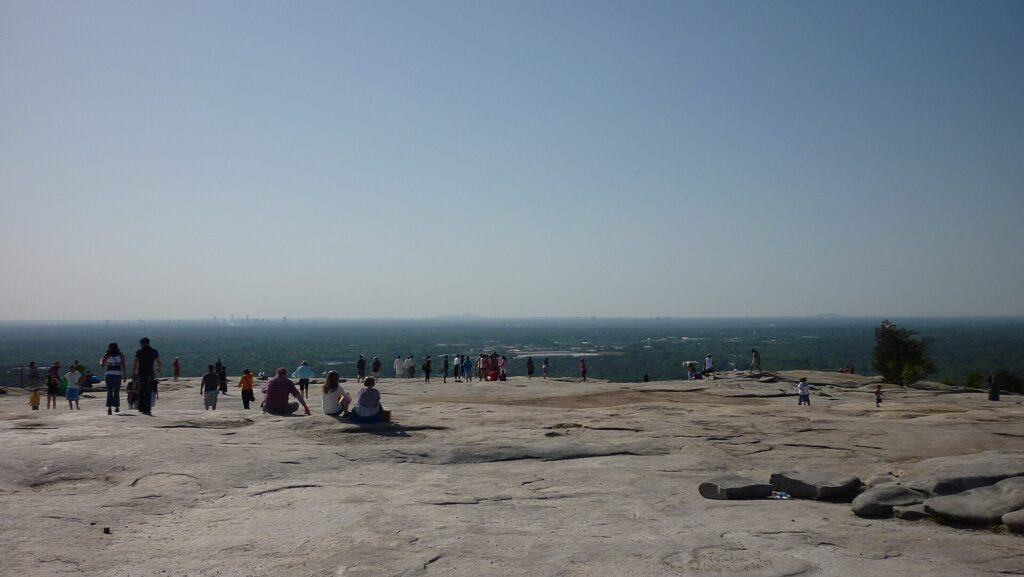
Stone Mountain Park, about half an hour east, is built around a vast granite dome rising above the forest. A steep walk-up trail of about a mile reaches the summit, where the views stretch back to the Atlanta skyline, or you can ride the cable car. The enormous carved relief of Confederate leaders on the north face is one of the largest in the world and the subject of long debate; the park now presents it with historical context. The Chattahoochee River National Recreation Area runs along the river on the northern edge of the city, with riverside trails and, in summer, tubing and kayaking with local outfitters. Farther afield, Athens, about an hour and a half east, is the University of Georgia’s college town and the birthplace of R.E.M. and the B-52s. The North Georgia mountains, 90 minutes to two hours north, have Amicalola Falls, the tallest waterfall in Georgia and the start of the approach trail to Springer Mountain and the Appalachian Trail, the Bavarian-themed town of Helen, and a wine region in the hills. Chattanooga, about two hours northwest in Tennessee, has the Tennessee Aquarium and Lookout Mountain. Savannah, about four hours southeast, is better as an overnight. If you are continuing north, our Atlanta to Charlotte route guide covers the four-hour drive up I-85. All of these are car trips; see our Atlanta car rental page.
Two sample itineraries
Three days, no car
Day one: MARTA from the airport to downtown, the Georgia Aquarium in the morning, the National Center for Civil and Human Rights after lunch, a walk through Centennial Olympic Park, and a Hawks game or a show in the evening. Day two: the streetcar to Sweet Auburn for the Martin Luther King Jr. National Historical Park, lunch at the Curb Market, then walk up to the BeltLine’s Eastside Trail through the Old Fourth Ward to Ponce City Market for the afternoon, and dinner in Inman Park. Day three: MARTA to Midtown for the High Museum, the Atlanta Botanical Garden and a long walk through Piedmont Park, a chili dog at the Varsity, and an evening at the Fox Theatre.
Five days, with the region
Add a day for Buckhead and the Atlanta History Center, or Fernbank and Decatur, then rent a car for two days: one for Stone Mountain and a dinner run along Buford Highway, and one for the North Georgia mountains or Chattanooga. Return the car at the airport’s rental center on the way to your flight.
Practical details
- Transit: MARTA charges a flat fare for rail and bus rides, with free transfers; buy a reloadable Breeze card at any station or use the Breeze app, and check whether contactless bank cards are accepted at the gates. MARTA has maps and service alerts; our car-versus-transit guide goes into detail.
- From ATL: the Red or Gold Line from the Airport station, at the west end of the domestic terminal, reaches Five Points downtown in about 20 minutes and Midtown in under half an hour. Taxis charge flat rates to downtown, Midtown and Buckhead.
- Weather: light clothing, sunscreen and water in summer; layers in spring and fall; a real coat for the occasional cold snap in winter. The National Weather Service’s Atlanta office has the forecast, including the severe thunderstorm warnings that are common in spring.
- Time zone: Eastern, the same as New York and Washington, DC.
- Safety: the usual big-city awareness applies, especially downtown late at night and around transit stations; stick to busy, well-lit streets, and do not leave anything visible in a parked car.
- Entry requirements: visitors from Visa Waiver Program countries need an approved ESTA before boarding; most others need a visa. The State Department’s travel site is the authoritative source. Discover Atlanta, the city’s official visitor bureau, has current event listings.
Frequently asked questions
How many days do you need in Atlanta?
Three full days covers downtown, Sweet Auburn, the BeltLine and Midtown without rushing; add one for Buckhead or Fernbank and one or two for Stone Mountain and the mountains.
What is the number one thing to do in Atlanta?
The Martin Luther King Jr. National Historical Park, which is free and unlike anything else in the country. For a second choice, walk the BeltLine’s Eastside Trail to Ponce City Market on a sunny afternoon.
Is Atlanta walkable?
In pockets. Downtown, Midtown, Inman Park, the Old Fourth Ward, Decatur’s square and the BeltLine are pleasant on foot; the distances between them, and everything beyond, assume MARTA, a ride-hail or a car.
Do I need a car in Atlanta?
Not if you stay downtown or in Midtown and stick to the central sights, because MARTA runs from the airport to both. For Buckhead’s side streets, the Braves’ ballpark, Buford Highway and day trips, a car or ride-hail helps.
What is Atlanta known for?
Martin Luther King Jr. and the civil rights movement, the busiest airport in the world, the 1996 Olympics, Coca-Cola, Southern food, hip-hop, a thriving film industry, and one of the densest tree canopies of any major American city.
Ready to go? Compare flights to Atlanta, find a place to stay with our Atlanta hotel search, and if the mountains or Stone Mountain are on the list, price a rental car for those days.
Keep planning with TicketScanner
- Cheap flights to Atlanta
- Atlanta hotels — by neighborhood
- Atlanta car rentals — for Stone Mountain and the North Georgia mountains
- Events in Atlanta — Braves, Falcons, Hawks, Atlanta United, concerts and shows on sale
- Best time to fly to Atlanta: month by month
- Atlanta: rent a car or ride MARTA?
- Hartsfield-Jackson Atlanta (ATL) airport guide
- Where to stay: Midtown
- Driving Atlanta to Charlotte
- Things to do in Charlotte — about four hours up I-85
Leave a Reply