Tag: Atlanta

  • Best Time to Fly to Atlanta: Seasons, Weather & Prices

    Best Time to Fly to Atlanta: Seasons, Weather & Prices

    Atlanta has the busiest airport in the world, and that fact shapes everything about the cost of getting here. Hartsfield-Jackson is Delta’s largest hub and a major base for several low-cost carriers, and the competition keeps fares into Atlanta lower than into many smaller cities. The price that swings is the hotel. Atlanta is one of the biggest convention cities in the country, it hosts a full calendar of college football, professional sports and stadium concerts, and a handful of weekends, from Dragon Con to the SEC Championship, fill every room downtown. Add a climate with a glorious spring, a long, sticky summer, a golden fall and a mild but occasionally icy winter, and the “best time” depends as much on the event calendar as on the weather. This guide walks through the weather, the fare and hotel seasons, the events that move prices, and the airport.

    The short answer

    For the best combination of weather and value, aim for late April to mid-May, after the spring-break and pollen peak and before the summer heat, and mid-October to mid-November, when the air is dry, the leaves turn and the city is at its most comfortable. The cheapest fares and hotel rates usually come in January and February, outside the big trade shows and holiday weekends, and in the second half of August, when Georgia’s schools are already back in session and the heat keeps leisure visitors away. The most expensive stretches are spring break in March and early April, Thanksgiving and the Christmas and New Year holidays, and specific event weekends, above all Labor Day weekend for Dragon Con and college football and the first weekend of December for the SEC Championship. Whatever you choose, run a flexible-date search on our Atlanta flights page; a shift of a few days can change the total cost entirely.
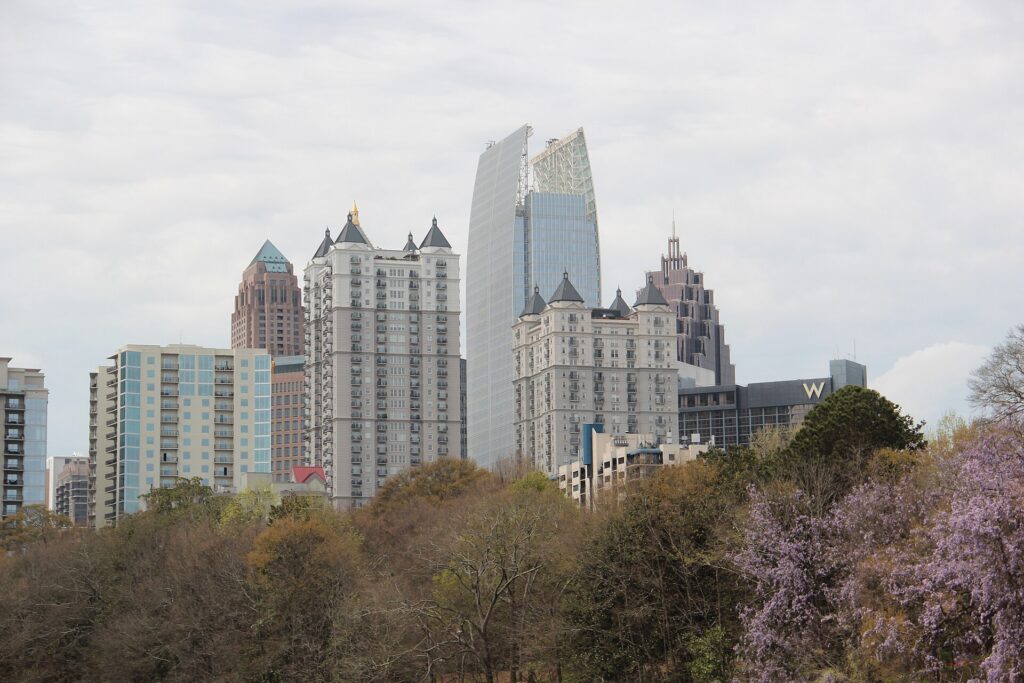
    Piedmont Park and the Midtown Atlanta skyline in early spring
    Piedmont Park in March, when spring comes early and the festival season begins (Photo: Thomson200 via Wikimedia Commons, CC0)

    Atlanta’s weather, season by season

    Atlanta sits in the foothills of the Appalachians at an elevation of about 300 meters (1,000 feet), which takes a little of the edge off the Southern heat. It still has a humid subtropical climate: long, hot and humid summers with afternoon thunderstorms, short and mild winters with the occasional hard freeze, and springs and falls that are the reason people move here. The figures below are approximate seasonal patterns based on the long-term climate normals for Hartsfield-Jackson from NOAA’s National Weather Service; check the current forecast before you pack, because spring and fall can swing ten degrees from one day to the next.

    MonthTypical daytime highTypical overnight lowWhat it feels likeFare pressure
    Januaryaround 12 °C (53 °F)around 1 °C (34 °F)Cool and often gray; a rare ice or snow event can close the cityLow, except MLK weekend and trade-show weeks
    Februaryaround 14 °C (57 °F)around 3 °C (37 °F)Mild spells and cold snaps; the first blossoms by month’s endLow; rises for Presidents’ Day weekend
    Marcharound 18 °C (65 °F)around 7 °C (44 °F)Spring arrives; dogwoods and azaleas, pollen and stormsHigh for spring break
    Aprilaround 23 °C (73 °F)around 11 °C (51 °F)The loveliest month; festivals every weekendHigh early in the month, easing later
    Mayaround 27 °C (80 °F)around 16 °C (60 °F)Warm and green; humidity starts to buildModerate; graduations fill some weekends
    Junearound 31 °C (87 °F)around 19 °C (67 °F)Hot and humid; afternoon thunderstorms beginModerate to high with summer travel
    Julyaround 32 °C (90 °F)around 22 °C (71 °F)The hottest month; heat index often far above the air temperatureModerate; July Fourth weekend is busy
    Augustaround 31 °C (88 °F)around 21 °C (70 °F)Still hot and sticky; storms most afternoonsLow to moderate once schools are back
    Septemberaround 28 °C (83 °F)around 18 °C (64 °F)Summer lingers; the humidity finally breaks late in the monthPeak on Labor Day weekend, then moderate
    Octoberaround 23 °C (74 °F)around 12 °C (53 °F)Dry, sunny and comfortable; often the best weather of the yearModerate to high with conventions and football
    Novemberaround 17 °C (63 °F)around 6 °C (42 °F)Crisp and bright; peak fall color in the city early in the monthModerate, then peak for Thanksgiving
    Decemberaround 13 °C (55 °F)around 2 °C (36 °F)Cool and damp; festive lights; the odd frostLow until mid-month, then peak

    Three things the table cannot show. First, the humidity: a July afternoon at 32 °C in Atlanta regularly feels closer to 38 °C (100 °F), and the heat builds through the day until a thunderstorm breaks it. Plan the BeltLine and the outdoor sights for the morning and the evening, and the aquarium and the museums for the middle of the day. Second, the storms: spring brings severe thunderstorms and, some years, tornado warnings, and summer afternoons bring short, violent downpours that can halt operations at the airport for an hour. Because so many connections pass through Atlanta, a ground stop here ripples across the network. Third, winter ice: Atlanta sees little snow in a normal year, but a light glaze of freezing rain on untreated roads can bring the metro area to a standstill for a day, and flights cancel when it does.

    How Atlanta’s fare seasons work

    Three forces drive the cost of a trip to Atlanta. The first is the airport itself: because Hartsfield-Jackson is the country’s biggest connecting hub, there is enormous capacity into the city from almost everywhere, and airfares tend to follow national travel patterns (spring break, summer, the holidays) rather than local ones. The second is the convention and event calendar: the Georgia World Congress Center downtown is one of the largest convention centers in the country, AmericasMart holds huge trade markets, and Mercedes-Benz Stadium and State Farm Arena host major games and concerts almost every week, so downtown hotel rates can jump on a Tuesday for a trade show nobody outside the industry has heard of. The third is the weather, which pushes leisure visitors into spring and fall and away from the peak of summer.

    Peak season

    Mid-March to mid-April, Thanksgiving week, and roughly December 20 to January 2, plus specific event weekends at any time of year. Spring break sends families through Atlanta in both directions, many of them connecting to Florida, which fills flights even when Atlanta’s hotels are not. The Thanksgiving and Christmas periods bring some of the heaviest days of the year at the airport, with security lines to match. The event weekends, Dragon Con and college football over Labor Day, the SEC Championship in early December, and big concerts and conventions, spike hotel rates without necessarily moving airfares. If you must travel in peak, book early, fly mid-week, and compare hotels in Midtown and Buckhead, which are on MARTA and often cheaper than downtown during big events.

    Shoulder season

    Late April to May and late September to mid-November. This is when Atlanta is at its best: warm, dry days, festivals in Piedmont Park, patios open all day, and fall color in the city in early November. Both have busy weekends, but mid-week travel is consistently good value. Watch Memorial Day weekend and the convention calendar.

    Low season

    January and February outside the holiday weekends and the biggest trade shows, early December before the holidays, and the second half of August. In winter, fares and hotel rates are at their annual lows, the city is quiet, and the weather is cool but rarely harsh. In late August, Georgia’s schools have gone back, family travel stops, and the heat keeps leisure visitors away, so hotel rates soften everywhere except around conventions.

    As elsewhere, mid-week departures and early or late flights usually price below Friday and Sunday afternoons on the same route, and a search across a whole month reveals cheaper pairs of dates close to your first choice. Our guide to the best times to book explains how to read those patterns.

    Atlanta month by month

    January

    Cool, quiet and one of the two cheapest months to visit, once the New Year holiday rush has cleared. Martin Luther King Jr. Day, on the third Monday of the month, brings commemorations at Ebenezer Baptist Church and the King Center and a parade on Auburn Avenue, Watch for the January market at AmericasMart and the big trade shows at the Georgia World Congress Center, which fill downtown hotels for several days at a time. An ice storm is rare but possible.

    February

    Mild spells alternate with cold snaps, and the first blossoms appear by the end of the month. Fares are low outside Presidents’ Day weekend, and Black History Month brings programming across the city’s museums. The Hawks and college basketball are in season. This is a strong value month for a museum-and-food trip.

    March

    Spring arrives early here. The Bradford pears, then the dogwoods and azaleas bloom across the city, the patios fill, and the Braves open their season at the end of the month or in early April. It is also spring break season, which pushes fares through Atlanta up for most of the month, and the start of pollen season, when pine pollen turns cars and sidewalks yellow for several weeks; allergy sufferers should pack medication. Severe thunderstorms are possible.

    April

    The month many Atlantans would pick: warm, green and blooming, with a festival every weekend, including the Atlanta Dogwood Festival in Piedmont Park and the Inman Park Festival at the end of the month. The first half of April is still busy with spring break, and Masters week in Augusta, about two and a half hours east, sends thousands of golf fans through Atlanta’s airport and its rental counters. The second half of the month is one of the best windows of the year.

    May

    Warm and green, with humidity starting to build by the end of the month. College and high school graduations fill hotels on some weekends, and the free Atlanta Jazz Festival takes over Piedmont Park on Memorial Day weekend. Fares are moderate, and the first three weeks of May, mid-week, are excellent value.

    June

    Summer proper: hot, humid, with thunderstorms building most afternoons. National summer travel lifts fares from other U.S. cities, although Atlanta’s hotels are generally less pressured than in spring, apart from convention weeks.

    July

    The hottest month. The Peachtree Road Race, the largest 10K in the world, runs from Buckhead to Piedmont Park on the morning of July Fourth, followed by fireworks across the city, and it makes the holiday weekend busy. The July market at AmericasMart fills downtown hotels for a week. Otherwise, rates are moderate.

    August

    Still hot and sticky, with storms most afternoons, but a quiet month for visitors. Metro Atlanta’s schools go back in early August, much earlier than in the Northeast, so family travel drops off sharply, and the second half of the month is one of the best-value periods of the year for hotels. College football returns at the very end of the month.

    September

    Starts with the busiest weekend of the year for downtown hotels. Labor Day weekend brings Dragon Con, the huge fan convention that takes over the downtown hotels and fills Peachtree Street with costumed attendees for its Saturday parade, often alongside a season-opening college football game at Mercedes-Benz Stadium. After that, rates settle, the heat lingers through most of the month, and the humidity finally breaks toward the end. The remnants of an Atlantic or Gulf tropical storm occasionally bring a day or two of heavy rain.

    October

    Dry, sunny and comfortable, and often the best weather of the year. It is also a busy month, with conventions downtown, college football every Saturday, homecoming weekends at the Atlanta University Center colleges, and Atlanta Pride. Fares are moderate to high; mid-week stays and Midtown hotels are the value play. In the North Georgia mountains, the fall color arrives in the last two weeks of the month.

    November

    Crisp and bright, with peak fall color in the city early in the month, and one of the best months to walk the BeltLine and Piedmont Park. The Botanical Garden’s holiday lights open in mid-November. The week of Thanksgiving is one of the heaviest of the year at the airport, with high fares and long security lines; the weeks either side are good value.

    December

    Two months in one. The first half is quiet and reasonably priced, apart from the SEC Championship Game weekend at the start of the month, which fills hotels across downtown and Midtown. From around December 20, fares climb for the Christmas and New Year holidays, and the Peach Bowl, a College Football Playoff game at Mercedes-Benz Stadium around New Year, adds pressure on hotels.
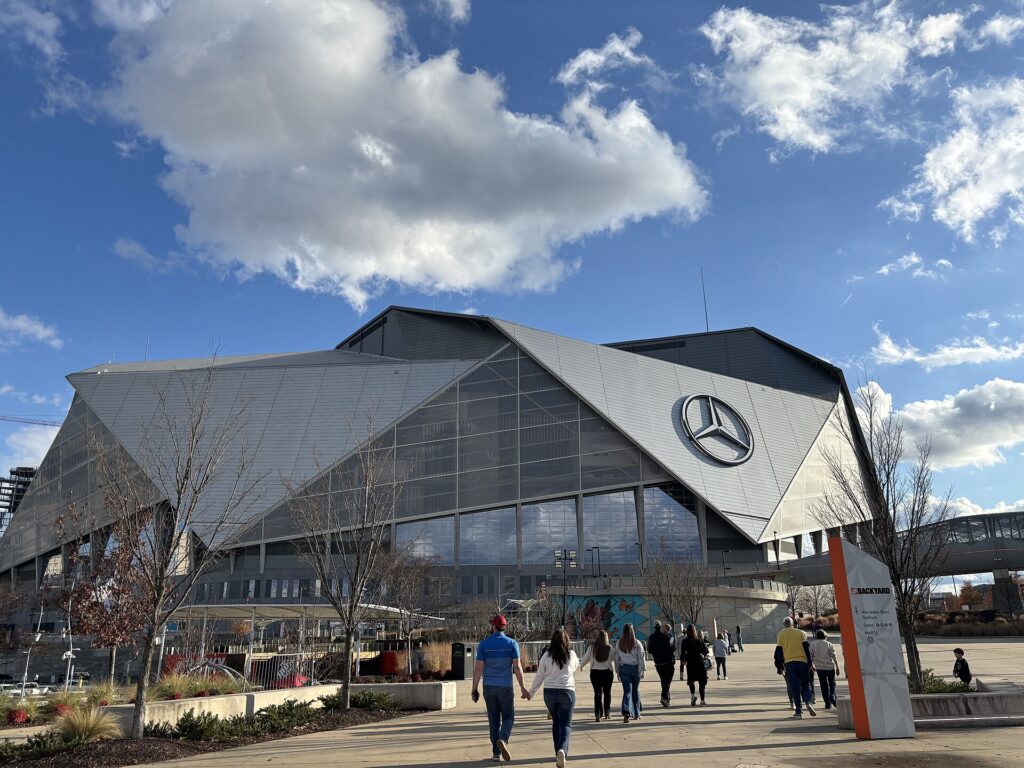
    The exterior of Mercedes-Benz Stadium in downtown Atlanta
    Mercedes-Benz Stadium, where the SEC Championship, the Peach Bowl and big concerts fill downtown hotels (Photo: BullDawg2021 via Wikimedia Commons, CC BY 4.0)

    Events that move Atlanta flight and hotel prices

    Cross-check these against your dates before you book. Exact dates shift each year; Discover Atlanta keeps the current calendar.

    • Martin Luther King Jr. Day weekend (third Monday of January) and the January market at AmericasMart.
    • Spring break (mid-March to mid-April, varying by school district), when Atlanta’s connecting flights fill with families heading to Florida.
    • Masters week in Augusta (early April), which tightens rental cars at the airport.
    • Festival weekends in Piedmont Park: the Dogwood Festival in April and the Jazz Festival on Memorial Day weekend.
    • The Peachtree Road Race (July Fourth), run by the Atlanta Track Club, and the July market at AmericasMart.
    • Labor Day weekend: Dragon Con and a season-opening college football game, the single biggest hotel spike downtown.
    • October: college homecomings, Atlanta Pride and a heavy convention calendar.
    • Thanksgiving week and the Christmas to New Year holidays, including the Peach Bowl.
    • The SEC Championship Game (first Saturday of December), Falcons and Atlanta United home games, and stadium concerts. Our Atlanta events page shows what is on sale for your dates.
    • Trade shows and conventions at the Georgia World Congress Center, which can fill downtown hotels mid-week without warning; if your dates look strangely expensive, that is usually why.

    Getting in from the airport

    Hartsfield-Jackson Atlanta International Airport (ATL) is about 16 kilometers (10 miles) south of downtown and is the only major commercial airport serving the city. It has two terminals: the Domestic Terminal, with its North and South sides, and the Maynard H. Jackson Jr. International Terminal on the east side of the airfield. Seven concourses, T and A through F, are linked by an underground train, the Plane Train, and a walkway lined with art. Delta, which is headquartered next door, runs its largest hub here, and Southwest and several low-cost airlines also have big operations, with nonstops across the U.S. and to Europe, Latin America, Africa and Asia. Getting into the city is easy: the MARTA Red and Gold Lines start at the Airport station, at the west end of the Domestic Terminal beside baggage claim, and reach Five Points downtown in about 20 minutes and Midtown in under half an hour for a flat fare. Taxis charge flat rates to downtown, Midtown and Buckhead, ride-hail pickups are signposted from baggage claim, and the rental companies are all at the Rental Car Center, reached by the ATL SkyTrain from the Domestic Terminal. Our Atlanta car-versus-transit guide works through whether you need a car at all, and our ATL airport guide covers the layout in detail.
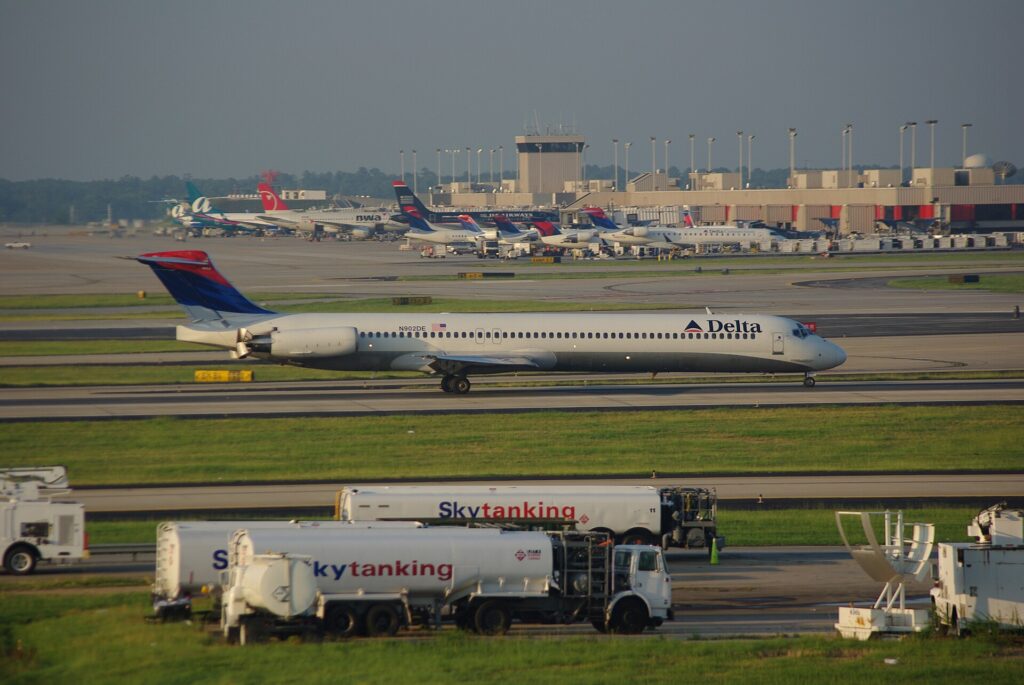
    Delta aircraft at the terminal at Hartsfield-Jackson Atlanta International Airport
    Hartsfield-Jackson, the world's busiest airport and Delta's largest hub (Photo: I'll Never Grow Up via Wikimedia Commons, CC BY 2.0)

    Timing tricks that work for Atlanta

    • Search the whole month. Conventions and big games create sharp edges in the hotel calendar, and holiday weekends do the same for fares. A calendar search on TicketScanner shows them instantly.
    • Price the hotel before the flight. A cheap fare into Dragon Con weekend or a trade-show week is not cheap once the room is added. Run an Atlanta hotel search for the same dates before you commit to either, and compare downtown with Midtown.
    • Stay downtown on weekends. Downtown’s convention hotels are priced for weekday business travel and often drop sharply on Friday and Saturday nights when there is no big event.
    • Fly mid-week, and early. Tuesday to Thursday departures are usually cheaper, and morning flights are the least likely to be caught in summer’s afternoon thunderstorms and the ground stops that follow.
    • Use the hub to your advantage. Because so many airlines fly nonstop to Atlanta, it is often cheaper to fly here and drive onward to Chattanooga, Athens or even Charlotte than to fly to a smaller airport; our Atlanta to Charlotte route guide covers one of those drives.
    • Allow real time at security. ATL’s checkpoints handle enormous volumes, and lines can be long at peak times and on holiday weekends. Check the airport’s site for wait times, and see our guide to how early to arrive.
    • Flying out of Atlanta instead? Its huge route network makes it one of the best departure cities in the country; see cheap flights from Atlanta.
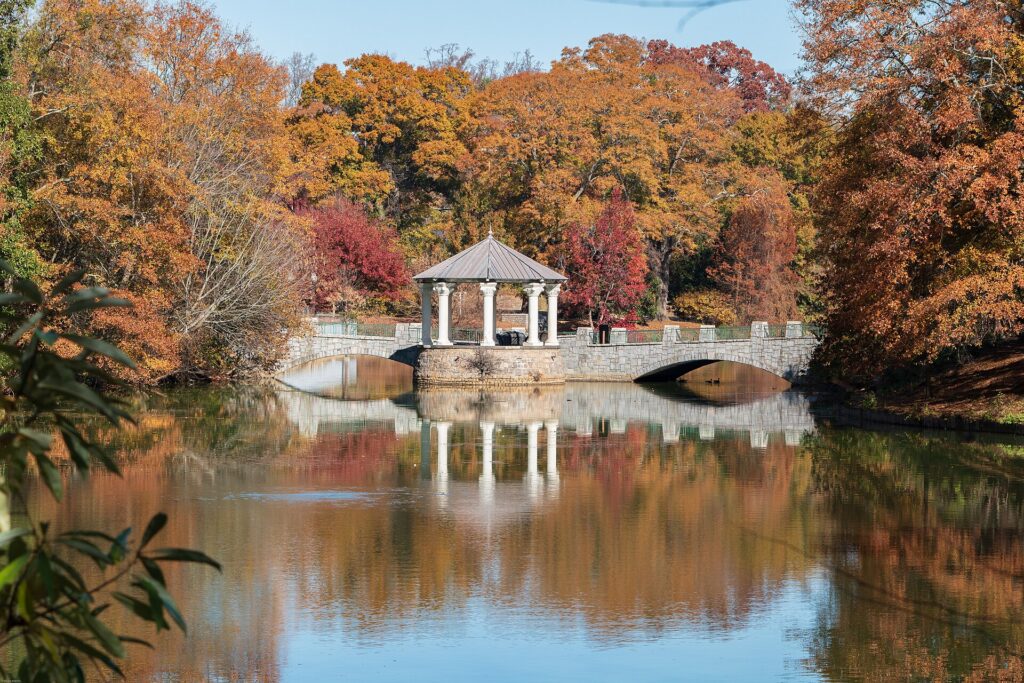
    Fall colors around the gazebo at Lake Clara Meer in Piedmont Park
    Piedmont Park in fall, the season many Atlantans would pick for a visit (Photo: Marc Merlin via Wikimedia Commons, CC BY-SA 4.0)

    What to pack, by season

    Winter (December to February): a warm jacket, layers and waterproof shoes; most days are mild, but a cold, damp wind can make a day near freezing feel raw. Spring (March to May): layers, a light rain jacket and an umbrella for the storms, sunglasses, and allergy medication if pollen affects you. Summer (June to August): the lightest, most breathable clothing you own, a hat, sunscreen, a refillable water bottle, and a sweater for the powerful air-conditioning indoors. Fall (September to November): summer clothing into late September, then layers and a light jacket by November. In every season, bring comfortable walking shoes.

    The best time to fly to Atlanta for…

    The best weather

    The second half of April and the first half of May, or mid-October to early November. Both offer warm, dry days and comfortable evenings.

    Festivals and the city in bloom

    April, for the dogwoods, the Dogwood Festival and the Inman Park Festival, accepting higher prices in the first half of the month. Bring allergy medication.

    Sports

    September to December for college football, the Falcons and the SEC Championship; April to September for the Braves; October to April for the Hawks. Book hotels early for the biggest games.

    The lowest prices

    January and February outside the holiday weekends and trade shows, early December, and the second half of August. Stay downtown on a weekend for the best hotel rates.

    Families

    Late May and early June, before the worst of the heat, or early December for the holiday lights without the holiday prices.

    International visitors

    Visitors from Visa Waiver Program countries need an approved ESTA before boarding; most others need a visa. The State Department’s travel site explains what applies to you, and the TSA lists what you can carry through security. If you are connecting to a domestic flight after clearing immigration at ATL, you will collect and recheck your bags, so leave a generous connection time.

    Frequently asked questions

    What is the cheapest month to fly to Atlanta?

    January and February are usually the cheapest overall, followed by late August and early December. Always check for trade shows and big games, which can push hotel rates up in any month.

    What is the best month to visit Atlanta for weather?

    October, with late April and May close behind. Summer is hot and humid; winter is mild but gray.

    Why are Atlanta hotels so expensive on some weeknights?

    Conventions and trade shows. Atlanta is one of the biggest convention cities in the country, and a large show at the Georgia World Congress Center or AmericasMart can fill downtown mid-week. Midtown and Buckhead, both on MARTA, are the alternatives.

    Is Atlanta too hot to visit in summer?

    It is hot and humid, but very manageable if you plan outdoor sightseeing for the morning and evening and spend the afternoons in the aquarium, the museums and the food halls. The late-August hotel rates are a real reward.

    How early should I get to the Atlanta airport?

    For a domestic flight, two hours is sensible, more on holiday weekends and at spring break; for international departures, three hours. The terminal is vast, and walking or riding the Plane Train to the farther concourses takes time.

    How far ahead should I book?

    Earlier for spring break, Thanksgiving, the Christmas holidays and the big event weekends, when prices tend only to rise; for January, February and late August, fares are stable enough that choosing the right dates matters more.

    Does it snow in Atlanta?

    Rarely, and usually only a dusting. The bigger risk is freezing rain, which can glaze the roads and shut the city for a day or two, so build some flexibility into a January or February trip.

    Ready to pick your dates? Compare fares across the whole month on our Atlanta flights page, then find a room with our Atlanta hotel search. For what to do when you land, start with our first-timer’s guide to Atlanta.

  • Atlanta: Should You Rent a Car or Rely on Public Transit?

    Atlanta: Should You Rent a Car or Rely on Public Transit?

    Atlanta has a reputation as one of the most car-dependent cities in America, and for the people who live here it is mostly deserved: a metro area of more than six million people spread across dozens of counties, freeways that jam twice a day, and suburbs that were built with no thought of a train. But visitors are not commuters, and the Atlanta a visitor sees looks different. The airport has its own rail station inside the terminal, and the MARTA trains from it run straight to downtown, Midtown and Buckhead, which is where most hotels and most of the sights are. The BeltLine’s Eastside Trail links several of the best neighborhoods on foot, and ride-hail is quick and widely available for the gaps. A rental car earns its keep for the Braves’ ballpark, Buford Highway, Stone Mountain and the North Georgia mountains, and for anyone staying in the suburbs. This guide explains how the city and MARTA work, what driving here is really like, and how to decide.

    The short answer

    Skip the car if you are staying downtown, in Midtown or in Buckhead and your plans are the aquarium and Centennial Olympic Park, the Martin Luther King Jr. National Historical Park, the High Museum and Piedmont Park, the BeltLine, a Hawks game, a Falcons game or a convention. MARTA from the airport, your feet and the occasional ride-hail will cover it, and you will avoid hotel parking fees that can add a large sum to each night. Rent a car if you are staying in the suburbs or with family, if a Braves game, Stone Mountain, the Chattahoochee, Buford Highway or a day trip to the mountains, Athens or Chattanooga is on the list, or if Atlanta is one stop on a Southern road trip. And for many visitors the right answer is both: car-free for the city days, a rental for the day trips. Compare rental rates for any of these plans on our Atlanta car rental page.

    How Atlanta is laid out

    Atlanta has no grid. Its streets follow old ridgelines and railway lines, so they curve and change names, and the most famous of them, Peachtree Street, runs north along a ridge from downtown through Midtown to Buckhead, where it becomes Peachtree Road. There are dozens of other streets with Peachtree in their names; always check the full address. Downtown holds the state capitol, the convention center, the stadium, the arena and the Centennial Olympic Park attractions. Midtown, about three kilometers (two miles) north, has the arts district, Piedmont Park, Georgia Tech and a cluster of high-rise hotels. Buckhead, another eight kilometers (five miles) north, is the upscale business and shopping district. East of downtown and Midtown, the historic in-town neighborhoods, the Old Fourth Ward, Inman Park, Little Five Points, Virginia-Highland and Decatur, are linked by the BeltLine and, in part, by MARTA’s east-west line. Two freeways, I-75 and I-85, merge into the Downtown Connector through the middle of the city, I-20 crosses it east to west, and the I-285 ring road, known as the Perimeter, circles the whole thing; locals divide the region into ITP and OTP, inside and outside the Perimeter. The airport is due south, just inside I-285.

    Hotels cluster downtown around Peachtree Center and the convention district, in Midtown along Peachtree Street, in Buckhead near Lenox Square, around the airport in College Park and Hapeville, and in the suburban business districts along I-285. Our Atlanta hotel search lets you compare them.

    Getting in from the airport

    Hartsfield-Jackson Atlanta International (ATL) is about 16 kilometers (10 miles) south of downtown, with a rail station built into the terminal. The MARTA Airport station is at the west end of the Domestic Terminal, beside baggage claim, and the Red and Gold Line trains from it reach Five Points downtown in about 20 minutes, Midtown in under half an hour, and Buckhead in around 40 minutes, for the same flat fare as any other ride. Taxis operate on flat rates from the airport to downtown, Midtown and Buckhead, and ride-hail pickups are signposted from baggage claim; the drive downtown takes 20 to 30 minutes in light traffic and much longer at rush hour, when the Downtown Connector backs up. All the rental companies are at the Rental Car Center, a large consolidated facility reached by the free ATL SkyTrain from the Domestic Terminal. If you land at the international terminal, a shuttle or the Plane Train connects you to the domestic side, so allow extra time. Check the airport’s site for current ground-transport details; our ATL airport guide covers the layout.

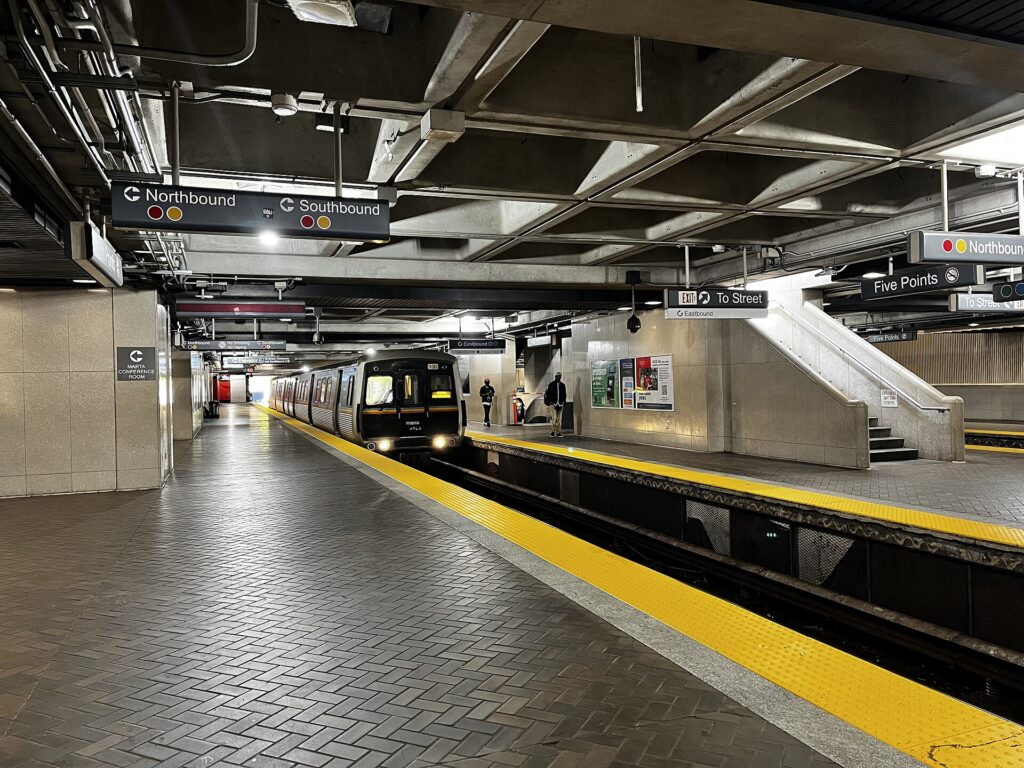
    A MARTA train arriving at Five Points station in downtown Atlanta
    Five Points, where all four MARTA lines meet; the airport is about 20 minutes south (Photo: RedRails via Wikimedia Commons, CC BY-SA 4.0)

    Atlanta’s transit, explained

    The Metropolitan Atlanta Rapid Transit Authority, MARTA, runs the heavy-rail network, the bus system and the downtown streetcar. The rail system is fast, reasonably frequent and, for a visitor based in the city core, genuinely useful: it links the airport, downtown, Midtown, Buckhead and Decatur, which covers most of the itinerary for a first trip. Its limitation is coverage. The lines run along a cross-shaped spine, many in-town neighborhoods are a long walk from a station, and the suburbs beyond are largely unserved by rail.

    MARTA rail

    Four lines, colored Red, Gold, Blue and Green, meet at Five Points downtown. The Red and Gold Lines run north-south: from the airport through College Park and East Point, through downtown (Garnett, Five Points, Peachtree Center, Civic Center), through Midtown (North Avenue, Midtown and Arts Center stations) and on to Lindbergh Center, where they split. The Red Line continues to Buckhead, the Medical Center and North Springs; the Gold Line serves Lenox, for Lenox Square, and continues to Doraville, near the international restaurants of Buford Highway. The Blue and Green Lines run east-west: west from Five Points past the GWCC and Vine City stations, for Mercedes-Benz Stadium and State Farm Arena, and east through King Memorial, for Sweet Auburn and Oakland Cemetery, and Inman Park/Reynoldstown, for Inman Park and Little Five Points, with the Blue Line continuing to Decatur. Trains typically run every 10 to 20 minutes depending on the line and the time of day, from early morning until around 1 a.m., less often on weekends.

    Buses and the streetcar

    MARTA’s bus network fills in the gaps, including routes to the Atlanta History Center, Zoo Atlanta, Ponce City Market and the in-town neighborhoods, but it is slow and infrequent by big-city standards. The Atlanta Streetcar, run by MARTA, is a short loop through downtown that links Centennial Olympic Park with Peachtree Center and the Martin Luther King Jr. historic district on Auburn Avenue; it is slow, but it is the easiest way between the two biggest sight clusters downtown.

    Fares and tickets

    MARTA charges a flat fare for any ride, whatever the distance, and the fare includes transfers between trains and buses within a set time window, which makes the airport-to-Buckhead ride exceptional value. Pay with a reloadable Breeze card, sold with a small card fee at vending machines in every station, or through the Breeze mobile app; MARTA has been introducing contactless payment with bank cards and phones, so check the current options on its site before you travel. Multi-day passes are available and worth it for a busy sightseeing trip. Check MARTA’s site for current fares.

    Accessibility

    All MARTA rail stations have elevators and step-free access to the platforms, and buses are equipped with ramps or lifts. Elevator outages do happen, and MARTA posts them on its site and app; check before you rely on a particular station with luggage or a wheelchair.

    Beyond MARTA

    • Walking. Downtown, Midtown and the in-town neighborhoods are walkable within themselves, although the summer heat and the hills make distances feel longer than they look.
    • The BeltLine. The Atlanta BeltLine‘s Eastside Trail is a paved, car-free path of about three miles that links Piedmont Park, Ponce City Market, the Old Fourth Ward, Inman Park and Krog Street Market. It is the best way to see those neighborhoods, on foot or by bike.
    • Scooters and bikes. Shared e-scooters and e-bikes are widely available in the city core through the usual apps. The city has at times restricted scooter riding overnight, so check the app’s rules before you plan a late ride home.
    • Taxis and ride-hail. Uber, Lyft and licensed taxis operate everywhere, and for trips between neighborhoods off the rail lines, Ponce City Market to Buckhead, or Midtown to the Westside, they are much quicker than the bus. Surge pricing after games and concerts at the stadium can be steep; walking to a MARTA station is usually faster anyway.
    • Trains and intercity buses. Amtrak’s Crescent, between New York and New Orleans, calls daily at the Peachtree station north of Midtown; Amtrak has the schedule. Intercity buses connect Atlanta with cities across the Southeast.
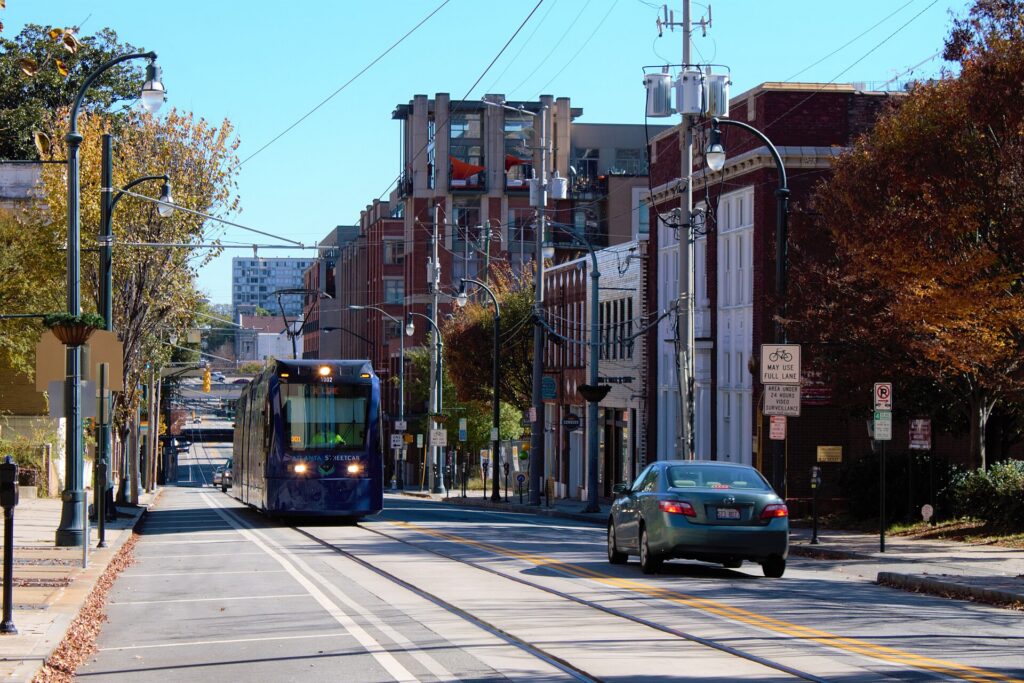
    An Atlanta Streetcar tram on Auburn Avenue in the Sweet Auburn district
    The Atlanta Streetcar on Auburn Avenue, linking the King historic district with Centennial Olympic Park (Photo: brandon walker via Wikimedia Commons, CC0)

    Driving in Atlanta: what it is really like

    Atlanta’s traffic is among the worst in the country, and its reputation is earned on the freeways. The Downtown Connector, where I-75 and I-85 share a dozen or more lanes through the heart of the city, is one of the busiest stretches of road in the United States and crawls every weekday morning and afternoon. I-285, especially its northern arc through the business districts, and GA 400 through Buckhead are the other chronic bottlenecks, and any crash or rainstorm multiplies the delay. Rush hour runs roughly from 6 to 10 a.m. and from 3 to 7 p.m., and Friday afternoons are the worst of the week. Surface streets are less stressful but confusing, with changing names, one-way sections downtown, and those endless Peachtrees. On the plus side, drivers are generally courteous and parking outside the core is easy.

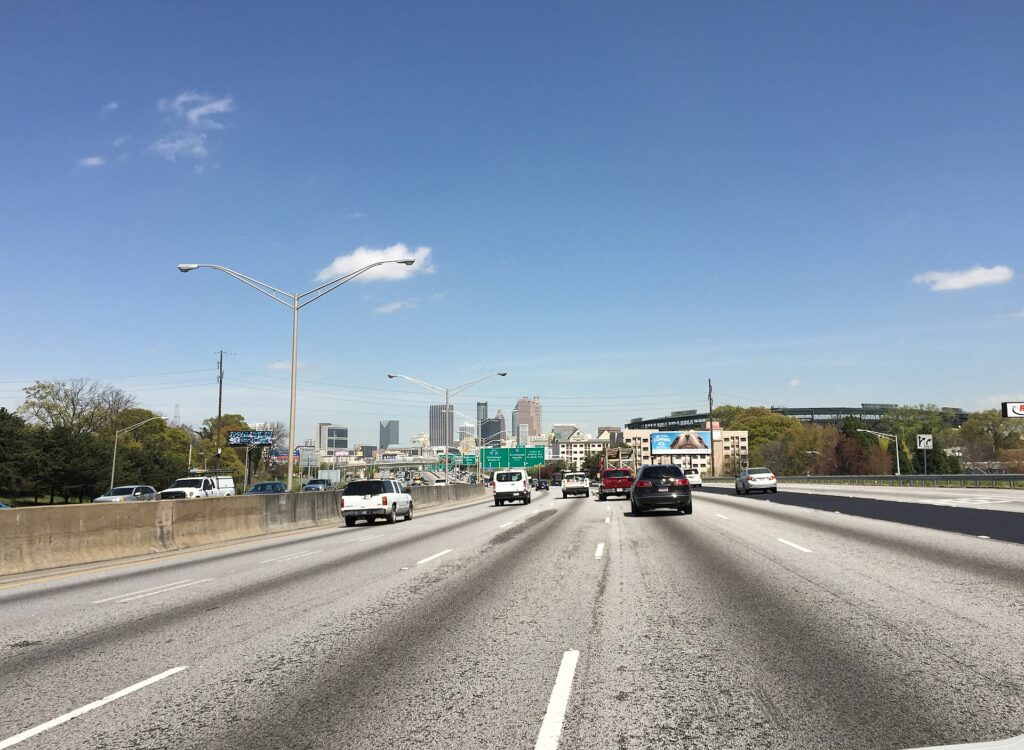
    Traffic on the Downtown Connector, where I-75 and I-85 run together through Atlanta
    The Downtown Connector, where I-75 and I-85 merge through the middle of the city, and where rush hour is measured (Photo: Famartin via Wikimedia Commons, CC BY-SA 4.0)

    Parking

    Parking is the hidden cost of a car in Atlanta. Downtown, Midtown and Buckhead hotels charge a substantial nightly fee, usually for valet, and it is rarely included in the room rate. Commercial lots and garages downtown are plentiful but priced up sharply on game and concert days near Mercedes-Benz Stadium and State Farm Arena. Street parking in the city core is metered, and most meters are paid through the ParkMobile app; read the signs carefully, because enforcement is strict and private lots are known for towing and booting quickly. Outside the core, at Stone Mountain, the malls, the Atlanta History Center and suburban attractions, parking is straightforward, although Stone Mountain Park charges a daily vehicle fee.

    Rules and conditions worth knowing

    • Hands-free law. Georgia bans holding or supporting a phone while driving; use a mount and voice controls.
    • Express lanes. Several freeways have variably priced express lanes that require a Peach Pass transponder; Peach Pass explains how they work. With a rental car, either use the rental company’s toll program, which carries daily fees, or stay in the free general lanes.
    • Move Over law. Georgia requires drivers to move over a lane, or slow down, for stopped emergency and service vehicles, including the state’s yellow HERO trucks that help stranded motorists on metro freeways.
    • Right turns on red are permitted after a full stop unless signed otherwise.
    • Cameras monitor school-zone speed limits and some intersections; fines follow the car, and the rental company will bill you with a fee on top.
    • Storms and ice. Summer thunderstorms bring sudden downpours and flooded underpasses; slow down and never drive into standing water. A rare winter ice storm can make untreated roads treacherous; if one is forecast, stay put. Georgia 511 publishes traffic, closures and conditions.
    • Fuel in Georgia is usually priced below the national average, one small point in the rental’s favor.

    When renting a car makes sense

    • A Braves game. Truist Park and The Battery are northwest of the city in Cobb County and not on the MARTA rail network; driving, with parking booked in advance, or a ride-hail are the realistic options.
    • Stone Mountain, the Chattahoochee and Kennesaw Mountain. All are within 45 minutes of downtown and effectively car-only.
    • Buford Highway. The Gold Line reaches Doraville, but the restaurants are strung out along miles of strip malls; a car makes an evening of it far easier.
    • Day trips. The North Georgia mountains, Athens, Chattanooga and Callaway Gardens are all 90 minutes to two hours away and need a car.
    • Staying in the suburbs or with family. Outside the MARTA corridors, a car is how the region works.
    • Southern road trips. Atlanta to Charlotte, Chattanooga and Nashville, Savannah and the coast, or Birmingham; our Atlanta to Charlotte route guide covers the four-hour drive up I-85.

    If any of those apply, our rental car booking tips cover insurance, deposits and the questions to ask at the counter, and our family car rental guide looks at vehicle choice.

    When it does not

    • You are staying downtown, in Midtown or in Buckhead near a MARTA station, and your plans are the city’s main sights.
    • You are in town for a convention at the Georgia World Congress Center, a Falcons, Atlanta United or Hawks game, or a stadium concert, when downtown parking is at its most expensive and MARTA stops beside the venues.
    • You are on a short trip or a long layover and want to see the MLK historic site or the aquarium between flights.
    • You are traveling solo or as a couple, and the rental, the toll program and the hotel parking add up to more than a few ride-hail trips.
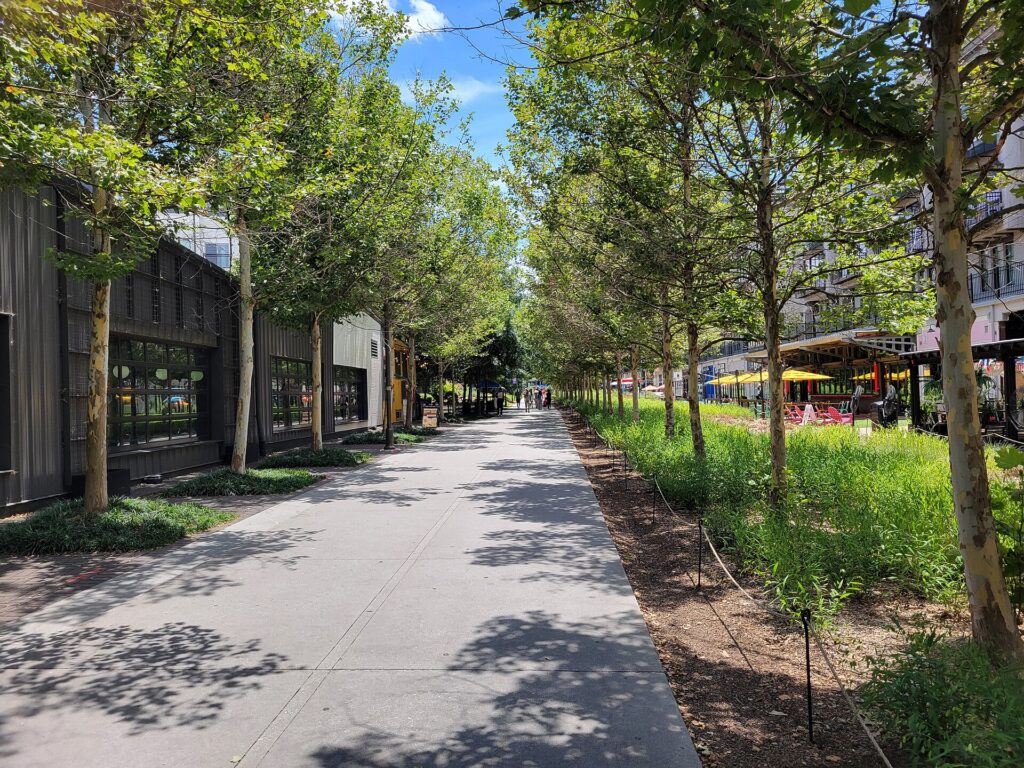
    Walkers and cyclists on the Atlanta BeltLine Eastside Trail in Inman Park
    The BeltLine's Eastside Trail, the car-free way between Piedmont Park, Ponce City Market and Inman Park (Photo: John Phelan via Wikimedia Commons, CC BY 4.0)

    The hybrid plan for a city-plus-countryside trip

    Go car-free for the city days and rent for the day trips, and think carefully about where you pick up. Renting at the airport’s Rental Car Center makes sense if you are heading straight out of the city on arrival, because the freeways are a few minutes away and you avoid the Downtown Connector. Renting from a downtown, Midtown or Buckhead location makes sense if you are spending the first nights in the city, because you avoid the airport’s concession fees and facility charges and the hotel parking on the nights you are not using the car. A pattern that works well: MARTA from the airport to a Midtown hotel, two or three car-free days, pick up a rental in the city for the day trips, and return it at the airport on the way to your flight, which most companies allow for little or no extra charge. Compare the day rates on our Atlanta car rental page against a full-trip rental and the difference is usually obvious.

    A worked cost comparison

    Numbers change with the season and the booking window, so treat this as a method rather than a quote, and check current rates before deciding. For a four-night city break in Midtown for two people, the car-free version costs two MARTA rides from the airport and back per person, a multi-day pass or a handful of single fares, and perhaps three or four ride-hail trips to Inman Park, the Westside or Buckhead; the rental version adds four days of a compact car, four nights of hotel valet parking, fuel, the airport fees and paid parking at every stop, and buys you very little you could not ride to. The transit option wins easily. For the same four nights with a Braves game and a day at Stone Mountain, the car-free version adds a round-trip ride-hail to Truist Park, which can surge after the game, and another to Stone Mountain; the hybrid version adds a two-day rental picked up in Midtown, fuel, stadium parking and the park’s vehicle fee. For two people the costs are often close; for a family of four the rental usually wins. For a week touring the North Georgia mountains, Chattanooga or the coast, a rental is the only practical answer, and the airport pickup, with its fees, is still simpler than a trip into the city to collect a car downtown. Run the rental rates for your dates on our Atlanta car rental page and put them beside the ride-hail estimates before you choose.

    Driving out of Atlanta in each season

    The roads out of Atlanta are easy once you clear the Perimeter, and the timing matters more than the route. In spring, the mountains are green and the waterfalls are full, but severe thunderstorms can bring sudden downpours, and spring-break traffic heading south on I-75 toward Florida jams on Friday afternoons and Saturday mornings. In summer, leave early for the mountains, the lakes and the Chattahoochee to beat the heat and the afternoon storms, and expect holiday weekends to fill every highway out of the city. In fall, the leaf season in the North Georgia mountains, from mid-October into early November, brings weekend traffic to GA 400 and the mountain towns that rivals a summer holiday; go mid-week if you can, and avoid the drive home on Sunday afternoon. In winter, the roads are usually clear and the traffic lighter, but the mountains can see snow and ice, and a rare ice storm in the city makes staying put the only sensible choice. In every season, time your departure and return to avoid the Downtown Connector and I-285 at rush hour, and check Georgia 511 before you set off.

    Decision table

    Your tripRecommendationWhy
    City break downtown or in MidtownNo carMARTA runs from the airport to both; hotel parking is expensive
    Convention, Falcons, Hawks or Atlanta United gameNo carMARTA stops beside the venues; event parking is costly
    Long layoverNo carThe train from the terminal reaches downtown in about 20 minutes
    City plus a Braves game or Stone MountainHybrid: rent in the city for a day or twoCar-free city days, car for the places MARTA does not reach
    North Georgia mountains, Athens or ChattanoogaRentDay trips of 90 minutes to two hours, with no practical transit
    Family visit to the suburbsRent for the whole staySuburban distances make the car worthwhile daily
    Family with young childrenRent, with a hotel that includes parkingCar seats, heat and spread-out attractions all argue for a car
    Southern road tripRent (consider one-way to Charlotte or Savannah)Atlanta is the start, not the destination

    Money-saving tips for both options

    • On transit: take MARTA from the airport instead of a taxi; buy a multi-day pass for a busy trip; choose a hotel within a short walk of a station.
    • On a rental: compare airport and city pickup, book early for spring break, Masters week and fall weekends, decline the toll program if you will stay out of the express lanes, decline extras you already have through a credit card or home policy (check first), and fill up before returning the car.
    • On the hotel: if you are renting, price the parking fee into the room rate, and consider a hotel outside the core with free parking for the days you have the car.
    • On timing: avoid the Downtown Connector and I-285 in the weekday peaks and on Friday afternoons; the best time to fly to Atlanta guide lists the busiest weekends, when traffic and parking are at their worst.
    • On event days: ride MARTA to the stadium and the arena rather than paying event parking, and wait out the ride-hail surge with a drink nearby after the game.

    Frequently asked questions

    Is it worth renting a car in Atlanta?

    For a city break based downtown, in Midtown or in Buckhead, no; MARTA and ride-hail cover it. For a Braves game, Stone Mountain, the suburbs, Buford Highway or day trips, yes.

    Is MARTA good for tourists?

    For the core, yes: it links the airport, downtown, Midtown, Buckhead and Decatur, and stops beside the stadium and the arena. It does not reach the Braves’ ballpark, most of the BeltLine or the suburbs.

    How do I get from Atlanta airport to downtown?

    The MARTA Red or Gold Line from the Airport station in the Domestic Terminal, about 20 minutes to Five Points, or a flat-rate taxi or a ride-hail in 20 to 30 minutes outside rush hour.

    How do I pay for MARTA?

    With a reloadable Breeze card from the station machines or through the Breeze app, and increasingly by contactless card or phone; the flat fare includes transfers between trains and buses within a set window.

    Can I get to a Braves game on MARTA?

    Not directly by train. Truist Park is in Cobb County, off the rail network; most fans drive or take a ride-hail.

    Is parking expensive in Atlanta?

    At downtown, Midtown and Buckhead hotels, and around the stadium on event days, yes. Outside the core, it is usually easy and often free.

    Is it hard to drive in Atlanta?

    The freeways are congested at rush hour, and the surface streets are confusing, but drivers are generally courteous. Avoid the peaks, use a navigation app, and stay out of the express lanes without a Peach Pass.

    Whichever way you go, start with the flight. Compare cheap flights to Atlanta, choose a neighborhood with our Atlanta hotel search, and if a day trip or a Braves game is on the list, price the rental for those dates on our Atlanta car rental page. For what to see once you are there, our first-timer’s guide to Atlanta covers the whole city.

  • Things to Do in Atlanta: A First-Timer’s Guide

    Things to Do in Atlanta: A First-Timer’s Guide

    Atlanta is the city most travelers pass through without ever seeing. Its airport is the busiest in the world, and millions of people change planes here every year without once stepping outside. That is a shame, because the city beyond the terminal is one of the most rewarding in the South: the birthplace of Martin Luther King Jr. and the heart of the civil rights movement, a downtown rebuilt around the 1996 Olympic Games, a former railway loop turned into a walking and cycling trail lined with food halls and murals, an arts district with the largest art museum in the Southeast, leafy Victorian neighborhoods, and a food scene that runs from fried chicken and lemon pepper wings to the international restaurants of Buford Highway. This guide covers the sights, the neighborhoods, the food, the day trips and the practical details that turn a layover city into a destination.

    If you are still comparing cheap flights to Atlanta, read this alongside our guides to the best time to fly to Atlanta and whether to rent a car or ride MARTA. Between the three you can plan the whole trip.

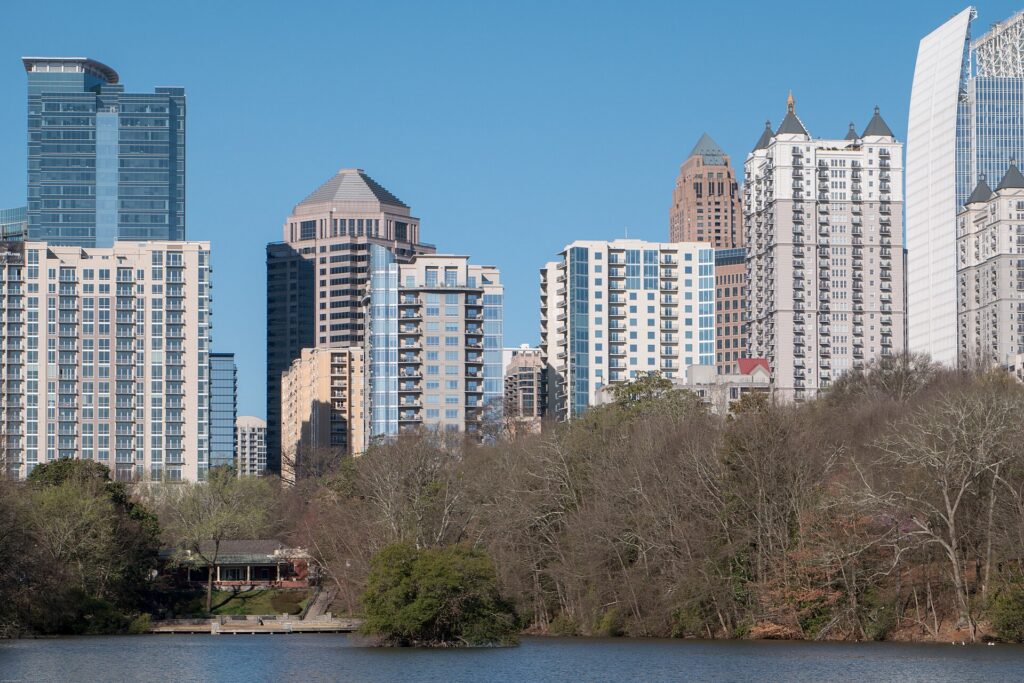
    The Midtown Atlanta skyline across Lake Clara Meer in Piedmont Park
    Midtown's towers over Lake Clara Meer in Piedmont Park, the city's central park (Photo: Marc Merlin via Wikimedia Commons, CC BY-SA 4.0)

    Atlanta at a glance for first-timers

    • Airport: Hartsfield-Jackson Atlanta International (ATL), about 16 km (10 miles) south of downtown, with its own MARTA rail station inside the domestic terminal; the train reaches downtown in about 20 minutes. See our ATL airport guide.
    • Getting around: MARTA’s rail lines link the airport, downtown, Midtown, Buckhead and Decatur, and those neighborhoods are walkable on their own. The BeltLine’s Eastside Trail connects several more on foot. For the suburbs, the Braves’ ballpark and day trips, you will want a car or a ride-hail.
    • Money: U.S. dollars. State and local sales tax is added at the till, and hotel rooms carry extra taxes and fees. Tipping 18 to 20 percent in sit-down restaurants is customary.
    • Weather: long, hot and humid summers, mild winters with the occasional ice storm, and a spring and fall that are among the most pleasant in the country. Our month-by-month guide has the detail.
    • Where to stay: downtown for the Olympic park attractions and the arenas; Midtown for the arts district, Piedmont Park, restaurants and the best MARTA access; Buckhead for upscale shopping; Inman Park or the Old Fourth Ward for the BeltLine and a neighborhood feel. Our Atlanta hotel search covers them all.

    Downtown: Centennial Olympic Park and its neighbors

    The 1996 Summer Olympics left Atlanta with Centennial Olympic Park, a 21-acre green space in the middle of downtown that serves as the front lawn for the city’s biggest attractions. The Fountain of Rings, where water jets dance in the shape of the Olympic symbol, is the park’s centerpiece. On its northern edge, the Georgia Aquarium is one of the largest in the world, and one of the very few aquariums anywhere where you can watch whale sharks, alongside manta rays, beluga whales and a large dolphin presentation; buy timed tickets online and go early on a weekday. Next door, the World of Coca-Cola tells the story of the drink invented by an Atlanta pharmacist in 1886, shows off the vault said to hold the secret formula, and ends in a tasting room with dozens of soft drinks from around the world. The National Center for Civil and Human Rights, on the same plaza, is the most powerful museum downtown, connecting the American civil rights movement to human rights struggles worldwide, with a lunch-counter sit-in exhibit that stays with visitors for a long time. The College Football Hall of Fame and the SkyView Ferris wheel complete the cluster. A few blocks south, the gold dome of the Georgia State Capitol, gilded with gold leaf from the North Georgia mountains, is open to visitors on weekdays.

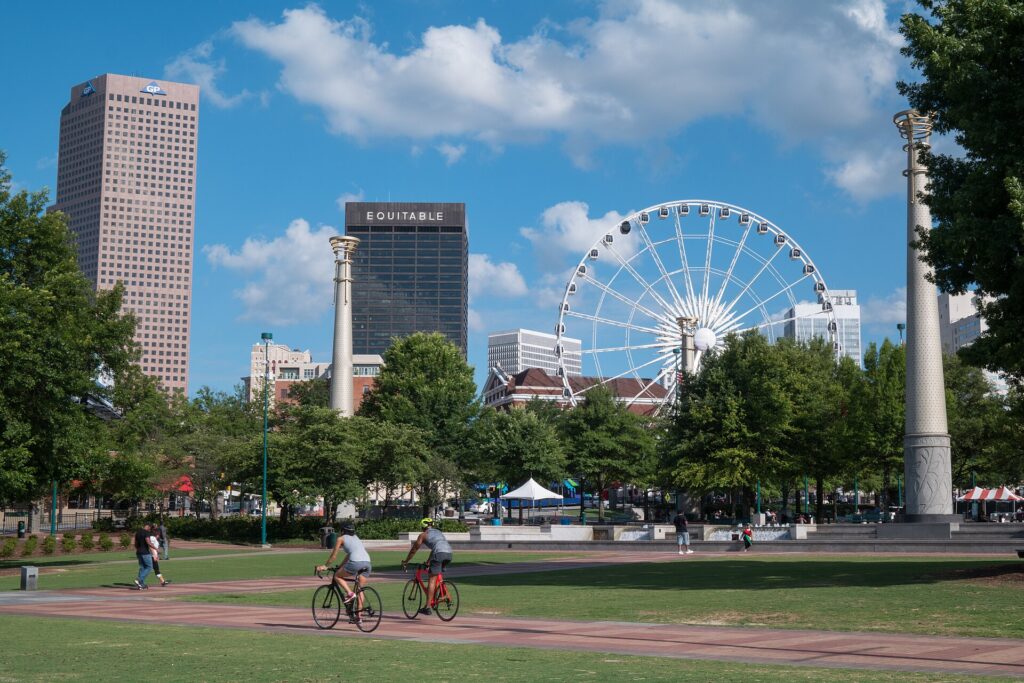
    Centennial Olympic Park with the downtown Atlanta skyline behind it
    Centennial Olympic Park, the 1996 Games' legacy and the front lawn for the aquarium and the civil rights museum (Photo: Marc Merlin via Wikimedia Commons, CC BY-SA 4.0)

    Sweet Auburn and the Martin Luther King Jr. National Historical Park

    No visit to Atlanta is complete without Auburn Avenue. In the first half of the twentieth century, Sweet Auburn was one of the most prosperous Black business districts in the country, with banks, insurance companies, newspapers and churches, and it was here, in a Queen Anne house at 501 Auburn Avenue, that Martin Luther King Jr. was born in 1929. The Martin Luther King Jr. National Historical Park, run by the National Park Service and free to visit, covers several blocks. Start at the visitor center, which tells the story of the movement and King’s life, then walk to Historic Ebenezer Baptist Church, where King, his father and his grandfather all preached, and where recordings of his sermons play in the restored sanctuary. Across the street, The King Center holds the tomb of Dr. King and Coretta Scott King, set in a reflecting pool beside an eternal flame. The birth home itself is open for ranger-led tours on a limited basis; check the park’s site for the current schedule and how to reserve. Allow at least half a day, with lunch at the Sweet Auburn Curb Market a few blocks west; the Atlanta Streetcar loops back to Centennial Olympic Park.

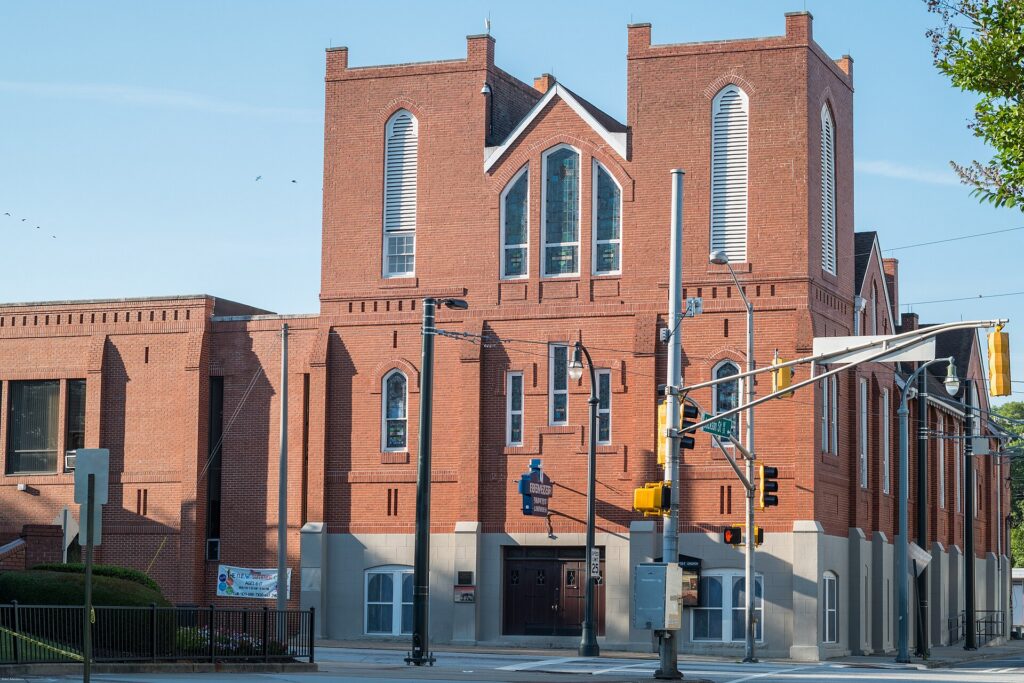
    Historic Ebenezer Baptist Church on Auburn Avenue in Atlanta
    Historic Ebenezer Baptist Church, where Martin Luther King Jr. preached, part of the free national historical park (Photo: Marc Merlin via Wikimedia Commons, CC BY-SA 4.0)

    The BeltLine and the Eastside Trail

    The Atlanta BeltLine is the most ambitious urban project in the South: a 22-mile loop of former railway corridors around the city core, being turned into a continuous trail and park system that links dozens of neighborhoods. The most developed stretch, the Eastside Trail, runs for about three miles from the edge of Piedmont Park south through the Old Fourth Ward and Inman Park to Reynoldstown, and on a warm weekend it feels like the whole city is out on it. The anchors are two food halls in converted industrial buildings. Ponce City Market, in the enormous brick former Sears, Roebuck warehouse on Ponce de Leon Avenue, has a food hall on the ground floor, shops above, and a rooftop amusement park with mini golf and skyline views. Krog Street Market, farther south in Inman Park, is smaller and more local. Just off the trail, the Krog Street Tunnel, a railway underpass completely covered in constantly changing graffiti, is the most photographed wall in the city. Walk the whole Eastside Trail in about an hour and a half with stops, or rent a bike or a scooter.

    Midtown: Piedmont Park, the arts district and the Fox

    Midtown is the Atlanta most visitors fall for. Piedmont Park, laid out for the Cotton States Exposition of 1895 and later reshaped by the Olmsted Brothers firm, is the city’s central park: 200 acres of lawns, a lake with a view of the Midtown skyline, and the site of the city’s biggest festivals. On its northern edge, the Atlanta Botanical Garden is one of the best in the country, with a treetop canopy walk, a conservatory of tropical and desert plants, and in winter the Garden Lights, Holiday Nights show that sells out on weekends. A few blocks west on Peachtree Street, the High Museum of Art, the largest art museum in the Southeast, occupies a white Richard Meier building and a Renzo Piano expansion; its folk and self-taught art collection is outstanding. The High is part of the Woodruff Arts Center, which also houses the Alliance Theatre and the Atlanta Symphony Orchestra. Farther down Peachtree, the Fox Theatre, a 1929 movie palace with an Arabian-nights interior and a ceiling painted as a starlit sky, hosts Broadway tours and concerts and offers guided tours of the building. The Arts Center and Midtown MARTA stations put all of it within a short walk.

    Neighborhoods worth a half-day

    Inman Park

    Atlanta’s first planned suburb, laid out in the 1880s and connected to downtown by an early electric streetcar, is a neighborhood of restored Victorian houses under huge old trees, with the BeltLine running along its western edge. The restaurants along Highland Avenue and around Krog Street Market are some of the best in the city, and the Inman Park Festival at the end of April, with its tour of homes and a gloriously eccentric parade, is one of the best neighborhood festivals in the South.

    Little Five Points

    Just east of Inman Park, the intersection of Moreland and Euclid Avenues is the city’s bohemian quarter: vintage clothing stores, record shops, tattoo parlors and bars, plus a skull-shaped burger-bar entrance that everyone photographs. It is the least polished corner of in-town Atlanta, which is exactly its appeal.

    Virginia-Highland and Poncey-Highland

    North and east of Ponce City Market, these two residential neighborhoods have walkable strips of cafés, bars and independent shops set among bungalows. Poncey-Highland is also home to the Jimmy Carter Presidential Library and Museum, set in landscaped grounds with a Japanese garden and a replica of the Oval Office.

    Buckhead

    Atlanta’s wealthy north end has the grandest houses in the city along West Paces Ferry Road, the upscale malls of Lenox Square and Phipps Plaza, and the Atlanta History Center: the 1928 Swan House mansion, a working 1860s farm, gardens, and the restored Battle of Atlanta cyclorama, a vast circular painting from the 1880s displayed in its own gallery.

    Decatur

    Technically its own city, Decatur is six miles east of downtown at the end of a MARTA ride, and its courthouse square, with restaurants, pubs and bookshops around the old DeKalb County courthouse, feels like a small Southern town.

    Grant Park and Cabbagetown

    Southeast of downtown, Grant Park has Victorian cottages and Zoo Atlanta, known for one of the largest gorilla populations in North America. Between the park and downtown, Historic Oakland Cemetery, founded in 1850, is a Victorian garden cemetery where Margaret Mitchell and golfer Bobby Jones are buried; the grounds are free and the guided tours are excellent. Next to it, the old mill village of Cabbagetown has shotgun houses, murals and a cluster of good restaurants.

    Museums, culture and family attractions

    Beyond the headline sights, Atlanta has a deep bench of museums. The Fernbank Museum of Natural History, in the Druid Hills neighborhood east of the city, has one of the largest dinosaurs ever found, an Argentinosaurus, dominating its Great Hall, and outdoor trails through an old-growth urban forest. The Center for Puppetry Arts in Midtown holds the largest collection of Jim Henson puppets and artifacts on public display, with shows that small children love. The Delta Flight Museum, in historic hangars beside the airport, lets you walk through a retired Boeing 747 and try a professional flight simulator, a good use of a long layover. The city also has a busy live music and comedy scene, from Little Five Points to the Eastside. The Atlanta University Center, west of downtown, is the largest consortium of historically Black colleges and universities in the country, including Morehouse and Spelman, and homecoming weekends there each fall are city-wide events. For what is on stage and in the arenas during your dates, our Atlanta events page lists concerts, shows and games.

    Sports

    Atlanta is one of the busiest sports cities in the country. Mercedes-Benz Stadium, the downtown stadium with a retractable roof that opens like a camera shutter, is home to the Atlanta Falcons of the NFL and Atlanta United, the MLS club whose crowds are among the largest in American soccer; it also hosts the SEC Championship Game, the Peach Bowl and, in 2026, World Cup matches. The Atlanta Hawks play NBA basketball at State Farm Arena, a short walk away, from October to April. The Atlanta Braves play baseball from April to September at Truist Park, northwest of the city in Cobb County, surrounded by The Battery’s restaurants and bars; note that the ballpark is not on the MARTA rail network, so plan on driving or a ride-hail. Check what is on sale in Atlanta for your dates before you book flights, because a big game or a convention can fill every downtown hotel.

    What to eat, and where

    Atlanta eats Southern, but it does not eat only Southern. The foundation is soul food and Southern cooking: fried chicken, collard greens, macaroni and cheese, biscuits, fried green tomatoes, peach cobbler, and the meat-and-three restaurants where you choose one main and three sides; Mary Mac’s Tea Room in Midtown has been serving it since 1945. The city’s signature bar snack is the lemon pepper wing, often ordered “wet,” with the lemon pepper tossed in butter. The Varsity, the giant drive-in beside Georgia Tech, has been shouting “What’ll ya have?” at customers since 1928, and a chili dog and a frosted orange there is an Atlanta rite. Then there is Buford Highway, a stretch of strip malls running northeast from Brookhaven through Chamblee and Doraville, with the best concentration of international restaurants in the Southeast: Korean barbecue, Vietnamese pho, Sichuan and Cantonese, Mexican taquerias and Salvadoran pupuserias, all within a few miles. The food halls at Ponce City Market and Krog Street Market are the easiest way to sample the newer scene, and the restaurants of Inman Park, the Westside and Decatur are where Atlanta’s best chefs cook.

    Atlanta through the seasons

    Atlanta is a different city in each season, and what you do depends on when you come. Spring (March to May) is the showpiece: dogwoods and azaleas bloom across the city in late March and April, the Atlanta Dogwood Festival fills Piedmont Park in April, the Inman Park Festival closes out the month, and the Atlanta Jazz Festival brings free concerts to Piedmont Park over Memorial Day weekend. The drawback is pollen, which coats every car in yellow dust for a few weeks. Summer (June to August) is hot and humid, with afternoon thunderstorms, and the day belongs to the air-conditioned museums and the aquarium, with evenings on the BeltLine and at the ballpark; the Peachtree Road Race, the largest 10K in the world, runs through the city every Fourth of July morning. Fall (September to November) is the local favorite, warm and dry into October, with college football on every screen, Dragon Con transforming downtown over Labor Day weekend, Atlanta Pride in October, and the fall color arriving in the North Georgia mountains in late October. Winter (December to February) is mild, quiet and the cheapest time to visit. Our month-by-month guide has the fare patterns that go with each season.

    Atlanta with kids

    Atlanta is an easy city with children, and much of the best of it is clustered downtown. The Georgia Aquarium is the obvious full morning, with its whale sharks and a touch pool, and the Fountain of Rings in Centennial Olympic Park is a free splash zone in summer. The Children’s Museum is next door, and the World of Coca-Cola’s tasting room is a hit with older kids. Fernbank Museum, with its dinosaurs and forest trails, and the Center for Puppetry Arts are the other standouts, and Zoo Atlanta in Grant Park suits younger children. In summer, the splash pad at Historic Fourth Ward Park is free, and tubing on the Chattahoochee with an outfitter is a hit with teenagers. For families driving to the mountains or the coast, our family car rental guide covers the vehicle question.

    Atlanta on a budget

    Some of the best of Atlanta is free: the Martin Luther King Jr. National Historical Park, the BeltLine and the Krog Street Tunnel, Piedmont Park, Centennial Olympic Park and the Fountain of Rings, the grounds of Oakland Cemetery, the State Capitol, and the free festivals in Piedmont Park, including the Jazz Festival. The paid attractions downtown add up; look at the combination tickets they sell, and buy online in advance. Eat well for less on Buford Highway, at the Sweet Auburn Curb Market, and at the neighborhood soul food spots; the food halls are good value at lunch. MARTA’s flat fare from the airport to downtown or Midtown is a fraction of a taxi. Compare rates by neighborhood on our Atlanta hotel search.

    Day trips from Atlanta

    Stone Mountain Park, about half an hour east, is built around a vast granite dome rising above the forest. A steep walk-up trail of about a mile reaches the summit, where the views stretch back to the Atlanta skyline, or you can ride the cable car. The enormous carved relief of Confederate leaders on the north face is one of the largest in the world and the subject of long debate; the park now presents it with historical context. The Chattahoochee River National Recreation Area runs along the river on the northern edge of the city, with riverside trails and, in summer, tubing and kayaking with local outfitters. Farther afield, Athens, about an hour and a half east, is the University of Georgia’s college town and the birthplace of R.E.M. and the B-52s. The North Georgia mountains, 90 minutes to two hours north, have Amicalola Falls, the tallest waterfall in Georgia and the start of the approach trail to Springer Mountain and the Appalachian Trail, the Bavarian-themed town of Helen, and a wine region in the hills. Chattanooga, about two hours northwest in Tennessee, has the Tennessee Aquarium and Lookout Mountain. Savannah, about four hours southeast, is better as an overnight. If you are continuing north, our Atlanta to Charlotte route guide covers the four-hour drive up I-85. All of these are car trips; see our Atlanta car rental page.

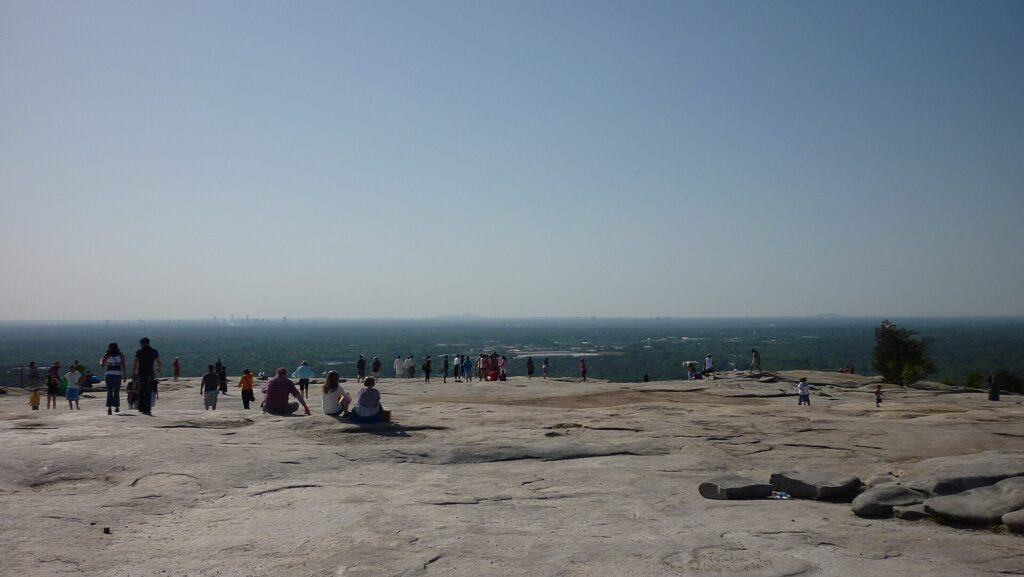
    The view from the granite summit of Stone Mountain east of Atlanta
    The summit of Stone Mountain, half an hour east of downtown, with the city on the horizon (Photo: Lonesome Crow via Wikimedia Commons, CC BY-SA 3.0)

    Two sample itineraries

    Three days, no car

    Day one: MARTA from the airport to downtown, the Georgia Aquarium in the morning, the National Center for Civil and Human Rights after lunch, a walk through Centennial Olympic Park, and a Hawks game or a show in the evening. Day two: the streetcar to Sweet Auburn for the Martin Luther King Jr. National Historical Park, lunch at the Curb Market, then walk up to the BeltLine’s Eastside Trail through the Old Fourth Ward to Ponce City Market for the afternoon, and dinner in Inman Park. Day three: MARTA to Midtown for the High Museum, the Atlanta Botanical Garden and a long walk through Piedmont Park, a chili dog at the Varsity, and an evening at the Fox Theatre.

    Five days, with the region

    Add a day for Buckhead and the Atlanta History Center, or Fernbank and Decatur, then rent a car for two days: one for Stone Mountain and a dinner run along Buford Highway, and one for the North Georgia mountains or Chattanooga. Return the car at the airport’s rental center on the way to your flight.

    Practical details

    • Transit: MARTA charges a flat fare for rail and bus rides, with free transfers; buy a reloadable Breeze card at any station or use the Breeze app, and check whether contactless bank cards are accepted at the gates. MARTA has maps and service alerts; our car-versus-transit guide goes into detail.
    • From ATL: the Red or Gold Line from the Airport station, at the west end of the domestic terminal, reaches Five Points downtown in about 20 minutes and Midtown in under half an hour. Taxis charge flat rates to downtown, Midtown and Buckhead.
    • Weather: light clothing, sunscreen and water in summer; layers in spring and fall; a real coat for the occasional cold snap in winter. The National Weather Service’s Atlanta office has the forecast, including the severe thunderstorm warnings that are common in spring.
    • Time zone: Eastern, the same as New York and Washington, DC.
    • Safety: the usual big-city awareness applies, especially downtown late at night and around transit stations; stick to busy, well-lit streets, and do not leave anything visible in a parked car.
    • Entry requirements: visitors from Visa Waiver Program countries need an approved ESTA before boarding; most others need a visa. The State Department’s travel site is the authoritative source. Discover Atlanta, the city’s official visitor bureau, has current event listings.

    Frequently asked questions

    How many days do you need in Atlanta?

    Three full days covers downtown, Sweet Auburn, the BeltLine and Midtown without rushing; add one for Buckhead or Fernbank and one or two for Stone Mountain and the mountains.

    What is the number one thing to do in Atlanta?

    The Martin Luther King Jr. National Historical Park, which is free and unlike anything else in the country. For a second choice, walk the BeltLine’s Eastside Trail to Ponce City Market on a sunny afternoon.

    Is Atlanta walkable?

    In pockets. Downtown, Midtown, Inman Park, the Old Fourth Ward, Decatur’s square and the BeltLine are pleasant on foot; the distances between them, and everything beyond, assume MARTA, a ride-hail or a car.

    Do I need a car in Atlanta?

    Not if you stay downtown or in Midtown and stick to the central sights, because MARTA runs from the airport to both. For Buckhead’s side streets, the Braves’ ballpark, Buford Highway and day trips, a car or ride-hail helps.

    What is Atlanta known for?

    Martin Luther King Jr. and the civil rights movement, the busiest airport in the world, the 1996 Olympics, Coca-Cola, Southern food, hip-hop, a thriving film industry, and one of the densest tree canopies of any major American city.

    Ready to go? Compare flights to Atlanta, find a place to stay with our Atlanta hotel search, and if the mountains or Stone Mountain are on the list, price a rental car for those days.