
Atlanta has a reputation as one of the most car-dependent cities in America, and for the people who live here it is mostly deserved: a metro area of more than six million people spread across dozens of counties, freeways that jam twice a day, and suburbs that were built with no thought of a train. But visitors are not commuters, and the Atlanta a visitor sees looks different. The airport has its own rail station inside the terminal, and the MARTA trains from it run straight to downtown, Midtown and Buckhead, which is where most hotels and most of the sights are. The BeltLine’s Eastside Trail links several of the best neighborhoods on foot, and ride-hail is quick and widely available for the gaps. A rental car earns its keep for the Braves’ ballpark, Buford Highway, Stone Mountain and the North Georgia mountains, and for anyone staying in the suburbs. This guide explains how the city and MARTA work, what driving here is really like, and how to decide.
The short answer
Skip the car if you are staying downtown, in Midtown or in Buckhead and your plans are the aquarium and Centennial Olympic Park, the Martin Luther King Jr. National Historical Park, the High Museum and Piedmont Park, the BeltLine, a Hawks game, a Falcons game or a convention. MARTA from the airport, your feet and the occasional ride-hail will cover it, and you will avoid hotel parking fees that can add a large sum to each night. Rent a car if you are staying in the suburbs or with family, if a Braves game, Stone Mountain, the Chattahoochee, Buford Highway or a day trip to the mountains, Athens or Chattanooga is on the list, or if Atlanta is one stop on a Southern road trip. And for many visitors the right answer is both: car-free for the city days, a rental for the day trips. Compare rental rates for any of these plans on our Atlanta car rental page.
How Atlanta is laid out
Atlanta has no grid. Its streets follow old ridgelines and railway lines, so they curve and change names, and the most famous of them, Peachtree Street, runs north along a ridge from downtown through Midtown to Buckhead, where it becomes Peachtree Road. There are dozens of other streets with Peachtree in their names; always check the full address. Downtown holds the state capitol, the convention center, the stadium, the arena and the Centennial Olympic Park attractions. Midtown, about three kilometers (two miles) north, has the arts district, Piedmont Park, Georgia Tech and a cluster of high-rise hotels. Buckhead, another eight kilometers (five miles) north, is the upscale business and shopping district. East of downtown and Midtown, the historic in-town neighborhoods, the Old Fourth Ward, Inman Park, Little Five Points, Virginia-Highland and Decatur, are linked by the BeltLine and, in part, by MARTA’s east-west line. Two freeways, I-75 and I-85, merge into the Downtown Connector through the middle of the city, I-20 crosses it east to west, and the I-285 ring road, known as the Perimeter, circles the whole thing; locals divide the region into ITP and OTP, inside and outside the Perimeter. The airport is due south, just inside I-285.
Hotels cluster downtown around Peachtree Center and the convention district, in Midtown along Peachtree Street, in Buckhead near Lenox Square, around the airport in College Park and Hapeville, and in the suburban business districts along I-285. Our Atlanta hotel search lets you compare them.
Getting in from the airport
Hartsfield-Jackson Atlanta International (ATL) is about 16 kilometers (10 miles) south of downtown, with a rail station built into the terminal. The MARTA Airport station is at the west end of the Domestic Terminal, beside baggage claim, and the Red and Gold Line trains from it reach Five Points downtown in about 20 minutes, Midtown in under half an hour, and Buckhead in around 40 minutes, for the same flat fare as any other ride. Taxis operate on flat rates from the airport to downtown, Midtown and Buckhead, and ride-hail pickups are signposted from baggage claim; the drive downtown takes 20 to 30 minutes in light traffic and much longer at rush hour, when the Downtown Connector backs up. All the rental companies are at the Rental Car Center, a large consolidated facility reached by the free ATL SkyTrain from the Domestic Terminal. If you land at the international terminal, a shuttle or the Plane Train connects you to the domestic side, so allow extra time. Check the airport’s site for current ground-transport details; our ATL airport guide covers the layout.
Atlanta’s transit, explained
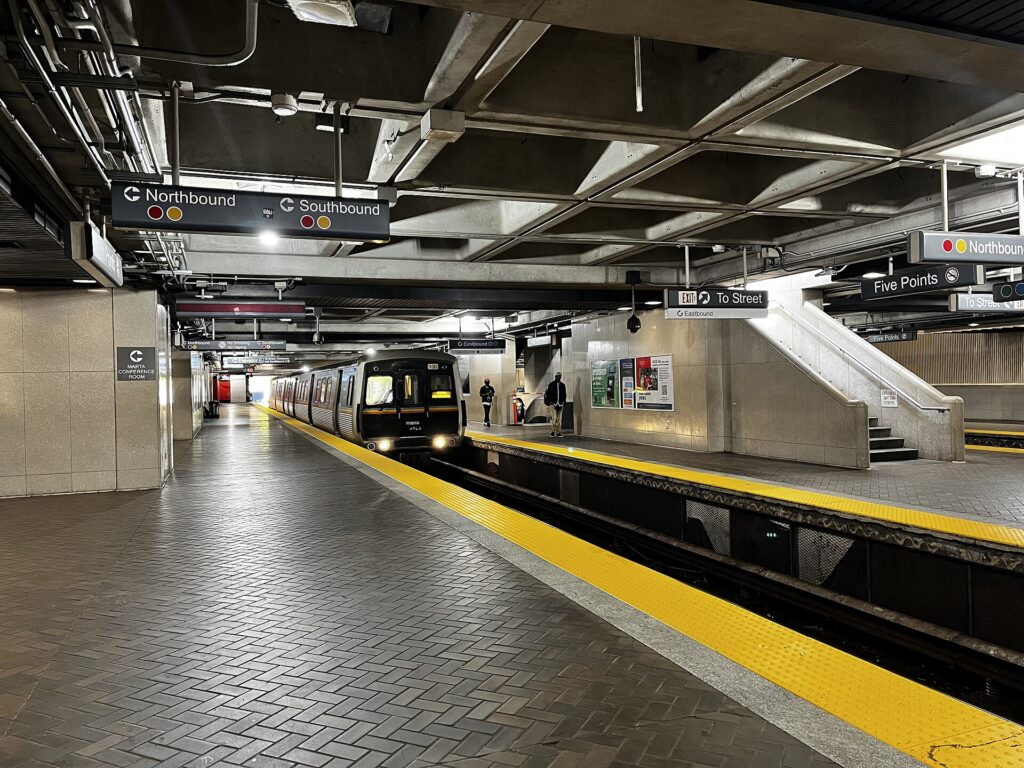
The Metropolitan Atlanta Rapid Transit Authority, MARTA, runs the heavy-rail network, the bus system and the downtown streetcar. The rail system is fast, reasonably frequent and, for a visitor based in the city core, genuinely useful: it links the airport, downtown, Midtown, Buckhead and Decatur, which covers most of the itinerary for a first trip. Its limitation is coverage. The lines run along a cross-shaped spine, many in-town neighborhoods are a long walk from a station, and the suburbs beyond are largely unserved by rail.
MARTA rail
Four lines, colored Red, Gold, Blue and Green, meet at Five Points downtown. The Red and Gold Lines run north-south: from the airport through College Park and East Point, through downtown (Garnett, Five Points, Peachtree Center, Civic Center), through Midtown (North Avenue, Midtown and Arts Center stations) and on to Lindbergh Center, where they split. The Red Line continues to Buckhead, the Medical Center and North Springs; the Gold Line serves Lenox, for Lenox Square, and continues to Doraville, near the international restaurants of Buford Highway. The Blue and Green Lines run east-west: west from Five Points past the GWCC and Vine City stations, for Mercedes-Benz Stadium and State Farm Arena, and east through King Memorial, for Sweet Auburn and Oakland Cemetery, and Inman Park/Reynoldstown, for Inman Park and Little Five Points, with the Blue Line continuing to Decatur. Trains typically run every 10 to 20 minutes depending on the line and the time of day, from early morning until around 1 a.m., less often on weekends.
Buses and the streetcar
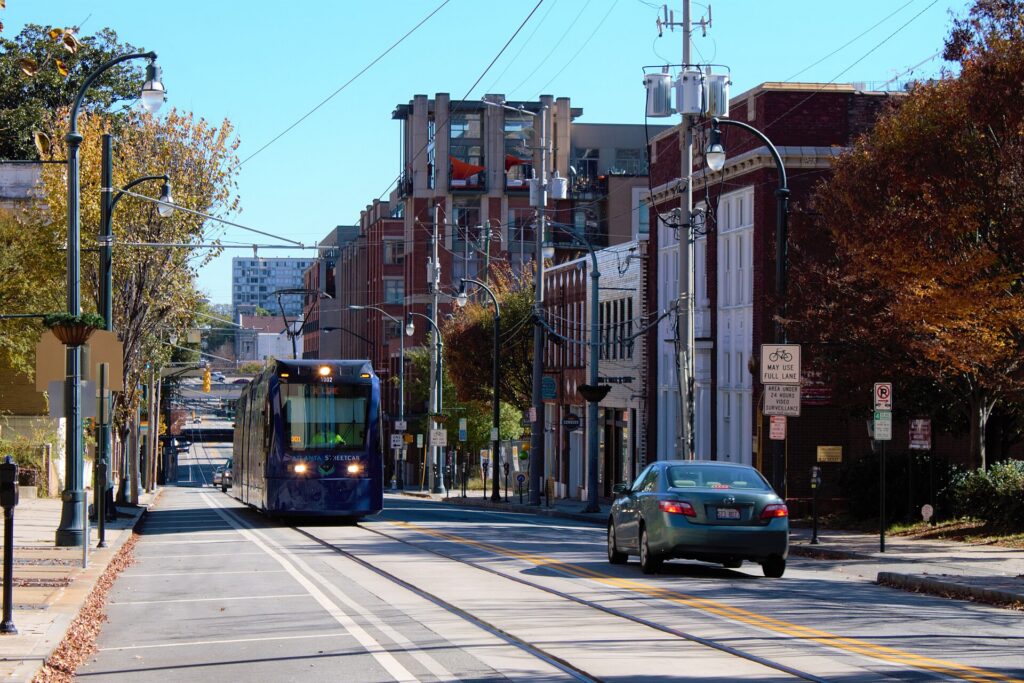
MARTA’s bus network fills in the gaps, including routes to the Atlanta History Center, Zoo Atlanta, Ponce City Market and the in-town neighborhoods, but it is slow and infrequent by big-city standards. The Atlanta Streetcar, run by MARTA, is a short loop through downtown that links Centennial Olympic Park with Peachtree Center and the Martin Luther King Jr. historic district on Auburn Avenue; it is slow, but it is the easiest way between the two biggest sight clusters downtown.
Fares and tickets
MARTA charges a flat fare for any ride, whatever the distance, and the fare includes transfers between trains and buses within a set time window, which makes the airport-to-Buckhead ride exceptional value. Pay with a reloadable Breeze card, sold with a small card fee at vending machines in every station, or through the Breeze mobile app; MARTA has been introducing contactless payment with bank cards and phones, so check the current options on its site before you travel. Multi-day passes are available and worth it for a busy sightseeing trip. Check MARTA’s site for current fares.
Accessibility
All MARTA rail stations have elevators and step-free access to the platforms, and buses are equipped with ramps or lifts. Elevator outages do happen, and MARTA posts them on its site and app; check before you rely on a particular station with luggage or a wheelchair.
Beyond MARTA
- Walking. Downtown, Midtown and the in-town neighborhoods are walkable within themselves, although the summer heat and the hills make distances feel longer than they look.
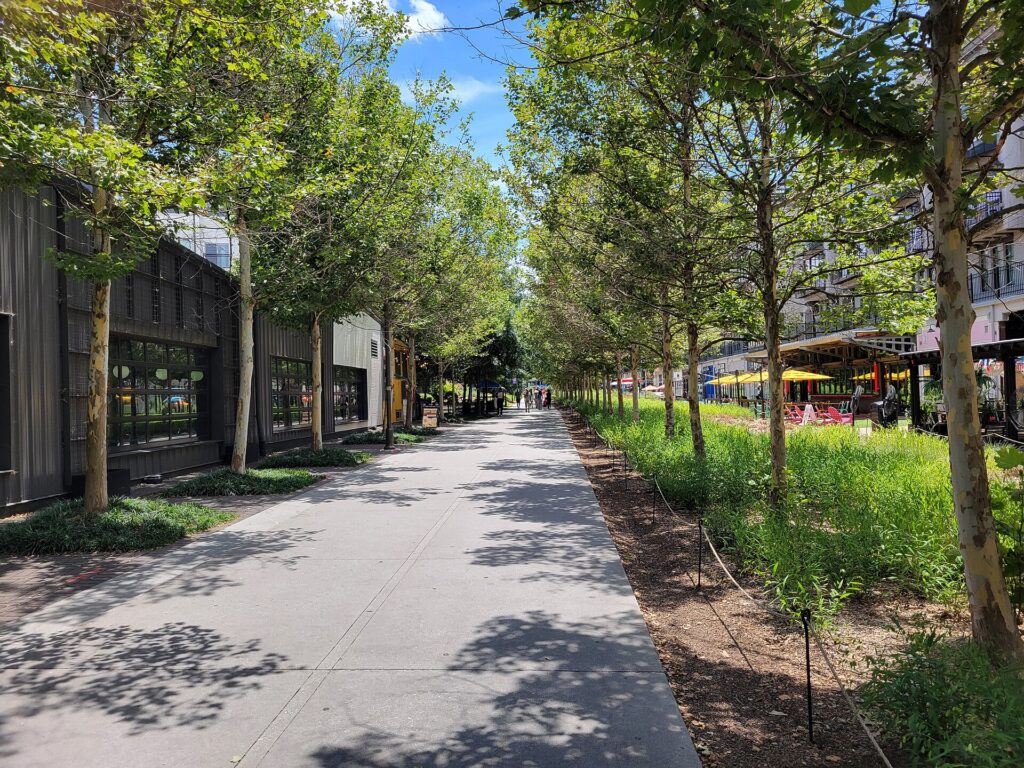
- The BeltLine. The Atlanta BeltLine‘s Eastside Trail is a paved, car-free path of about three miles that links Piedmont Park, Ponce City Market, the Old Fourth Ward, Inman Park and Krog Street Market. It is the best way to see those neighborhoods, on foot or by bike.
- Scooters and bikes. Shared e-scooters and e-bikes are widely available in the city core through the usual apps. The city has at times restricted scooter riding overnight, so check the app’s rules before you plan a late ride home.
- Taxis and ride-hail. Uber, Lyft and licensed taxis operate everywhere, and for trips between neighborhoods off the rail lines, Ponce City Market to Buckhead, or Midtown to the Westside, they are much quicker than the bus. Surge pricing after games and concerts at the stadium can be steep; walking to a MARTA station is usually faster anyway.
- Trains and intercity buses. Amtrak’s Crescent, between New York and New Orleans, calls daily at the Peachtree station north of Midtown; Amtrak has the schedule. Intercity buses connect Atlanta with cities across the Southeast.
Driving in Atlanta: what it is really like
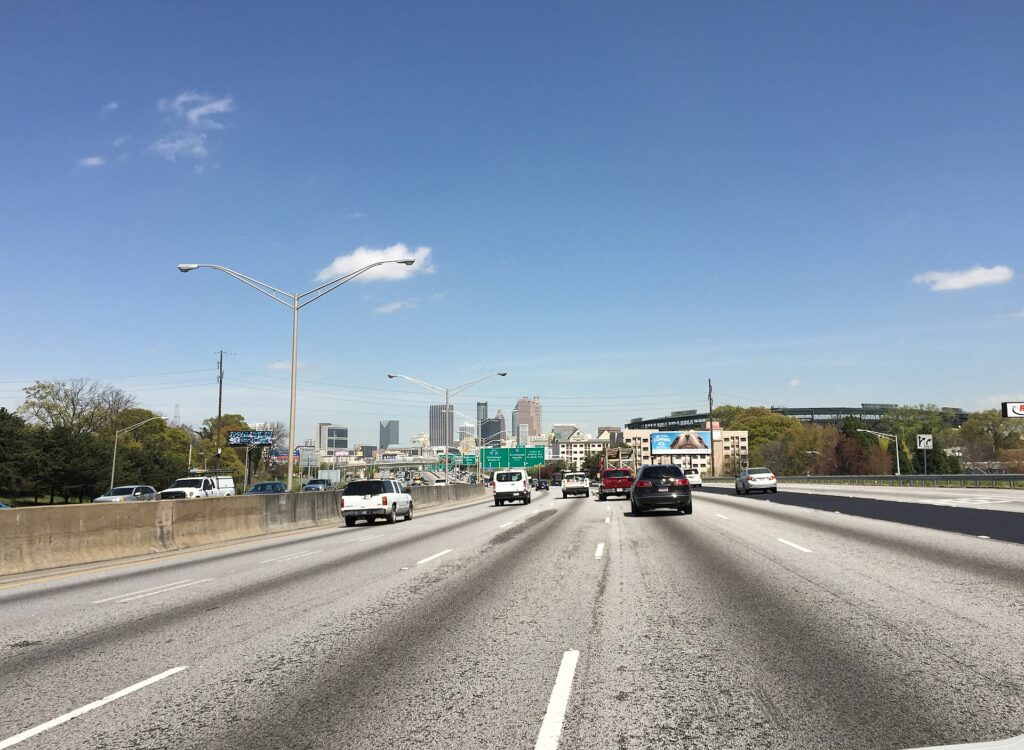
Atlanta’s traffic is among the worst in the country, and its reputation is earned on the freeways. The Downtown Connector, where I-75 and I-85 share a dozen or more lanes through the heart of the city, is one of the busiest stretches of road in the United States and crawls every weekday morning and afternoon. I-285, especially its northern arc through the business districts, and GA 400 through Buckhead are the other chronic bottlenecks, and any crash or rainstorm multiplies the delay. Rush hour runs roughly from 6 to 10 a.m. and from 3 to 7 p.m., and Friday afternoons are the worst of the week. Surface streets are less stressful but confusing, with changing names, one-way sections downtown, and those endless Peachtrees. On the plus side, drivers are generally courteous and parking outside the core is easy.
Parking
Parking is the hidden cost of a car in Atlanta. Downtown, Midtown and Buckhead hotels charge a substantial nightly fee, usually for valet, and it is rarely included in the room rate. Commercial lots and garages downtown are plentiful but priced up sharply on game and concert days near Mercedes-Benz Stadium and State Farm Arena. Street parking in the city core is metered, and most meters are paid through the ParkMobile app; read the signs carefully, because enforcement is strict and private lots are known for towing and booting quickly. Outside the core, at Stone Mountain, the malls, the Atlanta History Center and suburban attractions, parking is straightforward, although Stone Mountain Park charges a daily vehicle fee.
Rules and conditions worth knowing
- Hands-free law. Georgia bans holding or supporting a phone while driving; use a mount and voice controls.
- Express lanes. Several freeways have variably priced express lanes that require a Peach Pass transponder; Peach Pass explains how they work. With a rental car, either use the rental company’s toll program, which carries daily fees, or stay in the free general lanes.
- Move Over law. Georgia requires drivers to move over a lane, or slow down, for stopped emergency and service vehicles, including the state’s yellow HERO trucks that help stranded motorists on metro freeways.
- Right turns on red are permitted after a full stop unless signed otherwise.
- Cameras monitor school-zone speed limits and some intersections; fines follow the car, and the rental company will bill you with a fee on top.
- Storms and ice. Summer thunderstorms bring sudden downpours and flooded underpasses; slow down and never drive into standing water. A rare winter ice storm can make untreated roads treacherous; if one is forecast, stay put. Georgia 511 publishes traffic, closures and conditions.
- Fuel in Georgia is usually priced below the national average, one small point in the rental’s favor.
When renting a car makes sense
- A Braves game. Truist Park and The Battery are northwest of the city in Cobb County and not on the MARTA rail network; driving, with parking booked in advance, or a ride-hail are the realistic options.
- Stone Mountain, the Chattahoochee and Kennesaw Mountain. All are within 45 minutes of downtown and effectively car-only.
- Buford Highway. The Gold Line reaches Doraville, but the restaurants are strung out along miles of strip malls; a car makes an evening of it far easier.
- Day trips. The North Georgia mountains, Athens, Chattanooga and Callaway Gardens are all 90 minutes to two hours away and need a car.
- Staying in the suburbs or with family. Outside the MARTA corridors, a car is how the region works.
- Southern road trips. Atlanta to Charlotte, Chattanooga and Nashville, Savannah and the coast, or Birmingham; our Atlanta to Charlotte route guide covers the four-hour drive up I-85.
If any of those apply, our rental car booking tips cover insurance, deposits and the questions to ask at the counter, and our family car rental guide looks at vehicle choice.
When it does not
- You are staying downtown, in Midtown or in Buckhead near a MARTA station, and your plans are the city’s main sights.
- You are in town for a convention at the Georgia World Congress Center, a Falcons, Atlanta United or Hawks game, or a stadium concert, when downtown parking is at its most expensive and MARTA stops beside the venues.
- You are on a short trip or a long layover and want to see the MLK historic site or the aquarium between flights.
- You are traveling solo or as a couple, and the rental, the toll program and the hotel parking add up to more than a few ride-hail trips.
The hybrid plan for a city-plus-countryside trip
Go car-free for the city days and rent for the day trips, and think carefully about where you pick up. Renting at the airport’s Rental Car Center makes sense if you are heading straight out of the city on arrival, because the freeways are a few minutes away and you avoid the Downtown Connector. Renting from a downtown, Midtown or Buckhead location makes sense if you are spending the first nights in the city, because you avoid the airport’s concession fees and facility charges and the hotel parking on the nights you are not using the car. A pattern that works well: MARTA from the airport to a Midtown hotel, two or three car-free days, pick up a rental in the city for the day trips, and return it at the airport on the way to your flight, which most companies allow for little or no extra charge. Compare the day rates on our Atlanta car rental page against a full-trip rental and the difference is usually obvious.
A worked cost comparison
Numbers change with the season and the booking window, so treat this as a method rather than a quote, and check current rates before deciding. For a four-night city break in Midtown for two people, the car-free version costs two MARTA rides from the airport and back per person, a multi-day pass or a handful of single fares, and perhaps three or four ride-hail trips to Inman Park, the Westside or Buckhead; the rental version adds four days of a compact car, four nights of hotel valet parking, fuel, the airport fees and paid parking at every stop, and buys you very little you could not ride to. The transit option wins easily. For the same four nights with a Braves game and a day at Stone Mountain, the car-free version adds a round-trip ride-hail to Truist Park, which can surge after the game, and another to Stone Mountain; the hybrid version adds a two-day rental picked up in Midtown, fuel, stadium parking and the park’s vehicle fee. For two people the costs are often close; for a family of four the rental usually wins. For a week touring the North Georgia mountains, Chattanooga or the coast, a rental is the only practical answer, and the airport pickup, with its fees, is still simpler than a trip into the city to collect a car downtown. Run the rental rates for your dates on our Atlanta car rental page and put them beside the ride-hail estimates before you choose.
Driving out of Atlanta in each season
The roads out of Atlanta are easy once you clear the Perimeter, and the timing matters more than the route. In spring, the mountains are green and the waterfalls are full, but severe thunderstorms can bring sudden downpours, and spring-break traffic heading south on I-75 toward Florida jams on Friday afternoons and Saturday mornings. In summer, leave early for the mountains, the lakes and the Chattahoochee to beat the heat and the afternoon storms, and expect holiday weekends to fill every highway out of the city. In fall, the leaf season in the North Georgia mountains, from mid-October into early November, brings weekend traffic to GA 400 and the mountain towns that rivals a summer holiday; go mid-week if you can, and avoid the drive home on Sunday afternoon. In winter, the roads are usually clear and the traffic lighter, but the mountains can see snow and ice, and a rare ice storm in the city makes staying put the only sensible choice. In every season, time your departure and return to avoid the Downtown Connector and I-285 at rush hour, and check Georgia 511 before you set off.
Decision table
| Your trip | Recommendation | Why |
|---|---|---|
| City break downtown or in Midtown | No car | MARTA runs from the airport to both; hotel parking is expensive |
| Convention, Falcons, Hawks or Atlanta United game | No car | MARTA stops beside the venues; event parking is costly |
| Long layover | No car | The train from the terminal reaches downtown in about 20 minutes |
| City plus a Braves game or Stone Mountain | Hybrid: rent in the city for a day or two | Car-free city days, car for the places MARTA does not reach |
| North Georgia mountains, Athens or Chattanooga | Rent | Day trips of 90 minutes to two hours, with no practical transit |
| Family visit to the suburbs | Rent for the whole stay | Suburban distances make the car worthwhile daily |
| Family with young children | Rent, with a hotel that includes parking | Car seats, heat and spread-out attractions all argue for a car |
| Southern road trip | Rent (consider one-way to Charlotte or Savannah) | Atlanta is the start, not the destination |
Money-saving tips for both options
- On transit: take MARTA from the airport instead of a taxi; buy a multi-day pass for a busy trip; choose a hotel within a short walk of a station.
- On a rental: compare airport and city pickup, book early for spring break, Masters week and fall weekends, decline the toll program if you will stay out of the express lanes, decline extras you already have through a credit card or home policy (check first), and fill up before returning the car.
- On the hotel: if you are renting, price the parking fee into the room rate, and consider a hotel outside the core with free parking for the days you have the car.
- On timing: avoid the Downtown Connector and I-285 in the weekday peaks and on Friday afternoons; the best time to fly to Atlanta guide lists the busiest weekends, when traffic and parking are at their worst.
- On event days: ride MARTA to the stadium and the arena rather than paying event parking, and wait out the ride-hail surge with a drink nearby after the game.
Frequently asked questions
Is it worth renting a car in Atlanta?
For a city break based downtown, in Midtown or in Buckhead, no; MARTA and ride-hail cover it. For a Braves game, Stone Mountain, the suburbs, Buford Highway or day trips, yes.
Is MARTA good for tourists?
For the core, yes: it links the airport, downtown, Midtown, Buckhead and Decatur, and stops beside the stadium and the arena. It does not reach the Braves’ ballpark, most of the BeltLine or the suburbs.
How do I get from Atlanta airport to downtown?
The MARTA Red or Gold Line from the Airport station in the Domestic Terminal, about 20 minutes to Five Points, or a flat-rate taxi or a ride-hail in 20 to 30 minutes outside rush hour.
How do I pay for MARTA?
With a reloadable Breeze card from the station machines or through the Breeze app, and increasingly by contactless card or phone; the flat fare includes transfers between trains and buses within a set window.
Can I get to a Braves game on MARTA?
Not directly by train. Truist Park is in Cobb County, off the rail network; most fans drive or take a ride-hail.
Is parking expensive in Atlanta?
At downtown, Midtown and Buckhead hotels, and around the stadium on event days, yes. Outside the core, it is usually easy and often free.
Is it hard to drive in Atlanta?
The freeways are congested at rush hour, and the surface streets are confusing, but drivers are generally courteous. Avoid the peaks, use a navigation app, and stay out of the express lanes without a Peach Pass.
Whichever way you go, start with the flight. Compare cheap flights to Atlanta, choose a neighborhood with our Atlanta hotel search, and if a day trip or a Braves game is on the list, price the rental for those dates on our Atlanta car rental page. For what to see once you are there, our first-timer’s guide to Atlanta covers the whole city.
Keep planning with TicketScanner
- Atlanta car rentals — compare airport and in-town pickup
- Cheap flights to Atlanta
- Atlanta hotels — factor parking into the rate
- Things to do in Atlanta: a first-timer's guide
- Best time to fly to Atlanta: month by month
- Hartsfield-Jackson Atlanta (ATL) airport guide
- Where to stay: Midtown — on MARTA
- Driving Atlanta to Charlotte
- Rental car booking tips
- Car, transit or taxi in a new city?
Leave a Reply