Tag: Cheap Flights

  • How To Find Cheap Flights To Mexico City For Your Next Trip

    How To Find Cheap Flights To Mexico City For Your Next Trip

    Mexico City is one of the great cities of the Americas: a historic center built on the ruins of Tenochtitlan, museums that rank with any in the world, leafy neighborhoods full of cafés, and some of the best food you will eat anywhere, from street tacos to tasting menus. It is also a major airline hub, which is good news for anyone hunting for a fair price. Big hubs attract competition, and competition keeps fares honest. Finding a genuinely cheap flight still takes a method, though: choosing the right season, comparing airports and routings, understanding what each fare includes and knowing how the city’s two main airports differ. This guide walks through when to go, when to book, how to compare nonstop and connecting options from Canada and the United States, what the entry process looks like, how to get from the airport into the city, and how to keep the rest of the trip affordable. It is part of our flight booking series, which starts with our guide to the best time to book cheap flights and hotels.

    The short answer

    Travel outside the big holiday weeks, especially Christmas and New Year, Semana Santa (Holy Week) and the Día de Muertos period around the start of November, and you will usually find better fares and hotel rates. Book roughly two to four months ahead for ordinary dates and earlier for holidays. Search a range of dates and compare nonstop and one-stop options, because a sensible connection can be much cheaper. Check which airport your flight uses: Mexico City International (AICM, code MEX) is close to the city, while Felipe Ángeles International (AIFA, code NLU) is well to the north. Price the whole trip, with bags and seats included. And read the official entry requirements for your passport before you book. You can compare fares across a whole month on our flight search.
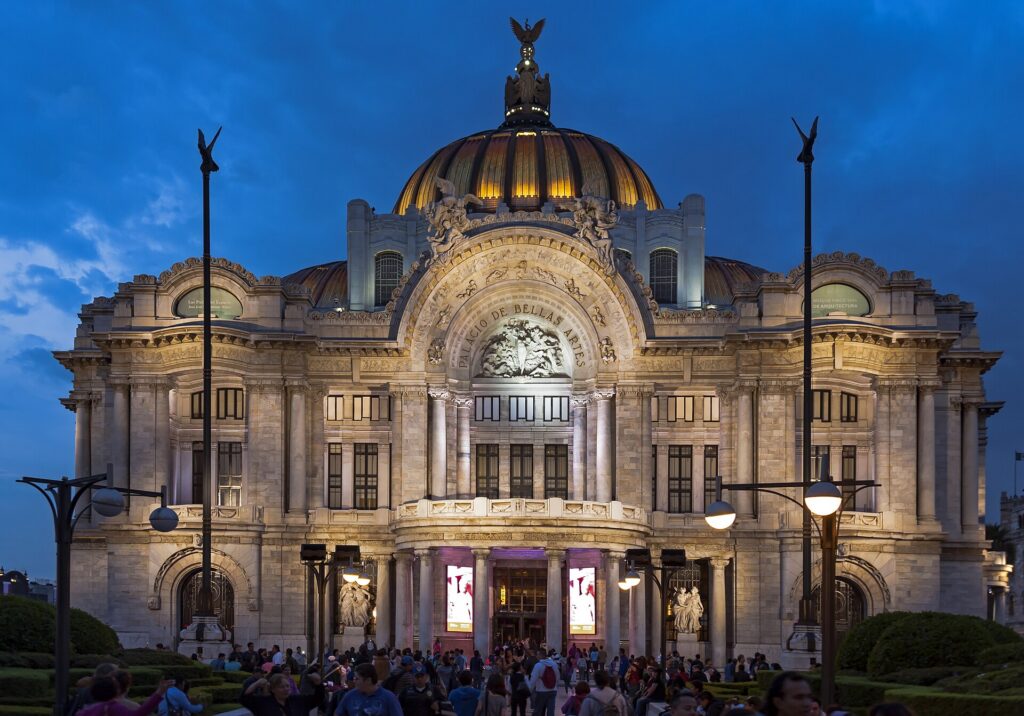
    The Palacio de Bellas Artes in Mexico City at dusk
    Mexico City's historic center is one of the great sights of the Americas (Photo: Daniel Case via Wikimedia Commons, CC BY-SA 3.0)

    When to visit Mexico City

    Mexico City sits in a high valley at about 2,240 meters, which gives it a mild climate year-round. It rarely gets very hot, and evenings can be cool at any time of year. The seasons that matter are wet and dry, not summer and winter.

    PeriodWeatherCrowds and prices
    November to FebruaryDry, sunny days and cool nights; the coolest monthsPopular with visitors from the north; Christmas and New Year are peak
    March to MayDry and the warmest time of year; spring can be hazySemana Santa is very busy and many locals travel; otherwise good value
    June to SeptemberRainy season, usually with afternoon or evening showers and sunny morningsOften the lowest prices outside summer school holidays
    OctoberRains tapering off, pleasant temperaturesBuilds toward Día de Muertos at the start of November, when demand rises

    For value, the rainy season can be surprisingly good: showers usually come later in the day, mornings are often clear, and the city is green. Pack a light rain jacket and plan museum visits for the afternoon. Visitors with respiratory conditions should note the Government of Canada’s advice that air pollution in Mexico City peaks between December and March.

    Holidays and events that move prices

    • Christmas and New Year: the busiest and most expensive period for flights from Canada and the United States.
    • Semana Santa: Holy Week, the week before Easter, when many Mexicans travel. Flights and hotels across the country get expensive.
    • Independence Day: celebrations on the night of September 15 and on September 16 bring big crowds to the historic center.
    • Día de Muertos: the Day of the Dead celebrations around November 1 and 2 are a major draw, with events and decorations throughout the city in the days before. Book early if you want to be there.
    • Summer school holidays: July and August bring family travel from the north and within Mexico.

    If you want the best balance of weather and price, look at late January and February outside long weekends, late April and May after Semana Santa, and the quieter weeks of the rainy season.

    When to book

    Flights from Canada and the United States to Mexico City behave like other medium-haul international routes. Use these windows as a guide, then book when a fare lands at or below the normal level for your route.

    TripSensible booking window
    Ordinary dates from the U.S.About 1 to 3 months ahead
    Ordinary dates from CanadaAbout 2 to 4 months ahead
    Christmas, New Year, Semana Santa, Día de MuertosAbout 4 to 6 months ahead, or as soon as your plans are firm
    Short noticePossible on a busy hub route, but rarely cheap on peak dates

    Start watching fares as soon as you know roughly when you want to go. Look at a month view to spot the cheap days, set a price alert, and book once you see a fare that matches or beats what you have been seeing. For flights to or from the United States booked at least seven days before departure, most airlines let you cancel within 24 hours without penalty, which gives you a day to double-check. Our international flights booking tips explain the wider strategy for trips abroad.

    Choosing your airports

    At the Mexico City end

    Mexico City now has two main airports, and it matters which one your ticket uses.

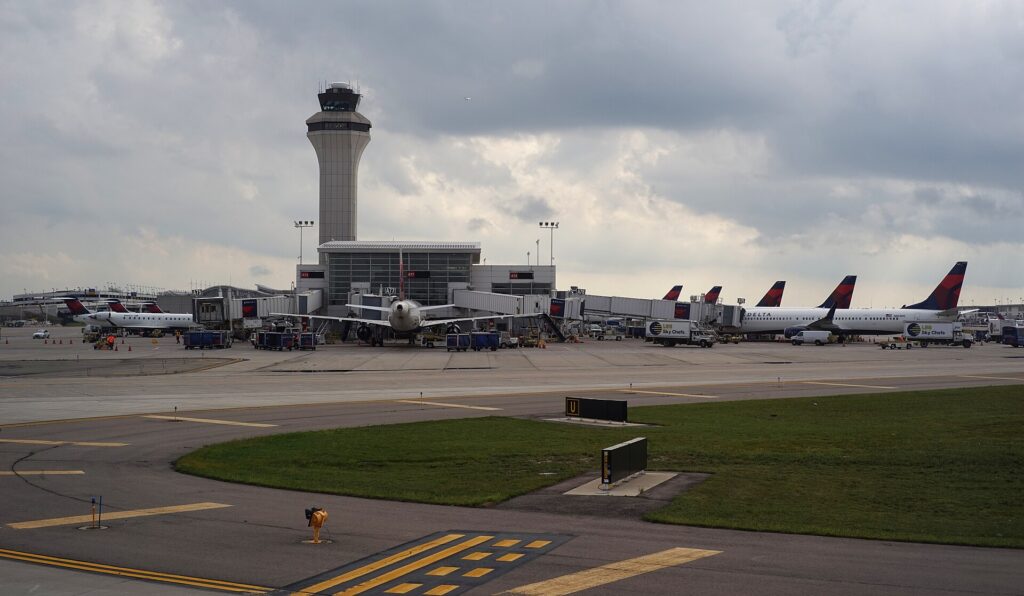
    • Mexico City International Airport (AICM, code MEX), officially Benito Juárez International, sits inside the city, east of the center. It has two terminals, Terminal 1 and Terminal 2, and handles most international flights. Being so close to neighborhoods like the Centro Histórico, Roma and Condesa, it is usually the most convenient choice. Check your terminal on your booking and on the airport’s official site.
    • Felipe Ángeles International Airport (AIFA, code NLU) opened in 2022 north of the city in the State of Mexico. Some domestic and a smaller number of international flights use it. It can be a good option if the fare is much lower, but the ground transfer to central Mexico City is much longer, and in traffic can take well over an hour.
    • Toluca International (TLC), west of the city, handles a small number of flights. It is rarely the right choice for a visitor unless the fare saving is large.

    When you compare fares, look at the airport code on each option. A cheaper flight into AIFA may cost you more in time and transport than it saves.

    At your end

    From Canada, Toronto, Montreal and Vancouver have typically had nonstop service to Mexico City; from other Canadian cities, you will usually connect, either through one of those airports or through a U.S. or Mexican hub. From the United States, many large hubs have nonstops, including cities such as Chicago, Dallas, Houston, Los Angeles, New York and Atlanta, and connections are easy from almost everywhere. Search from every airport you could realistically use, and remember to include the cost of getting there. Our flights from Toronto, flights from Montreal and flights from Vancouver pages are a good place to start from Canada.
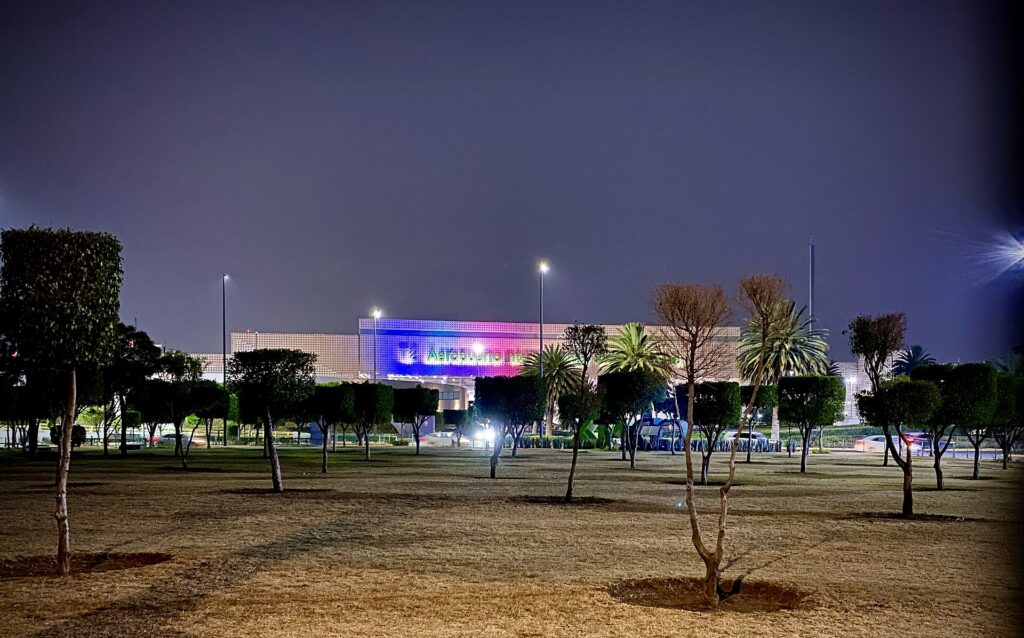
    Terminal 2 at Mexico City International Airport
    Check the airport code: AICM is inside the city, AIFA is well to the north (Photo: Sharon Hahn Darlin via Wikimedia Commons, CC BY 2.0)

    Nonstop or connecting?

    A nonstop flight is the easy choice when the price difference is small. A connection can make sense when the saving is significant or when nonstop times do not suit you. Weigh these points:

    • Total travel time. A connection can add several hours. Compare door-to-door time, not just the fare.
    • Connection length. Very short connections are risky, especially if you need to change terminals or clear immigration. Very long ones eat into the value of the saving.
    • Connecting through the United States. The U.S. has no international transit zone, so travelers connecting through a U.S. airport go through U.S. border formalities even if they never leave the airport. Canadians generally need only a valid passport, but travelers of other nationalities may need U.S. travel authorization. Allow extra time for the process.
    • One ticket or two. On a single ticket, the airline rebooks you if a delay makes you miss your connection. On two separate tickets, you are usually on your own. Avoid self-connecting on a tight schedule.
    • Checked bags. On a single ticket, bags are normally checked through to Mexico City, although you may need to collect and recheck them at your first point of entry in some countries. Ask at check-in.

    Comparing airlines and fares

    Mexico City is the main hub of Aeroméxico, Mexico’s flag carrier, and an important base for Mexican low-cost airlines such as Volaris and Viva Aerobus. Major U.S. and Canadian airlines also fly in from their hubs. That variety is the reason prices can be competitive, but it also means fares are structured very differently.

    Airline typeTypical strengthsWhat to check
    Full-service airlinesMore included, easier connections, loyalty benefitsWhether your fare type includes a checked bag and seat selection
    Low-cost airlinesLow base fares, especially on nonstop routesCarry-on and checked bag fees, seat fees and size limits
    Basic economy fares on any airlineThe lowest price on that flightNo changes, last boarding, possible carry-on restrictions

    Compare the total with the bags and seats you actually need. A slightly higher fare that includes a checked bag can easily beat a bare-bones one. Our carry-on size guide explains how to check limits, and our flight details guide explains fare brands and baggage allowances.

    Entry requirements: check before you book

    Entry rules change, and they depend on your passport, so always read the official page for your nationality before booking.

    • Canadians: the Government of Canada’s travel advice for Mexico says Canadian tourists do not need a visa for stays of up to 180 days, and that your passport must be valid for the expected duration of your stay. It also explains how arrival works: an officer may stamp your passport with your permitted stay, or you may be directed to an e-gate kiosk, and you may need to complete a digital migration form. Keep proof of your entry with you.
    • U.S. citizens: read the U.S. State Department’s Mexico country information page for passport and entry requirements.
    • Other nationalities: check Mexico’s requirements for your passport, and U.S. transit rules if you connect through the United States.

    The same government pages carry safety and health advice, including regional advisories within Mexico, so read them as part of your planning. The Canadian page notes that Mexico City’s altitude can affect some visitors; take it easy on your first day, drink water and talk to a doctor before you go if you have heart or lung conditions.

    Getting from the airport into the city

    From AICM, the main options are:

    • Authorized airport taxis. Buy a ticket at an official taxi booth inside the terminal, with the price based on your destination zone, then take it to the taxi rank. This is the simplest option for most first-time visitors, especially at night.
    • Ride-hailing apps. App-based rides operate in Mexico City; follow the airport signs to the designated pickup areas.
    • Metrobús and Metro. Metrobús Line 4 serves the airport terminals and runs toward the historic center, and the Metro has a station near Terminal 1. Public transit is very cheap but can be crowded, and it is awkward with large suitcases.
    • Hotel transfers. Some hotels arrange pickups; compare the price with an authorized taxi.

    From AIFA, allow much more time. Check the current transport options on the airport’s information before you fly, and weigh the cost of the transfer against the fare saving. Most visitors do not need a rental car in Mexico City itself: traffic is heavy, parking is limited, and taxis, apps and transit cover the areas you will want to see. A car can make sense for road trips beyond the city.
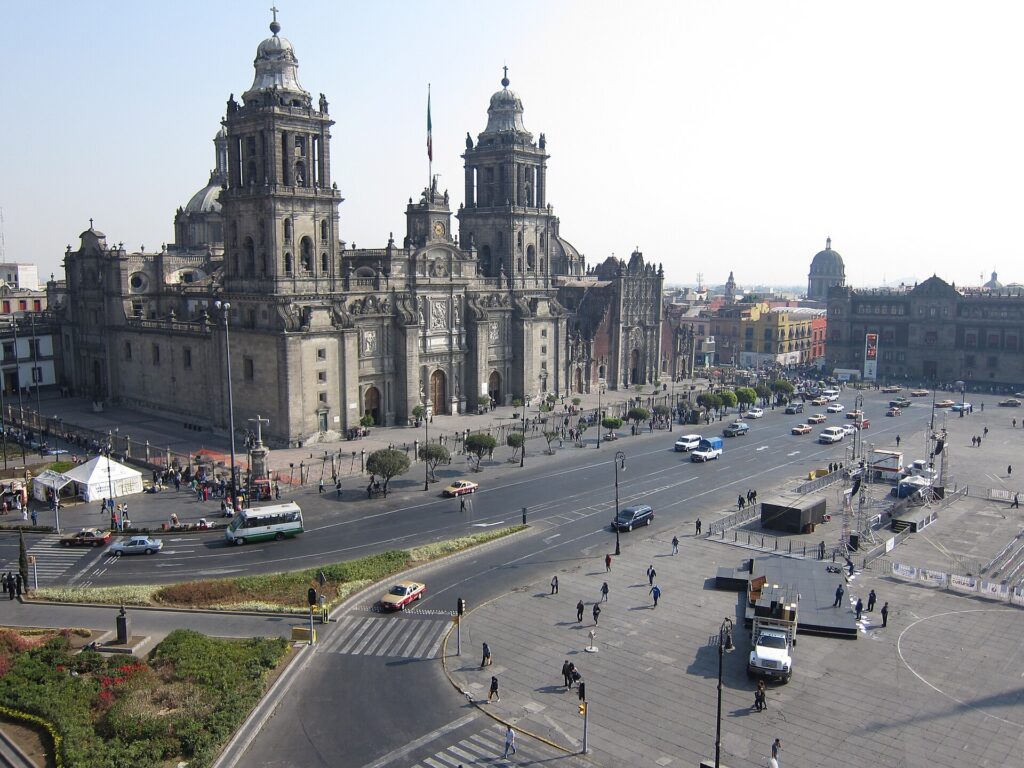
    The Zocalo and Metropolitan Cathedral in Mexico City
    The Centro Historico is a convenient base for first-time visitors (Photo: Jeff Kramer via Wikimedia Commons, CC BY 2.0)

    Where to stay, and how it affects your budget

    Hotel prices vary widely by neighborhood. Choosing the right base can save both money and hours in traffic.

    NeighborhoodWhy stay thereGood for
    Centro HistóricoWalking distance to the Zócalo, the cathedral, Templo Mayor and Bellas ArtesFirst-time visitors and sightseeing
    Roma Norte and CondesaTree-lined streets, parks, cafés, restaurants and nightlifeFood lovers and longer stays
    JuárezCentral, between the historic center and Roma, near Paseo de la ReformaEasy access to several areas
    PolancoUpscale hotels, shopping, fine dining, near Chapultepec Park and major museumsComfort and business travelers
    CoyoacánColonial streets, a relaxed pace, near the Frida Kahlo MuseumA quieter base, farther from the center

    Book a refundable room on our hotel search once your flight is set, then recheck the price before your cancellation deadline. Our hotel booking tips explain how to compare total prices.

    What to do once you are there

    You can fill a week in Mexico City without leaving the city limits. The highlights most visitors build a trip around:

    • The historic center: the Zócalo, one of the largest public squares in the world, the Metropolitan Cathedral, the ruins of the Templo Mayor and the Palacio de Bellas Artes.
    • Chapultepec: a vast park with Chapultepec Castle and the National Museum of Anthropology, one of the most important museums in the Americas. Give it at least half a day.
    • Coyoacán: the Frida Kahlo Museum, the Casa Azul, is hugely popular; buy timed tickets in advance.
    • Xochimilco: the canals in the south of the city, where colorful boats called trajineras carry groups along the water.
    • Teotihuacan: the pyramids of the Sun and Moon, an easy and very popular day trip northeast of the city. Start early to beat the heat and the crowds.
    • Food: markets, taco stands, bakeries and some of the most celebrated restaurants in Latin America. Eating well here does not have to be expensive.

    The city’s official tourism site, CDMX Travel from the Mexico City tourism ministry, lists attractions, neighborhoods and events.

    Keeping the rest of the trip affordable

    • Eat where locals eat. Markets, fondas serving set lunches and street stands offer excellent food for very little.
    • Use the free and low-cost sights. Walking the historic center, Chapultepec Park and many churches and public buildings costs nothing; some museums have free days for residents, so check.
    • Use transit or taxis wisely. Metro and Metrobús fares are very low; apps and authorized taxis are reasonably priced for longer trips.
    • Carry some pesos. Cards are widely accepted in hotels and restaurants, but markets and small vendors often prefer cash. Use bank ATMs inside branches or shopping centers.
    • Drink bottled or filtered water. Tap water is not recommended for drinking; most hotels provide bottled water.

    Mexico City or the beach?

    Many travelers from Canada and the United States think of Mexico as the beach. If you are deciding between a city trip and a resort, Mexico City often offers more to do for the money, with lower hotel prices outside the luxury end and a cooler climate. A beach resort offers rest and sun. Some travelers combine both, flying into Mexico City and continuing to the coast on a domestic flight. If the beach is calling, our guides to the best time to fly to Cancun and things to do in Cancun cover the Caribbean side, and you can compare fares on Cancun flights. For more ideas on stretching your budget, see our list of budget travel destinations.

    Use alerts, points and flexibility together

    The travelers who find the best fares to Mexico City usually combine several small habits rather than relying on one trick.

    • Set alerts on more than one route. If you could fly from two or three airports, watch all of them. A fare drop from a nearby city might beat your home airport.
    • Consider one-way fares. Flying out on one airline and back on another can sometimes give better times or a lower total, especially when low-cost airlines are involved. Compare with a round trip before booking.
    • Price points against cash. Loyalty points can be good value on routes where cash fares are high, such as holiday dates. Compare the points price and taxes with the cash fare before redeeming.
    • Stay flexible by a day or two. Moving your departure by a single day can drop the fare to a cheaper level.
    • Book the hotel on a refundable rate. Once the flight is set, a flexible room lets you rebook if prices fall.

    Common mistakes to avoid

    • Not checking the airport code. A flight into AIFA instead of AICM can mean a much longer transfer.
    • Booking during Semana Santa or Día de Muertos without meaning to. Check the calendar before choosing dates.
    • Comparing base fares instead of totals. Add bags and seats, especially on low-cost airlines.
    • Tight connections through a U.S. airport. Border formalities take time.
    • Ignoring the altitude. Plan a lighter first day.
    • Skipping the travel advice. Read your government’s page for Mexico before you book and again before you fly.
    • Arriving too late for check-in. International check-in deadlines are earlier than domestic ones; our guide on how early to arrive for an international flight explains why.

    An aerial view of Chapultepec Castle on its hill in Chapultepec Park, Mexico City
    Chapultepec Park holds the castle and the National Museum of Anthropology (Photo: ProtoplasmaKid via Wikimedia Commons, CC BY 4.0)

    Frequently asked questions

    What is the cheapest time to fly to Mexico City?

    Outside the major holiday periods: late January and February outside long weekends, late April and May after Semana Santa, and the quieter weeks of the rainy season often have better fares. Check a fare calendar for your route.

    How far ahead should I book a flight to Mexico City?

    About one to three months ahead from the United States and two to four months ahead from Canada for ordinary dates, and earlier for Christmas, Semana Santa and Día de Muertos.

    Which airport should I fly into?

    For most visitors, Mexico City International (AICM, MEX) is the most convenient because it is inside the city. Felipe Ángeles (AIFA, NLU) is much farther north, so only choose it if the saving justifies the longer transfer.

    Do Canadians need a visa for Mexico?

    According to the Government of Canada, Canadian tourists do not need a visa for stays of up to 180 days. Entry rules can change, so check the official travel advice before you book and before you fly.

    Is it cheaper to connect through the United States?

    Sometimes. A connection through a U.S. hub can be cheaper than a nonstop, but you will go through U.S. border formalities during the connection, so allow enough time and check any travel authorization your passport requires.

    Is the rainy season a bad time to visit?

    Not necessarily. Rain usually comes in the afternoon or evening, mornings are often clear, and prices can be lower. Pack a rain jacket and plan indoor visits for later in the day.

    Do I need a rental car in Mexico City?

    Usually not. Traffic is heavy and parking is limited, while taxis, ride-hailing apps, the Metro and Metrobús cover the main areas. A car can be useful for trips outside the city.

    How do I get from the airport to my hotel?

    From AICM, an authorized taxi bought at an official booth inside the terminal is the simplest option. Ride-hailing apps, Metrobús Line 4 and the Metro are alternatives.

    Ready to plan your trip? Search a whole month of fares to Mexico City on our flight search to find the cheapest days and routings, then compare rooms in the neighborhood that suits you on our hotel search. For the bigger picture on timing, read our guide to the best time to book cheap flights and hotels.

  • Best Time to Fly to Salt Lake City: Seasons, Weather & Prices

    Best Time to Fly to Salt Lake City: Seasons, Weather & Prices

    Salt Lake City runs on two calendars at once, and its airfares follow both. In winter it is the most convenient ski gateway in North America, with seven resorts within about an hour of the terminal and powder that draws skiers from both coasts and from overseas. From spring to fall it is one of the two main gateways, with Las Vegas, to Utah’s national parks, and road-trippers pour through on their way to Arches, Bryce Canyon and Zion. Layer on top of that a Delta hub that makes the airport one of the best connected in the West, twice-yearly church conferences that fill every downtown hotel, a July holiday that belongs to Utah alone, and a winter weather pattern, the valley inversion, that no temperature table can show, and you have a city where the “best time” depends entirely on why you are going. This guide walks through the weather month by month, the fare seasons, the events and holidays that move prices, and how to handle the airport.

    The short answer

    For the city and the canyons without skis, the best value-and-weather windows are mid-May to mid-June, before the summer heat and the peak road-trip season, and mid-September to mid-October, when the canyons turn gold and red, the air is clear and the national parks are at their most comfortable. For skiing, January outside the holiday weekends and early March combine deep snow with fares below the Christmas and Presidents’ Day peaks. The cheapest fares usually come in late April and May, when the ski season is over and the summer has not started, in November before Thanksgiving, and in early December. The most expensive stretches are the Christmas and New Year ski weeks, the Martin Luther King Jr. and Presidents’ Day weekends, March spring-break weeks, and June to August generally, when the parks drive demand. Whatever you choose, run a flexible-date search on our Salt Lake City flights page; a shift of a few days around a holiday weekend or a General Conference can change the fare band entirely.
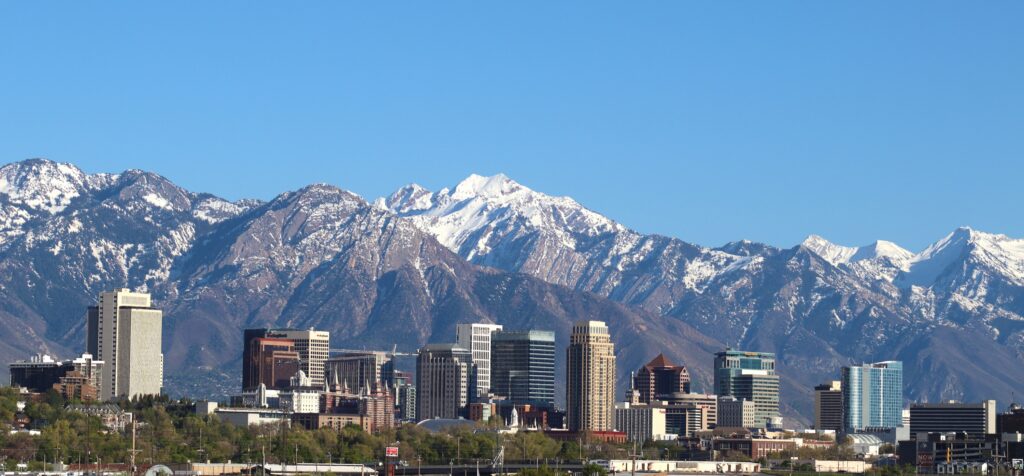
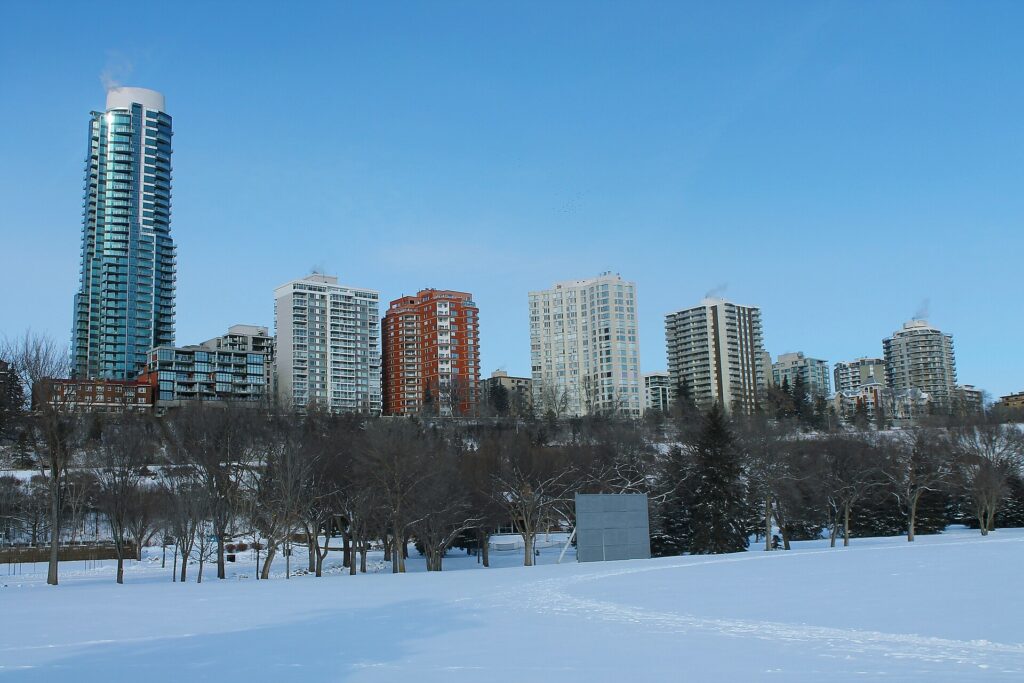
    The downtown Salt Lake City skyline with the Wasatch Mountains behind
    Downtown Salt Lake City with the Wasatch Range behind (Photo: Invictus323 via Wikimedia Commons, CC BY 4.0)

    Salt Lake City’s weather, season by season

    Salt Lake City sits about 1,300 m (4,300 feet) above sea level on the floor of a valley between the Wasatch Range to the east and the Oquirrh Mountains to the west, with the Great Salt Lake to the northwest. That gives it a semi-arid climate with four distinct seasons: hot, dry summers, cold winters with regular snow, and short, changeable springs and falls, while the ski areas a few thousand feet higher are far colder and snowier than the city. The figures below are approximate seasonal patterns based on the long-term climate normals from NOAA’s National Weather Service office in Salt Lake City; check the current forecast before you pack, because a storm can drop the temperature sharply in a few hours, and the mountains are always colder than the valley.

    MonthTypical daytime highTypical overnight lowWhat it feels likeFare pressure
    Januaryaround 3 °C (38 °F)around -5 °C (23 °F)Cold, often gray in the valley during inversions; deep powder in the mountainsHigh for MLK weekend, otherwise moderate
    Februaryaround 7 °C (44 °F)around -3 °C (27 °F)Still wintry; storms alternate with clear, cold daysModerate; Presidents’ Day spike
    Marcharound 12 °C (54 °F)around 1 °C (34 °F)Mild in the city, often big snow in the canyons; longer days on the slopesHigh during spring-break weeks
    Aprilaround 16 °C (61 °F)around 4 °C (40 °F)Changeable; blossom in the valley, spring skiing up high, late snow possibleModerate early, falling as the resorts close
    Mayaround 22 °C (72 °F)around 9 °C (49 °F)Green and pleasant; spring showers; high trails still snowboundLow to moderate; rises for Memorial Day
    Junearound 28 °C (83 °F)around 14 °C (58 °F)Warm, dry and sunny; the canyons are green and coolHigh
    Julyaround 34 °C (93 °F)around 19 °C (67 °F)Hot and dry; afternoon thunderstorms late in the monthPeak
    Augustaround 33 °C (91 °F)around 18 °C (65 °F)Hot; monsoon storms; wildfire smoke possible in some yearsHigh, easing late in the month
    Septemberaround 27 °C (80 °F)around 13 °C (55 °F)Often the best month: warm, dry and clear; fall color begins up highModerate, falling after Labor Day
    Octoberaround 18 °C (65 °F)around 6 °C (42 °F)Crisp and bright; peak canyon color early; first snow in the mountainsLow to moderate
    Novemberaround 10 °C (50 °F)around -1 °C (31 °F)Cooling fast; the first valley snow; ski areas open late in the monthLow, then high for Thanksgiving
    Decemberaround 3 °C (38 °F)around -5 °C (23 °F)Cold and festive; inversions begin; the mountains are in full winterLow early, then peak for the holidays

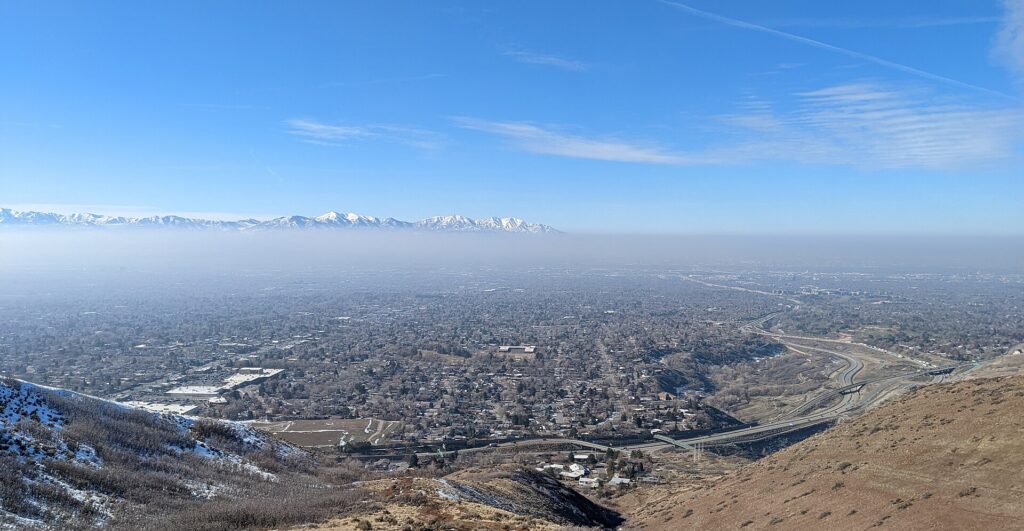
    Three things the table cannot show. First, the inversion: on calm winter days a layer of cold air settles in the valley under warmer air above, trapping haze and pollution over the city for days at a time, sometimes a week or more, until a storm clears it. The city can sit under a gray lid at freezing point while the ski resorts twenty minutes up the canyons are in bright sunshine, which is one more reason to go uphill. Second, the snow: the Wasatch receives far more snow than the valley floor, and it is famously light and dry, partly thanks to the lake, which can add moisture to passing storms. The city might see a dusting while Alta measures a foot. Third, the dry heat and the sun: summer days feel less oppressive than the numbers suggest because the humidity is low, but the sun at altitude burns quickly, nights cool off, and you will drink more water than you planned.

    How Salt Lake City’s fare seasons work

    Three calendars drive seats into Salt Lake City: the ski season, which pulls visitors from late November to April and peaks on holiday weekends; the national parks and road-trip season, which runs from spring to fall and peaks in summer; and the city’s own calendar of conventions, church conferences and events. Behind all three is the Delta hub, which gives the airport more nonstop routes than a metro area of its size would normally support and keeps competition healthy on the big domestic routes, with Southwest, United, American, Alaska and several low-cost carriers also serving the city. The result is a double-peaked year, with winter holiday spikes and a long summer plateau, and two genuine shoulder seasons in between.

    Peak season

    Roughly December 20 to January 3, the Martin Luther King Jr. weekend in mid-January, Presidents’ Day weekend in mid-February, the March spring-break weeks, and June through mid-August. The winter peaks are driven by skiers and are sharpest at the canyon and Park City lodging, which spills over into city hotels; the summer peak is driven by national park road trips, family travel and the long July holiday stretch that includes both Independence Day and Pioneer Day. If you must travel in peak, book early, fly mid-week, and compare Park City lodging against a city hotel with a rental car.

    Shoulder season

    Mid-April to early June and September to October. April offers spring skiing at the higher resorts and blossom in the valley; late May and early June offer green canyons, pleasant heat and the parks before the summer crowds. September and October are the best months of the year for many visitors: settled weather, spectacular fall color in Big Cottonwood Canyon and along the Alpine Loop, and the southern parks at their most comfortable temperatures. Watch Memorial Day, Labor Day, the October General Conference weekend and Utah’s school fall break.

    Low season

    Late April and May in the mountain towns, which locals call mud season, November before Thanksgiving, and the first half of December. Fares are at their lowest, city hotels discount, and the ski resorts are either closed or just opening. Early December can be excellent value for skiers if the early storms have delivered, but it is a gamble; the higher resorts, such as Alta, Snowbird and Brighton, are the safer bets for early snow.

    As elsewhere, mid-week departures and early or late flights usually price below Friday and Sunday afternoons on the same route, and a search across a whole month reveals cheaper pairs of dates close to your first choice. Our guide to the best times to book explains how to read those patterns.

    Salt Lake City month by month

    January

    Deep winter and prime powder. The resorts are in full swing after the Christmas rush, and the weeks after New Year’s are among the best value of the ski season, apart from the Martin Luther King Jr. Day weekend (the third Monday of January), a big ski-travel weekend. January is also peak inversion season, so the city can be gray and cold while the mountains are sunny. The Sundance Film Festival, long held in Park City in late January and a major driver of Park City prices, is moving to Boulder, Colorado, from 2027, so late-January demand in the Park City area may ease; check before assuming.

    February

    Similar conditions with more daylight, reliable snow and low-to-moderate fares outside the Presidents’ Day weekend (the third Monday of February), one of the busiest ski weekends of the year. Weekdays in early and late February are some of the best ski value in the calendar, and the Jazz and the Mammoth are both at home through the month.

    March

    Often the snowiest month in the mountains, with big spring storms and longer, warmer days, which makes it many skiers’ favorite. It is also the month of spring break, when school holidays across the country send families to the slopes over several weeks; fares and lodging rise sharply in those weeks. In the valley, March brings the first mild days and blossom.

    April

    A month of transitions. The resorts close one by one, with Snowbird and some higher mountains often open into late spring, while the valley turns green and the orchards and the cherry trees at the Capitol bloom. The church’s General Conference, held on the first weekend of April, fills downtown hotels and adds crowds around Temple Square. Otherwise fares fall steadily through the month.

    May

    One of the best value months. The valley is green and warm, the canyons are waterfalls of snowmelt, and the southern national parks are pleasant before the summer heat, though the high country above about 2,700 m (9,000 feet) is often still under snow. Fares are low apart from the Memorial Day weekend at the end of the month.

    June

    Summer arrives with long days and dry heat. The Utah Arts Festival fills Library Square in late June, Utah Pride takes over downtown in early June, and the canyon trails open as the snow melts. Fares step up through the month as school ends and road-trip season begins in earnest.

    July

    Peak summer and peak heat. Independence Day is followed three weeks later by Pioneer Day on July 24, a Utah state holiday commemorating the arrival of the first pioneers in 1847, with a big downtown parade, rodeos and fireworks; for Utahns it is a bigger celebration than the Fourth. The canyons and Park City offer cooler air, and the southern parks are very hot. Fares are at their summer high.

    August

    Hot, with late-summer monsoon thunderstorms that can bring flash floods to the southern slot canyons, and wildfire smoke in some years. Fares ease in the second half as schools across the West return, which in Utah happens earlier than in many states. Late August is a good value window for the parks if you can handle the heat.

    September

    The month many locals would send you to: warm, dry, clear and calm, with the summer crowds thinning after Labor Day. The Utah State Fair runs in early September, the aspens start to turn at high elevation by late in the month, and the southern parks become comfortable for hiking again. Fares are moderate and falling.

    October

    Crisp, bright and often spectacular, with the canyon color peaking early in the month. The October General Conference weekend (the first weekend of the month) is the one date to book around downtown, and Utah’s school fall break brings a brief family-travel bump. The first snow usually dusts the peaks, and fares are low to moderate.

    November

    Winter arrives. The first snow often reaches the valley, the resorts open from about Thanksgiving depending on the snow, and fares and hotel rates are among the lowest of the year, with the exception of the Thanksgiving weekend itself, which is a heavy travel period nationally.

    December

    Two months in one. The first half continues November’s low pricing, with the holiday lights around Temple Square and City Creek and early-season skiing on reduced terrain. From about December 20, fares and lodging jump for the Christmas and New Year ski weeks, which are the most expensive of the year in Park City and the canyons.

    Winter inversion haze lying over the Salt Lake Valley
    Salt Lake City in winter: snowy, cold and sometimes hazy under an inversion while the mountains above are in sunshine (Photo: Derrellwilliams via Wikimedia Commons, CC BY-SA 4.0)

    Events that move Salt Lake City flight and hotel prices

    Cross-check these against your dates before you book. Exact dates shift each year; Visit Salt Lake keeps the current calendar.

    • Christmas to New Year: the peak of the ski season and the most expensive stretch of the year.
    • Martin Luther King Jr. weekend (third Monday of January) and Presidents’ Day weekend (third Monday of February): the biggest ski weekends.
    • Spring break (March, varying by school district across the country).
    • General Conference (first weekends of April and October): downtown hotels fill with visitors from around the world.
    • The Salt Lake Temple open house: the church plans a public open house for the renovated temple before its rededication, which is likely to raise demand for downtown hotels for as long as it runs; check Temple Square’s site for the dates.
    • Memorial Day, Independence Day and Pioneer Day (July 24).
    • Labor Day weekend and Utah’s school fall break in October.
    • Thanksgiving weekend, and the resort opening weekends around it.
    • Jazz and Mammoth home games, University of Utah football Saturdays, big concerts and conventions at the Salt Palace. Our Salt Lake City events page shows what is on sale for your dates.

    Getting in from the airport

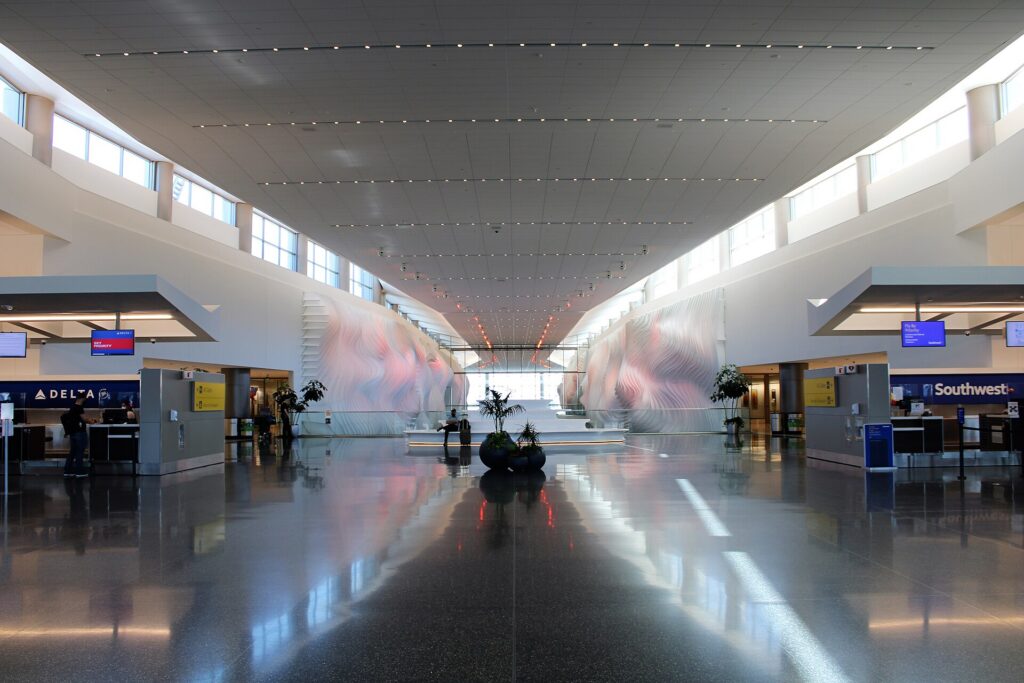
    Salt Lake City has one commercial airport, Salt Lake City International (SLC), about 6 kilometers (4 miles) west of downtown, which makes it one of the closest major airports to its city center in the country. It was rebuilt from scratch as a single terminal with long concourses, opened in phases from 2020; the new building is bright and spacious, but the walk from security to the far gates is long, so allow extra time. Delta runs one of its main hubs here, with nonstop flights to most large US cities and a handful of international routes, and the other major and low-cost airlines serve the big domestic markets. Getting downtown: the TRAX Green Line light rail runs from the station beside the terminal to downtown in about 20 minutes, taxis and ride-hail pick up at the terminal, and the drive downtown takes 10 to 20 minutes outside rush hour. The rental counters are in the garage facing the terminal. For skiers, shuttle companies run to Park City and the canyon resorts, and the drive to the nearest lifts is under an hour. Our Salt Lake City car-versus-transit guide works through the rental decision, and our SLC airport guide covers the layout.

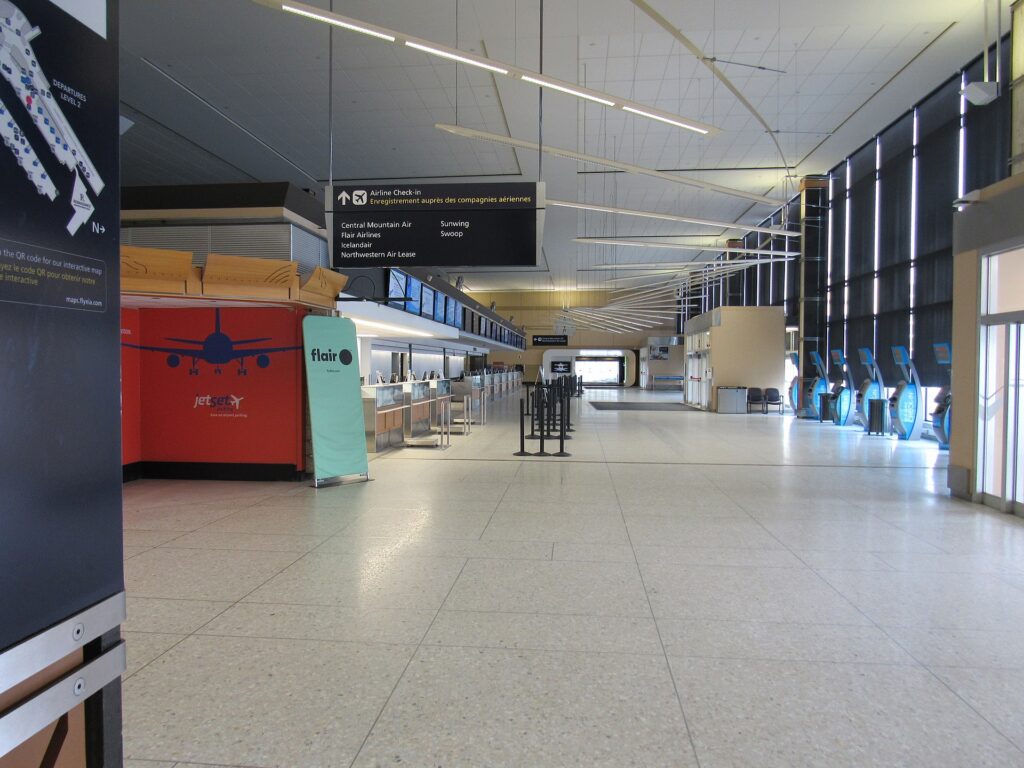
    Inside the new terminal at Salt Lake City International Airport (SLC)
    Salt Lake City International (SLC), rebuilt from 2020 and only about 20 minutes from downtown by TRAX (Photo: Farragutful via Wikimedia Commons, CC BY-SA 4.0)

    Timing tricks that work for Salt Lake City

    • Search the whole month. Holiday weekends create sharp edges in the fare calendar. A calendar search on TicketScanner shows them instantly, and the week after Presidents’ Day or MLK weekend is often much cheaper than the weekend itself.
    • Price lodging before the flight in ski season. A cheap fare into a holiday week is not cheap once a slopeside room is added. Compare a Salt Lake City hotel search with a rental car against canyon or Park City lodging for the same dates.
    • Use the hub. Delta’s network means nonstop flights from many mid-sized cities, and competition on the big routes from Los Angeles, Denver, Phoenix, Seattle and the Bay Area keeps fares reasonable outside the peaks.
    • Consider an open-jaw park trip. Fly into Salt Lake City and out of Las Vegas, or the reverse, and drive through Arches, Capitol Reef, Bryce Canyon and Zion on the way; compare flights to Las Vegas and the one-way rental fee before you commit.
    • Or pair it with Denver. The drive between the two cities takes about eight hours; our Denver to Salt Lake City route guide covers it, and our guide to the best time to fly to Denver shows how that city’s seasons line up.
    • Build a winter buffer. Snowstorms can disrupt SLC and close the canyon roads between December and March; avoid the tightest connections and leave a spare morning before an important flight home. Our guide to how early to arrive covers what to allow.
    • Flying out of Salt Lake City instead? The same seasonality applies in reverse; see cheap flights from Salt Lake City.
    Delicate Arch in Arches National Park at sunset, with the La Sal Mountains behind
    Arches National Park, about four hours from Salt Lake City and one reason summer fares stay high (Photo: Arches National Park via Wikimedia Commons, Public domain)

    What to pack, by season

    Winter (December to March): a warm, waterproof coat, hat, gloves and boots with grip for the city, and full ski layers for the mountains, where temperatures are much lower. Sunglasses and sunscreen matter on bright snow. Spring (April to May): layers and a rain shell, with a warm layer for late cold snaps and the high canyons. Summer (June to August): light, breathable clothing, a wide-brimmed hat, strong sunscreen and a refillable water bottle, plus a fleece for canyon evenings and a rain shell for afternoon storms. Fall (September to October): layers again, a warm jacket by late October, and hiking shoes for the canyon trails. For the national parks in any season, add sturdy footwear and more water than you think you need.

    The best time to fly to Salt Lake City for…

    Skiing

    Mid-January to early March outside the holiday weekends, for the best snow and value; March for longer days and big storms; early December only if you are flexible and watching the snow reports.

    The national parks

    Late April to early June and mid-September to late October, when temperatures in the southern parks are comfortable and the crowds are thinner than in summer. Check Arches and the other parks’ own pages for any reservation systems in force.

    Fall color

    Late September to mid-October, when the aspens and maples turn in Big Cottonwood Canyon, along the Alpine Loop and around Park City.

    The lowest fares

    Late April and May, November before Thanksgiving, and early December. Pair with a city break, a museum trip or the parks.

    Temple Square and church events

    Book early for General Conference weekends and the temple open house once its dates are set, and consider staying outside downtown if the center is full; TRAX makes it easy to get in.

    International visitors

    Visitors from Visa Waiver Program countries need an approved ESTA before boarding; most others need a visa. The State Department’s travel site explains what applies to you, and the TSA lists what you can carry through security. Many international visitors connect through another US hub; clear immigration at your first point of entry and allow for it in your connection time.

    Frequently asked questions

    What is the cheapest month to fly to Salt Lake City?

    Late April and May are consistently among the lowest, along with November before Thanksgiving and the first half of December.

    What is the best month to visit Salt Lake City for weather?

    September, with late May, early June and early October close behind. July and August are hot; December and January can bring inversion haze in the valley.

    What is the best month to ski in Utah?

    February and March usually offer the deepest base and reliable storms, and weekdays outside Presidents’ Day and spring break are the best value. January has excellent snow but more inversion days in the valley.

    What is an inversion?

    A winter weather pattern in which cold air is trapped in the valley beneath warmer air above, holding haze and pollution over the city until a storm clears it. The mountains above are often sunny while it lasts.

    Should I fly into Salt Lake City or Las Vegas for the national parks?

    Salt Lake City is closer to Arches, Canyonlands and Capitol Reef; Las Vegas is closer to Zion. For a loop through all five, fly into one and out of the other.

    How far ahead should I book?

    Earliest for the Christmas ski weeks, the holiday weekends, spring break and General Conference, when fares and lodging tend only to rise; for the shoulder months, fares are stable enough that finding the right dates matters more than booking early.

    Does it snow in Salt Lake City?

    Yes, regularly from November to March in the valley, though it often melts within days; the mountains above get many times more, which is why the skiing is so good.

    Ready to pick your dates? Compare fares across the whole month on our Salt Lake City flights page, then find a room with our Salt Lake City hotel search. For what to do when you land, start with our first-timer’s guide to Salt Lake City.

  • Best Time to Fly to Charlotte: Seasons, Weather & Prices

    Best Time to Fly to Charlotte: Seasons, Weather & Prices

    Charlotte’s airfares follow a different logic from most American cities. Charlotte Douglas is one of American Airlines’ biggest hubs, and most of the people on the planes are connecting to somewhere else, which means the price of a ticket to Charlotte itself depends as much on the airline’s network as on the city’s own calendar. That calendar matters too: a long, humid summer, a spring and fall that are among the most pleasant in the country, a NASCAR race on Memorial Day weekend that draws one of the biggest crowds in American sport, NFL and college football from September to January, and a convention and banking calendar that fills Uptown hotels on weeknights. This guide walks through the weather month by month, the fare seasons, the events that move prices, and how to handle one of the busiest connecting airports in the world.

    The short answer

    For weather and value together, the best windows are mid-April to mid-May, avoiding Memorial Day weekend, and late September to early November, when the heat has broken, the skies are dry and the Blue Ridge Mountains two hours west are turning color. The cheapest fares usually come in January and February, after the New Year return, and in the first half of December. The most expensive stretches are Memorial Day weekend, when the Coca-Cola 600 fills hotels from Concord to Uptown, the summer school holidays from mid-June to mid-August, Thanksgiving and the Christmas and New Year weeks, and any weekend with a Panthers home game, the ACC Championship or a big stadium concert. Whatever you choose, run a flexible-date search on our Charlotte flights page; shifting a trip by a few days around a race or a holiday weekend can change the fare band entirely.

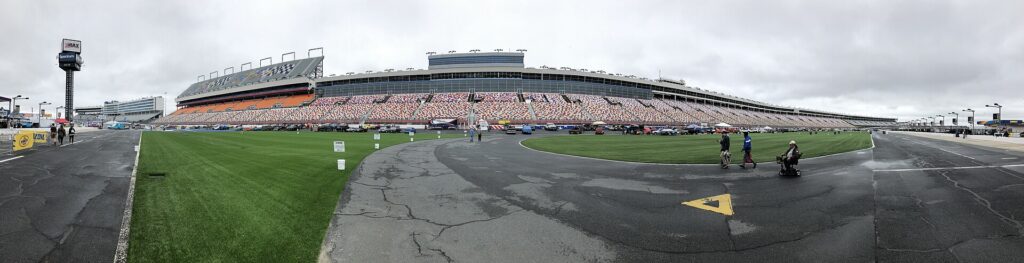
    Charlotte Motor Speedway in Concord on a race weekend in May
    Charlotte Motor Speedway, where the Coca-Cola 600 on Memorial Day weekend makes it the priciest hotel weekend of the year (Photo: Ken Lund from Reno, Nevada, USA via Wikimedia Commons, CC BY-SA 2.0)

    Charlotte’s weather, season by season

    Charlotte sits in the Piedmont of North Carolina at an elevation of about 230 meters (750 feet), between the Blue Ridge to the west and the coastal plain to the east. It has a humid subtropical climate: long, hot and humid summers with afternoon thunderstorms, short winters that are mostly mild but can bring a hard freeze or an ice storm, and a spring and fall that stretch for months. The figures below are approximate seasonal patterns based on the long-term climate normals for Charlotte Douglas from NOAA’s National Weather Service; check the current forecast before you pack, because spring and fall can swing ten degrees from one day to the next.

    MonthTypical daytime highTypical overnight lowWhat it feels likeFare pressure
    Januaryaround 11 °C (52 °F)around 0 °C (32 °F)Cool and often gray; an ice or snow event can shut the city for a day or twoLow, after the New Year return
    Februaryaround 13 °C (56 °F)around 2 °C (35 °F)Changeable; warm spells alternate with cold snapsLow; rises for Presidents’ Day weekend
    Marcharound 18 °C (64 °F)around 5 °C (41 °F)Spring arrives early; the first blossoms by mid-monthModerate; spring break spike
    Aprilaround 23 °C (73 °F)around 9 °C (49 °F)Dogwoods, azaleas and heavy pine pollen; near-perfect temperaturesModerate to high
    Mayaround 27 °C (80 °F)around 14 °C (58 °F)Warm and green; humidity building by the end of the monthModerate, with a Memorial Day race spike
    Junearound 31 °C (87 °F)around 19 °C (66 °F)Hot and humid; afternoon thunderstorms beginHigh from mid-month
    Julyaround 32 °C (90 °F)around 21 °C (70 °F)The hottest month; muggy nights and pop-up stormsHigh, especially around the Fourth
    Augustaround 31 °C (88 °F)around 21 °C (69 °F)Still hot and humid; the heat eases a little late in the monthHigh, softening after schools return
    Septemberaround 28 °C (82 °F)around 17 °C (63 °F)Warm; drier by the end of the month; tropical-storm remnants possibleModerate, falling after Labor Day
    Octoberaround 22 °C (72 °F)around 11 °C (51 °F)Often the best month: dry, sunny and mildModerate; football and race weekends spike
    Novemberaround 17 °C (62 °F)around 5 °C (41 °F)Crisp and clear; fall color lingers in the cityLow to moderate, peak at Thanksgiving
    Decemberaround 12 °C (54 °F)around 2 °C (35 °F)Cool and mostly dry; festive lights across the regionLow until mid-month, then peak

    Three things the table cannot show. First, the humidity: from June to early September, the air in Charlotte feels hotter than the numbers suggest, and a 32 °C (90 °F) afternoon with a thunderstorm building is normal. Second, the pollen: for a few weeks in late March and April, pine pollen turns cars, patios and anything left outside yellow, and allergy sufferers should plan accordingly. Third, winter weather: Charlotte sees measurable snow in some winters and none in others, but a quarter-inch of ice is enough to close schools, snarl the interstates and delay flights, because the region has little equipment to deal with it.

    How Charlotte’s fare seasons work

    Three forces drive prices into Charlotte. The first is the hub: American Airlines carries the large majority of passengers at Charlotte Douglas and runs a huge connecting operation, which gives the city a remarkable number of nonstop routes but also means less fare competition on many of them than at airports with several big carriers. The second is business travel: the banks, the energy and technology companies and the Charlotte Convention Center keep weekday flights and Uptown hotels busy year-round, especially Monday to Thursday. The third is the leisure calendar: summer holidays, the Memorial Day race, football season, and the regional pull of the mountains and the lakes. The result is a relatively flat fare curve with sharp spikes around specific weekends, and hotel prices that often move more than airfares do.

    Peak season

    Mid-June to mid-August, plus Memorial Day weekend, Thanksgiving week and roughly December 20 to January 2. Summer is driven by families, with Charlotte both a destination and a gateway to the beaches and the mountains. Memorial Day weekend is in a class of its own for hotels: the Coca-Cola 600 fills Concord, University City and much of Uptown, and weekend rates climb steeply. If you must travel in peak, book early, fly mid-week, and consider staying on the Blue Line away from the race-weekend hotspots.

    Shoulder season

    March to May and September to November. April and October are the two best months for weather, and both have busy weekends: spring break and college graduations in the spring, and football, the fall NASCAR weekend and homecoming weekends in the fall. Weekdays are usually good value in both seasons, and early May and early November are often the sweet spots.

    Low season

    January and February outside the holiday weekends, and the first half of December. Fares and hotel rates are at their lowest, the weather is cool but mostly manageable, and the Hornets are in season. The exceptions are Martin Luther King Jr. weekend, Presidents’ Day weekend and any big convention. Build a buffer into connections in case of an ice storm.

    As elsewhere, mid-week departures and early or late flights usually price below Friday and Sunday afternoons on the same route, and a search across a whole month reveals cheaper pairs of dates close to your first choice. Our guide to the best times to book explains how to read those patterns.

    Charlotte month by month

    January

    Cool, often gray and, after the first week, one of the two cheapest months to fly in. Highs are usually in the low teens Celsius (mid-50s Fahrenheit), with occasional cold snaps and the small but real chance of an ice storm that stops the city. The museums, the NASCAR Hall of Fame and the Hornets at the Spectrum Center are the main draws, and a Panthers playoff game, when there is one, fills Uptown for a weekend. Martin Luther King Jr. weekend brings a small bump.

    February

    Similar weather with more warm days and low fares outside Presidents’ Day weekend. Charlotte FC usually opens its MLS season late in the month or in early March. A strong value month for a city break focused on museums, food and breweries.

    March

    Spring comes early to the Piedmont. The first blossoms appear by mid-month, patios reopen, and the St. Patrick’s Day parade fills Uptown. Spring break from mid-March into April raises fares from the Northeast and Midwest, and when Charlotte hosts the ACC men’s basketball tournament, as it does in some years, Uptown hotels fill for that week.

    April

    Arguably the prettiest month, with dogwoods and azaleas in bloom across Myers Park and Dilworth, near-perfect temperatures and the Knights opening their baseball season at Truist Field. The catch is pine pollen, heaviest in early-to-mid April. Easter weekend and college events raise prices a little; weekdays remain good value.

    May

    Warm, green and busy. Quail Hollow Club hosts a PGA Tour event in most years, college graduations fill hotels on a couple of weekends, and Memorial Day weekend brings the Coca-Cola 600 at Charlotte Motor Speedway, the longest race on the NASCAR calendar. Book race weekend months ahead; the rest of May is fine value.

    June

    Summer arrives with heat, humidity and afternoon thunderstorms. The Whitewater Center, Lake Norman and the ballpark come into their own, and Juneteenth celebrations fill the city. Fares climb from mid-month as schools finish across the country. Early June is the value play.

    July

    The hottest month and part of the summer peak. The Fourth of July fireworks over Uptown are the big event, the Knights play most nights, and the mountains, two hours west and noticeably cooler, are at their busiest. Plan outdoor sightseeing for the morning and leave the afternoon for the museums.

    August

    Still hot and humid, with Charlotte Pride filling Uptown on a weekend in August and the Panthers’ preseason starting. Many schools in the South return in the first half of the month, and North Carolina’s public schools by the last week, so late August is usually softer on prices than July.

    September

    Warm and gradually drier, with prices falling after Labor Day. Football season begins, and Panthers home Sundays and big college games raise weekend hotel rates. The Festival in the Park fills Freedom Park, and this is the peak of hurricane season, when the remnants of a tropical storm occasionally bring a day or two of heavy rain.

    October

    Often the best month of the year: dry, sunny and mild, with the fall color reaching the Blue Ridge Mountains in the middle of the month. The fall NASCAR weekend at the Speedway, Panthers games, college homecomings and conventions make some weekends expensive; weekdays are excellent value.

    November

    Crisp, clear and quieter, with fall color lingering in the city’s oaks and maples until mid-month. Fares are low to moderate until Thanksgiving, when the Uptown parade and holiday travel create one of the busiest weeks of the year at the airport. The holiday lights at the Speedway switch on in mid-to-late November.

    December

    Two months in one. The first weekend often brings the ACC Championship Game to Bank of America Stadium, which fills Uptown hotels. The first half is otherwise cheap, with holiday lights at the Speedway and in McAdenville, Christmas Town USA. From about December 20, fares jump for the holidays, and a college bowl game around New Year adds another spike.

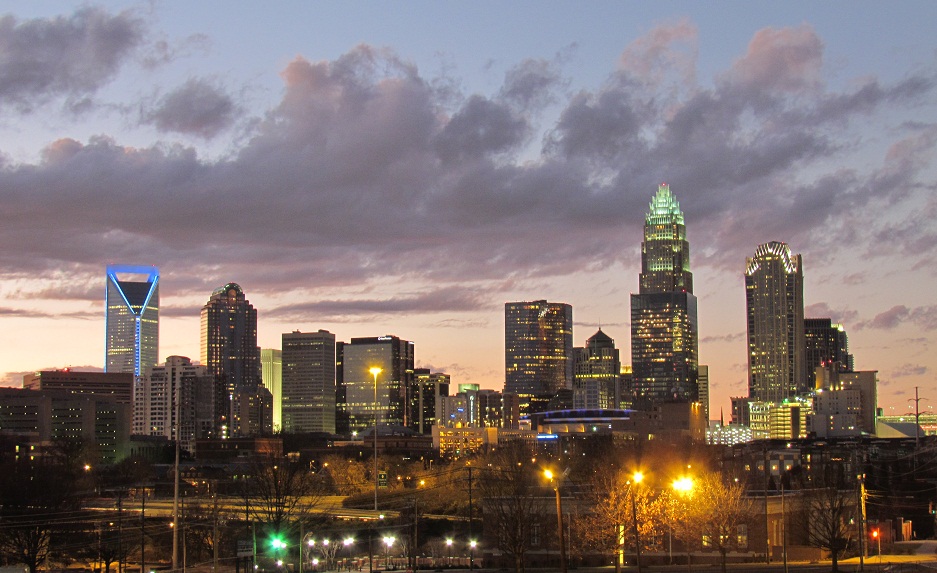
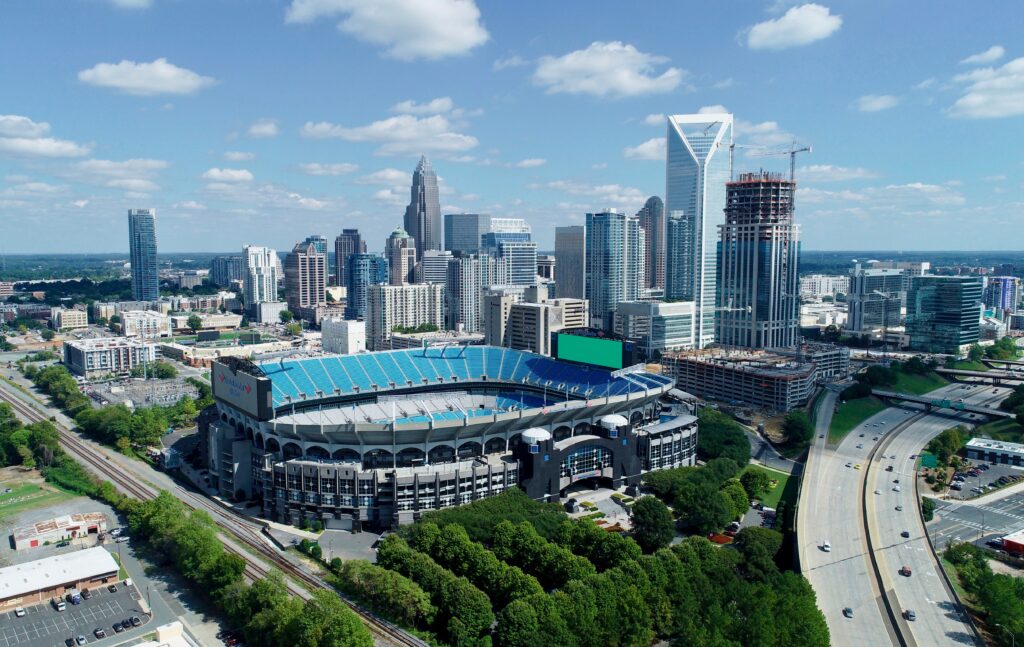
    An aerial view of the Uptown Charlotte skyline
    Uptown Charlotte from the air (Photo: Precisionviews via Wikimedia Commons, CC BY-SA 4.0)

    Events that move Charlotte flight and hotel prices

    Cross-check these against your dates before you book. Exact dates shift each year; Charlotte’s Got A Lot, the city’s official visitor site, keeps the current calendar.

    • Martin Luther King Jr. weekend and Presidents’ Day weekend in January and February.
    • Spring break (mid-March to mid-April), and the ACC men’s basketball tournament in the years Charlotte hosts it.
    • College graduations in May, when families fill hotels near the universities and Uptown.
    • The PGA Tour event at Quail Hollow in most Mays.
    • Memorial Day weekend and the Coca-Cola 600: the single biggest hotel spike of the year in Concord and University City, felt in Uptown too.
    • The Fourth of July and Labor Day weekends.
    • Carolina Panthers home games (September to January), the Speedway’s fall NASCAR weekend, and college football weekends.
    • Thanksgiving, the ACC Championship Game in early December, and Christmas to New Year with its bowl game.
    • Conventions and stadium concerts, which can fill Uptown hotels mid-week without warning. Our Charlotte events page shows what is on sale for your dates.

    Getting in from the airport

    Charlotte Douglas International (CLT) is about 11 kilometers (7 miles) west of Uptown and one of the busiest airports in the world by flight operations, most of them American Airlines and American Eagle flights feeding its hub. That hub gives Charlotte nonstops to most large U.S. cities, Canada, Mexico, the Caribbean and several European gateways, and a handful of other U.S. carriers, including low-cost airlines, also serve the airport. The terminal is a single building with several concourses fanning out from a central atrium, famous for its white rocking chairs, and it has been in the middle of a long expansion program, so allow extra time at the curb and in security at peak hours. Getting to Uptown: a taxi or ride-hail takes 15 to 20 minutes in normal traffic; the CATS Route 5 bus runs between the terminal and the Charlotte Transportation Center in Uptown for a standard local fare; and the rental car counters are a short walk from baggage claim. There is no rail link to the airport yet. Our Charlotte car-versus-transit guide works through whether to rent, and our CLT airport guide covers the layout.

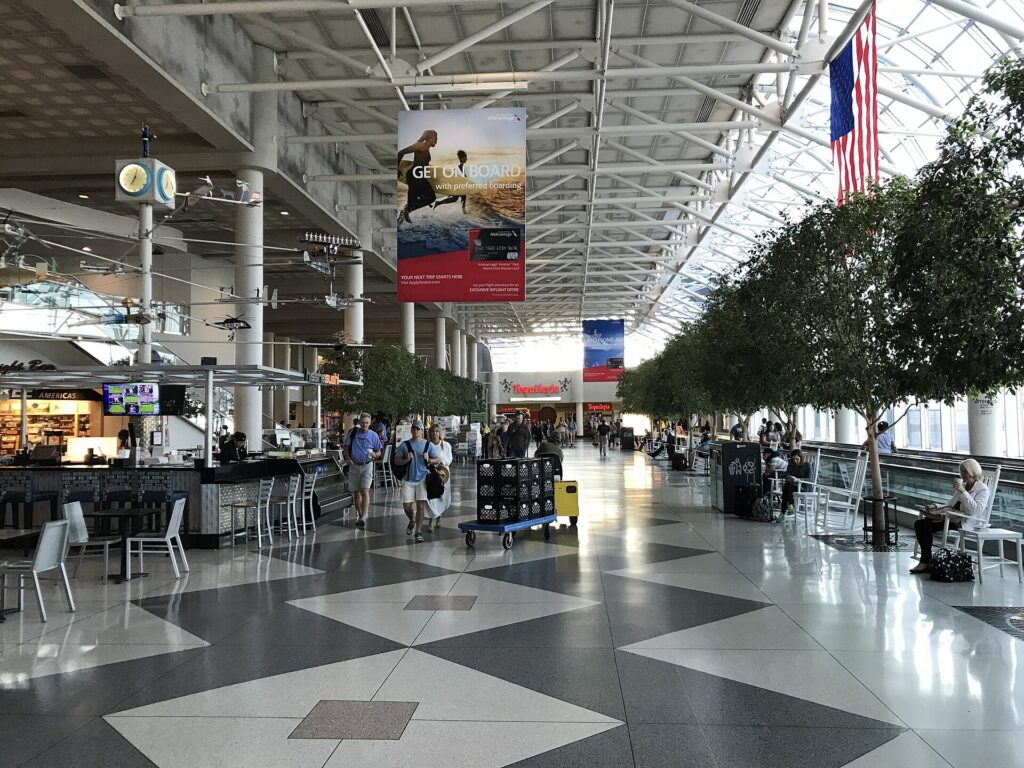
    The central atrium of the terminal at Charlotte Douglas International Airport (CLT)
    Charlotte Douglas (CLT), one of American Airlines' largest hubs and one of the busiest airports in the world by flights (Photo: SunDawn via Wikimedia Commons, CC BY-SA 4.0)

    Timing tricks that work for Charlotte

    • Search the whole month. Race weekends, football Sundays and holidays create sharp edges in the calendar. A flexible search on TicketScanner shows them instantly.
    • Book the hotel first on big weekends. A cheap fare into Memorial Day weekend or an ACC Championship weekend is not cheap once the room is added. Run a Charlotte hotel search for the same dates before you commit.
    • Fly mid-week. Charlotte’s business traffic makes Monday morning and Thursday and Friday afternoon the priciest flights on many routes; Tuesday and Wednesday are usually the value.
    • Compare nearby airports. Because one airline dominates CLT, it is worth checking Greenville-Spartanburg, about an hour and a half southwest, and Raleigh-Durham, about two and a half hours northeast, especially from cities with low-cost service to them. Add the cost of the drive before you decide.
    • Consider Atlanta for a road trip. Atlanta is about four hours down I-85, and a one-way trip between the two cities works well; see our best time to fly to Atlanta guide and our Atlanta to Charlotte route guide.
    • Build a buffer for storms. Summer thunderstorms and the occasional winter ice storm cause ground stops at CLT that ripple across American’s network; avoid the tightest connections. Our guide to how early to arrive covers what to allow.
    • Flying out of Charlotte instead? The hub gives you a huge choice of nonstops; see cheap flights from Charlotte.
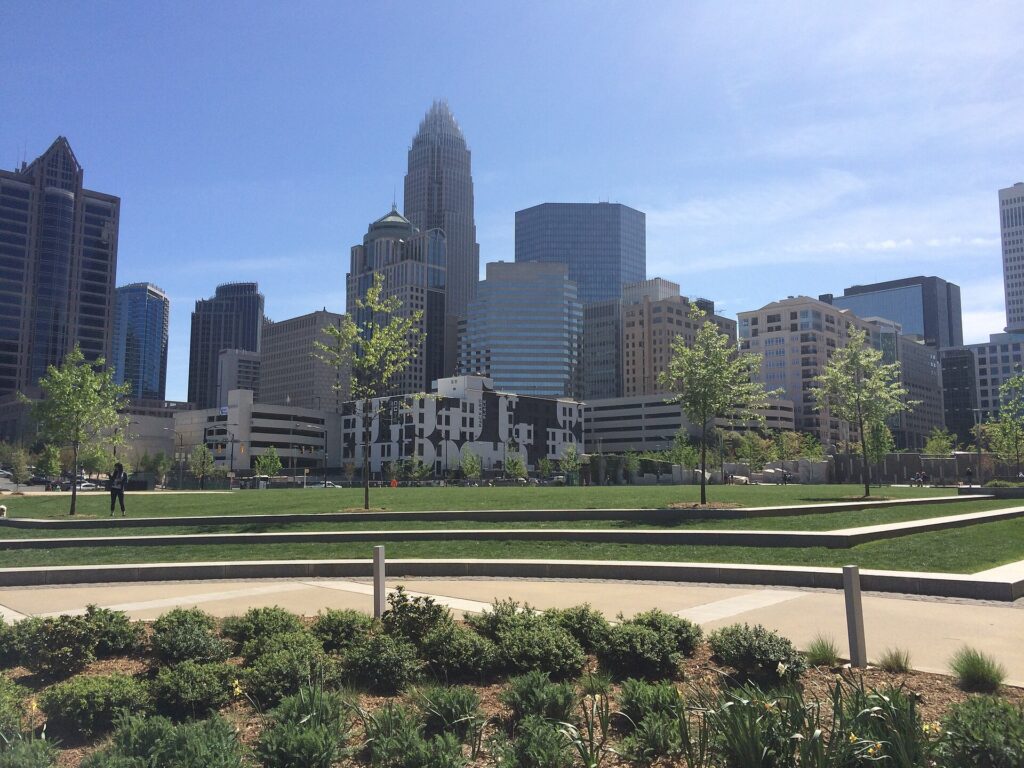
    Romare Bearden Park with the Uptown Charlotte skyline behind
    Romare Bearden Park in Uptown: spring and fall are the seasons to be outdoors in Charlotte (Photo: Fortibus via Wikimedia Commons, CC BY-SA 4.0)

    What to pack, by season

    Spring (March to May): layers for mornings and evenings, a light rain jacket, and antihistamines if pollen bothers you. Summer (June to August): the lightest, most breathable clothing you own, sunscreen, a hat, a water bottle, a compact umbrella for the afternoon storms, and a light layer for the heavily air-conditioned museums and restaurants. Fall (September to November): summer clothes into early October, then layers and a light jacket for the evenings. Winter (December to February): a warm coat, layers and shoes that can handle rain; the occasional ice storm is a reason to stay put rather than a reason to pack snow boots. If you are adding a mountain day, bring a warmer layer than the city needs in any season.

    The best time to fly to Charlotte for…

    The best weather

    Mid-April to mid-May, and late September to early November, with October the pick of the year.

    Racing

    Memorial Day weekend for the Coca-Cola 600, booked months ahead with the hotel first, or the Speedway’s fall race weekend. For the NASCAR Hall of Fame and a Speedway tour without the crowds, any weekday outside race weeks.

    Football and other sports

    September to early January for the Panthers and the college games, including the ACC Championship in early December; October to April for the Hornets; April to September for the Knights and summer evenings at Truist Field.

    The lowest fares

    January and February outside the holiday weekends, and early December before the holidays.

    Families

    Spring break or early June, when the Whitewater Center and Lake Norman are open and the heat has not yet peaked, or late August, once schools across the South have returned and prices soften.

    International visitors

    Visitors from Visa Waiver Program countries need an approved ESTA before boarding; most others need a visa. The State Department’s travel site explains what applies to you, and the TSA lists what you can carry through security. Most international travelers connect through CLT, and immigration and customs take place at your first U.S. airport, so allow a generous connection if Charlotte is your port of entry.

    Frequently asked questions

    What is the cheapest month to fly to Charlotte?

    January and February are usually the lowest outside the holiday weekends, followed by early December and weekdays in November before Thanksgiving.

    What is the best month to visit Charlotte for weather?

    October, with April and early May close behind. July and August are hot and humid; January can be cold and gray.

    How expensive is Charlotte on Memorial Day weekend?

    Very, for hotels: the Coca-Cola 600 makes it the priciest weekend of the year in Concord and University City and one of the priciest in Uptown. Flights rise too, though less sharply. The weeks either side are much cheaper.

    Why are flights to Charlotte sometimes expensive?

    Charlotte is a fortress hub for American Airlines, so on many routes there is little nonstop competition. Flexible dates, mid-week travel and a comparison with Greenville-Spartanburg or Raleigh-Durham usually find a better fare.

    How early should I get to the Charlotte airport?

    Two hours for domestic flights is sensible at busy times, and more at peak holiday periods or while construction affects the terminal; allow three for international departures.

    How far ahead should I book?

    Earlier for Memorial Day weekend, summer, Thanksgiving, Christmas and big football weekends, when fares tend only to rise; for January, February and weekday shoulder trips, fares are stable enough that finding the right dates matters more.

    Does it snow in Charlotte?

    Occasionally. Some winters bring a snowfall or two and others none, and ice storms are the bigger risk; when they happen, the city largely shuts down for a day or two.

    Ready to pick your dates? Compare fares across the whole month on our Charlotte flights page, then find a room with our Charlotte hotel search. For what to do when you land, start with our first-timer’s guide to Charlotte.

  • Best Time to Fly to Quebec City: Seasons, Weather & Prices

    Best Time to Fly to Quebec City: Seasons, Weather & Prices

    Quebec City has the most seasonal calendar of any major Canadian destination, and it is worth choosing your month deliberately. Summer brings the Festival d’été, the cruise ships and the crowds on the Petit-Champlain; fall brings the maples and the emptiest, loveliest Old Town of the year; winter brings four months of snow, the Christmas market, the ice hotel and the Carnaval, and a city that has made cold its brand; spring brings mud, maple syrup and the year’s lowest prices. The airport is small, with a limited set of nonstop routes, which means that for many visitors the real question is not only when to fly but whether to fly to Quebec City at all or to Montreal, three hours away, and take the train. This guide walks through the weather month by month, the fare seasons, the events that move prices, the airport, and the Montreal alternative.

    The short answer

    The best combination of weather and value is September to mid-October, when the summer crowds have gone, the maples on the Plains and along the river turn in early October, and hotel rates inside the walls ease. Early June is the other excellent window, warm and green, before the school holidays and the Festival d’été. For winter, January and early-to-mid March give you the snow, the skiing and the ice hotel without the Carnaval prices. The cheapest fares come in November, late January and April. The most expensive stretches are the Festival d’été in the first half of July, the Carnaval over ten days in early February, the Christmas and New Year weeks, when the Old Town under snow is at its most popular, and the Saint-Jean-Baptiste and Canada Day week at the end of June. Whatever you choose, run a flexible-date search on our Quebec City flights page, and price Montreal alongside it; a few days’ shift, or a train from Montreal, can change the cost of the trip entirely.

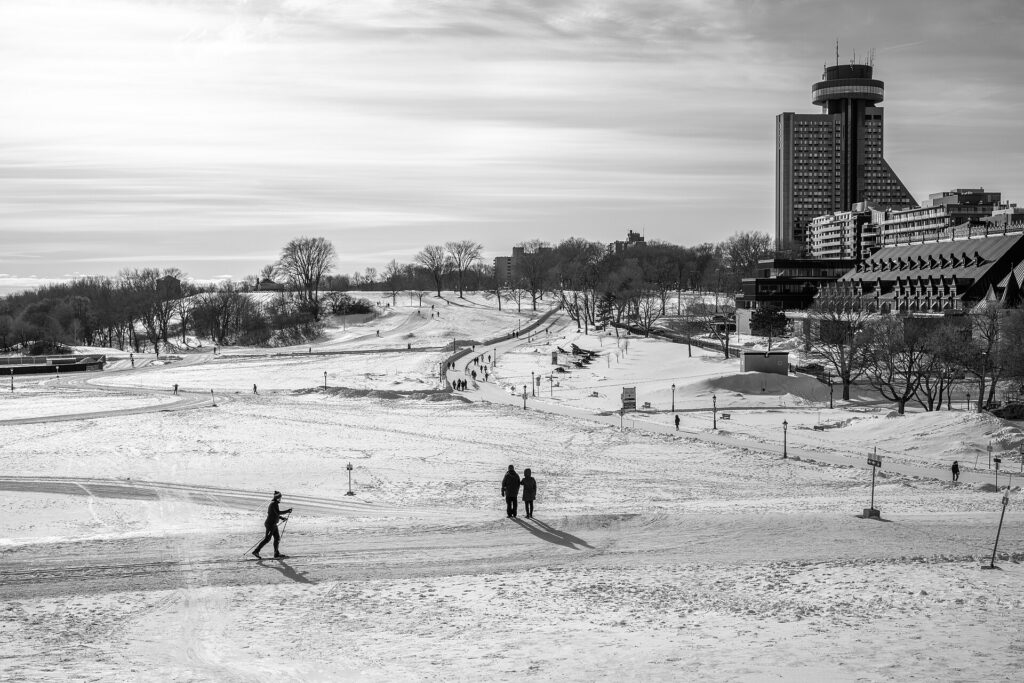
    A snow-covered street in Old Quebec in winter
    Old Quebec in winter: the Carnaval in February is the one cold-season fare spike (Photo: Wilfredor via Wikimedia Commons, CC BY-SA 4.0)

    Quebec City’s weather, season by season

    Quebec City sits on the St. Lawrence where the river narrows, 250 kilometres downstream of Montreal, and its climate is colder and snowier than Montreal’s in every season: more than three metres of snow in an average winter, a spring that arrives two weeks later, and summers that are warm but rarely oppressive. The figures below are approximate seasonal patterns based on the long-term climate normals from Environment and Climate Change Canada; check the current forecast before you pack.

    MonthTypical daytime highTypical overnight lowWhat it feels likeFare pressure
    Januaryaround -8 °Caround -17 °CDeep winter; heavy snow; bright cold daysLow after the first week
    Februaryaround -6 °Caround -16 °CCold and snowy; the CarnavalLow, with a sharp Carnaval spike
    Marcharound 0 °Caround -9 °CStill winter; best skiing; sugar shacks openLow; spring-break spike
    Aprilaround 8 °Caround -1 °CMelt and mud; the river ice breaks upLowest of the year
    Mayaround 17 °Caround 6 °CSpring arrives in the second half; tulips and terrassesLow to moderate; Victoria Day / Patriots’ Day weekend
    Junearound 22 °Caround 11 °CWarm, long days; the city fills from mid-monthModerate, rising fast in the last week
    Julyaround 25 °Caround 14 °CWarm, sometimes humid; the Festival d’été; peak crowdsPeak
    Augustaround 24 °Caround 13 °CWarm and settled; New France festival; cruise seasonHigh
    Septemberaround 18 °Caround 8 °CWarm days, cool nights; crowds ease after Labour DayModerate, falling
    Octoberaround 11 °Caround 3 °CCrisp; colour peaks in the first two weeks; cruise shipsModerate on colour weekends, then low
    Novemberaround 3 °Caround -3 °CGrey; first snow; the Christmas market opens late in the monthLow
    Decemberaround -4 °Caround -12 °CSnow, lights, the market; deep cold by the endLow until mid-month, then a holiday peak

    Two things the table cannot show. First, the snow: Quebec City gets more than any other big city in eastern Canada, and from December to March the Old Town is reliably white, which is the whole point of a winter visit; it also means the stairs and cobbles are icy and proper boots are not optional. Second, the river: the St. Lawrence moderates the summer heat, so the city rarely has Montreal’s humidity, and in winter the ice floes and the canoe race across them are part of the scenery.

    How Quebec City’s fare seasons work

    Quebec City’s airport is small and its nonstop routes are limited, which makes its fares less elastic than the big hubs’: there are fewer seats to discount in the low season and fewer to add in the peak. Demand is driven by leisure almost entirely, with the provincial government adding a modest weekday base, and it follows three calendars: the summer tourist season, from Saint-Jean-Baptiste Day on June 24 to Labour Day, with the Festival d’été as its peak; the winter festival season, from the Christmas market through the Carnaval; and the fall colour and cruise season in late September and October, when the Old Port is full of ships. The result is a fare curve with a high summer, a sharp February spike, a holiday peak, and two lows in April and November that are among the deepest of any Canadian city.

    Peak season

    Late June to late August, plus roughly December 20 to January 3, plus the Carnaval’s ten days in early February. The Festival d’été, in the first half of July, is the single biggest hotel event of the year; the last week of June, with Quebec’s national holiday on the 24th and Canada Day on the 1st, runs straight into it. August brings the Fêtes de la Nouvelle-France and the peak of the cruise season. Book early, and book the hotel first.

    Shoulder season

    Early to mid-June, September and October. Early June is warm, green and cheap; September is the best month by most measures, with the humidity gone and the crowds thinning after Labour Day; the first two weeks of October are the colour peak, busy on weekends, quiet mid-week. Watch Labour Day and Thanksgiving.

    Low season

    November, mid-January through March outside the Carnaval and the spring break, and April. Fares and hotel rates are at their lowest, and for a winter trip, January and March deliver the snow, the skiing at Mont-Sainte-Anne and the ice hotel without the Carnaval premium. April is the deepest low: the snow is melting, the river is breaking up, and the sugar shacks are the reason to come.

    As elsewhere, mid-week departures and early or late flights usually price below Friday and Sunday afternoons on the same route, and a whole-month search reveals cheaper pairs of dates close to your first choice. Our guide to the best times to book explains how to read those patterns.

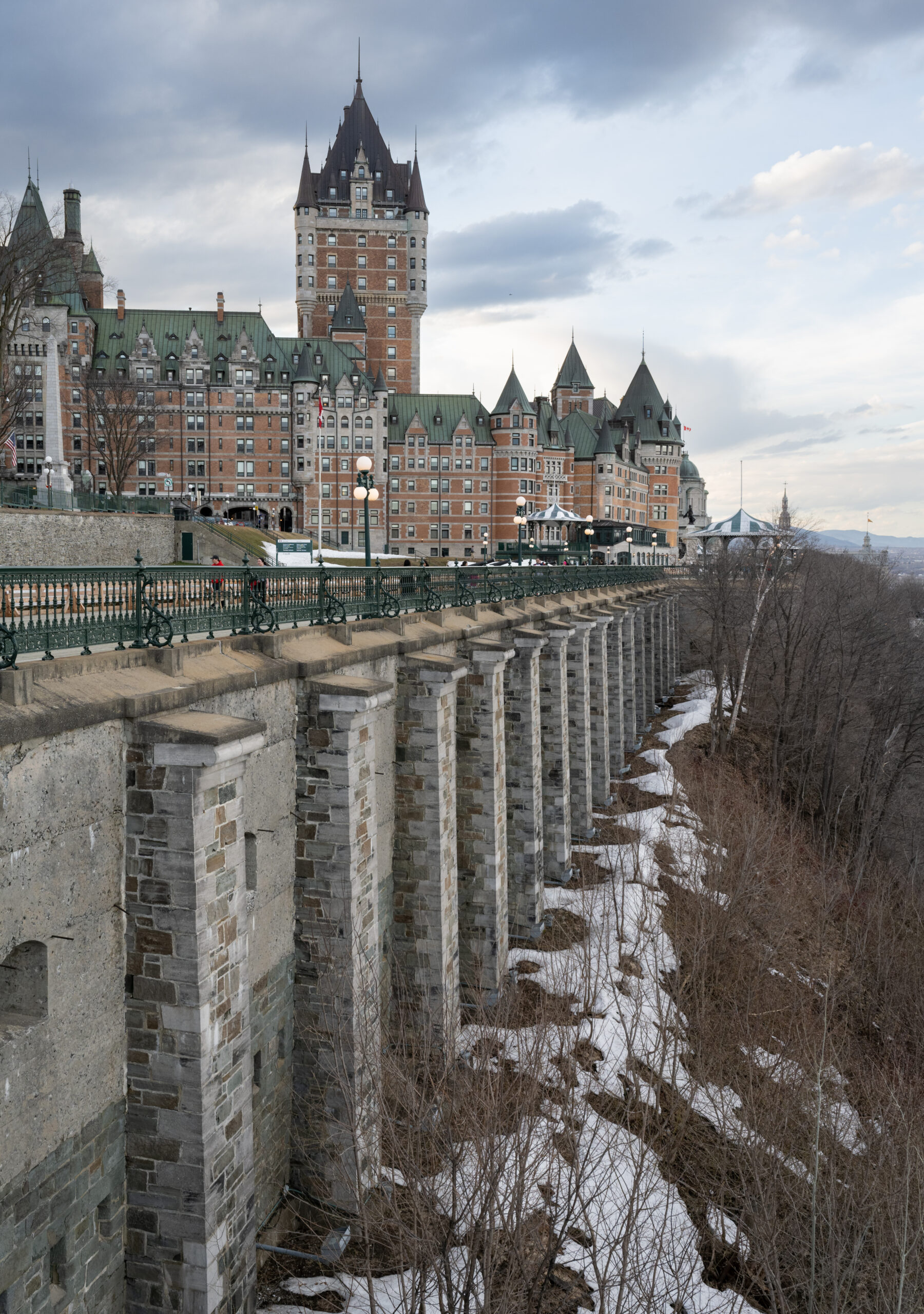
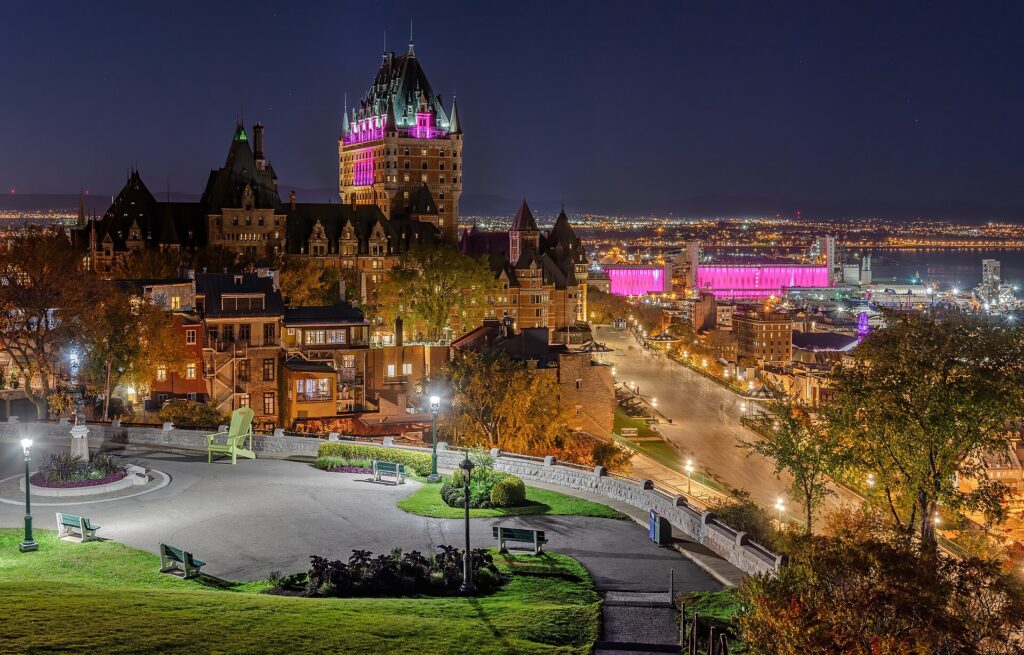
    The Château Frontenac illuminated at night
    The Château Frontenac at night, above the Terrasse Dufferin (Photo: Wilfredor via Wikimedia Commons, CC0)

    Quebec City month by month

    January

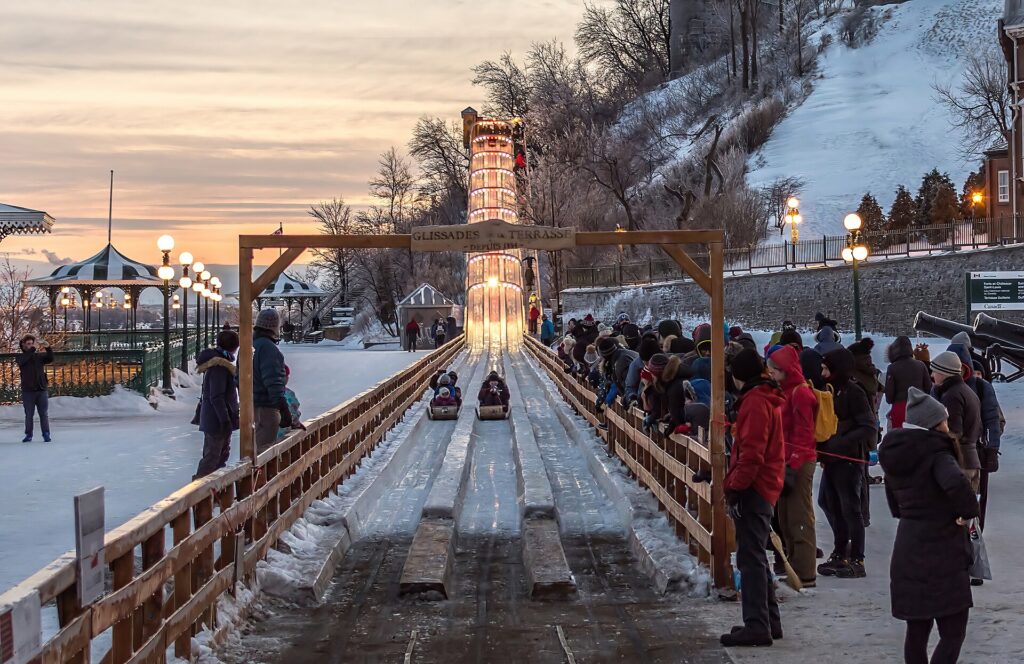
    Deep winter, with heavy snow and bright cold days, and after the first week one of the cheapest months to visit. The Old Town is white and quiet, the Hôtel de Glace opens for the season outside the city, the ski hills at Mont-Sainte-Anne, Stoneham and the Massif are in full operation, the Plains are groomed for cross-country, and the toboggan run on the Terrasse is running. Fares are low; hotels inside the walls offer their best rates of the year.

    February

    The Carnaval de Québec fills ten days in the first half of the month with parades, ice sculptures, the ice palace, the canoe race across the river and Bonhomme, and it is the one winter stretch when hotels fill and fares from other Canadian cities rise; the Family Day weekend elsewhere in Canada adds to the third weekend. The weeks either side are cheap and still deep winter.

    March

    Still winter here, with the best snow of the season on the ski hills and the sugar shacks opening in the countryside for maple season; the mid-to-late March spring break, which in Quebec falls in the first week of March, lifts fares briefly. Otherwise a cheap, snowy, sunny month.

    April

    The melt. Grey skies, slush in the Old Town, the river ice breaking up, and the lowest fares and hotel rates of the year. The reasons to come are the sugar shacks, the museums, and the price.

    May

    Spring arrives in the second half, later than in Montreal, with tulips on the Plains and the terrasses opening on the Grande Allée. The Journée nationale des patriotes weekend, the same Monday as Victoria Day elsewhere, is a busy travel weekend. Late May is a good-value window, still quiet.

    June

    Warm, green and increasingly busy. The first three weeks are among the best windows of the year: long days, the island’s strawberry season, and the city’s summer programme beginning. The last week, with Saint-Jean-Baptiste on June 24 and Canada Day a week later, is peak, and fares and hotels rise sharply.

    July

    Peak. The Festival d’été, eleven days from early July, puts international headliners on the Plains of Abraham and fills every hotel in the city; the Old Town is at its most crowded, the fireworks light the river, and the weather is at its warmest. If you are coming for the festival, book the hotel first; the Quebec City hotel search shows what is left. The second half of July eases slightly.

    August

    Warm, settled and busy, with the Fêtes de la Nouvelle-France in the Lower Town, the cruise ships beginning their season in the Old Port, and the island in full harvest. Fares are high but below July’s, and the last week, once Quebec’s schools return in late August, is noticeably softer.

    September

    The month many locals would send you to: warm days, cool nights, the crowds gone after Labour Day, the cruise ships in port on weekdays, and the first colour by the end of the month. Fares and hotel rates fall through the month.

    October

    The colour peak in the first two weeks, when the Plains, the island and the Charlevoix hills are at their best and the leaf-peeping weekends and the cruise calendar fill the Old Town; mid-week is quiet and good value. Thanksgiving, on the second Monday, is the one date to book around. By the end of the month the city is quiet and cheap.

    November

    Grey, cold and the cheapest month alongside April. The first snow usually arrives, and the German Christmas market and the Old Town lights open in the last week, which makes the end of the month a lovely, inexpensive time to visit.

    December

    Two months in one. The first three weeks bring the Christmas market, the lights on the Château and the Petit-Champlain, and early-season snow at November prices; from about December 20, the Old Town under snow is one of the most sought-after Christmas destinations in the country, and fares and hotel rates peak through New Year.

    The Plains of Abraham in Quebec City in summer
    The Plains of Abraham, the Festival d'été's main stage in July and the city's park the rest of the year (Photo: Wilfredor via Wikimedia Commons, CC0)

    Events that move Quebec City flight and hotel prices

    Cross-check these against your dates before you book. Exact dates shift each year; Destination Québec cité keeps the current calendar.

    • Carnaval de Québec (ten days in early February): the winter’s one hotel spike.
    • Quebec spring break (first week of March) and the rest of Canada’s (mid-to-late March).
    • Patriots’ Day / Victoria Day weekend (Monday before May 25).
    • Saint-Jean-Baptiste Day (June 24) and Canada Day (July 1).
    • Festival d’été de Québec (eleven days from early July): the single largest hotel spike of the year.
    • Fêtes de la Nouvelle-France (early August).
    • Labour Day (first Monday of September).
    • Fall colour weekends (first two weeks of October) and Thanksgiving.
    • Christmas to New Year.
    • Cruise-ship days from August to October, which crowd the Lower Town in the middle of the day without affecting hotels much.
    • Concerts and shows at the Centre Vidéotron and the Grand Théâtre; our Quebec City events page shows what is on sale for your dates.

    Getting in from the airport

    Quebec City’s airport, Québec City Jean Lesage International (YQB), is about 15 kilometres west of the Old Town, small, modern and easy. It has nonstop flights from Montreal, Toronto, Ottawa and a few other Canadian cities year-round, seasonal service from a handful of U.S. hubs and, in summer, from Paris, and sun-destination charters in winter; most international itineraries connect through Montreal or Toronto. Getting into the city: taxis operate at a fixed fare to the downtown zone and take 20 to 30 minutes; ride-hail is available; an RTC bus route connects the terminal to the network; and the rental counters are in the terminal, which matters here because the Île d’Orléans and Charlevoix are the reasons many visitors rent. Our YQB airport guide covers the layout, and our car-versus-transit guide works through whether you need a rental, which inside the walls you emphatically do not.

    The terminal at Québec City Jean Lesage International Airport (YQB)
    Jean Lesage International (YQB), fifteen kilometres from the Old Town (Photo: Pymouss via Wikimedia Commons, CC BY-SA 4.0)

    Quebec City or Montreal: choosing your gateway

    This is the question that matters most for anyone flying from outside eastern Canada. Montreal’s airport, three hours away, has vastly more nonstop routes and, from the United States, Europe and the rest of Canada, usually lower fares; Quebec City’s has the convenience of landing fifteen minutes from the Old Town. There are three ways to weigh it. First, price the direct or one-stop fare into Quebec City for your dates. Second, price a fare into Montreal plus VIA Rail’s three-hour service from Montreal’s Central Station to the Gare du Palais in the Lower Town, which arrives a walk from the Old Town’s hotels; the train is comfortable, frequent and often cheap when booked ahead, and the combination frequently beats a direct fare, especially in the Festival d’été and Carnaval weeks. Third, price a fare into Montreal plus a one-way rental up Highway 20 or the prettier Highway 40 along the north shore, which turns the trip into a two-city holiday and gives you the car for the island and Charlevoix; our Montreal to Quebec City route guide covers the drive. In the low season, when Quebec City’s own fares are soft, the direct flight usually wins on time; in the peaks, the Montreal route usually wins on money. Run all three on TicketScanner before you commit.

    Timing tricks that work for Quebec City

    • Search the whole month. The Festival d’été and the Carnaval are short, sharp spikes; a week either side can be dramatically cheaper. A calendar search on TicketScanner shows the edges instantly.
    • Book the hotel first for the festival, the Carnaval and Christmas. Rooms inside the walls disappear before fares rise; run a Quebec City hotel search before you commit to the flight, and look at Saint-Roch and the Grande Allée for value.
    • Take the winter without the Carnaval. January and March give you the same snow, the ice hotel and the ski hills at low-season prices.
    • Consider the train from Montreal. For most international visitors, it is the cheapest route to the Old Town and a pleasant one.
    • Go mid-week in October. The colour weekends fill the Old Town; Tuesday to Thursday in the first fortnight is the same scenery with half the people.
    • Build a winter buffer. Snow can disrupt YQB and the Montreal connections between December and March; avoid the tightest connections. Our guide to how early to arrive covers what to allow.
    • Flying out of Quebec City instead? The same seasonality applies in reverse; see cheap flights from Quebec City.

    What to pack, by season

    Winter (December to March): a genuinely warm coat, a hat, gloves, a scarf, insulated boots with grip for the icy stairs, and layers; the Old Town is walked, not driven, and you will be outside more than you expect. Spring (April to May): waterproof boots for the slush in April, a rain shell, and layers. Summer (June to August): light clothing, sun protection, a warm layer for the river breeze in the evening, and comfortable shoes for the cobbles and hills. Fall (September to October): layers, a warm jacket by October, and walking shoes for the Plains and Charlevoix.

    The best time to fly to Quebec City for…

    The Old Town under snow

    Late November for the Christmas market at low prices, or January for the deep snow and the ice hotel; the Christmas week is the most expensive and most sought-after.

    The Carnaval

    Early February, booked months ahead with the hotel first.

    The Festival d’été

    The first half of July, booked as early as the line-up is announced in the spring; the pass is cheap, the hotel is not.

    Fall colours

    The first two weeks of October, mid-week if you can.

    The lowest fares

    April and November, then late January and early-to-mid March.

    Families

    Late June for the strawberries and the long days if you can avoid the last week, or the last week of August; in winter, the Carnaval is built for children if the budget allows, and January is the cheap alternative.

    Cross-border and international visitors

    U.S. citizens need a valid passport; most other visa-exempt travellers arriving by air need an Electronic Travel Authorization. The Government of Canada’s visitor page explains what applies to you, and CATSA lists what you can carry through security.

    Frequently asked questions

    What is the cheapest month to fly to Quebec City?

    April and November are consistently the lowest, with late January and March close behind outside the Carnaval and the spring breaks.

    What is the best month to visit Quebec City?

    September or early October for weather, colour and value; early June for warmth without crowds; January for snow without the Carnaval prices; July for the festival if you book early.

    Is it better to fly to Quebec City or Montreal?

    From within eastern Canada, Quebec City direct. From the United States, Europe or western Canada, Montreal plus the three-hour train is usually cheaper and sometimes the only nonstop option; price both.

    How cold is Quebec City in winter?

    Highs around -7 °C and lows around -16 °C on an average January day, with cold snaps well below -20 °C and more than three metres of snow over the season. Dress for it and it is magical.

    How crowded is Quebec City in summer?

    Very, in July and August, especially in the Lower Town in the middle of the day and during the Festival d’été. Early mornings and evenings, and the neighbourhoods outside the walls, are the escape.

    How far ahead should I book?

    Months ahead for the Festival d’été, the Carnaval and Christmas, when hotels inside the walls sell out; a few weeks for summer and fall; and as late as you like in April and November.

    Ready to pick your dates? Compare fares across the whole month on our Quebec City flights page, then find a room with our Quebec City hotel search. For what to do when you land, start with our first-timer’s guide to Quebec City.

  • Best Time to Fly to Halifax: Seasons, Weather & Prices

    Best Time to Fly to Halifax: Seasons, Weather & Prices

    Halifax has a maritime calendar, and it does not behave like the rest of Canada’s. Spring arrives late and foggy; summer is short, warm and intense, peaking in August rather than July; fall is long, golden and often the best weather of the year; and winter is wet, windy and grey more than deeply cold, with nor’easters that can close the airport for a day and then melt away. Fares follow the visitors, and the visitors come for the coast in July and August, the cruise ships from September to October, and the university term, which moves tens of thousands of students through the airport in September, December and April. The airport itself is thirty-five kilometres from downtown, the farthest of any big Canadian city, and most flights from outside the Atlantic region connect through Toronto or Montreal. This guide walks through the weather month by month, the fare seasons, the events that move prices, the airport, and the tricks that work for a city at the eastern end of the country.

    The short answer

    The best combination of weather and value is September to mid-October: the fog is gone, the sea is at its warmest, the days are settled, the summer crowds have left, and fares ease after the students arrive. Late June is the other good window, warm enough and quiet before the July festivals. The cheapest fares come in January through March outside the university breaks, and in November. The most expensive stretches are the last three weeks of July and all of August, when the coast is at its best and hotel rates in the city and along the South Shore peak, the Christmas and New Year weeks, when Atlantic Canadians fly home from the rest of the country and fares from Toronto and Alberta rise sharply, and the cruise-ship days in September and October, which tighten downtown hotels without affecting flights much. Whatever you choose, run a flexible-date search on our Halifax flights page; on the Toronto connection a few days’ shift can change the fare band entirely.

    The Halifax skyline at sunset seen from the Dartmouth ferry
    Halifax from the Dartmouth ferry at sunset (Photo: Tony Webster from San Francisco, California via Wikimedia Commons, CC BY-SA 2.0)

    Halifax’s weather, season by season

    Halifax sits on the Atlantic, and the ocean sets its terms: the Labrador Current keeps spring cool and foggy, the summer warms slowly and holds into September, and the winter is moderated by the sea into a freeze-thaw cycle of snow, rain and wind rather than the sustained cold of inland Canada. The figures below are approximate seasonal patterns based on the long-term climate normals from Environment and Climate Change Canada; check the current forecast before you pack, and in late summer and fall check the Canadian Hurricane Centre as well.

    MonthTypical daytime highTypical overnight lowWhat it feels likeFare pressure
    Januaryaround 0 °Caround -9 °CWet, windy, snow and rain in turns; nor’eastersLow after the first week
    Februaryaround 0 °Caround -9 °CThe snowiest month; grey; the pubs at their bestLow; university break spike
    Marcharound 3 °Caround -5 °CSlow thaw; slush; still stormyLow
    Aprilaround 9 °Caround 0 °CCool, damp, foggy; the students leaveLow, with an end-of-term spike
    Mayaround 15 °Caround 5 °CSpring at last; fog; the Gardens open; lobster seasonLow to moderate
    Junearound 20 °Caround 10 °CWarming; fog in the mornings; long daysModerate, rising late in the month
    Julyaround 24 °Caround 14 °CWarm and sunny; the season begins; festivalsHigh, peaking from the third week
    Augustaround 24 °Caround 15 °CThe warmest month; the sea is swimmable; hurricane watch beginsPeak
    Septemberaround 20 °Caround 11 °COften the best month; warm sea, settled skies; storm riskModerate, falling after mid-month
    Octoberaround 14 °Caround 6 °CCrisp, golden; the Cabot Trail peaks; cruise shipsModerate on cruise days, low otherwise
    Novemberaround 8 °Caround 1 °CGrey, wet, windy; the lights go upLow
    Decemberaround 2 °Caround -5 °CDamp cold; first snow; festive downtownLow until mid-month, then a sharp holiday peak

    Three things the table cannot show. First, the fog: from April to early July, warm air over the cold sea produces morning fog that can sit on the harbour all day, and it can delay flights; by August it is largely gone. Second, the wind: Halifax is one of the windiest cities in Canada, and the wind chill in winter makes 0 °C feel far colder than inland. Third, hurricane season: from late August to October, the remnants of Atlantic hurricanes occasionally reach Nova Scotia, and once every few years one arrives with real force, as Juan did in 2003 and Fiona in 2022; the risk to a given trip is low, but travel insurance and a flexible fare are worth having in September.

    How Halifax’s fare seasons work

    Halifax is a regional hub, not a national one. Air Canada, WestJet and Porter fly from Toronto, Montreal and Ottawa many times a day, there are direct flights from a handful of U.S. cities and, in summer, from London and a few European points, and the rest of the country connects. That means fares to Halifax are really fares to Toronto or Montreal plus a regional leg, and the regional leg has its own seasonality: it fills with tourists from late June to early September, with students in early September, at Christmas and in late April, and with Atlantic Canadians coming home from Alberta and Ontario over the holidays. The result is a fare curve with a short high summer, a sharp Christmas peak, a soft long winter, and two shoulders that are the traveller’s friend.

    Peak season

    The third week of July through the end of August, plus roughly December 18 to January 3. The summer peak is driven by the coast: Peggy’s Cove, the South Shore and the Cabot Trail fill with visitors, and Halifax’s hotels absorb the overflow while hosting the Jazz Festival, Pride, the Busker Festival and Natal Day. The Christmas peak is driven by homecoming, and it is sharper on the Toronto, Calgary and Edmonton routes than on any other. Book early for either, and book the hotel before the flight in August.

    Shoulder season

    Late May to mid-July, and September to October. Late June is warm and quiet; September is the best weather of the year and the crowds are gone after Labour Day, though the cruise ships fill downtown hotels on port days and the students fill the Toronto flights in the first week; October is crisp and cheap apart from Thanksgiving and the Cabot Trail colour weekends.

    Low season

    November, and mid-January to mid-May outside the university reading week in February and the end of term in April. Fares are at their lowest, hotel rates too, and the city’s indoor life, the pubs, the music, the museums and the restaurants, is the reason to come. Build a weather buffer into connections in winter.

    As elsewhere, mid-week departures and early or late flights usually price below Friday and Sunday afternoons on the same route, and a whole-month search reveals cheaper pairs of dates close to your first choice. Our guide to the best times to book explains how to read those patterns.

    Halifax month by month

    January

    Wet, windy and grey, with snow one day and rain the next, and after the first week the cheapest month of the year to fly in. The pubs and the music are the draw, the Mooseheads are at home, and the Citadel’s hill is a sledding run when the snow holds. Nor’easters can close the airport for a day; keep connections loose.

    February

    The snowiest month, and still cheap, apart from the university reading week in the middle of the month, when the Toronto flights fill with students going home. A good month for a city-and-pubs weekend at low prices.

    March

    Slow thaw, slush and the last of the storms. Fares stay low, and the Hal-Con and the film society programmes keep the indoor calendar going.

    April

    Cool, damp and foggy, with the students leaving at the end of the month, which lifts the Toronto and Montreal fares for a week. Otherwise low.

    May

    Spring arrives, later than in Ontario, with the Public Gardens opening, the patios appearing on warm days, and the South Shore lobster season at its peak. The Victoria Day weekend is the traditional start of the season. Fares are low to moderate, and late May is a value window for a lobster-focused trip.

    June

    Warming through the month, with morning fog that burns off by noon on good days and sits all day on bad ones. The Royal Nova Scotia International Tattoo in the last week or the first week of July, the tall ships when they visit, and the long days open the season. Late June, before Canada Day, is among the best-value warm windows.

    July

    Warm and sunny, and the season proper. Canada Day on the waterfront, the Jazz Festival in the second week, Pride in the third, and the coast filling up push fares and hotels up through the month; the last two weeks are peak.

    August

    The warmest month, with the sea finally swimmable at Crystal Crescent and Lawrencetown, the Busker Festival on the waterfront, Natal Day fireworks on the first weekend, and the busiest hotels of the year in the city and on the South Shore. Book early, and watch the hurricane forecast from the middle of the month.

    September

    The month many locals would send you to: warm sea, settled skies, the fog gone, the crowds gone after Labour Day, the Atlantic Film Festival in the middle, and the cruise ships in port on weekdays. The first week is busy with the university move-in on the Toronto and Montreal routes; after that, fares and hotel rates fall. Storm remnants are the one risk.

    October

    Crisp and golden, with the Cabot Trail’s colour peaking in the second and third weeks, the Pop Explosion music festival and Nocturne in the middle of the month, and the last cruise ships. Thanksgiving on the second Monday is the one date to book around. Otherwise a cheap, beautiful month.

    November

    Grey, wet and windy, and the cheapest month alongside January. The Christmas tree lighting on the Grand Parade and the holiday markets open the festive season at the end of the month.

    December

    Two months in one. The first half continues November’s pricing with a festive downtown; from about December 18, the homecoming rush from Toronto, Alberta and the rest of the country makes Halifax one of the most expensive destinations in Canada to fly to until after New Year.

    A Halifax Transit ferry crossing the harbour
    The harbour ferry in August, the month Halifax is warmest and busiest (Photo: Gordon Leggett via Wikimedia Commons, CC BY 4.0)

    Events that move Halifax flight and hotel prices

    Cross-check these against your dates before you book. Exact dates shift each year; Discover Halifax keeps the current calendar.

    • University reading week (mid-February) and end of term (late April).
    • Victoria Day weekend (Monday before May 25).
    • Royal Nova Scotia International Tattoo (late June or early July).
    • Canada Day (July 1).
    • Halifax Jazz Festival (mid-July) and Halifax Pride (late July).
    • Natal Day (first weekend of August) and the Busker Festival.
    • Labour Day and the university move-in (first week of September): the single biggest week on the Toronto route outside Christmas.
    • Cruise-ship days (September to October), which fill downtown hotels.
    • Thanksgiving (second Monday of October) and the Cabot Trail colour weekends.
    • Christmas to New Year: the sharpest homecoming peak in the country.
    • Arena concerts at the Scotiabank Centre; our Halifax events page shows what is on sale for your dates.

    Getting in from the airport

    Halifax has one commercial airport, Halifax Stanfield International (YHZ), about 35 kilometres northeast of downtown at Enfield, the most distant big-city airport in Canada. It has a single terminal, frequent flights from Toronto, Montreal and Ottawa, direct service from a few U.S. hubs, seasonal flights to London and a handful of European cities, and connections to the rest of Atlantic Canada. Getting downtown takes planning: a taxi or ride-hail takes 30 to 40 minutes on Highway 102 and is priced for the distance; Halifax Transit’s MetroX Route 320 runs to downtown in about an hour for a premium transit fare; hotel shuttles serve some properties; and every major rental company is in the terminal, which matters here because Peggy’s Cove, Lunenburg and the Cabot Trail are the reasons many visitors come. For two or more people, the rental is often cheaper than two taxi rides. Our YHZ airport guide covers the layout, and our car-versus-transit guide works through whether you need one for the city.

    The terminal at Halifax Stanfield International Airport (YHZ)
    Halifax Stanfield (YHZ), 35 kilometres from downtown (Photo: Daniel from Glasgow, United Kingdom via Wikimedia Commons, CC BY 2.0)

    Timing tricks that work for Halifax

    • Search the whole month. The August peak and the Christmas homecoming have sharp edges; late June and the second half of September are the value. A calendar search on TicketScanner shows the edges instantly.
    • Price the Toronto leg separately. Most Halifax itineraries connect through Toronto, and on some dates two separate tickets, or a different connecting city such as Montreal, beat a through fare; check both.
    • Book the hotel first in August and on cruise days. Rooms downtown disappear before fares rise; run a Halifax hotel search before you commit to the flight, and consider Dartmouth across the ferry.
    • Fly mid-week. Halifax’s business and student traffic makes Sunday evening and Friday afternoon the busiest flights on the Toronto route; Tuesday to Thursday is the value.
    • Avoid the first week of September on the Toronto route. The university move-in fills every seat; the second and third weeks are the best of the year.
    • Have a fog and storm plan. From April to June, morning fog can delay arrivals; in September and October, storm remnants can cancel a day. Avoid the tightest connections, and consider travel insurance in the fall. Our guide to how early to arrive covers what to allow.
    • Consider the drive from the airport as part of the trip. If Peggy’s Cove or the South Shore is on the list, a rental from the terminal and a hotel outside downtown can save the taxi twice over.
    • Flying out of Halifax instead? The same seasonality applies in reverse, and the Christmas homecoming means outbound fares to the rest of Canada peak too; see cheap flights from Halifax.

    How far ahead to book

    Halifax rewards early booking for its two peaks and patience for everything else. For the last three weeks of July and all of August, both flights and hotels tend only to rise as the dates approach, and the South Shore’s inns and the downtown waterfront hotels sell out weeks ahead, so book as soon as your dates are fixed, with the hotel first. For the Christmas homecoming, the Toronto, Calgary and Edmonton routes fill from October onward, and the traveller who waits until December pays the most expensive fares of the year; book by early fall. For June and September, a few weeks out is usually enough for the flight, though a cruise-ship day can surprise you on the hotel. For the low season, from November through May, fares are low and flat, last-minute deals are common on the Toronto and Montreal routes, and the only reason to book early is to lock in a particular non-stop time. In every season, a whole-month search on our Halifax flights page will show you the cheap dates near your own, and on the Toronto connection the difference between a Sunday evening and a Tuesday afternoon can be larger than any discount you will find by waiting.

    The painted waterfront of Lunenburg, Nova Scotia
    Lunenburg in the fall, the best season on the South Shore (Photo: daryl_mitchell via Wikimedia Commons, CC BY-SA 2.0)

    What to pack, by season

    Winter (December to March): a warm, windproof and waterproof coat, a hat, gloves, waterproof boots with grip for the slush, and layers; the damp wind is the enemy, not the thermometer. Spring (April to June): a rain shell, a warm layer for the fog, and patience. Summer (July to August): light clothing, sun protection, a warm layer for the evenings on the water, and a windbreaker for the coast; the sea breeze at Peggy’s Cove is cold on the warmest day. Fall (September to November): layers, a rain shell, a warm jacket by October, and walking shoes for the Cabot Trail.

    The best time to fly to Halifax for…

    The coast

    August for the warmest sea and the busiest villages, or September for the same coast with the crowds gone; the Cabot Trail is best in the second and third weeks of October.

    Lobster

    May and early June, when the South Shore season is at its peak and the prices are lowest; lobster is on every menu year-round.

    The festivals

    July, from the Tattoo through the Jazz Festival and Pride, booked early with the hotel first.

    The lowest fares

    November, and mid-January through March outside the reading week.

    Families

    The last two weeks of August for the beaches and the Busker Festival, or late June for the value; in winter, a rainy-day city with the Discovery Centre and the museums is workable but not the reason to come.

    Cross-border and international visitors

    U.S. citizens need a valid passport; most other visa-exempt travellers arriving by air need an Electronic Travel Authorization. The Government of Canada’s visitor page explains what applies to you, and CATSA lists what you can carry through security.

    Frequently asked questions

    What is the cheapest month to fly to Halifax?

    November and January through March, outside the university reading week, are consistently the lowest, with April and early May close behind.

    What is the best month to visit Halifax?

    September for weather and value, August for the warmest sea and the fullest calendar, October for the Cabot Trail, and late June for a quiet warm week.

    Is Halifax foggy?

    From April to early July, often, especially in the mornings on the harbour; by August it is rare. The fog can delay morning flights in spring.

    Is hurricane season a problem?

    Rarely, but from late August to October the remnants of Atlantic storms can bring a day of wind and rain, and once every few years a serious one. Travel insurance and a flexible fare are sensible in September.

    Why are Christmas fares to Halifax so high?

    Because a large share of Atlantic Canadians live in Ontario and Alberta and fly home at once; the routes from Toronto, Calgary and Edmonton are among the most expensive in the country between December 18 and January 3.

    How far ahead should I book?

    Months ahead for August and Christmas, when fares and rooms only rise; a few weeks for June and September; and as late as you like in the winter and spring low season.

    Ready to pick your dates? Compare fares across the whole month on our Halifax flights page, then find a room with our Halifax hotel search. For what to do when you land, start with our first-timer’s guide to Halifax.

  • Best Time to Fly to Winnipeg: Seasons, Weather & Prices

    Best Time to Fly to Winnipeg: Seasons, Weather & Prices

    Winnipeg has the most extreme climate of any big city in Canada, and its fares are shaped by it in ways that reward a little planning. Winter is long, very cold and, unusually, very sunny; summer is short, hot and packed with festivals; the spring and fall between them are brief. Demand into the city is driven by leisure in July and August, by the Jets from October to April and unpredictably in the playoffs, by the polar bear season in Churchill, for which Winnipeg is the only gateway, in October and November, and by the steady business and government traffic of a provincial capital and a regional hub. The airport is ten minutes from downtown, which is a rare convenience, and the city is one of the cheapest in the country to stay in once you land. This guide walks through the weather month by month, the fare seasons, the events that move prices, the airport, and the tricks that work for a city in the middle of the continent.

    The short answer

    The best combination of weather and value is the first three weeks of June, when the days are long, the heat has not yet arrived, the Jazz festival and the Red River Ex open the season, and fares are moderate, and September, when the summer festivals have finished, the weather is often the most settled of the year, and fares ease after Labour Day. The cheapest fares come in January and February outside the Festival du Voyageur and the Family Day weekend, in November, and in April. The most expensive stretches are the second week of July, when the Folk Festival draws tens of thousands to Birds Hill Park, the first two weeks of August, when Folklorama fills the city, the Christmas and New Year weeks, any Jets playoff series, which can fill downtown hotels at a few days’ notice, and, for the Churchill connection, October and November. Whatever you choose, run a flexible-date search on our Winnipeg flights page; a shift of a few days around the festivals can change the fare band entirely.

    The Esplanade Riel footbridge and the Winnipeg skyline at dusk
    The Esplanade Riel over the Red River at dusk (Photo: Ethan Sahagun via Wikimedia Commons, CC BY 4.0)

    Winnipeg’s weather, season by season

    Winnipeg sits in the middle of the continent, far from any ocean, and its climate is as continental as they come: winters that are among the coldest of any city of its size in the world, summers that are genuinely hot, more than 2,300 hours of sunshine a year, low humidity most of the time, and rapid transitions between the seasons. The figures below are approximate seasonal patterns based on the long-term climate normals from Environment and Climate Change Canada; check the current forecast before you pack, and in winter check the wind chill, which is the number that matters.

    MonthTypical daytime highTypical overnight lowWhat it feels likeFare pressure
    Januaryaround -12 °Caround -21 °CVery cold, dry, sunny; wind chills to -40; the river trail opensLow after the first week
    Februaryaround -9 °Caround -19 °CStill very cold; more light; Festival du VoyageurLow, with Voyageur and Family Day spikes
    Marcharound -2 °Caround -11 °CThaw begins late; slush; the river trail closesLow; spring-break spike
    Aprilaround 10 °Caround -2 °CBrown, windy; the Red River may flood; Jets playoffsLowest of the year, unless the Jets are winning
    Mayaround 18 °Caround 5 °CGreen arrives fast; warm days; Manito AhbeeLow to moderate; Victoria Day spike
    Junearound 23 °Caround 11 °CWarm, long days; thunderstorms; mosquitoes arriveModerate
    Julyaround 26 °Caround 14 °CHot, sunny; the Folk Festival and the Fringe; mosquitoesHigh, peaking in the second week
    Augustaround 25 °Caround 13 °CHot and drier; Folklorama; the beachesPeak in the first two weeks
    Septemberaround 19 °Caround 7 °CWarm days, cool nights; the most settled month; first frostModerate, falling after Labour Day
    Octoberaround 11 °Caround 0 °CCrisp, brief fall; first snow late in the month; Churchill seasonLow in the city; high on the Churchill connection
    Novemberaround 0 °Caround -9 °CWinter sets in; short days; the Jets in full swingLow
    Decemberaround -9 °Caround -18 °CDeep cold arrives; sunny and festiveLow until mid-month, then a holiday peak

    Three things the table cannot show. First, the wind chill: Winnipeg’s winter cold is dry, which helps, but the prairie wind at Portage and Main can push a -20 °C day to a -35 wind chill, and that is the number to dress for. Second, the sunshine: Winnipeg is one of the sunniest cities in Canada, and a January day is often brilliantly clear, which makes the cold more bearable than a grey -5 in Toronto. Third, the mosquitoes: from mid-June to the end of July, in a wet year, they are a genuine feature of the outdoors, and repellent is not optional at the Folk Festival or the beach.

    How Winnipeg’s fare seasons work

    Winnipeg is a regional hub with frequent flights from Toronto, Calgary, Vancouver, Edmonton and Ottawa, a handful of U.S. routes, principally to Minneapolis, Chicago and Denver, seasonal sun flights in winter, and the Churchill service north. Demand is a mix of leisure, which follows the festivals and the weather; business and government, which fills weekday flights all year; the university, which moves students in early September, late December and late April; and the north, because Winnipeg is the connecting point for Churchill, Thompson and the Nunavut communities of the Kivalliq. The result is a fare curve with a short, sharp summer peak in July and August, a Christmas peak driven by Manitobans flying home, a long cheap winter with a Voyageur bump, and the two unpredictable elements, a Jets playoff run and the Churchill polar bear season.

    Peak season

    The second week of July through mid-August, plus roughly December 18 to January 3. The Folk Festival, over a long weekend in the second week of July at Birds Hill Park, draws tens of thousands, many of whom camp but many of whom fill the city’s hotels; the Fringe follows in the Exchange in the second half of July; and Folklorama’s two weeks at the start of August are the city’s busiest fortnight. Book early for any of these, and book the hotel first for the Folk Festival weekend.

    Shoulder season

    Late May to early July, and September to mid-October. June is the best-value warm month; September is quieter and often the best weather of the year, with the Banjo Bowl and Nuit Blanche on the calendar. Watch the Victoria Day weekend, Labour Day and Thanksgiving.

    Low season

    November, mid-January to March outside the Voyageur and Family Day weekends and the spring break, and April. Fares and hotel rates are at their annual low, and the winter city, the river trail, the Voyageur festival and the Jets, is the draw. The Churchill connection is the exception in October and November, when the polar bear season fills the northbound flights and the tour operators book Winnipeg’s hotels for their groups. And a Jets playoff run in April or May can fill downtown at a few days’ notice.

    As elsewhere, mid-week departures and early or late flights usually price below Friday and Sunday afternoons on the same route, and a whole-month search reveals cheaper pairs of dates close to your first choice. Our guide to the best times to book explains how to read those patterns.

    Winnipeg month by month

    January

    Very cold, very sunny and, after the first week, the cheapest month of the year to fly in. The river skating trail at The Forks opens as the ice thickens, the warming huts appear, the Jets are at home, the polar bears at the zoo are in their element, and the aurora is visible on clear nights outside the city. Dress for -35 wind chills and it is a fine, cheap trip.

    February

    Still deep winter, with more daylight, and the Festival du Voyageur over ten days in the second half of the month is the city’s great winter event and the one week when hotels fill and fares rise; the Family Day long weekend on the third Monday often falls inside it. The weeks either side are cheap.

    March

    The thaw begins late, the river trail closes, and the mid-to-late March spring break lifts fares for a fortnight. Otherwise a cheap, bright, slushy month.

    April

    Brown, windy and unpredictable, and the cheapest month of the year, with two exceptions: the Red River floods in some springs, which is a spectacle rather than a disruption in the city itself, and the Jets playoffs, which begin in mid-April and, in a good year, turn downtown into a whiteout with hotel rates to match. If the team is in contention, book early or plan around game nights.

    May

    Green arrives fast in the second half, the patios open on Corydon and in Osborne Village, the Manito Ahbee Indigenous festival fills the arena, and the Victoria Day weekend is the traditional start of the cottage season. Early May is the value play.

    June

    Warm, long days, the Red River Exhibition fair, Jazz Winnipeg, Pride, the Blue Bombers’ season opening and the Goldeyes at the ballpark. The first three weeks are among the best windows of the year for value; the mosquitoes arrive by the end of the month.

    July

    Hot and sunny, and peak. The Winnipeg Folk Festival, over the second weekend, is the single biggest hotel and flight spike of the summer, and the Fringe in the second half of the month keeps the Exchange full. If you are coming for the Folk Festival, book the hotel first; the Winnipeg hotel search shows what is left.

    August

    Hot and drier, with Folklorama filling the first two weeks with pavilions across the city and the beaches at Grand Beach and Gimli’s Icelandic Festival on the long weekend. The last two weeks of the month, once Folklorama ends, are a pocket of good value before September.

    September

    Often the best month: warm days, cool nights, the mosquitoes gone, the Banjo Bowl against Saskatchewan on the Labour Day weekend, the writers’ festival, and Nuit Blanche in the Exchange at the end of the month. Fares ease after Labour Day and the university move-in; mid-September is a strong value window.

    October

    Crisp and brief, with the first snow usually by the end of the month and the Jets’ season opening. Fares in the city are low apart from Thanksgiving, but the Churchill polar bear season, which peaks in late October and November, fills the northbound flights and brings tour groups through the city’s hotels; if Churchill is your goal, book months ahead.

    November

    Winter sets in, the days shorten, and the city’s fares and hotel rates are at their annual low; the Churchill connection is still at its peak. The Jets and the Blue Bombers’ playoffs, the Santa Claus parade and the holiday lights at The Forks are the calendar.

    December

    Deep cold arrives, sunny and festive, and the river trail opens by the end of the month in a cold year. The first half continues November’s pricing; from about December 18, Manitobans flying home from Alberta, Ontario and BC push fares up sharply through New Year.

    A snow sculpture at the Festival du Voyageur in Saint-Boniface, Winnipeg
    The Festival du Voyageur in February, the one winter week that fills Winnipeg's hotels (Photo: Words in the Wind via Wikimedia Commons, CC BY 4.0)

    Events that move Winnipeg flight and hotel prices

    Cross-check these against your dates before you book. Exact dates shift each year; Tourism Winnipeg keeps the current calendar.

    • Festival du Voyageur (ten days in the second half of February) and the Family Day weekend.
    • Spring break (mid-to-late March).
    • Jets playoff series (mid-April to June in a good year): the most unpredictable hotel spike in the city.
    • Victoria Day weekend (Monday before May 25).
    • Winnipeg Folk Festival (second weekend of July): the biggest summer spike.
    • Winnipeg Fringe (second half of July).
    • Folklorama (first two weeks of August).
    • Labour Day, the Banjo Bowl and the university move-in (first week of September).
    • Thanksgiving (second Monday of October).
    • Churchill polar bear season (late October to November) on the northbound connection.
    • Christmas to New Year.
    • Arena concerts at the Canada Life Centre and stadium shows; our Winnipeg events page shows what is on sale for your dates.

    Getting in from the airport

    Winnipeg has one commercial airport, Winnipeg James Armstrong Richardson International (YWG), about 10 kilometres west of downtown, and it is one of the most convenient big-city airports in Canada: a single, modern terminal, a taxi or ride-hail to downtown in 15 to 20 minutes, a Winnipeg Transit bus route that runs to downtown for a standard fare in about half an hour, hotel shuttles, and every major rental company in the terminal. It has frequent flights from the big Canadian cities, U.S. service to Minneapolis, Chicago, Denver and a few seasonal points, winter sun flights, and the Calm Air and other services north to Churchill and Nunavut. Our YWG airport guide covers the layout, and our car-versus-transit guide works through whether you need a rental.

    The terminal at Winnipeg James Armstrong Richardson International Airport (YWG)
    Winnipeg Richardson International (YWG), fifteen minutes from downtown (Photo: Quintin Soloviev via Wikimedia Commons, CC0)
    The docks at The Forks on the Red River at dusk in summer
    The Forks in summer, when the river taxis run and the patios are full (Photo: Ethan Sahagun via Wikimedia Commons, CC BY 4.0)

    Timing tricks that work for Winnipeg

    • Search the whole month. The Folk Festival and Folklorama are short, sharp spikes; the last two weeks of August and the first three of June are the value. A calendar search on TicketScanner shows the edges instantly.
    • Check the Jets’ schedule. A home playoff game can make downtown hotels expensive for a night; shift by a day, stay near Polo Park or the airport, or embrace it and get a ticket. Our Winnipeg events page lists what is on sale.
    • Book Churchill first. If the polar bears are the goal, the northbound flights and the Churchill hotels sell out months ahead; the Winnipeg leg is the easy part.
    • Consider Minneapolis. For U.S. visitors, a fare into Minneapolis plus the seven-hour drive up Interstate 29 and Highway 75 is a classic prairie road trip and occasionally cheaper than the connection; for most, the direct flight wins on time.
    • Fly mid-week. Winnipeg’s business and government traffic makes Monday morning and Friday afternoon the busiest and priciest flights on the Toronto and Calgary routes; Tuesday to Thursday is the value.
    • Take the winter without the festival. Late January and early March give you the river trail, the Jets and the polar bears at low-season prices.
    • Build a winter buffer. Extreme cold and blizzards can disrupt YWG between November and March, though the airport handles cold well; avoid the tightest connections. Our guide to how early to arrive covers what to allow.
    • Flying out of Winnipeg instead? The same seasonality applies in reverse, and the winter sun flights to Mexico and the Caribbean peak in the school holidays; see cheap flights from Winnipeg.

    What to pack, by season

    Winter (November to March): a genuinely warm coat rated for -30 °C or colder, a hat that covers the ears, insulated gloves or mitts, a scarf or neck warmer, insulated boots with grip, and layers; the wind at Portage and Main is not a joke, and the river trail is a long way from a warm building. Spring (April to May): layers, a windproof shell, and be ready for anything from snow to 25 °C. Summer (June to August): light clothing, sun protection, insect repellent, a warm layer for the cool evenings, and rain gear for the thunderstorms. Fall (September to October): layers, a warm jacket by October, and walking shoes for the Exchange and the parks.

    The best time to fly to Winnipeg for…

    The festivals

    The second week of July for the Folk Festival, the second half for the Fringe, and the first two weeks of August for Folklorama, each booked early with the hotel first.

    The river trail and the winter city

    Late January to early March, with the Festival du Voyageur in the second half of February as the peak and the weeks either side as the value.

    The Jets

    October to April for regular-season games; April to June, at short notice and high prices, for the playoffs.

    Churchill’s polar bears

    Late October to mid-November, booked months ahead; the beluga whales are the July and August alternative.

    The lowest fares

    November, January and February outside the festival and holiday weekends, and April if the Jets are out of contention.

    Families

    The last two weeks of August for the beaches and the empty museums, or late June for the value; in winter, The Forks’ trail and the polar bears at the zoo make a cheap January workable for children dressed for it.

    Cross-border and international visitors

    U.S. citizens need a valid passport; most other visa-exempt travellers arriving by air need an Electronic Travel Authorization. The Government of Canada’s visitor page explains what applies to you, and CATSA lists what you can carry through security.

    Frequently asked questions

    What is the cheapest month to fly to Winnipeg?

    November, January and April are consistently the lowest, with February and early March close behind outside the Voyageur festival and the holiday weekends.

    What is the best month to visit Winnipeg?

    September for weather and value, June for the long days before the heat and mosquitoes, July and August for the festivals, and February for the winter city at its best.

    How cold does Winnipeg get?

    January highs around -12 °C and lows around -21 °C on an average day, with cold snaps to -35 °C and wind chills beyond -40. It is dry and sunny, and the city is built for it.

    Is Winnipeg the gateway to Churchill?

    Yes, the only one: Churchill has no road, and the flights and the two-day train both leave from Winnipeg. Polar bear season is late October to November, beluga season is July and August.

    How far is the airport from downtown?

    About 10 kilometres, 15 to 20 minutes by taxi, or half an hour by city bus. It is one of the easiest airport transfers in the country.

    How far ahead should I book?

    Months ahead for the Folk Festival, Folklorama, Christmas and Churchill; a few weeks for the summer and September; and as late as you like in the winter and spring low season. Playoff travel is booked at short notice by everyone, so move quickly when a series is confirmed.

    Ready to pick your dates? Compare fares across the whole month on our Winnipeg flights page, then find a room with our Winnipeg hotel search. For what to do when you land, start with our first-timer’s guide to Winnipeg.

  • Best Time to Fly to Edmonton: Seasons, Weather & Prices

    Best Time to Fly to Edmonton: Seasons, Weather & Prices

    Edmonton’s year has two halves that could belong to different cities. From June to early September it is Festival City, with a river valley in full leaf, daylight past ten at night, and a calendar so dense that the Fringe, the Folk Festival and the Heritage Festival run within a fortnight of each other. From November to March it is the coldest big city in Canada, dry, bright and often below -20 °C, with a population that has decided to enjoy it. Fares follow that split more sharply than in most Canadian cities: a summer plateau with an August spike, a long cheap winter, and two shoulders that are short and, for the flight-shopper, the best value of the year. There is one wildcard, the Oilers, whose playoff runs in April, May and June can fill the city’s hotels at a moment’s notice. This guide walks through the weather month by month, the fare seasons, the events that move prices, and the airport, which is farther from the city than most.

    The short answer

    The best combination of weather and value is the first three weeks of June, when the valley is green, the days are at their longest and the festival season has begun but the August crowds have not, and the first half of September, when the summer weather usually holds, the aspens begin to turn and fares ease after Labour Day. The cheapest fares come in January and February outside the holiday weeks, and in November and April. The most expensive stretches are the first three weeks of August, when the Folk Festival, the Heritage Festival and the Fringe run back to back and hotel rates across the city climb, the Christmas and New Year weeks, and any Oilers playoff series, which can double downtown hotel rates on game nights with a few days’ notice. Whatever you choose, run a flexible-date search on our Edmonton flights page; a shift of a few days at either end of August can change the fare band entirely.

    The downtown Edmonton skyline seen from across the river valley
    Downtown Edmonton above the North Saskatchewan valley (Photo: Matthew Boonstra via Wikimedia Commons, CC BY-SA 4.0)

    Edmonton’s weather, season by season

    Edmonton sits at 53 degrees north, farther north than any other big city on the continent, and its climate is continental to the core: cold, dry winters with far more sunshine than eastern Canada’s, warm and fairly dry summers, and short transitions between. The reward for the latitude is the light, with sunset after ten in late June and a long blue dusk beyond it. The figures below are approximate seasonal patterns based on the long-term climate normals from Environment and Climate Change Canada; check the current forecast before you pack.

    MonthTypical daytime highTypical overnight lowWhat it feels likeFare pressure
    Januaryaround -6 °Caround -15 °CCold, dry, bright; cold snaps to -30 °C and belowLow after the first week
    Februaryaround -3 °Caround -12 °CSimilar; the light returns fast; Silver Skate FestivalLow; Family Day spike
    Marcharound 3 °Caround -8 °CThaw and refreeze; late stormsLow; spring-break spike
    Aprilaround 12 °Caround -1 °CBrown, windy, unpredictable; Oilers playoffs beginLow, unless the Oilers are winning
    Mayaround 18 °Caround 5 °CGreen arrives in the second half; snow still possibleModerate; May long weekend and playoffs
    Junearound 21 °Caround 10 °CLong, warm, showery; sunset after 10 p.m.Moderate
    Julyaround 24 °Caround 12 °CWarm, dry, sunny; the warmest month; K-DaysModerate to high
    Augustaround 23 °Caround 11 °CWarm, settled; Folk, Heritage and Fringe festivalsPeak in the first three weeks
    Septemberaround 17 °Caround 5 °CCooling fast; aspens gold in the last two weeks; frostModerate, falling after Labour Day
    Octoberaround 10 °Caround -1 °CCrisp; first snow usually arrivesLow; Thanksgiving spike
    Novemberaround 0 °Caround -9 °CWinter sets in; short daysLow
    Decemberaround -5 °Caround -13 °CCold, festive, dark by 4:30 p.m.Low until mid-month, then a holiday rise

    Two things the table cannot show. First, Edmonton’s dryness: winter cold here is a dry cold, which is more bearable than the damp -10 °C of Toronto, and summers rarely have the humidity of the east. Second, the daylight: seventeen hours of it in late June, less than eight in late December. A June visit feels longer than the calendar says; a December one feels shorter.

    How Edmonton’s fare seasons work

    Three things drive seats into Edmonton: leisure demand, which follows the weather and the festivals; the energy and government economies, which fill weekday flights from Calgary, Toronto and Vancouver year-round and keep hotels busy mid-week; and the north, because Edmonton is the connecting airport for Fort McMurray, Yellowknife and the territories, which adds a steady base of traffic that does not care about the season. The result is a fare curve with a summer plateau, an August peak, a long soft winter with holiday bumps, and an Oilers wildcard.

    Peak season

    Late July through the third week of August, plus roughly December 18 to January 3. K-Days at the end of July starts it; the Folk Festival in the second weekend of August, the Heritage Festival on the August long weekend and the Fringe in the second half of the month keep hotels full for three weeks. Book early for any of these, and book the hotel first for the Folk Festival weekend.

    Shoulder season

    June to late July, and September to mid-October. June is the best-value warm month, with the longest days and the Street Performers Festival and Pride to start the season; September is quieter and cheaper, with the valley in colour. Watch the May long weekend, Labour Day and Thanksgiving.

    Low season

    November, and mid-January to April outside the Family Day weekend and the March spring break. Fares are at their lowest, hotel rates too, and the city’s winter festivals and the Oilers are the draw. The exception is a playoff run: if the Oilers are alive in April or May, downtown hotel rates on game nights climb steeply and flights from Canadian cities fill with travelling fans, sometimes within a day of a series being confirmed.

    As elsewhere, mid-week departures and early or late flights usually price below Friday and Sunday afternoons on the same route, and a whole-month search reveals cheaper pairs of dates close to your first choice. Our guide to the best times to book explains how to read those patterns.

    The frozen North Saskatchewan River in Edmonton in winter
    The river valley in winter: cold, dry and bright, and the cheapest season to fly in (Photo: formulanone from Huntsville, United States via Wikimedia Commons, CC BY-SA 2.0)

    Edmonton month by month

    January

    Cold, dry and bright, and, after the first week, the cheapest month of the year to fly in. The river valley trails are groomed for skiing, the Ice District is at its busiest with the Oilers, the Deep Freeze festival on Alberta Avenue and the Flying Canoë Volant light festival in the Mill Creek ravine give the city its winter colour, and the mall’s waterpark is the family fallback. Dress for -25 °C and it is a fine, cheap trip.

    February

    Similar weather with noticeably more daylight. The Silver Skate Festival in Hawrelak Park is the city’s main winter event, and the Family Day long weekend on the third Monday is the one date when fares from other Canadian cities rise. Otherwise a low-fare month.

    March

    Thaw and refreeze, with late snowstorms most years. The mid-to-late March spring break lifts fares for a fortnight; the rest of the month is cheap and unglamorous.

    April

    Brown, windy and unpredictable, the least rewarding month for scenery and one of the cheapest, with one large exception: the NHL playoffs begin in mid-April, and in a year when the Oilers go deep, the city transforms and hotel rates with it. If the team is in contention, book early or plan around game nights.

    May

    Green arrives in the second half of the month, the farmers’ markets move outdoors, and the patios open on Whyte. The May long weekend (the Monday before May 25) is the traditional start of the camping season and a busy travel weekend, and a continuing playoff run keeps downtown tight. Early May is the value play.

    June

    The best-value warm month: the valley is green, the days run past ten at night, the Street Performers Festival and Pride open the festival season, and fares are moderate. The Oilers’ season ends, with a Stanley Cup Final in mid-June if the year is a good one.

    July

    Warm, dry and sunny, the warmest month of the year, with Taste of Edmonton, the Street Performers, the Freewill Shakespeare Festival in Hawrelak Park and, in the last ten days, K-Days, the summer fair. Fares step up through the month toward August.

    August

    Peak. The Folk Music Festival on the second weekend, the Heritage Festival over the August long weekend, and the Fringe in the second half fill the city, and the hotels in Old Strathcona and downtown sell out around them. The last week of August, once the Fringe closes, is a small pocket of relief before September. If you are coming for the festivals, book the hotel first; the Edmonton hotel search shows what is left.

    September

    Cooling fast but often lovely, with the aspens gold in the valley in the last two weeks, the Kaleido festival on Alberta Avenue, the film festival, and the Oilers and Elks both in season. Fares ease after Labour Day, and mid-September is one of the best-value windows of the year.

    October

    Crisp, with the first lasting snow usually by the end of the month. Fares are low apart from the Thanksgiving weekend on the second Monday, and Jasper’s Dark Sky Festival in the middle of the month is a reason to combine the city with the mountains.

    November

    Winter sets in, the days shorten, and fares and hotel rates are at their annual low. The Canadian Finals Rodeo, when it is in the city, and the Oilers are the draw; the Legislature’s lights switch on at the start of December.

    December

    Two months in one. The first half continues November’s pricing with the holiday lights on the Legislature grounds and in the Ice District; the last two weeks bring the holiday rise as students and families move, and the northern connections fill with workers heading home.

    Events that move Edmonton flight and hotel prices

    Cross-check these against your dates before you book. Exact dates shift each year; Explore Edmonton keeps the current calendar.

    • Family Day weekend (third Monday of February).
    • Spring break (mid-to-late March).
    • Oilers playoff series (mid-April to mid-June in a good year): the single most unpredictable hotel spike in the city.
    • May long weekend (Monday before May 25).
    • K-Days (late July).
    • Edmonton Folk Music Festival (second weekend of August).
    • Heritage Festival (August long weekend).
    • Edmonton International Fringe Theatre Festival (second half of August).
    • Labour Day and the university move-in (first week of September).
    • Thanksgiving (second Monday of October).
    • Christmas to New Year.
    • Stadium concerts at Commonwealth Stadium and arena shows at Rogers Place; our Edmonton events page shows what is on sale for your dates.

    Getting in from the airport

    Edmonton has one commercial airport, Edmonton International (YEG), about 30 kilometres south of downtown beside Leduc, which makes it one of the more distant airports of any Canadian city. It has a single terminal, nonstop flights from most Canadian cities and several U.S. hubs, seasonal European and sun-destination service, and heavy traffic to the north. Getting downtown takes planning: a taxi or ride-hail takes 30 to 45 minutes and is priced for the distance; the airport’s public bus route runs to the Century Park LRT station on the south side, from which the train reaches downtown in about 25 minutes; private shuttles serve the hotels; and every major rental company is in the terminal. For a group, or with luggage, the rental is often the cheapest way into the city and the natural choice if Jasper or Elk Island is in the plan. Our YEG airport guide covers the layout, and our car-versus-transit guide works through whether you need one.

    The departures area at Edmonton International Airport (YEG)
    Edmonton International (YEG), about 30 kilometres south of downtown (Photo: Khoshhat via Wikimedia Commons, CC BY-SA 4.0)

    Timing tricks that work for Edmonton

    • Search the whole month. The August festivals create a three-week plateau with sharp edges: late July and the last days of August are noticeably cheaper. A calendar search on TicketScanner shows the edges instantly.
    • Check the Oilers’ schedule. A home playoff game can make downtown hotels unaffordable for a night; shift by a day, stay in Old Strathcona or the west end, or embrace it and get a ticket. Our Edmonton events page lists what is on sale.
    • Book the hotel first for the Folk Festival. Rooms near Gallagher Park disappear before fares rise; run an Edmonton hotel search before you commit to the flight.
    • Price Calgary too. Calgary’s airport is three hours south on a divided highway, often has better fares, especially from overseas, and a one-way rental between the two cities is a classic Alberta itinerary. Compare Calgary flights against Edmonton’s, and see our Calgary to Edmonton route guide.
    • Fly mid-week. Edmonton’s business and northern traffic makes Monday morning and Friday afternoon the busiest and priciest flights on the Calgary, Vancouver and Toronto routes; Tuesday to Thursday is the value.
    • Think of June as August without the crowds. The valley is green, the light is longer, and the city is cheaper.
    • Build a winter buffer. Extreme cold and snow can disrupt YEG between November and March, and the drive from the airport is long; avoid the tightest connections. Our guide to how early to arrive covers what to allow.
    • Flying out of Edmonton instead? The same seasonality applies in reverse; see cheap flights from Edmonton.
    The interior atrium at West Edmonton Mall
    West Edmonton Mall, one of the largest shopping and entertainment complexes in North America (Photo: GoToVan via Wikimedia Commons, CC BY 2.0)

    Edmonton or Calgary: choosing your gateway

    Alberta has two big airports three hours apart on a divided highway, and for many trips it is worth pricing both. Calgary has more nonstop routes, especially from the United States and Europe, and its fares from overseas are frequently lower; Edmonton has the shorter drive to Jasper, the direct connections to the north, and, for a city-focused trip, the cheaper hotels once you land. The classic way to use both is a one-way rental: fly into whichever is cheaper, drive the Icefields Parkway between Jasper and Lake Louise in the middle of the trip, and fly home from the other, which most rental companies allow for a modest drop fee. Compare Calgary flights against Edmonton’s for your dates, and read our Calgary to Edmonton route guide for the drive between them. For a trip that is only Edmonton, the difference between the two airports rarely justifies the three hours on Highway 2, except in the August festival weeks or during a playoff run, when Edmonton’s own fares are at their highest and Calgary’s may not be.

    How far ahead to book

    Edmonton rewards early booking for its August peak and its holiday weeks and patience for everything else. For the Folk Festival, the Heritage Festival and the Fringe, both flights and hotels tend only to rise as the dates approach, and Old Strathcona’s rooms sell out weeks ahead, so book as soon as your dates are fixed, with the hotel first. For June, July and September, a few weeks out is usually enough for the flight and hotel rates are stable. For the low season, from October through April, fares are low and flat, last-minute deals are common on the Calgary, Vancouver and Toronto routes, and the only reason to book early is to lock in a particular non-stop time. The exception is playoff hockey, which nobody can plan around: if the Oilers advance, everyone books at once, and the traveller who moves the same day the series is confirmed gets the room. In every season, a whole-month search on our Edmonton flights page will show you the cheap dates near your own.

    What to pack, by season

    Winter (November to March): a genuinely warm coat rated for -25 °C or colder, a hat, insulated gloves, a scarf or neck warmer, boots with grip and insulation, and layers; the dry cold is more bearable than it sounds but it is not forgiving of underdressing. Spring (April to May): layers, a windproof shell, and be ready for snow into May. Summer (June to August): light clothing, sun protection, a warm layer for the cool evenings, an eye mask if the late light bothers you, and rain gear for the June showers. Fall (September to October): layers, a warm jacket by October, and walking shoes for the valley trails.

    The best time to fly to Edmonton for…

    The festivals

    The first three weeks of August, booked early with the hotel first; the Folk Festival’s tickets sell out in hours when they go on sale in the spring.

    The Oilers

    October to April for regular-season games; April to June, at short notice and high prices, for the playoffs.

    Jasper and the northern Rockies

    Late June to mid-September for hiking, with the Dark Sky Festival in October and the ski season at Marmot Basin from November to April; the Icefields Parkway is at its best from July to September.

    The lowest fares

    November, January and February outside the holiday weeks, and April if the Oilers are out of contention.

    Families

    Late June or the last week of August, when the valley and Fort Edmonton are at their best and the festival hotels have eased; in winter, the mall’s waterpark and the valley’s skating make January a cheap and workable option.

    Cross-border and international visitors

    U.S. citizens need a valid passport; most other visa-exempt travellers arriving by air need an Electronic Travel Authorization. The Government of Canada’s visitor page explains what applies to you, and CATSA lists what you can carry through security.

    Frequently asked questions

    What is the cheapest month to fly to Edmonton?

    November and January are consistently the lowest, with February, early March and April close behind outside the holiday weekends and any Oilers playoff run.

    What is the best month to visit Edmonton?

    August for the festivals, June for weather and value, September for the fall colour in the valley. For a winter visit, February has the most light and the Silver Skate Festival.

    How cold does Edmonton get?

    Winter highs are around -5 °C and lows around -15 °C on an average day, with cold snaps to -30 °C or below most winters. It is a dry cold, and the sun is out most days.

    Should I fly into Edmonton or Calgary?

    Edmonton for the city itself, Jasper and the north; Calgary for Banff and often for the cheaper fare from overseas. The three-hour drive between them makes a one-way rental an easy way to do both.

    How far is the airport from downtown?

    About 30 kilometres, 30 to 45 minutes by taxi, or bus plus LRT in about an hour. Factor the transfer into a short trip.

    How far ahead should I book?

    Earlier for the August festivals and the Christmas weeks, when fares only rise; for the low season, fares are stable and finding the right dates matters more. Playoff travel is booked at short notice by everyone, so move quickly when a series is confirmed.

    Ready to pick your dates? Compare fares across the whole month on our Edmonton flights page, then find a room with our Edmonton hotel search. For what to do when you land, start with our first-timer’s guide to Edmonton.

  • Best Time to Fly to Ottawa: Seasons, Weather & Prices

    Best Time to Fly to Ottawa: Seasons, Weather & Prices

    Ottawa is a four-season capital, and that is not a slogan. It has a hot, humid summer, a brilliant short fall, a cold winter that the city has turned into an attraction, and a spring that arrives all at once in May with a million tulips. Its airfares follow that calendar closely, with three sharp spikes, the Tulip Festival, Canada Day and Bluesfest, and Winterlude, sitting on top of a fare curve that is otherwise gentler and lower than Toronto’s or Montreal’s. Ottawa is also a government town, which means the weekday flights fill with business travellers when Parliament is sitting and empty in August and over the holidays, a pattern that works in a leisure traveller’s favour. This guide walks through the weather month by month, the fare seasons, the events that move prices, and the airport, which has changed a great deal in the last few years.

    The short answer

    The best combination of weather and value is September to mid-October, when the summer humidity breaks, the Gatineau hills turn colour, and fares and hotel rates ease after Labour Day. Early June is the other excellent window, after the Tulip Festival and before Canada Day, with long warm days and the city’s summer programming beginning. The cheapest fares come in late January through March outside the Winterlude weekends, and in November. The most expensive stretches are the Canada Day week around July 1, which runs straight into Bluesfest, the Tulip Festival in the second half of May, particularly the Victoria Day long weekend, and the Winterlude weekends in February, when the Skateway is at its busiest. Whatever you choose, run a flexible-date search on our Ottawa flights page; a shift of a few days around Canada Day or the tulips can change the fare band entirely.

    Red tulips at Commissioners Park during the Canadian Tulip Festival in Ottawa
    The Canadian Tulip Festival in May, the first of Ottawa's three big fare spikes (Photo: elPadawan via Wikimedia Commons, CC BY-SA 2.0)

    Ottawa’s weather, season by season

    Ottawa sits inland at the meeting of the Ottawa, Rideau and Gatineau rivers, far from the moderating effect of the Great Lakes, and its climate is more continental than Toronto’s: hotter in July, colder in January, with more snow and a faster transition between them. The figures below are approximate seasonal patterns based on the long-term climate normals from Environment and Climate Change Canada; check the current forecast before you pack.

    MonthTypical daytime highTypical overnight lowWhat it feels likeFare pressure
    Januaryaround -6 °Caround -14 °CCold, snowy, bright; the Skateway usually opensLow after the first week
    Februaryaround -4 °Caround -13 °CCold and often sunny; Winterlude weekendsLow, with Winterlude and Family Day spikes
    Marcharound 2 °Caround -7 °CThaw begins; Skateway closes; slush and sugar shacksLow; spring-break spike
    Aprilaround 11 °Caround 1 °CGrey, wet, then suddenly warm; the canal refillsLow to moderate
    Mayaround 19 °Caround 8 °CSpring in a rush; tulips, patios, the Race WeekendModerate to high in the second half
    Junearound 24 °Caround 13 °CWarm, long days; Jazz FestivalModerate, rising late in the month
    Julyaround 27 °Caround 16 °CHot and humid, with storms; Canada Day and BluesfestPeak in the first half
    Augustaround 25 °Caround 15 °CWarm, humid, settled; the city emptiesModerate; lower than July
    Septemberaround 20 °Caround 10 °CWarm days, cool nights; the best monthModerate, falling after Labour Day
    Octoberaround 13 °Caround 4 °CCrisp; Gatineau colour peaks in the first two weeksLow to moderate; Thanksgiving spike
    Novemberaround 5 °Caround -2 °CGrey; first snow; lights go upLow
    Decemberaround -3 °Caround -10 °CCold and festive; lights on the HillLow until mid-month, then a holiday rise

    Two things the table cannot show. Ottawa’s humidity makes July feel hotter and January feel colder than the numbers, and the winter here is real: -20 °C cold snaps are normal, the snowbanks last until April, and the city is built for it, with an indoor life, a cross-country ski culture and the Skateway. Visitors who arrive dressed for Toronto’s winter are underdressed.

    How Ottawa’s fare seasons work

    Ottawa’s flights are driven by three calendars: the government’s, which fills weekday flights from September to June and empties them in August and over the holidays; the festivals’, which produce the three spikes; and the university’s, with Carleton and the University of Ottawa moving tens of thousands of students in and out in early September, late December and late April. Underneath, leisure demand follows the weather. The result is a fare curve with a summer plateau that is lower than Toronto’s, two spring and summer spikes, and a winter that is cheap apart from February’s festival weekends.

    Peak season

    The second half of May through mid-July, plus roughly December 18 to January 3. The Tulip Festival and the Victoria Day weekend lift the second half of May; late June brings the Jazz Festival and school holidays; Canada Day, July 1, is the single biggest hotel spike of the year, with the national celebration on the Hill and at LeBreton Flats, and Bluesfest follows within a week or two. Book early for any of these, and book the hotel before the flight.

    Shoulder season

    Early May, mid-July through August, September and October. August is the pleasant surprise: the government is on holiday, the festival crowds have gone, the weather is settled, and fares and rooms are noticeably softer than July’s. September and early October are the best weather of the year and the best value of the warm months, with the Gatineau colours peaking in the first two weeks of October. Watch Labour Day and Thanksgiving.

    Low season

    November, and mid-January to April outside the Winterlude weekends, Family Day and the March spring break. Fares are at their lowest, the Skateway and the ski trails are open, and the museums are empty. Build a weather buffer into connections and pack properly.

    As elsewhere, mid-week departures and early or late flights usually price below Friday and Sunday afternoons on the same route, and a whole-month search reveals cheaper pairs of dates close to your first choice. Our guide to the best times to book explains how to read those patterns.

    Parliament Hill and the Ottawa skyline seen across the Ottawa River
    Parliament Hill above the Ottawa River, seen from the Gatineau side (Photo: LBM1948 via Wikimedia Commons, CC BY-SA 4.0)

    Ottawa month by month

    January

    Cold, bright and, after the first week, one of the cheapest months to fly in. The Rideau Canal Skateway usually opens in January, depending on the cold, and once it does the city’s winter comes alive; the Gatineau Park ski trails are in full operation, the Senators are at home, and the museums are quiet. Fares from Canadian cities are at their annual low.

    February

    Winterlude runs over the first three weekends, with ice sculptures in Confederation Park, the snow playground in Gatineau, and the Skateway at its busiest, and it is the one winter stretch when hotels fill and fares rise, especially over the Family Day long weekend on the third Monday. The weekdays between are still cheap, and February is the safest month for good ice.

    March

    The thaw. The Skateway usually closes in the first half of the month, the sugar shacks in the Ottawa Valley and across the river open for maple season, and the mid-to-late March spring break lifts fares for a fortnight. Otherwise a cheap, grey month.

    April

    Wet, grey and then, in the last week, suddenly warm. The canal refills, the paths dry out, and the city’s bikes come out. Fares are low, hotel rates are low, and the museums are the plan.

    May

    Spring arrives in a rush, and the second half is peak: the Canadian Tulip Festival fills Commissioners Park and the Hill for two weeks in the middle of the month, the Race Weekend brings tens of thousands of runners in the last weekend, and the Victoria Day long weekend on the Monday before May 25 sits in the middle of it. Early May is the value play, and it is often warm enough.

    June

    Long, warm, green and lively, with Italian Week on Preston Street, the Jazz Festival in the last week and the Changing of the Guard beginning on the Hill. Fares are moderate and rise as the month ends; the first three weeks are among the best windows of the year.

    July

    Peak. Canada Day on July 1 is the national celebration, and the city is at its fullest and most expensive for the days around it; Bluesfest follows within a week or two at LeBreton Flats and draws big-name headliners for ten days. After Bluesfest ends, the second half of July eases, though the weather stays hot and humid. If you are coming for either event, book the hotel first; the Ottawa hotel search shows what is left.

    August

    The quiet month, and the value month of the summer. Parliament and the civil service are on holiday, the festival crowds have gone, Chamberfest and the Lebanese Festival are the calendar, and the beaches at Meech Lake and Westboro are in use. Fares and hotel rates are noticeably lower than July’s.

    September

    The best month by most measures: warm days, cool nights, the humidity gone, and fares easing after Labour Day. The students return in the first week and the government in the second, which busies the weekday flights, but the weekends and the hotels are soft. The Animation Festival is in late September.

    October

    Crisp and colourful. The Gatineau hills peak in the first two weeks, and the park’s Fall Rhapsody weekends are the busiest of the season on the parkways; Thanksgiving, on the second Monday, is the one date to book around. Fares fall through the month.

    November

    Grey, cold and the cheapest month of the year, with the Christmas lights on the Hill switching on in early December to look forward to. The Senators and Redblacks are both in season. A museums-and-restaurants trip in November costs a fraction of one in July.

    December

    Two months in one. The first half is November’s pricing with the lights on the Hill and in the Market; the last two weeks bring the holiday rise as students and families move, though it is gentler than in Toronto, and the Skateway may open by New Year in a cold year.

    Skaters on the Rideau Canal Skateway during Winterlude
    Winterlude in February: the one winter stretch when Ottawa fares and hotels rise (Photo: Michel Rathwell from Cornwall, Canada via Wikimedia Commons, CC BY 2.0)

    Events that move Ottawa flight and hotel prices

    Cross-check these against your dates before you book. Exact dates shift each year; Ottawa Tourism keeps the current calendar.

    • Winterlude (first three weekends of February) and the Family Day long weekend.
    • Spring break (mid-to-late March).
    • Canadian Tulip Festival (mid-to-late May) and the Victoria Day weekend.
    • Ottawa Race Weekend (last weekend of May).
    • Ottawa Jazz Festival (late June).
    • Canada Day (July 1): the single largest hotel spike of the year.
    • Bluesfest (early-to-mid July).
    • Labour Day and the university move-in (first week of September).
    • Thanksgiving (second Monday of October) and the Gatineau colour weekends.
    • Christmas to New Year.
    • Senators playoff runs and stadium concerts at TD Place; our Ottawa events page shows what is on sale for your dates.

    Getting in from the airport

    Ottawa has one commercial airport, Ottawa Macdonald-Cartier International (YOW), about 10 kilometres south of downtown, with a single, easy terminal, nonstop flights from most Canadian cities and a handful of U.S. hubs, and seasonal flights to Europe and the sun destinations. The big change of the last few years is rail: the O-Train’s Line 2 and its airport branch, Line 4, now connect the terminal to the city, with a change at South Keys, and take you to Bayview to join the east-west Line 1 through downtown. Taxis and ride-hail pick up outside arrivals and take 20 to 30 minutes to the centre, and the rental counters are in the terminal. Check the airport’s site and OC Transpo for current service; our YOW airport guide covers the layout, and our car-versus-transit guide works through whether you need a rental.

    The terminal at Ottawa Macdonald-Cartier International Airport (YOW)
    Ottawa Macdonald-Cartier International (YOW), now linked to downtown by the O-Train (Photo: dave_7 from Lethbridge, Canada via Wikimedia Commons, CC BY-SA 2.0)

    Timing tricks that work for Ottawa

    • Search the whole month. Ottawa’s spikes are short and sharp: a week either side of Canada Day or the tulips can be dramatically cheaper. A calendar search on TicketScanner shows them instantly.
    • Consider August. It is the anomaly in Ottawa’s calendar: summer weather, empty government, low fares.
    • Book the hotel first for Canada Day, the tulips and Winterlude. Rooms disappear before fares rise; run an Ottawa hotel search before you commit to the flight.
    • Fly mid-week, but not with Parliament. Monday morning and Thursday evening are the government-traveller flights on the Toronto and Montreal routes when the House is sitting; Tuesday and Wednesday, and any day in August, are softer.
    • Price Montreal too. Montreal’s airport is two hours away by train or car and often has better international fares; a Montreal flight plus the train or a one-way rental can beat a direct flight to Ottawa from overseas, and you get two cities for one trip.
    • Toronto by road or rail. From Toronto, VIA Rail and the 401 are competitive with flying once airport time is counted; our Toronto to Ottawa route guide covers the drive.
    • Build a winter buffer. Snow can disrupt YOW between December and March; avoid the tightest connections. Our guide to how early to arrive covers what to allow.
    • Flying out of Ottawa instead? The same seasonality applies in reverse; see cheap flights from Ottawa.

    Ottawa, Montreal or Toronto: choosing your gateway

    Ottawa’s airport is convenient, but it is a regional one, and for anyone flying in from outside Canada the cheapest route is often through one of its bigger neighbours. From the United States, nonstop flights to Ottawa exist from a handful of hubs, and a connection through Toronto or Montreal is normal; from Europe, direct service is seasonal and limited, and most itineraries route through Toronto or Montreal anyway. That makes it worth pricing three options rather than one. First, a direct or one-stop fare into Ottawa. Second, a fare into Montreal, followed by VIA Rail’s two-hour service or a one-way rental up Highway 417, which turns the trip into a two-city holiday and often costs less overall. Third, a fare into Toronto, with a four-and-a-half-hour train or a short connecting flight; Toronto’s long-haul fares are frequently the lowest in the country, and the onward leg is cheap if booked early. The right answer depends on your origin and your dates, but the pattern is consistent: in Ottawa’s three spike periods, when direct fares are at their highest, the Montreal or Toronto route is most likely to save money, and in the low season, when Ottawa’s own fares are soft, the direct flight usually wins on time. Run all three on TicketScanner before you commit, and remember that a hotel in Montreal for a night is not a cost if you wanted to see Montreal anyway.

    How far ahead to book

    Ottawa rewards early booking for its spikes and patience for everything else. For Canada Day, the Tulip Festival and the Winterlude weekends, both flights and hotels tend only to rise as the date approaches, and downtown rooms sell out weeks ahead, so book as soon as your dates are fixed, with the hotel first. For the summer plateau and September, a few weeks out is usually enough for the flight, and hotel rates are stable. For the low season, from November through April, fares are low and flat, last-minute deals are common on the Toronto and Montreal routes, and the only reason to book early is to lock in a particular non-stop time. In every season, a whole-month search on our Ottawa flights page will show you the cheap dates near your own; the difference between a Wednesday and the adjacent Friday can be larger than any discount you will find by waiting.

    What to pack, by season

    Winter (December to March): a genuinely warm coat, a hat, gloves, a scarf, boots with grip, and layers; skates can be rented on the canal. Spring (April to May): a rain shell, layers, and a warm jacket for April; May can be hot. Summer (June to August): light clothing, sun protection, a rain shell for the storms, and something for air-conditioned museums. Fall (September to October): layers, a warm jacket by October, and walking shoes for the Gatineau trails.

    The best time to fly to Ottawa for…

    The tulips

    Mid-to-late May, booked early; the exact peak depends on the spring, and the festival’s site posts bloom updates.

    Canada Day

    Arrive by June 29 and leave July 2 or later, booked months ahead with the hotel first.

    Skating the canal

    February, with January and early March as the fringe; check the ice report before booking non-refundable fares, and consider Winterlude for the atmosphere or a mid-week in late January for the space.

    Fall colours

    The first two weeks of October, with the weekend parkway closures in Gatineau Park adding to the crowds; a weekday is better.

    The lowest fares

    November, and late January to April outside the festival and holiday weekends.

    Families

    August for the beaches and empty museums, or early July for Canada Day if you book far ahead.

    Cross-border and international visitors

    U.S. citizens need a valid passport; most other visa-exempt travellers arriving by air need an Electronic Travel Authorization. The Government of Canada’s visitor page explains what applies to you, and CATSA lists what you can carry through security.

    Frequently asked questions

    What is the cheapest month to fly to Ottawa?

    November and late January through March, outside the Winterlude and Family Day weekends, are consistently the lowest, with April close behind.

    What is the best month to visit Ottawa?

    September for weather and value, May for the tulips, February for the Skateway, and July for Canada Day, in roughly that order of ease.

    How expensive is Ottawa over Canada Day?

    Hotels downtown are at their annual maximum and book out; fares rise too, but less sharply. A week later, the city is at August prices.

    Is Ottawa cheaper than Toronto or Montreal to fly to?

    Often, from Canadian cities; from overseas, Montreal and Toronto usually have the cheaper long-haul fares and Ottawa is a short connection or a train ride from either.

    Can I rely on the Skateway being open?

    No. It depends on sustained cold; February is the safest bet, and a mild winter can shorten or nearly cancel the season. Have a Gatineau Park backup plan.

    How far ahead should I book?

    Earlier for Canada Day, the Tulip Festival and Winterlude, when fares only rise; for the low season, fares are stable and finding the right dates matters more.

    Ready to pick your dates? Compare fares across the whole month on our Ottawa flights page, then find a room with our Ottawa hotel search. For what to do when you land, start with our first-timer’s guide to Ottawa.

  • Best Time to Fly to Calgary: Seasons, Weather & Prices

    Best Time to Fly to Calgary: Seasons, Weather & Prices

    Calgary is two destinations in one, and its airfares reflect both. It is a prairie city with the sunniest climate of any major Canadian city, a ten-day rodeo in July that is the biggest annual event in the country, and a downtown that empties and fills with the energy industry’s calendar. It is also the gateway to Banff, Lake Louise and the Canadian Rockies, an hour and a half west, which means demand for seats into Calgary tracks the mountain seasons as much as the city’s own. Add the chinook, the warm winter wind that can turn a -20 °C morning into a +10 °C afternoon, and you have a place where the “best time” question has more than one right answer. This guide walks through the weather month by month, the fare seasons, the events and mountain windows that move prices, and how to handle the airport.

    The short answer

    For the city alone, the best value-and-weather windows are late May to late June, before the Stampede and the peak mountain season, and September, when the summer crowds have gone and the weather is often the most settled of the year. For the Rockies, early September to early October is the connoisseur’s choice: warm days, cold nights, larches turning gold in the last week of September, and fewer people on the trails. The cheapest fares come in January and February outside the ski-holiday weeks, and in November. The most expensive stretches are Stampede week in early-to-mid July, when the city’s hotels are as full as they ever get, July and August generally, when Banff drives demand, and the Christmas and New Year ski weeks. Whatever you choose, run a flexible-date search on our Calgary flights page; a shift of a few days around the Stampede or a long weekend can change the fare band entirely.

    The downtown Calgary skyline
    Downtown Calgary, with the Calgary Tower on the skyline (Photo: AceYYC via Wikimedia Commons, CC BY-SA 4.0)

    Calgary’s weather, season by season

    Calgary sits a kilometre above sea level on the edge of the prairies, in the rain shadow of the Rockies. That gives it dry air, an enormous amount of sunshine, cold winters interrupted by chinooks, cool nights even in July, and the ability to snow in any month of the year. The figures below are approximate seasonal patterns based on the long-term climate normals from Environment and Climate Change Canada; check the current forecast before you pack, because Calgary’s weather changes faster than almost anywhere else in the country.

    MonthTypical daytime highTypical overnight lowWhat it feels likeFare pressure
    Januaryaround -1 °Caround -12 °CCold and sunny; chinooks bring sudden thaws, cold snaps bring -30 °CLow, except the first week and ski weekends
    Februaryaround 1 °Caround -10 °CSimilar; the light returns noticeablyLow; rises for Family Day and school breaks
    Marcharound 5 °Caround -6 °CThaw and refreeze; late snowstorms are common; the mountains are still deep in ski seasonLow to moderate; spring break spike
    Aprilaround 11 °Caround -2 °CUnpredictable; sun one day, snow the next; brown before it is greenModerate
    Mayaround 16 °Caround 3 °CSpring proper, with the risk of a snowfall right up to the end of the monthModerate; rises for the May long weekend
    Junearound 20 °Caround 8 °CThe wettest month, with afternoon thunderstorms, but long and greenModerate to high
    Julyaround 24 °Caround 10 °CWarm, dry days and cool nights; hail is possiblePeak, with a Stampede spike
    Augustaround 23 °Caround 9 °CWarm and dry; wildfire smoke from BC or the interior is possible in some yearsHigh
    Septemberaround 18 °Caround 5 °COften the most settled month; warm days, frosty nights, larch season in the mountainsModerate, falling after Labour Day
    Octoberaround 12 °Caround -1 °CCrisp; first snow usually arrives; the mountains are between seasonsLow to moderate
    Novemberaround 4 °Caround -7 °CWinter arrives; ski hills open through the monthLow
    Decemberaround -1 °Caround -11 °CCold, bright, festive; the mountains are in full winterLow until mid-month, then peak

    Three things the table cannot show. First, the chinook: a warm, dry wind off the mountains that can raise the temperature by 15 to 20 degrees in a few hours, melting the snow and giving Calgary winter days that feel like April. It is why winter here is more variable, and often more pleasant, than the averages suggest. Second, the sun: Calgary records more hours of sunshine than any other large Canadian city, and even January is bright. Third, the altitude and the dry air: nights are cool in every month, sunburn comes faster than you expect, and you will drink more water than you planned.

    How Calgary’s fare seasons work

    Three calendars drive seats into Calgary: the Rockies, which pull visitors from June to September and skiers from December to April; the Stampede, which fills the city for ten days in July; and the energy industry, whose conferences and business travel keep the weekday flights busy year-round and, when the sector is booming, keep hotel rates high on weeknights. The result is a summer plateau with a sharp Stampede spike on top, a winter that is softer than summer but never as cheap as Toronto’s because of the skiing, and two shoulders where the weather is good and the prices are not.

    Peak season

    Late June to early September, plus roughly December 18 to January 3. Stampede week, which starts on the first Friday of July, is in a class of its own: hotel rates across the city climb steeply, downtown books out months ahead, and flights from across Canada and the U.S. fill with visitors in cowboy hats. The rest of July and August is driven by Banff and Lake Louise, whose summer season is short and intense; the city’s hotels absorb the overflow. If you must travel in peak, book early, fly mid-week, and consider basing yourself in Canmore or the city rather than in Banff itself.

    Shoulder season

    May to late June and September to mid-October. Late May and June give you spring in the city and early summer in the mountains, with some high lakes still frozen into June; September gives you the most reliable weather of the year and the larch turn in Kananaskis and around Lake Louise, which briefly makes the last week of September as busy in the mountains as August. Watch the May long weekend, Labour Day and Thanksgiving.

    Low season

    November, and mid-January to early March outside the ski-holiday weeks. Fares are at their lowest, the city is sunny and cold, and the mountains are in full ski season with Banff Sunshine, Lake Louise and Norquay all operating. The exceptions are the Family Day long weekend in February and the mid-to-late March spring break, when family ski travel lifts fares from other Canadian cities. Build a weather buffer into connections and pack for real cold.

    As elsewhere, mid-week departures and early or late flights usually price below Friday and Sunday afternoons on the same route, and a search across a whole month reveals cheaper pairs of dates close to your first choice. Our guide to the best times to book explains how to read those patterns.

    Calgary month by month

    January

    Cold, bright and, after the first week, one of the two cheapest months to fly in. Highs hover around freezing, cold snaps drop far below, and a chinook can arrive any day and make it feel like spring. The mountains are in prime ski condition, the Flames are at home at the Saddledome, and the city’s indoor attractions, the Central Library, Studio Bell, TELUS Spark, the +15 skywalk network for getting between downtown buildings without a coat, are at their least crowded. Ski weekends and the return from the holidays keep some flights from Canadian cities busier than the season suggests.

    February

    Similar weather with more daylight, and low fares outside the Family Day long weekend (the third Monday of February), which is a big ski-travel weekend. The Calgary Snow Show and a winter festival calendar in the city and in Banff fill the month; this is a strong value month for a city-plus-skiing trip if you avoid the long weekend.

    March

    Thaw and refreeze, with late snowstorms most years and the mountains still deep in ski season, which is often at its best in March for snow depth and longer days. The mid-to-late March spring break is a two-week spike in family ski travel; book around it and March is good value.

    April

    The most unpredictable month: warm sunny days, then a foot of snow, then brown grass. Ski season winds down in Banff through April and into May at Sunshine; hotel rates in the city are noticeably lower than they will be in eight weeks; and the Flames’ season ends, or the playoffs begin, which can tighten downtown hotels on game nights. Good for a museum-and-food trip; not ideal for hiking.

    May

    Spring arrives, unevenly. The river pathways and Prince’s Island Park green up, patios open on 17th Avenue and in Kensington, and the mountains are between seasons: lower trails open, high lakes and passes still frozen. The May long weekend (the Monday before May 25) is the one date to book around. Fares are moderate, and the second half of May is one of the better value windows for the city.

    June

    Long, green and the wettest month of the year, with afternoon thunderstorms that clear quickly. The Sled Island music festival fills the city’s venues in late June, Lake Louise thaws by mid-month, and fares step up from the third week as schools finish and the Stampede approaches. Early June is the value play.

    July

    Peak season, and the Stampede, ten days from the first Friday, is the city’s defining event: the rodeo and chuckwagon races at Stampede Park, the parade, the free pancake breakfasts across the city, and a downtown that dresses in denim and hats for a week and a half. Hotel rates are at their annual maximum and rooms downtown sell out well in advance; the Stampede’s site has dates. The week after the Stampede is a small pocket of relief before August, and it coincides with the best mountain weather.

    August

    Warm, dry and busy with Banff traffic. The Calgary Folk Music Festival and Pride fill the calendar, wildfire smoke can settle over the city for days in some years, and the last week, once families head home, is slightly softer on prices. Hail is a genuine August hazard for rental cars; park under cover when a storm is forecast.

    September

    The month many Calgarians would send you to: settled, sunny, warm afternoons and cold nights, with the summer crowds gone from the city after Labour Day. In the mountains, the larch trees turn gold in the last week of the month, which draws big crowds to Lake Louise and Kananaskis for a fortnight; book those hotels early even though the city is quiet. Fares are moderate and falling.

    October

    Crisp days, the first lasting snow usually by mid-month, and steadily lower prices apart from the Thanksgiving weekend on the second Monday. The mountains are between seasons, with hiking finishing and skiing not yet started; the city itself is at its quietest and cheapest for a fall visit.

    November

    Winter arrives, the ski hills open through the month, and fares and hotel rates are at their annual low. The Flames and Stampeders are both in season, the holiday lights switch on in late November, and a city-and-early-ski trip is exceptional value.

    December

    Two months in one. The first half continues November’s pricing with the festive lights, the Christmas market at Spruce Meadows, and the mountains in full winter. From about December 18, fares and hotel rates jump for the Christmas and New Year ski weeks, which are among the most expensive of the year in Banff and Lake Louise and push demand into Calgary’s hotels too.

    The Bow River running through Calgary
    The Bow River, which threads through downtown Calgary and its pathway system (Photo: Phil Whitehouse via Wikimedia Commons, CC BY 2.0)

    Events that move Calgary flight and hotel prices

    Cross-check these against your dates before you book. Exact dates shift each year; Tourism Calgary keeps the current calendar.

    • Family Day weekend (third Monday of February): the biggest ski-travel weekend of the winter.
    • Spring break (mid-to-late March, varies by school board).
    • May long weekend (Monday before May 25): the unofficial start of the mountain summer.
    • Calgary Stampede (ten days from the first Friday of July): the single largest hotel spike of the year.
    • Labour Day weekend and the larch season (last week of September, first week of October) in the mountains.
    • Thanksgiving weekend (second Monday of October).
    • Christmas to New Year and the ski weeks either side.
    • Flames playoff runs (April to June in a good year), Stampeders home games, and stadium concerts. Our Calgary events page shows what is on sale for your dates.
    • Energy-industry conferences, which can fill downtown hotels on weeknights without warning; if your dates are mid-week and the rates look strangely high, that is usually why.

    Getting in from the airport

    Calgary has one commercial airport, Calgary International (YYC), in the northeast of the city about 17 kilometres from downtown, and it is the gateway for the whole southern Rockies. The domestic and international terminals are connected, WestJet is headquartered here and Air Canada is the other major operator, and there are nonstop flights from most large Canadian and U.S. cities and from London, Frankfurt, Amsterdam, Tokyo and several other international hubs. Getting downtown: Calgary Transit’s Route 300 bus runs a direct service between the airport and downtown, taxis and ride-hail pick up outside arrivals, and the rental counters are in the terminal; the CTrain light rail does not reach the airport, although a bus connects to the Blue Line. For most visitors heading to Banff, the question is not how to get downtown but whether to rent a car at the airport or take one of the scheduled shuttle coaches that run straight to Banff and Lake Louise; our Calgary car-versus-transit guide works through that decision, and our YYC airport guide covers the layout.

    The terminal at Calgary International Airport (YYC)
    Calgary International (YYC), the gateway airport for Banff and the Rockies (Photo: Milan Suvajac via Wikimedia Commons, CC BY-SA 4.0)

    Timing tricks that work for Calgary

    • Search the whole month. The Stampede and the ski weekends create sharp edges in the fare calendar. A calendar search on TicketScanner shows them instantly, and the week after the Stampede is often a bargain relative to the week of it.
    • Book the hotel first in July. A cheap fare into Stampede week is not cheap once the room is added. Run a Calgary hotel search for the same dates before you commit to either.
    • Fly mid-week. Calgary’s business traffic makes Monday morning and Friday afternoon the busiest and priciest flights on most routes; Tuesday to Thursday in the middle of the day is usually the value.
    • Think of Calgary as the Rockies’ airport. If Banff is the goal, September’s larch season and June’s early summer both offer mountain weather that is nearly as good as August at a fraction of the price.
    • Consider Edmonton for a road trip. Three hours north, Edmonton’s airport occasionally has better fares, and a one-way rental between the two cities is a classic Alberta itinerary.
    • Build a winter buffer. Snow and, occasionally, extreme cold can disrupt YYC between November and March; avoid the tightest connections. Our guide to how early to arrive covers what to allow.
    • Flying out of Calgary instead? The same seasonality applies in reverse; see cheap flights from Calgary.
    Upper Kananaskis Lake in Kananaskis Country
    Kananaskis Country, less than an hour from Calgary and a popular day trip (Photo: Cszmurlo via Wikimedia Commons, CC BY 2.5)

    What to pack, by season

    Winter (November to March): a warm, wind-resistant coat, a hat, gloves, boots with grip, and layers, because a chinook can turn a parka day into a fleece day by lunchtime. Spring (April to May): layers and a rain shell, and be ready for snow. Summer (June to August): light clothing for the days, a warm layer for the cool evenings, sun protection for the altitude, and a rain shell for the afternoon storms. Fall (September to October): layers again, a warm jacket by October, and sunglasses year-round. For the mountains in any season, add hiking shoes and a warmer layer than the city needs.

    The best time to fly to Calgary for…

    The Stampede

    Early-to-mid July, booked as early as you can manage, with the hotel first.

    Banff and the Rockies in summer

    Late June for long days and green valleys, or the first three weeks of September for the best weather and fewer crowds; the larch turn at the end of September is spectacular but busy.

    Skiing

    January and February for snow and value, March for longer days, with the Christmas weeks and Family Day weekend the most expensive.

    The lowest fares

    November, and mid-January to early March outside the long weekend. Pair with a city-and-ski itinerary.

    Families

    The last week of August into Labour Day, or the July week after the Stampede, when the mountains are at their best and the city has calmed down.

    Cross-border and international visitors

    U.S. citizens need a valid passport; most other visa-exempt travellers arriving by air need an Electronic Travel Authorization. The Government of Canada’s visitor page explains what applies to you, and CATSA lists what you can carry through security. Banff National Park requires a park pass for every vehicle; Parks Canada sells them online and at the gates.

    Frequently asked questions

    What is the cheapest month to fly to Calgary?

    November and January are consistently the lowest, followed by February and early March outside the ski holidays and October outside Thanksgiving.

    What is the best month to visit Calgary for weather?

    September, with July and August close behind for warmth. June is green but wet; May can still snow.

    How expensive is Calgary during the Stampede?

    Very: it is the single most expensive week of the year for hotels, and downtown books out months ahead. Flights rise too, though less sharply. The week after is dramatically cheaper.

    What is a chinook?

    A warm, dry wind that descends from the Rockies and can raise Calgary’s temperature by 15 to 20 degrees in a few hours, melting snow in midwinter. Calgarians love them; visitors find them disorienting.

    Should I fly into Calgary or Edmonton for Banff?

    Calgary. It is an hour and a half from Banff; Edmonton is four hours. Only consider Edmonton if the fare gap is large and you are planning a road trip anyway.

    How far ahead should I book?

    Earlier for the Stampede, the Christmas ski weeks and July and August generally, when fares tend only to rise; for November through early March, fares are stable enough that finding the right dates matters more.

    Does it snow in Calgary in summer?

    Rarely in July, but it has snowed in every month of the year, and a cold, wet day in June or early September is normal. Pack a warm layer whenever you come.

    Ready to pick your dates? Compare fares across the whole month on our Calgary flights page, then find a room with our Calgary hotel search. For what to do when you land, start with our first-timer’s guide to Calgary.

  • Best Time to Fly to Detroit: Seasons, Weather & Prices

    Best Time to Fly to Detroit: Seasons, Weather & Prices

    Detroit is an easy city to fly to and a surprisingly interesting one to time. Detroit Metropolitan Wayne County Airport (DTW) is one of Delta’s biggest hubs, with nonstop flights from almost every large city in North America and long-haul service to Europe and Asia, and low-cost carriers compete hard on the leisure routes to Florida, the Southwest and the East Coast. That keeps the airfare side of a Detroit trip fairly predictable. What moves the total price is the city’s calendar and its climate: a long, gray winter that makes January and February the cheapest months of the year; a short, sweet summer when the riverfront, Belle Isle and the festivals are at their best; a run of big events, from the auto show in January to the Grand Prix, the Dream Cruise, the Jazz Festival and the marathon, that can fill downtown hotels on particular weekends; and football Saturdays in Ann Arbor and Lions Sundays downtown that ripple through the whole region’s hotel market in the fall. This guide walks through the weather month by month, the fare and hotel seasons, the events that move prices, and how to get into the city from DTW.

    The short answer

    For the best balance of weather and price, go in late May to mid-June, when the parks are green and the patios open before the summer peak, or in September to mid-October, when the weather is often the most settled of the year and the fall color arrives. The cheapest fares and hotel rates come from January to early March, outside the auto show and the holiday weekends, when the city is cold and quiet and the hotels are hungry. The most expensive stretches are big event weekends: Movement and the Grand Prix around the end of May, the Fourth of July and the fireworks, the Woodward Dream Cruise in August, the Jazz Festival on Labor Day weekend, the marathon in October, Thanksgiving and the holiday weeks. Detroit’s summer peak is gentler than in coastal cities, because the region’s own residents head north to the lakes rather than into town. Whatever you choose, run a flexible-date search on our Detroit flights page; a shift of a few days can change the fare band entirely.

    The Detroit RiverWalk at Milliken State Park with downtown Detroit behind
    The Detroit RiverWalk in summer, when the city is at its liveliest and hotel rates at their highest (Photo: Fredlyfish4 via Wikimedia Commons, CC BY-SA 4.0)

    Detroit’s weather, season by season

    Detroit has a humid continental climate shaped by the Great Lakes. Winters are cold, cloudy and snowy, with a handful of Arctic outbreaks most years; spring is short and changeable, with cool, damp weeks and sudden warm spells; summers are warm to hot and humid, with thunderstorms; and fall is crisp and clear, with frost arriving in October. The figures below are approximate seasonal patterns based on the long-term climate normals from NOAA’s National Weather Service office for Detroit; check the current forecast before you pack, because a week in April can bring both snow and summer warmth.

    MonthTypical daytime highTypical overnight lowWhat it feels likeFare pressure
    Januaryaround 0 °C (32 °F)around -7 °C (19 °F)Cold, gray and snowy; the coldest monthLow after New Year’s week; auto show bump
    Februaryaround 2 °C (35 °F)around -6 °C (21 °F)Deep winter, with the odd thawLow
    Marcharound 8 °C (46 °F)around -2 °C (29 °F)Raw and changeable; snow and mild days alternateLow to moderate; spring break
    Aprilaround 15 °C (59 °F)around 4 °C (39 °F)Cool and showery; spring arrives in fitsModerate
    Mayaround 21 °C (70 °F)around 10 °C (50 °F)Green and pleasant; the best of springModerate; high on Memorial Day weekend
    Junearound 27 °C (80 °F)around 16 °C (60 °F)Warm, long days; thunderstormsHigh
    Julyaround 29 °C (84 °F)around 18 °C (64 °F)Hot and humid; the warmest monthHigh
    Augustaround 28 °C (82 °F)around 17 °C (63 °F)Hot and humid, easing late in the monthHigh, softer after mid-month
    Septemberaround 24 °C (75 °F)around 13 °C (55 °F)Warm, drier and often sunnyModerate; high on Labor Day weekend
    Octoberaround 17 °C (62 °F)around 6 °C (43 °F)Crisp and clear; fall colorModerate, with a marathon spike
    Novemberaround 9 °C (48 °F)around 1 °C (34 °F)Gray and cooling fast; first snow possibleLow, then high for Thanksgiving
    Decemberaround 3 °C (37 °F)around -4 °C (25 °F)Cold, cloudy and festive; snow likelyModerate early, then peak for the holidays

    Three things the table cannot show. First, the clouds: the Great Lakes keep Detroit under gray skies for much of November to February, and the lack of sun makes winter feel longer than the thermometer suggests. Second, the cold snaps: a few times most winters, Arctic air drops overnight lows well below -18 °C (0 °F) and the wind chill makes exposed skin a concern; snowfall is usually moderate rather than extreme, since the city sits upwind of the heaviest lake-effect bands, but a single storm can still close roads and delay flights. Third, the summer storms: thunderstorms build on hot afternoons from June to August, sometimes with damaging wind, and they are the main cause of summer delays at DTW.

    How Detroit’s fare seasons work

    Three calendars drive demand for Detroit. The first is the leisure and events calendar, which is concentrated between Memorial Day and mid-October, when the riverfront, the festivals, the ballpark and the big weekends draw visitors from across the Midwest and Ontario. The second is business travel: the auto industry, its suppliers and the engineering firms of the suburbs keep weekday flights and hotels near the airport and along the freeways busy year-round, with a lull at the holidays and in high summer. The third is the hub effect: because DTW is a major Delta connecting hub, there are far more seats into Detroit than the local market alone would support, so fares from other hubs and from Florida and the Sun Belt are often competitive, while routes where Delta faces little competition can be pricier. For most visitors, the hotel is the bigger swing factor, and it swings on event weekends.

    Peak season

    Late May to August, the big event weekends in September and October, and roughly Thanksgiving through New Year’s Day. Summer brings the highest hotel rates of the year downtown, with Memorial Day weekend, the Fourth of July and Dream Cruise weekend at the top; the holidays bring family travel and the big Thanksgiving Day parade and Lions game. If you must travel in peak, book early, fly mid-week and compare hotels across neighborhoods and the suburbs rather than only downtown.

    Shoulder season

    April to mid-May and mid-September to early November. Late spring gives you long days and green parks before the summer surge; fall gives you the most reliable weather and the color. Watch for home football weekends, both the Lions downtown and the University of Michigan in Ann Arbor, which can lift hotel rates across the region on fall weekends.

    Low season

    January to early March, outside New Year’s week, the auto show and the long weekends. Fares and hotel rates are at their lowest, the museums and restaurants are quiet, and the Red Wings and Pistons are in season. The trade-off is cold, gray weather and the chance of a snowstorm; build a buffer into connections.

    As elsewhere, mid-week departures and early or late flights usually price below Friday and Sunday afternoons on the same route, and a search across a whole month reveals cheaper pairs of dates close to your first choice. Our guide to the best times to book explains how to read those patterns.

    Detroit month by month

    January

    The cheapest month of the year to fly and to stay, after the New Year week, and the coldest. The Detroit Auto Show at Huntington Place, one of the oldest in the country, has returned to a winter slot after a few years in September; check its current dates, because it fills downtown hotels while it runs. Otherwise the city is yours: no lines at the DIA, skating at Campus Martius, and Red Wings and Pistons games at Little Caesars Arena.

    February

    Deep winter, with low fares and gray skies, broken by Presidents’ Day weekend and the occasional thaw. An excellent month for a museum, music and food trip if you pack for the cold, and hotel rates downtown are at their softest.

    March

    Raw and changeable, with snow one day and a mild spell the next. Corktown’s St. Patrick’s Day parade, one of the oldest in the Midwest, fills Michigan Avenue on the Sunday before the holiday, and college spring breaks lift fares in the middle of the month. The first half of March is still one of the cheapest windows of the year.

    April

    Spring arrives unevenly. The Tigers open their season at Comerica Park, in weather that can include snow flurries, and Opening Day is an unofficial city holiday. Fares are moderate, and graduation weekends at the region’s universities begin to fill hotels in Ann Arbor and the suburbs late in the month.

    May

    Green and pleasant, and the start of the busy season. Movement, the electronic music festival in Hart Plaza, takes over Memorial Day weekend and draws fans from around the world to the birthplace of techno, and the Detroit Grand Prix brings IndyCar racing to downtown streets around the end of the month or the start of June. Book around those weekends and May is a lovely time to visit.

    June

    Long days and warm weather. The riverfront and Belle Isle are at their best, the patios fill, and in late June the fireworks over the Detroit River, a joint celebration of Canada Day and the Fourth of July watched from both shores, draw enormous crowds downtown. Fares and hotel rates climb through the month; early June is the value play.

    July

    Peak summer: hot, humid and busy, with the Fourth of July, the free Concert of Colors world music festival in Midtown, Tigers games, and the beaches on Belle Isle and at Metroparks around the region. Many locals head “up north” to the lakes, which keeps city hotel rates below those of coastal cities in the same weeks.

    August

    The Woodward Dream Cruise, on the third Saturday of the month, is billed as the world’s largest one-day automotive event, with classic cars and huge crowds along Woodward Avenue through the northern suburbs, and hotels along the route fill for the weekend. The rest of the month is hot and summery, with slightly softer prices once schools start late in the month.

    September

    One of the best months to visit: warm, drier and settled. Labor Day weekend brings the free Detroit Jazz Festival downtown and Arts, Beats and Eats in Royal Oak, and the month continues with design events, since Detroit is a UNESCO City of Design, and the start of football season, with the Lions at Ford Field and Michigan in Ann Arbor. Outside the big weekends, it is excellent value.

    October

    Crisp and clear, with fall color on Belle Isle and in the parks and orchards around the region. The Detroit Free Press Marathon, in mid-October, is one of the few international marathons in the world, crossing the Ambassador Bridge into Canada and returning through the tunnel, and that weekend is busy downtown. The rest of the month is quiet and good value.

    November

    Gray and cooling, with the first snow possible late in the month. The first half is quiet and cheap. America’s Thanksgiving Parade marches down Woodward on Thanksgiving morning, the Lions play their traditional home game that afternoon, and the holiday tree goes up at Campus Martius; Thanksgiving week brings a sharp spike in fares as the whole country travels.

    December

    Two months in one. The first half is festive and moderately priced, with the rink and markets downtown and Noel Night, when Midtown’s museums and shops open their doors for an evening of music and lights in early December. From about the middle of the month, fares rise sharply for Christmas and New Year.

    Skaters on the ice rink at Campus Martius Park in downtown Detroit in winter
    Skating at Campus Martius: Detroit in winter is cold, gray and the cheapest time of year to visit (Photo: Michael Barera via Wikimedia Commons, CC BY-SA 4.0)

    Events that move Detroit flight and hotel prices

    Cross-check these against your dates before you book. Exact dates shift each year; Visit Detroit, the official tourism site, keeps the current calendar.

    • Detroit Auto Show (winter, at Huntington Place; check the current dates).
    • University graduations (late April and early May), which fill hotels in Ann Arbor and the suburbs.
    • Movement (Memorial Day weekend) and the Detroit Grand Prix (around the end of May or the start of June).
    • River fireworks (late June) and the Fourth of July.
    • Woodward Dream Cruise (the third Saturday of August).
    • Detroit Jazz Festival and Arts, Beats and Eats (Labor Day weekend).
    • Football weekends: the Lions at Ford Field and Michigan home games in Ann Arbor, from September.
    • Detroit Free Press Marathon (mid-October).
    • Thanksgiving, with the parade and the Lions game, through New Year’s Day.
    • Home games and concerts: Tigers from April to September, Red Wings and Pistons from October. Our Detroit events page shows what is on sale for your dates.

    Getting in from the airport

    Detroit Metropolitan Wayne County Airport (DTW) is in Romulus, about 32 km (20 miles) southwest of downtown Detroit, and it has two terminals. The McNamara Terminal, Delta’s hub, is a single long concourse with an elevated Express Tram running its length and a colorful light-and-music tunnel linking the concourses; Delta’s long-haul flights to Europe and Asia leave from here. The other terminal, the former North Terminal, handles most other airlines. The drive to downtown along I-94 takes 25 to 40 minutes by taxi or ride-hail, longer at rush hour; there is no rail link, but SMART runs express buses between the airport and downtown along Michigan Avenue, which are far cheaper and considerably slower, and the Michigan Flyer coach connects the airport with Ann Arbor and East Lansing. Rental companies run shuttle buses from both terminals to their lots. Our Detroit car-versus-transit guide works through the ground-transport decision, and our DTW airport guide covers the terminals.

    The McNamara Terminal at Detroit Metropolitan Wayne County Airport
    The McNamara Terminal at DTW, Delta's Midwest hub and gateway to Europe and Asia (Photo: Dllu via Wikimedia Commons, CC BY-SA 4.0)

    Timing tricks that work for Detroit

    • Check the event calendar first. A cheap fare on Memorial Day weekend, Dream Cruise weekend or Labor Day weekend can come with a hotel rate that doubles the trip. Run a Detroit hotel search for the same dates before you commit.
    • Look at the suburbs. When downtown is full, hotels in Dearborn, near the airport or along the northern freeways are often much cheaper, and with a rental car the drive in is short outside rush hour.
    • Fly mid-week in shoulder season. Business travelers fill Monday morning and Thursday evening flights, and downtown hotels full of conference-goers on weekdays can be cheaper on weekends outside summer.
    • Go in winter for value. January to early March has the lowest prices of the year and the DIA, the Motown Museum and the restaurants at their quietest; just pack for the cold.
    • Coming from southwestern Ontario? Many travelers from Windsor and London drive across the border to fly from DTW because of its much larger route network. If you do, allow generous time for the crossing, carry documents both countries accept, and check U.S. Customs and Border Protection and the Canada Border Services Agency for current rules.
    • Build a weather buffer. Snowstorms in winter and thunderstorms in summer both cause delays at DTW; avoid the tightest connections. Our guide to how early to arrive covers what to allow.
    • Flying out of Detroit instead? DTW’s Delta network makes it one of the best departure airports in the Midwest for Europe and Asia; see cheap flights from Detroit.
    Classic Austin-Healey sports cars at the Woodward Dream Cruise
    The Woodward Dream Cruise in August, one of the busiest hotel weekends of the summer (Photo: Dane via Wikimedia Commons, CC BY 2.0)

    What to pack, by season

    Winter (December to March): a warm, windproof coat, a hat, gloves and a scarf, waterproof boots with grip for slushy sidewalks, and thermal layers for the coldest days. Spring (April to May): layers, a rain jacket and a sweater, because a warm afternoon can turn cold by evening, especially near the river. Summer (June to August): light, breathable clothing, sunscreen, a swimsuit for Belle Isle or a hotel pool, an umbrella for thunderstorms, and a light layer for air-conditioned museums and evenings on the RiverWalk. Fall (September to November): a medium jacket by October and a warm coat by November, plus layers for football games, which get cold after dark. In every season, bring comfortable walking shoes for downtown and Midtown, and your passport if Windsor is on the list.

    The best time to fly to Detroit for…

    Summer on the riverfront

    Mid-June to mid-July for long days, the fireworks and Belle Isle’s beach, or late August for warm weather with slightly softer prices. Book early for the big weekends.

    Good weather without the crowds

    September after Labor Day, or the first two weeks of June.

    The lowest fares

    Mid-January to early March, outside the auto show and the long weekends.

    Baseball and football

    May, June and September for comfortable Tigers games at Comerica Park; September to December for the Lions at Ford Field, with Thanksgiving Day the most famous (and most expensive) game of the year.

    Music lovers

    Memorial Day weekend for Movement and techno, Labor Day weekend for the free Jazz Festival, and any time of year for a Motown Museum tour.

    Families

    June to August, when Belle Isle, the Detroit Zoo, the RiverWalk and Greenfield Village at The Henry Ford are all in full swing; early December for the holiday lights and skating downtown.

    International visitors

    Travelers from Visa Waiver Program countries need an approved ESTA before they board; most others need a visa. The State Department’s travel site explains what applies to you, and the TSA lists what you can carry through security. If you plan a side trip to Windsor, check that your entry status allows you to leave and re-enter the United States by land before you go.

    Frequently asked questions

    What is the cheapest month to fly to Detroit?

    January, after the New Year week, followed by February and early March, outside the auto show and the long weekends.

    What is the best month to visit Detroit for weather?

    September, with late May, June and early October close behind. July and August are hot and humid; January and February are cold and gray.

    Is DTW a good airport to fly into?

    Yes. It is a large, modern Delta hub with a wide route network and two efficient terminals, and it has often ranked well in passenger satisfaction surveys. Its main drawback is the distance from downtown and the lack of a rail link.

    When are hotels most expensive in Detroit?

    On big event weekends: Memorial Day, the Grand Prix, the Fourth of July, the Dream Cruise, Labor Day, marathon weekend and Thanksgiving, plus the auto show in winter.

    How cold does Detroit get in winter?

    Daytime highs around freezing are typical in January, but Arctic outbreaks can push overnight lows below -18 °C (0 °F) for a few days most winters, with wind chills colder still.

    How far ahead should I book?

    Earlier for summer event weekends, football weekends, Thanksgiving and the holidays, when fares and hotel rates tend only to rise; from January to early March, fares are stable enough that finding the right dates matters more than booking early.

    Can I combine Detroit with Chicago or Toronto?

    Easily. Chicago is about four and a half hours west by car or a little longer on Amtrak, and Toronto about four hours east plus the border crossing. See our guides to things to do in Chicago and things to do in Toronto.

    Ready to pick your dates? Compare fares across the whole month on our Detroit flights page, then find a room with our Detroit hotel search. For what to do when you land, start with our first-timer’s guide to Detroit, and if you are weighing a car, read rent a car or use transit in Detroit.