
Halifax splits neatly into two trips, and they need different answers. The first is the city: a compact peninsula where the waterfront, the Citadel, the Public Gardens, downtown, the North End and Point Pleasant Park are all within a half-hour walk of each other, where a twelve-minute ferry is both transit and the best sightseeing in town, and where downtown parking is a daily expense with no benefit. For that trip, a car is a nuisance. The second is the coast: Peggy’s Cove, Lunenburg and the South Shore, the Annapolis Valley, the Bay of Fundy and, farther out, the Cabot Trail, none of which has useful public transport, and all of which are the reasons many people fly to Nova Scotia at all. For that trip, a car is essential. Add an airport thirty-five kilometres from downtown and the arithmetic gets interesting. This guide explains how the peninsula is laid out, how the buses and ferries work, the airport transfer, what driving and parking are really like, when a car is worth it, and gives you a straightforward way to decide.
The short answer
Skip the car for the city. If you are staying downtown, on the waterfront, in the South End or in the North End and your plans are the boardwalk, the Citadel, the museums, the Gardens, Point Pleasant and Dartmouth, you will walk and take the ferry and never miss it, and you will not pay downtown parking. Rent for the coast. Peggy’s Cove, Lunenburg, the valley, Lawrencetown and the Fundy shore are car trips, and the Cabot Trail is a multi-day one. For most first-time visitors, the hybrid is right: car-free for the city days, a one- or two-day rental picked up downtown for the coast. And because the airport is so far out, a whole-trip rental picked up at the airport is worth pricing for any group of two or more, since it can cost less than two taxis and buy you the coast for free. Compare rental rates for any of these plans on our Halifax car rental page.
How Halifax is laid out
The city centre sits on a peninsula in Halifax Harbour, with the water on three sides and Citadel Hill in the middle. Downtown runs down the eastern slope of the hill to the waterfront and the boardwalk, with Argyle Street’s bars, the Grand Parade, Province House and the Art Gallery in a few blocks. Spring Garden Road runs west from downtown past the Public Gardens toward the universities and the South End, which ends at Point Pleasant Park on the harbour mouth. North of the Citadel and the Common is the North End, with Gottingen and Agricola streets, the Hydrostone and the Narrows beyond. The two harbour bridges, the Macdonald and the MacKay, cross to Dartmouth on the eastern shore, which is also reached by the ferries. Beyond the peninsula, the city sprawls west toward Bedford and the airport highway, and east through Dartmouth toward the Eastern Shore. The peninsula is walkable, though the hill is steep; everything beyond it assumes a car or a bus.
Hotels cluster on the downtown waterfront, along Spring Garden Road and in the South End near the universities, in Dartmouth by the ferry for value, and along the airport highway in Bedford and at the airport itself for early flights. Downtown hotels charge for parking; those in Dartmouth and the suburbs usually include it. Our Halifax hotel search lets you compare them.
Getting in from the airport
Halifax Stanfield International (YHZ) is about 35 kilometres northeast of downtown at Enfield, and the transfer is the first transport decision of the trip. A taxi or ride-hail takes 30 to 40 minutes on Highway 102 and is priced for the distance; for one person it is the largest single cost of a car-free Halifax visit. Halifax Transit’s MetroX Route 320 runs from the terminal to downtown in about an hour for a premium transit fare, roughly hourly, and is the cheap option for a traveller without much luggage. Hotel shuttles serve the airport-area hotels and a few downtown ones. And every major rental company is in the terminal, with the divided highway running straight into the city; for two or more people, a rental picked up at the airport is often cheaper than two taxi rides, and it is the natural choice if the coast is in the plan. Check the airport’s site and Halifax Transit for current service; our YHZ airport guide covers the layout.
Halifax’s transit, explained
Halifax Transit runs the buses and the harbour ferries. There is no rail. For a visitor based on the peninsula, the network matters less than in most cities, because the sights are on foot; the ferries and a handful of bus routes cover the rest.
The ferries
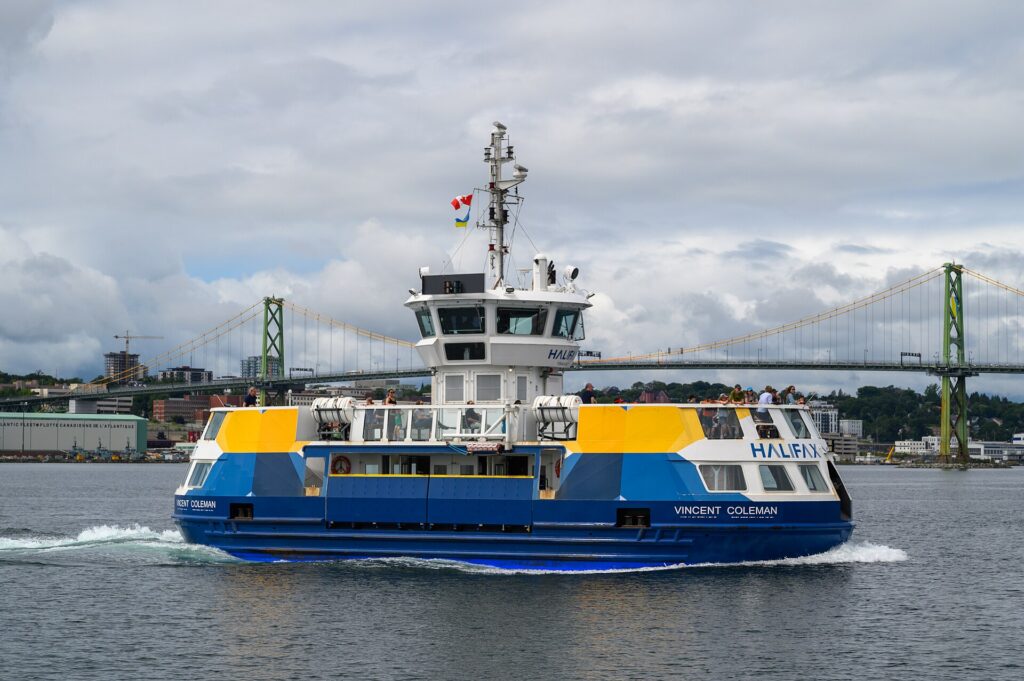
Two routes cross the harbour from the terminal on the downtown waterfront: the Alderney ferry to downtown Dartmouth, twelve minutes, every fifteen to thirty minutes from early morning to late evening, and the Woodside ferry to the eastern side of Dartmouth on weekdays. The service has run since 1752 and is the oldest saltwater ferry in North America. A regular transit fare buys the crossing, with the downtown skyline, the Navy dockyard and the bridges around you, and it is the single best-value experience in the city. The ferry is also the practical way to Dartmouth’s restaurants, its farmers’ market at Alderney Landing and its lakes.
Buses
The bus network fans out from downtown across the peninsula and over the bridges, with the frequent routes along Spring Garden, Robie, Gottingen and Barrington streets, and routes to Point Pleasant, the universities, the Halifax Shopping Centre, Bedford and the Dartmouth suburbs. The MetroX 320 is the airport bus. Frequencies are good on the main routes during the day and thin in the evenings and on Sundays; check times before relying on a bus for a late return.
Fares and tickets
Pay cash on board with exact change, buy tickets from the outlets around the city, or use the HFXGO app for single fares and passes on your phone; the airport bus charges a higher fare. A fare gives you 90 minutes of transfers across buses and ferries. Children twelve and under ride free. Check Halifax Transit’s site for current prices.
Accessibility
The buses are low-floor and accessible, and the ferry terminals are step-free; the hill between the waterfront and the Citadel is the peninsula’s real accessibility challenge.
Beyond Halifax Transit
- Walking. The boardwalk is four kilometres end to end; the waterfront to the Citadel is ten steep minutes; the Citadel to the North End’s restaurants is fifteen; Spring Garden to Point Pleasant is twenty-five. Most of a first visit is on foot.
- Bikes. The city has a growing network of protected bike lanes, a bike-share system in the warmer months, and the Chain of Lakes and Shearwater Flyer trails for longer rides; the peninsula’s hills are the only drawback.
- Taxis and ride-hail. Uber and licensed taxis cover the city; a ride from downtown to the North End or Point Pleasant is short and cheap, and to Peggy’s Cove and back it is possible but expensive.
- Tours. Coach and small-group tours run daily in season to Peggy’s Cove, Lunenburg and the valley from downtown hotels; for a solo traveller who wants one day on the coast without renting, they are the practical answer.
- Intercity. Maritime Bus connects Halifax with Moncton, Fredericton, Charlottetown, Sydney and the Cape Breton towns from the downtown terminal; VIA Rail’s Ocean runs to Moncton and Montreal a few days a week from the station beside the Westin.
Driving in Halifax: what it is really like
Outside the peninsula, Halifax is an easy place to drive: the 100-series highways are fast and uncrowded by big-city standards, the roads to the coast are two-lane and scenic, and drivers are polite to a fault, stopping for pedestrians at every crossing. On the peninsula, it is a different matter. The downtown grid is steep, several streets are one-way, the waterfront roads jam in summer, the two harbour bridges back up at rush hour with a toll on each, and the Armdale Rotary at the western neck of the peninsula is the city’s most reliable traffic jam. Construction season runs from May to November, and the downtown has been a building site for a decade. And winter adds the freeze-thaw: snow, then rain, then ice on the hills, and parking bans during snow clearing that move cars around the city overnight.
Parking
Downtown hotels charge a nightly parking fee, lower than Toronto’s but a real daily cost, and the commercial garages around the waterfront and Spring Garden are priced accordingly. Street parking downtown is metered through the HotSpot app, time-limited and scarce on summer days and on cruise-ship days; it is free in the evenings and on Sundays and holidays. The waterfront lots fill on festival days. Outside the core, parking is easy and mostly free: Point Pleasant Park, the Public Gardens’ surrounding streets, the North End’s side streets, Dartmouth’s ferry terminal and the museums and attractions on the coast all have lots. In winter, overnight parking bans during snow clearing are announced by the city and enforced with tows; ask your hotel.
Rules and conditions worth knowing
- Winter tires are not required by law in Nova Scotia, and rentals often come on all-seasons; for the coast roads and the Cabot Trail between December and March, ask for winter tires when you book. Nova Scotia 511 publishes road conditions.
- The harbour bridges charge a toll each way, paid by cash, MACPASS transponder or, increasingly, by plate; a rental may be billed for it afterward.
- Pedestrians have the right of way at every marked crosswalk, and Halifax drivers stop; visitors who do not are the ones who cause the accidents.
- Peggy’s Cove Road and the Lighthouse Route along the South Shore are two-lane, winding and slow, with coaches in summer; allow more time than the map suggests, and go early.
- Fog on the coast roads in spring and early summer can cut visibility to a few metres; drive accordingly.
- Moose are a hazard on the Cape Breton highways at dawn and dusk, and deer on the roads near the city.
- Fuel is more expensive in Nova Scotia than in Ontario or Alberta; fill up in the city before the coast.

When renting a car makes sense
- Peggy’s Cove, 45 minutes southwest, which a tour can cover but a car does better and earlier.
- Lunenburg, Mahone Bay and Chester along the South Shore, ninety minutes away and the classic day.
- The Annapolis Valley and its wineries, Grand-Pré and the Fundy shore, an hour and a half northwest.
- Lawrencetown Beach and the Eastern Shore, for surfing and the empty coast.
- The Cabot Trail in Cape Breton, five hours away and the great road trip of the region, better as two or three nights.
- Prince Edward Island and the Confederation Bridge, three hours north, or New Brunswick‘s Fundy coast.
- Staying outside the peninsula, in Bedford, the Dartmouth suburbs or with family.
- A group of two or more arriving at the airport, for whom the rental can be cheaper than the taxis alone.
If any of those apply, our rental car booking tips cover insurance, deposits and the questions to ask at the counter.
When it does not
- You are staying on the peninsula and your plans are the city and Dartmouth.
- You are in town for a conference, a concert at the Scotiabank Centre, Canada Day or the Busker Festival, when the waterfront closes and parking vanishes.
- You are travelling solo and a coach tour to Peggy’s Cove and Lunenburg costs less than a day of rental, fuel and insurance.
- You are arriving on a cruise ship, which lands you on the boardwalk.
The hybrid plan
Go car-free for the city days and rent for the coast, and choose the pickup point by the shape of the trip. If the coast is at the end, pick up downtown on the morning you leave the city, drive the South Shore or the valley, and return the car at the airport on the way to the flight home, which most companies allow within the region at little or no extra charge; the downtown branches are around the waterfront hotels and along Robie Street. If the coast is at the start, rent at the airport, drive straight to Peggy’s Cove and Lunenburg, and drop the car downtown when you settle into the city. If you are two or more and the taxi fares are close to the rental, rent for the whole trip and pick a hotel in Dartmouth or the South End that includes parking. Ask for winter tires from December to March. Compare the day rates on our Halifax car rental page against a full-trip rental and the difference is usually obvious.
A worked cost comparison
Numbers change with the season and the booking window, so treat this as a method rather than a quote, and check current rates before deciding. For a three-night city break downtown for two people, the car-free version costs two taxi rides from the airport or the MetroX bus, a couple of ferry fares and a day pass, and perhaps one ride-hail to Point Pleasant; the rental version adds three days of a compact car, three nights of downtown hotel parking, fuel and airport fees, and buys nothing you could not walk or ferry to. Transit wins clearly, and the taxi fare is the only real expense. For the same three nights plus Peggy’s Cove and Lunenburg, the car-free version adds a coach tour for two, which is convenient but fixed to the coach’s timetable; the hybrid adds a one-day rental from downtown, fuel and nothing else, since the coast attractions have free parking, and gives you the lighthouse at dawn without the crowds. For two people, the hybrid usually costs about the same as the tour and is far more flexible; for one person, the tour usually wins. For a week with the Cabot Trail, a rental for the whole stay from the airport is the only practical answer, and the airport taxi it replaces pays for the first day. Run the rates for your dates and put them beside the taxi and tour prices before you choose.
Decision table
| Your trip | Recommendation | Why |
|---|---|---|
| City break on the peninsula, couple or solo | No car | Everything is walkable or on the ferry; downtown parking is a daily cost |
| Canada Day, Busker Festival or a cruise-ship day | No car | The waterfront closes and parking vanishes |
| City plus Peggy’s Cove and Lunenburg, two or more people | Hybrid: one-day rental from downtown | Car-free city days, a car for the coast at your own pace |
| City plus one coast day, solo | No car; take a tour | A coach tour costs less than a solo rental |
| Two or more arriving at YHZ, any plan | Price a whole-trip airport rental | The rental can cost less than two taxi rides and includes the coast |
| Cabot Trail, PEI or the Fundy coast | Rent for the whole trip from the airport | Multi-day road trips with no transit alternative |
| Family visit to Bedford or the Dartmouth suburbs | Rent for the whole stay | Suburban distances make the car worthwhile daily |
| Winter city break | No car | Ice on the hills and parking bans; the pubs and museums are on foot |
Money-saving tips for both options
- On transit: take the MetroX bus from the airport if you are alone and travelling light; ride the ferry for the crossing instead of a paid harbour tour; buy fares through the HFXGO app; children twelve and under are free.
- On a rental: compare airport and downtown pickup, rent only for the coast days unless you are a group, ask for winter tires in the cold months, decline extras you already have through a credit card or home policy (check first), and fill up in the city before the coast roads.
- On the hotel: if you are renting, choose a hotel in Dartmouth or the South End that includes parking and ride the ferry in; if you are not, the downtown waterfront’s car-free premium is worth paying for the boardwalk at your door.
- On timing: avoid the bridges and the Armdale Rotary in the weekday peaks, and the Peggy’s Cove road on summer afternoons, when the coaches arrive; the best time to fly to Halifax guide lists the busy weekends.
- On tours: for a solo traveller, a small-group tour to the South Shore is cheaper than a rental and includes a guide who knows where the lobster is good.
Frequently asked questions
Is it worth renting a car in Halifax?
Not for the city, which is walkable and served by the ferry. For Peggy’s Cove, Lunenburg, the valley and the Cabot Trail, yes; rent for those days, or for the whole trip if you are a group arriving at the airport.
Is Halifax public transit good for tourists?
Adequate: the ferries are excellent and the buses cover the peninsula, but the sights are on foot anyway. There is no rail, and the airport bus takes about an hour.
How do I get from Halifax airport to downtown?
The MetroX 320 bus in about an hour for a premium fare; a taxi or ride-hail in 30 to 40 minutes; a hotel shuttle; or a rental from the terminal.
Can I get to Peggy’s Cove without a car?
By coach or small-group tour from downtown, daily in season, or by taxi at a price; there is no public bus. A one-day rental is the flexible answer for two or more.
Do I need winter tires in Halifax?
Not by law, but the coast roads and the Cabot Trail ice from December to March; ask for them when you book, and for the city alone, leave the car and walk.
Is parking expensive in downtown Halifax?
Moderate: hotel fees are a real daily cost and street parking is scarce in summer, but it is free in the evenings and on Sundays, and everything outside the core is easy.
Do the harbour bridges have tolls?
Yes, a small toll each way on both the Macdonald and MacKay bridges, paid by cash, transponder or plate. The ferry, for pedestrians, is a transit fare.
Whichever way you go, start with the flight. Compare cheap flights to Halifax, choose a neighbourhood with our Halifax hotel search, and if the coast is on the list, price the rental for those dates on our Halifax car rental page.
Keep planning with TicketScanner
- Halifax car rentals — compare airport and downtown pickup
- Cheap flights to Halifax
- Halifax hotels — downtown parking is a daily cost
- Things to do in Halifax: a first-timer's guide
- Best time to fly to Halifax: month by month
- Halifax Stanfield (YHZ) airport guide
- Where to stay: the downtown waterfront
- Rental car booking tips
- Car, transit or taxi in a new city?
Leave a Reply