
Tag: Cheap Flights

  • Cheap Flight Deals to Toronto: Your Gateway to the Marvels of Canada’s Cultural Hub

    Cheap Flight Deals to Toronto: Your Gateway to the Marvels of Canada’s Cultural Hub

    Toronto, the capital of Ontario and Canada’s largest city, is one of the most rewarding city breaks in North America. It has a skyline anchored by the CN Tower, a string of car-free islands a short ferry ride from downtown, major museums and galleries, big-league sports, a film festival that draws stars every September and neighborhoods where you can eat your way around the world in a weekend. It is also one of the best-connected cities on the continent. Toronto Pearson is Canada’s busiest airport, and the downtown island airport, Billy Bishop, puts some flights a short walk from the Financial District. That volume of flights is what makes good fares possible, but only if you know how the city’s seasons, events and airports affect the price. This guide explains when to go, when to book, which airport to use, how fares from within Canada, from the United States and from overseas differ, how to get downtown, and how to keep the whole trip affordable. It is part of our flight booking series, which starts with our guide to the best time to book cheap flights and hotels.

    The short answer

    Winter and the quieter shoulder weeks are cheapest, while summer, the September film festival and major holiday weekends are the most expensive. Book about one to three months ahead for domestic and U.S. trips and two to six months ahead from overseas, earlier for peak dates. Compare both Toronto airports: Pearson has by far the most flights, while Billy Bishop is right next to downtown. Search a whole month, because shifting by a day often changes the fare. Compare the total price with bags and seats included. And if you are not Canadian, check your entry requirements, including whether you need an eTA, before you book. Compare fares across the month on our Toronto flights page.

    The Toronto skyline and CN Tower seen across the water from the Toronto Islands
    Toronto has two airports close to the city, and Billy Bishop is right by downtown (Photo: Jchmrt via Wikimedia Commons, CC BY-SA 4.0)

    Why Toronto is worth the trip

    Toronto works for almost any kind of traveler, which is part of why so many flights go there.

    • Landmarks and views: the CN Tower, the waterfront and the view of the skyline from the Toronto Islands.
    • Museums and culture: the Royal Ontario Museum, the Art Gallery of Ontario, a large theater district and a busy live music scene.
    • Neighborhoods and food: Kensington Market, Chinatown, Little Italy, the Distillery District and the St. Lawrence Market, with food from nearly every culture in one of the most diverse cities in the world.
    • Sports: the Maple Leafs and Raptors in winter, the Blue Jays in summer, and soccer and football too.
    • Easy day trips: Niagara Falls and the Niagara wine region are a manageable drive or tour away.

    Our guide to things to do in Toronto covers the highlights in detail, and the official tourism site, Destination Toronto, lists events and attractions.

    When to visit, and what it does to the price

    Toronto has four real seasons, and flight and hotel prices follow them closely.

    PeriodWeatherCrowds and prices
    January to MarchCold, with snow; a real Canadian winterUsually the cheapest months for flights and hotels, outside holiday weekends and school breaks in March
    April and MayCool to mild spring; parks turn greenGood value; the Victoria Day long weekend in May is busier
    June to AugustWarm to hot and humid; long eveningsPeak season, with Pride in June, big summer festivals, the Caribbean Carnival and the Canadian National Exhibition in late summer
    September and OctoberWarm early, crisp later; fall colorThe Toronto International Film Festival in September and conference season push hotel rates up; October is often excellent value
    November and DecemberCold, first snow possibleQuiet in November; holiday markets and Christmas travel make late December busy

    For the best mix of weather and price, look at May, early June, late September and October outside the film festival and Thanksgiving weekend. For the lowest prices, a winter weekend can be remarkably cheap if you do not mind the cold, and much of Toronto’s appeal, from museums to theater to restaurants, is indoors. Our month-by-month guide to the best time to fly to Toronto goes deeper.

    Events that move prices

    Big events fill hotels and flights on specific dates. Before you fix your trip, check what is on during your dates on our Toronto events page. A major concert run, a playoff series or a festival weekend can make hotels expensive even when flights look reasonable. If you are coming for the event, book as early as you can; if not, consider a different weekend.

    Which airport: Pearson, Billy Bishop or somewhere else?

    AirportWhat it offersChoose it when
    Toronto Pearson (YYZ)Canada’s busiest airport; flights from across Canada, the U.S. and around the world; two terminalsYou want the widest choice of flights and fares, or you are flying from overseas
    Billy Bishop Toronto City (YTZ)A small island airport next to downtown with flights to cities in Canada and the U.S.You are staying downtown and there is a flight from your city
    Hamilton (YHM)A smaller airport southwest of Toronto, sometimes served by low-cost airlinesThe fare saving outweighs a longer transfer, especially if you are going to Hamilton or Niagara
    Buffalo Niagara (BUF)A U.S. airport across the border from the Niagara regionYou are a U.S. traveler willing to drive and cross the border, and the saving is large

    For most visitors, the choice is between Pearson and Billy Bishop. Toronto Pearson is in Mississauga, northwest of downtown, with Terminal 1 and Terminal 3; check which one your airline uses before you travel, and see our Toronto Pearson airport guide. Billy Bishop sits on the Toronto Islands, connected to the mainland by a pedestrian tunnel and a short ferry, with a shuttle to Union Station. A slightly higher fare into Billy Bishop can easily be the cheaper trip once you count the transfer from Pearson, if you are staying downtown.

    Using a distant airport only makes sense when the numbers really work. Add the cost of the transfer, parking or a rental car, the time involved and, for Buffalo, the border crossing, before you decide.
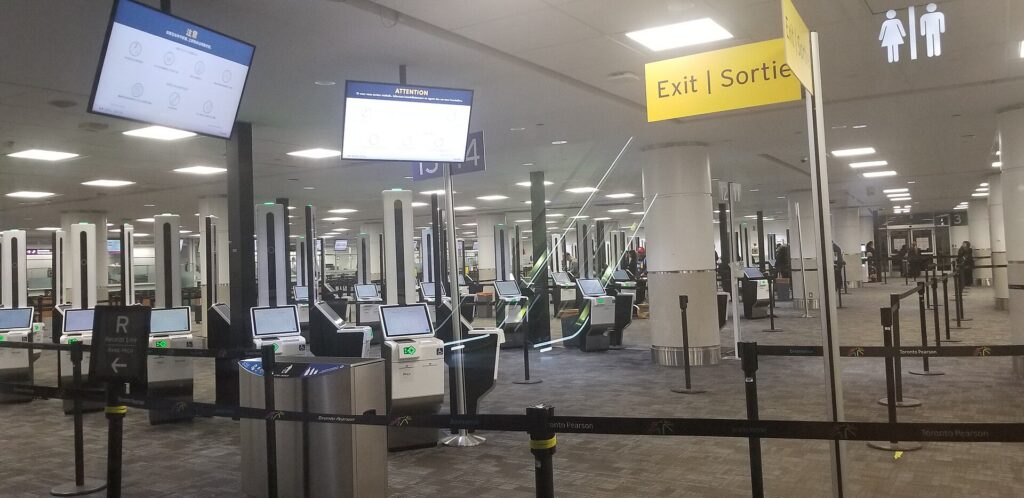
    Border inspection kiosks in the Terminal 3 arrivals hall at Toronto Pearson
    Pearson has the widest choice of flights, and international arrivals clear the border here (Photo: Silver Dovelet via Wikimedia Commons, CC BY-SA 4.0)

    Flying from within Canada

    Toronto is the biggest domestic hub in the country, with frequent flights from every major Canadian city. Air Canada, WestJet and Porter all fly to Toronto, and low-cost airlines serve some routes. A few things are worth knowing:

    • Busy business corridors. Routes such as Montreal, Ottawa, Calgary and Vancouver to Toronto carry many business travelers, so weekday peak flights are pricier. Midday, Saturday and midweek flights are often cheaper.
    • Compare airports on both ends. From Montreal or Ottawa, both Pearson and Billy Bishop are often options; from Vancouver or Calgary, you will almost always land at Pearson.
    • Check the train and the car for short trips. From Montreal and Ottawa, the train or a drive can compete with flying door to door. Our Toronto to Montreal and Toronto to Ottawa road trip pages cover those routes.
    • Know your protections. Canada’s Air Passenger Protection Regulations set out what airlines owe you for delays, cancellations and denied boarding.

    Canadian air fares are advertised with all mandatory taxes and fees included, but optional extras such as checked bags and seat selection are not, so compare totals with the extras you need. Our guide to carry-on size rules compares Canadian and U.S. airline limits.

    Flying from the United States

    Transborder flights to Toronto arrive from dozens of U.S. cities, with the heaviest traffic from the Northeast, Chicago, Florida and major hubs. The route from New York is one of the busiest in North America; our guide to cheap flights from New York to Toronto covers it in detail, including all six airport combinations.

    • Documents: the Government of Canada says U.S. citizens do not need an eTA but must carry proper identification such as a valid U.S. passport. U.S. lawful permanent residents are also eTA-exempt but need a valid passport and a valid green card. Check the official eTA page before you travel.
    • On arrival: you clear Canadian border formalities in Toronto. The Canada Border Services Agency explains what to bring and declare on its travel documents page.
    • On the way home: Toronto Pearson has U.S. preclearance, and Billy Bishop now offers it too, so you clear U.S. border formalities before departure. Arrive earlier than you would for a domestic flight.
    • Currency: fares may be shown in U.S. or Canadian dollars depending on where you book; compare in the same currency.

    Flying from overseas

    Toronto Pearson has nonstop flights from Europe, Asia, Latin America, the Caribbean and beyond, and many one-stop options through other hubs. For long-haul trips:

    • Book earlier. Two to six months ahead is a sensible window, and earlier still for summer and Christmas.
    • Compare nonstop and one-stop. A connection through a European or U.S. hub can be cheaper, but check transit rules; connecting through the United States means going through U.S. border formalities even in transit.
    • Check entry requirements. Most visa-exempt travelers need an eTA to fly to Canada, and some nationalities need a visitor visa. Apply well before you book nonrefundable travel.
    • Consider an open-jaw trip. Flying into Toronto and home from Montreal or Vancouver can be a smart way to see more of Canada.

    Our international flights booking tips cover routings, layovers and hidden costs in more depth, and our guide on how early to arrive for an international flight explains check-in deadlines.

    When to book

    TripSensible booking window
    Domestic Canada, ordinary datesAbout 1 to 3 months ahead
    From the U.S., ordinary datesAbout 1 to 3 months ahead
    Summer, long weekends, the film festival, holidaysAbout 2 to 4 months ahead, or as soon as plans are firm
    From overseasAbout 2 to 6 months ahead
    Last minuteSometimes fine on busy domestic routes midweek; rarely cheap on peak dates

    The method is the same everywhere: start searching early to learn what a normal fare looks like, set a price alert, and book when the fare meets that level. Our fare calendar on the flight search shows prices across the whole month so you can see the cheap days at a glance. Waiting for a last-minute deal on a popular date usually costs more, not less.

    A ferry crossing Toronto harbor to the Toronto Islands
    A ferry ticket buys the best skyline view in the city (Photo: Jason Zhang via Wikimedia Commons, CC BY-SA 3.0)

    Getting from the airport to downtown

    • UP Express from Pearson: the UP Express train runs between Pearson and Union Station downtown. The operator describes the trip as 28 minutes, with trains every 15 minutes. It is the fastest and most predictable way downtown.
    • TTC from Pearson: public buses connect Pearson with the subway. It is the cheapest option and slower, but useful if you are staying outside downtown. Routes and fares are on the TTC website.
    • Taxis and ride-hailing from Pearson: convenient with luggage or a group, but traffic on the highways into the city can be heavy at rush hour.
    • From Billy Bishop: walk through the pedestrian tunnel or take the short ferry to the mainland, then walk, take a streetcar, use the airport shuttle to Union Station or grab a taxi.

    Do you need a car? For a downtown trip, usually not: transit, walking and taxis cover most of what visitors want, and hotel parking is expensive. For day trips to Niagara or cottage country, a car helps. Our guide to renting a car or using transit in Toronto weighs it up, and you can compare prices on Toronto car rentals.

    Stopovers and connections in Toronto

    Many travelers pass through Toronto Pearson on the way somewhere else: between Europe and the Americas, between the Caribbean and Western Canada, or between smaller Canadian cities. If your itinerary includes a long connection, it can be worth turning it into a short stopover. The UP Express makes downtown easy to reach, so even a single night lets you see the waterfront, eat well and see the skyline from the CN Tower or the islands.

    • Check whether a stopover changes the fare. Sometimes adding a night or two in Toronto costs little or nothing extra; sometimes it prices the trip as two separate journeys. Search it both ways.
    • Know the entry rules. Leaving the airport means entering Canada, so you need the right documents, such as an eTA or visa where required. Some travelers in transit also need an eTA or transit visa even if they stay airside, so check the official rules for your passport.
    • Allow enough time on a tight connection. Pearson is large, and connections between international, transborder and domestic flights can involve border formalities and security. The airport’s connections page explains the process.
    • Stay near the airport for very early departures. Airport hotels make sense before a dawn flight; for anything longer, downtown is the better base.

    Traveling to Toronto with kids

    Toronto is an easy family city, with the aquarium at the foot of the CN Tower, the Royal Ontario Museum’s dinosaur galleries, the islands’ beaches and a children’s amusement area, and a zoo on the east side of the city. For families, timing matters even more than usual: flights and hotels are most expensive during summer holidays, March break and the Christmas period. If your children are young enough to travel outside school holidays, the savings can be substantial. Book family rooms early, because they sell first, and check seat selection rules on your fare so you can sit together. Our guide to the best time to book hotels for family vacations has more on timing.

    Where to stay

    AreaWhy stay there
    Entertainment DistrictClose to the CN Tower, theaters, Union Station and the waterfront; easy from both airports
    Financial District and waterfrontCentral, close to the island ferry and Billy Bishop; busy on weekdays, quieter at weekends
    Yorkville and the AnnexUpscale shopping, the Royal Ontario Museum, leafy streets
    Old Town and the Distillery DistrictHistoric streets, the St. Lawrence Market, restaurants
    Near PearsonConvenient for early flights and short stopovers, far from downtown sights

    Downtown business hotels are often cheaper on Friday and Saturday nights, when the weekday corporate guests have gone home, which makes Toronto a good weekend destination. Compare prices on our Entertainment District hotels page or all Toronto hotels, and book a refundable rate so you can rebook if the price drops. Our guide to booking hotels in Canada has more tips.

    A simple plan for a first long weekend

    If you are flying in for three or four days, a loose plan helps you choose the right hotel and the right flight times. Arrive early on the first day if you can, so you have an afternoon for the waterfront and the CN Tower area. Spend a day on culture, with the Royal Ontario Museum or the Art Gallery of Ontario in the morning and Kensington Market and Chinatown for lunch and a wander. Give another day to the Toronto Islands in warm weather, or to the Distillery District and the St. Lawrence Market in the colder months, and finish with a game, a show or dinner in one of the city’s many neighborhoods. Save Niagara Falls for a longer trip, or for a day when you have a car or a tour booked. Booking a late-afternoon or evening flight home gives you one more morning in the city, but on the way to the United States, leave time for preclearance.

    Keeping the whole trip affordable

    • Use transit. The TTC covers downtown and beyond; a day of subway and streetcars costs far less than taxis.
    • Take the ferry to the islands. The islands offer beaches, bike paths and the best skyline view in the city for the price of a ferry ticket.
    • Eat in the markets and neighborhoods. The St. Lawrence Market, Kensington Market and the city’s many neighborhood restaurants are good value.
    • Check free and discounted museum times. Some museums and galleries offer free or reduced admission at set times; check their websites.
    • Stay over a weekend. Downtown hotels are often cheaper on Friday and Saturday nights.
    • Travel light. A carry-on-only trip avoids checked bag fees on the cheapest fares.

    Common mistakes to avoid

    • Booking during the film festival or a festival weekend by accident. Check the events calendar first.
    • Ignoring Billy Bishop. For a downtown stay, it can save time and taxi fares.
    • Choosing a distant airport without doing the math. Hamilton and Buffalo only make sense with a large saving.
    • Forgetting the eTA. Most visa-exempt travelers who are not U.S. citizens need one to fly to Canada.
    • Underestimating the return. U.S.-bound travelers clear preclearance before departure; arrive early.
    • Renting a car for a downtown trip. Parking and traffic make it poor value.
    • Comparing base fares instead of totals. Add bags and seats before choosing.
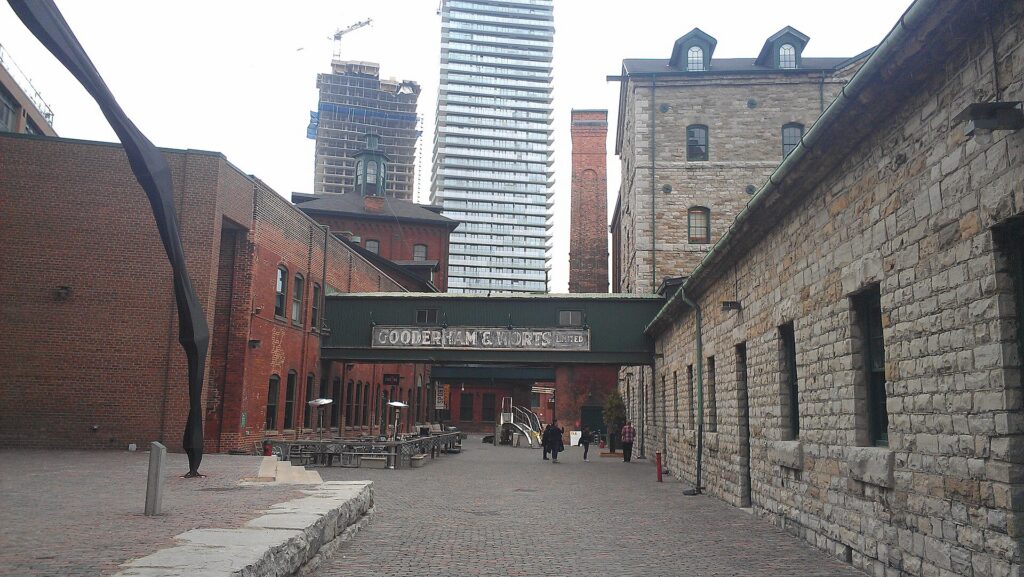
    Brick streets and Victorian industrial buildings in Toronto's Distillery District
    Neighborhoods like the Distillery District make Toronto an easy weekend trip (Photo: Alonso Inostrosa Psijas from Santiago, Chile via Wikimedia Commons, CC BY-SA 2.0)

    Frequently asked questions

    What is the cheapest month to fly to Toronto?

    Winter months such as January and February are usually the cheapest, outside holiday weekends and school breaks. Late spring and October are good value with better weather.

    Which Toronto airport is cheaper to fly into?

    Pearson usually has the most flights and the widest range of fares, but Billy Bishop can be the cheaper trip overall if you are staying downtown, because the transfer is so short.

    How far in advance should I book a flight to Toronto?

    About one to three months ahead from within Canada or the U.S., and two to six months ahead from overseas. Book earlier for summer, holidays and the film festival.

    Do I need an eTA to fly to Toronto?

    U.S. citizens do not need an eTA, but they must carry proper identification such as a valid passport. Most other visa-exempt travelers do need an eTA, and some nationalities need a visa. Check the Government of Canada’s eTA page before you book.

    How do I get from Pearson to downtown Toronto?

    The UP Express train runs to Union Station in about 28 minutes, according to the operator, with trains every 15 minutes. TTC buses, taxis and ride-hailing are alternatives.

    Is Toronto expensive to visit?

    Hotels in peak season and during big events can be pricey, but winter and shoulder-season trips, weekend hotel rates, good transit and affordable neighborhood food make a budget trip very achievable.

    Are last-minute flights to Toronto ever cheap?

    Occasionally on busy domestic routes midweek, when airlines have seats to fill. On peak dates and weekends, prices usually rise as departure approaches.

    Can I combine Toronto with other Canadian cities?

    Yes. Montreal and Ottawa are close enough for a train or drive, and flights connect Toronto with every major Canadian city. See our guides to flying to Montreal and things to do in Ottawa.

    Ready to plan your Toronto trip? Search a whole month of fares on our Toronto flights page to find the cheapest days, check what is on with our Toronto events listings, and compare rooms for the same dates on our Toronto hotels page. For more on timing, read our guide to the best time to book cheap flights and hotels.

  • Vacationing in New York: Your Complete Guide to Cheap Flights, Hotels, and Car Rentals

    Vacationing in New York: Your Complete Guide to Cheap Flights, Hotels, and Car Rentals

    New York has a reputation as one of the most expensive cities in the world, and some of that reputation is earned. Hotel rooms in Manhattan can cost more per night than a week of groceries, a cocktail in a rooftop bar can cost as much as a meal elsewhere, and a careless week of taxis and tourist-trap restaurants adds up fast. But New York is also full of things that cost very little or nothing at all: a free ferry past the Statue of Liberty, the best people-watching on the planet, some of the world’s great parks, a walk across the Brooklyn Bridge, and a subway that takes you almost anywhere for a single fare. The difference between an expensive New York trip and an affordable one is rarely luck. It comes down to when you go, where you sleep, how you get around and what you choose to pay for. This guide covers all four, from cheap flights to New York and cheap hotels to the free sights, the neighborhoods where food is good value, and the car question (the short answer is do not rent one).

    The short answer

    To do New York on a budget, travel in January or February after the New Year week, or in the shoulder weeks of late April to early June and early November, when rooms are cheaper than in the fall and holiday peaks. Compare all three airports: JFK, LaGuardia and Newark often price very differently. Stay a subway ride from Midtown, in places like Long Island City, Downtown Brooklyn or across the river in Jersey City, rather than steps from Times Square. Never rent a car for a city stay. Build the trip around free experiences, and spend on the one or two things that matter most to you, whether that is a Broadway show, a great restaurant or the view from an observation deck. Start by comparing a whole month of fares on our New York flights page, then compare neighborhoods on New York hotels.

    The Lower Manhattan skyline seen across the harbor from the Staten Island Ferry
    The free Staten Island Ferry gives one of the best skyline views in New York (Photo: Jakub Hałun via Wikimedia Commons, CC BY 4.0)

    Why New York is worth it, even on a budget

    There are cheaper cities, but very few give you as much for free. The Statue of Liberty from the water, the skyline from Brooklyn, the architecture of Midtown, the parks, the street life in dozens of distinct neighborhoods, the food of every culture on earth: most of what makes New York special costs nothing to experience. The expensive parts are optional, and with a little planning you can decide which ones are worth it. For a full list of sights and neighborhoods, see our guide to things to do in New York.

    When to go for the lowest prices

    In New York, the hotel is almost always the biggest part of the bill, and hotel prices follow the city’s calendar more than the weather. Timing your trip is the single biggest saving you can make.

    PeriodHotel pricesWeatherBudget verdict
    January to February (after New Year)Lowest of the yearCold, sometimes snowyBest value; Restaurant Week and Broadway Week discounts often run in this period
    MarchLow to moderateCool, changeableGood value, especially midweek
    Late April to early JuneModerateMild, parks at their bestBest balance of weather and price
    Late June to AugustModerate to highHot and humidBusy with international visitors; many free outdoor events
    September to OctoberHighest outside the holidaysThe best weather of the yearExpensive, especially during the UN General Assembly in late September
    Early NovemberModerateCool, crispA good-value window before the holidays
    Thanksgiving to New YearVery high, peaking in mid-DecemberColdMagical but pricey; go early in December for the best rates

    Our guide to the best time to fly to New York covers each month in more detail, including the events that push prices up. If you want the holiday experience anyway, our guide to the best cities for Christmas in the USA explains how to time it.

    How to find cheap flights to New York

    Compare all three airports

    New York has three major airports, and fares can differ significantly between them for the same dates:

    • John F. Kennedy International (JFK) in Queens handles most long-haul and many domestic flights. The AirTrain connects to the subway and the Long Island Rail Road. See our JFK airport guide.
    • LaGuardia (LGA), also in Queens, is the closest to Midtown and mostly domestic, with many flights from Canada. It has no rail link, but public buses connect it to the subway.
    • Newark Liberty (EWR), in New Jersey, is often competitive on price. The AirTrain connects to New Jersey Transit and Amtrak trains into Penn Station in Midtown.

    Search “New York” as a city rather than a single airport so you see all three at once, then compare the total cost including getting into the city. A cheaper fare into an airport with a long, expensive ride can end up costing more.

    Be flexible on dates

    Fares can change noticeably between neighboring days. Midweek flights are often cheaper than Friday and Sunday departures, and moving a trip by a day or two can make a real difference. Our guide to the best time to book cheap flights and hotels explains how far ahead to look.

    Watch the extras

    Low-cost fares often exclude a carry-on bag, a checked bag or seat selection. Add those up before choosing the cheapest headline fare. Our guide to booking cheap domestic flights in the US covers the common traps.

    Flying from Canada

    New York is one of the easiest international trips from Canada, with frequent flights from Toronto, Montreal and Ottawa. Our pages for flights from Toronto and from Montreal show the routes, and our guide to flights between New York and Toronto covers that corridor in detail. Remember that US border preclearance at several major Canadian airports means you clear US immigration before departure, so allow extra time at the airport.

    Consider the train or bus

    From Boston, Philadelphia and Washington, DC, trains and intercity buses can be cheaper and more convenient than flying, since they arrive in the middle of Manhattan. Compare them with the total cost of a flight plus airport transfers.

    How to find a cheap hotel in New York

    Accommodation is where most New York budgets break. These strategies help.

    Stay one subway stop outside the obvious

    Midtown and Times Square are convenient for first-timers, but you pay a premium for the location. The subway runs around the clock, so a hotel a few stops away can be just as practical at a lower price.

    AreaWhy it can save moneyTrade-offs
    Long Island City, QueensOne or two subway stops from Midtown, with newer hotels and skyline viewsQuieter at night; fewer sights on the doorstep
    Downtown BrooklynMany subway lines, easy access to Lower Manhattan and Brooklyn’s best neighborhoodsLonger ride to the Upper West Side and Upper East Side
    Jersey City and HobokenAcross the Hudson, with PATH trains to Manhattan and views of the skylinePATH is a separate system; check late-night service
    Upper ManhattanOften lower rates than Midtown; close to Central Park and museumsLonger ride downtown
    Midtown (Times Square area)Walk to theaters and many sights; saves on transitUsually the most expensive; busy and noisy

    If you do want to be in the middle of it, our guide to hotels around Times Square covers the trade-offs of staying there.

    Compare the full price

    New York hotels add sizable taxes to the nightly rate, and some add “destination” or “facility” fees. Compare the final total each provider shows at checkout, not the headline rate. Our hotel booking tips explain what to look for.

    Accept a small room

    New York hotel rooms are small by North American standards. If you will only be sleeping there, a compact room in a good location is often the smartest choice.

    Book refundable, then keep watching

    Reserve a refundable rate once your dates are fixed, then keep checking. Rates move with demand, and if a lower price appears, you can switch. If your plans are last minute, our guide to last-minute hotel booking helps.

    Be careful with short-term rentals

    New York strictly limits short-term apartment rentals, so options are much narrower than in many other cities. Check that a listing is legal and properly registered before you book.

    Getting around cheaply: skip the car

    New York is the one American city where a car is a liability for a visitor. Driving is slow, parking is scarce and expensive, and most of Manhattan south of Central Park sits inside a congestion toll zone. The subway, buses, ferries and your own feet are cheaper and usually faster.

    • Subway and buses: tap a contactless card or phone at the turnstile using the OMNY system. OMNY’s fare cap works in your favor: according to the official OMNY site, once you tap the same card or device for 12 trips within seven days, the rest of the week’s rides are free. Use one card or phone for all your rides to benefit.
    • Staten Island Ferry: the City of New York runs the Staten Island Ferry as a free service between Lower Manhattan and Staten Island, passing close to the Statue of Liberty with a superb view of the skyline.
    • Walking: Manhattan is a grid north of about 14th Street, and neighborhoods like the Village, SoHo and Chinatown are best explored on foot.
    • Bike share: Citi Bike can be convenient for short trips in good weather, particularly along the waterfront greenways.

    Our guide to car rental versus public transit in New York covers the whole system in detail, including when a car does make sense, such as for a day trip to the Hudson Valley or the beaches of Long Island. If you need one for a day or two, compare options on our car rental search and pick it up the morning you leave the city.

    A subway train pulling into a station platform in New York City
    The subway runs around the clock and is the cheapest way to get around New York (Photo: Martin David martindavid via Wikimedia Commons, CC0)

    The best free and cheap things to do

    Some of New York’s greatest experiences cost nothing. Build your days around these and save your money for a couple of splurges.

    Free

    • Ride the Staten Island Ferry for the classic harbor view of the Statue of Liberty and the skyline.
    • Walk the Brooklyn Bridge, ideally from Brooklyn toward Manhattan so the skyline is in front of you, then explore DUMBO and Brooklyn Bridge Park.
    • Explore Central Park: Bethesda Terrace, Bow Bridge, the Mall, Strawberry Fields and the Reservoir.
    • Walk the High Line, a public park built on an old elevated rail line on the West Side; the official High Line site lists hours and free events.
    • Visit the 9/11 Memorial: the memorial plaza and its reflecting pools are free to visit; the museum requires a ticket. See the official 9/11 Memorial site.
    • See Grand Central Terminal, the New York Public Library’s main branch on Fifth Avenue, and St. Patrick’s Cathedral.
    • People-watch in Times Square after dark, then walk down to Bryant Park.
    • Wander the neighborhoods: Greenwich Village, SoHo, Chinatown, the Lower East Side, Harlem and Williamsburg each feel like a different city.

    Cheap or worth paying for

    • Museums: several major museums offer free or pay-what-you-wish admission at certain times or for certain visitors, and the rules differ by museum and change occasionally. Check each museum’s official site before you go, and pick the one or two museums you care about most rather than trying to see them all.
    • Broadway on a budget: the TKTS booths run by the nonprofit Theatre Development Fund sell same-day discounted tickets for many shows; see TKTS by TDF. Many shows also run digital lotteries and rush tickets. Browse upcoming shows, games and concerts on events in New York.
    • The Statue of Liberty and Ellis Island: if you want to set foot on Liberty Island, book through the official concessionaire linked from the National Park Service’s Statue of Liberty page, and be wary of street sellers.
    • Observation decks: they are expensive, so choose one. Alternatively, get a free skyline view from the Brooklyn waterfront or the Staten Island Ferry.
    • Governors Island: a short ferry ride from Lower Manhattan, with lawns, hammocks and harbor views; check the season and ferry schedule on the official Governors Island site.
    Bow Bridge crossing the Lake in Central Park with trees and Manhattan buildings behind
    Bow Bridge in Central Park, one of the city's best free experiences (Photo: Jakub Hałun via Wikimedia Commons, CC BY 4.0)

    Eating well for less

    New York is one of the best cities in the world for cheap food, as long as you avoid the tourist traps around the major sights.

    • Go classic: a slice of pizza, a bagel, a hot dog from a cart and a halal platter from a street vendor are New York institutions that cost little.
    • Head to the neighborhoods: Chinatown, Flushing in Queens, Jackson Heights and Sunset Park in Brooklyn have outstanding food at neighborhood prices.
    • Use food halls and delis: good for quick meals, variety and groups with different tastes.
    • Make lunch your big meal: many restaurants offer lunch menus that cost less than dinner.
    • Watch for Restaurant Week: the city’s Restaurant Week promotions offer set menus at participating restaurants, typically in winter and summer.
    • Tip and tax: sales tax is added at the register, and tipping around 18 to 20 percent is expected in sit-down restaurants. Budget for both.

    A sample three-day budget itinerary

    Day 1: Lower Manhattan and Brooklyn

    Start with the Staten Island Ferry for the harbor view, then walk through the Financial District to the 9/11 Memorial. After lunch in Chinatown, walk across the Brooklyn Bridge to DUMBO and spend the late afternoon in Brooklyn Bridge Park as the skyline lights up.

    Day 2: Midtown and Central Park

    See Grand Central Terminal, the New York Public Library and Bryant Park, then walk up Fifth Avenue to Central Park. Spend the afternoon in the park or at one museum. In the evening, try the TKTS booth for a same-day show, or see Times Square lit up after dark.

    The Brooklyn Bridge and Lower Manhattan seen from the Brooklyn Heights Promenade
    Walking the Brooklyn Bridge and the Brooklyn waterfront costs nothing (Photo: Abzeronow via Wikimedia Commons, CC BY 4.0)

    Day 3: The West Side and the neighborhoods

    Walk the High Line from the Meatpacking District, explore Chelsea Market, then wander through Greenwich Village and SoHo. In the evening, take the subway to Queens or Brooklyn for dinner in a neighborhood known for its food.

    For a longer stay, add a day trip. The things to do in New York guide lists day trips that are easy by train.

    Getting from the airport for less

    The ride into the city is where many visitors overspend on day one. From JFK, the AirTrain connects to the subway at Jamaica and Howard Beach, and to the Long Island Rail Road at Jamaica for a faster ride to Penn Station or Grand Central Madison. From Newark, the AirTrain links to New Jersey Transit and Amtrak trains into Penn Station. From LaGuardia, public buses run to subway stations in Queens and Upper Manhattan. Official options and current details are on each airport’s site, including the JFK airport site. A taxi or ride-hail can make sense for a family with luggage arriving late at night, but for a solo traveler or couple, transit is far cheaper and often just as quick in rush-hour traffic.

    Your New York budget checklist

    • Pick dates in a low or shoulder period, and check for big events or conventions before you book.
    • Search all three airports and compare the total cost, including bags and the ride into the city.
    • Book a refundable room a subway ride from Midtown, comparing the final price with taxes and fees.
    • Use one contactless card or phone for every subway and bus ride so the weekly fare cap works for you.
    • Plan each day around free sights, and choose one or two paid experiences that matter most.
    • Eat your big meal at lunch, and head to neighborhoods like Chinatown or Flushing for dinner.
    • Buy show, ferry and statue tickets only from official sources.

    Budget traps to avoid

    • Renting a car for a city stay. Parking, tolls and traffic make it far more expensive than transit.
    • Eating right next to the big sights. Walk a few blocks away for better food at lower prices.
    • Buying “discount” tickets from street sellers. Buy ferry, statue and show tickets from official sources.
    • Taking taxis from the airport by default. Public transit from JFK and Newark is much cheaper, and buses link LaGuardia with the subway.
    • Visiting in peak weeks without checking prices. A trip in mid-December or late September can cost far more than the same trip in January or early November.
    • Ignoring taxes and fees. Hotel taxes and fees, sales tax and tips all add up; budget for them from the start.
    • Trying to see everything. Paying for five attractions in three days is expensive and exhausting. Choose one or two, and fill the rest with free experiences.

    Frequently asked questions

    What is the cheapest month to visit New York?

    January and February, after the New Year week, are usually the cheapest months for hotels and often for flights. It is cold, but the city’s museums, theaters and restaurants are all open, and seasonal promotions like Restaurant Week and Broadway Week often run in this period.

    Which New York airport is cheapest to fly into?

    It depends on your route and dates. JFK, LaGuardia and Newark often price differently, so search all three and compare the total cost including the trip into the city.

    Where should I stay in New York on a budget?

    Consider Long Island City, Downtown Brooklyn, Jersey City or Upper Manhattan, which are often cheaper than Midtown and have good transit links. Always compare the total price including taxes and fees.

    Do I need a car in New York?

    No. The subway, buses, ferries and walking cover everything a visitor needs, and driving and parking are expensive. Rent a car only for day trips outside the city.

    What can I do in New York for free?

    Ride the Staten Island Ferry, walk the Brooklyn Bridge and the High Line, explore Central Park, visit the 9/11 Memorial plaza, see Grand Central Terminal and wander neighborhoods like Greenwich Village, Chinatown and Williamsburg.

    How can I see a Broadway show cheaply?

    Try the TKTS booths for same-day discounted tickets, enter digital lotteries, or look for rush tickets. Weeknight performances and newer shows are often easier to get.

    How many days do I need in New York?

    Three full days cover the highlights; four or five let you explore Brooklyn, Queens and a museum or two without rushing. A longer stay also spreads the cost of the flight over more days.

    More guides in this series

    This article is part of our destinations and planning series. Start with the pillar guide to budget travel destinations for more places where your money goes further, then read our guide on how to save money for a trip, the best cities for Christmas in the USA, seven relaxing vacations for doing absolutely nothing, and our guide to planning and booking a trip on TicketScanner.

    Ready to plan an affordable New York trip? Compare fares into JFK, LaGuardia and Newark across a whole month on our New York flights page, then find a well-connected room on New York hotels. For the full list of sights, see our guide to things to do in New York.

  • The Ultimate Guide to Mastering Your Next Travel Adventure with TicketScanner.ca

    The Ultimate Guide to Mastering Your Next Travel Adventure with TicketScanner.ca

    Planning a trip usually means a dozen open browser tabs: one for flights, a few for hotels, another for rental cars, one for the game or concert you want to catch, and a couple of travel guides you meant to read. TicketScanner was built to pull those steps into one place. You search flights, hotels and rental cars through our travel partners, browse event tickets from the TicketNetwork exchange, and read destination, airport and planning guides, all on the same site. This guide explains how each part works, how to search smartly with flexible dates, how to read the fares and calendars you will see along the way, and how to combine a flight, a room and a car into a trip that fits your plans and your budget. It is a practical manual, not a sales pitch: we explain what the site does, what it does not do, and what to check before you pay anyone.

    The short answer

    TicketScanner is a search and comparison site. You search once, compare options from our travel partners, then book directly with the airline, hotel, rental company or ticket provider you choose, under their terms and customer support. The best way to use it is in order: find the flight first, using flexible dates and nearby airports on our flight search; choose a hotel in the neighborhood where you will spend your time on our hotel search; add a rental car only for the days you need one on our car rental search; then browse concerts, sports and theater for your dates. Before you book, always check the final price, the fare or rate rules, and the entry and security requirements for your trip.

    The gate areas along the concourse of Terminal 1 at Toronto Pearson
    Start with the flight: it fixes your dates, and everything else is planned around it (Photo: Daniel Case via Wikimedia Commons, CC BY-SA 3.0)

    How TicketScanner works

    It helps to understand what happens behind the search box, because it shapes how you should use the results.

    1. You search once. Enter your route or destination, dates and travelers. Our partner search checks airlines, hotel suppliers and rental companies for you.
    2. You compare. Results show options side by side, so you can weigh price, schedule, stops, location and conditions.
    3. You book with the provider. When you choose an option, you complete the booking with that airline, hotel, booking partner or rental company. Your contract, payment, changes and customer support are with them, not with TicketScanner.

    Two points follow from this. First, the provider’s checkout page is the final word on price and conditions, so read it carefully. Second, the prices you see on our destination and route pages are recent fares that other travelers found, shown to help you plan. They are not live quotes. Always run a search for your exact dates to see the current price.

    Searching for flights, step by step

    The flight search lives on the home page and on our flights page. Here is how to get the most from each field.

    1. Choose round trip or one way, and your cabin

    Pick Round trip or One way, and Economy or Business. For trips where you will arrive in one city and leave from another, compare two one-way searches with a round trip; sometimes separate one-way tickets are cheaper, and sometimes a round trip is.

    2. Enter where you are leaving from and going to

    Type a city or an airport and choose from the suggestions. If your city has more than one airport, choosing the city lets you compare them all at once. Toronto, New York, Chicago, Washington, DC, Houston and several other cities have more than one major airport, and fares can differ noticeably between them. If you are flexible, also try a larger hub within driving distance of home. The swap button flips your origin and destination in one tap, which is handy for checking the reverse direction.

    3. Pick your dates

    The date picker shows a calendar so you can see weekdays at a glance. Departing on a Tuesday or Wednesday is often cheaper than a Friday or Sunday, so if your plans allow it, try a few combinations.

    4. Add travelers

    Set the number of adults, children and infants. On our search, children means ages 2 to 11 and infants are under 2, traveling on an adult’s lap, one per adult. Airlines apply their own rules on ages and seating, so check them if you are traveling with young children.

    5. Compare the results

    Results come from our flight partner and list options from different airlines and booking sites. Before you pick the cheapest line, compare:

    • The number of stops and the connection times. A short connection can be risky; a very long one wastes a day.
    • Departure and arrival times. An early departure might mean an expensive taxi to the airport.
    • What is included. Basic fares may exclude a carry-on, checked bags or seat selection. Add those costs before comparing.
    • Who you are booking with. Booking directly with the airline can make changes and disruptions simpler to handle; some travelers are happy to use a booking site for a lower price.

    6. Check everything on the provider’s page

    When you select a flight, you move to the airline or booking partner to finish. Confirm the total price, the fare rules for changes and refunds, the baggage allowance and the names on the booking before you pay. Our guide to reading your flight details explains the fine print.

    When to use flexible dates

    Being flexible is the single most reliable way to lower the cost of a flight. It is most useful when:

    • You are planning a leisure trip without fixed commitments at either end.
    • Your dates touch a holiday or long weekend. Leaving a day earlier or returning a day later can move you out of the peak.
    • You are flying a busy business route. Monday morning and Friday evening flights fill with business travelers; midday and midweek flights are often cheaper.
    • You are going long-haul. International fares can vary significantly from one day to the next.

    Flexibility matters less when you are going to a fixed event, such as a wedding or a game, or when your dates are dictated by school holidays. In those cases, book early instead. Our guide to the best time to book cheap flights and hotels covers booking windows, and each of our city guides, such as the best time to fly to New York, explains that destination’s seasons.

    How to read fare calendars and recent fares

    Many travel sites, including some of our partners’ results pages, show fares for a range of dates in a calendar or chart. On TicketScanner, destination and route pages also show recent fares that travelers have found. Here is how to read them without being misled.

    Understand what the number means

    • One way or round trip? A calendar may show one-way fares, round-trip fares, or the lowest fare departing that day. Check the label.
    • Cached or live? Calendar prices and “recent fare” figures are usually based on searches that were run earlier. On our route pages, recent fares are prices other travelers found in roughly the last 48 hours. They are a good guide to what is typical, but the live price for your dates can be higher or lower.
    • What is included? The lowest calendar fare is often a basic fare with no bags. Compare like with like.

    Look for patterns, not a single cheap day

    A calendar is most useful for spotting patterns: cheaper weekdays, a price jump around a holiday, or a season when fares fall. Use it to pick a window of a few days, then run a full search for those dates.

    Run a few searches around your ideal dates

    If you do not see a calendar, the same approach works manually. Search your ideal dates, then move the departure a day or two earlier and later, and do the same for the return. Five or six searches usually show you the shape of the market.

    Using destination, departure and route pages

    Beyond the search box, TicketScanner has planning pages for the cities we cover.

    • Destination pages, such as flights to New York or flights to Vancouver, list the cities with nonstop routes to that destination, recent fares where we have them, and a search box ready to go.
    • Departure pages, such as flights from Toronto or from Montreal, show every route we cover from that city, with recent fares where available. They are ideal when you know when you want to travel but not where.
    • Route pages for popular city pairs combine a live search with recent fares and nonstop details, and you can reach them from the destination and departure pages.
    • Airport guides, such as our Toronto Pearson guide, cover terminals, ground transportation and practical tips.

    On the flights page, the search is also prefilled with a major airport near you, based on your approximate location, so you can start from home with one less step.

    Searching for hotels

    Switch to the Stays tab on the home page, or go to our hotels page.

    Fill in the search

    • Where to? Enter a city or destination.
    • Check-in and check-out: pick your dates on the calendar.
    • Travelers: set adults, children (ages 0 to 17) and the number of rooms.

    Compare more than the nightly rate

    Hotel results come from our hotel partner. When comparing, look at:

    • Location. A cheaper hotel far from where you will spend your days can cost more once you add transit or taxis.
    • The total price. Taxes, resort or destination fees and parking vary widely; compare the total the provider shows at checkout.
    • Cancellation terms. Non-refundable rates are often cheaper but lock you in. A refundable rate gives you room to change plans or switch if prices fall.
    • Recent reviews. They tell you more about cleanliness and noise today than a star rating.

    Use our neighborhood guides

    For many cities, we publish neighborhood guides that explain what each area is like and who it suits, such as hotels around Times Square, Yaletown in Vancouver and Old Montreal. City hotel pages also show recent hotel prices where we have them. For more, read our hotel booking tips.

    A double bed with bedside lamps in a hotel room
    Choose the neighborhood first, then compare the total price and cancellation terms (Photo: JIP via Wikimedia Commons, CC BY-SA 4.0)

    Searching for rental cars

    The Cars tab, and our car rental page, use our rental partner’s booking engine. Enter your pickup location, dates and times, and compare suppliers and vehicle types.

    • Airport or city pickup: airport counters are convenient but often carry location fees. A city branch a short ride away can be cheaper for longer rentals.
    • One-way rentals: dropping off in a different city is possible with many suppliers, sometimes with a fee. Our one-way route pages, such as Toronto to Montreal or Seattle to Vancouver, show real distances and drive times.
    • Insurance and fuel: check what your credit card or auto policy already covers before pickup, and choose a full-to-full fuel policy where possible.
    • Do you need a car at all? In many big cities, transit is faster and cheaper. Each city in our series has a guide to the question, such as Toronto: rent a car or use transit?

    Our rental car booking tips cover the rest.

    A car rental counter in the arrivals area at Vancouver International Airport
    Airport counters are convenient, but a city branch can cost less for longer rentals (Photo: GoToVan from Vancouver, Canada via Wikimedia Commons, CC BY 2.0)

    Finding concerts, sports and theater tickets

    The events section lists tickets for concerts, sports, theater, comedy and family shows in cities across Canada and the US. Listings come from the TicketNetwork exchange, a resale marketplace, which means sellers set the prices. Tickets can be above or below face value depending on demand.

    • Browse by city: city pages such as events in Toronto and events in New York show what is on sale there.
    • Browse by category or performer: go straight to concerts, sports, theater, comedy or family shows from the events hub, or search for a specific artist, team or show.
    • Filter by date and price to find seats that fit your trip.

    Before you buy, check the event date, time and venue, the seat location, the total price including fees, and the delivery method for the tickets. For events far from home, buy the tickets first if they are the reason for the trip, then book travel around them.

    A hockey game in progress inside a packed Scotiabank Arena in Toronto
    If a game or concert is the reason for the trip, lock in the tickets first (Photo: Adam Bishop via Wikimedia Commons, CC BY-SA 4.0)

    Attractions, tours and travel guides

    Many city pages also feature attractions, museums and tours from Tiqets, our activities partner. These are priced in Canadian dollars and booked directly on the partner’s site. They are useful for timed-entry sights that sell out.

    The TicketScanner blog is where our travel guides live. For each major city we cover, you will find a trio of guides: things to do, the best time to fly, and whether to rent a car. Our planning series, starting with the pillar guide to budget travel destinations, helps you choose where to go and how to pay for it.

    Putting it together: how to combine flights, hotels and cars

    A trip comes together most smoothly when you book in a sensible order.

    StepWhere on TicketScannerWhat to check
    1. Pick the destination and windowDeparture pages, destination pages, travel guidesSeason, events, recent fares, nonstop options
    2. Lock in any fixed eventEvents sectionDate, venue, seats, total price
    3. Book the flightFlight searchTotal price with bags, fare rules, connection times
    4. Book the hotelHotel search and neighborhood guidesLocation, total price, cancellation terms
    5. Add a car if neededCar rental search and city car guidesPickup location, insurance, fuel, one-way fees
    6. Add attractionsCity pagesTimed entry, opening hours

    Why the flight comes first

    Flights have the least flexibility and the biggest price swings, and they determine your arrival and departure times. Once they are fixed, you know exactly which nights you need a room and which days you might need a car.

    Match the hotel to your plans

    Choose the neighborhood before the hotel. If you are going to a game or concert, staying near the venue can save transit time and late-night taxis. If you are arriving late, a hotel near the airport for the first night can make sense.

    Rent the car only for the days you need it

    For a city break with a day trip, you might go without a car for most of the stay and rent one for a single day. For a road trip, pick up at the airport on arrival.

    An example: a weekend in Chicago for a game

    Say you are in Toronto and want to catch a game in Chicago. Start with events in Chicago to find the date and seats. Then search flights from Toronto to Chicago, comparing O’Hare and Midway. Book a refundable room near the venue or in the Loop, skip the car because Chicago’s trains cover the city, and read our guide to things to do in Chicago for the rest of the weekend.

    Planning for families and groups

    Group trips add a few wrinkles. For flights, search with the full number of travelers, since the price per person can change when fewer seats are left in a fare class; if the result looks high, try searching for a smaller group to see whether splitting the booking helps, and make sure everyone can still sit together. For hotels, set the number of rooms in the search rather than assuming a single large room will fit everyone, and check the property’s occupancy rules for children. For cars, count luggage as well as people: a family of four with checked bags may need a larger vehicle than the seat count suggests. For events, buy seats together in one order where you can. Our guide to car rentals for family vacations covers car seats and vehicle sizes.

    Book with confidence

    Common mistakes to avoid

    • Treating a recent fare as a quote. Always run a live search for your dates.
    • Comparing base fares instead of totals. Bags, seats and fees can reverse the order of the results.
    • Booking the hotel before the flight. Unless the room is refundable, you risk mismatched dates.
    • Renting a car for a city trip by default. Check the city’s car-or-transit guide first.
    • Skipping the fine print. Change rules, cancellation terms and ticket delivery details are on the provider’s page. Read them before you pay.
    • Forgetting names and documents. The name on your booking must match your passport or ID exactly.

    Frequently asked questions

    Does TicketScanner sell flights, hotels or car rentals?

    No. TicketScanner helps you search and compare. You book with the airline, hotel, booking partner or rental company you choose, under their terms, pricing and customer support.

    Are the prices on TicketScanner live?

    The search checks our partners live when you run it. Fares and prices shown on destination, route and city pages are recent prices other travelers found, so always run a search to confirm today’s price.

    How do I find the cheapest dates to fly?

    Use flexible dates: search your ideal dates, then shift the departure and return by a day or two in each direction. Check destination and departure pages for recent fares, and look for patterns such as cheaper midweek days.

    Can I search flights from more than one airport?

    Yes. Choosing a city rather than a single airport lets you compare all of its airports. You can also run separate searches from nearby hubs.

    Where do event tickets come from?

    From the TicketNetwork exchange, a resale marketplace covering concerts, sports and theater across North America. Sellers set the prices, so they can be above or below face value.

    Who do I contact if my flight is changed or canceled?

    The airline or booking partner you booked with, since your booking and customer support are with them.

    Can I plan a whole trip on TicketScanner?

    Yes. You can search flights, hotels and rental cars, browse event tickets and attractions, and read destination and planning guides, then book each part with the provider you choose.

    More guides in this series

    This article is part of our destinations and planning series. Start with the pillar guide to budget travel destinations, then read how to save money for a trip, New York on a budget, the best cities for Christmas in the USA and how to travel Europe on a multi-city itinerary.

    Ready to plan your next trip? Start with a flexible-date search on our flight search, choose a room in the right neighborhood on our hotel search, and add a car on our car rental search only if your plans need one.