Blog

  • Toronto: Should You Rent a Car or Rely on Public Transit?

    Toronto: Should You Rent a Car or Rely on Public Transit?

    Ask a Torontonian whether you should rent a car for your visit and you will usually get a laugh before you get an answer. The answer, for most trips, is no. Toronto’s downtown is compact and walkable, its subway and streetcar network reaches almost everything a first-time visitor wants to see, and driving in the core means paying for parking that can rival the cost of a hotel room in a smaller city. But “most trips” is not “all trips”. If you are heading to Niagara Falls, cottage country or the suburbs, travelling with small children in January, or splitting your time between the city and somewhere else in Ontario, a car can be the difference between a relaxed week and a logistical one. This guide lays out how the city is built, how its transit really works, what driving here is actually like, and a straightforward way to decide which option fits your trip.

    The short answer

    Skip the car if you are staying downtown or near a subway line and your plans are the city itself: the CN Tower, the museums, the neighbourhoods, a game, a show, the islands. Transit, walking and the occasional taxi will cover all of it, and you will not think about parking once. Rent a car if you have day trips on the list, if you are staying with family in the suburbs, if you are travelling in deep winter with young children and a lot of gear, or if Toronto is one stop on a longer Ontario itinerary. And in many cases the smartest answer is both: go car-free for the city days and pick up a rental from a downtown location for the one or two days you actually need it. Compare rates for either approach on our Toronto car rental page.

    How Toronto is laid out

    Toronto is a grid on a slope that runs gently down to Lake Ontario. Yonge Street is the north-south spine, and the main east-west streets (Front, King, Queen, Dundas, College, Bloor, St. Clair, Eglinton) cross it at roughly even intervals. Downtown is the rectangle between the lake and Bloor Street, and between roughly Bathurst Street in the west and the Don River in the east. Almost everything on a first-time visitor’s list sits inside that rectangle or within one subway ride of it. That geography is why transit works so well here: the sights cluster along two subway lines and a handful of streetcar routes, and the distances between them are short.

    Hotels cluster in four areas. The Entertainment District and the Financial District put you within walking distance of the CN Tower, Union Station, the theatres and the waterfront. Yorkville, at Bloor and Bay, is the upscale option beside the museums. The waterfront hotels trade a slightly longer walk for lake views. Airport-area hotels near Pearson are the cheapest, and the worst choice if you plan to spend your evenings downtown without a car. Our Toronto hotel search lets you compare all four.

    Getting in from the airport

    From Toronto Pearson (YYZ)

    Pearson is about 25 kilometres from downtown, and on a bad afternoon the drive can take an hour. The UP Express train solves that: it leaves Terminal 1 every fifteen minutes for most of the day, stops at Weston and Bloor, and reaches Union Station in about 25 minutes, with PRESTO cards and tap-to-pay accepted. If you are arriving at Terminal 3, the free inter-terminal train takes you to Terminal 1 in a couple of minutes. The cheaper option is the TTC’s 900 Airport Express bus to Kipling station at the western end of the Bloor-Danforth subway line, which works well if your hotel is on that line or you are on a tight budget and have time. Taxis and ride-hail services pick up outside both terminals, and every major rental company has counters in the terminals. The official Pearson site keeps current ground-transport details and terminal maps; our Pearson airport guide covers the layout.

    A UP Express train at the Toronto Pearson airport station
    The UP Express links Pearson Terminal 1 to Union Station in about 25 minutes (Photo: David Wilson from Oak Park, Illinois, USA via Wikimedia Commons, CC BY 2.0)

    From Billy Bishop Toronto City Airport (YTZ)

    Billy Bishop sits on the western edge of the Toronto Islands, and the mainland terminal is at the foot of Bathurst Street. A pedestrian tunnel and a short ferry, both free, connect the two. From the mainland it is a walk to the western waterfront hotels, a streetcar ride along Queens Quay or up Bathurst to the rest of downtown, or a short taxi. If you are flying in from Ottawa, Montreal, Halifax, New York, Boston, Chicago or Washington and staying downtown, Billy Bishop is often the more convenient airport even at a somewhat higher fare; the airport’s site lists routes and access options.

    From Hamilton (YHM)

    If a low-cost fare has brought you into Hamilton, roughly 75 kilometres away, this is the one arrival where a rental car almost always makes sense. Ground transport into Toronto without one is slow, and a car makes Niagara, which is closer to Hamilton than to Toronto, an easy add-on.

    Toronto’s transit, explained

    The Toronto Transit Commission runs the subway, streetcars and buses. It is the third-busiest transit system in North America, it is generally safe and frequent, and for visitors it is simpler than it looks on the map.

    The subway

    Two lines do most of the work. Line 1 (Yonge-University) is a U shape that runs down Yonge Street from the northern suburbs through downtown to Union Station and back up University Avenue and Spadina Road; it touches the Eaton Centre, City Hall, Union Station, the museums at Museum and St. George stations, and Yorkville. Line 2 (Bloor-Danforth) runs east-west across the city along Bloor Street and the Danforth, from Kipling in the west to Kennedy in the east, crossing Line 1 at Bloor-Yonge and St. George. Line 4 (Sheppard) is a short line in the north that few visitors use. Newer light-rail lines have been under construction across the city for years; check the TTC’s current map for what is open when you travel. Trains run from early morning until around 1:30 a.m., later on Saturdays, with a network of Blue Night buses and streetcars covering the small hours.
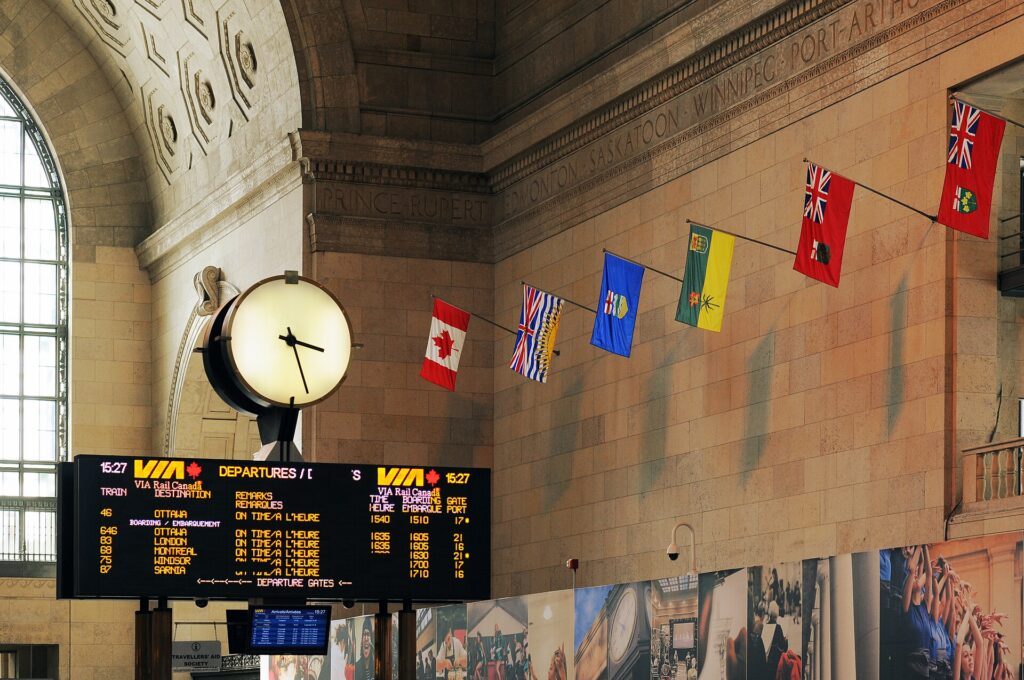
    The Great Hall inside Union Station, Toronto
    Union Station: the hub for GO Transit, VIA Rail, the UP Express and Line 1 of the subway (Photo: Milan Suvajac via Wikimedia Commons, CC BY-SA 4.0)

    Streetcars

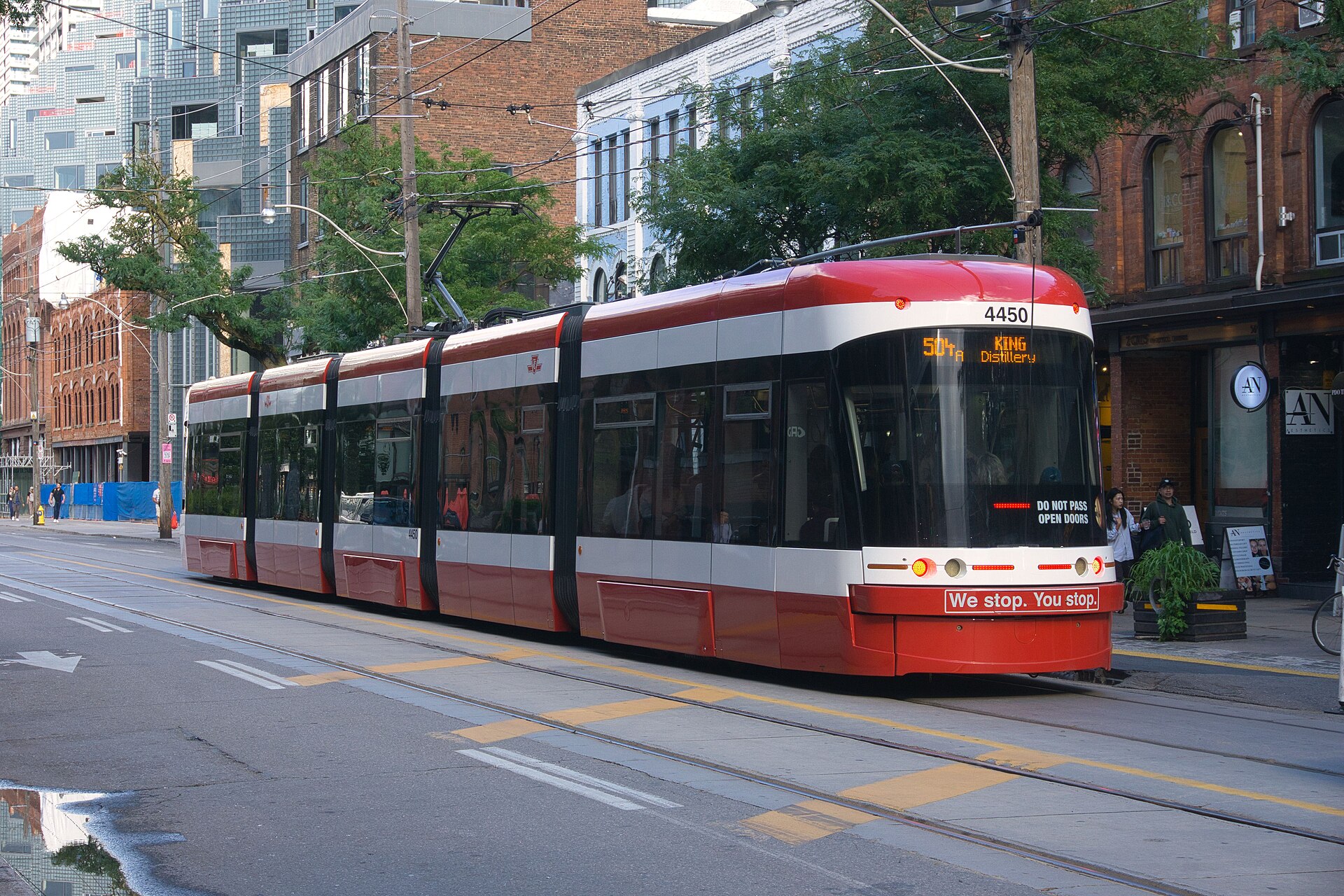
    Toronto has the largest streetcar network in the Americas, and it is the most pleasant way to see the downtown grid. The main east-west routes run along Queen, King, Dundas and College streets and Queens Quay; the north-south routes on Spadina and Bathurst connect the waterfront to the Bloor-Danforth line. Streetcars share the road with cars on most streets, which makes them slower than the subway but far better for watching the city go by. Two rules that catch visitors out: you board through any door and tap on board, and cars driving behind a streetcar must stop when its doors are open, so never step off without looking.
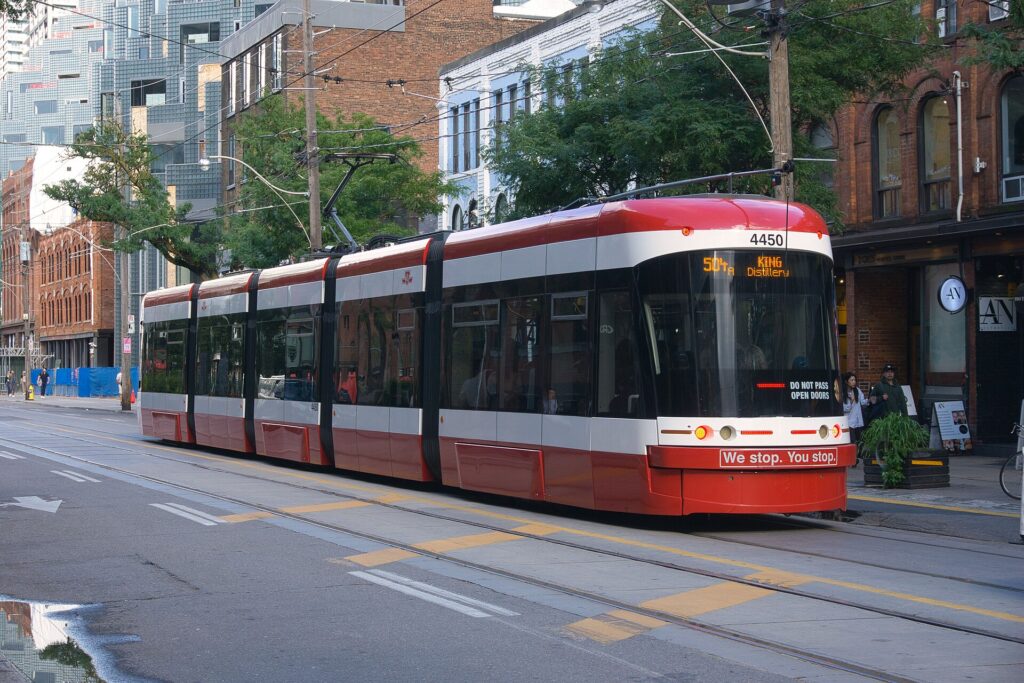
    A red TTC streetcar on a downtown Toronto street
    TTC streetcars run on most of the main downtown east-west streets (Photo: Chicken4War via Wikimedia Commons, CC BY-SA 4.0)

    Fares, PRESTO and tap-to-pay

    You do not need to buy anything before you ride. Tap a contactless credit card, debit card, phone or watch on the reader at any fare gate or on any bus or streetcar and you are paid. A single tap covers a two-hour transfer window in any direction, so a subway ride, a streetcar and a bus within two hours cost one fare. If you would rather not tap a card, buy a PRESTO card from a machine in any subway station and load it; PRESTO also works on the UP Express and on GO Transit and the transit systems in the surrounding regions, and since the One Fare program began, transfers between the TTC and those systems within the window no longer cost a second fare. Children twelve and under ride the TTC free. Check the TTC’s site for current fares and any day-pass options before you go.

    Accessibility

    Most, though not all, subway stations have elevators, all buses and the newer streetcars are low-floor and accessible, and the TTC publishes a list of accessible stations. If step-free access matters, plan around that list rather than assuming every station has it.

    Beyond the TTC

    • GO Transit is the regional rail and bus network, hubbed at Union Station. It reaches Hamilton, Oakville, Oshawa, Barrie and the whole suburban ring, and runs seasonal weekend trains and year-round buses to Niagara Falls. See GO Transit for schedules.
    • VIA Rail runs from Union Station to Montreal, Ottawa, Kingston and Windsor; the Toronto-Montreal corridor is a genuine alternative to flying or driving between the two cities.
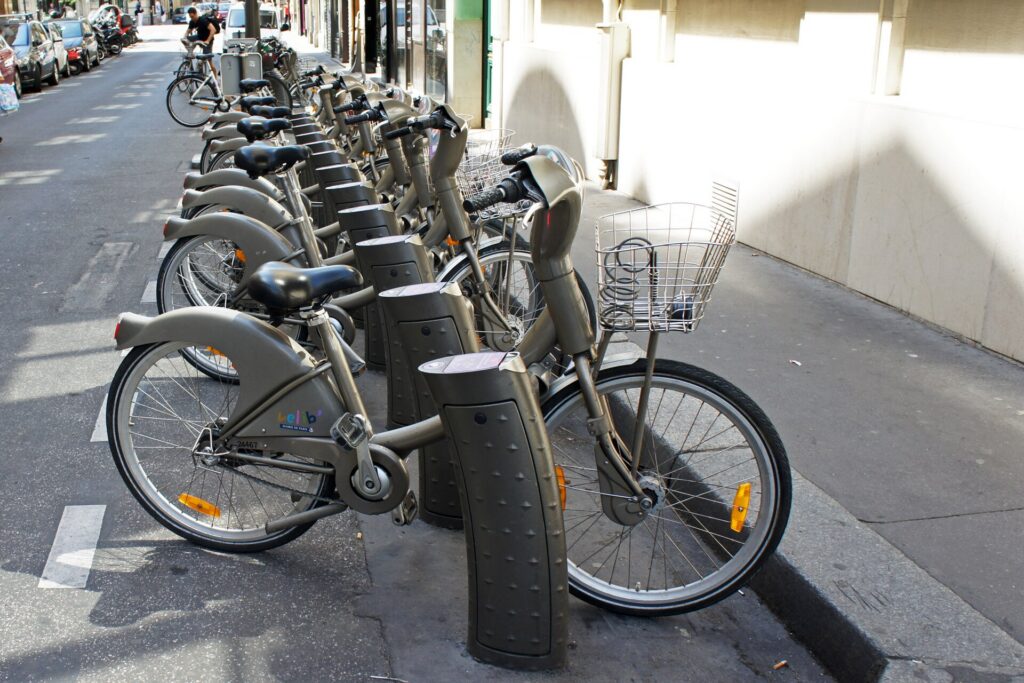
    • Bike Share Toronto has hundreds of docks across the central city and operates year-round. It is the best way to cover the waterfront trail and to get between neighbourhoods that are a little too far to walk.
    • The Toronto Islands ferries leave from the Jack Layton Ferry Terminal at the foot of Bay Street; the islands themselves are car-free.
    • Walking and the PATH. Downtown is flat and dense. In winter, the PATH network of underground walkways links Union Station, most of the Financial District and the Eaton Centre, which is how locals move around in January.
    • Taxis and ride-hail. Uber and Lyft both operate, and licensed taxis are plentiful downtown. For a group of three or four, a short taxi ride can cost about the same as transit fares and save real time late at night.

    Driving in Toronto: what it is really like

    Toronto is not a hard city to drive in by the standards of New York or Boston. The grid is logical, drivers are generally orderly, and signage is clear. What makes it tiring is volume. Highway 401, the main east-west artery across the north of the city, is one of the busiest highways in North America. The Gardiner Expressway, the elevated road that carries traffic along the waterfront into downtown, and the Don Valley Parkway, which feeds in from the northeast, both jam solidly in the morning and evening peaks, roughly seven to nine-thirty and four to six-thirty on weekdays, and regularly at other times when there is an event at the stadiums or a lane closed for construction. Summer is construction season, and it shows.
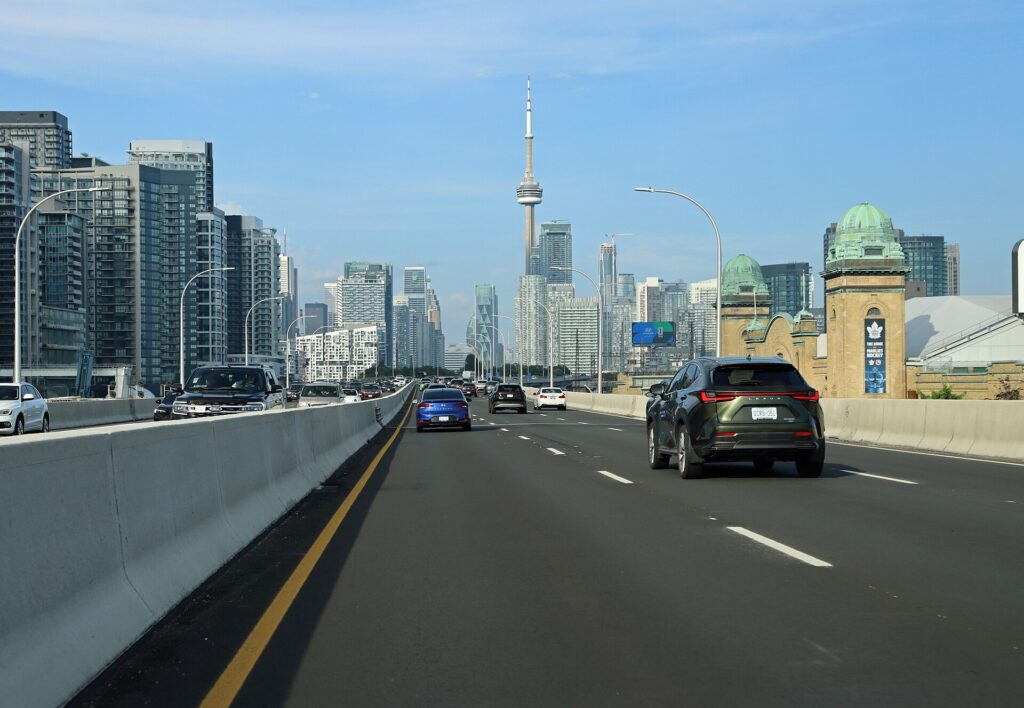
    Traffic on the Gardiner Expressway, Toronto
    The Gardiner Expressway: the main route into downtown by car, and the main reason many visitors leave the car at the hotel (Photo: Coolcaesar via Wikimedia Commons, CC BY 4.0)

    Parking

    This is the deciding factor for most visitors. Downtown hotels typically charge a substantial nightly fee for parking, and overnight rates at commercial lots are not much better. Street parking exists but is metered, time-limited, and on the main streets is prohibited during rush hours, with towing enforced. The city’s Green P lots are the most predictable option. Add it up for a five-night stay and the parking alone can cost more than a week of transit for two people, before you have paid for the car or the fuel.

    Tolls, cameras and rules worth knowing

    • Highway 407, the toll road that runs across the top of the region, uses electronic tolling with no booths. Rental companies pass the tolls through, usually with an administrative fee per trip; ask the counter how they handle it before you use it.
    • Red-light and automated speed cameras operate across the city; fines follow the car, and the rental company will bill you.
    • Streetcars: when a streetcar stops and its doors open, traffic behind it must stop. It is the law in Ontario and it is enforced.
    • Right turns on red are permitted after a full stop unless signed otherwise, as in most of North America.
    • Bike lanes are extensive downtown and often physically separated; check your mirror before every turn.
    • Winter: Ontario does not require winter tires, and rental cars usually come on all-seasons. For the city that is fine. If you are heading north to ski or to cottage country between December and March, ask specifically for a vehicle with winter tires.

    When renting a car makes sense

    • Day trips. Niagara Falls and Niagara-on-the-Lake, Stratford, Prince Edward County, Blue Mountain, Elora, Muskoka and Algonquin are all far easier and more flexible by car. Most of our day-trip suggestions assume one.
    • Family in the suburbs. If you are staying in Mississauga, Brampton, Vaughan, Markham or Scarborough with relatives, a car makes evenings downtown and days in the suburbs both workable.
    • Winter with young children. Strollers, car seats, snowsuits and a streetcar in a February snowstorm are a hard combination. A car and a hotel with parking can be worth every dollar.
    • Multi-stop Ontario or cross-border trips. Toronto to Ottawa, Montreal, Detroit or Buffalo is a natural drive, and a one-way rental can be cheaper than the extra flights.
    • Arriving at Hamilton. Covered above; almost always yes.
    • Accessibility or mobility needs that transit cannot comfortably meet.

    If any of those apply, our rental car booking tips cover insurance, deposits and the questions to ask at the counter, and our family car rental guide looks at vehicle choice.

    When it does not

    • You are staying downtown or within a few minutes of a subway station.
    • Your plans are the icons, the museums, the neighbourhoods, a show and a game.
    • You are visiting for a festival, a conference or a sporting event, when downtown traffic and parking are at their worst.
    • You are travelling as a couple or solo and value your time over a fixed vehicle.
    • You dislike driving in snow and are visiting between December and March.

    The hybrid plan most visitors should use

    Go car-free for the city portion of the trip, then rent a car for exactly the days you need it, picking it up from a downtown location rather than the airport. Downtown pickups let you avoid airport surcharges, skip the drive in from Pearson at peak time, and avoid paying hotel parking on the nights you are not using the car. Book the rental in advance for the specific dates; walk-up availability downtown on a summer weekend is poor. Return it the evening before you fly, take the UP Express or a taxi to the airport, and the whole thing costs a fraction of a week-long rental. Compare the day rates on our Toronto car rental page against the full-trip rate and the difference is usually obvious.

    Decision table

    Your tripRecommendationWhy
    Weekend downtown, couple or soloNo carEverything is walkable or one subway ride; parking would cost more than the transit
    Four or five days, one day trip to NiagaraHybrid: rent for one day downtownCar-free city days, car for the one day it matters
    Family visit to the suburbsRent for the whole staySuburban transit is slower and the car earns its keep daily
    Winter trip with small childrenRent, choose a hotel with parkingWeather and gear make transit hard work
    Ontario road trip starting or ending in TorontoRent (consider one-way)Toronto is the bookend, not the destination
    Flying into HamiltonRent at the airportGround transport without a car is poor
    Conference, TIFF week or a big gameNo carDowntown traffic and parking are at their worst
    Business trip, meetings across the regionRent, or taxi and GODepends on how spread out the meetings are

    Money-saving tips for both options

    • On transit: tap the same card every time so transfers register; use the two-hour window to combine errands; ride the streetcars for sightseeing rather than paying for a bus tour.
    • On a rental: compare downtown and airport pickup prices, book early for summer and holiday weekends, decline extras you already have through your credit card or home insurance (check first), ask about the 407 toll policy, and refuel before you return.
    • On the hotel: if you are renting, price the parking fee into the room rate when you compare; a slightly pricier hotel with included parking can be the cheaper choice.
    • On timing: avoid arriving or leaving downtown by car in the weekday peaks; the best time to fly to Toronto guide lists the event weeks when downtown traffic is heaviest.
    • On the airport run: the UP Express is almost always faster than a taxi from Pearson in daytime traffic, and for one or two people it is cheaper too.

    Frequently asked questions

    Is it worth renting a car in Toronto?

    Only if you are leaving the city, staying in the suburbs, or travelling in winter with young children. For a downtown-focused visit, transit and walking are faster and far cheaper once parking is counted.

    Is Toronto public transit good for tourists?

    Yes. Two subway lines and the downtown streetcars reach nearly every major sight, tap-to-pay means no ticket to buy, and a single fare covers two hours of transfers.

    How do I get from Pearson Airport to downtown Toronto?

    The UP Express train from Terminal 1 to Union Station takes about 25 minutes. The TTC 900 bus to Kipling station is cheaper and slower; taxis and ride-hail are available outside both terminals.

    Can I use my credit card on the TTC?

    Yes. Tap a contactless credit or debit card, or a phone or watch, at the fare gate or on board. A PRESTO card is an alternative and also works on GO Transit and the UP Express.

    Is parking expensive in downtown Toronto?

    Yes. Hotel and commercial lot rates are high enough that for a stay of several nights the parking alone can exceed the cost of transit for two people for the whole trip.

    Do I need winter tires to drive in Toronto?

    Not by law, and rentals usually come on all-season tires, which are adequate for the city. Ask for winter tires if you are driving north to ski country or cottage country between December and March.

    Can I get to Niagara Falls without a car?

    Yes: GO Transit runs seasonal weekend trains and year-round buses, VIA Rail serves the region, and many companies run day tours from downtown. A car gives you more flexibility for Niagara-on-the-Lake and the wineries.

    Whichever way you go, start with the flight. Compare cheap flights to Toronto, choose a neighbourhood with our Toronto hotel search, and if a day trip is on the list, price the rental for those dates on our Toronto car rental page.

  • Best Time to Fly to Toronto: Seasons, Weather & Prices

    Best Time to Fly to Toronto: Seasons, Weather & Prices

    Toronto is a four-season city in the truest sense: the same downtown that sits under a foot of snow in February fills its patios in July, and the price of a seat to Toronto Pearson moves with that calendar. If you are flexible on dates, the difference between a good week and a bad week to fly can be larger than the difference between two airlines. This guide walks through Toronto’s weather month by month, the periods when fares and hotel rates climb, the festivals and long weekends that quietly drive those spikes, and which of the city’s three airports makes sense for your trip.

    The short answer

    For most first-time visitors, the sweet spot is late May through June and again from early September to mid-October. Both windows bring comfortable temperatures, long days in spring and warm lake evenings in fall, and demand that sits below the summer peak. The cheapest fares of the year usually appear from mid-January to early March, when the city is cold, the days are short, and business travel is the main thing filling planes. The most expensive stretches are the summer school holidays (July and August), the Christmas and New Year period, and a handful of event weeks covered below, TIFF in September being the one that surprises people most.

    Whichever window you choose, run a Toronto flight search on TicketScanner with flexible dates before you commit. The calendar view makes it obvious when a mid-week departure or a shift of two or three days changes the price band entirely.

    Cherry blossoms in full bloom at High Park, Toronto, in spring
    High Park cherry blossoms, a late-April to early-May event that fills hotels near the park (Photo: Fabian Roudra Baroi via Wikimedia Commons, CC BY-SA 4.0)

    Toronto’s weather, season by season

    Toronto sits on the northwest shore of Lake Ontario, and the lake matters. It softens the worst of the winter cold compared with cities further inland, keeps spring slightly cooler than you would expect from the calendar, and holds warmth into October. The figures below are approximate seasonal patterns drawn from the long-term climate normals published by Environment and Climate Change Canada; always check the current forecast a few days before you fly, because Toronto can swing ten degrees in a day when a front moves through.

    MonthTypical daytime highTypical overnight lowWhat it feels likeFare pressure
    Januaryaround -1 °Caround -7 °CCold, grey, snow on the ground most weeks; wind off the lake bites downtownLow (after the first week)
    Februaryaround 0 °Caround -6 °CStill deep winter; the coldest snaps of the year often land hereLow, except Family Day weekend
    Marcharound 4 °Caround -2 °CThaw and freeze; slush, then the first mild afternoonsLow to moderate (March Break)
    Aprilaround 12 °Caround 3 °CUnpredictable; a warm week can be followed by a late snowfallModerate
    Mayaround 19 °Caround 9 °CSpring proper; cherry blossoms, patios open, cool eveningsModerate; rises around the long weekend
    Junearound 24 °Caround 14 °CWarm, long days, occasional thunderstormsModerate to high
    Julyaround 27 °Caround 18 °CHot and humid; humidex values well above the thermometerHigh
    Augustaround 26 °Caround 17 °CHot and humid, cooling slightly in the last weekHigh
    Septemberaround 22 °Caround 13 °CWarm days, crisp evenings; the lake is at its warmestModerate, with a TIFF spike
    Octoberaround 14 °Caround 7 °CFall colour in the ravines and High Park; jacket weatherModerate to low
    Novemberaround 7 °Caround 1 °CGrey and damp; first snow is common late in the monthLow
    Decemberaround 1 °Caround -4 °CWinter arrives; festive lights and markets downtownLow until mid-month, then peak

    Two things the table cannot show. First, humidity: a 27 °C July afternoon downtown routinely carries a humidex reading in the mid-30s, so plan indoor breaks if you are not used to it. Second, daylight: Toronto gets roughly fifteen and a half hours of daylight around the June solstice and under nine hours in late December. A winter visit is not shorter in days, but it is much shorter in usable sightseeing light.

    How Toronto’s fare seasons work

    Airfares to Toronto follow a pattern that is more predictable than most travellers assume, because the city’s demand is driven by three overlapping calendars: the school year in Ontario and in the American and European markets that feed it, the business-travel week, and a festival schedule that is heavily concentrated between June and September.

    Peak season

    Late June to the end of August, plus the two weeks around Christmas and New Year. Schools are out across Canada, the United States and the United Kingdom, families travel, and Toronto’s summer festival season is in full swing. Expect the highest fares and the tightest hotel availability, especially on weekends. If you must travel in peak, book early and fly mid-week; a Tuesday or Wednesday departure frequently sits in a lower fare band than the Friday of the same week.

    Shoulder season

    April to mid-June and September to October. This is where value and weather overlap. Demand is real but not frantic, hotels have inventory, and the city is either waking up (spring) or at its most photogenic (fall). Watch for the long weekends, Victoria Day in late May and Thanksgiving in early October, and for the September TIFF window, all of which temporarily behave like peak.

    Low season

    Mid-January to early March, and most of November. Fares are at their lowest, and Toronto’s winter has its own appeal: skating at Nathan Phillips Square, museums without queues, restaurant weeks, and hockey. The trade-off is weather risk. Build a buffer into connections, and if you are flying in from a warm climate, read our note on what to wear on the plane and pack a real coat in your carry-on rather than checking it.

    Fares also move with the day of the week and the time of day. Early-morning and late-evening departures are often priced below mid-day flights on the same route, and a search that spans the whole month will usually reveal a cheaper pair of dates within a few days of your first choice. Our guide to the best times to book flights and hotels goes deeper on how to read those patterns.

    Toronto month by month

    January

    The first week is still holiday-priced; after that, January is reliably the cheapest month to fly into Toronto. It is also genuinely cold. Highs hover around freezing, lows drop below -10 °C on the colder days, and the wind on the waterfront makes it feel colder still. What January does well: hockey at Scotiabank Arena, the winter restaurant festival (Winterlicious usually runs from late January into February), the PATH network of underground walkways that lets you cross much of the financial district without stepping outside, and museum days at the ROM and the AGO with no crowds. Fly in with a checked-bag-free strategy if you can; winter storms occasionally disrupt Pearson, and being able to walk off with everything you own is worth a lot.

    February

    Similar to January in temperature and price, with one exception: Family Day, an Ontario statutory holiday on the third Monday of February, creates a mini long weekend that lifts fares and hotel rates for a few days. Outside that weekend, February is a strong value month. The Toronto Light Festival at the Distillery District has run in recent winters, and the city’s skating rinks, including the one at Nathan Phillips Square, are at their best. Check the City of Toronto’s festivals and events listings for what is scheduled in the year you travel.

    March

    March is a transition month, and the weather is honest about it: slush, sudden thaws, and the odd late snowstorm. Prices stay low except around March Break, the Ontario school holiday in the middle of the month, when family demand rises and flights from sun destinations back into Toronto get busy. If you are visiting rather than returning, aim for the first or last week of the month.

    April

    Spring arrives unevenly. Early April can still be cold; by the end of the month the patios are cautiously opening and the city is greening up. The Blue Jays’ home season begins at Rogers Centre, which puts a few thousand extra visitors in downtown hotels on game nights. Fares sit in the moderate band, and hotel rates are noticeably lower than they will be in six weeks. April is an underrated month for a museum-and-food trip.

    May

    The best-kept secret in the Toronto calendar. The cherry blossoms in High Park usually peak in late April or the first week of May, drawing big local crowds on the weekend but few overnight visitors. Doors Open Toronto, which lets you inside dozens of buildings normally closed to the public, typically falls in late May. The Victoria Day long weekend (the Monday before May 25) is the one date to book around. Otherwise, May offers spring weather, opening-season energy, and prices well below June.

    June

    Warm, long, and busy. Pride Toronto culminates in one of the largest Pride parades in North America at the end of the month, Luminato brings arts programming across the city, and the summer patio season is fully open. Fares step up from mid-month as schools finish. If June is your month, the first two weeks are the value play.

    July

    Peak season proper. Canada Day on July 1 opens the month with fireworks and a long weekend; the Honda Indy runs at Exhibition Place; Summerlicious brings prix-fixe menus to restaurants across the city; and the humidity settles in. Fares and hotel rates are at their annual high. The Toronto Islands, with their beaches and car-free lanes, are the local escape valve, and the ferry line at Jack Layton Ferry Terminal on a hot Saturday tells you everything about demand.

    August

    Still peak, with two big demand events: the Toronto Caribbean Carnival (often called Caribana), whose grand parade takes place on the Saturday of the first weekend in August, a civic long weekend in Ontario; and the Canadian National Exhibition, the CNE, which runs from mid-August to Labour Day at Exhibition Place. The last week of August, after most families have flown home but before the CNE closes, is a small pocket of slightly softer pricing.

    September

    Many locals will tell you September is the best month in Toronto, and the weather agrees: warm days, cool nights, and a lake that has finally warmed up. The catch is the Toronto International Film Festival, which runs for roughly ten days in early-to-mid September and fills downtown hotels with the film industry. TIFF week fares and room rates behave like peak season. Fly in after the festival closes and you get September weather at shoulder prices. Check TIFF’s official site for the exact dates before you book.

    October

    Fall colour in the ravines, High Park and the Don Valley; crisp days that still reach the mid-teens; and, apart from the Thanksgiving long weekend on the second Monday of the month, steadily falling prices. Nuit Blanche, the all-night contemporary art event, has landed in late September or October in recent years. Late October is one of the best value-for-weather windows of the whole year.

    November

    Grey, damp and quiet, which is exactly why fares and hotel rates are low. The Royal Agricultural Winter Fair fills Exhibition Place for ten days in early November, the Santa Claus Parade runs in the middle of the month, the Cavalcade of Lights switches on the holiday lights at Nathan Phillips Square, and the Distillery Winter Village (formerly the Toronto Christmas Market) opens at the Distillery District in the second half of the month. If you like a city at its festive best without paying festive prices, the last ten days of November are the target.

    December

    Two months in one. The first half continues November’s value pricing with the added bonus of the holiday markets and lights in full swing. From about December 18 onward, fares and hotel rates jump for the Christmas and New Year period and stay high into the first days of January. Winter is fully here: expect snow, short days, and the occasional weather delay at Pearson.

    Snow-covered path in High Park, Toronto, in winter
    Toronto in January: cold, quiet, and usually the cheapest month to fly in (Photo: Chicken4War via Wikimedia Commons, CC BY-SA 4.0)

    Events that move Toronto flight and hotel prices

    The following dates are worth cross-checking against your travel plans before you book. Some are worth planning a trip around; all of them are worth knowing about if your dates happen to overlap. Exact dates shift each year, so confirm with Destination Toronto or the event organizers.

    • Family Day weekend (third Monday of February): short domestic spike.
    • March Break (mid-March): family travel, especially inbound from sun destinations.
    • Victoria Day weekend (Monday before May 25): the unofficial start of summer.
    • Pride Toronto (late June): major weekend demand downtown.
    • Canada Day (July 1) and the surrounding long weekend.
    • Toronto Caribbean Carnival (civic long weekend, early August): one of the busiest weekends of the year for hotels.
    • Canadian National Exhibition (mid-August to Labour Day): steady demand, plus the air show on Labour Day weekend.
    • TIFF (early-to-mid September): the single biggest hotel-rate spike outside the holidays.
    • Thanksgiving weekend (second Monday of October).
    • Christmas to New Year (roughly December 18 to January 3).
    • Major sporting events: Blue Jays playoff games, Raptors and Maple Leafs playoff runs in April through June, and international matches at BMO Field can all tighten hotel availability on short notice. Our Toronto events page lists what is on sale for the dates you are considering.

    Which Toronto airport should you fly into?

    Toronto has two airports inside the city region and a third an hour away that budget carriers have used. The right choice depends on where you are coming from and where you are staying.

    Toronto Pearson International (YYZ)

    Canada’s busiest airport, in Mississauga about 25 kilometres northwest of downtown. Virtually every international flight and most domestic and transborder flights land here. There are two terminals: Terminal 1 is the Air Canada and Star Alliance home, and Terminal 3 hosts most other carriers, including WestJet and the major American airlines. Getting downtown is straightforward: the UP Express train runs from Terminal 1 to Union Station in about 25 minutes, the TTC’s 900 Airport Express bus connects to Kipling subway station, and taxis and ride-hail pick up outside both terminals. Check the official Pearson site for terminal maps and current ground-transport options, and see our Toronto car-rental-versus-transit guide before you reserve a car at the airport.

    Terminal 1 at Toronto Pearson International Airport (YYZ)
    Terminal 1 at Toronto Pearson (YYZ), the hub for Air Canada and most international arrivals (Photo: Daniel Case via Wikimedia Commons, CC BY-SA 3.0)

    Billy Bishop Toronto City Airport (YTZ)

    On an island a few hundred metres from the downtown waterfront, Billy Bishop is one of the most convenient city airports anywhere. Porter Airlines is the main operator, with Air Canada also flying select routes; destinations are mostly short-haul, covering eastern Canada and the northeastern United States, including Newark, Boston, Chicago and Washington. A free pedestrian tunnel and a short ferry connect the terminal to the mainland, and from there it is a walk, a streetcar or a five-minute taxi to most downtown hotels. If you are travelling from a city Billy Bishop serves and staying downtown, it is often worth a slightly higher fare for the hour it saves at each end.

    John C. Munro Hamilton International (YHM)

    About 75 kilometres southwest of Toronto, Hamilton’s airport has periodically hosted low-cost carriers on domestic and sun routes. A very low fare into Hamilton can be worth it if you are renting a car, heading to Niagara, or have time to spare; it is a poor choice if you are staying downtown without a car and arriving late, because the ground-transport options are thin. Compare the total trip cost, not just the fare.

    Timing tricks that actually work for Toronto

    • Search a whole month, not a date. Toronto’s demand curve has sharp edges around long weekends and TIFF. A calendar search on TicketScanner shows those edges instantly; shifting a Friday arrival to Thursday, or leaving on the Tuesday after a long weekend, is often the single cheapest change you can make.
    • Fly mid-week in peak season. July and August weekends are where the highest fares live. Tuesday and Wednesday departures on the same route are frequently in a lower band.
    • Book the event weeks early and the low-season weeks late. TIFF, Caribbean Carnival and Christmas fares rarely fall as departure approaches; January and November fares, by contrast, are stable enough that waiting for the right dates costs little.
    • Price the flight and the hotel together. A cheap fare into a TIFF week is not cheap once you have paid the hotel. Run a Toronto hotel search for the same dates before you commit to either.
    • Consider Billy Bishop for short-haul. From cities it serves, the door-to-door time saving is real, and the fare gap is often smaller than expected.
    • Build a winter buffer. If you are connecting through Pearson between December and March, avoid the tightest connection times. Our guide on how early to arrive for an international flight covers what to allow.
    • Coming from the US Northeast? The New York to Toronto route has its own rhythms, with multiple airports on both ends worth comparing.
    • Flying out of Toronto instead? The same seasonality applies in reverse; see cheap flights from Toronto for outbound routes.
    The flatiron-shaped Gooderham Building in Toronto's Distillery District
    The historic Distillery District, a popular Toronto stop year-round (Photo: Geo Swan, stitched by Marku1988 via Wikimedia Commons, CC BY-SA 3.0)

    What to pack, by season

    Winter (December to March): an insulated, wind-resistant coat, a hat that covers your ears, waterproof boots with grip, and layers for overheated indoor spaces. Spring (April to May): a rain shell, a mid-weight jacket, and shoes you do not mind getting wet; mornings can be near freezing and afternoons mild. Summer (June to August): light, breathable clothing, sun protection, and something for aggressively air-conditioned restaurants and subway cars. Fall (September to November): layers again, a warm jacket by mid-October, and an umbrella in November. Whatever the season, Toronto is a walking city; comfortable shoes matter more than anything else on this list.

    The best time to fly to Toronto for…

    Families

    Late June (before peak fares fully set in) or the last week of August into Labour Day, when the CNE is on and the Toronto Islands, the zoo and Ripley’s Aquarium are all in full summer operation. March Break works well if you are content with indoor attractions.

    The lowest fares

    Mid-January through the first week of March, avoiding Family Day weekend, and the first half of November. Pair with a downtown hotel and lean into the indoor city: the PATH, the museums, the theatre district and the hockey.

    Food and festivals

    July for Summerlicious, patios and the Caribbean Carnival; late January and February for Winterlicious at a fraction of the price. Kensington Market’s pedestrian Sundays run through the summer months.

    Sports

    April to June for hockey and basketball playoff atmosphere; April to September for baseball; the fall for Toronto FC and the Argonauts at BMO Field. Ticket availability, not the fare, is usually the constraint; check what is on sale in Toronto before you book flights.

    Business travel

    Any month, but note that downtown hotels price sharply around TIFF and the big convention weeks. Mid-week arrivals in the shoulder months are the most predictable.

    Cross-border and visiting family

    If you are a U.S. citizen flying in, a valid passport is required, and travellers from visa-exempt countries other than the United States generally need an Electronic Travel Authorization; the Government of Canada’s visitor page explains what applies to you. Canadians returning from abroad should review the current travel advice and entry requirements. Security screening at Canadian airports is run by CATSA, whose site lists what you can carry on.

    Frequently asked questions

    What is the cheapest month to fly to Toronto?

    January and February are consistently the lowest-fare months, followed by November and early December. The first week of January is the exception, as it is still priced with the holidays.

    What is the best month to visit Toronto for weather?

    September for warm days and cool nights, with June a close second. Both are far more comfortable than the humid heart of July and August.

    Is Toronto expensive to visit in summer?

    July and August are the most expensive months for both flights and hotels, driven by school holidays and a dense festival calendar. Mid-week travel and booking well ahead take some of the edge off.

    Should I fly into Pearson or Billy Bishop?

    Pearson for almost all international and long-haul flights and the widest choice of fares; Billy Bishop if you are coming from eastern Canada or the U.S. Northeast and staying downtown, where the convenience is hard to beat.

    How far ahead should I book a flight to Toronto?

    Earlier for peak periods and event weeks, when fares tend only to rise; for low-season dates the fares are stable enough that finding the right pair of days matters more than booking months out. Use flexible-date search and compare across a full month.

    Does it snow in Toronto in April?

    Occasionally, yes, usually early in the month and rarely lasting. By late April the city is firmly in spring, and the High Park cherry blossoms follow soon after.

    When do the High Park cherry blossoms bloom?

    Typically late April to early May, for roughly a week to ten days depending on the year’s weather. The City of Toronto’s parks pages post bloom updates each spring.

    Ready to pick your dates? Compare fares across the whole month on our Toronto flights page, then line up a place to stay with our Toronto hotel search. If you are planning what to do once you land, start with our first-timer’s guide to Toronto.

  • Things to Do in Toronto: A First-Timer’s Guide

    Things to Do in Toronto: A First-Timer’s Guide

    Toronto rewards a plan. Canada’s largest city is spread along a lakefront that runs for kilometres, and its best experiences are clustered in neighbourhoods that are each worth a half-day on their own. Try to see everything with no structure and you will spend your trip on the subway. Group the city by area, give yourself one “big” sight per day and one neighbourhood to wander, and Toronto opens up quickly. This guide is built for a first visit: the landmarks that genuinely earn their reputation, the museums and shows worth booking, the neighbourhoods locals actually spend time in, the food, the sports, the day trips, and the practical details that make the difference between a good trip and a great one.

    If you are still comparing cheap flights to Toronto, read this alongside our guides to the best time to fly to Toronto and whether you need a car. Between the three, you can plan the whole trip.

    Toronto skyline and CN Tower at sunset seen from the Toronto Islands
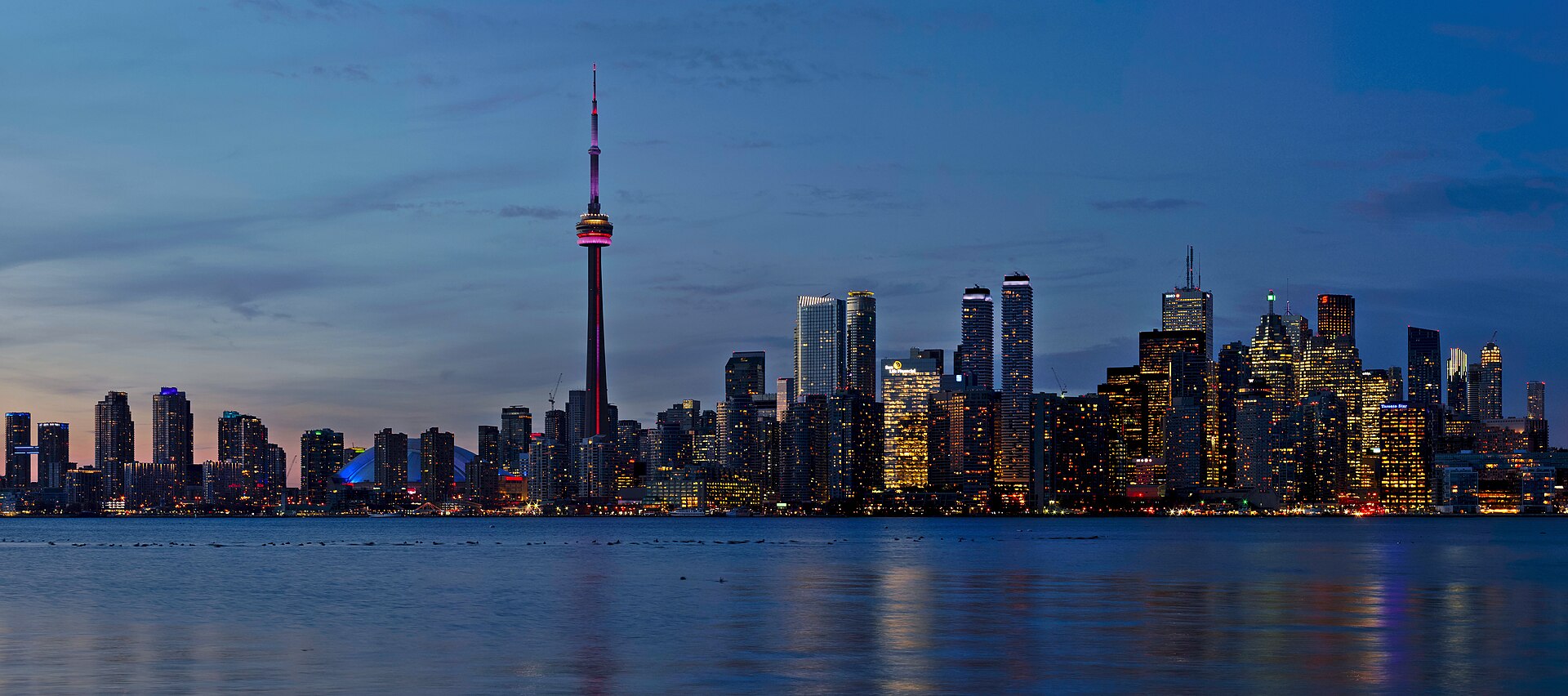
    The Toronto skyline from the Toronto Islands, a 15-minute ferry ride from downtown (Photo: Jchmrt via Wikimedia Commons, CC BY-SA 4.0)

    Toronto at a glance for first-timers

    • Airports: Toronto Pearson (YYZ), about 25 km northwest of downtown, handles nearly all international flights; Billy Bishop (YTZ) sits on an island minutes from the downtown core and serves short-haul routes in eastern Canada and the U.S. Northeast. See our Toronto Pearson airport guide.
    • Getting around: the TTC subway, streetcars and buses cover the central city well, and downtown is compact enough to walk. Most first-time visitors do not need a car unless they are planning day trips.
    • Money: Canadian dollars. Prices on menus and shelves do not include Ontario’s 13% HST, which is added at the till. Tipping 15 to 20 percent in restaurants is customary. Tap-to-pay is accepted almost everywhere, including on transit.
    • Language: English, with a genuinely multilingual population; Toronto is one of the most diverse cities in the world, and that shows in its food.
    • Where to stay: the Entertainment District and the Financial District for walkability to the big sights; Yorkville for upscale shopping and the museums; the waterfront for lake views; the Bloor-Yonge and Queen West areas for a more local feel. Our Entertainment District hotel guide and Toronto hotel search cover the options.

    The downtown icons

    CN Tower

    Yes, it is touristy, and yes, it is still worth it. The CN Tower was the world’s tallest free-standing structure for more than three decades, and the view from the main observation level takes in the whole city, the lake, and on a clear day the mist of Niagara Falls on the horizon. The glass floor is a rite of passage. The EdgeWalk, a hands-free walk around the outside of the main pod on a harness, is the city’s best-known thrill experience and books out in summer. Go at sunset if you can; the timed-entry ticket system means you should book the slot in advance rather than queue on the day.

    Ripley’s Aquarium of Canada and Rogers Centre

    Both sit at the foot of the tower. Ripley’s Aquarium is one of the best rainy-day and family attractions in the city, with a moving walkway through an underwater tunnel that small children will not want to leave. Next door, Rogers Centre is home to the Toronto Blue Jays from April to September; a weeknight game is one of the cheapest ways to sit under the open roof with the tower lit up above you.

    The Toronto Islands

    The single best thing to do in Toronto on a warm day costs the price of a ferry ticket. The Toronto Islands are a car-free chain of parkland a fifteen-minute ferry ride from the Jack Layton Ferry Terminal at the foot of Bay Street, with beaches, picnic lawns, bike rentals, a small amusement park (Centreville, open in the warmer months) and the definitive view of the skyline. Ward’s Island is the quieter, residential end; Centre Island has the amenities; Hanlan’s Point has the widest beach. Bring water and food, because options on the islands are limited, and check the City of Toronto’s parks pages for ferry schedules, which change by season.

    Downtown Toronto skyline seen from the Toronto Islands ferry
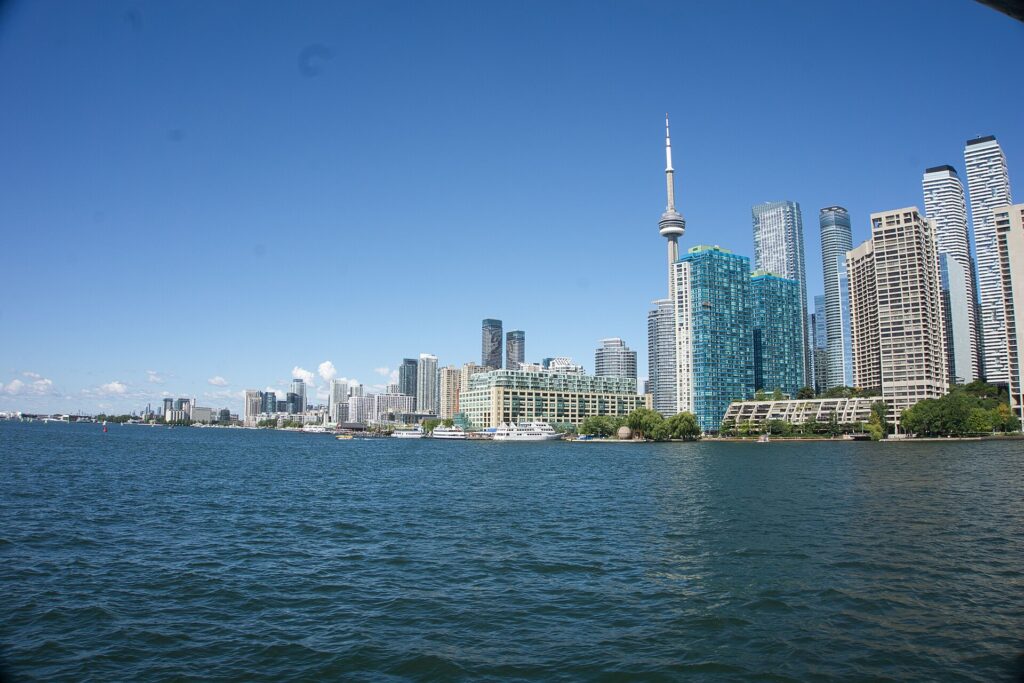
    The city from the Toronto Islands ferry, which leaves from Jack Layton Ferry Terminal at the foot of Bay Street (Photo: Chicken4War via Wikimedia Commons, CC BY-SA 4.0)

    Harbourfront and the waterfront trail

    Between the ferry terminal and the foot of Bathurst Street, Harbourfront Centre runs a year-round program of free outdoor concerts, craft studios you can watch at work, skating in winter and a summer sailing scene. The waterfront trail continues in both directions for kilometres; a rented bike from a Bike Share Toronto dock is the easiest way to cover it.

    Nathan Phillips Square and City Hall

    The plaza in front of Toronto’s modernist City Hall is the city’s civic living room: a reflecting pool in summer, a skating rink in winter, the illuminated TORONTO sign for the obligatory photo, and free events through the year. The Cavalcade of Lights in November switches on the holiday season here.

    St. Lawrence Market

    The St. Lawrence Market, a few blocks east of the Financial District, is the place to eat a peameal bacon sandwich, buy Ontario cheese and maple products, and see how Toronto shopped before supermarkets. The main South Market runs Tuesday to Sunday; the Saturday farmers’ market draws the crowds. Go hungry and go early.

    The Distillery District

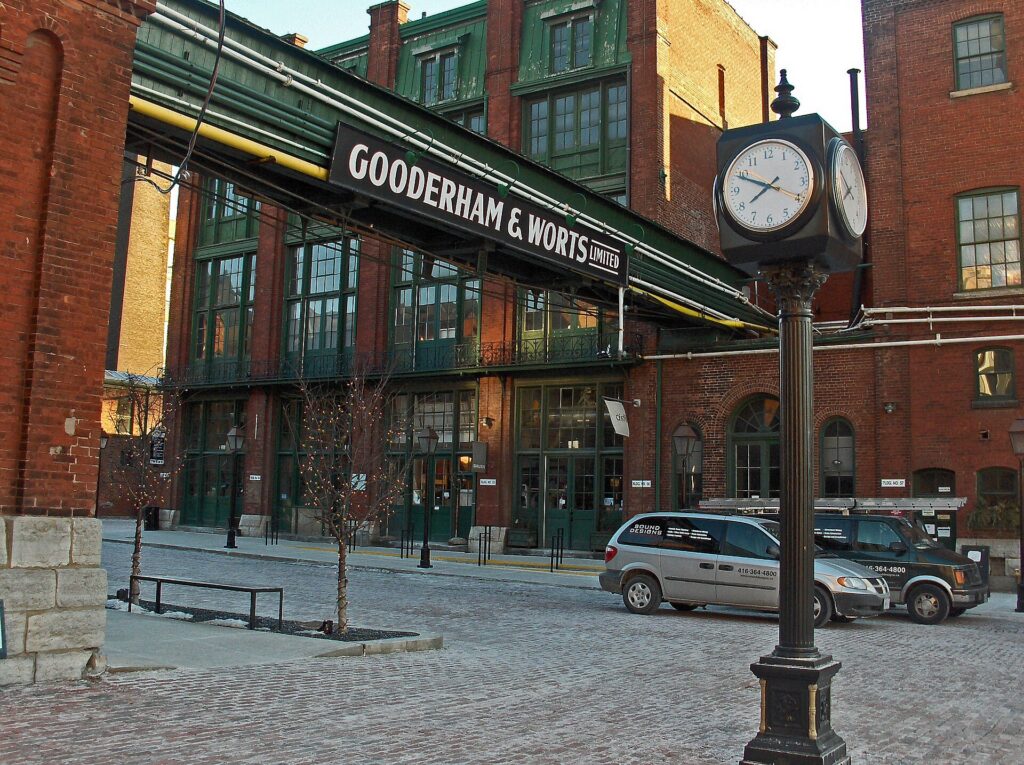
    A ten-minute walk east of St. Lawrence Market, the Distillery District is a pedestrian-only cluster of Victorian industrial buildings that once housed the Gooderham & Worts distillery and now hold galleries, restaurants, a brewery, a sake maker and a theatre. It is at its most atmospheric in the evening and, in late November and December, during the Distillery Winter Village, when the lanes fill with lights and market stalls.

    Victorian brick buildings and cobblestone lane in the Distillery District, Toronto
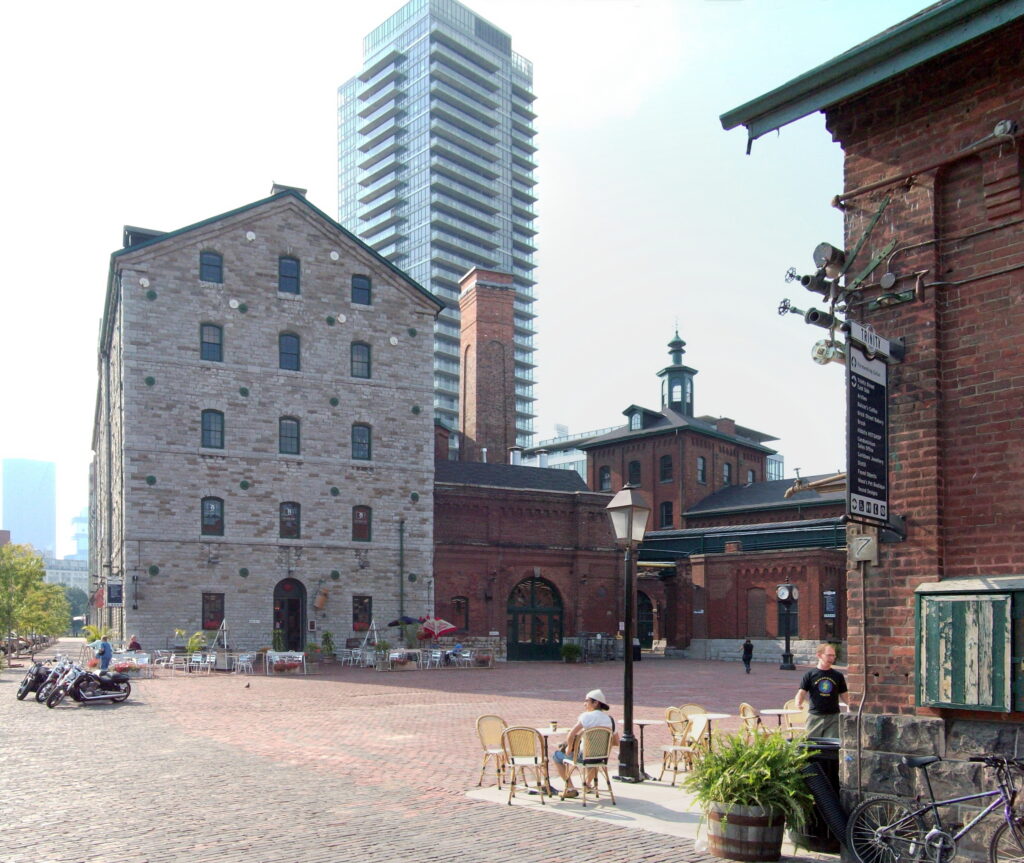
    The pedestrian-only Distillery District, east of downtown (Photo: Mathew Ingram via Wikimedia Commons, CC BY 2.0)

    Museums, galleries and the stage

    Royal Ontario Museum

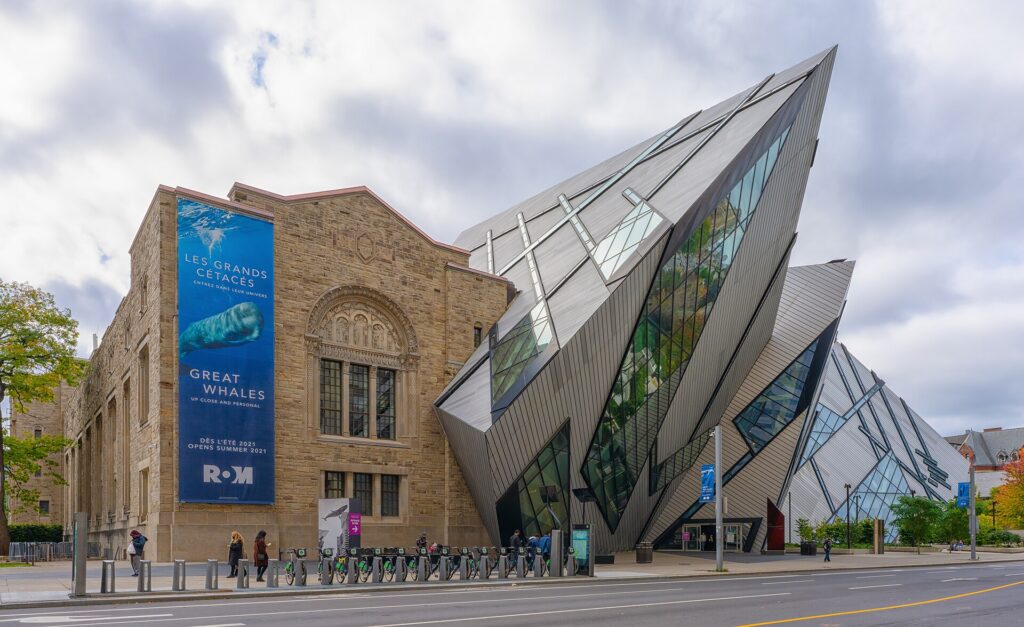
    Canada’s largest museum, the ROM, sits at Bloor Street and Avenue Road above its own subway station. The dinosaur galleries are the draw for families, the world-culture and natural-history collections reward a full day, and the Michael Lee-Chin Crystal, the angular glass addition on Bloor, is a landmark in its own right. Allow at least three hours.

    The Royal Ontario Museum on Bloor Street, Toronto, with its glass crystal addition
    The Royal Ontario Museum at Bloor and Avenue Road, beside the Museum subway station (Photo: Maksim Sokolov (Maxergon) via Wikimedia Commons, CC BY-SA 4.0)

    Art Gallery of Ontario

    On Dundas Street West at the edge of Chinatown, the AGO holds one of the world’s great collections of Henry Moore sculpture, the definitive gathering of the Group of Seven and Tom Thomson, and a Frank Gehry redesign whose spiral staircase and Galleria Italia are worth the visit alone. Check the gallery’s site for free or reduced-admission evenings, which have run on a regular weekly schedule in recent years.

    Casa Loma

    A Gothic Revival mansion built by a financier who ran out of money before he ran out of ambition, Casa Loma is Toronto’s castle: turrets, secret passages, an underground tunnel to the stables and gardens with a view over the city. It sits north of Dupont Street, an uphill walk from Dupont subway station. Seasonal events, including a summer symphony series and Halloween and holiday programming, sell out.

    The smaller museums worth your time

    The Hockey Hall of Fame at Yonge and Front lets you stand next to the Stanley Cup. The Bata Shoe Museum and the Gardiner Museum of ceramics, both near the ROM, are small, excellent and rarely crowded. The Aga Khan Museum, in Don Mills, pairs a serene modern building with a collection of Islamic art and is one of the city’s most beautiful spaces. Evergreen Brick Works, in the Don Valley, is a reclaimed brick factory with trails, a Saturday farmers’ market and a good café.

    Theatre, music and film

    Toronto is the third-largest English-language theatre centre in the world after London and New York. The Mirvish theatres on King Street West and Yonge Street host the touring Broadway productions; the Four Seasons Centre is home to the Canadian Opera Company and the National Ballet of Canada; Roy Thomson Hall hosts the Toronto Symphony; and Massey Hall, reopened after a full restoration, remains the city’s best room for a concert. Every September the Toronto International Film Festival takes over the Entertainment District, and its year-round home, the TIFF Lightbox on King Street, screens films every day. For what is on sale during your dates, our Toronto events page lists concerts, shows and games.

    Neighbourhoods worth a half-day

    Kensington Market and Chinatown

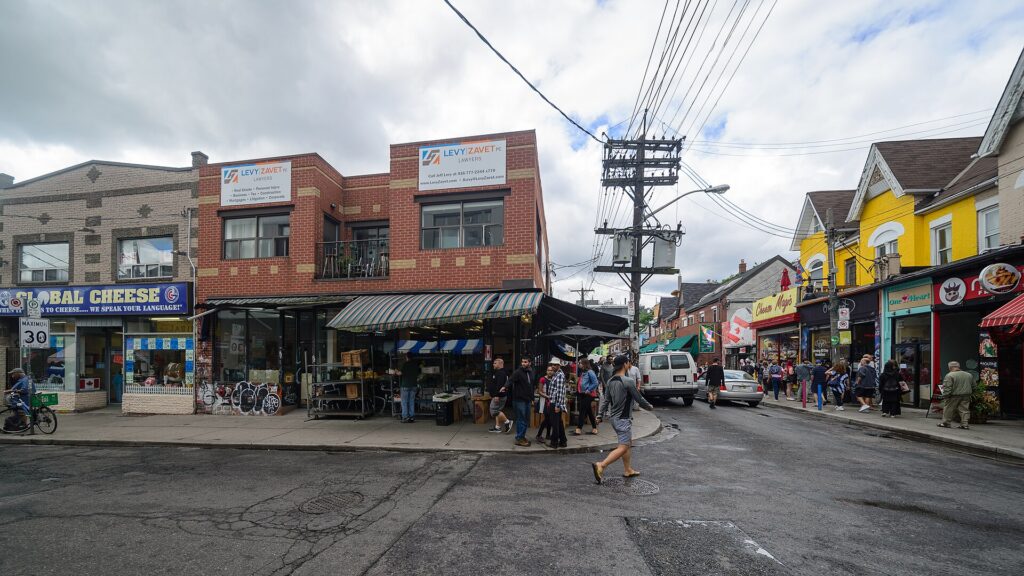
    Start on Spadina Avenue at Dundas, the heart of the largest of Toronto’s Chinatowns, for dim sum and bakeries, then walk two blocks west into Kensington Market. Kensington is a scruffy, colourful grid of vintage shops, cheese mongers, Latin American and Caribbean grocers, taquerias and patios, and it is at its best on Pedestrian Sundays, when the streets close to traffic on the last Sunday of the month from late spring to fall.

    Colourful shopfronts at Kensington Avenue and Baldwin Street in Kensington Market, Toronto
    Kensington Market, a few blocks west of Chinatown (Photo: Arild Vågen via Wikimedia Commons, CC BY-SA 4.0)

    Queen West, Ossington and Trinity Bellwoods

    Queen Street West from University Avenue to Bathurst is the shopping-and-brunch stretch; keep going past Bathurst and it becomes West Queen West, with galleries, independent boutiques and Graffiti Alley, the lane behind Queen where the murals run for blocks. Trinity Bellwoods Park is the neighbourhood’s front lawn on a summer afternoon, and Ossington Avenue, running north from Queen, has one of the city’s best concentrations of restaurants and bars.

    Yorkville

    Once the centre of the 1960s folk scene, Yorkville is now Toronto’s luxury district: the flagship stores on Bloor Street, the boutique hotels, the galleries on Hazelton Avenue and the outdoor tables where the film festival crowd gathers each September. It sits right beside the ROM, which makes it an easy pairing.

    The Danforth, Leslieville and the Beaches

    Take the Bloor-Danforth subway east and the neighbourhoods change character with each stop. The Danforth around Chester and Pape stations is Greektown, with the restaurants to match. Leslieville, along Queen Street East, is the brunch-and-antiques strip. Keep going east to the Beaches, where a wooden boardwalk runs along Woodbine and Kew beaches and the pace slows down entirely; it is a different city from the Financial District, and it is twenty-five minutes away.

    Little Italy, Koreatown and the west end

    College Street west of Bathurst is Little Italy, still lined with cafés and trattorias and lively late into the night. Bloor Street west of Bathurst is Koreatown, with barbecue restaurants and karaoke. Further west, Roncesvalles Avenue is the Polish-heritage main street beside High Park, Toronto’s largest park, with a free zoo, Grenadier Pond, the famous cherry blossoms in late April or early May, and outdoor Shakespeare in summer.

    Sports and live events

    Toronto is a serious sports city, and a game is one of the most local things a visitor can do. The Maple Leafs and Raptors play at Scotiabank Arena, attached to Union Station; the Blue Jays play at Rogers Centre beside the CN Tower; Toronto FC and the Argonauts share BMO Field at Exhibition Place; and the Marlies, the Leafs’ farm team, are the affordable hockey option. MLSE, which owns most of those teams, lists home schedules; for tickets across all of them, plus concerts at Scotiabank Arena, Budweiser Stage and Massey Hall, check what is on in Toronto for your dates before you book flights, because a playoff run or a stadium tour can tighten hotel availability quickly.

    The festival calendar is dense from June to September: Pride at the end of June, Canada Day on July 1, the Honda Indy in July, the Toronto Caribbean Carnival on the August long weekend, the Canadian National Exhibition from mid-August to Labour Day, and TIFF in September. The City of Toronto’s festivals calendar and Destination Toronto keep current dates.

    What to eat, and where

    Toronto’s defining food experience is not a dish but a map. More than half the city’s residents were born outside Canada, and each community has a main street. Eat dim sum in Chinatown or, for the real thing, in Scarborough or Markham; Caribbean roti and jerk in the west end and in Scarborough; Greek on the Danforth; Italian on College; Korean on Bloor; South Asian on Gerrard Street East, the Gerrard India Bazaar; Portuguese in Little Portugal along Dundas West; and Middle Eastern almost everywhere. The city’s own contributions are the peameal bacon sandwich at St. Lawrence Market and, less romantically, an outstanding brunch culture in Leslieville and on Queen West.

    Two restaurant festivals bring prix-fixe menus to hundreds of restaurants: Winterlicious in late January and February, and Summerlicious in July. Both are good ways to try the city’s more ambitious kitchens at a fixed price. In summer, patios matter: Toronto takes its outdoor dining seriously for the few months it can.

    Toronto with kids

    The Toronto Islands and Centreville, Ripley’s Aquarium, the ROM’s dinosaurs, the High Park zoo and playground, the Toronto Zoo in Scarborough (large, spread out, and best with a full day), skating at Nathan Phillips Square in winter, the Hockey Hall of Fame for older kids, and a Blue Jays game with the roof open. Children under 13 ride the TTC free, which makes getting between all of the above cheap.

    Day trips from Toronto

    Niagara Falls is the obvious one: about an hour and a half by car, reachable by seasonal GO train service and year-round bus, and offered by every tour company in the city. The boat to the base of the Horseshoe Falls is the experience worth paying for; Niagara Falls Tourism covers the rest. Niagara-on-the-Lake, twenty minutes further, is wine country and the home of the Shaw Festival. Stratford, two hours west, runs one of North America’s great theatre festivals from spring to fall. Prince Edward County, two and a half hours east, has wineries, sand dunes and small-town inns. Blue Mountain, north of the city, is the closest ski resort in winter and a hiking and cycling base in summer. Algonquin Provincial Park, three hours north, is the classic Ontario canoe landscape; Ontario Parks handles reservations. Most of these are far easier with a car; see our Toronto car rental page and our rental car booking tips if you are planning more than one.

    Two sample itineraries

    Two days, no car

    Day one: St. Lawrence Market for breakfast, walk to the Distillery District, streetcar back west along King Street through the Financial and Entertainment Districts, CN Tower at sunset, dinner on King West. Day two: Ferry to the Toronto Islands in the morning, back for lunch in Chinatown, Kensington Market in the afternoon, the AGO if it is a late-opening evening, and a game or a show at night.

    Four days, with one day trip

    Add a day for the ROM, Yorkville and Casa Loma, a day for the west end (Queen West, Ossington, High Park or the Beaches, depending on the season), and use the fourth day for Niagara Falls. Rent the car for that single day from a downtown location rather than the airport, which keeps parking out of the equation for the rest of the trip.

    Practical details

    • Transit: tap a credit card, debit card or phone on any TTC vehicle or fare gate, or buy a PRESTO card; a single tap covers a two-hour transfer window. The TTC’s site has maps and service alerts. Our transit-versus-car guide goes into detail.
    • From Pearson: the UP Express train reaches Union Station in about 25 minutes. Details on both airports are on the Pearson and Billy Bishop sites.
    • Weather: humid summers, cold snowy winters, and two lovely shoulder seasons. The best time to fly to Toronto guide has a month-by-month table; check Environment Canada’s forecast before you pack.
    • The PATH: a network of underground walkways connects most of the Financial District, Union Station and the Eaton Centre. In January it is how locals get around downtown without a coat.
    • Entry requirements: U.S. citizens need a valid passport; most other visa-exempt visitors arriving by air need an Electronic Travel Authorization. The Government of Canada’s visitor page is the authoritative source.
    • Safety: Toronto is a large, generally safe city; the usual big-city awareness applies downtown late at night.

    Frequently asked questions

    How many days do you need in Toronto?

    Three full days covers the icons and two or three neighbourhoods comfortably; five lets you add a day trip and slow down. A weekend is enough for the downtown core and the islands.

    What is the number one thing to do in Toronto?

    On a warm day, the ferry to the Toronto Islands, for the skyline view alone. In any season, the CN Tower at sunset is the classic.

    Is Toronto walkable?

    Downtown, very. The stretch from the waterfront north to Bloor Street and from the Distillery District west to Bathurst is flat and dense with things to see. Beyond that, the subway and streetcars fill the gaps.

    Do I need a car in Toronto?

    Not for the city itself. Rent one for day trips to Niagara, wine country or the parks, ideally from a downtown location for just those days.

    What is Toronto known for?

    The CN Tower, its diversity and food, the Toronto International Film Festival, its sports teams, and a waterfront and island park system that most first-time visitors underestimate.

    Is Toronto expensive?

    Hotels downtown are the main cost, especially in summer and during TIFF. Transit, the islands, the markets, the parks and many festivals are free or inexpensive. Booking flights in shoulder season and comparing hotels across neighbourhoods keeps the total manageable.

    Ready to go? Compare flights to Toronto, find a place to stay with our Toronto hotel search, and if Niagara is on the list, price a rental car for the day.

  • New York: Should You Rent a Car or Rely on Public Transit?

    New York: Should You Rent a Car or Rely on Public Transit?

    New York is the one city in America where the answer to “should I rent a car?” is almost always no. It has the largest rapid transit system on the continent, running around the clock, a street grid built for walking, a free ferry, a bike-share network across four boroughs and more taxis than anywhere else in the country. It is also the hardest, slowest and most expensive place in the United States to drive and park: garages charge by the hour at rates that would pay for a hotel room elsewhere, street parking is governed by rules that confound locals, and most of Manhattan now sits inside a congestion toll zone. Fewer than half of New York households own a car, and visitors have even less reason to, though a car does make sense for some day trips. This guide explains how the city is laid out, how the subway, buses, trains and ferries work and what they cost, what driving here is really like, when a car earns its keep, and gives you a straightforward way to decide.

    The short answer

    Skip the car for any trip based in Manhattan, Brooklyn or Queens, which is nearly every visit. The subway, your feet, the ferries and the occasional taxi will get you everywhere a first-timer wants to go, faster than a car and for a fraction of the cost. Rent a car only for the days it is genuinely needed: a trip to the Catskills, the Hamptons, the North Fork, Bear Mountain or somewhere else the trains do not reach well, a visit to family in the suburbs, or a longer road trip up the coast or into New England. Even then, pick it up on the morning you leave the city and return it when you come back, so that you never pay to park it overnight in Manhattan. If a car is on the list, compare rates for your dates on our car rental search.

    How New York is laid out

    New York is five boroughs spread across islands and a peninsula at the mouth of the Hudson. Manhattan, the long, narrow island at the center, is where most visitors spend most of their time. North of about 14th Street it is a grid: numbered streets run east to west and rise as you go north, and avenues run north to south, with Fifth Avenue dividing the East Side from the West Side. Below 14th Street, in the Village, SoHo and the Financial District, the older streets have names and wander. Twenty north-south blocks make roughly a mile, and crosstown blocks between avenues are much longer. Brooklyn and Queens share Long Island to the east, across the East River; the Bronx is the only borough on the mainland, to the north; and Staten Island sits in the harbor to the southwest. New Jersey is across the Hudson to the west, with Jersey City and Hoboken closer to Midtown by train than much of Queens.

    Hotels cluster in Midtown around Times Square and the theaters, in Lower Manhattan, in Chelsea and the Village, and increasingly in Long Island City, Downtown Brooklyn and Williamsburg, one or two subway stops from Manhattan. The best rule for choosing one is proximity to a station served by several lines. Our New York hotel search lets you compare them.

    Getting in from the airports

    New York has three major airports, and none of them is on the subway directly. From JFK, in southeast Queens, the AirTrain links every terminal to Jamaica station, where you can take the Long Island Rail Road to Penn Station or Grand Central Madison in about 20 minutes, or the E train into Midtown; a second AirTrain branch reaches the A train at Howard Beach. The AirTrain charges a separate fare when you leave or enter at Jamaica or Howard Beach. Yellow taxis charge a flat fare from JFK to anywhere in Manhattan, plus tolls, surcharges and tip; the drive takes 45 minutes to well over an hour. From LaGuardia, in northern Queens, the Q70 LaGuardia Link bus runs to the subway at Jackson Heights and Woodside, and a taxi to Midtown takes 25 to 45 minutes. From Newark, in New Jersey, the AirTrain runs to Newark Liberty International Airport station, where NJ Transit and Amtrak trains reach Penn Station in about half an hour. Every airport has rental counters, but unless you are driving straight out of the city, there is no reason to use them on arrival. The JFK airport site covers current ground-transport options; our JFK airport guide covers the layout.

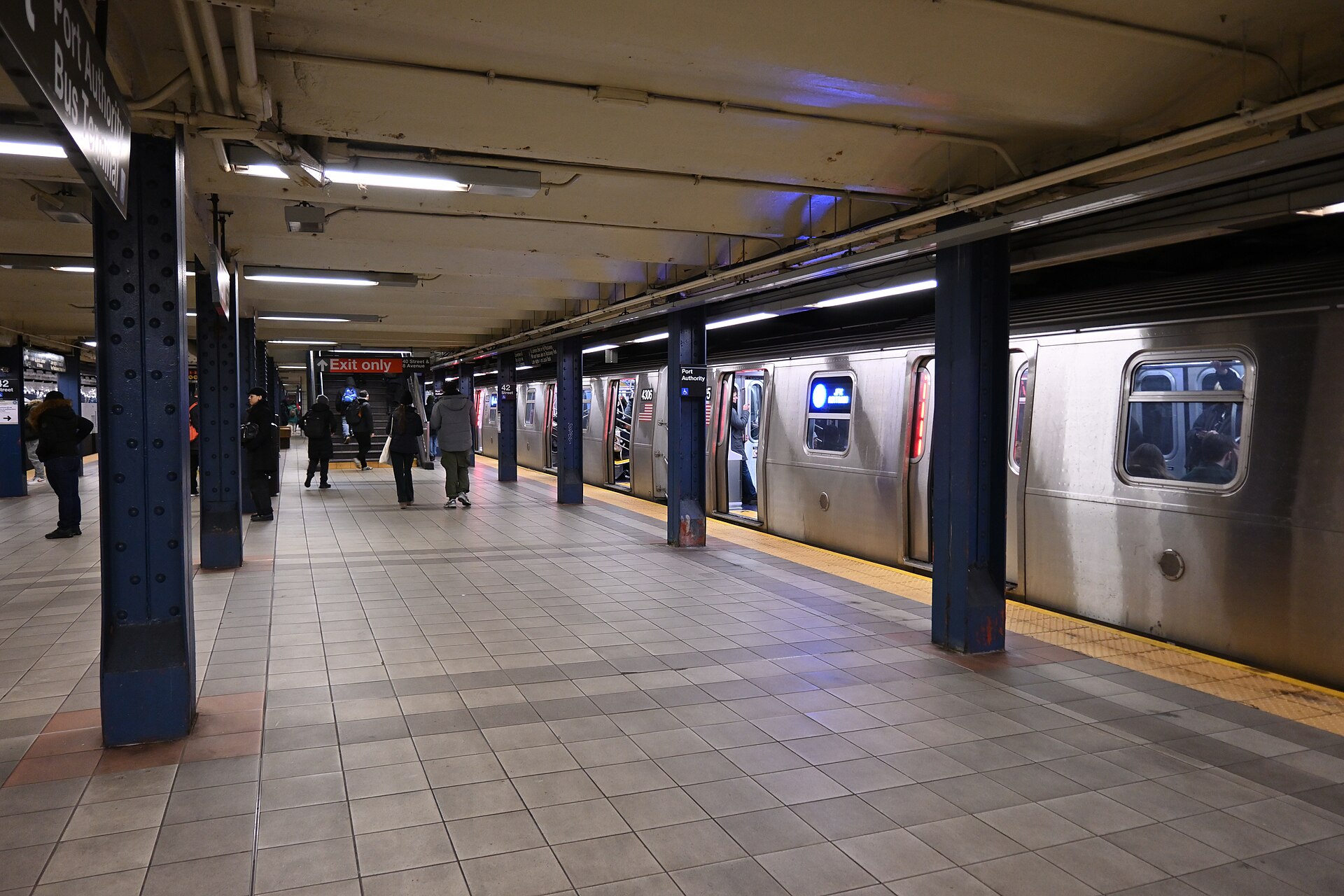
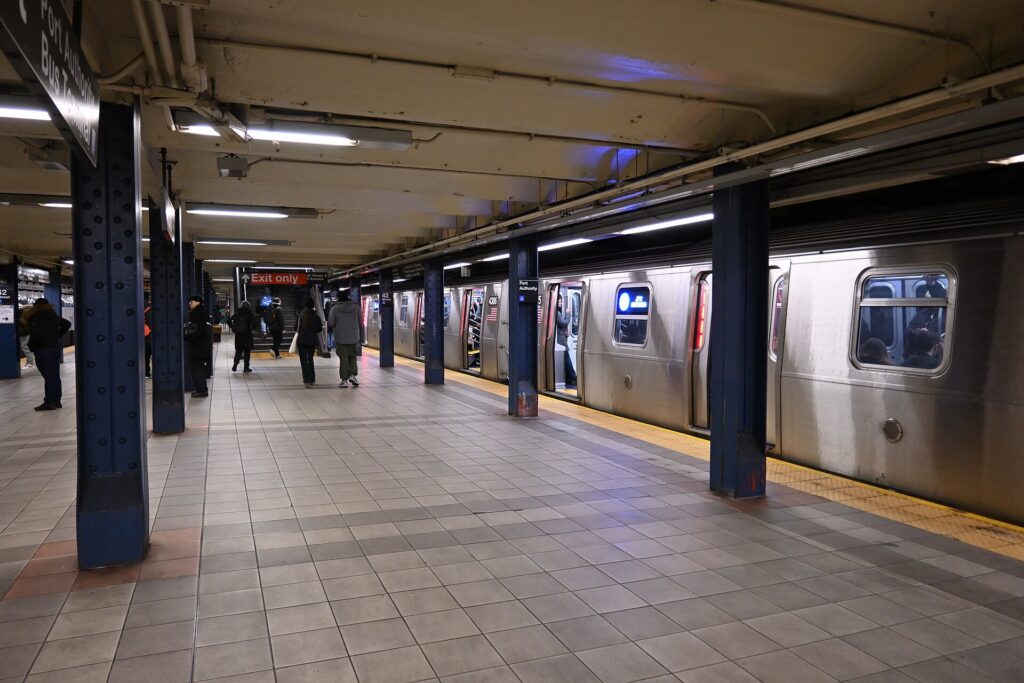
    An A train at the 42nd Street station in Midtown Manhattan
    The subway runs 24 hours a day and is the fastest way around the city (Photo: 4300streetcar via Wikimedia Commons, CC BY 4.0)

    New York’s transit, explained

    The Metropolitan Transportation Authority runs the subway, the city buses and the two commuter railroads. The system is huge, busy and imperfect, with weekend service changes and the occasional delay, but it is the fastest way around the city at almost any hour, and for a visitor it is one of the great bargains of the trip.

    The subway

    More than 400 stations on some two dozen services, identified by a letter or a number and a color, reach every borough except Staten Island, and the system runs 24 hours a day. Most Manhattan lines run north to south, with a few crosstown connections, such as the 7 and the shuttle across 42nd Street and the L across 14th Street. The two things that trip up visitors are express and local trains, which share the same tracks and platforms but skip different stations, and uptown and downtown entrances, which at some stations are on opposite sides of the street with no connection underground. Check the sign above the entrance and the train’s letter or number before you board, and use a transit app or the maps on the platforms for weekend changes.

    Buses

    City buses cover every borough, including the crosstown routes across Manhattan that the subway lacks and the neighborhoods of Brooklyn and Queens between subway lines. Select Bus Service routes, marked with blue lights, run limited stops with bus lanes. They are slower than the subway in Midtown but useful for anyone who cannot manage stairs.

    Commuter rail and PATH

    The Long Island Rail Road, from Penn Station and Grand Central Madison, and Metro-North, from Grand Central Terminal, serve the suburbs, the Hudson Valley and Long Island, and are the way to the beaches and the day trips. Both sell a reduced-fare ticket for trips within the city limits. PATH trains, run by the Port Authority, cross under the Hudson to Hoboken, Jersey City and Newark from stations along Sixth Avenue and at the World Trade Center, and use their own fare system. NJ Transit runs trains and buses to New Jersey from Penn Station and the Port Authority Bus Terminal.

    Fares and tickets

    Pay for the subway and buses by tapping a contactless credit or debit card, a phone or a watch on the OMNY reader at the turnstile or the bus door; the old MetroCard is being phased out, and reloadable OMNY cards are sold for anyone who prefers cash. One fare covers a single trip of any length, with a free transfer between subway and bus, or bus and bus, within two hours. The fare cap is the best deal for visitors: tap the same card or device every time, and after a set number of paid rides in any seven-day period, the rest of the rides in that period are free, with no pass to buy in advance. Children 44 inches (112 cm) and under ride free with a paying adult. Express buses, the commuter railroads and the AirTrain charge separate, higher fares. Check the MTA’s site for current fares before you go.

    Accessibility

    Every city bus is low-floor and accessible, but only around a third of subway stations have elevators, and many of those are on a single line at a complex. The MTA is adding elevators steadily and its map marks accessible stations; if you are traveling with a wheelchair, a stroller or heavy luggage, choose a hotel near an accessible station and check the elevator status before setting out.

    Beyond the subway

    • Walking. Manhattan is the most walkable place in North America, and walking between neighboring areas, Midtown to Chelsea, the Village to SoHo, the Lower East Side to Chinatown, is often faster than going underground.
    • Citi Bike. The bike-share network has thousands of docking stations across Manhattan, much of Brooklyn and Queens, the Bronx, and Jersey City and Hoboken, with pedal and electric bikes, single rides and day passes. Protected bike lanes run along many avenues and the Hudson River Greenway.
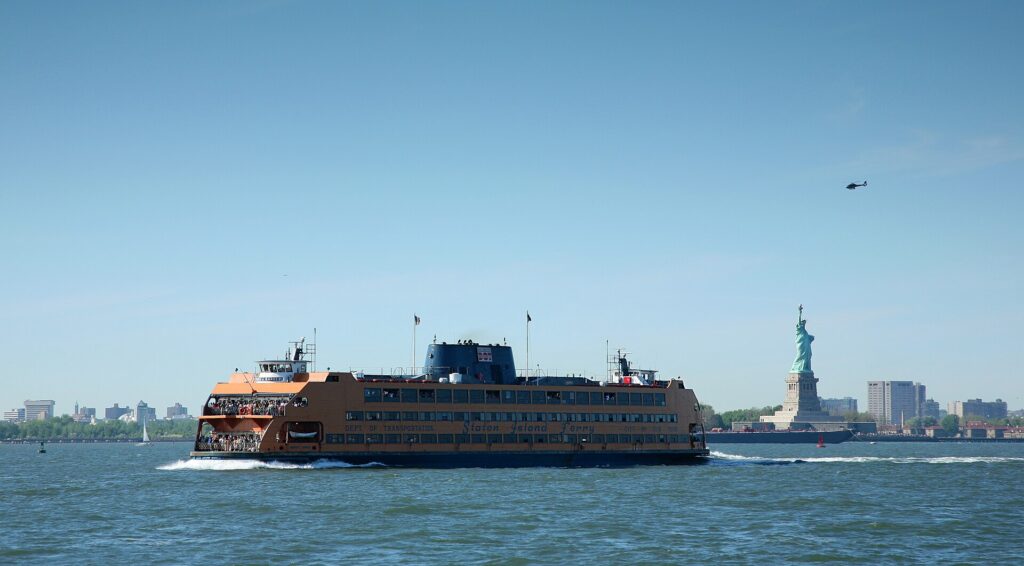
    • The ferries. The Staten Island Ferry is free, runs around the clock, and passes the Statue of Liberty. NYC Ferry routes cross the East River to DUMBO, Williamsburg, Long Island City and Astoria, and reach the Rockaway beaches in summer, for a fare close to a subway ride and with far better views.
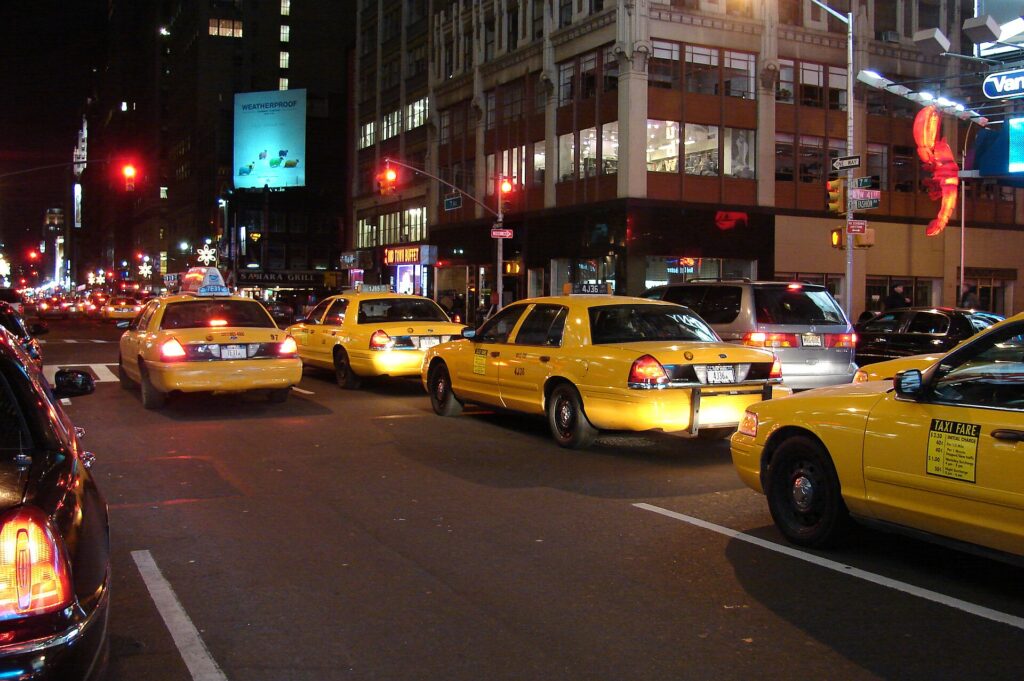
    • Taxis and ride-hail. Yellow cabs cruise Manhattan and the airports; Uber and Lyft operate everywhere. Both are quick late at night and competitive for three or four people on short trips, and painfully slow in Midtown traffic during the day. Surcharges apply to trips in the congestion zone.
    • Intercity trains and buses connect New York with Philadelphia, Washington, Boston and beyond from Penn Station, Grand Central and the Port Authority Bus Terminal. Amtrak runs the Northeast Corridor.
    The Staten Island Ferry crossing the harbor with the Statue of Liberty behind
    The Staten Island Ferry: free, around the clock, and past the Statue of Liberty (Photo: Daniel Schwen via Wikimedia Commons, CC BY-SA 4.0)

    Driving in New York: what it is really like

    Driving in New York is not dangerous so much as slow, expensive and stressful. Midtown traffic often moves at walking pace during the day. Streets are crowded with delivery trucks double-parked in the travel lane, taxis stopping without warning, cyclists, pedestrians who cross on the local interpretation of the signals, and construction that closes lanes with little notice. The highways in and out of the city, the FDR Drive, the West Side Highway, the Brooklyn-Queens Expressway, the Cross Bronx Expressway and the Long Island Expressway, are among the most congested roads in the country at rush hour and on summer weekends.

    Yellow taxis on a Manhattan street at night
    Yellow cabs in Manhattan: quick late at night, slow in daytime Midtown traffic (Photo: Loadmaster (David R. Tribble

    This image was made by Loadmaster (David R. Tribble).
    Email the author: David R. Tribble
    Also see my personal gallery at Google Photos via Wikimedia Commons, CC BY-SA 3.0)

    Parking

    Parking is where a car in New York becomes truly expensive. Manhattan garages charge by the hour at high rates, with the daily maximum at many Midtown garages rivaling a budget hotel room, and hotel valet parking is typically charged per night on top of the room. Street parking exists, but it is scarce, and every block has its own signs: alternate-side parking rules that require you to move the car for street cleaning on certain mornings, metered zones, commercial zones, no-standing zones and hydrants, with tickets and tows enforced aggressively. Booking a garage space in advance through a parking app is the most reliable way to control the cost if you must bring a car into the city.

    Rules and conditions worth knowing

    • Congestion pricing. Driving into Manhattan south of 60th Street incurs a daily congestion toll, charged automatically by license plate, on top of any bridge or tunnel toll. Check the MTA’s site for current rates and hours.
    • Tolls are cashless. Most bridges and tunnels into and out of the city charge tolls by transponder or by license plate. Rental companies pass these on, usually with a daily administration fee for their toll program; ask at the counter how it works and what it costs.
    • No right turn on red anywhere in New York City unless a sign specifically allows it, which is unlike the rest of the country.
    • Parkways ban commercial vehicles. The Henry Hudson, Taconic, Belt, Grand Central and other parkways have low stone bridges; cargo vans and trucks are prohibited, and that includes rental moving vans.
    • Speed and red-light cameras operate across the city, including school-zone speed cameras at all hours; fines follow the car, and the rental company will bill you with a fee on top.
    • Do not block the box. Entering an intersection you cannot clear is a ticketable offense, and gridlock enforcement is common in Midtown.
    • Young drivers. New York State requires rental companies to rent to drivers aged 18 and over, but the young-driver surcharge under 25 is steep.
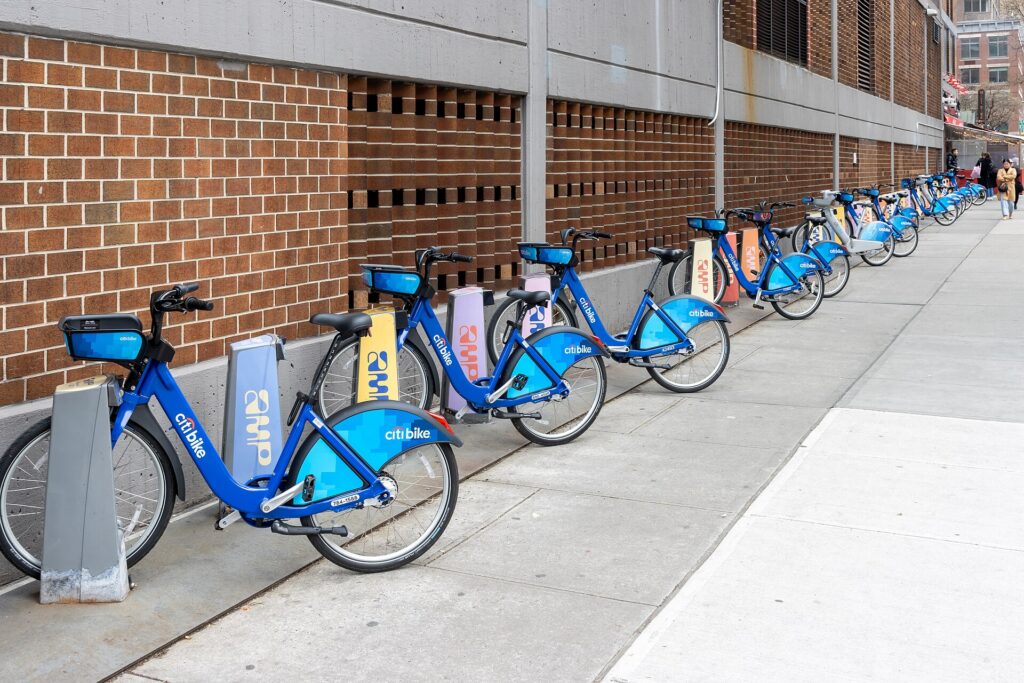
    A row of Citi Bikes docked on 42nd Street in Manhattan
    Citi Bike docks cover Manhattan, much of Brooklyn and Queens, and the Jersey waterfront (Photo: Photograph by Mike Peel (www.mikepeel.net). via Wikimedia Commons, CC BY-SA 4.0)

    When renting a car makes sense

    • The Catskills and the upper Hudson Valley. Hiking trails, small towns and farm stays are spread out and poorly served by transit.
    • The Hamptons, Montauk and the North Fork. The Long Island Rail Road reaches them, but a car makes it possible to move between beaches, vineyards and farm stands.
    • Bear Mountain, Storm King Art Center and Woodbury Common. All are an hour or so up the Hudson and easier by car.
    • Family in the suburbs. Visiting relatives in Westchester, Long Island or New Jersey often means a car.
    • Road trips. New York to New England, the Jersey Shore, or down to Philadelphia and Washington; our Philadelphia, Boston and Washington car rental pages cover onward trips.

    If any of those apply, our rental car booking tips cover insurance, deposits and the questions to ask at the counter, and our family car rental guide looks at vehicle choice.

    When it does not

    • You are staying in Manhattan, Brooklyn or Queens and your plans are the city itself.
    • You are in town for Broadway, museums, a conference, a concert or a game; every major venue is on the subway or the commuter rail.
    • Your day trips are to the Hudson Valley towns on the Metro-North line, the beaches on the LIRR or the subway, or Philadelphia, Washington and Boston by train.
    • You are traveling solo or as a couple, when even occasional taxis cost far less than a rental plus parking.

    The hybrid plan for a city-plus-country trip

    Go car-free for the city days and rent only for the days out of town, and think carefully about where you pick up. Rental locations in Manhattan are convenient but tend to be pricier, with limited hours at some branches, and driving out means crossing Midtown traffic and a toll bridge or tunnel. Locations near the edge of the city, in upper Manhattan, the outer boroughs, or across the Hudson in Jersey City and Hoboken, are often cheaper and put you straight onto the highway toward the Hudson Valley or New Jersey. The airports have the largest fleets and the longest hours, and a common pattern works well for travelers heading out at the end of the trip: spend the city days car-free, take the train or a taxi to the airport, pick up a car there for the country days, and return it at the same airport before your flight home. The worst option is renting on arrival and paying to park in Manhattan for days while riding the subway. Compare the rates for your country days on our car rental search against a full-trip rental and the difference is usually obvious.

    A worked cost comparison

    Numbers change with the season and the booking window, so treat this as a method rather than a quote, and check current rates before deciding. For a four-night city break in Midtown for two people, the car-free version costs the airport transfer, a week of subway rides that the fare cap limits automatically, and perhaps a couple of late-night taxis; the rental version adds four days of a compact car, four nights of hotel or garage parking at Manhattan rates, daily congestion tolls, bridge and tunnel tolls, the rental company’s toll-program fees and fuel. The transit option wins by a very wide margin. For the same four nights with one day in the Hudson Valley, the car-free version adds two Metro-North round trips to Beacon or Cold Spring; the hybrid version adds a one-day rental, tolls and fuel. For two people the train is usually cheaper and more relaxing; for four, a day rental from an edge-of-city location can be competitive, and it wins on flexibility if you want to combine several stops. For a week split between the city and the Catskills or the Hamptons, a rental for the country days is the practical answer, and the saving from not parking it in Manhattan for the city days more than pays for the extra trip to collect it. Run the rental rates for your dates on our car rental search and put them beside the train fares before you choose.

    Driving out of New York in each season

    The roads out of the city are where most visitors meet New York traffic, and timing matters more than route. In summer, the problem is the weekend exodus: the Long Island Expressway eastbound toward the Hamptons on Friday afternoon, the Garden State Parkway south to the Jersey Shore, and the Thruway north to the mountains all jam from early afternoon, with the return on Sunday afternoon just as bad. Leave before noon on Friday or early Saturday, and come back Sunday morning or Monday. Holiday weekends, Memorial Day, the Fourth of July and Labor Day, are the worst of the year. In fall, the foliage weekends in October bring the same pressure to the Hudson Valley and the Catskills, particularly on the Taconic and the Palisades parkways, which are beautiful drives and narrow, winding ones. In winter, snowstorms and nor’easters close roads and slow the highways, rental cars rarely come with winter tires, and the mountain roads in the Catskills and the Berkshires can be icy when the city is only wet; check 511NY for conditions before you leave, and be ready to postpone. In every season, avoid leaving or entering Manhattan between about 7 and 10 in the morning and 4 and 7 in the evening on weekdays, and budget far more time than a map suggests for any crossing of the Hudson or East River.

    Decision table

    Your tripRecommendationWhy
    City break in Manhattan, couple or soloNo carThe subway, walking and the fare cap cover everything; parking would cost more than it saves
    Family trip based in the cityNo carChildren ride free up to a height limit, and taxis fill the gaps
    Broadway, museums, a conference or a gameNo carEvery venue is on transit, and Midtown parking is the most expensive in the country
    City plus a Hudson Valley dayMetro-North, or a one-day rentalBeacon and Cold Spring are on the train; wider exploring suits a car
    City plus the Hamptons, North Fork or CatskillsHybrid: rent only for those daysPick up at the edge of the city or the airport, and never park in Manhattan
    Visiting family in the suburbsRent for the whole staySuburban distances make the car worthwhile daily
    Northeast road tripRent at the end of your city daysStart driving when you leave the city, not before
    Philadelphia, Washington or Boston side tripTrainAmtrak runs center to center, faster than driving in traffic

    Money-saving tips for both options

    • On transit: tap the same card or phone for every ride so the weekly fare cap kicks in; walk short hops; use the free Staten Island Ferry instead of a harbor cruise; and take the train, not a taxi, from JFK and Newark when traffic is heavy.
    • On a rental: compare Manhattan, outer-borough, New Jersey and airport pickups, rent only for the days you leave the city, ask how the toll program is charged, decline extras you already have through a credit card or home policy (check first), and book ahead for summer weekends and fall foliage season.
    • On the hotel: if you are driving, price parking into the room rate; hotels in Long Island City, Jersey City and Hoboken often have cheaper parking and fast trains to Manhattan.
    • On timing: avoid driving in or out of Manhattan in the weekday peaks and on Friday afternoons in summer; the best time to fly to New York guide lists the busiest weeks of the year.

    Frequently asked questions

    Is it worth renting a car in New York?

    Almost never for the city itself. Rent only for day trips or onward travel that the trains do not cover, and only for those days.

    Is the New York subway good for tourists?

    Yes. It runs 24 hours, reaches nearly everything a visitor wants to see, and the weekly fare cap makes it very cheap. Learn the difference between express and local trains and you will be fine.

    How do I pay for the subway?
    Tap a contactless card, phone or watch on the OMNY reader at the turnstile. Use the same one every time so the fare cap applies.

    How do I get from JFK to Manhattan?
    The AirTrain to Jamaica and then the Long Island Rail Road or the E train, or a yellow taxi at a flat fare plus tolls and tip.

    How much does parking cost in Manhattan?

    A lot. Garage rates in Midtown can rival a budget hotel room for a full day, and hotels charge per night. Booking a space in advance through an app is the cheapest reliable option.

    What is congestion pricing?

    A daily toll for driving into Manhattan south of 60th Street, charged automatically by license plate. Rental companies pass it on to you with their toll fees.

    Can I visit the Hudson Valley without a car?

    Yes. Metro-North trains from Grand Central reach Beacon, Cold Spring and other river towns, with Dia Beacon and hiking trails a short walk from the stations.

    Whichever way you go, start with the flight. Compare cheap flights to New York, choose a neighborhood with our New York hotel search, and for what to see once you arrive, read our first-timer’s guide to New York.

  • Best Time to Fly to New York: Seasons, Weather & Prices

    Best Time to Fly to New York: Seasons, Weather & Prices

    New York is the busiest air market in North America, and that works in your favor. Three major airports, every large airline, and more routes than any other American city mean that there is almost always a seat somewhere, and that fares are driven less by a shortage of flights than by the city’s own calendar. That calendar is crowded: the holidays from Thanksgiving to New Year, when the whole world seems to want to see the tree and the windows; a summer when international visitors arrive in force; a fall when the weather is perfect and conventions, Fashion Week and the United Nations fill every hotel; and a deep, cold, quiet stretch after New Year when the city is at its cheapest. The flight is rarely the expensive part of a New York trip. The hotel is, and the two do not always peak together. This guide walks through the weather month by month, the fare and hotel seasons, the events that move prices, and how to handle the three airports.

    The short answer

    For the best balance of weather and price, go in late April to early June, when the parks are green and the heat has not arrived, or in early November, after the fall peak and before the holidays. September and October have the best weather of the year, and New Yorkers will tell you so, but they are also the most expensive months for hotels. The cheapest time to fly and to stay is January and February, after the New Year week, when fares and room rates fall to their annual low and the city’s Restaurant Week and Broadway Week discounts arrive to fill the seats. The most expensive stretches are the weeks from Thanksgiving to New Year, especially mid-December, late September during the UN General Assembly, and the summer for transatlantic flights. Whatever you choose, run a flexible-date search on our New York flights page; a shift of a few days, or a switch between JFK, LaGuardia and Newark, can change the fare band entirely.

    Bow Bridge in Central Park surrounded by fall color
    Central Park in the fall, the season with the best weather and the highest hotel rates (Photo: Querent via Wikimedia Commons, CC BY 4.0)

    New York’s weather, season by season

    New York has four distinct seasons and a coastal climate that can swing hard within each of them. Winters are cold and sometimes snowy, with a nor’easter or two most years; spring is brief and changeable; summers are hot, humid and punctuated by thunderstorms; and fall is long, dry and golden. The figures below are approximate seasonal patterns based on the long-term Central Park climate normals from NOAA’s National Weather Service; check the current forecast before you pack, because a week in March or November can hold both a warm day and a snowstorm.

    MonthTypical daytime highTypical overnight lowWhat it feels likeFare pressure
    Januaryaround 4 °C (39 °F)around -3 °C (27 °F)Cold, gray, windy between the towers; snow is possibleLow after New Year’s week
    Februaryaround 6 °C (42 °F)around -2 °C (29 °F)Still cold; often the snowiest monthLow; rises for Presidents’ Day weekend
    Marcharound 10 °C (50 °F)around 2 °C (35 °F)Raw and changeable; a late snowfall is commonLow to moderate; spring break spike
    Aprilaround 17 °C (62 °F)around 7 °C (45 °F)Blossom month; showers and the first warm daysModerate; Easter spike
    Mayaround 22 °C (71 °F)around 13 °C (55 °F)Warm, green, often perfectModerate to high
    Junearound 26 °C (80 °F)around 18 °C (64 °F)Warm to hot; humidity builds; long eveningsHigh
    Julyaround 29 °C (85 °F)around 21 °C (70 °F)Hot and humid; heat waves above 32 °C (90 °F); thunderstormsHigh for flights; hotels a little softer
    Augustaround 28 °C (83 °F)around 21 °C (69 °F)Hot and sticky; locals leave town on weekendsHigh early, easing late in the month
    Septemberaround 24 °C (76 °F)around 17 °C (62 °F)Warm and settling; the best weather beginsHigh, with a UN week hotel peak
    Octoberaround 18 °C (65 °F)around 11 °C (51 °F)Crisp, dry and sunny; leaves turn late in the monthHigh for hotels
    Novemberaround 12 °C (54 °F)around 5 °C (42 °F)Cool and clear, then cold; late foliage in the parksModerate; peak around Thanksgiving
    Decemberaround 7 °C (44 °F)around 0 °C (33 °F)Cold and festive; dark by late afternoonPeak, especially hotels

    Three things the table cannot show. First, the humidity: a July day at 29 °C in New York feels far hotter than the number suggests, the subway platforms are hotter still, and the heat stored in the pavement keeps nights warm. Plan outdoor sightseeing for mornings and evenings in high summer. Second, the wind: in winter the avenues act as wind tunnels, and a day that reads as a few degrees above freezing can feel well below it at a river-facing corner. Third, the storms: summer thunderstorms and winter nor’easters are the two kinds of weather that ground flights at all three airports at once, and the Atlantic hurricane season, which peaks from August to October, occasionally sends the remnants of a tropical storm up the coast.

    How New York’s fare seasons work

    Three forces set prices for a New York trip. The first is tourism, which peaks in summer for international visitors and at Christmas for everyone. The second is business and conventions, which fill Midtown hotels from Monday to Thursday for most of the year and push fall rates to their highest. The third is competition: with three airports and nearly every carrier in the country fighting for the market, New York fares are often lower than those to smaller cities at the same distance, and a sale on one airline tends to be matched quickly by others. The practical result is that flights and hotels follow slightly different curves. Flights peak in summer and over the holidays; hotels peak in the fall and in December, and are softer in July and August than most visitors expect.

    Peak season

    The weeks from Thanksgiving to New Year, especially the middle of December, are the most expensive of the year for hotels, with flights also high around the holidays themselves. Late September and October are the other hotel peak, driven by perfect weather, conventions and the United Nations General Assembly, whose high-level week in the second half of September fills Midtown East and closes streets around the UN. June to mid-August is peak for transatlantic and long-haul flights. If you must travel in a peak window, book early, fly mid-week, and consider staying in Brooklyn or Long Island City.

    Shoulder season

    Mid-March to early June, and early November before Thanksgiving. Late April and May are the sweet spot for weather and value, with Easter and Memorial Day weekend the dates to watch. Early November keeps some of October’s color and crisp weather at noticeably lower hotel rates, although Marathon weekend, on the first Sunday of the month, fills the city.

    Low season

    From the first full week of January to early March. Fares and hotel rates are at their lowest, the museums and restaurants are at their quietest, and the city runs its best promotions to fill the gap: NYC Restaurant Week and NYC Broadway Week both land in this window. The exceptions are the Martin Luther King Jr. and Presidents’ Day long weekends and the mid-February school break, when domestic travel rises. Build a buffer into connections in case of snow.

    As elsewhere, mid-week departures and early or late flights usually price below Friday and Sunday afternoons on the same route, and a search across a whole month reveals cheaper pairs of dates close to your first choice. Our guide to the best times to book explains how to read those patterns.

    New York month by month

    January

    After New Year’s week, the cheapest month of the year, and one of the best for anyone who dislikes crowds. It is cold, with highs just above freezing and the chance of a real snowstorm, but the museums, Broadway and the restaurants are all at full strength and easier to get into. NYC Restaurant Week and Broadway Week usually begin in the second half of the month, and the holiday decorations linger into the first days of January.

    February

    Still cold, often snowy, and still cheap outside Presidents’ Day weekend (the third Monday of February) and the mid-winter school break that surrounds it. The Lunar New Year celebrations in Chinatown and Flushing, New York Fashion Week and the tail of the winter promotions fill the calendar. A strong value month for a theater-and-food trip.

    March

    Raw and changeable, with late snow in some years and the first mild days in others. The St. Patrick’s Day Parade up Fifth Avenue on or around March 17 is one of the largest in the world. Spring break brings a spike in family travel through the second half of the month; book around it and March is still good value.

    April

    The blossom month: magnolias and cherry trees in Central Park and the Brooklyn Botanic Garden, and the first warm afternoons. Easter weekend brings the Easter Parade and Bonnet Festival on Fifth Avenue, a spike in family travel and higher rates. The Broadway season’s spring openings crowd into April ahead of the Tony Awards nominations, which makes it a strong month for new shows. Pack for showers.

    May

    Often the most pleasant month of the year, and prices reflect it. Central Park is at its greenest, rooftop bars and outdoor dining open in earnest, and Fleet Week brings the Navy to the Hudson piers over Memorial Day weekend (the last Monday of May), the unofficial start of summer and a date to book around.

    June

    Long, warm evenings, Shakespeare in the Park, the Tribeca Festival, the Tony Awards, free outdoor concerts across the boroughs, and the Pride March on the last Sunday of the month, which draws an enormous crowd. Transatlantic fares are high from the middle of the month as schools finish in Europe and North America. Early June is the value play.

    July

    Hot and humid, with heat waves and afternoon thunderstorms. The Fourth of July brings the Macy’s fireworks over the East River or the Hudson, depending on the year. Flights are at summer peak, but hotel rates, freed from the business traveler, are often lower than in spring or fall, and the city’s free summer programming, from outdoor movies in Bryant Park to concerts in the parks, is in full swing.

    August

    The month New Yorkers leave town. It is hot and sticky, the city is noticeably quieter, and hotel rates can be surprisingly reasonable, especially in the second half. The US Open begins in the last week of August at Flushing Meadows and runs into September, lifting demand in Queens.

    September

    The city comes back from vacation and the best weather of the year begins. Labor Day weekend, New York Fashion Week, the Feast of San Gennaro in Little Italy and, above all, the UN General Assembly high-level week in the second half of the month drive hotel rates to some of their highest levels of the year and snarl Midtown traffic. Fly in the first half of the month if you can.

    October

    Crisp, dry and sunny, and the favorite month of many New Yorkers. Hotel rates stay high all month. The leaves start to turn in Central Park in the last week, the Village Halloween Parade fills Sixth Avenue on October 31, and Columbus Day weekend brings a small rise in domestic travel. Book well ahead for October hotels.

    November

    Two months in one. The first three weeks are one of the best-value windows of the year, with cool, clear weather and the last of the foliage in the parks, interrupted only by the New York City Marathon on the first Sunday. Thanksgiving (the fourth Thursday) brings the Macy’s parade and the start of the holiday season, and fares and hotel rates rise sharply around it.

    December

    The most expensive month for hotels, and for good reason: the Rockefeller Center tree, the Fifth Avenue windows, the holiday markets in Bryant Park and Union Square, the Radio City Christmas Spectacular, the Nutcracker at Lincoln Center, and New Year’s Eve in Times Square. The first week of December is the least expensive part of the season; the week before Christmas and New Year’s week are the peak. Book as early as you can.

    The Christmas tree and holiday decorations at Rockefeller Center in Midtown Manhattan
    The Rockefeller Center tree: December is the most expensive month for New York hotels (Photo: JJonahJackalope via Wikimedia Commons, CC BY-SA 4.0)

    Events that move New York flight and hotel prices

    Cross-check these against your dates before you book. Exact dates shift each year; New York City Tourism + Conventions, the official visitor bureau, keeps the current calendar.

    • New Year’s Eve in Times Square and the days either side.
    • Presidents’ Day weekend (third Monday of February) and the February school break.
    • Spring break and Easter (late March to April, varies by year).
    • Memorial Day weekend and Fleet Week (late May).
    • Pride (last Sunday of June) and the Fourth of July.
    • The US Open (last week of August into the first week of September).
    • The UN General Assembly high-level week (second half of September): the single most disruptive week of the year for Midtown hotels and traffic.
    • The New York City Marathon (first Sunday of November).
    • Thanksgiving to New Year, peaking in the week before Christmas.
    • Big games and concerts at Madison Square Garden, Yankee Stadium and MetLife Stadium. Our New York events page shows what is on sale for your dates.

    Getting in from the airports

    New York has three major airports, and choosing between them is one of the best ways to save. John F. Kennedy International (JFK), in southeast Queens about 24 kilometers (15 miles) from Midtown, handles most long-haul international flights and is in the middle of a multi-year rebuild, with new terminals opening in phases. The AirTrain links every terminal to Jamaica station, for the Long Island Rail Road to Penn Station or Grand Central Madison and the E train, and to Howard Beach for the A train; yellow taxis charge a flat fare to Manhattan plus tolls and surcharges, and the drive takes 45 minutes to well over an hour depending on traffic. LaGuardia (LGA), in northern Queens, is the closest to Midtown and mostly domestic, with rebuilt terminals and bus links to the subway. Newark Liberty (EWR), in New Jersey, is a major hub with its own AirTrain to a rail station on the Northeast Corridor, from which NJ Transit and Amtrak trains reach Penn Station in about half an hour; for the West Side and Lower Manhattan it can be as convenient as JFK. Search all three at once, then weigh the ground transport; our New York car-versus-transit guide covers the options, and our JFK airport guide covers the layout.

    The AirTrain approaching Terminal 4 at John F. Kennedy International Airport
    The AirTrain at JFK links every terminal to the subway and the Long Island Rail Road (Photo: Acroterion via Wikimedia Commons, CC BY-SA 4.0)

    Timing tricks that work for New York

    • Search all three airports. JFK, LaGuardia and Newark compete on most routes, and the cheapest of the three changes from week to week. A multi-airport search on TicketScanner shows them side by side.
    • Price the hotel first in the fall and December. A cheap fare in October or mid-December is not cheap once the room is added. Run a New York hotel search for the same dates before you commit to either.
    • Stay over a weekend. Midtown hotels built for business travelers often drop their rates on Friday and Saturday nights, the reverse of most leisure destinations.
    • Fly mid-week. Tuesday, Wednesday and Saturday departures are usually cheaper than Friday and Sunday on the busiest domestic routes.
    • Avoid the UN week. If your dates fall in the second half of September and rates look strangely high, that is why; move a week either way.
    • Build a weather buffer. Thunderstorms in summer and snow in winter cause cascading delays across all three airports; avoid tight connections, and read our guide to how early to arrive for what to allow.
    • Combine cities by train. An open-jaw ticket into New York and out of Boston, Philadelphia or Washington, with Amtrak in between, is often no more expensive than a round trip.
    • Flying out of New York instead? The same seasonality applies in reverse; see cheap flights from New York.
    The beach at Coney Island in Brooklyn
    Coney Island, a subway ride from Manhattan, when the summer heat sets in (Photo: Chiffon Lions via Wikimedia Commons, CC BY-SA 3.0)

    What to pack, by season

    Winter (December to February): a warm, windproof coat, a hat, gloves, a scarf and waterproof boots for slush at the crossings, plus layers you can shed in overheated museums and subway cars. Spring (March to May): layers, a light waterproof jacket and an umbrella; March can still be cold. Summer (June to August): the lightest clothing you own, a refillable water bottle, sun protection and a compact umbrella for the afternoon storms, plus a light layer for aggressively air-conditioned theaters and restaurants. Fall (September to November): a light jacket in September, a warmer one by November. In every season, the most important item is a pair of comfortable walking shoes: a normal day in New York means 15,000 steps or more.

    The best time to fly to New York for…

    The holidays

    The first week of December for the tree, the windows and the markets at lower rates than the weeks that follow; book well ahead if Christmas week or New Year’s Eve is the point.

    Good weather

    Mid-September to late October, or May. Book the hotel early for fall.

    The lowest fares

    Mid-January to late February outside the long weekends, with Restaurant Week and Broadway Week as a bonus.

    Broadway

    Any time, but January and February for the best availability and the two-for-one Broadway Week offers, and late spring for the new season’s openings before the Tony Awards.

    Families

    Late spring or late August, when the parks and beaches are open and the heat and crowds are more manageable than in July; December for the holiday magic if the budget allows.

    International visitors

    Travelers from Visa Waiver Program countries need an approved ESTA before they board; most others need a visa. The State Department’s travel site explains what applies to you, U.S. Customs and Border Protection covers arrival, and the TSA lists what you can carry through security.

    Frequently asked questions

    What is the cheapest month to fly to New York?

    January and February, after the New Year week and outside the long weekends. Early March and the first three weeks of November are the next best.

    What is the best month to visit New York for weather?

    October, with September and May close behind. July and August are hot and humid; January and February are cold.

    Which New York airport is best?

    Whichever is cheapest and closest to where you are staying. JFK has the most international flights, LaGuardia is closest to Midtown, and Newark is often the easiest for the West Side and Lower Manhattan by train.

    How expensive is New York at Christmas?

    Very, for hotels: mid-December is the priciest time of the year. Flights rise too, though less sharply. The first week of December offers most of the atmosphere for less.

    Is New York crowded in summer?

    The landmarks are, with international visitors at their peak, but many New Yorkers leave on weekends, and hotels are often cheaper than in spring or fall.

    How far ahead should I book?

    Earlier for December, the fall and summer transatlantic flights, when fares tend only to rise; for January to early March, fares are stable enough that finding the right dates matters more than booking early.

    Does it snow in New York?

    Most winters bring a few snowfalls, usually between December and March, and occasionally a major storm that closes the airports for a day. Many winters are milder than the city’s reputation.

    Ready to pick your dates? Compare fares across the whole month on our New York flights page, then find a room with our New York hotel search. For what to do when you land, start with our first-timer’s guide to New York.

  • Things to Do in New York: A First-Timer’s Guide

    Things to Do in New York: A First-Timer’s Guide

    New York does not need an introduction, which is exactly the problem for a first visit. Everyone arrives with a list already written by films, songs and other people’s photographs, and the list is too long for any trip: the Statue of Liberty, the Empire State Building, Central Park, Times Square, Broadway, the Met, the Brooklyn Bridge, the 9/11 Memorial, a slice, a bagel, a show. All of those are worth doing. But the city New Yorkers live in is the one between the landmarks: the Village streets that ignore the grid, the dumpling counters of Flushing, the free ferry with the best view of the harbor, the neighborhoods of Brooklyn and Queens that have become destinations in their own right. This guide covers the sights that earn a day, the neighborhoods worth a half-day, the food, Broadway and the sports, the day trips that are easier here than from any other American city, and the practical details that turn a checklist into a trip.

    If you are still comparing cheap flights to New York, read this alongside our guides to the best time to fly to New York and whether you need a car (you almost certainly do not). Between the three you can plan the whole trip.

    The Midtown Manhattan skyline with the Empire State Building
    Midtown Manhattan from the One World Observatory downtown (Photo: Christian David via Wikimedia Commons, CC BY-SA 4.0)

    New York at a glance for first-timers

    • Airports: three of them. John F. Kennedy International (JFK) in Queens handles most long-haul flights and is about 24 km (15 miles) from Midtown; LaGuardia (LGA), also in Queens, is closer and mostly domestic; Newark Liberty (EWR) is across the Hudson in New Jersey. See our JFK airport guide.
    • Getting around: the subway runs 24 hours a day and is the fastest way around the city; tap a contactless card or phone at the turnstile. Manhattan is walkable block by block, and the Staten Island Ferry is free. Nobody needs a car, and our car-versus-transit guide explains why.
    • Money: US dollars. Sales tax of just under 9 percent is added at the register, not shown on the tag, but clothing and footwear under a set price per item are exempt. Tipping 18 to 20 percent in restaurants is expected, and a dollar or two per drink at a bar.
    • Weather: four real seasons: cold, sometimes snowy winters, a short lovely spring, hot and humid summers, and a long golden fall. Our month-by-month guide has the detail.
    • Where to stay: Midtown and Times Square for theaters and first-visit convenience; Lower Manhattan for the harbor and quieter weekends; Chelsea, the Village or the Lower East Side for restaurants and nightlife; Williamsburg, Downtown Brooklyn or Long Island City for lower rates a short subway ride from Manhattan. Our New York hotel search covers them all.

    Midtown: the Empire State Building, Grand Central and Times Square

    Midtown is where most first visits start, and its landmarks sit within a twenty-minute walk of one another. The Empire State Building, with decks on the 86th and 102nd floors, is still the classic view; Top of the Rock at Rockefeller Center is the view of the Empire State Building, with Central Park spread out to the north; and Summit One Vanderbilt, beside Grand Central, is the most theatrical, with mirrored rooms and glass ledges over Madison Avenue. Pick one for sunset and book a timed ticket. Grand Central Terminal is free and is the best building in Midtown: the celestial ceiling of the main concourse, the whispering gallery outside the Oyster Bar, and the food market on the Lexington Avenue side. Two blocks west, the New York Public Library opens its Rose Main Reading Room to anyone, and Bryant Park behind it has a free ice rink and holiday market in winter and lawn chairs and movies in summer. Rockefeller Center has the rink and the tree, Radio City Music Hall and St. Patrick’s Cathedral across Fifth Avenue. Times Square is loud, bright and worth one evening; the TKTS booth under the red steps sells discounted same-day theater tickets, and the Broadway houses are on the side streets just west of it.

    Times Square in Midtown Manhattan, lit by its screens
    Times Square, worth one evening for the screens, the crowd and the TKTS booth (Photo: Terabass via Wikimedia Commons, CC BY-SA 3.0)

    Lower Manhattan: the Statue of Liberty, the 9/11 Memorial and the Brooklyn Bridge

    The southern tip of Manhattan holds the two sights most visitors would name first. The Statue of Liberty and Ellis Island are reached only by the official ferry authorized by the National Park Service, which leaves from the Battery; one ticket covers both islands and their museums, and pedestal and crown access sell out weeks ahead, so book early and take the first boat of the morning to beat the security lines. The 9/11 Memorial, two reflecting pools in the footprints of the twin towers, is free; the 9/11 Memorial & Museum beneath it is a serious, moving two hours, and the Oculus, the white-ribbed transit hall next door, is a landmark in its own right. From here it is a short walk past Trinity Church and Wall Street to the Brooklyn Bridge, which you should walk, ideally from Brooklyn toward Manhattan in the late afternoon so the skyline is in front of you; allow about half an hour. The Staten Island Ferry, from the Whitehall Terminal, is free, runs around the clock, and passes the Statue of Liberty on its 25-minute crossing; ride it over and straight back for the cheapest harbor cruise in the world.

    The Brooklyn Bridge over the East River with Lower Manhattan behind
    The Brooklyn Bridge: walk it toward Manhattan in the late afternoon (Photo: Arild Vågen via Wikimedia Commons, CC BY-SA 4.0)

    Central Park and the rivers

    Central Park is 843 acres in the middle of Manhattan, and it deserves a morning rather than a shortcut. From Grand Army Plaza at the southeast corner, walk north past the zoo, up the elm-lined Mall to Bethesda Terrace and its fountain, over Bow Bridge into the Ramble, and up to Belvedere Castle above Turtle Pond and the Delacorte Theater, home of free Shakespeare in the Park in summer. Strawberry Fields near West 72nd Street remembers John Lennon, the Reservoir loop is the classic run, and the Conservatory Garden at 105th Street is the formal garden most visitors never find. The Central Park Conservancy publishes maps and free tours. The city’s other great green spaces are on the water. The High Line, a freight railway turned elevated park, runs from the Whitney Museum in the Meatpacking District to Hudson Yards; go early or at dusk to avoid the crowds. Little Island, a park on pillars in the Hudson at 13th Street, and the long Hudson River Park are where Manhattan watches the sunset. Across the East River, Brooklyn Bridge Park runs along the water under both bridges, with the best skyline view in the city from its piers and from the Brooklyn Heights Promenade above.

    Neighborhoods worth a half-day

    Greenwich Village and the West Village

    South of 14th Street the grid breaks down, and the streets around Washington Square Park and west toward the Hudson are the most walkable in the city: brownstones, corner cafés, the Stonewall National Monument on Christopher Street, the Village Vanguard and other jazz clubs, and old coal-oven pizzerias on Bleecker Street. It is the best place in Manhattan for an unplanned afternoon and a late set.

    SoHo, Chinatown and the Lower East Side

    SoHo’s cast-iron warehouses hold the city’s densest shopping; Chinatown, across Canal Street, has dim sum, hand-pulled noodles and the best cheap lunches in Manhattan; and the Lower East Side is Katz’s Delicatessen, Russ & Daughters, the Essex Market, the bars of Ludlow and Orchard Streets, and the Tenement Museum, which tells the immigrant story through the restored apartments of a single building.

    Chelsea, the Meatpacking District and Hudson Yards

    The galleries of West Chelsea, between roughly 19th and 27th Streets near the High Line, are free and show more contemporary art on a Saturday than most museums. Chelsea Market fills the old Nabisco factory, the Whitney anchors the foot of the High Line, and Hudson Yards at the top has the Shed arts center and the Edge deck, with a glass floor 100 stories above the West Side.

    Harlem

    Take the 2 or 3 train to 125th Street for the Apollo Theater, where Amateur Night on Wednesdays is an institution, soul food, the brownstones of Strivers’ Row and, on Sunday mornings, gospel services at churches that welcome respectful visitors. Combine it with the Cloisters, the Met’s medieval branch in Fort Tryon Park.

    Brooklyn: DUMBO, Brooklyn Heights and Williamsburg

    DUMBO, under the Manhattan Bridge, is the photograph everyone takes on Washington Street, plus Jane’s Carousel; Brooklyn Heights above it is the loveliest residential neighborhood in the city. Williamsburg, a stop from Manhattan on the L, is restaurants, vintage shops, rooftop bars and the Smorgasburg food market on warm-weather Saturdays.

    Queens: Jackson Heights, Flushing and Long Island City

    The 7 train from Times Square is the best food tour in America. Get off at Jackson Heights for Indian, Nepali, Tibetan and Colombian kitchens, and ride to the end of the line in Flushing for a Chinatown larger than Manhattan’s. Long Island City has MoMA PS1 and the skyline from Gantry Plaza State Park; Astoria is the Greek neighborhood.

    Museums, culture and family attractions

    New York has more first-rank museums than any visitor can see, so choose. The Metropolitan Museum of Art on Fifth Avenue deserves a full day: the Temple of Dendur, the European paintings, the American Wing, the arms and armor, and the rooftop garden in summer. The Museum of Modern Art on 53rd Street has Van Gogh’s The Starry Night, Monet’s water lilies and the definitive modern collection. The American Museum of Natural History, across the park from the Met, is the dinosaurs, the blue whale, the planetarium and the Gilder Center’s cave-like atrium; it is the museum for families. The Guggenheim, Frank Lloyd Wright’s spiral on Fifth Avenue, is worth seeing for the building alone; the Frick Collection is back in its Fifth Avenue mansion after a long renovation; and the Whitney, the Brooklyn Museum and the Intrepid Museum, an aircraft carrier on the Hudson with a space shuttle on its flight deck, each fill a half-day. The Bronx Zoo and the New York Botanical Garden sit side by side in the Bronx. For live performance, Lincoln Center houses the Metropolitan Opera, the New York Philharmonic and New York City Ballet, whose Nutcracker runs through December; Carnegie Hall is on 57th Street. For what is on during your dates, our New York events page lists concerts, shows and games.

    Broadway

    Broadway is the city’s defining night out, and the mechanics are simpler than they look. Around forty theaters in the blocks west of Times Square run shows most nights, with Monday the usual dark night and matinees on Wednesday, Saturday and Sunday. The long-running hits sell out months ahead; newer plays often have seats on the day. The TKTS booth sells same-day tickets at a discount, and most shows run a digital lottery or rush tickets; check each show’s own site the day before. Twice a year, in winter and again in late summer, NYC Broadway Week offers two-for-one tickets across much of the season. Off-Broadway, in smaller houses across the Village and Chelsea, is where new work starts and seats cost far less. Dress as you like, and eat before the show a few blocks west in Hell’s Kitchen, along Ninth Avenue, rather than on the square. If you are coming for a particular show, buy those tickets before the flights.

    Sports

    New York has two of everything. The Yankees play in the Bronx, about 20 minutes from Midtown on the 4, B or D trains, and the Mets at Citi Field in Queens on the 7. The Knicks and the Rangers share Madison Square Garden, directly above Penn Station; the Nets and the WNBA’s Liberty play at Barclays Center in Brooklyn. The Giants and Jets share MetLife Stadium in New Jersey, reached on game days by NJ Transit from Penn Station with a change at Secaucus. The US Open fills Flushing Meadows for two weeks from late August, and the New York City Marathon on the first Sunday of November turns all five boroughs into a grandstand. Check what is on sale in New York for your dates before you book flights.

    What to eat, and where

    New York eats better and more variously than any city in the country, and the essentials are cheap. The slice is the city’s food: folded in half from a corner shop and eaten standing up, with a coal-oven pie in the Village or under the Brooklyn Bridge for the full version. The bagel with cream cheese and lox from an appetizing store, and pastrami on rye at Katz’s, which has been slicing since 1888, are the other pillars. Then there are the halal carts that feed Midtown at lunch, the bacon, egg and cheese from a bodega, Nathan’s hot dogs on the Coney Island boardwalk, cheesecake at Junior’s, and Korean barbecue on 32nd Street after midnight. The real depth is in the boroughs: Flushing and Jackson Heights for Chinese, Indian and Latin American food, Arthur Avenue in the Bronx for old-school Italian, and the Smorgasburg markets on weekends. At the top end, NYC Restaurant Week, in winter and summer, is the affordable way in. Book serious restaurants weeks ahead, and remember that tax and tip add roughly 30 percent to the menu price.

    New York through the seasons

    New York is a different city in each season. Winter (December to February) opens with the holidays: the Rockefeller Center tree, the Fifth Avenue windows, the rinks at Bryant Park and Wollman, the Radio City Christmas Spectacular and the New Year’s Eve crowd in Times Square. January and February are cold and much cheaper, with Restaurant Week, Broadway Week, the Lunar New Year celebrations in Chinatown and quiet museums. Spring (March to May) is short and lovely: the St. Patrick’s Day Parade up Fifth Avenue, cherry blossoms at the Brooklyn Botanic Garden in late April, and Fleet Week over Memorial Day. Summer (June to August) is hot and humid, but it is also Shakespeare in the Park, outdoor movies in Bryant Park, the Pride March on the last Sunday of June, the Macy’s fireworks on the Fourth of July, ferries to Governors Island and the beaches at Coney Island and the Rockaways. Fall (September to November) is the local favorite and the priciest hotel season: perfect weather, Fashion Week and the UN General Assembly in September, the Feast of San Gennaro in Little Italy, leaves turning in Central Park, the Village Halloween Parade, the Marathon and the Macy’s Thanksgiving Day Parade. Our month-by-month guide has the fare patterns for each.

    New York with kids

    New York is easier with children than it looks, because the subway is an adventure and the sights are close together. The Natural History Museum is the obvious full day; the Central Park Zoo, the carousel and the playgrounds are across the park. The Intrepid’s flight deck, the Statue of Liberty ferry, the free Staten Island Ferry, the Roosevelt Island Tramway, which runs on a subway fare, and the New York Transit Museum, set in a disused Brooklyn subway station with vintage cars you can climb through, are all reliable hits. The Bronx Zoo, Coney Island’s rides in summer and the Brooklyn Bridge Park playgrounds fill the rest, and a family musical makes the best evening. Children 44 inches (112 cm) and under ride the subway free with a paying adult; strollers and stairs do not mix, so choose a hotel near a station with an elevator.

    New York on a budget

    The city is expensive to sleep in and cheap to see. Free: Central Park, the High Line, the Brooklyn Bridge, the Staten Island Ferry, Grand Central, the Public Library, the 9/11 Memorial plaza, the Chelsea galleries, the Brooklyn Heights Promenade and Times Square at night. Several museums have a pay-what-you-wish or free evening; check each site before you go. The subway is the best bargain in town: tap the same card or phone for every ride and, after a set number of paid trips in any seven-day period, the rest of that week’s rides are free. TKTS and rush tickets put Broadway within reach, and the slice, the bagel, the halal cart and the 7 train neighborhoods feed you well for very little. The hotel is where the money goes, and hotel taxes add roughly 15 percent to the rate: look at Long Island City, Downtown Brooklyn and the Upper West Side. Our guide to New York on a budget goes deeper, and our New York hotel search compares rates by neighborhood.

    Day trips from New York

    No American city makes it easier to leave for a day without a car. The Hudson Valley is under two hours north on Metro-North from Grand Central: Dia Beacon, a vast contemporary art museum a short walk from Beacon station, and the river town of Cold Spring, with hiking trails from the platform. The beaches are on the subway and the train: Coney Island and the Rockaways by subway or ferry, Long Beach and Jones Beach by the Long Island Rail Road. Philadelphia is about 90 minutes by train from Penn Station and an easy day; Washington, DC is about three hours and Boston nearer four, which makes each an easy overnight; our guides to Washington and Boston cover both. Hoboken, a PATH train or ferry across the Hudson, has the best view of Manhattan from the west. The trips that need a car, the Catskills, Bear Mountain, Storm King Art Center and the North Fork vineyards, are best done with a rental picked up the morning you leave; our car-versus-transit guide explains how. For Niagara Falls and Toronto, fly: our New York to Toronto guide covers the options. I Love NY, the state tourism office, covers everything beyond the city.

    Bethesda Fountain and the Lake in Central Park
    Bethesda Fountain and the Lake, the heart of Central Park (Photo: Christian David via Wikimedia Commons, CC BY-SA 4.0)

    Two sample itineraries

    Three days, first visit

    Day one: the first ferry to the Statue of Liberty and Ellis Island, the 9/11 Memorial and the Oculus, a walk through Chinatown to the Lower East Side for a late lunch at Katz’s, and the Brooklyn Bridge at golden hour, ending in DUMBO for dinner. Day two: the Met in the morning, Central Park from the Conservatory Garden down to Bethesda Terrace, Rockefeller Center and Grand Central in the afternoon, and a Broadway show with dinner in Hell’s Kitchen. Day three: the High Line from Hudson Yards to the Whitney, Chelsea Market, an afternoon in Greenwich Village, and a jazz set or a sunset observation deck.

    Five days, deeper

    Add a Brooklyn day (the Heights, Brooklyn Bridge Park and a Williamsburg evening) and a Queens day on the 7 train to Jackson Heights and Flushing, or swap one for a Hudson Valley train trip or a Yankees game with dinner on Arthur Avenue.

    Practical details

    • Transit: tap a contactless card, phone or watch at any subway turnstile or bus reader; one fare includes a free transfer within two hours. Express trains skip stations, so check before you board. The MTA has maps and service alerts; our transit-versus-car guide goes into detail.
    • From the airports: from JFK, the AirTrain to Jamaica, then the Long Island Rail Road or the E train into Manhattan, or a taxi at a flat fare plus tolls; from LaGuardia, the Q70 bus to the subway or a taxi; from Newark, the AirTrain and an NJ Transit train to Penn Station. The JFK airport site covers ground transport and the ongoing terminal rebuild.
    • Weather: layers in spring and fall, real cold-weather gear in January and February, light clothing and an umbrella in summer. The National Weather Service’s New York office has the forecast.
    • Time zone: Eastern, the same as Toronto, Boston and Washington.
    • Entry requirements: visitors from Visa Waiver Program countries need an approved ESTA before boarding; most others need a visa. The State Department’s travel site is the authoritative source.
    • Safety: one of the safest large cities in the country; the usual awareness applies on late-night trains and in crowds.

    Frequently asked questions

    How many days do you need in New York?

    Three full days covers the landmarks, one museum, Central Park, a Brooklyn walk and a show; five lets you add Queens, a second museum and a day trip. Nobody ever finishes.

    What is the number one thing to do in New York?

    Walk the Brooklyn Bridge toward Manhattan in the late afternoon. If you can buy only one ticket, make it the Statue of Liberty ferry; if you have one evening, make it Broadway.

    Is New York walkable?

    The most walkable big city in America. Manhattan’s grid makes navigation easy (about twenty north-south blocks to the mile), and the subway fills the gaps.

    Do I need a car in New York?

    No. Parking is expensive, traffic is slow, and the subway is faster to nearly everywhere. Rent one only for a day trip the trains do not reach.

    Is New York expensive?

    Hotels and sit-down dinners are, especially in the fall and at Christmas. Everything else can be done cheaply: the subway, the free sights, the slice, discount theater tickets and free museum evenings.

    Which borough should I stay in?

    Manhattan for a first visit, ideally near a station served by several lines. Brooklyn or Long Island City for lower rates a short ride from Midtown.

    Ready to go? Compare flights to New York, find a place to stay with our New York hotel search, and see what is on stage and in the arenas for your dates on our New York events page.

  • London: Should You Rent a Car or Rely on Public Transit?

    London: Should You Rent a Car or Rely on Public Transit?

    London is the easiest city in this series to answer. For almost every visitor, the honest answer to “should I rent a car?” is no, and it is not close. The city has one of the most extensive public transport networks in the world, run under one authority with one way of paying, and it reaches every sight, neighbourhood, station and airport a visitor is likely to need. Driving in central London, meanwhile, means a daily congestion charge, a city-wide emissions zone, streets laid out long before cars, parking that is scarce and priced accordingly, traffic on the left and journeys that are usually slower than the Tube. The exceptions are real but narrow: a road trip into the English countryside, a family visit deep in the outer suburbs, or a traveller for whom stairs and crowds are a genuine barrier. This guide explains how the city is laid out, how the Underground, buses and trains work and what they cost, what driving here is really like, when a car genuinely earns its keep, and gives you a straightforward way to decide.

    The short answer

    Do not rent a car for London itself. That covers the sights of Westminster, the South Bank, the City, the museums of South Kensington, the markets and neighbourhoods, Greenwich, Kew and Hampton Court, and it covers the classic day trips to Windsor, Oxford, Cambridge, Bath, Brighton and Canterbury, all of which are faster and less stressful by train. Tap a contactless card or phone at the gates, let the daily cap protect you from overpaying, and walk between the central sights. Rent a car only for the parts of a trip that leave London behind: the Cotswolds, the south coast, Devon and Cornwall, the Lake District or a rural cottage, where villages and trailheads sit beyond the railway. Even then, the smart move is to collect the car on the day you leave the city, never on the day you arrive. If a road trip is on the itinerary, compare pickup locations on our car rental search and read on for the details.

    How London is laid out

    London is not a grid but a collection of villages that grew together along the Thames, and it shows. The river curves east to west through the middle of the city; the West End (Soho, Covent Garden, Mayfair and the shopping streets), Westminster with Parliament and the palaces, and the City of London, the old walled Square Mile that is now the financial district, all sit on the north bank, while the South Bank, Southwark and Borough face them across the water. South Kensington’s museums and Hyde Park lie west of the centre, Camden and Regent’s Park to the north, Shoreditch and the East End to the east, and Greenwich downriver to the southeast. Beyond that, Greater London sprawls for more than 1,500 square kilometres inside the M25 orbital motorway, with Heathrow on its western edge. Transport fares are organised in zones, from Zone 1 in the centre out to Zone 6, where Heathrow sits, and beyond; nearly every sight a first-time visitor needs is in Zones 1 and 2.

    Hotels cluster in the West End and Covent Garden, around Paddington, King’s Cross and Victoria stations, in South Kensington and Earl’s Court, along the South Bank and in the City, and increasingly in Shoreditch, Canary Wharf and Stratford, where rates are lower and the Elizabeth line and Jubilee line put the centre within a few stops. Almost none of the central hotels have parking, which tells you something about how London expects its visitors to travel. Our hotel booking tips explain how to find the best rate by area.

    Getting in from the airport

    From Heathrow, the main long-haul airport, there are three good rail options and no good reason to drive. The Elizabeth line runs from the Heathrow stations straight through Paddington, Bond Street, Tottenham Court Road, Farringdon, Liverpool Street and on to Canary Wharf without a change, and is the best all-round choice. The Heathrow Express reaches Paddington in about fifteen minutes for a premium fare, best booked in advance. The Piccadilly line is the cheapest ride, slower and busier but direct to Earl’s Court, Knightsbridge, Piccadilly Circus, Covent Garden and King’s Cross. A black cab or a ride-hail car into central London takes 45 minutes to well over an hour depending on traffic and is expensive; it makes sense only for a group with heavy luggage or for a hotel far from a station. From Gatwick, the Gatwick Express runs to Victoria and Thameslink trains to London Bridge, Farringdon and St Pancras; from Stansted, the Stansted Express runs to Liverpool Street; from Luton, a shuttle connects to trains at Luton Airport Parkway; and London City sits on the DLR, a few stops from Canary Wharf and Bank. Every major rental company has desks at Heathrow and Gatwick, which is useful on the way out of the country, not on the way in. Our Heathrow airport guide covers the terminals.

    A London Underground Central line train leaving Mile End station
    The Underground reaches almost every sight a visitor needs, with fares capped daily when you tap a contactless card (Photo: Aleem Yousaf via Wikimedia Commons, CC BY-SA 2.0)

    London’s public transport, explained

    Transport for London (TfL) runs the Underground, the Elizabeth line, the London Overground, the Docklands Light Railway, the trams and the bus network, and they all share one fare system. It is busy at rush hour and occasionally disrupted by engineering works at weekends, but it is frequent, extensive and easy to use, and for a visitor it removes any need for a car.

    The Underground

    The Tube is the oldest underground railway in the world and still the backbone of the city, with eleven lines, each with its own colour on the famous map, and around 270 stations. In central London, trains on the main lines come every two to five minutes through most of the day, and you rarely need to check a timetable. Some useful habits: stations in the centre are often closer together than the map suggests, and walking between Covent Garden and Leicester Square, or Charing Cross and Embankment, is quicker than riding; many central stations involve long corridors and stairs, so allow time; and the Victoria, Jubilee, Central, Northern and Piccadilly lines run the Night Tube on Friday and Saturday nights on all or part of their routes. Stand on the right on escalators and let passengers off before boarding, and you will blend in.

    The Elizabeth line, the Overground and the DLR

    The Elizabeth line, opened in 2022, is a fast, air-conditioned east-west railway that crosses the centre in a few minutes, linking Heathrow and Paddington to the West End, the City, Canary Wharf and Stratford; it is the most comfortable way across town. The London Overground, now divided into six named lines, circles the inner suburbs and reaches neighbourhoods such as Shoreditch, Dalston, Hackney and Camden Road that the Tube misses. The driverless Docklands Light Railway serves Canary Wharf, Greenwich and London City Airport, and a seat at the front of the train is one of the city’s best free views. Trams run in south London around Croydon and Wimbledon.

    Buses

    London’s red double-deckers run on hundreds of routes, many around the clock, and the top deck is the cheapest sightseeing tour in the city: routes through the West End, along the Strand and past St Paul’s cover many of the landmarks. Buses do not accept cash; you tap a contactless card, phone or Oyster card on boarding. The Hopper fare lets you make unlimited bus and tram journeys within one hour of the first tap for a single fare, and a bus fare is always cheaper than the Tube. Stops display the route numbers and a letter; the TfL journey planner and the common mapping apps show live arrivals.

    Fares and paying

    The simplest way to pay is to tap a contactless bank card or phone on the yellow readers at the gates and on buses, using the same card or device every time. Fares depend on the zones you travel through and the time of day, with higher peak fares on weekday mornings and late afternoons; the system caps what you pay automatically, both per day and, from Monday to Sunday, per week, so a heavy sightseeing day never costs more than a day pass would have. Check with your bank that your card does not charge foreign-transaction fees on each tap. An Oyster card, bought at stations, works the same way and suits visitors without a contactless card. Paper single tickets are far more expensive and not worth buying. Children under eleven travel free with a fare-paying adult. Check TfL’s site for current fares and caps before you go.

    Accessibility

    Accessibility is London’s weak point. The Elizabeth line, the DLR, the trams and every bus are step-free, and a growing share of Tube stations have lifts, but many older central stations still involve stairs and long passages. TfL publishes a step-free Tube map and its journey planner has a step-free option; for travellers with limited mobility, buses, the Elizabeth line and black cabs, which are all wheelchair accessible, cover most of what the Tube does.

    Beyond TfL

    • Walking. Central London is compact, and many of the best experiences, the South Bank from Westminster to Tower Bridge, the West End at night, the lanes of the City at the weekend, are walks. A first-time visitor can easily cover fifteen kilometres a day.
    • Cycling. The Santander Cycles docking bikes, known to everyone as Boris bikes, are available across the centre, and several dockless e-bike schemes operate through an app. Protected cycle routes now cross much of inner London, and Hyde Park and Regent’s Park are pleasant rides.
    • Black cabs and ride-hail. Licensed black cabs can be hailed on the street when the yellow light is on, are metered, and their drivers know the city by heart; Uber, Bolt and other apps operate everywhere. Both are expensive for long journeys in traffic but useful late at night or with luggage.
    • The river bus. Uber Boat by Thames Clippers runs a scheduled service along the Thames between west London, Westminster, the Tower, Canary Wharf and Greenwich, accepts contactless payment, and is the most enjoyable commute in the city.
    • National Rail. Mainline trains from the big termini (Paddington, King’s Cross, St Pancras, Euston, Victoria, Waterloo, London Bridge and Liverpool Street) serve the suburbs and every day-trip destination; National Rail has the timetables, and advance and off-peak tickets are much cheaper than buying on the day at peak.
    • Eurostar. High-speed trains from St Pancras reach Paris in a little over two hours and Brussels in about the same; Eurostar sells the tickets, and passport checks happen before you board.
    A red double-decker bus on a London street at night
    London's buses are cashless, run around the clock on many routes, and the Hopper fare covers transfers within an hour (Photo: 0x010C via Wikimedia Commons, CC BY-SA 4.0)

    Driving in London: what it is really like

    Driving in central London is slow, expensive and stressful, and Londoners who own cars rarely use them to go into the centre. Traffic moves at walking pace for much of the day, the street plan is a medieval tangle of one-way systems, narrow lanes and junctions where five roads meet, and bus lanes, cycle lanes and red routes govern where you can drive and stop. On top of that, visitors drive on the left in cars that are usually manual unless they pay for an automatic, and navigate roundabouts clockwise. Two charges apply to drivers. The Congestion Charge is a daily fee for driving within the central zone during its operating hours, which cover the working day on weekdays and the afternoon and early evening at weekends and on bank holidays; it is charged per day however briefly you enter, and it has risen repeatedly. The Ultra Low Emission Zone (ULEZ) covers all of Greater London around the clock; most modern rental cars meet its standards, but confirm with the rental company, because a non-compliant car adds another daily charge. Neither charge is paid at a toll booth: cameras read the number plate and you pay online, and if you forget, the penalty goes to the rental company, which will pass it on to you with an administration fee.

    A Congestion Charge zone entry sign on a street in central London
    The Congestion Charge zone: cameras read every number plate, and the rental company passes on any penalty (Photo: Mark Ahsmann via Wikimedia Commons, CC BY-SA 3.0)

    Parking

    Parking is the other reason not to drive. Most central streets are controlled parking zones, reserved for residents with permits or metered by the hour at some of the highest rates in Europe and paid through apps rather than coins; commercial car parks in the centre charge by the hour at similar levels, and the few central hotels with garages charge heavily for them. Outside the centre, parking eases but rarely disappears: suburban high streets have short-stay limits, and the car parks at Kew, Hampton Court and the big parks fill on sunny weekends. If you do end up with a car in London, the cheapest option is often to leave it at a hotel or car park in the outer suburbs near a Tube or rail station and travel in by train.

    Rules and conditions worth knowing

    • Drive on the left and give way to traffic from the right at roundabouts. If you are not used to it, collect the car somewhere quieter than central London.
    • Licences. Visitors can drive in the UK on a valid Canadian or U.S. licence; ask the rental company whether it also wants an International Driving Permit, and note that many companies charge extra for drivers under 25.
    • Speed limits and cameras. A 20 mph limit now applies on many central and inner London roads, and fixed and average-speed cameras are everywhere; the fines follow the car.
    • Red routes and bus lanes. Red lines mean no stopping at all during their hours; bus lanes are camera-enforced during the hours on the sign.
    • River crossings. The Dartford Crossing on the M25 east of London charges a fee paid online, and the Blackwall and Silvertown tunnels in east London now charge as well.
    • The M25. The orbital motorway is the way around London and one of the busiest roads in Europe; allow extra time at rush hour, on Friday afternoons and on bank holiday weekends.
    • Fuel and cars. Fuel is expensive by North American standards and sold by the litre; rental cars are smaller than you may be used to, which is an advantage on country lanes.

    When renting a car makes sense

    • The Cotswolds. The honey-stone villages northwest of Oxford are served by a handful of stations, but moving between villages is far easier by car.
    • Stonehenge, Salisbury and Bath as a loop. Each is reachable by train and tour, but a car lets you combine them with Avebury and the Wiltshire countryside in a day or two.
    • The south coast, Devon and Cornwall. Coves, coastal paths and fishing villages sit well beyond the railway.
    • A countryside cottage or a wedding in a village. Rural England assumes a car, and taxis are scarce.
    • Family visits in the outer suburbs, where bus journeys can be long and the Tube does not reach.
    • Limited mobility. For travellers for whom stairs and crowds are a genuine barrier, a car for trips outside the centre can make sense, though black cabs are often the better answer within it.

    If any of those apply, our rental car booking tips cover insurance, deposits and the questions to ask at the counter, our family car rental guide looks at vehicle choice, and our note on car rental return timing helps you avoid late fees on the way to the airport.

    When it does not

    • Your trip is London itself, including Greenwich, Kew and Hampton Court.
    • Your day trips are Windsor, Oxford, Cambridge, Bath, Brighton, Canterbury or Paris, all faster by train.
    • You are staying anywhere in Zones 1 to 3, where parking alone would cost more than your transport.
    • You are travelling solo or as a couple, when rail tickets bought in advance are cheaper than a rental, fuel and charges.
    • You have never driven on the left and your first drive would be out of Heathrow in rush hour.

    The hybrid plan for a London-plus-countryside trip

    Spend the London days car-free, then collect a car on the day you leave the city, and think carefully about where you pick up. For the Cotswolds, Bath or the west, the best option is often to take the train to Oxford, Reading or Swindon and pick up a car there, skipping London traffic entirely. For the south coast or Kent, a pickup in a suburban branch or at Gatwick avoids the centre. Heathrow is a good choice at either end: collect a car there after your London days, heading west on the M4 or M40 without entering the city, or return it there before your flight home. Avoid collecting a car in central London, where you pay for parking before you have used it and start the trip in the most difficult driving conditions in the country. A pattern that works well: Elizabeth line from Heathrow into the city, four car-free days in London, a train to Oxford to pick up a rental, three days in the Cotswolds and Bath, and a return drop at Heathrow on the way to the flight. Book automatics early if you need one, because they are the first cars to sell out. Compare pickup locations on our car rental search before you fix the plan.

    Eurostar trains at London St Pancras International station
    St Pancras, where Eurostar trains leave for Paris and Brussels and fast domestic trains run to Kent (Photo: mattbuck (category) via Wikimedia Commons, CC BY-SA 3.0)

    A worked cost comparison

    Numbers change with the season and the booking window, so treat this as a method rather than a quote, and check current prices before deciding. For a five-night London trip for two people, the car-free version costs a return Elizabeth line or Piccadilly line journey from Heathrow for two, five days of capped contactless travel each, perhaps a river bus to Greenwich, and a black cab home after a late show; with the daily cap, even a heavy sightseeing day costs a modest fixed amount. The rental version adds five days of a car, five nights of central parking if you can find it, the Congestion Charge on every weekday and weekend afternoon you enter the zone, fuel, and journeys that are slower than the Tube. It is not a close contest, and the car-free option wins by a large margin. For the same five nights with day trips to Windsor, Oxford and Bath, the car-free version adds three rail return fares each, much cheaper when booked in advance for off-peak trains; driving adds the rental, fuel, parking in three busy tourist towns and the stress of leaving and re-entering London each day. The train still wins for two people, and usually for four. For a week split between London and the Cotswolds, the hybrid plan is the clear winner: car-free in the city, a train out to Oxford, and three or four days of a rental picked up there, with none of the London charges. Run the rental rates for your countryside days on our car rental search and set them beside the rail fares before you choose.

    Leaving London by road: the countryside in each season

    Once you are out of London, England is a pleasant place to drive, with good motorways, well-signed A-roads and country lanes that are narrow, hedged and beautiful. The challenge is getting out, and the timing matters in every season. In summer, the roads to the coast and the West Country are at their busiest on Friday afternoons and Saturday mornings, and the M25, the M4 and the A303 past Stonehenge can queue for hours on the bank holiday weekends at the end of May and August; leave early in the morning or mid-week. In spring, the Easter weekend brings the first big exodus, but otherwise April and May are ideal, with long days and quieter roads. In autumn, September is one of the best months for touring, with settled weather and the school holidays over, and the October half-term is the one busy week. In winter, snow is uncommon in the south of England, but fog, frost on country lanes and early darkness, with sunset before four in December, shorten the driving day; plan to be at your destination before dark. In any season, avoid leaving or returning to London in the weekday rush hours, allow for roadworks on the M25, and remember that a single-track lane with passing places is normal in the countryside. And in any season, the train to the edge of the region and a car from there will save you most of the hardest miles.

    Decision table

    Your tripRecommendationWhy
    City break in central LondonNo carThe Tube, buses and your feet reach everything; driving means charges, traffic and parking
    London with day trips to Windsor, Oxford, Bath or BrightonNo carTrains are faster, cheaper when booked ahead, and deliver you to the town centre
    London plus ParisNo carEurostar from St Pancras reaches Paris in a little over two hours
    London plus the Cotswolds or the West CountryHybrid: train out of London, rent thereCar-free city days, a car where villages and lanes need one
    Road trip around EnglandRent at Heathrow after your London daysHead west without entering the city; return it before your flight
    Family visit in the outer suburbsConsider a rental for those daysSuburban journeys can be long by bus; parking is easier outside the centre
    Travellers with limited mobilityBlack cabs and step-free transport in the centre, a car beyondMany older Tube stations have stairs; cabs and buses are all accessible
    Arriving jet-lagged at HeathrowNo car, Elizabeth line or Heathrow ExpressDriving on the left in rush hour after an overnight flight is a poor start

    Money-saving tips for both options

    • On transport: use the same contactless card or phone for every journey so the daily and weekly caps apply; take the bus when you can for the Hopper fare; travel after the morning peak when possible; and walk between neighbouring central stations.
    • On trains out of London: book advance tickets for day trips and travel off-peak; a railcard can cut fares further for some travellers staying longer.
    • On a rental: pick up outside central London, book an automatic early if you need one, check that the car is ULEZ-compliant, decline extras you already have through a credit card or home policy (check first), and pay any Congestion Charge or crossing fee yourself on the day to avoid penalties.
    • On the hotel: a room near an Elizabeth line or Jubilee line station in Zone 2 is often much cheaper than Zone 1 and only a few minutes further from the sights.
    • On timing: avoid driving out of London on Friday afternoons and bank holiday weekends; the best time to fly to London guide lists the busiest dates.

    For a broader comparison of the options in any city, see our guide to renting a car versus public transport versus taxis, and if Paris is next on the itinerary, our Paris transport guide covers the Métro, the RER and the same car question there.

    Frequently asked questions

    Is it worth renting a car in London?

    Not for the city. Public transport is faster, cheaper and easier than driving, and central London adds a congestion charge, an emissions zone and expensive parking. A car only makes sense for trips into the countryside, collected on the way out.

    Is London public transport good for tourists?

    It is excellent: the Tube, the Elizabeth line, the Overground, the DLR and the buses reach every sight, run frequently, and share one fare system with automatic daily caps when you tap a contactless card or phone.

    How do I get from Heathrow to central London?

    The Elizabeth line is the best all-round option, the Heathrow Express the fastest to Paddington, and the Piccadilly line the cheapest. A taxi takes 45 minutes to over an hour and costs far more.

    Do I need an Oyster card?

    Not if you have a contactless bank card or phone that works without foreign-transaction fees; it gets the same fares and caps. An Oyster card is the alternative if you do not.

    What is the London Congestion Charge?

    A daily fee for driving within central London during its operating hours, paid online and enforced by cameras. It is separate from the Ultra Low Emission Zone, which covers all of Greater London.

    Can I drive in the UK on a Canadian or U.S. licence?

    Yes, as a visitor. Check whether your rental company also asks for an International Driving Permit, and remember that traffic drives on the left.

    How do I get to Stonehenge or the Cotswolds without a car?

    For Stonehenge, take the train to Salisbury and the tour bus from the station, or book a coach tour from London. For the Cotswolds, trains reach a handful of towns, and local buses and tours cover the villages; a car gives you far more freedom there.

    Whichever way you go, start with the flight. Compare cheap flights to London, plan your days with our first-timer’s guide to London, and if the countryside is on the list, price a rental for those days on our car rental search.

  • Best Time to Fly to London: Seasons, Weather & Prices

    Best Time to Fly to London: Seasons, Weather & Prices

    London is one of the busiest air destinations on earth, and that shapes the “best time” question in a way that is different from almost anywhere else. There is never a month when the city is empty, never a month when the museums close or the theatres go dark, and never a month when the weather is genuinely bad enough to keep people away. What changes through the year is the price of getting there and, even more, the price of sleeping there. Transatlantic fares follow the North American holiday calendar, London’s hotels follow the British school holidays and the city’s enormous events diary, and the two do not always line up. Add a climate that is mild, grey and changeable in every season, with summer evenings that stay light until after nine and December afternoons that are dark before four, and you have a city where the right answer depends on what you want to trade. This guide walks through the weather month by month, the fare seasons, the events that move prices, the airports, and the timing tricks that work for London.

    The short answer

    For the best balance of weather and value, aim for late April to early June, when the parks are in blossom, the days are long and the summer crowds and fares have not yet arrived, and September to mid-October, when the weather is often settled, the schools are back and the city’s cultural season is starting. The cheapest fares come in January, February and early March, outside the school half-term week in February, and in November, when transatlantic demand is at its lowest and London hotels are at their most reasonable. The most expensive stretches are late June to the end of August, when North American summer travel and the British school holidays overlap, and the two weeks around Christmas and New Year, when fares from Canada and the U.S. peak even though London’s hotels are relatively quiet in the days after Christmas. Whatever you choose, run a flexible-date search on our London flights page; with so many daily departures from North America, a shift of two or three days can move the fare more than a change of month.

    The Palm House at Kew Gardens seen across the summer gardens
    Kew Gardens in July, when long days and warm weather make London's peak season expensive (Photo: Daniel Case via Wikimedia Commons, CC BY-SA 3.0)

    London’s weather, season by season

    London has a temperate maritime climate: mild winters, warm rather than hot summers, and rain spread fairly evenly through the year, usually as light showers rather than downpours. Snow is rare and seldom settles for long; heatwaves have become more frequent, and a few days above 30 °C now happen in most summers. The figures below are approximate seasonal patterns based on the long-term climate averages published by the UK Met Office; check the current forecast before you pack, because a London day can include sunshine, a shower and a cold wind in the space of an afternoon.

    MonthTypical daytime highTypical overnight lowWhat it feels likeFare pressure
    Januaryaround 8 °Caround 2 °CGrey, damp and short days; frost on clear nights, snow only occasionallyLow after the first week
    Februaryaround 9 °Caround 2 °CSimilar, with more light by the end of the month; the first daffodilsLow; rises for the half-term week
    Marcharound 12 °Caround 4 °CChangeable; blustery days, early blossom, cold snaps still possibleLow to moderate; Easter can fall late in the month
    Aprilaround 15 °Caround 6 °CSpring proper; showers and sunshine, parks in full blossomModerate; Easter holidays push it up
    Mayaround 18 °Caround 9 °COften lovely; long, green and one of the drier monthsModerate; bank holiday weekends busy
    Junearound 21 °Caround 12 °CWarm, light until after nine in the eveningHigh from mid-month
    Julyaround 24 °Caround 14 °CThe warmest month; occasional heatwaves, and the Tube gets hotPeak
    Augustaround 23 °Caround 14 °CWarm, with thundery showers some years; many Londoners are awayPeak
    Septemberaround 20 °Caround 11 °COften settled and mild; a good month for walkingModerate, falling after the first week
    Octoberaround 16 °Caround 9 °CAutumn colour, cooler evenings, more rain toward the endModerate; half-term week busier
    Novemberaround 11 °Caround 5 °CDamp, grey and dark by half past four; the Christmas lights go onLow
    Decemberaround 9 °Caround 3 °CCool, festive and dark before four on the shortest daysLow until mid-month, then peak from North America

    Three things the table cannot show. First, the light: London sits at roughly the same latitude as Calgary, so the difference between seasons is dramatic, with around sixteen and a half hours of daylight in late June and fewer than eight in late December. A summer evening on the river at half past nine is one of the great pleasures of the city; a December visit means planning outdoor sights for the middle of the day. Second, the rain: London’s reputation is worse than its record, and the typical wet day is a drizzle or a passing shower rather than a washout, but it can come in any month, and a light waterproof jacket is more useful than an umbrella in the wind. Third, the heat indoors: many older buildings, hotels and much of the Underground have no air conditioning, so a 30 °C day in July feels hotter in London than the number suggests.

    How London’s fare seasons work

    Three calendars drive the cost of a London trip. The first is the North American holiday calendar, which sets transatlantic fares: summer and the Christmas holidays are expensive, spring break lifts March, and the autumn and late winter are cheap. The second is the British school calendar, which fills the city’s hotels and attractions during the Easter holidays, the half-term weeks in February, late May and late October, and the long summer holiday from late July to early September. The third is London’s events diary, which is so crowded that some part of the city is always hosting something: Wimbledon, the big stadium concerts, the Chelsea Flower Show, the fashion weeks and the major conferences all push up hotel rates on their dates. The result is a long, expensive summer, a sharp Christmas spike on the flights, and two shoulders in spring and autumn that are the sweet spot for most visitors.

    Peak season

    Mid-June to the end of August, plus roughly December 18 to January 3 for flights from North America. Summer is the most expensive time for both flights and hotels, and the queues at the Tower, the London Eye and Buckingham Palace are at their longest; July, when Wimbledon, the start of the Proms and the first week of the British school holidays overlap, is often the tightest month for rooms. The Christmas weeks are unusual: transatlantic fares peak as North Americans fly home or on holiday, but London’s hotels, emptied of business travellers, can be good value between Christmas and New Year’s Eve. If you must travel in summer, book early, fly mid-week, and stay slightly outside the centre near a good Tube or Elizabeth line station.

    Shoulder season

    April to mid-June and September to October. Spring gives you blossom, long evenings and the parks at their best, with fares that step up through May; autumn gives you settled weather in September, autumn colour in October and the start of the theatre, gallery and concert seasons. Watch the Easter holidays, the two May bank holiday weekends, the late-May half-term and the late-October half-term, when British families travel and attractions fill.

    Low season

    November, and January to mid-March outside the February half-term. Transatlantic fares are at their lowest, hotel rates in the centre drop noticeably, and the museums, theatres and restaurants are full of Londoners rather than visitors. January brings the sales and short, grey days; November brings the Christmas lights and markets before the December crowds. The weather is cool and damp rather than harsh, so the main cost of a winter trip is daylight.

    As elsewhere, mid-week departures and overnight flights from North America usually price below Friday and Sunday departures on the same route, and a search across a whole month reveals cheaper pairs of dates close to your first choice. Our guide to the best times to book explains how to read those patterns, and our international flight booking tips cover the long-haul specifics.

    London month by month

    January

    After New Year’s Day, one of the two cheapest months of the year to fly and the cheapest for hotels. The days are short and grey, but London is built for winter: the national museums are free and uncrowded, the January sales fill Oxford Street and the department stores, and the West End runs discount schemes on theatre tickets to fill seats in the quiet weeks. The New Year’s Day Parade through the West End closes the holidays. A good month for a city-focused trip built around museums, theatre and restaurants.

    February

    Still cheap outside the half-term week in mid-February, when British families take a short break and attractions fill. The first blossom and daffodils appear in the parks, Chinese New Year brings one of the biggest celebrations outside Asia to the West End and Trafalgar Square in late January or February, and the Six Nations rugby championship fills Twickenham and the pubs on match weekends. London Fashion Week, held in February and September, lifts hotel rates in the centre for a few days.

    March

    Changeable, with blustery days and the parks beginning to bloom. Fares stay low for most of the month, but spring break in Canada and the U.S. lifts transatlantic prices for a fortnight, and when Easter falls in March, the school holidays begin with it. St Patrick’s Day brings a festival to Trafalgar Square, and the clocks go forward to British Summer Time on the last Sunday of the month, adding an hour of evening light overnight.

    April

    Spring proper, with blossom along the streets and cherry trees in the Royal Parks and at Kew. The Easter holidays, usually two weeks in late March or April, fill the attractions and lift prices; outside them, April is good value. The London Marathon, usually on a Sunday in late April, closes a large part of the city and fills hotels near the route and the finish on the Mall. The Boat Race between Oxford and Cambridge rows the Thames in late March or early April.

    May

    Often the best month of the year for weather and value together: long days, fresh green parks, some of the lowest rainfall of the year, and fares that are still below summer levels. There are two bank holidays, on the first and last Mondays of the month, and the late-May half-term follows the second; these are the dates to book around. The Chelsea Flower Show in late May is the high point of the gardening year and books out well ahead.

    June

    Warm, light until after nine in the evening, and increasingly busy. Trooping the Colour, the King’s official birthday parade, marches down the Mall on a Saturday in June, open-air theatre starts in Regent’s Park, and the summer exhibitions open at the galleries. Wimbledon begins in the last week of June and runs for two weeks; fares and hotels climb steeply from mid-month as North American summer travel begins. Early June is the value play.

    July

    Peak season. Wimbledon runs into the first half of the month, the Proms begin their nightly concerts at the Royal Albert Hall in mid-July, the big outdoor concerts fill Hyde Park, and the British school holidays start in the third week. It is the warmest month and the most crowded; the parks, the river and the long evenings are the reward. Book the hotel before the flight, and expect the queues at the headline sights to be at their longest.

    August

    Still peak, although many Londoners are away and the City is noticeably quieter on weekdays. The Proms continue, the parks host open-air cinema and concerts, and the Notting Hill Carnival takes over west London over the August bank holiday weekend at the end of the month, drawing crowds in the hundreds of thousands. Fares from North America ease slightly in the last week as schools there go back.

    September

    The month many Londoners would send you to. The weather is often mild and settled, the summer crowds thin out once the schools return in the first week, and fares fall steadily through the month. The Proms end with the Last Night in mid-September, London Fashion Week and the design festival fill the calendar, and Open House weekend opens hundreds of normally closed buildings to the public. Business travel returns, so mid-week hotel rates in the centre can be firmer than the season suggests.

    October

    Autumn colour in the parks, cooler evenings and moderate prices, with the half-term week in late October the one to book around. The BFI London Film Festival brings premieres to Leicester Square and cinemas across the city, the galleries open their big autumn exhibitions, and the clocks go back on the last Sunday of the month, bringing the dark afternoons in suddenly.

    November

    One of the cheapest months of the year. It is grey and damp, and dark by half past four, but the Christmas lights are switched on across the West End early in the month, the markets and ice rinks open, Bonfire Night fireworks light up the parks around the fifth, and the Lord Mayor’s Show parades through the City on the second Saturday. Before the December crowds, this is the best-value way to see festive London.

    December

    Two months in one. The first half continues November’s low transatlantic fares, with the city at its most festive and the markets and Winter Wonderland in Hyde Park in full swing, though weekend hotel rates in the centre rise with Christmas shopping and office parties. From about December 18, fares from North America peak for the holidays. London itself goes quiet on Christmas Day, when almost all public transport stops, and the New Year’s Eve fireworks on the Thames are a ticketed event with limited viewing areas along the river.

    Christmas lights strung above Regent Street in London's West End
    Regent Street's Christmas lights, switched on in November, before the December fare spike from North America (Photo: The wub via Wikimedia Commons, CC BY-SA 4.0)

    Events that move London flight and hotel prices

    Cross-check these against your dates before you book. Exact dates shift each year; Visit London keeps the current calendar, and the UK government’s bank holiday page lists the public holidays.

    • School half-terms in mid-February, late May and late October, and the Easter holidays in late March or April.
    • London Marathon (usually a Sunday in late April).
    • Chelsea Flower Show (late May).
    • Wimbledon (two weeks from the last week of June); the official site explains the ballot and the queue.
    • The Proms (mid-July to mid-September) and the big summer concerts in Hyde Park and at Wembley.
    • British school summer holidays (late July to early September), which overlap with North American summer travel.
    • Notting Hill Carnival (August bank holiday weekend, the last weekend of August).
    • London Fashion Week (February and September) and major trade fairs, which can fill central hotels mid-week.
    • Christmas to New Year, when transatlantic fares peak.
    • Premier League, rugby and NFL games, stadium tours and West End openings. Our London events page shows what is on sale for your dates.

    Getting in from the airport

    London has six airports, and which one you land at matters more than in most cities. Heathrow (LHR), about 24 kilometres west of the centre, is the main long-haul gateway, with the widest choice of nonstop flights from Canada and the U.S. on British Airways, Air Canada and the major North American airlines. It is also the best connected: the Elizabeth line runs straight through the West End and the City without changing, the Heathrow Express reaches Paddington in about fifteen minutes for a premium fare, and the Piccadilly line is the cheapest ride into central London, slower but direct to Knightsbridge, Piccadilly Circus and King’s Cross. Gatwick (LGW), south of the city, handles some transatlantic flights and a great deal of European and holiday traffic, with the Gatwick Express to Victoria and Thameslink trains to London Bridge, Farringdon and St Pancras. Stansted and Luton, to the north, are the low-cost airports for Europe, linked by the Stansted Express and by Thameslink and East Midlands Railway trains; London City, in Docklands, is the business airport on the DLR, a few stops from Canary Wharf; Southend is the smallest. For a North American visitor, the practical rule is to compare Heathrow and Gatwick on price and then weigh the transfer: Heathrow is almost always the easier arrival. Our Heathrow airport guide covers the terminals, and our London transport guide explains why nobody should pick up a rental car at the airport.

    Terminal 5 at London Heathrow Airport
    Heathrow, London's main long-haul gateway, linked to the centre by the Elizabeth line, the Heathrow Express and the Tube (Photo: CedarGlen86 via Wikimedia Commons, CC0)

    Timing tricks that work for London

    • Search the whole month. With dozens of daily departures from North America, the fare calendar has deep dips mid-week. A calendar search on TicketScanner shows them instantly.
    • Price the hotel first in summer. A good fare into Wimbledon fortnight or the late-July school holidays is not a good deal once a London hotel room is added. Check rates for the same dates before you commit to either, and read our hotel booking tips.
    • Compare Heathrow and Gatwick. The fare difference between the two can be significant on some routes; the Gatwick Express or Thameslink closes most of the gap in convenience.
    • Fly overnight, arrive in the morning. Eastbound transatlantic flights arrive early, so book a hotel that will store luggage and plan a gentle first day on foot in the fresh air, which is the best cure for jet lag.
    • Consider an open-jaw ticket. Flying into London and home from Paris or Rome, with the Eurostar or a short flight in between, often costs little more than a return; see flights to Paris and our guide to multi-city trips in Europe.
    • Avoid the British school holidays if your dates are flexible; the half-term weeks and the Easter holidays fill attractions and lift hotel rates even when transatlantic fares are low.
    • Allow time at the airport on the way home. Heathrow security and long walks to the gates mean a generous buffer; our guide to how early to arrive covers what to allow.
    • Flying out of London instead? The same seasonality applies in reverse; see cheap flights from London.
    Performers in costume at the Notting Hill Carnival in west London
    The Notting Hill Carnival fills west London over the August bank holiday weekend (Photo: David Sedlecký via Wikimedia Commons, CC BY-SA 4.0)

    What to pack, by season

    Winter (December to February): a warm, waterproof coat, a scarf and gloves, and shoes that can handle wet pavements; you will rarely need snow boots, but you will want layers, because the Tube and the museums are warm and the streets are raw. Spring (March to May): layers, a light waterproof jacket and something warm for the evenings, which are cool even when the afternoons are bright. Summer (June to August): light clothing, a light jacket or jumper for the evenings and for air-conditioned theatres, sunglasses, and a compact umbrella for the showers; in a heatwave, a refillable water bottle for the Tube. Autumn (September to November): layers again, a proper waterproof by late October, and a warm coat by November. In every season, bring the most comfortable walking shoes you own; London is a city you see on foot, and a first-time visitor easily walks fifteen kilometres a day.

    The best time to fly to London for…

    Sightseeing on foot

    Late April to early June, or September, for long days, mild weather and manageable queues.

    Theatre, museums and restaurants

    January to early March and November, when fares and hotel rates are low, the West End runs ticket promotions, and the galleries are quiet.

    Festive London

    Late November and the first half of December, for the lights, the markets and the ice rinks before the Christmas fare spike.

    The lowest fares

    January after New Year, February outside half-term, and November. Pair with a city-focused itinerary and plan outdoor sights for the middle of the day.

    Families

    If your children’s school calendar allows, March Break in Canada and many U.S. spring breaks fall in mid-March, often a week or more away from the British Easter holidays, which is the window to aim for; otherwise, the last week of August into early September, when London’s own schools are about to return.

    International visitors

    Canadian, American and most other visa-exempt visitors now need an Electronic Travel Authorisation (ETA), applied for online before travel. The UK government’s visa checker explains what applies to your passport, and Transport for London has the journey planner and fare information for your arrival.

    Frequently asked questions

    What is the cheapest month to fly to London?

    January and November are consistently the lowest from North America, followed by February outside the half-term week and early March before spring break.

    What is the best month to visit London for weather?

    May and September offer the best combination of mild temperatures, long days and fewer crowds; June and July are warmer but busier and more expensive.

    How rainy is London?

    Less than its reputation. Rain is spread through the year, usually as showers or drizzle rather than heavy downpours, and most days have dry spells. Carry a light waterproof in every season.

    Is London expensive in summer?

    Yes. Mid-June to August is the most expensive time for both flights and hotels, and July, with Wimbledon and the start of the school holidays, is often the tightest month for rooms.

    Should I fly into Heathrow or Gatwick?

    Heathrow for convenience, with the Elizabeth line, the Heathrow Express and the Tube direct to the centre; Gatwick if the fare saving is worthwhile, with the Gatwick Express and Thameslink covering the transfer.

    How far ahead should I book?

    Well ahead for summer, the Christmas holidays and any major event date, when fares and hotel rates tend only to rise; for the low season, fares are stable enough that finding the right days of the week matters more than booking early.

    Does it snow in London?

    Occasionally, usually between December and February, and it rarely lasts more than a day or two in the city. A cold, damp week is far more likely than a snowy one.

    Ready to pick your dates? Compare fares across the whole month on our London flights page, then see what is on in London for your trip. For what to do when you land, start with our first-timer’s guide to London.

  • Things to Do in London: A First-Timer’s Guide

    Things to Do in London: A First-Timer’s Guide

    London does not need selling, but it does need editing. It is a city of nine million people spread across more than 1,500 square kilometres, with two thousand years of history layered on top of each other, a dozen world-class museums that charge nothing to enter, a theatre district that runs more shows in a week than most countries stage in a year, and neighbourhoods so different from one another that Greenwich, Notting Hill and Shoreditch could be three separate cities. First-time visitors tend to make one of two mistakes: they try to see all of it and spend the trip on the Underground, or they stay within a mile of Big Ben and never find out why Londoners love the place. This guide is the edit. It covers the sights that earn a day, the neighbourhoods worth a half-day, the free museums, the parks and the river, the theatre and the football, the food, the day trips that England makes easy, and the practical details that turn a long-haul flight into a good trip.

    If you are still comparing cheap flights to London, read this alongside our guides to the best time to fly to London and whether you need a car (you almost certainly do not). Between the three you can plan the whole trip.

    Tower Bridge and the towers of the City of London across the Thames
    Tower Bridge and the City of London from the south bank of the Thames (Photo: Diliff via Wikimedia Commons, CC BY 3.0)

    London at a glance for first-timers

    • Airports: Heathrow (LHR), the main long-haul gateway, is about 24 km west of the centre and connected by the Elizabeth line, the Heathrow Express and the Piccadilly line; Gatwick, Stansted, Luton and London City handle much of the European and low-cost traffic. See our Heathrow airport guide.
    • Getting around: the Underground, the buses and the Elizabeth line reach everything in this guide, and you pay by tapping a contactless card or phone with an automatic daily cap. Walking between central sights is often faster than the Tube. Nobody needs a car in London; our transport guide explains why.
    • Money: pounds sterling. Contactless payment is accepted almost everywhere, including on buses, which no longer take cash. Prices include 20 percent VAT, and a service charge of around 12.5 percent is usually added to restaurant bills, so no further tip is expected. Tipping in pubs is not customary.
    • Weather: mild, grey and changeable in every season, with cool summers and wet, rarely freezing winters. A light waterproof layer is more useful than an umbrella. Our month-by-month guide has the detail.
    • Where to stay: Westminster, St James’s and Covent Garden for the sights on foot; South Bank and Southwark for the river and the theatres; Kensington for the museums and the parks; Shoreditch or Camden for nightlife; King’s Cross for a value base with the best transport links in the city. Our hotel booking tips cover how to get the rate down.

    Westminster: Big Ben, the Abbey and the palaces

    Start where the postcards do. The Houses of Parliament, properly the Palace of Westminster, fill the north bank of the Thames between Westminster Bridge and Lambeth Bridge, and the clock tower that everyone calls Big Ben (the name belongs to the bell) is best seen from the south end of Westminster Bridge in the early morning before the crowds arrive. Across Parliament Square, Westminster Abbey has crowned every English and British monarch since 1066 and holds the graves of Newton, Darwin, Dickens and Chaucer; it is one of the few major sights in London that charges admission, and it is worth it, particularly with the audio guide. A ten-minute walk up Whitehall passes the Cenotaph, Downing Street behind its gates, and the Horse Guards, where the mounted sentries change through the morning, before reaching Trafalgar Square and Nelson’s Column. Off Whitehall, the Churchill War Rooms, the underground complex from which the Second World War was directed, is one of the best museums in the city. From Trafalgar Square, the Mall runs through St James’s Park to Buckingham Palace; the Changing of the Guard takes place on set mornings, the State Rooms open to visitors in summer, and the park itself, with its pelicans and its view of the palace across the lake, is the prettiest in central London.

    The Houses of Parliament and the Elizabeth Tower beside Westminster Bridge
    The Palace of Westminster and Big Ben from the South Bank (Photo: Mikey from Wythenshawe, Manchester, UK via Wikimedia Commons, CC BY 2.0)

    The South Bank and Bankside: the river walk everyone should take

    The south bank of the Thames between Westminster Bridge and Tower Bridge is the best walk in London, and it takes about an hour without stops, which nobody manages. It begins at the London Eye, the observation wheel opposite Parliament, passes the National Theatre and the concrete arts complex of the Southbank Centre, with its skateboarders, book market under Waterloo Bridge and riverside bars, and continues past the Oxo Tower to Tate Modern, the power station turned gallery whose Turbine Hall is free to walk into and whose viewing terrace gives one of the best free views of St Paul’s across the river. Next door, Shakespeare’s Globe is a faithful reconstruction of the 1599 theatre; the summer season plays to standing “groundlings” in the open yard for a few pounds, which is the best theatre bargain in the city. Beyond it, under the railway arches by London Bridge, Borough Market has been feeding the city for centuries and is now its most famous food market, at its best on a weekday morning. The walk ends at Tower Bridge, with HMS Belfast moored below it and the Shard, the tallest building in Britain, rising over London Bridge station behind you.

    The City and the Tower

    The Tower of London is the essential paid attraction, a thousand-year-old fortress that has been a palace, a prison, a mint and a zoo and that still houses the Crown Jewels; book a timed ticket through Historic Royal Palaces, arrive at opening, go straight to the jewels before the queue forms and then join a Yeoman Warder tour. From the Tower, the Square Mile of the City of London, the financial district on the site of the Roman town, is a place of contrasts: medieval churches and livery halls between glass towers with nicknames (the Gherkin, the Walkie-Talkie, the Cheesegrater). The Sky Garden at the top of the Walkie-Talkie is free to visit with an advance booking and gives a better view than most paid decks. St Paul’s Cathedral, Wren’s masterpiece after the Great Fire of 1666, charges admission but the climb to the Whispering Gallery and the dome is one of the great London experiences. The City empties at weekends, which makes Saturday the best day to walk its lanes and the worst to look for lunch; Leadenhall Market and the streets around the Bank of England are at their most atmospheric on a weekday.

    The great free museums

    London’s national museums are free, which changes how you use them: instead of one exhausting day, visit two or three for an hour or two each. The British Museum in Bloomsbury holds the Rosetta Stone, the Parthenon sculptures and the Egyptian galleries under Norman Foster’s glass Great Court; go early and pick three rooms. The National Gallery on Trafalgar Square has Van Gogh’s Sunflowers, Turner, Constable and the great Italian collection, with the National Portrait Gallery around the corner. In South Kensington, three museums sit on one street: the Natural History Museum, with its dinosaurs and its cathedral-like Romanesque hall, the Science Museum, and the V&A, the world’s largest museum of design and decorative art, whose café and courtyard are worth the visit alone. Across the river, Tate Britain holds the Turner collection and Tate Modern the contemporary art, with a boat linking the two. Smaller and stranger: the Wallace Collection in Marylebone, Sir John Soane’s Museum in Lincoln’s Inn Fields, the Imperial War Museum in Lambeth, and the Museum of London Docklands on the history of the port. Most charge for special exhibitions and all are busiest on wet weekend afternoons.

    The glass-roofed Great Court of the British Museum in Bloomsbury
    The Great Court of the British Museum, free to enter like all of London's national museums (Photo: Andy Li via Wikimedia Commons, CC0)

    Neighbourhoods worth a half-day

    Soho and Covent Garden

    The West End’s two liveliest districts sit side by side. Covent Garden’s piazza and covered market have street performers, the London Transport Museum and the Royal Opera House; Soho, to the west, is the city’s restaurant, bar and theatre village, with Chinatown at its southern edge and Carnaby Street on its western one. Come for dinner and a show and stay for the pubs.

    Notting Hill and Portobello Road

    West of Hyde Park, Notting Hill’s pastel terraces and the Saturday antiques market on Portobello Road are the reason the area is so photographed. Go on a Saturday morning for the market, or on a weekday for the quiet streets and the independent shops of Westbourne Grove; in late August the Notting Hill Carnival takes over the whole district.

    Shoreditch, Spitalfields and the East End

    East of the City, Shoreditch is the street-art, bar and independent-shop quarter, Spitalfields has a covered market and Georgian streets, and Brick Lane has the curry houses, the Sunday market and the bagel bakeries that stay open all night. Columbia Road’s Sunday flower market is a half-hour’s walk north. This is the London that changes fastest, and the best area for a night out.

    Camden and Regent’s Park

    Camden Town’s markets along the canal are chaotic, touristy and still fun, and the music venues around it launched half of British rock. Walk south along the Regent’s Canal to Regent’s Park, the rose garden and London Zoo, or climb Primrose Hill for the skyline view.

    Greenwich

    Downriver by boat or on the DLR, Greenwich is a day on its own: the Cutty Sark, the Royal Observatory on the hill where the Prime Meridian is marked in the courtyard, the National Maritime Museum, the Old Royal Naval College and its Painted Hall, the covered market, and the park with the best view of Canary Wharf and the Thames in the city.

    Kensington and Chelsea

    The museums of South Kensington, Kensington Palace and its gardens, the Royal Albert Hall, the shops of the King’s Road and the riverside at Chelsea Embankment: this is the grand, expensive, well-kept London of the guidebooks, and it is at its best on a sunny afternoon.

    Parks, palaces and the river

    London has more green space than any comparable capital, and the Royal Parks are the core of it. Hyde Park and Kensington Gardens together form a two-mile stretch of lawns, the Serpentine lake, Speakers’ Corner and the Diana memorial fountain; Regent’s Park has the rose garden and the zoo; St James’s Park and Green Park frame Buckingham Palace; and Richmond Park, in the southwest, is a genuine deer park of ancient oaks and bracken that feels a hundred miles from the city. Hampstead Heath has the swimming ponds and the view from Parliament Hill. The palaces are spread along the river: Kensington Palace in the park, Hampton Court, Henry VIII’s Tudor palace with its maze and gardens, about 35 minutes by train from Waterloo, and Kew Gardens, the world’s most important botanic garden, with its Victorian glasshouses and treetop walkway, on the District line. The Thames itself is a transport route: Uber Boat by Thames Clippers runs a scheduled river bus from Putney in the west past Westminster and the Tower to Greenwich and beyond, accepts contactless payment, and is the most enjoyable way to travel between Westminster, the Tower and Greenwich.

    Theatre, music and sport

    The West End runs around forty theatres within a few streets of Shaftesbury Avenue and the Strand, with musicals, new plays and the long-runners, and the National Theatre, the Old Vic, the Globe and the Almeida stage the serious drama. Buy on the day at the TKTS booth in Leicester Square or through the theatres’ own sites; matinees are cheaper. Classical music runs at the Barbican, the Southbank Centre, Wigmore Hall and the Royal Albert Hall, where the Proms fill every night from mid-July to mid-September with cheap standing tickets. The O2 in Greenwich is the big arena, and Wembley Stadium and the Tottenham Hotspur Stadium host the stadium shows. For sport, London usually has six or seven clubs in the Premier League, with Arsenal, Chelsea and Tottenham the biggest names and Crystal Palace, Fulham, Brentford and West Ham among the others, and the England national side at Wembley. Rugby is at Twickenham, cricket at Lord’s and the Oval, and the two weeks of Wimbledon in late June and early July are the most famous tennis tournament in the world; the daily ballot and the queue still give walk-up fans a chance. For what is on stage and in the stadiums during your dates, our London events page lists concerts, shows and matches on sale.

    What to eat, and where

    London’s food has two faces, and both are good. The first is the pub: a Sunday roast with Yorkshire pudding, fish and chips, a pie, a pint of cask ale, in a room that has served the same purpose for two or three hundred years. The riverside pubs in Hammersmith, Wapping and Greenwich, the ancient ones off Fleet Street and in Southwark, and any well-run local in Bloomsbury or Islington will do. The second is the city of immigrants: Indian and Bangladeshi food on Brick Lane and, better, in Tooting and Southall; Turkish grills on Green Lanes and in Dalston; Vietnamese on Kingsland Road; Chinatown and the dim sum houses of Soho; Caribbean in Brixton; Portuguese in Stockwell. Add the markets, with Borough for produce and lunch, Maltby Street for the arches, Broadway Market and Brixton Village at weekends, and the food halls that have opened in every district; the afternoon tea rituals of the grand hotels and the department stores; and a restaurant scene that ranges from the chains everyone loves to some of the world’s best tasting menus. Coffee is now excellent everywhere, and the bakeries of Hackney and Bermondsey are worth a detour on a Saturday morning.

    London through the seasons

    London works in every season, which is one reason it is among the most visited cities in the world. Winter (December to February) is dark by four but the city dresses for it: the Christmas lights on Regent Street and Oxford Street, the markets on the South Bank, the seasonal ice rinks at Somerset House and elsewhere, Winter Wonderland in Hyde Park, and the January sales. It is also when the museums and the theatres are quietest and the hotel rates lowest. Spring (March to May) brings blossom to the parks, daffodils to St James’s, the Boat Race on the Thames, the London Marathon in April, and the Chelsea Flower Show in late May; the days are long by May and the weather is at its most reliable in the second half of the season. Summer (June to August) is the crowded, expensive, glorious version: Wimbledon, the Proms, open-air theatre in Regent’s Park, the Buckingham Palace State Rooms, swimming on the Heath, and long evenings on the river. Autumn (September to November) is the local favourite, with the parks turning gold, Open House weekend opening buildings that are normally closed, the film festival in October, Bonfire Night fireworks on the fifth of November and the Lord Mayor’s Show on the second Saturday of November. Our month-by-month guide matches the seasons to the fare patterns.

    London with kids

    London is an outstanding city for children, and much of it is free. The Natural History Museum, with the blue whale in the hall and the dinosaur gallery, and the Science Museum next door, with its hands-on floors and flight gallery, are the obvious full day in South Kensington, and the Diana Memorial Playground in Kensington Gardens is next to them. The Tower of London, with its ravens, armour and Crown Jewels, and HMS Belfast, the warship moored by Tower Bridge, cover a day in the east. The London Transport Museum in Covent Garden lets children climb on old buses and Tube trains. London Zoo in Regent’s Park, the Cutty Sark and the Observatory in Greenwich, a ride on the London Eye, the top deck of a red bus and the front seat of a driverless DLR train through Docklands all work for younger children; the Changing of the Guard is a hit if you arrive early enough to see. The Warner Bros. Studio Tour, the Harry Potter film sets at Leavesden northwest of the city, needs a timed ticket booked well ahead and a train to Watford Junction. Children under eleven travel free on the Tube and buses with an adult, and most restaurants are relaxed about families before seven in the evening.

    London on a budget

    London is expensive to sleep in and cheap to see. The national museums, the parks, the river walk, the Changing of the Guard, the Sky Garden, the markets, the street art of Shoreditch, the view from Primrose Hill and the ceremonial streets of Westminster all cost nothing. Pay for the Tower, the Abbey and one view, and skip the rest of the ticketed attractions unless one really matters to you. Travel with a contactless card and the daily cap means you will never overpay on transport, and the bus, with its Hopper fare, is the cheapest tour in the city. Eat at the markets, in the pubs and in the neighbourhoods rather than in the West End, and use the supermarket meal deal for lunch, as the locals do. Theatre on the day from TKTS, standing tickets at the Globe and the Proms, and the cheaper seats booked directly with the theatres are far below the headline prices. Hotels are the cost that matters, and the answer is location: stay in Zone 2 near a good Tube or Elizabeth line station rather than in Zone 1, book well ahead for summer, and read our guide to the best times to book before you commit.

    Day trips from London

    England is small and its railways start in London, which makes the day trips easy and the car unnecessary. Windsor, with the castle that is the monarch’s weekend home and the town beneath it, is under an hour by train from Waterloo or Paddington. Oxford and Cambridge are each about an hour by train, from Paddington and King’s Cross respectively, and both are best seen on foot with a walking tour of the colleges. Bath, the Georgian spa city with its Roman baths, is about an hour and a half from Paddington. Brighton, the seaside city with the pier, the Royal Pavilion and the Lanes, is an hour from Victoria or London Bridge. Canterbury and its cathedral are an hour on the high-speed line from St Pancras. Stonehenge is the one that needs a tour or a train to Salisbury and a bus; English Heritage runs the site and sells timed tickets. Further afield, Paris is a little over two hours by Eurostar from St Pancras, close enough for an overnight, and our Paris guide and Paris flights page cover it; our guide to multi-city trips in Europe explains how to combine the two. For any of these, buy train tickets in advance through National Rail and travel after the morning peak for the cheapest fares. VisitBritain covers the rest of the country.

    Windsor Castle above the town of Windsor, west of London
    Windsor Castle, under an hour by train from central London (Photo: Diego Delso via Wikimedia Commons, CC BY-SA 4.0)

    Two sample itineraries

    Two days, on foot and by Tube

    Day one: Westminster Bridge at eight for Big Ben without the crowds, the Abbey at opening, Whitehall and the Churchill War Rooms, lunch in St James’s, Buckingham Palace and the park, the National Gallery for an hour, then dinner in Soho and a West End show. Day two: the Tower of London at opening, a walk across Tower Bridge and along the South Bank past Borough Market for lunch, Tate Modern and the Globe, the river bus back to Westminster or on to Greenwich, and a pub dinner by the river.

    Four days, with the neighbourhoods

    Add a morning in the British Museum and an afternoon in Bloomsbury and Covent Garden, then a day split between South Kensington’s museums, Hyde Park and Notting Hill; finish with Greenwich by boat, or a day trip to Windsor, Oxford or Brighton, and a final evening in Shoreditch.

    Practical details

    • Transport: tap a contactless card, phone or Oyster card at the gates and on the bus; fares cap automatically each day and each week. Transport for London has the maps and the journey planner; our transport guide explains the zones, the peak hours and the airport options.
    • From Heathrow: the Elizabeth line to Paddington and the West End, the Heathrow Express to Paddington in a quarter of an hour, or the Piccadilly line for the cheapest ride. Heathrow’s site covers the terminals, and our Heathrow guide the layout.
    • Weather: a waterproof layer in every season, comfortable shoes always, and a warm coat from November to March. The Met Office forecast is the one to trust.
    • Time zone: Greenwich Mean Time in winter and British Summer Time from late March to late October; five hours ahead of Toronto and New York and eight ahead of Vancouver for most of the year.
    • Entry requirements: Canadian, American and most other visa-exempt visitors now need an Electronic Travel Authorisation before boarding, applied for online in advance. The UK government’s visa checker is the authoritative source and tells you what applies to your passport.
    • Safety: a safe city by the standards of any capital; the practical risks are phone-snatching from bikes in the centre and pickpockets on crowded Tube platforms, so keep phones out of sight at the kerb.

    Frequently asked questions

    How many days do you need in London?

    Three full days covers Westminster, the South Bank, the Tower and two or three museums; five lets you add the neighbourhoods and Greenwich; a week gives you a day trip or two and a proper feel for the city.

    What is the number one thing to do in London?

    Walk the South Bank from Westminster Bridge to Tower Bridge with stops at Tate Modern and Borough Market. It is free, it takes a morning, and it shows you more of London than any single ticketed attraction.

    Is London walkable?

    The centre is, and most first-time itineraries cover Westminster, the West End, the City and the South Bank on foot with a few Tube rides between them. The outer neighbourhoods need the Tube, the bus or the boat.

    Do I need a car in London?

    No. Driving in central London involves a congestion charge, an emissions zone, scarce and expensive parking and slower journeys than the Tube. Day trips go by train. Our car-versus-transport guide explains the exceptions.

    Is London expensive?

    Hotels and drinks are; almost everything else can be done cheaply. The major museums are free, transport is capped, and the markets and pubs feed you well for less than the West End restaurants.

    What is London known for?

    The monarchy and its palaces, Parliament and Big Ben, the Tower and the Crown Jewels, the West End theatres, the red buses and black cabs, the pubs, the free museums, the Premier League, and a mixture of cultures that makes it one of the most cosmopolitan cities on earth.

    Ready to go? Compare flights to London, check the best month to travel before you pick dates, and see what is on in London while you are there, from West End shows to Premier League matches.

  • Paris: Should You Rent a Car or Rely on Public Transit?

    Paris: Should You Rent a Car or Rely on Public Transit?

    Paris is the easiest question in this series. For a stay in the city itself, a rental car is not just unnecessary but a burden: the Métro puts a station within a few minutes’ walk of almost every address, the streets are being steadily handed over to buses, bikes and pedestrians, parking is scarce and expensive, and most hotels in the centre have no garage at all. Even the classic day trips, Versailles, Disneyland, Giverny, Fontainebleau and Reims, are faster and cheaper by train. But the question does not end at the Périphérique. If your trip continues to the Loire châteaux, the Normandy beaches, the Champagne vineyards or a road trip across France, a car becomes the right tool, and the trick is knowing where and when to pick it up so that you never have to drive in Paris at all. This guide explains how the city is laid out, how the Métro, RER, buses and tickets work, what driving here is really like, when a car earns its keep, and gives you a straightforward way to decide.

    The short answer

    Skip the car for any stay in Paris itself and for the day trips most visitors take; the Métro, the RER, the suburban trains, your feet and the occasional taxi cover all of it, and you will save on parking, fuel, tolls and stress. Rent a car only for the part of the trip that leaves the city: the Loire Valley, Normandy and Mont-Saint-Michel, the Champagne villages, Burgundy, or a longer road trip through France. Even then, the best plan is usually to take a fast train out of Paris and pick up the car at a station or airport on the way, rather than collecting one in the city. And if you arrive late at night with heavy bags, the fixed-fare airport taxi is the stress-free third option. Our guide to car, transit or taxi in a new city sets out the general trade-offs; this one applies them to Paris.

    How Paris is laid out

    The city of Paris proper is small by world-capital standards, about 10 kilometres across, enclosed by the Boulevard Périphérique ring road and home to around two million people, with another ten million in the suburbs beyond. The Seine flows east to west through the middle, dividing the Right Bank to the north, with the Louvre, the Marais, the Opéra, the Champs-Élysées and Montmartre, from the Left Bank to the south, with Saint-Germain, the Latin Quarter, the Eiffel Tower and Montparnasse. The city is divided into twenty arrondissements, numbered in a clockwise spiral from the 1st around the Louvre, and every address carries its number; the last digits of the postcode give it away, so 75004 is the 4th. The historic centre, roughly the first seven arrondissements, is compact enough to cross on foot in an hour.

    Hotels cluster in every central arrondissement, with the densest choice in the Marais and around the Opéra on the Right Bank and in Saint-Germain and the Latin Quarter on the Left. Very few have parking. Our Paris hotel search lets you compare them, and our guide to staying in Le Marais covers the most central, walkable option.

    Getting in from the airports

    From Charles de Gaulle (CDG), about 25 kilometres northeast, the RER B runs to Gare du Nord in about 35 minutes and continues through Châtelet, Saint-Michel and Denfert-Rochereau, connecting with most Métro lines; the Roissybus runs to Opéra; and taxis charge a fixed fare to anywhere in the city, one rate for the Right Bank and a slightly higher one for the Left. From Orly (ORY), about 14 kilometres south, Métro line 14 has run directly into the centre since 2024, reaching Châtelet in around half an hour, and fixed-fare taxis serve the city too. Public-transport trips to and from the airports need a specific airport ticket rather than a standard one, while a weekly Navigo pass covers them. Every major rental company has desks at both airports, but unless you are heading straight out to the regions, there is no reason to collect a car there. Check Paris Aéroport for current ground-transport details; our CDG airport guide covers the layout.

    The Art Nouveau Guimard entrance of Porte Dauphine Métro station in Paris
    A Guimard Métro entrance: in central Paris, the next station is rarely more than a few minutes' walk away (Photo: Maindron, Charles (Paris, 29–06–1861 – Saint-Cloud, en 15–07–1940 — 1940), photographe via Wikimedia Commons, CC0)

    Paris public transport, explained

    Public transport in Paris and the surrounding Île-de-France region is organised by Île-de-France Mobilités and run mainly by the RATP and the national railway, SNCF. It is dense, frequent and fast; its weaknesses are crowding at rush hour, a lot of stairs, and a ticketing system that has changed more than once in recent years.

    The Métro

    Sixteen lines, numbered 1 to 14 plus two short branch lines, 3bis and 7bis, with more than 300 stations, most of them only a few hundred metres apart. Lines are identified by number, colour and the name of the terminus in the direction you are travelling, which is what the signs show, so check the end station before you go down to the platform. Line 1, which runs east to west past the Louvre, the Tuileries, the Champs-Élysées and La Défense, and line 14, the fast line between Saint-Lazare, Châtelet, Gare de Lyon and Orly, are fully automated. Trains run from about 5.30 in the morning until after one at night, later on Friday and Saturday nights, and the Noctilien night buses fill the gap.

    The RER and suburban trains

    The five RER lines, A to E, are express trains that cross the city underground with few stops and then fan out into the suburbs. They are the fast way across Paris and the way to the main day trips: the RER B to CDG and the Stade de France, the RER A to La Défense and Disneyland, and the RER C along the Left Bank to Versailles. The Transilien suburban trains from the main stations reach further, including Chantilly, Fontainebleau and Giverny’s station at Vernon.

    Buses and trams

    More than 300 bus routes criss-cross the city and suburbs, and they are the scenic alternative to the Métro: routes along the Seine and across the centre pass one landmark after another, and every bus is step-free.

    Fares and tickets

    Since 2025, a single Métro-train-RER ticket covers any one journey by Métro, RER or suburban train anywhere in the region at one flat price, apart from the airports, which have their own airport ticket; a separate, cheaper bus-tram ticket covers journeys by bus or tram. The old paper tickets are being phased out. The simplest option for visitors is to buy tickets on a phone with the official Île-de-France Mobilités app, or to load them onto a Navigo Easy card, a reusable card sold for a small fee at station counters and machines. If you are staying a week, the Navigo weekly pass, which runs from Monday to Sunday, needs an ID photo and a Navigo card and covers unlimited travel across the whole region, including the airports, Versailles and Disneyland; it is usually the best deal if your dates fit. Children under four travel free, and reduced fares apply to young children. Check Île-de-France Mobilités for current fares before you go.

    Accessibility

    This is the Métro’s weak point. Most of the network dates from the early twentieth century, and only line 14 and the newest extensions are fully step-free; many stations have long corridors and stairs with no lift. The RER is better in places, and every bus is low-floor and accessible, so travellers with a wheelchair, a buggy or heavy luggage should plan bus routes. The RATP publishes accessibility information for each line.

    Beyond the Métro

    • Walking. Central Paris is made for it. Stations are so close together that walking between neighbouring ones is often quicker than changing lines, and the walk along the Seine from the Eiffel Tower to Notre-Dame passes most of the city’s great sights.
    • Vélib’ and cycling. Paris has transformed itself into a cycling city, with hundreds of kilometres of cycle lanes, the Rue de Rivoli largely given over to bikes and buses, and the Vélib’ bike-share system with classic and electric bikes at stations across the city and inner suburbs. Shared e-scooters were banned in 2023, but electric bikes from private operators remain.
    • Taxis and ride-hail. Licensed taxis, with a light on the roof, can be hailed or found at taxi ranks, and Uber and other ride-hail apps operate widely. Taxis can use the bus lanes, which helps at rush hour; for a group of three or four, a short ride can be competitive with Métro fares.
    • Trains beyond the region. High-speed TGV and Eurostar trains leave from the city’s big stations: Gare du Nord for London and Brussels, Gare de l’Est for Reims and Strasbourg, Gare de Lyon for the southeast, and Montparnasse for the Loire, Brittany and Bordeaux. SNCF Connect sells tickets for all of them.
    A row of Vélib' shared bikes at a docking station in central Paris
    Vélib', the city's bike-share system, with classic and electric bikes across Paris and the inner suburbs (Photo: Mariordo (Mario Roberto Durán Ortiz) via Wikimedia Commons, CC BY-SA 3.0)

    Driving in Paris: what it is really like

    Driving in Paris is not dangerous so much as slow, confusing and expensive, and the city has spent twenty years making it harder on purpose. The speed limit is 30 km/h on most streets and, since 2024, 50 km/h on the Périphérique; through traffic has been restricted in the four central arrondissements since late 2024; lanes have been converted to bus and bike lanes across the city; and on-street parking has become steadily more expensive for visitors. Add narrow one-way streets, delivery vans double-parked in the only lane, scooters threading between cars, and the famous roundabout at the Arc de Triomphe, where twelve avenues meet with no lane markings and traffic entering has priority, and you have a city where locals themselves increasingly leave the car at home.

    Parking

    On-street parking in Paris is paid almost everywhere, with the city’s highest rates in the central arrondissements, time limits for visitors, and a much higher visitor rate for heavier vehicles, including many SUVs. Payment is by card at the machines or through an app; there are no coin meters to feed. Underground public car parks are plentiful and easier, but a full day in one costs more than many museum tickets combined, and hotels that offer parking charge a substantial nightly fee. Parking fines are enforced and follow the car, and the rental company will pass them on with an administrative charge.

    Rules and conditions worth knowing

    • Crit’Air sticker. Paris and its inner suburbs operate a low-emission zone, and vehicles need a Crit’Air air-quality sticker on the windscreen. Cars rented in France normally have one; if you are driving in from another country, order it in advance from the official Crit’Air site, and check the current rules, which have been the subject of political debate.
    • Priority to the right. Unless signs say otherwise, traffic joining from the right has priority, including on some roundabouts; it catches out North American drivers more than anything else.
    • Manual gearboxes are still the default in rental fleets. Automatics are available but cost more and sell out first; book one specifically if you need it.
    • Tolls. The autoroutes out of Paris to Normandy, the Loire, Champagne and the south are mostly tolled. Toll booths take cards, and the cost is worth adding to any comparison.
    • Speed limits and cameras. 130 km/h on autoroutes, 110 in the rain; 80 or 90 km/h on two-lane roads depending on the department; 50 or less in towns. Fixed and mobile speed cameras are everywhere, and fines follow the car.
    • Licence. Visitors can drive on a valid Canadian, American or British licence for a short stay; an International Driving Permit alongside it is recommended. Rental companies often set a minimum age of 21 and charge a young-driver surcharge.
    • Alcohol. The limit is 0.5 grams per litre of blood, lower than in much of North America, and lower still for new drivers.
    A TGV high-speed train at Paris Gare de Lyon
    A TGV at a Paris terminus: take the train out and pick up the car in the regions (Photo: Jordi Verdugo via Wikimedia Commons, CC BY-SA 2.0)

    When renting a car makes sense

    • The Loire Valley châteaux. Chambord, Chenonceau, Cheverny and dozens more are spread across the countryside; take the train to Tours or Blois and pick up a car there.
    • Normandy. The D-Day beaches, the American Cemetery, Bayeux, Honfleur, Étretat and Mont-Saint-Michel are far apart and poorly served by public transport; the train to Caen or Bayeux plus a car is the classic plan.
    • The Champagne villages. Reims and Épernay are easy by train, but the vineyard villages and smaller champagne houses between them need a car and a designated driver.
    • Burgundy, Provence and the Dordogne. Rural France rewards a car, and the fast train gets you to within an hour of each.
    • Families with lots of luggage heading to the regions. A car from CDG, straight onto the autoroute, avoids hauling bags through Paris.
    • A road trip across France. Pick up on the day you leave Paris, not before, and consider a one-way rental to another city or airport.

    If any of those apply, our rental car booking tips cover insurance, deposits and the questions to ask at the counter, and our family car rental guide looks at vehicle choice.

    When it does not

    • You are staying in Paris, in any arrondissement, and your plans are the city.
    • You are visiting Versailles, Disneyland, Fontainebleau, Chantilly, Giverny or Reims as day trips, all of which are easy by train.
    • You are in town for a match at the Stade de France or the Parc des Princes, or a concert, when traffic and parking are at their worst and the RER and Métro run extra trains.
    • You are travelling solo or as a couple and only need a car for a day; a guided tour or a train plus a local taxi is often cheaper.

    The hybrid plan for a Paris-plus-regions trip

    Go car-free for the Paris days and rent only for the regional days, and think carefully about where you pick up. The worst option is collecting a car at an office in central Paris and driving out through the city traffic. Better is to take a high-speed train to the edge of the region you are visiting and collect the car at the station: Tours or Saint-Pierre-des-Corps for the Loire, Caen for Normandy, Reims for Champagne, Avignon for Provence, all of which have rental offices at or beside the station. If you are starting your trip in the regions straight off a long-haul flight, collect at CDG, where the autoroutes to the north, east and west are minutes away, or take a TGV directly from CDG’s own station. If you are finishing in the regions, drop the car at a station and take the train back into Paris, or return it at CDG or Orly on the way to your flight, which avoids driving into the centre entirely. Check one-way fees, which vary a great deal, and book an automatic early if you need one. Bison Futé, the official French road-traffic service, publishes forecasts of the busiest days on the autoroutes.

    A worked cost comparison

    Numbers change with the season and the booking window, so treat this as a method rather than a quote, and check current rates before deciding. For a five-night stay in Paris for two people, the car-free version costs the RER or a taxi from the airport, two weekly Navigo passes or a handful of tickets, and perhaps a couple of late-night taxis; the rental version adds five days of a car, five nights of hotel or underground parking at Paris rates, fuel, and the airport collection fee. The transport option wins by a wide margin. For the same stay plus a day at Versailles and a day at Giverny, the car-free version adds the RER C to Versailles, which is covered by a weekly Navigo pass, and return train tickets to Vernon with the shuttle bus to Giverny; a one-day rental for Giverny adds the car, fuel, tolls and parking, and the train is usually cheaper for two people and not much slower. For a week split between Paris and Normandy, the hybrid plan, a train to Caen and a three-day rental there, typically costs less than a week-long rental from Paris once parking and tolls are included, and spares you the drive out of the city. Run the numbers for your own dates, but the pattern is consistent: in Paris, pay for the car only on the days you are outside it.

    Driving out of Paris in each season

    The autoroutes that radiate from Paris are fast and well maintained, but the timing of your departure matters more than the season. The worst days of the year are the big French holiday getaways: the first and last weekends of July and August, when Bison Futé issues red and black warnings and queues on the A6 south and the A10 toward the Loire and Bordeaux can stretch for tens of kilometres, and the Friday afternoons before the May bridge weekends. In summer, leave early in the morning, avoid Saturdays in July and August, and expect heavy traffic back into Paris on Sunday evenings. In spring and autumn, the roads are quieter outside the school holidays, and the Loire and Normandy are at their most pleasant for driving, with fewer coaches at the châteaux. In winter, snow rarely affects the main roads; short daylight on rural roads is the bigger issue. In every season, the ring roads around Paris, the Périphérique and the A86, jam every weekday morning and evening, so time your departure outside the rush hour or pick up the car beyond them.

    Decision table

    Your tripRecommendationWhy
    City break in Paris, couple or soloNo carThe Métro reaches everything; parking is scarce and expensive
    Paris with day trips to Versailles, Disneyland or GivernyNo carRER and suburban trains are faster and cheaper
    Late arrival with heavy luggageFixed-fare taxiA known price to your door, and it can use the bus lanes
    Loire Valley châteauxTrain to Tours or Blois, then rentThe châteaux are spread out; the drive out of Paris is not worth it
    Normandy and Mont-Saint-MichelTrain to Caen or Bayeux, then rentBeaches and villages are far apart and poorly served by buses
    ChampagneTrain to Reims; rent or book a tour for the villagesThe cellars in Reims are walkable; the vineyards are not
    Family heading straight to the regionsRent at CDGStraight onto the autoroute without entering Paris
    Road trip across FranceRent on the day you leave Paris, ideally one-wayParis is the start, not the place for the car

    Money-saving tips for both options

    • On transport: buy a weekly Navigo pass if your stay runs Monday to Sunday; walk between nearby stations; take the bus for scenic routes; and use the airport ticket or pass rather than paying twice.
    • On a rental: pick up outside Paris, book early for July and August, reserve an automatic if you need one, check one-way fees, decline extras you already have through a credit card or home policy (check first), and budget for tolls.
    • On the hotel: if you must bring a car into Paris, choose a hotel with parking or near an underground car park and price the fee into the room rate.
    • On timing: avoid the big holiday getaway weekends and the Paris ring roads at rush hour; the best time to fly to Paris guide lists the holiday periods.
    • On day trips: compare a train-plus-taxi day with a one-day rental; for one or two people, the train usually wins.

    Frequently asked questions

    Is it worth renting a car in Paris?

    Not for the city or the usual day trips. Rent only for the Loire, Normandy, Champagne or a road trip, and pick the car up outside Paris.

    Is Paris public transport good for tourists?

    Excellent for coverage and frequency; the Métro and RER reach almost everything. The drawbacks are rush-hour crowding and stairs.

    How do I get from CDG to central Paris?

    The RER B to Gare du Nord and Châtelet in about 35 to 45 minutes, the Roissybus to Opéra, or a fixed-fare taxi.

    Can I visit Versailles without a car?

    Yes. The RER C runs to Versailles Château Rive Gauche, a short walk from the palace, and suburban trains from Saint-Lazare and Montparnasse serve the town too.

    Do I need an International Driving Permit in France?

    It is recommended alongside a Canadian, American or British licence, and some rental desks ask for one; it is cheap and quick to obtain at home.

    Is parking expensive in Paris?

    Yes. Street parking is paid and time-limited for visitors, heavier cars pay more, and underground car parks and hotel garages are costly.

    What is the best way to see the Loire or Normandy from Paris?

    Take the train to Tours, Blois, Caen or Bayeux and rent a car there, or join a guided day tour if you only have one day.

    Whichever way you go, start with the flight. Compare cheap flights to Paris, choose a neighbourhood with our Paris hotel search, and plan your days with our first-timer’s guide to Paris.