Tag: budget air travel

  • New York to Toronto Cheap Flights: How to Find the Best Deals

    New York to Toronto Cheap Flights: How to Find the Best Deals

    New York to Toronto is one of the busiest cross-border air routes in North America. It links the largest city in the United States with the largest city in Canada, it is short enough to fly in about an hour and a half, and it is served by several airlines from three New York airports to two Toronto airports. That combination is good news for anyone looking for a cheap flight: lots of competition and lots of choice. It also means there are more ways to get it wrong, from picking the airport pair that looks cheapest but costs you an hour in traffic, to booking a fare that charges for the bag you assumed was included, to arriving at the airport without the right document for the border. This guide explains how to pick the right airports, when to fly and book, how airlines and fares compare on this route, what to know about the border in each direction, how to get downtown at both ends, and when the train or the car is worth considering. It is part of our flight booking series, which starts with our guide to the best time to book cheap flights and hotels.

    The short answer

    Compare all six airport pairs: JFK, LaGuardia and Newark in New York, and Toronto Pearson and Billy Bishop Toronto City Airport in Toronto. Billy Bishop is on an island next to downtown Toronto and can save a long transfer. Fly midweek or on Saturday if you can, because the route is heavy with business travelers on weekdays and weekend visitors on Fridays and Sundays. Book roughly one to three months ahead, earlier for holidays and big event weekends. Price the total, including bags and seats and the cost of getting to and from each airport. And bring the right document: U.S. citizens need a valid passport to fly to Canada, and most other visitors need an eTA or a visa. Compare fares across a whole month on our Toronto flights page or from the other direction on New York flights.
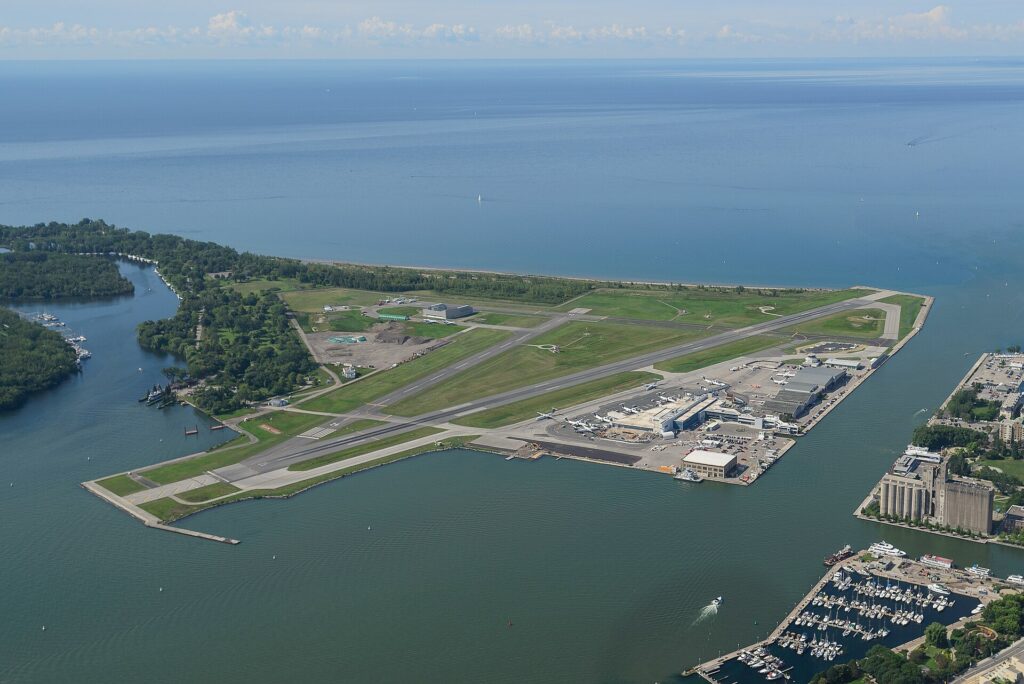
    Billy Bishop Toronto City Airport on the Toronto Islands, seen from the CN Tower
    Billy Bishop sits next to downtown Toronto and can save a long transfer (Photo: Arild VÃ¥gen via Wikimedia Commons, CC BY-SA 4.0)

    Know your airports on both sides

    The choice of airports shapes the fare, the airlines available, and how long the trip takes door to door. On a short flight, the ground transfer can take longer than the flight itself, so choose with your final destination in mind.

    New York

    AirportLocationBest for
    LaGuardia (LGA)Queens, closest major airport to Midtown ManhattanManhattan, Queens and the Bronx; quick trips
    JFKSoutheast QueensBrooklyn, Queens and anyone connecting from long-haul flights; AirTrain to the subway and Long Island Rail Road
    Newark (EWR)New Jersey, west of ManhattanNew Jersey, the west side of Manhattan and travelers using the AirTrain to rail connections

    Check each airport’s official site for current transit options: LaGuardia, JFK and Newark. Our JFK airport guide covers terminals and transfers, and our guide to getting around New York explains why most visitors skip the car.

    Toronto

    AirportLocationBest for
    Toronto Pearson (YYZ)Mississauga, northwest of downtownThe widest choice of airlines and flights; travelers heading to the west and north of the city or connecting onward
    Billy Bishop Toronto City (YTZ)Toronto Island, next to downtownDowntown hotels, the Financial District and the waterfront

    Toronto Pearson is Canada’s busiest airport, with two passenger terminals, Terminal 1 and Terminal 3. Check which one your airline uses on the Toronto Pearson website or our Toronto Pearson airport guide. The UP Express train connects Pearson with Union Station downtown; the operator describes the trip as 28 minutes, with trains every 15 minutes.

    Billy Bishop is a small airport on the Toronto Islands, reached by a pedestrian tunnel or a very short ferry ride from the foot of Bathurst Street, with a shuttle to Union Station. For a trip to downtown Toronto it can save a lot of time. Porter Airlines has long flown between Billy Bishop and Newark, and other airlines have added service at the island airport in recent years; check the current schedule when you search. The airport’s official site lists destinations and ground transportation, and notes that U.S. preclearance is now open there.

    Which airlines fly New York to Toronto?

    The route is served by Canadian airlines including Air Canada and Porter, and by major U.S. airlines from their New York hubs. Porter, for example, flies Billy Bishop to Newark and has added Pearson to LaGuardia service. Schedules and airport pairs change, so search all combinations rather than assuming. On a route this competitive, the cheapest airline varies by day and time, and the airlines often match each other’s fares on popular flights.

    What to compareWhy it matters on this route
    Airport pairA cheaper fare into Pearson may cost more overall if you are staying downtown and Billy Bishop was an option
    Fare typeBasic fares may exclude seat selection, changes and, on some airlines, a full-size carry-on
    Checked bag policyTransborder fares often charge for the first checked bag on the cheapest fare types
    Aircraft sizeRegional aircraft have smaller overhead bins; a large carry-on may be checked at the door
    ScheduleAn early nonstop protects a same-day meeting better than a cheaper midday flight
    LoyaltyStatus and credit card benefits can include free bags and better seats, changing which fare is really cheapest

    Check the current baggage and fare rules on each airline’s own site before you pay. Our carry-on size guide explains how to measure your bag and how limits compare between U.S. and Canadian airlines, and our flight details guide decodes fare brands and codeshares.

    When to fly and when to book

    Days and times

    This is a classic business route. Weekday morning and early evening flights are popular with people traveling for work, and Friday afternoon and Sunday evening flights fill with weekend visitors. Midweek flights, Saturday flights and midday departures are often cheaper. Very early morning and late evening flights can be good value, but check how you will get to and from the airport at those hours.

    Seasons

    PeriodWhat to expect
    January to MarchCold in both cities; often the cheapest time outside holiday weekends
    April to JunePleasant weather arrives; long weekends and June events increase demand
    July and AugustSummer peak for leisure travel and festivals
    September and OctoberExcellent weather; the Toronto International Film Festival in September and busy conference weeks lift hotel rates
    November and DecemberQuieter until the holidays; Thanksgiving weekends in each country and the Christmas period are busy

    Remember that the two countries celebrate Thanksgiving on different dates, Canada in October and the United States in November, and each country’s long weekends affect demand in its own direction. For more detail on each city’s seasons, see our guides to the best time to fly to Toronto and the best time to fly to New York.

    Booking window

    For ordinary dates, booking about one to three months ahead is a sensible window. For holiday weekends and major event dates, book earlier. Set a price alert, watch the route for a few weeks to learn what a normal fare looks like, and book when a fare lands at or below that level. For flights to or from the United States booked at least seven days out, most airlines let you cancel within 24 hours of booking without penalty, which is a useful safety net.

    Terminal B at LaGuardia Airport in New York
    LaGuardia is the closest major airport to Midtown Manhattan (Photo: David from Simply Aviation via Wikimedia Commons, CC BY 4.0)

    Crossing the border in each direction

    Flying New York to Toronto

    When you fly into Canada, you clear Canadian border formalities on arrival in Toronto. The documents you need depend on your citizenship:

    • U.S. citizens do not need an electronic travel authorization (eTA). The Government of Canada says they must carry proper identification such as a valid U.S. passport.
    • U.S. lawful permanent residents are also exempt from the eTA, but must travel with a valid passport from their country of nationality and a valid green card or equivalent proof of status.
    • Other visa-exempt travelers generally need an eTA before boarding a flight to Canada, and some nationalities need a visitor visa.

    Check your requirements on the Government of Canada’s eTA page before you book, and read the Canada Border Services Agency’s travel documents guidance. Declare any food, alcohol, cash and goods according to CBSA rules.

    Flying Toronto to New York

    On the way back, you usually clear U.S. border formalities before you leave Toronto. Toronto Pearson has U.S. preclearance facilities, and Billy Bishop now offers preclearance too, so you land in New York as a domestic passenger with no immigration line. That is convenient, but it means you need to arrive at the Toronto airport earlier than for a domestic flight, because check-in, security and preclearance all happen before departure. Our guide on how early to arrive for an international flight explains how to plan it.

    Getting downtown at each end

    AirportMain options into the city
    Toronto PearsonUP Express to Union Station; TTC buses; taxis and ride-hailing; rental cars
    Billy BishopWalk through the pedestrian tunnel or take the short ferry, then streetcar, shuttle, taxi or walk into downtown
    LaGuardiaBuses to the subway and rail connections; taxis and ride-hailing
    JFKAirTrain to the subway or Long Island Rail Road; taxis and ride-hailing
    NewarkAirTrain to NJ Transit and Amtrak trains toward New York Penn Station; taxis and ride-hailing

    In Toronto, the TTC runs the subway, streetcars and buses; the TTC website has routes and fares. Our guide to renting a car or using transit in Toronto explains when a car is worth it, and you can compare prices on Toronto car rentals if you plan day trips to Niagara Falls or cottage country.

    Fly, drive or take the train?

    For most travelers, flying is the fastest way between the two cities, but it is worth knowing the alternatives.

    • Flying: about an hour and a half in the air, plus airport time. Best for most trips, especially short ones.
    • Train: Amtrak’s Maple Leaf, operated with VIA Rail, runs between New York Penn Station and Toronto Union Station, with border inspection along the way. It takes most of a day, but it is scenic, runs city center to city center and suits travelers who prefer not to fly.
    • Driving: a long day’s drive through New York State, with a border crossing near Niagara Falls or Buffalo. It makes sense if you want a car in Toronto or plan to stop along the way.
    • Bus: usually the cheapest fare but the longest trip.

    For a weekend or a business trip, a flight almost always wins. For a slow trip with stops in upstate New York or Niagara, the car or train can be part of the fun.

    A step-by-step booking routine for this route

    • Decide where you are staying in both cities, so you know which airports are really convenient.
    • Search a flexible range of dates and all airport pairs; our flights from New York and flights from Toronto pages show fares across the month.
    • Shortlist a few options and add bags, seats and ground transfer costs to each.
    • Check your documents for the border before paying.
    • Book, then use the 24-hour cancellation window to double-check names and details.
    • Book a refundable hotel for the same dates, then recheck the price before the free cancellation deadline.
    • Check the events calendar. Our Toronto events and New York events pages show what is on.

    Inside a UP Express train, which links Toronto Pearson with Union Station
    UP Express links Pearson with Union Station downtown (Photo: David Wilson from Oak Park, Illinois, USA via Wikimedia Commons, CC BY 2.0)

    If you fly this route often

    New York to Toronto is a commuter route for many people: consultants, bankers, lawyers, people with family in both cities and couples splitting time between them. If you fly it several times a year, a few habits pay off.

    • Consider NEXUS. NEXUS is a joint Canada and U.S. trusted traveler program for low-risk, pre-approved travelers. According to the Canada Border Services Agency’s NEXUS page, members can use self-serve kiosks and automated gates at major Canadian airports, expedited security lines where available, and TSA PreCheck lanes at participating U.S. airports. It involves an application, a fee and an interview, and it lasts five years.
    • Pick an airline and stick with it where it makes sense. On a short route, the fare difference between airlines is often small, and the perks of status, such as free bags, better seats and priority boarding, can matter more than a small saving.
    • Learn the airport pair that works for you. Many regulars settle on one combination, such as Billy Bishop and Newark for downtown Toronto and west Manhattan, or Pearson and LaGuardia for a wider schedule.
    • Watch fares for your usual days. Set a standing price alert for your typical departure days so you notice when the route gets cheaper.
    • Keep a flexible fare in mind. If your plans change often, a fare that allows changes can cost less over a year than repeatedly forfeiting cheap nonrefundable tickets.

    Making a same-day business trip work

    A day trip between the two cities is very doable. Book the first or second flight of the morning, which is less likely to be delayed by knock-on problems, and a return in the early evening with a later backup option on the same airline. Travel with a carry-on only, keep your passport and boarding pass on your phone and in your pocket, and leave extra time in Toronto for U.S. preclearance on the way home. If your meetings are downtown, Billy Bishop can save an hour or more of ground travel compared with Pearson, which is a big share of a short day.

    Where to stay

    In Toronto, staying downtown puts you close to the CN Tower, the waterfront, the Financial District and the theaters; the Entertainment District is a popular base and is close to both Union Station and Billy Bishop. Compare prices on our Entertainment District hotels page or all Toronto hotels. For ideas on what to do, read our guide to things to do in Toronto.

    In New York, Midtown Manhattan is the classic base for first-time visitors, with easy access to Broadway and the major sights, but Brooklyn, Queens and Lower Manhattan can offer better value. Compare on our Times Square hotels page or all New York hotels, and see our guides to things to do in New York and visiting New York on a budget.

    Making the most of a weekend in Toronto

    Many New Yorkers fly to Toronto for a long weekend, and the city rewards it. Downtown is compact, transit is straightforward and most visitors can see the waterfront, the CN Tower, a museum and a couple of neighborhoods in two or three days. Flying up on Thursday evening or Saturday morning and back on Monday often costs less than the classic Friday-to-Sunday pattern, and downtown hotels that fill with business travelers midweek often cut rates on Friday and Saturday nights. Check a Blue Jays, Maple Leafs or Raptors home schedule if you want to catch a game, and remember that prices are in Canadian dollars once you arrive, which can make the trip feel better value for visitors paying in U.S. dollars, depending on the exchange rate at the time.

    Points, miles and packages

    Short cross-border flights can be good value for loyalty points, especially when cash fares are high on busy weekday flights. Compare the points price with the cash fare, and remember that taxes and fees still apply. If you fly the route often, airline status or a co-branded credit card can add free checked bags and better seats, which changes which fare is really cheapest. Flight and hotel packages are sometimes available; compare the package price with booking separately and read the change rules. For more on getting better seats, see our guide to business class upgrade hacks.

    A Porter Airlines Dash 8-400 landing at Billy Bishop Toronto City Airport
    Compare every airline and airport pair on this busy route (Photo: Fabian Roudra Baroi via Wikimedia Commons, CC BY-SA 4.0)

    Common mistakes to avoid

    • Searching only one airport pair. The cheapest and most convenient options may be at different airports.
    • Forgetting the transfer. A cheaper fare to a farther airport can cost more in time and taxis.
    • Arriving without the right document. U.S. citizens need a passport to fly to Canada; many other travelers need an eTA.
    • Underestimating preclearance. On the way back from Toronto, U.S. border formalities happen before departure; allow time.
    • Assuming a bag is included. Check the fare rules on transborder basic fares.
    • Booking a large carry-on on a small aircraft. It may be checked at the door; keep valuables in your personal item.
    • Ignoring holiday calendars on both sides. Canadian and U.S. long weekends fall on different dates.

    Frequently asked questions

    How long is the flight from New York to Toronto?

    About an hour and a half in the air, depending on the airports and routing. Allow extra time for the airport and ground transfers at both ends.

    Which airport in Toronto is best?

    Billy Bishop is best if you are staying downtown and a flight suits you. Toronto Pearson offers the most flights and airlines, and the UP Express connects it with Union Station.

    Which New York airport is cheapest for Toronto?

    It varies by date and airline. Search JFK, LaGuardia and Newark together, and include the cost and time of getting to each one.

    Do U.S. citizens need a passport to fly to Canada?

    The Government of Canada says U.S. citizens must carry proper identification such as a valid U.S. passport. They do not need an eTA. Check the official page before you travel.

    Do I clear customs in Toronto on the way back to New York?

    Usually yes. Toronto Pearson has U.S. preclearance, and Billy Bishop now offers it too, so you clear U.S. border formalities before departure and arrive in New York as a domestic passenger.

    What is the cheapest day to fly between New York and Toronto?

    Midweek and Saturday flights are often cheaper than Friday and Sunday flights. Use a fare calendar to check your dates.

    How far in advance should I book?

    About one to three months ahead for ordinary dates, and earlier for holidays and big events. Set a price alert and book when the fare is at or below the normal level.

    Is it cheaper to book a round trip or two one-way tickets?

    On this route, one-way fares are often priced reasonably, so two one-ways, even on different airlines or between different airports, can give you better times at a similar total. Compare both ways, and remember that each separate ticket has its own bag and change rules.

    Is the train a good alternative?

    It is a scenic city-center-to-city-center option, but it takes most of a day. For short trips, flying is much faster.

    Ready to book? Compare fares across a whole month on our Toronto flights page, check both Toronto airports and all three New York airports, then find a room for the same dates on our Toronto hotels page. For more on timing, read our guide to the best time to book cheap flights and hotels.

  • Local Flights in the USA: How to Book Cheap, Fast and Smart

    Local Flights in the USA: How to Book Cheap, Fast and Smart

    Short domestic flights are some of the most useful trips you can buy in the United States. A one-hour hop can replace a full day of driving, turn a long weekend into a real getaway and get you to a meeting and home again before dinner. They are also some of the easiest flights to overpay for, because short routes are priced aggressively by demand, the cheapest fares strip out bags and seats, and the difference between a smart and a careless booking often comes down to one airport or one day of the week. This guide explains how short-haul domestic pricing works, when to book, how to pick the right airport and airline, how to compare the real cost of a fare, when driving or the train makes more sense, and how to get through the airport quickly on a short trip. It is part of our flight booking series, which starts with our guide to the best time to book cheap flights and hotels.

    The short answer

    If you only have a minute: search a range of dates rather than one day, because the day you fly moves the price more than anything else. Book roughly one to three months ahead for ordinary dates and earlier for holidays and long weekends. Check every airport within a reasonable drive at both ends of the trip, including secondary airports that big-city travelers forget. Compare the total cost, with bags and seats added, not the headline fare, because a basic fare that looks cheap can end up costing more than a standard one. Use the 24-hour cancellation window that applies to most U.S. bookings made at least seven days out to double-check everything. And make sure your ID is ready: TSA now requires a REAL ID-compliant license or another accepted document such as a passport to fly within the country. You can compare fares across a whole month on our flight search.

    An American Eagle Embraer 175 regional jet on approach to land
    Many short domestic routes are flown by regional jets with smaller overhead bins (Photo: DOMDCF via Wikimedia Commons, CC BY-SA 4.0)

    What counts as a local flight, and why they are priced the way they are

    There is no official definition of a “local” flight. Most travelers mean a short domestic trip, often under two hours in the air, within a region: New York to Boston, Chicago to Minneapolis, Dallas to Houston, Los Angeles to Las Vegas, Seattle to the Bay Area, Atlanta to Charlotte. Airlines call these short-haul routes, and they share a few traits that shape how you should book them.

    • They carry a lot of business travelers. Weekday morning and evening flights on busy corridors fill with people traveling for work, whose employers pay higher fares for flexibility. That pushes up prices at peak times and leaves cheaper seats at off-peak times.
    • They compete with the car and sometimes the train. On a route of a few hundred miles, the airline is competing with driving, so fares on quiet days can be surprisingly low. On the busiest days, when everyone wants to fly, the competition matters much less.
    • They are often served by regional jets. Many short routes are flown by smaller aircraft operated by regional partners under the big airlines’ brands. That affects cabin size, overhead bin space and whether your carry-on has to be checked at the aircraft door.
    • Taxes and fees are a larger share of the total. Government taxes and airport charges are added to every ticket, so on a short, cheap flight they make up a bigger slice of what you pay. That is one reason a fare that looks tiny in an advertisement grows at checkout.

    Airline prices follow the same basic logic on every route. Each flight is divided into fare levels, the cheapest sell first, and revenue management systems open and close levels as the flight fills. Our pillar guide explains the mechanics in detail; for short trips, the practical point is that busy flights get more expensive as they fill, while quiet ones can stay flat for weeks.

    When to book a domestic flight

    There is no magic number of days, but there are sensible windows. Use them as a guide for when to start paying close attention, then book when you see a fare at or below the normal level for your route.

    TripSensible windowWhy
    Ordinary weekday or weekend tripAbout 1 to 3 months aheadEnough time for fares to settle and for you to spot a good one; waiting longer rarely helps on busy routes
    Holiday weekends (Memorial Day, July 4, Labor Day)About 2 to 4 months aheadFriday departures and Monday returns sell out first
    Thanksgiving, Christmas and New YearAs early as 3 to 6 months aheadThe most popular dates rarely get cheaper as they approach
    Spring break and summer trips to beach and theme park citiesAbout 2 to 4 months aheadFamily demand concentrates on the same weeks
    Short-notice tripsOnly as neededOccasionally cheap on quiet routes, but usually the most expensive time to buy

    The simplest method is to start searching as soon as you know roughly when you want to go. Look at a month view to see which days are cheap, note what a normal fare looks like, and set a price alert. When a fare lands at or below that level, book. Trying to catch the absolute lowest price usually means waiting too long.

    The day you fly matters more than the day you book

    On most domestic routes, Tuesday, Wednesday and often Saturday departures are cheaper than Friday and Sunday, because business travelers fill Monday mornings and Thursday and Friday evenings and leisure travelers crowd the weekend edges. The first flight of the morning and late-evening departures are often cheaper than midday. Patterns differ by route, so let the fare calendar show you the cheap days instead of assuming. The old advice to buy on a particular weekday, or late at night, does not hold up: fares change when seats sell, not on a timetable.

    Your 24-hour safety net

    For flights within, to or from the United States, the U.S. Department of Transportation requires airlines to either hold a reservation at the quoted fare for 24 hours without payment or let you cancel within 24 hours of booking without penalty, as long as you book at least seven days before departure. Most large airlines offer free cancellation. Use that day to check names, dates and connections, and to confirm the fare still looks right. If your flight is later canceled or significantly changed by the airline and you choose not to travel, DOT’s refund rules explain when you are owed your money back rather than a travel credit. The wider set of passenger protections is on the DOT Aviation Consumer Protection site.

    Choose the right airport, at both ends

    Airport choice is the most underused way to save on short flights. Big metro areas often have two or more commercial airports, and they can differ in price, airlines, traffic and how long it takes to get through security.

    Metro areaAirports to compareWhat to weigh
    New YorkJFK, LaGuardia (LGA), Newark (EWR); sometimes Long Island MacArthur, WestchesterLaGuardia is closest to Manhattan for many trips; Newark suits New Jersey and west-side Manhattan; compare transfer times
    ChicagoO’Hare (ORD), Midway (MDW)Midway is closer to downtown and the South Side; O’Hare has more airlines and routes
    DallasDallas Fort Worth (DFW), Dallas Love Field (DAL)Love Field is close to central Dallas; DFW is the big hub with the widest choice
    HoustonGeorge Bush Intercontinental (IAH), Hobby (HOU)Hobby is closer to downtown and the south side
    Los AngelesLAX, Burbank (BUR), Long Beach (LGB), Ontario (ONT), Orange County (SNA)The smaller airports can save a long drive across the region and are usually quicker to get through
    San Francisco Bay AreaSFO, Oakland (OAK), San Jose (SJC)Choose by where you are actually going in the Bay Area
    Washington, D.C.Reagan National (DCA), Dulles (IAD), Baltimore/Washington (BWI)DCA is on the Metro and close to the city; BWI often has different airline options
    South FloridaMiami (MIA), Fort Lauderdale (FLL), Palm Beach (PBI)Fort Lauderdale can be convenient for northern Miami-Dade and Broward

    A cheaper fare from a more distant airport is only a saving if the total holds up. Add parking or the ride to the airport, the time it takes and the ride at the other end. For a short trip, an extra hour of driving each way can wipe out the benefit. Our airport guides, such as Chicago O’Hare, Dallas Fort Worth, Los Angeles International and New York JFK, cover terminals and ground transportation.

    Smaller airports have real advantages

    Secondary and regional airports are often quicker to get through, with shorter walks, simpler parking and less congestion at the curb. For a day trip or a tight schedule, those minutes matter. The trade-off is fewer flights, so a cancellation can mean a longer wait for the next departure. If you must be somewhere at a set time, an earlier flight from a smaller airport or a later one from a hub with frequent backup options are both reasonable strategies; choose knowingly.

    Concourse A at Chicago Midway International Airport
    Secondary airports like Chicago Midway can be closer to downtown and quicker to get through (Photo via Wikimedia Commons, CC BY-SA 3.0)

    Choose the airline and fare, not just the price

    Domestic airlines in the United States fall roughly into three groups, and the same headline price can buy very different trips.

    • Network airlines such as American, Delta, United and Alaska fly from large hubs to almost everywhere, with regional partners on smaller routes. They sell several fare types on every flight, from basic economy to flexible and premium fares, and their loyalty programs and credit cards are built around frequent domestic flying.
    • Point-to-point and value airlines such as Southwest and JetBlue connect many city pairs directly, often from secondary airports. Their fare structures and bag policies have been changing, so check what is included on each booking rather than relying on what you remember.
    • Ultra-low-cost carriers sell very low base fares and charge separately for nearly everything else: carry-on bags, checked bags, seat assignments and sometimes printing a boarding pass at the airport. They can be excellent value for a traveler with just a small personal item and flexible plans, and poor value for a family with luggage.

    Basic economy: what you give up

    Basic economy fares exist to compete with the ultra-low-cost carriers, and the restrictions vary by airline. Common trade-offs include boarding last, no seat selection until check-in or a fee to choose, no changes or no refunds of the fare, and, on some airlines, no full-size carry-on bag. Last to board also means last to find bin space, so a carry-on can end up checked at the gate on a full flight. Before you choose a basic fare, read exactly what it excludes on the airline’s own site and compare the price to the next fare up with the things you need added.

    Compare the total cost

    CostWhere it hidesHow to handle it
    Carry-on bagExcluded on some basic and ultra-low-cost faresCheck the fare rules and size limits; our carry-on size guide explains how to measure
    Checked bagUsually charged per bag, per direction on domestic faresPaying online in advance is often cheaper than at the airport
    Seat selectionCharged on basic fares and sometimes on standard onesDecide whether you need to sit together; families should read the airline’s seating policy
    ChangesThe cheapest fares may be unchangeableIf your plans might move, a changeable fare can be cheaper overall
    Airport transfer and parkingNot in the fare at allAdd them when comparing airports

    A fare that includes a bag and a seat can easily beat one that looks much cheaper. Our flight details guide explains fare brands, baggage allowances and what the codes on your itinerary mean.

    Nonstop, connecting and the hidden-city trap

    On a short trip, a nonstop flight is almost always worth a modest premium. A connection can double the travel time on a one-hour route and adds a second chance for delays, missed connections and misrouted bags. Connections make sense when there is no nonstop at a reasonable time, or when the saving is large enough to justify the extra hours.

    If you do connect, leave a realistic cushion. Airlines sell connections that meet their minimum connection time, but a tight connection at a large hub in bad weather is a gamble. On a single ticket, the airline is responsible for rebooking you if you miss a connection because of a delay; on two separate tickets, you usually are not protected, so leave much more time or avoid it.

    You may also hear about “hidden-city” ticketing, where a traveler books a flight to a farther city with a connection in the city they actually want and simply leaves at the connection. Airlines generally prohibit this in their contracts of carriage. It only works with carry-on bags, the rest of the itinerary is canceled if you skip a segment, and airlines can penalize accounts. It is not a strategy we recommend.

    Is flying really faster? Fly, drive or take the train

    For short distances, the honest comparison is door to door. A one-hour flight involves getting to the airport, parking or a ride, security, waiting at the gate, boarding, the flight itself, deplaning and getting into the city at the other end. On routes of a couple of hundred miles, driving or taking the train can be just as fast and far less stressful.

    SituationUsually betterWhy
    Solo traveler, 300 miles or moreFlyingThe time saved in the air outweighs the airport overhead
    Family or group of three or more, under about 300 milesDrivingOne car costs the same however many people are inside, and there are no bag fees
    Downtown to downtown on the Northeast CorridorOften the trainAmtrak runs between city centers from Washington through New York to Boston, with no airport transfers
    Day trip for a meetingFlying, on an early nonstopProtects the schedule if you pick the first flight of the day
    You need a car at the destination anywayOften drivingSaves a rental and gives you flexibility

    If you do fly and need a car at the other end, our rental car booking tips explain when to reserve and how airport and city locations differ in price.

    Getting through the airport quickly on a short trip

    Have the right ID

    TSA began enforcing the REAL ID requirement on May 7, 2025. To fly within the United States, adult travelers need a REAL ID-compliant driver’s license or state ID, usually marked with a star, or another accepted document such as a U.S. passport, a passport card or a trusted traveler card. TSA explains the options, and what happens if you arrive without an acceptable ID, on its REAL ID page. Check your wallet well before your trip, because getting a new license can take time.

    Pack for security, not just for the trip

    A carry-on-only trip is the fastest way through a domestic airport: no bag drop, no waiting at the carousel. Keep liquids within TSA’s 3-1-1 liquids rule, keep electronics and your liquids bag easy to reach, and wear shoes you can slip off if your lane requires it. Our guide on what not to wear on a flight covers clothes that slow screening down.

    Consider TSA PreCheck

    If you fly domestically more than a few times a year, TSA PreCheck lets approved travelers use dedicated lanes at participating airports, usually without removing shoes, belts, laptops or small liquids. It involves an application, a fee and an in-person appointment, and membership lasts several years. Some credit cards and loyalty programs reimburse the application fee.

    Know the check-in deadline

    Every airline sets a minimum check-in time and a bag-drop deadline before departure, and boarding doors close before the scheduled departure time too. For domestic flights these deadlines are commonly somewhere between 30 and 60 minutes, but they vary by airline and airport, so look them up for your flight. How early you should arrive depends on the airport, the time of day and whether you are checking a bag; a big hub at the Monday morning rush needs more time than a small regional airport midafternoon. Check in online, download the airline’s app for gate changes and boarding passes, and allow more time on holiday weekends.

    The ticketing and check-in hall in Terminal B at LaGuardia Airport
    Check in online and know your airline's bag-drop deadline (Photo: Silver Dovelet via Wikimedia Commons, CC BY-SA 4.0)

    A step-by-step booking routine for short flights

    • Define the trip loosely. Decide on a range of dates and all the airports you would realistically use at both ends.
    • Search a month view. Find the cheap days before fixing your plans. Our flight search shows prices across the month.
    • Check the event calendar. A big game, a convention or a festival can make both flights and hotels expensive for a specific weekend.
    • Shortlist two or three flights and price each with the bags and seats you actually need.
    • Weigh the schedule. A nonstop at a sensible hour often beats a slightly cheaper option that costs you an evening.
    • Book, then use the 24-hour window to double-check names and details.
    • Add the hotel and car. Book a refundable room on our hotel search and add a rental car only if you will use it.
    • Keep watching. If the airline cuts the fare on a ticket that allows changes, you may be able to rebook and keep the difference as a credit; rules vary, so check yours.

    Popular short routes and what to know

    A few examples of how the principles play out on real corridors. Use them as patterns, not as a list of deals.

    • Los Angeles to Las Vegas: one of the busiest short leisure routes in the country, with heavy Friday and Sunday demand. The drive is a real alternative for groups; our Los Angeles to Las Vegas road trip page covers it. If you fly, our guide to cheap flights to Las Vegas explains how the event calendar moves fares.
    • New York to Boston or Washington: flights compete directly with Amtrak and buses. Compare door-to-door time before assuming the plane is faster.
    • Chicago to Minneapolis or Detroit: frequent flights, and a straightforward drive for groups. Compare O’Hare and Midway.
    • Dallas to Houston: multiple flights a day between four airports. Love Field and Hobby are the downtown-friendly pair.
    • Seattle to Portland or Vancouver: short enough that driving or the train can win; flying makes sense on tight schedules.
    • Atlanta to regional cities: Atlanta is the hub for the Southeast, so many short routes connect there. See our Atlanta airport guide before a tight connection.

    Planning a longer domestic trip? Our month-by-month guides, such as the best time to fly to Chicago and the best time to fly to New York, explain when each city is cheapest and busiest.

    Loyalty points and credit cards on short flights

    Short flights can be good value for points, because some programs price award seats by distance or by the cash fare, and the cash fare on a short route at a busy time can be high. Compare the points price with the cash price before you redeem, and remember that taxes and fees still apply to award tickets. On the other side, a cheap short flight earns few miles, so do not choose a worse schedule just to stay loyal to one airline. For frequent short-haul flyers, the most valuable perks are usually free checked bags, earlier boarding and better seats, which some airline credit cards include. Whether that is worth an annual fee depends on how often you fly; do the arithmetic for your own travel. Upgrades on short domestic flights are covered in our guide to business class upgrade hacks.

    Common mistakes that cost money

    • Searching one date and one airport. The cheapest option is often a day or an airport away.
    • Buying basic economy without reading it. A carry-on fee at the gate can wipe out the saving.
    • Booking two separate tickets with a tight connection. If the first flight is late, you may lose the second.
    • Ignoring the drive. For groups on short routes, the car is often cheaper and just as fast.
    • Arriving with the wrong ID. Check REAL ID compliance before the trip, not at the checkpoint.
    • Forgetting the return. Sunday evening flights home are often the most expensive; a Monday morning or Saturday return can be much cheaper.
    • Waiting for last-minute deals. On popular domestic routes, prices usually rise close to departure.
    A Southwest Airlines Boeing 737 taking off from San Jose
    Compare every airport within reach, including smaller ones like San Jose (Photo: en:user:DonFB via Wikimedia Commons, CC BY-SA 4.0)

    Frequently asked questions

    How far in advance should I book a domestic flight?

    For ordinary dates, about one to three months ahead is a good window. For holiday weekends, Thanksgiving and Christmas, book earlier. Set a price alert and book when the fare drops to or below the normal level for your route.

    What is the cheapest day to fly within the U.S.?

    Tuesdays, Wednesdays and often Saturdays are cheaper on many routes, and early-morning and late-evening flights can be cheaper than midday. Check a fare calendar for your route, because patterns vary.

    Are ultra-low-cost airlines worth it?

    They can be, if you travel light and your plans are firm. Add the carry-on, checked bag and seat fees you would pay, then compare the total with a standard fare on another airline.

    Do I need a REAL ID to fly domestically?

    Yes, or another accepted document. TSA began enforcing REAL ID on May 7, 2025, so adults need a compliant license or state ID, or an alternative such as a passport. Check TSA’s REAL ID page for the full list.

    Can I cancel a domestic flight for free?

    Within 24 hours of booking, usually yes, if you booked at least seven days before departure. After that, it depends on the fare: the cheapest fares may be nonrefundable. If the airline cancels or significantly changes your flight and you decline the alternative, DOT rules say you are owed a refund.

    Is it cheaper to book a round trip or two one-ways?

    On many U.S. domestic routes, round-trip and one-way fares are priced similarly, so two one-ways, even on different airlines, can give you more flexibility at little or no extra cost. Compare both ways.

    How early should I get to the airport for a domestic flight?

    It depends on the airport, the time of day and whether you are checking a bag. Look up your airline’s check-in and bag-drop deadlines and allow extra time at busy hubs and on holidays.

    Does searching in private mode get cheaper fares?

    There is little evidence that it does. Fares change because seats sell and fare levels close. Private browsing does no harm, but it will not unlock lower prices.

    Ready to book your next short trip? Search a whole month of fares on our flight search to find the cheapest days and airports, then compare rooms on our hotel search and add a rental car if you need one. For the bigger picture on timing, read our guide to the best time to book cheap flights and hotels.