Washington, DC is the rare capital where the best things cost nothing. The Smithsonian’s museums on the National Mall are free, the memorials are open around the clock, the Capitol and the Library of Congress give free tours, and the National Gallery of Art, one of the great art museums in the country, charges no admission either. That changes how you plan a trip here: the question is not what you can afford but how many days you have and how to pace them, because it is easy to walk fifteen miles along the Mall in two days and see only half of it. Beyond the monuments is a city many visitors never find, of row-house neighborhoods, a waterfront reborn, Ethiopian and Salvadoran restaurants, jazz history on U Street and a canal towpath that runs from Georgetown to the Allegheny Mountains. This guide covers the sights that earn a day, the neighborhoods worth a half-day, the museums on and off the Mall, the big events, the food, the day trips, and the practical details that make a first visit work.
If you are still comparing cheap flights to Washington, DC, read this alongside our guides to the best time to fly to Washington, DC and whether to rent a car or ride the Metro. Between the three you can plan the whole trip.
Washington, DC at a glance for first-timers
- Airports: three. Reagan National (DCA), across the Potomac in Arlington, is about 6 km (4 miles) from the Mall and has its own Metro station; see our Reagan National guide. Dulles (IAD), about 42 km (26 miles) west in Virginia, is on the Metro’s Silver Line and handles most long-haul and international flights; see our Dulles guide. Baltimore/Washington (BWI), northeast toward Baltimore, is linked to Union Station by train; see our BWI guide.
- Getting around: the Metro reaches almost everything a visitor needs except Georgetown, and the core is flat and walkable. Capital Bikeshare docks are everywhere. A car is a liability in the city and useful only for day trips.
- Money: U.S. dollars. Sales tax is added at the till, and some restaurants add a service charge to the bill, so read it before tipping the customary 18 to 20 percent on top.
- Weather: four real seasons, with a hot, humid summer, a mild and changeable winter, and a spring and fall that are the best times to walk the Mall. Our month-by-month guide has the detail.
- Where to stay: Penn Quarter and downtown for walking to the Mall; Dupont Circle for restaurants and a residential feel; Capitol Hill, Georgetown, the Wharf or Navy Yard for character; Arlington and Crystal City across the river for lower rates on the Metro. Our Washington, DC hotel search covers them all.
The National Mall and the memorials
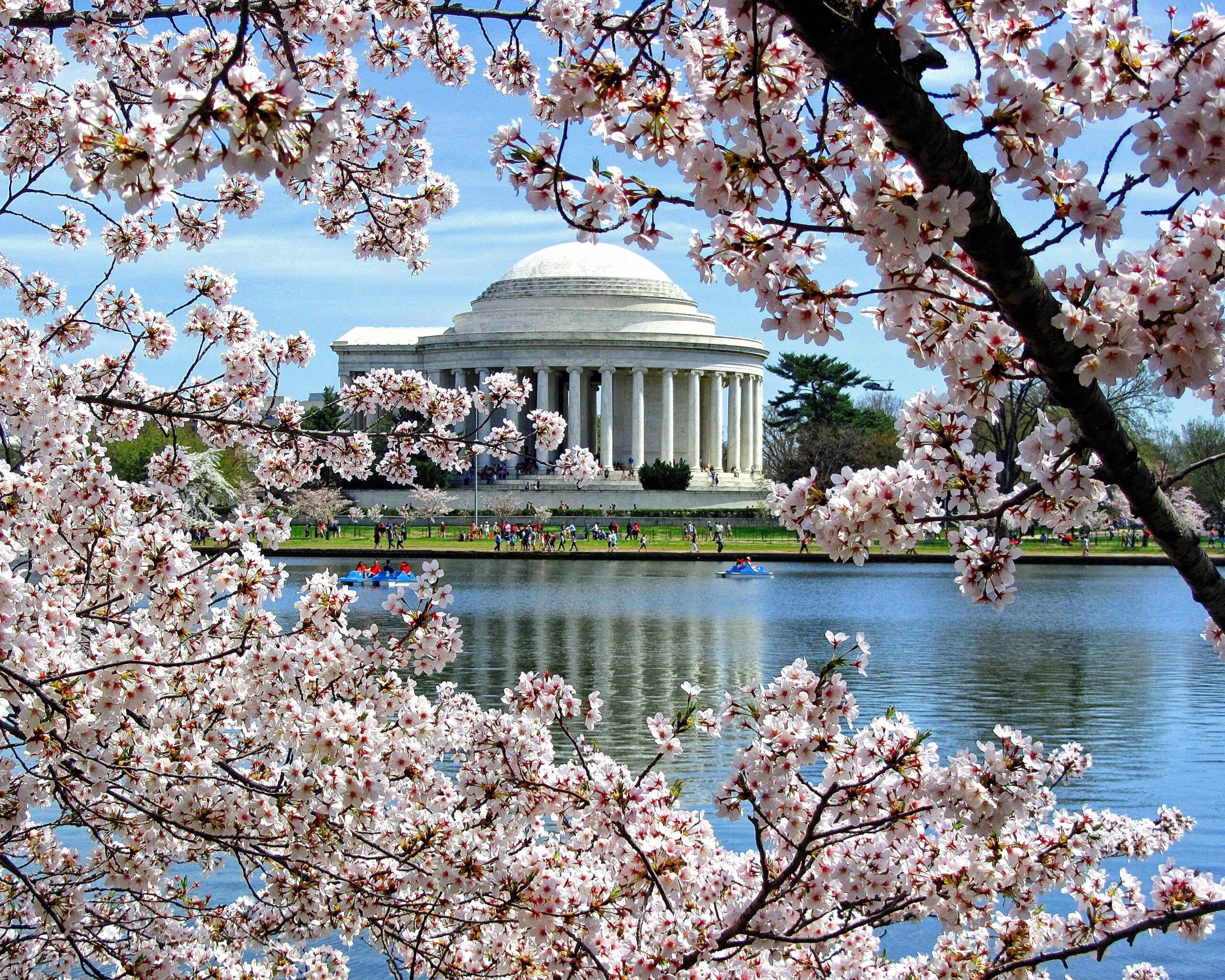
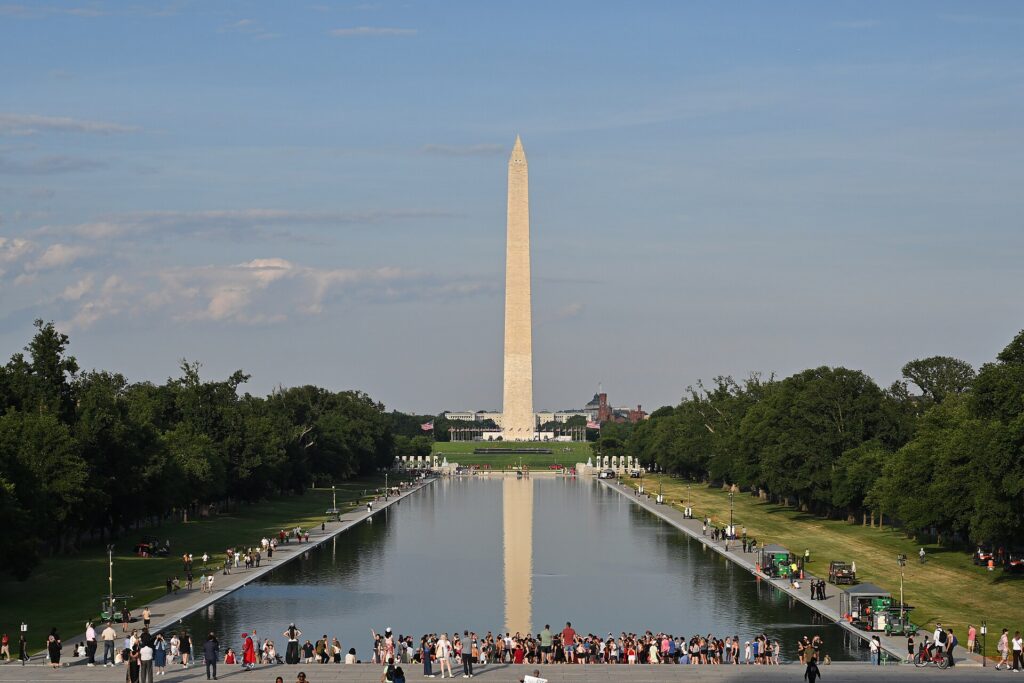
The National Mall is the three-kilometer lawn that runs from the Capitol to the Lincoln Memorial, and it is where almost every first visit begins. The National Park Service looks after it, and the memorials are open 24 hours a day, which is worth knowing because they are at their best early in the morning and after dark, when the crowds and the summer heat have gone. Start at the Washington Monument, the marble obelisk at the center; the elevator to the observation level runs on timed tickets, most of them reserved online in advance for a small booking fee, and the view along the axis of the Mall explains the city’s plan in a glance. West of it, the World War II Memorial frames the Reflecting Pool, and at the far end the Lincoln Memorial, with the seated Lincoln and the steps where Martin Luther King Jr. gave the “I Have a Dream” speech, looks back toward the Capitol. On either side of the Reflecting Pool are the Vietnam Veterans Memorial, the black granite wall with more than 58,000 names, and the Korean War Veterans Memorial, with its patrol of steel soldiers. South of the Mall, the Tidal Basin loop takes in the Martin Luther King Jr. Memorial, the long, open-air FDR Memorial and the domed Jefferson Memorial on the water. The full circuit from the Capitol to the Lincoln Memorial, around the Tidal Basin and back is around 10 km, so wear real shoes and carry water in summer.
Capitol Hill: the Capitol, the Library of Congress and the Supreme Court
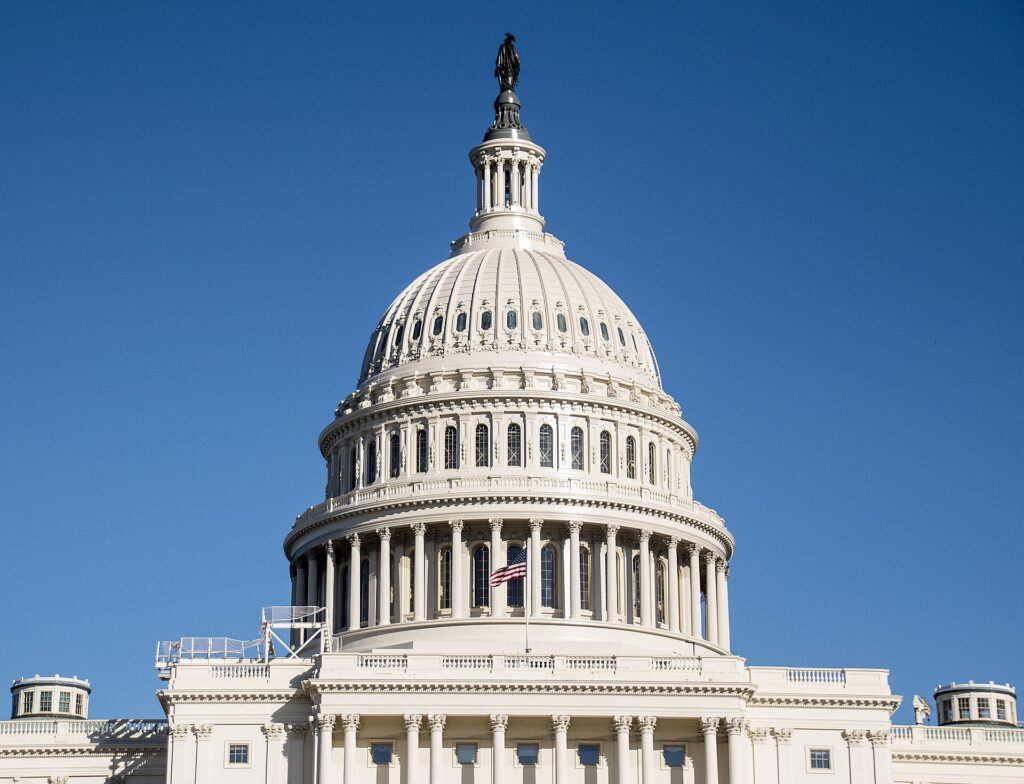
At the east end of the Mall, the U.S. Capitol offers free guided tours from its underground Visitor Center, Monday to Saturday; reserve them through the Capitol Visitor Center or through your representative’s or senator’s office, which can also arrange gallery passes to watch the House or Senate in session. Across the street, the Thomas Jefferson Building of the Library of Congress is the most beautiful interior in the city, a gilded, painted and mosaic-covered hall built in the 1890s, with a Gutenberg Bible and a reconstruction of Jefferson’s own library; entry is free, with timed passes recommended. The Supreme Court, beside it, is open to visitors on weekdays, with courtroom lectures on days the court is not sitting. Behind the Capitol, the row-house streets of Capitol Hill lead to Eastern Market, a brick market hall from the 1870s where the weekend farmers’ and flea markets are the neighborhood’s social life. Allow a full morning for the Capitol, the library and the court together, and book the tours before you fly.
The White House, the Archives and Penn Quarter
You can see the White House from Lafayette Square on the north side and the Ellipse on the south, but a tour inside is a project: U.S. citizens request one through their member of Congress, and visitors from other countries through their embassy in Washington, weeks to months in advance. The White House Visitor Center on Pennsylvania Avenue is the fallback for everyone else. Six blocks east, the National Archives displays the Declaration of Independence, the Constitution and the Bill of Rights in its domed Rotunda; admission is free and the line moves quickly outside the spring school-trip season. North of the Archives, Penn Quarter is the downtown entertainment district: Ford’s Theatre, where Lincoln was shot and which is still a working theater with a museum below it, the shared building of the National Portrait Gallery and the Smithsonian American Art Museum with its glass-roofed courtyard, Capital One Arena, and the small Chinatown with its Friendship Archway. This is the most convenient place to stay for a first visit, and the restaurant density is high.
The Smithsonian and the museums on the Mall
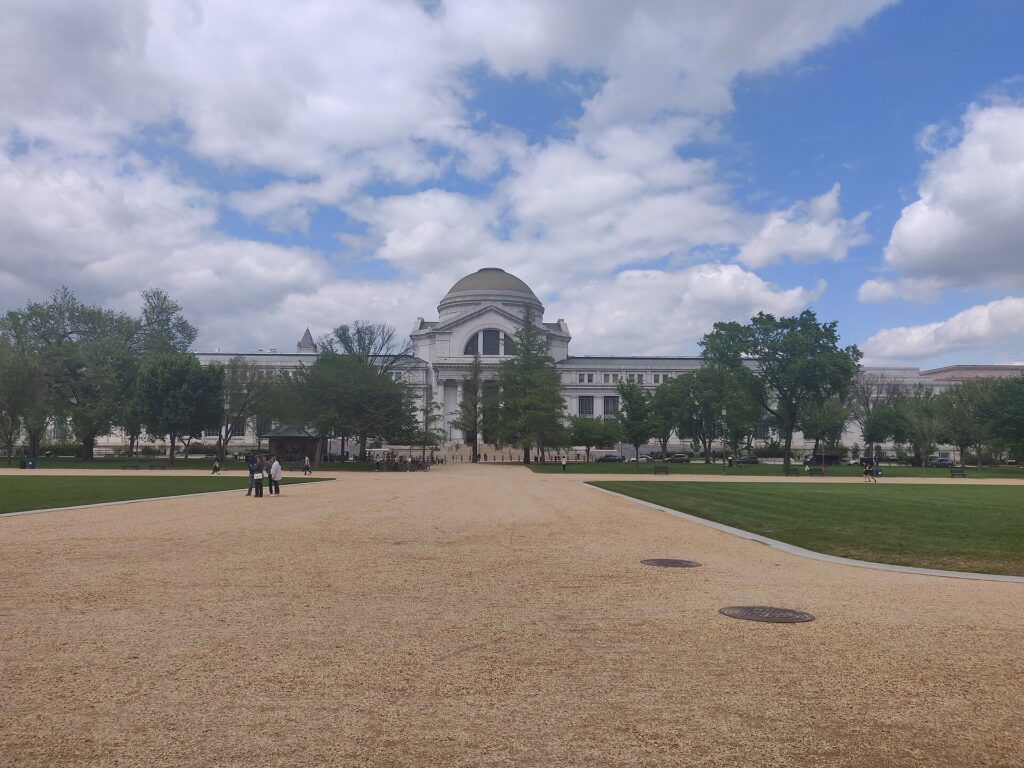
The Smithsonian Institution runs the largest museum complex in the world, and most of its museums line the Mall; they are free and open every day of the year except December 25. The National Museum of Natural History has the Hope Diamond, the elephant in the rotunda and a spectacular fossil hall. The National Museum of American History has the flag that inspired the national anthem, the Greensboro lunch counter and Dorothy’s ruby slippers. The National Air and Space Museum has been through a multi-year renovation with galleries reopening in phases, and it is the most popular museum in the city; free timed-entry passes are the way in. The National Museum of African American History and Culture, the bronze-clad building beside the Washington Monument, is the most moving museum in Washington and needs at least three hours; start at the bottom, in the history galleries, and work up. The National Museum of the American Indian, the Hirshhorn for modern art in its round concrete drum, and the National Museum of Asian Art complete the row. Across the Mall, the National Gallery of Art, which is separate from the Smithsonian but just as free, has the only Leonardo da Vinci painting in the Americas in its West Building, I. M. Pei’s East Building for modern art, and a sculpture garden that becomes an ice rink in winter.
Neighborhoods worth a half-day
Georgetown
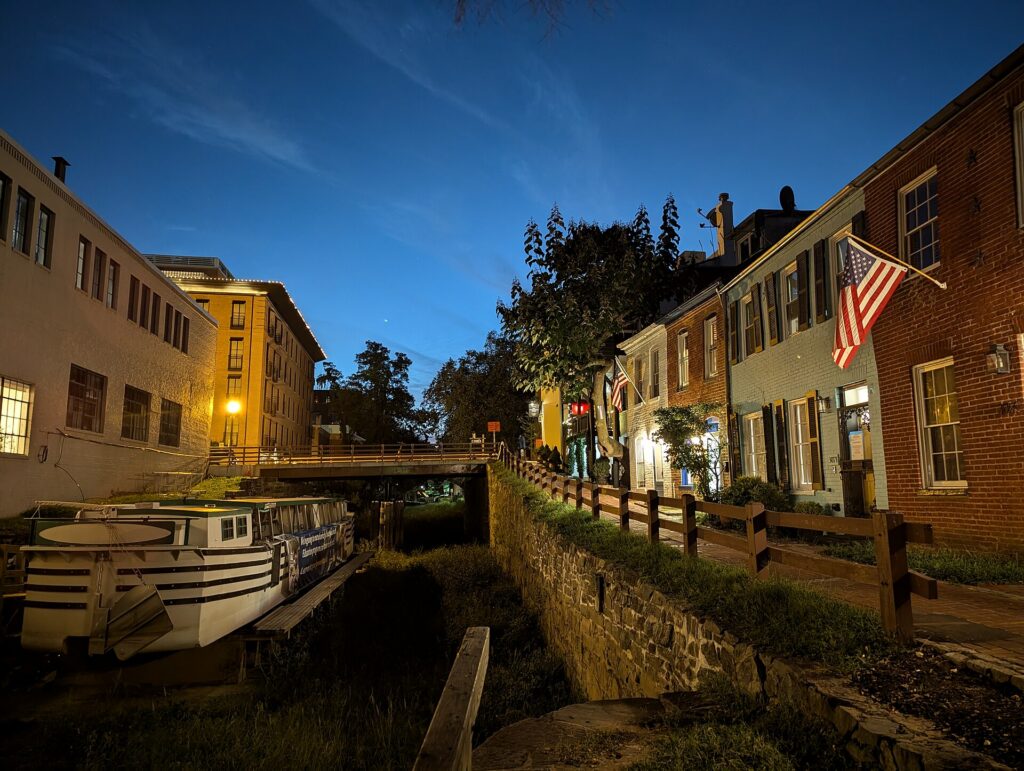
Older than the city itself, Georgetown is the cobbled, brick-and-federal-house neighborhood on the Potomac, with shopping along M Street and Wisconsin Avenue, the university on the hill, the gardens of Dumbarton Oaks and the Old Stone House, one of the oldest buildings in the city. The towpath of the C&O Canal starts here, and the waterfront park is the place for a sunset. There is no Metro stop; walk from Foggy Bottom or Dupont Circle.
Dupont Circle and Embassy Row
A traffic circle with a fountain at its center and a ring of grand mansions around it, many of them embassies along Massachusetts Avenue. The Phillips Collection, which opened in 1921 as America’s first museum of modern art, is here, with Renoir’s Luncheon of the Boating Party; the Sunday farmers’ market fills the circle year-round. It is one of the best neighborhoods to stay in.
Logan Circle, 14th Street and U Street
Fourteenth Street is the city’s restaurant row, running north from Logan Circle’s Victorian row houses to U Street, the historic center of Black Washington once known as Black Broadway, where Duke Ellington grew up and the Lincoln and Howard theaters still host shows. Ben’s Chili Bowl, open since 1958, serves the half-smoke that every visitor should try once.
Adams Morgan and Columbia Heights
Eighteenth Street in Adams Morgan is the nightlife strip, with bars, live music and late-night jumbo pizza slices; next door, Columbia Heights and Mount Pleasant have the Salvadoran pupuserias that reflect one of the city’s largest immigrant communities.
The Wharf and Navy Yard
The Southwest waterfront has been rebuilt as the Wharf, a mile of restaurants, piers, a concert hall and hotels, beside the Municipal Fish Market, the oldest continuously operating open-air fish market in the country. Navy Yard, along the Anacostia River to the east, has Nationals Park, the Yards Park and a riverwalk lined with breweries.
Museums beyond the Mall, culture and family attractions
The Smithsonian’s National Zoo, in Woodley Park on the Red Line, is free, set on a wooded hillside in Rock Creek Park, and has giant pandas again after a short absence. The United States Holocaust Memorial Museum, just off the Mall, is free but requires timed passes for the permanent exhibition in the busy months. The International Spy Museum at L’Enfant Plaza and the Museum of the Bible charge admission and draw big crowds. The Renwick Gallery, across from the White House, shows contemporary craft in a beautiful 1850s building. Across the river, Arlington National Cemetery, on the Blue Line, is the resting place of more than 400,000 service members and President Kennedy; the changing of the guard at the Tomb of the Unknown Soldier happens every half hour in summer and every hour in winter. Near Dulles Airport, the Smithsonian’s Udvar-Hazy Center holds the Space Shuttle Discovery, an SR-71 Blackbird and hundreds of other aircraft in two enormous hangars, and it is worth the trip for anyone who loved Air and Space. For live performance, the Shakespeare Theatre Company, Arena Stage and the Folger Shakespeare Library are the serious houses, the Anthem at the Wharf and the 9:30 Club are the best music venues, and Wolf Trap in Virginia is the summer outdoor stage. For concerts, shows and games during your dates, our Washington, DC events page lists what is on sale.
The big events: cherry blossoms and the Fourth of July
Two events define the Washington calendar. The National Cherry Blossom Festival runs for about four weeks from late March to mid-April, built around the peak bloom of the Yoshino cherry trees around the Tidal Basin, the descendants of a gift from Tokyo in 1912. Peak bloom usually falls in late March or the first days of April and lasts only a few days; the Park Service publishes a forecast in early March, and the official Washington, DC visitor site tracks the festival’s parade, kite festival and events. Go at sunrise if you want photographs without a crowd. The Fourth of July is the other: a parade along Constitution Avenue, a free concert on the Capitol’s West Lawn, and fireworks over the Reflecting Pool watched by hundreds of thousands of people on the Mall. Both are wonderful and both fill the city’s hotels; book the room before the flight. Every fourth January, the presidential inauguration takes over the city completely, and the next is in 2029.
Sports
The Washington Nationals play baseball at Nationals Park in Navy Yard from April to September, and a weeknight game there, with the Capitol dome visible from the upper deck, is one of the easiest nights out in the city. The Capitals (NHL) and the Wizards (NBA) share Capital One Arena in Penn Quarter, directly above the Gallery Place Metro station. D.C. United play soccer at Audi Field on the Anacostia waterfront, and the Mystics play WNBA basketball in Congress Heights. The Commanders play NFL football at their stadium in Landover, Maryland, a long trip out of the city on game days. Check what is on sale in Washington, DC for your dates before you book flights.
What to eat, and where
Washington’s food is shaped by its immigrant communities more than by any single local dish. The Washington area has one of the largest Ethiopian communities outside Africa, and injera with shared stews is a DC dinner in Shaw, on U Street, and increasingly in the Maryland and Virginia suburbs. The Salvadoran pupusa is the local comfort food in Columbia Heights and Mount Pleasant. The half-smoke, a coarse, smoky sausage served with chili, is the city’s own, and mumbo sauce, the sweet-sour sauce on wings from carry-outs across the city, is the other native flavor. Because Washington sits between Maryland and Virginia, Chesapeake blue crabs and crab cakes dominate summer menus, steamed and dusted with Old Bay. The Michelin Guide has covered the city for years, and the fine-dining scene around 14th Street, Penn Quarter and the Wharf rivals much larger cities. For grazing, Union Market in Northeast is the best food hall, Eastern Market has the weekend stalls, and the Municipal Fish Market sells steamed crabs and oysters from the barges at the Wharf. Brunch is a competitive sport on 14th Street and in Adams Morgan.
Washington through the seasons
What you do in Washington depends heavily on the season. Spring (March to May) is the peak: cherry blossoms in late March and early April, the dogwoods and azaleas after them, the embassies’ open houses in May, and school groups on every museum step from March to June. Summer (June to August) is hot and humid, so plan the monuments for early morning and evening, the museums for the afternoon heat, and the Smithsonian Folklife Festival on the Mall around the Fourth of July. Congress goes into recess in August, weekday hotel rates soften, and the city slows down. Fall (September to November) is the local favorite: warm, dry days in September, foliage along Rock Creek and the C&O Canal in late October, the Marine Corps Marathon, and baseball in the playoffs in a good year. Winter (December to February) is mild by northeastern standards but changeable, with occasional snowstorms that shut the city down for a day; the National Christmas Tree on the Ellipse and the ice rink in the National Gallery’s sculpture garden light up December, and the museums are at their quietest in January and February. Our month-by-month guide has the fare patterns that go with each season.
Washington with kids
Few cities are easier with children, because the biggest attractions are free and you can leave after an hour without feeling you have wasted a ticket. The Natural History museum, with its dinosaurs, insect zoo and gem hall, is the obvious first stop; Air and Space and the Udvar-Hazy Center are the second. The National Zoo, free and on the Metro, fills a morning, and the carousel on the Mall is a reward for good behavior between museums. The Spy Museum suits older children, and the Capitol tour and the Archives work best for kids who have studied American history at school. Paddle boats on the Tidal Basin in spring and summer and the fountains at the Yards Park win over reluctant teenagers. Children aged four and under ride the Metro free with a paying adult. If you are driving in from elsewhere, our family car rental guide covers the vehicle question.
Washington on a budget
This is the cheapest great city in the country to sightsee in. The Smithsonian museums, the National Gallery, the zoo, the memorials, the Capitol and Library of Congress tours, the Archives, Arlington National Cemetery and the Holocaust Museum are all free, and a Metro day pass covers the transport. Pack lunch for the Mall, because the museum cafés are expensive, and eat dinner in Columbia Heights, Adams Morgan or at the food halls. The expense is the hotel: Washington’s weekday rates are driven by government and business travel, so weekends, August and the weeks around Christmas are often much cheaper than a Tuesday in April. Staying across the river in Arlington or Crystal City, on the Blue and Yellow lines, saves money without costing much time. Compare rates by neighborhood on our Washington, DC hotel search.
Day trips from Washington
Mount Vernon, George Washington’s plantation estate on the Potomac, is about 25 km (16 miles) south along the George Washington Memorial Parkway; the Mount Vernon site has tickets and hours, and cyclists can ride the whole way on the Mount Vernon Trail. Old Town Alexandria, on the Blue and Yellow lines, is an 18th-century port town with a mile of shops and restaurants on King Street down to the river. Annapolis, an hour east, has the Naval Academy and a harbor full of sailboats; Baltimore, an hour north by train, has the Inner Harbor and Fort McHenry. Philadelphia is under two hours by Amtrak, and our guide to things to do in Philadelphia covers it; drivers can use our Washington, DC to Philadelphia route guide. West of the city, Great Falls on the Potomac is 30 minutes away, Harpers Ferry is about 90 minutes, and Shenandoah National Park and Skyline Drive are about 90 minutes to the Front Royal entrance, spectacular in October. Gettysburg is about two hours north. Most of these need a car; see our Washington, DC car rental page, and rent only for the days you leave the city.
Two sample itineraries
Three days, no car
Day one: the Capitol tour and the Library of Congress in the morning, lunch at Eastern Market, the National Gallery of Art in the afternoon, and dinner in Penn Quarter. Day two: the African American history museum at opening, the Washington Monument, then the Natural History museum after lunch; walk the memorials from the World War II Memorial to Lincoln at sunset, and eat on 14th Street. Day three: Arlington National Cemetery in the morning, Georgetown and the waterfront in the afternoon, and a Nationals game or dinner at the Wharf.
Five days, with the region
Add a day for Air and Space, the zoo and U Street, then rent a car for Mount Vernon and Old Town Alexandria, or for Shenandoah and Harpers Ferry, returning it before you head back into the city. Philadelphia or Baltimore by train is the car-free alternative.
Practical details
- Transit: tap a SmarTrip card, or SmarTrip in your phone’s wallet, at the fare gates; fares depend on distance and time of day, and one-day and multi-day passes are available. WMATA has maps and service alerts; our car-versus-Metro guide goes into detail.
- From the airports: the Blue or Yellow Line from Reagan National, the Silver Line from Dulles, and MARC or Amtrak trains from the BWI rail station, reached by a free shuttle from the terminal.
- Weather: light clothing, sunscreen and water in summer; layers in spring and fall; a warm coat from December to February. The National Weather Service’s Baltimore/Washington office has the forecast.
- Time zone: Eastern, the same as New York, Philadelphia and Toronto.
- Security: expect bag checks at every museum and federal building, leave pocketknives at the hotel, and allow extra time; streets around the White House and the Capitol close without warning for motorcades and demonstrations.
- Entry requirements: visitors from Visa Waiver Program countries need an approved ESTA before boarding; most others need a visa. The State Department’s travel site is the authoritative source.
Frequently asked questions
How many days do you need in Washington, DC?
Three full days covers the Mall, the Capitol, the main Smithsonian museums and one or two neighborhoods; add a day for Arlington and Georgetown, and another for Mount Vernon or a trip into Virginia.
Are the museums in Washington really free?
The Smithsonian museums, the National Gallery of Art, the National Zoo, the Archives and the Holocaust Museum are all free, though a few require free timed passes at busy times. The Spy Museum and the Museum of the Bible charge admission.
What is the number one thing to do in Washington, DC?
Walk the National Mall from the Capitol to the Lincoln Memorial, ideally in the evening, when the memorials are lit and the heat has gone.
Is Washington, DC walkable?
Very, in the core. The Mall, downtown, Capitol Hill, Dupont Circle and Georgetown are all walkable, and the Metro connects them; the distances along the Mall are longer than they look.
Do I need a car in Washington, DC?
No. Parking is expensive, traffic is heavy and the Metro covers almost everything. Rent for a day trip to Mount Vernon or Shenandoah if you want one.
Can you tour the White House?
Yes, but it must be requested well in advance through a member of Congress for U.S. citizens, or through your embassy for international visitors. Tours are free and not guaranteed.
Ready to go? Compare flights to Washington, DC into all three airports, find a place to stay with our Washington, DC hotel search, and if Virginia or Maryland is on the list, price a rental car for those days.
Keep planning with TicketScanner
- Cheap flights to Washington, DC — compare DCA, IAD and BWI
- Washington, DC hotels — by neighborhood
- Washington, DC car rentals — for Mount Vernon and Shenandoah
- Events in Washington, DC — Nationals, Capitals, concerts and shows on sale
- Best time to fly to Washington, DC: month by month
- Washington, DC: rent a car or take the Metro?
- Reagan National (DCA) airport guide
- Where to stay: Dupont Circle
- Things to do in Philadelphia — under two hours by train
- Things to do in New York
Leave a Reply