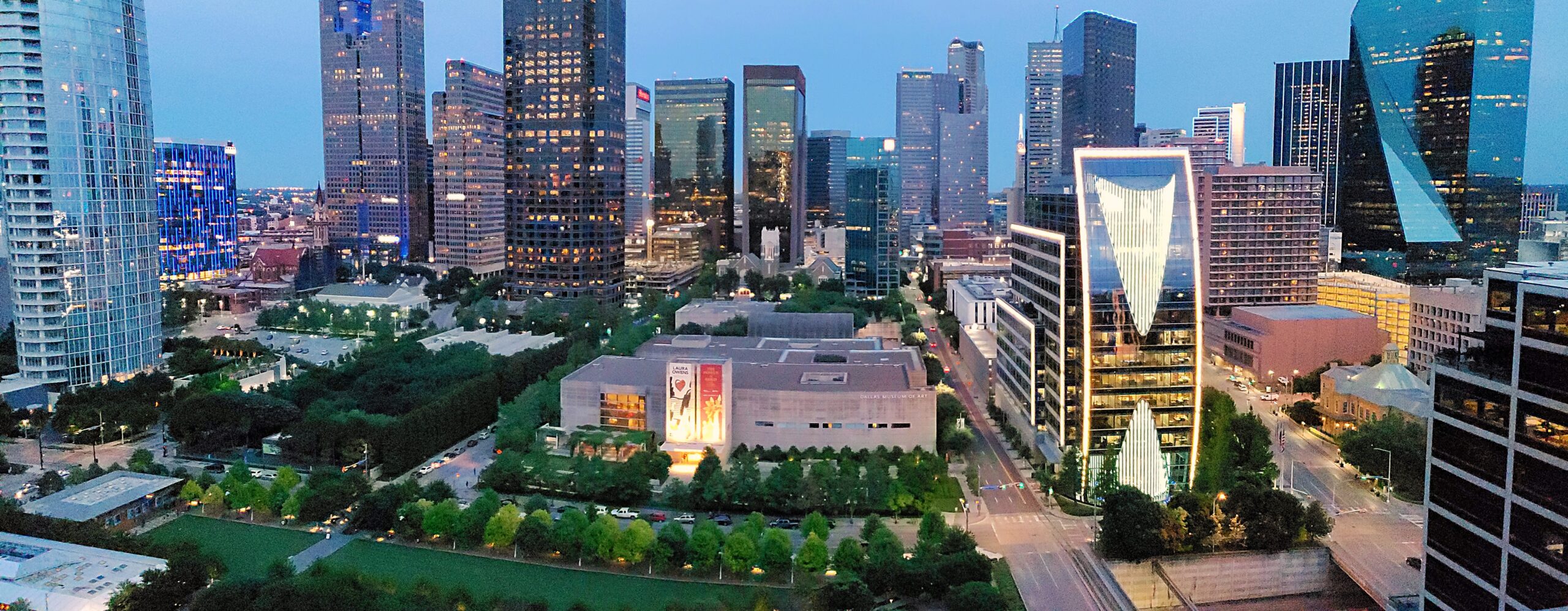
Dallas rarely sells itself on a postcard, and first-time visitors often arrive expecting glass towers, freeways and not much else. They leave having found the largest contiguous arts district in the country, a free art museum with five thousand years of collection, a park built on a deck over a freeway, the most sobering historic site in Texas at Dealey Plaza, neighborhoods of live music, murals and independent restaurants, one of the biggest state fairs in America every fall, and a food scene that runs from brisket and Tex-Mex to tacos as good as any north of the border. It is also the gateway to Fort Worth, a real Western town with cattle drives and world-class museums half an hour away. This guide covers the sights that earn a day, the neighborhoods worth a half-day, the food, the State Fair and the sports, the day trips, and the practical details that turn a business trip or a stopover into a proper visit.
If you are still comparing cheap flights to Dallas, read this alongside our guides to the best time to fly to Dallas and whether you need a car. Between the three you can plan the whole trip.
Dallas at a glance for first-timers
- Airports: Dallas Fort Worth International (DFW), about 32 km (20 miles) northwest of downtown Dallas, is the main airport and the largest hub of American Airlines. Dallas Love Field (DAL), only about 10 km (6 miles) from downtown, is the home base of Southwest Airlines and handles mostly domestic flights. See our DFW airport guide.
- Getting around: DART runs one of the longest light-rail networks in the country, reaching downtown, the Arts District, Deep Ellum, Fair Park, the zoo and DFW, and the free M-Line trolley covers Uptown. The metro area is enormous, though, and many visitors rent a car for Fort Worth, Arlington and the suburbs.
- Money: US dollars. Texas has no state income tax, but the combined sales tax in Dallas is 8.25 percent and hotel taxes add noticeably to a room rate. Tipping 18 to 20 percent in restaurants is expected, and valet parking, which is everywhere, deserves a few dollars.
- Weather: mild winters with the occasional ice storm, a warm and stormy spring, long, very hot summers with regular 100 °F days, and a warm, pleasant fall. Our month-by-month guide has the detail.
- Where to stay: downtown or the Arts District for museums, DART and Klyde Warren Park; Uptown for restaurants, bars and the trolley; Deep Ellum for live music; near DFW if you are splitting time with Fort Worth. Our Dallas hotel search covers them all.
Downtown and Dealey Plaza
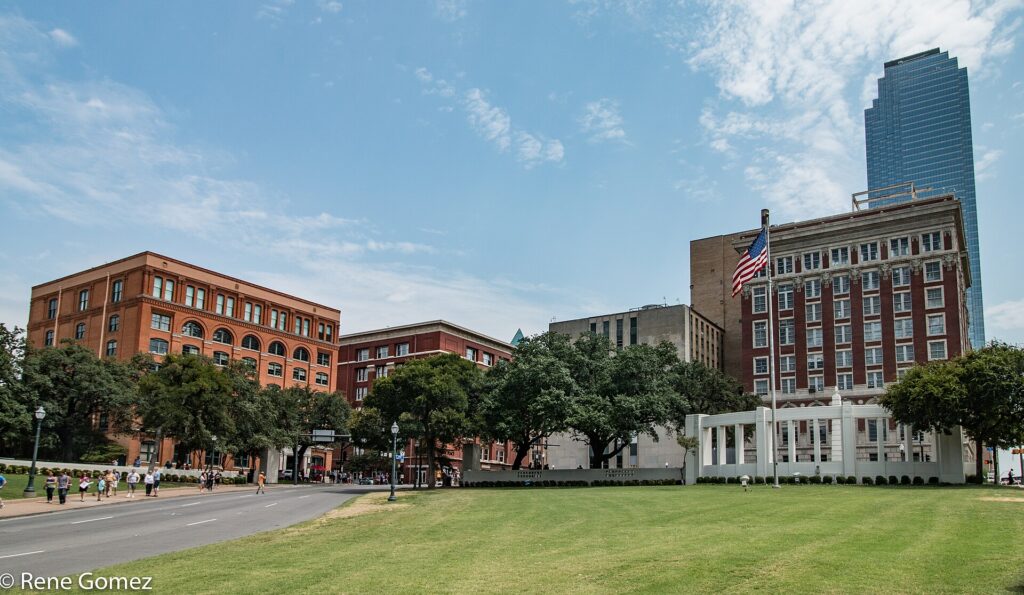
Most visitors begin at Dealey Plaza, on the western edge of downtown, where President John F. Kennedy was assassinated on November 22, 1963. The plaza, the grassy knoll and the triple underpass look much as they did that day, and the former Texas School Book Depository on the corner of Elm and Houston streets now houses The Sixth Floor Museum at Dealey Plaza. Its exhibition tells the story of Kennedy’s life, the assassination and its aftermath with film, photographs and the preserved corner window from which the shots were fired, and it is restrained and deeply affecting; allow two hours and book a timed ticket in busy months. A block east, the John F. Kennedy Memorial, an open concrete cenotaph by Philip Johnson, is a quiet place to finish. Nearby, the red sandstone Old Red Courthouse of 1892 houses a museum of Dallas County history, and the West End has the Dallas Holocaust and Human Rights Museum. Walk east to see Thanks-Giving Square with its spiral chapel and Pioneer Plaza, where forty-nine bronze longhorns and three cowboys drive a herd down a hill beside the convention center.
The Arts District and Klyde Warren Park
On the northern edge of downtown, the Dallas Arts District covers nineteen blocks and is the largest contiguous urban arts district in the United States. The anchor is the Dallas Museum of Art, whose collection spans five millennia, from ancient Mediterranean and pre-Columbian works to European painting, American art and contemporary galleries, and whose general admission is free. Across the street, the Nasher Sculpture Center, designed by Renzo Piano, has one of the finest collections of modern sculpture anywhere, with Rodin, Matisse, Picasso and Calder in a walled garden of live oaks, and the free Crow Museum of Asian Art is a quiet hour of jade, bronze and Japanese screens. For performance, the Meyerson Symphony Center by I. M. Pei is home to the Dallas Symphony Orchestra, the red drum of the Winspear Opera House hosts the Dallas Opera and touring Broadway shows, and the vertical Wyly Theatre is home to the Dallas Theater Center.
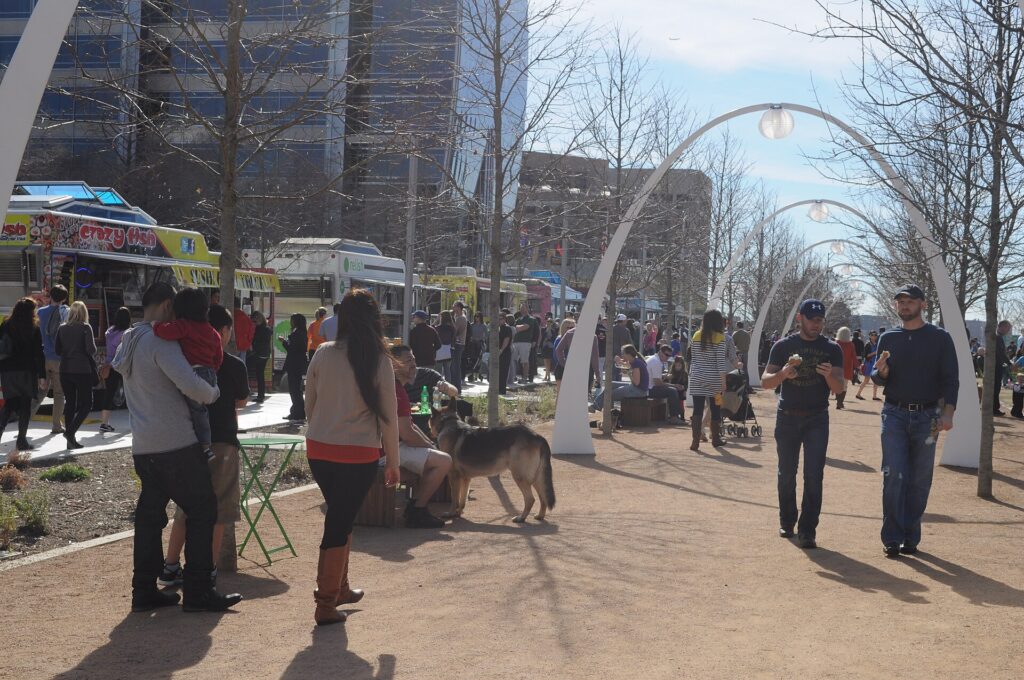
Just north, Klyde Warren Park is the city’s favorite public space: a five-acre lawn built on a deck over the sunken Woodall Rodgers Freeway, opened in 2012 and busy from breakfast to late evening. There are food trucks every day, a children’s park with splash fountains, a dog park, free yoga and concerts, and lawn games, and it stitches the Arts District to Uptown in a way that has reshaped the whole area. Across the freeway, the Perot Museum of Nature and Science, a concrete cube with a glass escalator tube running down its face, has five floors of dinosaurs, gems and hands-on engineering labs that keep children busy for a full morning.
Reunion Tower, the Trinity River and West Dallas
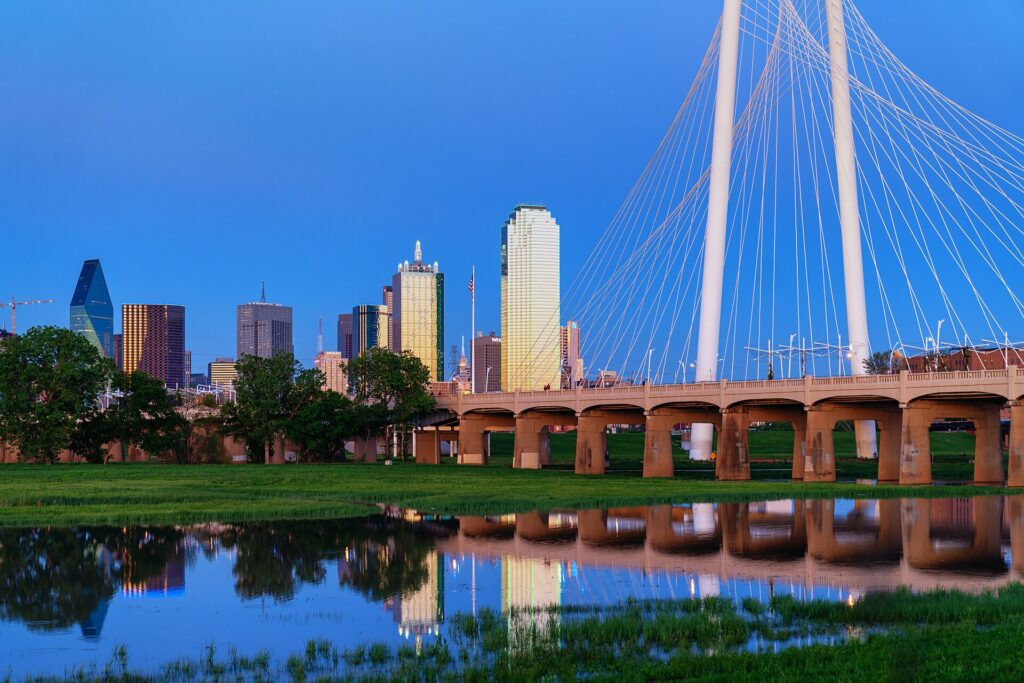
Reunion Tower, the concrete shaft topped by a lattice ball that lights up at night, has been the signature of the Dallas skyline since 1978. Its observation deck gives, on a clear evening, the best overview of the city, from the downtown towers to the long green corridor of the Trinity River below. That river is Dallas’s next frontier. For decades it was hidden behind flood levees; now the white arch of the Margaret Hunt Hill Bridge, designed by Santiago Calatrava and opened in 2012, carries traffic across the floodplain to West Dallas, and the old Continental Avenue Bridge beside it has become a pedestrian bridge with seating, shade and views back to the skyline. At the western end, Trinity Groves is a cluster of restaurants and patios, and the sunset view of the city from here is one of the best in town. South of downtown, the Great Trinity Forest is one of the largest urban hardwood forests in the country.
Neighborhoods worth a half-day
Deep Ellum
East of downtown along Elm, Main and Commerce streets, Deep Ellum was the center of the city’s Black commercial life and blues scene in the 1920s, when Blind Lemon Jefferson and Lead Belly played its streets. Today it is the city’s live-music and nightlife district: dozens of venues and bars, murals on nearly every wall, breweries and some of the best barbecue in Dallas. It is on the DART Green Line and walkable from downtown.
Bishop Arts District
Across the Trinity in Oak Cliff, a few blocks of 1920s storefronts around Bishop Avenue and Davis Street hold independent boutiques, bookshops, galleries, coffee shops and some of the most interesting restaurants in the city. The Dallas Streetcar runs here from Union Station, and the surrounding streets of Craftsman bungalows make for a good walk.
Uptown and the Katy Trail
North of downtown, Uptown is dense, walkable and polished, with restaurants and bars along McKinney Avenue, the West Village at its northern end, and the free M-Line trolley running vintage streetcars through the middle. The Katy Trail, a paved path on a former railroad corridor, runs about 3.5 miles toward Southern Methodist University and is where the city jogs, cycles and walks its dogs.
Lower Greenville and Knox-Henderson
Northeast of downtown, Lower Greenville Avenue is a strip of patios, bars and music venues that hosts one of the largest St. Patrick’s Day parades in the South, and Knox-Henderson nearby has restaurants and design shops in a leafier setting. Both are best in the evening.
The Park Cities
Highland Park and University Park, north of Uptown, are the city’s old-money enclaves, with SMU, the George W. Bush Presidential Library and Museum, and Highland Park Village, one of the country’s first planned shopping centers, opened in 1931.
Museums, culture and family attractions
Beyond the Arts District, the George W. Bush Presidential Library and Museum on the SMU campus has a full-scale replica of the Oval Office and a sobering exhibit on September 11, and the Meadows Museum, also at SMU, holds one of the largest collections of Spanish art outside Spain. Fair Park, east of Deep Ellum, is a National Historic Landmark of Art Deco exhibition halls built for the 1936 Texas Centennial, home to the African American Museum and busiest during the State Fair. The Dallas Zoo, the oldest in Texas, is on the DART Red Line south of downtown, and its Giants of the Savanna habitat lets giraffes, elephants and zebras share one landscape. At White Rock Lake, the Dallas Arboretum and Botanical Garden has sixty-six acres of gardens on the eastern shore, spectacular in spring during Dallas Blooms and in fall, when its pumpkin village draws crowds. For what is on during your dates, our Dallas events page lists concerts, shows and games.
The State Fair of Texas
For about three and a half weeks from late September into October, Fair Park becomes the State Fair of Texas, one of the largest state fairs in the country. It is presided over by Big Tex, the 55-foot talking cowboy who has greeted fairgoers since the 1950s, and it runs on fried food: the corny dog was popularized here, and every year the fair crowns new deep-fried inventions in its Big Tex Choice Awards. Beyond the food there are livestock shows, a huge auto show, free concerts every night, the Texas Star, one of the tallest Ferris wheels in North America, and the Art Deco halls of the park, lit up at night. The biggest day is the Red River Showdown, the University of Texas against the University of Oklahoma at the Cotton Bowl stadium inside the fairgrounds, usually in the second week of October, when half the stadium wears burnt orange and half crimson. Take DART’s Green Line to Fair Park rather than driving, go on a weekday for smaller crowds, and bring an appetite. If you are not coming for the fair, remember that it pushes up hotel rates on its weekends, on Texas-OU weekend in particular.
Sports
Dallas is a serious sports town, and its teams are spread across the metro. The Dallas Cowboys play at AT&T Stadium in Arlington, halfway to Fort Worth, a vast building with a retractable roof and one of the largest video boards in sport; it hosted matches of the 2026 World Cup, stages the Cotton Bowl Classic around New Year, and runs tours on non-event days, and the Cowboys play at home every Thanksgiving. Next door, the Texas Rangers, the 2023 World Series champions, play at Globe Life Field, which has a retractable roof for the summer heat. Arlington has no light rail, so a car, a shuttle or a ride-hail is the way in. Closer to the center, the Dallas Mavericks and the Dallas Stars share the American Airlines Center in Victory Park, walkable from Uptown and on DART, and a Mavericks game is the easiest big-league night out in the city. Check what is on sale in Dallas for your dates before you book flights.
What to eat, and where
Dallas eats Tex-Mex with conviction, and it has a claim on the style: the frozen margarita machine was invented here in 1971. Order cheese enchiladas in chili gravy, fajitas and a frozen margarita at least once. The second pillar is barbecue: Central Texas-style brisket, smoked for hours over post oak and sliced to order, with lines forming before lunch at the best places in Deep Ellum and beyond. Third, tacos: the taquerias of Oak Cliff serve al pastor, barbacoa and breakfast tacos as good as any in the state. Beyond that, Dallas is a steakhouse city, with grand dining rooms downtown and in Uptown, and a city of immigrant food: Korean restaurants along Royal Lane and in Carrollton, Vietnamese in Garland, and a large Asian dining district in Richardson. The Dallas Farmers Market on the edge of downtown has a food hall and weekend stalls, and the craft-brewery scene in Deep Ellum and the Design District is strong.
Dallas through the seasons
What you do in Dallas depends heavily on when you come. Spring (March to May) is the best-loved season: Dallas Blooms fills the Arboretum with tulips, bluebonnets line the highways outside the city in late March and April, patios open, and the Deep Ellum Arts Festival and the Lower Greenville St. Patrick’s Day parade bring crowds. It is also severe-storm season, so watch the forecast. Summer (June to mid-September) is long and hot, with afternoons regularly near or above 100 °F; the best plans are museums by day, Klyde Warren Park and the patios after dark, a Rangers game under the roof, and a morning at White Rock Lake before the heat. Fall (late September to November) is Dallas at its best, with the State Fair, Texas-OU weekend, pumpkins at the Arboretum, football every weekend and warm, clear afternoons. Winter (December to February) is mostly mild and sunny, with holiday lights in Highland Park and the Dallas Marathon in December, but an ice storm can shut the city down for a day or two in most winters. Our month-by-month guide has the fare patterns that go with each season.
Dallas with kids
Dallas is a very good city for children, largely because so much of it was built for families and for air conditioning. The Perot Museum is the obvious first stop, with its dinosaur hall and hands-on engineering floor. The Dallas Zoo is an easy train ride from downtown, and the Dallas World Aquarium’s rainforest walk-through works for all ages. Klyde Warren Park’s children’s area and splash pad are free, and the Arboretum has a children’s garden built around science and nature. In Arlington, Six Flags Over Texas, the original park of the chain, and its Hurricane Harbor water park fill a summer day. Fort Worth adds the longhorn cattle drive in the Stockyards and an excellent zoo, and Dinosaur Valley State Park, ninety minutes southwest, has real dinosaur footprints in the riverbed that children can stand in. For families renting a vehicle, our family car rental guide covers the choices.
Dallas on a budget
A surprising amount of the best of Dallas costs nothing. The Dallas Museum of Art and the Crow Museum are free, Klyde Warren Park and its daily programming are free, and so are Dealey Plaza, the Kennedy Memorial, Pioneer Plaza, the Katy Trail, the murals of Deep Ellum, White Rock Lake and the pedestrian bridge over the Trinity. The M-Line trolley through Uptown is free, and a DART day pass covers everything else on rail, including the airport. The Sixth Floor Museum, Reunion Tower and the Perot Museum charge admission but are fairly priced. Eat well for less at the taquerias of Oak Cliff, the barbecue joints, where a pound of brisket feeds two, and the food trucks at Klyde Warren. Because so much hotel demand is business travel, downtown and Uptown rates often fall on Friday and Saturday nights, and summer is the cheapest season for rooms. Compare rates by neighborhood on our Dallas hotel search.
Day trips from Dallas
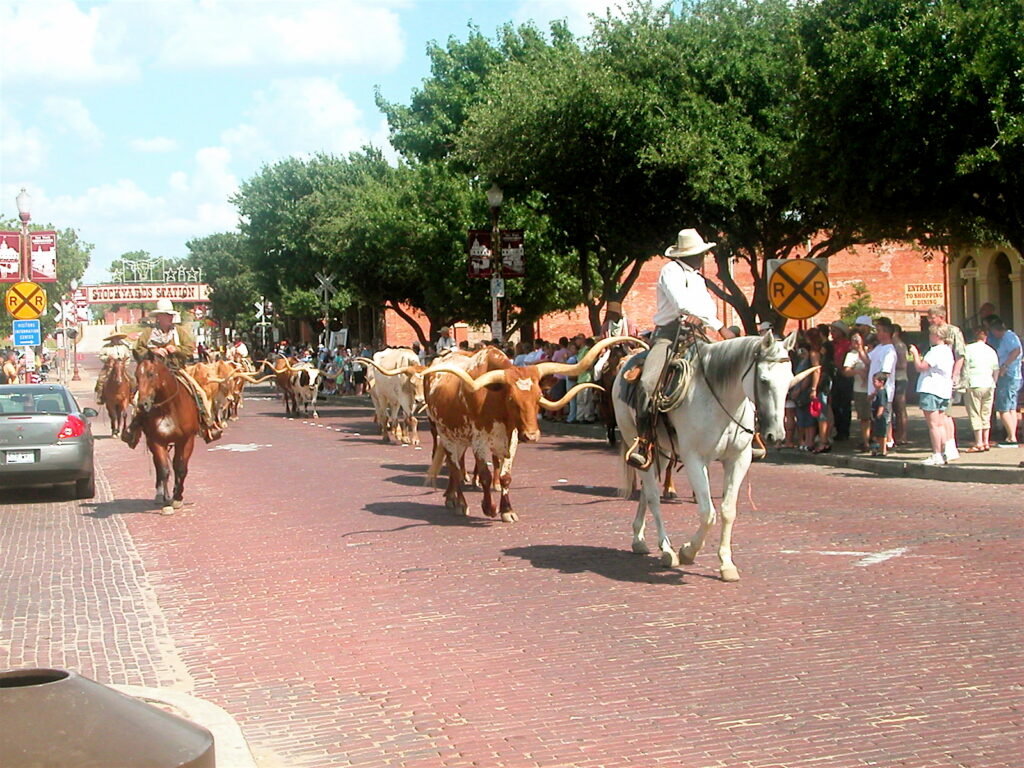
Fort Worth, about 50 km (30 miles) west, is the essential side trip, and it feels like a different state. In the Stockyards National Historic District, cowhands drive a herd of Texas longhorns down Exchange Avenue twice a day, the Cowtown Coliseum holds a rodeo on weekend nights, and Billy Bob’s Texas is a honky-tonk the size of a warehouse. The Cultural District has three superb museums: the Kimbell Art Museum in Louis Kahn’s vaulted building, the Modern Art Museum of Fort Worth by Tadao Ando, and the free Amon Carter Museum of American Art. Visit Fort Worth has the details, and the Trinity Railway Express commuter train links the two downtowns. Grapevine, beside DFW, has a restored Main Street, wineries and a heritage railroad. Waco, about ninety minutes south on I-35, has Magnolia Market at the Silos and the Waco Mammoth National Monument. For a longer trip, Houston is about four hours south on I-45; our Dallas to Houston driving guide covers the route and our guide to things to do in Houston covers the city. Most of these trips need a car; compare rates on our Dallas car rental page.
Two sample itineraries
Two days, no car
Day one: Dealey Plaza and the Sixth Floor Museum in the morning, a walk through downtown past Thanks-Giving Square and Pioneer Plaza, lunch from the food trucks at Klyde Warren Park, the Dallas Museum of Art and the Nasher in the afternoon, and dinner and live music in Deep Ellum. Day two: the Perot Museum or a morning on the Katy Trail, the M-Line trolley through Uptown for lunch on McKinney Avenue, the streetcar to Bishop Arts for the afternoon, and sunset at Reunion Tower or Trinity Groves before a Mavericks game or a show.
Four days, with Fort Worth
Add a day for White Rock Lake and the Arboretum, the Bush Library and dinner on Lower Greenville, then pick up a car and spend a full day in Fort Worth, starting with the Kimbell and the Modern and finishing with the cattle drive, a steak and a honky-tonk in the Stockyards, returning the car at DFW on the way home.
Practical details
- Transit: buy DART tickets and passes in the GoPass app or at the machines on every rail platform; a day pass covers trains and buses. DART has maps and service alerts; our transit-versus-car guide goes into detail.
- From DFW: the DART Orange Line from Terminal B to downtown in about 50 minutes, TEXRail to downtown Fort Worth, a taxi or ride-hail, or a rental from the consolidated Rental Car Center. The airport’s site covers ground transport. From Love Field, a DART shuttle bus connects to the light rail, and downtown is a short taxi ride.
- Weather: sun protection and water from May to September, layers for spring and fall, and a proper jacket for winter cold snaps. The National Weather Service’s Fort Worth office covers Dallas and issues the storm warnings worth heeding in spring.
- Time zone: Central, one hour behind New York and the same as Chicago and Houston.
- Entry requirements: visitors from Visa Waiver Program countries need an approved ESTA before boarding; most others need a visa. The State Department’s travel site is the authoritative source.
- Tourist information: Visit Dallas, the official tourism office, has current events and neighborhood guides.
Frequently asked questions
How many days do you need in Dallas?
Two full days covers Dealey Plaza, the Arts District, Klyde Warren Park, Deep Ellum and Bishop Arts; add a third for White Rock Lake and a game, and a fourth for Fort Worth.
What is the number one thing to do in Dallas?
The Sixth Floor Museum at Dealey Plaza is the one sight almost every visitor should see. In the fall, the State Fair of Texas is the city’s defining experience.
Is Dallas walkable?
Downtown, the Arts District, Uptown, Deep Ellum and Bishop Arts are, and DART and the free trolley connect them. The rest of the metro assumes a car, and the summer heat makes long midday walks hard work.
Do I need a car in Dallas?
Not for the central neighborhoods. For Arlington, Fort Worth, the suburbs and road trips, yes; rent it only for the days you need it.
Is Dallas expensive?
Moderately. Hotels are cheaper than in New York or Los Angeles and often cheaper at weekends, many major sights are free, and food is good value, but State Fair weekends and big conventions push rates up.
What is Dallas known for?
Dealey Plaza and the Kennedy assassination, the Cowboys, the State Fair of Texas, Tex-Mex and brisket, a huge Arts District, and a booming business culture.
Ready to go? Compare flights to Dallas, find a place to stay with our Dallas hotel search, and if Fort Worth, Arlington or a Texas road trip is on the list, price a rental car for those days.
Keep planning with TicketScanner
- Cheap flights to Dallas
- Dallas hotels — by neighborhood
- Dallas car rentals — for Fort Worth, Arlington and Texas road trips
- Events in Dallas — Cowboys, Mavericks, Stars, concerts and shows on sale
- Best time to fly to Dallas: month by month
- Dallas: rent a car or use public transit?
- Dallas Fort Worth International (DFW) airport guide
- Where to stay: the Arts District
- Driving Dallas to Houston
- Things to do in Houston — about four hours south by car
Leave a Reply