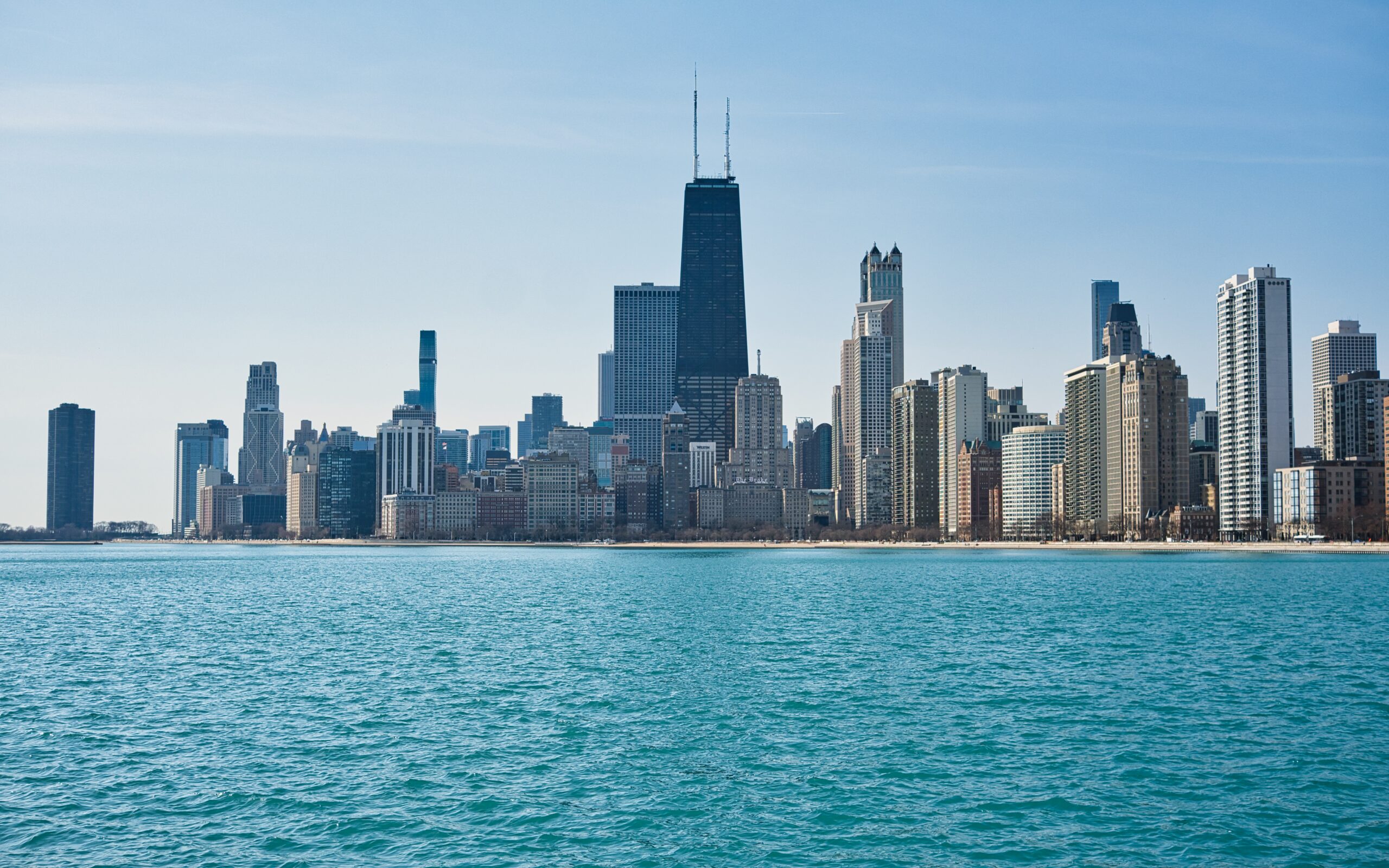
Chicago is the rare American city where most visitors are better off without a car. It has the second-largest public transit system in the country, trains that run from both airports straight into downtown, a 24-hour rail line to O’Hare, a compact core of walkable neighborhoods, a lakefront trail made for bikes, and some of the most expensive parking and highest rental taxes anywhere in the Midwest. The expressways into the city are also among the most congested in the nation. But the question is not quite closed. Chicago is the hub of the Midwest, and a surprising number of travelers use it as the start of a road trip to Wisconsin, Michigan or the Illinois countryside, visit family in the far-flung suburbs, or want the freedom to reach Starved Rock or the Indiana Dunes on their own schedule. This guide explains how the city is laid out, how the ‘L’, the buses and Metra work, what driving and parking here are really like, and gives you a straightforward way to decide.
The short answer
Skip the car if you are staying downtown, in River North, the West Loop, the Magnificent Mile or a North Side neighborhood, and your plans are the museums, the lakefront, the river, the ballparks and the restaurants; the ‘L’, the buses, Divvy bikes and your feet will cover all of it, and you will save the parking fees, the taxes and the traffic. That is most visitors. Rent a car if you are driving on to Milwaukee, Wisconsin’s lakes, Michigan or Minneapolis, if you are visiting family in the outer suburbs, if you have a day planned at Starved Rock or Galena, or if you are traveling with small children and a lot of gear to a hotel outside the transit network. And if you need a car for only part of the trip, rent it only for those days, picking up in the city rather than at O’Hare. Compare rental rates for any of these plans on our Chicago car rental page.
How Chicago is laid out
Chicago is a grid, and a very logical one. Every address is numbered from the intersection of State and Madison Streets in the Loop, with 800 numbers to a mile, so 1600 North is two miles north of Madison and 3200 West is four miles west of State. Lake Michigan forms the eastern edge of everything. Downtown is the Loop, the business district inside the ring of elevated tracks, with Millennium Park and the Art Institute on its lake side; the Chicago River wraps its north and west sides. North of the river are River North and the Magnificent Mile, then the Gold Coast, Old Town, Lincoln Park and Lakeview along the lake. West of the Loop is the West Loop and Fulton Market; the Museum Campus and the South Loop are to the south, with Chinatown, Pilsen and, farther down the lake, Hyde Park. The city extends for miles in every direction, and the suburbs for many more, with O’Hare on the northwest edge and Midway on the Southwest Side.
Hotels cluster in the Loop, River North, the Magnificent Mile and the West Loop, with a large group around O’Hare in Rosemont and a scattering in the neighborhoods. Our Chicago hotel search lets you compare them, and it is worth checking the parking fee on any hotel before you decide on a car.
Getting in from the airports
O’Hare (ORD) is about 27 km (17 miles) northwest of the Loop. The CTA Blue Line leaves from a station beneath the parking garage in the middle of the terminal complex, runs 24 hours a day, and reaches the Loop in about 45 minutes for a slightly higher fare than a normal ride; it is the cheapest way downtown and, at rush hour, often the fastest. By taxi or ride-hail, the drive along the Kennedy Expressway takes anywhere from 30 minutes late at night to well over an hour at the evening peak. The rental companies share a multi-modal facility reached by the free airport transit train. Midway (MDW), about 16 km (10 miles) southwest of the Loop, is simpler still: the CTA Orange Line starts at the terminal and reaches the Loop in about 25 minutes, and the rental counters and taxis are a short walk away. The Chicago airports’ site covers ground transport at both; our O’Hare airport guide covers the layout.
Chicago’s transit, explained
The Chicago Transit Authority runs the ‘L’ trains and the city buses, Metra runs the commuter rail to the suburbs, and Pace runs the suburban buses. For a visitor, the CTA alone covers almost everything, and it is frequent, extensive and, on the main lines, around the clock.
The ‘L’
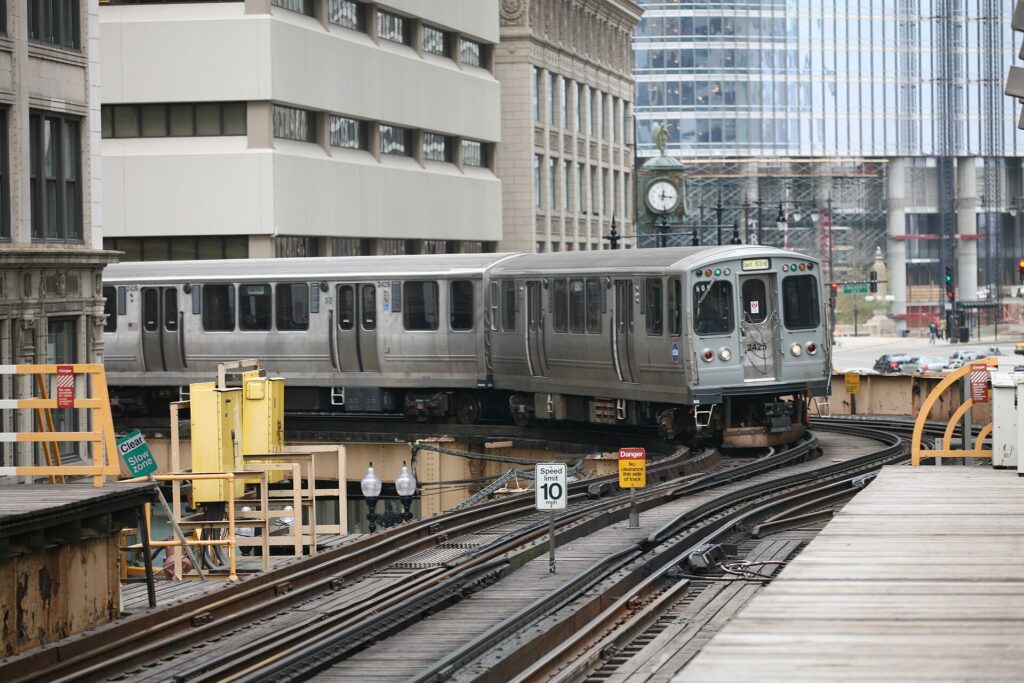
Eight color-coded lines and about 145 stations. The Red Line is the backbone, running north-south through the city under State Street, with stops for the Magnificent Mile, Wrigley Field (Addison), Chinatown and the White Sox ballpark. The Blue Line runs from O’Hare through Logan Square, Wicker Park and the Loop to the West Side. Both run 24 hours. The Brown, Green, Orange, Pink and Purple Lines circle the Loop on the elevated tracks that give the district its name, and then fan out to the North Side, the West Side, Oak Park and Midway; the Yellow Line is a short shuttle to Skokie. Riding the Brown Line around the elevated Loop at dusk is one of the best cheap sightseeing trips in the city. Trains on most lines run every few minutes at peak times and less often late at night; check the CTA’s train tracker for real-time arrivals.
Buses
The CTA’s bus network follows the grid and reaches everywhere the ‘L’ does not, including the Museum Campus, Navy Pier and the lakefront neighborhoods. Useful routes for visitors run along Michigan Avenue, the lakefront and the major east-west streets, and some of the busiest run through the night. Buses get caught in traffic at rush hour, but for short trips across the grid they are hard to beat.
Metra and the South Shore Line
Metra’s eleven commuter lines leave from four downtown terminals, Union Station, the Ogilvie Transportation Center, LaSalle Street and Millennium Station, for the suburbs, including Evanston, Oak Park and the Chicago Botanic Garden. Service is frequent at rush hour and thinner at weekends. The separate South Shore Line runs from Millennium Station to Indiana Dunes National Park and South Bend.
Fares and tickets
The simplest way to pay on the CTA is to tap a contactless bank card or a phone wallet at the turnstile or on the bus; you can also buy a reusable Ventra card at stations, or use the Ventra app, which also sells Metra tickets. One-, three- and seven-day unlimited passes are good value if you will ride more than a few times a day, and transfers within two hours are discounted or included depending on how you pay. Trips starting at the O’Hare station cost more than a standard ride. Children under seven ride free, and there are reduced fares for older children, seniors and riders with disabilities. Check the CTA’s site for current fares before you go.
Accessibility
Every CTA bus is accessible, and most ‘L’ stations have elevators, though some older stations on the elevated lines do not; the CTA is working through them and marks accessible stations on its maps. Check before relying on a particular station with a wheelchair or a stroller.
Beyond the CTA
- Walking and the Pedway. The Loop, River North, the Magnificent Mile and the lakefront are all easy on foot, and the grid makes it hard to get lost. In winter, the Pedway, a network of underground tunnels and overhead bridges beneath about forty blocks of the Loop, links stations, office buildings and department stores out of the wind.
- Divvy bikes. The city’s bike-share system has thousands of pedal bikes and e-bikes at docks across the city, and the Lakefront Trail, the Riverwalk and a growing network of protected lanes make it the best way to see the shore. Buy a day pass or ride by the minute through the Divvy app.
- Water taxis. In the warmer months, water taxis run along the river between the train stations, Michigan Avenue and Chinatown, and across the harbor between Navy Pier and the Museum Campus. They are transport and a sightseeing trip at once.
- Taxis and ride-hail. Licensed taxis and the ride-hail apps operate across the city. For a group of three or four, a short ride is competitive with transit fares, and late at night it is the easy way home from the neighborhoods off the 24-hour lines.
- Amtrak. Union Station is the hub of the national rail network, with frequent trains to Milwaukee and regular services to Detroit, St. Louis and beyond; Amtrak is a genuine alternative to a rental for trips to Milwaukee.
Driving in Chicago: what it is really like
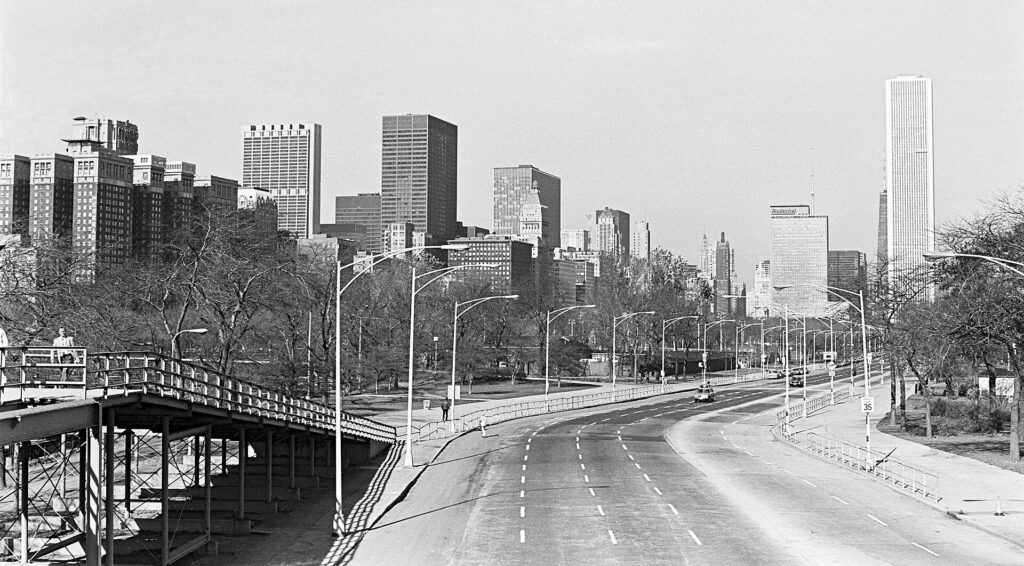
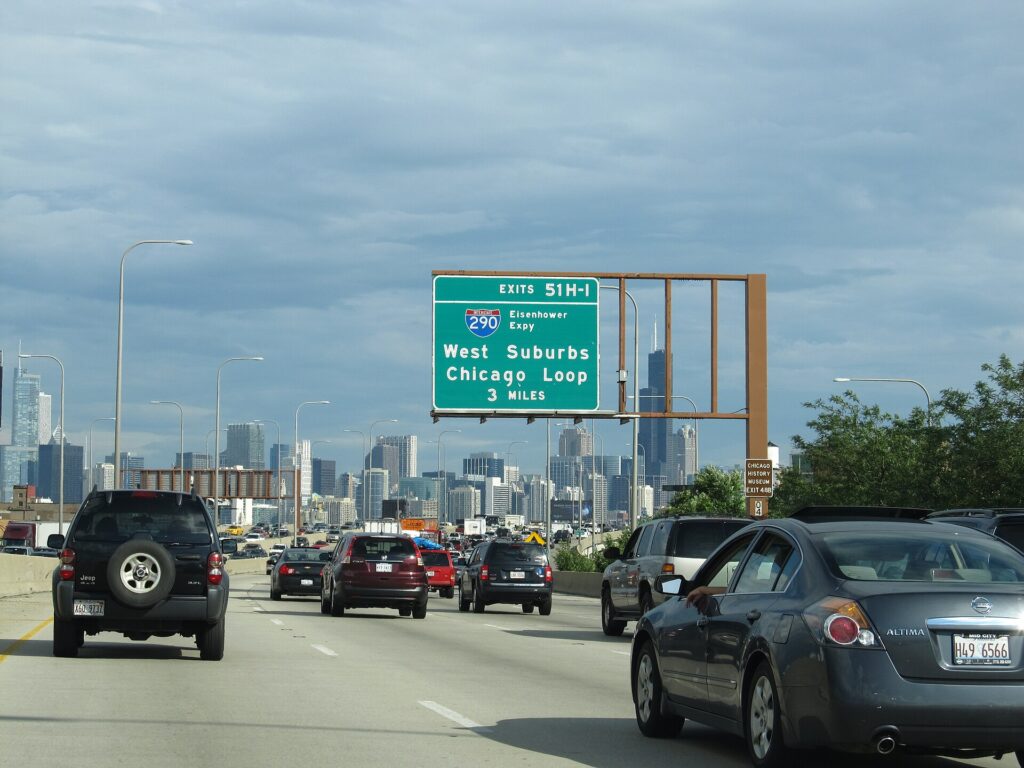
Driving in Chicago is manageable for anyone used to a big American city, and the grid makes navigation easy, but it is rarely fast. The expressways, the Kennedy to O’Hare, the Dan Ryan south, the Eisenhower west, the Stevenson toward Midway and the Edens north, converge on downtown and jam every weekday morning and evening, and the city consistently ranks among the most congested in the United States. The Circle Interchange, where they meet west of the Loop, is notorious. Lake Shore Drive, officially renamed Jean Baptiste Point DuSable Lake Shore Drive, is the scenic exception: an expressway along the lakefront with the skyline on one side and the beaches on the other, and one of the great urban drives in the country, though it too backs up at rush hour and trucks are banned from it. Downtown streets are dense with pedestrians, cyclists, buses and delivery vehicles, many turns are restricted, and summer brings construction on the main routes and street closures for festivals and parades.
Parking
Parking is where a Chicago rental gets expensive. The city’s parking meters were leased to a private operator in 2008, and the rates in the Loop and River North are among the highest of any American city; pay at the street boxes or with the ParkChicago app, and read the signs for rush-hour restrictions, which tow cars from some arterial streets at peak times. Downtown hotels charge a substantial nightly fee, often for valet only, and the garages are priced accordingly, although booking a garage space online in advance can cut the rate considerably. In the neighborhoods, residential permit zones cover many side streets in the evenings, and street cleaning signs from spring to fall mean a ticket or a tow for the unwary. In winter, the city bans overnight parking on certain signed arterial streets from December 1 to April 1, and a separate ban kicks in on other routes after a heavy snowfall. The city’s impound lots are a long way from anywhere, and retrieving a towed car costs a day of your trip.
Rules and conditions worth knowing
- Tolls. The Illinois Tollway, which includes the roads to O’Hare’s western side, the Tri-State around the suburbs and the route toward Wisconsin, is fully electronic, with no cash booths. Rental companies offer transponder programs for a daily fee; if you decline, you can usually pay the tolls online by license plate within the grace period on the Illinois Tollway’s site. I-PASS and E-ZPass transponders both work.
- Cameras. Speed cameras operate near parks and schools across the city, and red-light cameras at more than a hundred intersections; the fines follow the car, and the rental company will bill you with a fee on top.
- Phones. Illinois bans handheld phone use while driving; hands-free only.
- Right turns on red are permitted after a full stop unless signed otherwise, and many downtown intersections are signed otherwise.
- Winter driving. The city and state plow quickly, and rental cars on all-season tires cope with most Chicago winters, but lake-effect snow bands and ice storms can make the expressways treacherous for a few hours. Check conditions before long drives from December to March.
- Fuel and taxes. Layered state, county and city taxes make fuel in Chicago noticeably pricier than in Indiana or Wisconsin, and Chicago and O’Hare add some of the steepest rental taxes and fees in the country. Fill up across the state line on a road trip.
When renting a car makes sense
- Midwest road trips. Chicago is the natural start for a drive north to Milwaukee, Madison and Minneapolis, or east around the lake to Michigan; our route guides for Chicago to Minneapolis and Chicago to Detroit cover the two classic runs.
- State parks and small towns. Starved Rock State Park, Galena and Lake Geneva in Wisconsin are effectively car-only.
- Family in the suburbs. The suburbs sprawl for 50 miles or more, and while Metra reaches many of them, a car earns its keep daily if your base is out there.
- Families with small children and gear staying outside the city, where the train is not an option.
- A hotel near O’Hare for a business trip to the suburbs, where offices are spread out along the tollways.
If any of those apply, our rental car booking tips cover insurance, deposits and the questions to ask at the counter, and our family car rental guide looks at vehicle choice.
When it does not
- You are staying downtown, in River North, the West Loop or a North Side neighborhood, and your plans are the city.
- You are in town for a convention at McCormick Place, a ball game, a concert or a festival, when traffic and parking are at their worst and transit goes straight to the door.
- Your day trips are Oak Park, Evanston, the Indiana Dunes or Milwaukee, all of which have direct trains.
- You are traveling solo or as a couple and would spend more on the rental, taxes and parking than on a week of transit passes and the odd taxi.
The hybrid plan for a city-plus-road-trip visit
Go car-free for the city days and rent only for the days you leave town, and think carefully about where you pick up. Renting at O’Hare makes sense if you are driving straight out on arrival toward Wisconsin or the western suburbs, because the tollways are right there and you never enter downtown traffic. For everyone else, it pays to take the Blue Line or the Orange Line into the city, spend the first days without a car, and pick up from a neighborhood or downtown rental office on the morning you leave; you avoid the airport concession fees and several nights of hotel parking. If your road trip ends somewhere else, a one-way rental to Minneapolis or Detroit is a classic Midwest itinerary, though one-way fees vary widely by company and season. Book ahead for summer weekends and holiday weeks. Compare the day rates on our Chicago car rental page against a full-trip rental and the difference is usually obvious.
A worked cost comparison
Numbers change with the season and the booking window, so treat this as a method rather than a quote, and check current rates before deciding. For a four-night city break downtown for two people, the car-free version costs two Blue Line trips each way, a pair of multi-day CTA passes, perhaps a Divvy day pass and two or three late-night ride-hail trips; the rental version adds four days of a compact car with Chicago’s rental taxes, four nights of hotel parking at downtown rates, fuel and the airport fees, and buys you nothing you could not reach faster by train. The transit option wins by a wide margin. For the same four nights with a day at Starved Rock, the car-free version cannot easily do it; the hybrid version adds a single-day rental picked up in the city, fuel and a toll or two, and is still far cheaper than a four-day rental with parking. For a week-long road trip to Wisconsin or Michigan that starts in Chicago, a rental is the only practical answer, and the question becomes where to pick it up: O’Hare, if you leave on arrival; the city, if you spend the first nights downtown. Run the rental rates for your dates on our Chicago car rental page and put them beside the transit costs before you choose.
Driving out of Chicago in each season
Getting out of Chicago is the hardest part of any road trip from it. In summer, the problem is traffic: northbound on the Edens and the Kennedy on Friday afternoons, as the city heads for Wisconsin’s lakes and the Michigan dunes, and southbound on Sunday evenings, can add an hour or more to the drive, and construction season narrows the expressways from spring to fall. Leave early in the morning or after the evening peak. In fall, the drives north to Door County and Wisconsin’s farm country, and east into Michigan, are at their most beautiful in early-to-mid October, and the roads are quieter once school is back. In winter, the expressways are plowed and generally open, but lake-effect snow can hit northwest Indiana and southwest Michigan hard, making the I-94 run toward Detroit slow or dangerous for a few hours at a time, and Wisconsin and Minnesota can see heavy snow on the way to Minneapolis; check the forecast and the state road-condition sites before you leave, and carry a scraper, a full tank and a warm layer. In spring, the roads are wet and potholed after the freeze-thaw, and the first thunderstorms arrive. In every season, remember that the drive to Detroit crosses into Eastern time, so you lose an hour going east and gain it coming back.
Decision table
| Your trip | Recommendation | Why |
|---|---|---|
| City break downtown, couple or solo | No car | The ‘L’, buses, Divvy and walking cover it; parking and rental taxes are high |
| Convention at McCormick Place | No car | Shuttles, buses and Metra serve it; downtown traffic is at its worst |
| Ball game, concert or festival | No car | The Red Line goes to both ballparks; festival street closures make driving miserable |
| City plus one day out | Hybrid: rent in the city for that day | Car-free city days, a single-day rental for Starved Rock or Galena |
| Oak Park, Evanston, Milwaukee or the Dunes | No car: take the ‘L’, Metra, Amtrak or the South Shore Line | All have direct trains from downtown |
| Family visit to the suburbs | Rent for the whole stay | Suburban distances make the car worthwhile daily |
| Business trip to suburban offices | Rent at O’Hare | The tollways start at the airport; offices are spread out |
| Midwest road trip | Rent (consider one-way to Minneapolis or Detroit) | Chicago is the start, not the destination |
Money-saving tips for both options
- On transit: tap your card or phone, buy a multi-day pass if you will ride often, take the Blue or Orange Line from the airport instead of a taxi, and remember children under seven ride free.
- On a rental: pick up in the city to avoid the airport fees, rent only for the days you leave town, compare the transponder fee with paying tolls online, decline extras you already have through a credit card or home policy (check first), and fill up outside Chicago.
- On the hotel: if you are renting, price the parking fee into the room rate, and look at garages you can book online nearby, which are often cheaper than hotel valet.
- On timing: avoid the expressways in the weekday peaks and on summer Friday afternoons, and watch for convention weeks, when both hotels and traffic are at their worst; the best time to fly to Chicago guide lists the busiest dates.
- On day trips: for one or two people, a return Amtrak or South Shore Line ticket usually costs less than a day’s rental plus fuel, parking and tolls, and you can read on the way.
Frequently asked questions
Is it worth renting a car in Chicago?
For a city visit, no; the transit is good and parking, taxes and traffic are all expensive. For road trips, the suburbs, state parks and small towns, yes, and rent only for those days.
Is Chicago public transit good for tourists?
Very. The ‘L’ and the buses reach almost every sight, the Red and Blue Lines run 24 hours, and both airports have direct train service to the Loop.
How do I get from O’Hare to downtown Chicago?
The Blue Line in about 45 minutes, around the clock, or a taxi or ride-hail in 30 minutes to more than an hour depending on traffic.
How do I get from Midway to downtown Chicago?
The Orange Line from the terminal to the Loop in about 25 minutes, or a taxi or ride-hail in 20 to 40 minutes.
Is parking expensive in downtown Chicago?
Yes, among the most expensive in the country, both on the street and at hotels. Booking a garage online in advance helps, but a downtown visit is cheaper without a car.
Do I need to pay tolls in a rental car in Chicago?
Only on the tollways, which are cashless. Use the rental company’s transponder program or pay online by license plate within the grace period.
Is it safe to ride the ‘L’ at night?
The main lines are busy into the evening and generally safe; late at night, ride in a car with other passengers, near the front where the operator is, and consider a taxi for the last leg.
Whichever way you go, start with the flight. Compare cheap flights to Chicago, choose a neighborhood with our Chicago hotel search, read our first-timer’s guide to Chicago, and if a road trip is on the list, price the rental for those dates on our Chicago car rental page.
Keep planning with TicketScanner
- Chicago car rentals — compare airport and city pickup
- Cheap flights to Chicago
- Chicago hotels — factor parking into the rate
- Things to do in Chicago: a first-timer's guide
- Best time to fly to Chicago: month by month
- O'Hare International (ORD) airport guide
- Driving Chicago to Minneapolis
- Driving Chicago to Detroit
- Rental car booking tips
- Car, transit or taxi in a new city?
Leave a Reply