Tag: Chicago

  • Best Time to Fly to Chicago: Seasons, Weather & Prices

    Best Time to Fly to Chicago: Seasons, Weather & Prices

    Chicago is one of the easiest cities in America to fly to, and one of the trickiest to time. O’Hare is a hub for both United and American, Midway is one of Southwest’s biggest bases, and between them there are nonstop flights from almost every city in North America and from dozens abroad, which keeps fares competitive for most of the year. What moves the price of a Chicago trip is less the flight than the city’s calendar: a summer so good that the whole Midwest wants to be on the lakefront, a festival season that fills Grant Park most weekends, a marathon in October, a holiday season on the Magnificent Mile, and above all the convention center, McCormick Place, the largest in North America, whose trade shows can fill every downtown hotel room on a random Tuesday in spring. Then there is winter, which is cold enough to make January the cheapest month of the year. This guide walks through the weather month by month, the fare and hotel seasons, the events that move prices, and how to handle the two airports.

    The short answer

    For the best balance of weather and price, go in late May to mid-June, when the lakefront comes alive before the summer peak, or in September to mid-October, when the weather is often the best of the year and the summer crowds have gone. The cheapest fares and hotel rates come in January and February, after the New Year week, and in the first half of March, when the city is cold, the museums are quiet and the hotels are hungry. The most expensive stretches are June to August, especially festival weekends like Lollapalooza, marathon weekend in October, the holiday weeks from Thanksgiving to New Year, and any week when a major convention is in town, which can happen in almost any month. Whatever you choose, run a flexible-date search on our Chicago flights page; a shift of a few days, or a switch between O’Hare and Midway, can change the fare band entirely.
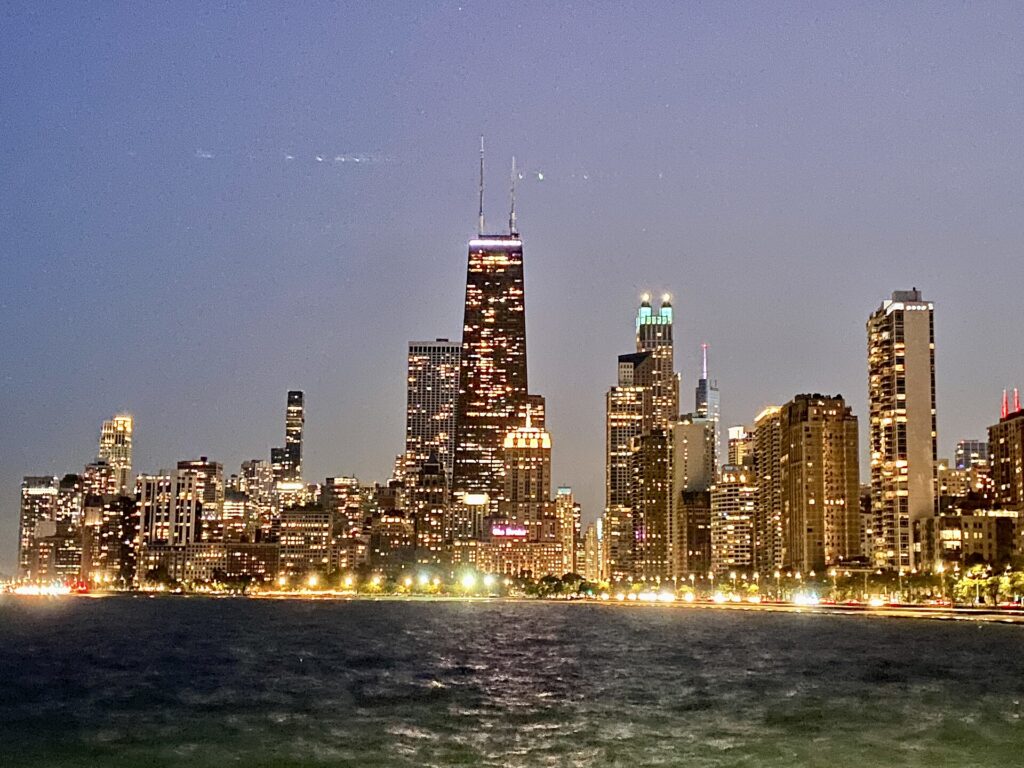
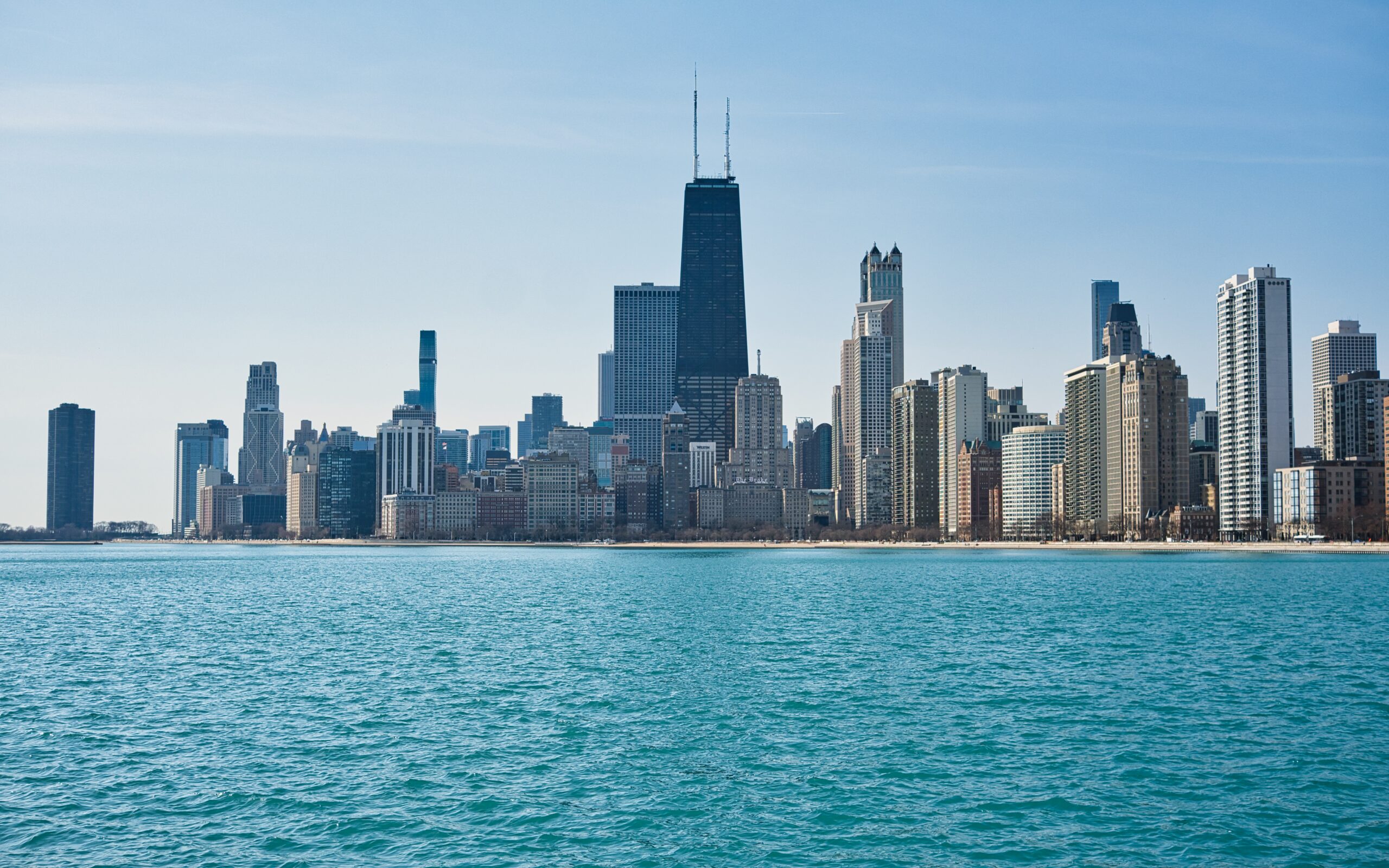
    The Chicago skyline from North Avenue Beach on Lake Michigan
    North Avenue Beach, where Chicago spends its summer, and the reason June to August is peak season (Photo: w_lemay via Wikimedia Commons, CC BY-SA 2.0)

    Chicago’s weather, season by season

    Chicago has a continental climate moderated, sometimes, by Lake Michigan. Winters are cold and windy, with snow from December to March and occasional Arctic outbreaks that push wind chills far below zero; spring comes late, and the lake keeps the shore cool into June; summers are warm to hot and humid, with thunderstorms; and fall is long, dry and clear. The figures below are approximate seasonal patterns based on the long-term climate normals from NOAA’s National Weather Service office for Chicago; check the current forecast before you pack, because a spring day by the lake can be 10 degrees cooler than the same day at O’Hare.

    MonthTypical daytime highTypical overnight lowWhat it feels likeFare pressure
    Januaryaround 0 °C (32 °F)around -8 °C (18 °F)Cold, gray and windy; Arctic snaps bring bitter wind chillsLow after New Year’s week
    Februaryaround 2 °C (36 °F)around -6 °C (21 °F)Still deep winter; the snowiest month in some yearsLow; rises for the Auto Show and Presidents’ Day
    Marcharound 8 °C (47 °F)around -1 °C (30 °F)Raw and changeable; a warm day, then snowLow to moderate; spring break and St. Patrick’s weekend
    Aprilaround 15 °C (59 °F)around 4 °C (40 °F)Spring in fits and starts; cool by the lake, rain showersModerate
    Mayaround 21 °C (70 °F)around 10 °C (50 °F)Green and pleasant, but the lakefront can stay chillyModerate; conventions and Memorial Day push it up
    Junearound 27 °C (80 °F)around 16 °C (60 °F)Warm, long days; beaches open; thunderstormsHigh
    Julyaround 29 °C (84 °F)around 19 °C (66 °F)Hot and humid, with heat waves; the lake breeze helpsPeak
    Augustaround 28 °C (82 °F)around 18 °C (64 °F)Hot and humid; the warmest lake swimming of the yearHigh, easing late in the month
    Septemberaround 24 °C (75 °F)around 13 °C (56 °F)Often the best month: warm, dry and sunnyModerate to high
    Octoberaround 17 °C (62 °F)around 7 °C (44 °F)Crisp and clear; fall color in the parksModerate, with a marathon spike
    Novemberaround 9 °C (48 °F)around 1 °C (33 °F)Gray and cooling fast; first snow possibleLow, then high for Thanksgiving
    Decemberaround 2 °C (36 °F)around -5 °C (23 °F)Cold and festive; snow likely by the holidaysModerate early, then peak for the holidays

    Three things the table cannot show. First, the wind chill: Chicago’s nickname has nothing to do with the weather, but the wind off the lake and down the canyons of the Loop makes a -5 °C (23 °F) day feel much colder, and an Arctic outbreak in January or February can push the wind chill to levels where exposed skin is at risk within minutes. Second, the lake effect: in spring and early summer, an onshore breeze can drop the temperature along the shore by 10 degrees or more in an hour, which is why forecasts say “cooler by the lake”, and in winter the lake can add bands of snow. Third, the thunderstorms: summer storms roll in fast from the west, and they are the main cause of delays at O’Hare between June and August, not the snow.

    How Chicago’s fare seasons work

    Three calendars drive demand for Chicago. The first is the leisure season, which is heavily weighted to summer, when the lakefront, the festivals and the ballparks draw visitors from across the Midwest and the country. The second is the convention calendar: McCormick Place and the big downtown hotels host trade shows and medical and industry conferences through most of the year, and a single large show can fill the city’s hotels and lift weekday fares in any month except the depth of winter. The third is the hub effect: because O’Hare and Midway are major connecting airports with heavy competition among United, American and Southwest, airfares to Chicago are often lower than the city’s popularity would suggest, and the hotel is usually the bigger variable in the trip.

    Peak season

    June to August, marathon weekend in October, and roughly the week of Thanksgiving through New Year’s Day. Summer brings the highest hotel rates of the year, with the festival weekends, the Fourth of July and Lollapalooza at the top; the holidays bring demand for the Magnificent Mile lights, the Christkindlmarket and family visits. If you must travel in peak, book early, fly mid-week, and compare hotels across neighborhoods rather than only downtown.

    Shoulder season

    April to May and September to early November. Late May and early June give you long days and blooming parks before the summer surge; September and October give you the city’s most reliable weather. These are also the busiest months for conventions, so check for a large show before you book: a week that looks cheap in the airfare calendar can still carry a hotel spike.

    Low season

    January to mid-March, outside the New Year week and the big February events. Fares and hotel rates are at their lowest, the theaters, museums and restaurants are quiet, and the Bulls and Blackhawks are in season. The trade-off is real cold. Build a buffer into connections, because snowstorms can ground flights at O’Hare for a day, and pack for wind chills below freezing even on a “mild” day.

    As elsewhere, mid-week departures and early or late flights usually price below Friday and Sunday afternoons on the same route, and a search across a whole month reveals cheaper pairs of dates close to your first choice. Our guide to the best times to book explains how to read those patterns.

    Chicago month by month

    January

    The cheapest month of the year to fly and to stay, after the first week. It is also the coldest, with gray skies, regular snow and the possibility of a polar blast. The upside is a city to yourself: no lines at the Art Institute or the Field Museum, easy restaurant reservations, the ice rink in Millennium Park, Bulls and Blackhawks games at the United Center, and the underground Pedway to get around the Loop without a coat. Chicago Restaurant Week, a multi-week run of set-price menus across the city, usually starts in late January or early February.

    February

    Similar weather and low fares, with two exceptions: the Chicago Auto Show at McCormick Place, one of the largest in the country, which fills downtown hotels for about ten days, and the Presidents’ Day weekend. Otherwise February is excellent value for a museum, theater and food trip.

    March

    Raw and changeable, with snow and sixty-degree days in the same week. The river turns green for the St. Patrick’s Day parade weekend, which draws huge crowds downtown, and college spring breaks lift fares in the second half of the month. The first half of March remains one of the cheapest windows of the year.

    April

    Spring arrives, unevenly: the tulips on Michigan Avenue bloom, the Cubs and White Sox open their seasons in weather that can include snow, and the lake keeps the shore cool. Fares are moderate and hotel rates begin to climb, and the first large conventions of the year appear. A good month for the city if you pack layers and do not plan on the beach.

    May

    Green, pleasant and busy. The National Restaurant Association Show and other large conventions at McCormick Place fill hotels for parts of the month, and Memorial Day weekend, when the beaches officially open, is the start of summer. The Riverwalk and the patios come back to life. Book around the big shows and late May is a lovely time to visit.

    June

    Long days, warm weather and the start of the festival season: the Chicago Blues Festival in Millennium Park, the free Grant Park Music Festival concerts, street festivals in the neighborhoods nearly every weekend, and the Pride Parade on the last Sunday of the month. Fares and hotel rates climb through the month; early June is the value play.

    July

    Peak summer. The Fourth of July fireworks, the beaches, the rooftop bars, the ballparks and the architecture cruises are all at full capacity, and the weather is hot and humid with the occasional heat wave. Hotel rates are near their annual high, and Lollapalooza, which can start at the end of July, pushes them higher still.

    August

    Lollapalooza fills Grant Park for four days in late July or early August, and the Chicago Air and Water Show takes over the lakefront sky later in the month. The lake is at its warmest for swimming, the city is at its liveliest, and the last week, once schools start, brings slightly softer prices. Thunderstorms are the main travel hazard.

    September

    The month many Chicagoans would pick: warm and dry, with the beach still usable for the first few weeks and the humidity gone. The Chicago Jazz Festival fills Labor Day weekend, and the Bears’ season begins at Soldier Field. It is also a heavy convention month, so hotel rates can be higher than the weather-and-crowds picture suggests.

    October

    Crisp, clear and colorful in Lincoln Park and along the lakefront. The Chicago Marathon, on a Sunday in early-to-mid October, is one of the world’s major marathons, and that weekend is among the most expensive of the year for hotels. Open House Chicago, when buildings across the city open their doors for free, is a highlight for architecture lovers. Outside marathon weekend, October is excellent value.

    November

    Gray and cooling, with the first snow possible late in the month. The first half is quiet and cheap. The Magnificent Mile Lights Festival on the weekend before Thanksgiving opens the holiday season, the Christkindlmarket opens in Daley Plaza, and Thanksgiving week brings a sharp spike in fares as the whole country travels.

    December

    Two months in one. The first half is festive and moderately priced: the lights, the tree in Millennium Park, the markets, the windows on State Street, holiday shows at the theaters. From about December 18, fares rise sharply for Christmas and New Year, and New Year’s Eve hotel rates downtown are among the highest of the winter.
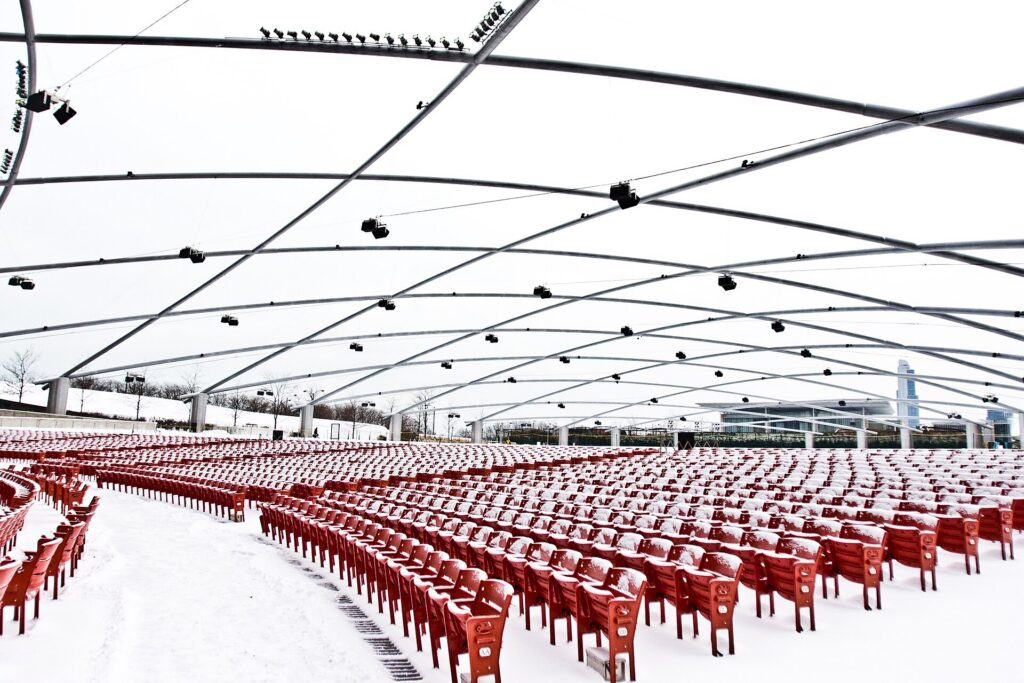
    Millennium Park in downtown Chicago under snow in winter
    Chicago in winter: cold, windy and the cheapest time of year to visit (Photo: Tony Webster via Wikimedia Commons, CC BY-SA 3.0)

    Events that move Chicago flight and hotel prices

    Cross-check these against your dates before you book. Exact dates shift each year; Choose Chicago, the city’s official tourism site, keeps the current calendar.

    • Chicago Auto Show (February, about ten days at McCormick Place).
    • St. Patrick’s Day parade weekend (usually the Saturday before March 17), when the river is dyed green.
    • Major conventions at McCormick Place, which can fill downtown hotels in any month but cluster in spring and fall; if weekday rates look strangely high, that is usually why.
    • Memorial Day weekend (last Monday of May): the start of beach season.
    • Blues Festival and Pride (June), and the Fourth of July.
    • Lollapalooza (four days in late July or early August): the single biggest summer hotel spike.
    • Air and Water Show (August) and the Jazz Festival (Labor Day weekend).
    • Chicago Marathon (a Sunday in early-to-mid October).
    • Thanksgiving through New Year’s Day, with the Lights Festival the weekend before Thanksgiving.
    • Home games and concerts: Cubs and White Sox from April to September, Bears from September, Bulls and Blackhawks from October. Our Chicago events page shows what is on sale for your dates.

    Getting in from the airports

    Chicago has two commercial airports, both run by the city’s Department of Aviation. O’Hare International (ORD), about 27 km (17 miles) northwest of the Loop, is one of the busiest airports in the world, a hub for United and American, and the city’s main international gateway, with Terminal 5 as its international terminal. The CTA Blue Line runs from beneath the terminal core to the Loop 24 hours a day, in about 45 minutes, and it is often faster than a taxi at rush hour on the Kennedy Expressway, where the drive can take anywhere from 30 minutes to well over an hour. Midway (MDW), about 16 km (10 miles) southwest of the Loop, is smaller and easier, dominated by Southwest, with the CTA Orange Line reaching the Loop in about 25 minutes. Taxis, ride-hail and rental cars are available at both; at O’Hare, the rental companies share a multi-modal facility reached by the airport transit system. Our Chicago car-versus-transit guide works through the ground-transport decision, and our O’Hare airport guide covers the terminals.
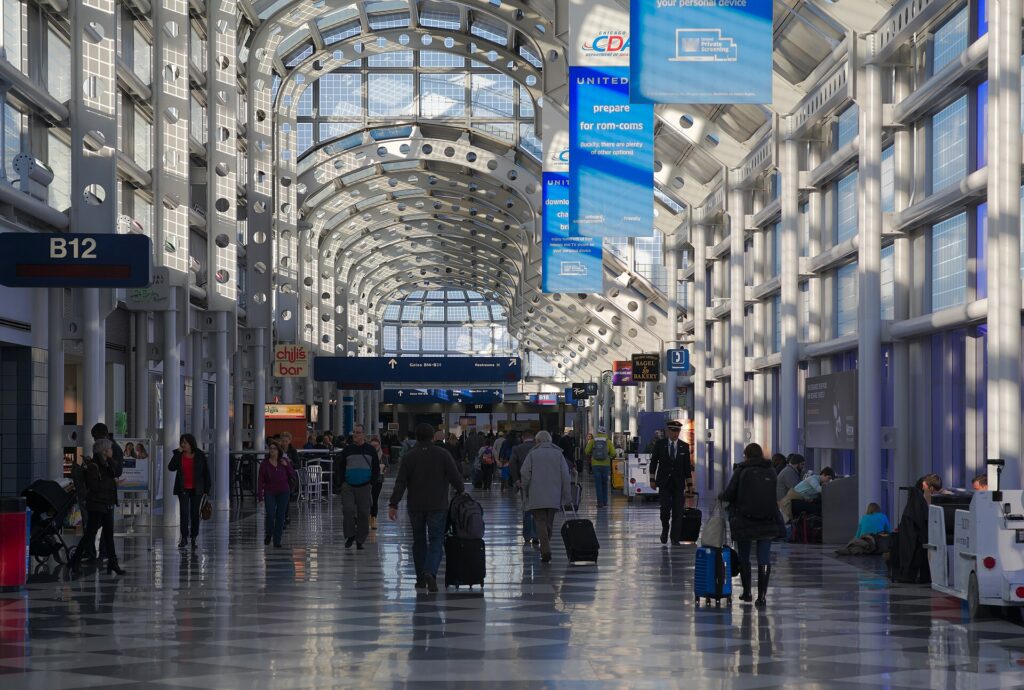
    Concourse B in Terminal 1 at Chicago O'Hare International Airport
    O'Hare's Terminal 1, the United hub and one of the busiest airport complexes in the world (Photo: Dllu via Wikimedia Commons, CC BY-SA 4.0)

    Timing tricks that work for Chicago

    • Search both airports. O’Hare and Midway compete on many routes, and Southwest’s big schedule at Midway often undercuts the O’Hare fare on domestic flights; compare both before you book.
    • Check the convention calendar. A cheap weekday fare in May or September can come with a hotel rate that doubles the trip. Run a Chicago hotel search for the same dates before you commit to either.
    • Fly mid-week, stay the weekend. Chicago’s business travel makes Monday morning and Thursday evening flights the busiest, while downtown hotels, full of conventioneers on weekdays, are sometimes cheaper on Friday and Saturday nights outside summer.
    • Go in winter for value. January to early March has the lowest prices of the year and the museums, theaters and restaurants at their most relaxed; just pack for the cold.
    • Consider Milwaukee. Milwaukee’s airport, about 145 km (90 miles) north, has its own Amtrak station on the line to downtown Chicago, and occasionally has better fares.
    • Build a weather buffer. Snow in winter and thunderstorms in summer both cause ground stops at O’Hare; avoid the tightest connections. Our guide to how early to arrive covers what to allow.
    • Flying out of Chicago instead? O’Hare’s route network makes it one of the best departure airports in the country; see cheap flights from Chicago.
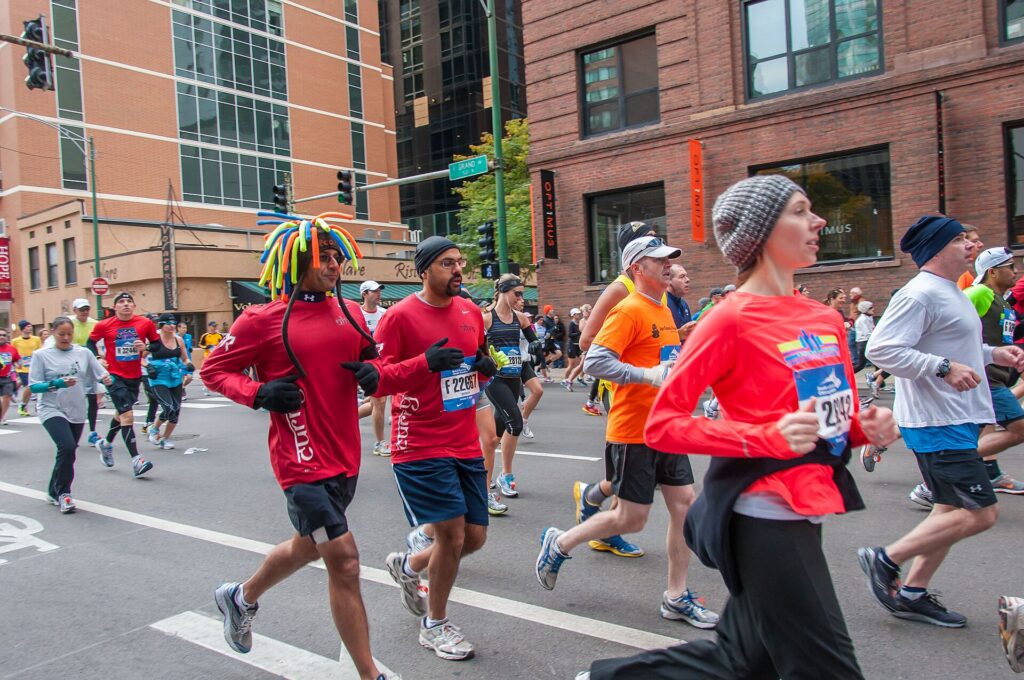
    Runners on the streets of Chicago during the Chicago Marathon
    The Chicago Marathon in October, one of the most expensive hotel weekends of the fall (Photo: bradhoc from USA via Wikimedia Commons, CC BY 2.0)

    What to pack, by season

    Winter (December to March): a properly warm, windproof coat, a hat that covers your ears, gloves, a scarf, waterproof boots with grip, and thermal layers for the coldest days; Chicagoans dress for the wind chill, not the thermometer. Spring (April to May): layers, a rain jacket and a warm sweater for the lakefront, which can be much cooler than inland. Summer (June to August): light, breathable clothing, a swimsuit for the beaches, sunscreen, and a light layer for air-conditioned museums and evening boat tours. Fall (September to November): layers again, a medium jacket by October and a warm coat by November. In every season, bring comfortable walking shoes; this is a city best seen on foot.

    The best time to fly to Chicago for…

    Summer on the lakefront

    Mid-June to mid-July for long days and warm beaches, or late August for the warmest water with slightly fewer crowds. Book early and check for festival weekends.

    Good weather without the crowds

    September, avoiding the big convention weeks, or the first half of June.

    The lowest fares

    Mid-January to early March, outside the Auto Show and the long weekends, with Restaurant Week as a bonus.

    Baseball

    Any time from April to September, but May, June and September for comfortable day games at Wrigley without July’s heat.

    Families

    June or August, when the beaches, Navy Pier and the Museum Campus are all in full swing; December for the holiday lights if the budget allows.

    International visitors

    Travelers from Visa Waiver Program countries need an approved ESTA before they board; most others need a visa. The State Department’s travel site explains what applies to you, U.S. Customs and Border Protection covers arrival, and the TSA lists what you can carry through security.

    Frequently asked questions

    What is the cheapest month to fly to Chicago?

    January, after the New Year week, followed by February outside the Auto Show and early March.

    What is the best month to visit Chicago for weather?

    September, with late May, June and early October close behind. July and August are hot and humid; January and February are very cold.

    Should I fly into O’Hare or Midway?

    Whichever is cheaper for your route. O’Hare has far more flights and all long-haul international service; Midway is closer to the Loop and quicker to get through, and it is Southwest’s base.

    How expensive is Chicago during Lollapalooza?

    Very, for hotels: it is one of the most expensive weekends of the summer, and downtown sells out. Flights rise too, though less sharply. Book well ahead or pick another weekend.

    How cold does Chicago get in winter?

    Daytime highs around freezing are typical in January, but Arctic outbreaks can bring temperatures well below -18 °C (0 °F) and dangerous wind chills for a few days most winters.

    How far ahead should I book?

    Earlier for summer, marathon weekend, the holidays and convention weeks, when fares and rates tend only to rise; for January to early March, fares are stable enough that finding the right dates matters more than booking early.

    Why is it called the Windy City?

    Nobody is entirely sure. One popular theory credits the city’s boastful nineteenth-century boosters and politicians, another simply the weather; either way, the wind off Lake Michigan makes the name feel earned in January.

    Ready to pick your dates? Compare fares across the whole month on our Chicago flights page, then find a room with our Chicago hotel search. For what to do when you land, start with our first-timer’s guide to Chicago.

  • Chicago: Should You Rent a Car or Rely on Public Transit?

    Chicago: Should You Rent a Car or Rely on Public Transit?

    Chicago is the rare American city where most visitors are better off without a car. It has the second-largest public transit system in the country, trains that run from both airports straight into downtown, a 24-hour rail line to O’Hare, a compact core of walkable neighborhoods, a lakefront trail made for bikes, and some of the most expensive parking and highest rental taxes anywhere in the Midwest. The expressways into the city are also among the most congested in the nation. But the question is not quite closed. Chicago is the hub of the Midwest, and a surprising number of travelers use it as the start of a road trip to Wisconsin, Michigan or the Illinois countryside, visit family in the far-flung suburbs, or want the freedom to reach Starved Rock or the Indiana Dunes on their own schedule. This guide explains how the city is laid out, how the ‘L’, the buses and Metra work, what driving and parking here are really like, and gives you a straightforward way to decide.

    The short answer

    Skip the car if you are staying downtown, in River North, the West Loop, the Magnificent Mile or a North Side neighborhood, and your plans are the museums, the lakefront, the river, the ballparks and the restaurants; the ‘L’, the buses, Divvy bikes and your feet will cover all of it, and you will save the parking fees, the taxes and the traffic. That is most visitors. Rent a car if you are driving on to Milwaukee, Wisconsin’s lakes, Michigan or Minneapolis, if you are visiting family in the outer suburbs, if you have a day planned at Starved Rock or Galena, or if you are traveling with small children and a lot of gear to a hotel outside the transit network. And if you need a car for only part of the trip, rent it only for those days, picking up in the city rather than at O’Hare. Compare rental rates for any of these plans on our Chicago car rental page.

    How Chicago is laid out

    Chicago is a grid, and a very logical one. Every address is numbered from the intersection of State and Madison Streets in the Loop, with 800 numbers to a mile, so 1600 North is two miles north of Madison and 3200 West is four miles west of State. Lake Michigan forms the eastern edge of everything. Downtown is the Loop, the business district inside the ring of elevated tracks, with Millennium Park and the Art Institute on its lake side; the Chicago River wraps its north and west sides. North of the river are River North and the Magnificent Mile, then the Gold Coast, Old Town, Lincoln Park and Lakeview along the lake. West of the Loop is the West Loop and Fulton Market; the Museum Campus and the South Loop are to the south, with Chinatown, Pilsen and, farther down the lake, Hyde Park. The city extends for miles in every direction, and the suburbs for many more, with O’Hare on the northwest edge and Midway on the Southwest Side.

    Hotels cluster in the Loop, River North, the Magnificent Mile and the West Loop, with a large group around O’Hare in Rosemont and a scattering in the neighborhoods. Our Chicago hotel search lets you compare them, and it is worth checking the parking fee on any hotel before you decide on a car.

    Getting in from the airports

    O’Hare (ORD) is about 27 km (17 miles) northwest of the Loop. The CTA Blue Line leaves from a station beneath the parking garage in the middle of the terminal complex, runs 24 hours a day, and reaches the Loop in about 45 minutes for a slightly higher fare than a normal ride; it is the cheapest way downtown and, at rush hour, often the fastest. By taxi or ride-hail, the drive along the Kennedy Expressway takes anywhere from 30 minutes late at night to well over an hour at the evening peak. The rental companies share a multi-modal facility reached by the free airport transit train. Midway (MDW), about 16 km (10 miles) southwest of the Loop, is simpler still: the CTA Orange Line starts at the terminal and reaches the Loop in about 25 minutes, and the rental counters and taxis are a short walk away. The Chicago airports’ site covers ground transport at both; our O’Hare airport guide covers the layout.

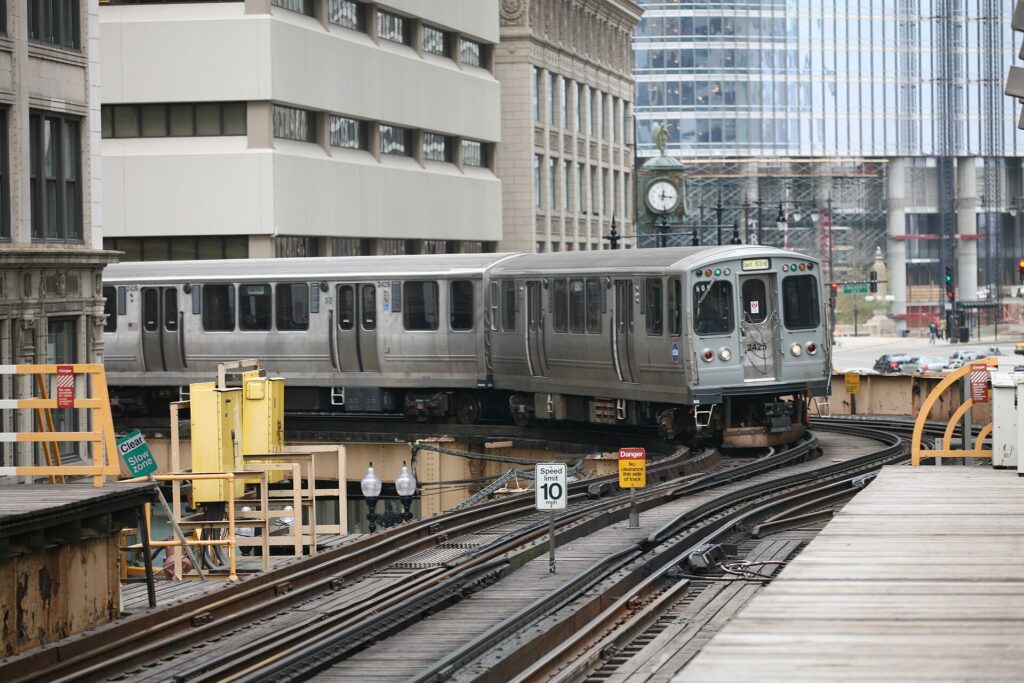
    A CTA 'L' train on the elevated tracks at the northeast corner of the Loop
    The 'L' on the elevated Loop tracks, the cheapest sightseeing ride in the city (Photo: Daniel Schwen via Wikimedia Commons, CC BY-SA 4.0)

    Chicago’s transit, explained

    The Chicago Transit Authority runs the ‘L’ trains and the city buses, Metra runs the commuter rail to the suburbs, and Pace runs the suburban buses. For a visitor, the CTA alone covers almost everything, and it is frequent, extensive and, on the main lines, around the clock.

    The ‘L’

    Eight color-coded lines and about 145 stations. The Red Line is the backbone, running north-south through the city under State Street, with stops for the Magnificent Mile, Wrigley Field (Addison), Chinatown and the White Sox ballpark. The Blue Line runs from O’Hare through Logan Square, Wicker Park and the Loop to the West Side. Both run 24 hours. The Brown, Green, Orange, Pink and Purple Lines circle the Loop on the elevated tracks that give the district its name, and then fan out to the North Side, the West Side, Oak Park and Midway; the Yellow Line is a short shuttle to Skokie. Riding the Brown Line around the elevated Loop at dusk is one of the best cheap sightseeing trips in the city. Trains on most lines run every few minutes at peak times and less often late at night; check the CTA’s train tracker for real-time arrivals.

    Buses

    The CTA’s bus network follows the grid and reaches everywhere the ‘L’ does not, including the Museum Campus, Navy Pier and the lakefront neighborhoods. Useful routes for visitors run along Michigan Avenue, the lakefront and the major east-west streets, and some of the busiest run through the night. Buses get caught in traffic at rush hour, but for short trips across the grid they are hard to beat.

    Metra and the South Shore Line

    Metra’s eleven commuter lines leave from four downtown terminals, Union Station, the Ogilvie Transportation Center, LaSalle Street and Millennium Station, for the suburbs, including Evanston, Oak Park and the Chicago Botanic Garden. Service is frequent at rush hour and thinner at weekends. The separate South Shore Line runs from Millennium Station to Indiana Dunes National Park and South Bend.

    Fares and tickets

    The simplest way to pay on the CTA is to tap a contactless bank card or a phone wallet at the turnstile or on the bus; you can also buy a reusable Ventra card at stations, or use the Ventra app, which also sells Metra tickets. One-, three- and seven-day unlimited passes are good value if you will ride more than a few times a day, and transfers within two hours are discounted or included depending on how you pay. Trips starting at the O’Hare station cost more than a standard ride. Children under seven ride free, and there are reduced fares for older children, seniors and riders with disabilities. Check the CTA’s site for current fares before you go.

    Accessibility

    Every CTA bus is accessible, and most ‘L’ stations have elevators, though some older stations on the elevated lines do not; the CTA is working through them and marks accessible stations on its maps. Check before relying on a particular station with a wheelchair or a stroller.

    Beyond the CTA

    • Walking and the Pedway. The Loop, River North, the Magnificent Mile and the lakefront are all easy on foot, and the grid makes it hard to get lost. In winter, the Pedway, a network of underground tunnels and overhead bridges beneath about forty blocks of the Loop, links stations, office buildings and department stores out of the wind.
    • Divvy bikes. The city’s bike-share system has thousands of pedal bikes and e-bikes at docks across the city, and the Lakefront Trail, the Riverwalk and a growing network of protected lanes make it the best way to see the shore. Buy a day pass or ride by the minute through the Divvy app.
    • Water taxis. In the warmer months, water taxis run along the river between the train stations, Michigan Avenue and Chinatown, and across the harbor between Navy Pier and the Museum Campus. They are transport and a sightseeing trip at once.
    • Taxis and ride-hail. Licensed taxis and the ride-hail apps operate across the city. For a group of three or four, a short ride is competitive with transit fares, and late at night it is the easy way home from the neighborhoods off the 24-hour lines.
    • Amtrak. Union Station is the hub of the national rail network, with frequent trains to Milwaukee and regular services to Detroit, St. Louis and beyond; Amtrak is a genuine alternative to a rental for trips to Milwaukee.
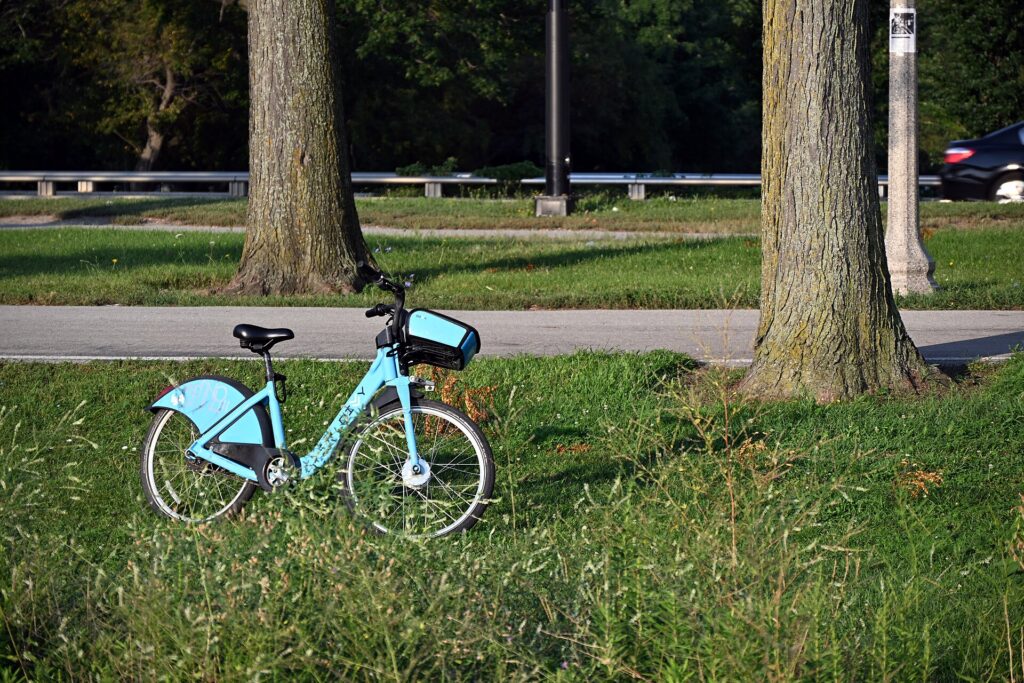
    A Divvy bike-share bike on the Lakefront Trail in Chicago
    A Divvy bike on the Lakefront Trail, the best way to see the shore (Photo: DimiTalen via Wikimedia Commons, CC0)

    Driving in Chicago: what it is really like

    Driving in Chicago is manageable for anyone used to a big American city, and the grid makes navigation easy, but it is rarely fast. The expressways, the Kennedy to O’Hare, the Dan Ryan south, the Eisenhower west, the Stevenson toward Midway and the Edens north, converge on downtown and jam every weekday morning and evening, and the city consistently ranks among the most congested in the United States. The Circle Interchange, where they meet west of the Loop, is notorious. Lake Shore Drive, officially renamed Jean Baptiste Point DuSable Lake Shore Drive, is the scenic exception: an expressway along the lakefront with the skyline on one side and the beaches on the other, and one of the great urban drives in the country, though it too backs up at rush hour and trucks are banned from it. Downtown streets are dense with pedestrians, cyclists, buses and delivery vehicles, many turns are restricted, and summer brings construction on the main routes and street closures for festivals and parades.

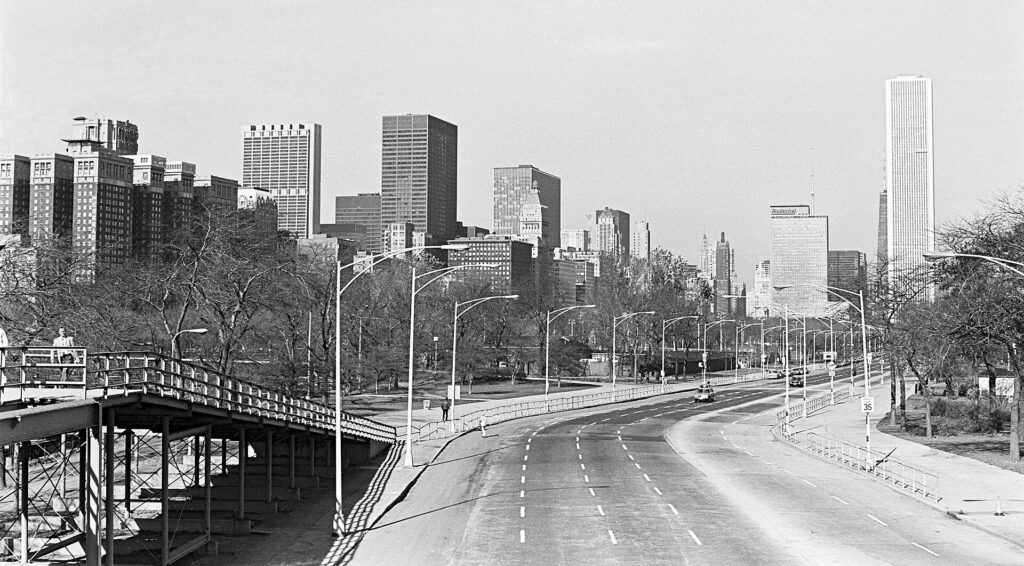
    Lake Shore Drive running north along Lake Michigan in the evening
    Lake Shore Drive, one of the great urban drives in America, and still jammed at rush hour (Photo: Downtowngal via Wikimedia Commons, CC BY-SA 4.0)

    Parking

    Parking is where a Chicago rental gets expensive. The city’s parking meters were leased to a private operator in 2008, and the rates in the Loop and River North are among the highest of any American city; pay at the street boxes or with the ParkChicago app, and read the signs for rush-hour restrictions, which tow cars from some arterial streets at peak times. Downtown hotels charge a substantial nightly fee, often for valet only, and the garages are priced accordingly, although booking a garage space online in advance can cut the rate considerably. In the neighborhoods, residential permit zones cover many side streets in the evenings, and street cleaning signs from spring to fall mean a ticket or a tow for the unwary. In winter, the city bans overnight parking on certain signed arterial streets from December 1 to April 1, and a separate ban kicks in on other routes after a heavy snowfall. The city’s impound lots are a long way from anywhere, and retrieving a towed car costs a day of your trip.

    Rules and conditions worth knowing

    • Tolls. The Illinois Tollway, which includes the roads to O’Hare’s western side, the Tri-State around the suburbs and the route toward Wisconsin, is fully electronic, with no cash booths. Rental companies offer transponder programs for a daily fee; if you decline, you can usually pay the tolls online by license plate within the grace period on the Illinois Tollway’s site. I-PASS and E-ZPass transponders both work.
    • Cameras. Speed cameras operate near parks and schools across the city, and red-light cameras at more than a hundred intersections; the fines follow the car, and the rental company will bill you with a fee on top.
    • Phones. Illinois bans handheld phone use while driving; hands-free only.
    • Right turns on red are permitted after a full stop unless signed otherwise, and many downtown intersections are signed otherwise.
    • Winter driving. The city and state plow quickly, and rental cars on all-season tires cope with most Chicago winters, but lake-effect snow bands and ice storms can make the expressways treacherous for a few hours. Check conditions before long drives from December to March.
    • Fuel and taxes. Layered state, county and city taxes make fuel in Chicago noticeably pricier than in Indiana or Wisconsin, and Chicago and O’Hare add some of the steepest rental taxes and fees in the country. Fill up across the state line on a road trip.
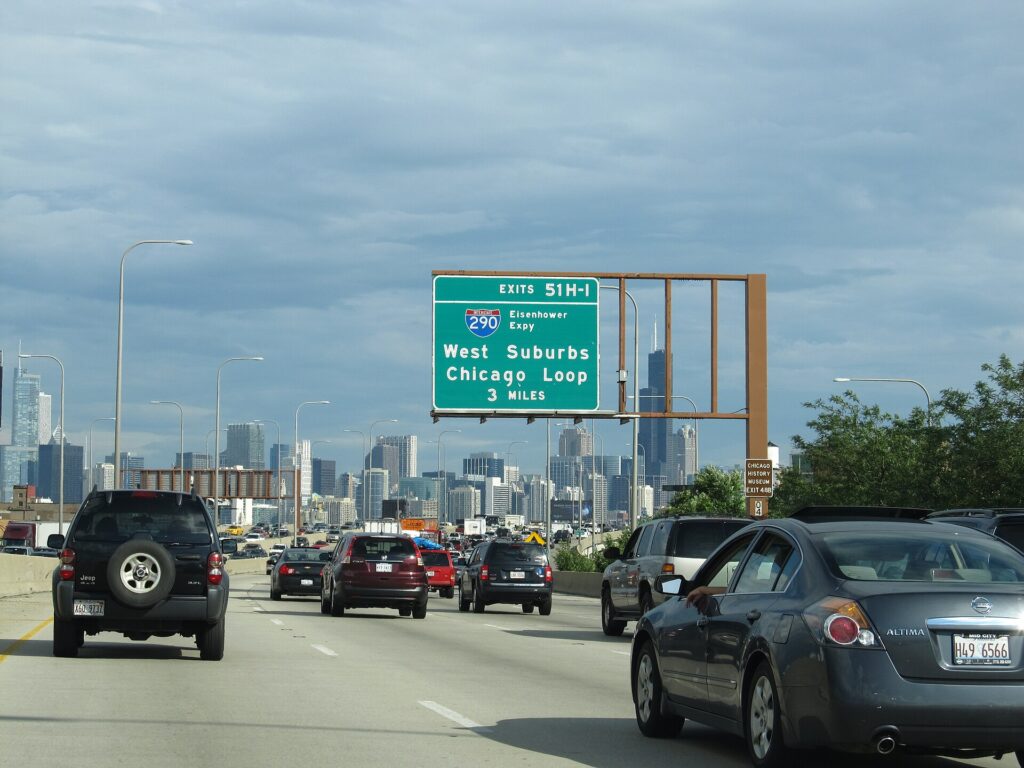
    Traffic on the Kennedy Expressway approaching downtown Chicago
    The Kennedy Expressway, the road from O'Hare, where the Blue Line often beats a taxi at rush hour (Photo: Ken Lund from Reno, Nevada, USA via Wikimedia Commons, CC BY-SA 2.0)

    When renting a car makes sense

    • Midwest road trips. Chicago is the natural start for a drive north to Milwaukee, Madison and Minneapolis, or east around the lake to Michigan; our route guides for Chicago to Minneapolis and Chicago to Detroit cover the two classic runs.
    • State parks and small towns. Starved Rock State Park, Galena and Lake Geneva in Wisconsin are effectively car-only.
    • Family in the suburbs. The suburbs sprawl for 50 miles or more, and while Metra reaches many of them, a car earns its keep daily if your base is out there.
    • Families with small children and gear staying outside the city, where the train is not an option.
    • A hotel near O’Hare for a business trip to the suburbs, where offices are spread out along the tollways.

    If any of those apply, our rental car booking tips cover insurance, deposits and the questions to ask at the counter, and our family car rental guide looks at vehicle choice.

    When it does not

    • You are staying downtown, in River North, the West Loop or a North Side neighborhood, and your plans are the city.
    • You are in town for a convention at McCormick Place, a ball game, a concert or a festival, when traffic and parking are at their worst and transit goes straight to the door.
    • Your day trips are Oak Park, Evanston, the Indiana Dunes or Milwaukee, all of which have direct trains.
    • You are traveling solo or as a couple and would spend more on the rental, taxes and parking than on a week of transit passes and the odd taxi.

    The hybrid plan for a city-plus-road-trip visit

    Go car-free for the city days and rent only for the days you leave town, and think carefully about where you pick up. Renting at O’Hare makes sense if you are driving straight out on arrival toward Wisconsin or the western suburbs, because the tollways are right there and you never enter downtown traffic. For everyone else, it pays to take the Blue Line or the Orange Line into the city, spend the first days without a car, and pick up from a neighborhood or downtown rental office on the morning you leave; you avoid the airport concession fees and several nights of hotel parking. If your road trip ends somewhere else, a one-way rental to Minneapolis or Detroit is a classic Midwest itinerary, though one-way fees vary widely by company and season. Book ahead for summer weekends and holiday weeks. Compare the day rates on our Chicago car rental page against a full-trip rental and the difference is usually obvious.

    A worked cost comparison

    Numbers change with the season and the booking window, so treat this as a method rather than a quote, and check current rates before deciding. For a four-night city break downtown for two people, the car-free version costs two Blue Line trips each way, a pair of multi-day CTA passes, perhaps a Divvy day pass and two or three late-night ride-hail trips; the rental version adds four days of a compact car with Chicago’s rental taxes, four nights of hotel parking at downtown rates, fuel and the airport fees, and buys you nothing you could not reach faster by train. The transit option wins by a wide margin. For the same four nights with a day at Starved Rock, the car-free version cannot easily do it; the hybrid version adds a single-day rental picked up in the city, fuel and a toll or two, and is still far cheaper than a four-day rental with parking. For a week-long road trip to Wisconsin or Michigan that starts in Chicago, a rental is the only practical answer, and the question becomes where to pick it up: O’Hare, if you leave on arrival; the city, if you spend the first nights downtown. Run the rental rates for your dates on our Chicago car rental page and put them beside the transit costs before you choose.

    Driving out of Chicago in each season

    Getting out of Chicago is the hardest part of any road trip from it. In summer, the problem is traffic: northbound on the Edens and the Kennedy on Friday afternoons, as the city heads for Wisconsin’s lakes and the Michigan dunes, and southbound on Sunday evenings, can add an hour or more to the drive, and construction season narrows the expressways from spring to fall. Leave early in the morning or after the evening peak. In fall, the drives north to Door County and Wisconsin’s farm country, and east into Michigan, are at their most beautiful in early-to-mid October, and the roads are quieter once school is back. In winter, the expressways are plowed and generally open, but lake-effect snow can hit northwest Indiana and southwest Michigan hard, making the I-94 run toward Detroit slow or dangerous for a few hours at a time, and Wisconsin and Minnesota can see heavy snow on the way to Minneapolis; check the forecast and the state road-condition sites before you leave, and carry a scraper, a full tank and a warm layer. In spring, the roads are wet and potholed after the freeze-thaw, and the first thunderstorms arrive. In every season, remember that the drive to Detroit crosses into Eastern time, so you lose an hour going east and gain it coming back.

    Decision table

    Your tripRecommendationWhy
    City break downtown, couple or soloNo carThe ‘L’, buses, Divvy and walking cover it; parking and rental taxes are high
    Convention at McCormick PlaceNo carShuttles, buses and Metra serve it; downtown traffic is at its worst
    Ball game, concert or festivalNo carThe Red Line goes to both ballparks; festival street closures make driving miserable
    City plus one day outHybrid: rent in the city for that dayCar-free city days, a single-day rental for Starved Rock or Galena
    Oak Park, Evanston, Milwaukee or the DunesNo car: take the ‘L’, Metra, Amtrak or the South Shore LineAll have direct trains from downtown
    Family visit to the suburbsRent for the whole staySuburban distances make the car worthwhile daily
    Business trip to suburban officesRent at O’HareThe tollways start at the airport; offices are spread out
    Midwest road tripRent (consider one-way to Minneapolis or Detroit)Chicago is the start, not the destination

    Money-saving tips for both options

    • On transit: tap your card or phone, buy a multi-day pass if you will ride often, take the Blue or Orange Line from the airport instead of a taxi, and remember children under seven ride free.
    • On a rental: pick up in the city to avoid the airport fees, rent only for the days you leave town, compare the transponder fee with paying tolls online, decline extras you already have through a credit card or home policy (check first), and fill up outside Chicago.
    • On the hotel: if you are renting, price the parking fee into the room rate, and look at garages you can book online nearby, which are often cheaper than hotel valet.
    • On timing: avoid the expressways in the weekday peaks and on summer Friday afternoons, and watch for convention weeks, when both hotels and traffic are at their worst; the best time to fly to Chicago guide lists the busiest dates.
    • On day trips: for one or two people, a return Amtrak or South Shore Line ticket usually costs less than a day’s rental plus fuel, parking and tolls, and you can read on the way.

    Frequently asked questions

    Is it worth renting a car in Chicago?

    For a city visit, no; the transit is good and parking, taxes and traffic are all expensive. For road trips, the suburbs, state parks and small towns, yes, and rent only for those days.

    Is Chicago public transit good for tourists?

    Very. The ‘L’ and the buses reach almost every sight, the Red and Blue Lines run 24 hours, and both airports have direct train service to the Loop.

    How do I get from O’Hare to downtown Chicago?

    The Blue Line in about 45 minutes, around the clock, or a taxi or ride-hail in 30 minutes to more than an hour depending on traffic.

    How do I get from Midway to downtown Chicago?

    The Orange Line from the terminal to the Loop in about 25 minutes, or a taxi or ride-hail in 20 to 40 minutes.

    Is parking expensive in downtown Chicago?

    Yes, among the most expensive in the country, both on the street and at hotels. Booking a garage online in advance helps, but a downtown visit is cheaper without a car.

    Do I need to pay tolls in a rental car in Chicago?

    Only on the tollways, which are cashless. Use the rental company’s transponder program or pay online by license plate within the grace period.

    Is it safe to ride the ‘L’ at night?

    The main lines are busy into the evening and generally safe; late at night, ride in a car with other passengers, near the front where the operator is, and consider a taxi for the last leg.

    Whichever way you go, start with the flight. Compare cheap flights to Chicago, choose a neighborhood with our Chicago hotel search, read our first-timer’s guide to Chicago, and if a road trip is on the list, price the rental for those dates on our Chicago car rental page.

  • Things to Do in Chicago: A First-Timer’s Guide

    Things to Do in Chicago: A First-Timer’s Guide

    Chicago surprises people who have not been. Visitors expect a big Midwestern city of offices and winter wind, and they find instead the most beautiful skyline in America rising straight out of a river, a lakefront of beaches and parkland that runs for miles without a single private building on it, one of the three or four great art museums in the country, neighborhoods with more personality than most whole cities, and a food scene that goes far beyond the deep-dish pizza everyone arrives wanting to try. It is a city built to be walked and ridden: the ‘L’ rattles above the Loop, the Riverwalk runs beneath the bridges, and the Lakefront Trail is where half the city spends its summer evenings. This guide covers the sights that earn a day, the neighborhoods worth a half-day, the food, the music and the sports, the day trips that the trains make easy, and the practical details that turn a long weekend into a trip you will want to repeat.

    If you are still comparing cheap flights to Chicago, read this alongside our guides to the best time to fly to Chicago and whether you need a car (for the city itself, you probably do not). Between the three you can plan the whole trip.

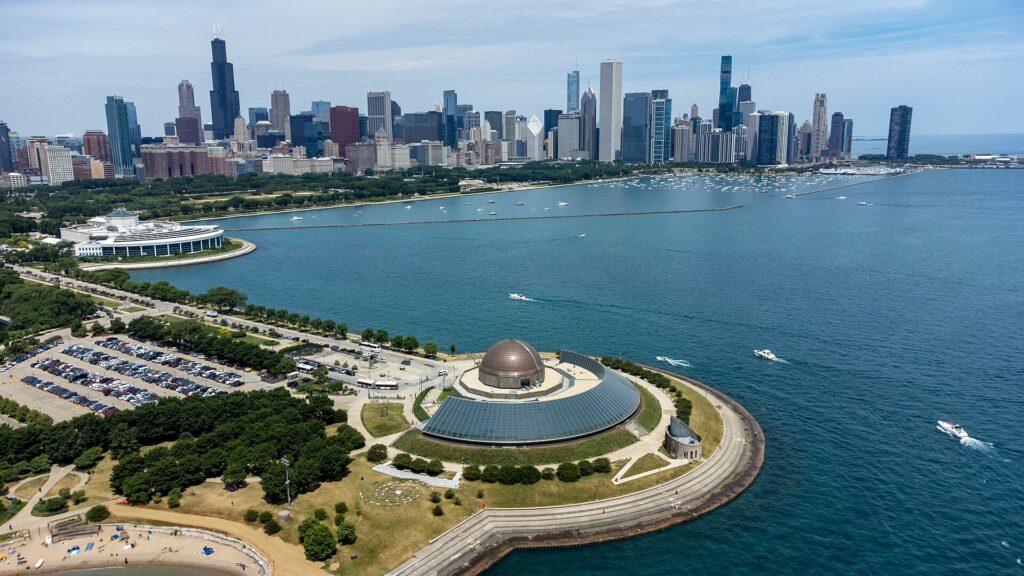
    The Chicago skyline across the water from the Adler Planetarium
    The Chicago skyline from the Museum Campus, the best free view in the city (Photo: Sea Cow via Wikimedia Commons, CC BY-SA 4.0)

    Chicago at a glance for first-timers

    • Airports: two of them. O’Hare International (ORD), about 27 km (17 miles) northwest of downtown, is one of the busiest airports in the world and a hub for United and American; the CTA Blue Line runs from the terminal to the Loop around the clock. Midway (MDW), on the Southwest Side, is smaller, closer and mostly domestic, with the Orange Line at the door. See our O’Hare airport guide.
    • Getting around: the CTA’s ‘L’ trains and buses cover the city, and the Red and Blue Lines run 24 hours; tap a contactless card or phone at the turnstile. The Loop, River North, the Magnificent Mile and the lakefront are all walkable, and Divvy bikes are everywhere. Our car-versus-transit guide explains when a car helps.
    • Money: US dollars. Chicago’s combined sales tax is one of the highest of any big American city, a little over 10 percent, and it is added at the register rather than shown on the tag; hotel taxes are higher still. Tipping 18 to 20 percent in restaurants is expected.
    • Weather: four emphatic seasons: cold, windy winters, a late and changeable spring, warm and humid summers cooled by the lake, and a crisp, clear fall. Our month-by-month guide has the detail.
    • Where to stay: the Loop for the museums, Millennium Park and the theaters; River North and the Magnificent Mile for restaurants and shopping; the West Loop for the dining scene; Lincoln Park or Wicker Park for a neighborhood feel. Our Chicago hotel search covers them all.

    The Loop and Millennium Park

    The Loop, named for the ring of elevated tracks that circles it, is the business district and the historic core, and it is where the city’s reputation as the birthplace of the skyscraper was earned after the Great Fire of 1871. Start at Millennium Park, on its eastern edge, which is free and is the city’s front lawn: Anish Kapoor’s Cloud Gate, the polished steel sculpture everyone calls the Bean, reflects the skyline and the crowds; Jaume Plensa’s Crown Fountain projects the faces of Chicagoans onto two glass towers that spout water in summer; Frank Gehry’s Jay Pritzker Pavilion hosts free concerts on summer evenings; and the Lurie Garden is a quiet planted meadow in the middle of it all. In winter the McCormick Tribune ice rink opens beside the Bean. From there, walk the Loop’s streets for the architecture: the Rookery, with a light-filled lobby remodeled by Frank Lloyd Wright; the dark brick Monadnock Building; the untitled Picasso in Daley Plaza, Chagall’s Four Seasons mosaic a few blocks south and Calder’s red Flamingo in Federal Plaza. The Chicago Cultural Center, across Michigan Avenue from the park, is free and has what is claimed as the largest Tiffany glass dome in the world. For the view, the Willis Tower Skydeck, on the 103rd floor of the building that was the world’s tallest when it opened in 1973, has the Ledge, glass boxes that hang out over the street.

    The Chicago skyline reflected in Cloud Gate, the Bean, in Millennium Park
    Cloud Gate in Millennium Park, the sculpture every Chicagoan calls the Bean (Photo: Roman Boed from The Netherlands via Wikimedia Commons, CC BY 2.0)

    The river: the architecture cruise and the Riverwalk

    If you do one paid thing in Chicago, make it an architecture river cruise. The Chicago River runs through the middle of downtown, and a ninety-minute boat trip up its main and branch channels passes more than a century of skyscrapers, from the Wrigley Building and the Gothic Tribune Tower to the corncob towers of Marina City and the glass curves of the newer residential towers, with a guide explaining how the city reinvented the tall building again and again. The Chicago Architecture Center runs the best-known tour and has a gallery and a large model of the city at its riverside home; several other operators leave from the docks near Michigan Avenue. On foot, the Riverwalk follows the south bank of the main branch for more than a mile from the lake toward the Loop’s western edge, with wine bars, kayak rentals and seating on the water beneath the bascule bridges, several of which still lift for sailboats in spring and fall. The DuSable Bridge on Michigan Avenue is the classic spot to stand, with the river canyon on one side and the start of the Magnificent Mile on the other.

    The lakefront, the Magnificent Mile and Navy Pier

    Chicago’s great civic decision was to keep its lakefront public, and the result is extraordinary: parks, beaches and a trail along Lake Michigan for most of the city’s length. The Lakefront Trail runs about 29 km (18 miles) along the shore, with separate paths for bikes and walkers on the busiest stretches; rent a Divvy bike and ride north from Grant Park past Oak Street Beach to Lincoln Park, and you will see the skyline from its best angle. In summer, North Avenue Beach and Oak Street Beach fill with volleyball, sunbathers and swimmers, a surreal sight with office towers a few hundred yards behind the sand. Grant Park, between the Loop and the lake, holds Buckingham Fountain, which runs from spring to fall with a water show at the top of every hour. The Magnificent Mile, North Michigan Avenue from the river to Oak Street, is the city’s grand shopping street, with the historic Water Tower, one of the few buildings to survive the 1871 fire, and 360 Chicago, the observation deck near the top of the former John Hancock Center, whose lake view many locals prefer to the Skydeck. Navy Pier, a short walk east, is touristy but fun with children, with the Centennial Wheel, boat tours and fireworks on summer evenings.

    The Chicago Lakefront Trail along Lake Michigan with the skyline behind
    The Lakefront Trail, about 18 miles of public shoreline and the best way to see the city by bike (Photo: AlphaBeta135 via Wikimedia Commons, CC BY 4.0)

    Neighborhoods worth a half-day

    River North and the West Loop

    River North, just north of the river, has the densest concentration of restaurants, galleries and hotels in the city. The West Loop, and especially Randolph Street and Fulton Market, is where Chicago’s dining reputation is made: former meatpacking warehouses turned into restaurants, food halls and hotels, with some of the most talked-about kitchens in the country within a few blocks of each other.

    Lincoln Park and Old Town

    North of downtown along the lake, Lincoln Park combines the park itself, with the free Lincoln Park Zoo and the glasshouse conservatory, with a leafy neighborhood of brownstones, bars and blues clubs. Old Town, just south, is home to The Second City, the improv theater that launched a remarkable share of American comedy.

    Wicker Park, Bucktown and Logan Square

    On the Blue Line northwest of the Loop, Wicker Park and Bucktown center on the six-way intersection of Milwaukee, North and Damen Avenues: vintage shops, record stores, bars and brunch. The 606, an elevated rail line turned into a trail, runs through both. Logan Square, a few stops farther, has the boulevards, the cocktail bars and the Sunday farmers’ market.

    Lakeview and Wrigleyville

    Home to Wrigley Field and the Cubs, and to the lively bars around it on game days; Northalsted, in Lakeview, is one of the oldest recognized LGBTQ neighborhoods in the country. Farther north, Andersonville keeps its Swedish heritage and a strip of independent shops, and Uptown has the Green Mill, a jazz club with Prohibition-era history and live music every night.

    Pilsen and Chinatown

    Pilsen, on the Lower West Side, is the historic heart of Mexican Chicago, with street murals, bakeries, taquerias and the free National Museum of Mexican Art. Chinatown, on the Red Line south of the Loop, has dim sum, bakeries and a riverside park with water taxis back downtown in summer.

    Hyde Park

    On the South Side by the lake, Hyde Park is home to the University of Chicago, Frank Lloyd Wright’s Robie House and the Museum of Science and Industry, and it is the site of the Obama Presidential Center in Jackson Park; check its opening status and ticketing before you go.

    Museums, culture and family attractions

    The Art Institute of Chicago, on Michigan Avenue at the edge of Millennium Park, is one of the great museums of the world, and it deserves at least half a day: Seurat’s A Sunday on La Grande Jatte, Hopper’s Nighthawks, Grant Wood’s American Gothic, one of the finest Impressionist collections outside Paris, the miniature Thorne Rooms, and Renzo Piano’s Modern Wing. The Museum Campus, on the lake south of Grant Park, groups three institutions within a short walk: the Field Museum, whose natural history halls hold SUE, one of the most complete Tyrannosaurus rex skeletons ever found; the Shedd Aquarium, with beluga whales and a vast Caribbean reef tank; and the Adler Planetarium, the first planetarium in the Western Hemisphere, with the best skyline view in the city from its front lawn. The Museum of Science and Industry in Hyde Park, housed in a surviving building from the 1893 World’s Fair, has a captured German U-boat, a replica coal mine and hands-on exhibits that keep children busy for hours. The Museum of Contemporary Art near the Water Tower and the free Garfield Park Conservatory on the West Side round out the list. For performance, the Chicago Symphony Orchestra at Symphony Center and the Lyric Opera are world-class, the Goodman and Steppenwolf lead a deep theater scene, and the Broadway houses in the Loop host the touring hits. For what is on stage and in the arenas during your dates, our Chicago events page lists concerts, shows and games.

    The blues, jazz and the summer festivals

    Chicago invented electric blues, when musicians from the Mississippi Delta plugged in on the South Side after the Second World War, and the city still has clubs where you can hear it most nights of the week: Buddy Guy’s Legends in the South Loop and Kingston Mines and B.L.U.E.S. in Lincoln Park are the best known. Jazz has the Green Mill in Uptown and a handful of rooms downtown. In summer the music moves outdoors and much of it is free. The Chicago Blues Festival takes over Millennium Park in June, the Grant Park Music Festival gives free classical concerts at the Pritzker Pavilion through the summer, and the Chicago Jazz Festival fills Labor Day weekend. Lollapalooza, one of the biggest music festivals in the country, occupies Grant Park for four days in late July or early August. The Pride Parade on the last Sunday of June, the Air and Water Show over North Avenue Beach in August, and neighborhood street festivals nearly every summer weekend make the season one long party. In March, the city dyes the river green for the St. Patrick’s Day parade weekend, and in November the Magnificent Mile Lights Festival opens the holidays, with the German-style Christkindlmarket in Daley Plaza running until Christmas Eve.

    Sports

    Chicago is one of the great sports towns, with two teams in baseball and a fan base that fills bars from April to February. Wrigley Field, home of the Cubs since 1916, is the second-oldest ballpark in the major leagues, with ivy on the outfield walls, a hand-turned scoreboard and rooftop bleachers across the street; a day game there is one of the classic American experiences, even for people who do not follow baseball. The White Sox play at Rate Field on the South Side, on the Red Line, with cheaper tickets and excellent ballpark food. The Bears play football at Soldier Field on the lakefront from September to January; the Bulls and the Blackhawks share the United Center on the West Side, where the Michael Jordan statue stands outside; the Fire play soccer at Soldier Field and the Sky play basketball at Wintrust Arena. Check what is on sale in Chicago for your dates before you book flights.

    What to eat, and where

    Start with the classics, and then go further. Deep-dish pizza, baked in a tall pan with the cheese under the tomato sauce, is the famous one, and Lou Malnati’s, Giordano’s and Pizzeria Uno, which claims to have invented it in 1943, all have their loyalists; allow 45 minutes for it to bake. Locals, it should be said, eat more tavern-style pizza, a cracker-thin crust cut into squares. The Chicago-style hot dog comes on a poppy-seed bun with yellow mustard, onion, bright green relish, tomato, a pickle spear, sport peppers and celery salt, and never ketchup. The Italian beef, thin-sliced roast beef soaked in its juices on a roll with sweet peppers or hot giardiniera, is the city’s great sandwich. Beyond that, Chicago’s food is its neighborhoods: tacos and carnitas in Pilsen and Little Village, the Puerto Rican jibarito in Humboldt Park, Vietnamese on Argyle Street in Uptown, Korean and Middle Eastern on the North Side, Polish in Avondale, and some of the most ambitious fine dining in the country in the West Loop. Grab a bag of cheese-and-caramel popcorn, the “Chicago mix”, on the Magnificent Mile, and eat brunch in Wicker Park or Logan Square.

    Chicago through the seasons

    Chicago’s seasons are so distinct that it can feel like four different cities. Winter (December to March) is cold, windy and sometimes brutal, with lake-effect snow and wind chills that keep locals indoors; it is also when the museums are quiet, the theaters and the Bulls and Blackhawks are in season, the rink in Millennium Park is open, and hotels are at their cheapest. The Pedway, a network of underground walkways beneath the Loop, helps. Spring (April to May) arrives late and unevenly; the lake keeps the shore cool while the suburbs warm up, and the Cubs’ season opens in April weather that can include snow. Summer (June to August) is the reason people fall for the city: the beaches, the Lakefront Trail, the free concerts, the festivals, the patios and rooftop bars, and day games at Wrigley. It can be hot and humid, with thunderstorms, but the lake breeze helps. Fall (September to November) is crisp and clear, with the marathon in October, Open House Chicago opening the doors of buildings across the city, and the Bears at Soldier Field. Our month-by-month guide has the fare patterns that go with each season.

    Chicago with kids

    Chicago is excellent with children. The Museum Campus alone fills two days: the dinosaurs at the Field Museum, the belugas and the dolphins at the Shedd, and the sky shows at the Adler. The Museum of Science and Industry is a full day on its own, and the Chicago Children’s Museum is on Navy Pier, alongside the Centennial Wheel and summer boat rides. Lincoln Park Zoo is free, compact and easy with a stroller, and the farm-in-the-zoo section is a hit with small children. In summer, the Crown Fountain in Millennium Park doubles as a splash pad, the Maggie Daley Park next door has a climbing wall, play garden and, in winter, a skating ribbon, and the beaches have lifeguards from late May to Labor Day. A Cubs day game is a rite of passage. Kids ride the ‘L’ for free under seven, and the elevated ride around the Loop on the Brown Line is an attraction in itself. For families planning trips beyond the city, our family car rental guide covers the vehicle question.

    Chicago on a budget

    A remarkable amount of Chicago’s best is free: Millennium Park and the Bean, the Lakefront Trail and the beaches, the Riverwalk, the Lincoln Park Zoo and Conservatory, the Garfield Park Conservatory, the Chicago Cultural Center, the National Museum of Mexican Art, the Loop’s public art, and the summer concerts in Millennium and Grant Parks. The big museums offer free days for Illinois residents but not for visitors, so budget for them, and consider a multi-attraction pass if you plan to see four or more. Eat well for less on hot dogs, Italian beef, tacos in Pilsen and dim sum in Chinatown. A multi-day CTA pass makes transit almost free per ride, and hotel rates from January to March are among the lowest of any big American city. Compare rates by neighborhood on our Chicago hotel search.

    Day trips from Chicago

    Oak Park, on the Green Line or Metra just west of the city, has the largest collection of Frank Lloyd Wright buildings anywhere, including his Home and Studio and Unity Temple; the Frank Lloyd Wright Trust runs the tours. Evanston, on the Purple Line or Metra north, has the Northwestern University campus on the lake, and neighboring Wilmette has the domed Bahá’í House of Worship; the Chicago Botanic Garden in Glencoe is on the same Metra line. Indiana Dunes National Park, about an hour east on the South Shore Line train, has beaches and giant sand dunes on the southern shore of Lake Michigan; the National Park Service has the trail and beach details. Milwaukee, about 145 km (90 miles) north and 90 minutes by Amtrak, has Calatrava’s winged art museum on the lake, the Harley-Davidson Museum and its own brewing tradition. By car, Starved Rock State Park, about two hours southwest, has canyons and waterfalls along the Illinois River, and Lake Geneva in Wisconsin and Galena in the far northwest of the state are classic weekend escapes. For longer road trips, see our route guides for driving from Chicago to Minneapolis and Chicago to Detroit, or price a car on our Chicago car rental page. Choose Chicago, the city’s official tourism site, covers the region.

    The Chicago Riverwalk beneath the towers of the Chicago River
    The Riverwalk along the main branch of the Chicago River, with the Wrigley Building beyond (Photo: MK Feeney via Wikimedia Commons, CC BY 2.0)

    Two sample itineraries

    Three days, no car

    Day one: Millennium Park and the Bean in the morning, the Art Institute until mid-afternoon, then the architecture river cruise and a walk along the Riverwalk, with dinner in River North. Day two: the Museum Campus in the morning, lunch in Chinatown by water taxi or the Red Line, the Skydeck or 360 Chicago at sunset, and deep-dish pizza. Day three: a Divvy ride up the Lakefront Trail to Lincoln Park and the zoo, an afternoon in Wicker Park, and a blues club or a show at Second City at night.

    Five days, with the neighborhoods and a day out

    Add a day in Hyde Park for the Museum of Science and Industry and the Robie House, a Cubs game at Wrigley in season, a dinner on Randolph Street in the West Loop, and a day trip to Oak Park by the Green Line or to the Indiana Dunes on the South Shore Line.

    Practical details

    • Transit: tap a contactless card or phone at any ‘L’ turnstile or bus, or buy a Ventra card or multi-day pass. The CTA has maps and service alerts; our transit-versus-car guide goes into detail.
    • From O’Hare: the Blue Line to the Loop in about 45 minutes, a taxi or ride-hail, or a rental from the multi-modal facility. The Chicago airports’ site covers both O’Hare and Midway.
    • Weather: layers in every season, a serious coat, hat and gloves from December to March, and sunscreen for the beach in summer. NOAA’s National Weather Service office for Chicago has the forecast, and “cooler by the lake” is a real thing.
    • Time zone: Central, one hour behind New York and two ahead of Los Angeles.
    • Entry requirements: visitors from Visa Waiver Program countries need an approved ESTA before boarding; most others need a visa. The State Department’s travel site is the authoritative source.
    • Safety: the areas visitors spend their time in, downtown, the lakefront and the North Side neighborhoods, are busy and generally safe; use ordinary big-city awareness late at night, and on the ‘L’ late at night ride in a car with other passengers.

    Frequently asked questions

    How many days do you need in Chicago?

    Three full days covers the Loop, the Art Institute, the river cruise, the Museum Campus and one or two neighborhoods; add a day or two for Hyde Park, a ball game and a day trip.

    What is the number one thing to do in Chicago?

    The architecture river cruise, followed closely by the Art Institute. In summer, add a bike ride along the Lakefront Trail.

    Is Chicago walkable?

    Very, in the Loop, River North, the Magnificent Mile, the lakefront and the North Side neighborhoods, and the ‘L’ links them. The grid is logical and every address is numbered from State and Madison.

    Do I need a car in Chicago?

    Not for the city, where parking is expensive and transit is good. Rent one for Starved Rock, Galena or a road trip, and only for those days.

    Is Chicago expensive?

    Cheaper than New York or San Francisco, especially for hotels outside summer and big convention weeks, but taxes are high. Much of the best of the city is free.

    What food is Chicago known for?

    Deep-dish pizza, the Chicago-style hot dog and the Italian beef sandwich, plus tavern-style thin crust, cheese-and-caramel popcorn and an outstanding restaurant scene in the West Loop.

    Ready to go? Compare flights to Chicago, find a place to stay with our Chicago hotel search, and if a road trip is on the list, price a rental car for those days.