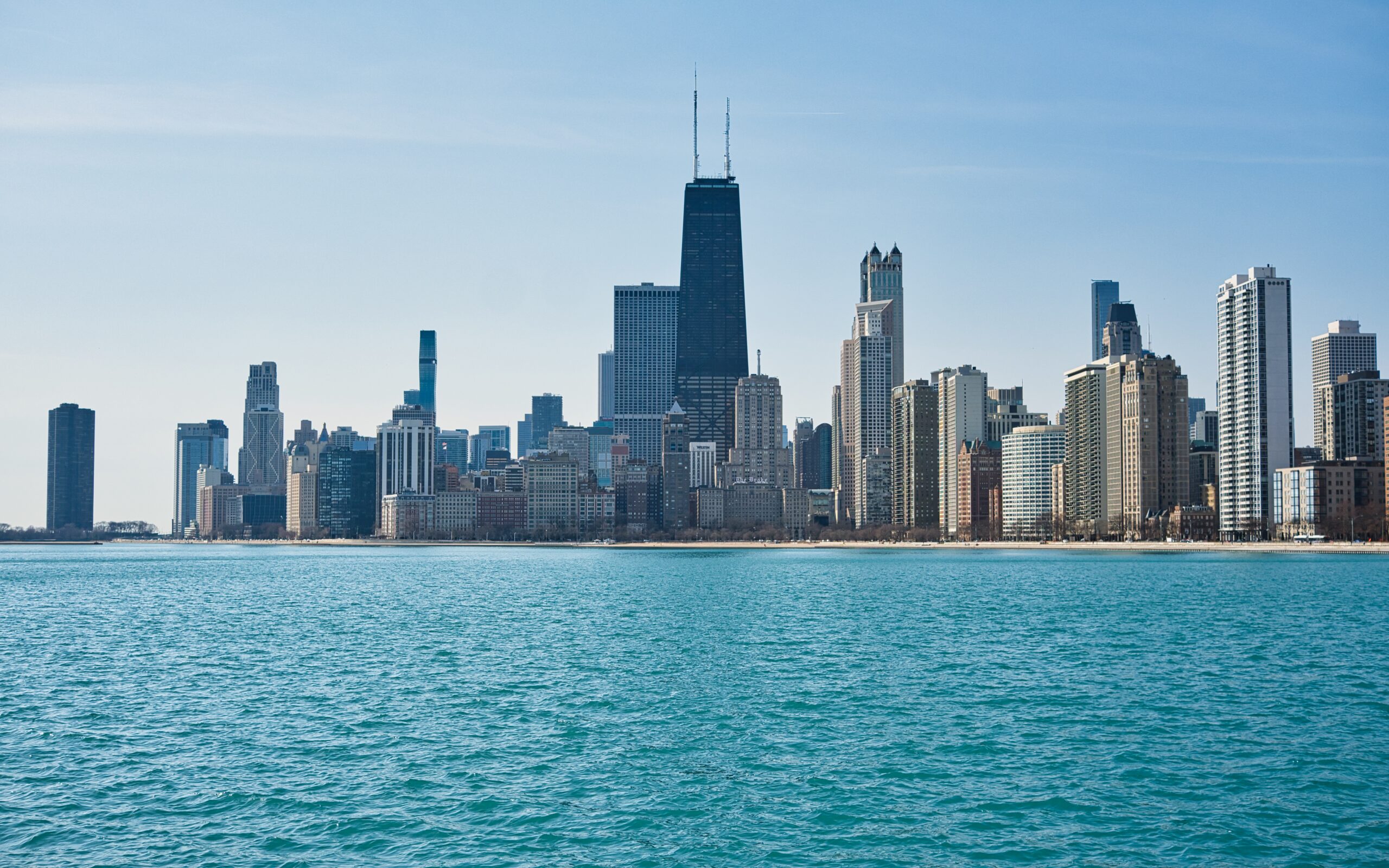
Chicago surprises people who have not been. Visitors expect a big Midwestern city of offices and winter wind, and they find instead the most beautiful skyline in America rising straight out of a river, a lakefront of beaches and parkland that runs for miles without a single private building on it, one of the three or four great art museums in the country, neighborhoods with more personality than most whole cities, and a food scene that goes far beyond the deep-dish pizza everyone arrives wanting to try. It is a city built to be walked and ridden: the ‘L’ rattles above the Loop, the Riverwalk runs beneath the bridges, and the Lakefront Trail is where half the city spends its summer evenings. This guide covers the sights that earn a day, the neighborhoods worth a half-day, the food, the music and the sports, the day trips that the trains make easy, and the practical details that turn a long weekend into a trip you will want to repeat.
If you are still comparing cheap flights to Chicago, read this alongside our guides to the best time to fly to Chicago and whether you need a car (for the city itself, you probably do not). Between the three you can plan the whole trip.
Chicago at a glance for first-timers
- Airports: two of them. O’Hare International (ORD), about 27 km (17 miles) northwest of downtown, is one of the busiest airports in the world and a hub for United and American; the CTA Blue Line runs from the terminal to the Loop around the clock. Midway (MDW), on the Southwest Side, is smaller, closer and mostly domestic, with the Orange Line at the door. See our O’Hare airport guide.
- Getting around: the CTA’s ‘L’ trains and buses cover the city, and the Red and Blue Lines run 24 hours; tap a contactless card or phone at the turnstile. The Loop, River North, the Magnificent Mile and the lakefront are all walkable, and Divvy bikes are everywhere. Our car-versus-transit guide explains when a car helps.
- Money: US dollars. Chicago’s combined sales tax is one of the highest of any big American city, a little over 10 percent, and it is added at the register rather than shown on the tag; hotel taxes are higher still. Tipping 18 to 20 percent in restaurants is expected.
- Weather: four emphatic seasons: cold, windy winters, a late and changeable spring, warm and humid summers cooled by the lake, and a crisp, clear fall. Our month-by-month guide has the detail.
- Where to stay: the Loop for the museums, Millennium Park and the theaters; River North and the Magnificent Mile for restaurants and shopping; the West Loop for the dining scene; Lincoln Park or Wicker Park for a neighborhood feel. Our Chicago hotel search covers them all.
The Loop and Millennium Park
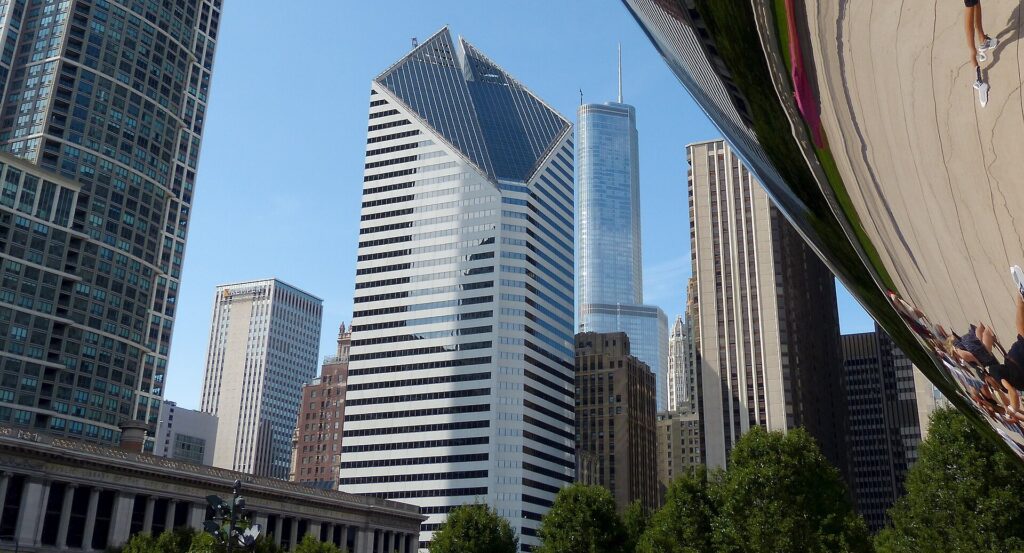
The Loop, named for the ring of elevated tracks that circles it, is the business district and the historic core, and it is where the city’s reputation as the birthplace of the skyscraper was earned after the Great Fire of 1871. Start at Millennium Park, on its eastern edge, which is free and is the city’s front lawn: Anish Kapoor’s Cloud Gate, the polished steel sculpture everyone calls the Bean, reflects the skyline and the crowds; Jaume Plensa’s Crown Fountain projects the faces of Chicagoans onto two glass towers that spout water in summer; Frank Gehry’s Jay Pritzker Pavilion hosts free concerts on summer evenings; and the Lurie Garden is a quiet planted meadow in the middle of it all. In winter the McCormick Tribune ice rink opens beside the Bean. From there, walk the Loop’s streets for the architecture: the Rookery, with a light-filled lobby remodeled by Frank Lloyd Wright; the dark brick Monadnock Building; the untitled Picasso in Daley Plaza, Chagall’s Four Seasons mosaic a few blocks south and Calder’s red Flamingo in Federal Plaza. The Chicago Cultural Center, across Michigan Avenue from the park, is free and has what is claimed as the largest Tiffany glass dome in the world. For the view, the Willis Tower Skydeck, on the 103rd floor of the building that was the world’s tallest when it opened in 1973, has the Ledge, glass boxes that hang out over the street.
The river: the architecture cruise and the Riverwalk
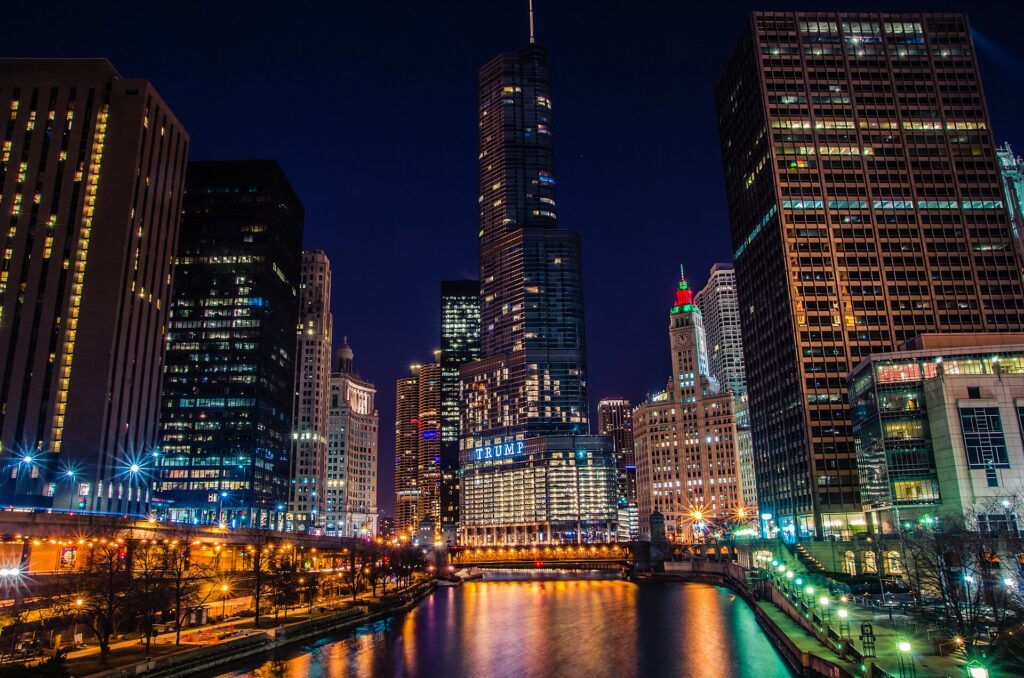
If you do one paid thing in Chicago, make it an architecture river cruise. The Chicago River runs through the middle of downtown, and a ninety-minute boat trip up its main and branch channels passes more than a century of skyscrapers, from the Wrigley Building and the Gothic Tribune Tower to the corncob towers of Marina City and the glass curves of the newer residential towers, with a guide explaining how the city reinvented the tall building again and again. The Chicago Architecture Center runs the best-known tour and has a gallery and a large model of the city at its riverside home; several other operators leave from the docks near Michigan Avenue. On foot, the Riverwalk follows the south bank of the main branch for more than a mile from the lake toward the Loop’s western edge, with wine bars, kayak rentals and seating on the water beneath the bascule bridges, several of which still lift for sailboats in spring and fall. The DuSable Bridge on Michigan Avenue is the classic spot to stand, with the river canyon on one side and the start of the Magnificent Mile on the other.
The lakefront, the Magnificent Mile and Navy Pier
Chicago’s great civic decision was to keep its lakefront public, and the result is extraordinary: parks, beaches and a trail along Lake Michigan for most of the city’s length. The Lakefront Trail runs about 29 km (18 miles) along the shore, with separate paths for bikes and walkers on the busiest stretches; rent a Divvy bike and ride north from Grant Park past Oak Street Beach to Lincoln Park, and you will see the skyline from its best angle. In summer, North Avenue Beach and Oak Street Beach fill with volleyball, sunbathers and swimmers, a surreal sight with office towers a few hundred yards behind the sand. Grant Park, between the Loop and the lake, holds Buckingham Fountain, which runs from spring to fall with a water show at the top of every hour. The Magnificent Mile, North Michigan Avenue from the river to Oak Street, is the city’s grand shopping street, with the historic Water Tower, one of the few buildings to survive the 1871 fire, and 360 Chicago, the observation deck near the top of the former John Hancock Center, whose lake view many locals prefer to the Skydeck. Navy Pier, a short walk east, is touristy but fun with children, with the Centennial Wheel, boat tours and fireworks on summer evenings.
Neighborhoods worth a half-day
River North and the West Loop
River North, just north of the river, has the densest concentration of restaurants, galleries and hotels in the city. The West Loop, and especially Randolph Street and Fulton Market, is where Chicago’s dining reputation is made: former meatpacking warehouses turned into restaurants, food halls and hotels, with some of the most talked-about kitchens in the country within a few blocks of each other.
Lincoln Park and Old Town
North of downtown along the lake, Lincoln Park combines the park itself, with the free Lincoln Park Zoo and the glasshouse conservatory, with a leafy neighborhood of brownstones, bars and blues clubs. Old Town, just south, is home to The Second City, the improv theater that launched a remarkable share of American comedy.
Wicker Park, Bucktown and Logan Square
On the Blue Line northwest of the Loop, Wicker Park and Bucktown center on the six-way intersection of Milwaukee, North and Damen Avenues: vintage shops, record stores, bars and brunch. The 606, an elevated rail line turned into a trail, runs through both. Logan Square, a few stops farther, has the boulevards, the cocktail bars and the Sunday farmers’ market.
Lakeview and Wrigleyville
Home to Wrigley Field and the Cubs, and to the lively bars around it on game days; Northalsted, in Lakeview, is one of the oldest recognized LGBTQ neighborhoods in the country. Farther north, Andersonville keeps its Swedish heritage and a strip of independent shops, and Uptown has the Green Mill, a jazz club with Prohibition-era history and live music every night.
Pilsen and Chinatown
Pilsen, on the Lower West Side, is the historic heart of Mexican Chicago, with street murals, bakeries, taquerias and the free National Museum of Mexican Art. Chinatown, on the Red Line south of the Loop, has dim sum, bakeries and a riverside park with water taxis back downtown in summer.
Hyde Park
On the South Side by the lake, Hyde Park is home to the University of Chicago, Frank Lloyd Wright’s Robie House and the Museum of Science and Industry, and it is the site of the Obama Presidential Center in Jackson Park; check its opening status and ticketing before you go.
Museums, culture and family attractions
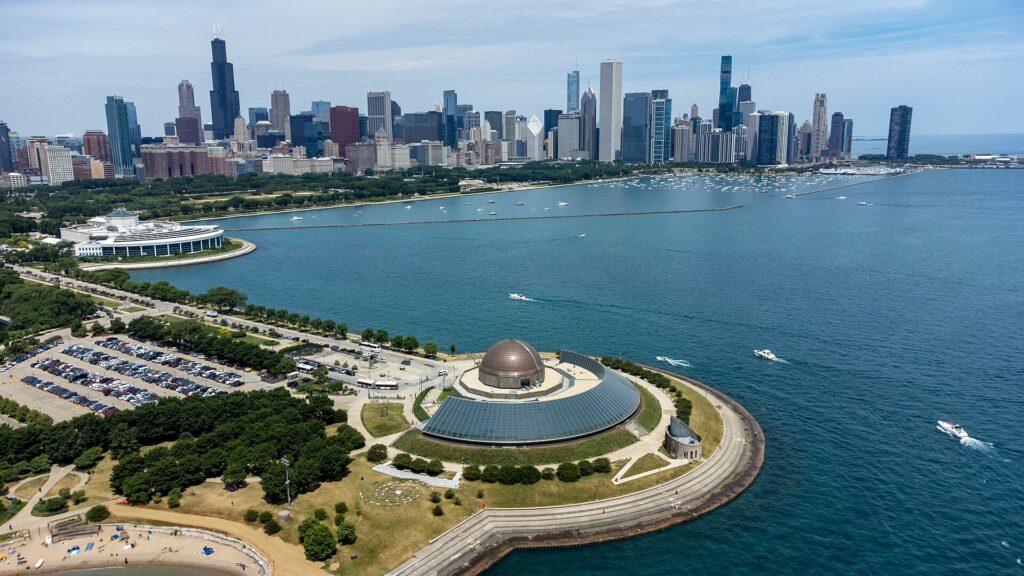
The Art Institute of Chicago, on Michigan Avenue at the edge of Millennium Park, is one of the great museums of the world, and it deserves at least half a day: Seurat’s A Sunday on La Grande Jatte, Hopper’s Nighthawks, Grant Wood’s American Gothic, one of the finest Impressionist collections outside Paris, the miniature Thorne Rooms, and Renzo Piano’s Modern Wing. The Museum Campus, on the lake south of Grant Park, groups three institutions within a short walk: the Field Museum, whose natural history halls hold SUE, one of the most complete Tyrannosaurus rex skeletons ever found; the Shedd Aquarium, with beluga whales and a vast Caribbean reef tank; and the Adler Planetarium, the first planetarium in the Western Hemisphere, with the best skyline view in the city from its front lawn. The Museum of Science and Industry in Hyde Park, housed in a surviving building from the 1893 World’s Fair, has a captured German U-boat, a replica coal mine and hands-on exhibits that keep children busy for hours. The Museum of Contemporary Art near the Water Tower and the free Garfield Park Conservatory on the West Side round out the list. For performance, the Chicago Symphony Orchestra at Symphony Center and the Lyric Opera are world-class, the Goodman and Steppenwolf lead a deep theater scene, and the Broadway houses in the Loop host the touring hits. For what is on stage and in the arenas during your dates, our Chicago events page lists concerts, shows and games.
The blues, jazz and the summer festivals
Chicago invented electric blues, when musicians from the Mississippi Delta plugged in on the South Side after the Second World War, and the city still has clubs where you can hear it most nights of the week: Buddy Guy’s Legends in the South Loop and Kingston Mines and B.L.U.E.S. in Lincoln Park are the best known. Jazz has the Green Mill in Uptown and a handful of rooms downtown. In summer the music moves outdoors and much of it is free. The Chicago Blues Festival takes over Millennium Park in June, the Grant Park Music Festival gives free classical concerts at the Pritzker Pavilion through the summer, and the Chicago Jazz Festival fills Labor Day weekend. Lollapalooza, one of the biggest music festivals in the country, occupies Grant Park for four days in late July or early August. The Pride Parade on the last Sunday of June, the Air and Water Show over North Avenue Beach in August, and neighborhood street festivals nearly every summer weekend make the season one long party. In March, the city dyes the river green for the St. Patrick’s Day parade weekend, and in November the Magnificent Mile Lights Festival opens the holidays, with the German-style Christkindlmarket in Daley Plaza running until Christmas Eve.
Sports
Chicago is one of the great sports towns, with two teams in baseball and a fan base that fills bars from April to February. Wrigley Field, home of the Cubs since 1916, is the second-oldest ballpark in the major leagues, with ivy on the outfield walls, a hand-turned scoreboard and rooftop bleachers across the street; a day game there is one of the classic American experiences, even for people who do not follow baseball. The White Sox play at Rate Field on the South Side, on the Red Line, with cheaper tickets and excellent ballpark food. The Bears play football at Soldier Field on the lakefront from September to January; the Bulls and the Blackhawks share the United Center on the West Side, where the Michael Jordan statue stands outside; the Fire play soccer at Soldier Field and the Sky play basketball at Wintrust Arena. Check what is on sale in Chicago for your dates before you book flights.
What to eat, and where
Start with the classics, and then go further. Deep-dish pizza, baked in a tall pan with the cheese under the tomato sauce, is the famous one, and Lou Malnati’s, Giordano’s and Pizzeria Uno, which claims to have invented it in 1943, all have their loyalists; allow 45 minutes for it to bake. Locals, it should be said, eat more tavern-style pizza, a cracker-thin crust cut into squares. The Chicago-style hot dog comes on a poppy-seed bun with yellow mustard, onion, bright green relish, tomato, a pickle spear, sport peppers and celery salt, and never ketchup. The Italian beef, thin-sliced roast beef soaked in its juices on a roll with sweet peppers or hot giardiniera, is the city’s great sandwich. Beyond that, Chicago’s food is its neighborhoods: tacos and carnitas in Pilsen and Little Village, the Puerto Rican jibarito in Humboldt Park, Vietnamese on Argyle Street in Uptown, Korean and Middle Eastern on the North Side, Polish in Avondale, and some of the most ambitious fine dining in the country in the West Loop. Grab a bag of cheese-and-caramel popcorn, the “Chicago mix”, on the Magnificent Mile, and eat brunch in Wicker Park or Logan Square.
Chicago through the seasons
Chicago’s seasons are so distinct that it can feel like four different cities. Winter (December to March) is cold, windy and sometimes brutal, with lake-effect snow and wind chills that keep locals indoors; it is also when the museums are quiet, the theaters and the Bulls and Blackhawks are in season, the rink in Millennium Park is open, and hotels are at their cheapest. The Pedway, a network of underground walkways beneath the Loop, helps. Spring (April to May) arrives late and unevenly; the lake keeps the shore cool while the suburbs warm up, and the Cubs’ season opens in April weather that can include snow. Summer (June to August) is the reason people fall for the city: the beaches, the Lakefront Trail, the free concerts, the festivals, the patios and rooftop bars, and day games at Wrigley. It can be hot and humid, with thunderstorms, but the lake breeze helps. Fall (September to November) is crisp and clear, with the marathon in October, Open House Chicago opening the doors of buildings across the city, and the Bears at Soldier Field. Our month-by-month guide has the fare patterns that go with each season.
Chicago with kids
Chicago is excellent with children. The Museum Campus alone fills two days: the dinosaurs at the Field Museum, the belugas and the dolphins at the Shedd, and the sky shows at the Adler. The Museum of Science and Industry is a full day on its own, and the Chicago Children’s Museum is on Navy Pier, alongside the Centennial Wheel and summer boat rides. Lincoln Park Zoo is free, compact and easy with a stroller, and the farm-in-the-zoo section is a hit with small children. In summer, the Crown Fountain in Millennium Park doubles as a splash pad, the Maggie Daley Park next door has a climbing wall, play garden and, in winter, a skating ribbon, and the beaches have lifeguards from late May to Labor Day. A Cubs day game is a rite of passage. Kids ride the ‘L’ for free under seven, and the elevated ride around the Loop on the Brown Line is an attraction in itself. For families planning trips beyond the city, our family car rental guide covers the vehicle question.
Chicago on a budget
A remarkable amount of Chicago’s best is free: Millennium Park and the Bean, the Lakefront Trail and the beaches, the Riverwalk, the Lincoln Park Zoo and Conservatory, the Garfield Park Conservatory, the Chicago Cultural Center, the National Museum of Mexican Art, the Loop’s public art, and the summer concerts in Millennium and Grant Parks. The big museums offer free days for Illinois residents but not for visitors, so budget for them, and consider a multi-attraction pass if you plan to see four or more. Eat well for less on hot dogs, Italian beef, tacos in Pilsen and dim sum in Chinatown. A multi-day CTA pass makes transit almost free per ride, and hotel rates from January to March are among the lowest of any big American city. Compare rates by neighborhood on our Chicago hotel search.
Day trips from Chicago
Oak Park, on the Green Line or Metra just west of the city, has the largest collection of Frank Lloyd Wright buildings anywhere, including his Home and Studio and Unity Temple; the Frank Lloyd Wright Trust runs the tours. Evanston, on the Purple Line or Metra north, has the Northwestern University campus on the lake, and neighboring Wilmette has the domed Bahá’í House of Worship; the Chicago Botanic Garden in Glencoe is on the same Metra line. Indiana Dunes National Park, about an hour east on the South Shore Line train, has beaches and giant sand dunes on the southern shore of Lake Michigan; the National Park Service has the trail and beach details. Milwaukee, about 145 km (90 miles) north and 90 minutes by Amtrak, has Calatrava’s winged art museum on the lake, the Harley-Davidson Museum and its own brewing tradition. By car, Starved Rock State Park, about two hours southwest, has canyons and waterfalls along the Illinois River, and Lake Geneva in Wisconsin and Galena in the far northwest of the state are classic weekend escapes. For longer road trips, see our route guides for driving from Chicago to Minneapolis and Chicago to Detroit, or price a car on our Chicago car rental page. Choose Chicago, the city’s official tourism site, covers the region.
Two sample itineraries
Three days, no car
Day one: Millennium Park and the Bean in the morning, the Art Institute until mid-afternoon, then the architecture river cruise and a walk along the Riverwalk, with dinner in River North. Day two: the Museum Campus in the morning, lunch in Chinatown by water taxi or the Red Line, the Skydeck or 360 Chicago at sunset, and deep-dish pizza. Day three: a Divvy ride up the Lakefront Trail to Lincoln Park and the zoo, an afternoon in Wicker Park, and a blues club or a show at Second City at night.
Five days, with the neighborhoods and a day out
Add a day in Hyde Park for the Museum of Science and Industry and the Robie House, a Cubs game at Wrigley in season, a dinner on Randolph Street in the West Loop, and a day trip to Oak Park by the Green Line or to the Indiana Dunes on the South Shore Line.
Practical details
- Transit: tap a contactless card or phone at any ‘L’ turnstile or bus, or buy a Ventra card or multi-day pass. The CTA has maps and service alerts; our transit-versus-car guide goes into detail.
- From O’Hare: the Blue Line to the Loop in about 45 minutes, a taxi or ride-hail, or a rental from the multi-modal facility. The Chicago airports’ site covers both O’Hare and Midway.
- Weather: layers in every season, a serious coat, hat and gloves from December to March, and sunscreen for the beach in summer. NOAA’s National Weather Service office for Chicago has the forecast, and “cooler by the lake” is a real thing.
- Time zone: Central, one hour behind New York and two ahead of Los Angeles.
- Entry requirements: visitors from Visa Waiver Program countries need an approved ESTA before boarding; most others need a visa. The State Department’s travel site is the authoritative source.
- Safety: the areas visitors spend their time in, downtown, the lakefront and the North Side neighborhoods, are busy and generally safe; use ordinary big-city awareness late at night, and on the ‘L’ late at night ride in a car with other passengers.
Frequently asked questions
How many days do you need in Chicago?
Three full days covers the Loop, the Art Institute, the river cruise, the Museum Campus and one or two neighborhoods; add a day or two for Hyde Park, a ball game and a day trip.
What is the number one thing to do in Chicago?
The architecture river cruise, followed closely by the Art Institute. In summer, add a bike ride along the Lakefront Trail.
Is Chicago walkable?
Very, in the Loop, River North, the Magnificent Mile, the lakefront and the North Side neighborhoods, and the ‘L’ links them. The grid is logical and every address is numbered from State and Madison.
Do I need a car in Chicago?
Not for the city, where parking is expensive and transit is good. Rent one for Starved Rock, Galena or a road trip, and only for those days.
Is Chicago expensive?
Cheaper than New York or San Francisco, especially for hotels outside summer and big convention weeks, but taxes are high. Much of the best of the city is free.
What food is Chicago known for?
Deep-dish pizza, the Chicago-style hot dog and the Italian beef sandwich, plus tavern-style thin crust, cheese-and-caramel popcorn and an outstanding restaurant scene in the West Loop.
Ready to go? Compare flights to Chicago, find a place to stay with our Chicago hotel search, and if a road trip is on the list, price a rental car for those days.
Keep planning with TicketScanner
- Cheap flights to Chicago
- Chicago hotels — by neighborhood
- Events in Chicago — Cubs, Bears, Bulls, concerts and shows on sale
- Best time to fly to Chicago: month by month
- Chicago: rent a car or use public transit?
- O'Hare International (ORD) airport guide
- Where to stay: the Loop
- Driving Chicago to Minneapolis
- Things to do in Detroit — a classic drive from Chicago
- Things to do in Minneapolis
Leave a Reply