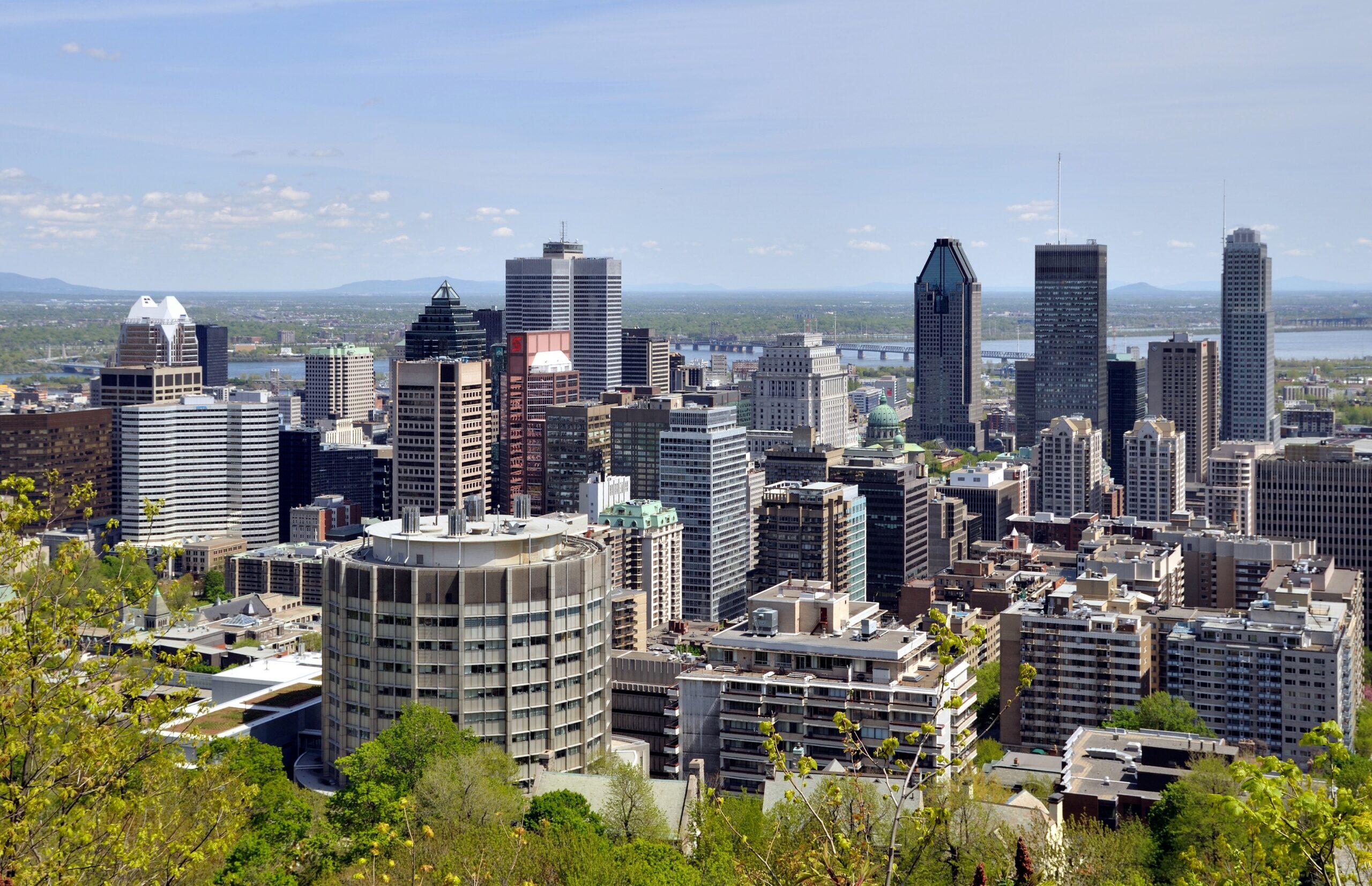
Montreal is the closest thing North America has to a European city, and it wears the comparison lightly. The cobblestones and the 17th-century church squares are real, the French is real, and so are the bagels, the hockey, the winter and the festivals that turn the downtown streets into a stage every summer. What makes it easy for a first-time visitor is that it is compact: Old Montreal, downtown, the mountain and the Plateau are all within a few metro stops or a long walk of each other, and each is a half-day or more. This guide covers the sights that earn their reputation, the neighbourhoods locals actually spend their weekends in, the food (which is the real reason many people come), the museums, the sports, the day trips, and the practical details that make the trip work.
If you are still comparing cheap flights to Montreal, read this alongside our guides to the best time to fly to Montreal and whether you need a car. Between the three you can plan the whole trip.
Montreal at a glance for first-timers
- Airport: Montréal-Trudeau (YUL), in Dorval about 20 km west of downtown; the 747 bus runs downtown around the clock. See our Trudeau airport guide.
- Getting around: four metro lines, buses, BIXI bikes and your feet. The city is walkable and most visitors do not need a car unless they are leaving the island.
- Language: French is the official language and the everyday one; English is widely spoken in hotels, restaurants and shops in the areas visitors frequent. A bonjour goes a long way.
- Money: Canadian dollars. Menu and shelf prices exclude the federal GST and the Quebec sales tax, which together add about 15 percent at the till. Tipping 15 to 20 percent in restaurants is customary. Tap-to-pay is nearly universal.
- Where to stay: Old Montreal for atmosphere and boutique hotels; downtown for the Bell Centre, the museums and the underground city; the Quartier des Spectacles for the festivals; the Plateau for a local, café-and-terrace feel. Our Montreal hotel search covers them all.
Old Montreal and the Old Port
Notre-Dame Basilica and Place d’Armes
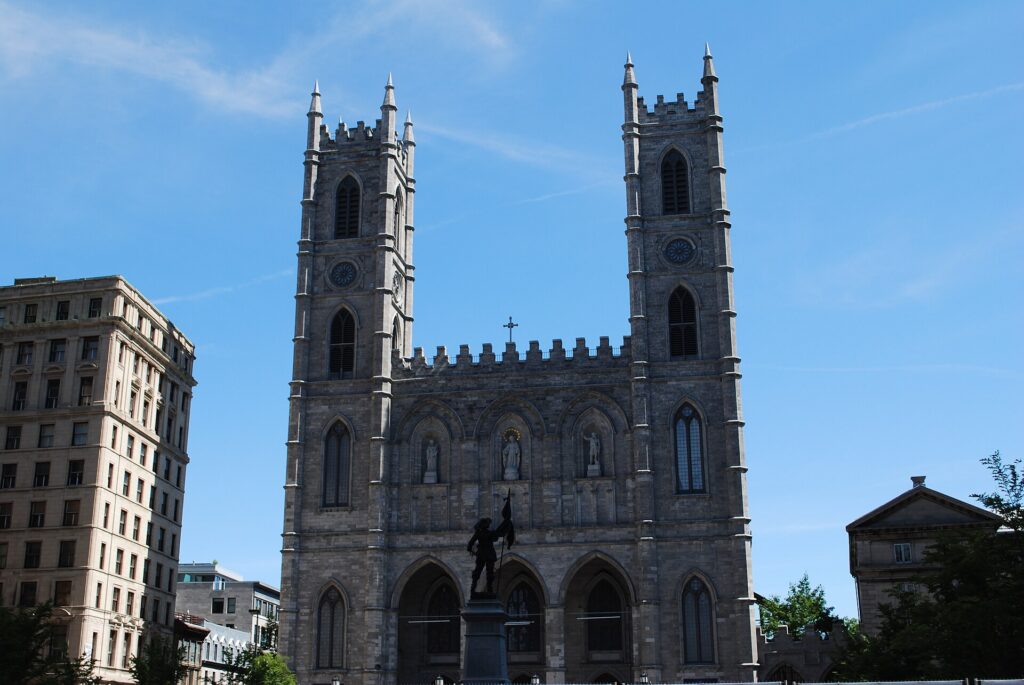
Start at Place d’Armes, the square where the city was founded, and go inside Notre-Dame Basilica. The exterior is handsome Gothic Revival; the interior is something else, a deep blue vault studded with gold stars above an altar carved in wood, and one of the most beautiful church interiors on the continent. The AURA light-and-sound show in the evenings sells out and is worth booking ahead. Around the square are the old Bank of Montreal head office and the Sulpician seminary, the oldest building in the city.
The streets and squares
Rue Saint-Paul, the oldest street in Montreal, runs the length of the old town past galleries, boutiques and the domed Bonsecours Market, now a crafts market. Place Jacques-Cartier slopes down from City Hall to the river, lined with terraces and street performers in summer and a Christmas market in December. The Château Ramezay, an 18th-century governor’s residence, and Pointe-à-Callière, the archaeology museum built over the actual foundations of the first settlement, are the two history museums to prioritise; Pointe-à-Callière in particular is a superb piece of museum design. Old Montreal is at its most atmospheric early in the morning and after dark, when the tour groups are gone and the lamplit streets look like the postcards.
The Old Port
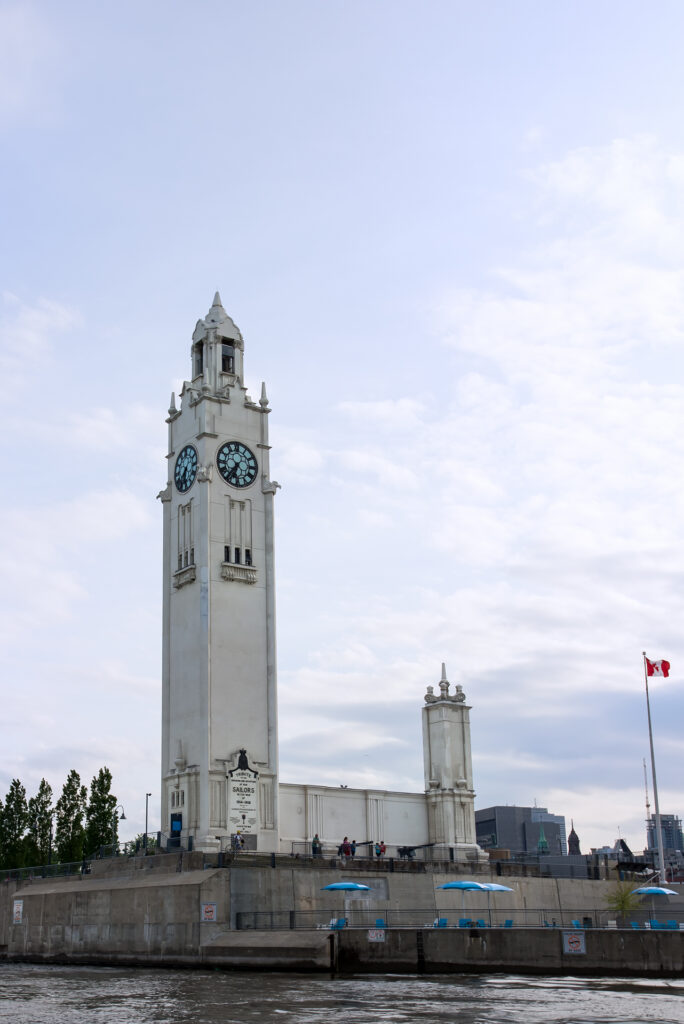
Between the old town and the river, the former docks are now a linear park. The big Ferris wheel gives the best view of the old town’s rooftops and the river; Bota Bota, a spa built into a converted ferry, is the most Montreal way to spend a winter afternoon; the Clock Tower at the eastern end has a small urban beach beside it in summer; and the Montreal Science Centre on the King Edward Pier is the best rainy-day option with children. In winter the Old Port has a large skating rink and, on weekends from mid-January, the Igloofest electronic music festival. The river cruises and the jet-boat trips through the Lachine Rapids leave from here.
Mount Royal
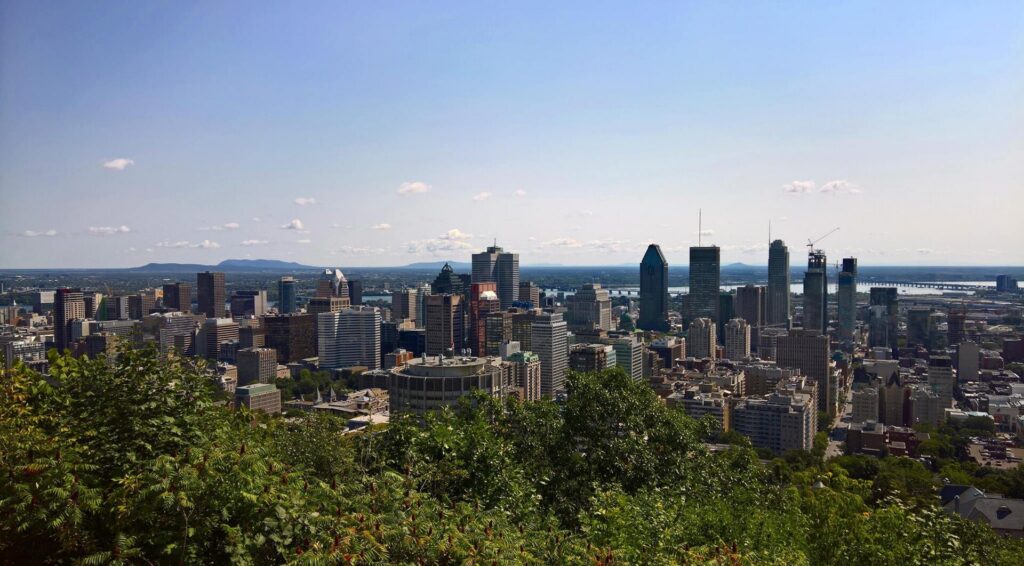
The wooded hill in the middle of the city is Montreal’s Central Park, designed by the same architect, Frederick Law Olmsted, and it is the best free thing to do in the city. From the Plateau, the walk up from the Sir George-Étienne Cartier Monument on Avenue du Parc takes twenty to thirty minutes on a winding path and ends at the Kondiaronk Belvedere, the terrace in front of the chalet with the definitive view of downtown and the river. Beaver Lake, on the far side of the summit, has paddle boats in summer and skating and tobogganing in winter; cross-country ski trails loop through the woods. On Sunday afternoons from spring to fall, the Tam-Tams, an informal drum circle that has gathered at the monument for decades, turns the lawn into a festival. On the west flank of the mountain, Saint Joseph’s Oratory is a vast domed basilica with a view of its own; pilgrims still climb its central steps on their knees.
The Plateau and Mile End
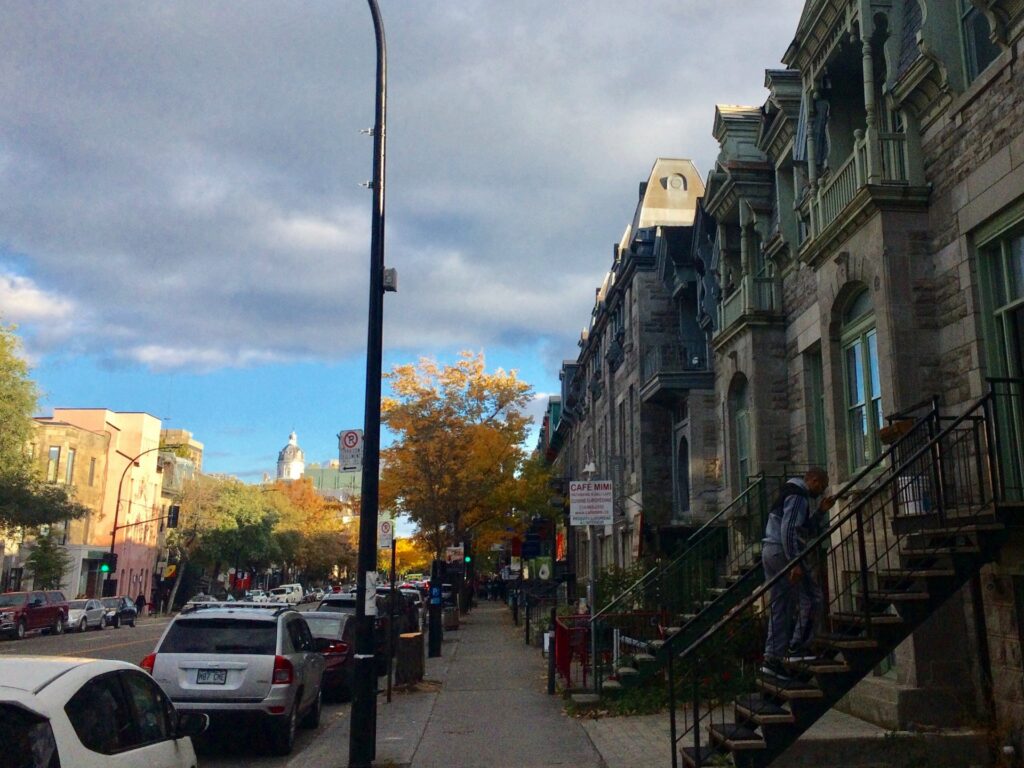
East of the mountain, the Plateau Mont-Royal is the neighbourhood that defines the city’s image: three-storey walk-ups with painted cornices and iron outdoor staircases spiralling down to the sidewalk, murals on the gable ends, cafés and terraces on every corner. Boulevard Saint-Laurent, the Main, is the historic dividing line between the French east and the English west and the spine of the neighbourhood’s nightlife; Avenue du Mont-Royal and Rue Saint-Denis are the shopping and café streets; Parc La Fontaine is the front lawn. The murals are the legacy of the annual MURAL festival in June, which paints a fresh crop each year along the Main.
Mile End, north of the Plateau, is where the bagels are. St-Viateur and Fairmount, both open around the clock, bake Montreal’s wood-fired, honey-sweetened bagels a few blocks apart, and the argument about which is better has run for seventy years. The neighbourhood is also the city’s indie-music and café heartland, with Wilensky’s, a lunch counter unchanged since the 1930s, as its landmark. A morning here, with a bag of hot bagels and a coffee, is the most Montreal morning there is.
Downtown and the Quartier des Spectacles
Downtown is Sainte-Catherine Street, the long shopping spine, and the grid around it. The Montreal Museum of Fine Arts on Sherbrooke Street is the one museum every visitor should see, with a strong Canadian collection, Old Masters, decorative arts and blockbuster exhibitions spread across several pavilions; the McCord Stewart Museum, a few blocks east, covers the city’s social history and has an excellent First Nations collection. The Quartier des Spectacles, around Place des Arts, is the festival district, a set of squares wired for light and sound that hosts the jazz festival, the comedy festival and Montréal en Lumière, and is worth wandering on any summer evening. Below all of it runs the RESO, the underground city, roughly 30 kilometres of corridors linking metro stations, shopping centres, hotels and Central Station, which is how Montrealers cross downtown in January. The Bell Centre, home of the Canadiens, sits at the western edge.
The markets, Little Italy and the canal
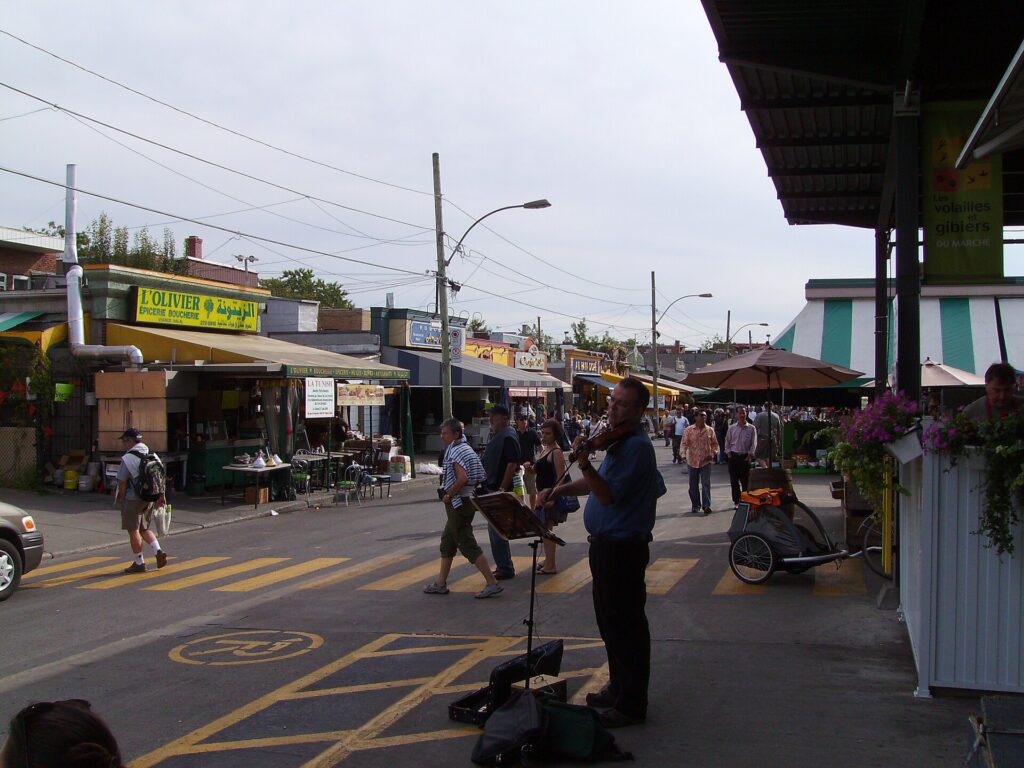
Jean-Talon Market, in Little Italy on the Orange Line, is one of the largest open-air markets in North America and a highlight of any visit: Quebec produce, cheeses, maple products, prepared food and, in late summer, a riot of peppers, corn and tomatoes. Little Italy around it has the espresso bars and trattorias to match. Atwater Market, in the southwest, is smaller and more elegant, with an Art Deco tower and the city’s best butchers, and it sits on the Lachine Canal, whose bike path runs from the Old Port through the reinvented industrial neighbourhoods of Griffintown and Saint-Henri to the rapids at Lachine. A BIXI along the canal, stopping at Atwater for lunch, is a perfect summer half-day.
Parc Jean-Drapeau and the Olympic Park
Two islands in the river, reached by the Yellow Line metro, make up Parc Jean-Drapeau: the site of Expo 67, whose Biosphere, Buckminster Fuller’s geodesic dome, is now an environment museum; La Ronde, the city’s amusement park; the casino; a swimming beach; and the Circuit Gilles Villeneuve, the Grand Prix track, which is open to cyclists and skaters the rest of the year. Osheaga, the big summer music festival, happens here. Across town at the east end of the Green Line, the Olympic Park’s leaning tower is still the tallest inclined structure in the world, and the Space for Life complex beside it groups the Biodome, with its recreated ecosystems, the Botanical Garden with its celebrated Chinese and Japanese gardens, the Insectarium and the Planetarium. With children, this is the best day in the city.
What to eat, and where
Montreal’s food is the strongest reason to visit, and it rewards a plan. Smoked meat, the city’s cured brisket, is best at Schwartz’s on the Main, where the queue is part of the experience, or at its rivals nearby. Bagels are Mile End, above. Poutine is everywhere, but La Banquise on the Plateau, open all night with dozens of variations, is the pilgrimage. Portuguese grilled chicken from the rotisseries around the Plateau is the local takeout. Tourtière, the meat pie, and maple everything are the Quebec classics, best at the sugar shacks in March or at the markets year-round. The city’s serious restaurants cluster in Little Burgundy, Saint-Henri, the Plateau and Old Montreal, and its bring-your-own-wine restaurants along Rue Duluth and Rue Prince-Arthur are a Montreal institution that makes a good meal considerably cheaper. Quebec cheeses, craft beer from the city’s many microbreweries, and the dépanneurs that sell both on every corner round out the picture. Two festivals bring prix-fixe menus to hundreds of restaurants: MTLàTABLE in November and the winter festival’s food programme in February.
Sports and live events
The Montreal Canadiens are the most decorated franchise in hockey and the Bell Centre on a game night is the loudest room in the country; tickets are hard to come by but worth the effort, and the pre-game atmosphere in the bars around the arena is part of it. CF Montréal play soccer at Stade Saputo beside the Olympic Stadium, and the Alouettes play football at the Percival Molson Stadium on the slope of the mountain, one of the most scenic places to watch a game anywhere. The festival calendar is the densest in North America: the jazz festival from late June, the Just for Laughs comedy festival in July, the fireworks competition on summer weekends, Osheaga in early August, Pride, the film festival, and in winter Igloofest and Montréal en Lumière. For tickets across all of it, check what is on sale in Montreal for your dates before you book flights, because the Grand Prix and a Canadiens playoff run can fill the city’s hotels in a day. Tourisme Montréal keeps the festival dates.
Montreal with kids
The Biodome, the Insectarium and the Planetarium at Space for Life; the Science Centre and the Ferris wheel in the Old Port; La Ronde and the beach at Parc Jean-Drapeau; the paddle boats on Beaver Lake; the Ecomuseum Zoo in the West Island; and, in winter, skating in the Old Port and tobogganing on the mountain. The metro is an adventure in itself, and children eleven and under ride free.
Montreal through the seasons
Montreal changes character with the calendar more than any other Canadian city, and it is worth choosing your season deliberately. Summer (June to August) is the city at full volume: the Jazz Festival, Just for Laughs, the Francofolies and Osheaga back to back, the fireworks competition over the river on summer evenings, terrasses on every street, the Tam-Tams drum circle on Mount Royal every Sunday, and pedestrianized stretches of Mont-Royal Avenue and Sainte-Catherine. Fall (September to October) is the quieter, cheaper version, with the maples on the mountain turning in early October, the Marathon, Pop Montreal, and the best restaurant season of the year as the summer crowds leave. Winter (December to March) is cold, and Montrealers have built a city to enjoy it: the Underground City, with its 30-plus kilometres of connected passages, malls and metro stations, keeps downtown walkable in any weather; the outdoor rinks in the Old Port and at Parc La Fontaine, the Fête des Neiges on Île Sainte-Hélène, Igloofest’s outdoor electronic music in January, Montréal en Lumière and the all-night Nuit Blanche in late February, and the Canadiens at the Bell Centre fill the calendar. Spring (April to May) is mud and sugar shacks, with the cabanes à sucre in the countryside serving maple-drenched meals through March and April, then a sudden explosion of terrasses in May. Our month-by-month guide matches each season to the fare calendar.
Montreal on a budget
Montreal is the most affordable of Canada’s big three cities, and the free list is long: Mount Royal and the lookout, the Tam-Tams, the outdoor stages of the summer festivals, the Old Port promenade, Parc La Fontaine, the Lachine Canal path, the markets, the Notre-Dame Basilica exterior and the Place d’Armes, and the Underground City itself. The Montreal Museum of Fine Arts has free admission to its permanent collection for visitors under a certain age and reduced days for everyone; check its site. Eat cheaply and brilliantly at the bagel bakeries, the smoked-meat counters, the Jean-Talon Market stalls, and the Portuguese chicken and Vietnamese pho on Saint-Laurent and in Côte-des-Neiges. The metro’s unlimited weekend and multi-day passes are good value, and BIXI bikes are cheap for short hops. Hotels are noticeably cheaper than Toronto’s outside the festival weeks and the Grand Prix; compare them by neighbourhood on our Montreal hotel search, and see our guide to the best times to book flights and hotels for the booking side.
Day trips from Montreal
Quebec City, three hours away by car or by VIA Rail, is the walled capital with the Château Frontenac and the only fortified city north of Mexico; it deserves an overnight, but a long day is possible by train. See our Quebec City guide. Mont-Tremblant, ninety minutes north in the Laurentians, is the ski resort in winter and a lakes-and-hiking base in summer; Tremblant has resort details. The Eastern Townships, an hour and a half east, are wine, cider, lakes and small towns like Magog, Knowlton and North Hatley. Ottawa is two hours west by road or train. In March and April, the sugar shacks in the countryside serve the traditional maple feast; in the fall, the orchards around Mont-Saint-Hilaire and Oka open for apple picking. Most of these are easier with a car; see our Montreal car rental page, and note that Quebec requires winter tires from December 1 to March 15. Bonjour Québec covers the wider province.
Two sample itineraries
Two days, no car
Day one: Notre-Dame Basilica and Old Montreal in the morning, lunch on Rue Saint-Paul, the Old Port and the Ferris wheel in the afternoon, dinner in Old Montreal or Griffintown. Day two: bagels in Mile End, walk south through the Plateau along Saint-Laurent, climb Mount Royal to the lookout, descend to downtown for the Museum of Fine Arts, smoked meat at Schwartz’s for dinner, and a Canadiens game or a show at night.
Four days, with one day trip
Add a day for Jean-Talon Market, Little Italy and the Space for Life complex, a day for the Lachine Canal by BIXI with lunch at Atwater Market and an evening in Little Burgundy, and use the fourth for Quebec City by train or Tremblant and the Laurentians by car, rented from a downtown location for that day only.
Practical details
- Transit: buy an OPUS card or tickets from any metro station; a three-day pass covers most visits. The STM’s site has maps; our transit-versus-car guide goes into detail.
- From Trudeau: the 747 bus runs around the clock to downtown and its fare includes 24 hours of transit. The airport’s site covers ground transport.
- Weather: real winters, humid summers, and two short, lovely shoulders. Our month-by-month guide has the table; check Environment Canada’s forecast before you pack.
- Driving: no right turns on red on the island of Montreal, and winter tires are mandatory from December 1 to March 15.
- Entry requirements: U.S. citizens need a valid passport; most other visa-exempt visitors arriving by air need an Electronic Travel Authorization. The Government of Canada’s visitor page is the authoritative source.
- Safety: a safe city by any standard; the usual big-city awareness applies downtown late at night.
Frequently asked questions
How many days do you need in Montreal?
Three full days covers Old Montreal, the mountain, the Plateau and the museums comfortably; five lets you add the markets, the Olympic Park and a day trip. A weekend is enough for the old town and the Plateau.
What is the number one thing to do in Montreal?
Notre-Dame Basilica’s interior, then the walk up Mount Royal to the lookout. And eat a bagel from Mile End on the way.
Is Montreal walkable?
Very. Old Montreal, downtown and the Plateau are all connected on foot, and the metro fills the gaps. In winter the underground city keeps you moving without a coat.
Do I need to speak French in Montreal?
No, but it helps. English is widely spoken in the areas visitors frequent, and starting with bonjour is both polite and appreciated.
Do I need a car in Montreal?
Not for the city. Rent one for Tremblant, the Townships or a road trip to Quebec City, ideally from a downtown location for just those days.
What is Montreal famous for?
Its French character, Old Montreal, the Canadiens, the summer festivals, and its food: smoked meat, bagels, poutine and one of the best restaurant scenes in North America.
Ready to go? Compare flights to Montreal, find a place to stay with our Montreal hotel search, and if Tremblant or the Townships are on the list, price a rental car for those days.
Keep planning with TicketScanner
- Cheap flights to Montreal
- Montreal hotels — by neighbourhood
- Montreal car rentals — for Tremblant, the Townships and Quebec City
- Events in Montreal — Canadiens, concerts and festivals on sale
- Best time to fly to Montreal: month by month
- Montreal: rent a car or use transit?
- Montreal-Trudeau (YUL) airport guide
- Where to stay: Old Montreal
- Things to do in Quebec City
Leave a Reply