Miami is a city where the answer to “should I rent a car?” depends almost entirely on where you sleep and what you want to see. The famous parts of the city, South Beach, downtown, Brickell and Wynwood, are compact, flat and increasingly well served by free trolleys, the free Metromover and ride-hail, and parking in them is expensive and scarce. But Miami-Dade is a huge, sprawling county built around the car, the transit network thins out quickly beyond the core, and the trips that many visitors come for, the Everglades, the Florida Keys and the drive up the coast, are car trips. In between sits a surprisingly useful set of options: a rail line from the airport to downtown, a free people mover, trolleys on Miami Beach, and a fast intercity train to Fort Lauderdale, Palm Beach and Orlando. This guide explains how the city is laid out, how transit and fares work, what driving here is really like, when a car earns its keep, and gives you a straightforward way to decide.
The short answer
Skip the car if you are staying in South Beach, Brickell or downtown and your plans are the beach, the Art Deco District, Wynwood, Little Havana, the museums and the nightlife; walking, the free trolleys and Metromover, the Airport Flyer bus and the occasional ride-hail will cover it, and you will not pay nightly valet fees. Rent a car if the Everglades, the Florida Keys or the Gulf Coast are on the itinerary, if you are staying in the suburbs, Doral or near the airport, if you are traveling with small children and gear, or if Miami is one stop on a Florida road trip. And if you want the best of both, rent for a day or two in the middle of a car-free stay. Compare rental rates for any of these plans on our Miami car rental page.
How Miami is laid out
Miami is really two cities joined by causeways. On the mainland, the City of Miami has downtown and Brickell on Biscayne Bay, Wynwood, the Design District and Little Haiti to the north, Little Havana to the west, and Coconut Grove and Coral Gables (a separate city) to the south, with the airport about 13 kilometers (8 miles) west of downtown. Across the bay, Miami Beach is a separate city on a long barrier island, with South Beach at its southern tip, Mid-Beach and North Beach above it, and the towns of Surfside, Bal Harbour and Sunny Isles continuing north. Five causeways cross the bay between them; the MacArthur and the Julia Tuttle carry most of the traffic. Beyond that, Miami-Dade County spreads west toward the Everglades and south toward Homestead and the Keys, and north into Broward County and Fort Lauderdale without a break. The core is compact enough to explore without a car; the county is not.
Hotels cluster in South Beach, along Collins Avenue in Mid-Beach and North Beach, in Brickell and downtown, near the airport and in Doral, and in smaller numbers in Coconut Grove and Coral Gables. If you are going car-free, South Beach, Brickell and downtown are the easiest bases.
Getting in from the airport
Miami International (MIA) is well connected by Florida standards. The free MIA Mover train runs from the terminal to the Miami Intermodal Center, where you will find the Rental Car Center, with every major company under one roof, and the Miami Airport station for Metrorail’s Orange Line, which reaches downtown and Brickell in around 15 to 20 minutes, and for Tri-Rail, the commuter train north to Fort Lauderdale and Palm Beach. For Miami Beach, the Airport Flyer bus runs from the terminal to South Beach and up Collins Avenue for a standard bus fare, and takes around 45 minutes to an hour depending on traffic. Taxis charge flat fares to zones on Miami Beach, and ride-hail pickups are on the arrivals level; the drive to South Beach takes 20 to 40 minutes, longer at rush hour. Check the airport’s site for current ground-transport details; our MIA airport guide covers the layout.
Miami’s transit, explained
Miami-Dade Transit runs Metrorail, Metromover and the Metrobus network. The rail lines are clean, elevated and useful for the corridors they serve, and the free Metromover is one of the best-value rides in the country; the limitation is coverage, because Metrorail does not cross the bay to Miami Beach, and the buses that fill the gaps are often slow in traffic.
Metrorail
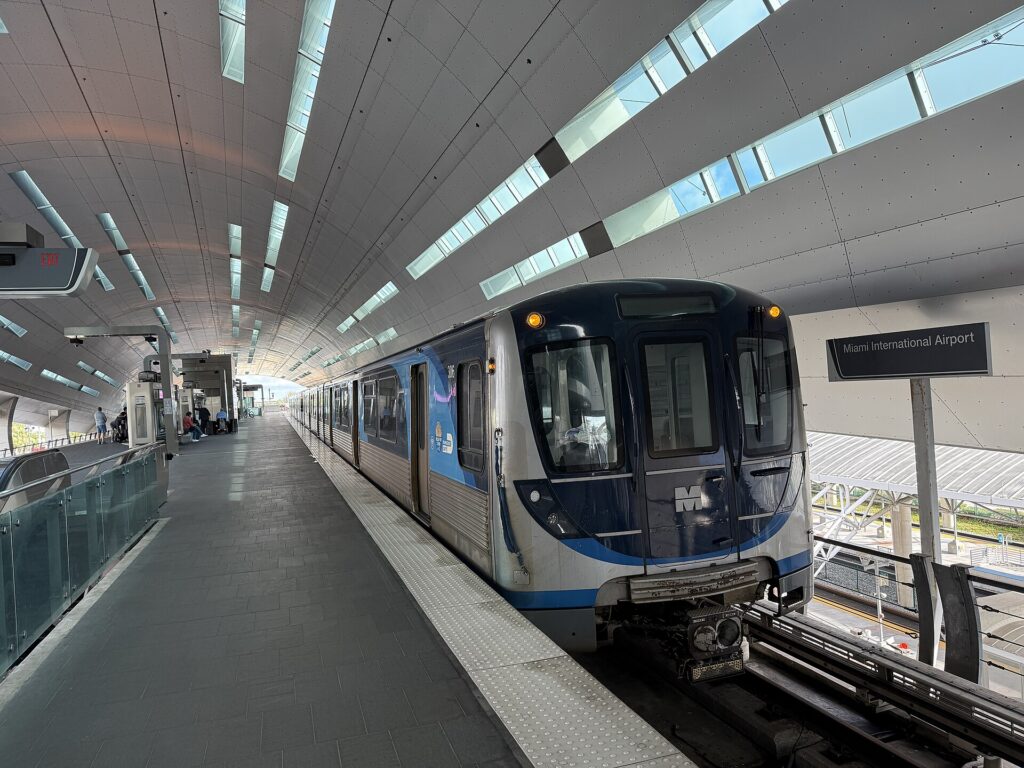
An elevated heavy-rail system of about 40 kilometers (25 miles) with two lines, Green and Orange, that share tracks through the center of the city. The Orange Line starts at the airport; the Green Line starts in the northwest suburbs; both run through the Civic Center hospital district, Overtown and downtown (Government Center station), then south through Brickell and on to Vizcaya, Coconut Grove, Douglas Road, University (for Coral Gables and the University of Miami) and Dadeland. For a visitor, the useful stretch is the airport to downtown and the run south to Vizcaya and the Grove. Trains run from early morning until around midnight, with lower frequency in the evenings and on weekends.
Metromover
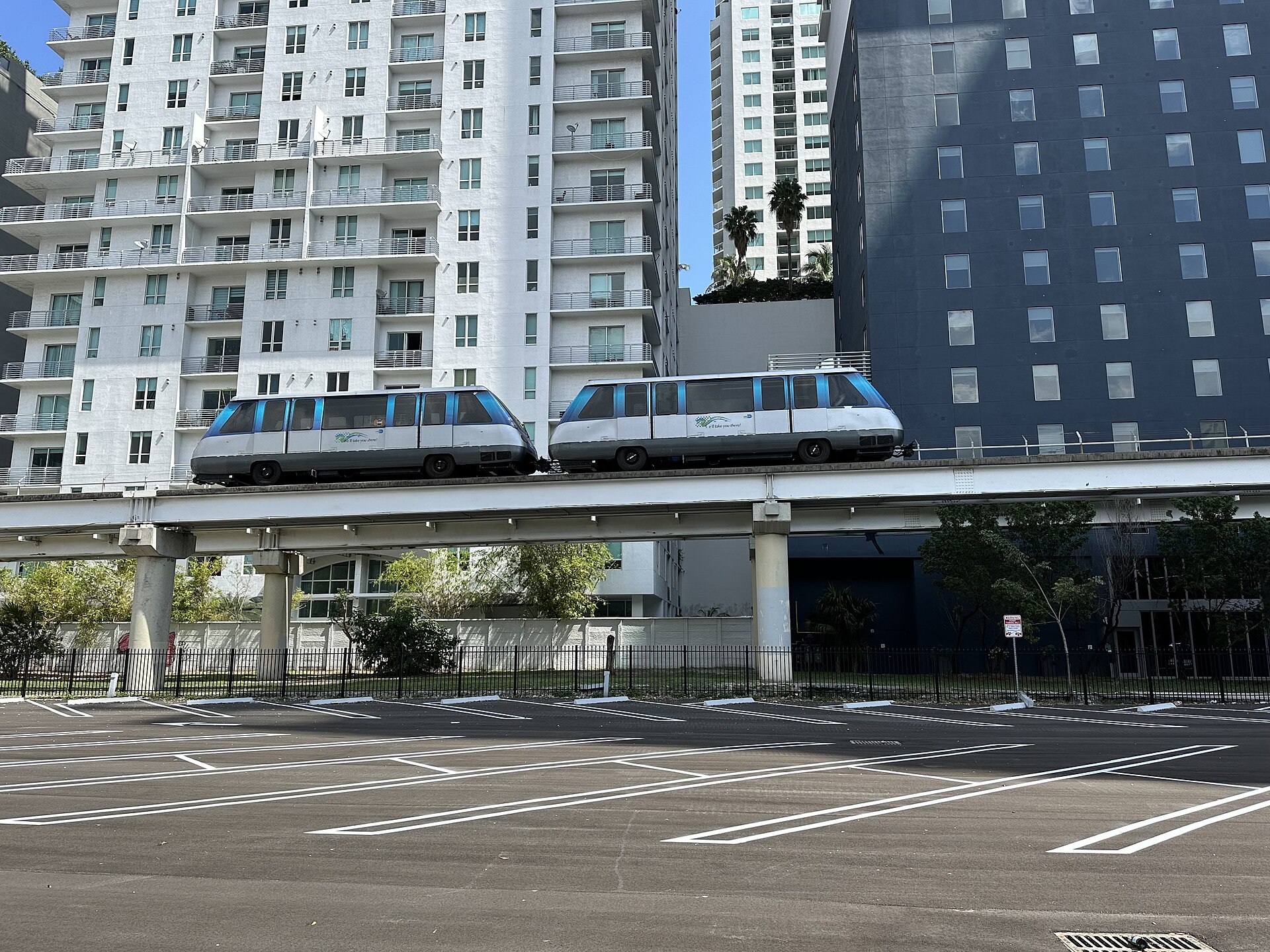
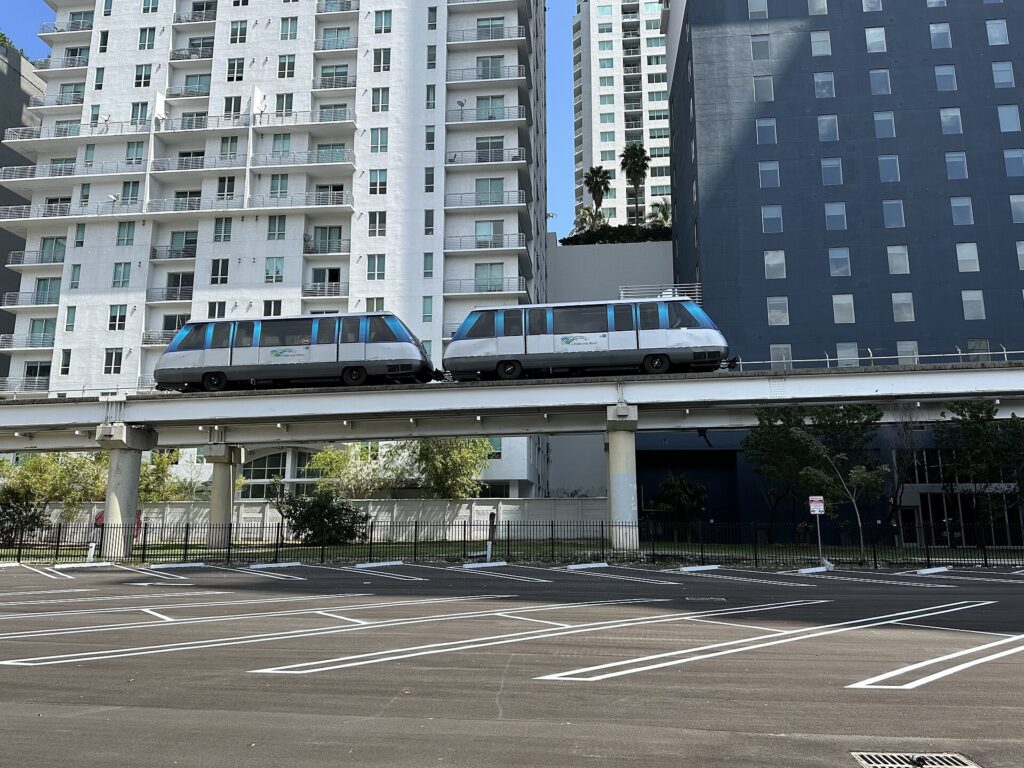
A free, automated, elevated people mover with three loops: the Inner Loop around downtown, the Omni Loop north to Museum Park, the Pérez Art Museum and the Adrienne Arsht Center, and the Brickell Loop south through the financial district. It connects with Metrorail at Government Center and Brickell stations, stops near Bayside Marketplace and the Kaseya Center, and is the easiest way to move around the core. Riding a full loop is also a cheap tour of the skyline.
Buses and trolleys
Metrobus covers the whole county, including the Airport Flyer to Miami Beach and routes across the causeways, but buses share the roads with everyone else and can be slow. For visitors, the more useful services are the free trolleys: the City of Miami trolley routes serve Brickell, downtown, Wynwood, Little Havana, Coconut Grove and other neighborhoods; the Miami Beach trolley runs free loops through South Beach, Mid-Beach and North Beach; and Coral Gables runs its own free trolley along Ponce de Leon Boulevard. Several cities also run Freebee, a free on-demand electric shuttle booked through an app, within set zones.
Fares and tickets
Metromover and the city trolleys are free. For Metrorail and Metrobus, you can load an EASY Card or EASY Ticket at station machines, pay through the transit agency’s app, and, on most readers, tap a contactless bank card or phone wallet; check the current options and fares on the Miami-Dade Transit site before you go. Day and week passes are available and can pay off on a heavy sightseeing day.
Accessibility
All Metrorail and Metromover stations have elevators, and buses and trolleys have ramps or lifts. Elevator outages do happen, so check the agency’s service alerts before relying on a particular station.
Beyond Miami-Dade Transit
- Walking and cycling. South Beach, downtown, Brickell and Wynwood are flat and walkable, though the heat and the sun from May to October make distances feel longer. Citi Bike Miami docks are spread across Miami Beach and the city, the Miami Beach Beachwalk and Baywalk are good for cycling, and shared e-scooters operate in parts of the city.
- Taxis and ride-hail. Uber, Lyft and licensed taxis operate everywhere. For a group of three or four, a ride across the causeway is often competitive with transit and much faster.
- Brightline. The intercity train runs from MiamiCentral station downtown to Aventura, Fort Lauderdale, Boca Raton, West Palm Beach and Orlando International Airport, in about three and a half hours to Orlando. Brightline is the way to add a Fort Lauderdale or Palm Beach day, or the theme parks, without a car.
- Tri-Rail. The Tri-Rail commuter line runs north from the airport through Broward and Palm Beach counties, with some trains continuing to MiamiCentral downtown; it is slower than Brightline but cheaper.
- Tours and shuttles. Tour companies run day trips from Miami hotels to the Everglades, Key West and the Keys, a practical alternative to driving for a single day out.
Driving in Miami: what it is really like
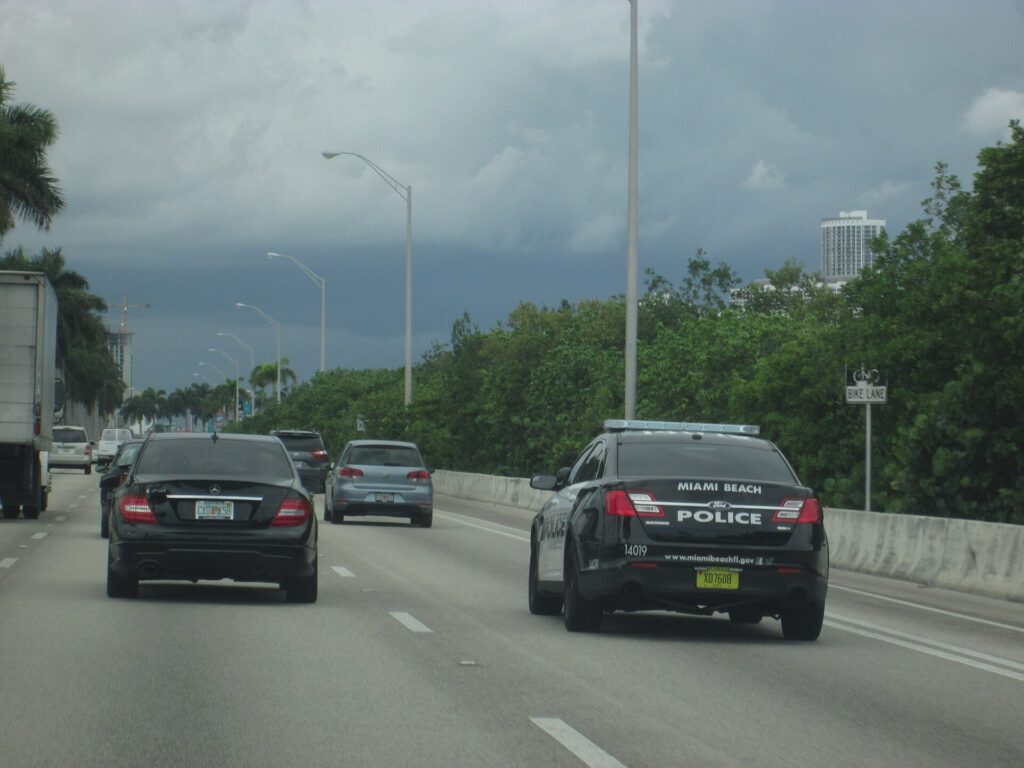
Driving in Miami is not difficult in the technical sense: the roads are flat, wide and on a grid, and signage is clear. It is, however, stressful. Traffic on I-95, the Palmetto Expressway (SR 826) and the Dolphin Expressway (SR 836) is heavy for much of the day, not only at rush hour, and local driving is assertive: fast lane changes, late merges and little patience at green lights. The causeways to Miami Beach back up on weekend evenings, during events and whenever there is a crash or a drawbridge opening, and South Beach itself is slow going at night. Heavy summer downpours can reduce visibility to almost nothing and flood low-lying streets within minutes.
Parking
Parking is the strongest argument against a car in the core. Many South Beach hotels offer only valet parking, charged by the night, and it can add significantly to the cost of a stay. On-street parking in South Beach and Brickell is metered, paid by app or machine, and expensive, and the city garages fill on weekends and during events; residential zones are strictly enforced and towing is fast and costly. Downtown and Brickell have plenty of garages, priced for office workers during the week. Outside the core, parking at the malls, Coral Gables, Coconut Grove, Key Biscayne and the Everglades visitor centers is straightforward, though Shark Valley’s lot fills early on winter weekends.
Rules and conditions worth knowing
- Tolls are all electronic. The Dolphin Expressway, the Airport Expressway, Florida’s Turnpike, the express lanes on I-95 and the Rickenbacker and Venetian Causeways charge tolls, mostly with no cash booths. Rental companies bill tolls plus a daily convenience fee through their own programs, which can add up; ask at the counter what applies, and whether you can use your own transponder. SunPass explains how Florida’s system works.
- Headlights in the rain. Florida law requires headlights in rain, smoke and fog. In a heavy downpour, slow down and leave a large gap; do not stop in the travel lanes.
- Flooded streets. Heavy storms and the seasonal king tides in the fall can flood streets in Miami Beach, Brickell and other low-lying areas. Do not drive through standing water; salt water damages cars, and the rental agreement will not cover it kindly.
- Hurricanes. If a storm threatens, follow evacuation orders; Miami Beach and the Keys are evacuated first. FL511 publishes road conditions and closures.
- Red-light cameras operate at many intersections; fines follow the car, and the rental company will bill you with a fee added.
- Right turns on red are permitted after a full stop unless signed otherwise.
- Move over for emergency and service vehicles stopped on the shoulder, which is Florida law, and do not hold a phone while driving through school or work zones.
When renting a car makes sense
- The Everglades. Shark Valley and the Ernest F. Coe Visitor Center at the main park entrance are each about an hour from the city and have no useful public transit; Everglades National Park charges a per-vehicle entrance fee.
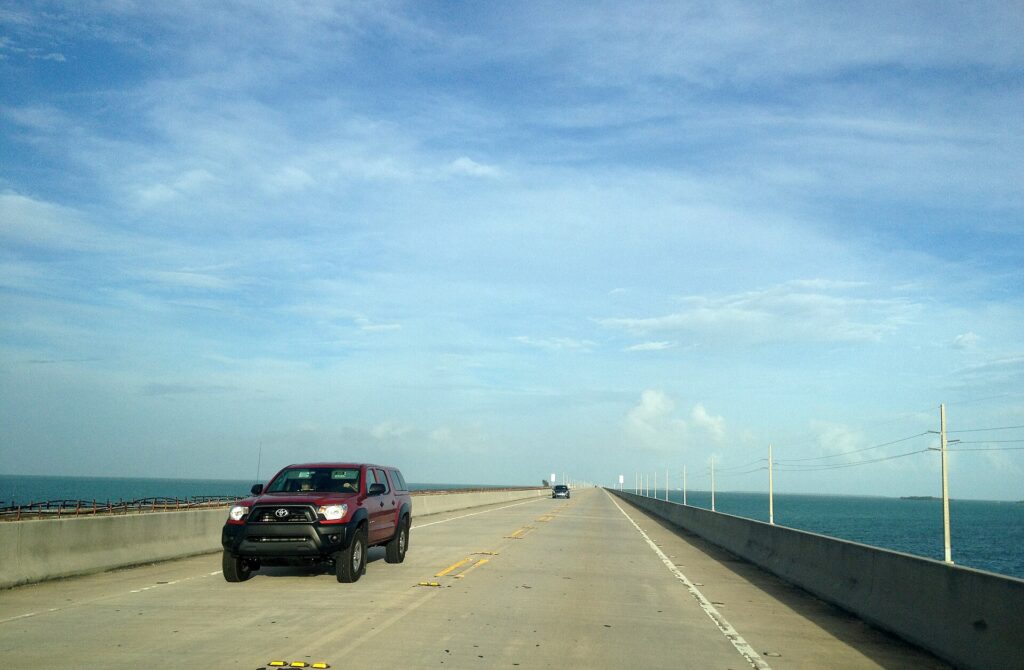
- The Florida Keys. Key Largo is an easy day, Key West a long one, and the drive down the Overseas Highway is part of the experience.
- Staying outside the core. Doral, the airport area, Kendall and the western suburbs are poorly served by transit for visitors.
- Families with small children and gear. Beach equipment, strollers and car seats are easier with a car, especially for trips to Zoo Miami, Key Biscayne and the Everglades.
- Florida road trips. Miami to Orlando, Naples and the Gulf Coast, or Palm Beach; our Orlando to Miami route guide covers the drive most visitors combine with the theme parks.
If any of those apply, our rental car booking tips cover insurance, deposits and the questions to ask at the counter, and our family car rental guide looks at vehicle choice.
When it does not
- You are staying in South Beach and your plans are the beach, the Art Deco District and the restaurants.
- You are in Brickell or downtown, where the Metromover, Metrorail and trolleys connect most of what you want to see.
- You are in town for Art Basel, the Heat, a concert or a cruise, when parking is at its worst and ride-hail is easier.
- You are traveling solo or as a couple and the rental, tolls, insurance and nightly valet add up to more than the rides you would take.
The hybrid plan for a city-plus-Everglades-or-Keys trip
Go car-free for the city days and rent for the day trips, and think carefully about where you pick up. Renting at the airport’s Rental Car Center makes sense if you are heading straight out of town on arrival, or if you are staying near the airport or in Doral; it has the widest choice and the easiest access to the highways. Renting from a neighborhood office in Miami Beach or Brickell makes sense if you are spending the first nights in the city, because you avoid the airport fees and the nightly valet on the nights you are not using the car. A common pattern that works well: the Airport Flyer, Metrorail or a taxi to your hotel, two or three car-free days, a one- or two-day rental from a city office for the Everglades and Key Largo, and a return at the airport on the way home, where one-way returns within the city are usually allowed. Book ahead for the winter season and the holidays, and ask about the toll program when you pick up. Compare the day rates on our Miami car rental page against a full-trip rental and the difference is usually obvious.
A worked cost comparison
Numbers change with the season and the booking window, so treat this as a method rather than a quote, and check current rates before deciding. For a four-night beach break in South Beach for two people, the car-free version costs the Airport Flyer or a flat-rate taxi each way, free trolleys on Miami Beach, and three or four ride-hail trips across the causeway to Wynwood, Little Havana and Brickell; the rental version adds four days of a compact car, four nights of hotel valet, the rental toll program, fuel and airport fees, and buys you very little you could not reach otherwise. The car-free option wins easily. For the same four nights with a day in the Everglades and a day in Key Largo, the car-free version adds two guided tours with hotel pickup for two people; the hybrid version adds a two-day rental from a city office, fuel, tolls, the park entrance fee and two nights of valet if you keep the car overnight. Priced honestly, the tours are often competitive for a couple who want a guide and an airboat ride, and the rental wins for families and anyone who wants to set their own pace, stop at the fruit stands in Homestead or snorkel at John Pennekamp. For a week split between Miami and Key West, a rental is the practical answer, and a one-way rental or a flight home from Key West is worth pricing. Run the rental rates for your dates on our Miami car rental page and put them beside the tour prices before you choose.
Driving from Miami to the Keys in each season
The Overseas Highway, US 1, runs from the mainland at Florida City across dozens of bridges to Key West, and it is one of the great drives in the United States. It is also mostly a two-lane road with few places to pass, and first-time visitors underestimate how long it takes. From Miami, allow around an hour to Key Largo and three and a half to four hours to Key West without traffic, and more with it. In winter, the high season, the road is at its busiest: southbound traffic builds on Friday afternoons and northbound on Sunday afternoons, and the stretch through the Upper Keys can crawl on holiday weekends. Leave early, or travel mid-week. In spring, the weather is at its best, with calm seas for snorkeling, but spring break and festival weekends add traffic. In summer, the road is quieter, the water is warm, and afternoon thunderstorms can make the bridges slow and slick; drive in the morning when you can. In fall, the peak of hurricane season, check the forecast before you set out; the Keys are the first place in the region to be evacuated, and the Overseas Highway is the only road out. In every season, obey the speed limits, which drop through the towns and are strictly enforced, watch the mile markers that serve as addresses along the route, and allow time to stop; the drive across the Seven Mile Bridge is a reason to go in itself. The Florida Keys tourism council has current information for each island.
Decision table
| Your trip | Recommendation | Why |
|---|---|---|
| Beach break in South Beach, couple or solo | No car | Walking, free trolleys and ride-hail cover it; hotel valet is expensive |
| City break in Brickell or downtown | No car | Metromover, Metrorail and trolleys link the core and the airport |
| Art Basel, a cruise or a big event | No car | Parking is at its worst; ride-hail and transit are easier |
| City plus the Everglades or Key Largo | Hybrid: rent for a day or two from a city office, or take a tour | Car-free city days, car or tour for the day trips |
| Miami plus Key West | Rent (consider one-way) | The Overseas Highway is the trip; transit does not serve it well |
| Family with small children | Rent for the whole stay | Gear, heat and spread-out attractions favor a car |
| Staying near the airport or in Doral | Rent at the airport | Transit to the sights is slow from the suburbs |
| Florida road trip with Orlando | Rent, or take Brightline one way | The train links downtown Miami and Orlando airport |
Money-saving tips for both options
- On transit: use the free Metromover and trolleys; take the Airport Flyer to Miami Beach instead of a taxi if you travel light; buy a day pass for a heavy Metrorail day.
- On a rental: compare airport and city pickup, book early for the winter season, ask how the toll program is charged, decline extras you already have through a credit card or home policy (check first), and fill the tank before you return the car.
- On the hotel: if you are renting, price the nightly valet into the room rate, and consider a hotel in Mid-Beach, Brickell or downtown with cheaper self-parking.
- On timing: avoid I-95 and the causeways at rush hour, and the Overseas Highway southbound on Friday afternoons and northbound on Sunday afternoons in winter; the best time to fly to Miami guide lists the busiest weekends.
- On day trips: for one or two people doing a single Everglades day, a guided tour with hotel pickup can cost less than a rental plus valet, tolls and fuel.
Frequently asked questions
Is it worth renting a car in Miami?
For the Everglades, the Keys, the suburbs or a Florida road trip, yes. For a beach or city break based in South Beach, Brickell or downtown, no; transit, trolleys and ride-hail are enough.
Is Miami public transit good for tourists?
Good for the airport, downtown, Brickell and the Metrorail corridor south to Coconut Grove, with the free Metromover and trolleys filling gaps. It is weaker for Miami Beach, which has no rail link, and for the suburbs.
How do I get from Miami airport to South Beach?
The Airport Flyer bus in around 45 minutes to an hour, a flat-rate taxi, or ride-hail in 20 to 40 minutes depending on traffic.
Can I visit the Everglades without a car?
Yes, on a guided tour with hotel pickup from Miami; tour companies run daily trips. Public transit does not reach the park entrances.
How do tolls work in a Miami rental car?
Tolls are collected electronically, and rental companies charge them to you through their own programs, usually with a daily fee. Ask at the counter what the program costs before you drive away.
Is parking expensive in South Beach?
Yes. Hotel valet is charged by the night, street meters are pricey, garages fill on weekends, and towing in residential zones is strict.
Can I take the train from Miami to Orlando?
Yes. Brightline runs from downtown Miami to Orlando International Airport in about three and a half hours, with stops in Fort Lauderdale, Boca Raton and West Palm Beach.
Whichever way you go, start with the flight. Compare cheap flights to Miami, choose a base with our South Beach hotel search, and if the Everglades or the Keys are on the list, price the rental for those dates on our Miami car rental page. For what to see once you arrive, start with our first-timer’s guide to Miami.
Keep planning with TicketScanner
- Miami car rentals — compare airport and city pickup
- Cheap flights to Miami
- South Beach hotels — factor valet parking into the rate
- Things to do in Miami: a first-timer's guide
- Best time to fly to Miami: month by month
- Miami International (MIA) airport guide
- Driving Orlando to Miami
- Rental car booking tips
- Car, transit or taxi in a new city?
Leave a Reply