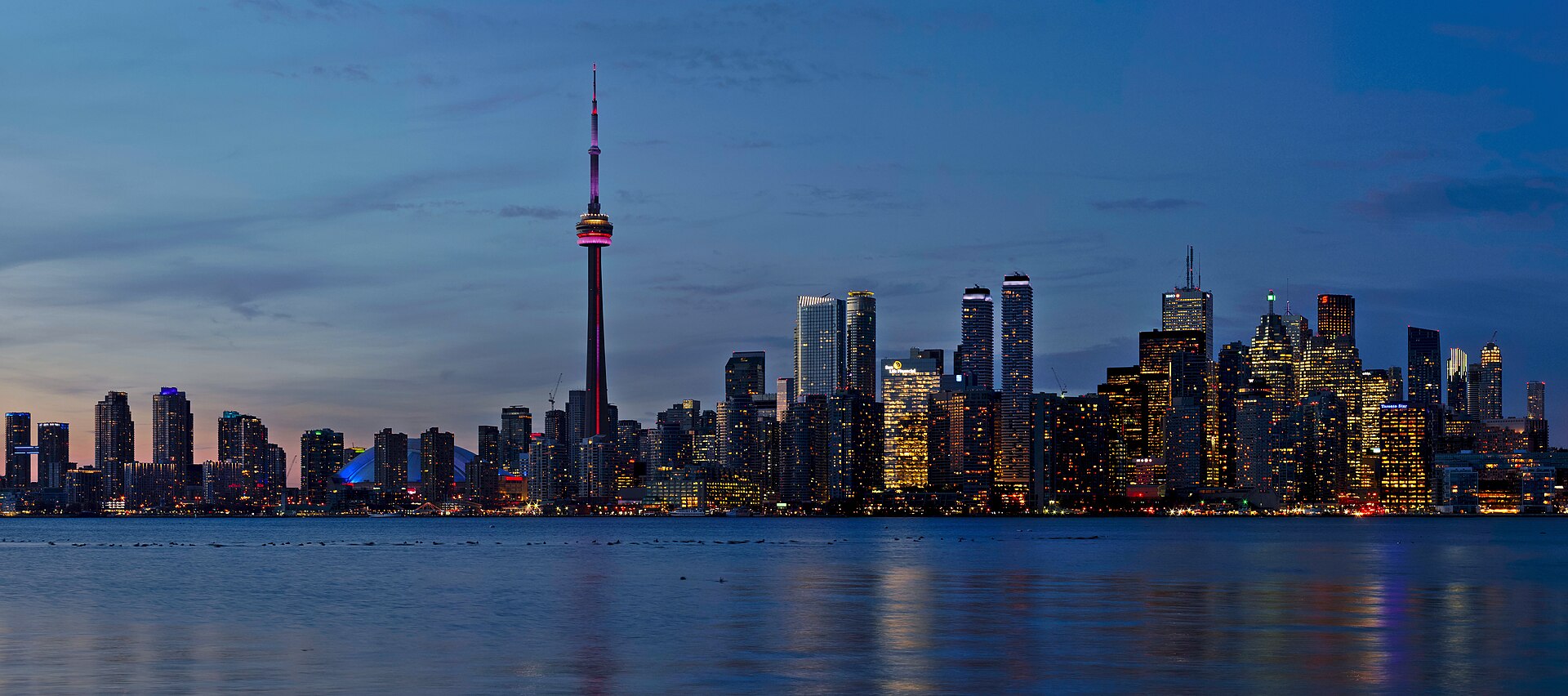
Toronto rewards a plan. Canada’s largest city is spread along a lakefront that runs for kilometres, and its best experiences are clustered in neighbourhoods that are each worth a half-day on their own. Try to see everything with no structure and you will spend your trip on the subway. Group the city by area, give yourself one “big” sight per day and one neighbourhood to wander, and Toronto opens up quickly. This guide is built for a first visit: the landmarks that genuinely earn their reputation, the museums and shows worth booking, the neighbourhoods locals actually spend time in, the food, the sports, the day trips, and the practical details that make the difference between a good trip and a great one.
If you are still comparing cheap flights to Toronto, read this alongside our guides to the best time to fly to Toronto and whether you need a car. Between the three, you can plan the whole trip.
Toronto at a glance for first-timers
- Airports: Toronto Pearson (YYZ), about 25 km northwest of downtown, handles nearly all international flights; Billy Bishop (YTZ) sits on an island minutes from the downtown core and serves short-haul routes in eastern Canada and the U.S. Northeast. See our Toronto Pearson airport guide.
- Getting around: the TTC subway, streetcars and buses cover the central city well, and downtown is compact enough to walk. Most first-time visitors do not need a car unless they are planning day trips.
- Money: Canadian dollars. Prices on menus and shelves do not include Ontario’s 13% HST, which is added at the till. Tipping 15 to 20 percent in restaurants is customary. Tap-to-pay is accepted almost everywhere, including on transit.
- Language: English, with a genuinely multilingual population; Toronto is one of the most diverse cities in the world, and that shows in its food.
- Where to stay: the Entertainment District and the Financial District for walkability to the big sights; Yorkville for upscale shopping and the museums; the waterfront for lake views; the Bloor-Yonge and Queen West areas for a more local feel. Our Entertainment District hotel guide and Toronto hotel search cover the options.
The downtown icons
CN Tower
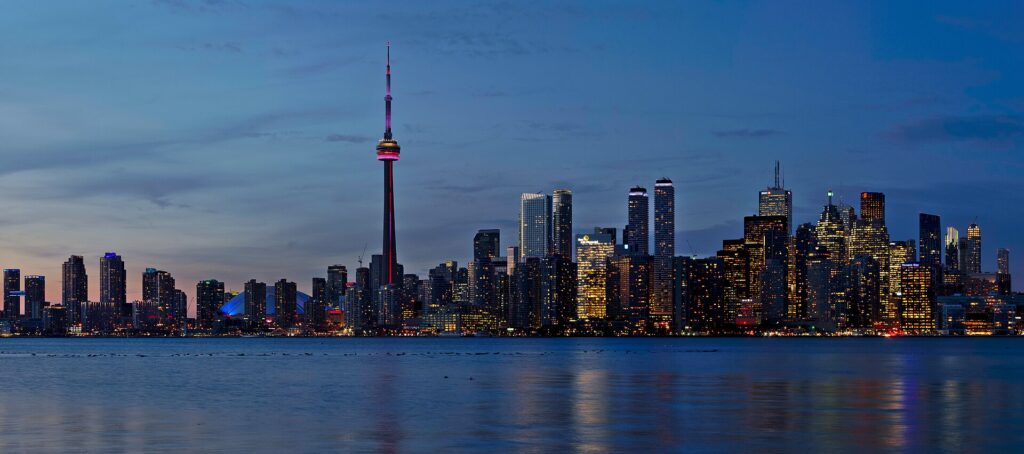
Yes, it is touristy, and yes, it is still worth it. The CN Tower was the world’s tallest free-standing structure for more than three decades, and the view from the main observation level takes in the whole city, the lake, and on a clear day the mist of Niagara Falls on the horizon. The glass floor is a rite of passage. The EdgeWalk, a hands-free walk around the outside of the main pod on a harness, is the city’s best-known thrill experience and books out in summer. Go at sunset if you can; the timed-entry ticket system means you should book the slot in advance rather than queue on the day.
Ripley’s Aquarium of Canada and Rogers Centre
Both sit at the foot of the tower. Ripley’s Aquarium is one of the best rainy-day and family attractions in the city, with a moving walkway through an underwater tunnel that small children will not want to leave. Next door, Rogers Centre is home to the Toronto Blue Jays from April to September; a weeknight game is one of the cheapest ways to sit under the open roof with the tower lit up above you.
The Toronto Islands
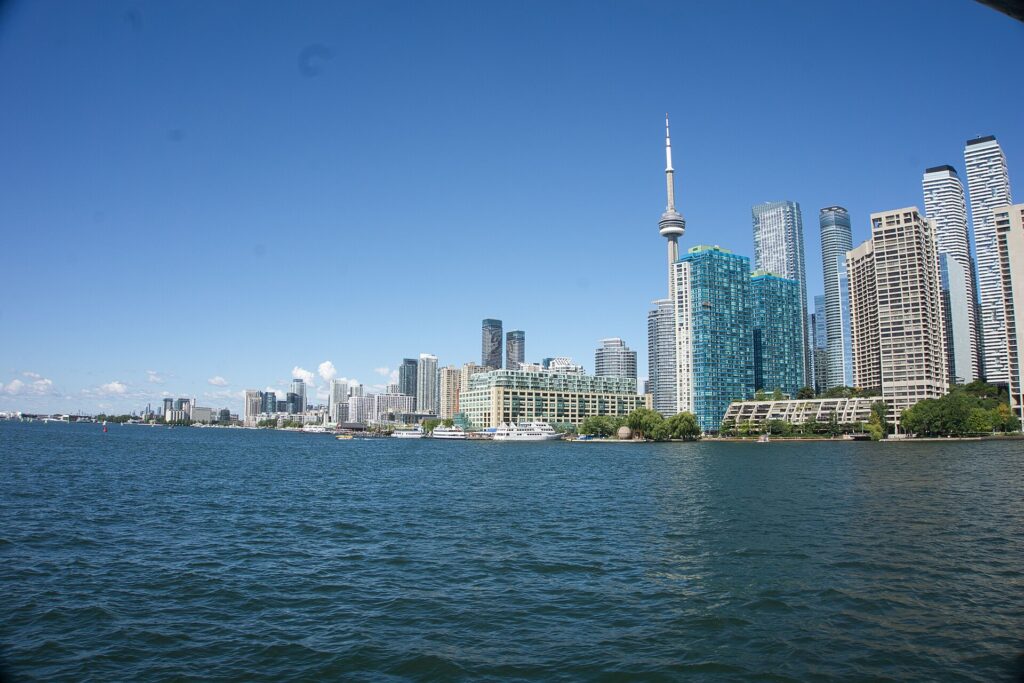
The single best thing to do in Toronto on a warm day costs the price of a ferry ticket. The Toronto Islands are a car-free chain of parkland a fifteen-minute ferry ride from the Jack Layton Ferry Terminal at the foot of Bay Street, with beaches, picnic lawns, bike rentals, a small amusement park (Centreville, open in the warmer months) and the definitive view of the skyline. Ward’s Island is the quieter, residential end; Centre Island has the amenities; Hanlan’s Point has the widest beach. Bring water and food, because options on the islands are limited, and check the City of Toronto’s parks pages for ferry schedules, which change by season.
Harbourfront and the waterfront trail
Between the ferry terminal and the foot of Bathurst Street, Harbourfront Centre runs a year-round program of free outdoor concerts, craft studios you can watch at work, skating in winter and a summer sailing scene. The waterfront trail continues in both directions for kilometres; a rented bike from a Bike Share Toronto dock is the easiest way to cover it.
Nathan Phillips Square and City Hall
The plaza in front of Toronto’s modernist City Hall is the city’s civic living room: a reflecting pool in summer, a skating rink in winter, the illuminated TORONTO sign for the obligatory photo, and free events through the year. The Cavalcade of Lights in November switches on the holiday season here.
St. Lawrence Market
The St. Lawrence Market, a few blocks east of the Financial District, is the place to eat a peameal bacon sandwich, buy Ontario cheese and maple products, and see how Toronto shopped before supermarkets. The main South Market runs Tuesday to Sunday; the Saturday farmers’ market draws the crowds. Go hungry and go early.
The Distillery District
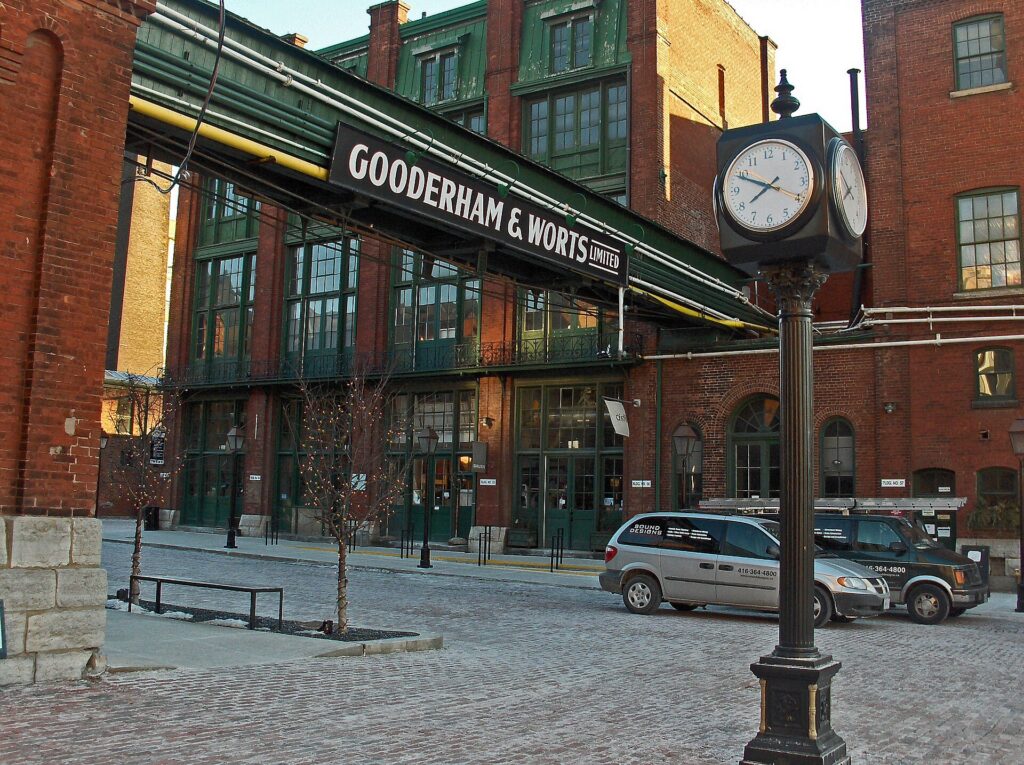
A ten-minute walk east of St. Lawrence Market, the Distillery District is a pedestrian-only cluster of Victorian industrial buildings that once housed the Gooderham & Worts distillery and now hold galleries, restaurants, a brewery, a sake maker and a theatre. It is at its most atmospheric in the evening and, in late November and December, during the Distillery Winter Village, when the lanes fill with lights and market stalls.
Museums, galleries and the stage
Royal Ontario Museum
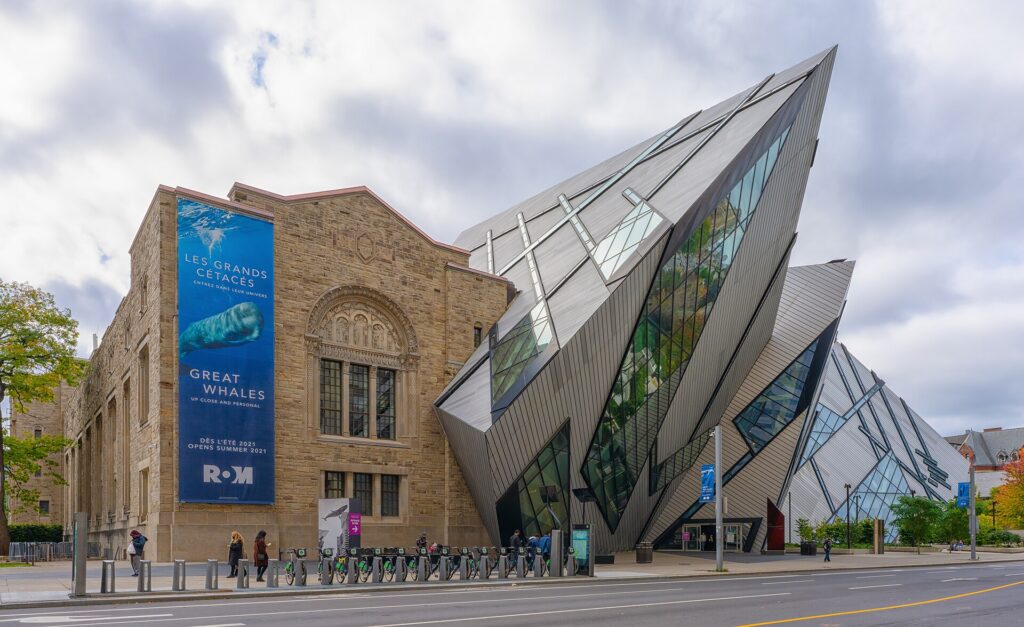
Canada’s largest museum, the ROM, sits at Bloor Street and Avenue Road above its own subway station. The dinosaur galleries are the draw for families, the world-culture and natural-history collections reward a full day, and the Michael Lee-Chin Crystal, the angular glass addition on Bloor, is a landmark in its own right. Allow at least three hours.
Art Gallery of Ontario
On Dundas Street West at the edge of Chinatown, the AGO holds one of the world’s great collections of Henry Moore sculpture, the definitive gathering of the Group of Seven and Tom Thomson, and a Frank Gehry redesign whose spiral staircase and Galleria Italia are worth the visit alone. Check the gallery’s site for free or reduced-admission evenings, which have run on a regular weekly schedule in recent years.
Casa Loma
A Gothic Revival mansion built by a financier who ran out of money before he ran out of ambition, Casa Loma is Toronto’s castle: turrets, secret passages, an underground tunnel to the stables and gardens with a view over the city. It sits north of Dupont Street, an uphill walk from Dupont subway station. Seasonal events, including a summer symphony series and Halloween and holiday programming, sell out.
The smaller museums worth your time
The Hockey Hall of Fame at Yonge and Front lets you stand next to the Stanley Cup. The Bata Shoe Museum and the Gardiner Museum of ceramics, both near the ROM, are small, excellent and rarely crowded. The Aga Khan Museum, in Don Mills, pairs a serene modern building with a collection of Islamic art and is one of the city’s most beautiful spaces. Evergreen Brick Works, in the Don Valley, is a reclaimed brick factory with trails, a Saturday farmers’ market and a good café.
Theatre, music and film
Toronto is the third-largest English-language theatre centre in the world after London and New York. The Mirvish theatres on King Street West and Yonge Street host the touring Broadway productions; the Four Seasons Centre is home to the Canadian Opera Company and the National Ballet of Canada; Roy Thomson Hall hosts the Toronto Symphony; and Massey Hall, reopened after a full restoration, remains the city’s best room for a concert. Every September the Toronto International Film Festival takes over the Entertainment District, and its year-round home, the TIFF Lightbox on King Street, screens films every day. For what is on sale during your dates, our Toronto events page lists concerts, shows and games.
Neighbourhoods worth a half-day
Kensington Market and Chinatown
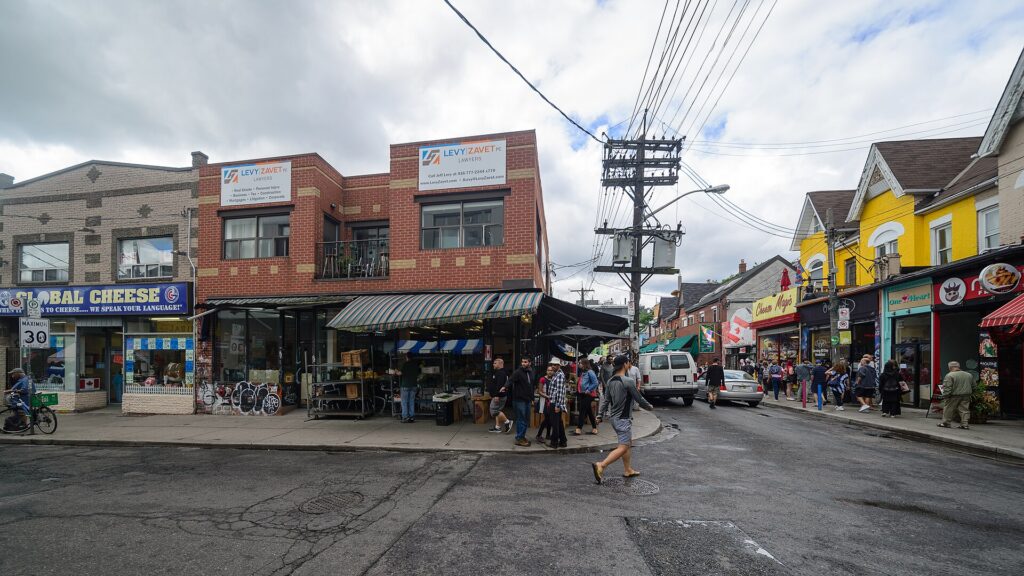
Start on Spadina Avenue at Dundas, the heart of the largest of Toronto’s Chinatowns, for dim sum and bakeries, then walk two blocks west into Kensington Market. Kensington is a scruffy, colourful grid of vintage shops, cheese mongers, Latin American and Caribbean grocers, taquerias and patios, and it is at its best on Pedestrian Sundays, when the streets close to traffic on the last Sunday of the month from late spring to fall.
Queen West, Ossington and Trinity Bellwoods
Queen Street West from University Avenue to Bathurst is the shopping-and-brunch stretch; keep going past Bathurst and it becomes West Queen West, with galleries, independent boutiques and Graffiti Alley, the lane behind Queen where the murals run for blocks. Trinity Bellwoods Park is the neighbourhood’s front lawn on a summer afternoon, and Ossington Avenue, running north from Queen, has one of the city’s best concentrations of restaurants and bars.
Yorkville
Once the centre of the 1960s folk scene, Yorkville is now Toronto’s luxury district: the flagship stores on Bloor Street, the boutique hotels, the galleries on Hazelton Avenue and the outdoor tables where the film festival crowd gathers each September. It sits right beside the ROM, which makes it an easy pairing.
The Danforth, Leslieville and the Beaches
Take the Bloor-Danforth subway east and the neighbourhoods change character with each stop. The Danforth around Chester and Pape stations is Greektown, with the restaurants to match. Leslieville, along Queen Street East, is the brunch-and-antiques strip. Keep going east to the Beaches, where a wooden boardwalk runs along Woodbine and Kew beaches and the pace slows down entirely; it is a different city from the Financial District, and it is twenty-five minutes away.
Little Italy, Koreatown and the west end
College Street west of Bathurst is Little Italy, still lined with cafés and trattorias and lively late into the night. Bloor Street west of Bathurst is Koreatown, with barbecue restaurants and karaoke. Further west, Roncesvalles Avenue is the Polish-heritage main street beside High Park, Toronto’s largest park, with a free zoo, Grenadier Pond, the famous cherry blossoms in late April or early May, and outdoor Shakespeare in summer.
Sports and live events
Toronto is a serious sports city, and a game is one of the most local things a visitor can do. The Maple Leafs and Raptors play at Scotiabank Arena, attached to Union Station; the Blue Jays play at Rogers Centre beside the CN Tower; Toronto FC and the Argonauts share BMO Field at Exhibition Place; and the Marlies, the Leafs’ farm team, are the affordable hockey option. MLSE, which owns most of those teams, lists home schedules; for tickets across all of them, plus concerts at Scotiabank Arena, Budweiser Stage and Massey Hall, check what is on in Toronto for your dates before you book flights, because a playoff run or a stadium tour can tighten hotel availability quickly.
The festival calendar is dense from June to September: Pride at the end of June, Canada Day on July 1, the Honda Indy in July, the Toronto Caribbean Carnival on the August long weekend, the Canadian National Exhibition from mid-August to Labour Day, and TIFF in September. The City of Toronto’s festivals calendar and Destination Toronto keep current dates.
What to eat, and where
Toronto’s defining food experience is not a dish but a map. More than half the city’s residents were born outside Canada, and each community has a main street. Eat dim sum in Chinatown or, for the real thing, in Scarborough or Markham; Caribbean roti and jerk in the west end and in Scarborough; Greek on the Danforth; Italian on College; Korean on Bloor; South Asian on Gerrard Street East, the Gerrard India Bazaar; Portuguese in Little Portugal along Dundas West; and Middle Eastern almost everywhere. The city’s own contributions are the peameal bacon sandwich at St. Lawrence Market and, less romantically, an outstanding brunch culture in Leslieville and on Queen West.
Two restaurant festivals bring prix-fixe menus to hundreds of restaurants: Winterlicious in late January and February, and Summerlicious in July. Both are good ways to try the city’s more ambitious kitchens at a fixed price. In summer, patios matter: Toronto takes its outdoor dining seriously for the few months it can.
Toronto with kids
The Toronto Islands and Centreville, Ripley’s Aquarium, the ROM’s dinosaurs, the High Park zoo and playground, the Toronto Zoo in Scarborough (large, spread out, and best with a full day), skating at Nathan Phillips Square in winter, the Hockey Hall of Fame for older kids, and a Blue Jays game with the roof open. Children under 13 ride the TTC free, which makes getting between all of the above cheap.
Day trips from Toronto
Niagara Falls is the obvious one: about an hour and a half by car, reachable by seasonal GO train service and year-round bus, and offered by every tour company in the city. The boat to the base of the Horseshoe Falls is the experience worth paying for; Niagara Falls Tourism covers the rest. Niagara-on-the-Lake, twenty minutes further, is wine country and the home of the Shaw Festival. Stratford, two hours west, runs one of North America’s great theatre festivals from spring to fall. Prince Edward County, two and a half hours east, has wineries, sand dunes and small-town inns. Blue Mountain, north of the city, is the closest ski resort in winter and a hiking and cycling base in summer. Algonquin Provincial Park, three hours north, is the classic Ontario canoe landscape; Ontario Parks handles reservations. Most of these are far easier with a car; see our Toronto car rental page and our rental car booking tips if you are planning more than one.
Two sample itineraries
Two days, no car
Day one: St. Lawrence Market for breakfast, walk to the Distillery District, streetcar back west along King Street through the Financial and Entertainment Districts, CN Tower at sunset, dinner on King West. Day two: Ferry to the Toronto Islands in the morning, back for lunch in Chinatown, Kensington Market in the afternoon, the AGO if it is a late-opening evening, and a game or a show at night.
Four days, with one day trip
Add a day for the ROM, Yorkville and Casa Loma, a day for the west end (Queen West, Ossington, High Park or the Beaches, depending on the season), and use the fourth day for Niagara Falls. Rent the car for that single day from a downtown location rather than the airport, which keeps parking out of the equation for the rest of the trip.
Practical details
- Transit: tap a credit card, debit card or phone on any TTC vehicle or fare gate, or buy a PRESTO card; a single tap covers a two-hour transfer window. The TTC’s site has maps and service alerts. Our transit-versus-car guide goes into detail.
- From Pearson: the UP Express train reaches Union Station in about 25 minutes. Details on both airports are on the Pearson and Billy Bishop sites.
- Weather: humid summers, cold snowy winters, and two lovely shoulder seasons. The best time to fly to Toronto guide has a month-by-month table; check Environment Canada’s forecast before you pack.
- The PATH: a network of underground walkways connects most of the Financial District, Union Station and the Eaton Centre. In January it is how locals get around downtown without a coat.
- Entry requirements: U.S. citizens need a valid passport; most other visa-exempt visitors arriving by air need an Electronic Travel Authorization. The Government of Canada’s visitor page is the authoritative source.
- Safety: Toronto is a large, generally safe city; the usual big-city awareness applies downtown late at night.
Frequently asked questions
How many days do you need in Toronto?
Three full days covers the icons and two or three neighbourhoods comfortably; five lets you add a day trip and slow down. A weekend is enough for the downtown core and the islands.
What is the number one thing to do in Toronto?
On a warm day, the ferry to the Toronto Islands, for the skyline view alone. In any season, the CN Tower at sunset is the classic.
Is Toronto walkable?
Downtown, very. The stretch from the waterfront north to Bloor Street and from the Distillery District west to Bathurst is flat and dense with things to see. Beyond that, the subway and streetcars fill the gaps.
Do I need a car in Toronto?
Not for the city itself. Rent one for day trips to Niagara, wine country or the parks, ideally from a downtown location for just those days.
What is Toronto known for?
The CN Tower, its diversity and food, the Toronto International Film Festival, its sports teams, and a waterfront and island park system that most first-time visitors underestimate.
Is Toronto expensive?
Hotels downtown are the main cost, especially in summer and during TIFF. Transit, the islands, the markets, the parks and many festivals are free or inexpensive. Booking flights in shoulder season and comparing hotels across neighbourhoods keeps the total manageable.
Ready to go? Compare flights to Toronto, find a place to stay with our Toronto hotel search, and if Niagara is on the list, price a rental car for the day.
Keep planning with TicketScanner
- Cheap flights to Toronto
- Toronto hotels — by neighbourhood
- Toronto car rentals — for Niagara and day trips
- Events in Toronto — concerts, hockey, baseball and shows on sale
- Best time to fly to Toronto: month by month
- Toronto: rent a car or use transit?
- Toronto Pearson (YYZ) airport guide
- Where to stay: the Entertainment District
- New York to Toronto cheap flights
Leave a Reply