Tag: Road Trips

  • The Complete Guide to Rental Car Booking Tips for Every Traveler

    The Complete Guide to Rental Car Booking Tips for Every Traveler

    A rental car can be the best money you spend on a trip or the most frustrating line item on your credit card statement, and the difference is rarely luck. It comes down to a handful of decisions made before you ever reach the counter: whether you need a car at all, which class to book, when and where to pick it up, how the insurance and fuel rules work, and what you agree to when you sign. This guide walks through every one of those decisions in the order you will face them, explains what the jargon on the rental agreement actually means, and flags the mistakes that cost travelers the most. It is written for North American travelers renting at home or abroad, whether you are picking up a compact for a weekend in Chicago, a minivan in Orlando or a manual hatchback in Rome.

    If you already know you need a car, you can compare rates from the major companies side by side on our car rental search. If you are still deciding, start with the first section.

    The short version

    If you read nothing else, these are the habits that save the most money and trouble:

    • Decide whether you need a car for the whole trip. Many city trips need a car for one or two days, not seven.
    • Book early on a free-cancellation rate, then keep checking. If the price drops, rebook and cancel the original.
    • Compare the total price, not the daily rate. Taxes, airport fees and add-ons can change the ranking completely.
    • Know your insurance before you arrive. Call your auto insurer and your card issuer, and write down exactly what each covers.
    • Choose full-to-full fuel and refill close to the return location.
    • Photograph and video the car at pickup and at return, including the fuel gauge and odometer.
    • Return on time. Rental days are usually counted in 24-hour blocks from pickup, and a short delay can cost a full day.

    Step 1: Decide whether you need a car, and for how long

    The cheapest rental is the one you do not take. In dense cities with good transit, such as New York, London, Paris, Toronto or Montreal, a car is often a liability: parking is scarce and expensive, hotels charge nightly for it, and traffic eats the time you saved. In spread-out places such as Los Angeles, Phoenix, Orlando, Dallas or Calgary, or anywhere your plans include national parks, small towns or a coastline, a car is often the only practical way to get around.

    The smartest answer is frequently a split: go without a car for the city days, then rent for the day trips or the road-trip leg. Neighborhood branches often open later and close earlier than airport counters, but their rates can be lower and they save you paying for a car that sits in a hotel garage. Our guide to renting a car versus public transport versus taxis works through the decision in detail, and our city guides answer it for specific places, for example New York, Los Angeles and Las Vegas.

    Step 2: Choose the right car class

    Rental companies sell car classes, not specific models. The listing will show one model with the words “or similar”, and you are guaranteed the class, not the car in the picture. Book the smallest class that genuinely fits your people and your luggage; bigger cars cost more per day, burn more fuel and are harder to park in old city centers. But do not squeeze four adults and four suitcases into a compact to save a little, because you will pay for it in comfort on every drive.

    ClassRealistic fitBest forWatch out for
    Economy / compactTwo adults, two carry-ons and one checked bagCity driving, tight parking, short tripsSmall trunk; can feel underpowered on mountain roads or highways
    Intermediate / standard sedanTwo to four adults, two large bagsMost couples and small familiesRear seats get tight for three adults on long drives
    Full-size sedanFour adults, three or four bagsLong highway drives, business travelParking in older European and downtown garages
    Compact or midsize SUVFour people, luggage plus a strollerFamilies, winter trips, gravel roadsHigher fuel use; “SUV” does not always mean all-wheel drive
    Full-size or three-row SUVFive to seven people with limited luggage when all rows are upLarger families, ski tripsLuggage space disappears with the third row in use
    MinivanSeven or eight people, or five with plenty of luggageFamilies with car seats, groupsLimited supply at peak times; book early
    Premium / luxuryAs a sedan, with more comfort and featuresBusiness travel, special occasionsOften excluded from credit card rental coverage

    Two class details trip travelers up regularly. First, if you need all-wheel or four-wheel drive, for a ski trip or a mountain road in winter, check whether the class guarantees it; many listings do not. Second, if you are renting in Europe, Latin America or much of Asia, the default is often a manual transmission. If you cannot drive stick confidently, filter for automatic and book early, because automatics are the smaller part of many fleets outside North America.

    A car rental counter in the arrivals area at Vancouver International Airport
    Airport rental counters are the most convenient place to pick up, and usually the most expensive (Photo: GoToVan from Vancouver, Canada via Wikimedia Commons, CC BY 2.0)

    Step 3: When to book

    Car rental prices move with supply and demand, and unlike airline seats, the fleet at a given location is fixed in the short term. When every car on the lot is spoken for, prices climb sharply and the minivans and SUVs go first. The periods that reliably tighten supply are summer, the Christmas and New Year weeks, spring break and school holidays, long weekends, and big local events such as a major conference, a championship game or a festival.

    The practical strategy is simple:

    1. Book as soon as your dates are firm, on a “pay later” or free-cancellation rate. For peak periods and larger vehicles, that means weeks or months ahead.
    2. Check the price again a few weeks out and a few days out. Rental rates do fall as well as rise, especially when a location has more cars than expected.
    3. If it drops, book the cheaper rate first, then cancel the original. Never cancel first; the lower price may disappear.

    Prepaid rates can be cheaper, but they usually carry cancellation fees or no refund at all, and some companies do not refund unused days if you return early. Use them only when your plans cannot change. It also pays to test slightly different pickup and return times: because rentals are priced in 24-hour periods, and weekly rates sometimes undercut five or six daily rates, a small shift can change the price noticeably.

    Step 4: Airport or neighborhood pickup?

    Airport locations are the most convenient and usually the most expensive. Many airports allow rental companies to pass on concession fees and facility charges, which appear on your bill as separate line items, and some add a customer facility charge that pays for a consolidated rental car center. Off-airport and neighborhood branches avoid some of those charges, but they add a shuttle ride or a taxi, and their opening hours are shorter; an office that closes at 6 pm on Saturday and reopens Monday is not much use for a Sunday afternoon return.

    A few rules of thumb:

    • Arriving late at night, with kids or with lots of luggage: pay for the airport location.
    • Spending the first days in a transit-friendly city: take the train or a taxi to your hotel and rent from a neighborhood branch on the day you leave town.
    • Flying in with a flight that might be delayed: add your flight number to the reservation, so the counter knows to hold the car rather than marking you a no-show.

    Our airport guides, such as Toronto Pearson, LAX and Denver International, explain where the rental counters are and how to reach them.

    The entrance to the consolidated Rental Car Center at Miami International Airport
    Many large airports group every company in one rental car center, often paid for through a facility charge on your bill (Photo: Xnatedawgx via Wikimedia Commons, CC BY-SA 4.0)

    Step 5: Read the whole price

    The daily rate in large type is the start of the price, not the end. Before you compare two offers, open the full breakdown and look for:

    • Taxes and airport fees, which vary widely by city and state or province.
    • Young driver surcharges, typically for drivers under 25.
    • Additional driver fees, charged per day at many companies.
    • One-way or drop fees if you return to a different location.
    • Equipment: child seats, GPS, ski racks, snow chains, each usually charged per day, often with a cap per rental.
    • Mileage limits, rare on North American leisure rentals but common on some specialty vehicles and international rentals.
    • Toll programs and their daily service fees.
    • Coverage products you may or may not need, covered in the next step.

    A rate that looks cheaper per day can end up costing more once these are added. Compare like for like: the same class, the same pickup and return times, the same drivers, the same coverage.

    Step 6: Understand rental car insurance

    Insurance is where most counter arguments happen and where most travelers either overpay or leave themselves exposed. There are four products you are likely to be offered, under slightly different names depending on the company and country.

    Collision damage waiver (CDW) or loss damage waiver (LDW)

    Strictly speaking, not insurance but a waiver: if you buy it, the company agrees not to charge you for damage to, or theft of, its car, subject to exclusions. Without it, you are responsible for the car’s damage, and sometimes also for “loss of use” while it is being repaired and for administrative fees. In Europe and many other regions a basic waiver is often included in the price but comes with a high deductible (called an “excess”), and the counter will offer a second product to reduce that deductible.

    Liability coverage

    Liability covers damage you cause to other people and their property. Rules differ sharply by country, state and province: some rentals include a legal minimum, some include very little, and in some countries, Mexico being the best-known example for North Americans, locally issued liability insurance is mandatory and your home policy is not accepted. Rental companies sell supplemental liability to top up the minimum.

    Personal accident and personal effects coverage

    These cover medical costs for you and your passengers and theft of belongings from the car. Many travelers already have this through health insurance, travel insurance or a home or renter’s policy.

    Where you may already be covered

    • Your own auto policy. In the US and Canada, many personal policies extend some coverage to rental cars for personal use, but often only within your home country, and not always collision.
    • Your credit card. Many cards include a rental collision benefit if you pay for the whole rental with that card and decline the company’s waiver. Some are primary, some are secondary to your own policy, and most have exclusions: certain countries, luxury and exotic cars, large vans and trucks, and rentals longer than a set number of days. Liability is almost never included.
    • Travel insurance. Some policies include rental car damage coverage as an option.

    Do this before the trip, not at the counter: call your insurer and your card issuer, ask exactly what is covered, in which countries, for which vehicle types and for how long, and ask them to send the benefit terms in writing. Then decide which of the counter products you actually need. Declining coverage you do not have is the expensive mistake; buying coverage you already have is the common one.

    Step 7: Drivers, age, license and payment

    • Minimum age. At most major companies in the US and Canada, the minimum is 21 (sometimes 20), with a daily surcharge for drivers under 25 and restrictions on premium classes. A few US states require companies to rent to younger drivers, with fees. Outside North America the rules vary, and some countries also have upper age limits or extra requirements for older drivers.
    • Additional drivers. Anyone who will drive must be on the agreement, present at pickup with a valid license. Some companies, and some jurisdictions, waive the fee for a spouse or domestic partner; ask. An unlisted driver in an accident can void your coverage.
    • Credit versus debit. Nearly every company prefers a credit card in the main driver’s name and places a hold for the estimated total plus a deposit. Debit cards are accepted at some locations with extra conditions, such as proof of a return flight or a credit check, and the hold ties up real money in your account for days after the return.
    • Your license. Bring the physical card. A digital license is not accepted everywhere, and an expired or temporary paper license can be refused.
    • International Driving Permit. An IDP is a translation of your license recognized under international conventions. Some countries require it, others recommend it, and rental companies sometimes ask for it even where the law does not. Canadians get one from CAA, as explained on the Government of Canada’s IDP page; Americans get one from the issuers listed by the US State Department. Get it before you leave; it cannot be issued abroad.

    Step 8: Fuel policies and electric cars

    PolicyHow it worksWhen it makes sense
    Full-to-fullPick up full, return full; you pay only for fuel you use, at pump pricesAlmost always the best value
    Prepaid fuel (full-to-empty)Pay for a full tank at pickup, return at any level, no refund for fuel leftOnly if you will genuinely return near empty and have no time to refuel
    Refuel on returnReturn below full and the company refills it at its own per-unit rate plus a service feeRarely; this is usually the most expensive way to buy fuel
    Same-to-sameReturn at the level you received itFine, but photograph the gauge at pickup

    Fill up within a few miles of the return location and keep the receipt; some companies ask for it if the gauge reads just below full. If you rent an electric vehicle, ask about the return charge requirement (many companies set a minimum percentage), where the nearest fast chargers are, which charging networks work with the car, and whether charging cables are included. EVs are excellent in cities with good charging and less relaxing on long rural drives where chargers are sparse. The US Department of Energy’s Alternative Fuels Data Center has a station locator that is useful for planning.
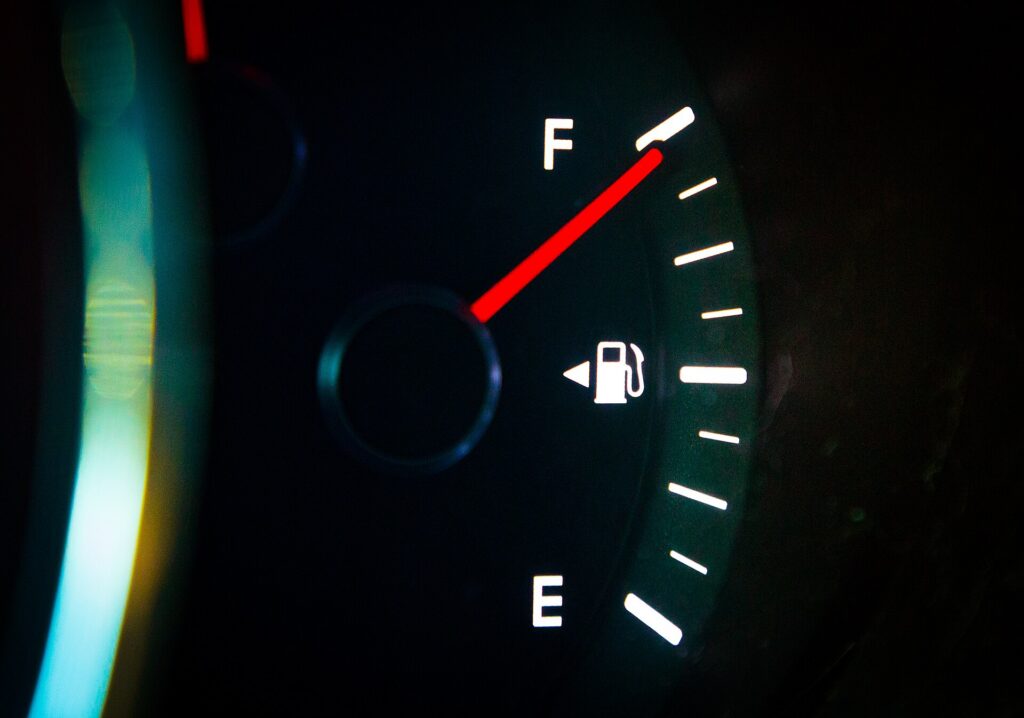
    A car dashboard fuel gauge showing a full tank
    On a full-to-full rental, photograph the gauge at pickup and bring the car back showing the same (Photo: Tony Webster via Wikimedia Commons, CC BY 2.0)

    Step 9: Mileage, one-way trips and borders

    Most leisure rentals in the US and Canada include unlimited mileage, but check, especially for specialty vehicles, local-renter rates and some international rentals. If you plan to drop the car somewhere else, price the one-way fee early; it can be large, but some popular routes are cheap in one direction when companies need to rebalance fleets. Our drive guides, such as Toronto to Montreal and Los Angeles to Las Vegas, are a good place to compare.

    Crossing a border needs to be declared at booking. Driving between the US and Canada is routine with the major companies, though some restrict certain vehicle classes; taking a US rental into Mexico, or driving between some European countries, can be restricted or require extra coverage and fees. Ask at booking and make sure the permission is written on the agreement.

    Step 10: Tolls

    Toll roads have increasingly gone cashless, charging by transponder or by photographing the license plate. Rental companies handle this through their own toll programs, which typically add a daily service fee on top of the tolls, sometimes for every day of the rental rather than only the days you use a toll road. Your options are to accept the program, use your own transponder where it is compatible and allowed, pay the toll operator directly online where that is possible, or plan routes that avoid tolls. Highway 407 ETR north of Toronto, for example, is fully electronic, and its operator’s site explains how unregistered vehicles are billed. Ask at the counter how tolls will be charged and read the program terms before you drive off.

    At the counter: handling the upsell

    Counter staff are often paid partly on what they sell, so expect offers of an upgrade, prepaid fuel, coverage and a toll package. None of that is a scam; some of it is useful. But decide in advance. A calm “no thank you, I have coverage through my card and my policy” is enough. Before you sign, check that the agreement matches your reservation: the class, the total estimate, the return date and time, the fuel policy, the drivers, and that nothing you declined has been added. If the class you booked is not available, the usual practice is a free upgrade to a larger class, not a paid one; ask for it.

    Loyalty programs are free to join at most companies and are worth it even if you rent once a year: members at many large airports skip the counter and go straight to the car, which saves time and removes the sales pitch entirely.

    Inspect the car before you leave the lot

    1. Walk around the car with your phone recording video. Get every panel, the bumpers, the wheels and the windshield, then close-ups of anything scratched, dented or chipped.
    2. Photograph the dashboard showing the fuel level, the odometer and any warning lights.
    3. Check the interior for stains, burns, damage and smells, and confirm the spare tire or inflation kit is present.
    4. Test the basics: lights, wipers, air conditioning, mirrors, seat adjustment and any child seat you rented.
    5. Get damage noted. Make sure anything you find is recorded on the checkout sheet or in the app, and ask an agent to initial it if possible.

    It is also worth entering the license plate or VIN into the recall lookup on the NHTSA recalls page if you are renting in the US; it takes a minute.

    While you have the car

    • Breakdowns: the roadside assistance number is usually on the key tag, the windshield sticker or the agreement. Call it before you call a tow truck yourself, or you may not be reimbursed.
    • Accidents: make sure everyone is safe, call the police if required locally, photograph everything, exchange details, and notify the rental company as soon as you can. Do not sign anything admitting fault.
    • Parking tickets and traffic cameras: fines follow the car. The company pays the authority, bills your card and usually adds an administrative fee, sometimes months later.
    • Changing plans: if you need the car longer, call and extend before your return time rather than just keeping it; the rate can be very different.
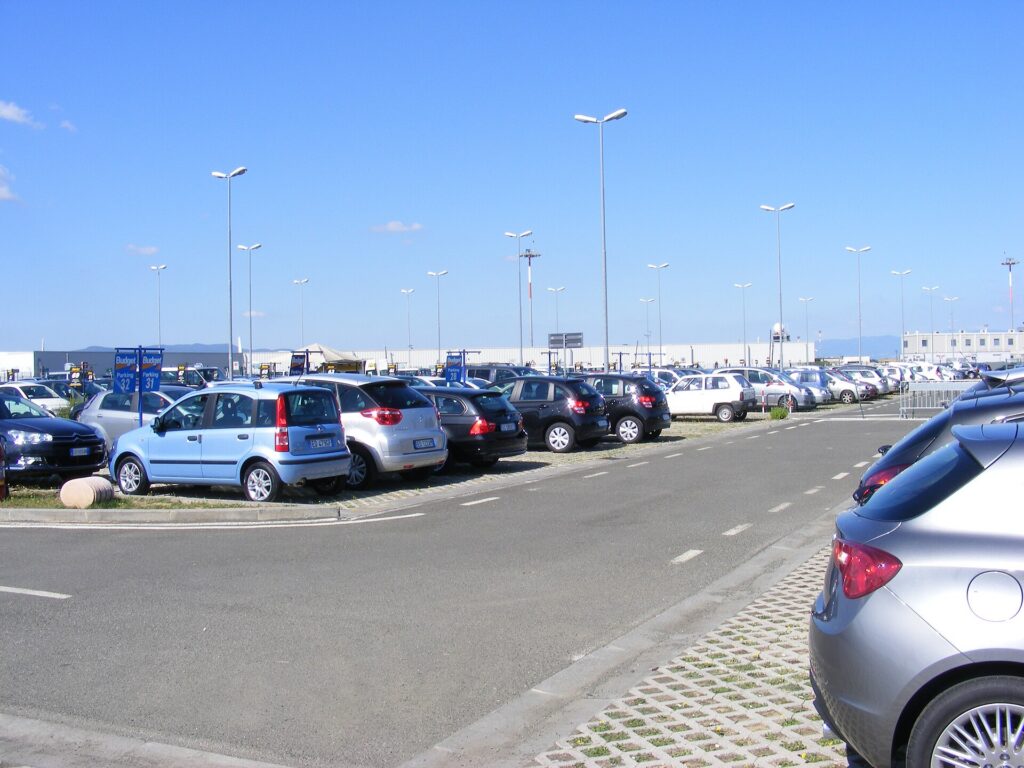
    Rows of rental cars parked in an airport rental lot
    Before you drive off, record a video walkaround of the car and photograph the dashboard (Photo: User:Mattes via Wikimedia Commons, Public domain)

    Returning the car

    Return timing matters more than most travelers expect. Rental days are usually counted in 24-hour blocks from pickup, grace periods are short, and being a few hours late can add a full day at a higher rate. Returning early is not always cheaper either, because rates may be recalculated. Allow extra time at airports, where the return garage can be a shuttle ride from the terminal, refill nearby, and do another video walkaround and dashboard photo. If you drop after hours, you normally remain responsible for the car until staff check it in, so your photos matter even more. Our guide to car rental return timing covers grace periods, late fees, early returns and after-hours drop-offs in detail. Check your final receipt before you leave and your card statement for the following weeks.

    Renting with kids

    Families have extra choices to make: vehicle size once car seats go in, whether to rent seats or bring your own, and which companies make pickup easiest with tired children. Child seats rented at the counter are charged per day, availability is not guaranteed unless reserved, and staff are generally not permitted to install them for you. Car seat laws vary by state, province and country; Transport Canada’s child car seat safety page is a good starting point for the principles. Our guide to the best car rental services for family vacations covers all of this, including seat math for three-across rows.

    Renting abroad

    • Check the license rules for each country, including whether you need an IDP.
    • Learn the road basics: which side of the road, how roundabouts work, speed units, and local rules such as low-emission zones and restricted historic centers, which are enforced by camera in many European cities and generate fines that reach you long after the trip.
    • Confirm what “included” means. Quoted rates abroad may or may not include basic collision cover, theft protection and liability, and deductibles can be large.
    • Expect smaller cars and manual gearboxes, and narrow streets and parking spaces to match.
    • Keep your passport with your license; many counters ask for both.

    Our city guides for Rome, London, Paris and Cancun go into local specifics.

    The mistakes that cost the most

    • Booking late for peak dates and paying whatever is left, often for a car that is too big or too small.
    • Comparing daily rates instead of totals, then discovering the fees at the counter.
    • Assuming a credit card covers everything, including liability, luxury cars or a country it excludes.
    • Letting an unlisted friend drive.
    • Skipping the pickup video, then having no proof about a scratch that was already there.
    • Accepting prepaid fuel and returning with half a tank.
    • Keeping the car an extra few hours without calling, and paying for an extra day at a walk-up rate.
    • Renting for the entire trip when you only needed a car for two days of it.

    Book the trip, not just the car

    A rental works best when it fits the rest of the itinerary. Match pickup to your flight’s arrival time, leaving a buffer for delays; choose a hotel with parking if you will keep the car overnight, and factor the parking fee into the room rate; and time the return so you are not racing for a flight. Our guide to the best time to book flights and hotels covers timing for the other two pieces, and our hotel booking tips explain how to read the fees on a room rate the same way you now read a rental agreement.

    Frequently asked questions

    How far in advance should I book a rental car?

    As soon as your dates are firm, on a free-cancellation rate. For summer, holidays, spring break and large vehicles, that means weeks to months ahead. Then keep checking and rebook if the price drops.

    Is it cheaper to rent a car at the airport or in town?

    Often in town, because airport locations pass on concession and facility fees. But neighborhood branches have shorter hours and require getting there, so the saving is only worth it when the timing works.

    Do I need the rental company’s insurance?

    It depends on what you already have. Check your own auto policy and your credit card’s rental benefit before the trip, get the terms in writing, and buy only what fills a real gap, especially liability and any coverage abroad.

    Can I rent a car with a debit card?

    At some locations, with conditions such as proof of travel or a credit check, and a hold on your funds. A credit card in the main driver’s name is far simpler.

    What happens if I return the car late?

    After a short grace period, most companies charge hourly and then a full extra day once you pass a threshold of a few hours. Call before your return time if you know you will be late.

    Which fuel option is best?

    Full-to-full in almost every case. Prepaid fuel only makes sense if you will return nearly empty.

    Do I need an International Driving Permit?

    For some countries, yes, and rental counters may ask for one even where it is only recommended. Check the official government guidance for your destination and get the permit before you leave home.

    Can I add a second driver?

    Yes, at pickup, with their license present. There is often a daily fee, sometimes waived for a spouse or partner. Never let an unlisted person drive.

    Ready to price it out? Compare rates from the major companies on our car rental search, or go straight to a destination such as Orlando, Calgary or Phoenix, and line up the rest of the trip with cheap flights and hotels.

  • Best Car Rental Services for Family Vacations

    Best Car Rental Services for Family Vacations

    On a family vacation, the rental car is more than transport. It is where the car seats live, where the snacks and the spare clothes ride, where toddlers nap between stops and where everyone starts and ends each day. Get it right and the trip flows; get it wrong and you spend the week wrestling luggage into a trunk that was never big enough, arguing with a counter about a car seat that is not there, or paying for extras you did not know you had agreed to. This guide covers what actually matters when renting for a family: which vehicle fits your family and your gear, the car seat decision, how the major rental companies differ in ways that matter to parents, how to keep the cost down, and how to make the pickup, the drives and the return easier with children in tow.

    When you are ready to compare, our car rental search shows minivans, SUVs and sedans from the major companies side by side for your dates.

    The short version

    • Size the car for the car seats and the luggage, not just the number of people.
    • Book early, especially minivans and three-row SUVs for school holidays and summer, and use a free-cancellation rate.
    • Decide on car seats before the trip: bring your own if you can, reserve if you must rent, and plan to install them yourself.
    • Join the company’s free loyalty program so you can skip the counter where that is offered.
    • Pick up at the airport unless you have a strong reason not to; the saving from an off-airport branch rarely survives a shuttle ride with tired children.
    • Compare total prices, including add-ons such as seats, extra drivers and coverage, before choosing a company.

    Is a rental car the right call for your family?

    For most family trips, yes, but not all. In spread-out destinations, such as Orlando, Southern California, Phoenix, the Rockies or any national park, a car is close to essential, and one vehicle for the whole family is usually cheaper than taxis or tours. In the densest cities, such as New York, London or Paris, a car with children can be more trouble than it is worth: parking is scarce, hotel garages charge nightly, and the subway with a stroller, while not effortless, is often faster. Many families split the difference, going car-free for the city days and renting for the day trips or the road-trip part of the holiday. Our guide to renting a car versus public transport versus taxis works through that decision.

    Choosing the right vehicle

    Rental companies sell classes, not models, and the car you get will be the one pictured “or similar”. What you can control is the class. For families, the class decision is mostly about three things: seats, car seat fit and luggage.

    Vehicle classWorks well forCar seat fitLuggage reality
    Midsize or full-size sedanTwo adults, one or two childrenTwo seats fit comfortably; three across is rarely possibleTwo large suitcases plus carry-ons; a stroller may not fit with them
    Compact or midsize SUVTwo adults, two children, moderate luggageTwo seats comfortably, sometimes a booster between themBetter height for strollers; check the cargo cover and floor depth
    Standard or full-size SUV (two rows)Two adults, two or three childrenWider rear bench; three across may be possible with narrow seatsGenerous, and good for winter trips with bulky gear
    Three-row SUVFamilies of five to sevenMore positions, but third-row access can be awkward with seats installedVery little luggage space with the third row up
    MinivanFamilies of four to seven, especially with young childrenThe easiest vehicle for multiple car seats, with sliding doors and walk-through accessDeep well behind the third row; the best all-rounder for gear
    Large passenger vanGroups and multigenerational trips of eight or moreMany positionsPlenty of space, but harder to drive and park, and often excluded from credit card coverage

    A few rules of thumb from experience:

    • Count car seats as passengers and a half. A rear-facing infant seat takes a lot of front-to-back space and can push the front passenger seat forward.
    • Three seats across a single row is difficult in most sedans and many SUVs. With three children in seats, a minivan or three-row vehicle is usually the answer.
    • With a third row in use, luggage space collapses in most SUVs. If you need all seven seats and have suitcases, a minivan is usually the better choice.
    • Strollers are the forgotten bag. A full-size stroller can take as much space as a large suitcase. A compact travel stroller saves room.
    • If you need all-wheel drive for a winter trip to the mountains, check whether the class guarantees it; many do not.
    • If you are renting in Europe, vehicles run smaller, manual gearboxes are common and minivans are harder to find. Filter for automatic and book early.
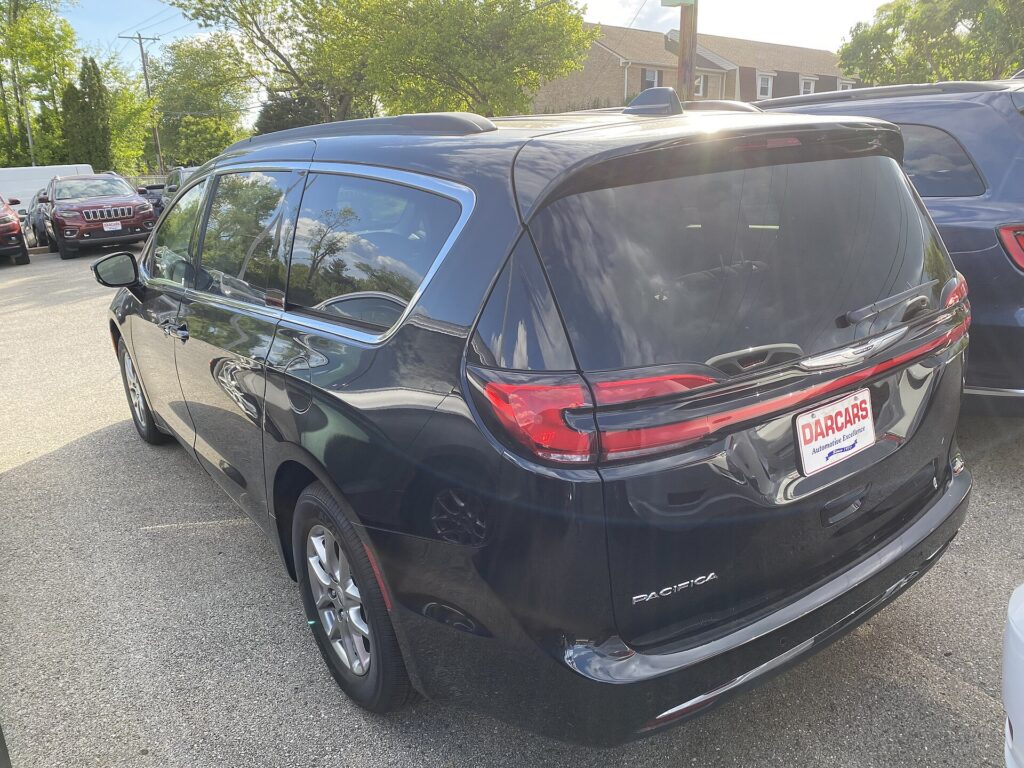
    A Chrysler Pacifica minivan, a common family rental in North America
    For families with car seats and luggage, a minivan is usually the easiest vehicle to rent (Photo: CZmarlin — Christopher Ziemnowicz — photo credit is required if this image is used anywhere other than Wikipedia. via Wikimedia Commons, CC BY-SA 4.0)

    The car seat decision

    This is the part of a family rental that causes the most stress, and it is worth deciding well before the trip.

    Renting seats from the rental company

    All the major companies offer child seats and boosters as an optional extra, usually for a daily fee, often capped per rental. The drawbacks are real: availability is not guaranteed unless you reserve, and even then a busy location can run out; you cannot choose the model; you may not know the seat’s history; and counter staff are generally not permitted to install seats for you, so you will be doing it yourself in a parking garage, possibly without the manual. If you rent, reserve the specific type you need (rear-facing infant, convertible, forward-facing or booster), check the seat when you collect the car for its expiration date, labels, harness and cleanliness, and ask for another if anything looks wrong.

    Bringing your own

    Many parents prefer to bring their own seat: you know its history, you know how to install it, and your child is used to it. Most major airlines in the US and Canada let you check a car seat free of charge, and often a stroller too, but confirm with your airline, because policies differ. Consider a padded travel bag to protect the seat in the hold. If you buy a seat on the plane for your child, you can use an approved car seat on board; the FAA explains which seats qualify and how to use them on its flying with children page. Booster seats are not approved for use during flight, but they are light and easy to carry on or check.

    Installing seats in a rental

    Most modern vehicles have lower anchors and top tethers, called LATCH in the US, UAS in Canada and ISOFIX in Europe, as well as seat belts you can use to install a seat. Practice installing your seat at home, bring the manual or download it to your phone, and give yourself time at pickup. The NHTSA car seat guidance and Transport Canada’s child car seat safety page explain how to choose and install the right seat for a child’s age and size.

    Rules on the road

    Car seat laws are set by each state, province and country, and they differ in the age, weight and height thresholds for each stage. The safe approach is to follow the stricter of your home rules and the local rules. Two principles are universal: never place a rear-facing seat in front of an active airbag, and keep children in the back seat whenever possible; safety agencies in both the US and Canada recommend the back seat for children under 13. In Europe, car seats must carry the local approval label, and a seat approved in North America may not meet that requirement, so check before relying on your own seat abroad.

    The major rental companies, from a family’s point of view

    The big brands are more similar than their marketing suggests. They have broadly similar fleets, all offer child seats as extras, and all have loyalty programs. Several also share owners: Enterprise, National and Alamo belong to the same group, as do Avis and Budget, while Hertz owns Dollar and Thrifty. What differs is their location networks, how they handle pickup and which travelers they target. Prices vary constantly by city, date and vehicle, so no brand is always cheapest; compare totals for your trip.

    Enterprise

    Enterprise is known for its large network of neighborhood branches as well as airport locations, which is useful if you want to rent for only part of the trip, start from near your hotel or swap cars mid-vacation. Its airport locations carry the usual range of SUVs and minivans. Its loyalty program is Enterprise Plus.

    National

    National is popular with frequent travelers because members of its Emerald Club can, at many airport locations, skip the counter and choose a car from a designated aisle. For a family, that means you can look at the actual cars and pick one whose trunk and rear seats suit your gear, rather than taking whatever is assigned.

    Alamo

    Alamo focuses on leisure travelers and is a common choice at vacation airports such as Orlando. At many locations you can check in online to skip the counter, and at many you can choose your own car from the available vehicles in your class, which, as with National, helps families find the right trunk and seat layout.

    Hertz

    Hertz has one of the widest airport networks and a broad fleet. Members of its free Gold Plus Rewards program can skip the counter at many airports and go straight to their car, which is a real advantage when you land with tired children.

    Avis

    Avis is another major airport brand with a wide network. Its Avis Preferred program lets members bypass the counter at many locations, and its app can manage parts of the rental.

    Budget

    Budget, Avis’s sister brand, is generally positioned as the value option and often shares facilities with Avis at airports. It is worth including in any comparison, particularly when you can apply a membership or employer discount.

    Sixt

    Sixt is headquartered in Germany, has a strong presence across Europe and a growing network at North American airports, and its fleet often includes European makes. For families renting in Europe it is one of the natural companies to compare, and in North America it is worth checking alongside the domestic brands.

    National and Alamo car rental counters at an airport
    Several big brands share owners and facilities; loyalty programs can let you skip the counter entirely (Photo: AutoRentals via Wikimedia Commons, CC BY-SA 4.0)

    How to choose between them

    What matters to youWhat to look for
    Avoiding a counter queue with kidsA free loyalty program with counter bypass at your airport (Emerald Club, Gold Plus Rewards, Avis Preferred, Alamo online check-in)
    Choosing a car that fits your gearLocations where you can pick from an aisle or lot (National, and Alamo at many locations)
    Renting for only part of the tripA strong neighborhood network near your hotel (Enterprise is known for this)
    The lowest total priceA side-by-side comparison of totals, including seats, drivers and coverage, for your exact dates
    Renting in EuropeAutomatic transmission availability, larger vehicle classes, and car seats that meet local rules

    Big families, grandparents and groups

    For multigenerational trips and groups of eight or more, you have two realistic choices: one large passenger van, or two ordinary cars. A large van keeps everyone together, but it is harder to drive and park, supply is limited, some companies restrict who may rent one, and many credit card rental benefits exclude it. Two minivans or SUVs cost more in fuel and parking but are easier to drive, give you the freedom to split up for different activities, and are usually covered by the same insurance as any other car. Whichever you choose, list every adult who might drive on the agreement. If a family member has limited mobility, ask about vehicles with easier step-in height, and if a driver needs hand controls, many major companies can fit them with advance notice; call the company’s accessibility line well before the trip rather than relying on the counter.

    Keeping the cost down

    • Book early on a free-cancellation rate and check again before the trip. Minivans and large SUVs are limited, and they go first in school holidays. If the price drops, book the new rate and then cancel the old one.
    • Compare totals, not daily rates. A company with a slightly higher rate can come out cheaper once you add car seats, an extra driver and coverage.
    • Bring your own car seats if you can. Daily seat fees across two or three seats add up over a week.
    • Check the additional-driver fee. Many companies charge per day for a second driver; some waive it for a spouse or domestic partner, and some loyalty programs or memberships include it. Ask.
    • Use discounts you already have: auto club, warehouse club, employer or credit card programs often have codes with the major brands.
    • Know your insurance before you reach the counter. Check what your own auto policy and your credit card cover, in which countries and for which vehicle types; large vans and some SUVs can be excluded. Our rental car booking tips explain the coverage products in plain terms.
    • Choose full-to-full fuel and refill near the return location.
    • Test the length of the rental. A weekly rate can make seven days cost little more than five.
    • Price parking into the hotel. A hotel or vacation rental with free parking can be worth more than a slightly lower room rate; our guide to the best time to book hotels for family vacations covers the rest of the accommodation side.

    Pickup day with children

    1. Put your flight number on the reservation so the car is held if you are delayed.
    2. Split up if you can. One adult collects the car while the other waits with the children and luggage at the curb or in a quiet corner of arrivals.
    3. Use the counter bypass if your loyalty program offers it at your airport.
    4. Check the car before loading it: walk around it recording a video, photograph the dashboard, and make sure the rear doors have child locks and the seat anchors are accessible.
    5. Install the car seats before anything else, then load the luggage, then the children.
    6. Set up the car: connect your phone, set the navigation for the hotel and adjust the mirrors while still parked.
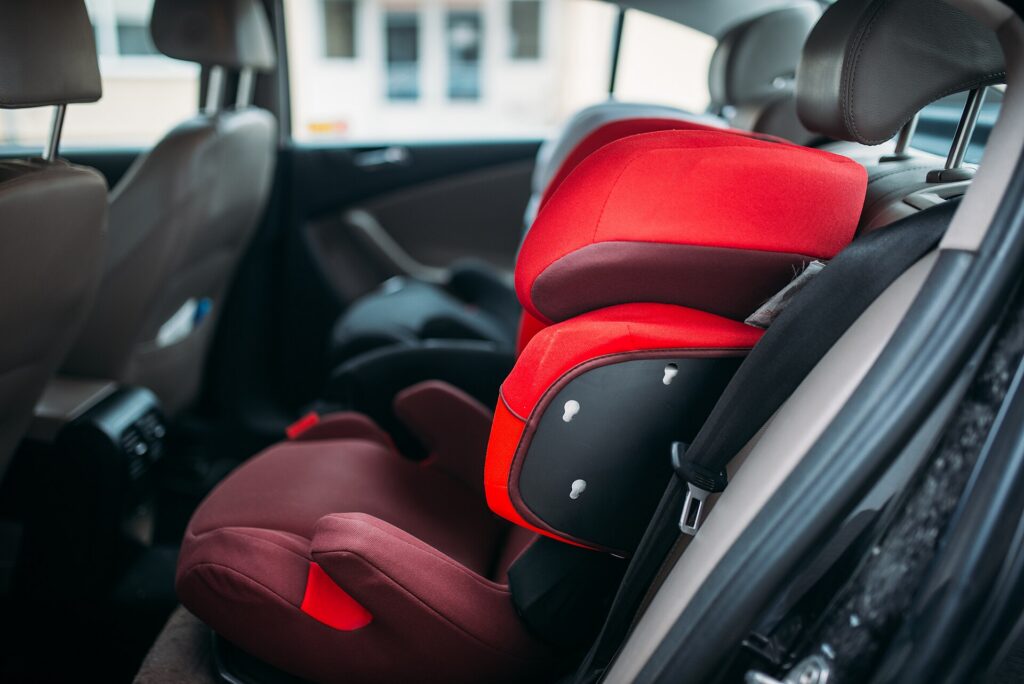
    A child car seat installed in the back seat of a car
    Decide before the trip whether to bring your own car seat or reserve one, and plan to install it yourself (Photo: Shixart1985 via Wikimedia Commons, CC BY 2.0)

    On the road with kids

    • Plan shorter driving days than you would as adults, and build in stops every couple of hours for restrooms, food and running around.
    • Download offline maps and entertainment before you leave the hotel Wi-Fi.
    • Pack a car bag within reach: snacks, water, wipes, a change of clothes, a small first-aid kit, sick bags and chargers. Our guide to the best travel first-aid kits covers what to carry.
    • Use window shades for sun on long drives, and never leave a child alone in a parked car, even briefly; cars heat up dangerously fast.
    • Keep valuables out of sight when you park at attractions, and take them with you where you can.
    • Let the drivers rest. If there are two adults, both should be on the agreement so you can swap.

    Returning the car

    Leave more time than you think for the return. Refueling, finding the return entrance, unloading car seats and luggage, and catching the shuttle to the terminal all take longer with children. Rental periods are usually counted in 24-hour blocks, so a late return can add a full day, including a day of seat rental and coverage. Our guide to car rental return timing explains grace periods, late charges and how much time to allow before a flight. Check under every seat and in every seatback pocket before you hand over the keys; small toys and pacifiers are the most common casualties.

    Family road-trip destinations where a rental shines

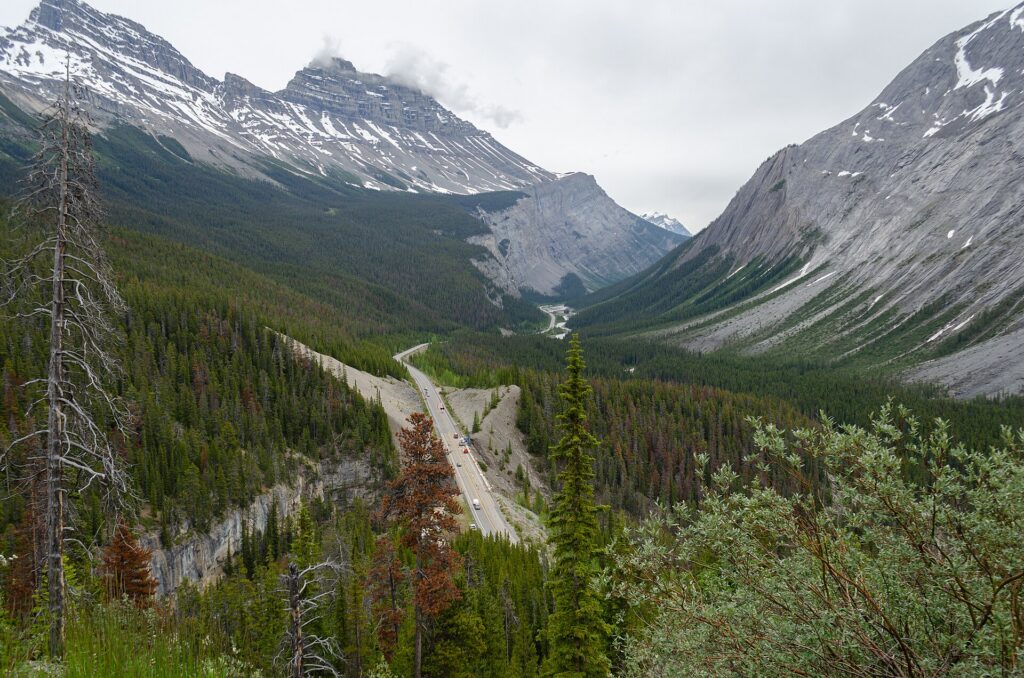
    The Icefields Parkway winding through the Canadian Rockies seen from Parker Ridge
    Family road trips such as the Icefields Parkway between Banff and Jasper are where a rental car shines (Photo: Ethan Sahagun via Wikimedia Commons, CC BY-SA 4.0)

    Common mistakes families make

    • Booking a car that fits the people but not the luggage.
    • Assuming a rented car seat will be waiting, without reserving, or assuming staff will install it.
    • Booking late for school holidays, and finding minivans sold out.
    • Letting a partner drive without adding them to the agreement.
    • Renting off-airport to save a little, then spending an hour on a shuttle with overtired children.
    • Underestimating the return, and running for the flight.

    Frequently asked questions

    What is the best rental car for a family of five?

    A minivan in most cases, especially with young children in car seats, because it combines easy access, space for three seats and room for luggage. A three-row SUV works if you pack light.

    Do rental car companies provide car seats?

    Yes, all the major companies offer them for a fee, usually per day with a cap. Reserve in advance, inspect the seat at pickup, and expect to install it yourself.

    Is it better to bring my own car seat?

    Often, yes. You know its history and how to install it, and most major airlines check car seats free of charge. Check your airline’s policy before you fly.

    Which rental company is best for families?

    There is no single best. Look for a company with a counter bypass or car choice at your airport, the vehicle class you need, and the lowest total price for your dates once seats, drivers and coverage are included.

    Do I need to pay extra for my spouse to drive?

    Sometimes. Many companies charge an additional-driver fee, but some waive it for a spouse or domestic partner, and some jurisdictions require them to. Ask at booking.

    How far ahead should I book a minivan?

    As early as your dates are firm, especially for summer, spring break and holiday weeks, on a free-cancellation rate so you can rebook if the price falls.

    Can I use a US car seat in a rental car in Europe?

    Possibly not legally. European rules require seats with local approval labels, which most North American seats do not carry. Check the rules for your destination or rent a compliant seat.

    Ready to plan? Compare minivans and SUVs on our car rental search, find family-friendly flight times, and choose a hotel with parking through our hotel search. For more on why the trip is worth the effort, read our piece on family vacations and work-life balance.

  • Travel Smarter: 10 Best Traveling Books for Kids

    Travel Smarter: 10 Best Traveling Books for Kids

    Every parent who has spent three hours in a car or a plane seat with a restless child knows how quickly the good mood runs out. Tablets help, until the battery dies or the downloads fail. Books are the quiet workhorse of family travel: no charging, no Wi-Fi, no volume to argue about, and the right one can hold a child’s attention for far longer than you would expect. The trick is choosing books that suit travel specifically, which is not the same as choosing good books. A beautiful hardcover with delicate pages, a stack of heavy picture books, or a sticker book that sheds pieces into the seat gap will make the trip harder, not easier. This guide covers what makes a book travel well, the best types by age, specific titles that are long-standing favorites, books that connect to where you are going, audiobooks, how to pack and ration them, and the mistakes that turn a reading plan into a mess.

    The short answer

    Pack light, durable books that reward repeat looking, and mix types. For toddlers, sturdy board books and lift-the-flap books about planes, trains and vehicles. For ages three to seven, search-and-find books like I Spy and Where’s Waldo?, picture books about airports and travel, and sticker and activity books. For confident readers, a chapter-book series they already love, plus an atlas or fact book about the world. Add a book about your destination, load a few library audiobooks for the car, and hold one new book back as a surprise for the hardest stretch of the trip.

    A boy lying down and reading a chapter book
    A chapter-book series a child already loves is the safest bet for a long flight (Photo: Wilfredor via Wikimedia Commons, CC0)

    What makes a book good for travel

    A good travel book passes a few practical tests on top of being a good read.

    • Durability. Board books, thick pages and wipe-clean covers survive juice, crumbs and being dropped in an airport. Save the heirloom hardcover for home.
    • Weight and size. Every book goes in someone’s bag. Paperbacks, slim activity books and compact formats win. A large-format atlas may be worth it for an older child on a long flight, but one is enough.
    • Replay value. Books children can look at again and again, like search-and-find books, detailed illustrated books and fact books, last far longer than a short story read once.
    • Few loose parts. Stickers and flaps are great; pop-up pieces, loose cards and books that come with small toys are easy to lose under a seat.
    • Low mess. Crayons roll, markers stain upholstery, and glitter is forever. Choose stickers, pencils or water-reveal pads for activity books.
    • Right level of independence. On a plane, a book the child can enjoy alone gives parents a break; a book that needs reading aloud is better for the car, where everyone can listen.

    Best types of travel books by age

    AgeBest typesWhy they travel well
    1 to 2Board books, touch-and-feel, lift-the-flapIndestructible, short, and good for pointing and naming
    3 to 5Picture books about travel and vehicles, search-and-find, sticker booksRepeatable, independent looking, and they explain what is happening at the airport
    5 to 7Activity books, early readers, flap books with factsMix of doing and reading; builds confidence on a long trip
    7 to 10Chapter-book series, puzzle books, illustrated atlasesLong enough to fill a flight; series mean the next book is always wanted
    10 to 12Longer novels, fact books, destination guides for kidsIndependent reading for hours; a way to prepare for the destination

    Toddlers: board books and flap books

    For children under three, the best travel books are sturdy, simple and about the things they will see. Board books about planes, trains, cars and trucks give a toddler words for the noisy, confusing world of an airport, and naming things on the page is an activity in itself.

    • My Big Train Book, a sturdy board book with big, bright photographs of trains, is ideal for pointing and naming and is durable enough for a bumpy ride.
    • Byron Barton’s Airport walks through a trip from arrival at the terminal to takeoff in bold, simple pictures, which can make a first flight feel less strange.
    • Lift-the-flap and touch-and-feel books keep small hands busy. Choose board-book flaps over paper ones, which tear.

    At this age, familiar favorites from home often work better than new books, because a toddler in an unfamiliar place finds comfort in the known. Bring one or two of those, plus one new travel-themed book.

    Ages three to seven: picture books, search-and-find, stickers

    This is the age where books do the most work on a trip, because children can look independently for long stretches but still love being read to.

    Picture books about travel

    • Usborne Look Inside an Airport is a flap book that shows what happens behind the scenes: check-in, baggage, security, the control tower and the plane. It answers a lot of questions before they are asked, and the flaps keep children busy at the gate.
    • Richard Scarry’s Cars and Trucks and Things That Go is a classic for road trips. The pages are packed with detail and running jokes, and children can pore over it for a long time, hunting for Goldbug on every spread.
    • National Geographic Little Kids First Big Book of the World introduces continents, animals, landmarks and people with big photographs and short, readable facts, roughly suited to ages four to eight. It is a good way to spark curiosity about where you are going. National Geographic Kids has more from the same family of books and games.

    Search-and-find books

    Search-and-find books may be the single best category for travel, because each page can take many minutes and children happily revisit them.

    • The I Spy books by Jean Marzollo and Walter Wick, with their photographed scenes and rhyming riddles, work for a wide age range, and siblings can compete to find objects first.
    • Where’s Waldo? by Martin Handford (published as Where’s Wally? in some countries) needs no reading at all, which makes it perfect for mixed ages.

    Sticker and activity books

    Sticker books are mess-free and absorbing. The Usborne Sticker Dolly Dressing series, with its many themed titles, is a long-running favorite, and there are sticker books on vehicles, dinosaurs, space and maps for every taste. Maze books, dot-to-dot books and simple puzzle books sized for travel are good for children around five to ten. Reusable water-reveal pads, where a water-filled pen reveals colors that fade as they dry, are a clever option for younger children, with nothing to spill beyond a few drops.

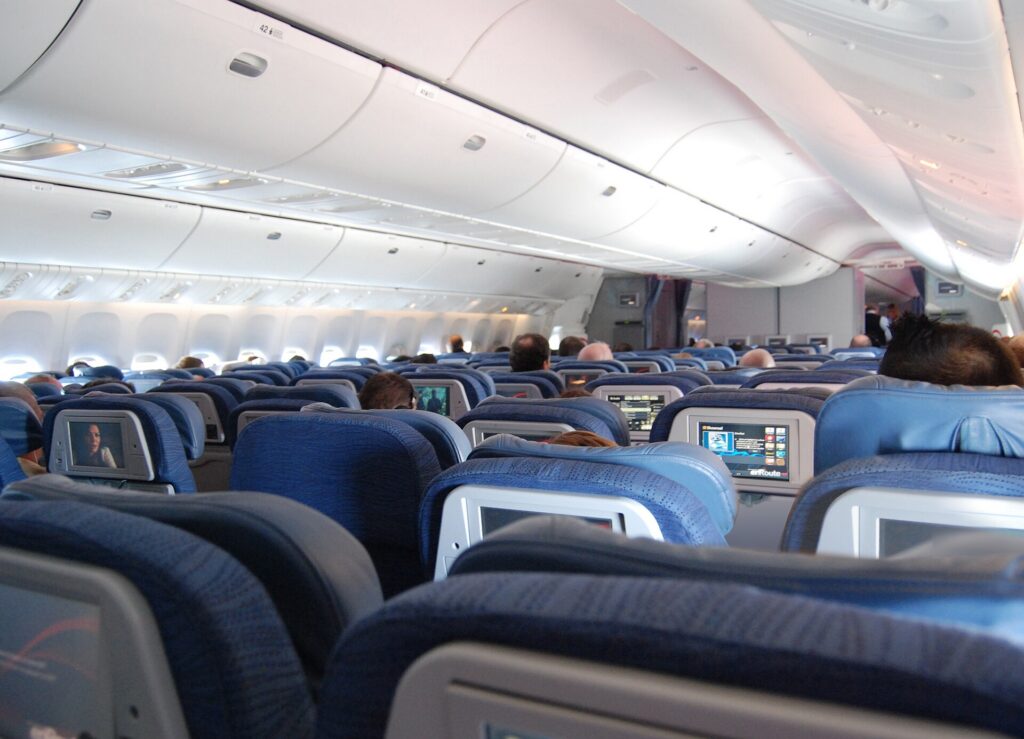
    Rows of economy seats in the cabin of an Air Canada Boeing 777
    On a plane, compact books a child can enjoy alone, kept in the bag under the seat, work best (Photo: jo3hug via Wikimedia Commons, CC BY 2.0)

    Ages seven to twelve: series, puzzles and atlases

    Older children who read independently are the easiest to entertain with books, as long as the book is one they actually want to read.

    Chapter-book series

    A series they already love is the safest bet: they know the characters, and finishing one book on the flight makes them want the next. Travel-themed series add to the excitement.

    • Mary Pope Osborne’s Magic Tree House series sends two siblings to a different place and time in each book, from ancient Rome to the rainforest. The books are short enough to finish on a flight, and there are many of them. The official Magic Tree House site lists the titles.
    • Jeff Brown’s Flat Stanley, about a boy flattened by a bulletin board who travels by mail, has inspired school projects around the world and is a natural travel read for early chapter-book readers.

    Atlases and fact books

    • Atlas of Adventures, illustrated by Lucy Letherland, is a large, beautifully illustrated atlas full of activities and adventures around the world, best for roughly seven to twelve. It is heavy, so bring it for a long flight rather than a day trip.
    • Maps by Aleksandra Mizielińska and Daniel Mizieliński is an oversized illustrated atlas of countries, packed with drawings of food, people, animals and landmarks. It is a book to linger over, ideal for a long-haul flight or a rainy afternoon at the hotel.
    • Fact books in the “weird but true” style from National Geographic Kids offer short, surprising facts that children love to read aloud to the rest of the car.

    Puzzle books

    Word searches, crosswords, logic puzzles and travel activity books with games and quizzes are ideal for children who find reading for long stretches tiring. Pack a pencil with a cap; pens leak in the cabin.

    Books about where you are going

    One of the most rewarding things you can pack is a book set in your destination. Reading about a place before and during the trip gives children something to look for, and seeing the real thing is thrilling.

    • Paris: Ludwig Bemelmans’s Madeline, about the little girl in the old house covered with vines, shows off Paris landmarks on every page. Planning the trip? Start with flights to Paris and our Paris guide.
    • London: Michael Bond’s A Bear Called Paddington begins at Paddington Station, which you can visit. See flights to London.
    • New York: Kay Thompson’s Eloise, the girl who lives at the Plaza Hotel, is a perfect before-the-trip read. See flights to New York and our New York guide.
    • Boston: Robert McCloskey’s Make Way for Ducklings is set in the Public Garden, where bronze statues of the duck family stand today. See flights to Boston.
    • Many cities: Miroslav Sasek’s classic This Is series, with titles including This Is Paris, This Is London, This Is New York and This Is Rome, offers illustrated tours of the great cities that older children and adults both enjoy.

    Your local librarian can suggest books for almost any destination, including picture books set in national parks and nonfiction about the history and animals of the place you are visiting.

    Books for first-time or nervous flyers

    For a child who has never flown, or one who is anxious about it, the unknown is often the hardest part. Books that walk through the whole journey, from packing and arriving at the airport to security, boarding, takeoff and landing, turn the unknown into a sequence they can picture. Read one several times in the week before the trip, and talk through each step: “This is where we give them our bags.” “This is the part where the plane goes fast and then lifts up.” On travel day, point out the things you saw in the book as you pass them. Many children find it reassuring to recognize the check-in desk, the X-ray belt and the jet bridge from the pages.

    It helps to be honest about the less pleasant parts, like waiting in lines, ears popping and the seat belt sign, so nothing comes as a shock. Pair the book with a plan for those moments: a snack or a drink during takeoff and landing, a favorite book for the wait at the gate, and a small reward when you land. Our guide on how early to get to the airport helps you build in enough time that travel day does not feel rushed, which keeps everyone calmer.

    Matching books to the kind of travel

    On a plane

    Planes suit independent reading and quiet activities: search-and-find books, sticker books, puzzle books and chapter books. Keep the books in the bag under the seat, not in the overhead bin, so you can reach them during taxi and turbulence when you cannot stand up. Choose compact formats that fit on a tray table.

    In a car

    Reading in a moving car makes many children feel sick. Children between about two and twelve are especially prone to motion sickness, according to the CDC’s guidance on motion sickness, which recommends looking at the horizon. If your child gets carsick, save books for stops and use audiobooks while driving, or choose picture books that need only a glance rather than long reading. Read-aloud from the front seat, where a parent reads to the whole car, works well for families who do not get sick.

    On a train

    Trains are the best of both: a table, space to spread out, and a smooth ride. Bring the big atlas, the activity book and the chapter book for a train journey.

    At the hotel

    A bedtime book from home helps children settle in an unfamiliar room. It is a small ritual that tells them the day is over, wherever you are. Our guide to booking hotels for family vacations covers choosing rooms where children can sleep while adults stay up.

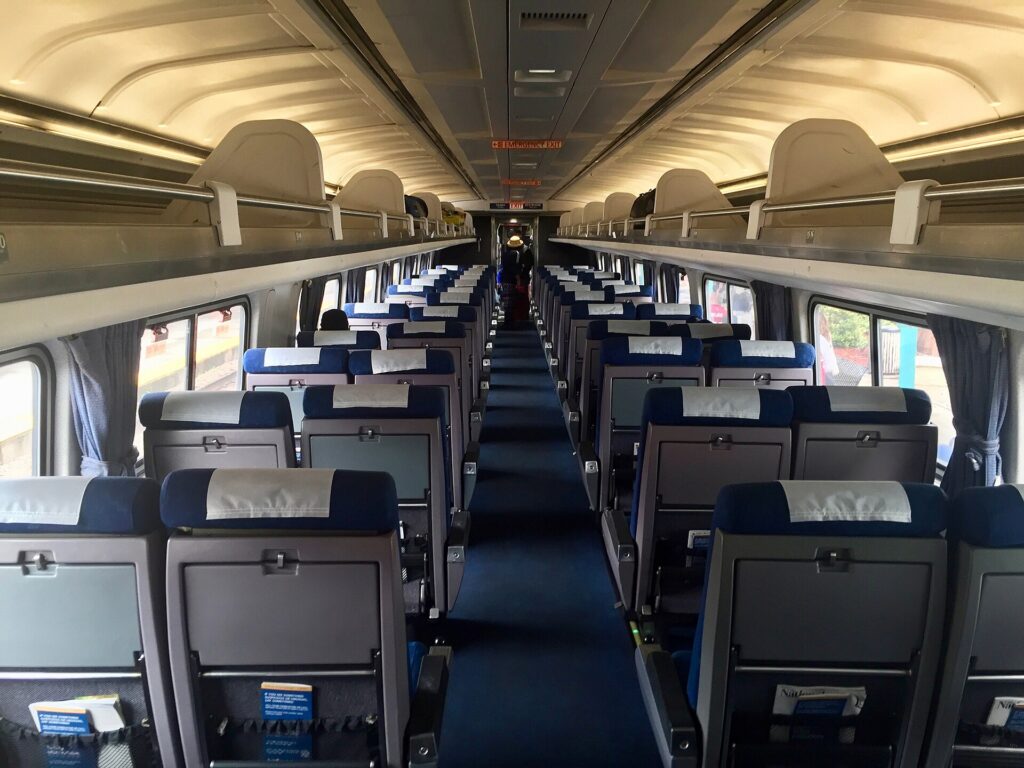
    The interior of an Amtrak passenger car with rows of seats
    Trains are the best of both worlds for reading: space, a smooth ride and a view (Photo: CZmarlin — Christopher Ziemnowicz — photo credit is required if this image is used anywhere other than Wikipedia. via Wikimedia Commons, CC BY-SA 4.0)

    Audiobooks and e-readers

    Audiobooks are the best answer to the reading-in-the-car problem and a great way for a whole family to share a story. Many public libraries lend audiobooks and e-books free through apps like Libby and Hoopla; all you need is a library card. Borrow and download titles before you leave, because loans expire and you may not have a good signal on the road. A long series read aloud by a good narrator can carry a family across hundreds of miles.

    For older children, an e-reader holds dozens of books in the space of one paperback, with a long battery life. It is a good investment for a child who reads fast. For younger children, physical books are usually more engaging and easier to manage.

    How to pack and ration books

    • Give each child a pouch. A zippered pouch or small bag of their own books and activities keeps things organized and easy to grab.
    • Keep a surprise in reserve. One new book, wrapped or hidden, brought out at the hardest point of the journey, often at the end of a long flight, buys an hour of calm.
    • Rotate. Do not hand over everything at once. Offer one book, then an activity, then a snack, then a different book.
    • Mix ages for siblings. A book the younger child can look at while the older one reads it aloud keeps two children busy at once.
    • Weigh the bag. Books are heavy. Limit the number per child, and choose paperbacks and slim activity books.
    • Plan for the return. Pack one or two books that have not been seen yet for the trip home, when everyone is tired.

    Books go in the child’s own backpack or case; our guide to kids’ suitcases covers bags that children can manage themselves.

    Shelves of children's books in the children's section of a public library
    Your public library is the best place to stock up on travel and destination books before a trip (Photo: Micheal Kaluba via Wikimedia Commons, CC BY-SA 4.0)

    Making reading part of the trip

    • Ask questions as you read. “What would you pack if you went there?” “Which of these animals do you think we will see?” Books become a way to talk about the trip.
    • Start a travel journal. A small notebook where children draw what they saw, stick a ticket stub and write a sentence or two turns the trip into their own book to reread later.
    • Visit a bookstore or library on the trip. Choosing a book in a new city is a souvenir that lasts, and many city libraries have wonderful children’s rooms.
    • Use small rewards if they help. A sticker after a chapter, or choosing the next snack, can keep reluctant readers going. Keep it light.
    • Read yourself. Children notice when parents put down their phones and pick up a book.

    Where to find good books before you go

    You do not need to buy everything. Your public library is the best starting point, with children’s librarians who can recommend books for every age and destination. The Association for Library Service to Children publishes an annual list of notable children’s books, a reliable source of well-reviewed titles. Borrowing a stack of travel and destination books a couple of weeks before the trip builds anticipation, and the ones that are a hit can be bought for the journey itself.

    Common mistakes

    • Packing too many. Five books per child is plenty for most trips; the rest is weight.
    • Bringing only new books. Familiar favorites are comforting, especially for young children in an unfamiliar place.
    • Loose-piece books on planes. Pop-ups, puzzle pieces and card sets end up under the seats.
    • Markers and glitter. Crayons and markers stain upholstery and tray tables. Stick to stickers and pencils.
    • Forcing reading in the car. If a child feels sick, stop. Switch to an audiobook and look out of the window.
    • Not downloading audiobooks ahead. No signal in the mountains means no audiobook, unless you downloaded it at home.

    Frequently asked questions

    What are the best books for kids to take traveling?

    Durable, light books with high replay value: board books for toddlers, search-and-find and sticker books for preschoolers, activity books and a favorite chapter-book series for older children, and one atlas or fact book about the world.

    At what age should I start bringing books on trips?

    From the very first trip. Babies enjoy simple board books with high-contrast pictures, and a familiar book from home is a comfort at any age. The type of book changes as children grow.

    Are books better than tablets for long journeys?

    They complement each other. Books need no battery or signal, encourage imagination and give eyes a break from screens. Many families use both: books and activities first, a screen as a reward or for the final stretch.

    How do I choose the right travel book for a plane or train?

    Choose compact books a child can enjoy alone, like search-and-find, sticker and puzzle books, for planes. On a train, with more space and a smooth ride, larger books like atlases work well.

    How can kids read in the car without getting sick?

    Many cannot, and that is normal. Encourage looking at the horizon, try picture books that need only brief glances, and use audiobooks for long stretches. Stop if a child feels unwell.

    How many books should I pack for a child?

    Three to five for most trips: a favorite, a new travel-themed book, an activity or sticker book, and a surprise for the hardest part of the journey. Add a library audiobook or two.

    Can travel books also be educational?

    Yes. Atlases, fact books and books set in your destination teach geography, history and culture, and a book about airports helps children understand what is happening on travel day.

    With the reading sorted, the rest is the trip. Compare fares on flexible dates on our flight search, choose a family-friendly base on our hotel search, and if there is a road trip in the plan, price a car with room for everyone on our car rental search. For the bigger picture, read our guide on why a family vacation is worth the time off, and if you are traveling with a baby, our travel bottle warmer guide and family car rental guide cover the essentials.

  • America’s Most Unique State Parks: Adventure Awaits

    America’s Most Unique State Parks: Adventure Awaits

    America’s national parks get the headlines, but some of the country’s strangest and most beautiful landscapes are protected as state parks. Red sandstone that seems to burn at sunset, stone spires named after a color film, a cypress swamp draped in Spanish moss, a river gorge with three great waterfalls, a volcanic field where you can dig for diamonds and keep what you find: these places are often less crowded than the big national parks, easier to fit into a long weekend, and close to cities with good flight connections. This guide profiles the state parks that stand out as genuinely unique, from the four in the original version of this article to seven more that deserve a place on the list. For each one, you will find what makes it special, when to go, how to get there and what to know before you set off, followed by advice on fees, reservations, safety and building a fly-and-drive trip around them.

    The short answer

    If you want desert color, start with Valley of Fire in Nevada, an hour from Las Vegas, and the Utah trio of Kodachrome Basin, Goblin Valley and Dead Horse Point. For water and forest, go to Letchworth in New York for its waterfalls and Caddo Lake in Texas for its cypress bayous. For wildlife, Custer State Park in South Dakota has free-roaming bison. For something completely different, dig for diamonds at Crater of Diamonds in Arkansas. Visit desert parks from fall to spring, not in midsummer; check each park’s official site for closures and reservations before you go; and plan to fly into a nearby city and rent a car, since almost none of these parks can be reached by public transport. Compare fares on our flight search and rental rates on our car rental search.

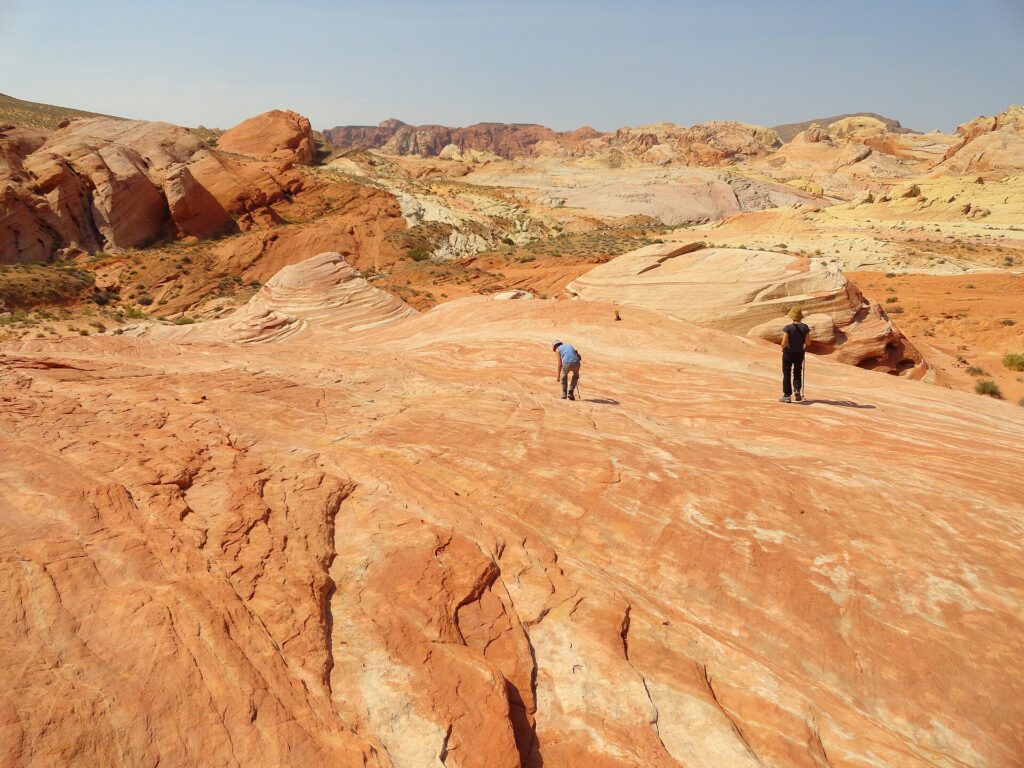
    Swirling red and white sandstone stripes on the Fire Wave Trail in Valley of Fire State Park, Nevada
    The Fire Wave in Valley of Fire State Park, about an hour from Las Vegas (Photo: Fabio Achilli from Milano, Italy via Wikimedia Commons, CC BY 2.0)

    State parks versus national parks

    State parks are run by individual states rather than the federal government, and that affects how you plan a visit.

    • Fees and passes are set by each state. A federal national parks pass does not cover state parks. Most charge a day-use fee per vehicle or per person, and some charge more for vehicles registered out of state. If you plan several visits in one state, check whether a state annual pass is available.
    • Reservations work differently. Campgrounds and cabins are booked through each state’s own reservation system, and popular parks fill up months ahead for weekends and holidays. Some parks also limit day-use entry at busy times.
    • They are often less crowded. Many state parks see far fewer visitors than nearby national parks, especially midweek, although the most famous ones can still be busy on weekends and holidays.
    • They pair well with national parks. Several of the parks below sit close to famous national parks, which makes them easy to add to a road trip.

    America’s most unique state parks

    1. Valley of Fire State Park, Nevada

    Valley of Fire earned its name from the red sandstone that seems to glow at sunrise and sunset. The park covers some 40,000 acres of bright red Aztec sandstone set among gray and tan limestone, with petrified trees and petroglyphs more than 2,000 years old. It is Nevada’s oldest state park and one of its most visited.

    • Don’t miss: the swirling stripes of the Fire Wave, the pastel rocks of the White Domes, the petroglyphs at Atlatl Rock and along the Mouse’s Tank trail, and Elephant Rock near the east entrance.
    • When to go: fall through spring. Summer temperatures are extreme, and some trails close during the hottest months for safety. The park also closes completely for maintenance for the first two weeks of December each year.
    • Getting there: about an hour’s drive northeast of Las Vegas, which makes it an easy day trip. Fly into Harry Reid International Airport, compare flights to Las Vegas, and pick up a rental car in Las Vegas.

    Hours, fees, closures and trail information are on the official Valley of Fire page from Nevada State Parks. Our guides on whether you need a rental car in Las Vegas and things to do in Las Vegas help you build a trip that combines the Strip with the desert.

    2. Kodachrome Basin State Park, Utah

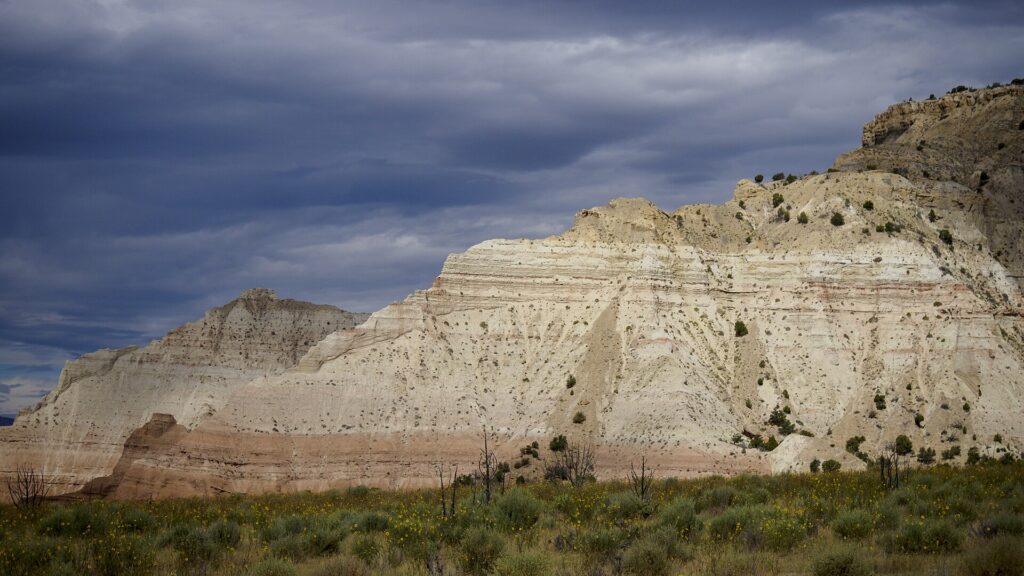
    The color and beauty of this basin in southern Utah led a National Geographic Society expedition to name it after Kodachrome color film in 1948. Its signature features are 67 monolithic stone spires called sedimentary pipes, rising from multi-hued sandstone layers that reveal around 180 million years of geologic history.

    • Don’t miss: the easy nature trail, the Panorama Trail for a longer loop past the spires, and the colors at sunrise and sunset.
    • When to go: spring and fall are ideal. Summers are hot, and winters can bring snow and cold nights at this elevation.
    • Stay: the park has campgrounds and cabins, which are popular, so reserve early.
    • Combine it: it sits a short drive from Bryce Canyon National Park, so many visitors pair the two, and it fits naturally into a southern Utah loop from Las Vegas or Salt Lake City.

    See the official Kodachrome Basin page from Utah State Parks for camping and trail details.

    Colorful sandstone cliffs and rock spires in Kodachrome Basin State Park, Utah
    Kodachrome Basin in southern Utah, named after the color film in 1948 (Photo: Nhartmannphotos via Wikimedia Commons, CC BY 4.0)

    3. Goblin Valley State Park, Utah

    Goblin Valley looks like another planet. Thousands of mushroom-shaped rock formations, known as hoodoos or goblins, crowd a valley in the desert of east-central Utah, and unlike many parks, visitors are free to wander among them off trail. The park is also known for its dark night skies, making it a great place to stargaze.

    • When to go: spring and fall. Summer days are very hot, and there is little shade.
    • Combine it: it sits between Capitol Reef National Park and the Moab area, so it slots easily into a longer Utah road trip.

    4. Dead Horse Point State Park, Utah

    Dead Horse Point is famous for one view: a sheer overlook high above a dramatic gooseneck bend in the Colorado River, with the canyons of Canyonlands stretching away beyond. It is close to Moab and to both Arches and Canyonlands national parks, and it is popular for sunrise, sunset and stargazing.

    5. Caddo Lake State Park, Texas

    The original list described Caddo Lake as a labyrinth of waterways and swamps, and that still captures it. Towering bald cypress trees draped with Spanish moss rise out of Big Cypress Bayou, and paddling the channels feels closer to the Louisiana bayou country next door than to the Texas of most people’s imagination. The fishing is excellent, with more than 70 species recorded.

    • Don’t miss: a canoe or kayak trip along the paddling trails, a guided boat tour from one of the nearby marinas, and a night in one of the historic cabins built by the Civilian Conservation Corps more than 80 years ago.
    • When to go: spring and fall are the most comfortable. Summer is hot and humid, and the mosquitoes are out in force.
    • Getting there: the park is in East Texas, close to the Louisiana line, a few hours’ drive east of Dallas. Compare flights to Dallas and a rental car in Dallas; our guide on whether to rent a car or use transit in Dallas explains the options.

    Reservations, alerts and paddling maps are on the official Caddo Lake State Park page from Texas Parks and Wildlife.

    6. Palo Duro Canyon State Park, Texas

    Texas Parks and Wildlife describes Palo Duro Canyon as the second largest canyon in the country. It cuts through the flat Texas Panhandle in layers of red, orange and white rock, and it is a surprise to anyone who expects nothing but plains.

    • Don’t miss: the hike to the Lighthouse, the canyon’s best-known rock formation; the scenic drive to the canyon floor; and, in summer, the outdoor musical performances held in the canyon amphitheater.
    • When to go: spring and fall. Summer is very hot on the canyon floor, so hike early and carry plenty of water.
    • Getting there: the park is near Amarillo, which is reached by domestic flights or a long drive from Dallas.

    Visit the official Palo Duro Canyon State Park page for trail conditions and reservations.

    7. Letchworth State Park, New York

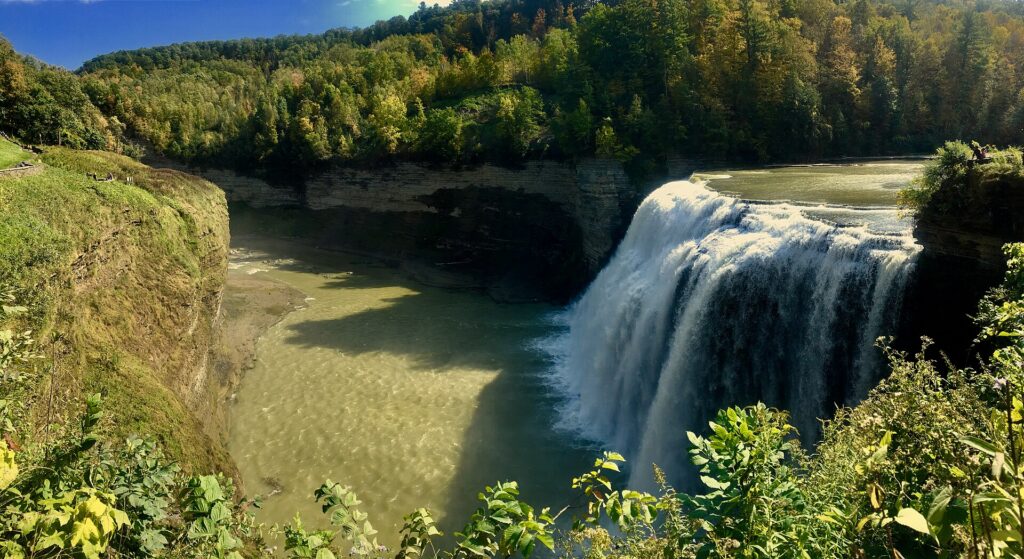
    Known as the “Grand Canyon of the East”, Letchworth is one of the most scenic places in the eastern United States. The Genesee River roars through a gorge over three major waterfalls, between cliffs as high as 600 feet in some places, surrounded by forest. There are 66 miles of hiking trails, as well as routes for horseback riding, biking and winter sports.

    • Don’t miss: the Upper, Middle and Lower Falls, the Gorge Trail along the rim, and the views from the park’s many overlooks.
    • When to go: summer for long days and full facilities; October for spectacular fall color, which makes it one of the park’s busiest times. Campgrounds and cabins operate seasonally and are booked through the state’s reservation system.
    • Getting there: the park is in western New York, within easy driving distance of Rochester and Buffalo, and it makes a good road trip from Toronto via one of the Niagara crossings; bring your passport and check border requirements. Compare car rentals in Toronto and confirm that your rental company allows cross-border travel.

    Opening dates and camping information are on the official Letchworth State Park page from New York State Parks. If you would rather combine New York’s outdoors with the city, our guide to New York on a budget covers the other end of the state.

    The Middle Falls of the Genesee River plunging into the gorge at Letchworth State Park, New York
    Middle Falls at Letchworth State Park, the "Grand Canyon of the East" (Photo: Andre Carrotflower via Wikimedia Commons, CC BY-SA 4.0)

    8. Custer State Park, South Dakota

    Custer State Park, in the Black Hills, is one of the best places in the country to see bison roaming free. Its Wildlife Loop Road passes through grasslands where you may also see pronghorn, elk, deer and the park’s famous begging burros, and its winding scenic roads squeeze between granite spires and through narrow tunnels.

    • Safety: the animals are used to cars, but they are wild. Stay in your vehicle or keep at least 100 yards from bison and elk, as the park advises.
    • When to go: late spring to early fall. The park’s annual bison roundup in the fall is a major event.
    • Combine it: Mount Rushmore, Wind Cave National Park and Badlands National Park are all within reach, making the Black Hills a great road-trip region.

    See the official Custer State Park page from South Dakota Game, Fish and Parks for lodging, campgrounds and visitor centers.

    9. Anza-Borrego Desert State Park, California

    Anza-Borrego is the largest state park in California, a vast desert of badlands, palm oases and canyons with hundreds of miles of dirt roads and twelve wilderness areas. In a good year, spring rains trigger spectacular wildflower displays, and patient visitors may spot bighorn sheep.

    • Don’t miss: the visitor center near Borrego Springs, the badlands views from Font’s Point, and the giant metal sculptures scattered around Borrego Springs.
    • When to go: late fall through spring. Wildflower season depends entirely on winter rainfall, so check the park’s updates. Summers are dangerously hot.
    • Check before you go: some trails can be closed after fire or flood damage; the park’s page lists current closures.
    • Getting there: a scenic drive inland from San Diego. Compare flights to San Diego and car rentals in San Diego, and see our guide to things to do in San Diego.

    The official Anza-Borrego Desert State Park page from California State Parks has closures, campground information and seasonal updates.

    10. Crater of Diamonds State Park, Arkansas

    This is the only place in the world where the public can search for natural diamonds in their original volcanic source. Visitors search a 37-acre plowed field on the eroded surface of an ancient volcanic crater, and any rock, mineral or gem you find is yours to keep. The largest diamond ever unearthed in the United States, the 40.23-carat Uncle Sam, was found here before it became a state park.

    • How it works: bring your own hand tools or rent them at the park. Battery-operated and motorized tools are not allowed.
    • Tips: searching after rain can make diamonds easier to spot on the surface, and the park staff can help identify finds.
    • When to go: spring and fall are most comfortable; summer in the open field is hot.

    The official Crater of Diamonds page from Arkansas State Parks explains the rules and has tips for first-time searchers.

    11. Starved Rock State Park, Illinois

    Starved Rock surprises visitors who think of Illinois as flat. Sandstone canyons carved by glacial meltwater cut into the bluffs along the Illinois River, and after spring rains or snowmelt, waterfalls pour into many of them. In winter, eagles gather along the river.

    At a glance

    ParkStateWhy it is uniqueBest seasonNearest major airport
    Valley of FireNevadaRed sandstone, petroglyphsOctober to AprilLas Vegas
    Kodachrome BasinUtahSedimentary pipes, colorSpring and fallLas Vegas or Salt Lake City
    Goblin ValleyUtahThousands of hoodoos, dark skiesSpring and fallSalt Lake City
    Dead Horse PointUtahColorado River gooseneck overlookSpring and fallSalt Lake City
    Caddo LakeTexasCypress bayou paddlingSpring and fallDallas
    Palo Duro CanyonTexasSecond largest canyon in the countrySpring and fallAmarillo or Dallas
    LetchworthNew YorkGorge with three major waterfallsSummer and OctoberBuffalo, Rochester or Toronto
    CusterSouth DakotaFree-roaming bisonLate spring to early fallRapid City
    Anza-BorregoCaliforniaDesert wilderness, wildflowersLate fall to springSan Diego
    Crater of DiamondsArkansasDig for diamonds and keep themSpring and fallLittle Rock
    Starved RockIllinoisCanyons and seasonal waterfallsSpring, fall and winterChicago

    Road trips that link several parks

    The Southwest loop

    Fly into Las Vegas and spend a day at Valley of Fire. Continue into southern Utah for Kodachrome Basin and Bryce Canyon, then head north and east through Capitol Reef to Goblin Valley and on to Moab for Dead Horse Point, Arches and Canyonlands. Finish in Salt Lake City and fly home from there. A one-way rental usually costs more than a round trip, so compare it with looping back to Las Vegas; our guide to car rental return timing explains how pickup and drop-off times affect the price.

    Texas two ways

    From Dallas, Caddo Lake makes a relaxed weekend of paddling and cabin life in East Texas. Palo Duro Canyon is a separate trip to the Panhandle, best combined with a stay in Amarillo.

    Great Lakes and New York

    Letchworth pairs naturally with Niagara Falls and the Finger Lakes wine region, and it is an easy drive from Toronto, Buffalo or Rochester. Starved Rock is a separate day trip from Chicago.

    The Black Hills

    Fly into Rapid City and spend three or four days combining Custer State Park with Mount Rushmore, Wind Cave and the Badlands.

    Planning your trip

    Flights

    These parks are spread across the country, so start by finding the nearest major airport with good fares from your home city. Our guide to cheap domestic flights in the USA explains how to find them, and our guide to the best time to book cheap flights and hotels covers timing. Canadian travelers should compare flights from Toronto and other gateways into Las Vegas, Salt Lake City, Dallas, San Diego or Chicago.

    Rental cars

    A car is essential for almost every park on this list. Reserve early for peak seasons, check mileage limits for long road trips, and choose a vehicle suited to the roads; most park roads are paved, but some scenic drives and backcountry routes are gravel or dirt and may be off limits under your rental agreement. Our rental car booking tips cover insurance and fees, and our guide to car rentals for family vacations helps if you are traveling with children.

    Where to stay

    State park campgrounds and cabins are the most atmospheric option and often the best value, but they book up quickly. Reserve through each state’s official system as soon as your dates are set. Otherwise, stay in the nearest gateway town or city; in Las Vegas, for example, rooms on the Strip are often much cheaper midweek than at weekends, which suits a desert day trip. Compare options on our hotel search.

    Fees, reservations and passes

    Every state sets its own fees, and some charge more for out-of-state vehicles. Check the official park page for current day-use fees, hours and any timed-entry or reservation system before you drive out, and consider a state annual pass if you plan several visits. Parks are one of the best-value trips there is, and our guide on how to save money for a trip shows how to fund the flights and car.

    Safety and park etiquette

    • Respect the heat. Desert parks can be dangerously hot from late spring to early fall. Hike early, carry more water than you think you need, and turn back if you feel unwell. Some parks close trails in summer for this reason.
    • Keep your distance from wildlife. Bison, elk and other large animals can injure people who get too close. Follow each park’s distance guidance.
    • Stay on marked trails where required and leave rocks, plants and artifacts where you find them, except at Crater of Diamonds, where keeping your finds is the point.
    • Never touch petroglyphs. Oils from skin damage them, and defacing them is illegal.
    • Check conditions before you go. Flash floods, fire damage, maintenance closures and seasonal road closures all happen. The official park page is the most reliable source.
    • Leave no trace. Pack out all trash, respect quiet hours in campgrounds and keep pets leashed where they are allowed.

    What to pack

    Bring sturdy walking shoes or hiking boots, a sun hat, sunscreen and sunglasses, layers for cool desert mornings and evenings, a refillable water bottle or hydration pack, snacks, a headlamp for stargazing, and a paper map, since cell coverage is patchy in many parks. A comfortable daypack makes a big difference on longer hikes; our guide to the best hiking backpacks can help you choose one. For paddling at Caddo Lake, add insect repellent and quick-drying clothes; for Crater of Diamonds, a bucket, a small trowel and a change of shoes.

    Bald cypress trees rising from the calm water of Caddo Lake in East Texas
    Bald cypress on Caddo Lake, best explored by canoe or kayak (Photo: Maciej Kraus via Wikimedia Commons, CC BY 2.0)

    Common mistakes to avoid

    • Visiting desert parks in midsummer without planning for extreme heat.
    • Assuming a national parks pass covers state parks. It does not.
    • Arriving without a reservation for popular campgrounds and cabins on holiday weekends.
    • Underestimating distances. Parks that look close on a map can be hours apart, especially in Utah and Texas.
    • Not checking closures. Valley of Fire, for example, closes for two weeks every December, and trails anywhere can close after storms or fires.
    • Relying on your phone for navigation. Download offline maps before you lose signal.

    Frequently asked questions

    What is the most unique state park in the US?

    It depends on what you are looking for, but Crater of Diamonds stands out because it is the only place in the world where the public can dig for diamonds in their original volcanic source. For scenery, Valley of Fire, Kodachrome Basin and Goblin Valley are hard to beat.

    Do I need a reservation to visit a state park?

    For day visits, usually not, though some popular parks limit entry at busy times. Campgrounds and cabins almost always need reservations, often months ahead for weekends and holidays. Check the official park page before you go.

    Does the America the Beautiful pass work at state parks?

    No. That pass covers federal lands such as national parks. State parks set their own fees, and many states sell their own annual passes.

    When is the best time to visit desert state parks?

    Fall through spring. Summer temperatures in parks like Valley of Fire, Anza-Borrego and Goblin Valley can be dangerous, and some trails close in the hottest months.

    Can I visit these parks without a car?

    Generally not. A few offer guided tours from nearby cities, such as Valley of Fire from Las Vegas, but a rental car gives you far more flexibility.

    Which state park is best for families?

    Crater of Diamonds is a hit with children, Custer State Park’s wildlife is thrilling for all ages, and Starved Rock and Letchworth have plenty of shorter trails and overlooks.

    Can Canadians easily visit these parks?

    Yes. Letchworth and Starved Rock are within reach of the Great Lakes region, and the western parks are an easy fly-and-drive trip via Las Vegas, Salt Lake City or San Diego. Carry your passport and check US entry requirements before you travel.

    Ready to explore? Find flights to the nearest gateway city on our flight search, book a rental car for the drive, and compare rooms near the park on our hotel search. For more ways to travel well without overspending, read our guide to budget travel destinations, and for a very different kind of escape, see our relaxing vacations for doing absolutely nothing or our guide to the best cities for Christmas in the USA.