
A suitcase of their own changes how a child experiences a trip. Rolling it through the terminal, choosing what goes in it and being responsible for it at the hotel makes a boy feel like a real traveler instead of cargo, and it takes a little weight off the adults at the same time. The catch is that most children’s luggage is sold on looks: a favorite color, a truck, a rocket, a cartoon. Looks matter to a six-year-old, but the things that decide whether a kids’ suitcase actually works are size, weight, wheels, handle height and how it fits the airline’s rules. This guide explains what to look for at each age, how carry-on allowances work for children, hardside versus softside, spinner versus two-wheel, ride-on cases and backpacks, a few affordable sets worth considering, and how to get your son packing and pulling his own bag without a meltdown at the gate.
The short answer
For most boys between about four and ten, the right choice is a light carry-on size case, roughly 16 to 18 inches tall, with smooth wheels and a telescoping handle that adjusts low enough for his height, in a design he picked himself. Toddlers do better with a small backpack or a ride-on case that a parent can tow. Pre-teens can usually handle a standard adult carry-on. Keep the empty weight low, since your child can only pull what he can lift, and check your airline’s carry-on and personal-item rules before you buy, because a child with his own seat usually gets the same allowance as an adult. Affordable sets from brands like Rosamo, GYMAX and Travelers Club bundle a small spinner with matching bags, which is good value if you want a backpack and case together.
Why a child’s own suitcase is worth it
- Responsibility. A child who packs and pulls his own bag learns to keep track of his things, and he is more likely to notice when something is missing.
- Excitement. A suitcase he chose turns the trip into something he owns. Many parents find that the bag comes out of the closet days before departure and gets packed and unpacked several times.
- Fewer hands full. Families already juggle car seats, strollers, documents and snacks. One less bag for an adult to carry matters.
- Organization. Each child’s clothes in their own case means less digging through a shared bag at the hotel, and a clear answer to “where are my pajamas?”
It is also one of the small decisions that make a family trip smoother, which is the point of our broader guide on why a family vacation matters for work-life balance.
Sizing by age
Children grow fast, and the suitcase that is perfect at five will look tiny at nine. The table below is a practical starting point. Heights are the overall height of the case including wheels, which is how most retailers list them.
| Age | Best option | Typical size | Why |
|---|---|---|---|
| 2 to 3 | Small backpack or ride-on case | Backpack or about 18 in ride-on | Toddlers cannot steer a case for long; a parent tows the ride-on when they tire |
| 4 to 6 | Small spinner or two-wheel case | About 14 to 16 in | Light enough to pull, low handle, fits under a seat on many aircraft |
| 7 to 10 | Kids’ carry-on | About 16 to 18 in | Holds a week of kids’ clothes; still manageable through a terminal |
| 11 and up | Standard adult carry-on | Within the airline’s carry-on limit | Will not be outgrown; handle height suits taller kids |
Two things matter more than the headline size. First, handle height: many small cases have a telescoping handle that is too long even at its lowest setting, which forces a small child to pull at an awkward angle. If you can, have your son try the handle before you buy. Second, empty weight: a heavy case filled with clothes becomes a bag the parent carries. Look for the lightest case in the size you need.
How airline rules apply to children
Airline baggage rules are the same for children as for adults in most cases, which surprises many parents. The principles:
- A child with a paid seat usually gets the full cabin allowance of their fare: typically one carry-on for the overhead bin and one personal item under the seat. Basic economy fares on some airlines restrict the full-size carry-on, so check the fare rules.
- Lap infants (usually under two, sitting on a parent’s lap) generally do not get their own carry-on, though many airlines allow a diaper bag and let you check or gate-check a stroller and car seat. Policies vary.
- Size limits apply to the child’s bag too. A kids’ case that is within the airline’s carry-on dimensions can go in the overhead bin; a very small one may fit under the seat in front as the personal item, which keeps it within reach for snacks and toys.
- Measure with the wheels and handle. Airline limits include wheels and handles, and a case that is fine on paper can be too deep once the pockets are full.
Rules change and differ between airlines, so check the official pages before you fly: Air Canada, WestJet, Delta and American Airlines all publish their current limits. Air Canada also has a page on travelling with children that covers infant allowances. Our guide to Delta carry-on sizes goes into one airline in detail.
Hardside or softside?
Both work for children. The choice comes down to how the bag will be used.
Hardside
Hardside cases, made from ABS or polycarbonate plastics, protect contents from crushing, wipe clean easily and usually carry the bold printed designs that kids love. Most kids’ spinner sets are hardside. The downsides are that the shell scuffs, a cheap shell can crack if it is dropped hard or overpacked, and there is no give when you are trying to squeeze one more sweater in. Hardside cases also typically open like a clamshell into two halves, which needs floor space in a small hotel room.
Softside
Fabric cases are lighter for their size in many cases, have outside pockets for a book or a jacket, and flex to fit a tight overhead bin. They hide scuffs and are less likely to crack. They are harder to clean after a spilled juice box, and the designs tend to be less flashy, which matters to some children more than others.
For a young child who will drag the case along the ground, bump it down stairs and sit on it at the gate, a sturdy hardside shell or a well-made softside case both last. Avoid the thinnest, cheapest shells if your son is rough on his things.
Spinner wheels or two wheels?
Most kids’ suitcases now come with four spinner wheels, and in a smooth airport terminal that is easiest for a child: the case glides beside him and he can push or pull it in any direction. Spinners are less happy on cobblestones, cracked sidewalks, carpet and gravel, where small wheels catch and the case tips. Two-wheel, or inline, cases are pulled behind at an angle; they roll better on rough surfaces and are less likely to roll away on a sloping floor or a moving train, but they take a little more coordination.
For trips that are mostly airport, hotel and car, spinners are fine. For cities with old streets or a lot of walking between transit and the hotel, a two-wheel case, or a backpack, is often less frustrating. Whichever you choose, check that the wheels turn freely and quietly, and that the handle locks firmly at each height without wobbling.
Ride-on suitcases
Ride-on cases, which a small child can sit on while a parent tows them by a strap, are a popular answer to the tired-toddler problem. Trunki is the best-known brand. They are fun, they give a three-year-old a place to sit at the gate, and they solve the problem of little legs that give out halfway down a long concourse. The trade-offs: capacity is small, the shape does not pack efficiently, and they are awkward for an adult to carry once the child outgrows riding. Use common sense on where to ride: never on escalators or moving walkways, and not in crowded security lines. They suit children roughly from two to five; beyond that, a normal small case is more practical.
Backpacks as an alternative (or addition)
Many families find that a good kids’ backpack is the most useful single bag for a young child. It keeps hands free for holding a parent’s hand, it goes up stairs and onto trains easily, and it can be the personal item under the seat with snacks, a book and headphones. For short trips, a backpack alone may be enough. For longer trips, a small case for clothes plus a backpack for the flight is the ideal combination, which is why so many kids’ luggage sets include one.
Keep a child’s backpack light: a few kilograms at most for a young child, and adjust the straps so it sits high and close to the back.
Affordable sets worth considering
Kids’ luggage sets offer good value if you want coordinated pieces. The sets below are affordable options that suit boys who want a fun design without paying adult-luggage prices. Specifications, colors and designs change often, so check the current listing for dimensions and weight before you buy.
Rosamo 16-inch Kid’s Luggage Set (6 pieces)
Rosamo sells a 16-inch hardside spinner case bundled with several smaller matching pieces, such as a backpack and accessory bags, in a range of kid-friendly designs. It suits families who want everything in one purchase: the case for clothes, a backpack for the flight and extras for toiletries or toys. Check that the 16-inch case suits your son’s height and that the backpack is sized for his back.
GYMAX Kids Carry-On Luggage Set (12-inch and 16-inch)
This set pairs a 12-inch and a 16-inch rolling case. That makes it flexible: a younger sibling can take the small one while an older child takes the larger, or the same child can use the 12-inch for weekends and the 16-inch for longer trips. It is a practical buy for families with two young children close in age.
Travelers Club 5-Piece Kids’ Luggage Set (First Responders theme)
Travelers Club makes kids’ sets with themed graphics, including a first responders design with fire trucks, police cars and ambulances that appeals to many young boys. The multi-piece set gives a child a matching collection, and a theme he loves is a strong motivation to pack and pull his own bag.
A plain case he will not outgrow
For boys around ten and up, consider skipping kids’ designs altogether and buying a lightweight adult carry-on in a color he likes. It costs a little more, but it will last into the teenage years. Our guide to top travel luggage covers what to look for in an adult case.
Design, themes and letting him choose
A suitcase that a child loves is a suitcase he will actually pull. Let him choose the design from a shortlist you have already checked for size and weight. Dinosaurs, space, vehicles, sports and superheroes are perennially popular, but plenty of boys prefer a plain bold color, and interests change fast; a strong color or a simple pattern may last longer than a character he will be embarrassed by in two years. Bright or distinctive cases have a practical upside too: they are easy to spot on a baggage carousel and harder for another family to grab by mistake.
Teaching kids to pack their own bag
Packing is a skill, and a trip is a good time to teach it. For children around five and up:
- Give a picture or written list. Number of shirts, shorts or pants, underwear and socks, pajamas, a sweater, a swimsuit, toothbrush. Younger children do well with pictures.
- Lay it out first. Have your son put everything on the bed, then check it together before it goes in the case.
- Roll clothes. Rolled clothes take less space and are easier for small hands to fit in.
- One comfort item, chosen by him. A stuffed animal or small blanket goes in the backpack, not the checked bag.
- Limit the toys. Two or three small toys and a couple of books are plenty. Our list of the best traveling books for kids has ideas that pack flat.
- Leave room for souvenirs. A case packed to bursting on the way out has no room for the trip home.
- The parent does the final check. Chargers, medications and anything that cannot be replaced should be packed or checked by an adult.
Getting through security with a child’s suitcase
A child’s carry-on goes through the X-ray just like an adult’s, and the same liquid limits apply to anything inside it. Toy guns, realistic replica weapons and some toys with sharp parts can be refused, and water bottles need to be empty at the checkpoint. Snacks are generally fine. Formula, breast milk and baby food are treated differently from other liquids; our travel bottle warmer guide explains those rules for families with babies.
In the United States, the TSA’s traveling with children page explains screening for children, strollers and car seats, and the TSA “What Can I Bring?” list covers specific items. In Canada, Transport Canada publishes what not to bring on a plane. Pack the child’s bag so that anything the officers may want to check, like a tablet or a snack pouch, is easy to reach, and allow extra time at the airport when traveling as a family; our guide to airport arrival times has the details.
Siblings, longer trips and checked bags
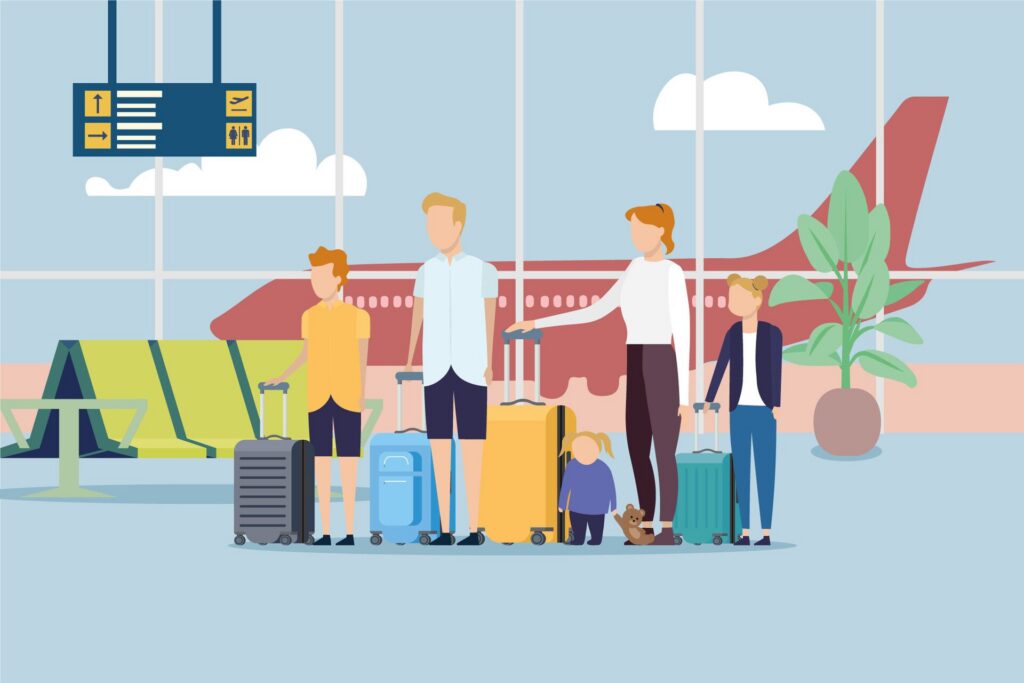
With two or three children, the question is whether everyone gets a case or whether the family shares. A workable pattern for many families: every child carries a backpack with their own flight essentials, children old enough to manage it pull a small case, and one larger checked bag holds the bulky items, such as jackets, extra shoes and beach gear, for everyone. That keeps each child’s load light while avoiding a line of five overhead-bin cases that all need lifting at boarding.
For trips of more than a week, or trips that need winter clothes, a small child’s case will not hold everything, and that is fine. Pack the child’s case with the clothes he will need for the first couple of days plus his favorite things, and put the rest in the shared checked bag. If the checked bag is delayed, he still has what matters to him. On road trips, soft bags squash into a car trunk more easily than several hardside cases; our family car rental guide covers choosing a vehicle with enough room.
Labels, tracking and not losing it
- Label inside and out. A luggage tag with a parent’s phone number outside, and a card with the same details inside, in case the tag is torn off. Do not put the child’s name on the outside.
- Add a small tracker if you like. A Bluetooth tracker tucked in a pocket can help locate a case left at a gate or delayed by the airline.
- Photograph it. A quick photo of the case, and of what is inside, makes a lost-baggage claim much easier.
- Do a count. At every transition, gate, taxi, hotel lobby, count the bags. Give each child the job of counting his own.
Making it last
Children are hard on luggage. A few habits help a case survive several trips:
- Push the handle all the way down before lifting the case by the side or top handle.
- Do not let children stand on the case or sit on a spinner, which is not built for it. Ride-on cases are the exception.
- Wipe hardside shells after the trip, and empty and air softside cases before storing them.
- Check the wheels and zippers before each trip, not the night before departure.
- Store the case somewhere dry; a damp garage is hard on zippers and fabric.
Common mistakes
- Buying too big. A case sized “to grow into” is too heavy and awkward for the child now, so an adult ends up carrying it.
- Ignoring handle height. A handle that is too tall is the most common reason kids give up pulling their bag.
- Assuming any kids’ case fits under the seat. Under-seat space varies by aircraft and seat. Measure against the airline’s personal-item limit if that is the plan.
- Checking the child’s only bag. Keep a change of clothes and the comfort item in the cabin in case checked bags are delayed.
- Buying on design alone. A great print on a flimsy shell with sticky wheels will not last one trip.
Frequently asked questions
What size suitcase does a child need?
For about four to six, a case around 14 to 16 inches; for about seven to ten, 16 to 18 inches; from around eleven, a standard adult carry-on within the airline’s limit. Handle height and weight matter as much as size.
Do kids get a free carry-on on flights?
A child with their own paid seat usually gets the same cabin allowance as an adult on that fare. Lap infants usually do not get a separate carry-on, though many airlines allow a diaper bag. Check your airline’s rules.
Are kids’ suitcases allowed as carry-on?
Yes, as long as they are within the airline’s carry-on or personal-item dimensions, including wheels and handles. Many kids’ cases are well inside the limits, but measure before you fly.
Is a hardside or softside suitcase better for kids?
Both work. Hardside protects contents and wipes clean; softside is lighter, flexible and has outside pockets. Choose on weight, wheels and handle before material.
What age can a child pull their own suitcase?
Many children can manage a small, light case from about four, with help on stairs and escalators. Younger children do better with a backpack or a ride-on case a parent can tow.
Are ride-on suitcases worth it?
For children roughly two to five on trips with long walks through airports, many parents find them very useful. They hold less and are outgrown quickly, so older children are better served by a normal case.
Should my child’s suitcase be a set with a backpack?
If you do not already have a kids’ backpack, a set is good value: the case holds clothes and the backpack holds the flight essentials under the seat.
With the bags sorted, the rest is the trip itself. Compare family fares across flexible dates on our flight search, find a room with space for everyone on our hotel search, and if you are driving from the airport, add a car with room for the luggage on our car rental search. Our guide to booking hotels for family vacations covers timing and room types, and a first family trip to Orlando or San Diego is a great first outing for a new suitcase.
Keep planning with TicketScanner
- Why a family vacation matters for work-life balance — the family travel guide
- Best traveling books for kids
- Travel bottle warmers for flights and road trips
- Best time to book hotels for family vacations
- Car rentals for family vacations
- Top travel luggage bags
- Delta carry-on size rules
- Search flights — family fares on flexible dates
- Things to do in San Diego
Leave a Reply