
Winnipeg is a prairie city that grew up around a railway and then around the car, and most of its residents drive. But the Winnipeg a visitor comes for is unusually concentrated: The Forks, the Canadian Museum for Human Rights, the Exchange District, the Legislative Building and Saint-Boniface are all within twenty minutes of each other on foot, the airport is ten minutes from downtown, and most of the hotels outside the core include parking anyway. So the question is less about the city than about the season and the day trips: Assiniboine Park and the polar bears are a bus ride in July and a car ride in January; Grand Beach, Lower Fort Garry, the Mennonite village and Riding Mountain are car trips in any season; and the Jets’ arena is in the middle of downtown. This guide explains how the city is laid out, how the buses and the rapid-transit line work, the airport transfer, what driving and parking are really like in a place where -30 is a normal January morning, when a car is worth it, and gives you a straightforward way to decide.
The short answer
Skip the car if you are staying downtown, in the Exchange District or near The Forks for a city break, a Jets game, a conference or a festival, and your plans are the museums, the rivers, the Exchange and Saint-Boniface; you will walk almost everywhere and take a bus or a ride-hail to Assiniboine Park. Rent a car if the beaches, Lower Fort Garry, the Mint, Fort Whyte, Steinbach, Riding Mountain or the Whiteshell are on the itinerary, if you are staying in the suburbs or with family, if you are visiting in deep winter and want the zoo, the aurora and the Voyageur festival without waiting for buses at -30, or if you are continuing on a prairie road trip. For most first-time visitors, the hybrid is right: car-free in the core, a one-day rental for the countryside. Compare rental rates for any of these plans on our Winnipeg car rental page.
How Winnipeg is laid out
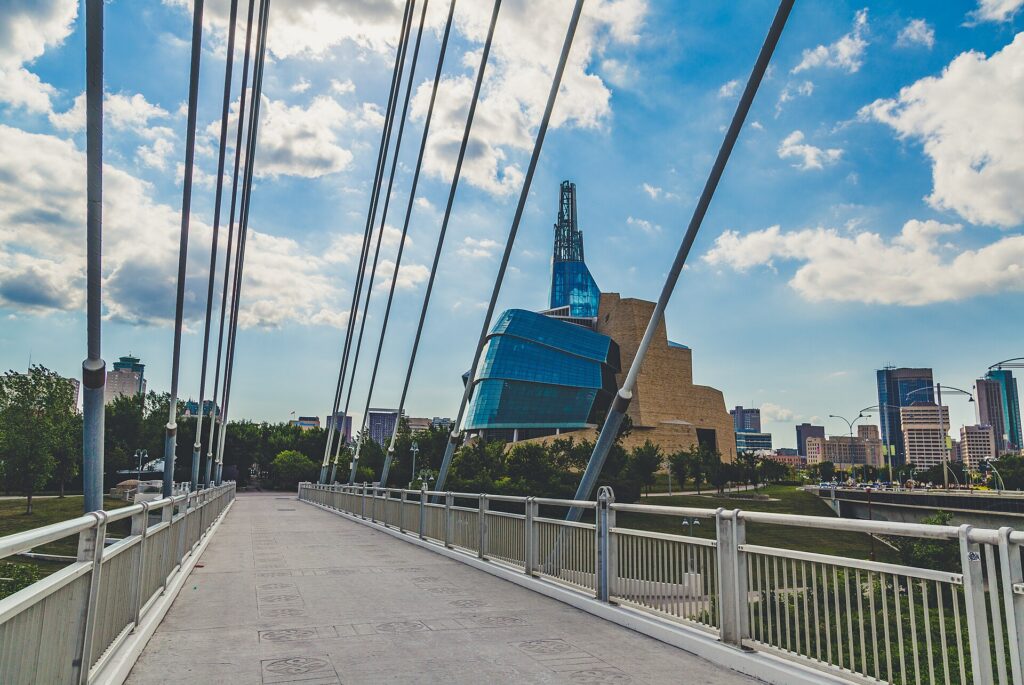
Winnipeg sits at the confluence of the Red River, flowing north, and the Assiniboine, flowing east, and the two rivers define it. Downtown occupies the wedge north of the Assiniboine and west of the Red, with Portage Avenue and Main Street as its axes and their famous intersection at its heart; the Exchange District is the block of heritage warehouses north of Portage and Main, with the Jets’ arena on its edge; The Forks and the Human Rights Museum are at the tip of the wedge where the rivers meet; and the Legislative Building stands on the Assiniboine’s north bank at the western edge of downtown. Across the Red by the Esplanade Riel footbridge is Saint-Boniface, the French quarter; south across the Assiniboine are Osborne Village and, further, Corydon Avenue‘s Little Italy and the residential south end toward the university; west along Portage are the Polo Park shopping district and the airport; further west is Assiniboine Park. The North End, beyond the rail yards, holds the old immigrant neighbourhoods and the Main Street strip. The core is walkable and flat; the rest of the city is spread out across the prairie and assumes a car or a bus.
Hotels cluster downtown around the arena and the convention centre, in the Exchange District, at The Forks, along the airport strip on Wellington Avenue, and around Polo Park; most outside the core include parking. Our Winnipeg hotel search lets you compare them.
Getting in from the airport
Winnipeg Richardson International (YWG) is about 10 kilometres west of downtown along Wellington Avenue and Portage, and the transfer is one of the easiest in the country. A taxi or ride-hail takes 15 to 20 minutes and is inexpensive by big-city standards. Winnipeg Transit’s Route 20 runs from the terminal along Wellington and Portage to downtown for a standard fare in about half an hour. Hotel shuttles serve the airport-strip hotels. And every major rental company is in the terminal, with Route 90 and the Perimeter Highway close by for anyone heading straight to the lake or the parks. Check the airport’s site and Winnipeg Transit for current service; our YWG airport guide covers the layout.
Winnipeg’s transit, explained
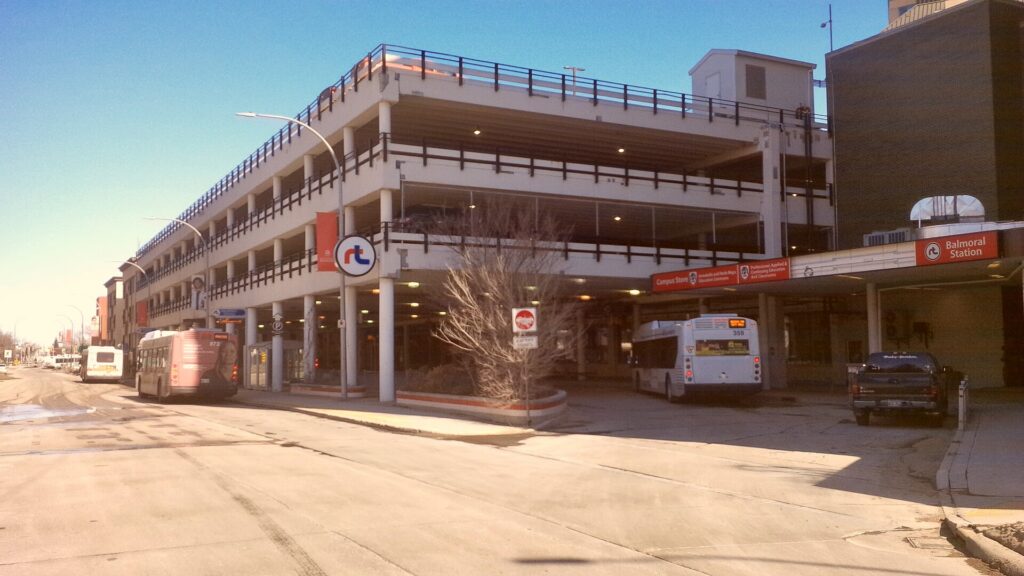
Winnipeg Transit runs the city’s buses; there is no rail, and the long-debated light rail has never been built. What the city does have is a rapid-transit busway, the Blue line, which runs on its own right-of-way from downtown south to the University of Manitoba, and a network of frequent routes along Portage, Main, Pembina, Henderson and the other arterials that, for a visitor, covers everything the walkable core does not. In 2025, Winnipeg Transit overhauled its whole network into a spine-and-feeder system with more frequent main lines and fewer meandering routes; the route numbers and patterns changed, so check the current map rather than an older guidebook.
The routes that matter to a visitor
The Blue rapid-transit line links downtown, Osborne Village, the Fort Rouge neighbourhoods and the university and stadium in the south; the Portage Avenue lines run west past Polo Park to the airport area and, with a change, to Assiniboine Park; the Main Street and Henderson lines run north and northeast to the North End and the river; and the routes across the Provencher Bridge serve Saint-Boniface, though the footbridge is quicker from The Forks. Downtown itself has a free-fare zone on some routes along Portage and Main, and the Downtown Spirit, when it runs, is a free circulator. Buses run from early morning until after midnight on the main lines.
Fares and tickets
Pay cash on board with exact change, buy tickets from the outlets around the city, or use a Peggo card, the reloadable smart card sold at the transit centres, Shoppers Drug Mart locations and online; a fare gives you a transfer window across the network, and day passes are available. Check Winnipeg Transit’s site for current prices and for the tap-to-pay options that have been rolling out.
Accessibility
The fleet is low-floor and accessible; the winter sidewalks and the wait at an unsheltered stop at -30 are the real challenge, and a ride-hail is the honest answer on the coldest days.
Beyond Winnipeg Transit
- Walking. The Forks to the Exchange is fifteen minutes; The Forks to Saint-Boniface over the Esplanade Riel is five; the Legislative Building to Osborne Village over the Osborne Bridge is ten. The core is flat and compact, and in summer it is entirely on foot.
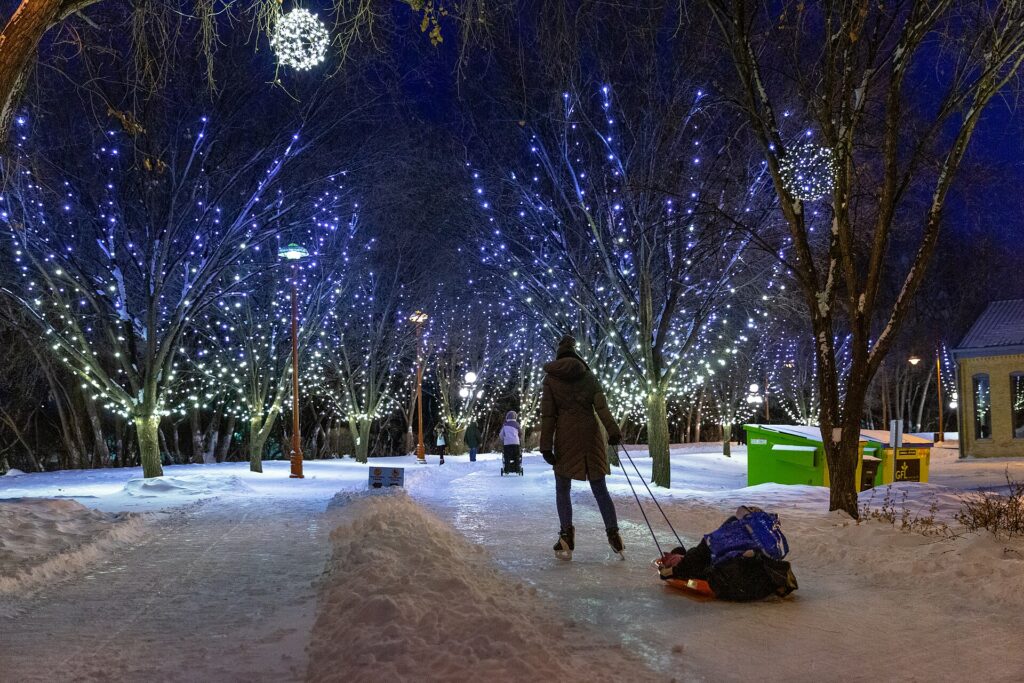
- The river trail. In winter, when the ice is thick enough, the skating and walking trail on the Red and Assiniboine from The Forks is a genuine, if seasonal, route to Osborne Village and Saint-Boniface, with warming huts along the way. Skates rent at The Forks.
- River taxis. Splash Dash runs water taxis on the rivers from The Forks to the Legislative Building, Osborne Village and the Saint-Boniface cathedral in summer; slow, scenic and cheap.
- Bikes. A growing network of protected lanes and the river trails make summer cycling easy, and the city is flat; bike rentals are available at The Forks and in Osborne Village, and a bike-share has been piloted.
- Taxis and ride-hail. Uber and licensed taxis cover the city; a ride from downtown to Assiniboine Park, the Mint or Fort Whyte is short and, for a group, competitive with the bus.
- Intercity. Buses connect Winnipeg with Brandon, Thunder Bay, Regina and Minneapolis from the downtown terminals; VIA Rail’s Canadian runs to Toronto and Vancouver and its Hudson Bay line to Churchill from the Union Station beside The Forks.
Driving in Winnipeg: what it is really like
Winnipeg is one of the easiest big Canadian cities to drive in for most of the year: flat, gridded, with the Perimeter Highway ringing it, wide arterials, cheap and plentiful parking outside the core, and drivers who are unhurried. The frustrations are specific. Route 90, Pembina Highway and the bridges over the rivers jam in the weekday peaks; construction season runs from May to October and the city’s roads, famous for their potholes after every thaw, are always being repaired somewhere; and the intersection of Portage and Main was closed to pedestrians for decades and has only recently reopened, so its crossings still confuse visitors. And winter is the real difference. Snow stays on the ground from November to March, the side streets rut and narrow, black ice on the bridges is routine, the city imposes snow-route parking bans overnight after storms, and extreme cold, -30 °C and below, is a normal occurrence that a rental car needs to be ready for.
Parking
Downtown parking is inexpensive by the standards of any other big Canadian city. The hotels charge a modest nightly fee or include it, the surface lots and garages around the arena and the convention centre are priced for locals, and street parking downtown is metered through the PayByPhone app and free in the evenings and on Sundays and holidays. On Jets game nights, the lots nearest the arena fill and the prices rise, but the walk from a few blocks away is short. Outside the core, parking is easy and almost always free: The Forks has large lots that charge a small fee in summer, Assiniboine Park, the zoo, the Mint, Fort Whyte, the museums and the malls all have their own. In winter, watch for the snow-route signs, which impose overnight bans on the main streets after a storm and are enforced with tows.
Rules and conditions worth knowing
- Winter tires are not required by law in Manitoba, and rental cars usually come on all-seasons; for the highways to the lake and the parks between November and March, ask for winter tires when you book. Manitoba 511 publishes road conditions and closures, and the Perimeter and the highways do close in blizzards.
- Extreme cold. Below about -25 °C, cars struggle to start; park in a garage on the coldest nights if you can, keep the tank above half full, and ask at the counter how to use the block-heater cord, which every Winnipeg parking lot has outlets for.
- Photo radar operates in school zones, construction zones and at intersections across the city; fines follow the car and the rental company will bill you.
- Right turns on red are permitted after a full stop unless signed otherwise.
- Wildlife. Deer are common on the Perimeter and the highways at dawn and dusk, and moose and bears on the roads to Riding Mountain and the Whiteshell.
- The Red River floodway and the spring floods occasionally close roads north and south of the city in April; check before a spring day trip.
- Fuel is cheaper in Manitoba than in most of Canada.
When renting a car makes sense
- Grand Beach and Lake Winnipeg, an hour north, with Gimli and the Interlake on the way.
- Lower Fort Garry, half an hour north on the Red, and the Oak Hammock Marsh bird sanctuary nearby.
- Steinbach‘s Mennonite Heritage Village, an hour southeast.
- Riding Mountain National Park, three hours northwest, and the Whiteshell, two hours east; both are overnight trips.
- Birds Hill Park, half an hour northeast, for the Folk Festival and the trails.
- The Mint, Fort Whyte Alive and the aviation museum, which are reachable by bus but awkward.
- Assiniboine Park and the zoo in winter, when the bus and the walk from the stop are a cold proposition.
- The aurora. On a clear winter night, the northern lights are visible half an hour outside the city’s glow, and a car is the only way there.
- Family in the suburbs, or a prairie road trip to Saskatchewan, Minnesota or North Dakota.
If any of those apply, our rental car booking tips cover insurance, deposits and the questions to ask at the counter.
When it does not
- You are staying downtown, in the Exchange or at The Forks and your plans are the core.
- You are in town for a Jets game, an arena concert or a convention, when the venue is a walk from every downtown hotel.
- You are coming for the Fringe, Nuit Blanche or the Festival du Voyageur, which are on foot or a short bus ride.
- You are travelling solo and a couple of ride-hails to the park and the Mint cost less than a day of rental.
The hybrid plan
Go car-free for the city days and rent for the countryside, and because the airport is so close, the pickup decision is easy: collect the car at the terminal on the morning of the day-trip day if you are staying on the airport strip, or from one of the downtown branches around the convention centre and Portage Avenue if you are in the core, and return it the same evening or at the airport on the way to the flight home. The airport concession fees in Winnipeg are modest, and the drive from the terminal to the Perimeter Highway is ten minutes. Ask for winter tires from November to March, and if the aurora is on the list, a night rental with a full tank and a thermos is the whole plan. Compare the day rates on our Winnipeg car rental page against a full-trip rental; because parking is cheap, the full-trip rental is closer to break-even here than in most cities, and for a family it often wins.
A worked cost comparison
Numbers change with the season and the booking window, so treat this as a method rather than a quote, and check current rates before deciding. For a three-night city break downtown for two people, the car-free version costs two short taxi rides from the airport or the Route 20 bus, a day pass or two, and a ride-hail to Assiniboine Park and back; the rental version adds three days of a compact car, three nights of modest hotel parking, fuel and airport fees, and buys the park, the Mint and Fort Whyte in exchange. If those are on the list, the rental is close to break-even; if not, transit wins. For the same three nights plus Grand Beach or Lower Fort Garry, a one-day rental plus fuel is cheap and the only practical way to go; the hybrid wins. For a family of four in winter, with the zoo, the Voyageur festival, the aurora and the airport all on the list, a rental for the whole stay from the terminal, with a hotel that includes parking, is usually cheaper than the taxis and ride-hails it replaces and far warmer. Run the rates for your dates and put them beside the taxi and transit fares before you choose.
Decision table
| Your trip | Recommendation | Why |
|---|---|---|
| City break downtown or in the Exchange, couple or solo | No car | The core is walkable; the park is a bus or a ride-hail away |
| Jets game, arena concert or convention | No car | The arena is a walk from every downtown hotel |
| Summer city break with the park and the zoo | No car | The bus and the river taxi reach the park; the core is on foot |
| City plus Grand Beach, Lower Fort Garry or Steinbach | Hybrid: one-day rental | Car-free city days, a car for the prairie |
| Winter visit with the zoo, the Voyageur festival and the aurora | Rent, with winter tires | Cold, distance and the night drive all argue for a car |
| Family of four, any season | Price a whole-trip rental | Cheap parking and a close airport make it close to break-even |
| Family visit to the suburbs | Rent for the whole stay | Suburban distances make the car worthwhile daily |
| Riding Mountain, the Whiteshell or a prairie road trip | Rent for the whole trip | Winnipeg is the start, not the destination |
Money-saving tips for both options
- On transit: take the Route 20 bus from the airport if you are travelling light; walk the core; use the river taxi in summer for the ride and the view; buy a day pass if you will ride to the park and back.
- On a rental: compare airport and downtown pickup, rent only for the day-trip days unless you are a family, ask for winter tires in the cold months, decline extras you already have through a credit card or home policy (check first), plug in the block heater on the coldest nights, and fill up in the city, where fuel is cheap.
- On the hotel: if you are renting, choose a hotel that includes parking, which most outside the core do; if you are not, stay downtown or in the Exchange and walk.
- On timing: avoid Route 90, Pembina and the bridges in the weekday peaks, the arena lots on game nights, and the highway to Grand Beach on summer Sunday afternoons; the best time to fly to Winnipeg guide lists the busy weekends.
- On the aurora: a night rental and a drive north on Highway 59 past the city lights is the cheapest northern-lights trip in the country; check the aurora forecast first.
Frequently asked questions
Is it worth renting a car in Winnipeg?
Not for the core, which is walkable and close to the airport. For the beaches, the forts, the parks, the aurora, a winter visit with children or a family trip where parking is cheap, yes.
Is Winnipeg public transit good for tourists?
Adequate: an airport bus, a rapid-transit busway to the university, and frequent arterial routes cover what the walkable core does not. There is no rail, and winter waits at unsheltered stops are cold.
How do I get from Winnipeg airport to downtown?
A taxi or ride-hail in 15 to 20 minutes, the Route 20 bus in about half an hour, a hotel shuttle, or a rental from the terminal.
Can I get to Assiniboine Park and the zoo without a car?
Yes, by bus along Portage with a change, by river taxi in summer, or by ride-hail in fifteen minutes. In winter, the ride-hail is the honest answer.
Do I need winter tires in Winnipeg?
Not by law, but the highways drift and ice from November to March; ask for them when you book, and for the city alone, drive carefully on all-seasons.
Is parking expensive in downtown Winnipeg?
No; it is among the cheapest of any big Canadian city, free on the street in the evenings and on Sundays, and included at most hotels outside the core. Game nights near the arena are the exception.
Can I drive from Winnipeg to Churchill?
No; Churchill has no road. The train from Union Station takes two days, and the flight takes two hours.
Whichever way you go, start with the flight. Compare cheap flights to Winnipeg, choose a neighbourhood with our Winnipeg hotel search, and if the lake or the parks are on the list, price the rental for those dates on our Winnipeg car rental page.
Keep planning with TicketScanner
- Winnipeg car rentals — compare airport and downtown pickup
- Cheap flights to Winnipeg
- Winnipeg hotels — most include parking
- Things to do in Winnipeg: a first-timer's guide
- Best time to fly to Winnipeg: month by month
- Winnipeg Richardson (YWG) airport guide
- Where to stay: the Exchange District
- Rental car booking tips
- Car, transit or taxi in a new city?
Leave a Reply