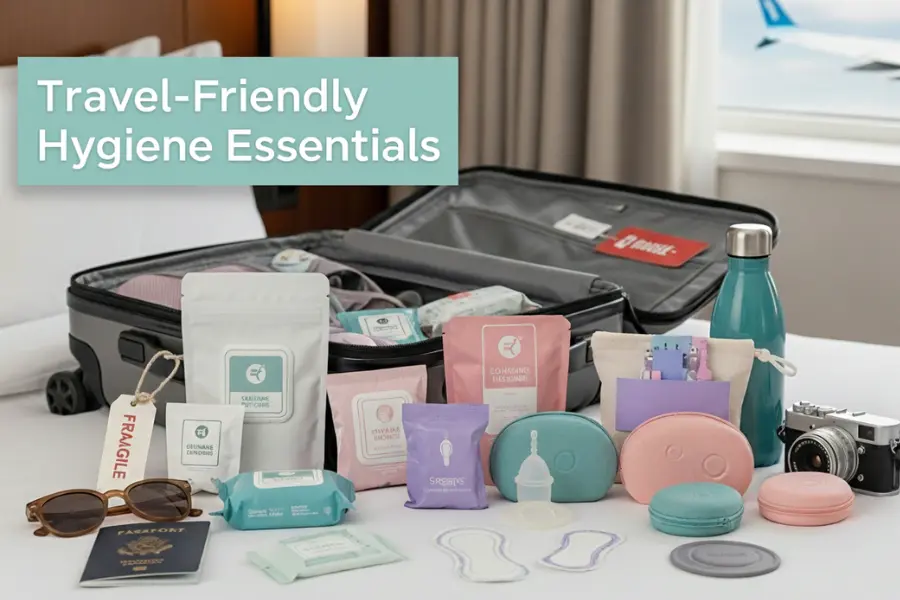
Tag: travel hygiene

  • Travel-Friendly Feminine Hygiene Products: What to Pack and How to Fly With Them

    Travel-Friendly Feminine Hygiene Products: What to Pack and How to Fly With Them

    A period does not have to shape your itinerary, but it does change what you pack. On a long-haul flight you may be in your seat for hours with a lavatory line in the aisle. On a road trip the next clean restroom may be an hour away. On a beach holiday you might want to swim every day, and on a hiking trip there may be no bin at all. Abroad, the brand and format you rely on may be hard to find, and the words on the box may be in a language you do not read. Travel-friendly feminine hygiene products solve most of this: compact, discreet, easy to carry through airport security and suited to the kind of trip you are taking. This guide covers how to choose between disposable and reusable options, how airport security rules apply to period products and intimate care liquids, how much to pack, how to handle disposal and cleaning on the road, and a handful of well-known products from our original list that we have checked on the makers’ own sites.

    The short answer

    Pack a small, ready-to-grab pouch in your personal item with enough products for the travel day plus a spare, and put the rest in your main bag. Pads, liners, tampons, menstrual cups and period underwear are solids, so they are not affected by liquid limits; liquid washes, gels and sprays are, and have to follow the TSA’s 3-1-1 rule in the United States and CATSA’s 100 ml rule in Canada. Choose compact disposables for convenience and short trips, and consider reusable options like a cup or period underwear for long trips, remote places and less waste, as long as you are comfortable with cleaning them while traveling. Carry enough of what you prefer for the first few days, since formats and brands vary from country to country. If you use tampons, follow the FDA’s safety advice and the directions on the package.
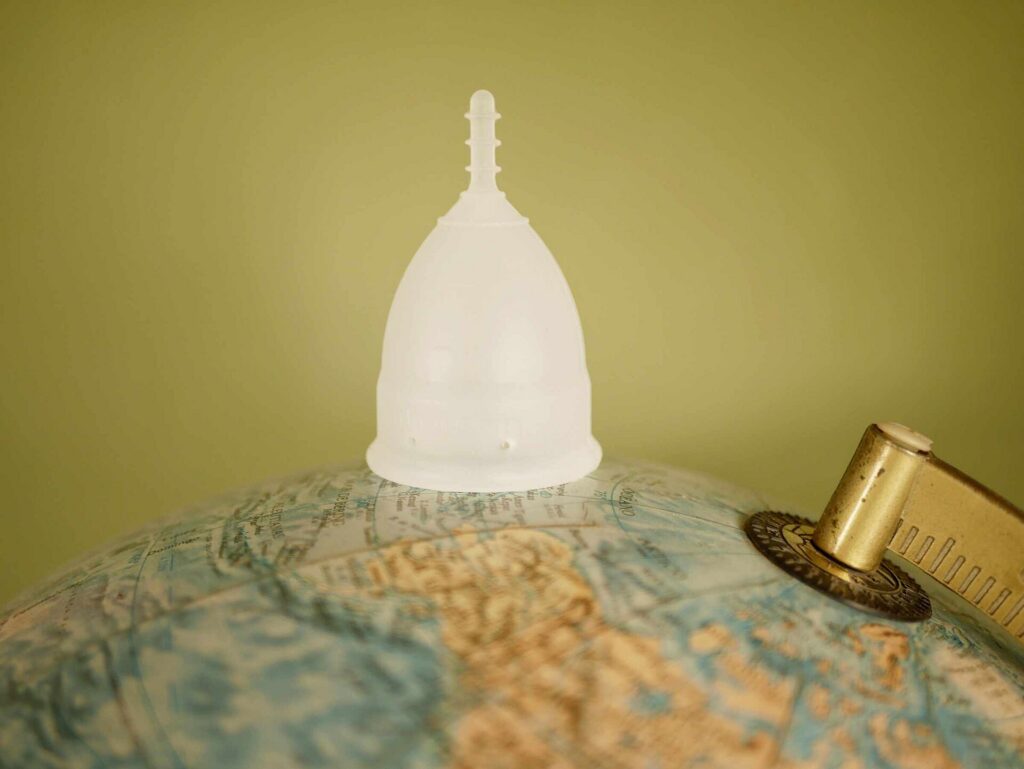
    A reusable menstrual cup placed next to a small world globe
    One reusable cup can cover a whole trip, as long as you are comfortable cleaning it on the road (Photo: Vulvani via Wikimedia Commons, CC BY-SA 4.0)

    What makes a product travel-friendly

    • Compact and light. Thin pads, compact applicator or applicator-free tampons and a single reusable cup take up much less space than bulky packs.
    • Individually wrapped. Wrapped items stay clean in a handbag or a jacket pocket and are easier to carry discreetly.
    • Reliable for long stretches. Travel days are full of situations where you cannot change right away: boarding, taxiing, seatbelt signs, long drives and tours. Choose what you trust for those stretches, and always follow the product’s own directions on how long it can be worn.
    • Easy to dispose of or clean. Disposables need a bin; reusables need water and somewhere to wash and dry them.
    • Familiar. A trip is not the best time to try something completely new. If you want to switch to a cup or period underwear, try it at home for a cycle or two first.

    Disposable vs reusable for travel

    ProductWhy travelers like itTrade-offs on the roadAirport security
    Pads and linersEasy, familiar, widely soldBulkier to pack; need a binSolid; no liquid limit
    TamponsCompact, discreet, swim-friendlyNeed a bin; formats vary abroadSolid; no liquid limit
    Menstrual cup or discOne item for the whole trip; less wasteNeeds water and privacy to empty and cleanSolid; no liquid limit
    Period underwearNothing to insert or throw away; good backupNeeds washing and drying timeClothing
    Intimate wash, gel or sprayFreshening up on long daysCounts toward liquid limits in carry-onLiquid; follow TSA 3-1-1 or CATSA 100 ml
    WipesUseful where facilities are basicDo not flush; create wasteCheck the TSA and CATSA item tools

    Many travelers end up with a mix: a cup or period underwear as the main option, and a few compact disposables as a backup for travel days, long bus rides and moments when there is no good place to clean a reusable.

    Airport security rules for period products and liquids

    Security rules are the part of this that trips people up, and they change, so check the official pages before you fly.

    United States (TSA)

    The TSA’s liquids, aerosols and gels rule allows travel-sized containers of 3.4 ounces (100 milliliters) or less per item in a single quart-sized bag in your carry-on. That covers liquid intimate washes, cleansing gels, sprays and any liquid cup wash you pack. Pads, liners, tampons, cups and period underwear are not liquids. For any specific item, search the TSA’s What Can I Bring? tool, and remember that the officer at the checkpoint makes the final call.

    Canada (CATSA)

    CATSA’s page on liquids, non-solid food and personal items sets the carry-on limit at containers of 100 ml or 100 g (3.4 oz) or less, all fitting in one clear, resealable plastic bag of no more than 1 L. Larger containers can go in checked baggage if they are not otherwise prohibited. The same logic applies: solid period products are fine; liquid washes and gels go in the bag.

    Everywhere else

    Most countries use a similar 100 ml approach for carry-on liquids, but screening technology and rules differ between airports. If you are connecting through another country, the rules at the transfer checkpoint apply. The simplest plan is to keep liquids small and together, and to carry solid period products loose in a separate pouch so nothing needs to come out of your bag.

    Screening tips

    • Keep period products in a plain pouch separate from your liquids bag, so the liquids bag can come out quickly if your lane requires it.
    • A menstrual cup in its storage pouch is a small, soft item; there is nothing special to declare.
    • If you are carrying medication for menstrual pain, keep it in its original labeled packaging in your carry-on.
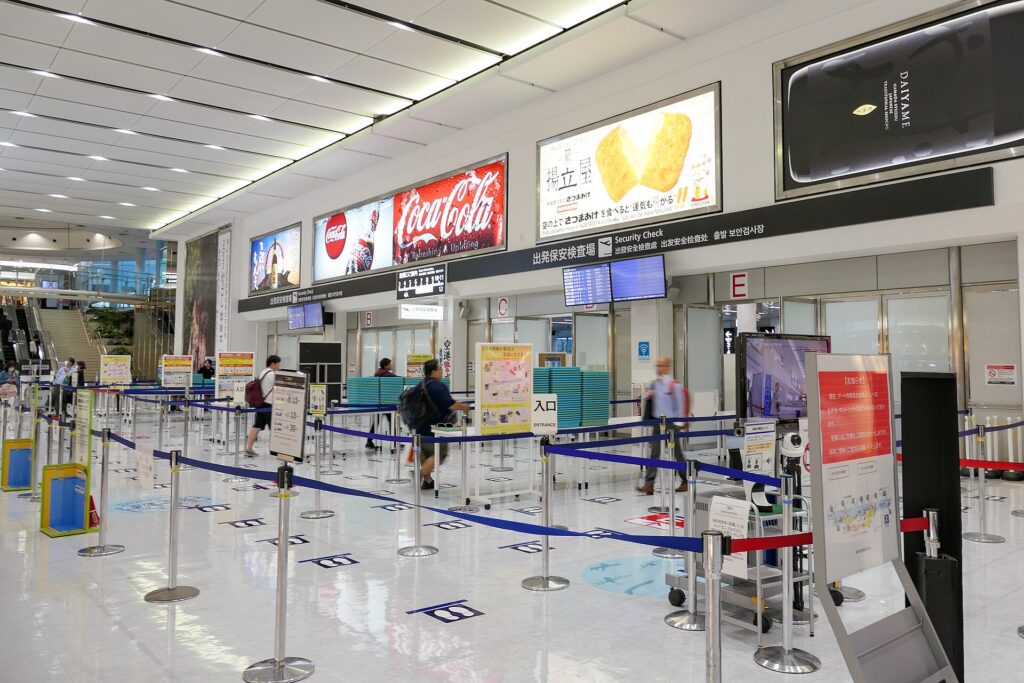
    Passengers approaching an airport security checkpoint with screening lanes
    Pads, tampons and cups are solids; only liquid washes and gels need to go in your liquids bag (Photo: MaedaAkihiko via Wikimedia Commons, CC BY-SA 4.0)

    Options from our original list

    These products appeared in the earlier version of this guide. We have kept the ones we could confirm on each maker’s own website and described them by what they are and who they suit, not by claims about health or performance. Product lines change, so check the current range and directions from the maker before you buy.

    Always Radiant Pads with FlexFoam

    Always lists Radiant Pads with FlexFoam in its range, alongside its Infinity pads with FlexFoam and daily liners. Thin, individually wrapped pads like these are the easy choice for travelers who already use pads and want something slim enough to carry in a small bag or jacket pocket. Pair them with a few liners for the lighter days of a trip.

    Rael Organic Cotton Cover Pads

    Rael sells Organic Cotton Cover Pads with Wings in several sizes and pack counts, as well as liners. They suit travelers who prefer an organic cotton cover and want a mainstream, individually wrapped disposable pad. Buy the pack size that matches your trip so you are not carrying a bulky box.

    Cora organic cotton tampons

    Cora’s range includes applicator tampons and applicator-free tampons, pads, liners, discs and a cup. For travel, applicator-free tampons are the most compact option to pack, while compact applicator tampons suit people who prefer an applicator but want something smaller to carry. Several large brands make compact applicator tampons, so you have choices if one is hard to find.

    DIVA Cup

    Diva, the maker of the long-running DivaCup, currently sells the DIVA Cup Model 1 along with cleansing and period essentials bundles. A reusable cup is one item for the whole trip, which is why many long-term travelers and backpackers like cups. Read the maker’s instructions on sizing, wear time and cleaning, and practice at home before relying on it on a trip.

    Saalt menstrual cups

    Saalt makes reusable menstrual cups in several sizes and colors, and publishes cup instructions on its site. Like any cup, it suits travelers who are comfortable emptying and rinsing it in a private bathroom and want less waste. Follow Saalt’s own guidance on use and cleaning.

    Thinx period underwear

    Thinx makes period underwear designed to be worn in place of or as a backup to other products. On a trip, a couple of pairs are a useful backup for overnight flights, long drives and days when you want nothing to insert or throw away. Plan for washing and drying time; quick-dry fabrics and a hotel room with a heater or good airflow help.

    We removed the other products from the original list because we could not confirm their current details on the makers’ own sites. That does not mean they are not good products; it means we are not in a position to describe them accurately.

    Tampon safety and toxic shock syndrome

    If you use tampons, it is worth knowing the FDA’s guidance, because travel days make it easy to lose track of time. The FDA explains in The Facts on Tampons and Tampon Safety that toxic shock syndrome (TSS) is rare and is caused by a toxic substance produced by certain kinds of bacteria. The FDA advises using the lowest absorbency you need, not wearing a tampon for more than eight hours and using tampons only during your period. It lists symptoms that may include a sudden high fever, vomiting, diarrhea, fainting or feeling faint when standing up, dizziness, or a rash that looks like a sunburn, and says that if you have any of these symptoms during or soon after your period, you should stop using tampons and seek medical attention immediately (source: FDA). On a long flight or a long travel day, set a phone reminder so a change does not slip your mind, and consider a pad or period underwear for overnight flights if you expect to sleep for a long stretch.

    How much to pack

    There is no universal number, but a simple method works:

    1. Estimate what you use in a typical cycle, by type (heavier days, lighter days, overnight).
    2. Add a buffer for travel days, delays and changes in routine. Cycles are not always predictable and trips get extended, so pack for the possibility that your period arrives during the trip even if you do not expect it.
    3. Decide whether to buy there. For a long trip to a place with plenty of shops, pack enough for the first few days and buy the rest locally. For remote destinations, cruises, safaris and hiking trips, pack everything you need.
    4. Split it up. Keep a day’s supply plus a spare in your personal item and the rest in your main bag, so a delayed checked bag does not leave you without.

    The carry-on period pouch

    A small zip pouch at the top of your personal item makes travel days much easier. A good kit includes:

    • Enough pads, liners or tampons for the travel day plus a spare, or your cup in its pouch
    • A spare pair of underwear or period underwear
    • A few small, opaque disposal bags for when there is no bin
    • Hand sanitizer and a few individually wrapped wipes
    • Any pain relief you normally use, in its original packaging
    • A small liquid wash, if you use one, inside your liquids bag

    A slim pouch or organizer also keeps things discreet if your bag is opened at security. Our guide to travel wallets for women covers small organizers, and our guide to a travel first aid kit covers the basic health items worth carrying on every trip.

    Managing your period on a flight

    • Choose an aisle seat if you expect to get up often. It is easier to reach the lavatory without climbing over neighbors.
    • Change just before boarding. Boarding, taxiing and the climb can take a long time with the seatbelt sign on.
    • Take your pouch with you to the lavatory rather than digging through your bag in the aisle.
    • Never flush products in an airplane toilet. Wrap them and use the bin in the lavatory.
    • Dress for comfort. Dark, soft, loose layers are more comfortable on a long flight. Our guide on what not to wear on a flight has more.
    • On overnight flights, consider a pad or period underwear as backup while you sleep. Our guide to sleeping on flights covers seat choice and routines for resting well in the air.
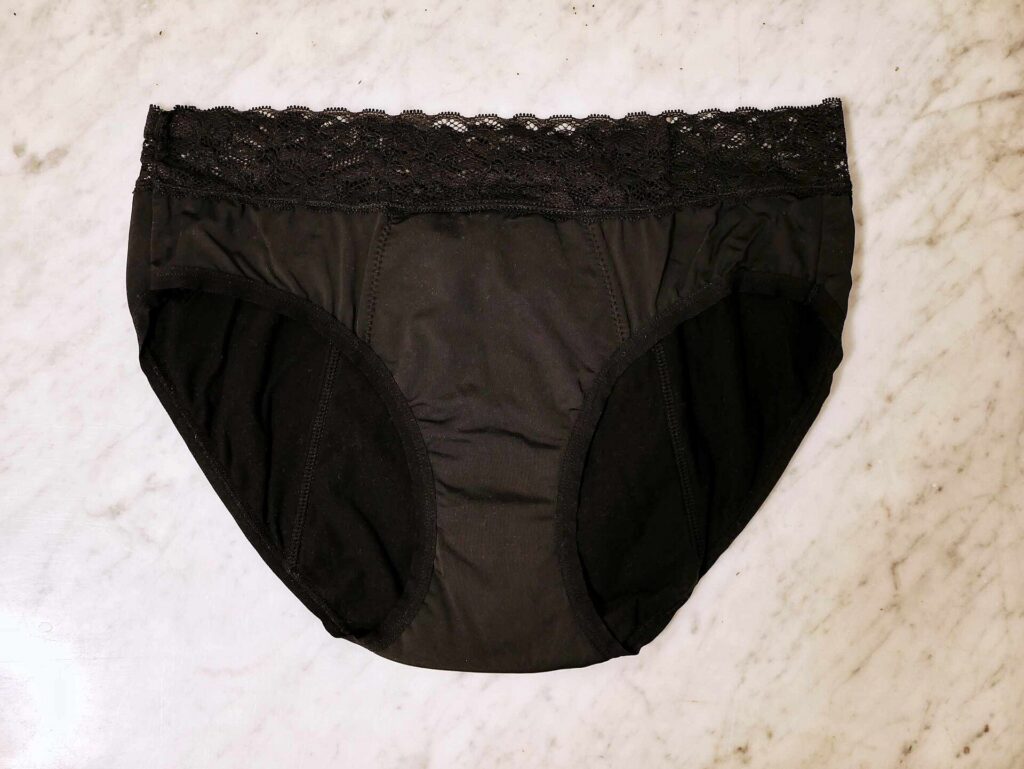
    A pair of period underwear laid flat
    Period underwear packs like clothing and makes a useful backup on overnight flights and long drives (Photo: Vulvani via Wikimedia Commons, CC BY-SA 4.0)

    Disposal and cleaning on the road

    Disposal

    In many countries, plumbing is not designed for anything but toilet paper, and in some places even toilet paper goes in a bin. Look for signs in the bathroom, and when in doubt, wrap products and use the bin. Carry a few small opaque bags for places with no bin, such as trailheads, beaches and some bus stations, and dispose of them at the next trash can. In campgrounds and national parks, follow the park’s own rules for packing out waste.

    Cleaning a cup on the go

    Follow the maker’s cleaning instructions. On the road, the practical challenge is privacy and water: a hotel bathroom is easy; a shared toilet stall is harder. Some travelers carry a small bottle of water into the stall to rinse, or simply empty the cup, wipe it and reinsert, then do a full clean back at the hotel. If you are not comfortable with the local tap water, use bottled water to rinse. Bring the cup’s storage pouch and let it dry fully before storing.

    Washing period underwear

    Rinse in cold water, wash according to the label and hang to dry. Hotel sinks, a small bottle of travel detergent within liquid limits and a travel clothesline make this manageable on longer trips. Plan around drying time, especially in humid climates.

    Buying period products abroad

    Pads are sold almost everywhere, but the formats and brands you are used to may not be. Some places have a narrower range of tampons or cups, and packaging may not show sizes the way you expect. A few tips:

    • Pack enough of your preferred product to get through the first few days.
    • Look in pharmacies and large supermarkets rather than small convenience shops for a wider range.
    • Take a photo of the box you use at home, including the absorbency or size, to show a pharmacist.
    • Learn the local word for pads and tampons before you go; a translation app works too.
    • In remote areas, islands and on cruise ships, assume that choice will be limited and prices higher.
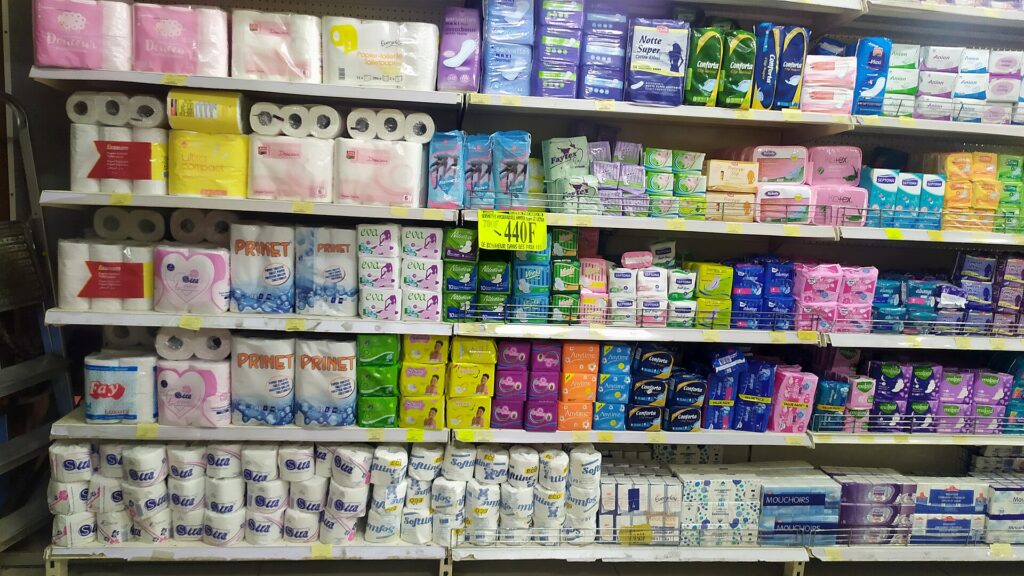
    A supermarket shelf stocked with sanitary pads, tampons and toilet paper
    Pads are sold almost everywhere, but your usual brand and format may not be, so bring enough for the first few days (Photo: Minette Lontsie via Wikimedia Commons, CC BY-SA 4.0)

    Choosing by type of trip

    Business trips

    Discretion and convenience matter most. Compact, individually wrapped disposables in a slim pouch fit easily in a laptop bag. Pack a spare in your jacket or handbag for long meetings.

    Beach and pool holidays

    Tampons, cups and discs are the usual choice for swimming. Some brands also make period swimwear. Pack enough for extra changes after swimming.

    Hiking, camping and remote travel

    A cup or disc reduces what you have to carry and pack out, but it needs clean hands and water. Disposables need opaque, sealable bags to carry waste until you reach a bin. Plan with the facilities along your route in mind.

    Road trips

    Restroom stops can be far apart. Keep a pouch within reach in the car, not in the trunk, and stop before you need to. A rental car road trip is also a good reason to pack a small bin bag for the car. Our car rental search helps you plan the trip itself.

    Long-term and backpacking trips

    This is where reusables shine: a cup and a couple of pairs of period underwear can cover months of travel with very little space. Keep a small backup of disposables for travel days.

    Festivals and events

    Portable toilets and long lines make disposables with a wipe and a bag the easiest option. Carry a small pouch rather than a whole pack.

    Sustainable choices

    Reusable cups, discs and period underwear reduce the amount of waste you create on a trip, which is useful in places where trash collection is limited. Organic cotton disposables appeal to travelers who prefer natural materials. Whatever you use, dispose of it properly and never leave anything behind on trails or beaches. If you are building a lower-waste travel kit, our guide to eco-friendly travel flip-flops covers another small swap.

    Common mistakes

    • Packing everything in checked baggage. A delayed bag should not leave you without products.
    • Trying a new product on the trip. Test cups, discs and period underwear at home first.
    • Putting liquid washes in your pouch instead of the liquids bag. It can mean a bag search at security.
    • Assuming you can buy your usual brand abroad. Bring enough for the first days.
    • Losing track of time on travel days. Set reminders, especially if you use tampons.
    • Flushing products. Especially on planes and in countries with older plumbing, always use the bin.

    Frequently asked questions

    Can I take tampons and pads through airport security?

    Yes. They are solids, not liquids, so liquid limits do not apply. Check the TSA’s What Can I Bring? tool or CATSA’s carry-on page for any specific item you are unsure about.

    Can I bring a menstrual cup in my carry-on?

    Yes. A cup is a small solid item. Any liquid cup wash you bring follows the liquid rules.

    Do intimate washes count toward the liquid limit?

    Yes. In the United States they follow the TSA’s 3-1-1 rule, and in Canada CATSA’s 100 ml rule with a 1 L bag. Larger bottles can go in checked baggage.

    Is it safe to wear a tampon on a long flight?

    Follow the FDA’s guidance: use the lowest absorbency you need and do not wear a tampon for more than eight hours (FDA). On long or overnight flights, set a reminder or use a pad or period underwear while you sleep.

    What is the most space-efficient option for a long trip?

    A reusable cup or disc takes the least space, followed by applicator-free tampons. Period underwear is a good backup that packs like clothing.

    Where do I throw away products on a plane?

    Use the bin in the lavatory. Never flush anything but toilet paper in an airplane toilet.

    Will my period products be easy to find abroad?

    Pads usually are. Specific brands, tampon formats and cups can be harder to find, so bring enough of your preferred product for the first few days.

    Should I pack period products even if my period is not due?

    Yes. Timing is not always predictable and trips run long, and a small backup pouch weighs almost nothing.

    With your kit sorted, the rest of the trip is about the booking. Compare fares and flexible dates on our flight search, find a hotel with a private bathroom and good laundry options on our hotel search, and if you are planning a city break, our guide to things to do in Paris is a good start. For the rest of your packing, see our main guide to travel luggage, our guide to travel jewelry cases and our guide to anti-theft backpacks for a secure daypack.

  • Must-Have Travel Essentials for Indian Travelers (and Visitors to India)

    Must-Have Travel Essentials for Indian Travelers (and Visitors to India)

    Travel between India and the rest of the world is a constant flow in both directions: students heading to Canada, the UK and Australia, families visiting relatives in Toronto or New Jersey, professionals flying to conferences in Europe and Singapore, and millions of visitors arriving in India for weddings, business, festivals and some of the most varied travel on earth. Whichever direction you are going, the essentials are surprisingly similar. You need the right documents and a visa or electronic authorization where required, a way to charge your devices in a country with different plugs, a carry-on that gets you through a long-haul flight comfortably, and a few small items that make daily life easier when things work differently from home. This guide covers both journeys: packing and planning for Indian travelers going abroad, and practical preparation for travelers visiting India. We point to official government sources for every rule, because visa and entry requirements change and only the official source is authoritative.

    The short answer

    For any trip into or out of India, start with documents: a passport with plenty of validity, the visa or electronic authorization your destination requires (checked on that government’s official website) and printed or offline copies of bookings. Then sort power: India uses plug types C, D and M at 230 volts, so check the plug type and voltage at your destination and pack a suitable adapter. Carry a power bank in your carry-on, never in checked baggage. Build a long-haul comfort kit: neck pillow, eye mask, earplugs or headphones, a warm layer and a refillable bottle. Keep medicines in original packaging with a copy of any prescription. And add the small items that make you comfortable, whether that is a handheld bidet bottle, familiar snacks you have declared at customs or a light scarf for visiting places of worship.

    The departures hall inside Terminal 3 at Indira Gandhi International Airport in New Delhi
    Delhi's Terminal 3 handles many of the long-haul flights between India and North America, Europe and the Gulf (Photo: PDXDUS via Wikimedia Commons, CC0)

    Documents and visas: the principles

    Entry rules are the one area where a mistake can end a trip before it starts, and they change often. We will not list country-by-country requirements here. Instead, here is how to check them properly.

    1. Your passport

    Many countries expect your passport to be valid for a period beyond your planned stay, and some require blank pages for stamps. Check your destination’s rule well before you book. Indian citizens apply for and renew passports through the Ministry of External Affairs’ Passport Seva portal; start early, since you may need an appointment at a Passport Seva Kendra.

    2. Visas and electronic travel authorizations

    Always use the destination government’s own website. For the most common routes from India:

    • Canada: Immigration, Refugees and Citizenship Canada’s tool to check if you need a visa or eTA asks about your citizenship, how you are traveling and why.
    • United States: the US State Department’s US visas section explains the types of US visas and how to apply.
    • Other destinations: go to the official immigration or foreign affairs website of the country you are visiting, not a third-party site.

    Two warnings. Unofficial sites that look like government portals often charge high “service fees” for applications you can make directly. And transit rules matter: some countries require a transit visa even if you never leave the airport, depending on your nationality and route.

    3. What your airline checks: IATA Timatic

    At check-in, airlines verify that you have the documents to enter your destination and any transit country. Most use IATA’s Timatic database for this. IATA describes its IATA Travel Centre as a source of passport, visa and health requirement information drawn from the same database used by virtually every airline. It is a useful cross-check, but the destination government’s own site is the final word, and the airline can deny boarding if your documents do not meet the requirements.

    4. Copies and backups

    Keep a photo of your passport data page, visa and bookings in your phone and in cloud storage, and a printed copy in a separate bag. If your passport is lost abroad, contact the nearest Indian embassy or consulate (or your own country’s embassy if you are visiting India) as soon as possible.

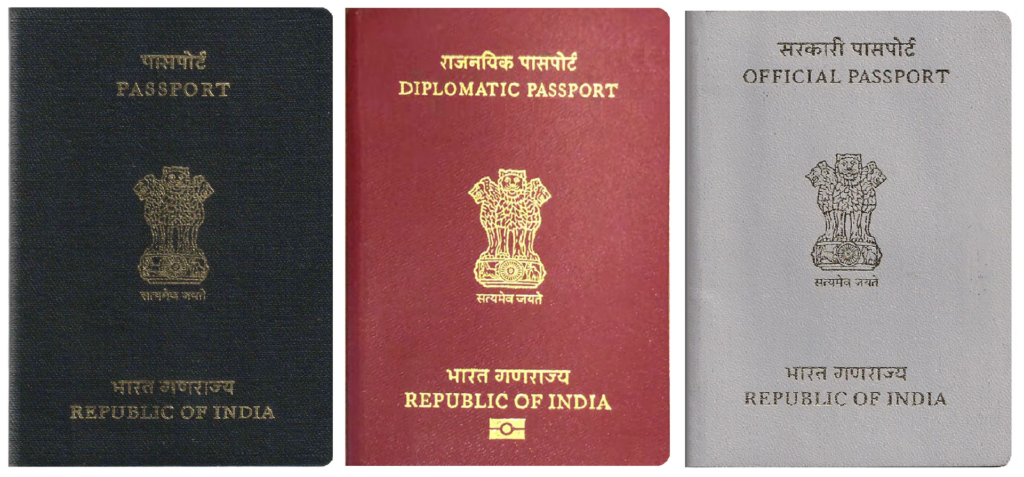
    Ordinary, official and diplomatic Indian passports side by side
    Check your passport's validity well before you book; many countries require it to extend beyond your stay (Photo: Vikassinghhhh via Wikimedia Commons, CC BY-SA 4.0)

    Visiting India: eVisa and arrival basics

    If you are traveling to India from abroad, the Government of India’s official portal is Indian Visa Online (eVisa). Here is what the portal itself sets out:

    • eVisa categories include e-Tourist, e-Business, e-Medical, e-Medical Attendant, e-Student, e-Transit and others. The e-Tourist visa comes in several durations; check the current options and conditions on the portal.
    • The process is to apply online and upload a photo and passport page, pay the fee online, receive an Electronic Travel Authorization (ETA) by email, then present the ETA at the immigration check post, where the eVisa is stamped in your passport.
    • Eligibility and entry points: the portal lists which nationalities can use the eVisa and the authorized airports and seaports through which eVisa holders can enter. Check both before you book, especially if you plan to arrive by land or sea.
    • No express fees: the portal advises that the Government of India makes no provision for charging emergency or express fees for an eVisa. Treat any site that charges one with suspicion.
    • e-Arrival card: the portal notes that foreigners and OCI cardholders can complete the e-Arrival card online within 72 hours before arrival, and that this is for arrival information, not a visa.

    The portal also advises travelers to read the instructions on the Bureau of Immigration website. Canadians should also read the Government of Canada’s travel advice for India, which covers entry requirements, safety, health and local laws from a Canadian perspective.

    Power: plugs, voltage and adapters

    India uses plug types C, D and M, at 230 volts and 50 hertz. Type D (three round pins in a triangle) is the most common for everyday sockets, type M is a larger three-pin version used for heavier appliances, and type C is the familiar two-pin plug. Many Indian hotels and homes have universal or multi-standard sockets, but you cannot count on it. The International Electrotechnical Commission’s World Plugs page shows the plug type and voltage for every country; check your destination before you pack.

    RegionPlug typesVoltageWhat an Indian traveler needs
    IndiaC, D, M230 VVisitors from North America need a C or D adapter and dual-voltage devices
    Canada and the United StatesA, B120 VA/B adapter; check that each device accepts 120 V
    United KingdomG230 VG adapter
    Most of continental EuropeC, F (plus E in some countries)230 VA two-pin C plug often fits; an adapter covers the rest
    AustraliaI230 VI adapter
    SingaporeG230 VG adapter

    Confirm the details for your exact destination on the IEC World Plugs page, since some countries use more than one type.

    Adapter or converter?

    An adapter only changes the shape of the plug. A converter changes the voltage. Most phone, tablet and laptop chargers are designed to accept a wide range of voltages; look for an input rating such as “100-240V” printed on the charger. If you see that, an adapter is all you need. High-power heating appliances such as hair dryers, straighteners and kettles are often single-voltage; a 230-volt Indian appliance should not be plugged into a 120-volt North American outlet through an adapter alone, and vice versa. Many travelers simply buy a dual-voltage appliance or leave it at home.

    What to pack

    • A universal travel adapter with USB ports, or two simple adapters for your destination.
    • A compact multi-port charger to charge several devices from one socket. Our guide to 3-in-1 chargers covers compact options for phone, watch and earbuds.
    • A short extension or travel power strip with the right plug, useful in hotel rooms with a single socket.
    • Cables for every device, plus one spare.
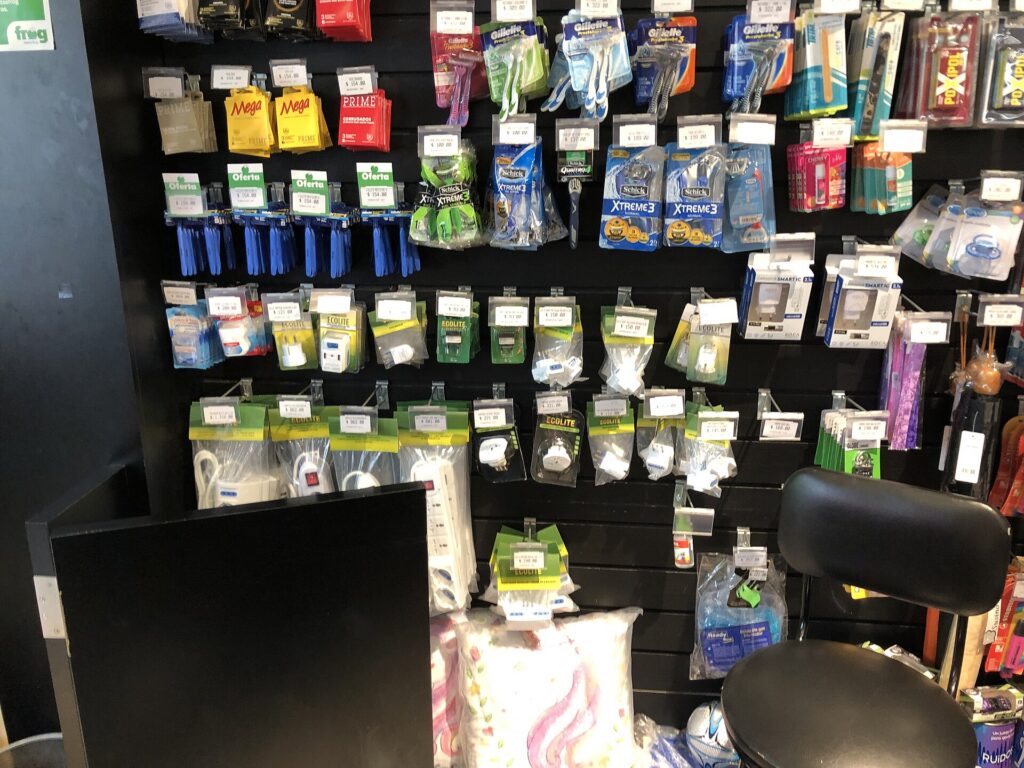
    Travel plug adapters and power strips hanging on a store display
    An adapter changes the plug shape, not the voltage; check each device's input rating before you plug in (Photo: Grandmaster Huon via Wikimedia Commons, CC0)

    Power banks and batteries

    A power bank is essential for long travel days, but it has to go in your carry-on. The US Federal Aviation Administration states that spare lithium batteries, including power banks and battery charging cases, must be carried in carry-on baggage only, and that many airlines have stricter limits on how many you can bring. Rules in India and other countries follow similar principles, and individual airlines may restrict using or charging power banks on board. Check your airline’s current policy before you fly, and if your cabin bag is checked at the gate, take the power bank out first.

    Essentials for Indian travelers going abroad

    A long-haul comfort kit

    Flights from India to North America are among the longest in the world, and even flights to Europe or with a Gulf connection make for a long day. A small kit makes a real difference:

    • A neck pillow that suits how you sleep; see our guide to airplane pillows
    • An eye mask and earplugs, or noise-cancelling headphones; see our guide to noise-cancelling headphones
    • A warm layer or shawl, since cabins get cold
    • Comfortable socks and slip-on shoes
    • A refillable water bottle, empty through security
    • A phone holder that clips to the seatback, if you like watching your own downloads
    • Toothbrush, lip balm and small toiletries within liquid limits

    Our guide to sleeping on flights covers seat choice, jet lag and drug-free ways to rest on a long-haul flight.

    Packing cubes and smart luggage

    Packing cubes keep clothes, gifts and electronics separate, make security checks faster and help you repack after a stopover. They are especially helpful for family trips and for students moving abroad with a lot of luggage. Check your airline’s baggage allowance carefully: some fares allow a number of pieces with a weight limit per bag, others a total weight, and allowances often differ between the international and domestic legs of a trip. A luggage scale saves arguments at the check-in counter. Our main guide to travel luggage explains carry-on vs checked bags, hardside vs softside and how airline size rules work.

    Documents wallet and security

    A passport holder or travel wallet keeps your passport, visa printouts, boarding passes and cards together. For busy cities and transit, a money belt or hidden pocket keeps backup cash and cards safe. See our guides to passport holders, money belts and anti-theft backpacks.

    Handheld bidet or peri bottle

    Washing with water after using the toilet is the everyday norm in India and in many other countries, while bathrooms in North America, the UK and much of Europe often provide only toilet paper. A collapsible peri bottle or a compact portable bidet sprayer solves this simply and discreetly. Pack it empty; it takes very little space. Travelers visiting India from abroad will often find a hand shower or tap next to the toilet and may want to carry some tissue as well.

    Clothing for a different climate

    If you are heading to Canada, the northern United States or northern Europe between late autumn and spring, a proper winter coat, gloves, a hat and waterproof shoes are essential, and they are often easier to buy after you arrive, where the range suits local conditions. Pack layers rather than one heavy item, and wear your bulkiest shoes and jacket on the plane to save space. For long walking days, see our guide to comfortable walking shoes.

    Food from home and customs

    Many travelers carry snacks, spices or sweets from home, and it is a lovely part of visiting family. But customs rules on food are strict in many countries, particularly for meat, dairy, fresh fruit, vegetables and seeds. The safe principle is to declare all food on your customs form or to the officer when you arrive; undeclared food can lead to fines, while declared food is either allowed or simply taken away. Check the destination’s customs agency website before you pack, and keep homemade items well sealed and labeled.

    Medicines

    Carry prescription medicines in their original labeled packaging in your carry-on, with a copy of the prescription and a letter from your doctor for anything unusual. Some medicines that are sold over the counter in one country are controlled in another, so check the destination’s rules. A small travel first aid kit covers minor needs on the road.

    Money and connectivity

    Tell your bank you are traveling, carry at least two cards from different networks and keep some local currency for your arrival. A forex card or a card without foreign transaction fees can reduce costs. For your phone, compare an international roaming pack with a local SIM or eSIM at your destination, and make sure your phone is unlocked if you plan to use a local SIM. Download offline maps and your airline’s app before you leave.

    Essentials for travelers visiting India

    Health preparation

    The CDC’s India travel health page recommends seeing your doctor at least a month before your trip for any vaccines or medicines you may need (source: CDC). It also advises choosing safe food and drinks and practicing good hand hygiene, and recommends protecting yourself from mosquito bites with insect repellent, long sleeves and pants, and air-conditioned or screened rooms, noting that several mosquito-borne diseases cannot be prevented by vaccines alone (source: CDC). Pack hand sanitizer, a refillable bottle for filtered or bottled water and insect repellent, and see a travel health clinic for advice specific to your itinerary.

    Clothing and respect for local customs

    India is vast and diverse, and dress norms range from very relaxed in big cities and beach areas to more conservative in rural areas and at religious sites. Light, breathable cotton and linen suit most of the country for much of the year. Bring a light scarf or shawl: it is useful for covering your head where that is expected, for example in gurdwaras, and for covering shoulders at temples and mosques. Shoes are removed at many places of worship, so slip-ons are practical, and a pair of socks helps on hot stone floors. When in doubt, watch what others do or ask; people are generally happy to explain.

    Weather and seasons

    Much of India has a hot season, a monsoon season roughly from early summer into early autumn, and a cooler dry season in winter, but the pattern varies widely between the south, the plains and the Himalayas. The mountains can be cold at any time of year. Check the forecast for each region on your itinerary and pack layers, a compact umbrella or rain jacket in the monsoon, and sun protection year-round.

    Power and devices

    Bring a type C or D adapter (or a universal adapter), and check that your devices accept 230 volts. Power cuts happen in some areas, so a power bank is useful, and a small flashlight or your phone light helps at night.

    Getting around

    India has an extensive domestic flight network and one of the world’s largest rail systems. Ride-hailing apps work in most big cities. Keep digital and printed copies of your ETA and hotel bookings, since you may be asked for them on arrival and at hotel check-in.

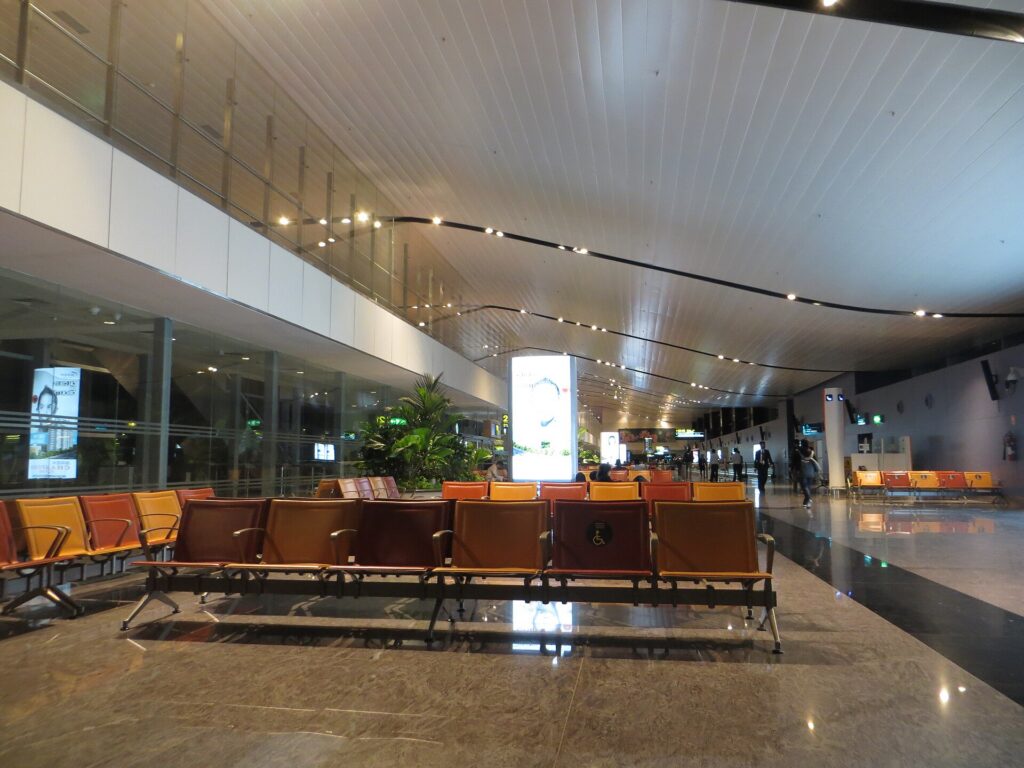
    The international departures area of Kempegowda International Airport in Bengaluru
    Airlines check your visa or travel authorization at check-in, so have documents ready before you reach the counter (Photo: Sunnya343 via Wikimedia Commons, CC BY-SA 4.0)

    Carry-on checklist for a long-haul flight to or from India

    • Passport, visa or ETA printout, boarding pass and a copy of your hotel or host address
    • Pen for arrival forms
    • Phone, charger, universal adapter and power bank
    • Medicines in original packaging, plus a copy of prescriptions
    • Neck pillow, eye mask, earplugs or headphones
    • Warm layer or shawl, socks
    • Empty refillable bottle
    • Toothbrush and toiletries within liquid limits
    • A change of clothes, in case your checked bag is delayed
    • Peri bottle or small pack of tissues and wipes
    • Some snacks, declared if you are crossing a border

    For women travelers, our guide to travel-friendly feminine hygiene products covers what to carry and how liquid rules apply. For laptop users, our list of laptop travel accessories helps keep work gear organized.

    Common mistakes

    • Using an unofficial visa website. Apply through the destination government’s official portal, such as India’s eVisa portal for visitors to India.
    • Forgetting transit requirements. A connection in a third country can need its own visa or authorization depending on your nationality.
    • Packing power banks in checked bags. They belong in your carry-on.
    • Plugging a single-voltage appliance into the wrong voltage. An adapter does not convert voltage.
    • Not declaring food. Declaring is almost always the safer choice.
    • Letting a passport get too close to expiry. Renew early if you have trips planned.
    • Relying on one card or one copy of documents. Keep backups in separate places.

    Frequently asked questions

    What plug type does India use?

    India uses types C, D and M at 230 volts and 50 hertz. Type D is the most common for everyday sockets. Check your destination on the IEC World Plugs page.

    Do I need a voltage converter for India or for travel abroad?

    For most phone and laptop chargers, no: check for an input rating like “100-240V”. High-power heating appliances are often single-voltage and need a dual-voltage model or a proper converter.

    Where do foreigners apply for an Indian eVisa?

    On the Government of India’s official Indian Visa Online portal, which lists eligible nationalities, visa categories, required documents and authorized entry points.

    What is the e-Arrival card for India?

    According to the official portal, foreigners and OCI cardholders can submit an e-Arrival card online within 72 hours before arriving in India. It provides arrival information and is not a visa.

    How do I check visa rules for my destination?

    Use the destination government’s official website, such as Canada’s visa and eTA checker, and cross-check with the IATA Travel Centre, which draws on the database airlines use at check-in.

    Can I carry a power bank on international flights?

    Yes, in your carry-on only, according to the FAA. Airlines may limit the number and capacity and may restrict use on board, so check your airline’s rules.

    Can I bring Indian snacks and spices abroad?

    Often yes, but rules vary by country and by type of food. Declare all food on arrival and check the destination’s customs website before you pack.

    What should visitors to India pack for health?

    See a doctor at least a month before your trip, as the CDC recommends, and pack insect repellent, hand sanitizer and a refillable bottle for safe water.

    Once your documents and bags are ready, compare fares across flexible dates on our flight search, including routes to Toronto and London, two of the busiest destinations for travelers from India. Our guide to international flight booking tips helps you choose connections and fares, and our guide to airport arrival times for international flights helps you plan the day of travel. If you are visiting family or studying in Canada, our guide to things to do in Toronto and our hotel search will help you plan the rest of the trip.