
Minneapolis rewards people who come without expectations. Visitors picture a cold Midwestern business city, and they find a downtown built on the only major waterfall on the Mississippi, a chain of lakes inside the city limits ringed by busy paths, two art museums that would be the pride of a city three times its size, a theater scene second only to New York’s by some counts, and neighborhoods where breweries, Somali restaurants, Scandinavian bakeries and Indigenous kitchens sit a few blocks apart. The winters are genuinely hard, and the city has answered them with enclosed skyways, a winter festival calendar and a stubborn habit of going outside anyway. This guide covers the sights that earn a day, the neighborhoods worth a half-day, the food, the State Fair and the sports, the day trips, and the practical details that turn a quick visit into a trip.
If you are still comparing cheap flights to Minneapolis, read this alongside our guides to the best time to fly to Minneapolis and whether you need a car. Between the three you can plan the whole trip.
Minneapolis at a glance for first-timers
- Airport: Minneapolis-Saint Paul International (MSP), about 16 km (10 miles) south of downtown Minneapolis, between the two cities. The METRO Blue Line light rail runs from both terminals to downtown in about 25 minutes. See our MSP airport guide.
- Getting around: two light-rail lines, the Blue Line to the airport and the Mall of America and the Green Line to the University and downtown Saint Paul, plus buses. Downtown is walkable, and in winter the skyways let you cross it indoors. For day trips, most visitors rent a car.
- Money: US dollars. Sales tax is added at the register, with extra city taxes on downtown hotels and restaurants; Minnesota does not tax most clothing, which makes shopping slightly cheaper. Tipping 18 to 20 percent in restaurants is expected.
- Weather: four emphatic seasons: long, cold, snowy winters with Arctic outbreaks that push temperatures far below 0 °F, a short spring, warm and sometimes humid summers with thunderstorms, and a crisp, colorful fall. Our month-by-month guide has the detail.
- Where to stay: downtown for the skyways, the theaters and the stadiums; the North Loop for restaurants and the riverfront; the St. Anthony Main side of the river for a quieter base by the falls; near the University or in Saint Paul if your plans are on that side. Our Minneapolis hotel search covers them all.
Downtown: Nicollet Mall, the IDS Center and the skyways
Downtown Minneapolis is compact, and its spine is Nicollet Mall, a pedestrian and transit street with public art and the bronze statue of Mary Tyler Moore tossing her hat, a nod to the television show set in the city. The IDS Center, the tallest building in the state since 1973, stands on the Mall, and its glass-roofed Crystal Court is the central crossroads of the skyway system, roughly 15 km (9.5 miles) of enclosed, heated bridges and corridors one story above the street that link some 80 blocks of downtown. Walking it in January, from a hotel to dinner to a Timberwolves game without a coat, is a genuinely Minneapolitan experience. The skyways are owned by the buildings they pass through, so hours vary: most are open from early morning into the evening on weekdays, with shorter hours on weekends. A block west, Hennepin Avenue is the theater district, with the restored Orpheum, State and Pantages theaters staging touring Broadway shows, and the First Avenue nightclub, where Prince filmed Purple Rain and whose exterior wall is covered in silver stars for the acts that have played there.
The riverfront: St. Anthony Falls, the Stone Arch Bridge and Mill City
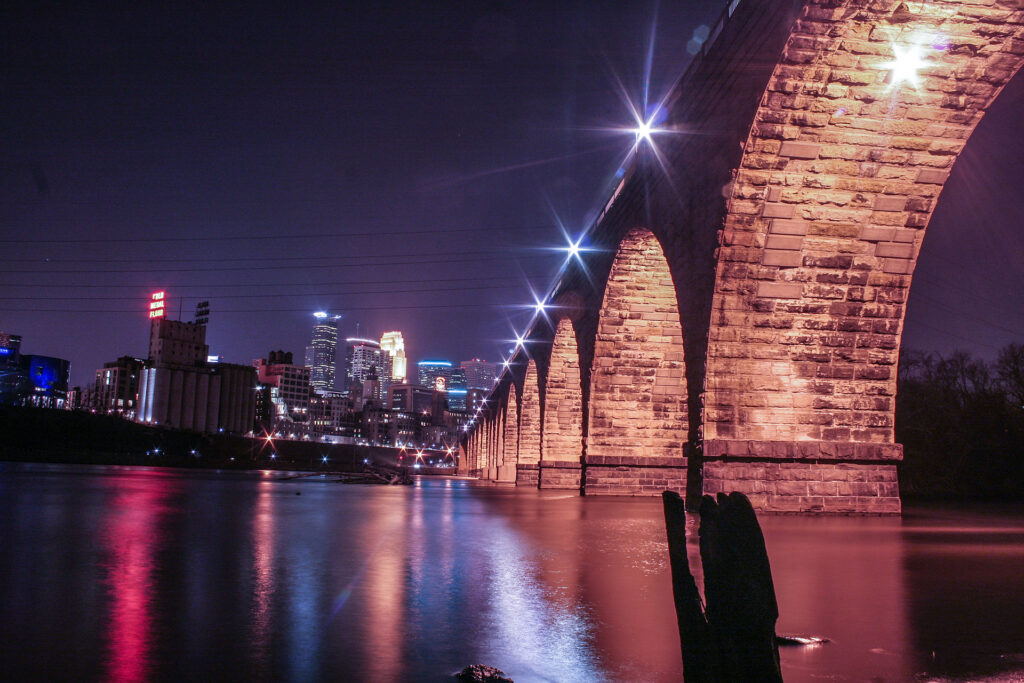
Minneapolis exists because of St. Anthony Falls, the only natural major waterfall on the whole Mississippi, whose power drove the flour mills that made the city, for half a century, the milling capital of the world. The Stone Arch Bridge, a curving railroad viaduct built in 1883 and now open only to walkers and cyclists, crosses the river just below the falls and is the best viewpoint in the city, with the skyline on one side and the falls and mill ruins on the other. On the west bank, the Mill City Museum, run by the Minnesota Historical Society, is built inside the burned-out ruins of the Washburn A Mill, once the largest flour mill in the world; the Flour Tower ride and the observation deck are the highlights. Beside it, Water Works, a riverside park built into old mill foundations, is home to Owamni, the award-winning Indigenous restaurant, and the Guthrie Theater, the most celebrated regional theater in the country, has a cantilevered “Endless Bridge” over the riverbank that is free to walk onto during building hours. Across the river, the east bank has the cobblestone St. Anthony Main and Nicollet Island with its Victorian houses. The whole stretch is part of the Mississippi National River and Recreation Area, and the riverside paths continue for miles in both directions.
The Walker, the Sculpture Garden and Mia
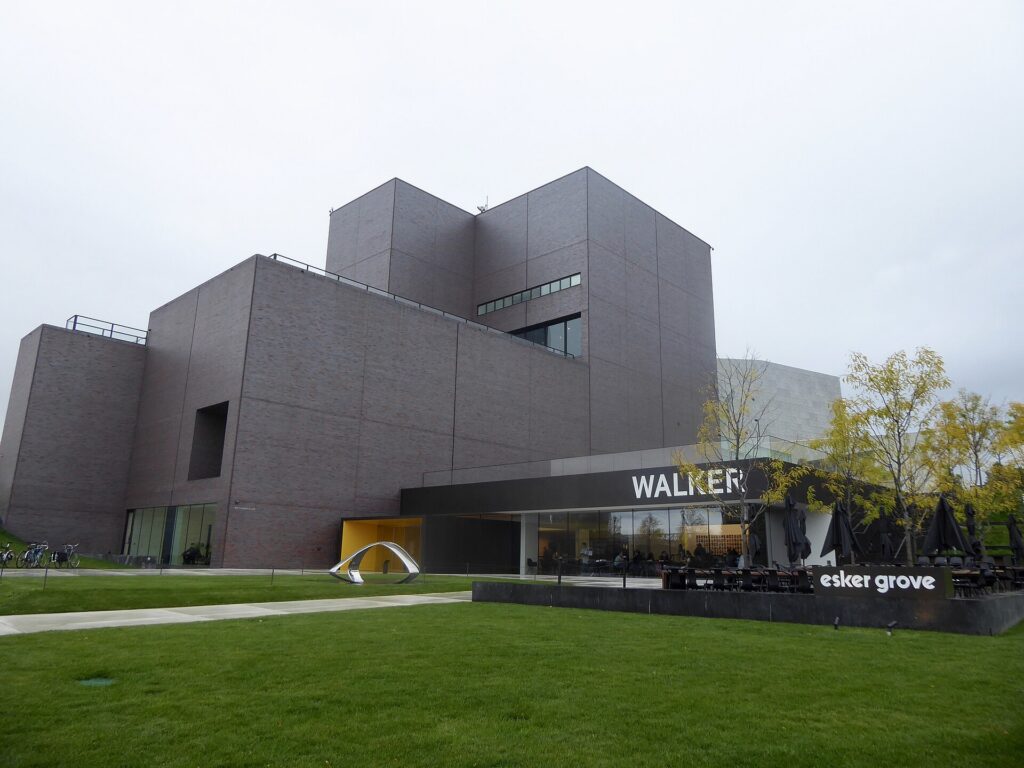
Minneapolis has two art museums that justify the trip on their own. The Walker Art Center, on the edge of downtown by Loring Park, is one of the country’s leading museums of contemporary art. Across the street, the free Minneapolis Sculpture Garden holds some forty works across eleven acres, including Spoonbridge and Cherry by Claes Oldenburg and Coosje van Bruggen, the giant spoon with a cherry balanced on it that appears on half the postcards in town. The Minneapolis Institute of Art, universally called Mia, in the Whittier neighborhood south of downtown, is an encyclopedic museum that runs from Egyptian antiquity through European painting, including a well-known Rembrandt, to one of the strongest Asian collections in the country, and general admission is free. On the University of Minnesota campus, the free Weisman Art Museum, in a stainless-steel building by Frank Gehry, is worth the stop for the building alone, and the American Swedish Institute, in a turreted mansion south of downtown, tells the story of the Scandinavians who shaped the state.
The lakes, the Grand Rounds and Minnehaha Falls
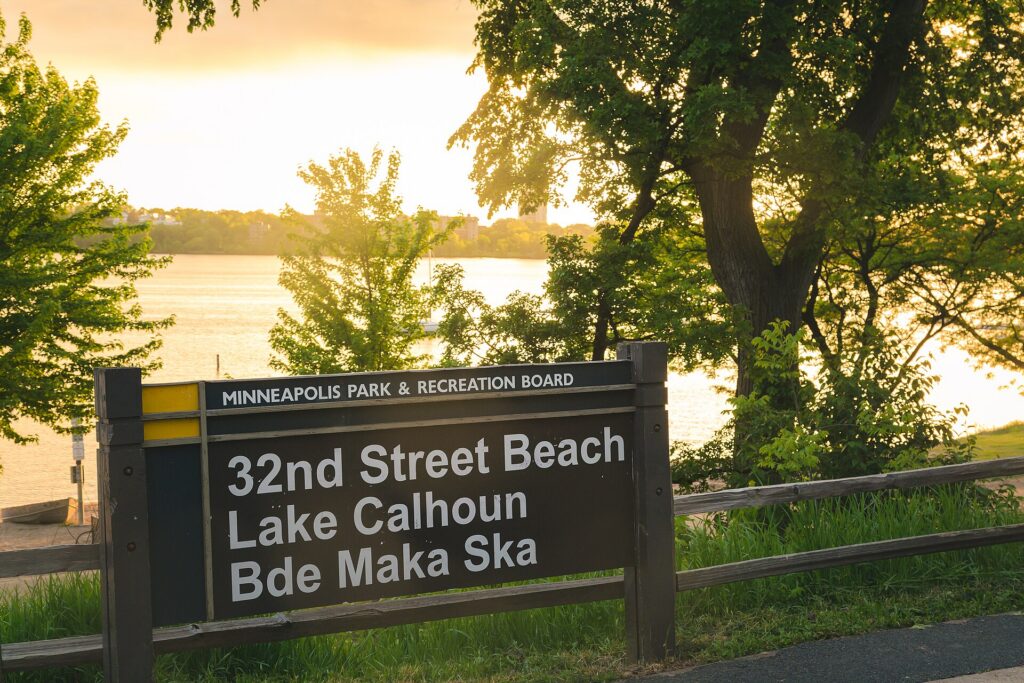
The city’s best public space is not downtown at all. The Chain of Lakes, a few miles southwest of downtown, is where Minneapolis lives in summer: Bde Maka Ska, the largest, with beaches, sailboats and paddleboard and kayak rentals; the quieter Lake of the Isles, ringed by grand houses; Cedar Lake, with the most natural shoreline; and Lake Harriet, with a bandshell that hosts free concerts on summer evenings, rose gardens and the restored Como-Harriet streetcar, which runs short rides in summer. Paved paths, separate for walkers and cyclists, circle every lake. They are part of the Grand Rounds, a loop of parkways and trails of about 80 km (50 miles) around the city, which links the lakes to the Mississippi and to Minnehaha Falls, a 16-meter (53-foot) waterfall in a wooded gorge made famous by Longfellow’s Song of Hiawatha. The falls are free, a short walk from a Blue Line station, and in a hard winter they freeze into a column of ice. The Minneapolis Park and Recreation Board runs it all; rent a bike and you can see the lakes and the falls in a day.
Neighborhoods worth a half-day
The North Loop
The old warehouse district beside Target Field is now the city’s most fashionable neighborhood: brick lofts, boutique hotels, independent shops and many of the city’s best restaurants and cocktail bars along Washington Avenue, a short walk from the riverfront.
Northeast
Across the river, “Nordeast”, the old immigrant working-class district, is now the arts and brewery quarter: studios in former factories such as the Northrup King Building, a dense cluster of taprooms, old Polish delis, and Art-A-Whirl in May, one of the largest open-studio weekends in the country.
Uptown and Lyn-Lake
The streets around Hennepin and Lake, a short walk from Bde Maka Ska, are the traditional nightlife district; Lyn-Lake, a few blocks east, is the more independent strip. Combine either with the lakes.
Eat Street and Whittier
Nicollet Avenue south of downtown, branded Eat Street, has a mile of Vietnamese, Mexican, Somali and Korean restaurants and runs past Mia. Farther south, Lake Street and the Midtown Global Market, a food hall in a former Sears building, show the city’s immigrant communities at their liveliest.
Cedar-Riverside and the University
The West Bank, by the University of Minnesota, is the heart of the largest Somali community in the country, with cafés, markets and restaurants. Across the river, the main campus, Dinkytown and the Weisman are a Green Line stop away.
Saint Paul
The other Twin City deserves at least half a day. The Green Line runs to its downtown in around 45 minutes, past the Hmong and Vietnamese restaurants of University Avenue. Saint Paul has the Cass Gilbert-designed Minnesota State Capitol, the Cathedral of Saint Paul on its hill, Summit Avenue, a long boulevard of Victorian mansions where F. Scott Fitzgerald lived as a young man, the Science Museum, and the free Como Park Zoo and Conservatory.
Museums, culture and family attractions
For live performance, Minneapolis is exceptional. Beyond the Guthrie and the Hennepin Avenue theaters, the Minnesota Orchestra plays at Orchestra Hall on Nicollet Mall, the Children’s Theatre Company beside Mia is one of the most honored in the nation, and dozens of smaller companies give the Twin Cities more theater seats per person than almost anywhere outside New York. The music scene produced Prince, the Replacements and Hüsker Dü, and the clubs still matter: First Avenue and its smaller room, the 7th St Entry, the Turf Club in Saint Paul, and the Dakota for jazz. Prince fans can tour Paisley Park, his home and studio complex in suburban Chanhassen, about half an hour southwest; book ahead. The Mall of America, at the end of the Blue Line, is the largest mall in the country. Historic Fort Snelling, on the bluffs where the Minnesota River meets the Mississippi, tells the story of the fort and of the Dakota people whose homeland this is. For what is on during your dates, our Minneapolis events page lists concerts, shows and games.
The State Fair and the festival year
For twelve days ending on Labor Day, the Minnesota State Fair is the center of the state’s universe. It is one of the largest state fairs in the country, drawing close to two million visitors to the fairgrounds between the two downtowns, and locals call it the Great Minnesota Get-Together without irony. The attractions are prize animals, butter sculptures, a midway, grandstand concerts and, above all, the food, much of it on a stick. Go on a weekday morning and take the fair’s express buses or park-and-ride shuttles rather than driving. The rest of the year has its own calendar. The Saint Paul Winter Carnival, from late January into early February, is one of the oldest winter festivals in the country, with ice sculptures and parades; the Loppet ski festival fills Theodore Wirth Park around the same time; the Aquatennial in July has fireworks over the river; Twin Cities Pride fills Loring Park in late June; and the Twin Cities Marathon, in early October, runs past the lakes and the river. If you are coming for the fair, book the hotel first: rooms across the metro fill in late August.
Sports
Minneapolis has a team in every major league, and most play downtown. The Twins play baseball at Target Field in the North Loop, an open-air ballpark with a skyline view; April and September games can be cold, so bring a layer. The Vikings play at U.S. Bank Stadium, the translucent-roofed building in Downtown East that hosted a Super Bowl. The Timberwolves and the Lynx, one of the most successful franchises in WNBA history, play at Target Center, connected to the skyways. The Wild play hockey in downtown Saint Paul, in a state that takes the sport more seriously than any other, and Minnesota United play soccer at Allianz Field on the Green Line. Check what is on sale in Minneapolis for your dates before you book flights.
What to eat, and where
Minnesota’s food reputation used to rest on hotdish, the tater-tot-topped casserole of the church basement, and it still makes an appearance. The dish every visitor should try is the Jucy Lucy (or Juicy Lucy, depending on which bar you ask), a burger with the cheese sealed inside the patty, which two South Minneapolis bars, Matt’s and the 5-8 Club, both claim to have invented; let it cool before you bite. The North Loop and Northeast have the chef-driven restaurants; Owamni, on the riverfront, serves Indigenous food without wheat, dairy or cane sugar; Eat Street and Lake Street have pho, taquerías and Somali restaurants serving rice, goat and sambusas; University Avenue in Saint Paul is the place for Hmong food; and the Scandinavian heritage survives in bakeries and holiday lefse. Walleye, the state fish, turns up as a sandwich or pan-fried at supper clubs. Minnesota changed its liquor laws in 2011 to allow brewery taprooms, and the result is one of the densest craft-beer scenes in the country, concentrated in Northeast.
Minneapolis through the seasons
Winter (December to early March) is cold, sometimes brutally so, with snow on the ground for months and cold snaps below -25 °C (-13 °F), but the city is built for it: the skyways connect downtown, the lakes freeze solid enough for skating, pond hockey and ice fishing, Theodore Wirth Park has cross-country skiing and a tubing hill minutes from downtown, and the museums and theaters are at their best on a January night. Spring (late March to May) arrives late; the ice leaves the lakes in April, and the Twins’ home opener is often a hat-and-gloves affair. Summer (June to August) is the payoff: long evenings on the lakes, patios in the North Loop, the Aquatennial, and the State Fair to close it out. Fall (September to October) is the local favorite: warm afternoons, cool nights, the marathon, and fall color along the river that peaks in early-to-mid October. Our month-by-month guide has the fare patterns that go with each season.
Minneapolis with kids
Minneapolis is an easy city with children, in any weather. The Mall of America’s Nickelodeon Universe and aquarium are the obvious indoor day, and the Blue Line takes you there. In Saint Paul, the Science Museum of Minnesota has dinosaurs and a giant-screen theater, the Minnesota Children’s Museum is built for the under-tens, and the free Como Park Zoo and Conservatory is one of the best-value family days anywhere. In summer, the lake beaches, the Lake Harriet streetcar and Minnehaha Falls fill the days; in winter, the Children’s Theatre Company, tubing at the parks and the Winter Carnival’s ice sculptures keep everyone busy. For families heading north to Duluth, our family car rental guide covers the vehicle question.
Minneapolis on a budget
Much of the best of Minneapolis is free: Mia, the Sculpture Garden, the Weisman, the Stone Arch Bridge and the riverfront, the Chain of Lakes, Minnehaha Falls, the Lake Harriet bandshell concerts, the Guthrie’s Endless Bridge, the skyways, and the Como Park Zoo. The Walker has free hours on certain evenings; check its site. Light-rail fares are modest, and the ride between the two airport terminals is free. Eat well for less on Eat Street, at the Midtown Global Market on Lake Street, in the Somali cafés of Cedar-Riverside and along University Avenue in Saint Paul. Hotel rates in winter are among the lowest of any major American city, and outside State Fair week, convention weeks and big stadium events, downtown rates are reasonable year-round. Compare rates by neighborhood on our Minneapolis hotel search.
Day trips from Minneapolis
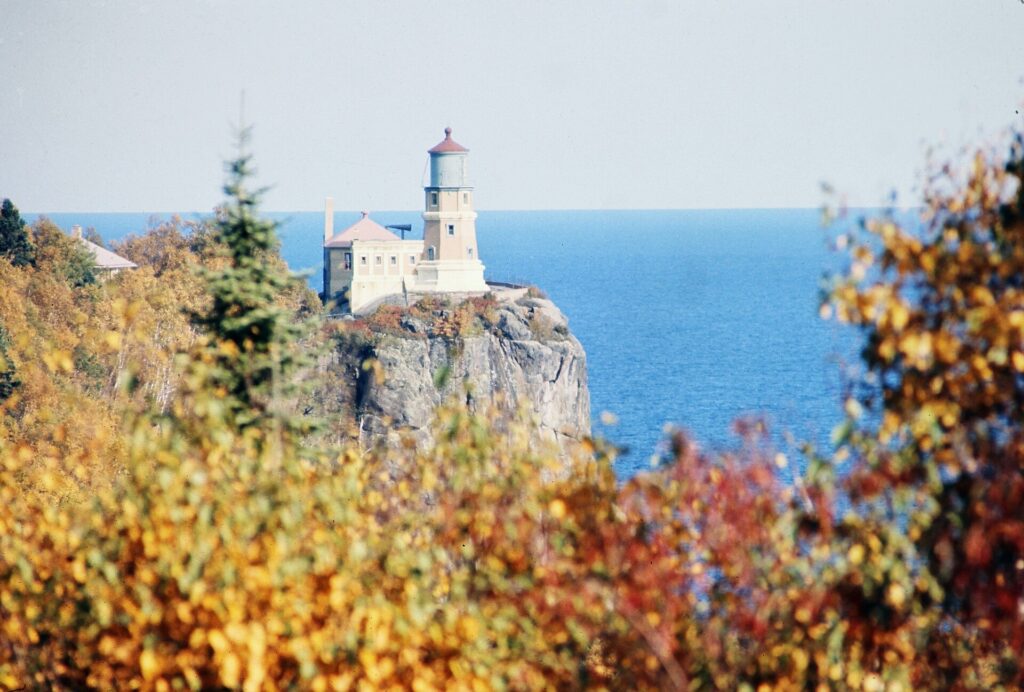
Stillwater, about 45 minutes east on the St. Croix River, is the prettiest small town in the metro: a brick main street of antique shops and restaurants, a historic lift bridge, and paddlewheel cruises in summer. Duluth, about two and a half hours north on I-35, sits at the western tip of Lake Superior, with the Aerial Lift Bridge, a lakefront walk and the ore boats, and it is the gateway to the North Shore: Gooseberry Falls and Split Rock Lighthouse, both state parks, are within an hour of it along one of the most scenic roads in the Midwest. South along the Mississippi, Red Wing and Wabasha, where the National Eagle Center watches the bald eagles that winter on the river, make a good loop past the bluffs in fall color season. All of these are car trips; see our Minneapolis car rental page, and in winter check road conditions before heading north. Explore Minnesota covers the wider state. If you are combining the Twin Cities with Chicago, our Chicago to Minneapolis route guide covers the drive, and our guide to things to do in Chicago covers the other end.
Two sample itineraries
Two days, no car
Day one: Nicollet Mall and the Crystal Court, the Mill City Museum and the Guthrie’s Endless Bridge, a walk across the Stone Arch Bridge, lunch in the North Loop, the Walker and the Sculpture Garden in the afternoon, and a show on Hennepin Avenue or at First Avenue. Day two: Mia in the morning, lunch on Eat Street, an afternoon on a rented bike around the Chain of Lakes and down the Minnehaha Parkway to the falls, then the Blue Line back downtown and dinner in Northeast among the breweries.
Four days, with Saint Paul and the St. Croix
Add a day in Saint Paul by Green Line, then pick up a car for a day in Stillwater, or a night in Duluth and on the North Shore, returning it at the airport on the way home.
Practical details
- Transit: buy tickets at the light-rail station machines or in the Metro Transit app, or use a Go-To card; a day pass pays off on a busy sightseeing day. Metro Transit has maps and service alerts; our transit-versus-car guide goes into detail.
- From MSP: the Blue Line from either terminal to downtown in about 25 minutes, a taxi or ride-hail in about 20 minutes outside rush hour, or a rental from the terminal ramps. The airport’s site covers ground transport and which airlines use which terminal.
- Weather: serious winter gear from December to March, layers in spring and fall, and sunscreen and a rain layer in summer. NOAA’s National Weather Service office for the Twin Cities has the forecast and winter weather warnings.
- Time zone: Central, one hour behind New York and two ahead of Los Angeles.
- Entry requirements: visitors from Visa Waiver Program countries need an approved ESTA before boarding; most others need a visa. The State Department’s travel site is the authoritative source.
- Safety: the areas visitors spend their time in, downtown, the riverfront, the lakes and the main neighborhoods, are busy and generally safe; use ordinary big-city awareness late at night downtown and on the light rail.
Frequently asked questions
How many days do you need in Minneapolis?
Two full days covers downtown, the riverfront, the Walker, Mia and the lakes; add a day for Saint Paul and one or two for Stillwater, Duluth or the North Shore.
What is the number one thing to do in Minneapolis?
In late August, the State Fair. Any other time, the river: walk the Stone Arch Bridge at sunset, with St. Anthony Falls below and the skyline lit up behind it.
Is Minneapolis walkable?
Downtown, the North Loop, the riverfront and Uptown are, and the skyways make downtown walkable even in January. The lakes and Minnehaha Falls are best reached by bike or light rail.
Do I need a car in Minneapolis?
Not for downtown, the riverfront, the lakes or Saint Paul; the light rail and a bike cover them. For Stillwater, Duluth, the North Shore and the suburbs, yes.
How cold does Minneapolis get in winter?
January daytime highs are usually well below freezing, and cold snaps with temperatures below -25 °C (-13 °F) happen most winters. The skyways, the museums and good boots make it very manageable.
What is Minneapolis known for?
The lakes, St. Anthony Falls, the skyways, Prince, the Guthrie, the State Fair, the Jucy Lucy, and a winter locals are quietly proud of surviving.
Ready to go? Compare flights to Minneapolis, find a place to stay with our Minneapolis hotel search, and if Duluth or the St. Croix are on the list, price a rental car for those days.
Keep planning with TicketScanner
- Cheap flights to Minneapolis
- Minneapolis hotels — by neighborhood
- Minneapolis car rentals — for Stillwater, Duluth and the North Shore
- Events in Minneapolis — Twins, Vikings, Timberwolves, concerts and shows on sale
- Best time to fly to Minneapolis: month by month
- Minneapolis: rent a car or use transit?
- Minneapolis-Saint Paul International (MSP) airport guide
- Where to stay: the North Loop
- Things to do in Chicago
Leave a Reply