Tag: Long-Haul Flights

  • Top 10 Noise Cancelling Headphones For Airplane Travel in 2025: Comfort Meets Silence

    Top 10 Noise Cancelling Headphones For Airplane Travel in 2025: Comfort Meets Silence

    An airplane cabin is a loud place to spend a few hours. Engines and air-conditioning produce a steady low roar, and on top of that come galley carts, announcements, conversations and the occasional crying baby. You stop noticing it after a while, but it keeps wearing on you, and it is a big part of why a long flight leaves you more tired than a day of sitting still should. Good noise-cancelling headphones take much of that edge off. They make movies and podcasts easier to hear at lower volume, they make sleep more likely, and they make it possible to read or work without your brain filtering noise the whole time. This guide explains how noise cancelling works, which features matter on a plane and which are marketing, over-ear versus earbuds, how to connect to seatback entertainment, the airline and battery rules that apply, and the models from our original list with who each one suits. It is part of our travel gear series, which starts with our main guide to choosing travel luggage.

    The short answer

    For most flyers, the best choice is a pair of over-ear headphones with active noise cancelling (ANC) that fold into a protective case, can be used with a cable for seatback screens, and have a battery that comfortably outlasts your longest flight plus the journey either side. Comfort matters more than a small difference in noise-cancelling strength, because you will wear these for hours: look for soft, deep ear cushions and moderate clamping force. If you hate the bulk, noise-cancelling earbuds with a good seal are the lighter alternative, at the cost of some low-frequency quiet and a harder time with wired seatback systems. Whatever you choose, pack a 3.5 mm cable and a two-prong airline adapter if your headphones support wired use, charge them before you leave home, and check what your airline allows during takeoff, landing and the safety briefing.
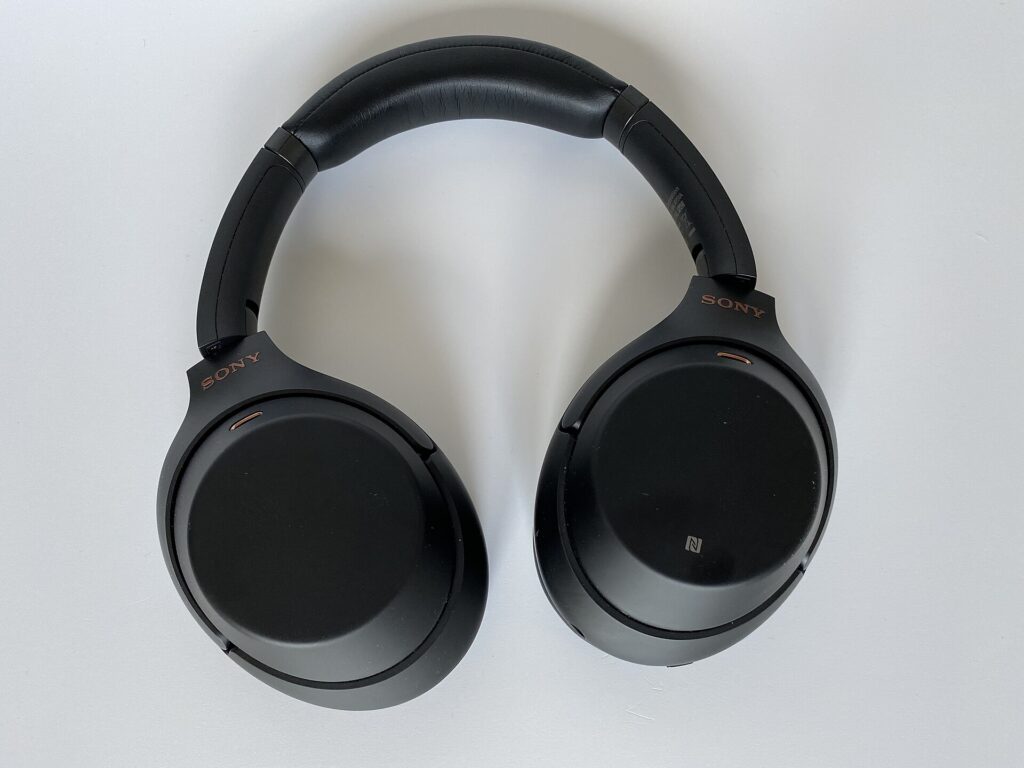
    A pair of black over-ear wireless noise-cancelling headphones lying flat on a white surface
    Deep, soft ear cushions matter as much as the noise cancelling when you wear headphones for hours (Photo: www.digitalpush.net via Wikimedia Commons, CC BY 4.0)

    How noise cancelling actually works

    There are two kinds of quiet at work in a good pair of travel headphones, and understanding them helps you choose.

    Passive isolation

    Passive isolation is simply blocking sound physically. Thick, well-sealed ear cushions on over-ear headphones, or snug tips on earbuds, stop a lot of higher-pitched sound such as voices, clinking cutlery and the rattle of a trolley. It needs no battery and it works even when the headphones are switched off. The quality of the seal matters a great deal: glasses arms, long hair or a poor fit can break the seal and let noise in.

    Active noise cancelling

    Active noise cancelling uses small microphones to listen to the noise around you and produces an opposing sound wave that cancels much of it before it reaches your ear. It is most effective against steady, low-frequency noise, which is exactly what engine and air-system noise is. It is less effective against sudden or irregular sounds, like a nearby conversation or a call button chime. That is why the best travel headphones combine both: ANC for the low drone and a good passive seal for everything else.

    Hybrid ANC

    “Hybrid” ANC means the headphones use microphones on both the outside and the inside of the ear cup, which generally lets them cancel a wider range of noise than systems with outside microphones only. Many mid-priced and premium headphones use this approach, and it is a reasonable feature to look for, though real-world results depend on the whole design, not one label.

    Transparency or ambient modes

    Most noise-cancelling headphones also offer a mode that deliberately lets outside sound in through the microphones, variously called transparency, ambient or aware mode. On a plane, it is useful for hearing a crew member’s question or a boarding announcement without taking the headphones off. Some models can switch into it automatically when you start speaking.

    What matters on a plane

    Comfort over hours

    This is the most underrated factor. A pair that sounds wonderful in a shop can become painful after three hours if the headband presses on the top of your head, the ear cups press on your glasses, or the cushions trap heat. Look for deep, soft cushions that surround your ears rather than sitting on them, a padded headband and moderate clamping force. If you wear glasses, try them on with your glasses. If you plan to sleep in them, consider how they feel when you lean your head against a window or a neck pillow: flatter, smaller ear cups are easier to rest against.

    Noise-cancelling strength

    Premium models from long-established audio brands generally lead on noise cancelling, and budget models have improved a lot. The difference between a good budget pair and a premium pair is most noticeable on long-haul flights and in the loudest seats, which tend to be further back near the engines. If you fly long-haul often, the premium end is easier to justify. For occasional short flights, a well-reviewed budget hybrid-ANC pair can be plenty.

    Battery life and charging

    Your headphones need to last the whole journey, not just the flight: the train to the airport, the wait at the gate, a delay, a connection and the ride to your hotel. Look at the maker’s figure for battery life with ANC switched on, which is usually lower than the headline figure, and aim for a comfortable margin over your longest door-to-door trip. Quick charging, where a short charge gives a few hours of use, is useful when you realize at the gate that you forgot. A USB-C port lets the headphones share a charger and cable with your phone and laptop, which is one fewer thing to pack.

    Wired use

    Many seatback entertainment systems still need a wire. Headphones with a 3.5 mm input and a supplied cable can plug straight into the seat, and many keep noise cancelling working while wired as long as they are switched on. Some also play passively when the battery is flat, without ANC, which is a useful fallback. Check this before you buy if you watch a lot of in-flight movies.

    Folding design and a case

    A hard or semi-hard case protects the headband hinges and ear cups from being crushed in a backpack, and keeps the cable and adapter together. Headphones that fold flat or fold inward take up less room. If space is tight, earbuds win easily; our guide to laptop travel accessories covers other small items that are easy to lose in a bag, and why a single pouch helps.

    Microphones and calls

    If you take calls at airports and in hotel rooms, microphone quality matters. Most noise-cancelling headphones handle calls in quiet places reasonably well; busy terminals are the hard test. On the plane itself, calls are rarely allowed or practical, so this is mainly an airport and destination feature.

    Multipoint and app features

    Multipoint Bluetooth lets the headphones stay connected to two devices at once, such as a phone and a laptop, which saves re-pairing when you switch. Companion apps can offer an equalizer, adjustable noise cancelling and firmware updates. These are nice extras; they do not make up for poor comfort or weak battery life.

    Over-ear, on-ear or earbuds?

    Each style has a place. This table sums up the trade-offs for flying.

    StyleNoise reductionComfort on long flightsPackingBest for
    Over-ear ANC headphonesUsually the strongest, especially for low engine noiseVery good if cushions are deep and soft; can feel warmBulky; needs a caseLong-haul flights, frequent flyers, watching movies
    On-ear ANC headphonesModerate; passive seal is weakerCan press on ears after a few hoursSmaller than over-earShort flights, people who dislike covering the whole ear
    ANC earbudsGood, depends heavily on tip fitGood for side sleepers; can tire ear canalsPocket sizeLight packers, side sleepers, travelers with small bags
    Wired earbuds or basic headphonesPassive onlyVariesTinyBackup pair, children, seatback screens only

    Many frequent flyers carry over-ear headphones for the flight and a small pair of earbuds as a backup and for the gym or the street at their destination. If you only want one, choose based on how you sleep on planes: if you rest your head sideways, earbuds and a good neck pillow are usually more comfortable than bulky ear cups.

    Connecting to seatback entertainment

    This catches out many travelers with new wireless headphones.

    • Most seatback screens use a wired jack. Some are standard 3.5 mm sockets; older aircraft may use a two-prong socket, which needs a small airline adapter. Some headphones include one, and they are inexpensive to buy.
    • Some newer systems support Bluetooth pairing. It depends on the airline and the aircraft, so you cannot count on it. If it is available, it will be explained on the seatback screen.
    • Bluetooth transmitters are small battery-powered dongles that plug into the seat jack and send the audio to wireless headphones. They are handy if your headphones have no cable input, but they are another thing to charge.
    • Check the wired-mode behavior. Some headphones keep noise cancelling working while wired only if they are switched on, and some play without power at all. Know which before you board.
    • Bring your own cable. Airline-supplied headphones are usually basic, and the seat jack only helps if you have a cable to plug in.
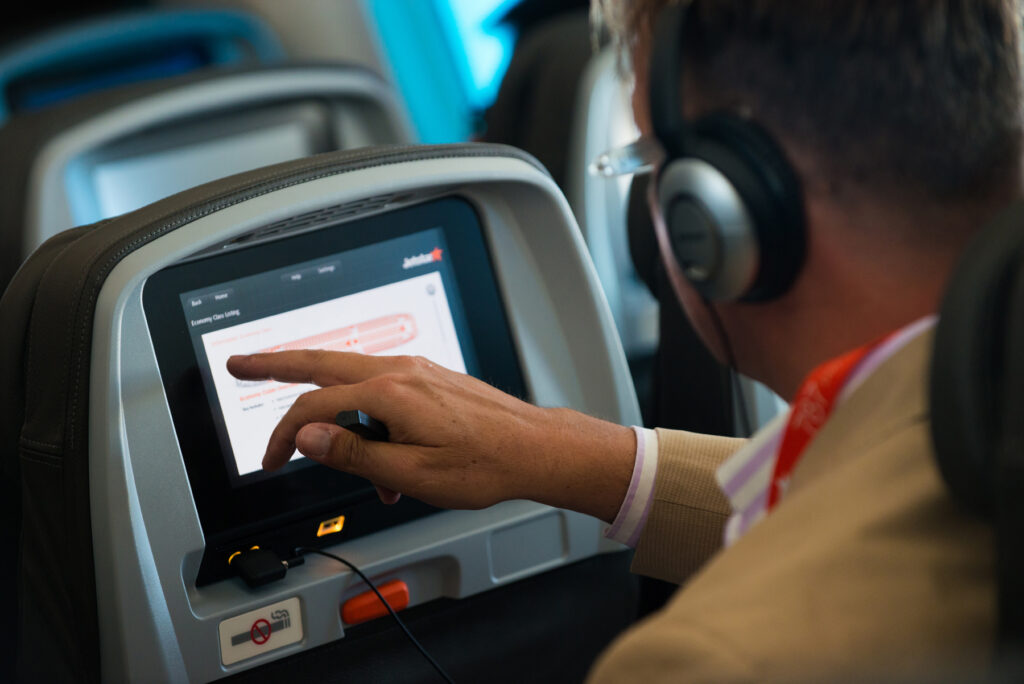
    A passenger wearing headphones using a seatback entertainment screen in an economy cabin
    Most seatback screens still need a wire, so pack the cable and a two-prong adapter (Photo: Jetstar Airways from Melbourne, Australia via Wikimedia Commons, CC BY-SA 2.0)

    Airline rules and etiquette

    Rules on using headphones and wireless devices on board vary by airline and country, and they change. We will not quote specific policies here, because they go out of date. The principles are stable:

    • Crew instructions always come first. Some airlines ask passengers to remove headphones, or at least one ear, during the safety briefing, taxi, takeoff and landing, so that you can hear instructions in an emergency. Do so when asked.
    • Airplane mode is expected. Phones and tablets are generally used in airplane mode or with the cellular connection switched off. Whether you can use Bluetooth accessories, and when, is the airline’s decision. The FAA explained when it expanded device use that policies would vary by airline, and that passengers should check with their airline.
    • Use transparency mode or remove a cup to talk to crew. It is quicker and more polite than asking someone to repeat themselves.
    • Keep the volume sensible. Sound leaks from open or poorly sealed headphones, and a neighbor trying to sleep will notice. A side benefit of noise cancelling is that you can listen at lower volume, which is kinder to your ears too.
    • Tell the person next to you if you plan to sleep. If you are in the window seat with headphones on, a small note on the seatback or a quick word before you nod off saves an awkward shoulder tap when they need to get out.

    Batteries and security screening

    Headphones and earbuds contain small lithium-ion batteries built into the device. As principles:

    • Headphones and earbuds are generally fine in carry-on bags, and it is sensible to keep them there anyway so they are not crushed or lost.
    • Spare lithium batteries and power banks must travel in the cabin, not in checked baggage, and should be protected from short circuits. If you carry a power bank to top up headphones, it goes in your carry-on.
    • Check the official guidance before flying: the FAA’s PackSafe lithium battery page, the TSA’s What Can I Bring? tool and CATSA’s guidelines for batteries in Canada. Airlines can add their own rules.
    • At security, large electronics may need to come out of your bag depending on the airport and the screening lane. Headphones in a case can usually stay in the bag, but follow the officer’s instructions.

    To keep the number of chargers down, a multi-device charger is worth considering; our guide to 3-in-1 Apple chargers covers one approach.

    Headphones from our original list

    The headphones below were featured in the original version of this guide. They cover a range of budgets and styles rather than a strict ranking. Models are updated and replaced often, and prices change constantly, so check the current specifications and battery figures from the maker before you buy. Where we have linked to a maker’s page, the details mentioned come from that page.

    Soundcore Life Q20

    The Soundcore Life Q20 from Anker’s audio brand is a budget over-ear pair with hybrid active noise cancelling. Soundcore describes memory foam ear cups and says the headphones target low- and mid-frequency noise such as airplane engines, and the product page lists AUX wired use. It suits travelers who fly a few times a year and want real noise cancelling without spending much. Budget ANC is not as strong as the premium end, but it is a large step up from basic earbuds.

    Soundcore Life Q30 and Soundcore Q20i

    Two more Soundcore models appeared on the original list. The Life Q30 sits above the Q20 in the range and was featured for its multiple noise-cancelling modes and app-based sound customization. The Q20i is another budget hybrid-ANC model with app support. Both suit value-minded travelers. Soundcore’s lineup changes often, so compare the current models on the maker’s site before you buy.

    TOZO HT2

    The TOZO HT2 was featured as a budget over-ear pair with hybrid noise cancelling and app-based sound adjustment. It suits travelers who want long battery life and a basic app at a low price. As with any budget pair, check the current listing for the battery figure with ANC on and whether a cable is included for seatback screens.

    INFURTURE active noise cancelling headphones

    The original list included a pair of INFURTURE over-ear ANC headphones, featured in a rose gold finish. They are a budget option for travelers who care about looks as well as function. With lesser-known brands, pay particular attention to the seller’s return policy and read the listing carefully for battery and wired-use details.

    Beats Studio Pro

    The Beats Studio Pro is an over-ear pair with fully adaptive active noise cancelling and a transparency mode. Beats describes a foldable design with a carrying case, lossless audio over USB-C, and a 3.5 mm analog input for wired sources and in-flight entertainment. It suits travelers in the Apple ecosystem who want quick pairing, and also works with Android. Beats lists separate battery figures for ANC on and off, so look at the lower one when planning a long flight.

    Beats Studio3 Wireless

    The Studio3 was on the original list as an earlier Beats noise-cancelling model. Beats’ website now sends visitors looking for the Studio3 to the Studio Pro, a sign that the older model has been superseded. If you find a Studio3 as remaining stock or refurbished at a good price, it can still be a reasonable choice, but compare it with the Studio Pro first.

    Sony WH-1000XM4

    Sony’s WH-1000XM4 has been a popular choice among frequent flyers for years. Sony’s help guide for the XM4 explains using the supplied headphone cable on an airplane, where noise cancelling keeps working while the headset is switched on, and mentions a supplied plug adaptor for in-flight use. It also supports Speak-to-Chat, which pauses playback when you start talking. Sony has released newer models since, so the XM4 is often found at lower prices; compare it with the current generation before deciding.

    Bose QuietComfort Headphones and QuietComfort Ultra Headphones

    Bose has made noise-cancelling headphones for travelers for a long time, and two of its models were on the original list. The QuietComfort Headphones are the more affordable of the two. The QuietComfort Ultra Headphones are Bose’s premium over-ear model, which Bose describes with an Aware mode for hearing your surroundings and Bose Immersive Audio for spatialized sound. Bose announced a second-generation QuietComfort Ultra in 2025, so check which version you are buying. These suit frequent long-haul flyers who put noise cancelling and comfort first.

    How to choose between them

    • Occasional flyer on a budget: a Soundcore or TOZO hybrid-ANC pair, as long as it has a cable input for seatback screens.
    • Apple user who wants seamless pairing: Beats Studio Pro.
    • Frequent long-haul flyer: a premium Sony or Bose model, chosen for the fit that feels best on your head.
    • Value in a premium model: the previous generation of a premium pair, such as the Sony WH-1000XM4, when it is discounted after a newer model arrives.
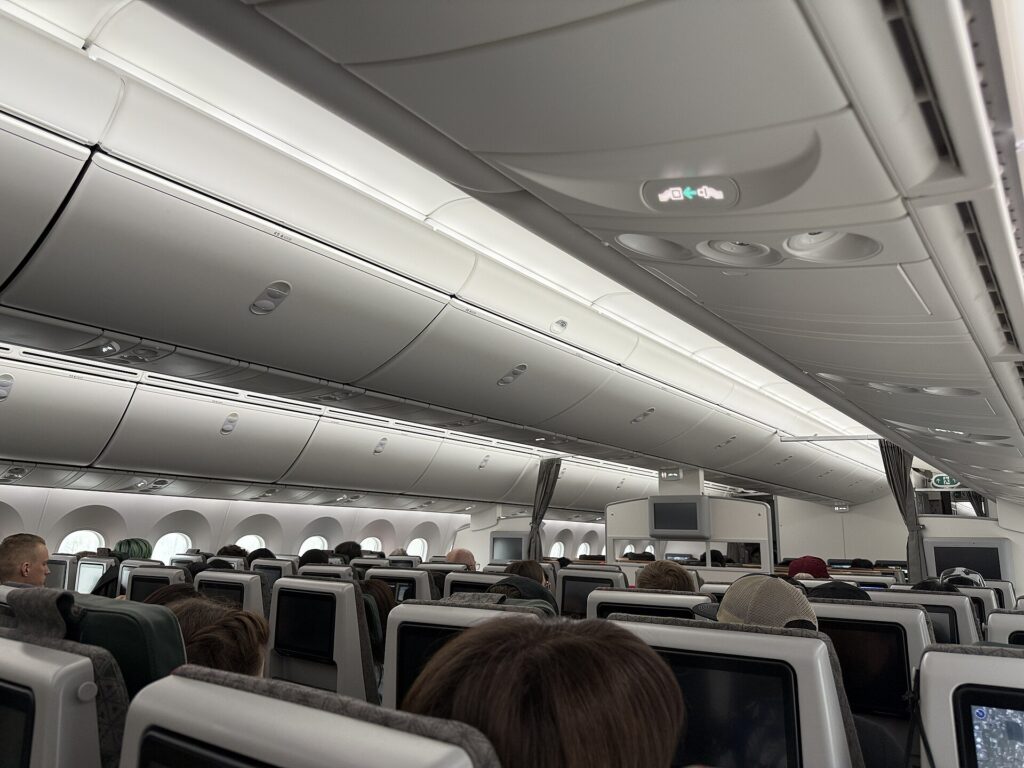
    The economy cabin of a widebody Boeing 787 with rows of seats and overhead bins
    Engine and air-system noise is a steady low drone, exactly what active noise cancelling handles best (Photo: 4300streetcar via Wikimedia Commons, CC BY 4.0)

    Getting the most from your headphones on a flight

    • Charge fully the night before, and top up at the gate if there is an outlet.
    • Download content before you leave. In-flight Wi-Fi can be slow, expensive or unavailable, and streaming apps often let you download for offline use.
    • Keep the case, cable and adapter together in your personal item, not the overhead bin, so you can reach them without standing up.
    • Switch ANC on at the gate. Airports are loud too, and starting the journey calm helps.
    • Take short breaks. On a long flight, give your ears and head a rest every couple of hours, which also reminds you to stand up and stretch.
    • Use a sleep playlist or white noise if you want to sleep. Silence plus ANC can feel odd at first; a quiet steady sound helps many people drift off. Our guide to sleeping on flights covers routines, light and seat choice.
    • Keep one ear free on the ground in busy streets and stations at your destination. Transparency mode helps, but staying aware of traffic and your bag matters more.

    Choosing a seat for a quieter flight

    Headphones do most of the work, but where you sit helps too. Seats toward the front of the cabin are generally quieter than seats near the engines or behind the wing on many aircraft, and seats close to galleys and lavatories see more foot traffic, conversation and door noise. Bulkhead rows are often near bassinet positions, which some travelers prefer to avoid if they want to sleep. When you compare flights, look at the aircraft type as well as the time and price, and use the airline’s seat map when you select a seat. If a quiet flight really matters to you, our guide to the difference between first class and business class explains what premium cabins add beyond the seat.

    Headphones for other parts of the trip

    Noise-cancelling headphones earn their keep beyond the plane. On trains and buses, they cut the rumble of the track and road. In hotel rooms near elevators, busy streets or nightlife, they can make it possible to sleep, although soft foam earplugs are more comfortable for side sleepers. In coworking spaces and cafés, they help you focus on work; our guide to travel keyboards covers the rest of a portable work setup. If you are choosing a room for a work trip, our business travel hotels guide explains how to find a quieter room.

    Care, storage and hygiene

    • Store them in the case whenever they are not on your head. Crushed headbands and snapped hinges are the most common travel failures.
    • Wipe the ear cushions with a slightly damp cloth after long flights and let them dry fully. Avoid soaking them or using harsh cleaners that can crack synthetic leather.
    • Replace worn cushions. Many premium headphones sell replacement ear pads, which restore comfort and passive isolation for a fraction of the cost of a new pair.
    • Keep the battery healthy by charging it every few weeks if the headphones sit unused between trips.
    • Update firmware through the companion app before a big trip, not at the gate.
    • Label the case or add a luggage tag. Headphones are among the items most often left behind in seat pockets.

    Common mistakes

    • Buying on noise cancelling alone. The quietest pair is no good if it hurts after two hours.
    • Forgetting the cable. Without it, many seatback screens are useless to you.
    • Trusting the headline battery figure. Look at the figure with ANC on, and plan for delays.
    • Packing headphones in checked luggage. They can be crushed or lost, and you will not have them on the flight.
    • Ignoring crew requests. When asked to remove headphones, do it promptly.
    • Turning the volume up to drown out the engines. Let the noise cancelling do the work and keep the volume moderate.
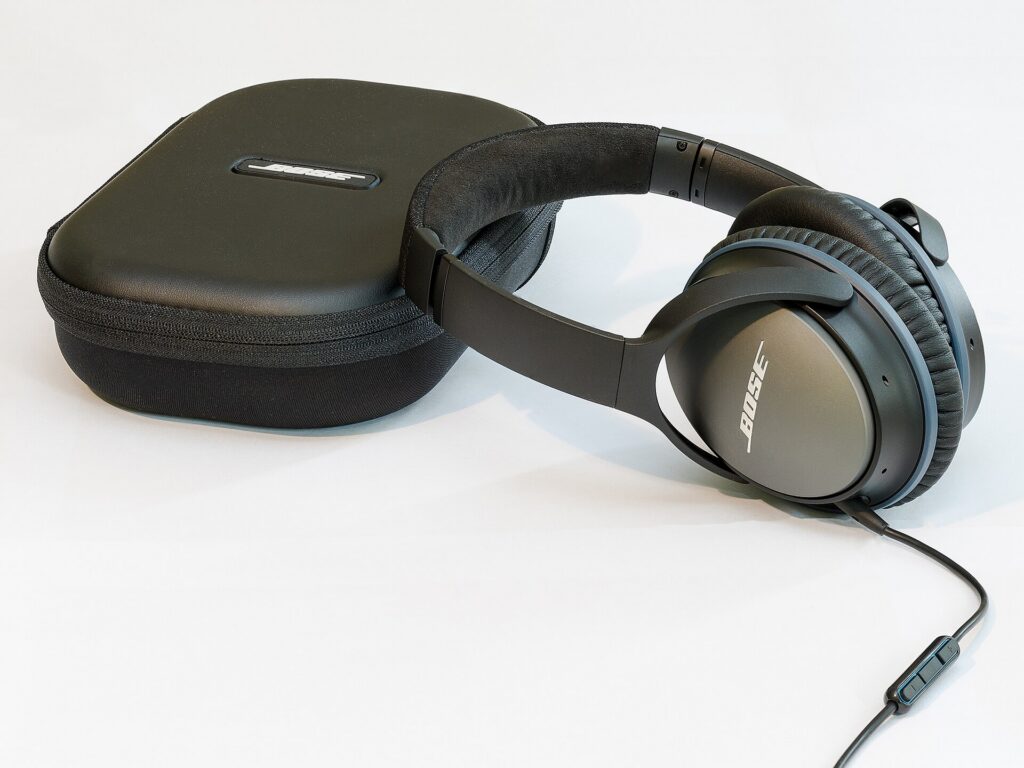
    Over-ear noise-cancelling headphones beside their protective carrying case
    A protective case keeps the hinges, cable and adapter safe in a packed backpack (Photo: Florian Fuchs via Wikimedia Commons, CC BY-SA 3.0)

    Frequently asked questions

    Can I use Bluetooth headphones on a plane?

    Usually yes, with your phone or tablet in airplane mode and Bluetooth switched back on, but it is up to the airline, and crew instructions come first. Some airlines ask passengers to remove headphones during the safety briefing, takeoff and landing.

    Will wireless headphones work with the seatback screen?

    Only if the headphones have a cable input, the seat supports Bluetooth pairing, or you use a Bluetooth transmitter plugged into the seat jack. Most seatback systems still expect a wire.

    Are noise-cancelling earbuds as good as over-ear headphones on a plane?

    Good earbuds with a snug seal work well, but over-ear headphones usually cut more low engine noise. Earbuds are lighter, smaller and better for sleeping on your side.

    Do noise-cancelling headphones block voices and crying babies?

    Partly. Active noise cancelling works best on steady low sounds like engines. Voices and sudden sounds are reduced mainly by the passive seal, so fit matters, and some sound always gets through.

    How much battery life do I need?

    Enough for your longest door-to-door journey with noise cancelling switched on, plus a margin for delays. Check the maker’s figure for ANC-on use, which is lower than the headline number.

    Can I bring headphones and a power bank in my carry-on?

    Headphones are generally fine in carry-on bags. Power banks and spare lithium batteries must travel in the cabin, not in checked luggage. Check the FAA, TSA or CATSA guidance and your airline’s rules before flying.

    What is the two-prong adapter for?

    Some older aircraft use a two-prong audio socket. A small adapter lets you plug a standard 3.5 mm headphone cable into it. Some headphones include one, and they are inexpensive to buy separately.

    Can I sleep in over-ear headphones?

    Many people do, especially sitting upright or leaning back. If you rest your head on the side, the ear cups can press uncomfortably; earbuds or soft earplugs with a neck pillow may be better.

    With the cabin noise handled, the rest is choosing the flight. Compare fares, aircraft and schedules on our flight search, find a quiet room on our hotel search, and if your trip continues by road, check our car rental search. Planning a long-haul trip to try your new headphones? Flights to London and our guide to things to do in London are a good place to start.

  • Best Compression Socks For Long Flights – Stay Comfortable & Supported

    Best Compression Socks For Long Flights – Stay Comfortable & Supported

    After a long flight, a lot of people notice the same thing: shoes that feel tighter than they did at takeoff, ankles that look puffy, and legs that feel heavy and restless. Sitting still for hours with your knees bent and little room to move is hard on legs, and it is the reason compression socks have become a staple in many travelers’ carry-on bags. They are also surrounded by more marketing claims than almost any other travel product, and because they touch on health, it is worth getting the facts straight. This guide explains what compression socks are, how compression levels and sizing work, how to put them on and wear them on a flight, what official health sources say about blood clots and travel, the other habits that keep your legs comfortable on long trips, and the socks from our original list with who each one suits. It is part of our travel gear series, which starts with our main guide to choosing travel luggage.

    Talk to your doctor first, especially if you have a circulation condition or are pregnant. This guide is general travel information, not medical advice. Compression is not suitable for everyone, and some health conditions make it a bad idea. If you have had a blood clot before, have a circulation or heart condition, diabetes, recent surgery or injury, are pregnant or have recently given birth, or take blood thinners, ask your doctor, midwife or pharmacist whether compression socks are right for you and what level to use before you fly.

    The short answer

    For a healthy traveler who simply wants more comfortable legs on a long flight, well-fitting, knee-high graduated compression socks at a light to moderate level, sized from your ankle and calf measurements rather than your shoe size, are the usual choice. Put them on before you leave for the airport, make sure they lie smooth without bunching or rolling at the top, and take them off if they cause pain, numbness, tingling or skin color changes. Compression socks are not a substitute for getting up and moving, flexing your ankles and staying hydrated, which the CDC and the NHS recommend for long journeys. If you have any risk factors for blood clots, the decision about compression, and which level, belongs with your doctor.

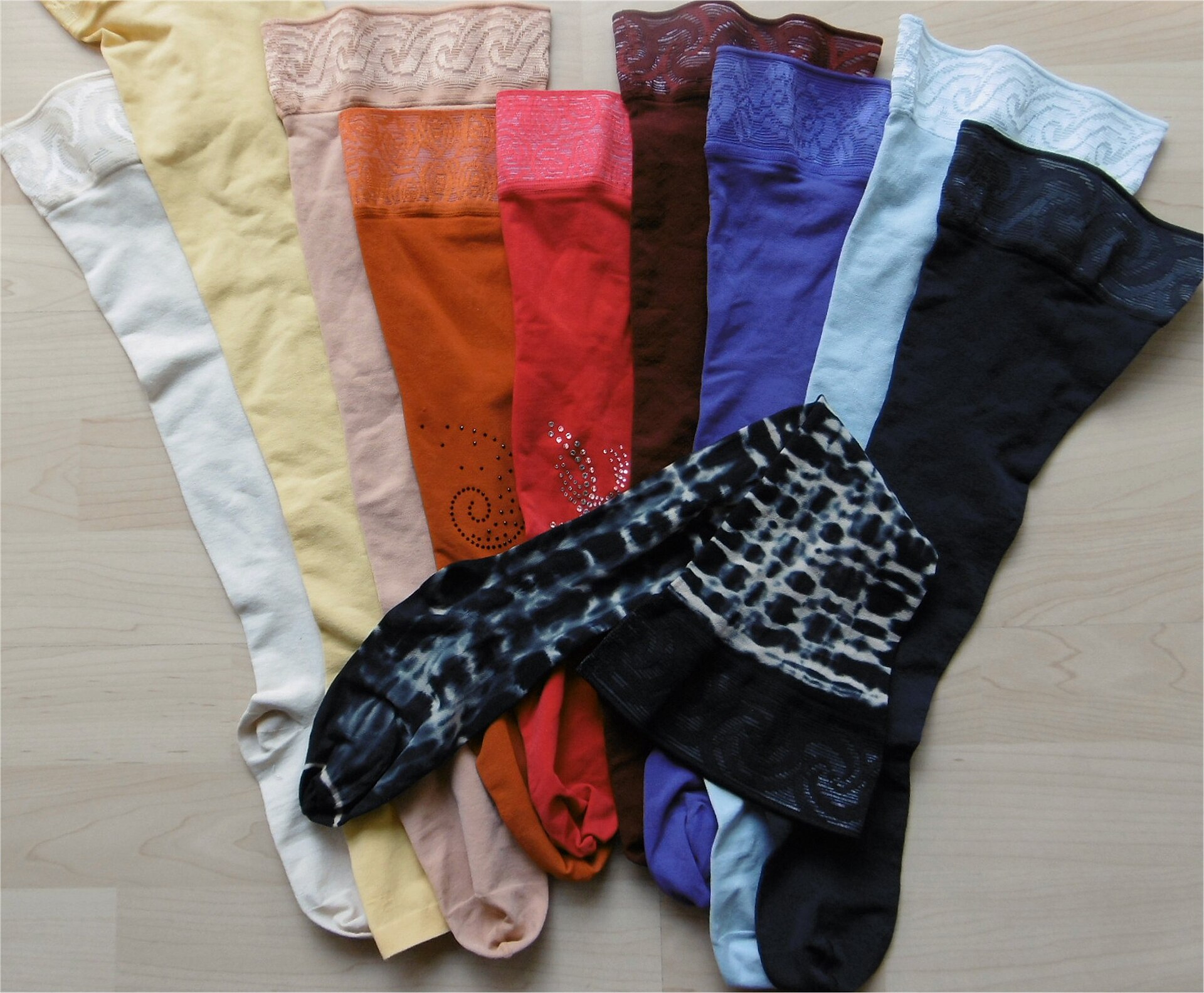
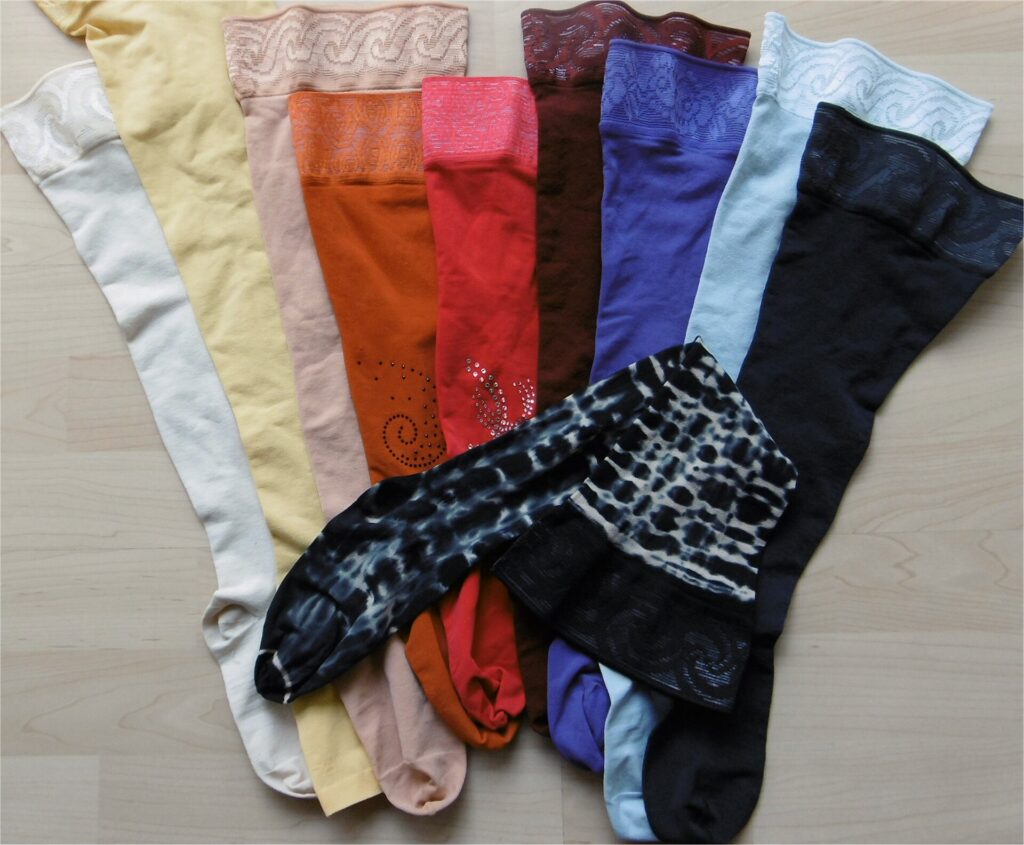
    Compression stockings in several colors and lengths laid out side by side
    Compression socks come in many lengths, colors and levels; read the mmHg figure, not the marketing words (Photo: Enter via Wikimedia Commons, CC BY-SA 3.0)

    What compression socks are

    Compression socks are tight, stretchy socks designed to squeeze the leg. Most travel compression socks are graduated, which means they are tightest at the ankle and gradually looser up the calf. The idea is to support the veins in the lower leg while you are sitting still. They look much like ordinary sports socks or dress socks, and many come in patterns and colors that make them easy to wear on the plane and afterwards.

    How compression is measured

    Compression is usually given in millimeters of mercury (mmHg), the same unit used for blood pressure. The number, or range, is printed on the packaging and describes how much pressure the sock applies, usually at the ankle. Higher numbers mean firmer compression.

    Compression levels

    Sellers group socks into rough bands, and the labels vary by brand and country:

    • Light or mild compression is widely sold for travel, standing jobs and everyday wear.
    • Moderate compression is also sold over the counter and marketed for travel and sport, often labeled as “firm” or “medical grade”.
    • Firmer levels are generally used under medical supervision and may need professional measuring and fitting.

    A higher number is not automatically better. Firmer socks are harder to put on and can be uncomfortable if they are not needed or do not fit. If you are unsure which level suits you, and particularly if you are considering a firmer level, ask your doctor or pharmacist.

    Travel socks, sports socks and medical stockings

    Travel and sports compression socks are consumer products sold in shops and online. Medical compression stockings prescribed for a condition, and the anti-embolism stockings used in hospitals for patients in bed, are different products chosen and fitted for a specific medical purpose. Do not assume that a sock sold for travel does the same job as a stocking your doctor prescribed, or the reverse.

    Blood clots and long flights: what official sources say

    Much of the marketing around compression socks mentions deep vein thrombosis (DVT), a blood clot that forms in a deep vein, usually in the leg. It is worth hearing what public health sources actually say.

    • The risk is generally very small. The CDC’s page on blood clots and travel says that anyone traveling more than about four hours, by air, car, bus or train, can be at risk, but that even for long-distance travelers the risk of developing a blood clot is generally very small.
    • Other risk factors matter most. The CDC says most people who develop travel-associated blood clots have one or more other risk factors. Its list includes older age, obesity, recent surgery or injury, estrogen-containing contraceptives or hormone replacement therapy, pregnancy and the postpartum period, a previous blood clot or a family history of clots, an inherited clotting disorder, active cancer, certain long-term conditions, limited mobility and varicose veins.
    • Compression is one option for some people. The CDC says that if you are at risk, you should talk with your doctor about prevention, and that some people may benefit from wearing graduated compression stockings.
    • Guidelines target people at increased risk. The CDC Yellow Book chapter on deep vein thrombosis and pulmonary embolism, written for health professionals, summarizes clinical guidelines that consider properly fitted compression stockings for long-distance travelers at increased risk, and that do not recommend them for clot prevention in travelers without risk factors.

    In plain terms: many healthy travelers wear compression socks because their legs feel more comfortable, which is a perfectly good reason. But a sock is not a guarantee against blood clots, and if you have risk factors, the right prevention plan is a conversation with your doctor, not a purchase.

    Know the warning signs

    The CDC lists the common symptoms of DVT as swelling of the leg or arm, pain or tenderness you cannot explain, skin that is warm to the touch, and redness or discoloration, and advises contacting your doctor as soon as possible if you notice them. It also lists symptoms of a pulmonary embolism, which is a clot that has traveled to the lungs, including difficulty breathing, chest pain, a fast or irregular heartbeat, coughing up blood and lightheadedness or fainting, and says to seek medical help immediately. The NHS page on deep vein thrombosis gives similar urgent advice. Symptoms can appear during or after a trip, including days later, so do not dismiss them because you are already home.

    Who should talk to a doctor before wearing compression socks

    This bears repeating. Talk to a doctor, midwife or pharmacist before you buy or wear compression socks for a flight if any of these apply:

    • You have a circulation condition, such as problems with the arteries in your legs, or heart failure.
    • You are pregnant or have given birth in the last few months.
    • You have had a blood clot before, or a close family member has.
    • You have diabetes, especially with numbness in your feet.
    • You have had recent surgery or an injury, or you have a leg in a cast.
    • You have skin problems on your legs, such as fragile skin, wounds or dermatitis.
    • You take blood thinners or other medicines that affect clotting.
    • You have any condition for which a doctor has told you to avoid tight clothing on your legs.

    Your doctor can tell you whether compression is appropriate, what level to use and how to be measured, and whether you need any other precautions for your trip.

    How to choose compression socks

    Compression level

    For comfort on a flight, most healthy travelers choose light to moderate compression. If you are buying on a doctor’s advice, use the level they recommend. Read the mmHg figure on the packaging rather than relying on words like “medical” or “athletic”, which are not used consistently.

    Size and fit

    Fit matters more than almost anything else. Compression socks are usually sized by ankle and calf circumference, sometimes combined with shoe size. Measure in the morning, before your legs have had a chance to swell, and use the maker’s size chart. A sock that is too tight can dig in and be uncomfortable; one that is too loose will not compress evenly. If you are between sizes or your calves are unusually slim or muscular, look for brands with more size options or wide-calf versions.

    Length

    Knee-high socks are the most common choice for travel. They should sit just below the bend of the knee. Thigh-high stockings and full tights exist, mainly for medical use, and are harder to put on and wear in a cramped seat. Ankle-length compression socks are sold for sport but do little for the calf.

    Material

    Most compression socks are made from nylon and spandex, sometimes blended with cotton, bamboo-derived fibers or merino wool. Synthetic blends are durable and dry quickly. Wool blends are warmer and handle odor well on long travel days. Cotton blends feel familiar but can hold moisture. If you run hot, look for thinner, breathable knits.

    Toe and heel

    Most travel socks have a closed toe and a shaped heel. Open-toe versions exist, mostly for medical use and for wearing with sandals. A well-shaped heel pocket keeps the compression in the right place.

    Durability and care

    Compression fabric loses its stretch over time, especially with hot washing and tumble drying. Follow the care label, usually a cool wash and air drying, and replace socks when they start to feel loose. Buying two pairs lets you wear one while the other dries on a long trip.

    TypeTypical useEase of wearing on a planeNotes
    Knee-high travel socks, light compressionComfort on flights and long days standingEasyCommon starting point for healthy travelers
    Knee-high socks, moderate compressionTravel and sport; sometimes on medical adviceModerate; firmer to put onCheck fit carefully; ask a doctor if unsure
    Wool-blend compression socksCold destinations, long travel daysEasyWarmer; good for odor control
    Thigh-high stockings or tightsMainly medical, on professional adviceHarder in a cramped seatShould be fitted as advised
    Hospital anti-embolism stockingsPatients in bed in hospitalNot designed for travelA different product; do not substitute
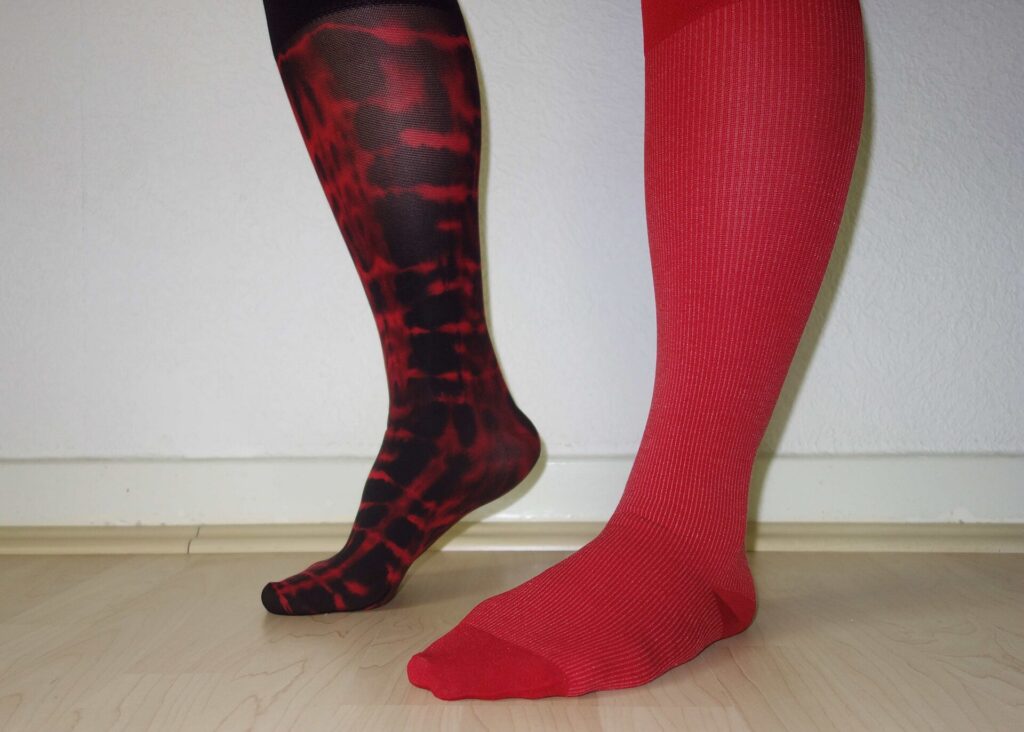
    Two legs wearing knee-high compression socks, one patterned and one plain red
    Knee-high socks should sit just below the bend of the knee, smooth and never rolled down (Photo: Enter via Wikimedia Commons, CC BY-SA 4.0)

    How to put compression socks on

    Compression socks are tighter than ordinary socks, and the first attempt can be a wrestle. A few tricks help:

    • Put them on in the morning, before your legs swell, ideally before you leave home for the airport.
    • Turn the sock inside out down to the heel. Slide your foot into the foot section, position the heel, then roll the rest of the sock up your leg a little at a time.
    • Smooth out every wrinkle. Bunching creates tight bands that concentrate pressure in the wrong place.
    • Never fold or roll the top down. A doubled-over top can act like a tight band around your calf.
    • Use rubber gloves for grip if you find the fabric hard to pull, and keep your fingernails short to avoid snagging.
    • Consider a donning aid if you have limited hand strength or flexibility. Pharmacies and medical supply stores sell frames and slippery sleeves that make putting socks on easier.

    Practice at home before your trip. You do not want to learn in a cramped airplane lavatory.

    Wearing them on a flight

    • Wear them from the start of the journey, not just once you are on the plane.
    • Check them during the flight. If a sock has slipped or bunched, straighten it.
    • Take them off if something feels wrong. Pain, numbness, tingling, pins and needles, or skin that turns pale, blue or dark are signs to remove the socks and seek advice.
    • Remove them after you arrive, unless your doctor has advised otherwise, and check your skin for marks or irritation.
    • Wear comfortable, roomy shoes. Feet can still swell a little, and tight shoes add pressure. Our guide to comfortable walking shoes for traveling covers shoes that suit long travel days.
    • Dress loosely elsewhere. Tight waistbands and restrictive trousers undo some of the comfort. Our guide to what not to wear on a flight covers clothing choices, and travel pants for men covers comfortable trousers.

    Other ways to keep your legs comfortable

    Compression socks are one tool. The habits that official sources recommend for long journeys apply whether you wear them or not.

    Move regularly

    The CDC recommends moving your legs frequently on long trips and exercising your calf muscles. When the seat belt sign is off and it is safe, get up and walk the aisle, and stand for a few minutes near the galley or lavatories if space allows. The NHS advises getting up and moving around when possible on journeys of four hours or more.

    Exercise in your seat

    The CDC describes simple seated movements: extend your legs and flex your ankles, pulling your toes toward you. Point and flex your feet, draw circles with your ankles and press your heels and then your toes into the floor. Do these every so often, especially when you cannot get up.

    Choose your seat thoughtfully

    An aisle seat makes it easy to get up without disturbing anyone. Bulkhead and exit rows may give more legroom, though exit rows come with conditions and are not available to everyone. Keep the space under the seat in front as clear as you can so you can stretch your feet, by putting bulky bags in the overhead bin.

    Drink water and go easy on alcohol

    Cabin air is dry. The NHS advises drinking plenty of water and avoiding alcohol on long journeys. Bring an empty refillable bottle through security and fill it afterwards.

    Break up long road and rail trips too

    The same principles apply to long drives, bus rides and train journeys. On a road trip, plan regular stops to walk around. If you are renting a car for a long drive after a flight, build in a break before you set off.

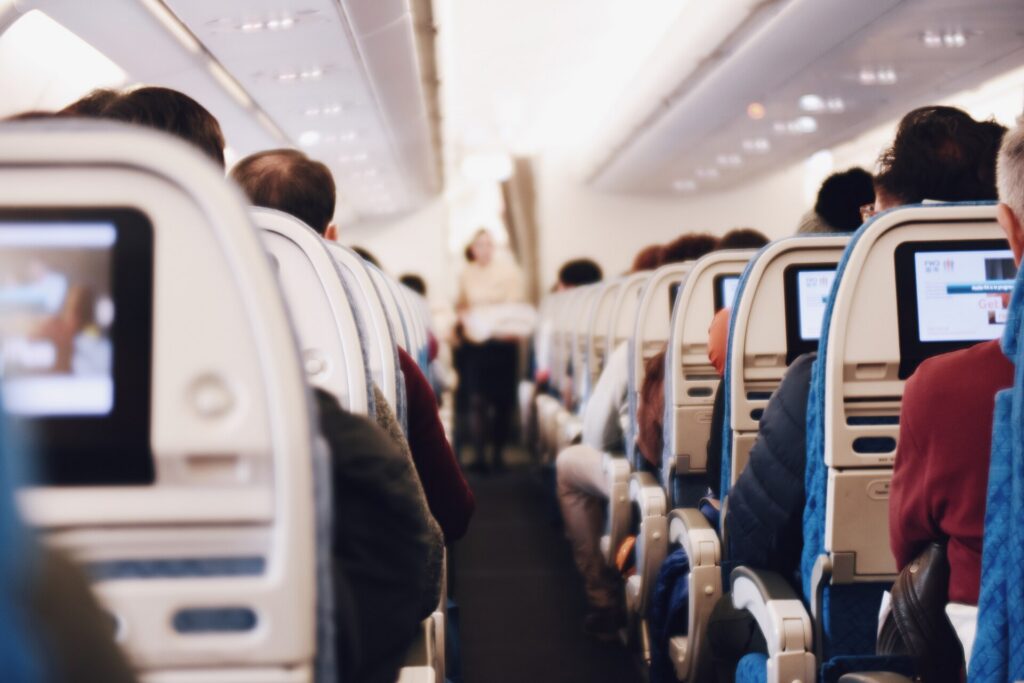
    The aisle of an airplane cabin during a flight, with seatback screens on both sides
    When the seat belt sign is off, a walk up the aisle does your legs more good than any sock (Photo: Suhyeon Choi choisyeon via Wikimedia Commons, CC0)

    Pregnancy and travel

    The CDC lists pregnancy and the first months after childbirth among the factors that can increase the risk of blood clots. If you are pregnant or have recently given birth, talk to your doctor or midwife before a long flight about whether you should wear compression socks, what level to use and how to fit them, and about any other precautions they recommend. Airlines also have their own rules on flying late in pregnancy, so check with your airline as well.

    Socks from our original list

    The socks below were featured in the original version of this guide. They cover different styles and budgets rather than a strict ranking, and we have not made claims about any of them preventing blood clots. Check each product’s compression level, size chart and care instructions from the maker or seller before you buy, and follow your doctor’s advice if you have one.

    Physix Gear compression socks

    Physix Gear sells compression socks marketed for travel, running and everyday wear. They suit travelers who want a sports-style sock that also works on a flight. Check the compression level on the listing against what you need.

    NEWZILL compression socks

    NEWZILL was featured for compression socks for men and women aimed at travel, hiking and everyday use. They suit travelers looking for an everyday sock in a range of colors.

    Dr. Scholl’s compression socks for women and men

    Dr. Scholl’s was featured twice, for knee-high women’s socks and over-the-calf men’s socks with graduated compression. They suit travelers who prefer a familiar brand found in many pharmacies, which also makes it easier to try sizes in a store.

    Multi-pack compression socks

    The list included several multi-packs, including an unbranded pack for men and women, FITRELL, fenglaoda and CHARMKING. Multi-packs suit frequent flyers and people who wear compression socks for work as well as travel, since having several pairs means one can dry while you wear another. Compression levels vary between packs, so read the listing.

    Crucial Compression socks

    Crucial Compression was featured for socks aimed at athletes and travelers. They suit people who want one pair for the gym and the plane.

    Wanderlust travel compression socks

    Wanderlust was featured for socks designed specifically for travel. They suit travelers who want a sock marketed for long-haul flights, often in travel-themed designs.

    Packing compression socks

    Socks take almost no space, so pack two pairs for a long trip: one to wear on the way out and one for the return, or for a long travel day in the middle. Keep them in your carry-on, so you can put on a fresh pair if a flight is delayed or you have a long connection. They fit neatly alongside a travel first aid kit and the rest of your in-flight comfort gear, such as a neck pillow and noise-cancelling headphones. If you carry the pillow separately, a pillow bag with a pocket can hold the socks too.

    If you need medicines or medical supplies for your trip, carry them in your hand luggage in their original packaging and check the official guidance for your destination. The Government of Canada’s travel health and safety pages are a good place to start for Canadian travelers.

    A drinking water fountain and bottle filling station in an airport terminal
    Bring an empty bottle through security and fill it before boarding, since cabin air is dry (Photo: Mds08011 via Wikimedia Commons, CC BY 4.0)

    Common mistakes

    • Buying by shoe size alone. Measure your ankle and calf and use the size chart.
    • Choosing the highest compression available. Firmer is not better unless you need it; ask a doctor.
    • Letting the top roll down. A folded top acts like a tight band.
    • Treating socks as protection against clots. They are one option for some people, not a guarantee.
    • Staying in your seat the whole flight. Movement matters whether or not you wear compression.
    • Ignoring warning signs. Pain, numbness or color changes mean take them off and get advice.
    • Skipping the doctor conversation when you are pregnant, have a circulation condition or have other risk factors.

    Frequently asked questions

    Do compression socks prevent blood clots on flights?

    They are not a guarantee. The CDC says some people at risk may benefit from graduated compression stockings and advises talking with your doctor. Clinical guidelines summarized by the CDC consider them for travelers at increased risk, not for clot prevention in travelers without risk factors. Many healthy travelers wear them for comfort.

    What compression level should I choose for a flight?

    Many healthy travelers choose light to moderate compression for comfort. If you have any health condition or risk factors, ask your doctor which level is right for you.

    Can I wear compression socks if I am pregnant?

    Talk to your doctor or midwife first. Pregnancy and the postpartum period are listed by the CDC as risk factors for blood clots, and your doctor can advise on compression and other precautions.

    Who should not wear compression socks?

    Compression is not suitable for everyone. People with circulation conditions, certain skin problems, diabetes with numb feet or other medical conditions should ask a doctor before wearing them.

    When should I put them on and take them off?

    Put them on in the morning before you travel, and take them off after you arrive, unless your doctor advises otherwise. Remove them immediately if they cause pain, numbness or skin color changes.

    How do I know what size to buy?

    Measure your ankle and calf circumference in the morning and compare with the maker’s size chart. Fit matters more than brand.

    Are compression socks allowed through airport security?

    Yes. They are ordinary clothing as far as security is concerned, and you can wear them through screening.

    What else can I do to keep my legs comfortable on a long flight?

    Get up and walk when it is safe, flex your ankles and calves in your seat, choose an aisle seat, drink water, avoid alcohol and wear loose clothing, as the CDC and the NHS recommend.

    With your legs looked after, choose a flight that makes the journey easier: nonstop routes cut total travel time, and a good schedule leaves time to stretch before a connection. Compare options on our flight search, book a hotel near the airport for a long layover on our hotel search, and if you are driving on arrival, plan stops along the way with a car from our car rental search. Flying long-haul to Europe? Flights to Paris and our guide to things to do in Paris are a good place to start, with plenty of walking to get your legs moving again.

  • 10 Best Airplane Pillows for Neck: Your Ultimate Guide to Comfort

    10 Best Airplane Pillows for Neck: Your Ultimate Guide to Comfort

    Airplane seats are not designed for sleeping. Unless you are lying flat in a premium cabin, your head has nowhere good to go: it drops forward onto your chest, rolls sideways onto a stranger’s shoulder, or props awkwardly against a cold window. You wake up with a stiff neck, a dry mouth and the feeling that you barely slept. A good travel pillow does not turn an economy seat into a bed, but it gives your head something to rest on and keeps it from lolling around, and that can be the difference between arriving wrecked and arriving able to function. The catch is that travel pillows come in very different designs, and the one that works for a friend may be useless for you. This guide explains the main types, how to match one to the way you sleep, what to look for in materials, fit and packing, how to use a pillow well on a plane, and the pillows from our original list with who each one suits. It is part of our travel gear series, which starts with our main guide to choosing travel luggage.

    The short answer

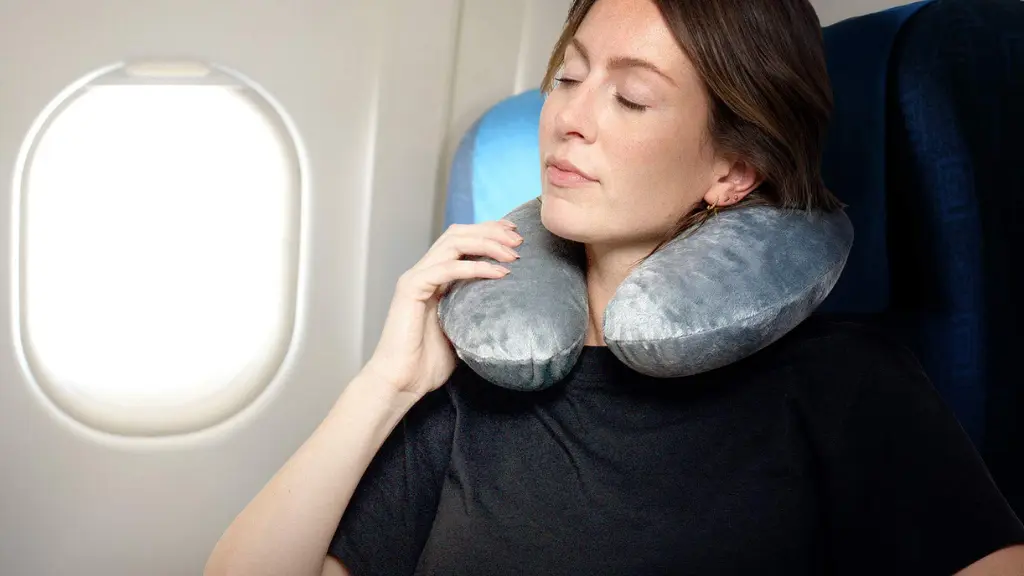
    If you tend to nod forward when you fall asleep sitting up, choose a pillow with chin or front support, such as a 360-degree design or a memory foam pillow with an adjustable front clasp, ideally one that straps to the seat. If you lean sideways against the window or the wing of the headrest, a firm U-shaped memory foam pillow or a wrap-style support with a strong side works well. If space is tight, an inflatable pillow packs to almost nothing and lets you set the firmness. Whatever you choose, make sure it comes with a compression case or bag, has a removable washable cover, and does not push your head forward against the seat’s headrest. Try it sitting upright in a chair at home for twenty minutes before a long flight.

    A red memory foam travel neck pillow with seat straps on a purple background
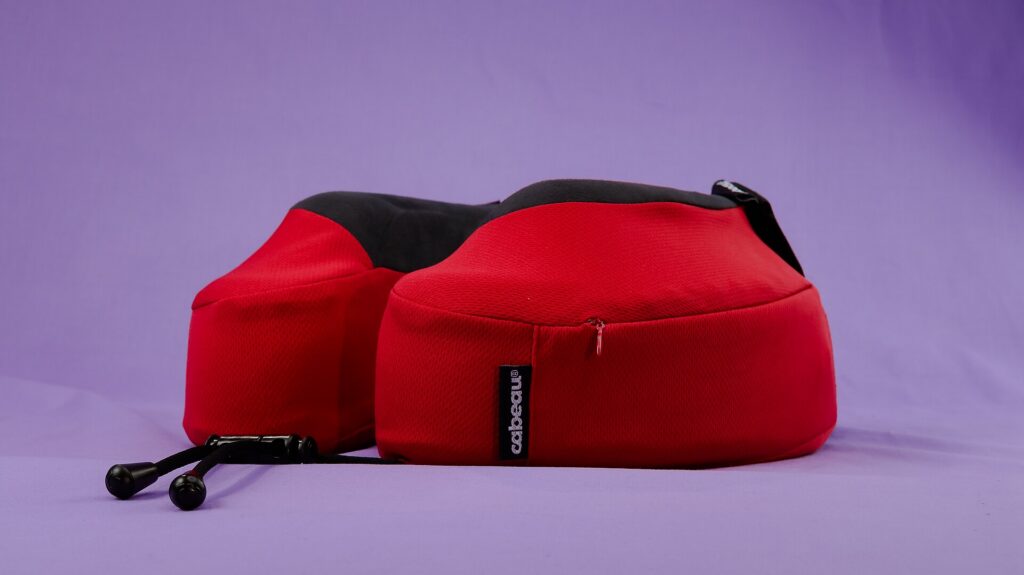
    Firm memory foam with raised sides and a flatter back gives the head more support than a soft horseshoe (Photo: Cabeautravel via Wikimedia Commons, CC BY-SA 4.0)

    Why the classic horseshoe pillow often disappoints

    The soft, bead-filled horseshoe sold at every airport kiosk is the pillow most people picture, and it is the one most people give up on. There are three common reasons:

    • It is too soft. A squashy pillow compresses under the weight of your head, so your head still drops, just a little more slowly.
    • It does nothing at the front. The open end of the U sits under your chin, which is exactly where most people’s heads fall when they sleep upright.
    • It is too thick at the back. A fat back section pushes your head forward against the seat’s headrest, which can make your neck more uncomfortable, not less.

    Better designs address one or more of those problems: firmer materials, front or chin support, a flatter back, or a way to anchor the pillow to the seat. Knowing which problem you have is the key to choosing well.

    Types of travel pillows

    Memory foam U-shaped pillows

    Memory foam pillows keep their shape under your head better than fiber-filled ones, so they give firmer side support. Better designs have raised sides and a flatter back, so they do not push your head forward. Their drawback is bulk: even with a compression case, they take up noticeable room. They suit travelers who lean sideways and value support over packing size.

    Memory foam pillows with front support or seat straps

    Some memory foam pillows add an adjustable front clasp that closes the gap under the chin, and straps that wrap around the seat’s headrest to hold the pillow in place and stop your head falling forward. They are among the most effective options for people who nod forward, and they suit long-haul flyers who sleep sitting upright.

    360-degree and chin-support pillows

    These pillows wrap the whole way around the neck, with support at the front and sides. Some include a hood, and some come in kits with an eye mask and earplugs. They suit forward-nodders but can feel warm, and some people find that full wrap-around support feels restrictive.

    Inflatable pillows

    Inflatable pillows deflate to pocket size, which makes them the best choice when space is tight or you carry a small bag. You can adjust firmness by how much air you put in, and a soft cover, often velour, makes them more comfortable against the skin. The trade-offs are that they can feel less cozy than foam, can slowly lose air, and need blowing up on board. Some inflatable designs include eye masks and earplugs in the set.

    Microbead pillows

    Microbead pillows are filled with tiny beads that move to fit your neck, giving a soft, squishy feel. They are comfortable for resting and are easy to squeeze into a bag, but they usually give less firm support than memory foam.

    Twist and bendable pillows

    Twist pillows are long, flexible tubes of foam that you can bend into different shapes: around the neck, under the chin, behind the lower back or between the knees. They suit travelers who shift position a lot or want one pillow for several uses on a road trip or train.

    Wrap-style supports

    Wrap-style supports look like a soft scarf with a built-in support on one side. You wrap them around your neck, with the support on the side your head leans towards. The maker trtl is known for this design and describes an internal support system that keeps the head and neck in position. They pack flatter than a U-shaped pillow and suit side-leaners.

    Regular soft pillows

    Some travelers simply bring a small soft pillow to wedge against the window or to support their lower back. It is less structured than a neck pillow but versatile, and it is comfortable in hotels and on trains. It takes up space, so it works best if you clip it to your bag in a pillow bag or case.

    TypeSupportPacked sizeBest forWatch out for
    Memory foam U-shapeFirm side supportBulky, smaller in a compression caseSide-leaners, long flightsThick backs that push the head forward
    Memory foam with front clasp or seat strapsSide and front; anchored to seatBulky, smaller in a compression caseForward-noddersTakes a moment to set up
    360-degree or chin supportAll aroundMedium to bulkyForward-noddersCan feel warm or restrictive
    InflatableAdjustable firmnessPocket sizeLight packersSlow air loss, less cozy
    MicrobeadSoft, conformingSmall, squashableResting rather than deep sleepLess firm support
    Twist or bendableFlexible, multi-positionMediumRoad trips, people who shift positionLess support at the front
    Wrap-styleOne-sided supportFlatSide-leaners who pack lightLess help for forward-nodders

    Match the pillow to how you sleep

    Before you buy, think about what your head actually does when you doze off in a chair. If you are not sure, ask a travel companion or notice how you wake up on a train or in front of the television.

    You nod forward

    This is the most common pattern. You need front support: a 360-degree pillow, a pillow with an adjustable front clasp, or a design that straps to the seat’s headrest. A standard horseshoe will not help much.

    You lean sideways

    You need firm side support on the side you lean toward, plus something that stops your head sliding off. A firm U-shaped memory foam pillow, a wrap-style support, or a window seat with a soft pillow against the wall all work. The window seat is a big help here; the aisle seat gives you nothing to lean on.

    Your head tips backward

    Less common in economy, but it happens when the seat reclines. A flatter-backed pillow that fills the gap behind the neck without pushing the head forward is best, combined with the adjustable wings on the seat’s headrest if your aircraft has them.

    You shift around a lot

    A twist pillow or a soft pillow you can move around gives you options through a long flight. Some travelers carry a compact inflatable plus a small soft pillow for the lower back.

    What to look for

    Firmness

    Firmer is usually better for sleep, because a soft pillow compresses under your head. Memory foam and well-inflated air pillows are firmer than fiber or bead fills. If a pillow feels lovely and soft when you squeeze it in a shop, it may be too soft to hold your head.

    Back thickness

    Look for a flatter back section, so the pillow does not push your head forward against the seat’s headrest. This is the most common design flaw in cheap pillows.

    Height and adjustability

    People have different neck lengths and shoulder widths. Adjustable clasps, drawstrings or inflation let you tune the fit. If a pillow sits too low, your head drops anyway; too high and it pushes your chin up.

    Cover material and washability

    A removable, machine-washable cover is important for hygiene, since the pillow sits against your skin and hair for hours. Soft fabrics feel nice but can be warm; breathable or cooling fabrics suit hot climates and warm sleepers. Check the care instructions before washing.

    Packing size and a case

    A pillow you leave at home helps nobody. Many memory foam pillows come with a compression case that squeezes them down and clips to a bag. Inflatables pack smallest. If you carry only a backpack, packing size may decide everything. Our guide to bags and cases for travel pillows covers ways to carry a pillow without using up bag space.

    Accessories

    Some pillows come in kits with an eye mask, earplugs and a carry bag. That can be good value if you do not already own them. A contoured eye mask that does not press on your eyelids is worth having on any overnight flight.

    Pillows from our original list

    The pillows below were featured in the original version of this guide. They cover different sleep styles and budgets rather than a strict ranking. Designs and features change, so check the current details from the maker or seller before you buy. Where we have linked to a maker’s page, the details mentioned come from that page.

    Cabeau Evolution S3

    The Cabeau Evolution S3 is a memory foam pillow with raised side supports and a flat back, which addresses the “pushes my head forward” problem. Cabeau describes a sliding front support clasp for a customizable fit, a seat strap system that attaches the pillow to the seat, a removable washable cover, and a travel case that compresses the pillow to about a third of its size. It suits long-haul flyers who nod forward or sideways and want one of the more supportive designs.

    Cabeau The Neck’s Evolution

    Cabeau also makes The Neck’s Evolution S3, a memory foam pillow with an adjustable strap system designed to support the head in all directions, seat straps, a removable machine-washable cover and a compact travel case. It suits travelers who want support all around, including under the chin.

    SNUGL memory foam neck pillow

    The SNUGL pillow was featured as a memory foam neck pillow with a carry bag and clip. It suits travelers who want a straightforward memory foam pillow they can clip to their luggage.

    Dot&Dot Twist memory foam pillow

    The Dot&Dot Twist is a bendable memory foam pillow that can be shaped to support the neck, chin, lower back or legs. It suits road-trippers, train travelers and anyone who shifts position a lot.

    360-degree pillow kit with eye mask and earplugs

    The original list included a 360-degree neck pillow sold as a kit with a contoured eye mask, earplugs and a mesh carry bag. It suits forward-nodders who want a complete sleep kit in one purchase. Check the listing for cover washability and packed size.

    Soft microfiber travel pillow

    A soft microfiber pillow in charcoal was on the original list. It is light and easy to pack, and it suits travelers who want gentle comfort rather than firm support, for resting and short naps.

    Adjustable memory foam pillow

    The list also featured a memory foam airplane pillow with adjustable height and firmness. Adjustability helps if standard pillows sit too high or too low on your neck.

    Inflatable pillow with velour cover

    A basic inflatable pillow with a soft velour cover and drawstring bag was featured for travelers who want something light and compact that supports the head, neck and chin.

    Cloudz microbead neck pillow

    Cloudz was featured for its microbead pillow, which molds to the neck and has a soft cover. It suits travelers who like a squishy feel and mainly want to rest rather than sleep deeply.

    Sunany inflatable pillow

    The Sunany pillow was featured as an inflatable design sold with an eye mask and earplugs. It suits light packers who want an adjustable pillow and a small sleep kit.

    A view of clouds from the window seat of an airplane
    A window seat gives side-leaners something to rest against and means nobody climbs over you (Photo: Bizelburp123 via Wikimedia Commons, Public domain)

    How to use a travel pillow well

    • Choose your seat with the pillow in mind. A window seat gives side-leaners something to rest against and means nobody needs to climb over you. Aisle seats suit people who want to get up often.
    • Sit well back in the seat. Get your lower back against the seat back first. A small cushion or rolled sweater behind the lower back can help.
    • Put the thick part where your head falls. If you nod forward, turn a U-shaped pillow around so the thicker section is under your chin, or use the front clasp.
    • Use the seat straps if your pillow has them, and the adjustable headrest wings if the seat has them.
    • Adjust inflation during the flight. Air expands and contracts as cabin pressure changes, so an inflatable may need topping up or letting down a little.
    • Add an eye mask and earplugs or headphones. Light and noise wake you as much as a lolling head does. Our guide to noise-cancelling headphones for flying covers the noise side.
    • Dress for sleep. Layers you can add or remove help, since cabins swing between warm and cold. Our guide to what not to wear on a flight covers clothing that makes sleep harder.

    Sleep better on a long flight

    A pillow is one piece of a bigger routine. On overnight and long-haul flights:

    • Pick flight times that match your body clock where you can. Overnight departures make it easier to sleep on board.
    • Limit caffeine and alcohol before and during the flight; both tend to make sleep lighter.
    • Drink water regularly, since cabin air is dry.
    • Get up and move when you are awake. The CDC’s guidance on blood clots and travel recommends moving your legs frequently on long trips. Our guide to compression socks for long flights covers leg comfort in more detail.
    • Talk to a doctor or pharmacist before using any sleep aid. Our guide to sleeping on flights covers routines, light and seat choice.

    If you have an existing neck or back condition, a pillow is a comfort item, not a treatment. Ask your doctor or physiotherapist which kind of support suits you before a long flight.

    Carrying your pillow through the airport

    Travel pillows are generally allowed through security, and the TSA’s What Can I Bring? tool and CATSA’s What can I bring? page let you check items in the US and Canada. Whether a pillow counts toward your carry-on allowance depends on the airline. Many airlines are relaxed about a pillow carried alongside your bags, but on strict budget fares anything outside your personal item can be questioned. Check your airline’s carry-on page, such as WestJet’s carry-on baggage rules, before you fly, and clip the pillow to your bag or pack it inside if in doubt. Our luggage guide explains how carry-on and personal-item allowances work.

    A soft panda-shaped travel neck pillow resting on a fabric seat
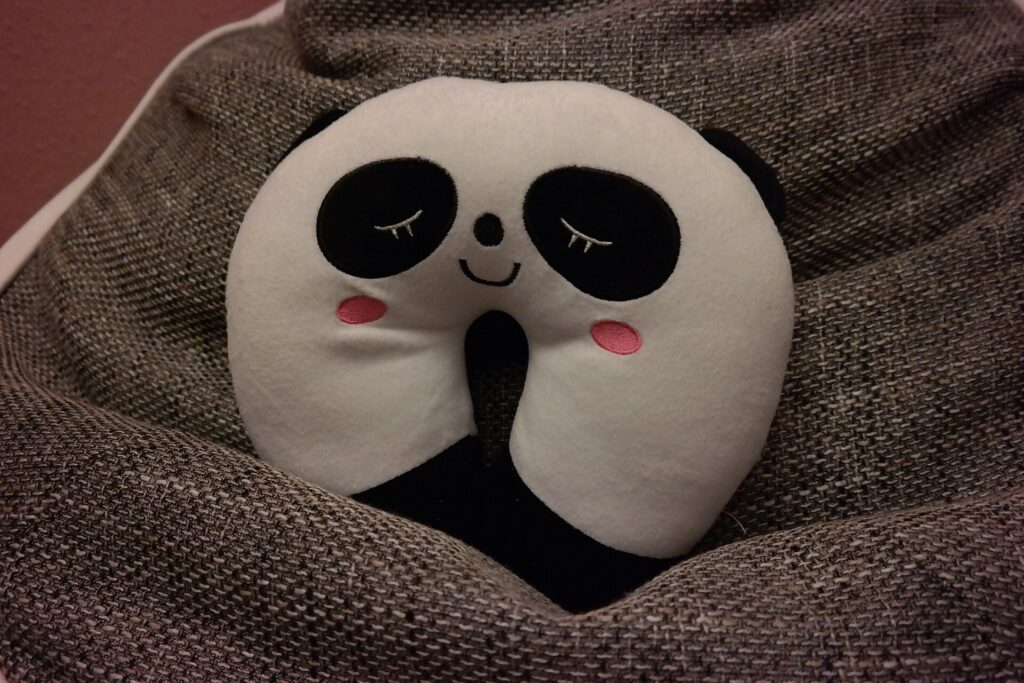
    Smaller, softer pillows suit children, as long as they never get in the way of a seat belt (Photo: Teemeah via Wikimedia Commons, CC BY-SA 4.0)

    Pillows for children

    Children sleep on planes in all sorts of positions, and adult pillows are often too big for them. Smaller, softer pillows made for children, including novelty animal shapes, can make a pillow feel like a treat rather than a chore. Check that any pillow fits without pushing a child’s head forward, and follow the airline’s rules and the crew’s instructions on child seats and restraints, since a pillow must never get in the way of a seat belt.

    Keeping your pillow clean

    • Wash the cover regularly, following the care label, and let it dry fully before packing.
    • Use the case so the pillow does not touch airport floors and seat pockets.
    • Air out memory foam after a trip; do not put the foam core in the washing machine unless the maker says you can.
    • Carry a spare cover on long trips if your pillow has one available.
    • Replace a pillow when the foam loses its shape or an inflatable starts to leak.

    Common mistakes

    • Buying the softest pillow in the shop. Soft feels nice in the hand but gives little support.
    • Ignoring how you actually sleep. A side-support pillow will not help a forward-nodder.
    • Choosing a thick back section. It pushes your head forward.
    • Leaving the pillow at home because it is bulky. Get a compression case or an inflatable instead.
    • Relying on the pillow alone. Light, noise, temperature and caffeine matter as much.
    • Never washing the cover. It spends hours against your skin.

    Frequently asked questions

    What type of travel pillow is best for sleeping upright?

    For most people, a firm memory foam pillow with front support or seat straps works best, because most people’s heads fall forward when they sleep sitting up. Side-leaners do well with firm U-shaped or wrap-style supports.

    Are inflatable neck pillows comfortable?

    They can be, especially with a soft cover and the right amount of air. They are the best choice for packing small, though some people find them less cozy than foam.

    Why does my neck pillow push my head forward?

    The back section is probably too thick for the seat’s headrest. Look for a flatter-backed design, or turn the pillow around so the thick part sits under your chin.

    Does a travel pillow count as a carry-on item?

    It depends on the airline and the fare. Many airlines allow a pillow alongside your bags, but strict basic fares may not. Check the airline’s carry-on rules, or clip the pillow to your bag.

    Can I wash a memory foam travel pillow?

    Usually you wash the removable cover, not the foam core. Follow the maker’s care instructions.

    Is a window or aisle seat better for sleeping?

    A window seat usually, because it gives you something to lean against and nobody needs to climb over you. Choose an aisle if you want to get up and move often.

    Can a travel pillow help with neck pain?

    A pillow can make sitting upright more comfortable, but it is not a treatment. If you have neck or back pain or a medical condition, ask your doctor or physiotherapist what support suits you.

    With your sleep kit sorted, choose a flight that gives you the best chance to rest. Compare overnight departures and schedules on our flight search, book somewhere to recover on our hotel search, and if you are driving on arrival, make sure you have slept before you pick up a car from our car rental search. Planning a long flight to Europe? Flights to Rome and our guide to things to do in Rome are a good place to start.