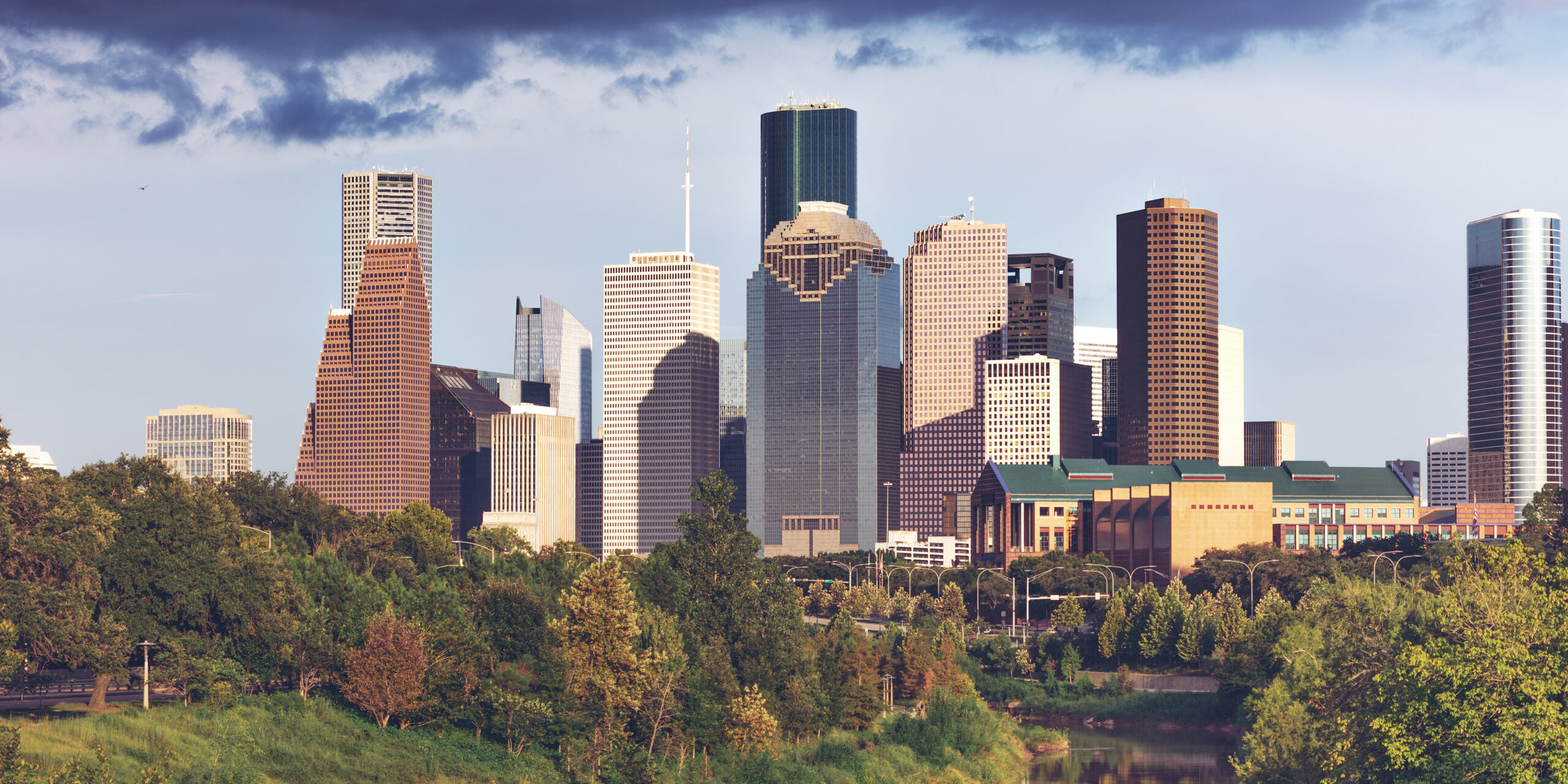
Tag: Houston

  • Houston: Should You Rent a Car or Rely on Public Transit?

    Houston: Should You Rent a Car or Rely on Public Transit?

    Houston is the car city other car cities point to. It covers more than 600 square miles, has no zoning code to concentrate its offices, shops and homes, and is laced with freeways, toll roads and three concentric ring roads, and most Houstonians drive everywhere. So the honest answer to “should I rent a car?” is often yes. But not always. METRO’s light-rail Red Line runs through the part of Houston most visitors actually want to see, linking downtown, Midtown, the Museum District, Hermann Park, the Texas Medical Center and NRG Park, and a stay inside that corridor can be done comfortably with the train, your feet and the occasional ride-hail, without paying for hotel parking or sitting in freeway traffic. This guide explains how the city is laid out, how METRO works, what driving here is really like, when a car earns its keep, and how to decide.

    The short answer

    Rent a car if Space Center Houston, Galveston or the Kemah Boardwalk is on the itinerary, if you are visiting family in the suburbs, eating your way along Bellaire Boulevard, working in the Energy Corridor or The Woodlands, or driving on to Dallas, Austin or San Antonio. That is a lot of visitors. Skip the car if you are staying downtown, in Midtown, in the Museum District or near the Medical Center, and your plans are the museums, Hermann Park, the Theater District, a convention at the George R. Brown or a game at NRG Stadium or Daikin Park; the Red Line, walking and a few ride-hail trips to Montrose or the Heights will cover it. Compare rental rates for any of these plans on our Houston car rental page.

    How Houston is laid out

    Think of Houston as a wheel. At the hub is downtown, on the south bank of Buffalo Bayou. Around it runs the 610 Loop, about ten kilometers (six miles) out, and “inside the Loop” is local shorthand for the older, denser, more walkable city: downtown, Midtown, Montrose, the Museum District, the Heights, EaDo, the Third Ward and River Oaks. The second ring is Beltway 8, whose main lanes are the Sam Houston Tollway, and the third, far out in the suburbs, is the Grand Parkway. Radial freeways run out like spokes: I-45 north toward IAH and Dallas and southeast toward Galveston, I-10 west through the Energy Corridor and east toward Louisiana, I-69/US-59 southwest and northeast, and US-290 to the northwest. The Galleria and Uptown sit just outside the Loop on its west side, the Medical Center and NRG Park inside it to the south, and Space Center Houston about 40 kilometers (25 miles) southeast. A trip that looks short on the map can take 45 minutes at rush hour.

    Hotels cluster downtown, in the Galleria area, around the Medical Center and the Museum District, in Montrose, along I-10 in the Energy Corridor, and near both airports. Our Houston hotel search lets you compare them.

    Getting in from the airport

    Neither airport has a rail link. George Bush Intercontinental (IAH) is about 37 kilometers (23 miles) north of downtown; the drive takes 30 to 45 minutes without traffic and an hour or more at rush hour, via I-69, I-45 or the Hardy Toll Road. Taxis and ride-hail pick up outside every terminal, and taxis charge fixed zone fares to downtown and some other districts, so check the posted rate before you set off. METRO’s local bus to downtown is cheap but takes around an hour. The rental companies share a consolidated rental car center reached by a shuttle bus from the terminals. William P. Hobby (HOU) is about 11 kilometers (7 miles) southeast of downtown, 20 to 30 minutes by car on I-45; taxis and ride-hail are quick and relatively cheap from here, local METRO buses connect to downtown, and the rental cars are close to the terminal. Hobby is also the better airport for Space Center Houston and Galveston, which are on its side of the city. The Houston Airport System’s site has current ground-transport details, and our guides to IAH and Hobby cover the layouts.
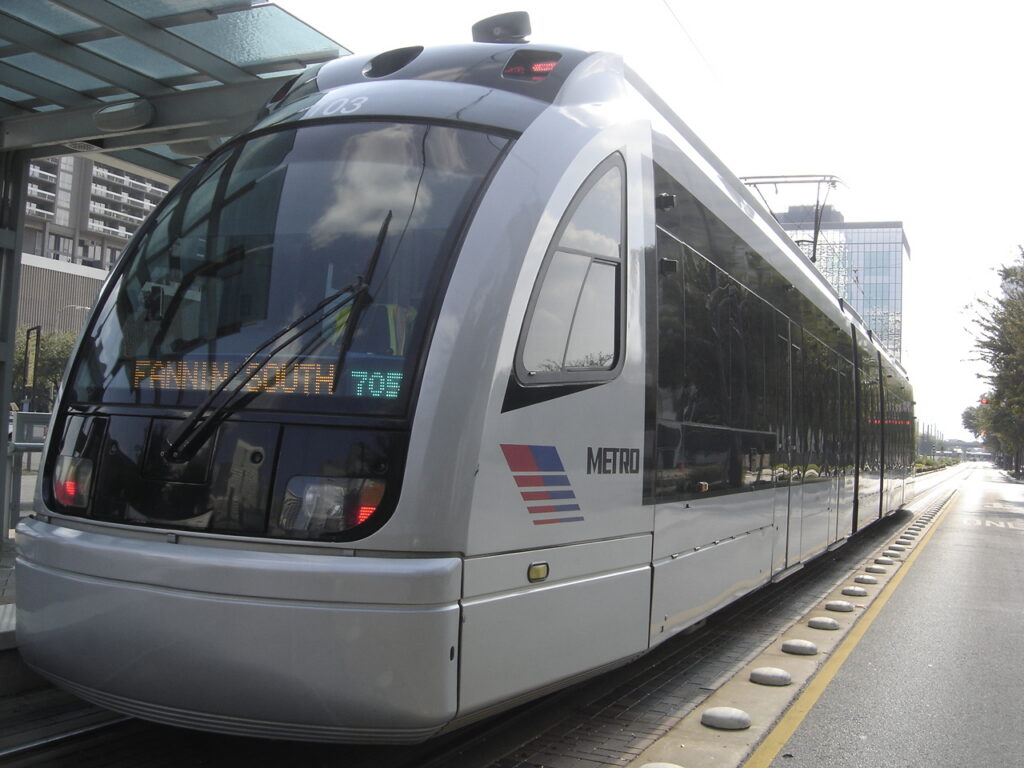
    A METRORail train in downtown Houston
    The METRORail Red Line, which links downtown, the Museum District, the Medical Center and NRG Park (Photo: Zereshk via Wikimedia Commons, CC BY 3.0)

    Houston’s transit, explained

    METRO, the Metropolitan Transit Authority of Harris County, runs the light rail, the bus network and the commuter park-and-ride buses. It is cheap and, along its core routes, frequent and dependable; its limitation is coverage, because the rail network is short for a city this size.

    METRORail

    Three lines. The Red Line is the one that matters most: it runs north to south from the Northline area through downtown along Main Street, then through Midtown, the Museum District (with stops by the Museum of Fine Arts and the Museum of Natural Science), Hermann Park and Rice University, the Texas Medical Center, and NRG Park, home of the Texans and the rodeo. Trains run frequently from early morning until around midnight. The Green Line runs east from downtown through EaDo, past Shell Energy Stadium, into the historic East End, and the Purple Line runs southeast through the Third Ward, past Texas Southern University and the University of Houston. Both share tracks through downtown and connect with the Red Line there. Rail is proof-of-payment: you pay at the platform machine or tap your fare card on the validator before boarding, and inspectors check tickets on board.

    Buses

    The bus network was redesigned around a grid of frequent routes, many of which run every 15 minutes or better throughout the day, seven days a week, and it reaches Montrose, the Heights, the Galleria, Chinatown and the airports. In Uptown, the METRORapid Silver Line runs bus rapid transit in dedicated lanes along Post Oak Boulevard past the Galleria. Outside the frequent network, some routes run only every half hour or hourly, especially in the evening; check times before relying on one.

    Fares and tickets

    METRO charges a flat local fare on buses and trains, among the lowest of any major American system, and it includes free transfers in any direction for three hours. Pay with a reloadable METRO Q fare card, through the METRO Q Mobile Ticketing app, or with exact cash on buses; check METRO’s site for current fares, day-pass options and whether tapping a bank card is accepted when you travel. Riders aged 70 and over ride free, and seniors, students and riders with disabilities qualify for reduced fares.

    Accessibility

    All rail stations are level-boarding and all buses are low-floor and accessible, and METROLift provides paratransit for riders who qualify.

    Beyond METRO

    • Walking and the tunnels. Downtown, Midtown, Montrose, the Museum District and the Heights are walkable in themselves, and downtown’s tunnel network, roughly six miles of air-conditioned passages under the office towers, is a lifesaver in summer. Note that the tunnels are open on weekdays during business hours only.
    • Bikes and the bayou trails. Houston BCycle, the city’s bike share, has stations downtown and in the inner neighborhoods, and a long and growing network of hike-and-bike trails follows Buffalo Bayou and the other bayous. In summer, ride early or late.
    • Taxis and ride-hail. Uber, Lyft and licensed taxis operate across the city.
    • Space Center Houston and Galveston. Neither is practical by public transit for a visitor. Ride-hail works for the Space Center, and organized tours run to both. On the island, Galveston’s restored trolley and local buses help once you are there.
    • Intercity travel. Amtrak’s Sunset Limited stops in Houston a few times a week on its route between New Orleans and Los Angeles, and intercity buses connect Houston with Dallas, Austin and San Antonio many times a day, a reasonable alternative to a one-way rental for solo travelers.
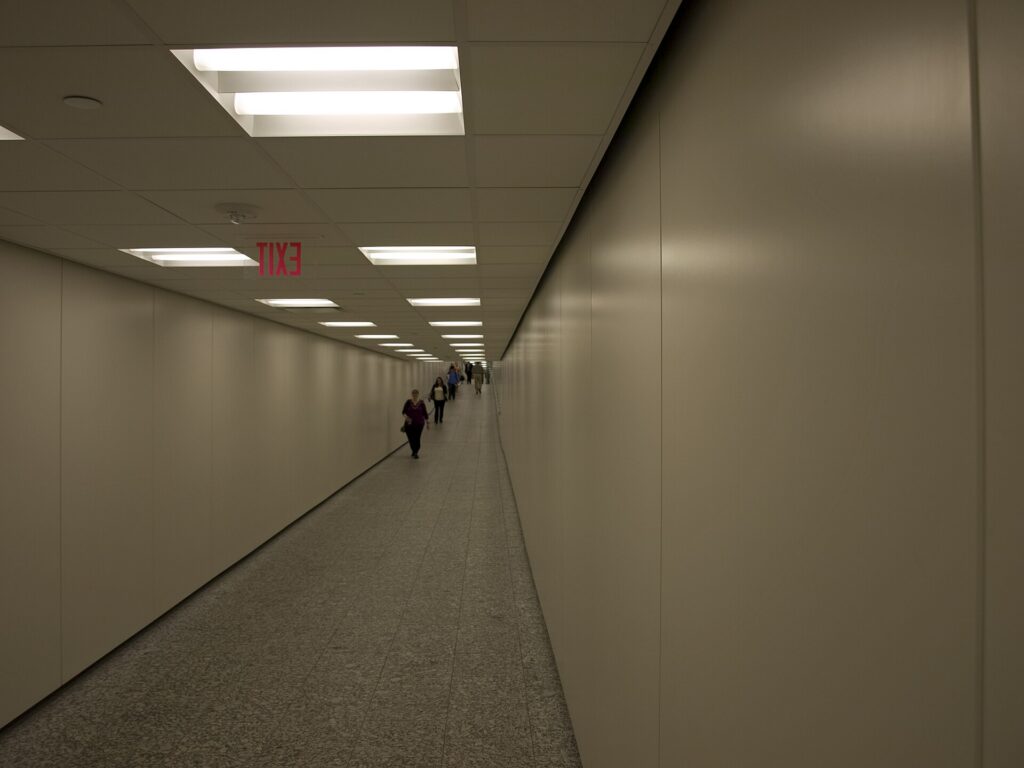
    A shopping and food plaza in the downtown Houston pedestrian tunnel system
    Downtown's air-conditioned tunnel network, open on weekdays, and the best way to cross the core in August (Photo: Ymblanter via Wikimedia Commons, CC BY-SA 3.0)

    Driving in Houston: what it is really like

    Houston’s freeways are enormous, including stretches of the Katy Freeway (I-10) among the widest in the world, and drivers move fast. The frustrations are specific. Rush hour, roughly 6 to 9 in the morning and 3:30 to 7 in the evening, jams every radial freeway and the 610 Loop, especially the West Loop by the Galleria and I-45 north of downtown. Construction is permanent somewhere, and a years-long rebuild of I-45 and the freeways around downtown is under way. And Texas frontage roads, the one-way service roads that run beside most freeways, take getting used to: exits come early, businesses sit on the frontage road rather than the freeway, and many interchanges have “Texas U-turn” lanes that let you reverse direction without a traffic light. Houston’s freeways have a reputation for serious crashes, so leave space and drive defensively. Houston TranStar publishes live traffic speeds, incidents and flood-prone roadways.
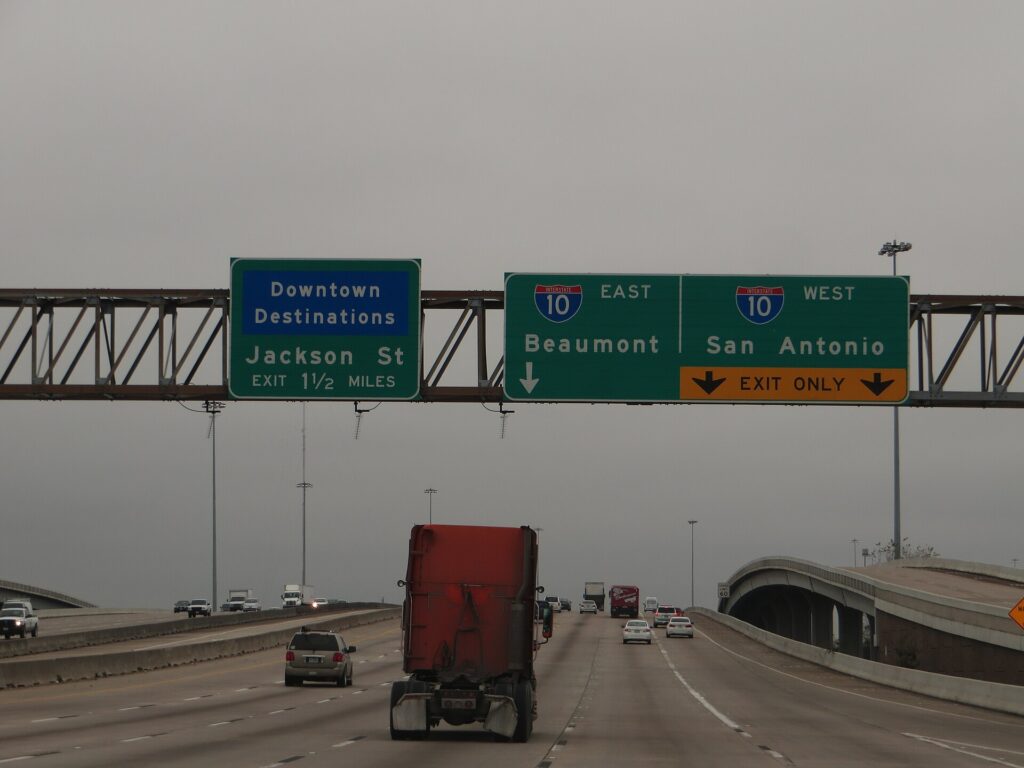
    The interchange of Interstate 10 and US-59 near downtown Houston
    The I-10 and US-59 interchange near downtown, where two of the radial freeways that shape Houston traffic meet (Photo: Ken Lund via Wikimedia Commons, CC BY-SA 2.0)

    Tolls

    Houston has an extensive network of toll roads, including the Sam Houston Tollway, the Hardy Toll Road to IAH, the Westpark Tollway and parts of the Grand Parkway, and most of them are fully cashless. Tolls are collected by transponder, the local EZ TAG issued by the Harris County Toll Road Authority, which also works with the Texas TxTag and Dallas TollTag, or by a bill mailed to the plate owner. With a rental car, that owner is the rental company, which will pass the tolls on with a daily or per-use fee. Ask at the counter how its toll program works; for a short stay, setting your navigation app to avoid tolls is often cheaper.

    Parking

    Downtown has plenty of garages and surface lots, priced highest on weekdays and during games and concerts, and metered street parking paid by machine or through the city’s ParkHouston app; read the posted hours on each meter. Hotels downtown and in the Galleria charge a nightly fee, often valet-only. Valet is common at restaurants across the city, and malls generally offer free self-parking. Space Center Houston charges for parking, and Galveston charges for parking along much of the seawall.

    Rules and conditions worth knowing

    • Flooding. Heavy rain can flood underpasses and low roads within minutes. Never drive into water on the road; the National Weather Service’s advice is “turn around, don’t drown”. The NWS Houston/Galveston office issues flash-flood warnings.
    • Hurricanes. From June to November, a tropical storm can close roads and trigger evacuations along the coast. If one is forecast, follow official guidance and do not head for Galveston.
    • Heat. A parked car becomes dangerously hot within minutes in summer; never leave children or pets inside, even briefly, and use a sunshade.
    • Speed limits are typically 60 to 65 mph on urban freeways and up to 75 mph on rural interstates, and frontage roads are often 45 to 55 mph.
    • Right turns on red are permitted after a full stop unless signed otherwise.
    • Texting while driving is illegal statewide, and handheld phone use is banned in school zones.
    • Move over or slow down for stopped emergency, tow and highway maintenance vehicles with flashing lights; it is the law in Texas.
    • Red-light cameras were banned in Texas in 2019, but police patrol the freeways heavily.

    When renting a car makes sense

    • Space Center Houston. It is 40 kilometers (25 miles) southeast, with no rail link; a car also lets you add the Kemah Boardwalk or Galveston the same day.
    • Galveston. An hour down I-45, with beaches, the Strand and the cruise terminals, and far easier with your own wheels.
    • Chinatown, Hillcroft and the suburbs. The best international food is spread along miles of suburban boulevards.
    • Business outside the core. The Energy Corridor, the Westchase district, The Woodlands and the port are all car commutes.
    • Family visits. Most Houstonians live beyond the Loop, and a car earns its keep daily.
    • Texas road trips. Dallas is about four hours north, Austin about three hours west and San Antonio a little farther; our Dallas to Houston route guide covers the most popular drive.

    If any of those apply, our rental car booking tips cover insurance, deposits and the questions to ask at the counter, and our family car rental guide looks at vehicle choice.

    When it does not

    • You are staying downtown, in Midtown, in the Museum District or near the Medical Center, and your plans are along the Red Line.
    • You are in town for a convention, a medical appointment in the Medical Center, or a Texans game or the rodeo at NRG Park, all of which are on the train.
    • You are visiting for a short city break and happy to use ride-hail for Montrose and the Heights.
    • You are traveling solo, and the rental, tolls, insurance and hotel parking add up to more than a handful of ride-hail trips.

    The hybrid plan for a city-plus-coast trip

    Go car-free for the city days and rent for the Space Center and Galveston, and think about where you pick up. If you fly into Hobby and are heading straight for the coast, renting at the airport makes sense: you are already on the south side, and the Space Center and Galveston are down I-45 without crossing the city. If you are spending the first nights in the Museum District or downtown, take a taxi or ride-hail in, use the Red Line for a few days, and rent from a city location for the days you need a car, which avoids the airport concession fees and several nights of hotel parking. If you are combining Houston with Dallas, a one-way rental between the two is usually available, though it may carry a drop fee; read our Dallas car-versus-transit guide for that end of the trip. Compare the day rates on our Houston car rental page against a full-trip rental and the difference is usually obvious.

    A worked cost comparison

    Numbers change with the season and the booking window, so treat this as a method rather than a quote, and check current rates before deciding. For a four-night city break in the Museum District for two people, the car-free version costs two ride-hail trips to and from the airport, a handful of METRO fares, and perhaps four short ride-hail trips to Montrose, the Heights and back; the rental version adds four days of a car, hotel parking, tolls and fees, fuel and airport concession charges. The car-free option wins easily. For the same four nights with a day at Space Center Houston and a day in Galveston, the car-free version adds two long ride-hail round trips or two tour tickets per person; the hybrid version adds a two-day rental from a city location, fuel, a little in tolls and parking at the Space Center and on the island. For two people the hybrid usually comes out ahead, and for a family of four it is clearly cheaper and far more flexible. For a week visiting family in the suburbs, or a business trip to the Energy Corridor, a rental for the whole stay is the only practical answer. Run the rental rates for your dates on our Houston car rental page and put them beside the ride-hail estimates before you choose.

    Driving to Galveston, Dallas and beyond in each season

    The two drives most visitors make are south to the coast and north to Dallas. Galveston is about an hour down I-45, past the NASA turnoff and across the causeway onto the island. Dallas is about 385 kilometers (240 miles) north on I-45, three and a half to four hours without traffic, past the Sam Houston statue at Huntsville and the giant Buc-ee’s travel center at Madisonville. In summer, the challenge is heat and weekend traffic: southbound to Galveston on Saturday mornings and northbound on Sunday afternoons, the freeway crawls, so leave early, and keep the tank well above a quarter on the long Dallas run. Summer is also hurricane season, and if a storm is approaching, the coast is the place not to be; watch the forecast and the DriveTexas road-conditions map. In fall, the weather is ideal and the coast is quieter after Labor Day, though football weekends fill the highways. In winter, the roads are usually clear, sea fog can settle over the causeway and the coast, and on the rare days of ice, when bridges and overpasses freeze first, the right call is to wait a day. In spring, thunderstorms bring blinding rain and street flooding, and a slow drive is a safe one. In every season, crossing Houston itself is usually the slowest part of the trip.

    Decision table

    Your tripRecommendationWhy
    City break in the Museum District, downtown or MidtownNo carThe Red Line links the main sights; hotel parking and tolls add up
    Convention, Medical Center visit or game at NRGNo carAll are on the Red Line, and event parking is expensive
    City plus Space Center Houston and GalvestonHybrid: rent for the coast daysCar-free city days, car for the southeast
    Flying into Hobby for the coastRent at the airportHobby is already on the south side, on the way to both
    Staying in Montrose or the HeightsNo car, or a short rentalWalkable neighborhoods; ride-hail fills the gaps
    Family visit to the suburbsRent for the whole staySuburban distances make the car worthwhile daily
    Business in the Energy Corridor or The WoodlandsRent at IAHBoth are freeway commutes far from the rail line
    Texas road tripRent (consider one-way to Dallas)Houston is the start, not the destination

    Money-saving tips for both options

    • On transit: use the free three-hour transfer window to link trains and buses on one fare, and pick a hotel within walking distance of a Red Line station.
    • On a rental: compare airport and city pickup, understand the toll program before you drive away, set your navigation to avoid tolls on short hops, decline extras you already have through a credit card or home policy (check first), and book early for rodeo season.
    • On the hotel: if you are renting, price the parking fee into the room rate, and look for hotels with free self-parking outside downtown.
    • On timing: avoid the freeways in the weekday peaks and I-45 to Galveston on summer Saturday mornings; the best time to fly to Houston guide lists the busiest weeks.
    • On the airport run: for two or more people, a taxi’s fixed zone fare or a ride-hail from Hobby is cheap; from IAH, compare it with the bus if you are traveling light.

    Frequently asked questions

    Is it worth renting a car in Houston?

    For Space Center Houston, Galveston, the suburbs or a road trip, yes. For a stay along the Red Line in the Museum District, downtown or Midtown, usually not.

    Is Houston public transit good for tourists?

    Good along the Red Line, which links downtown, the Museum District, Hermann Park, the Medical Center and NRG Park, and very cheap. Beyond that corridor, you will rely on buses, ride-hail or a car.

    How do I get from IAH to downtown Houston?

    A taxi at a fixed zone fare or a ride-hail in 30 to 45 minutes without traffic, or METRO’s local bus in about an hour for the standard fare.

    Can I get to Space Center Houston without a car?

    Yes, by ride-hail or on an organized tour, but there is no practical public transit option. With a car, you can add Kemah or Galveston the same day.

    Do I need an EZ TAG to drive in Houston?

    Not necessarily. Many toll roads are cashless, so a rental car’s toll program or a bill by mail will cover you, usually with a fee. Ask at the counter, or set your navigation to avoid tolls.

    Is driving in Houston difficult?

    The freeways are big, fast and busy, and rush hour is slow, but the roads are wide and well signed. Leave space, learn the frontage-road system, and never drive into floodwater.

    Is parking expensive in Houston?

    Downtown and hotel parking can be, especially on event nights. Malls generally offer free self-parking, and outside the core it is rarely a problem.

    Whichever way you go, start with the flight. Compare cheap flights to Houston, choose a neighborhood with our Houston hotel search, and if Space Center Houston or Galveston is on the list, price the rental for those dates on our Houston car rental page.

  • Things to Do in Houston: A First-Timer’s Guide

    Things to Do in Houston: A First-Timer’s Guide

    Houston has a reputation problem. People picture freeways, refineries and humidity, and many visitors fly in for a conference or a connection at IAH without ever seeing the city. The ones who stay find the fourth-largest city in the country and, by some measures, the most diverse: a museum district with around twenty institutions within walking distance of each other, the Menil Collection and the Rothko Chapel, NASA’s Mission Control, a bayou turned into one of the best urban parks in Texas, neighborhoods of bungalows, murals and taquerias, the biggest rodeo on earth every spring, and a food scene that runs from brisket and Tex-Mex to Viet-Cajun crawfish, Nigerian suya and Pakistani kebabs. The Gulf of Mexico is an hour away at Galveston. This guide covers the sights, the neighborhoods, the food, the rodeo and the sports, the day trips, and the practical details, including the heat, that turn a business trip into a proper visit.

    If you are still comparing cheap flights to Houston, read this alongside our guides to the best time to fly to Houston and whether you need a car. Between the three you can plan the whole trip.

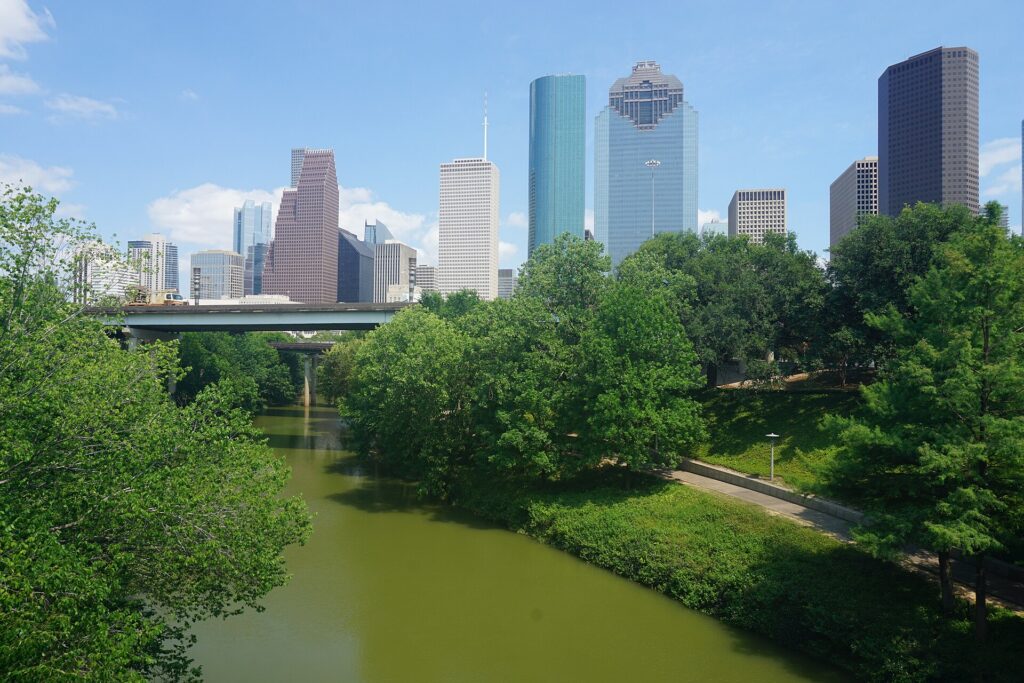
    The downtown Houston skyline above Buffalo Bayou Park
    Downtown Houston from Buffalo Bayou Park, the 160-acre green corridor along the river where the city was founded (Photo: Michael Barera via Wikimedia Commons, CC BY-SA 4.0)

    Houston at a glance for first-timers

    • Airports: George Bush Intercontinental (IAH), about 37 km (23 miles) north of downtown, is the main international gateway and a major hub for United Airlines. William P. Hobby (HOU), about 11 km (7 miles) southeast of downtown, is a big Southwest Airlines base with domestic flights and some routes to Mexico and the Caribbean. See our guides to Bush Intercontinental (IAH) and Hobby (HOU).
    • Getting around: the METRORail Red Line links downtown, Midtown, the Museum District, Hermann Park, the Texas Medical Center and NRG Park. The metro area is vast, though, and most visitors rent a car for Space Center Houston and Galveston.
    • Money: US dollars. The combined sales tax in Houston is 8.25 percent, and hotel taxes add noticeably to a room rate. Tipping 18 to 20 percent in restaurants is expected.
    • Weather: short, mild winters, a warm and green spring, a long, hot and humid summer, and a pleasant fall. Hurricane season runs from June to November. Our month-by-month guide has the detail.
    • Where to stay: downtown for the Theater District, the ballpark and Discovery Green; the Museum District or Montrose for art, restaurants and the Red Line; the Galleria for shopping; the Heights for a neighborhood feel. Our Houston hotel search covers them all.

    Downtown: Discovery Green, the tunnels and the Theater District

    Discovery Green, a twelve-acre park opened in 2008 beside the George R. Brown Convention Center, gave the east side of downtown a front lawn, with a lake, splash fountains, free concerts and, in winter, an ice ribbon for skating. Below the streets runs the downtown tunnel system, roughly six miles of air-conditioned pedestrian passages lined with food courts and shops that link around 95 blocks of office towers; it is open on weekdays during business hours only. On the northwest side of downtown, the Theater District packs one of the largest concentrations of performing-arts seats in the country outside New York into a few blocks: Jones Hall for the Houston Symphony, the Wortham Theater Center for the Houston Grand Opera and the Houston Ballet, the Alley Theatre, and the Hobby Center for touring Broadway.

    Buffalo Bayou Park, the Cistern and the bats

    Houston was founded in 1836 on the banks of Buffalo Bayou, the slow river that winds through downtown to the Ship Channel, and after decades of neglect it is now the city’s best public space. Buffalo Bayou Park, about 160 acres along both banks between Shepherd Drive and downtown, has paved hike-and-bike trails, a skate park, a dog park, sculpture, gardens and some of the best skyline views in the city, especially at sunset from the Rosemont Bridge. Kayak rentals and boat tours run on the water. Inside the park, the Cistern, a 1926 underground drinking-water reservoir with a forest of more than two hundred concrete columns, has been reopened for guided tours and immersive art installations, and its echo is unforgettable; book ahead. At dusk from spring to fall, head to the Waugh Drive Bridge, where a colony of Mexican free-tailed bats, estimated at around a quarter of a million, pours out from under the bridge to feed.

    The Museum District and Hermann Park

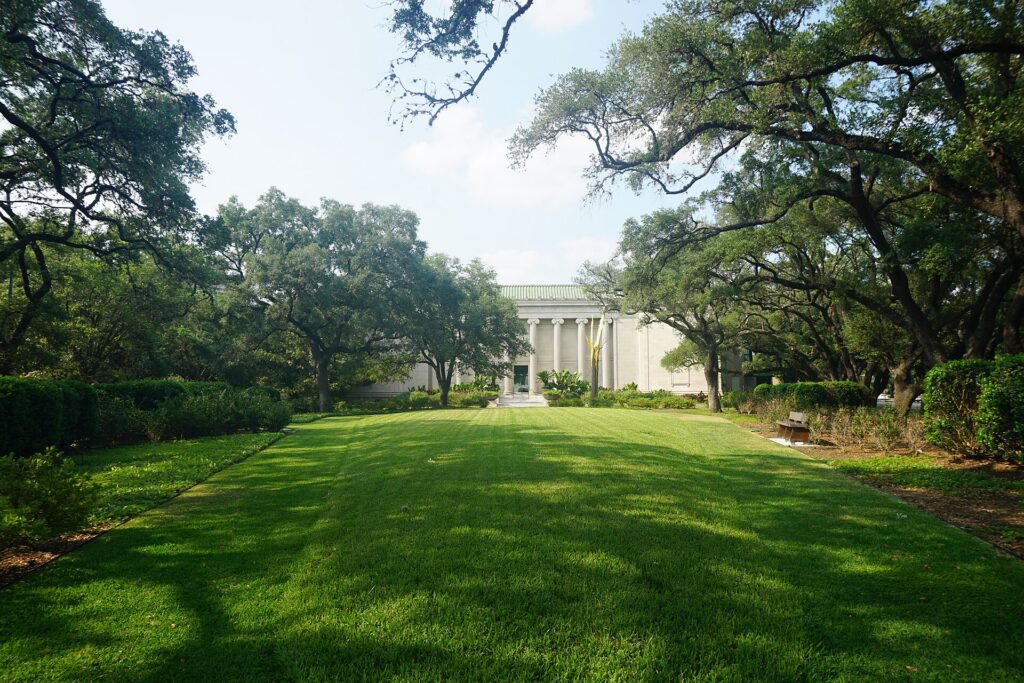
    South of Midtown, the Museum District holds around twenty museums within about a mile and a half, most of them on or near the Red Line. The anchor is the Museum of Fine Arts, Houston, one of the largest art museums in the country, with three main gallery buildings, including a glass hall by Mies van der Rohe and the Kinder Building, opened in 2020 for modern and contemporary art. The Isamu Noguchi-designed Cullen Sculpture Garden across the street is free, and general admission to the museum is free one day a week; check the museum’s site for the current day. The Houston Museum of Natural Science is the other giant, with the Morian Hall of Paleontology, a dazzling hall of gems and minerals, a planetarium, and the Cockrell Butterfly Center, a three-story glass rainforest full of free-flying butterflies. Smaller stops include the free Contemporary Arts Museum Houston, the Holocaust Museum Houston and the Children’s Museum Houston.

    Beside the museums, Hermann Park is Houston’s Central Park: 445 acres of lawns, lakes and oaks. The Houston Zoo, one of the most visited in the country, fills the middle; the Japanese Garden is peaceful; paddle boats run on McGovern Lake; and the Miller Outdoor Theatre stages free concerts, plays and dance performances on summer and fall evenings. The vast Texas Medical Center, the largest medical complex in the world, rises just south.

    The Museum of Fine Arts, Houston in the Museum District
    The Museum of Fine Arts, Houston, the anchor of a Museum District of around twenty institutions (Photo: Michael Barera via Wikimedia Commons, CC BY-SA 4.0)

    The Menil Collection and the Rothko Chapel

    If you see one thing in Houston that you cannot see anywhere else, make it the Menil Collection. It is the private collection of Dominique and John de Menil, oil-industry philanthropists who gathered surrealist paintings by Magritte and Max Ernst, antiquities, Byzantine icons, and African and Pacific art, housed since 1987 in a low, light-filled building by Renzo Piano set among the gray bungalows of Montrose. Admission is free, and so is everything on the surrounding campus: the Cy Twombly Gallery, a Dan Flavin light installation at Richmond Hall, the Menil Drawing Institute, and lawns shaded by live oaks. Two blocks away, the Rothko Chapel, commissioned by the de Menils and opened in 1971, is an octagonal, nondenominational space holding fourteen dark canvases by Mark Rothko. For many visitors it is the most moving room in Texas. Outside, Barnett Newman’s steel Broken Obelisk stands in a reflecting pool, dedicated to Martin Luther King Jr. Allow a half-day for the whole campus.

    Space Center Houston

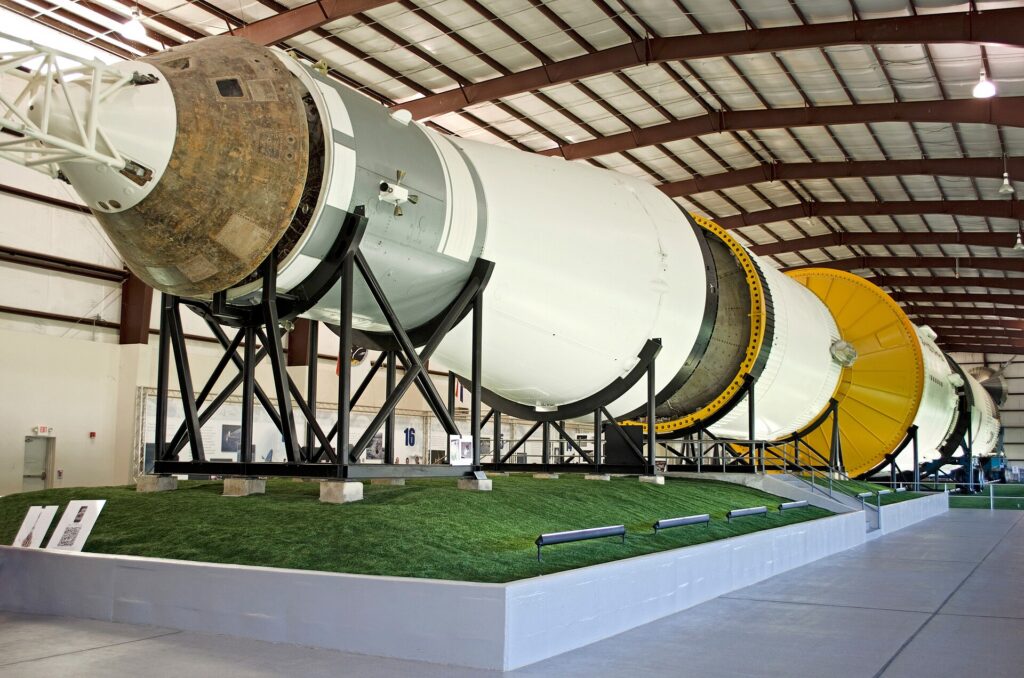
    About 40 km (25 miles) southeast of downtown, beside NASA’s Johnson Space Center at Clear Lake, Space Center Houston is the official visitor center and the city’s most famous attraction. “Houston” was the first word Neil Armstrong radioed back after Apollo 11 touched down. The essential experience is the tram tour onto the working NASA campus: depending on the day, it visits the restored Apollo-era Historic Mission Control, set up as it was during the Moon landings, the astronaut training facility, and Rocket Park, where one of the three remaining Saturn V moon rockets lies on its side in a hangar, 363 feet (110 meters) of it. Back at the center, Independence Plaza lets you walk through a space shuttle replica mounted on top of the original Boeing 747 shuttle carrier aircraft, and the galleries hold flown capsules, spacesuits and moon rocks brought back by the Apollo astronauts. Allow most of a day, buy tickets online, and arrive early for the tram. There is no rail link, so you will need a car, a ride-hail or a tour.

    The Saturn V moon rocket in Rocket Park at NASA's Johnson Space Center
    The Saturn V in Rocket Park, one of the stops on the Space Center Houston tram tour (Photo: Jim Evans via Wikimedia Commons, CC BY-SA 4.0)

    Neighborhoods worth a half-day

    Montrose

    West of the Museum District, Montrose is the city’s bohemian heart and the historic center of LGBTQ life in Houston: tree-lined streets of bungalows, vintage shops, bars, coffee shops and some of the city’s best restaurants along Westheimer Road. The Menil campus sits at its eastern edge. It is walkable and a good base; see our Montrose hotel guide.

    The Heights

    Northwest of downtown, the Heights was laid out in the 1890s as a separate town, and its Victorian houses and Craftsman bungalows now surround a lively strip of boutiques, antiques stores and restaurants on 19th Street. Heights Boulevard has a walking trail down its grassy esplanade, and weekend brunch here is an institution.

    EaDo and the East End

    East of downtown, EaDo (East Downtown) has gone from warehouses to murals, breweries and apartments, with Shell Energy Stadium, home of the Houston Dynamo and Houston Dash soccer teams, at its center. Beyond it, the East End along Navigation Boulevard and Harrisburg is the historic heart of Mexican-American Houston, with taquerias, panaderías, colorful murals and the restaurant widely credited with bringing fajitas to a mainstream audience in the 1970s. The METRORail Green Line runs through both.

    Third Ward

    South of downtown, the Third Ward is one of the historic centers of Black Houston, home to Texas Southern University and the University of Houston. Emancipation Park was bought in 1872 by formerly enslaved people to hold Juneteenth celebrations, and it still hosts them. Project Row Houses, an art project in a row of shotgun houses, is nationally admired.

    Uptown, the Galleria and River Oaks

    West of the Loop, Uptown is Houston’s second downtown, built around The Galleria, the largest shopping mall in Texas, with an ice rink under its glass roof. The free Gerald D. Hines Waterwall Park, a sixty-four-foot horseshoe of falling water beneath Williams Tower, is the neighborhood’s great free sight. Next door, River Oaks is the city’s grandest residential enclave.

    Chinatown and the Mahatma Gandhi District

    In southwest Houston, miles of Bellaire Boulevard form one of the largest Asian dining districts in the country, with Vietnamese, Chinese, Taiwanese and Korean restaurants, bakeries and crawfish houses in strip malls. Nearby, the Mahatma Gandhi District along Hillcroft Avenue has Indian and Pakistani restaurants and sweet shops. You will need a car or a ride-hail.

    More history and culture

    East of the city, the San Jacinto Battleground State Historic Site marks the spot where Sam Houston’s army defeated Santa Anna on April 21, 1836, winning Texas its independence in a battle that lasted about eighteen minutes. Its star-topped column is taller than the Washington Monument, with an observation deck at the top. The Orange Show Monument, a folk-art maze built by a postman, and the Beer Can House, clad in flattened cans, are the most delightful oddities in the city; the same organization runs the Art Car Parade every spring. Bayou Bend, the Museum of Fine Arts’ American decorative arts in a River Oaks mansion and gardens, is a lovely morning. In the west, Memorial Park, nearly twice the size of New York’s Central Park, has forest trails and the Houston Arboretum. For concerts, shows and games during your dates, our Houston events page lists what is on.

    The Houston Livestock Show and Rodeo

    For about three weeks from late February into March, the Houston Livestock Show and Rodeo takes over NRG Park, and it is billed as the largest livestock exhibition and rodeo in the world. It opens with the World’s Championship Bar-B-Que Contest, when hundreds of teams smoke brisket on the grounds, and with trail riders who ride into the city on horseback from across Texas. Then come the livestock shows and auctions, a carnival, a vast shopping hall, a wine competition, and, every night in NRG Stadium, a professional rodeo followed by a concert from a major country, pop, Latin or hip-hop star. Locals dress in boots and hats all month, and the proceeds fund scholarships across Texas. Take the METRORail Red Line to the NRG Park stations rather than driving, buy concert tickets early for the big names, and book your hotel before your flight if your dates overlap with it.

    Sports

    The Houston Astros, World Series champions in 2017 and 2022, play at Daikin Park downtown, under a retractable roof that makes July baseball bearable. The Houston Rockets play basketball at the Toyota Center, a few blocks away. The Houston Texans play NFL football at NRG Stadium, also roofed, which hosted matches of the 2026 World Cup and has hosted two Super Bowls. The Dynamo in MLS and the Dash in the NWSL play at Shell Energy Stadium in EaDo. The Red Line serves NRG Park and downtown, so you rarely need to drive to a game. Check what is on sale in Houston for your dates before you book flights.

    What to eat, and where

    Houston is one of the great eating cities in America, thanks to immigrants from Mexico, Vietnam, China, India, Pakistan, Nigeria, El Salvador and dozens of other countries. Start with Tex-Mex and fajitas, which Houston helped put on menus nationwide, and with breakfast tacos and kolaches, the Czech-Texan pastries sold at shops across the city. Then barbecue: Houston’s pitmasters now rank among the best in the state, with lines out the door at weekends. Houston’s signature crossover is Viet-Cajun crawfish, boiled and tossed in garlic butter and spices, at its best from roughly February to May. Gulf oysters, shrimp and red snapper appear on menus everywhere. Beyond that, eat pho on Bellaire Boulevard, biryani on Hillcroft, suya in the southwest, and steak in the Galleria. Montrose, the Heights and Midtown have the chef-driven restaurants.

    Houston through the seasons

    Spring (March to May) is the favorite season: azaleas in River Oaks, bluebonnets along the highways outside the city, the rodeo, patio season, and warm, green days before the summer heat; it is also the start of the storm season, so watch the forecast. Summer (June to September) is long, hot and very humid, with the heat index regularly above 100 °F (38 °C) and afternoon thunderstorms; plan museums by day and the bayou at dawn or dusk. It is also hurricane season, which runs from June to November and peaks from mid-August to early October; most years pass without a direct hit, but travelers should keep an eye on forecasts from the National Hurricane Center. Fall (October to November) brings relief, with warm, clear days, football and patio season again. Winter (December to February) is short and mostly mild, with holiday lights, ice skating at Discovery Green and the Houston Marathon in January, though an occasional hard freeze can close roads for a day. Our month-by-month guide has the fare patterns that go with each season.

    Houston with kids

    Houston is an excellent city for children, partly because so much of it is air-conditioned. Space Center Houston is the obvious highlight. The Children’s Museum Houston, the Houston Museum of Natural Science with its dinosaurs and butterflies, and the Houston Zoo fill a day in the Museum District, and the Hermann Park railroad and paddle boats are next door. Discovery Green’s splash fountains and playground are free, and so are the Miller Outdoor Theatre’s summer shows. At Brazos Bend State Park, an hour southwest, children can watch alligators basking beside the lakes from a safe distance. For families renting a vehicle, our family car rental guide covers the choices.

    Houston on a budget

    A surprising amount of the best of Houston is free. The Menil Collection, the Rothko Chapel, the Cy Twombly Gallery, the Contemporary Arts Museum and the Museum of Fine Arts on its free day cost nothing, and neither do Buffalo Bayou Park, the bats, Hermann Park, the Waterwall, Discovery Green, the Miller Outdoor Theatre and the murals of EaDo. METRO’s local fare is one of the cheapest of any big American transit system, and transfers within a few hours are free. Space Center Houston and the zoo are the expensive days. Eat well for less on Bellaire Boulevard and Hillcroft, at the taquerias of the East End, and at the barbecue joints. Business-driven downtown and Galleria hotels often drop their rates on weekends. Compare rates by neighborhood on our Houston hotel search.

    Day trips from Houston

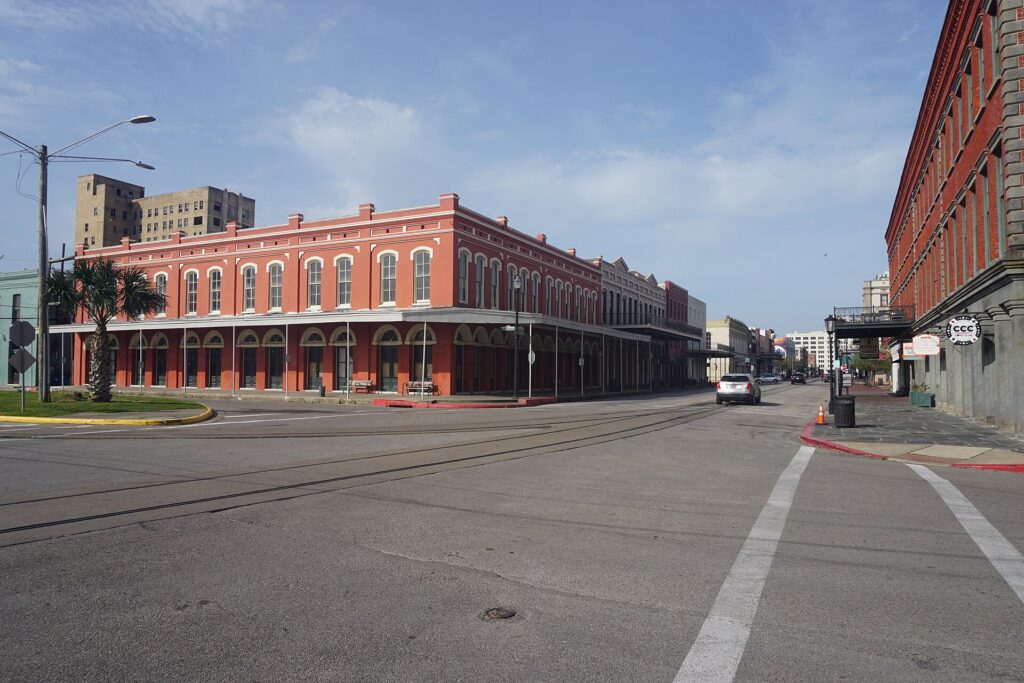
    Galveston, about 80 km (50 miles) southeast on I-45, is the essential side trip: a barrier island with beaches along the long seawall built after the 1900 Storm, still the deadliest natural disaster in American history. The Strand Historic District has cast-iron Victorian storefronts, and the East End has some of the finest Victorian houses in Texas. Galveston is also where the Union Army read the order announcing the end of slavery in Texas on June 19, 1865, the origin of Juneteenth, and today it is one of the country’s busiest cruise ports. Visit Galveston has the details. Space Center Houston and the Kemah Boardwalk are on the way. Brazos Bend State Park, about an hour southwest, has alligators, wetland birds and an observatory. For longer trips, Austin is about three hours west and San Antonio a little farther, and Dallas is about four hours north on I-45; our Dallas to Houston driving guide covers the route, and our guide to things to do in Dallas covers the city. Most of these trips need a car; compare rates on our Houston car rental page.

    Victorian storefronts in the Strand Historic District in Galveston
    The Strand in Galveston, an hour southeast of Houston on the Gulf of Mexico (Photo: Michael Barera via Wikimedia Commons, CC BY-SA 4.0)

    Two sample itineraries

    Two days, no car

    Day one: the Museum of Fine Arts or the Museum of Natural Science in the morning, a walk through Hermann Park, lunch in Montrose, the Menil Collection and the Rothko Chapel in the afternoon, and dinner on Westheimer Road. Day two: Discovery Green and the Theater District in the morning, a walk or kayak along Buffalo Bayou Park and a tour of the Cistern, the bats at the Waugh Drive Bridge at dusk, and an Astros or Rockets game or a show at night.

    Four days, with Space Center Houston and Galveston

    Add a day for the Heights, the East End and dinner on Bellaire Boulevard, then pick up a car and spend a full day at Space Center Houston, then a final day in Galveston, returning the car at Hobby or IAH on the way home.

    Practical details

    • Transit: pay for METRO with a METRO Q fare card or the METRO Q Mobile Ticketing app; a single fare includes free transfers for a few hours. METRO has maps and service alerts; our transit-versus-car guide goes into detail.
    • From the airports: taxis, ride-hail and rentals serve both; METRO buses also link each airport with downtown, slowly but cheaply. The Houston Airport System’s site covers ground transport at IAH and Hobby.
    • Weather: light, breathable clothes, sun protection and water from May to October, an umbrella year-round, and a light jacket for air-conditioned interiors and winter cold fronts. The National Weather Service’s Houston/Galveston office issues the heat, flood and storm warnings worth heeding; never drive into floodwater.
    • Time zone: Central, one hour behind New York and the same as Dallas and Chicago.
    • Entry requirements: visitors from Visa Waiver Program countries need an approved ESTA before boarding; most others need a visa. The State Department’s travel site is the authoritative source.
    • Tourist information: Visit Houston, the official tourism office, has current events and neighborhood guides.

    Frequently asked questions

    How many days do you need in Houston?

    Two full days covers the Museum District, the Menil and the Rothko Chapel, Buffalo Bayou and downtown; add a third for Space Center Houston and a fourth for Galveston.

    What is the number one thing to do in Houston?

    Space Center Houston and its tram tour to Mission Control. For art lovers, the Menil Collection and the Rothko Chapel.

    Is Houston walkable?

    Downtown, Midtown, the Museum District, Montrose and the Heights are walkable in themselves, and the Red Line connects several of them. The city as a whole is built around the car, and summer heat makes long midday walks hard going.

    Do I need a car in Houston?

    Not for the Museum District, Montrose and downtown. For Space Center Houston, Galveston, Chinatown and most of the suburbs, yes; rent it only for the days you need it.

    When is hurricane season in Houston?

    June 1 to November 30, with the greatest risk from mid-August to early October. Most visits are unaffected, but watch the forecast in those months and consider flexible bookings.

    What is Houston known for?

    NASA and Mission Control, the energy industry, the Texas Medical Center, the rodeo, one of the most diverse populations in the country, and a food scene to match.

    Ready to go? Compare flights to Houston, find a place to stay with our Houston hotel search, and if Space Center Houston or Galveston is on the list, price a rental car for those days.

  • Best Time to Fly to Houston: Seasons, Weather & Prices

    Best Time to Fly to Houston: Seasons, Weather & Prices

    Houston is a business city first, and its airfares show it. Two big airports, a United Airlines hub at Bush Intercontinental and a large Southwest Airlines operation at Hobby, compete for the traffic of the energy industry, the Texas Medical Center and one of the busiest convention calendars in the country, which keeps weekday flights full all year. Leisure demand layers on top: the rodeo in late February and March, spring break, the holidays, and the cruise passengers heading for Galveston. The weather adds its own twist. Houston’s winters are mild and its springs and falls are lovely, but its summers are long, hot and humid, and the city sits in the path of Gulf of Mexico hurricanes from June to November, which is exactly why late summer brings some of the lowest hotel rates of the year. This guide walks through the weather month by month, the fare seasons, the events that move prices, and how to choose between IAH and Hobby.

    The short answer

    For weather, the best windows are mid-October to early December and March to April, when days are warm, the humidity eases and the city lives outdoors. For value, late August and September and January after the holidays are usually the cheapest times to fly and to book a room, though late summer is hot and falls in the most active part of hurricane season. The most expensive stretches are rodeo season and spring break, from late February to mid-March, the week of the Offshore Technology Conference in early May, when the energy industry fills every hotel in the city, Thanksgiving, and the Christmas and New Year weeks. Whatever you choose, run a flexible-date search that includes both airports on our Houston flights page; a shift of a few days around the rodeo or a big convention can change the fare band entirely.

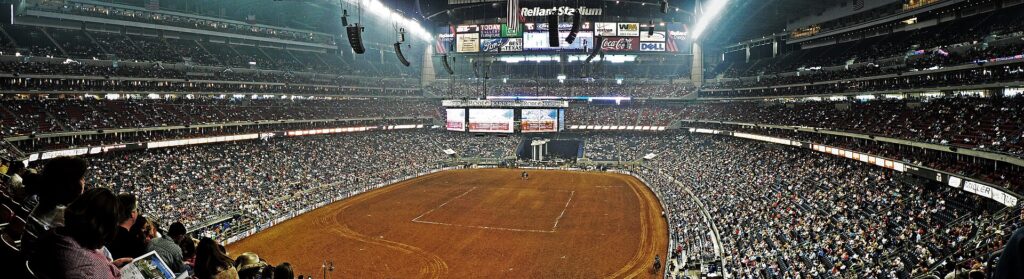
    A rodeo performance inside NRG Stadium (formerly Reliant Stadium) during the Houston Livestock Show and Rodeo
    The Houston Livestock Show and Rodeo, about three weeks from late February that fill hotels across the city (Photo: No machine-readable author provided. W0lfie assumed (based on copyright claims). via Wikimedia Commons, CC BY-SA 2.5)

    Houston’s weather, season by season

    Houston sits on the flat coastal plain about 80 kilometers (50 miles) from the Gulf of Mexico, and the Gulf defines its climate: warm, moist air for most of the year, heavy rain that can fall in any month, long humid summers, and short winters broken by cold fronts from the north. The figures below are approximate seasonal patterns based on the long-term climate normals for Bush Intercontinental from NOAA’s National Weather Service Houston/Galveston office; check the current forecast before you pack, because a Gulf downpour or a winter front can change the day in an hour.

    MonthTypical daytime highTypical overnight lowWhat it feels likeFare pressure
    Januaryaround 17 °C (63 °F)around 6 °C (43 °F)Mild and changeable; gray, damp days and occasional cold fronts; hard freezes are rareLow after New Year’s week
    Februaryaround 19 °C (67 °F)around 8 °C (47 °F)Mild, with the first azaleas late in the monthLow, rising sharply once the rodeo opens
    Marcharound 23 °C (74 °F)around 12 °C (53 °F)Warm and green; azaleas and bluebonnets; thunderstorms beginHigh: rodeo and spring break
    Aprilaround 27 °C (80 °F)around 16 °C (60 °F)Warm and pleasant, with the risk of severe storms and heavy rainModerate; Easter weekend busier
    Mayaround 31 °C (87 °F)around 20 °C (68 °F)Hot and increasingly humid; downpours can flood streetsModerate, with a sharp spike for the Offshore Technology Conference
    Junearound 33 °C (92 °F)around 23 °C (74 °F)Hot and sticky, with afternoon storms; hurricane season beginsModerate to high for flights, soft for hotels
    Julyaround 35 °C (95 °F)around 24 °C (75 °F)Hottest and most humid; heat index often above 38 °C (100 °F)Moderate; hotels at their cheapest
    Augustaround 35 °C (95 °F)around 24 °C (75 °F)Just as hot; tropical storm risk risingLow to moderate
    Septemberaround 32 °C (90 °F)around 21 °C (70 °F)Still hot and humid; the heart of hurricane seasonLow
    Octoberaround 28 °C (82 °F)around 16 °C (61 °F)Relief arrives with the first real fronts; often the best monthModerate; conventions and playoff baseball can lift it
    Novemberaround 22 °C (72 °F)around 11 °C (51 °F)Mild, dry and sunnyModerate, with a Thanksgiving spike
    Decemberaround 18 °C (64 °F)around 7 °C (45 °F)Mild, sometimes gray; cold fronts bring brief chillsLow until mid-month, then peak

    Three things the table cannot show. First, the humidity: from May to September the air is heavy with Gulf moisture, mornings are muggy even before sunrise, and the heat index, which combines temperature and humidity, is what you will actually feel. The National Weather Service issues heat advisories most summers; take them seriously, drink water and plan outdoor sightseeing for early morning or evening. Second, the rain: Houston receives around 50 inches (about 1,270 mm) a year, spread across every month, and it often arrives in short, intense downpours that can flood underpasses and low streets within an hour. Never drive into water on the road. Third, the hurricane season, which the next section covers in more detail.

    Hurricane season, in perspective

    The Atlantic hurricane season officially runs from June 1 to November 30, and the greatest risk to the Texas coast is from mid-August to early October. Most years pass without a direct hit on Houston, and most summer trips go ahead without a second thought, but the city has been struck hard in the past: Hurricane Harvey brought catastrophic flooding in 2017, and Hurricane Beryl knocked out power across much of the region in July 2024. The practical advice is simple. If you are booking for August through October, choose fares and hotels with flexible change policies or consider travel insurance that covers named storms, watch the outlooks from NOAA’s National Hurricane Center in the week before you travel, and remember that storms are tracked for days before they arrive, so airlines usually issue travel waivers well in advance.

    How Houston’s fare seasons work

    Three calendars drive seats into Houston. The first is business: the energy industry, the Medical Center, NASA contractors and the port keep Monday-morning and Thursday-evening flights full in every season, and big conventions at the George R. Brown Convention Center and NRG Park can fill downtown hotels without warning. The second is leisure, concentrated in rodeo season, spring break, the holidays and the cruise season out of Galveston. The third is the weather, which pushes visitors away in late summer and pulls them back in the fall. Because Houston is served by two large airports with different main airlines, competition on popular routes is strong, and a fare that looks high at one airport is often lower at the other.

    Peak season

    Late February to mid-March, for the Houston Livestock Show and Rodeo and spring break; the week of the Offshore Technology Conference in early May; Thanksgiving week; and the Christmas and New Year fortnight, from roughly the third week of December to the first days of January. During the rodeo, hotels near NRG Park and downtown fill for the big concert nights, and Texas school spring break, usually in the middle two weeks of March, adds families flying in and out. OTC week is the single sharpest hotel spike for business travelers. In summer, flights stay reasonably busy because Houstonians are flying out on vacation, but hotels in the city are soft.

    Shoulder season

    April to May outside OTC week, and October to early December outside Thanksgiving. These are the months with the most comfortable weather and moderate prices; October and November in particular are the local favorites. Watch Easter, Memorial Day, the Astros’ October playoff runs, and big home football weekends.

    Low season

    January after New Year’s week and early February, and late August through September. January is mild and quiet, apart from Houston Marathon weekend in mid-January. Late summer is hot, humid and in the heart of hurricane season, and it is when downtown and Galleria hotels discount most heavily; if you can handle the heat and book flexibly, it is excellent value.

    As elsewhere, mid-week departures and early or late flights usually price below Friday and Sunday afternoons on the same route, and a search across a whole month reveals cheaper pairs of dates close to your first choice. Our guide to the best times to book explains how to read those patterns.

    Houston month by month

    January

    Mild and changeable, with highs in the 60s °F and the occasional cold front that makes a jacket necessary for a day or two. After New Year’s week it is one of the cheapest months to fly and to stay, and it is a comfortable time for Space Center Houston, the museums and the bayou. The Houston Marathon in mid-January fills downtown hotels for one weekend. Hard freezes are rare but do happen; when they do, the city is not built for ice and roads can close for a day.

    February

    Mild, with azaleas starting to bloom by the end of the month. Fares stay low through the first half, then climb when the Houston Livestock Show and Rodeo opens in late February with its barbecue contest and trail rides. Mardi Gras is celebrated on Galveston Island in the weeks before Lent, and it fills the island’s hotels on its weekends.

    March

    Warm, green and beautiful, with azaleas in River Oaks and bluebonnets along the highways outside the city. It is also the busiest leisure month of the year: the rodeo runs into mid-March with a concert every night, and Texas school spring break, usually in the middle of the month, adds family travel. Book early, and compare IAH and Hobby.

    April

    One of the best months to visit, warm and pleasant before the humidity builds, with patio season in full swing and the Art Car Parade bringing hundreds of decorated vehicles to the streets. Spring storms can be severe, with hail and heavy rain, so keep an eye on the forecast. Fares are moderate apart from Easter weekend.

    May

    Hot and increasingly humid, with the chance of heavy rain. The Offshore Technology Conference at NRG Park in early May draws tens of thousands of energy-industry visitors, and hotel rates across the city jump that week; check the dates before you book. Memorial Day weekend is busy on the roads to Galveston. Otherwise, fares are moderate.

    June

    Summer arrives in earnest, and hurricane season begins on June 1. Afternoon thunderstorms are frequent. Juneteenth on June 19 is celebrated in Emancipation Park and in Galveston, where the holiday began, and Houston’s Pride celebrations take place during the month. Flights are busy with summer travelers, but city hotels start to soften.

    July

    The hottest, most humid month, with the heat index often above 100 °F (38 °C). The Fourth of July brings fireworks downtown, and the rest of the month is for air-conditioned museums, roofed baseball at Daikin Park, and early-morning or evening outings. Hotels are at their cheapest of the year, and fares ease after the holiday.

    August

    Just as hot, with rising tropical storm risk. Houston Restaurant Weeks, when many of the city’s restaurants offer fixed-price menus for charity, run through the month and into early September. Families head back to school in mid-August, and fares and hotel rates fall. Book flexibly.

    September

    Still hot and humid, and the peak of hurricane season. It is usually the cheapest month of the year for flights and hotels, and most years it passes without incident, but watch the forecasts in the days before you travel and avoid non-refundable bookings where you can. Labor Day weekend is busy on the roads to the coast.

    October

    Relief. The first real cold fronts arrive, the humidity drops, and the city moves back outdoors. It is often the best month of the year to visit. Fares are moderate, though large conventions and an Astros playoff run can tighten hotels on particular weeks, and the Texas Renaissance Festival draws weekend crowds northwest of the city through the fall.

    November

    Mild, dry and sunny, with comfortable days for Galveston, the bayou and outdoor dining. Fares are moderate until Thanksgiving, when the week’s flights are among the most expensive of the year; the city’s Thanksgiving parade runs downtown that morning. The week after Thanksgiving is a good-value window.

    December

    Mild, with occasional gray days and short cold snaps. The first half of the month is quiet and reasonably priced, with holiday lights across the city and ice skating at Discovery Green. From around the third week of the month, fares jump for the Christmas and New Year weeks as Houstonians fly home and visitors arrive.

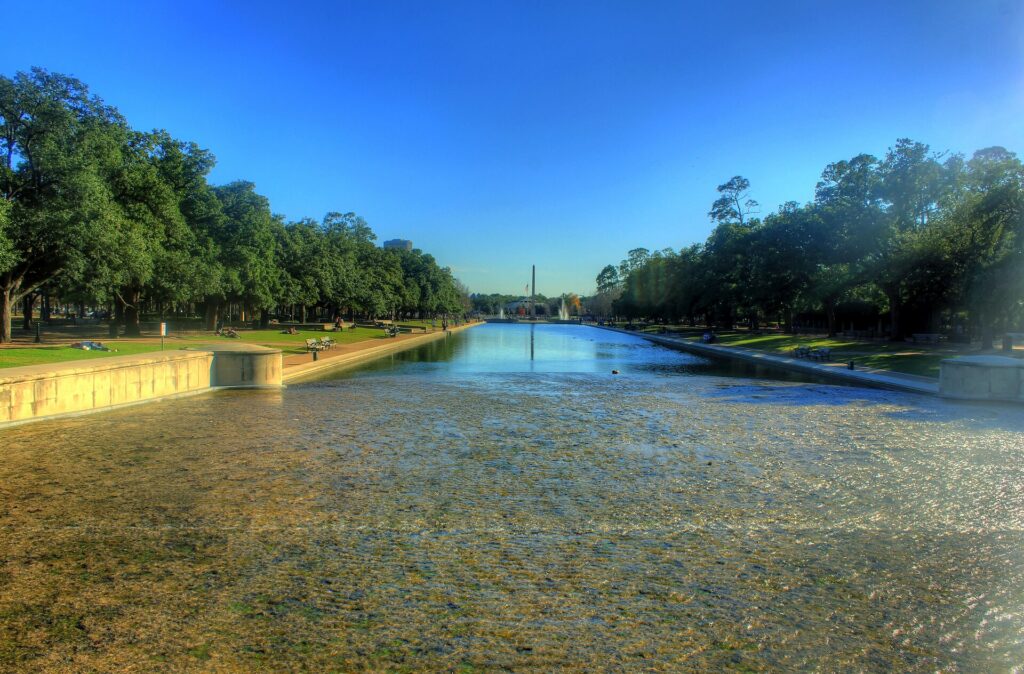
    The pond in Hermann Park, Houston
    Hermann Park in spring, the season when Houston is at its greenest and most comfortable (Photo: Yinan Chen via Wikimedia Commons, Public Domain)

    Events that move Houston flight and hotel prices

    Cross-check these against your dates before you book. Exact dates shift each year; Visit Houston keeps the current calendar.

    • Houston Marathon (a Sunday in mid-January): fills downtown hotels for one weekend.
    • Houston Livestock Show and Rodeo (about three weeks from late February into March): the city’s biggest leisure event; the rodeo’s site has dates and the concert lineup.
    • Texas spring break (usually mid-March, varies by school district).
    • Offshore Technology Conference (early May): the sharpest business-hotel spike of the year.
    • Juneteenth (June 19) and Houston Pride (June).
    • Fourth of July, Memorial Day and Labor Day weekends, when Galveston and the coast fill up.
    • Hurricane season (June to November, peaking from mid-August to early October): low prices, higher risk.
    • Thanksgiving and Christmas to New Year.
    • Astros playoff runs, Texans home games, and stadium concerts. Our Houston events page shows what is on sale for your dates.
    • Big conventions, which can fill downtown hotels on weeknights; if your mid-week rates look strangely high, that is usually why.

    Getting in from the airport

    Houston has two commercial airports, both run by the Houston Airport System. George Bush Intercontinental (IAH), about 37 kilometers (23 miles) north of downtown, is the larger: a major United Airlines hub with nonstop flights across the United States and to dozens of cities in Latin America, Europe, Asia and the Middle East, and several terminals linked by an airside train. The drive downtown takes 30 to 45 minutes without traffic and closer to an hour at rush hour; taxis and ride-hail pick up outside every terminal, a shuttle bus runs to the consolidated rental car center, and METRO’s local bus service to downtown is cheap but slow. William P. Hobby (HOU), about 11 kilometers (7 miles) southeast of downtown, is dominated by Southwest Airlines, has a compact terminal with an international concourse for flights to Mexico, Central America and the Caribbean, and is 20 to 30 minutes from downtown by car. Hobby is also the closer airport for Space Center Houston and Galveston. Our guides to IAH and Hobby cover the layouts, and our Houston car-versus-transit guide works through whether to rent.

    George Bush Intercontinental Airport (IAH) in Houston
    Bush Intercontinental (IAH), a major United Airlines hub and Houston's main international gateway (Photo: Famartin via Wikimedia Commons, CC BY-SA 4.0)

    Timing tricks that work for Houston

    • Search both airports. United dominates IAH and Southwest dominates Hobby, and the cheaper airport changes from route to route and week to week. A calendar search on TicketScanner that includes both shows the difference instantly.
    • Book the hotel first for the rodeo and OTC. A cheap fare is not cheap once the room is added. Run a Houston hotel search for the same dates before you commit to either.
    • Fly mid-week, stay the weekend. Business traffic makes Monday morning and Thursday evening the priciest flights on most routes, while downtown and Galleria hotels often discount Friday and Saturday nights.
    • Book flexibly in late summer. August and September are the cheapest months, and a refundable fare or a flexible hotel rate costs little extra insurance against a tropical storm.
    • Pair Houston with Dallas. The two cities are about four hours apart on I-45, and fares into Dallas sometimes undercut Houston; a one-way rental makes a classic Texas trip. Our guide to the best time to fly to Dallas covers that end.
    • Allow time at IAH. Security and immigration lines can be long at peak times; our guide to how early to arrive covers what to allow.
    • Flying out of Houston instead? The same seasonality applies in reverse; see cheap flights from Houston.
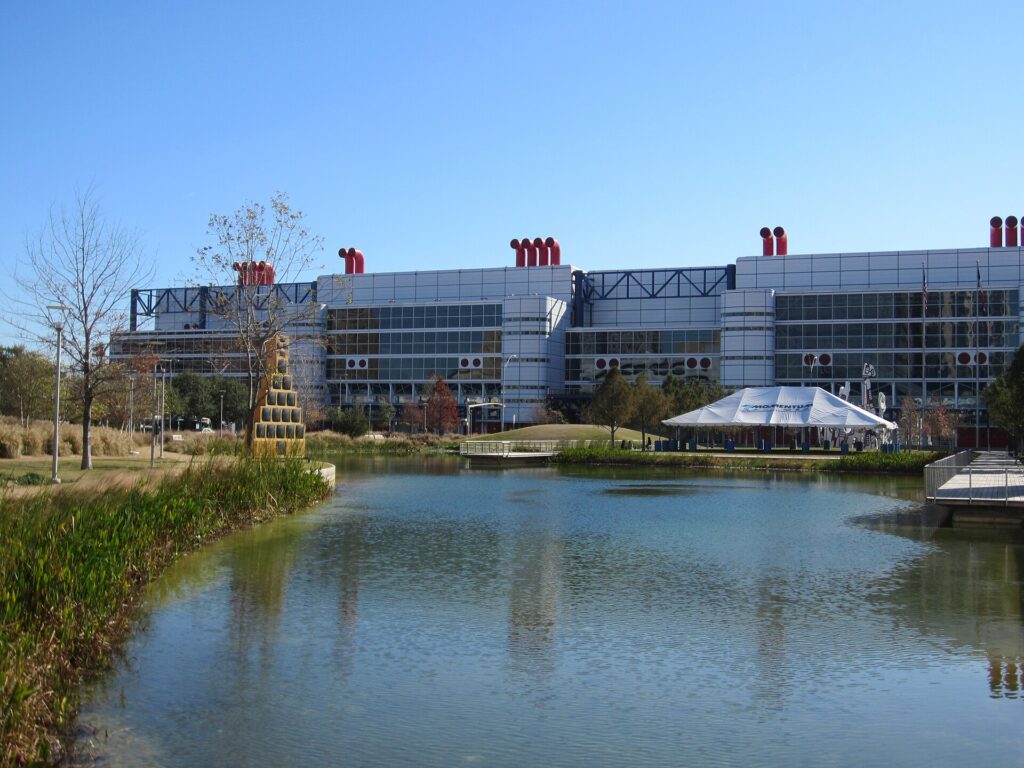
    The lake at Discovery Green in downtown Houston, with the George R. Brown Convention Center behind
    Discovery Green, downtown Houston's front lawn, busiest from October to April when the heat eases (Photo: Another Believer via Wikimedia Commons, CC BY-SA 3.0)

    What to pack, by season

    Summer (June to September): the lightest, most breathable clothes you own, a hat, sunscreen, a refillable water bottle, a compact umbrella for the afternoon storms, and a light layer for the fierce air-conditioning indoors. Spring and fall (March to May, October to November): light clothes for warm days, a light jacket for the evenings and the odd cold front, and rain gear. Winter (December to February): layers and a medium jacket; most days are mild, but a front can drop the temperature sharply overnight. In every season, comfortable shoes for the museums and something smarter for Houston’s restaurants, which dress up more than visitors expect.

    The best time to fly to Houston for…

    The rodeo

    Late February to mid-March, booked as early as you can manage, with the hotel first and concert tickets bought when the lineup is announced.

    Space Center Houston and Galveston

    April to May or October to November, when the weather is warm enough for the beach but not punishing, and the Space Center’s tram lines are shorter than in the summer holidays.

    The best weather

    Mid-October to early December and March to April. Days are warm, evenings are comfortable, and the humidity is manageable.

    The lowest fares

    Late August and September, and January after the holidays. For late summer, book flexibly and keep an eye on the tropical forecast.

    Families

    Spring break is busy but ideal for the Space Center and the museums; the week after Thanksgiving and late October are calmer. In summer, lean on the indoor attractions and plan Galveston for the morning.

    International visitors

    Visitors from Visa Waiver Program countries need an approved ESTA before boarding; most others need a visa. The State Department’s travel site explains what applies to you, and the TSA lists what you can carry through security. IAH handles most long-haul arrivals, so allow time for immigration and customs.

    Frequently asked questions

    What is the cheapest month to fly to Houston?

    September is usually the lowest, followed by late August and January after New Year’s week. Early December before the holiday rush is also good value.

    What is the best month to visit Houston for weather?

    October and November, with March and April close behind. Summer is hot and humid; winter is mild but can be gray.

    Should I avoid Houston during hurricane season?

    Not necessarily. The season runs from June to November and most visits are unaffected, but from mid-August to early October book flexibly, consider travel insurance, and check the National Hurricane Center’s outlook before you go.

    How hot does Houston get in summer?

    Highs are typically in the mid-90s °F (about 35 °C) in July and August, and the humidity pushes the heat index above 100 °F (38 °C) on many days.

    Should I fly into IAH or Hobby?

    Compare both. IAH has far more international flights and is the United hub; Hobby is closer to downtown, the Space Center and Galveston, and is Southwest’s base.

    How far ahead should I book?

    Earlier for the rodeo, spring break, OTC week, Thanksgiving and Christmas, when fares tend only to rise; for late summer and January, finding the right dates matters more than booking early.

    Does it snow in Houston?

    Very rarely. Measurable snow falls only once every few years at most, but hard freezes do happen occasionally in winter, and the city is not equipped for ice when they do.

    Ready to pick your dates? Compare fares across the whole month on our Houston flights page, then find a room with our Houston hotel search. For what to do when you land, start with our first-timer’s guide to Houston.