How you get around once you land shapes a trip more than most people expect. It decides how much of your day goes to logistics, what you can realistically see, where it makes sense to stay, and a surprisingly large share of the budget. The choice is usually framed as three options, rent a car, use public transport or take taxis and ride-hail, but the best answer for most trips is a mix, chosen deliberately rather than by default. This guide explains how to make that call for any destination: the factors that actually decide it, what each option really costs and demands, how to learn an unfamiliar transit system quickly, how to use taxis and ride-hail without overpaying, and a table that matches the right approach to the kind of trip you are taking.
The short answer
Rent a car when the places you want to see are spread out, when transit is thin, when you are traveling as a family or group with luggage, or when the trip is about national parks, coastlines, small towns or a road trip. Use public transport when you are staying in a dense city with a real rail or metro network, when parking is scarce and expensive, and when most of your plans are within the city. Use taxis and ride-hail for the gaps: airport runs with bags, late nights, short hops where transit is awkward, and days when time matters more than money. And for many trips, the winning combination is transit and walking for the city days, a rental for the day trips, and an occasional taxi when it is late or raining. You can compare rental rates for just the days you need on our car rental search.
The seven factors that decide it
1. The shape of the destination
This matters more than anything else. Cities built before the car, or rebuilt around rail, such as New York, London, Paris, Rome, Toronto, Montreal and Washington, reward going car-free; their attractions are close together, their transit is frequent, and driving and parking are slow and costly. Cities that grew up around the freeway, such as Los Angeles, Phoenix, Houston, Dallas and Orlando, spread attractions across huge distances and run transit that works for commuters more than visitors. Rural areas and national parks often have no useful transit at all.
2. Where you are staying
The same city can be a car trip or a transit trip depending on the hotel. A downtown hotel near a metro station makes a car unnecessary; a resort, a suburban rental or a relative’s house can make one essential. If you are flexible, it is often cheaper overall to pay a little more for a central, well-connected hotel than to pay for a car and parking to reach a cheaper one. Our hotel search lets you compare by neighborhood.
3. What is on the itinerary
List the places you want to go and ask how you would reach each one without a car. If most are in the center, transit wins. If two or three are an hour or more outside the city, consider renting only for those days. If most are spread out, rent for the trip.
4. Who is traveling
A solo traveler or couple with carry-ons can use any system. A family with a stroller, car seats and four suitcases, a group of five, or a traveler with limited mobility may find a car or taxis far easier, and the cost per person of a rental falls as the group grows.
5. The real budget
Transit is almost always the cheapest option per trip. A rental can be good value for a group, but its cost is more than the daily rate, as the next section shows. Taxis and ride-hail are the most expensive per mile and the cheapest overall only when you take very few trips.
6. Your comfort with driving there
Driving on the other side of the road, in a manual car, through narrow historic streets, in snow or in heavy city traffic is a real cost in stress and risk. Be honest about it. If you would not enjoy it, the trip will be better without it.
7. Time
On a short trip, time is the scarcest resource. A car can save hours when destinations are far apart; transit can save hours in a city where driving means traffic and parking hunts; a taxi can save the last hour before a flight.
What each option really costs
People tend to compare the rental rate with a transit fare and a taxi quote, which misleads in both directions. A fair comparison adds up everything for your actual plans.
A rental car costs the daily rate, plus taxes and airport fees, plus any young-driver or additional-driver fees, plus insurance you need to buy, plus fuel or charging, plus tolls and the rental company’s toll-program fees, plus parking at the hotel each night and at each stop during the day. In a big downtown, overnight hotel parking alone can rival the daily rate. Our rental car booking tips explain how to read the full price.
Public transport costs the fares, or a day or weekly pass, plus the airport link if it charges a premium, plus the occasional taxi for the trips transit does not cover. Many systems cap what you pay in a day or week when you tap with the same card, which makes it hard to overspend.
Taxis and ride-hail cost the fare, which rises with distance, time in traffic and demand, plus tips where customary, plus airport or event surcharges. A few rides a day across a big city add up fast.
To compare, sketch your days, estimate how many trips you would take and how far, and total each option. For a couple spending four days in a transit-rich city, transit plus two or three taxis will usually come out well ahead. For a family of five spending a week touring a spread-out region, the rental usually wins.

Renting a car: freedom, with overhead
Where it shines
- Flexibility. Leave when you want, stop where you want, change the plan halfway through the day.
- Reach. Trailheads, beaches, wineries, small towns and viewpoints that no bus serves.
- Luggage and gear. Strollers, skis, coolers and beach chairs travel with you, and you can leave things in the trunk between stops (out of sight).
- Families and groups. One vehicle carries everyone, and the per-person cost drops with each passenger.
- Privacy and comfort. Your own climate control, music and schedule, which matters on long days with children.
Where it hurts
- Parking in dense cities is expensive, scarce and time-consuming, and hotels often charge for it nightly.
- Traffic in large cities can make a car slower than the train at the times you want to travel.
- Unfamiliar rules: right turns on red (legal in most of the US and Canada, but not on the island of Montreal), camera-enforced restricted zones in European historic centers, toll roads that only take transponders, and roundabout etiquette.
- One designated driver means one person who cannot relax, drink at dinner or watch the scenery.
- Responsibility: damage, tickets, fuel, return times and insurance are all yours to manage.
Make a rental work better
Rent only for the days you need it, from a neighborhood branch if you are starting in the city. Choose a hotel with reasonable parking, or one on the edge of the center with easy transit in. Download offline maps. Learn how tolls are charged before you drive. And read our guide to car rental return timing so an extra hour does not turn into an extra day.

Public transport: cheap, fast in the right places, and easier than it looks
Where it shines
- Cost. Usually the cheapest way to move around, often dramatically so.
- Speed in dense cities. A metro line under a congested downtown beats any car at rush hour.
- No parking, no driving stress. You arrive, walk out of the station and start exploring.
- A view of local life, and in some cities, such as the ferries in Vancouver or Halifax, genuinely scenic rides.
- Lower emissions per traveler than a car or a taxi.
Where it falls short
- Coverage. Fixed routes and timetables do not reach everything, and service thins out at night, on weekends and away from the center.
- Luggage. Stairs, crowded trains and turnstiles are hard with big suitcases and strollers.
- Crowding at rush hour, and a learning curve in an unfamiliar language.
- Accessibility varies. Some older systems have many stations without elevators; check before you rely on them.
How to learn a new system in 20 minutes
- Look at the official map before you travel. Identify the lines near your hotel and the main sights, and note the line colors or numbers.
- Find out how to pay. Many large systems now take contactless bank cards and phones at the gate or on the bus, including London, New York, Toronto, Vancouver and Chicago, and many cap daily or weekly spending when you tap with the same card. Others use their own card or an app. The operator’s site, such as Transport for London, the MTA in New York or the TTC in Toronto, explains fares and passes.
- Check the airport link. Many airports have a direct rail connection, such as the Elizabeth line and Piccadilly line at Heathrow, the RER B at Paris Charles de Gaulle, the UP Express at Toronto Pearson, the Canada Line at Vancouver and the Blue Line at Chicago O’Hare, but some charge a premium fare. Our airport guides, such as Heathrow and Toronto Pearson, cover the options.
- Use a journey planner. The operator’s own app or a general map app will give live times; download the offline map in case you lose signal underground.
- Learn the late-night picture. Know when the last train runs and whether night buses replace it, so you are not stranded after dinner.
Taxis and ride-hail: convenience on demand
Where they shine
- Door to door, with no transfers and no parking.
- Airport runs with luggage, children or an early flight.
- Late nights, bad weather, and neighborhoods transit does not reach.
- Short trips across awkward gaps, where the transit route would take three times as long.
Where they fall short
- Cost adds up quickly, especially over longer distances or several trips a day.
- Surge pricing on ride-hail apps at peak times, after concerts and games, and in bad weather.
- Traffic slows them as much as a rental.
- Waits can be long at busy times or in less populated areas, and in some rural places there are simply no drivers.
Taxi or ride-hail?
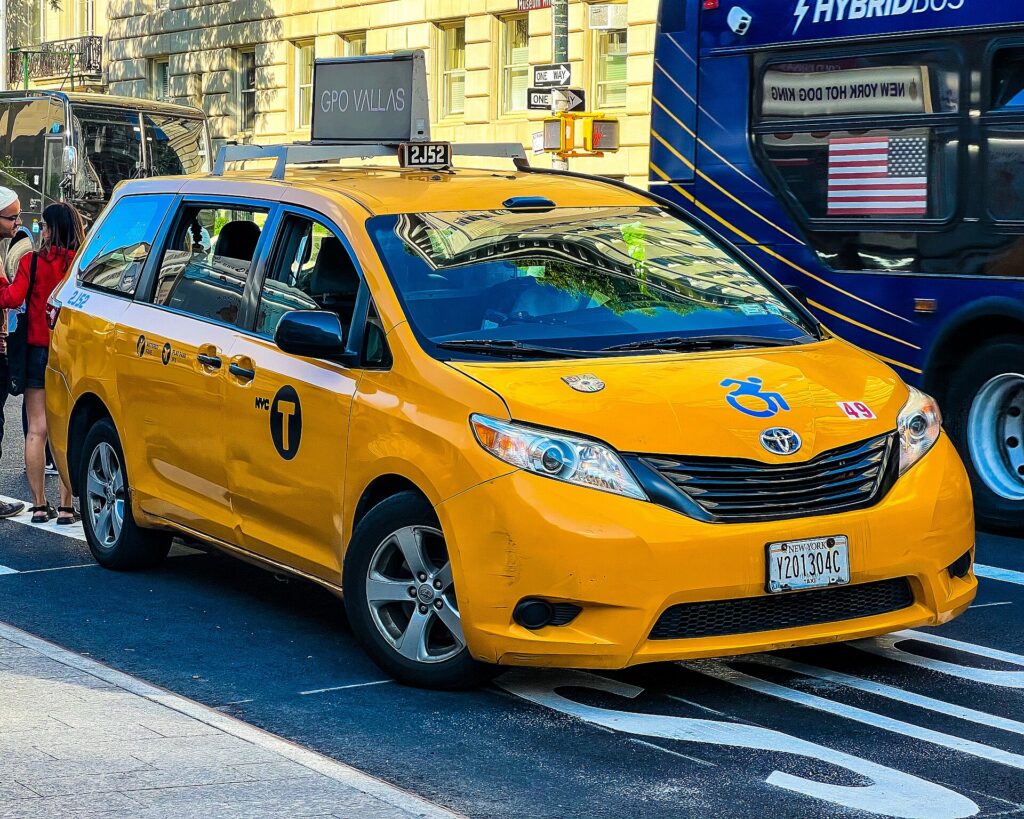
In most US and Canadian cities, Uber and Lyft operate alongside licensed taxis, and outside North America you will find Uber in many countries alongside strong local apps. Ride-hail shows the price before you book, which helps in a new city; taxis can be quicker to find at a rank and are sometimes cheaper during surges. Some airports set flat taxi fares into the city, including JFK to Manhattan and the Paris airports into central Paris; check the current amount on the official airport or city site, such as the NYC Taxi and Limousine Commission, before you get in.
Using them safely and fairly
- At airports, use the official taxi rank or the designated ride-hail pickup zone, and decline offers from people approaching you in the arrivals hall.
- For ride-hail, match the plate and driver in the app before getting in.
- For taxis, make sure the meter is running or agree the fare first where fares are fixed.
- Know the tipping norm: customary in the US and Canada, less so in much of Europe.
- If you have children who need car seats, know that rules for taxis vary by place and that most taxis and ride-hail cars will not have one; bring your own or plan around it.
The options people forget
- Walking. In compact centers, the best way to see a city is on foot, and it costs nothing.
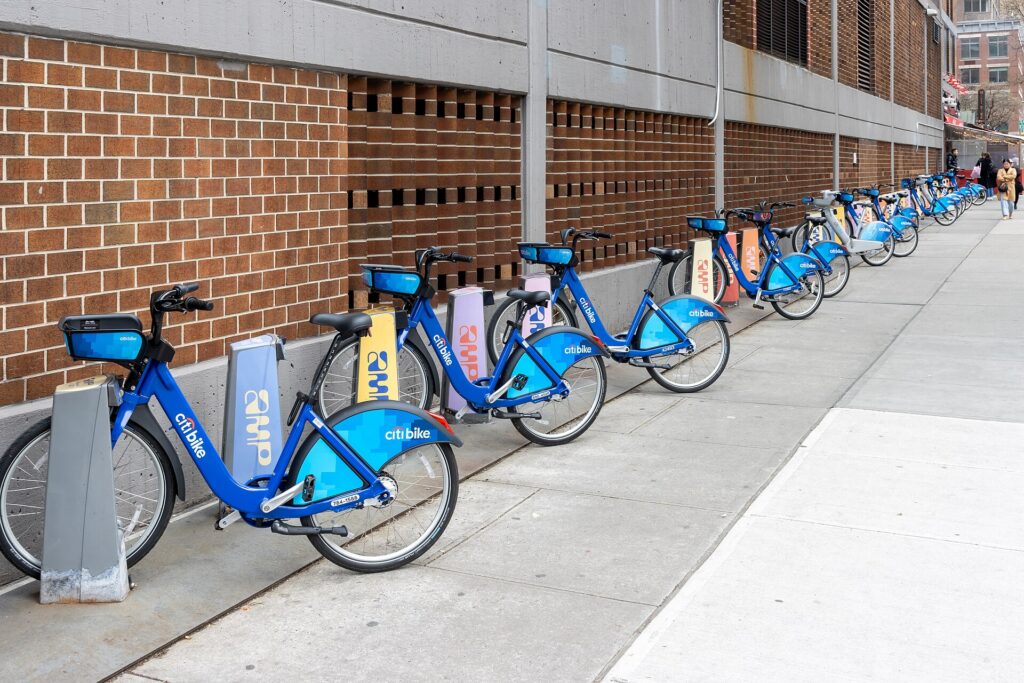
- Bike share and scooters. Most large cities have docked bike share; they are ideal for short hops along waterfronts and park paths. Check the local rules on helmets and where you may ride.
- Car share by the hour. In some cities, members can book a car for a few hours, which can beat a full-day rental for a single errand or excursion; sign-up usually takes time, so arrange it before the trip.
- Airport and park shuttles. Scheduled coaches from airports to resort towns and national parks, and in-park shuttle systems, can replace a car for the part of the trip where it would be hardest to park.
- Intercity trains and buses. For city-to-city legs, a train can be faster than driving once you count traffic and parking at both ends.
- Day tours. For one remote sight, a tour with transport included can cost less than a day’s rental with fuel and parking.
Match the approach to the trip
| Trip type | Usually best | Why |
|---|---|---|
| City break in a transit-rich city | Transit and walking, taxis at night | Frequent service, expensive parking, sights close together |
| City break in a spread-out city | Rental car, or ride-hail if staying central | Long distances, thin transit away from the core |
| City plus day trips | Transit in the city, rent for the day-trip days | Pay for the car only when it earns its keep |
| Road trip or national parks | Rental car | No practical alternative for most routes |
| Beach or theme-park resort | Depends on the resort; a car for spread-out areas, shuttles where provided | Some resorts are self-contained, others spread over many miles |
| Family with young children | Rental car in most places; transit and taxis in the densest cities | Car seats, luggage, naps and flexibility |
| Solo traveler on a budget | Transit and walking | Cheapest per trip; a rental does not divide |
| Group of four to six adults | Rental or a large ride-hail car | Cost per person falls sharply |
| Business trip, downtown hotel | Taxis or ride-hail, airport rail link | Time matters, parking is costly, trips are short |
| Traveler with limited mobility | Taxis or accessible ride-hail; transit where fully accessible | Door to door, fewer stairs and transfers |
City examples
A few illustrations of how the balance shifts:
- New York: the subway and your feet cover almost everything; a car in Manhattan is a burden. See our New York guide.
- Toronto: transit and walking work well downtown, and a rental earns its keep for Niagara, cottage country or a drive to Montreal. See our Toronto guide.
- Washington, DC: Metro and walking cover the Mall and the main neighborhoods. See rent a car or take the Metro.
- Los Angeles and Phoenix: distances are large and a car is the default for most visitors. See our guides to Los Angeles and Phoenix.
- Las Vegas: the Strip is walkable and served by taxis and ride-hail, while a car makes sense for Red Rock, Hoover Dam or the Grand Canyon. See do you need a rental car in Las Vegas.
- Calgary: transit covers the core, but most visitors are headed for Banff and the Rockies. See our Calgary guide.
- Rome and Paris: historic centers restrict traffic, and a car is only worth it for countryside days. See our guides to Rome and Paris.
Mix and match: three sample plans
Four days in a big transit city
Take the airport train or a taxi to a central hotel. Use a contactless card or a multi-day pass for the metro and buses, walk as much as possible, and budget for a taxi or two at night. No rental.
A week split between a city and the countryside
Spend the first days in the city on transit. On the morning you leave, pick up a rental from a neighborhood branch near your hotel, drive out for the countryside days, and return it at the airport before your flight, pricing the one-way fee first.
A family week in a spread-out destination
Rent at the airport so the car seats go in once, choose a hotel or vacation rental with free parking, and plan each day around one or two areas to limit driving. Use ride-hail for a night out if the drivers want to relax. Our guide to car rentals for family vacations covers the vehicle and seat questions.
Common mistakes
- Renting for the whole trip by default, then paying for a car that sits in a garage for three days.
- Ignoring parking when comparing hotels and rentals.
- Relying on ride-hail in remote areas, where drivers are scarce and you can be stranded after a hike or a late dinner.
- Taking unofficial taxis offered inside airport terminals.
- Not checking the last train, and paying a surge fare at midnight.
- Underestimating the airport journey, whether by traffic, a rental return shuttle or a transfer; our guide to how early to get to the airport helps plan the buffer.
Frequently asked questions
Is it cheaper to rent a car or use taxis?
It depends on how many trips you take. For a few short rides a day in a city, taxis are often cheaper once you count parking, fuel and fees on a rental. For long distances, many stops or a group, a rental usually wins.
Is public transport safe for tourists?
In most major cities, yes, and it is used by millions of residents daily. Use normal city sense: keep valuables secure, stay aware late at night, and prefer busier cars and stations.
Should I rent a car at the airport or later?
If your first days are in a transit-friendly city, rent later from a neighborhood branch. If you are heading straight out of town or traveling with kids and luggage, rent at the airport.
Are Uber and Lyft available everywhere?
They are widely available in US and Canadian cities, and Uber operates in many other countries, but coverage is thin in rural areas and some countries favor local apps or licensed taxis. Check before you rely on them.
Can I use my credit card to pay for transit?
In many large cities, yes, by tapping a contactless card or phone at the gate or farebox. Check the operator’s site before you go.
What is the best option for a family?
In most destinations, a rental car, because of car seats, luggage and flexibility. In the densest cities, transit, walking and the occasional taxi are often easier.
Do I need a car to visit national parks?
Usually, yes, though some parks run shuttles and some gateway towns have coaches from the nearest airport. Check the park’s own site for current options and any vehicle reservation rules.
Once you have picked your approach, build the trip around it: compare cheap flights, choose a well-connected base with our hotel search, and price a rental for only the days you need on our car rental page.
Keep planning with TicketScanner
- Rental car booking tips: the complete guide
- Car rental return timing: early, late and after hours
- Best car rental services for family vacations
- Compare car rentals — rent only for the days you need
- New York: car rental or public transit?
- Toronto: car rental or public transit?
- Las Vegas: do you need a rental car?
- Washington, DC: rent a car or take the Metro?