“Get there three hours early” is the standard advice for international flights, and for many trips it is about right. But it is a rule of thumb, not a law. The time you actually need depends on the airport, the season, the time of day, whether you are checking bags, which border controls you pass through before boarding and who you are traveling with. Arrive too late and you can miss a check-in deadline you did not know existed, even with the plane still at the gate. Arrive far too early and you spend hours in a terminal you did not need to be in. This guide explains what the three hours is actually for, the deadlines that matter, the factors that add or remove time, how U.S. preclearance at Canadian airports changes the math, what happens when you land, and how to build a timeline for your own flight.
The short answer
For most international flights, plan to arrive about three hours before departure, which is what many airlines and large airports recommend. Allow more at peak holiday periods, at very large or unfamiliar airports, when you are checking bags, traveling with children or needing assistance, and when you clear U.S. customs and immigration before boarding at a Canadian airport. You can cut it closer at a smaller airport, off-peak, with no checked bags and a trusted traveler membership, but never plan to arrive after the airline’s check-in and bag drop deadlines. The three numbers to look up for every flight are the check-in cutoff, the bag drop cutoff and the boarding gate closing time. Your airline’s website lists them, and your airport’s website usually lists its own recommended arrival times.
What the three hours is actually for
The recommendation is built from a sequence of steps, each of which can take a few minutes or a long time depending on the day. Here is a typical international departure, working backward from the departure time.
| Step | Typical time needed | What can slow it down |
|---|---|---|
| Getting to the airport and into the terminal | Varies; add a buffer to your normal travel time | Traffic, parking shuttles, rental car returns, weather |
| Check-in and bag drop | A few minutes to more than an hour | Peak times, document checks, oversize items, overweight bags |
| Security screening | A few minutes to more than an hour | Time of day, holidays, bags pulled for extra screening |
| Exit controls or U.S. preclearance (some airports) | A few minutes to an hour or more | Several departures at once, secondary inspection |
| Walking or taking a train to the gate | 5 to 30 minutes at large airports | Remote gates, terminal transfers |
| Boarding | Often begins 30 to 60 minutes before departure on long-haul flights | Document checks at the gate on international flights |
On a quiet day, all of this can take well under an hour. On a busy day, each step can stack. The three-hour guideline gives you enough margin for a bad day at most large airports, and on a good day, time for a meal before you board.
The deadlines that actually matter
Airlines set hard cutoffs, and missing them can cost you your seat even if the aircraft has not left. These vary by airline, airport and route, so check the details for your flight; the principles are the same everywhere.
Check-in cutoff
This is the latest time you can check in for your flight, online or at the airport. For international flights, it is commonly around 60 minutes before departure and can be earlier at some airports and on some routes. After the cutoff, the system may close and the airline can give your seat away. Checking in online, often from 24 hours before departure, protects you from missing this one, but international passengers sometimes must still have documents verified at the counter before a boarding pass is issued.
Bag drop cutoff
If you are checking a bag, there is usually a separate, and sometimes earlier, deadline for dropping it off. Bags need time to be screened and loaded. Arrive after the bag drop closes and you may be told you can fly without the bag or not at all.
Boarding gate closing time
Gates typically close somewhere from 10 to 30 minutes before departure, often earlier on international and wide-body flights, so the airline can finalize the passenger list and close the doors on time. “Departure time” means the time the aircraft door closes and it pushes back, not the time you need to reach the gate.
Put all three times in your calendar the day before, and plan to be at the gate well before boarding begins. Our flight details guide explains where to find these times on your booking and boarding pass.
What adds time, and what saves it
| Factor | Effect | What to do |
|---|---|---|
| Peak holidays and school breaks | Longer lines at every step | Add an hour to your usual buffer |
| Early morning departure bank | Many flights leave at once; security can be busy right after opening | Check when security opens and arrive with margin |
| Checked bags | Adds the bag drop step and its cutoff | Use online check-in and bag tags where offered |
| Children, strollers, car seats | Slower at security and check-in | Add 30 minutes or more; see family lanes where available |
| Wheelchair or mobility assistance | Assistance must be arranged and can take time | Request assistance in advance through the airline and arrive early |
| Pets, sports equipment, oversized items | Special handling counters and documents | Confirm airline procedures and add time |
| U.S. preclearance or exit passport control | An extra border control before the gate | Add time; use trusted traveler programs if eligible |
| Returning a rental car | Return, inspection and shuttle to the terminal | Add 30 minutes or more; see our car rental return timing guide |
| Trusted traveler membership | Faster security or border lanes | Can cut time significantly, but lanes are not always open |
| Carry-on only, checked in online | Skips the counter entirely at many airports | Go straight to security if no document check is required |
Trusted traveler programs
If you fly internationally more than once or twice a year, a trusted traveler program is the most effective way to shorten your airport time.
- NEXUS is a joint Canada and U.S. program for pre-approved travelers. It provides expedited border processing when entering Canada and the United States, and members can use dedicated security lines at many Canadian airports.
- Global Entry is the U.S. program for expedited entry into the United States for pre-approved travelers.
- TSA PreCheck provides expedited security screening at participating U.S. airports, on participating airlines.
Applications take time and include an interview or in-person step, so apply well before a trip. Eligibility and benefits change, so check the official page before relying on a program for a specific flight.
Flying from Canada to the U.S.: preclearance
Several large Canadian airports, including Toronto Pearson, Vancouver, Montreal, Calgary, Edmonton, Ottawa, Winnipeg and Halifax, have U.S. preclearance. That means you go through U.S. customs and immigration in Canada, before you board, and arrive in the United States as if on a domestic flight.
Preclearance makes arrival easy, but it moves a border control to the start of your trip. After check-in and security, you queue for U.S. Customs and Border Protection, and the time this takes varies with how many U.S.-bound flights are leaving at once. For that reason, transborder flights often need as much time as long-haul international flights. Many airports and airlines recommend arriving around the same time as for international departures. Checked bags travel through the preclearance process too, so bag drop deadlines can be earlier.
If you are traveling between Canada and the U.S., our guide to cheap flights between New York and Toronto covers the route, and our Toronto Pearson airport guide explains the terminals.
Departing from the U.S., the UK and Europe
From the United States
The U.S. does not have exit passport control in the way many countries do. After check-in, you go through TSA screening, and your airline checks your passport and any required visa or authorization for your destination at check-in or the gate. The liquids rule for carry-on bags is explained on the TSA liquids page, and the full list of what you can bring is on TSA’s What Can I Bring page.
From Canada
Canada does not have exit immigration either. Screening is carried out by CATSA, whose site lists what you can pack. For flights to the United States from a preclearance airport, add the U.S. border step described above.
From the UK and the Schengen area
Leaving the Schengen area involves exit passport control after security, and the EU’s digital Entry/Exit System, which records non-EU travelers’ biometrics, can add time, particularly during rollout and at busy times. Large hubs such as London Heathrow and Paris Charles de Gaulle also have long walks and transit trains between areas, so allow extra time when returning home too.
Security rules that slow people down
Most delays at screening come from avoidable items in carry-on bags. The main principles are similar at most airports, though details differ and change, so check before you fly.
- Liquids: in Canada and the U.S., carry-on liquids, gels and aerosols generally must be in containers of 100 ml (3.4 oz) or less, together in one clear, resealable bag of about one liter. Some airports with newer scanners have relaxed these rules, but assume the limit applies unless your departure airport says otherwise, and remember the return airport may have different rules.
- Electronics: have laptops and larger electronics easy to reach in case you are asked to remove them.
- Sharp items and tools: check the rules for knives, scissors, tools and sporting goods before packing.
- Batteries: spare lithium batteries and power banks typically must be in carry-on, not checked bags.
- Clothing: belts with big buckles, heavy jewelry and complicated footwear slow things down. Our guide to what not to wear on a flight covers what makes screening easier.
- Bag size: an oversized carry-on can be sent back to check-in at the gate. Check your airline’s limits; our carry-on size guide explains how.
Getting to the airport
Your airport timeline starts at home. Build a buffer into the journey itself, especially at rush hour and in winter.
- Public transit and airport trains: often the most predictable option at rush hour. Toronto has the UP Express from Union Station to Pearson, and Vancouver’s Canada Line runs to YVR. Check the first and last trains for early or late flights.
- Driving and parking: allow time to park and take a shuttle from long-term lots, which can add 20 to 30 minutes. Reserve airport parking ahead at busy times.
- Rental car returns: returning a car, having it inspected and taking a shuttle to the terminal can take longer than expected.
- Staying near the airport: for very early departures, a hotel near the airport can remove the biggest source of uncertainty. Our hotel search can show properties near major airports.
How to build your own timeline
Instead of guessing, work backward from your flight.
- Start with departure time and look up the gate closing time for your airline. Aim to be at the gate at least 15 minutes before boarding begins.
- Add the walk to the gate, which can be 20 minutes or more at large airports.
- Add security and any border control. Many airports show estimated wait times online. At busy times, allow at least 30 to 60 minutes for each.
- Add check-in and bag drop if you need them, and make sure the result is well before the cutoffs.
- Add your journey to the airport plus a buffer for traffic or transit delays.
For most international trips, this works out close to the three-hour guideline. At a small airport off-peak, with no bags and a trusted traveler card, it may be less. At a major hub during the holidays, it may be more.
Examples
| Scenario | Suggested arrival | Why |
|---|---|---|
| Long-haul flight from a major hub, checked bags, summer | 3 hours or a little more | Busy counters, security and long walks |
| Transborder flight from a Canadian preclearance airport | About 3 hours, especially at peak times | Security plus U.S. customs and immigration before boarding |
| International flight from a small regional airport, carry-on only | About 2 hours | Shorter lines, but deadlines still apply |
| Family with young children and a stroller, holiday period | 3.5 hours or more | Every step takes longer, and you want time for a break |
| Traveler needing wheelchair assistance | At least the airline’s recommended time, plus a buffer | Assistance is coordinated across check-in, security and the gate |
These are planning examples, not guarantees. Always check your airline’s and airport’s current recommendations for your flight.
Notes on some major airports
Every airport publishes its own advice, and it is worth reading before you go. A few patterns at airports our readers use most:
- Toronto Pearson (YYZ): Canada’s busiest airport, with two terminals connected by a free automated train. Know which terminal your airline uses before you set out, and allow time for U.S. preclearance on transborder flights. The Toronto Pearson website shows current guidance and security wait estimates.
- Vancouver (YVR): the main gateway to Asia and a preclearance airport for U.S. flights. Domestic, U.S. and international departures use different areas of the terminal, so follow signs for your flight type.
- Montreal-Trudeau (YUL): handles domestic, transborder and international flights in one terminal building with separate zones, and has U.S. preclearance.
- Calgary (YYC): has U.S. preclearance and a busy international area in summer and during the ski season.
- New York JFK: several separate terminals linked by the AirTrain. Road traffic to the airport can be slow, so many travelers use rail connections to the AirTrain instead of a taxi at rush hour.
- London Heathrow (LHR): multiple terminals that are not all walkable from each other; check your terminal, and allow for long walks and transit to remote gates.
- Paris Charles de Gaulle (CDG): a very large airport where terminals can be far apart. Leave time for exit passport control on flights leaving the Schengen area.
Whatever the airport, check your terminal the day before. Going to the wrong one is among the most common ways people lose half an hour they did not have.
Using the extra time well
Arriving early is less painful if you plan to use the time. International terminals often have better food and more seating than domestic ones. If you have lounge access through your ticket, status or a card, check its hours and location beforehand. If you are flying in a premium cabin, our guides to business class upgrade strategies and the difference between first and business class explain the lounge and priority lane benefits that come with them. Otherwise, a refillable water bottle, a snack and a charged phone make the wait easier.
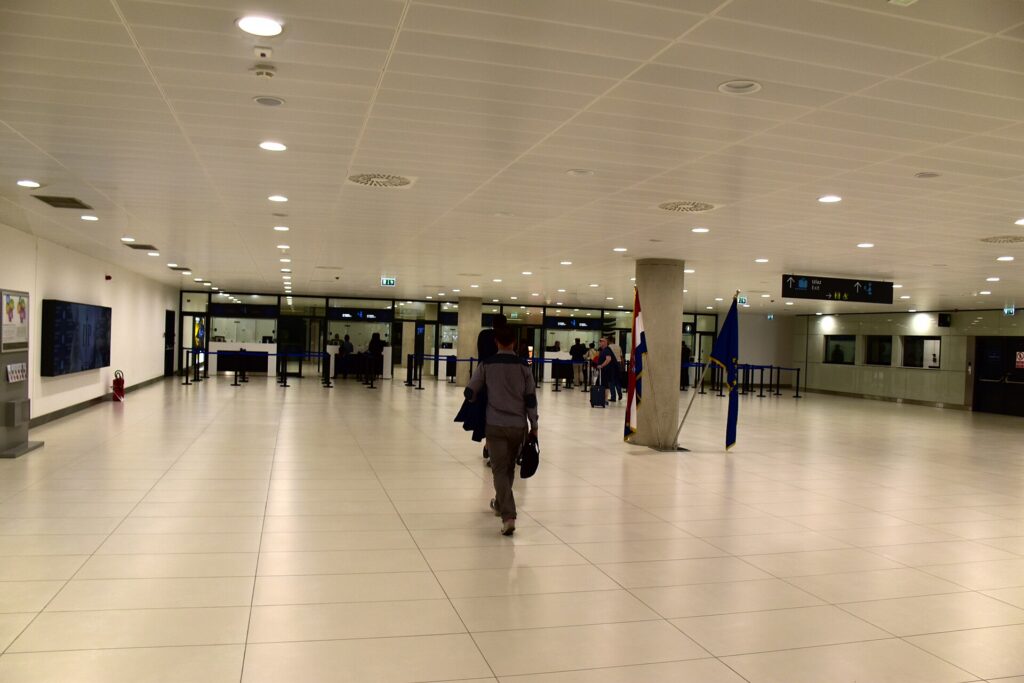
When you land: immigration and customs
The other half of the airport experience is arriving. Plan for it when you book connections and ground transport.
- Immigration: present your passport and any visa or authorization. Many airports use automated kiosks or e-gates for eligible passengers. Queues vary widely with how many flights arrive together.
- Baggage claim: if you checked bags, collect them before customs.
- Customs: declare goods as required. Entering Canada, the Canada Border Services Agency explains what to declare; entering the U.S., U.S. Customs and Border Protection does the same.
- Connections: if you connect after arriving in a new country, you may need to clear immigration, collect and recheck bags and go through security again. This is why international connections need more time; our international flights booking tips cover how much to allow.
If you are running late
- Check in online as soon as you can, so you are inside the check-in deadline.
- Contact your airline through its app or phone line; it may be able to rebook you before you miss the flight.
- Tell staff in line if your flight is close to closing; many airports have procedures to help passengers on imminent flights.
- Do not abandon a checked bag plan at the last minute without asking; a bag that misses the cutoff may need to travel on a later flight.
- Know the rules if you miss it: policies vary by airline and fare. Some airlines have a same-day rebooking policy for passengers who arrive shortly after departure; others treat a missed flight as a no-show, which can cancel the rest of your itinerary.
The day before your flight
- Check in online when it opens and download or print boarding passes.
- Check the flight status and the terminal.
- Look up check-in, bag drop and gate closing times.
- Confirm your passport, visa or electronic authorization.
- Pack liquids and electronics where you can reach them.
- Weigh checked bags.
- Plan your journey to the airport, including a backup.
- Set two alarms for early departures.
Frequently asked questions
Is three hours really necessary for an international flight?
Often, yes, at large airports and busy times. At a smaller airport off-peak, with no checked bags, two hours may be enough. Always stay well ahead of the check-in, bag drop and gate closing deadlines.
How early should I arrive for a flight from Canada to the U.S.?
At airports with U.S. preclearance, plan for roughly the same time as an international flight, because you clear U.S. customs and immigration before boarding. Check your airport’s current guidance.
What happens if I arrive after check-in closes?
The airline can refuse to check you in, and you may need to rebook. Policies vary; contact the airline immediately.
Does online check-in mean I can arrive later?
It helps, especially with carry-on only. International passengers may still need a document check at the counter, and security and border lines take the same time either way.
How long does security usually take?
From a few minutes to an hour or more depending on the airport, time of day and season. Many airports publish live wait times on their websites.
Should I arrive earlier during holidays?
Yes. Add at least an hour around major holidays, school breaks and long weekends.
Can I arrive too early?
Yes. Check-in counters for a specific flight often open only a few hours before departure, so arriving much earlier with bags may mean waiting landside. If you have a very early arrival, check when your airline’s counter opens and whether the airport offers bag storage.
How long does it take to clear immigration when I land?
It varies widely by airport and time of arrival. Trusted traveler programs and automated kiosks can shorten it considerably.
Ready to book? Compare departure times as well as fares on our flight search, since an early-morning flight changes your airport timeline, and read our guide to the best time to book cheap flights and hotels before you choose dates. If you need a room near the airport for an early start, check our hotel search.
Keep planning with TicketScanner
- Best time to book cheap flights and hotels
- International flights booking tips
- Flight details, decoded
- Carry-on size guide
- What not to wear on a flight
- Cheap flights from New York to Toronto
- Car rental return timing
- Compare flights — check departure times as well as fares
- Toronto Pearson (YYZ) airport guide
- Best time to fly to Montreal