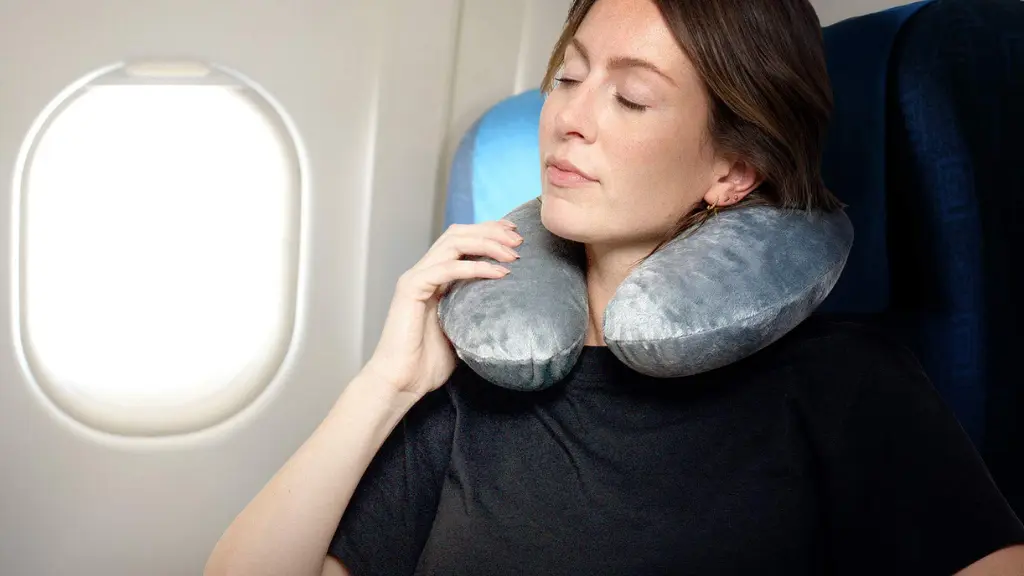
Airplane seats are not designed for sleeping. Unless you are lying flat in a premium cabin, your head has nowhere good to go: it drops forward onto your chest, rolls sideways onto a stranger’s shoulder, or props awkwardly against a cold window. You wake up with a stiff neck, a dry mouth and the feeling that you barely slept. A good travel pillow does not turn an economy seat into a bed, but it gives your head something to rest on and keeps it from lolling around, and that can be the difference between arriving wrecked and arriving able to function. The catch is that travel pillows come in very different designs, and the one that works for a friend may be useless for you. This guide explains the main types, how to match one to the way you sleep, what to look for in materials, fit and packing, how to use a pillow well on a plane, and the pillows from our original list with who each one suits. It is part of our travel gear series, which starts with our main guide to choosing travel luggage.
The short answer
If you tend to nod forward when you fall asleep sitting up, choose a pillow with chin or front support, such as a 360-degree design or a memory foam pillow with an adjustable front clasp, ideally one that straps to the seat. If you lean sideways against the window or the wing of the headrest, a firm U-shaped memory foam pillow or a wrap-style support with a strong side works well. If space is tight, an inflatable pillow packs to almost nothing and lets you set the firmness. Whatever you choose, make sure it comes with a compression case or bag, has a removable washable cover, and does not push your head forward against the seat’s headrest. Try it sitting upright in a chair at home for twenty minutes before a long flight.
Why the classic horseshoe pillow often disappoints
The soft, bead-filled horseshoe sold at every airport kiosk is the pillow most people picture, and it is the one most people give up on. There are three common reasons:
- It is too soft. A squashy pillow compresses under the weight of your head, so your head still drops, just a little more slowly.
- It does nothing at the front. The open end of the U sits under your chin, which is exactly where most people’s heads fall when they sleep upright.
- It is too thick at the back. A fat back section pushes your head forward against the seat’s headrest, which can make your neck more uncomfortable, not less.
Better designs address one or more of those problems: firmer materials, front or chin support, a flatter back, or a way to anchor the pillow to the seat. Knowing which problem you have is the key to choosing well.
Types of travel pillows
Memory foam U-shaped pillows
Memory foam pillows keep their shape under your head better than fiber-filled ones, so they give firmer side support. Better designs have raised sides and a flatter back, so they do not push your head forward. Their drawback is bulk: even with a compression case, they take up noticeable room. They suit travelers who lean sideways and value support over packing size.
Memory foam pillows with front support or seat straps
Some memory foam pillows add an adjustable front clasp that closes the gap under the chin, and straps that wrap around the seat’s headrest to hold the pillow in place and stop your head falling forward. They are among the most effective options for people who nod forward, and they suit long-haul flyers who sleep sitting upright.
360-degree and chin-support pillows
These pillows wrap the whole way around the neck, with support at the front and sides. Some include a hood, and some come in kits with an eye mask and earplugs. They suit forward-nodders but can feel warm, and some people find that full wrap-around support feels restrictive.
Inflatable pillows
Inflatable pillows deflate to pocket size, which makes them the best choice when space is tight or you carry a small bag. You can adjust firmness by how much air you put in, and a soft cover, often velour, makes them more comfortable against the skin. The trade-offs are that they can feel less cozy than foam, can slowly lose air, and need blowing up on board. Some inflatable designs include eye masks and earplugs in the set.
Microbead pillows
Microbead pillows are filled with tiny beads that move to fit your neck, giving a soft, squishy feel. They are comfortable for resting and are easy to squeeze into a bag, but they usually give less firm support than memory foam.
Twist and bendable pillows
Twist pillows are long, flexible tubes of foam that you can bend into different shapes: around the neck, under the chin, behind the lower back or between the knees. They suit travelers who shift position a lot or want one pillow for several uses on a road trip or train.
Wrap-style supports
Wrap-style supports look like a soft scarf with a built-in support on one side. You wrap them around your neck, with the support on the side your head leans towards. The maker trtl is known for this design and describes an internal support system that keeps the head and neck in position. They pack flatter than a U-shaped pillow and suit side-leaners.
Regular soft pillows
Some travelers simply bring a small soft pillow to wedge against the window or to support their lower back. It is less structured than a neck pillow but versatile, and it is comfortable in hotels and on trains. It takes up space, so it works best if you clip it to your bag in a pillow bag or case.
| Type | Support | Packed size | Best for | Watch out for |
|---|---|---|---|---|
| Memory foam U-shape | Firm side support | Bulky, smaller in a compression case | Side-leaners, long flights | Thick backs that push the head forward |
| Memory foam with front clasp or seat straps | Side and front; anchored to seat | Bulky, smaller in a compression case | Forward-nodders | Takes a moment to set up |
| 360-degree or chin support | All around | Medium to bulky | Forward-nodders | Can feel warm or restrictive |
| Inflatable | Adjustable firmness | Pocket size | Light packers | Slow air loss, less cozy |
| Microbead | Soft, conforming | Small, squashable | Resting rather than deep sleep | Less firm support |
| Twist or bendable | Flexible, multi-position | Medium | Road trips, people who shift position | Less support at the front |
| Wrap-style | One-sided support | Flat | Side-leaners who pack light | Less help for forward-nodders |
Match the pillow to how you sleep
Before you buy, think about what your head actually does when you doze off in a chair. If you are not sure, ask a travel companion or notice how you wake up on a train or in front of the television.
You nod forward
This is the most common pattern. You need front support: a 360-degree pillow, a pillow with an adjustable front clasp, or a design that straps to the seat’s headrest. A standard horseshoe will not help much.
You lean sideways
You need firm side support on the side you lean toward, plus something that stops your head sliding off. A firm U-shaped memory foam pillow, a wrap-style support, or a window seat with a soft pillow against the wall all work. The window seat is a big help here; the aisle seat gives you nothing to lean on.
Your head tips backward
Less common in economy, but it happens when the seat reclines. A flatter-backed pillow that fills the gap behind the neck without pushing the head forward is best, combined with the adjustable wings on the seat’s headrest if your aircraft has them.
You shift around a lot
A twist pillow or a soft pillow you can move around gives you options through a long flight. Some travelers carry a compact inflatable plus a small soft pillow for the lower back.
What to look for
Firmness
Firmer is usually better for sleep, because a soft pillow compresses under your head. Memory foam and well-inflated air pillows are firmer than fiber or bead fills. If a pillow feels lovely and soft when you squeeze it in a shop, it may be too soft to hold your head.
Back thickness
Look for a flatter back section, so the pillow does not push your head forward against the seat’s headrest. This is the most common design flaw in cheap pillows.
Height and adjustability
People have different neck lengths and shoulder widths. Adjustable clasps, drawstrings or inflation let you tune the fit. If a pillow sits too low, your head drops anyway; too high and it pushes your chin up.
Cover material and washability
A removable, machine-washable cover is important for hygiene, since the pillow sits against your skin and hair for hours. Soft fabrics feel nice but can be warm; breathable or cooling fabrics suit hot climates and warm sleepers. Check the care instructions before washing.
Packing size and a case
A pillow you leave at home helps nobody. Many memory foam pillows come with a compression case that squeezes them down and clips to a bag. Inflatables pack smallest. If you carry only a backpack, packing size may decide everything. Our guide to bags and cases for travel pillows covers ways to carry a pillow without using up bag space.
Accessories
Some pillows come in kits with an eye mask, earplugs and a carry bag. That can be good value if you do not already own them. A contoured eye mask that does not press on your eyelids is worth having on any overnight flight.
Pillows from our original list
The pillows below were featured in the original version of this guide. They cover different sleep styles and budgets rather than a strict ranking. Designs and features change, so check the current details from the maker or seller before you buy. Where we have linked to a maker’s page, the details mentioned come from that page.
Cabeau Evolution S3
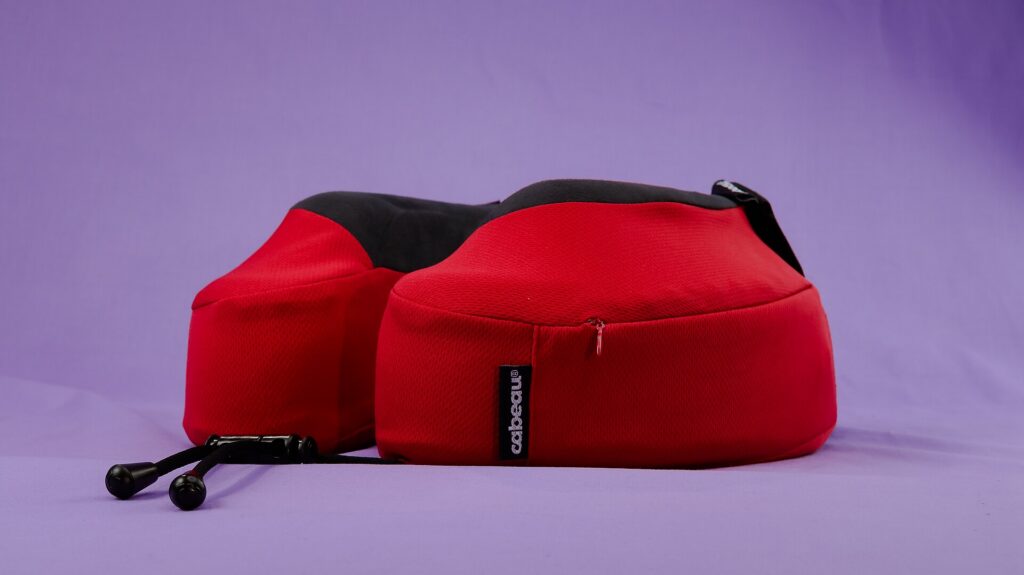
The Cabeau Evolution S3 is a memory foam pillow with raised side supports and a flat back, which addresses the “pushes my head forward” problem. Cabeau describes a sliding front support clasp for a customizable fit, a seat strap system that attaches the pillow to the seat, a removable washable cover, and a travel case that compresses the pillow to about a third of its size. It suits long-haul flyers who nod forward or sideways and want one of the more supportive designs.
Cabeau The Neck’s Evolution
Cabeau also makes The Neck’s Evolution S3, a memory foam pillow with an adjustable strap system designed to support the head in all directions, seat straps, a removable machine-washable cover and a compact travel case. It suits travelers who want support all around, including under the chin.
SNUGL memory foam neck pillow
The SNUGL pillow was featured as a memory foam neck pillow with a carry bag and clip. It suits travelers who want a straightforward memory foam pillow they can clip to their luggage.
Dot&Dot Twist memory foam pillow
The Dot&Dot Twist is a bendable memory foam pillow that can be shaped to support the neck, chin, lower back or legs. It suits road-trippers, train travelers and anyone who shifts position a lot.
360-degree pillow kit with eye mask and earplugs
The original list included a 360-degree neck pillow sold as a kit with a contoured eye mask, earplugs and a mesh carry bag. It suits forward-nodders who want a complete sleep kit in one purchase. Check the listing for cover washability and packed size.
Soft microfiber travel pillow
A soft microfiber pillow in charcoal was on the original list. It is light and easy to pack, and it suits travelers who want gentle comfort rather than firm support, for resting and short naps.
Adjustable memory foam pillow
The list also featured a memory foam airplane pillow with adjustable height and firmness. Adjustability helps if standard pillows sit too high or too low on your neck.
Inflatable pillow with velour cover
A basic inflatable pillow with a soft velour cover and drawstring bag was featured for travelers who want something light and compact that supports the head, neck and chin.
Cloudz microbead neck pillow
Cloudz was featured for its microbead pillow, which molds to the neck and has a soft cover. It suits travelers who like a squishy feel and mainly want to rest rather than sleep deeply.
Sunany inflatable pillow
The Sunany pillow was featured as an inflatable design sold with an eye mask and earplugs. It suits light packers who want an adjustable pillow and a small sleep kit.

How to use a travel pillow well
- Choose your seat with the pillow in mind. A window seat gives side-leaners something to rest against and means nobody needs to climb over you. Aisle seats suit people who want to get up often.
- Sit well back in the seat. Get your lower back against the seat back first. A small cushion or rolled sweater behind the lower back can help.
- Put the thick part where your head falls. If you nod forward, turn a U-shaped pillow around so the thicker section is under your chin, or use the front clasp.
- Use the seat straps if your pillow has them, and the adjustable headrest wings if the seat has them.
- Adjust inflation during the flight. Air expands and contracts as cabin pressure changes, so an inflatable may need topping up or letting down a little.
- Add an eye mask and earplugs or headphones. Light and noise wake you as much as a lolling head does. Our guide to noise-cancelling headphones for flying covers the noise side.
- Dress for sleep. Layers you can add or remove help, since cabins swing between warm and cold. Our guide to what not to wear on a flight covers clothing that makes sleep harder.
Sleep better on a long flight
A pillow is one piece of a bigger routine. On overnight and long-haul flights:
- Pick flight times that match your body clock where you can. Overnight departures make it easier to sleep on board.
- Limit caffeine and alcohol before and during the flight; both tend to make sleep lighter.
- Drink water regularly, since cabin air is dry.
- Get up and move when you are awake. The CDC’s guidance on blood clots and travel recommends moving your legs frequently on long trips. Our guide to compression socks for long flights covers leg comfort in more detail.
- Talk to a doctor or pharmacist before using any sleep aid. Our guide to sleeping on flights covers routines, light and seat choice.
If you have an existing neck or back condition, a pillow is a comfort item, not a treatment. Ask your doctor or physiotherapist which kind of support suits you before a long flight.
Carrying your pillow through the airport
Travel pillows are generally allowed through security, and the TSA’s What Can I Bring? tool and CATSA’s What can I bring? page let you check items in the US and Canada. Whether a pillow counts toward your carry-on allowance depends on the airline. Many airlines are relaxed about a pillow carried alongside your bags, but on strict budget fares anything outside your personal item can be questioned. Check your airline’s carry-on page, such as WestJet’s carry-on baggage rules, before you fly, and clip the pillow to your bag or pack it inside if in doubt. Our luggage guide explains how carry-on and personal-item allowances work.
Pillows for children
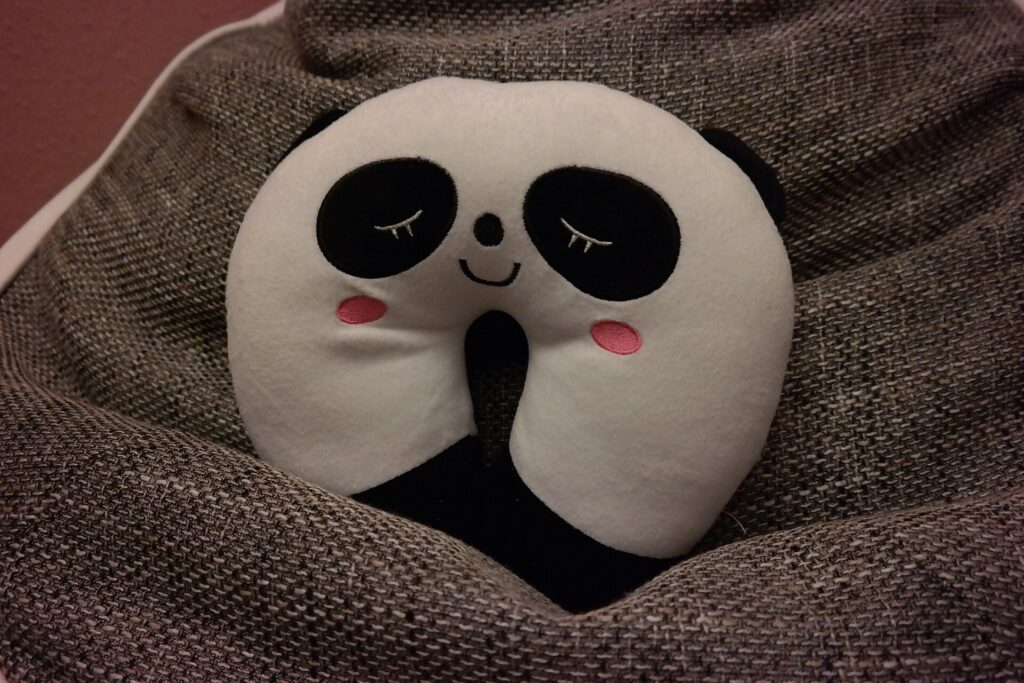
Children sleep on planes in all sorts of positions, and adult pillows are often too big for them. Smaller, softer pillows made for children, including novelty animal shapes, can make a pillow feel like a treat rather than a chore. Check that any pillow fits without pushing a child’s head forward, and follow the airline’s rules and the crew’s instructions on child seats and restraints, since a pillow must never get in the way of a seat belt.
Keeping your pillow clean
- Wash the cover regularly, following the care label, and let it dry fully before packing.
- Use the case so the pillow does not touch airport floors and seat pockets.
- Air out memory foam after a trip; do not put the foam core in the washing machine unless the maker says you can.
- Carry a spare cover on long trips if your pillow has one available.
- Replace a pillow when the foam loses its shape or an inflatable starts to leak.
Common mistakes
- Buying the softest pillow in the shop. Soft feels nice in the hand but gives little support.
- Ignoring how you actually sleep. A side-support pillow will not help a forward-nodder.
- Choosing a thick back section. It pushes your head forward.
- Leaving the pillow at home because it is bulky. Get a compression case or an inflatable instead.
- Relying on the pillow alone. Light, noise, temperature and caffeine matter as much.
- Never washing the cover. It spends hours against your skin.
Frequently asked questions
What type of travel pillow is best for sleeping upright?
For most people, a firm memory foam pillow with front support or seat straps works best, because most people’s heads fall forward when they sleep sitting up. Side-leaners do well with firm U-shaped or wrap-style supports.
Are inflatable neck pillows comfortable?
They can be, especially with a soft cover and the right amount of air. They are the best choice for packing small, though some people find them less cozy than foam.
Why does my neck pillow push my head forward?
The back section is probably too thick for the seat’s headrest. Look for a flatter-backed design, or turn the pillow around so the thick part sits under your chin.
Does a travel pillow count as a carry-on item?
It depends on the airline and the fare. Many airlines allow a pillow alongside your bags, but strict basic fares may not. Check the airline’s carry-on rules, or clip the pillow to your bag.
Can I wash a memory foam travel pillow?
Usually you wash the removable cover, not the foam core. Follow the maker’s care instructions.
Is a window or aisle seat better for sleeping?
A window seat usually, because it gives you something to lean against and nobody needs to climb over you. Choose an aisle if you want to get up and move often.
Can a travel pillow help with neck pain?
A pillow can make sitting upright more comfortable, but it is not a treatment. If you have neck or back pain or a medical condition, ask your doctor or physiotherapist what support suits you.
With your sleep kit sorted, choose a flight that gives you the best chance to rest. Compare overnight departures and schedules on our flight search, book somewhere to recover on our hotel search, and if you are driving on arrival, make sure you have slept before you pick up a car from our car rental search. Planning a long flight to Europe? Flights to Rome and our guide to things to do in Rome are a good place to start.
Keep planning with TicketScanner
- Top travel luggage bags: the buying guide — the travel gear guide
- Bags and cases for travel pillows
- Noise-cancelling headphones for flying
- Compression socks for long flights
- How to sleep on a flight
- What not to wear on a flight
- Travel pants for men
- Search flights — find an overnight departure
- Things to do in Rome