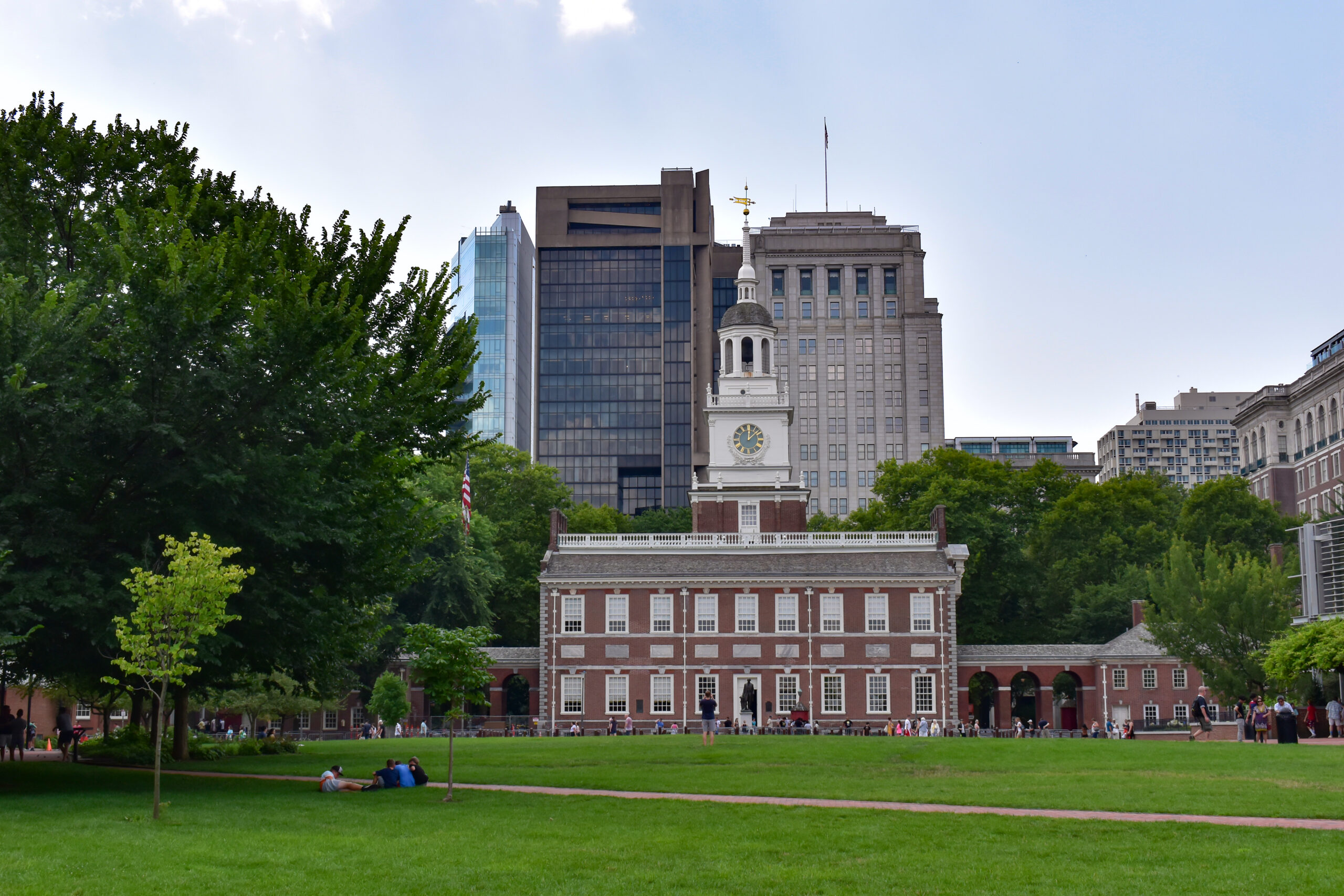
Tag: Philadelphia

  • Philadelphia: Should You Rent a Car or Rely on Public Transit?

    Philadelphia: Should You Rent a Car or Rely on Public Transit?

    Philadelphia is a city that punishes cars and rewards feet. William Penn laid out Center City in 1682 as a tight grid of narrow streets between two rivers, long before anyone imagined parking, and the historic core around Independence Hall still has brick sidewalks, cobbled lanes and streets barely wide enough for a delivery truck. Almost everything a first-time visitor wants to see, from the Liberty Bell to Reading Terminal Market, the art museum and the restaurants of Rittenhouse Square, fits inside an area you can walk across in under an hour, and SEPTA’s subway, trolleys, buses and regional trains cover the rest, including a direct train from the airport. Driving, by contrast, means some of the most congested expressways on the East Coast, a parking authority whose enforcement is part of local folklore, and hotel parking fees that add up quickly. But the car still has a job here. Valley Forge, Longwood Gardens, Lancaster County’s Amish country, Bucks County and the Jersey Shore are all classic day trips, and most of them are hard or impossible without one. This guide explains how the city is laid out, how SEPTA and the other rail systems work, what driving is really like, and gives you a straightforward way to decide.

    The short answer

    Skip the car for a city visit, which is what most first trips to Philadelphia are: SEPTA, your feet, Indego bike share and the occasional taxi will cover the historic district, Center City, the Parkway museums, South Philadelphia, Fishtown and University City, and you will save the parking and the stress. Rent a car only for the days you leave the city, for Valley Forge, Longwood Gardens and the Brandywine Valley, Lancaster County, New Hope and Bucks County, Gettysburg or the Shore, or if you are visiting family in the suburbs, traveling with small children and a lot of gear, or making Philadelphia one stop on an East Coast road trip. For most visitors, the right answer is a car-free city stay plus a one- or two-day rental. Compare rental rates for those days on our Philadelphia car rental page.

    How Philadelphia is laid out

    Center City is the rectangle between the Delaware River on the east and the Schuylkill River on the west, roughly two miles across and a mile deep, with City Hall at the center where Broad Street and Market Street cross. North-south streets are numbered, starting from Front Street at the Delaware and rising to the twenties by the Schuylkill, and east-west streets carry names, many of them trees, such as Chestnut, Walnut, Locust, Spruce and Pine. Old City and Society Hill, with Independence Hall and the oldest houses, fill the eastern end near the Delaware; Rittenhouse Square anchors the western half; the Benjamin Franklin Parkway runs diagonally northwest from City Hall to the art museum. South Philadelphia, with the Italian Market, East Passyunk and the stadiums, stretches below South Street; Northern Liberties and Fishtown lie north along the Delaware; University City is across the Schuylkill to the west. Most streets in the grid are one-way, which is logical once you know the pattern and baffling until you do. Beyond Center City the city runs far to the northeast and northwest, and the suburbs, the Main Line, Montgomery County, Delaware County, Bucks County and South Jersey across the river, are where public transit starts to thin out.

    Hotels cluster around City Hall and the Convention Center, around Rittenhouse Square, in Old City near the historic sites, in University City near 30th Street Station, and in a large group near the airport. Our Philadelphia hotel search lets you compare them.

    Getting in from the airport

    Philadelphia International (PHL) is in the southwest corner of the city, about 13 km (8 miles) from Center City, and it has one of the simplest airport connections in the country. The SEPTA Airport Line, a Regional Rail service, stops at every terminal and runs to University City, 30th Street Station, Suburban Station and Jefferson Station in around 25 minutes, typically every half hour from early morning until late evening; SEPTA’s site lists the current ticket options for the line. Taxis charge a flat fare between the airport and Center City, which takes the guesswork out of the trip, and ride-hail pickups are in marked zones outside baggage claim. The drive takes about 20 minutes in light traffic on I-95 and much longer at rush hour. The rental car companies are off-airport and run shuttles from the terminals to their lots. Unless you are heading straight out of the city, there is no reason to pick up a car on arrival. The airport’s site covers current ground transport, and our PHL airport guide covers the layout.
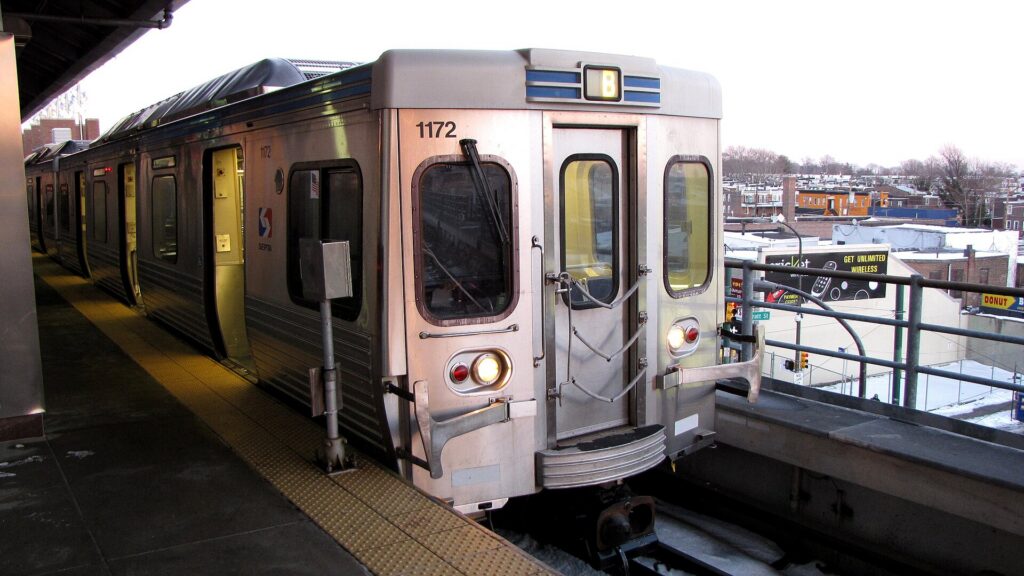
    A SEPTA Market-Frankford Line train in Philadelphia
    The Market-Frankford Line, which links Old City, City Hall, 30th Street Station and Fishtown (Photo: Ben Schumin from Montgomery Village, Maryland, USA via Wikimedia Commons, CC BY-SA 2.0)

    Philadelphia’s transit, explained

    SEPTA, the Southeastern Pennsylvania Transportation Authority, runs almost everything: two subway lines, a network of trolleys, the buses, and a large Regional Rail system that reaches the suburbs, the airport and Trenton in New Jersey. It is one of the few American transit systems that uses every mode, and for a visitor based in Center City it covers nearly everything worth seeing. It has also faced serious funding shortfalls in recent years that have brought threatened and sometimes actual service cuts, so check current schedules on SEPTA’s site before relying on a route, especially in the evenings.

    The subway and trolleys

    Two lines form a cross through the city. The Market-Frankford Line runs east-west under Market Street through Center City, with stops for Old City, Independence Mall, City Hall and 30th Street Station, then rises onto an elevated track to University City in the west and to Fishtown and the Northeast in the other direction. The Broad Street Line runs north-south under Broad Street, meeting the Market-Frankford Line at City Hall, and is the way to the stadiums at the southern end and to Temple University in the north. SEPTA has been renaming its rail transit lines under a SEPTA Metro brand, so on newer maps and signs the Market-Frankford Line appears as the L and the Broad Street Line as the B. The subway-surface trolleys run underground beneath Market Street in Center City and surface in West Philadelphia, which makes them useful for University City, and a separate trolley line runs along Girard Avenue past the zoo and through Fishtown.

    Buses

    Buses fill in the rest of the city, including the routes along South Street, Chestnut and Walnut, up to the art museum area, and out to Manayunk. Frequencies are good on the main corridors and much thinner late at night and on the outer routes. Check real-time arrivals in the SEPTA app rather than trusting a printed schedule.

    Regional Rail

    More than a dozen Regional Rail lines fan out from the Center City tunnel, which links Jefferson Station, Suburban Station and 30th Street Station. For visitors, the most useful are the Airport Line, the Manayunk/Norristown Line, the Chestnut Hill lines for the northwest neighborhoods, and the Trenton Line, which connects with New Jersey Transit trains to New York for travelers who want the cheaper, slower alternative to Amtrak. Service on most lines is roughly hourly outside the rush.

    Fares and tickets

    The simplest way to pay on the subway, trolleys and buses is to tap a contactless bank card or phone at the reader, or to load a reusable SEPTA Key card at station kiosks; paying with a Key card or contactless costs less than paying cash on a bus, and transfers are handled automatically within a set time. Regional Rail fares depend on the zone and whether you travel at peak times, and the Airport Line has its own fare. Day and weekly passes are available and worth it on a heavy sightseeing day. Young children ride free with a fare-paying adult; check SEPTA for the current age limit and fares before you go.

    Accessibility

    Every SEPTA bus is accessible, and a growing number of subway and Regional Rail stations have elevators, but some older subway stations and trolley stops still do not. SEPTA’s site lists accessible stations and elevator outages, and it is worth checking before you plan a route with luggage or a stroller.

    Beyond SEPTA

    • Walking. Center City is flat and compact, and you can walk from Independence Hall to Rittenhouse Square in about 25 minutes and to the art museum in about 40. On a pleasant day, walking is faster than waiting for a bus for most trips inside the grid.
    • Indego bike share. Indego has hundreds of stations across Center City and the neighborhoods around it, including electric bikes, and the Schuylkill River Trail from Center City past Boathouse Row is the best ride in the city.
    • PATCO. The PATCO Speedline runs from Center City across the Benjamin Franklin Bridge to Camden and the South Jersey suburbs, and it is the way to the Adventure Aquarium and the Battleship New Jersey.
    • Amtrak and New Jersey Transit. Amtrak connects 30th Street Station with New York, Washington and Boston on the Northeast Corridor, and with Harrisburg via Lancaster on the Keystone line, which makes Amish country a feasible car-free day trip. New Jersey Transit runs trains to Atlantic City and the River Line from Camden to Trenton.
    • Taxis and ride-hail. Uber, Lyft and licensed taxis operate across the city; for a group of three or four, a short ride is competitive with transit fares and far quicker for late-night returns.
    • Seasonal ferry. In the warmer months, a passenger ferry has typically crossed the Delaware between Penn’s Landing and the Camden waterfront; check before you go.
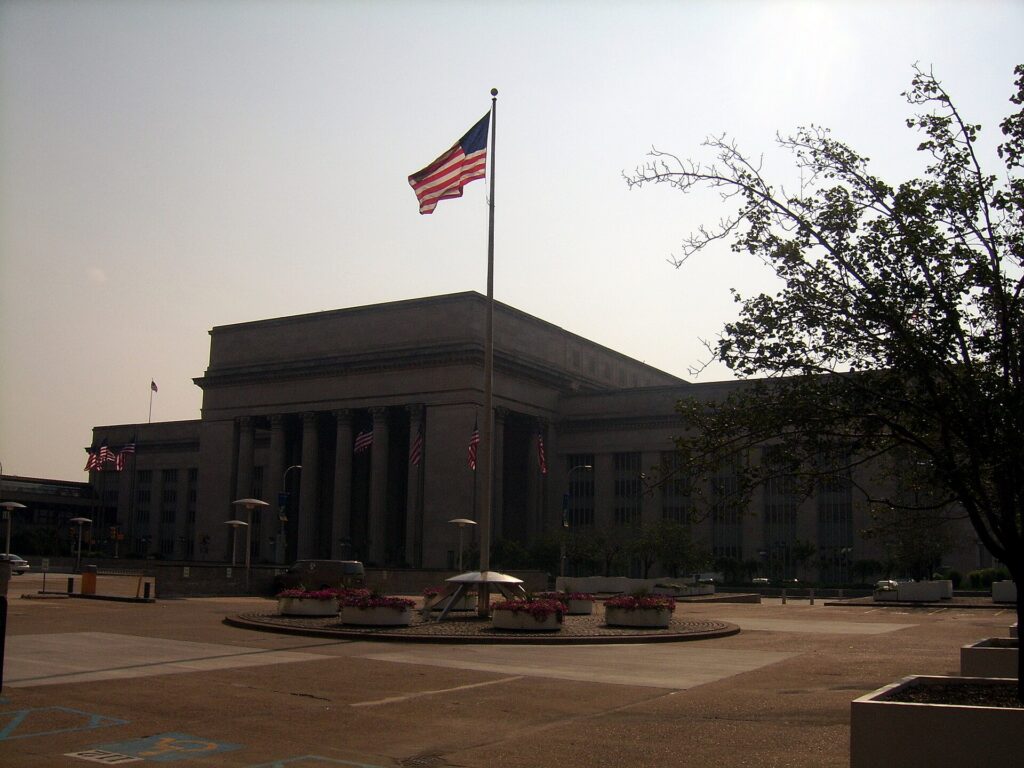
    30th Street Station, Philadelphia's main Amtrak and Regional Rail hub
    30th Street Station, where Amtrak, Regional Rail and the Airport Line meet (Photo: Reading Tom from Reading, UK via Wikimedia Commons, CC BY 2.0)

    Driving in Philadelphia: what it is really like

    Philadelphia is not the hardest city in the country to drive in, but it is harder than its size suggests. The Schuylkill Expressway (I-76), the main route from the western suburbs, Valley Forge and the Pennsylvania Turnpike into Center City, is a narrow, winding road squeezed between the river and the hills, and it jams every weekday morning and evening and often on weekends; locals have called it the “Sure-Kill” for decades. I-95 along the Delaware, the route from the airport and to New York, has its own rush-hour crawl and a long-running program of construction. The Vine Street Expressway (I-676) across the north of Center City links the two and backs up at both ends. Roosevelt Boulevard in the Northeast, a twelve-lane road with a grim safety record, now has automated speed cameras. Inside Center City, the grid of narrow one-way streets, double-parked delivery trucks, cyclists, pedestrians who cross against the light, and the cobblestones and tight corners of Old City and Society Hill make driving slow and stressful for anyone who does not know the pattern.
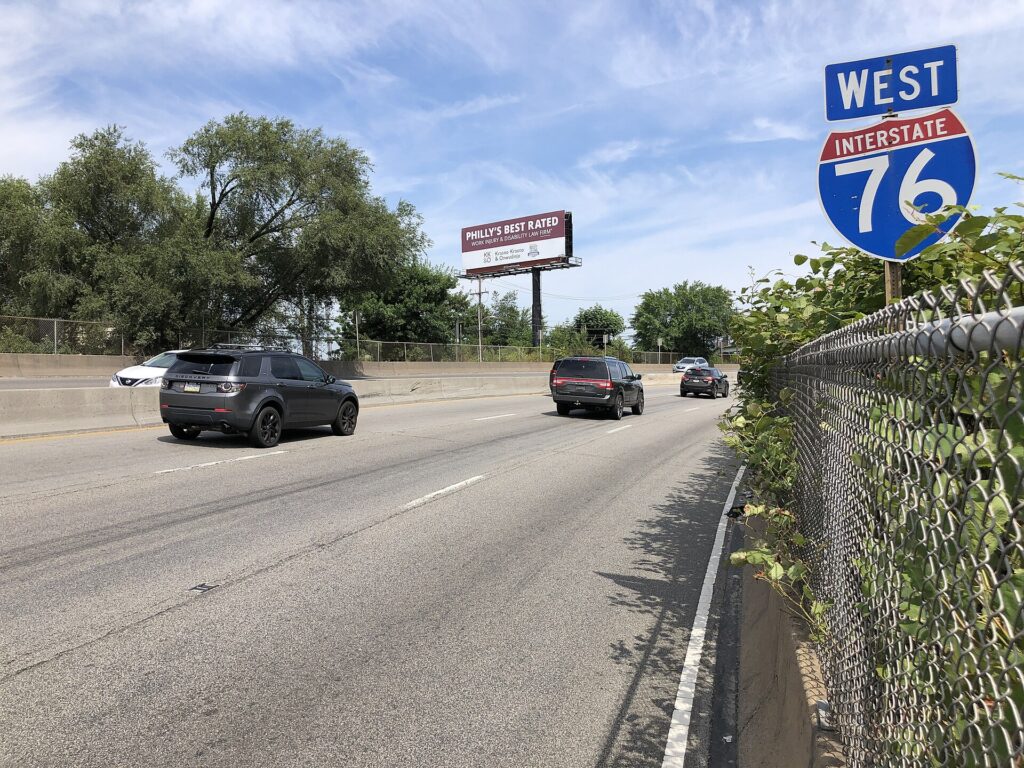
    Traffic on the Schuylkill Expressway (Interstate 76) in Philadelphia
    The Schuylkill Expressway, the main road in from the western suburbs and one of the most congested in the region (Photo: Famartin via Wikimedia Commons, CC BY-SA 4.0)

    Parking

    This is where most visitors decide the car is not worth it. On-street parking in Center City is scarce, metered and time-limited, and residential blocks in the surrounding neighborhoods are restricted to permit holders for all but a short period. The Philadelphia Parking Authority enforces the rules with an efficiency that has been the subject of its own reality television show, and a ticket or a tow is an expensive souvenir. Garages and lots are plentiful around City Hall, the Convention Center and Old City, and many offer early-bird and evening rates, but daily rates are high, and hotels charge a substantial nightly fee, often for valet only. Outside Center City, parking at the stadiums, the zoo, Valley Forge, Longwood Gardens and most suburban sights is simple, and the historic sites in Old City have a garage under the Independence Visitor Center. Pay street meters at the kiosk or with the parking authority’s app, read every sign on the block, and never park in a bus zone, a loading zone or a crosswalk.

    Rules and conditions worth knowing

    • Tolls. The Pennsylvania Turnpike, the New Jersey Turnpike and the bridges across the Delaware are tolled, most of them electronically. Many Pennsylvania Turnpike plazas no longer take cash, and the bill follows the plate; ask the rental company how its toll program works and what it charges.
    • Cameras. Red-light cameras operate at many intersections, and speed cameras on Roosevelt Boulevard and in school zones; fines follow the car, and the rental company will bill you with a fee on top.
    • Wipers on, lights on. Pennsylvania law requires headlights whenever your wipers are in use because of the weather.
    • Right turns on red are permitted after a full stop unless signed otherwise, which in Center City they often are. Left turns on red from one one-way street onto another are also legal after a stop.
    • Snow. A few storms a year bring snow emergency routes, where parked cars must be moved or towed; if you have a rental in the city during a storm, check where it is parked.
    • Game days. Eagles, Phillies, Flyers and 76ers games back up I-95, I-76 and Broad Street around the stadium complex in South Philadelphia. Take the Broad Street Line instead.
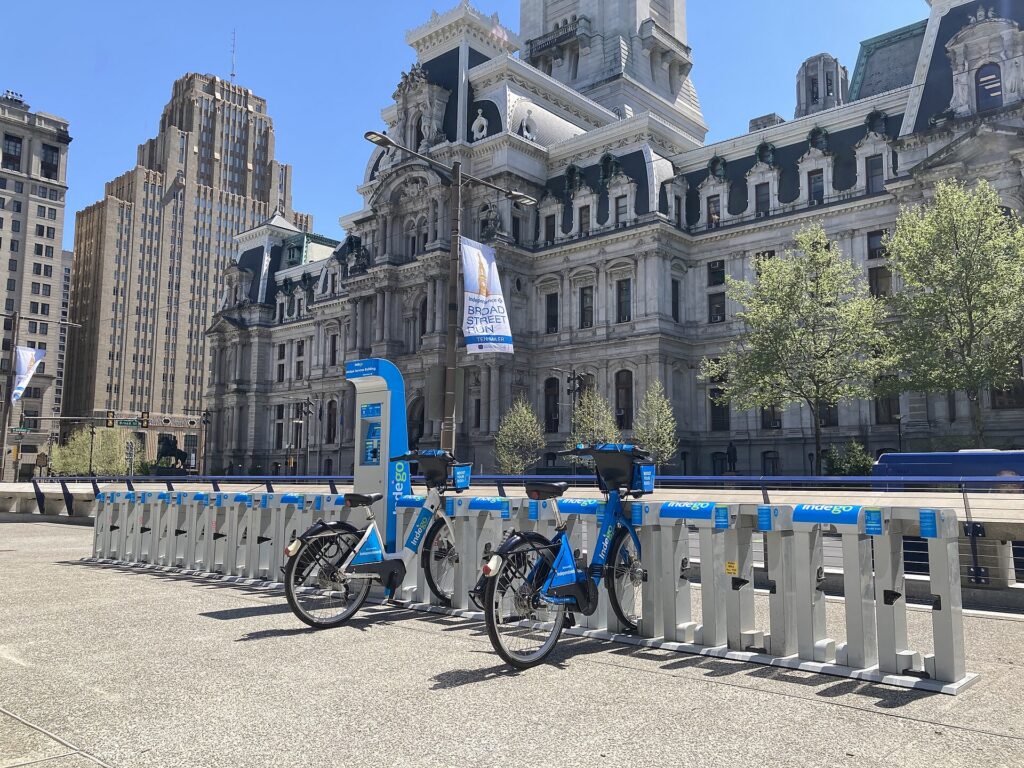
    An Indego bike share station in Philadelphia
    Indego bike share, the quickest way along the Schuylkill River Trail (Photo: Robert Perry via Wikimedia Commons, CC0)

    When renting a car makes sense

    • Valley Forge and the Main Line. Valley Forge National Historical Park is about 40 minutes northwest, and the park itself, with its driving tour past the encampment sites, is best seen by car.
    • Longwood Gardens and the Brandywine Valley. About an hour southwest, with Winterthur and the Brandywine museum nearby; public transport barely reaches them.
    • Lancaster County. The train reaches Lancaster city, but the farms, covered bridges and back roads of Amish country need a car.
    • Bucks County and New Hope. An hour north along the Delaware, with Washington Crossing Historic Park on the way.
    • The Jersey Shore. Cape May, Ocean City and the smaller shore towns are far easier by car; Atlantic City is the exception, with bus and train service.
    • East Coast road trips. Philadelphia sits between Washington and New York on I-95; our route guides for Washington, DC to Philadelphia and Philadelphia to Boston cover the drives, and our guides to Washington, DC and Boston cover what to do when you arrive.

    If any of those apply, our rental car booking tips cover insurance, deposits and the questions to ask at the counter, and our family car rental guide looks at vehicle choice.

    When it does not

    • You are staying in Center City, Old City or University City and your plans are the historic district, the museums, the markets and the neighborhoods.
    • You are in town for a convention, a game, a graduation or the Fourth of July, when parking is at its worst and SEPTA goes where you are going.
    • You are arriving or leaving by Amtrak, or combining Philadelphia with New York or Washington by train.
    • You are traveling solo or as a couple, and the rental, insurance, tolls and hotel parking add up to more than a week of transit and taxis.

    The hybrid plan for a city-plus-countryside trip

    Go car-free for the city days and rent for the countryside days, and think carefully about where you pick up. Renting at the airport makes sense only if you are heading straight out of the city on arrival, toward Longwood Gardens and the Brandywine Valley, for example, which are closer to PHL than to Center City. Renting from a downtown or 30th Street Station location makes sense if you are spending the first nights in the city, because you avoid the airport’s concession fees and the nightly hotel parking on the days you are not using the car. A common pattern that works well: the Airport Line into the city, two or three car-free days, pick up a rental in Center City in the morning, drive out for Valley Forge or Lancaster County, and return it that evening or on the way back to the airport. Leave early to beat the Schuylkill Expressway, and plan the return for after the evening rush. Compare the day rates on our Philadelphia car rental page against a full-trip rental and the difference is usually obvious.

    A worked cost comparison

    Numbers change with the season and the booking window, so treat this as a method rather than a quote, and check current rates before deciding. For a four-night city break in Center City for two people, the car-free version costs two return Airport Line fares, transit rides or a couple of day passes, an Indego ride or two along the river, and perhaps two or three short taxi trips at night; the rental version adds four days of a compact car, four nights of hotel parking at Center City rates, fuel and the airport concession fees, and buys you very little you could not walk or ride to. The transit option wins easily. For the same four nights with a day at Longwood Gardens and a day in Lancaster County, the car-free version would need an Amtrak return to Lancaster and taxis once you arrive, and would struggle to reach Longwood at all; the hybrid version adds a two-day rental picked up downtown, fuel, a toll or two and one or two nights of parking. The hybrid wins on both cost and time for almost everyone. For a family of four visiting the suburbs for a week, a rental for the whole stay is the practical answer, and the airport pickup is worth its fee. Run the rental rates for your dates on our Philadelphia car rental page and put them beside the transit costs before you choose.

    Driving out of Philadelphia in each season

    The day trips from Philadelphia are easy drives in any season, but the traffic changes with the calendar. In summer, the problem is the Shore: the Atlantic City Expressway and the roads to Cape May and Ocean City fill on Friday afternoons and Sunday evenings from Memorial Day to Labor Day, so go mid-week or leave very early. Summer thunderstorms can also flood low roads, including sections of the Schuylkill Expressway, for an hour or two. In fall, the roads to Bucks County, Lancaster County and the Brandywine Valley fill on foliage weekends in October, and Eagles Sundays make I-95 around the stadiums slow; weekday trips are calmer. In winter, snow is occasional rather than constant, and the main highways are plowed quickly, but a nor’easter can make the suburbs slow for a day or two, and the Christmas displays at Longwood Gardens draw heavy evening traffic through December. Rental cars come on all-season tires, which are fine for most winter days. In spring, the Schuylkill Expressway is at its worst on weekday rush hours as always, but the drive to Valley Forge and Longwood during the April blossoms and the May garden season is one of the best reasons to have a car. In every season, the rule is the same: leave Center City before the morning rush or after it, and come back after the evening one.

    Decision table

    Your tripRecommendationWhy
    City break in Center City, couple or soloNo carWalking, SEPTA and Indego cover it; parking is expensive and strictly enforced
    Fourth of July, a convention or a gameNo carStreets close, parking vanishes, and SEPTA goes to the Parkway and the stadiums
    City plus Valley Forge or Longwood GardensHybrid: rent downtown for one or two daysCar-free city days, car only when you leave
    Lancaster County and Amish countryRent for the day, or Amtrak plus a local tourThe train reaches Lancaster, but the farms and back roads need a car
    Philadelphia with New York or WashingtonNo car; take the trainAmtrak between city centers is faster than driving and parking
    Family visit to the suburbsRent for the whole staySuburban transit is thin and distances are long
    Jersey Shore beach daysRent, and go mid-weekMost shore towns are hard to reach without a car
    East Coast road tripRent (consider one-way)Philadelphia is a stop on I-95, not the destination

    Money-saving tips for both options

    • On transit: tap a contactless card or use a SEPTA Key card rather than paying cash; buy a day pass for a heavy sightseeing day; walk inside Center City whenever the weather allows.
    • On a rental: compare airport and downtown pickup, rent only for the days you leave the city, check the toll program before you drive, decline extras you already have through a credit card or home policy (check first), and fill the tank away from the airport.
    • On the hotel: if you are renting, price the parking fee into the room rate, and look at garages with evening or weekend rates near your hotel, which are often cheaper than hotel valet.
    • On timing: avoid the Schuylkill Expressway and I-95 in the weekday peaks and on game days, and the Shore roads on summer weekends; the best time to fly to Philadelphia guide lists the busiest weekends in the city.
    • On intercity trips: for New York, the SEPTA Trenton Line plus New Jersey Transit is slower than Amtrak but usually much cheaper; for Washington and Boston, compare Amtrak with a one-way rental for a group.

    Frequently asked questions

    Is it worth renting a car in Philadelphia?

    For a city visit, no; walking and SEPTA cover the sights, and parking is expensive and strictly enforced. For Valley Forge, Longwood Gardens, Lancaster County, Bucks County or the Shore, yes, for those days only.

    Is SEPTA good for tourists?

    Good within the city: the two subway lines, the trolleys and the buses reach nearly every sight, and the Airport Line connects every terminal to Center City. Check current schedules, as service levels have been affected by funding problems.

    How do I get from Philadelphia airport to Center City?

    The SEPTA Airport Line train in around 25 minutes, typically every half hour, or a flat-fare taxi or ride-hail in 20 to 40 minutes depending on traffic.

    How do I pay for SEPTA?

    Tap a contactless bank card or phone at the reader, or buy and load a SEPTA Key card at a station kiosk. Paying cash on a bus costs more and does not include a transfer.

    Can I get to Valley Forge without a car?

    It is possible by SEPTA bus from the Norristown area, but it is slow, and the park is spread out. A car, a bike or a tour is far easier.

    Is parking expensive in Philadelphia?

    In Center City, yes: street spaces are scarce and time-limited, garage day rates are high, and hotels charge a substantial nightly fee. Outside the center, parking is easy.

    Is it hard to drive in Philadelphia?

    The expressways are congested and the Center City grid is narrow, one-way and busy with pedestrians and cyclists. It is manageable with patience and a navigation app, but most visitors are happier without a car in the city.

    Whichever way you go, start with the flight. Compare cheap flights to Philadelphia, choose a neighborhood with our Philadelphia hotel search, and if the countryside is on the list, price the rental for those days on our Philadelphia car rental page. For what to see once you are here, start with our first-timer’s guide to Philadelphia.

  • Best Time to Fly to Philadelphia: Seasons, Weather & Prices

    Best Time to Fly to Philadelphia: Seasons, Weather & Prices

    Philadelphia is one of the easiest big cities in the country to time well, because its price calendar is driven by a handful of predictable things rather than by one overwhelming season. There is the tourist calendar, which peaks with the Fourth of July in the city where the Declaration of Independence was signed and stays busy through the summer. There is the university calendar, with dozens of colleges in and around the city sending families into hotels for move-in weekends in late August and graduations in May. There is the convention calendar at the Pennsylvania Convention Center, which can fill Center City hotels on any weeknight of the year. And there is the sports calendar, which in a city this devoted to its teams can tighten rooms on an Eagles weekend in a way that surprises visitors. Philadelphia International is also a major American Airlines hub with nonstop service across the country and to Europe, so fares from most places are competitive in every month. This guide walks through the weather month by month, the fare and hotel seasons, the events that move prices, and how to get into the city from the airport.

    The short answer

    For the best balance of weather and price, go in late April to mid-May, before the summer heat and outside the graduation weekends, or in late September through October, when the humidity has broken, the evenings are cool and the fall foliage is starting in Fairmount Park and along the Wissahickon. The cheapest time to fly and stay is January and February, outside the long weekends and the Flower Show in early March, with the first three weeks of November close behind. The most expensive stretches are the Fourth of July week, the summer from mid-June to mid-August, the graduation weekends in May, Thanksgiving and the Christmas to New Year period, and any weekend when a big convention, a stadium concert or an Eagles playoff game lands in town. Whatever you choose, run a flexible-date search on our Philadelphia flights page; moving your trip by a few days around a holiday weekend or a graduation can change the fare band entirely.

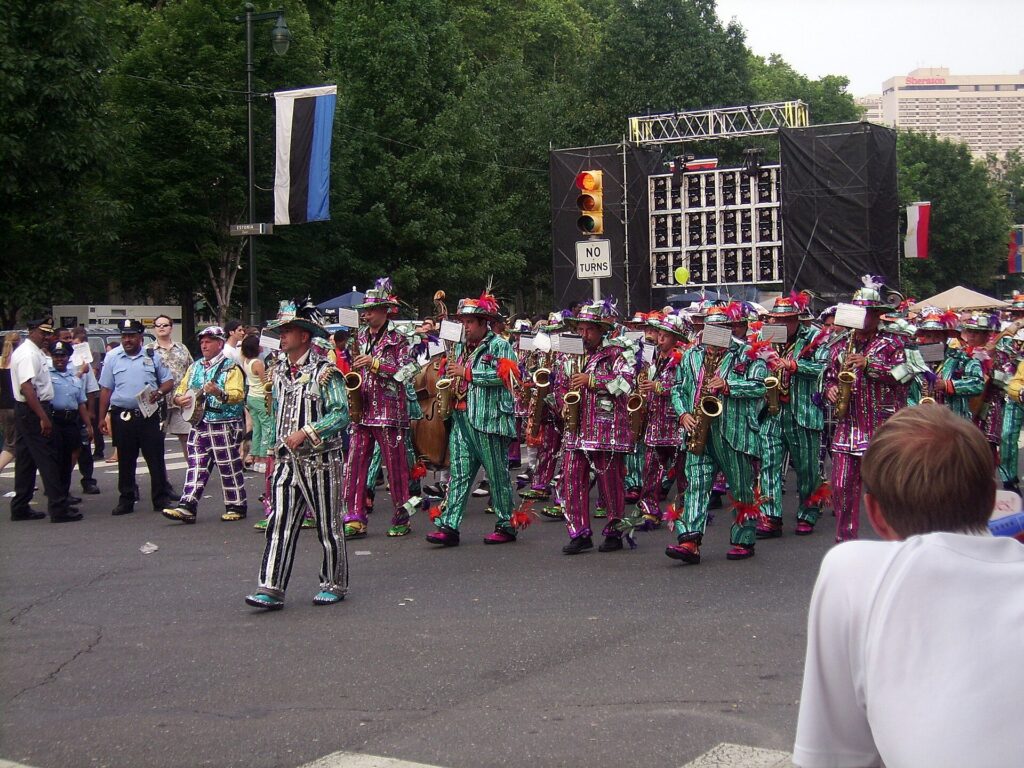
    A band marching in the Fourth of July parade in Philadelphia
    The Fourth of July parade in Philadelphia, the peak of the city's busiest and most expensive week (Photo: Reading Tom from Reading, UK via Wikimedia Commons, CC BY 2.0)

    Philadelphia’s weather, season by season

    Philadelphia sits between the Delaware and Schuylkill rivers, about 100 kilometers (60 miles) inland from the Atlantic, with a humid climate that gives it four very distinct seasons. Summers are hot and sticky with afternoon thunderstorms, winters are cold with a few snowfalls most years and the occasional big storm, and spring and fall are the seasons worth planning a trip around. The figures below are approximate seasonal patterns based on the long-term climate normals for Philadelphia International Airport from NOAA’s National Weather Service, whose Mount Holly office covers the city; check the current forecast before you pack, because March and November can each hold a mild afternoon and a hard freeze in the same week.

    MonthTypical daytime highTypical overnight lowWhat it feels likeFare pressure
    Januaryaround 5 °C (41 °F)around -3 °C (27 °F)Cold and often gray; snow in some years, raw wind off the riversLow, except New Year’s Day and MLK weekend
    Februaryaround 7 °C (45 °F)around -2 °C (28 °F)Still cold; the likeliest month for a heavy snowstormLow; rises for Presidents’ Day weekend
    Marcharound 12 °C (54 °F)around 2 °C (36 °F)Changeable; mild spells, late snow and plenty of windModerate; the Flower Show and spring break
    Aprilaround 18 °C (64 °F)around 7 °C (45 °F)Spring proper; cherry blossoms, showers, green parksModerate; school groups arrive
    Mayaround 24 °C (75 °F)around 13 °C (55 °F)Warm and pleasant; humidity starts to build late in the monthHigh on graduation weekends
    Junearound 29 °C (84 °F)around 18 °C (64 °F)Hot and humid; long evenings and thunderstormsHigh
    Julyaround 31 °C (88 °F)around 22 °C (72 °F)The hottest month; heat waves push the heat index far higherPeak around the Fourth, then high
    Augustaround 30 °C (86 °F)around 21 °C (70 °F)Hot and sticky; locals leave for the Jersey ShoreHigh, easing after mid-month
    Septemberaround 26 °C (79 °F)around 17 °C (63 °F)Warm and gradually drier; tropical storm remnants possibleModerate, falling after Labor Day
    Octoberaround 20 °C (68 °F)around 10 °C (50 °F)Crisp, sunny and colorful; many locals’ favorite monthModerate; high on convention weeks
    Novemberaround 14 °C (57 °F)around 4 °C (39 °F)Cool and increasingly gray; the leaves finish early in the monthLow until Thanksgiving week
    Decemberaround 8 °C (46 °F)around 0 °C (32 °F)Cold and festive; snow is possible but not reliableLow until mid-month, then peak

    Three things the table cannot show. First, the humidity: a July afternoon at 31 °C (88 °F) in Philadelphia feels much hotter than the same temperature in a dry climate, and the brick and asphalt of Center City hold the heat long after sunset, so plan the historic sites for the morning and the air-conditioned museums for the afternoon. Second, the snow: the city averages a modest amount each winter, but it tends to come in a few storms rather than a steady covering, and one big nor’easter can close schools and snarl flights for a day or two. Third, the rivers and the wind: a January day that looks mild on paper can feel bitter on the open plaza of Independence Mall or along the Delaware waterfront, so pack for the wind chill rather than the thermometer.

    How Philadelphia’s fare seasons work

    Four calendars drive seats and rooms in Philadelphia. The leisure calendar builds from the spring school-trip season into a summer peak around the Fourth of July. The university calendar puts parents into hotels for move-in in late August, family weekends in the fall and a run of commencement weekends through May, with the University of Pennsylvania’s graduation in mid-May the biggest single squeeze on Center City and University City rooms. The convention calendar at the Pennsylvania Convention Center, one of the largest in the Northeast, fills downtown hotels on weeknights with little regard for the season. And the sports calendar adds pressure on Eagles weekends in the fall and during any playoff run. Airfares are steadier than hotel rates, because PHL is a large American Airlines hub with competition from other carriers on the busiest routes, but the flights that matter to leisure travelers, Friday and Sunday afternoons, fill quickly on the big weekends. The pattern is a summer plateau with a sharp Fourth of July spike, a strong spring and fall, and a genuinely cheap winter.

    Peak season

    Mid-June to mid-August, the Fourth of July week above all, plus Thanksgiving week and roughly December 20 to January 2. The Fourth is Philadelphia’s own holiday: the Welcome America festival runs for days around it, and the free Parkway concert and fireworks draw huge crowds, so Old City and Center City hotels fill and rates climb well ahead. The rest of the summer is steady family and international travel, with the heat keeping a lid on the very highest prices. Graduation weekends in May behave like peak for hotels even though flights are only moderately busy. If you must travel in peak, book early, fly mid-week, and compare hotels near City Hall and in University City with those in Old City.

    Shoulder season

    April to early June and September to October. April brings the cherry blossoms and the first Phillies games but also the school groups that crowd Independence Hall into June; May is lovely apart from the graduation weekends. September, after Labor Day, is warm and quieter, and October is often the best month of the year for walking the city, with the foliage turning in Fairmount Park and along the Wissahickon at the end of the month. Watch the convention calendar and Eagles home dates, which can push weekday or weekend rates into peak territory at short notice.

    Low season

    January to early March, and November before Thanksgiving. Fares and hotel rates are at their lowest, the museums are at their emptiest, and the city is still busy enough to feel alive, with the 76ers and Flyers at home, the ice rinks open at Dilworth Park and on the waterfront, and restaurants eager for business. The exceptions are New Year’s Day, when the Mummers Parade fills Broad Street, the MLK and Presidents’ Day long weekends, and the Flower Show in early March. Build a weather buffer into any connection in January and February.

    As elsewhere, mid-week departures and early morning or late evening flights usually price below Friday and Sunday afternoons on the same route, and a search across a whole month reveals cheaper pairs of dates close to your first choice. Our guide to the best times to book explains how to read those patterns.

    Philadelphia month by month

    January

    Cold, gray and, after New Year’s Day, one of the cheapest months of the year. The Mummers Parade opens the year with string bands and sequined costumes along Broad Street, and then the city settles into winter. Highs hover a few degrees above freezing, snow falls in some years, and the major museums, from the art museum to the Barnes and the Penn Museum, are at their least crowded. Independence Hall and the Liberty Bell have the shortest lines of the year. Hotel rates in Center City drop sharply outside convention weeks, and a museum-and-restaurant long weekend is exceptional value.

    February

    Similar weather, with the highest chance of a real snowstorm, and low fares outside the Presidents’ Day weekend. The 76ers and Flyers are deep into their seasons at the arena in South Philadelphia, Philly Restaurant Week often falls in the winter months, and the skating rinks are open. If you are flexible, February is the month to find the lowest combination of flight and hotel prices.

    March

    Changeable, with mild afternoons, late snow and plenty of wind. The Philadelphia Flower Show, one of the largest and oldest in the world, fills the Convention Center for about a week in early March and brings a noticeable hotel spike to Center City. St. Patrick’s Day brings a parade and packed bars, and college spring breaks nudge fares from other cities up for a couple of weeks. The second half of March, with the first blossoms appearing, is a good value window.

    April

    Spring proper. The cherry trees bloom in Fairmount Park, around the Horticultural Center and along the river in the first half of the month, and a cherry blossom festival centered on the park’s Japanese House and Horticultural Center marks the season. The Phillies open their season at Citizens Bank Park, the Penn Relays fill Franklin Field in the last week of April, and school groups begin to crowd the historic district. Book Independence Hall tickets ahead from now until June.

    May

    Warm, green and one of the best months to walk the city, with one caveat: graduation weekends. Penn, Temple, Drexel, Villanova and many other colleges hold commencements across the month, and Penn’s in mid-May in particular fills hotels in University City and Center City. The Broad Street Run, a ten-mile race down the city’s spine, is usually the first Sunday of May, and Memorial Day weekend opens the Shore season. Check your dates against the university calendars before booking.

    June

    Hot, humid and busy. Spruce Street Harbor Park opens on the Delaware waterfront, the Odunde Festival on South Street is one of the largest African American street festivals in the country, Philly Pride fills the Gayborhood, and the Roots Picnic brings a big hip-hop and soul lineup to the city around the start of the month. Welcome America begins in the last days of June. Fares climb steadily as schools finish; early June is the value play.

    July

    Peak season, and the Fourth of July is the main event: a week of Welcome America festivities with free museum days, neighborhood block parties, the parade past Independence Hall, and the free concert on the Benjamin Franklin Parkway that ends with fireworks over the art museum. Rooms in Old City and Center City are at their annual maximum and sell out early. The rest of July is hot, with heat waves that make midday sightseeing hard work; the Phillies at home on a summer evening is the classic way to spend it.

    August

    Hot and sticky, and noticeably quieter as locals head for the Jersey Shore. Hotel rates often ease in the first half of the month, before the college move-in weekends late in August send parents and students into the city’s hotels, and before Labor Day weekend. For a visitor who can handle the heat and plans indoor afternoons, the middle of August can be surprisingly good value.

    September

    Warm, gradually drier and much calmer after Labor Day. The Philadelphia Fringe Festival fills theaters and odd spaces across the city for most of the month, the Eagles season begins, and the waterfront parks are still open. Remnants of tropical storms occasionally bring a day or two of heavy rain. Fares and hotel rates fall after Labor Day, apart from Eagles home weekends and big conventions.

    October

    Crisp, sunny and colorful, and for many Philadelphians the best month of the year. The foliage turns in Fairmount Park and along the Wissahickon in the second half of the month, Eastern State Penitentiary runs its famous Halloween nights, and in years when the Phillies reach the postseason the whole city turns red. Rates are moderate but can jump on college family weekends and convention weeks, so compare a few date pairs.

    November

    Cool and increasingly gray, with the leaves finishing early in the month and some of the lowest prices of the year until Thanksgiving. The Philadelphia Marathon takes over the Parkway and the river drives the weekend before Thanksgiving, and on Thanksgiving morning one of the oldest holiday parades in the country marches through Center City. The Christmas Village opens near City Hall in late November, and the Eagles are in full swing.

    December

    Two months in one. The first half is festive and reasonably priced, with the Christmas Village, the rinks at Dilworth Park and on the waterfront, and holiday concerts on the Avenue of the Arts. In years when the Army-Navy Game is played in Philadelphia, that December weekend fills hotels. From about December 20, fares climb for the holidays and stay high through New Year’s Day and the Mummers.

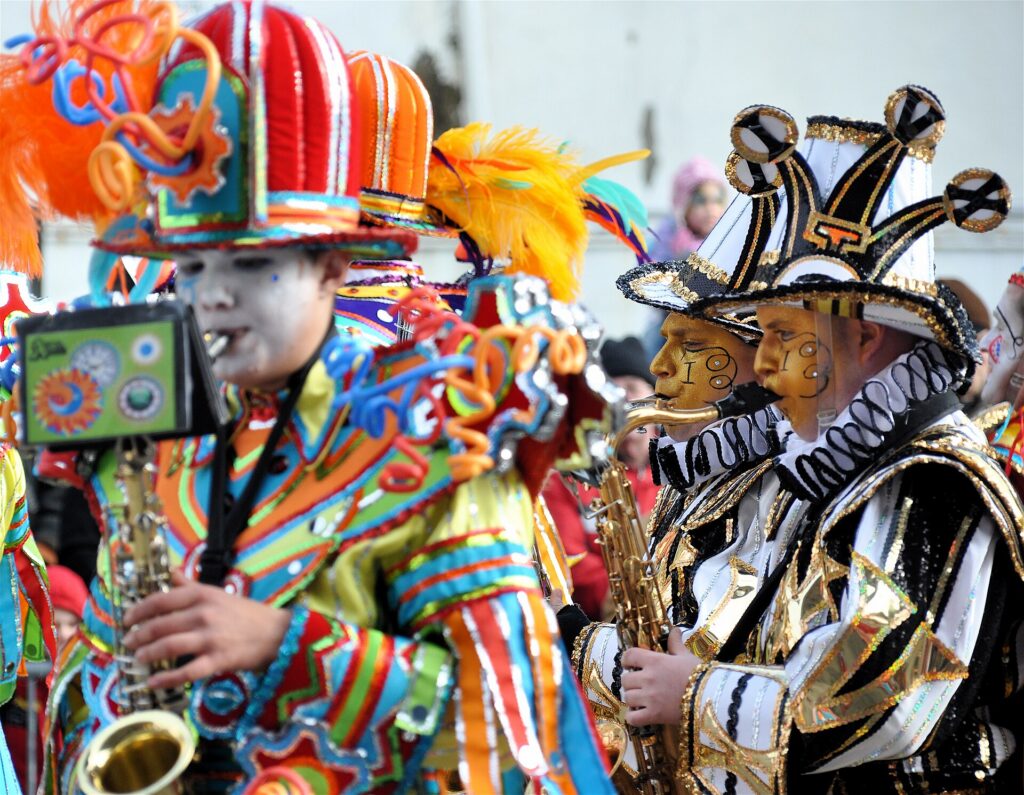
    Costumed performers in the Mummers Parade on New Year's Day in Philadelphia
    The Mummers Parade on New Year's Day, the colorful start to Philadelphia's cheapest season (Photo: Kevin Burkett from Philadelphia, Pa., USA via Wikimedia Commons, CC BY-SA 2.0)

    Events that move Philadelphia flight and hotel prices

    Cross-check these against your dates before you book. Exact dates shift each year; Visit Philadelphia keeps the current calendar.

    • New Year’s Day and the Mummers Parade on Broad Street.
    • Philadelphia Flower Show (early March) at the Convention Center.
    • Penn Relays (last week of April) at Franklin Field.
    • Graduation weekends (through May), especially Penn’s in mid-May.
    • Welcome America and the Fourth of July (late June to July 4): the single biggest hotel spike of the year in Old City and Center City.
    • College move-in (late August) and Labor Day weekend.
    • Eagles home games (September to January), and any Eagles, Phillies, 76ers or Flyers playoff run. Our Philadelphia events page shows what is on sale for your dates.
    • Philadelphia Marathon (the weekend before Thanksgiving) and Thanksgiving itself.
    • Christmas to New Year, plus the Army-Navy Game in the years it is played in the city.
    • Large conventions, which can fill Center City hotels on weeknights without warning; if your mid-week rates look strangely high, that is usually why.

    Getting in from the airport

    Philadelphia International (PHL) is in the southwest corner of the city beside the Delaware River, about 13 km (8 miles) from Center City, and it is the only major airport most visitors need to consider. It is a large hub for American Airlines, which flies nonstop to most big U.S. cities and to a long list of European destinations, and most other major U.S. carriers serve it too. The terminals are lettered A to F along a single curving building, with international flights mainly at Terminal A. Getting downtown is straightforward: the SEPTA Airport Line regional train stops at every terminal and runs to University City, 30th Street Station, Suburban Station and Jefferson Station in around 25 minutes, typically every half hour; taxis charge a flat fare to Center City; ride-hail pickups are in marked zones; and the rental car companies run shuttles from the terminals to their lots. Traffic on I-95 can stretch the drive from 20 minutes to well over 40 at rush hour, which is when the train earns its keep. Two alternatives are worth knowing about. Newark and Baltimore/Washington airports are each around 90 minutes away by car or train and occasionally have cheaper fares, and for travelers coming from New York, Washington or Boston, Amtrak to 30th Street Station is often faster door to door than flying. Our PHL airport guide covers the layout, and our car-versus-transit guide explains the onward options.

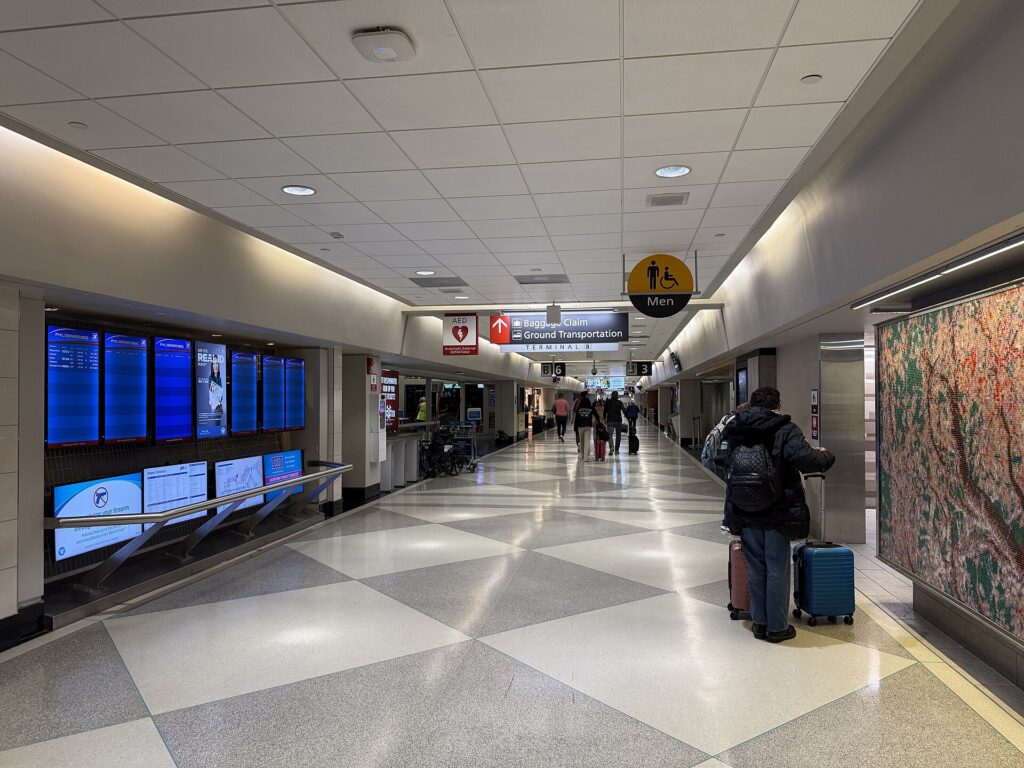
    Terminal B at Philadelphia International Airport (PHL)
    Philadelphia International (PHL), a major American Airlines hub about 13 kilometers (8 miles) from Center City (Photo: Dough4872 via Wikimedia Commons, CC BY-SA 4.0)

    Timing tricks that work for Philadelphia

    • Search the whole month. The Fourth of July, graduation weekends and holiday weekends create sharp edges in the fare calendar, and a calendar search on TicketScanner shows them instantly.
    • Book the hotel first around the Fourth and in May. A cheap fare into Welcome America week or Penn’s graduation weekend is not cheap once the room is added. Run a Philadelphia hotel search for the same dates before you commit to either.
    • Check the convention calendar. If mid-week rates in Center City look high, shift a night or two, or look at University City and the hotels near the airport on the Airport Line.
    • Fly mid-week, stay the weekend. Business travel makes Monday morning and Thursday evening flights busy; Tuesday and Wednesday departures and Saturday night stays are usually the value.
    • Compare the train. From New York, Washington or Boston, price Amtrak or a drive against the flight; our route guides for Washington, DC to Philadelphia and Philadelphia to Boston cover the road option.
    • Build a winter buffer. Snow and nor’easters can disrupt PHL between December and March; avoid the tightest connections. Our guide to how early to arrive covers what to allow.
    • Flying out of Philadelphia instead? PHL’s hub status means good nonstop options in every direction; see cheap flights from Philadelphia.
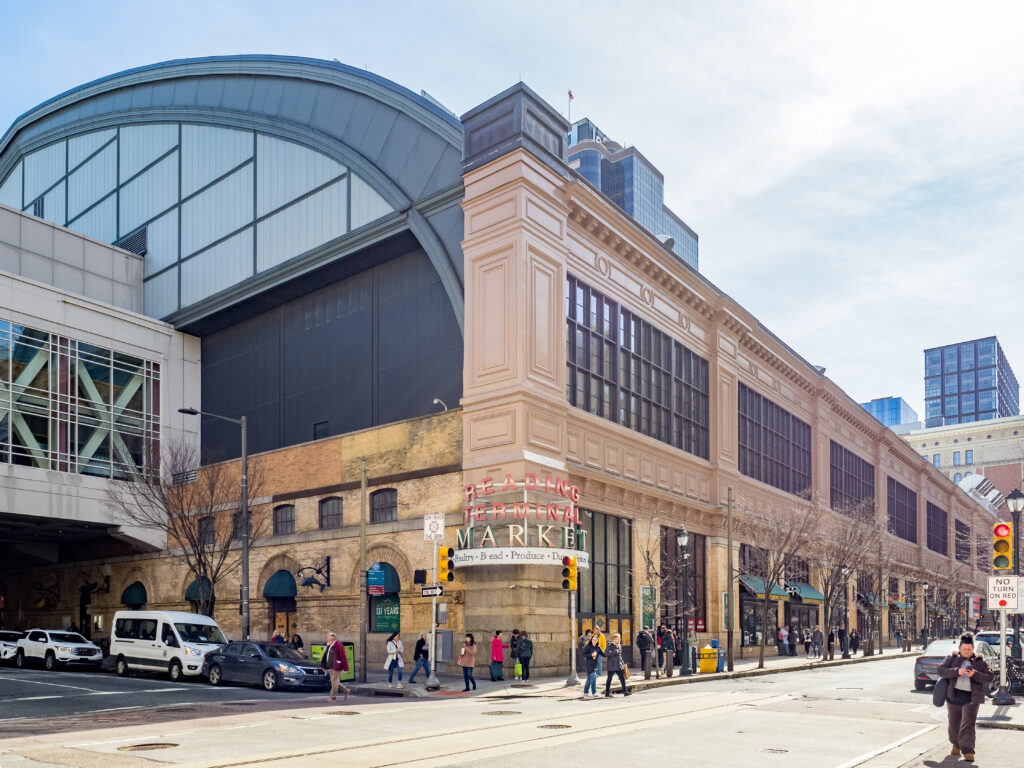
    Shoppers browsing food stalls inside Reading Terminal Market
    Reading Terminal Market, a Philadelphia institution since 1893 (Photo: ajay_suresh via Wikimedia Commons, CC BY 2.0)

    What to pack, by season

    Winter (December to February): a warm, windproof coat, a hat, gloves and waterproof shoes, because slush at the curb is more common than snow on the ground. Spring (March to May): layers, a light rain jacket and an umbrella, and a warmer layer for March evenings. Summer (June to August): light, breathable clothing, a refillable water bottle, sun protection and a light layer for air-conditioned museums and restaurants that can feel chilly after the heat outside. Fall (September to November): layers again, a medium jacket by late October, and comfortable walking shoes in every season, because the brick sidewalks and cobblestones of Old City are uneven. If a game is on the plan, add something green for the Eagles or red for the Phillies; you will fit in immediately.

    The best time to fly to Philadelphia for…

    The Fourth of July

    Arrive a few days before the Fourth to catch the Welcome America events, book as early as you can manage, and book the hotel first.

    History without the crowds

    January, February and November, when the lines at the Liberty Bell are short and timed tickets for Independence Hall are easy to get. Avoid April to June, when school groups fill the historic district.

    The best weather

    Late April to mid-May and late September to October, with October the most reliable for dry, sunny days.

    The lowest fares and hotel rates

    January and February outside the long weekends, and the first three weeks of November. Pair them with the museums and restaurants.

    Families

    Early June, before the peak, or the second half of October; in summer, plan indoor afternoons and use the waterfront parks and the Dilworth Park fountains in the evenings.

    International visitors

    Visitors from Visa Waiver Program countries need an approved ESTA before boarding; most others need a visa. The State Department’s travel site explains what applies to you, and the TSA lists what you can carry through security. For what to see once you land, start with our first-timer’s guide to Philadelphia, and if you are combining cities, our guides to New York, Washington, DC and Boston cover the rest of the Northeast Corridor.

    Frequently asked questions

    What is the cheapest month to fly to Philadelphia?

    January and February are consistently the lowest for both flights and hotels, followed by November before Thanksgiving and the second half of March outside the Flower Show.

    What is the best month to visit Philadelphia for weather?

    October, with May and late September close behind. July and August are hot and humid, and January and February are cold.

    How busy is Philadelphia around the Fourth of July?

    Very. It is the single most expensive week of the year for Old City and Center City hotels, and the Parkway concert and fireworks draw enormous crowds. Book months ahead, or come a week later for summer weather at lower prices.

    Is PHL a good airport to fly into?

    Yes. It is a large hub with plenty of nonstop options, it is close to the city, and the Airport Line train connects every terminal to Center City in around 25 minutes.

    Should I fly or take the train from New York or Washington?

    Take the train or drive. Amtrak reaches 30th Street Station from New York in roughly 70 to 90 minutes and from Washington in about two hours, which beats flying once airport time is counted.

    How far ahead should I book?

    Earlier for the Fourth of July, graduation weekends in May, Thanksgiving and the Christmas holidays, when fares tend only to rise; for January, February and November, fares are stable enough that finding the right dates matters more than booking far ahead.

    Does it snow in Philadelphia?

    Most winters bring a few snowfalls, usually in a handful of storms between December and March, and some years bring one big nor’easter. Many winter days are simply cold and dry.

    Ready to pick your dates? Compare fares across the whole month on our Philadelphia flights page, then find a room with our Philadelphia hotel search. For how to get around once you arrive, read our guide to renting a car or using public transit in Philadelphia.

  • Things to Do in Philadelphia: A First-Timer’s Guide

    Things to Do in Philadelphia: A First-Timer’s Guide

    Philadelphia is where the United States was argued into existence, and you can still stand in the room where it happened. Independence Hall, the Liberty Bell and the brick streets of Old City sit within a few blocks of each other, and most of them are free. But visitors who come for the history and leave after an afternoon miss the reason people fall for the place: a compact, walkable grid of rowhouse neighborhoods, one of the great art museums in the country at the top of a boulevard modeled on the Champs-Élysées, a collection of Impressionist paintings so large it needs its own building, thousands of murals, an open-air market that has been selling produce for more than a century, a restaurant scene built on small BYOB dining rooms, and sports fans whose reputation arrives before they do. It is also cheaper than New York or Boston and sits between them on the rail line. This guide covers the sights that earn a day, the neighborhoods worth a half-day, the museums, the food, the big events, the day trips, and the practical details that make a first visit work.

    If you are still comparing cheap flights to Philadelphia, read this alongside our guides to the best time to fly to Philadelphia and whether to rent a car or use public transit. Between the three you can plan the whole trip.

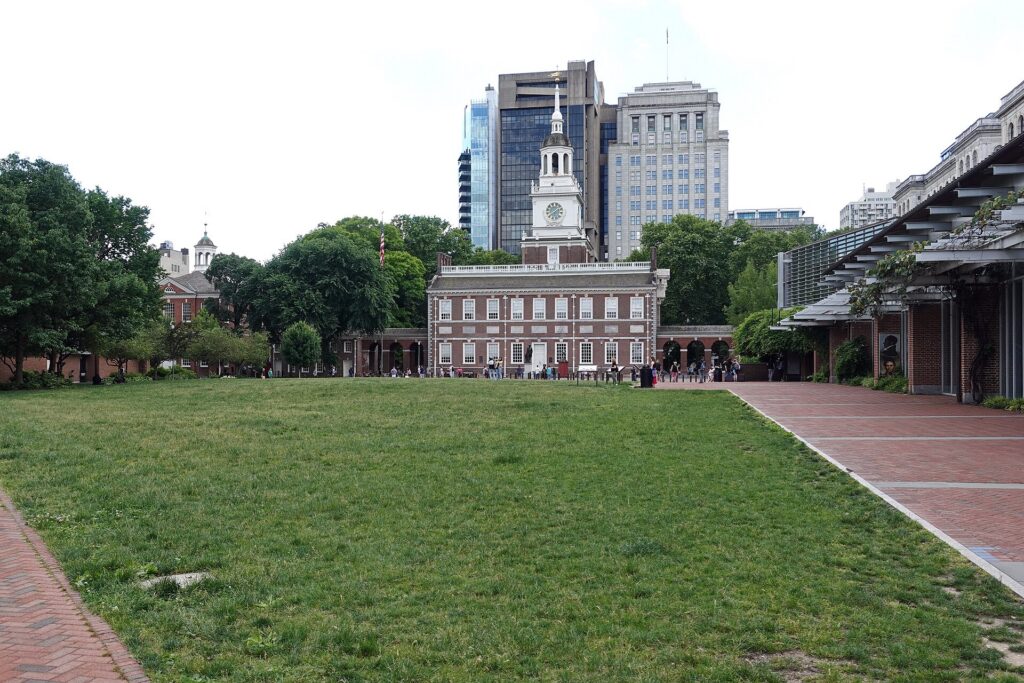
    Independence Hall, the red-brick State House in Philadelphia
    Independence Hall, where the Declaration of Independence and the Constitution were debated and signed (Photo: 颐园居 via Wikimedia Commons, CC BY-SA 4.0)

    Philadelphia at a glance for first-timers

    • Airport: Philadelphia International (PHL), in the southwest of the city about 13 km (8 miles) from Center City. The SEPTA Airport Line train reaches the downtown stations in around 25 minutes, and taxis charge a flat fare to Center City. See our PHL airport guide.
    • Getting around: Center City and Old City are flat, compact and best on foot. SEPTA’s two subway lines, trolleys, buses and Regional Rail cover the rest, and Indego bike share docks are everywhere. A car is a burden in the center and useful only for day trips.
    • Money: U.S. dollars. Sales tax in the city is higher than in the rest of Pennsylvania, but most clothing is exempt, which is a small bonus for shoppers. Tipping 18 to 20 percent in restaurants is customary.
    • Weather: four distinct seasons, with a hot and humid summer, a cold but usually manageable winter, and a spring and fall that are the best times to walk the city. Our month-by-month guide has the detail.
    • Where to stay: Old City for the historic sites on your doorstep; Rittenhouse Square for restaurants and a residential feel; around City Hall and the Convention Center for transit and value; University City near 30th Street Station if you arrive by train. Our Philadelphia hotel search covers them all.

    Independence National Historical Park and Old City

    Start where the country did. Independence National Historical Park, run by the National Park Service, covers the blocks around Independence Mall, and its centerpiece is Independence Hall, the red-brick State House where the Declaration of Independence was debated and signed in 1776 and the Constitution was drafted in 1787. Tours are free and ranger-led, but for most of the year you need a timed ticket, released online in advance for a small booking fee and handed out on the day at the Independence Visitor Center until they run out; book before you fly if your dates are fixed. Across Chestnut Street, the Liberty Bell Center holds the cracked bell itself, with no ticket needed, just a security line that is shortest first thing in the morning. At the north end of the mall, the National Constitution Center is the best museum in the country on how the Constitution works, with a hall of life-size bronze statues of the signers. Two blocks east, the Museum of the American Revolution tells the story of the war with real objects, including George Washington’s own field tent, and it is worth two hours even for visitors who think they know the story. Allow a full morning for the hall, the bell and one museum, and book the Independence Hall tour first.

    The streets around the park are the oldest part of the city. Elfreth’s Alley, a narrow lane of small houses dating to the early 1700s, is billed as the oldest continuously inhabited residential street in the country. Christ Church, where Washington and Franklin worshiped, is on Second Street, and Benjamin Franklin is buried in its burial ground a few blocks away, where visitors toss pennies onto his grave. The Benjamin Franklin Museum sits underground at Franklin Court, beneath a steel frame that outlines the house he lived in. Carpenters’ Hall, where the First Continental Congress met, and the Betsy Ross House are both within a ten-minute walk. In the evenings, Old City’s galleries, bars and restaurants along Market, Chestnut and Second streets fill up, and on the first Friday of each month the galleries stay open late.

    Center City: City Hall, Reading Terminal and the squares

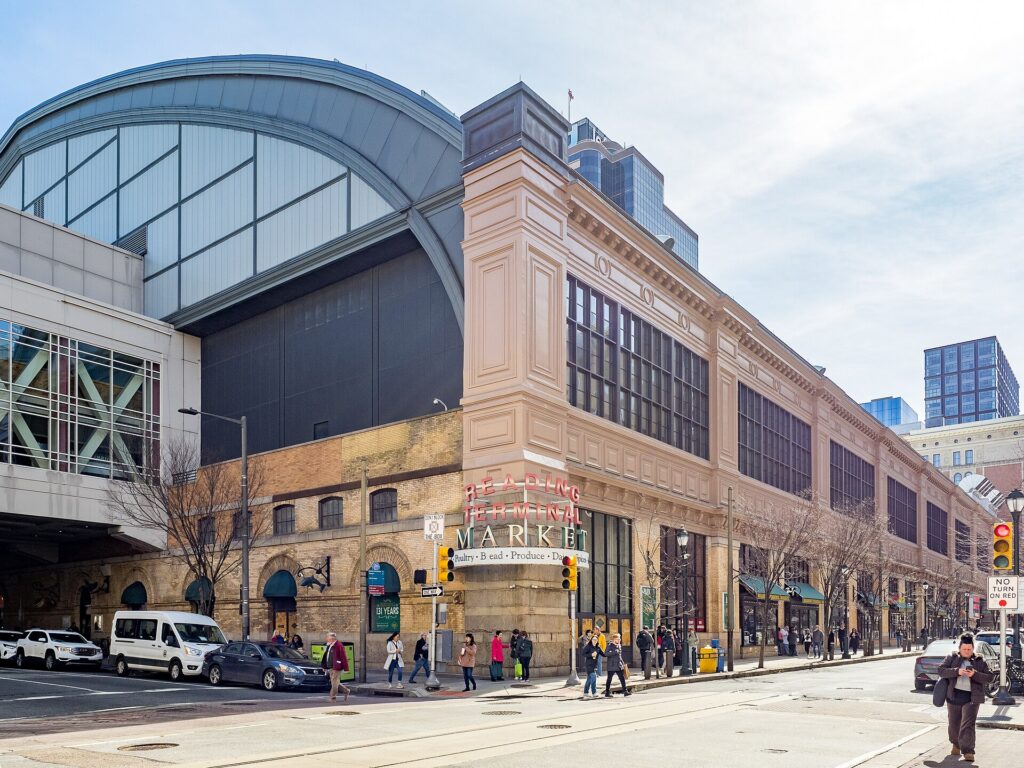
    William Penn laid out Philadelphia in 1682 as a grid between two rivers, with a central square and four smaller squares around it, and the plan still works. At the center, City Hall is the largest municipal building in the country, a wedding cake of granite and marble topped by a bronze statue of Penn himself; for most of the twentieth century no building in the city was allowed to rise above his hat. Tours of the building and the tower observation level run on weekdays when they are operating, and the view down Broad Street and out to the Parkway is the best way to understand the city’s layout. Beside it, Dilworth Park has fountains in summer and an ice rink in winter, and across the street LOVE Park holds Robert Indiana’s famous red sculpture. Two blocks east, Reading Terminal Market, opened in 1893 beneath the train shed of the old Reading Railroad, is the best indoor market in the country, with more than seventy vendors selling roast pork sandwiches, cheesesteaks, soft pretzels, Pennsylvania Dutch baked goods and ice cream under one roof. Go at breakfast or mid-afternoon to avoid the lunch crush. Penn’s other squares are worth a detour: Rittenhouse Square is the elegant living room of the western half of Center City, Washington Square holds the Tomb of the Unknown Revolutionary War Soldier, and Franklin Square has a carousel and a mini-golf course laid out around Philadelphia landmarks.

    Vendors and shoppers inside Reading Terminal Market in Philadelphia
    Reading Terminal Market, open since 1893 and the best place in the city for lunch (Photo: ajay_suresh via Wikimedia Commons, CC BY 2.0)

    The Benjamin Franklin Parkway and the museums

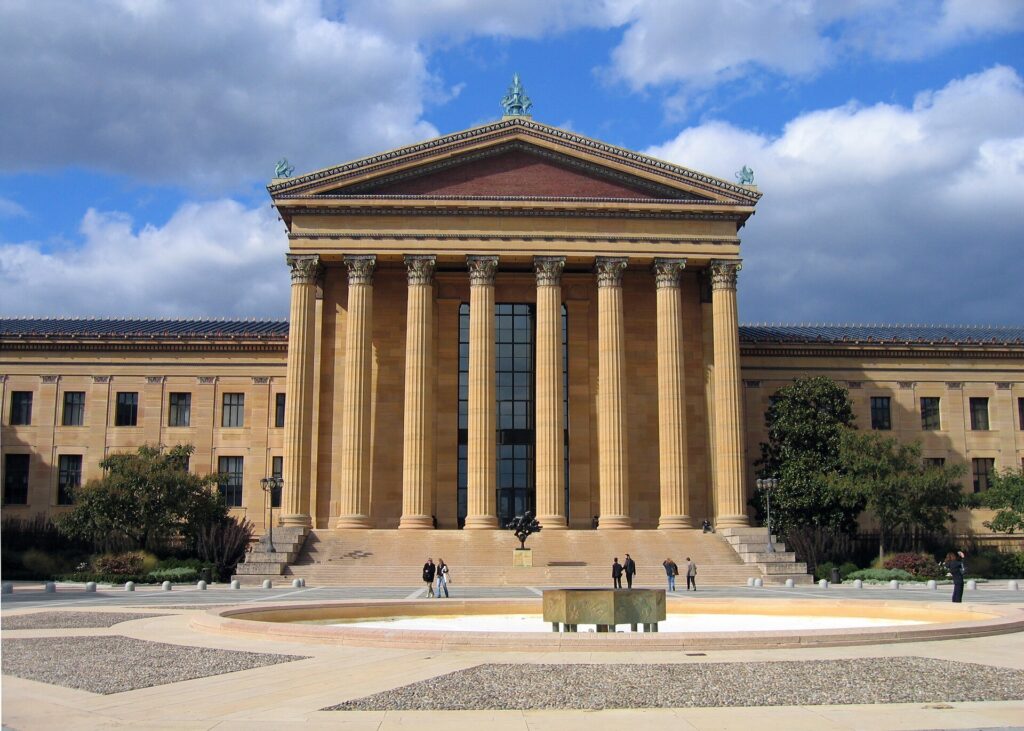
    The Parkway runs diagonally from City Hall to the art museum, lined with flags and fountains, and it holds more of the city’s great collections than any other mile. At the top, the art museum, long known as the Philadelphia Museum of Art and recently rebranded as the Philadelphia Art Museum, is one of the largest in the country, with Van Gogh’s Sunflowers, Cézanne’s Large Bathers, a superb collection of Duchamp, complete rooms of European architecture and an Asian wing that includes a Japanese teahouse. Most visitors also run up the front steps made famous by Rocky, and the bronze statue of the boxer stands at the bottom for photographs. Down the Parkway, the Barnes Foundation displays one of the world’s great collections of Renoir, Cézanne and Matisse, hung exactly as the collector Albert Barnes arranged it, wall by wall, with old keys and hinges between the paintings; timed tickets are wise. The Rodin Museum, with The Thinker at its gate, is small and lovely. The Franklin Institute is the city’s science museum, with a walk-through giant heart and a planetarium, and the Academy of Natural Sciences of Drexel University across Logan Square has the dinosaur hall that children remember. Just beyond the art museum, Eastern State Penitentiary, a crumbling castle-like prison that opened in 1829 and held Al Capone, is one of the most atmospheric sights in the country, and in the fall it runs a famous Halloween event.

    The main building of the Philadelphia art museum at the top of the Benjamin Franklin Parkway
    The art museum at the top of the Parkway, home of the Rocky Steps and one of the great collections in the country (Photo via Wikimedia Commons, Public domain)

    The rivers, Fairmount Park and Boathouse Row

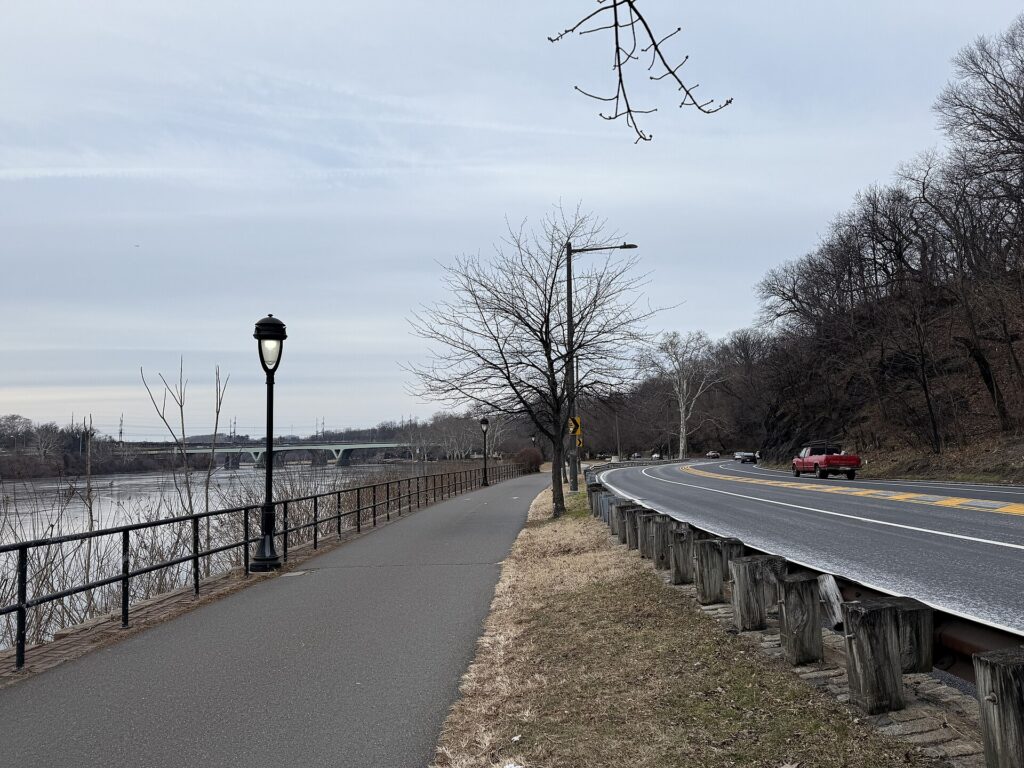
    Behind the art museum, the Schuylkill River curves north past Boathouse Row, a line of Victorian rowing clubhouses outlined in lights at night, and the paved Schuylkill River Trail runs along the water from Center City to the park and beyond. It is the best walk, run or bike ride in the city. Fairmount Park, which begins here, is one of the largest urban park systems in the country, with historic country houses, the Japanese House and Garden, the Horticultural Center, and, in the northwest, the wooded gorge of the Wissahickon Valley, where the gravel Forbidden Drive follows the creek for miles and feels nothing like a city. On the other side of Center City, the Delaware River waterfront at Penn’s Landing has the Independence Seaport Museum, the tall ships, the Race Street Pier park under the Benjamin Franklin Bridge, and, in summer, Spruce Street Harbor Park, with hammocks, floating barges and food stalls. In winter the same stretch becomes Blue Cross RiverRink, an outdoor skating rink with a lodge. A long-running project to cap the I-95 highway will link Old City to the river more directly when it is complete.

    Neighborhoods worth a half-day

    Society Hill and Washington Square West

    South of Independence Hall, Society Hill has the largest concentration of original eighteenth- and early nineteenth-century houses in the country, on quiet brick streets lit by gas lamps. Washington Square West, next door, is the heart of the Gayborhood, with rainbow street signs, independent restaurants along 13th Street and the lively bars of Midtown Village.

    Rittenhouse and Fitler Square

    The most elegant part of Center City, with the square itself, the boutiques and restaurants along Walnut and Chestnut streets, and brownstone blocks running west toward the Schuylkill. It is the best neighborhood for a hotel if restaurants matter more than history.

    South Street, Queen Village and the Italian Market

    South Street is the city’s bohemian strip, with tattoo parlors, bars and Philadelphia’s Magic Gardens, a maze of mirror-and-tile mosaics built by the artist Isaiah Zagar. A few blocks south and west, the Italian Market on 9th Street, one of the oldest open-air markets in the country, sells produce, cheese, fresh pasta and Mexican and Vietnamese groceries under metal awnings. Keep walking to where 9th Street meets Passyunk Avenue and you reach Pat’s and Geno’s, the rival cheesesteak stands that face each other across the intersection.

    East Passyunk

    Passyunk Avenue runs diagonally through South Philadelphia, and its eastern stretch is one of the best restaurant streets in the city, with small BYOB dining rooms, Italian bakeries, a lit fountain and a neighborhood feel that the tourist strips lack.

    Fishtown and Northern Liberties

    North of Old City along the Delaware, these former industrial neighborhoods have become the center of the city’s nightlife, with breweries, music venues, coffee roasters and many of its most talked-about restaurants along Frankford Avenue and Girard Avenue. The Market-Frankford Line gets you there in minutes.

    University City

    West of the Schuylkill, around the University of Pennsylvania and Drexel, the Penn Museum is one of the great archaeology museums in the world, with a granite sphinx, Egyptian mummies and treasures from the royal cemetery at Ur. 30th Street Station, the grand Amtrak terminal, is on the edge of the neighborhood.

    Manayunk and Chestnut Hill

    Two hilltop neighborhoods in the northwest, both on Regional Rail. Manayunk has a steep Main Street of bars and shops beside the old canal; Chestnut Hill has cobbled Germantown Avenue, independent shops and the Morris Arboretum. Either makes a gentle half-day away from the center.

    Murals, oddities and family attractions

    Philadelphia has more public murals than almost any city in the world, thanks to Mural Arts Philadelphia, which began as an anti-graffiti program in the 1980s and has painted thousands of walls since; walking and trolley tours explain the best of them, but you will see dozens simply walking through South Philadelphia or along the Market-Frankford Line. The Mütter Museum of the College of Physicians is a Victorian cabinet of medical curiosities, with skeletons, preserved specimens and slices of Einstein’s brain, and it is either the highlight of the trip or something you will never forgive the person who suggested it. The Philadelphia Zoo, the first in the country to be chartered, has an overhead trail network that lets the big cats and primates roam above visitors’ heads. The Please Touch Museum, in a grand building left over from the 1876 Centennial Exposition in Fairmount Park, is designed for children under eight. Across the Delaware in Camden, reached by the PATCO train or, in summer, a ferry from Penn’s Landing, the Adventure Aquarium and the Battleship New Jersey make a family day. For live performance, the Philadelphia Orchestra plays at the Kimmel Center on Broad Street’s Avenue of the Arts, the Academy of Music next door is the oldest opera house in the country still used for its original purpose, and the Walnut Street Theatre is the oldest theater in the country. Our Philadelphia events page lists concerts, shows and games during your dates.

    The big events: the Fourth of July and New Year’s Day

    Philadelphia treats the Fourth of July as its own holiday, which in a sense it is. The city’s Welcome America festival runs for several days around it, with free museum days, neighborhood events, a parade past Independence Hall and a free concert on the Parkway that ends with fireworks over the art museum; in 2026 the city was a focal point of the nation’s 250th anniversary celebrations. The other signature day is New Year’s Day, when the Mummers Parade, a century-old tradition of string bands, comic brigades and sequined, feathered costumes, fills Broad Street for most of the day. In early March, the Pennsylvania Horticultural Society’s Philadelphia Flower Show, one of the oldest and largest in the world, turns the Convention Center into a series of vast garden displays. The Penn Relays, the oldest and largest track meet in the country, fill Franklin Field in late April; the Broad Street Run, a ten-mile race straight down the city’s spine, is in early May; the Philadelphia Marathon is the weekend before Thanksgiving; and on Thanksgiving morning one of the oldest holiday parades in the country marches up the Parkway. From late November, a German-style Christmas Village fills the plaza by City Hall. Visit Philadelphia keeps the current calendar.

    Sports

    Philadelphia’s fans are loud, loyal and famous for it, and a game here is one of the best nights out in the city. All four major teams play at the South Philadelphia Sports Complex at the southern end of the Broad Street Line. The Eagles play NFL football at Lincoln Financial Field from September to January, won their second Super Bowl in February 2025, and are the closest thing the city has to a religion; tickets are hard to come by. The Phillies play baseball at Citizens Bank Park from April to September, and a summer evening there, with a roast pork sandwich and the skyline beyond the outfield, is easy to arrange. The Flyers (NHL) and the 76ers (NBA) share the arena next door. The Union play MLS soccer at Subaru Park on the river in Chester, just south of the airport. College basketball has deep roots too: the Big 5 rivalries between the city’s universities are played in historic gyms such as Penn’s Palestra. Check what is on sale in Philadelphia for your dates before you book flights.

    What to eat, and where

    Start with the cheesesteak, thin-sliced beef on a long roll with fried onions and your choice of provolone, American or Cheez Whiz. Pat’s and Geno’s in South Philadelphia are the tourist rite of passage, but locals will send you to a dozen neighborhood shops instead, and every one of them has an opinion. Many Philadelphians would argue the city’s best sandwich is actually the roast pork, with sharp provolone and broccoli rabe, the version at DiNic’s in Reading Terminal Market being the most famous. Then there are the hoagie, the city’s word for a sub, the twisted soft pretzel sold on street corners in the morning, water ice in summer, tomato pie served at room temperature in the Italian bakeries, and scrapple for the adventurous at breakfast. Beyond the classics, Philadelphia’s restaurant scene is one of the most creative in the country, and much of it is built on small, chef-owned BYOB restaurants, where you bring your own wine and the bill is lower for it; state-run liquor stores sell wine and spirits, and many supermarkets now sell beer and wine. Washington Avenue in South Philadelphia is lined with Vietnamese pho shops, the blocks around the Italian Market have some of the best Mexican food on the East Coast, Chinatown near the Convention Center has hand-pulled noodles and dim sum, and Fishtown and East Passyunk hold many of the city’s most talked-about dining rooms.

    Philadelphia through the seasons

    Philadelphia changes with the seasons more than visitors expect. Spring (March to May) starts with the Flower Show, brings cherry blossoms to Fairmount Park and the Horticultural Center in April, and ends with graduations, the Penn Relays and the first Phillies games; it is one of the best times to walk the city, although school groups crowd Independence Hall from April to June. Summer (June to August) is hot and often humid, so plan the historic sites for the morning, the museums for the afternoon, and the evenings for Spruce Street Harbor Park, rooftop bars and outdoor concerts; the Fourth of July is the peak. Fall (September to November) is the local favorite: warm, dry September days, Eagles season, the Fringe Festival, Halloween at Eastern State and foliage along the Wissahickon in late October. Winter (December to February) is cold, with a few snowy days most years, but the Christmas Village, the rinks at Dilworth Park and Penn’s Landing, the Mummers on New Year’s Day, and the empty galleries in January make it a surprisingly good time for a museum-focused trip at low prices. Our month-by-month guide has the fare patterns that go with each season.

    Philadelphia with kids

    Philadelphia is an easy city with children, because the history comes with real objects and costumed characters. The Liberty Bell and Independence Hall work best after the Museum of the American Revolution has set the scene, and in summer, storytellers and characters in eighteenth-century dress are stationed around Old City. The Franklin Institute, with its giant heart, the Academy of Natural Sciences, with its dinosaurs, and the Please Touch Museum for the youngest fill the rainy days. The Philadelphia Zoo and the Adventure Aquarium across the river are full-day outings. Franklin Square has the carousel and mini golf, Spruce Street Harbor Park and the Dilworth Park fountains are free summer entertainment, and a Phillies game is a good first ballgame. Sesame Place, the Sesame Street theme park, is about forty minutes north in Bucks County. If you are driving in from elsewhere, our family car rental guide covers the vehicle question.

    Philadelphia on a budget

    Much of the best of Philadelphia is free: the Liberty Bell and Independence Hall, the walk through Old City and Society Hill, Elfreth’s Alley, the murals, the Schuylkill River Trail and Boathouse Row, Fairmount Park and the Wissahickon, the Rocky Steps, Penn’s Landing and the parks along the river. The art museum and the Barnes have pay-what-you-wish or reduced-price periods at set times, so check their sites before you go. Eat for less at Reading Terminal Market, in Chinatown, on Washington Avenue and around the Italian Market, and take advantage of the BYOB restaurants, where skipping a wine list makes a big difference to the bill. Hotel rates are generally lower than in New York, Boston or Washington, especially on weekends and in January and February, and staying near City Hall rather than in Old City often saves money without adding much walking. Compare rates by neighborhood on our Philadelphia hotel search.

    Day trips from Philadelphia

    Valley Forge, where Washington’s army spent the winter of 1777 to 1778, is about 40 minutes northwest; Valley Forge National Historical Park has miles of trails and a driving tour past the reconstructed huts. Longwood Gardens, one of the great gardens of the country, with conservatories, fountain shows and a spectacular Christmas display, is about an hour southwest near Kennett Square, and the Brandywine Valley around it holds the Winterthur estate and the Brandywine museum with its Wyeth paintings. Lancaster County, the heart of Pennsylvania Dutch and Amish country, with farm stands, covered bridges and horse-drawn buggies on the back roads, is about 90 minutes west. New Hope and Bucks County, an hour north on the Delaware, pair artists’ galleries with Washington Crossing Historic Park. Gettysburg is about two and a half hours west. Atlantic City is about an hour east, and Cape May, with its Victorian houses and beaches, is about two hours south at the tip of New Jersey. By train, New York is about 70 to 90 minutes away and Washington, DC about two hours; our guides to things to do in New York and things to do in Washington, DC cover both, and drivers heading north can use our Philadelphia to Boston route guide on the way to Boston. Most of the countryside trips need a car; see our Philadelphia car rental page, and rent only for the days you leave the city.

    Boathouse Row on the Schuylkill River in Philadelphia
    Boathouse Row on the Schuylkill, where the river trail and Fairmount Park begin (Photo: Dough4872 via Wikimedia Commons, CC BY-SA 4.0)

    Two sample itineraries

    Three days, no car

    Day one: Independence Hall, the Liberty Bell and the Museum of the American Revolution in the morning, lunch at Reading Terminal Market, then Elfreth’s Alley, Christ Church and Franklin Court in the afternoon, and dinner in Old City. Day two: the art museum at opening, the Rocky Steps, a walk along Boathouse Row on the river trail, the Barnes in the afternoon, and dinner around Rittenhouse Square. Day three: the Magic Gardens and South Street, a cheesesteak at the Italian Market, East Passyunk for the afternoon, and a Phillies game or a night in Fishtown.

    Five days, with the region

    Add a day for Eastern State Penitentiary, the Penn Museum and University City, then rent a car for Valley Forge and Longwood Gardens, or for Lancaster County, returning it before you head back into the city. New York or Washington by train is the car-free alternative for the fifth day.

    Practical details

    • Transit: use a SEPTA Key card or tap to pay where accepted on the subway, trolleys and buses; Regional Rail fares depend on the zone and the time of day. SEPTA has maps and service alerts; our transit-versus-car guide goes into detail.
    • From PHL: the Airport Line train to Center City, a flat-fare taxi or ride-hail, or a rental from the airport’s rental car facilities. The airport’s site covers ground transport.
    • Weather: light clothing and water in summer, layers in spring and fall, a warm coat from December to February. The National Weather Service’s Mount Holly office covers Philadelphia.
    • Time zone: Eastern, the same as New York, Washington and Boston.
    • Safety: Center City, Old City and the main visitor areas are busy and generally safe; as in any large city, stay aware late at night, and ask your hotel before walking to unfamiliar neighborhoods after dark.
    • Entry requirements: visitors from Visa Waiver Program countries need an approved ESTA before boarding; most others need a visa. The State Department’s travel site is the authoritative source.

    Frequently asked questions

    How many days do you need in Philadelphia?

    Two full days covers the historic district, the art museum and a neighborhood or two; three lets you add the Barnes, South Philadelphia and a game, and a fourth makes room for Valley Forge or Longwood Gardens.

    Is the Liberty Bell free?

    Yes, and so is Independence Hall, although the hall requires a free timed ticket for most of the year. The Constitution Center and the Museum of the American Revolution charge admission.

    What is the number one thing to do in Philadelphia?

    Tour Independence Hall and see the Liberty Bell, then walk the brick streets of Old City to Elfreth’s Alley and Franklin’s grave. Finish with a sandwich at Reading Terminal Market.

    Is Philadelphia walkable?

    Very. Center City is a flat grid about two miles wide between the rivers, and you can walk from Independence Hall to the art museum in around 40 minutes.

    Do I need a car in Philadelphia?

    No. Parking is expensive and enforcement is famously strict, and SEPTA and your feet cover the city. Rent for Valley Forge, Lancaster County or the Jersey Shore if you want them.

    Where should I get a cheesesteak?

    Pat’s and Geno’s are the famous pair; locals argue for a long list of neighborhood shops across the city. Try one of each and join the argument.

    Ready to go? Compare flights to Philadelphia, find a place to stay with our Philadelphia hotel search, and if Valley Forge or Amish country is on the list, price a rental car for those days.