Tag: San Diego

  • San Diego: Should You Rent a Car or Rely on Public Transit?

    San Diego: Should You Rent a Car or Rely on Public Transit?

    San Diego sits in the middle of the American spectrum on this question. It is neither a transit city nor as car-dependent as Phoenix or Los Angeles. The downtown core is compact and walkable, the Trolley links it to Old Town, Mission Valley, the university area and the Mexican border, a ferry crosses the bay to Coronado, and the airport is only a few kilometers from the Gaslamp Quarter. But the things that make San Diego special are spread along a long coastline: La Jolla, Point Loma, the beach towns and North County are either off the rail network or a slow bus ride away, and most day trips are car trips. This guide explains how the city is laid out, how the MTS Trolley, buses and coastal trains work, what driving and parking are really like, when a car earns its keep, and gives you a straightforward way to decide.

    The short answer

    Rent a car if La Jolla, Torrey Pines, Point Loma and the beach towns are the heart of your trip, if you are staying in a beach neighborhood or in North County, if you plan day trips to the Safari Park, LEGOLAND, Temecula, Julian or the desert, if you have young children, or if this is part of a road trip. Skip the car if you are staying downtown in the Gaslamp Quarter or Little Italy for a convention, a Padres game or a short city break, and your plans are the waterfront, the USS Midway, Balboa Park, Old Town, Coronado by ferry and a day in Tijuana; the Trolley, the ferry, buses and the occasional ride-hail will cover that, and you will avoid steep downtown hotel parking fees. Many visitors do best with a hybrid: car-free city days and a car for the coast and the day trips. Compare rental rates for any of these plans on our San Diego car rental page.

    How San Diego is laid out

    Downtown San Diego sits on the east shore of San Diego Bay, with the Gaslamp Quarter, East Village and Petco Park to the south, Little Italy and the airport to the north, and Balboa Park rising on the mesa just to the northeast. West of the airport, the Point Loma peninsula shelters the bay, with Cabrillo National Monument at its tip and Ocean Beach at its northern end. North of that, Mission Bay’s lagoons are fronted by Mission Beach and Pacific Beach, and La Jolla sits on the headland beyond, about 20 kilometers (12 miles) from downtown. Inland, Old Town and Mission Valley follow the San Diego River east toward San Diego State University, and North County’s beach towns and inland suburbs stretch 50 kilometers (30 miles) up the coast. The freeways tie it together: I-5 runs north-south along the coast from the Mexican border through downtown to Los Angeles; I-805 is its inland twin; I-8 runs east from Ocean Beach through Mission Valley toward Arizona; I-15 heads inland to Escondido, Temecula and Las Vegas; and SR 163 runs through Balboa Park’s canyon between downtown and the northern suburbs.

    Hotels cluster downtown around the Gaslamp and the convention center, in Little Italy, near the airport and on Harbor and Shelter Islands, in Mission Valley along I-8, in the beach neighborhoods, in Coronado and in La Jolla. Our San Diego hotel search lets you compare them.

    Getting in from the airport

    San Diego International (SAN) sits on the bay about 5 kilometers (3 miles) northwest of downtown, and getting into the city is quick. A taxi or ride-hail from the marked zones outside the terminals takes about ten minutes to the Gaslamp outside rush hour and about twenty to La Jolla or Pacific Beach. On public transit, an MTS bus runs between the terminals and downtown, and the airport-run shuttle connects the terminals with the Old Town Transit Center, where you can change to the Trolley, the Coaster commuter train and Amtrak. For a rental, shared shuttle buses run from the terminals to the consolidated Rental Car Center on the north side of the airport, where the major companies have their counters. The airport has been redeveloping Terminal 1 and its roads for several years, so pickup zones and routes may have moved since your last visit; check the airport’s site for current ground-transport details. Our SAN airport guide covers the layout.

    San Diego transit, explained

    The San Diego Metropolitan Transit System (MTS) runs the Trolley and most buses across the southern half of the county, and the North County Transit District runs the Coaster commuter train and North County’s buses. Its limitation is the coast, where rail barely reaches and the buses are slow for sightseeing.

    The Trolley

    The San Diego Trolley, opened in 1981, is the backbone. The UC San Diego Blue Line runs from the Mexican border at San Ysidro through downtown and Old Town, then north along the Mid-Coast extension to UC San Diego and the University Towne Center area near La Jolla. The Green Line runs from downtown past Old Town, through Mission Valley’s hotels and malls, to Snapdragon Stadium, San Diego State and Santee. The Orange Line runs east from downtown to El Cajon, and the Copper Line links El Cajon and Santee; a vintage Silver Line loops downtown on limited days. Trains run from early morning until around midnight, typically every 15 minutes on the main lines through the day and less often late at night. Downtown stops serve Little Italy, the Santa Fe Depot, the convention center, the Gaslamp and Petco Park.

    Buses

    MTS buses cover most of the city, and several are useful to visitors: routes along Park Boulevard and El Cajon Boulevard pass Balboa Park and the zoo, buses from the Old Town Transit Center fan out to Ocean Beach, Mission Beach, Pacific Beach and La Jolla, and routes cross the Coronado Bridge to Coronado. Frequencies drop in the evenings and on weekends on many routes, so check the timetable before relying on a bus for a late return.

    The Coaster and the Pacific Surfliner

    NCTD’s Coaster runs up the coast from the Santa Fe Depot downtown through Old Town, Sorrento Valley, Solana Beach, Encinitas and Carlsbad to Oceanside, with a busier schedule on weekdays than at weekends. It is a scenic and relaxed way to reach the North County beach towns. Amtrak’s Pacific Surfliner follows much of the same line and continues to Los Angeles Union Station in about three hours, then on to Santa Barbara. Coastal landslides near San Clemente have periodically suspended or reduced service in recent years, so check the current status before building a trip around the train.

    Fares and tickets

    One fare system covers the Trolley and MTS buses. Pay with a PRONTO card or the PRONTO app, which cap what you pay at the price of a day pass once you have taken enough rides in a day, or buy tickets from the machines on the Trolley platforms. Tap before boarding, because fare inspectors check on board. The Coaster and the Surfliner have their own fares, and reduced fares are available for seniors, riders with disabilities and younger riders. Check the MTS site for current fares before you go.

    Accessibility

    The Trolley has low-floor cars and step-free stations throughout, and all MTS buses are accessible, with ramps and space for wheelchairs.

    Beyond MTS

    • The Coronado ferry. Ferries cross the bay from the Broadway Pier area downtown to the Coronado Ferry Landing in about fifteen minutes, with bicycles welcome on board; the landing is a short walk from Orange Avenue.
    • Ride-hail and taxis. Uber and Lyft operate across the county, and for trips to La Jolla, Point Loma, the beach towns and the brewery districts, they are much faster than the bus. Surge pricing after big events can be steep.
    • Walking and cycling. Downtown, the Embarcadero, Coronado and the beach boardwalks are excellent on foot or by bike. Shared e-bikes and e-scooters operate in many neighborhoods, subject to city rules, including slow zones on the boardwalks.
    • Tours and hop-on buses. Trolley-style sightseeing tours loop the main sights,, and day tours run to the Safari Park.
    • Crossing to Tijuana. The Blue Line runs to San Ysidro, where most visitors walk across the border. Carry a valid passport; Mexico’s Instituto Nacional de Migración sets the entry rules, and the return requires U.S. entry documents that U.S. Customs and Border Protection accepts for your nationality.
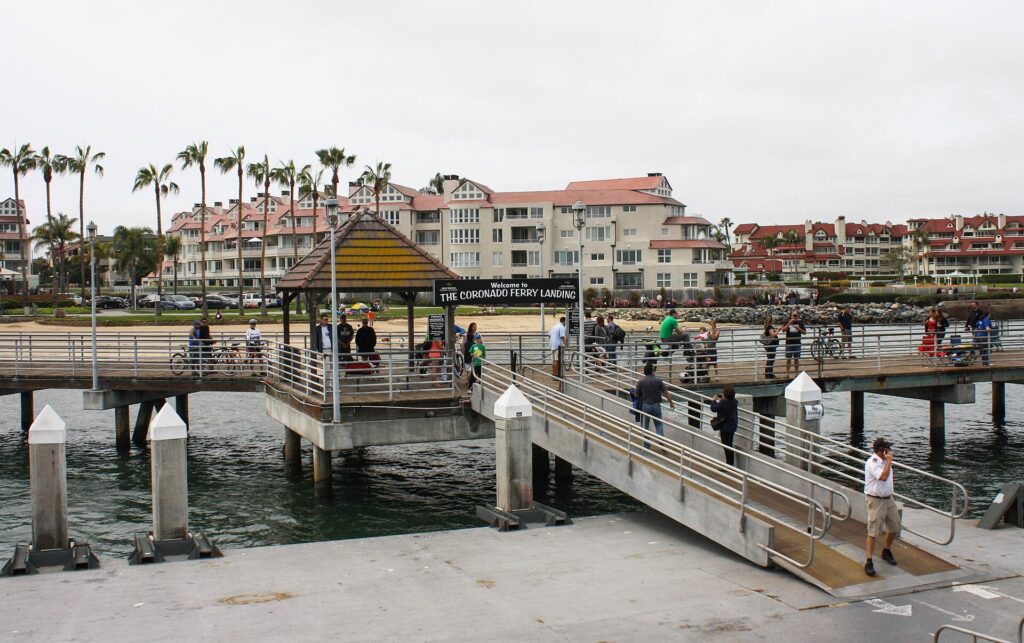
    The Coronado Ferry Landing on San Diego Bay
    The Coronado Ferry Landing, a short crossing from downtown and a short walk from Orange Avenue (Photo: Bernard Gagnon via Wikimedia Commons, CC BY-SA 3.0)

    Driving in San Diego: what it is really like

    By the standards of Southern California, San Diego is a reasonable place to drive: the freeways are well signed, the streets are easy to navigate once you know the main corridors, and traffic is lighter than in Los Angeles. The frustrations are specific. Weekday rush hours, roughly 6 to 9 a.m. and 3 to 7 p.m., slow I-5 and I-805 through the central city and at the Merge, where the two meet near Del Mar, along with I-15 and I-8 through Mission Valley. Sunday afternoons bring heavy northbound traffic on I-5 as weekend visitors head back to Orange County and Los Angeles. Events clog downtown, from Padres games and conventions to the Comic-Con crowds, and summer weekends fill the roads to the beaches.
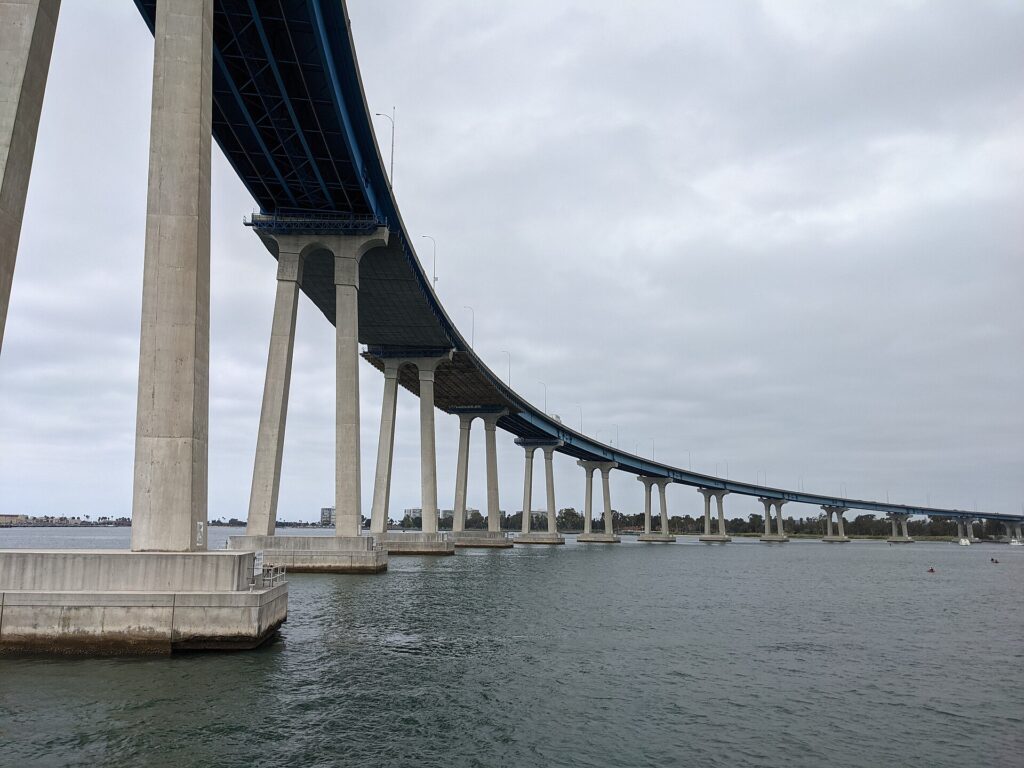
    The curving San Diego-Coronado Bridge over San Diego Bay
    The San Diego-Coronado Bridge, the drive to Coronado's beaches and the Hotel del Coronado (Photo: Mds08011 via Wikimedia Commons, CC BY 4.0)

    Parking

    Parking is the real cost of a car in San Diego. Downtown has metered street parking with posted hours and many garages, which charge premium event rates on game and concert nights, and most downtown hotels charge a hefty nightly fee for parking or valet. Balboa Park’s lots, free for decades, have moved to paid parking in recent years, so check the park’s current rules before you go. In La Jolla, time-limited street parking near the Cove and the village fills quickly, especially on weekends, and paid garages fill the gap. The beach lots in Mission Beach, Pacific Beach and Ocean Beach fill by late morning on summer weekends, and street parking in those neighborhoods is tight. Never leave valuables visible in a parked car at a beach or trailhead.

    Rules and conditions worth knowing

    • The border. Southbound I-5 and I-805 end at the San Ysidro crossing, and the last U.S. exits come quickly; watch the signs, because missing them puts you in the lanes for Mexico, where most rental agreements do not allow the car to go.
    • Mexico with a rental. Most U.S. rental companies forbid or restrict driving into Mexico, and those that allow it require Mexican auto insurance; for a Tijuana day trip, walking across is far simpler.
    • Express lanes and tolls. The I-15 Express Lanes and the I-5 lanes in North County are free for qualifying carpools and tolled for solo drivers with a FasTrak account, and SR 125 in the South Bay is a toll road; rental companies bill tolls through their own programs, often with a daily fee, so ask at the counter.
    • Phones. California law bans holding a phone while driving; use a mount and hands-free mode.
    • Right turns on red are permitted after a full stop unless signed otherwise.
    • Checkpoints. Border Patrol checkpoints operate on the main highways north and east of the city, including I-5 near San Onofre; carry ID.
    • Road conditions. 511 San Diego and the California Department of Transportation publish closures, crashes and conditions, including winter snow on the mountain roads to Julian and on I-8 east of the city.

    When renting a car makes sense

    • The coast. La Jolla, Torrey Pines, Point Loma, Cabrillo National Monument, Sunset Cliffs and the beach towns are strung along the shore, with slow bus links between them; a car lets you see several in a day.
    • North County and inland day trips. The Safari Park, LEGOLAND and the Flower Fields in Carlsbad, the Temecula wine country, Julian and Anza-Borrego are all a 40-minute to two-hour drive away.
    • Beach stays. If you are staying in Mission Beach, Pacific Beach, La Jolla or North County, a car makes getting downtown and to the attractions much easier.
    • Families. Car seats, beach gear and early starts at the zoo all argue for a car, and our family car rental guide looks at vehicle choice.
    • Road trips. Los Angeles is two to three hours north and Phoenix about five and a half hours east; our Los Angeles to San Diego route guide and Phoenix to San Diego route guide cover the drives.

    If any of those apply, our rental car booking tips cover insurance, deposits and the questions to ask at the counter.

    When it does not

    • You are staying downtown and your plans are the waterfront, Balboa Park, Old Town and Coronado by ferry.
    • You are in town for a convention, Comic-Con or a Padres game, when downtown parking is at its most expensive and the Trolley stops beside the venues.
    • Your main day trip is Tijuana, which is easiest on the Trolley and on foot.
    • You are staying at a single resort in Coronado or on Mission Bay and plan to spend most of the time on the sand, with ride-hail for the occasional dinner.

    The hybrid plan for a city-plus-coast trip

    Go car-free for the downtown days and rent for the coast and the day trips, and think about where you pick up. Every major company operates from the airport’s Rental Car Center, which is convenient but adds airport fees and surcharges; neighborhood offices downtown and elsewhere in the city can avoid some of those charges and make sense if you are spending the first nights in the Gaslamp or Little Italy. A pattern that works well: take a taxi or ride-hail from the airport, spend two or three car-free days on the waterfront, in Balboa Park, in Old Town and on the Coronado ferry, then pick up a car for La Jolla, Point Loma and the beaches, and a day in Carlsbad, Temecula or at the Safari Park, and return it to the airport on the way to your flight home. Compare the day rates on our San Diego car rental page against a full-trip rental and the difference is usually obvious.

    A worked cost comparison

    Numbers change with the season and the booking window, so treat this as a method rather than a quote, and check current rates before deciding. For a three-night city break downtown for two people, the car-free version costs a couple of ride-hail trips from and to the airport, Trolley and bus fares capped at a day pass each per day, the ferry to Coronado, and perhaps two ride-hail trips to La Jolla and Ocean Beach; the rental version adds three days of a compact car, airport fees and surcharges, three nights of downtown hotel parking and fuel. Transit wins clearly, largely because of parking. For a five-night stay with two coast days and a trip to the Safari Park, the hybrid version adds a two-day rental from a city location and fuel, against ride-hail trips of 30 to 60 minutes each way for the car-free version; the rental usually wins for two or more people. For a week at a beach hotel with a family, a rental for the whole stay is the practical answer, especially if the hotel’s parking is free or reasonable. Run the rental rates for your dates on our San Diego car rental page and put them beside the parking and ride-hail costs before you choose.

    Driving out of San Diego in each season

    The highways out of San Diego are good, but each has its own character. I-5 north to Los Angeles follows the coast through North County and past Camp Pendleton, about 200 kilometers (120 miles) downtown to downtown; allow two hours with light traffic and three or more at rush hour, on Friday afternoons northbound and on Sunday afternoons,. I-15 north reaches Temecula in about an hour and Las Vegas in about five, crossing the Mojave, where summer heat makes a breakdown dangerous. I-8 east to Phoenix climbs through the mountains east of the city, where winter storms can bring snow and ice to the high passes, then drops into the low desert past El Centro and Yuma, some of the hottest country in North America in summer; about five and a half hours in all, with fuel stops far apart. The mountain roads to Julian occasionally require chains after winter snow. In fall, Santa Ana wind events bring wildfire risk and occasional road closures. In summer, start desert drives early with a full tank and plenty of water. Before any long drive, check the Caltrans and 511 San Diego conditions.

    Decision table

    Your tripRecommendationWhy
    City break downtownNo carThe waterfront, Balboa Park, Old Town and Coronado by ferry are all reachable without one
    Convention, Comic-Con or a Padres gameNo carThe Trolley stops beside the venues; event and hotel parking is expensive
    Tijuana day tripNo carTrolley to San Ysidro and walk across; rentals rarely allowed into Mexico
    Coronado or Mission Bay resort, mostly on the sandNo car, ride-hail for outingsAvoids parking fees for a car you rarely use
    La Jolla, Point Loma and the beach townsRent for those daysThe coast is poorly served by rail
    City plus North County day tripsHybrid: rent from a city location for the trip daysCar-free downtown, car for the Safari Park, Carlsbad or Temecula
    Family beach holidayRent for the whole stayCar seats, beach gear and spread-out attractions
    Southern California or Southwest road tripRent (consider one-way to Los Angeles or Phoenix)San Diego is one stop on the route

    Money-saving tips for both options

    • On transit: use PRONTO so your fares cap at a day pass automatically, and combine the Trolley with the Coronado ferry and walking downtown.
    • On a rental: compare airport and neighborhood pickup, rent only for the days you need, book early for summer, and decline extras you already have through a credit card or home policy (check first).
    • On the hotel: if you are renting, price the parking into the room rate; beach and Mission Valley hotels often charge far less than downtown.
    • On timing: avoid I-5 at rush hour and on Sunday afternoons northbound; our best time to fly to San Diego guide lists the busiest weeks, and for the rest of Southern California, our guide to renting a car in Los Angeles covers the other end of I-5, and our Phoenix car guide covers the far end of I-8.
    • On ride-hail: for a group of three or four on a short trip, a single ride often costs less than four fares and saves a long bus ride; our guide to car, transit or taxi sets out the general trade-offs.
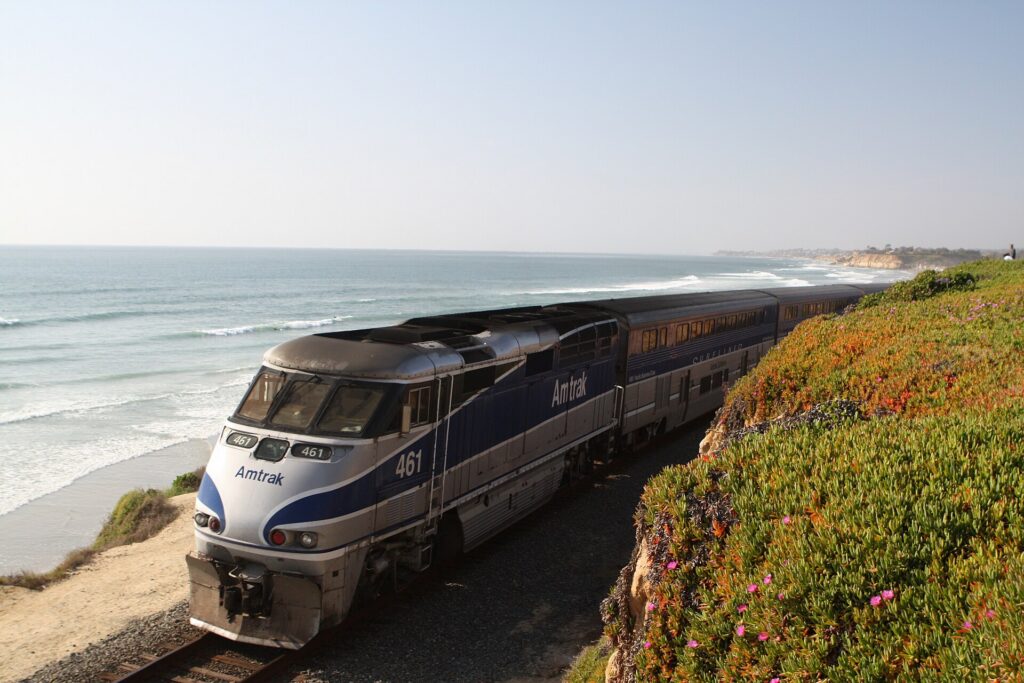
    An Amtrak Pacific Surfliner train in Del Mar, north of San Diego
    The Pacific Surfliner and the Coaster follow the coast north to the beach towns and Los Angeles (Photo: catlin.wolfard via Wikimedia Commons, CC BY-SA 3.0)

    Frequently asked questions

    Is it worth renting a car in San Diego?

    For La Jolla, Point Loma, the beach towns and North County day trips, yes. For a downtown stay built around the waterfront, Balboa Park, Old Town and Coronado, no.

    Is San Diego public transit good for tourists?

    Good for downtown, Old Town, Mission Valley and the border, and the ferry covers Coronado. The coast is harder: buses reach the beaches and La Jolla, but slowly.

    How do I get from San Diego airport to downtown?

    A taxi or ride-hail in about ten minutes, or an MTS bus. The airport shuttle to the Old Town Transit Center connects with the Trolley, the Coaster and Amtrak.

    Can I take the Trolley to Mexico?

    Yes. The Blue Line runs to San Ysidro, where you walk across the border. Carry a valid passport and the documents you need to re-enter the United States.

    Is parking expensive in San Diego?

    Downtown, yes, especially at hotels and on event nights. It is easier and cheaper in the beach neighborhoods outside summer weekends, and in Mission Valley.

    Can I take the train from San Diego to Los Angeles?

    Yes, on the Amtrak Pacific Surfliner from the Santa Fe Depot or Old Town to Union Station in about three hours, when coastal landslides are not disrupting service.

    Can I drive a rental car into Mexico?

    Usually not. Most U.S. rental companies forbid it, and those that allow it require Mexican insurance. Walk across at San Ysidro instead.

    Whichever way you go, start with the flight. Compare cheap flights to San Diego, choose a neighborhood with our San Diego hotel search, and if the coast or North County is on the list, price the rental for those dates on our San Diego car rental page. For what to do once you arrive, start with our first-timer’s guide to San Diego.

  • Things to Do in San Diego: A First-Timer’s Guide

    Things to Do in San Diego: A First-Timer’s Guide

    San Diego sells itself on the weather, and the weather deserves the reputation: mild in every month, dry for most of the year, and rarely too hot or too cold to be outside. But visitors who treat it as a beach town with a zoo miss most of the city. San Diego has one of the largest urban cultural parks in the country, an aircraft carrier you can walk from the flight deck to the engine room, the site where European settlement of California began, and a coastline that changes character every few miles, from the surf beaches of Pacific Beach to the sea lions of La Jolla and the tide pools of Point Loma. This guide covers the sights that earn a day, the neighborhoods worth a half-day, the beaches, the food, the sports, the day trips, and the practical details that turn a sunny long weekend into a proper trip.

    If you are still comparing cheap flights to San Diego, read this alongside our guides to the best time to fly to San Diego and whether you need a rental car. Between the three you can plan the whole trip.

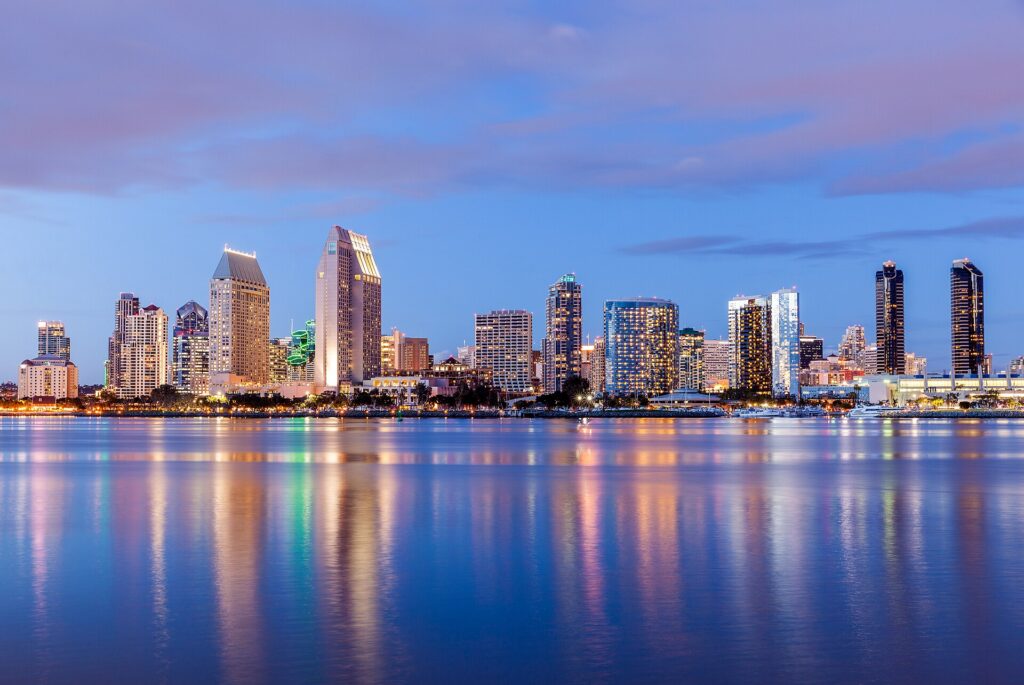
    The downtown San Diego skyline across San Diego Bay
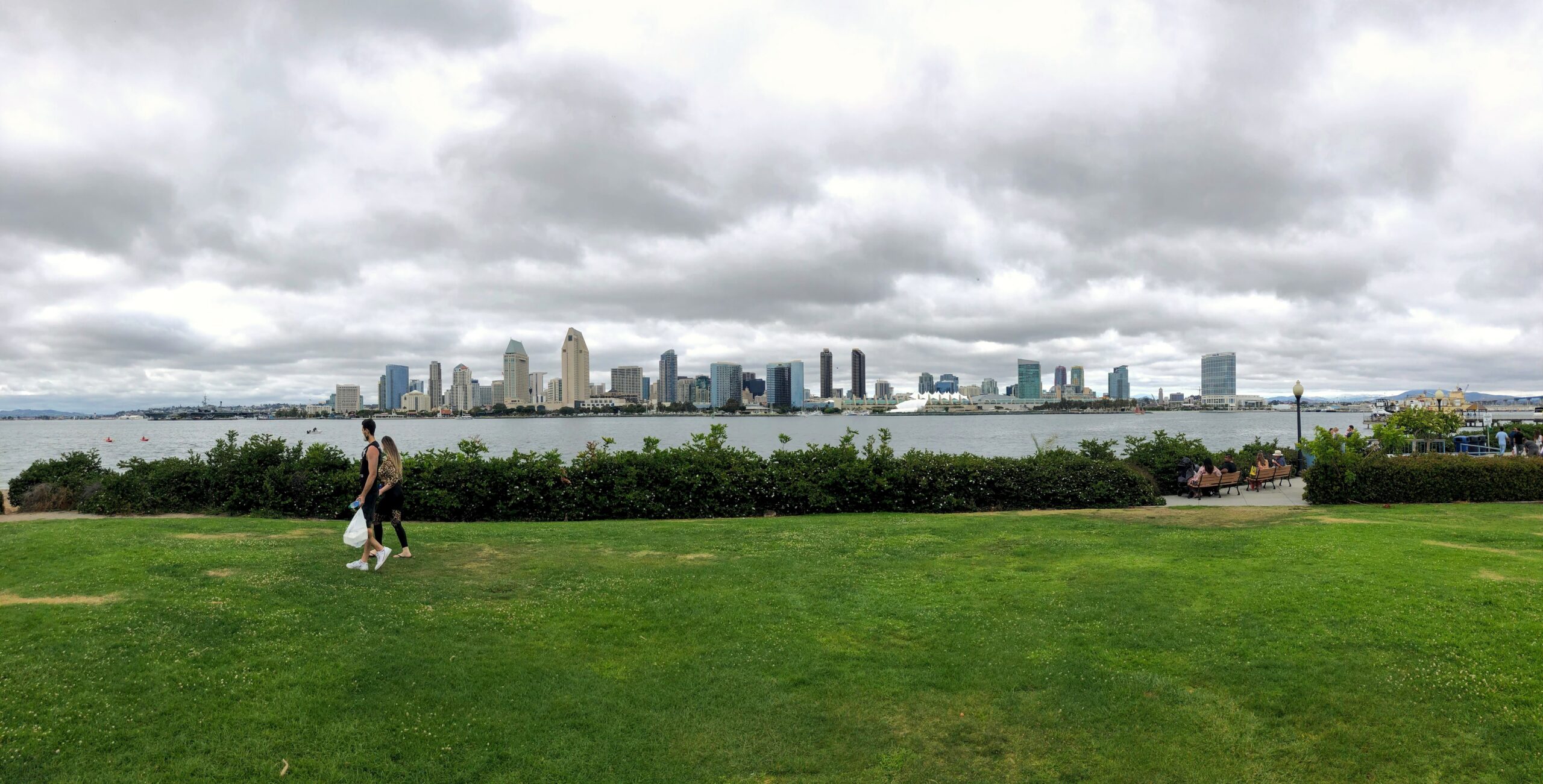
    Downtown San Diego at dusk, seen across the bay from Coronado (Photo: russellstreet via Wikimedia Commons, CC BY-SA 2.0)

    San Diego at a glance for first-timers

    • Airport: San Diego International (SAN), about 5 km (3 miles) northwest of downtown on San Diego Bay. Taxis, ride-hail, buses and the Rental Car Center shuttle serve it. See our SAN airport guide.
    • Getting around: the MTS Trolley links downtown, Old Town, Mission Valley, the university area and the Mexican border at San Ysidro. The beaches, La Jolla and Point Loma are easier by car or ride-hail, and many visitors rent for part of the stay.
    • Money: U.S. dollars. Sales tax is added at the register, and hotels and rental cars carry their own taxes and fees, so compare total prices. Tipping 18 to 20 percent in restaurants is standard.
    • Weather: afternoons around 19 °C (66 °F) in winter and 24 to 26 °C (76 to 78 °F) in late summer, a gray marine layer that often covers the coast in May and June, and most of the modest rain between November and March. Our month-by-month guide has the detail.
    • Where to stay: the Gaslamp Quarter for nightlife, the ballpark, the convention center and the Trolley; Little Italy for restaurants and a calmer downtown base; Coronado for the classic beach resort; Mission Beach and Pacific Beach for sand and surf; La Jolla for the prettiest coast and the highest prices. Our San Diego hotel search covers them all.

    Balboa Park and the San Diego Zoo

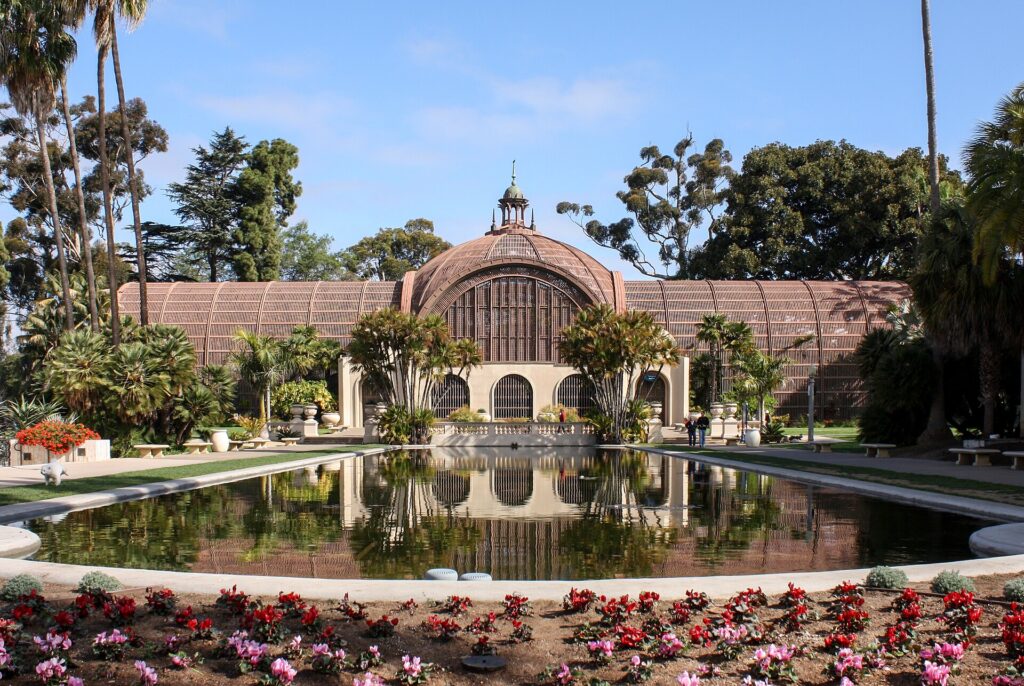
    Start at Balboa Park, a short drive or bus ride northeast of downtown and the cultural center of the city. Its core, the Prado, is a promenade of ornate Spanish Colonial Revival buildings put up for the Panama-California Exposition of 1915, crowned by the tiled dome and bell tower of the California Building. Around it are more than fifteen museums: the San Diego Museum of Art; the free Timken Museum of Art, a small jewel with works by old masters; the Museum of Us, devoted to human cultures; the Natural History Museum; the Fleet Science Center; and the Mingei, a museum of folk art and design. The Botanical Building, a vast wooden lath structure behind a long lily pond, is one of the most photographed spots in the city. On Sunday afternoons, free concerts at the Spreckels Organ Pavilion, home to one of the largest outdoor pipe organs in the world, draw a relaxed crowd. Walking the Prado and the gardens is free; the museums charge admission, so price a multi-museum pass if you plan several.

    The San Diego Zoo, at the northern edge of the park, is one of the most famous zoos in the world, its habitats set in planted canyons. Allow most of a day, arrive at opening time and use the aerial tram and the guided bus to cover the steep terrain.

    The Botanical Building and lily pond in Balboa Park, San Diego
    The Botanical Building and its lily pond, at the heart of Balboa Park (Photo: Bernard Gagnon via Wikimedia Commons, CC BY-SA 3.0)

    The waterfront: the USS Midway, the Embarcadero and the bay

    San Diego is a Navy city, and the waterfront shows it. The USS Midway Museum, moored at Navy Pier, is an aircraft carrier that served from the end of the Second World War until the early 1990s and is now one of the most visited naval museums in the country. Climb into the cockpits on the flight deck, walk the crew’s berths and engine room, and listen to the volunteer docents, many of them veterans; plan three to four hours. A short walk north, the Maritime Museum of San Diego keeps a fleet of historic vessels led by the Star of India, an iron-hulled sailing ship launched in 1863 and one of the oldest ships still able to sail. South of the Midway, the Embarcadero path runs past Tuna Harbor to Seaport Village, a cluster of waterfront shops and restaurants, and on past the convention center. Harbor cruises and the Coronado ferry leave from the Broadway Pier area.

    Old Town and the birthplace of California

    In 1769, a Spanish expedition founded a presidio and a mission on the hill above the San Diego River, the first permanent European settlement in what is now California. Old Town San Diego State Historic Park, run by California State Parks, preserves the town that grew below it in the Mexican and early American periods, with restored adobe houses, a schoolhouse, a newspaper office, a blacksmith and small museums that are free to enter. The surrounding streets of Mexican restaurants and souvenir shops are touristy, but the history is real. On the hill above, Presidio Park has lawns, views over Mission Valley and the JunĆ­pero Serra Museum. The mission itself moved inland in 1774, and Mission San Diego de AlcalĆ”, the first of the twenty-one California missions, is still an active parish with a whitewashed church, gardens and a small museum. Old Town is on the Trolley and the Coaster commuter train.

    Coronado

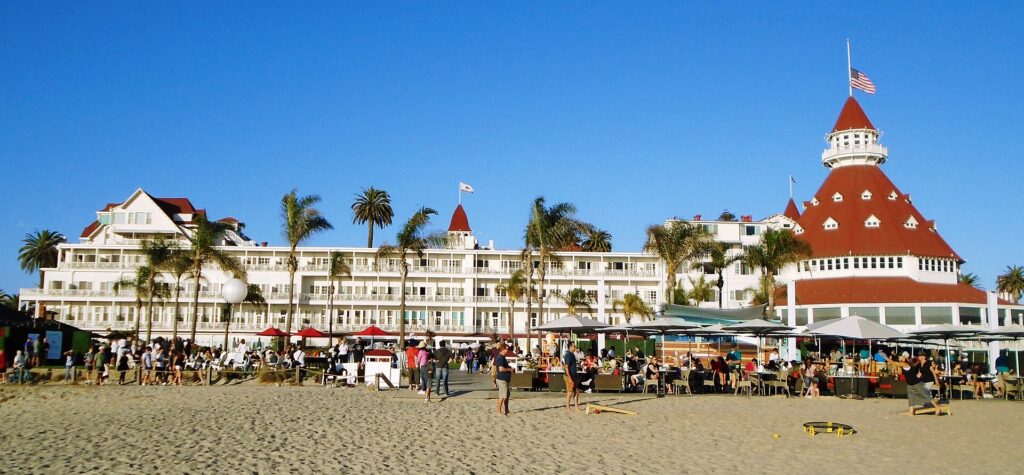
    Across the bay, Coronado is a quiet, affluent town on a peninsula joined to the mainland by the narrow Silver Strand, and reached most dramatically over the tall, curving San Diego-Coronado Bridge or by the ferry from downtown. Its landmark is the Hotel del Coronado, a vast white Victorian beach resort with red turrets, opened in 1888 and one of the grandest wooden buildings in the United States. You do not need to stay there to walk its lobby and grounds and continue onto Coronado Beach, one of the widest and most consistently praised beaches in the country, its sand flecked with glittering mica. Bicycles are an easy way to explore the flat streets and the bayside path. The ferry landing has the best view of the downtown skyline at dusk.

    The Hotel del Coronado and Coronado Beach
    The Hotel del Coronado, opened in 1888, behind one of the widest beaches in the country (Photo: Beyond My Ken via Wikimedia Commons, CC BY-SA 4.0)

    La Jolla and Torrey Pines

    About twenty minutes north of downtown, La Jolla is San Diego at its most beautiful: sandstone cliffs, coves of clear water and a village of galleries, boutiques and restaurants above them. At La Jolla Cove and along the cliffs toward the Children’s Pool, sea lions and harbor seals haul out on the rocks; keep your distance and respect the seasonal closures that protect seal pups. The cove is part of an ecological reserve with some of the best snorkeling in Southern California, including bright orange garibaldi, the state marine fish. Guided kayak tours paddle to the sea caves beneath the cliffs, and beginners take surf lessons at gentle La Jolla Shores just north. North again, Torrey Pines State Natural Reserve protects the rarest native pine in the country on eroded bluffs high above the Pacific, with short trails to viewpoints and a path down to the beach.

    Point Loma, Ocean Beach and the beach towns

    At the tip of the Point Loma peninsula, Cabrillo National Monument marks the spot where Juan RodrĆ­guez Cabrillo landed in 1542, the first European expedition to reach what is now the West Coast of the United States. It has the best panoramic view in the city, across the bay to downtown and Coronado; the restored Old Point Loma Lighthouse; and tide pools rich with anemones, crabs and sea stars at low tide, mostly in winter. From December to March, it is also a good place to watch for migrating gray whales. Just north, Sunset Cliffs is a stretch of eroded bluffs where locals gather in the evening; stay back from the crumbling edges. Ocean Beach is the most laid-back beach community, with surf shops, dive bars, a long fishing pier, a dog beach and a Wednesday farmers’ market. Across the channel, Mission Beach has a busy boardwalk and Belmont Park, where the wooden Giant Dipper roller coaster has run since 1925, while Pacific Beach is the younger, louder surf and bar district.

    The Pacific here is cooler than many visitors expect, in the upper teens Celsius (low to mid-60s Fahrenheit) for much of the year and around 20 to 22 °C (high 60s to low 70s Fahrenheit) in late summer, so a wetsuit helps outside August and September. Swim near a staffed lifeguard tower, and if a rip current pulls you out, swim parallel to the shore until you are free. After heavy rain, runoff can foul the water near river mouths, and the county posts beach advisories and closures; check before swimming, especially near the border, where sewage flows from the Tijuana River have closed beaches in Imperial Beach for long periods.

    Neighborhoods worth a half-day

    The Gaslamp Quarter

    The Gaslamp Quarter is the historic heart of downtown: around sixteen blocks of Victorian and early-20th-century buildings along Fifth Avenue, restored as a district of restaurants, rooftop bars, nightclubs and hotels. It is busiest on weekend nights and game days, when crowds pour out of Petco Park at its southern end.

    Little Italy

    North of downtown along India Street, Little Italy grew up around the families of Italian tuna fishermen and is now one of the city’s best dining districts, with piazzas, espresso bars and the Mercato, a large Saturday farmers’ market. It is on the Trolley and walkable from the waterfront.

    North Park and Hillcrest

    Just north of Balboa Park, North Park is the center of the craft beer scene, with breweries, taprooms and vintage shops along 30th Street and University Avenue. Neighboring Hillcrest, long the heart of the LGBTQ community and home of San Diego Pride, has a lively restaurant row.

    Barrio Logan

    Under the approaches to the Coronado Bridge, Chicano Park holds one of the largest collections of outdoor murals in the country, painted on the bridge’s pillars since the 1970s and now a National Historic Landmark. The surrounding streets have galleries, coffee shops and taquerias.

    Museums, culture and family attractions

    Beyond Balboa Park and the waterfront, San Diego’s culture is spread around the city. The Museum of Contemporary Art San Diego has its main home on the cliffs in La Jolla. The Old Globe in Balboa Park and the La Jolla Playhouse are two of the most respected regional theaters in the country, and several of their productions have gone on to Broadway. The San Diego Symphony plays at the Rady Shell, an outdoor venue on the bay beside Seaport Village. SeaWorld San Diego, on Mission Bay, is as much a roller coaster park as a marine park. For what is on during your dates, our San Diego events page lists concerts, shows and games.

    Sports

    The San Diego Padres play Major League Baseball at Petco Park, on the edge of the Gaslamp Quarter, from April to September; it is regularly named one of the best ballparks in the country, with the brick Western Metal Supply building built into the left-field corner. San Diego FC joined Major League Soccer in 2025 and plays at Snapdragon Stadium in Mission Valley, which it shares with the San Diego Wave of the National Women’s Soccer League and San Diego State football. The public Torrey Pines golf courses on the cliffs host a PGA Tour event each winter and have staged the U.S. Open. Check what is on sale in San Diego before you book flights.

    What to eat, and where

    San Diego’s signature food comes from across the border. The fish taco, battered white fish in a corn tortilla with cabbage, crema and salsa, arrived from Baja California and is now found everywhere from beach shacks to sit-down restaurants. The California burrito, carne asada, cheese and French fries in a flour tortilla, is a local invention and the classic late-night meal. On Saturday mornings, the Tuna Harbor Dockside Market sells the catch straight off the boats. Craft beer is the other obsession: the county has well over a hundred breweries, and the bitter, piney West Coast IPA is closely associated with the city. Little Italy and North Park have the most ambitious restaurants, and Convoy Street in Kearny Mesa the best Asian food.

    San Diego through the seasons

    San Diego has less seasonal swing than almost any big city in the country, but the seasons still shape a trip. Winter (December to February) brings afternoons around 19 °C (66 °F), clear days between occasional rainstorms, gray whales offshore, and December Nights, Balboa Park’s free holiday festival, in early December. Spring (March to May) brings wildflowers to Anza-Borrego in wet years and the Flower Fields in Carlsbad; by May, the marine layer often keeps the coast gray until midday, a pattern locals call May Gray. Summer (June to September) starts with June Gloom and turns sunny and warm from July, with the San Diego County Fair at Del Mar, Comic-Con in July, the Del Mar racing season, and the warmest ocean of the year. Fall (October to November) is many locals’ favorite, with warm, clear days, quieter beaches, and occasional Santa Ana winds that bring hot, dry air from the desert and raise the fire danger. Our month-by-month guide has the fare patterns for each season.

    San Diego with kids

    Few cities are as easy with children. The San Diego Zoo and the Safari Park are the headline attractions, and LEGOLAND California in Carlsbad, about forty minutes north, is aimed squarely at children up to about twelve. The Fleet Science Center has hands-on galleries, and the USS Midway fascinates every age. Mission Bay’s calm beaches suit small children, and the Cabrillo tide pools make a great morning at low tide. For day trips, our family car rental guide covers the vehicle question.

    San Diego on a budget

    Many of San Diego’s best experiences are free: every beach, the Embarcadero, Balboa Park’s Prado and gardens, the Sunday organ concerts, the Timken Museum of Art, the adobe museums of Old Town, the murals of Chicano Park, the seals of La Jolla, Sunset Cliffs, and Torrey Pines, where you pay only to park. Eat well for less at taco shops, along Convoy Street and at happy hours. A Trolley day pass covers downtown, Old Town and the border. Hotels are cheapest in winter outside the holidays and most expensive in July, August and convention weeks; compare rates by neighborhood on our San Diego hotel search.

    Day trips from San Diego

    The San Diego Zoo Safari Park, near Escondido about forty-five minutes north, shows African and Asian animals in large open enclosures from a tram or on a guided safari. Carlsbad has LEGOLAND, the spring Flower Fields and a pleasant beach village,. Inland, the Temecula Valley wine country is about an hour north, and the old gold-mining town of Julian, about an hour and a half into the mountains, is famous for apple pie. Los Angeles is two to three hours north by car or on the Amtrak Pacific Surfliner; see our Los Angeles guide and the Los Angeles to San Diego route guide. Phoenix is about five and a half hours east on I-8; our Phoenix guide and the Phoenix to San Diego route guide cover that trip. Most of these work best by car; see our San Diego car rental page, and the San Diego Tourism Authority for the wider county.

    A day in Tijuana: what to know first

    Tijuana is directly across the border, and the Blue Line Trolley runs from downtown to the San Ysidro crossing in under an hour, and most visitors walk across. Treat the documents as the plan. To enter Mexico, carry a valid passport; Mexico’s immigration authority, the Instituto Nacional de Migración, sets the rules on visas and visitor permits, which depend on your nationality and on how far and how long you travel. To come back, everyone must pass U.S. inspection: U.S. citizens need a passport, passport card or another document approved for land crossings, and international visitors need a visa or visa waiver status that allows them to re-enter. Check U.S. Customs and Border Protection before you go, especially if you are not a U.S. citizen. Return waits on foot can run to several hours on weekend afternoons; CBP publishes live wait times. Most U.S. rental companies restrict or forbid taking their cars into Mexico, so walk.

    Two sample itineraries

    Three days, light car use

    Day one: the USS Midway in the morning, a walk along the Embarcadero to Seaport Village, the ferry to Coronado for the beach and the Hotel del Coronado, and dinner in Little Italy. Day two: the San Diego Zoo at opening time, the Prado and the museums of Balboa Park in the afternoon, and beers and dinner in North Park. Day three: Old Town by Trolley in the morning, then La Jolla Cove, the seals and a kayak tour to the sea caves, and sunset at Sunset Cliffs, with ride-hail filling the gaps.

    Five days, with the coast and a day trip

    Add a morning at Cabrillo National Monument and the tide pools and an afternoon on the Mission Beach boardwalk, then pick up a car for the Safari Park and Carlsbad or the Temecula wine country, or spend a day in Tijuana on foot with your passport, and drop the car at the Rental Car Center on the way home.

    Practical details

    • Transit: pay Trolley and bus fares with the PRONTO card or app, or buy a day pass. MTS has maps and timetables; our car-versus-transit guide goes into detail.
    • From SAN: a taxi or ride-hail downtown in about ten minutes, a bus or the airport shuttle to the Old Town Transit Center, or a rental from the Rental Car Center. The airport’s site covers ground transport.
    • Weather: layers in every season, because coastal mornings can be cool and gray even in summer, and sunscreen year-round, since the marine layer does not stop you burning.
    • Time zone: Pacific Time, with daylight saving time from March to November.
    • Entry requirements: Canadians need a valid passport; visitors from Visa Waiver Program countries need an approved ESTA before boarding, and everyone else needs a visa. U.S. Customs and Border Protection is the authoritative source.
    • Safety: the tourist areas are generally safe with ordinary big-city awareness; keep valuables out of sight in parked cars at beaches and trailheads, stay back from cliff edges, and swim near lifeguards.

    Frequently asked questions

    How many days do you need in San Diego?

    Three days covers Balboa Park, the zoo, the waterfront and La Jolla; add a day for the beaches and Point Loma, and one more for the Safari Park, Carlsbad or Tijuana.

    What is the number one thing to do in San Diego?

    Balboa Park and the San Diego Zoo, ideally on the same day, followed closely by the coastline at La Jolla Cove.

    Is San Diego walkable?

    Downtown is, and the Trolley links it to Old Town. Getting between the beach towns usually takes a car, bus or ride-hail.

    Do I need a car in San Diego?

    Not for a downtown stay with Balboa Park, Old Town and Coronado by ferry. For La Jolla, Point Loma, the beach towns and North County, a car makes life much easier.

    Can you swim in the ocean in San Diego?

    Yes, all year with a wetsuit, and comfortably without one in late summer. Swim near lifeguards and check water quality advisories after rain.

    What is San Diego known for?

    Year-round mild weather, beaches and surfing, the San Diego Zoo and Balboa Park, the Navy, fish tacos and craft beer, Comic-Con, and its position on the Mexican border.

    Ready to go? Compare flights to San Diego, find a place to stay with our San Diego hotel search, and if La Jolla, the beaches or North County are on the list, price a rental car for those days.

  • Best Time to Fly to San Diego: Seasons, Weather & Prices

    Best Time to Fly to San Diego: Seasons, Weather & Prices

    San Diego has one of the gentlest climates of any big city in the United States, and that changes how you should think about timing a trip. There is no month when the weather rules the city out: winters are mild, summers are warm rather than hot, and the swing between the coolest and warmest months is only a few degrees. What moves prices instead is demand. Summer brings families, beach crowds and Comic-Con, the single biggest week of the hotel year; spring break and the holidays fill the rooms again; and a steady calendar of conventions can push downtown rates up in any month. Add the marine layer that grays the coast in late spring and early summer, and you have a city where the best time to go depends on whether you want the warmest ocean, the lowest total price or the clearest skies. This guide walks through the weather month by month, the fare seasons, the events that move prices, and how to get into the city from the airport.

    The short answer

    For the best mix of weather and value, come from mid-September to early November, when the summer crowds have gone, the days are warm and sunny, and the ocean is still at its warmest. For the lowest prices, look at January and February outside the holiday weekends, when hotels drop their rates and the weather is mild and often clear, if cool for swimming. The most expensive stretches are mid-June to late August, when school holidays, beach season and the San Diego County Fair overlap, the week of Comic-Con in July, spring break in March and early April, and the Thanksgiving, Christmas and New Year holidays. Whatever you choose, run a flexible-date search on our San Diego flights page, and price the hotel for the same dates before you commit; in summer, the room usually moves the total more than the fare.

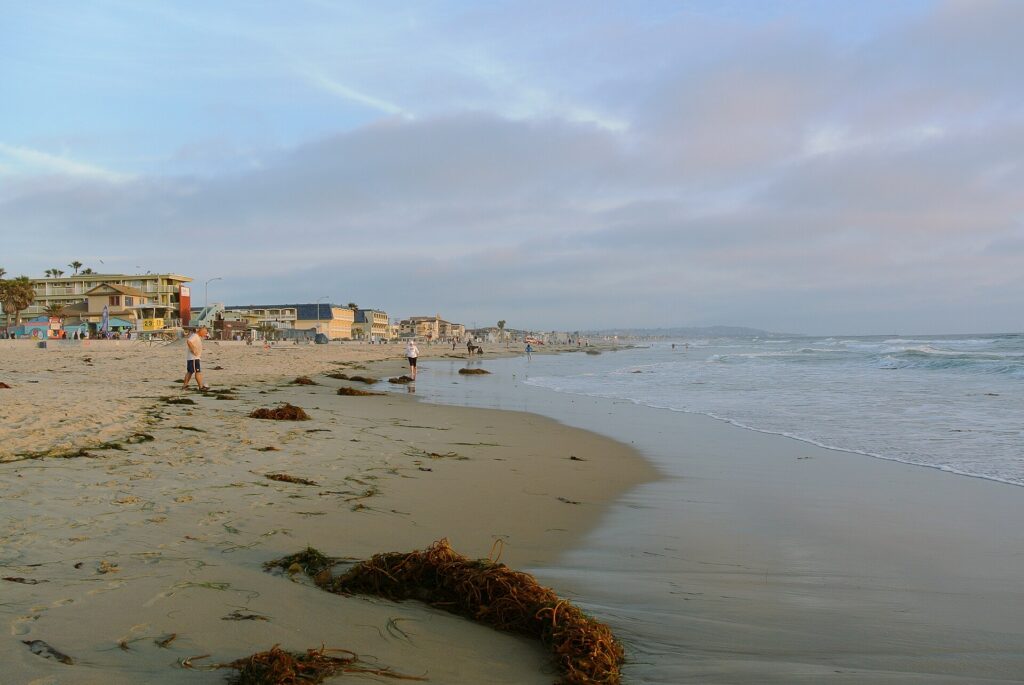
    The sand and surf at Pacific Beach in San Diego
    Pacific Beach in summer, the busiest and most expensive season on the San Diego coast (Photo: Adbar via Wikimedia Commons, CC BY-SA 3.0)

    San Diego weather, season by season

    San Diego sits on the Pacific in the far southwest corner of the country, and the cool California Current offshore moderates its climate in every season. It receives only about 250 mm (10 inches) of rain a year, almost all of it between November and March, and sees long runs of dry, sunny weather from summer into fall. The figures below are approximate seasonal patterns at San Diego International Airport, on the bay, based on the long-term climate normals published by NOAA and the National Weather Service’s San Diego office; check the current forecast before you pack, especially for winter storms and for Santa Ana wind and fire warnings in the fall.

    MonthTypical daytime highTypical overnight lowWhat it feels likeFare pressure
    Januaryaround 19 °C (66 °F)around 9 °C (49 °F)Mild, often clear days and cool nights; the wettest stretch of the yearLow; busier around the holiday weekends
    Februaryaround 19 °C (66 °F)around 10 °C (51 °F)Similar to January, with occasional rainstorms; gray whales offshoreLow; Presidents’ Day weekend busier
    Marcharound 19 °C (67 °F)around 12 °C (53 °F)Pleasant and green; the last of the rainModerate to high; spring break
    Aprilaround 21 °C (69 °F)around 13 °C (56 °F)Mild and mostly dry; wildflowers inlandModerate; Easter and spring break weeks higher
    Mayaround 21 °C (70 °F)around 16 °C (60 °F)May Gray: cloudy mornings on the coast, sun inlandModerate; Memorial Day weekend busy
    Junearound 23 °C (73 °F)around 17 °C (62 °F)June Gloom: gray starts, warm afternoonsHigh from mid-month; county fair
    Julyaround 24 °C (76 °F)around 19 °C (66 °F)Sunny and warm; the marine layer burns off earlierPeak; Fourth of July, Comic-Con
    Augustaround 26 °C (78 °F)around 20 °C (68 °F)The warmest month, with the warmest oceanPeak until mid-month, easing after
    Septemberaround 26 °C (78 °F)around 19 °C (66 °F)Warm and sunny; occasional hot spellsModerate after Labor Day
    Octoberaround 24 °C (75 °F)around 16 °C (61 °F)Clear and warm; Santa Ana winds possibleModerate
    Novemberaround 21 °C (70 °F)around 12 °C (54 °F)Mild and sunny; the first rains late in the monthModerate; Thanksgiving spike
    Decemberaround 19 °C (66 °F)around 9 °C (48 °F)Mild days, chilly nights, occasional rainLow until mid-month, then high

    Three things the table cannot show. First, the marine layer: in late spring and early summer, a deck of low cloud forms over the cool ocean at night and covers the coast until late morning or, on some days, all day. Locals call it May Gray and June Gloom, and it can make a beach day in early June feel cooler than one in October. Second, the ocean lags the air: the water is coolest in late winter and spring and warmest in August and September, so late summer and early fall are the best months for swimming, surfing and snorkeling without a wetsuit. Third, the Santa Ana winds: a few times each fall and winter, hot, dry winds blow from the deserts toward the coast, sending temperatures well above normal, dropping humidity to near zero and raising the wildfire danger across the county.

    How San Diego fare seasons work

    San Diego International is one of the busiest single-runway commercial airports in the country, with Southwest as its largest carrier, a strong Alaska Airlines presence, the other big U.S. airlines serving their hubs, and a handful of international routes to Canada, Mexico, Europe and Asia. That low-cost competition keeps domestic fares reasonable in most months, especially from the West and Southwest, and it means the sharpest price swings are in the hotel rooms. Three calendars drive them: school holidays, which fill the beach hotels from mid-June to August and again at spring break and the winter holidays; the convention calendar, led by Comic-Con in July, which can lift downtown rates in any month; and big events such as the county fair, the Del Mar racing season and major sporting weekends. The result is a long, expensive summer, busy holiday spikes, and quiet, good-value stretches in winter and after Labor Day.

    Peak season

    Mid-June to late August, plus spring break, Thanksgiving week, the Christmas and New Year holidays, and Comic-Con week. In summer the beach hotels charge their highest rates and weekends book up weeks ahead. If you must travel in peak, book the hotel early, fly midweek, and consider staying downtown or in Mission Valley, where rates are often lower than on the sand and the Trolley links you to the sights.

    Shoulder season

    March to May outside spring break, and mid-September to early November. These are many locals’ favorite months: spring is green, mild and quiet midweek, although May brings the gray mornings, and fall is warm, clear and uncrowded once the schools go back. Watch Easter, Memorial Day, the Labor Day weekend and big conventions.

    Low season

    Mid-November to mid-December outside Thanksgiving, and January and February outside the holiday weekends. Hotel rates are at their lowest of the year, and the zoo and Balboa Park are quiet. The ocean is cold for swimming, but it is prime time for whale watching and golf.

    As elsewhere, midweek departures and early or late flights usually price below Friday and Sunday afternoons on the same route, and a search across a whole month reveals cheaper pairs of dates close to your first choice. Our guide to the best times to book explains how to read those patterns.

    San Diego month by month

    January

    Quiet, mild and good value. Winter storms bring most of the year’s rain, usually a day or two at a time. Gray whales pass the coast on their southbound migration, and the PGA Tour’s event at Torrey Pines usually arrives late in the month or in early February. Martin Luther King Jr. weekend is busier; the rest of the month is one of the cheapest windows of the year.

    February

    Much like January, with a chance of rain and some of the clearest views of the year between storms. Whale watching peaks as the gray whales head north again with their calves, hotel rates stay low apart from Presidents’ Day weekend.

    March

    Green hills, the last of the rain, and the arrival of spring break, which lifts hotel rates and fills the beaches and theme parks for several weeks, depending on school calendars. In a wet year, the desert wildflowers at Anza-Borrego are spectacular, and the Flower Fields in Carlsbad start to bloom. The Padres open their season at the end of the month or in early April.

    April

    Mild and mostly dry, with the Flower Fields in full color and the San Diego Crew Classic rowing regatta on Mission Bay early in the month. Easter week and the tail of spring break are busy; the rest of April is a strong shoulder month for a city break.

    May

    The start of May Gray: many mornings on the coast are overcast and cool, and some days the sun never breaks through, while inland is warm and bright. Hotel rates are moderate until Memorial Day weekend, which marks the unofficial start of summer.

    June

    June Gloom continues, especially early in the month, but afternoons warm up and schools let out by mid-month, when rates jump. The San Diego County Fair runs at the Del Mar Fairgrounds from early June into early July. Book beach hotels early for the second half of the month.

    July

    Sunny, warm and the most expensive month of the year. The Fourth of July brings fireworks over the bay and crowds on every beach, the Del Mar racing season opens in mid-July, San Diego Pride fills Hillcrest, and Comic-Con International takes over the convention center and the whole of downtown for several days, usually in the second half of the month. During Comic-Con, downtown hotels sell out months in advance and rates rise across the city.

    August

    The warmest month, with the warmest ocean, and peak season until the schools go back, which in California can be as early as mid-August. After that, weekday rates ease noticeably while the weather stays perfect.

    September

    One of the best months of the year. After Labor Day weekend, the crowds thin, hotel rates fall, and the weather is warm and sunny, with the ocean still at its warmest. Occasional hot spells, sometimes driven by Santa Ana winds, can push the temperature well above normal even on the coast.

    October

    Clear, warm and quiet, with some of the most reliable sunshine of the year. Santa Ana winds are most likely from October on and bring hot, dry days and fire warnings. Rates are moderate apart from big convention weeks.

    November

    Mild and sunny, with the first winter rain usually arriving late in the month. Rates are moderate until Thanksgiving week, when fares from across the country rise. The San Diego Bay Wine and Food Festival usually runs in November.

    December

    Two months in one. The first half is quiet and good value, with December Nights, Balboa Park’s free holiday festival, in early December. From the week before Christmas, fares and hotel rates jump for the holidays, and the Holiday Bowl college football game brings fans to town near the end of the month.

    The San Diego Convention Center during Comic-Con
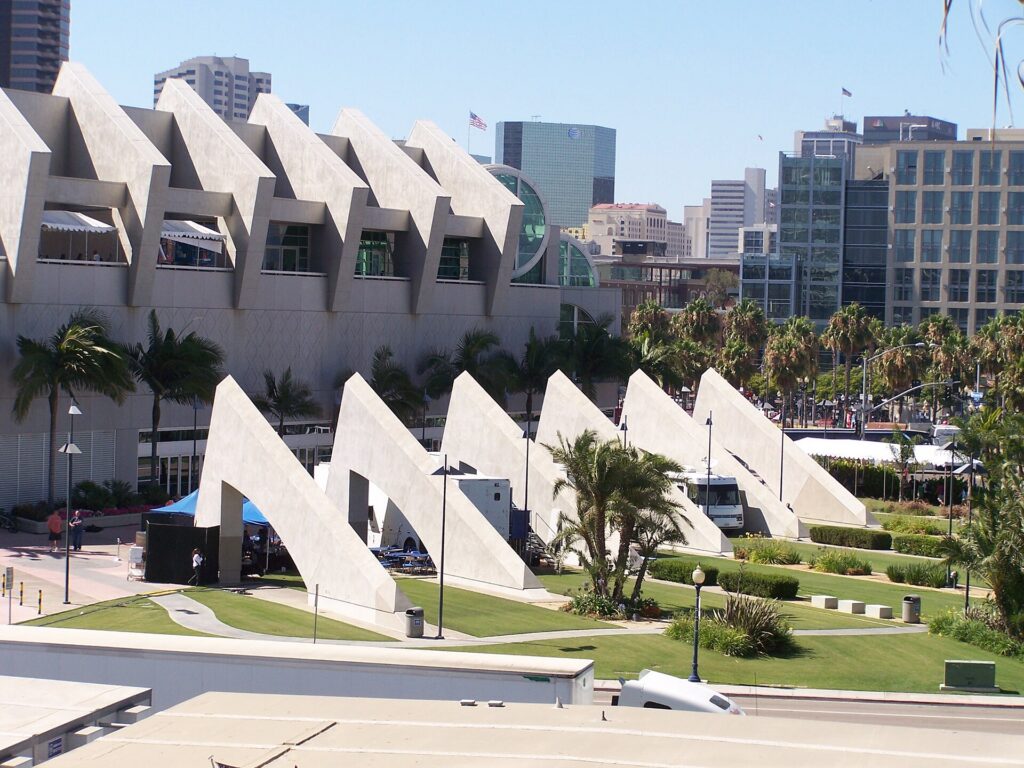
    The San Diego Convention Center, home of Comic-Con, the biggest hotel week of the year (Photo: William Tung via Wikimedia Commons, CC BY-SA 2.0)

    Events that move San Diego flight and hotel prices

    Cross-check these against your dates before you book. Exact dates shift each year; the San Diego Tourism Authority keeps the current calendar.

    • Comic-Con International (July, San Diego Convention Center): the biggest hotel spike of the year; badges sell out long in advance through Comic-Con’s own site.
    • Spring break (March and early April, varying by school district and university).
    • San Diego County Fair (early June to early July, Del Mar).
    • Fourth of July and the Del Mar racing season (mid-July to early September).
    • San Diego Pride (July, Hillcrest).
    • Memorial Day and Labor Day weekends: the bookends of beach season.
    • Thanksgiving week and the Christmas and New Year holidays, including the Holiday Bowl.
    • Big conventions at the convention center in any month, and Padres and San Diego FC home games. Our San Diego events page shows what is on sale for your dates.

    Getting in from the airport

    San Diego International (SAN), sometimes still called Lindbergh Field, sits on the bay about 5 kilometers (3 miles) northwest of downtown, which makes it one of the most convenient big-city airports in the country. It has two terminals, Terminal 1 and Terminal 2; Terminal 1 has been rebuilt as part of a multi-year redevelopment, so road and parking layouts are still changing, and it is worth checking the airport’s site for current details. Getting downtown is easy: a taxi or ride-hail takes about ten minutes outside rush hour; public transit options include an MTS bus and the airport’s shuttle to the Old Town Transit Center, where you can change to the Trolley, the Coaster and Amtrak; and shuttle buses run from the terminals to the consolidated Rental Car Center on the north side of the airport. The airport has an overnight curfew on departures, so the last flights out leave before midnight and the first leave after dawn. Our San Diego car-versus-transit guide works through whether to rent, and our SAN airport guide covers the layout.

    Terminal 2 at San Diego International Airport (SAN)
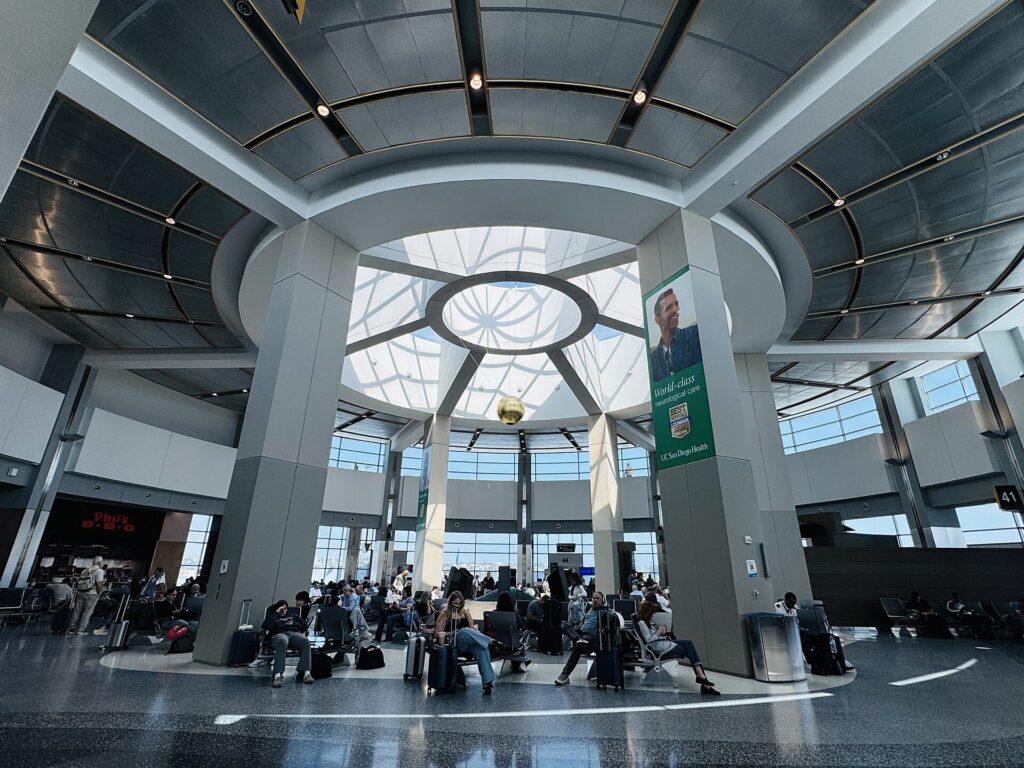
    San Diego International (SAN), about 5 km (3 miles) from downtown (Photo: Missvain via Wikimedia Commons, CC0)

    Timing tricks that work for San Diego

    • Price the room first. Airline competition at SAN keeps many fares steady, while beach hotel rates can double between February and July. Run a San Diego hotel search for your dates before you commit to the flight, and check whether a big convention is in town.
    • Search the whole month. Comic-Con, spring break and holiday weekends create sharp edges in the calendar; a calendar search on TicketScanner shows them instantly, and the week after Labor Day is often far cheaper than the week before.
    • Fly midweek. Friday and Sunday afternoons are the busiest times at SAN; Tuesday to Thursday is usually the value.
    • Compare Los Angeles. LAX has far more international and long-haul flights, and the drive or the Pacific Surfliner train takes two to three hours; compare fares with our Los Angeles flights page and our guide to the best time to fly to Los Angeles, and see the Los Angeles to San Diego route guide.
    • Consider Tijuana for Mexico. The Cross Border Xpress, a pedestrian bridge from the U.S. side at Otay Mesa straight into Tijuana’s airport, opens up Mexican domestic fares. You need a ticket for a flight from Tijuana and a valid passport; Mexico’s Instituto Nacional de Migración sets the entry rules, and the U.S. return goes through normal CBP inspection.
    • Allow for the marine layer. Low cloud occasionally slows early-morning arrivals in late spring and summer; a buffer for tight connections helps, and our guide to how early to arrive covers what to allow.
    • Flying out of San Diego instead? The same seasonality applies in reverse; see cheap flights from San Diego.
    Sunset Cliffs on the Point Loma peninsula in San Diego
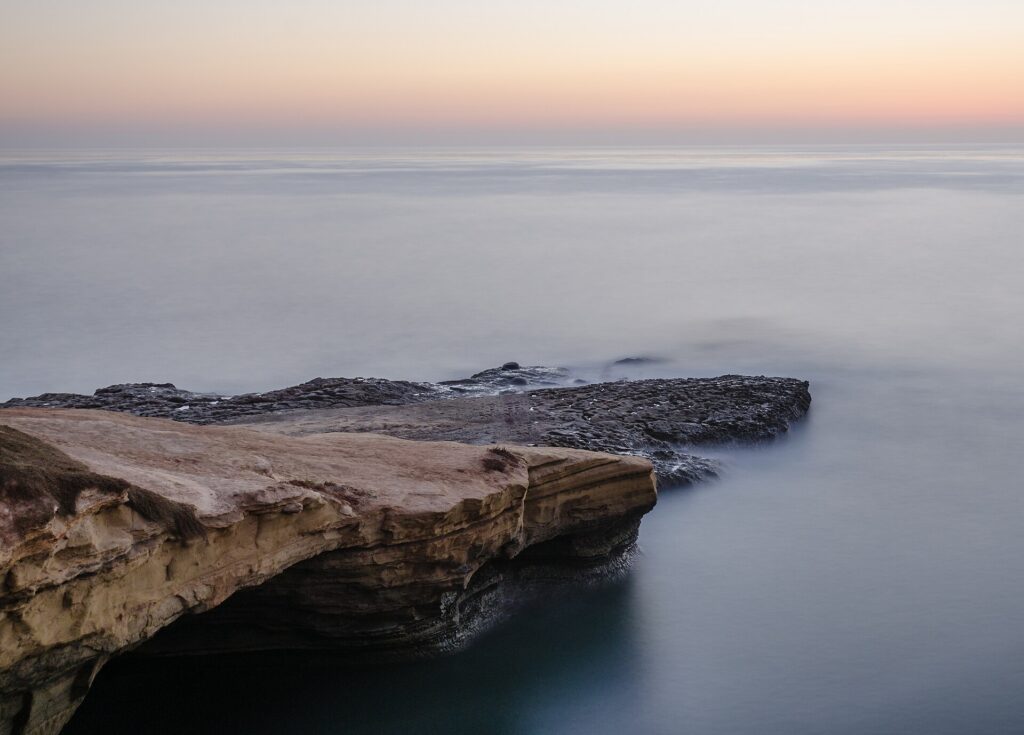
    Sunset Cliffs on Point Loma, as good in a clear January as in July (Photo: Tuxyso via Wikimedia Commons, CC BY-SA 3.0)

    May Gray, June Gloom and the beach calendar

    If the beach is the point of the trip, the calendar matters more than the table suggests. From roughly May to early July, the marine layer often sits over the coast until late morning, and some days it never clears; the sand is quieter, the light is soft, and a sweater is welcome, but it is not the postcard. From mid-July, the clouds burn off earlier and the afternoons are reliably bright. The water is warmest from August into early October, typically around 20 to 22 °C (high 60s to low 70s Fahrenheit), and coolest from January to April, when most surfers wear full wetsuits. After heavy winter rain, check the county’s beach water quality advisories before swimming. The practical conclusion: for swimming and sunbathing, September is the sweet spot, with warm water, clear skies and lower rates; for a mild, affordable city break with beach walks rather than beach days, January to April works well.

    What to pack, by season

    Winter (December to February): layers for mild days, a warm jacket for evenings that can drop below 10 °C (50 °F), a light rain shell, and sunglasses; add warmer clothing if you are heading to Julian or the mountains, where it can snow. Spring (March to May): light clothing, a sweater or jacket for gray mornings and cool evenings, and sunscreen. Summer (June to September): beachwear, a hat and high-factor sunscreen, which you need even under the marine layer, plus a light layer for evenings on the water. Fall (October to November): summer clothing into October, with a jacket for November nights. In every season, bring comfortable walking shoes for Balboa Park and the cliffs.

    The best time to fly to San Diego for…

    Beaches and swimming

    Late July to early October, and especially September after Labor Day, when the water is warmest and the crowds have thinned.

    Whale watching

    December to March for gray whales migrating along the coast, with a peak in January and February; blue whales and other species feed offshore in summer.

    Comic-Con

    Plan months ahead: secure the badge first, then book the hotel through the official housing process or as early as possible, and compare flights into SAN and LAX.

    Baseball

    April to September at Petco Park; weeknight games and midweek flights in April, May and September are the best value.

    The lowest prices

    January and February outside the holiday weekends, with mid-November to mid-December close behind.

    Families

    Summer for the warmest beaches, if you book early and accept peak rates; spring break and fall break for comfortable weather and slightly lower prices. The zoo, LEGOLAND and SeaWorld are quieter midweek outside school holidays.

    Road trips

    Spring and fall for combining San Diego with Los Angeles or Phoenix; in summer, the drive east on I-8 crosses some of the hottest desert in the country, so see our guide to the best time to fly to Phoenix before planning a desert leg.

    Cross-border and international visitors

    Canadians need a valid passport; travelers from Visa Waiver Program countries need an approved ESTA before boarding, and everyone else needs a visa. U.S. Customs and Border Protection explains what applies to you, including for re-entry after a day in Tijuana, and the TSA lists what you can carry through security.

    Frequently asked questions

    What is the cheapest month to fly to San Diego?

    For the total trip, January and February, when hotel rates are at their lowest outside the holiday weekends; airfares are usually reasonable too. Early December and late September are close behind.

    What is the best month to visit San Diego for weather?

    September and October, with warm, clear days and the warmest ocean. April and early November are close behind.

    Is San Diego warm enough for the beach in winter?

    For walking, sitting in the sun and tide pooling, often yes, with afternoons around 19 °C (66 °F). For swimming, the ocean is cold without a wetsuit.

    What is June Gloom?

    The low marine cloud that often covers the coast on late-spring and early-summer mornings, sometimes all day. It usually clears inland first and becomes less frequent from mid-July.

    How expensive is San Diego during Comic-Con?

    It is the most expensive week of the year for downtown hotels, and rates rise across the city. Flights rise less sharply. Book as early as possible, or avoid those dates if you are not attending.

    How far ahead should I book?

    Well ahead for summer, Comic-Con, spring break and the holidays; for winter and fall, rates are stable enough that choosing the right dates matters more than booking early.

    Does it rain much in San Diego?

    No. About 250 mm (10 inches) a year, almost all between November and March, often in a few storms. Summers are nearly dry.

    Ready to pick your dates? Compare fares across the whole month on our San Diego flights page, then find a room with our San Diego hotel search, perhaps in the Gaslamp Quarter. For what to do when you land, start with our first-timer’s guide to San Diego.