Every parent who has spent three hours in a car or a plane seat with a restless child knows how quickly the good mood runs out. Tablets help, until the battery dies or the downloads fail. Books are the quiet workhorse of family travel: no charging, no Wi-Fi, no volume to argue about, and the right one can hold a child’s attention for far longer than you would expect. The trick is choosing books that suit travel specifically, which is not the same as choosing good books. A beautiful hardcover with delicate pages, a stack of heavy picture books, or a sticker book that sheds pieces into the seat gap will make the trip harder, not easier. This guide covers what makes a book travel well, the best types by age, specific titles that are long-standing favorites, books that connect to where you are going, audiobooks, how to pack and ration them, and the mistakes that turn a reading plan into a mess.
The short answer
Pack light, durable books that reward repeat looking, and mix types. For toddlers, sturdy board books and lift-the-flap books about planes, trains and vehicles. For ages three to seven, search-and-find books like I Spy and Where’s Waldo?, picture books about airports and travel, and sticker and activity books. For confident readers, a chapter-book series they already love, plus an atlas or fact book about the world. Add a book about your destination, load a few library audiobooks for the car, and hold one new book back as a surprise for the hardest stretch of the trip.
What makes a book good for travel
A good travel book passes a few practical tests on top of being a good read.
- Durability. Board books, thick pages and wipe-clean covers survive juice, crumbs and being dropped in an airport. Save the heirloom hardcover for home.
- Weight and size. Every book goes in someone’s bag. Paperbacks, slim activity books and compact formats win. A large-format atlas may be worth it for an older child on a long flight, but one is enough.
- Replay value. Books children can look at again and again, like search-and-find books, detailed illustrated books and fact books, last far longer than a short story read once.
- Few loose parts. Stickers and flaps are great; pop-up pieces, loose cards and books that come with small toys are easy to lose under a seat.
- Low mess. Crayons roll, markers stain upholstery, and glitter is forever. Choose stickers, pencils or water-reveal pads for activity books.
- Right level of independence. On a plane, a book the child can enjoy alone gives parents a break; a book that needs reading aloud is better for the car, where everyone can listen.
Best types of travel books by age
| Age | Best types | Why they travel well |
|---|---|---|
| 1 to 2 | Board books, touch-and-feel, lift-the-flap | Indestructible, short, and good for pointing and naming |
| 3 to 5 | Picture books about travel and vehicles, search-and-find, sticker books | Repeatable, independent looking, and they explain what is happening at the airport |
| 5 to 7 | Activity books, early readers, flap books with facts | Mix of doing and reading; builds confidence on a long trip |
| 7 to 10 | Chapter-book series, puzzle books, illustrated atlases | Long enough to fill a flight; series mean the next book is always wanted |
| 10 to 12 | Longer novels, fact books, destination guides for kids | Independent reading for hours; a way to prepare for the destination |
Toddlers: board books and flap books
For children under three, the best travel books are sturdy, simple and about the things they will see. Board books about planes, trains, cars and trucks give a toddler words for the noisy, confusing world of an airport, and naming things on the page is an activity in itself.
- My Big Train Book, a sturdy board book with big, bright photographs of trains, is ideal for pointing and naming and is durable enough for a bumpy ride.
- Byron Barton’s Airport walks through a trip from arrival at the terminal to takeoff in bold, simple pictures, which can make a first flight feel less strange.
- Lift-the-flap and touch-and-feel books keep small hands busy. Choose board-book flaps over paper ones, which tear.
At this age, familiar favorites from home often work better than new books, because a toddler in an unfamiliar place finds comfort in the known. Bring one or two of those, plus one new travel-themed book.
Ages three to seven: picture books, search-and-find, stickers
This is the age where books do the most work on a trip, because children can look independently for long stretches but still love being read to.
Picture books about travel
- Usborne Look Inside an Airport is a flap book that shows what happens behind the scenes: check-in, baggage, security, the control tower and the plane. It answers a lot of questions before they are asked, and the flaps keep children busy at the gate.
- Richard Scarry’s Cars and Trucks and Things That Go is a classic for road trips. The pages are packed with detail and running jokes, and children can pore over it for a long time, hunting for Goldbug on every spread.
- National Geographic Little Kids First Big Book of the World introduces continents, animals, landmarks and people with big photographs and short, readable facts, roughly suited to ages four to eight. It is a good way to spark curiosity about where you are going. National Geographic Kids has more from the same family of books and games.
Search-and-find books
Search-and-find books may be the single best category for travel, because each page can take many minutes and children happily revisit them.
- The I Spy books by Jean Marzollo and Walter Wick, with their photographed scenes and rhyming riddles, work for a wide age range, and siblings can compete to find objects first.
- Where’s Waldo? by Martin Handford (published as Where’s Wally? in some countries) needs no reading at all, which makes it perfect for mixed ages.
Sticker and activity books
Sticker books are mess-free and absorbing. The Usborne Sticker Dolly Dressing series, with its many themed titles, is a long-running favorite, and there are sticker books on vehicles, dinosaurs, space and maps for every taste. Maze books, dot-to-dot books and simple puzzle books sized for travel are good for children around five to ten. Reusable water-reveal pads, where a water-filled pen reveals colors that fade as they dry, are a clever option for younger children, with nothing to spill beyond a few drops.
Ages seven to twelve: series, puzzles and atlases
Older children who read independently are the easiest to entertain with books, as long as the book is one they actually want to read.
Chapter-book series
A series they already love is the safest bet: they know the characters, and finishing one book on the flight makes them want the next. Travel-themed series add to the excitement.
- Mary Pope Osborne’s Magic Tree House series sends two siblings to a different place and time in each book, from ancient Rome to the rainforest. The books are short enough to finish on a flight, and there are many of them. The official Magic Tree House site lists the titles.
- Jeff Brown’s Flat Stanley, about a boy flattened by a bulletin board who travels by mail, has inspired school projects around the world and is a natural travel read for early chapter-book readers.
Atlases and fact books
- Atlas of Adventures, illustrated by Lucy Letherland, is a large, beautifully illustrated atlas full of activities and adventures around the world, best for roughly seven to twelve. It is heavy, so bring it for a long flight rather than a day trip.
- Maps by Aleksandra Mizielińska and Daniel Mizieliński is an oversized illustrated atlas of countries, packed with drawings of food, people, animals and landmarks. It is a book to linger over, ideal for a long-haul flight or a rainy afternoon at the hotel.
- Fact books in the “weird but true” style from National Geographic Kids offer short, surprising facts that children love to read aloud to the rest of the car.
Puzzle books
Word searches, crosswords, logic puzzles and travel activity books with games and quizzes are ideal for children who find reading for long stretches tiring. Pack a pencil with a cap; pens leak in the cabin.
Books about where you are going
One of the most rewarding things you can pack is a book set in your destination. Reading about a place before and during the trip gives children something to look for, and seeing the real thing is thrilling.
- Paris: Ludwig Bemelmans’s Madeline, about the little girl in the old house covered with vines, shows off Paris landmarks on every page. Planning the trip? Start with flights to Paris and our Paris guide.
- London: Michael Bond’s A Bear Called Paddington begins at Paddington Station, which you can visit. See flights to London.
- New York: Kay Thompson’s Eloise, the girl who lives at the Plaza Hotel, is a perfect before-the-trip read. See flights to New York and our New York guide.
- Boston: Robert McCloskey’s Make Way for Ducklings is set in the Public Garden, where bronze statues of the duck family stand today. See flights to Boston.
- Many cities: Miroslav Sasek’s classic This Is series, with titles including This Is Paris, This Is London, This Is New York and This Is Rome, offers illustrated tours of the great cities that older children and adults both enjoy.
Your local librarian can suggest books for almost any destination, including picture books set in national parks and nonfiction about the history and animals of the place you are visiting.
Books for first-time or nervous flyers
For a child who has never flown, or one who is anxious about it, the unknown is often the hardest part. Books that walk through the whole journey, from packing and arriving at the airport to security, boarding, takeoff and landing, turn the unknown into a sequence they can picture. Read one several times in the week before the trip, and talk through each step: “This is where we give them our bags.” “This is the part where the plane goes fast and then lifts up.” On travel day, point out the things you saw in the book as you pass them. Many children find it reassuring to recognize the check-in desk, the X-ray belt and the jet bridge from the pages.
It helps to be honest about the less pleasant parts, like waiting in lines, ears popping and the seat belt sign, so nothing comes as a shock. Pair the book with a plan for those moments: a snack or a drink during takeoff and landing, a favorite book for the wait at the gate, and a small reward when you land. Our guide on how early to get to the airport helps you build in enough time that travel day does not feel rushed, which keeps everyone calmer.
Matching books to the kind of travel
On a plane
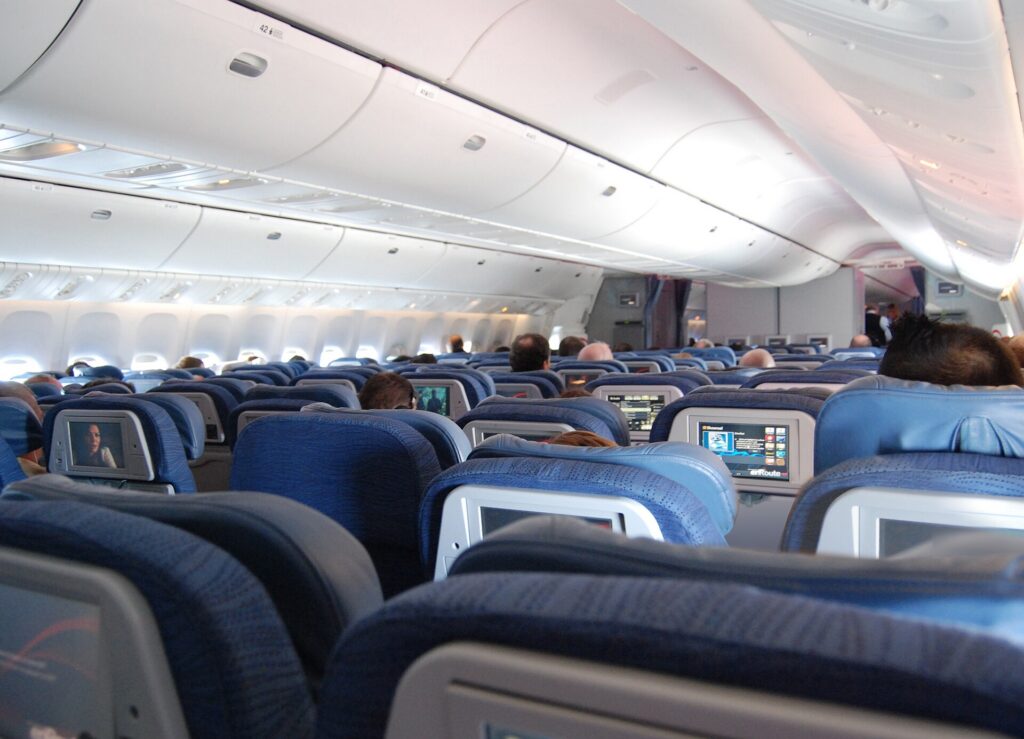
Planes suit independent reading and quiet activities: search-and-find books, sticker books, puzzle books and chapter books. Keep the books in the bag under the seat, not in the overhead bin, so you can reach them during taxi and turbulence when you cannot stand up. Choose compact formats that fit on a tray table.
In a car
Reading in a moving car makes many children feel sick. Children between about two and twelve are especially prone to motion sickness, according to the CDC’s guidance on motion sickness, which recommends looking at the horizon. If your child gets carsick, save books for stops and use audiobooks while driving, or choose picture books that need only a glance rather than long reading. Read-aloud from the front seat, where a parent reads to the whole car, works well for families who do not get sick.
On a train
Trains are the best of both: a table, space to spread out, and a smooth ride. Bring the big atlas, the activity book and the chapter book for a train journey.
At the hotel
A bedtime book from home helps children settle in an unfamiliar room. It is a small ritual that tells them the day is over, wherever you are. Our guide to booking hotels for family vacations covers choosing rooms where children can sleep while adults stay up.
Audiobooks and e-readers
Audiobooks are the best answer to the reading-in-the-car problem and a great way for a whole family to share a story. Many public libraries lend audiobooks and e-books free through apps like Libby and Hoopla; all you need is a library card. Borrow and download titles before you leave, because loans expire and you may not have a good signal on the road. A long series read aloud by a good narrator can carry a family across hundreds of miles.
For older children, an e-reader holds dozens of books in the space of one paperback, with a long battery life. It is a good investment for a child who reads fast. For younger children, physical books are usually more engaging and easier to manage.
How to pack and ration books
- Give each child a pouch. A zippered pouch or small bag of their own books and activities keeps things organized and easy to grab.
- Keep a surprise in reserve. One new book, wrapped or hidden, brought out at the hardest point of the journey, often at the end of a long flight, buys an hour of calm.
- Rotate. Do not hand over everything at once. Offer one book, then an activity, then a snack, then a different book.
- Mix ages for siblings. A book the younger child can look at while the older one reads it aloud keeps two children busy at once.
- Weigh the bag. Books are heavy. Limit the number per child, and choose paperbacks and slim activity books.
- Plan for the return. Pack one or two books that have not been seen yet for the trip home, when everyone is tired.
Books go in the child’s own backpack or case; our guide to kids’ suitcases covers bags that children can manage themselves.
Making reading part of the trip
- Ask questions as you read. “What would you pack if you went there?” “Which of these animals do you think we will see?” Books become a way to talk about the trip.
- Start a travel journal. A small notebook where children draw what they saw, stick a ticket stub and write a sentence or two turns the trip into their own book to reread later.
- Visit a bookstore or library on the trip. Choosing a book in a new city is a souvenir that lasts, and many city libraries have wonderful children’s rooms.
- Use small rewards if they help. A sticker after a chapter, or choosing the next snack, can keep reluctant readers going. Keep it light.
- Read yourself. Children notice when parents put down their phones and pick up a book.
Where to find good books before you go
You do not need to buy everything. Your public library is the best starting point, with children’s librarians who can recommend books for every age and destination. The Association for Library Service to Children publishes an annual list of notable children’s books, a reliable source of well-reviewed titles. Borrowing a stack of travel and destination books a couple of weeks before the trip builds anticipation, and the ones that are a hit can be bought for the journey itself.
Common mistakes
- Packing too many. Five books per child is plenty for most trips; the rest is weight.
- Bringing only new books. Familiar favorites are comforting, especially for young children in an unfamiliar place.
- Loose-piece books on planes. Pop-ups, puzzle pieces and card sets end up under the seats.
- Markers and glitter. Crayons and markers stain upholstery and tray tables. Stick to stickers and pencils.
- Forcing reading in the car. If a child feels sick, stop. Switch to an audiobook and look out of the window.
- Not downloading audiobooks ahead. No signal in the mountains means no audiobook, unless you downloaded it at home.
Frequently asked questions
What are the best books for kids to take traveling?
Durable, light books with high replay value: board books for toddlers, search-and-find and sticker books for preschoolers, activity books and a favorite chapter-book series for older children, and one atlas or fact book about the world.
At what age should I start bringing books on trips?
From the very first trip. Babies enjoy simple board books with high-contrast pictures, and a familiar book from home is a comfort at any age. The type of book changes as children grow.
Are books better than tablets for long journeys?
They complement each other. Books need no battery or signal, encourage imagination and give eyes a break from screens. Many families use both: books and activities first, a screen as a reward or for the final stretch.
How do I choose the right travel book for a plane or train?
Choose compact books a child can enjoy alone, like search-and-find, sticker and puzzle books, for planes. On a train, with more space and a smooth ride, larger books like atlases work well.
How can kids read in the car without getting sick?
Many cannot, and that is normal. Encourage looking at the horizon, try picture books that need only brief glances, and use audiobooks for long stretches. Stop if a child feels unwell.
How many books should I pack for a child?
Three to five for most trips: a favorite, a new travel-themed book, an activity or sticker book, and a surprise for the hardest part of the journey. Add a library audiobook or two.
Can travel books also be educational?
Yes. Atlases, fact books and books set in your destination teach geography, history and culture, and a book about airports helps children understand what is happening on travel day.
With the reading sorted, the rest is the trip. Compare fares on flexible dates on our flight search, choose a family-friendly base on our hotel search, and if there is a road trip in the plan, price a car with room for everyone on our car rental search. For the bigger picture, read our guide on why a family vacation is worth the time off, and if you are traveling with a baby, our travel bottle warmer guide and family car rental guide cover the essentials.
Keep planning with TicketScanner
- Why a family vacation matters for work-life balance — the family travel guide
- Kids' suitcases: a buyer's guide
- Travel bottle warmers for flights and road trips
- Best time to book hotels for family vacations
- Car rentals for family vacations
- How early to get to the airport
- Search flights — compare family fares
- Things to do in Paris
- Things to do in Boston